BOSTON MAYOR RACE : WALSH, ROSS BEST AT WBUR FORUM; CONNOLLY and BARROS DO OK AS WELL

Image

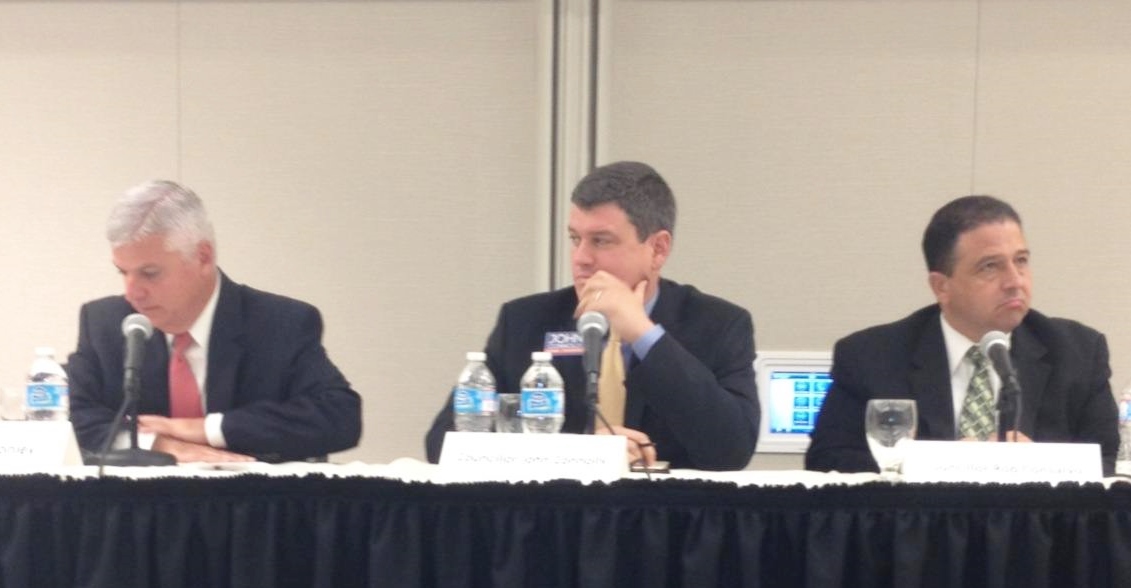
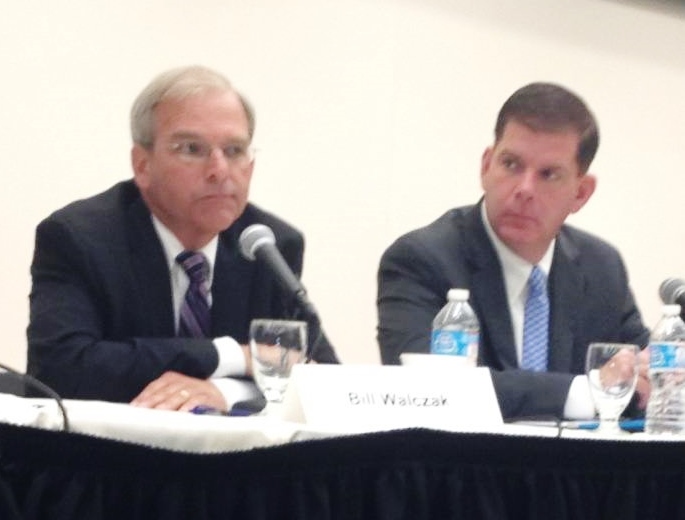
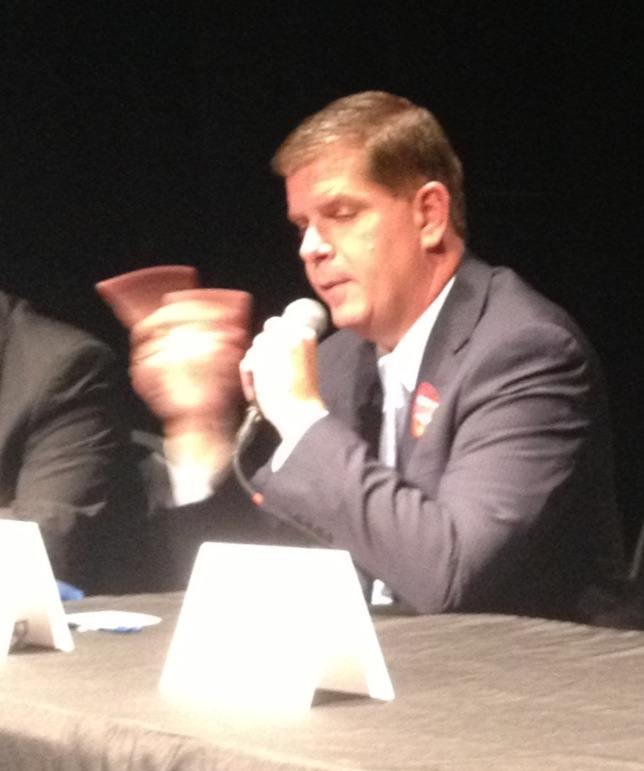
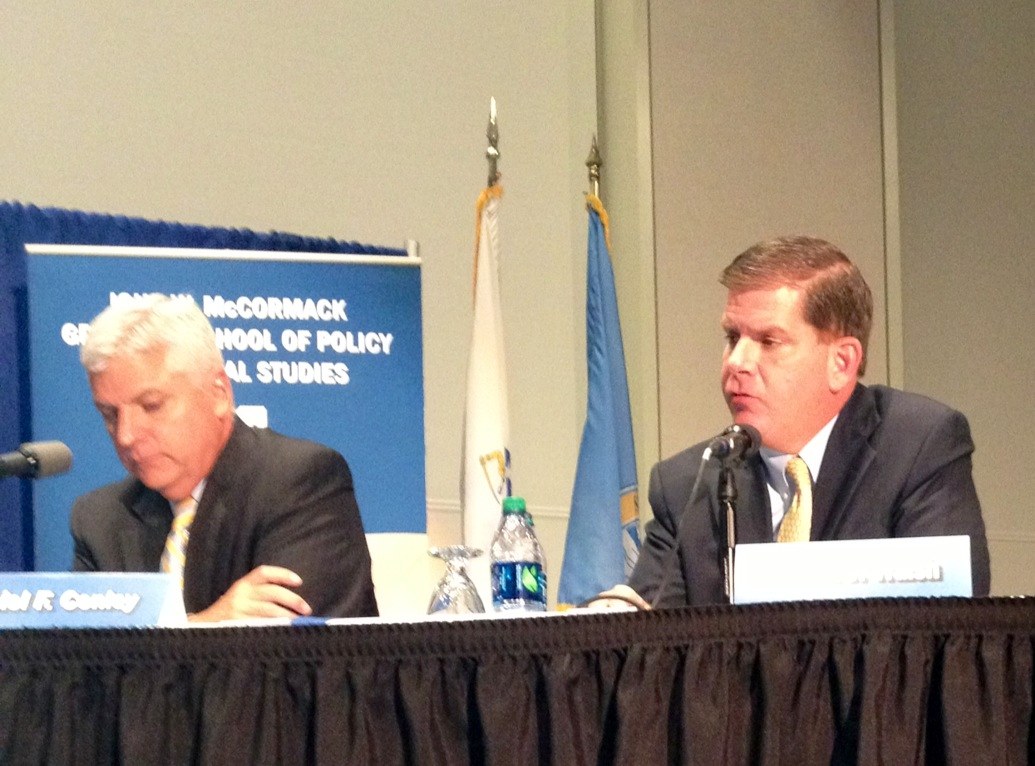
^ Dan Conley and Marty Walsh ; sitting to the side, waiting to get called on at this campaign’s least useful Forum

—- —- —-

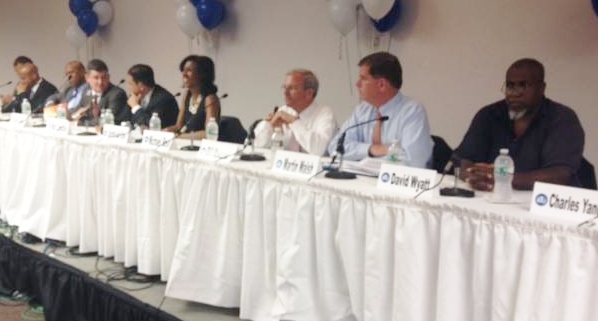
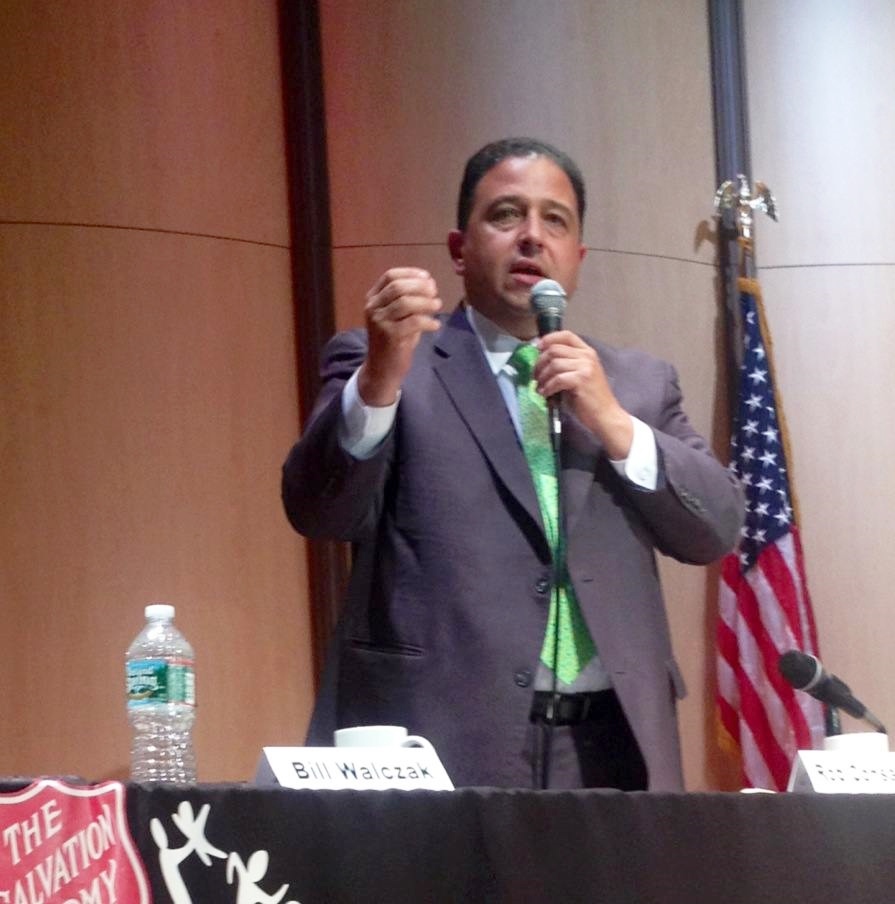
Station WBUR hosted the last major Mayor Forum before the Primary and broadcast it as well. Perhaps that was why so many of the ten candidates on stage — David Wyatt and Rob Consalvo did not attend — speechified, pandered, and played the anti-casino hypocrite.

Very little was learned at this Forum except that many candidates who had distinguished themselves for for thoughtfulness and answering the question posed showed that they could swing the sweet stuff and duck a question. This is the sort of swerve that has made so many voters view candidates as a low form of life. It was discouraging to see and hear.

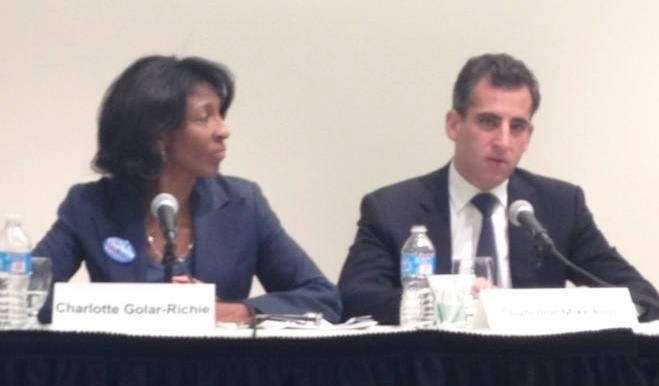
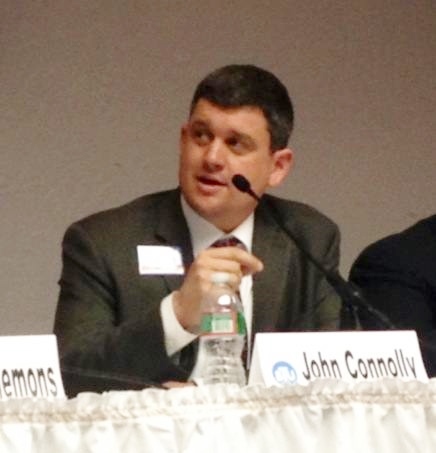
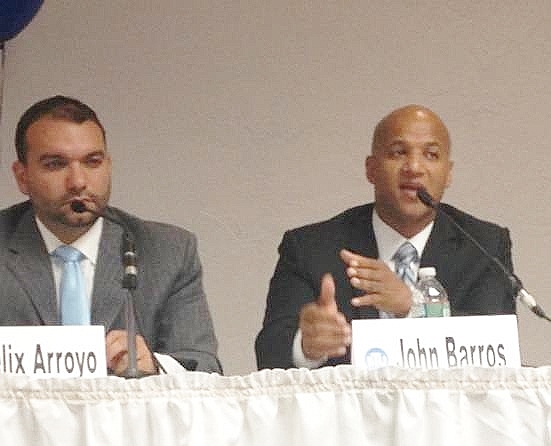
The questions, by WBUR’s Bob Oakes and his sidekick did not make things better. He seemed to favor the candidates sitting in front of him and to overlook those to the stage’s sides. Thus John Connolly and Marty Walsh, sitting at opposite ends, had to raise their hands to get called upon, while Jon Barros, Charlotte Golar-Richie, Charles Clemons, and Mike Ross, sitting stage front, answered and re-answered all night long.

Many of Oakes’s questions sought one line answers; many seemed like pea soup and pecan pie. Bring back David Bernstein ! Piniel Joseph ! Paul Watanabe ! Please, please….

Shall I go through the long night of chocolate mousse and near beer ? I guess that I must.

Asked who was the political figure they most admired, no fewer than six candidates said Barack Obama or Nelson Mandela. Felix Arroyo said “My father.” Wonderful men, all three; but shouldn’t
a question like this call for some original thinking ? Some sense of history ? Only Mike Ross — “Roosevelt” — and Dan Conley — “Abraham Lincoln” broke through the pillow talk.
Image

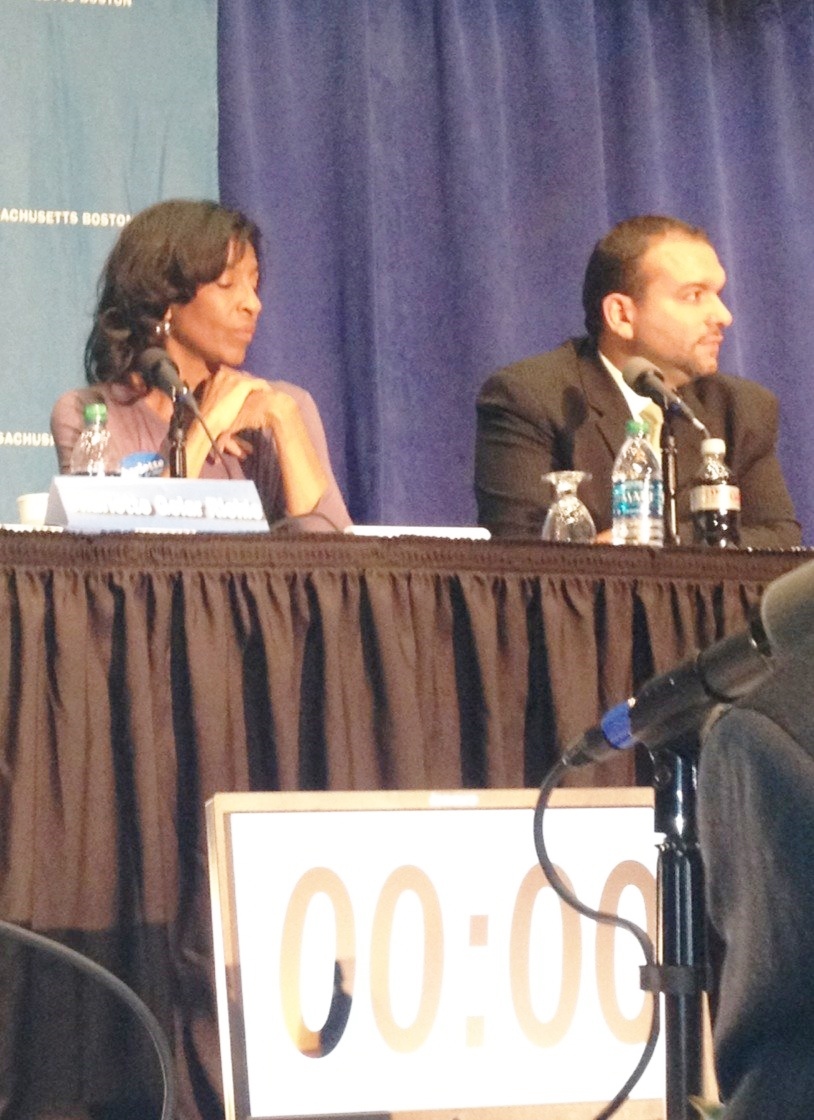
^ Charlotte Golar-Richie, Felix G. Arroyo : ready on day one to speechify …

Asked who was the person outside of politics that they most admired, nearly every candidate said “My Mom” or “My dad.” Let the angels dangle on their harps… Yes, one’s parents are wonderful people — usually — but is one’s family the only awareness field of these potential Mayors’ vision ? I suppose I should be grateful that no one said Mother Teresa…

Asked, “if you can’t be Mayor of Boston, which other city would you like to be Mayor of,” the candidates had to think fast, and it was tasty to watch them do so. Only two came up with a thoughtful answer. Marty Walsh : “Detroit, for the challenges.’ Charles Yancey ; “New Orleans, for the infrastructure work and the culture.” Dan Conley found levity in the query : “San Diego, for the weather !”

Questioned on whether the community vote to approve the East Boston casino should be city-wide or restricted to East Boston, the entire group, with two exceptions, answered as if intimidated by Bill Walczak, whose opposition to casinos, period, is an obsession with him. Walczak never ceases to decry that people of limited means will gamble their money away at the casino — as if they are not already doing that on scratch tickets and Keno ? OK, Bill, we do get it. What was truly depressing was to hear Dan Conley, Mike Ross, even Charlotte Golar-Richie dis the idea of a Boston casino. Ross tried to have it both ways. He doesn’t like casinos, but since if Boston doesn’t approve one there’ll be an Everett casino “seven feet from Charlestown,’ he will grudgingly seek a city-wide vote. Gee thanks, Mike.

Marty Walsh wouldn’t out and out say he likes the idea of a Boston casino, but he did note that it will benefit the economy of the City. (And also the construction workers who are his core constituency.)  John Connolly seemed to approve the casino project without endorsing it; he supported a city-wide vote and said so with his usual originality of argument. Walsh also noted that the enabling legislation — which he participated in enacting –for casinos included a mandate that a casino project would need have a program on site to deal with gambling addiction. So much for Walczak’s throwing drama all over the room on that subject.
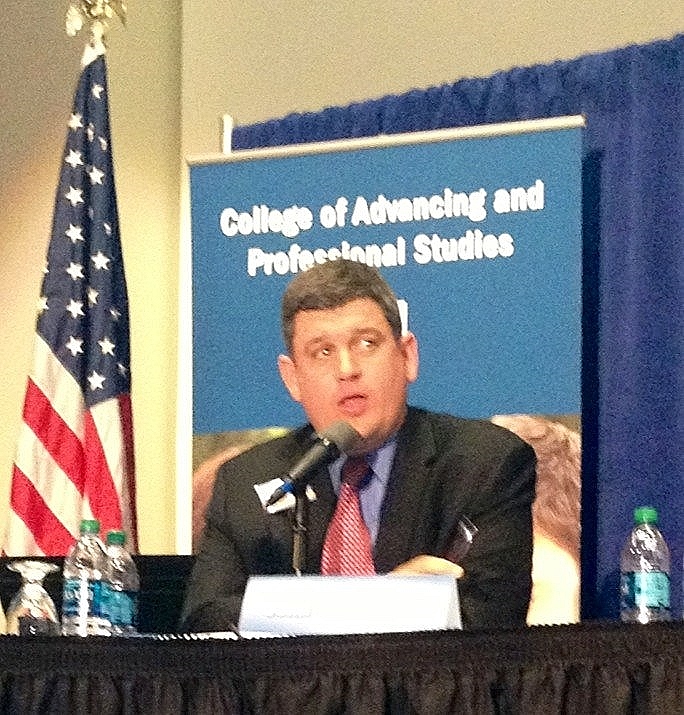
photo (7)

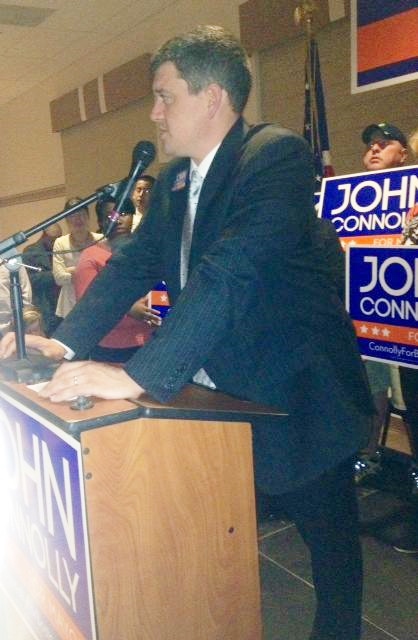
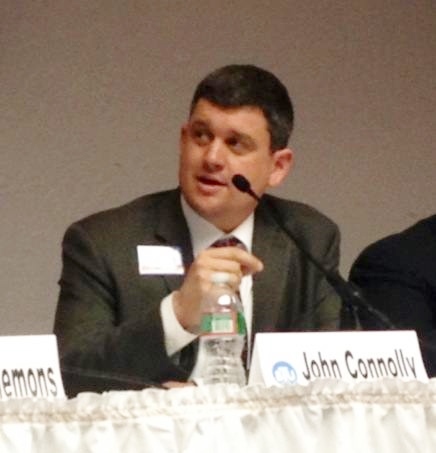
^ John Connolly : waiting to be called upon, he looked bored often and frustrated too. My sentiments exactly about this Forum

Listening to Walsh and Connolly address this issue, it’s reassuring to see them holding the top two spots, so it appears in Tuesday’s Primary. as for those who want only an East Boston vote, did anyone tell them that the gaming Legislation calls for a “community” vote ? and that the “community” here is the City of Boston, legally chartered as such ? Nothing in the legislation supports the notion of restricting a casino referendum to a neighborhood. Such a vote would simply be unlawful.

On and on it went. On the BRA and education questions, most candidates gave their usual speechify — Felix Arroyo especially, but also John Connolly, Dan Conley, and Charlotte Golar-Richie — even to some extent Marty Walsh. Perhaps their brains have fried now, their words stuck on hold, unable to restate. After two dozen candidate Forums it gets like that. Still, it is my duty to report, so here is a selection of what the candidates said about school reform :

Felix G. Arroyo : universal pre-school and a longer school day
Golar-Richie ; new school superintendent and create alumni associations of Boston public school graduates
Jon Barros : three strategies — focus, principals, school autonomy
Mike Ross : bring back our neighborhoods first because unhealthy children can’t learn as well as healthy kids
Marty Walsh : need to improve school buildings and school administration; we also need better diversity among our teaching staff

Does it all sound familiar ? You got it. Now go vote. Before the candidates repeat themselves into utter absurdity.

—- Michael Freedberg / Here and Sphere

BOSTON MAYOR RACE : WHAT THE THREE POLLS TELL US

Image

^ John Connolly : the school issue is his and very possibly the election

—- — —

You’ve all seen the three new polls published on Boston’s Mayor campaign. (If you haven’t seen them, go look.) Taken together, they show the following percents of vote for the top nine contenders :

Connolly at 14 to 16
Walsh at 10 to 12
Conley at 8 to 12
Golar-Richie at 10
Arroyo at 6 to 8
Consalvo at 6 to 8
Barros at 3 to 6
Walczak at 4 to 6
Ross at 5
Undecided : 19 to 22

There isn’t, or shouldn’t be, much doubt about what these numbers tell us :

1. John Connolly will be in the Final. He appears very much in command of the race. School transformation is his issue, it’s the voters’ number one issue too, and he articulates his agenda for schools with authority, detail, conviction, and a convincing tie-in to the other two major issues, jobs and public safety. His field organization — “ground game” in this campaign’s argot — is broadly based, in very diverse communities of the city, and well versed in what field organizations are supposed to in a primary : get out the vote. Plus, his Mom’s from Charlestown. That, dear readers, is authenticity.

photo (4)

^ Marty Walsh : the voice of Urgency

2. Marty Walsh should be in the Final, because his issue is a clear alternative one to Connolly’s : keeping the construction boom going in Boston — and expanding its reach, because it furthers economic development and creates good jobs. Unfortunately for Walsh, his issue is a smaller one than Connolly’s. There are 58,000 public school parents in Boston and lots more who would be public school parents if they could perceive the city’s public schools as good enough. There are far fewer than 58,000 construction jobs in city. The particularity of Walsh’s vision threatens to keep him out of second place — more on that below; but, fortunately for his chances, he is backed by a field organization as large as Connolly’s (and maybe larger) and passionately dedicated to this campaign’s “candidate of Urgency.”

It also helps that he is a true son of Boston’s land of on-street parking and rows of three deckers. That, dear readers, is grit and lumber !

Image

^ Dan Conley : administrative reform may not be sexy enough to win a spot in the final

3. Dan Conley might edge past Walsh to the second spot because as Suffolk County District Attorney (and former District 5 Councillor) he is already a proven city-wide administrator who speaks in authoritative detail — and with conviction — about the reforms he would bring to city administration, the police and fire departments most of all. He has tons of money and a field organization as dependable — if less passionate or diverse — as Walsh’s. His problem is that city administration reform isn’t an issue that hits voters where they live, as do schools and jobs. A Mayor can always hire an administrative reformer.

photo (37)

^ Charlotte Golar-Richie : political history is her mother earth

4.Charlotte Golar-Richie has risen in the polls. She now contends. This she has done by dint of being the only woman in the candidate list — something she rarely neglects to mention — and the most prominent of color. This is, oddly, a candidate of identity politics, a winner 30 and 40 years ago but probably not today. Voters of color give her strong backing, but by no means overwhelming. Today they want results, not image. Golar-Richie is also hindered by her forensics. At Forums and on the stump she sometimes articulates a vision, sometimes not. Even at her best the vision seems flavorless — a less punitive version of Conley’s “I Will Reform City Administration.” Uneven articulation of mild reform excites no one, and thus Golar-Richie’s field organization — and her voters — seem lacking the necessary force to “get out the vote” on Primary day. That is why she polls in fourth place.

UPDATE : as expected, Golar-Richie today received endorsement by State Senator Sonia Chang-Diaz and state Rep. Russell Holmes. BUT … State Rep. Byron Rushing endorsed Felix Arroyo….

Image

^ Particularist candidates ; Felix arroyo (above) and Rob Consalvo

5.Felix Arroyo and Rob Consalvo seem matched pairs. as Consalvo’s poll has declined, Arroyo’s has increased. They now poll the same. Each has the Boston Teachers Union (BTU) endorsement. Each man has a campaign theme that no rival encroaches upon : Arroyo’s theme is a “pathway out of poverty,” through full-day schools to jobs which, with union organization behind them, can pay well. (Arroyo never fails to mention how as an organizer of janitors, he got their pay boosted from $ 9.00 an hour with no benefits to $ 16,.00 an hour with full benefits.) He also talks “invest in Boston,’ a program — just now voted favorably by the City Council — to require banks in which the City keeps its money (a billion dollars) to invest in Boston businesses. Consalvo, meanwhile, has taken to being the BTU’s voice on school reform, an agenda quite unlike Connolly’s, one which takes the risky position of defending Boston Public school performance. The problem for both men, and why they poll at only 6 to 8 percent, is that the voters either do not agree (Consalvo) or are to narrow a constituency (Arroyo) to get either candidate close to a second place Primary finish. Limited visions with limited constituencies may well exhibit great passion ; both Consalvo and Arroyo have that from their supporters. But a passionate vote counts no more than a coolly reflective one, just as the keys on a laptop only punch one letter at a time no matter how hard your finger hits them.

photo (50)

^ Brilliance : Mike Ross (and John Barros) speak vividly of tomorrow. But the elect is today.

6. Mike Ross and John Barros poll lower still. The two men are the brightest and most progressive visionaries of all the candidates. No one speaks more eloquently. None has a surer grasp of what city life will be tomorrow. So what is the problem ? First, neither man leads a large constituency. Ross’s Back Bay / Beacon Hill / Mission Hill District has little in common, economically or culturally, with the rest of the City. Barros is a hero to the denizens of Dudley Square, which the organization that he founded has revitalized; to the citizens of Uphams’ Corner, where he lives; and to Boston’s Cape Verdean community. But even if you add up all three of Barros’s bases, it’s small potatoes compared to the city as a whole. And this is his first race ever for elected office.

7.The 19 % undecided. It’s still the largest number of any in the three polls. theoretically it’s large enough to anoint or eliminate anyone. That will not happen. undecided voters do one of the following : ( a ) not vote at all ( b ) vote for a perceived winner, because they know him or her best anyway or ( c ) decide on the issues, among several who they are considering. The first group doesn’t count. The second trends to John Connolly. the third will likely divide in many directions. My guess is that the undecideds won’t change the current poll very much. They’ll simply fatten its numbers.

—- Michael Freedberg / Here and Sphere
BOSTON MAYOR RACE : A TALE OF TWO CITIES

Image

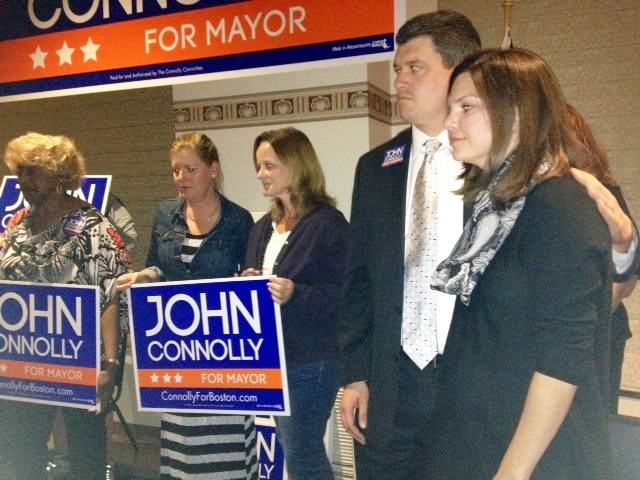
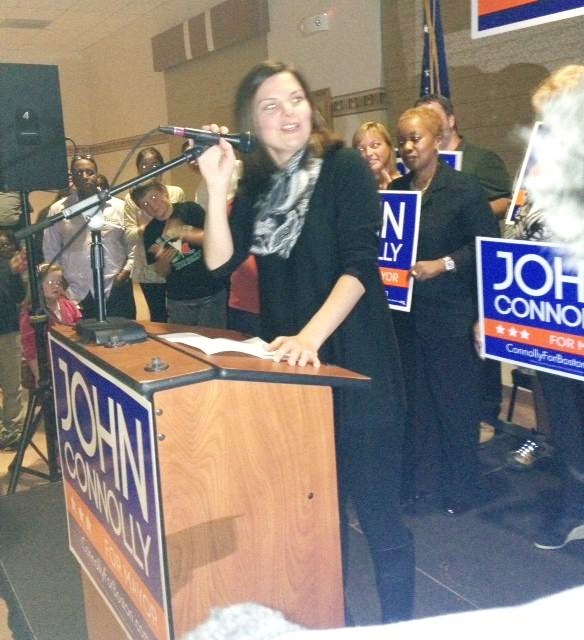
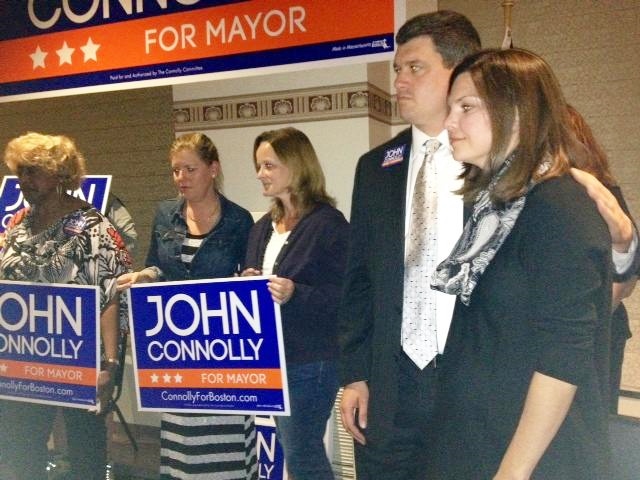
^ John and Meg Connolly — and an array of Boston Public School parents — at last night’s Elks hall rally

—- —- —-

The candidates for Mayor of Boston talk all the time about bringing the city together or about everybody, in whatever neighborhood, wanting the same thing. This is true. Yet campaigns are about differences. Campaigns don’t alleviate those differences, they emphasize them. Thus the differences magnified in the campaigns of this election’s two perceived leaders, Marty Walsh and John Connolly.

At his “Mondays With Marty” events — “community conversations” in the argot of today — Marty Walsh has drawn hundreds of listeners to his message of “best practices” education, improving the Downtown Boston economy, fighting the “heroin epidemic,” and setting up an office of diversity in City Hall so that the City’s departments “reflect what Boston looks like.” Walsh speaks passionately at these Mondays, if a bit quickly, and with a sincerity that touches everyone who hears him. Yet from East Boston to Dudley square in Roxbury and West Roxbury to Charlestown, Walsh’s Mondays seem to draw mostly people age 35 to 50 — the peak working years — who speak of, or look like, harried lives. He’s every bit the union workers’ candidate that he has been labeled as, and though he draws all kinds of work-age people, not only union workers by any means, the tones of voice of those who address questions to him is often gravelly, even anxious, the voices of people who work with their hands or whose work is always hands-on, and as hurried as is Walsh’s speaking.

Image

^ urgency : a full house at Marty Walsh’s Haley house “Monday” conversation (Council candidate Jack Kelly center top)

Walsh’s Mondays are front-line work. There’s an air of “now” in them. As much as Walsh speaks of future directions, his “Mondays” listeners want to know what is going to happen on Tuesday morning. The passion in Walsh’s listeners is palpable. You can feel it rumble. That passion arises from the urgency. Tuesday morning is just one night’s worry away. No candidate’s supporters show more angst than Walsh’s.

Is the urgency of Walsh’s supporters a bad thing ? Not at all. But it’s why his plan to sell City hall and begin the revitalization of Government Center as a “24/7 economic usage zone” moves them. His plan is for now, for immediate, doable action. Same with Walsh’s call that, “at my first meeting after I am elected will address the heroin epidemic.” Walsh knows that his voters can’t wait for improvements that may take a long while to bring about, or that may not happen at all. The difficulties that Walsh’s people want addressed will happen first thing Tuesday morning : traffic on Charlestown Neck, folks being priced out of their homes, how’s my son going to get a technology job, the lack of people of color in the higher-up Police department. And even if the last issue in this list seems like a task for another day, it isn’t. It’s something that Walsh’s supporters of color live with every day. (And Walsh does have many, many people of color supporting him and working in his campaign. He is seen as the candidate of burly white guys — and his stand-outs reinforce that perception — but he is much, much more than that.)

Walsh’s most recent “Monday,” at Haley House near Dudley square, drew an overflow crowd, standing room only and then some. Almost all were people of color. It was an event built on urgency and then some; on rescue.

Image

Marty Walsh : politics as rescue — for the folks at Haley House

Walsh spoke quickly. “Unemployment in Dudley is ten percent.,” he began. “This neighborhood lacks home ownership — a high percentage are renters. This neighborhood lacks education. We must make Madison Park High School work…as it hasn’t. Bring back ‘voke tech’ programs; they’re not here today.

“we are not preparing our kids for jobs,” he sprinted. “We have to do better… As mayor we’re going to strengthen our schools…turnaround schools..additional resources for ‘level 3’ schools. we need new school buildings !”

Walsh then jumped right into laying out his plan to sell City Hall and revitalize the Plaza area. And from there to “build work-force housing. Charge the buyer just the cost of construction, sell the buyer the land for one dollar. we have to do better…”

He spoke like a man being chased by demons, by wolves, of all sorts, every kind of clamoring need. “Violent kids ? We can lock them up all day, but it’s not working. We need to give kids a pathway to a job. More opportunities than just construction.”

The event was supposed to last only an hour,. It lasted two. Many questions were asked. Urgent ones. Walsh had sepcific answers to all of them. He has an agenda, and he knows every component of it and all are urgent. No wastage at all, no frills, no waiting.photo (81)

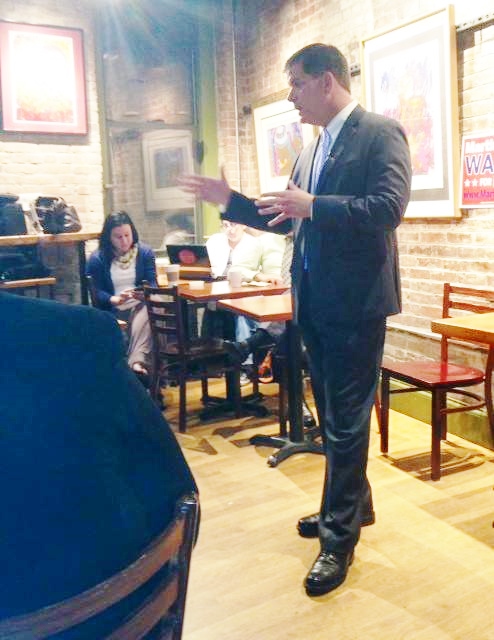
^ The questions and requests don’t stop : Marty Walsh “Monday”-ing in East Boston

And that is what his people are like too.

How different a city John Connolly lives in ! Last night we attended his “GOTV” — get out the vote — rally at the Elks Hall in West Roxbury. The room was almost as full as Walsh’s Haley House “Monday’ despite being much bigger.

photo (45)

Like Walsh’s supporters, Connolly’s come in all colors — a city once torn by racism seems largely to have moved past that burden, at least among the politically attuned. Immediately evident, however, was that Connolly’s ralliers were of all ages and, so it seemed, of diverse life and economic status. Many men wore suits and ties : they might have come directly from a Back Bay Association meeting. Most looked like shopping mall folkss, but some looked recognizably  like politics junkies. I saw veterans of Kevin White’s and even Ray Flynn’s City hall following ; old Arthur Lewis and Bob Cawley people too (both were State Senators decades ago in Connolly’s home area of Roslindale.) I spoke to retired teachers, young students, mothers with babies and pregnant mothers-to-be. Connolly’s parents looked on — Lynda the retired Chief Judge of Massachusetts District Courts, Mike a former Massachusetts Secretary of State (but, as Connolly said, “to me they’re my parents who made me what I am today”). I’ve known Mike and Lynda for over forty years, and, I suspect, so had many in the room.

The people sounded confident, acted it. Tough s Connolly said, “the next six days you have to work harder than ever,” no one seemed harried. People stood and waited relaxedly for Connolly to arrive — he had attended an earlier, Transportation Issues Forum at Boston Public Library downtown — and when he did arrive, though everyone cheered, it was a relaxed cheer. Excited, but not impatient. Patience is a Connolly virtue.

Connolly has two campaign chairmen : State Rep Ed Coppinger and a radio announcer from 101.3. Coppinger is white, the radio guy Black. Both gave their introduction speeches after which spoke one of several Boston Public school parents on stage — a slender woman with nine children, she proudly announced — and then spoke Connolly’s wife Meg, who is pursuing a doctoral degree in Mental Health. She orated off written remarks. It all seemed very carefully planned, like a televised Victory night. Planning is a Connolly virtue.

photo (43)

Planning : Meg Connolly introduces her husband John

And then the man himself spoke. “I am energized to meet people in every corner of this City,” he said. “We all want the same thing. we all care and want to have a bright future together.”

Connolly praised Mayor Menino, the man he had moved, back in February, to challenge : “We are a better city for his time in office and the sacrifices he has made.” I think we’ve all heard something like that being said about someone we are showing the door to. But i digress…

And then, finally, Connolly spoke with passion : “we are more and more a city of the very rich and the very poor. The task for the next mayor is to break that equity gap.

“It starts with a great job,” Connolly explained. “A great job makes that difference for a family. And then there’s housing. We have great plans for affordable housing and for expensive condos but we have no plan for middle level housing. We don’t have a pathway from renter to owner. I want a real pathway. A priority from day one.”

The gathered campaigners clapped. They appreciated Connolly’s remarks, agree with them. Appreciation is a Connolly virtue.

photo (42)

^  “ready one day one” is the theme : John Connolly speaks

Connolly now rose to a higher plane : “Jobs and housing matter because they are directly connected to a safe neighborhood. The neighbors who live in the three neighborhoods where 80 percent of the crime occurs bear the burden of crime. They are OUR neighbors ! (Pause.) We have some children who will hear bullets as a regular part of their childhood. And children who will not.”

It was eloquent, it was true — too true, every word. the room was silent, because everyone present knew that it is sad as well.

The speech was peaking now. “I want a City hall with someone who comes up to you with an i-pad and says, ‘how can i help ?” I want to take everything that I have learned from all of you and give every child a quality education. That is the best way to bond this city together. WE NEED BETTER SCHOOLS !”

If in reading my report you are thinking, “Connolly sounds like Martin Luther King orating ‘I have a dream,'” you grasp my thoughts exactly. Connolly is running a campaign of dreams. Passionate ones, yes, and all good. Political dreams, however, take time to get to, time to accomplish. Connolly’s supporters feel that time is on their side; that they can make use of it and proceed upon it. Nor are they wrong. Because after the Tuesday morning that challenges Walsh’s people like a road hazard challenges a driver, there is Wednesday, and a week, month, year, decade. As for Boston people, so for the City itself.

And so Connolly’s campaign addresses time extended —  seeks, and has garnered, votes from Boston people who live in extended time, a time for setting forth a dream and moving — patiently — toward it.

—- Michael Freedberg / Here and Sphere
BOSTON MAYOR RACE : WHAT THE ENDORSEMENTS (SHOULD) MEAN

Image

^ John F. Barros, John R. Connolly, Felix G. Arroyo : good news for all three (and for Rob Consalvo) this morning

—- —- —-

Early this morning, two major endorsements in Boston’s exciting Mayor campaign were given. The Boston Globe endorsed John Barros and John Connolly, with honorable mention to Mike Ross and Bill Walczak; the Boston Teachers Union selected Felix G. Arroyo and Rob Consalvo. They join the Boston Herald, which last week endorsed John Connolly and Dan Conley.

Here and Sphere is not going to make any endorsement before the Primary. The Globe speaks of the 12 candidates, by means of multiple wide-ranging Forums, having forged something like a common agenda. That is true; there is less commonality, however, in the major contenders’ bases of support. We feel that all Boston’s voters matter, and that, as many of the candidates have proven that they authoritatively articulate most if not all the major issues, we cannot pick two of them, but not a different two, and thus leave many bases of support on the sidelines.

In the “Final,” with only two contenders running, bases of support will not stand out so sharply. Each candidate will have to build a coalition of many bases of support. each, likely, will have to win votes as well from the other’s support base. Our endorsement will thus not unjustly raise up some political communities and downgrade others.

We also want to see more of how our potential endorsee manages his or her campaign. Mayor is a managerial job as well as one of policy vision. If a candidate can’t manage his or her campaign smoothly, what confidence do we have that he or she will manage the job of Mayor ? That said, many of the likely Finalists have managed their scheduling and outreach commendably — some better than that. Less of them have shown the degree of issue preparation we expect of an endorsee. A Mayor must be familiar enough with every City department, including Inspectional Services and the Public Health Commission (including its smoking ban section), to know what in each of them needs reforming — and what doesn’t; and how to explain his or her reforms convincingly to Boston’s interested voters, and to the department employees.

This matters a lot. The Boston Teachers Union has, by its endorsement of two candidates — Felix G. Arroyo and Rob Consalvo — both polling well out of the Final but who align closely with the Teachers’ own agenda, given the impression that it is unready to understand that dramatic reform of Boston’s public schools is going to happen. The newspaper endorsements proclaim it. The strong poll showing of John Connolly so far proves it. The Teachers’ Union risks, by its endorsement, being left out of the conversation that has been going on for months now — a conversation which it feels threatened by — and has said so.

Wiser it would have been, in our opinion, had the Union endorsed one favorite (Arroyo would have been our BTU choice) and one of the moderate school reformers, such as John Barros, Mike Ross, or Marty Walsh. Other endorsing Unions have done that. Union solidarity is commendable, and no workers work harder or contribute more importantly to society than teachers. But realism is also a necessary skill in the world of high politics and ;policy. Such realism will also be needed by the next Mayor if he or she is to not face serious conflict with the employees of any City department that he or she insists on reforming.

Our endorsement process begins now. Candidates should know that not only our editor, Mike Freedberg, our chief reporter on this campaign, will be involved in the decision. Our co-founder, Heather Cornell, will be equally involved. Cornell is Boston’s most gifted life-style writer and knows as much as anyone we have met about in-school issues, children’s health — both mental and physical, emotional and social education, drug abuse problems, health care and hospitals, and the gap between education and securing a decent job in the work force of tomorrow. Candidates should be prepared to answer her questions — and Freedberg’s — and, hopefully, may even add to their knowledge of the issues from conversing with us.

—- the editors / Here and Sphere

BOSTON MAYOR RACE : MARTY WALSH HITS A HOME RUN

Image

^ Boston’s City Hall : to be sold and razed ? Walsh says “do it !”

—- —- —-

Trapped in a Labor union suit by a week of editorial hits and campaign rivals’ debate points,. Marty Walsh today proposed as significant a single initiative as any other candidate has put forth.

He would sell the current City hall — as intimidating a foreboding palace of cold, cement bureaucracy as any structure I have ever visited — for about 135 million dollars and then develop all of City Hall Plaza for around-the-clock economic growth. “This area must evolve from a 9 to 5 weekday government-dependent culture to a culture economically driven to add value 24/7,” Walsh told the Boston Globe.

Unlike previous efforts to move City hall — Mayor Menino’s plan wanted to build it in the Seaport District — Walsh’s proposal would build the new Hall in the downtown area. The building would be privately built and leased to the city for 20 to 40 years, at a fixed rent; at the end of which term the City would buy it for one dollar ($ 1.00).

Some of Walsh’s rival candidates — but not John Connolly — criticized his proposal, and Rob Consalvo raised the point at today’s Back Bay Association Forum : “how would the city function while the present City hall is bull-dozed ?” asked Consalvo, a bit snidely. Walsh stated the obvious, that City hall would not be sold and razed until the new City hall was built.

I like Walsh’s idea a lot. As he said at the Back Bay Forum, “the next area of the City’s economic growth is Government Center.” His way of getting to it is bold, but the next mayor should be — HAS to be — bold if Boston is to move forward in an ever more complex and technologically fast-paced economy. Walsh’s proposal scopes smaller than John Connolly’s “school transformation,’ but it is a firmer step than anything Connolly proposes. All of Connolly’s school transformation goals have yet to be cast into shape; nor is it easy to envision them shaping up without huge controversy, with the BTU especially. Walsh’s proposal is specific — and achievable quickly.

Image

^ Marty Walsh ; “this area must evolve from a 9-to-5 weekday government-dependent culture to a culture economically driven to add value 24/7 !”

The proposal makes clear just how significant Walsh’s “Construction Boom” candidacy is for the City’s future direction and look. Score a big one here for Marty Walsh.

—- Michael Freedberg / Here and Sphere
BOSTON MAYOR RACE : BIG BUSINESS AND DEVILISH DETAILS @ BACK BAY ASSOCIATION FORUM

Image

^ Dan Conley, John Connolly, Rob Consalvo at this morning’s Back Bay Association Forum

—- —- —-

This morning the Back bay Neighborhood Association held its Mayor Forum in an appropriate setting : the conference center of Liberty Mutual Insurance Company. Big granite-walled office bureaucracies are the Back Bay’s money machine.

People fear money machines, and no neighborhood association in the City is more feared by the various business seeking to locate, or to develop real estate. Members live in some of the City’s highest income census tracts; achievement and dominance come naturally to the 200 well-dressed Forum attendees. Attentively they regarded the twelve candidates, answering questions put to them by Tom Keane and his co-host, as if they were job-interviewing — grilling — a room full of interns.

The Forum topics featured, unsurprisingly, zoning, permitting, development, the BRA, and late night closing hours — seriously complex issues all — and the banning of plastic bags.

But to the questions. Some were addressed only to some of the candidates, others to all.

To a question, to some, about what to do with the BRA, John Connolly gave the most well thought answer : “Planning should be an independent function. It’s about having real holistic planning — the process should not be for influence peddling. We need to modernize Inspectional services (ISD). (we) need honest conversations about zoning. We need to move beyond outdated zoning laws).”

The City’s permitting process has come under severe attack in most of this campaign’s Forums, for good reason. All the candidates want the process reformed, som radically. Charles Yancey cited “hostile employees’ at ISD’s office due to “inadequate training for the job.” Dan Conley promised “a bottom to top review’ and said that permitting “should be able to be done online.’ He would also “reform the zoning process.” John Barros decried the process a “illogical…unpredictable.”

Clearly ISD is in for a huge shake-up no matter who becomes the next Mayor.

To a question about “90 % of fire alarm calls not being for actual fires,” Rob Consalvo insisted that :we need more public safety, not less.” Marty Walsh, who has the Boston Firemen’s Union endorsement, admitted that the “number of fires are down” but insisted that “I don’t want to be the mayor who closes a firehouse.” Felix Arroyo said “municipal research says that we need to increase fire efficiency” — whatever that meant — and Charlotte Golar-Richie gave a similarly non-committal answer. And then it was Dan Conley’s turn. He did not waste it :

“There is overwhelming evidence that the Fire Department needs a full review and thus a Mayor who will reform the Fire department,” he said, aiming his remarks directly at Marty Walsh, whom polls show him tied with for second place in the Primary.

To which Conley added, “reform… was posed years ago when I was on the Council, but it was put on the shelf. (Stare Rep) Nick Collins has a bill in the legislature to allow fire people to respond as EMTs. it’s a crazy bill, but the firemen don’t have enough work to do, so this is a way to give them some work.”

Conley’s could have been the Forum’s big moment, but he was immediately knocked back by Charles Yancey, who said “If someone is injured within a block of a firehouse and the EMT’s can’t get there first, the Fire Department must save that life !” Mike Ross’s follow-up — “I’m the only Council member who has stood up to the Fire Department” — sounded like a shrug.

All the candidates were then asked a series of “yes or no, do you support” questions. Most of these at various Forums have been no-brainers to which all answered an easy yes or a no. Not so at this Forum. candidates had to think about whether to allow later closing hours, a “traffic congestion tax,” plastic bags, and Segway. Responses were divided.

Last came a round in which one candidate posed a question to one other, until all twelve candidates had either asked or answered. Obviously the intent was to have candidates emphasize their differences, but only two of the questions rose above the minutiae of Council votes little known to average voters.

The first useful question was Rob Consalvo’s to Marty Walsh, who has proposed razing the current City Hall and redeveloping its huge, centrally located plaza : “How will the city function while city hall is bulldozed, as you suggest ?” Walsh’s answer was as good as Conley’s on Fire Department reform : “Bulldoze is not my word,” said Walsh. “it aas the Herald’s. I want to offer City Hall Plaza to developers for proposals. It will give us 135 million dollars and 12 million a year in tax revenue. I want to reconnect Hanover steer and Quincy market…the next growth area in the City is government center !” Walsh’s answer highlighted his support by the city’s construction unions –and his being the Building Boom Candidate.

Image

^ Bill Walczak and Marty Walsh : the moralist vs. the building boom candidate

Mike Ross then asked Bill Walczak what he would do for city development if the city had no casino — as Walczak endlessly repeats — but one were then created “seven feet from our door” (in Everett) ? This gave Walczak his opportunity to rail against casinos in general — “I don’t want casinos anywhere” — in the moralistic manner that he truly believes and which gives his candidacy something of the social-issue darkness that has bedeviled a great deal of the national political debate these past five years or so. Who is he — who is anyone ? — to tell people how or where to spend their money ?

Image

^ Charlotte Golar-Richie and Mike Ross : on Ross’s home ground ? Or maybe not ?

It was difficult to tell which candidates most impressed the association’s members. Unlike the teachers union activists at their Forum, no one cheered or clapped hands. They received the candidates’ often passionate talk as calmly as candidate David Wyatt sits on a stage — though without his facial shrug. Many of the 200 worked laptops ; were they noting points ? Recording testimony as if at a deposition ? Maybe so. And who will they vote for ? This is Mike Ross’s home ground — the Council district that he represents — yet he hardly seemed the crowd favorite — although in the Forum’s humor moments, when he laughed, so did the 200. Maybe that was it. Maybe this Forum was a kind of in-group entertainment, and Mike Ross has its 200 votes in the bank.

If i were he, I wouldn’t count on it.

—- Michael Freedberg / Here and Sphere
BOSTON MAYOR RACE : YES, THE GLOBE POLL MATTERS

Image

^ well ahead : John Connolly

—- —- —-
The University of New Hampshire finally released its poll of the Boston mayor race, and its message has locust-plagued the City’s spin doctors. Just about every candidate purports to believe that the poll is good for him — or her. If only !

It’s hard to believe that none of the twelve candidates is known by more than 68 % of the voters polled. Does that mean that the poll sample has reached well beyond the 100,000 “likely” voters who even the least bullish pundit thinks will turn out ? The poll also doesn’t say how many of its respondents came from which of the city’s 22 wards. We are left to guess what electorate was polled.

Nonetheless, the poll does not drop out of the sky. It accurately reflects, in fact, the money raising that we’ve been reporting — amounts and trends up or down in each candidate’s deposits. It also accords fairly well with what we glean from our observation of the various campaigns. We believe what the poll says. So here are the numbers for the top four :

John Connolly gets 15 % of the vote and is known by 68 % of the voters
Dan Conley gets 10 % and is known by 65 % of the voters
Marty Walsh gets 10 % and is known by 58 % of the voters
Charlotte Golar-Richie gets 10 % and is known by only 50 % of the voters.

Striking facts : (1) Though clearly less well known than Walsh or Conley, Golar-Richie polls equally with them (2) Connolly is measurably ahead of all three, well beyond the poll’s margin of error (3) Walsh has actually lost since the last UNH poll, in which he had 11 %. He has lost 10% of his vote, after a week of being slammed as a union guy — a loss well in line with the political rule that attacks can cost a candidate up to, but not likely more than, said ten percent.

Image

^ Marty Walsh : must prove on Primary day that he’s more than a union guy

Can Walsh recover and secure the second Final spot ? Of course he can. He has lots of money, is running excellent TV ads, and has a superb election day organization working hard and enthusiastically. He doesn’t need many more votes to put him close to Connolly.

Nonetheless, the poll shows that a full 25 % of its voters remain undecided. That’s a lot of undecideds only nine days before voting day. This is where Golar-Richie’s potential looks big. If she can get 10% of the vote with only 50% of voters knowing her, how hard will it be for her to get another 5 % from the 25 % who are undecided ? All she has to do is win the same percentage from them as she has won from the decided.

Image

^ Charlotte Golar-Richie : big potential to move up

Will 15% be enough to secure second spot ? It will not win the top spot. Surely John Connolly will win additional votes from that 25 % undecided. My guess is that he finishes with 21 %. As for the second spot, I will be surprised if whoever gets it wins more than 15 %. It is unlikely that a catch-up candidate will win more undecideds than a candidate who is strong AND perceived to be strong.

I will give Connolly an additional 6 %, Golar-Richie 5 %, Walsh an additional 5 % on the basis of a strong election day pull, and Conley only 4 %, because he polls only equal with Walsh although better known.

The poll shows that the other eight candidates are very much out of the running. Felix Arroyo, John Barros, and Rob Consalvo all win 6 %, Mike Ross 5 %, Bill Walczak 4 %, Charles Yancey 3 %, Charles Clemons 2 %. Arroyo is not known by 34 %, Consalvo by 50 %, Ross by 47 % ; the others poll even less well known. How likely is it that candidates so not-known will garner major vote numbers from the 25 % who remain undecided ? My experience is that the undecideds tend to vote for the most known candidates, not the less well known. Many are undecided because they don’t know any of the candidates, but just as many, likely, are undecided because they know several and like them all.

My guess for these following candidates is that Arroyo wins 7 % but not more. I am truly surprised to see in a poll that though he is better known than Walsh or Golar-Richie, he draws much less of a vote and has a higher unfavorable (21 %) than ANY of the other candidates. Ross wins 7 % — on the strength of substantial funds in his account. Barros wins 7 % (he has surged since the last poll, doubling his vote from 3 %). Consalvo wins 7 % (and maybe less; he has no money). Walczak wins 5 % (he is, after all, against casinos). Which leaves not much for the others.

My guess could be wrong and probably is wrong. But not by much, unless a major story breaks in the next six days or so. Marty Walsh is battling Charlotte Golar-Richie for the second spot on the November ballot. It’s his election day enthusiasm and reach versus her ability to win the same proportion of the undecideds a she has won of those who have chosen. And even then it looks oh so close. Maybe even a recount. It might be a very long night on Primary Day.

—- Michael Freedberg / Here and Sphere
BOSTON MAYOR RACE : THE BOSTON HERALD BLOWS IT

Image

^ Marty Walsh as Boston Building Trades Council Business Manager

—- —- —-

Yesterday in its editorial, the Boston Herald made two endorsements for Mayor: Dan Conley and John Connolly. I have no quarrel with their doing so. They should endorse. What upsets me is their going on to NON-endorse candidate Marty Walsh. That is harsh. Unfair was their reason : that until recently he has been the Boston Building Trades Council Business manager — a Union guy — and thus, said the editorial, not a friend of taxpayers.

This is bogus. Completely bogus.

Union workers pay taxes, don’t they ? They earn a solid paycheck, and thus they pay a lot of taxes. So what’s the Herald talking about ?

In a phrase : the prevailing wage law, commonly known as the Pacheco Law. By the Pacheco Law, workers on jobs pursuant to State-funded construction contracts must be paid the prevailing wage for union construction contracts made with private businesses.

What is so wring with that ? Yes, all taxpayers, not just union workers, pay into the higher hourly wage mandated by the Pacheco Law. Non-union workers would, it is true, cost less. And if that were the whole story, the Herald might have a point.

Except that that IS NOT the whole story. Union workers who earn the prevailing wage do not stuff their extra money into suitcases. They spend it. They enter the discretionary economy — where economic growth most flourishes — to buy discretionary things and thus help tons of businesses to exist, to hire their own workers, and — hopefully — to pay those workers well.

That is how a growth economy works and why a reductionist economy doesn’t. A growth economy isn’t just me and my wallet, you and your bills. A flourishing economy involves all of us who are in it. Money doesn’t stay put in any economy. It moves constantly, into my pocket, out of my pocket; into yours, out of yours; then on to the next and the next and so on. The more money that moves the more freely, the better an economy is for everyone.

To reduce construction workers — to reduce ANY workers, and here I specifically include fast-food workers, who are now seeking $ 15.00 an hour and should have it — to the lowest doable wage is to reduce the economy, to starve it of what it lives by. Is that what we want ? Really ? i think not.

Right now our economy is growing much more slowly than it should because a huge portion of the pay being earned in it is going to CEO’s and hedge fund managers an ever-decreasing amount of said pay is going to everyone else. An economy cannot grow — can hardly exist — if only a tiny few have money to participate in it. Is this not basic Economics 101 ?

Right-wing pundits blame unions for the problems besetting municipal budgets and the slow growth of private-sector jobs. They are wrong. Unions are nothing more than workers banding together to force reluctant employers to grant them fair earnings. Workers earning a collectively bargained income do not crater municipal budgets. That’s the consequence of many other events, the housing bear market especially.

As for employers’ wage policies, not all take a reductionist view. Many employers understand that a well-paid work team is an asset to a business. well paid workers don’t leave the job as quickly; and turnover is a huge — and largely avoidable — cost to businesses beset by it. Well paid workers also suffer less stress; and an unstressed work team is healthier, thus less likely to call out sick, and better motivated. How have these basic economic conditions been so sweepingly un-learned in today’s America ?

That Marty Walsh is a union guy is a good thing. Endorse him, or not, that’s fine. We at Here and Sphere haven’t yet endorsed, and it may not be Walsh whom we end up supporting. But please, do not dis-endorse him because he is and was a business manager for Boston’s Building Trades Council.

—- Michael Freedberg / Here and Sphere
NOTE : this article was updated on Sept. 13, 2013 at 11:12 EDT.

BOSTON MAYOR RACE : FORUM AT BOSTON TEACHERS UNION

Image

^ the lineup. next came the interrogation.

—- —- —-

Most of the candidate Forums of this campaign for Mayor have taken place at churches, conference centers, theaters, auditoria — public gathering places. Not so with the Forum called by the Boston Teachers’ Union (BTU). This one took place in their union hall and had the feeling more of an interrogation than a debate. The BTU feels threatened by developments in public education and advocacies for school change, and it made plain that it strongly disagrees with the direction and purposes, charter schools especially. BTU President Richard Stutman read portions of a 10-page manifesto — which in a printed handout was available on a literature table — of opposition to charter schools and to school reform by “corporate executives, entrepreneurs or philanthropists.”

The union hall was full — of teachers, especially the union’s activists, and they knew exactly what they wanted to hear. And not to hear. Not surprisingly, some of the eleven candidates on hand — Dan Conley was the absent — told the BTU gathering what it wanted to hear and were loudly cheered and applauded. Quite the surprise was that John Connolly, who pointedly advocates school “transformation — his word — by corporate executives, entrepreneurs, and philanthropists (and by the Mayor), told the gathering exactly that, in well exampled detail. He gave reasons and stated goals, and he did not waver. He was received in almost total silence.

Image

^ John Connolly stood his ground.

David Bernstein — Boston’s premier political reporter (full disclosure: we both wrote for the Boston Phoenix), moderated. Being a playful and even ironic sort, he asked each candidate questions that would be hardest for them to answer; then picked out others of the eleven to give, he hoped, a competing view. It worked at first, but eventually the candidates began to interrupt, or to veer a response toward their agenda . Bernstein tried to cut off such manipulation but was not always successful. As he called upon the eleven in random order, occasionally he forgot one or two. Candidates had to raise their hands to be recognized.

The entire 90 minute event looked very much like a teacher and his class; appropriate, I suppose, for a Forum presented for teachers.

Still, many issues were raised : charter schools, the longer school day, arts and music, standardized testing (the MCAS), school kids’ health, parent involvement, diversity, students for whom English is a learned language, transportation, school construction and renovation. The diversity of responses was strong and plain to hear.

Rob Consalvo told the activists exactly what they wanted to hear, on every issue — charter schools too, of course — and passionately. as passionately was he cheered.

Image

^ Rob Consalvo : the BTU agenda is his agenda  (photo taken at a previous Forum)

John Barros outlined school reforms and problems with the detail and insight that he has gathered as a member of Boston’s school committee. particularly true was his observation that the public school system has been asked to do what so many of society’s systems have failed to do and that this is unfair to the schools. Barros thanked charter schools for finding new and innovative methods which the regular public schools have then adopted.

Charles Clemons, who opposes more charter schools, noted that Boston people today are 56 % of color, and, noting that diversity in the BTU has failed to meet 1975 goals, asked, “how many of the people in this room look like Boston ?”

Bill Walczak did not mention casinos even once. He affirmed his work in connecting the charter school that he created to the city’s health system and saw that as a model for all Boston schools.

Marty Walsh, who sits on the board of a charter school, passionately defended the school’s role in creating “best practices” for the entire system to adopt. He rejected the BTU’s assertion that elimination of difficult students is systemic to charter schools. Walsh called for a program of school construction and for a meaningful longer school day.

Mike Ross insisted that standardized testing is crucial to assuring that students will acquire core knowledge, and he called for the establishment of a city technology high school, noting that google.com did not open a Boston office because it doubted being able to fill even entry-level jobs with Boston high school graduates.

David Wyatt made no attempt to get an answer in if not called upon and, when called upon, said little — he the Stoic; but he did support charter schools for bringing competition into education, and he endorsed standardized testing.

Charlotte Golar-Richie was occasionally overlooked but, when she interrupted to speak, supported an arts and music longer school day. As for charter schools, she found them useful but did not find a need to increase their number.

John Connolly’s points have already been noted.

Felix G. Arroyo reminded the crowd that he is the husband, brother, and son of Boston public school teachers. He emphasized the language diversity, at home, that challenges so many Boston students in the classroom. He also saw an immediate need for arts, music, and crafts in the longer school day, noting how important crafts classes were to him.

Image

^ Felix G. Arroyo and John Barros : articulate and knowledgeable,  and not uncritically so, on public school concerns

Charles Yancey came late but made his time count. He called for the building of high schools which, he ranted, had been called for for years but nothing done. He would enforce a 1994 city ordinance granting school parents three days’ leave to visit their children’s schools and reminded the crowd of his mother, Alice Yancey, and how passionate she was about making sure that her son studied and learned.

And so it went. There was the beginning of a conversation about the City’s hugest and most intractable system. But only a beginning; with eleven hopefuls on hand, the school conversation stands at the sorting-out stage. Just as does the Primary itself.

That the conversation is just beginning was obvious from the many issues that were not discussed : school assignment reform (and transportation costs), teacher pay, funding school reforms, even the assaults, by students, sad to say, that afflict teachers almost daily. Some of these issues were discussed after the Forum as teachers and various newsies (including me) conversed in small groups.

Image

^ teachers were eager to converse with newsies and the candidates after the formal Forum

The BTU knows that it is losing the battle of public opinion about school reform. It wants badly to be heard — respectfully but forcefully. I hear the BTU. I have long experience of politics involving Boston schools, and I have nothing but respect for the energy, the poise, the courage of teachers who on every school day face exactly what John Barros said : the problems of society dropped at the school door for teachers and principals to deal with even as they try to perform their teaching mission : the teaching of knowledge.

Any school reform that does not find a central mission for the teachers, and pay accordingly, and that does not accord the teachers the last word on creating a curriculum and a classroom format is a reform that begins on the wrong foot. Any reform that seeks to downplay the teacher solidarity that a Union assures them is no reform at all. How can school transformation be a good thing if its first strike is to the one security that teachers, often overwhelmed by school problems, can count on ? Let us seek to make teachers’ jobs easier, not harder.

That said, I do not agree with the BTU’s position that charter schools detract from the public schools. No matter what format and curriculum the teachers decide (and I hope it is they who decide), charter schools offer a useful “but look here.” Useful because not even teachers know all that needs be learned about what works to educate.

All of the above needs be said, and often. But right now there is voting to be done. So how will the BTU teachers vote ? They are not stupid. They knew who was pandering, who was seeking common ground, and who was confident of him or herself. By no means should Consalvo, who was so noisily cheered, assume that the teacher activists are in his corner. My impression of their cheering — and not only for him — was for the statement, not the candidate. The teachers have a pretty solid idea of who is likely to win and who isn’t. After the Forum, I spoke to several, and they were quite clear about that being a factor in their vote on Primary day.

Image

^ Marty Walsh found friends at a union gathering hours after being slammed as a unionist by the Herald.

—- Michael Freedberg / Here and Sphere

BOSTON MAYOR RACE : CONNOLLY, WALSH, ROSS DOMINANT AT ARTS FORUM; HERALD DEBATE LESS INSTRUCTIVE. BUT ….

Image

^ so many would-be mayors, so few Will-be’s…

—- —- —

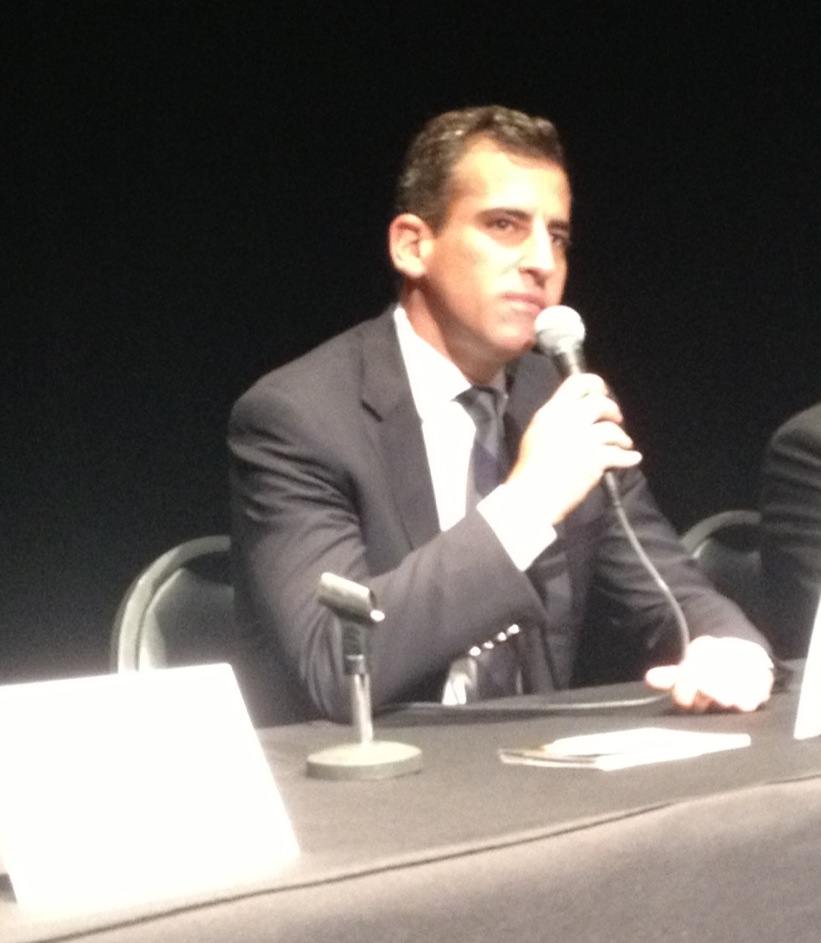
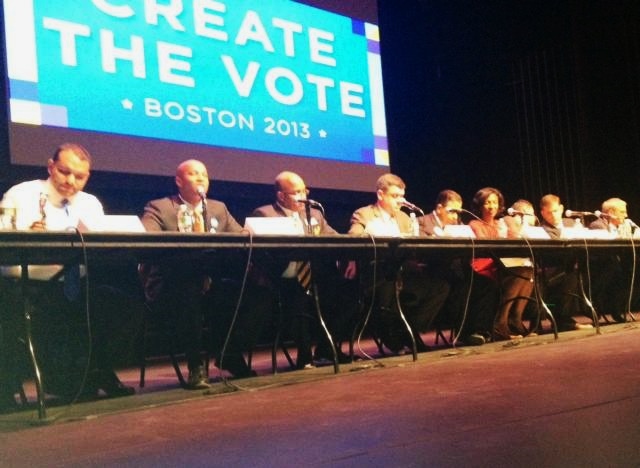
Bostonians had not one but two Mayor Forums to attend to tonight. First came Create the Vote’s Forum on Arts, Culture, and Creativity. Half an hour later came the campaign’s first televised debate, hosted by Joe Battenfield of the Boston Herald. Nine of the twelve hopefuls answered questions at Create the Vote’s Forum — Dan Conley, David Wyatt, and Charles Yancey missed out. All twelve took part in the televised debate.

Very little ground was covered in either Forum that earlier Forums had not already addressed. There were, of course, some specific questions that several candidates gave obviously ad hoc responses to. Yet none of the candidates surprised. All gave answers, to every question, well within the range of their agendas already long since worked out in admirable detail. This was as true of the Herald debate — of which we saw only part — as of the Arts Forum.

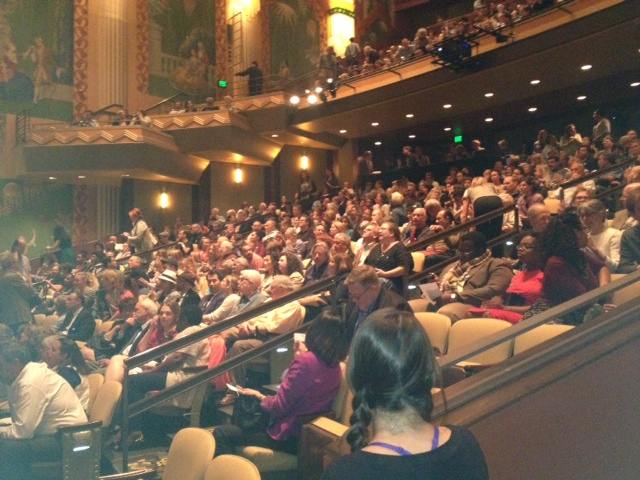
Image

^ large audience — and fully aware of what it wanted to hear

The differences tonight were the size of the audience and the command that the various candidates demonstrated in applying their respective agendas to the specific questions. Here was surprise. Felix Arroyo’s soft-spoken, highly personal narratives did not often command the same attention in these Forum’s big-hall and aggressively moderated formats that he easily wielded in earlier, more intimate Forums. His best moment was his paean to the Jamaica plain Music Festival, which he had attended the previous day.
John Barros, too, gave less developed answers to questions than his usual. Barros has a message of change that requires time to explicate. Given little time, he resorted to quips and smiles as a kind of narrative shorthand that, probably, those seeing him for the first time missed the significance of. He also overreached noticeably when, in response to a question about arts classes in Boston schools, he said, “no kid should be allowed to graduate high school without at least one arts class.”

Surprising, too, was the Arts Forum audience’s applause for Bill Walczak, who repeated, with hardly any new elaboration, his usual mantras : he’s from Codman Square, and he’s against the casino.

Charlotte Golar-Richie had strong moments — “I will be an arts Mayor,’ she promised; “I aspired to BE an artist. I will partner with non-profits to raise arts funds, and I will establish a blueprint for the arts. It’s a social and an economic driver.” But her response to a question, “what were your two most memorable moneys in the arts,” was less inspired: “watching neighborhood kids do the Nutcracker.” Rob Consalvo’s responses sounded entirely generic — “we must assure every kid has arts classes…the budget must include cultural affairs” — except to that “memorable moments question, in which he cited his home area of Hyde Park for its Riverside Theater, perhaps Boston’s most notable community stage play company.

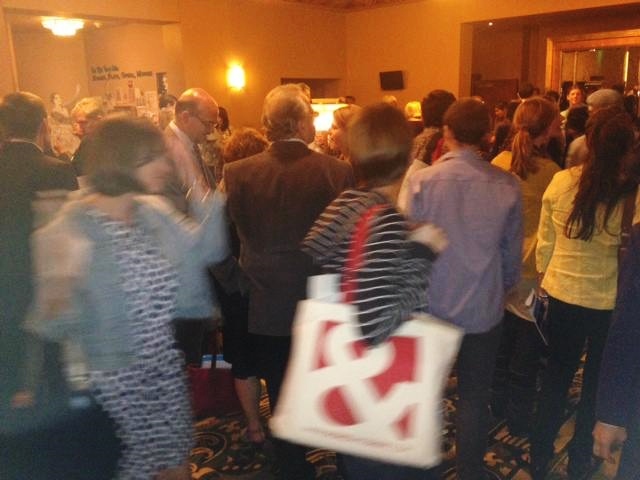
Image

^ no food in the foyer this time, but drinks were served and much conversation was exchanged.

In both Forums, command honors went to Marty Walsh and John Connolly; Mike Ross also spoke authoritatively at the Arts Forum. All three men have made it quite clear that they have a vision of the mayor’s office broad as well as deep, detailed as well as thematic.

Ross’s best moment — though he had many — was his response to the memorable arts question : “I am an oil painter. My oils hang on my walls at home…(Yes) arts in every school,” he added. “We need arts and festivals of the arts, and we need in our affordable housing plan housing that includes for artists !” Much applause greeted this answer, and justly; hardly any artist living in Boston is not one step away from not being able to afford the place he or she lives in.

Marty Walsh answered every arts question clearly, concisely, but his best, most original moment responded to a question “which city outside Boston do you look to for inspiration ?” “Montreal,” Walsh said without hesitation. “What they do: public arts and festivals all year round, all over the city. Here in Boston we struggle just to keep First Night !” He is right about Montreal, which hosts a Film Festival, the Juste Pour Rire comedy festival, one of the world’s largest international Jazz Festivals, and two Franco-folies festivals (of francophone pop music. Montreal’s not a city that many Mayor candidates would think of when answering this question. Walsh gets it.

His best applause arose from his answer to a question about raising the city’s arts budget. (Every candidate agreed that this should be done.) Said Walsh, “Change the culture of the BRA ! Create an office of economic planning so that arts can be included (directly) in planning !”

Connolly, too, answered this question memorably : “We spend one one-hundredth of a percent of our budget on the arts. Lobby the legislature for more funds ! we need to work with institutions (in the city), so that if they invest in the arts…and yes, use the capital budget, to build an arts infrastructure !” the applause was loud and long.

Connolly promised to raise the office of city arts commissioner to cabinet status and, as he says at every Forum, to “make the office user friendly, like an apple store.” The line continues to be a good one.

Image

^ John Connolly : good one-liners and a seriously thematic agenda

Entirely missing from the arts Forum was any discussion of performance difficulties in Boston : no late night transit, the 2:00 A.M. closing hour — and the milling around as clubs empty their patrons onto streets with no transport option except scarce taxis; fights sometimes ensue; or the expense of parking, the racism in Theater District nightclubs, problems with bouncers. Not to mention drug mishaps that shut down entertainment arts. Nothing of all of this was discussed at the only Forum where it seemed to be a vital part of the purpose…

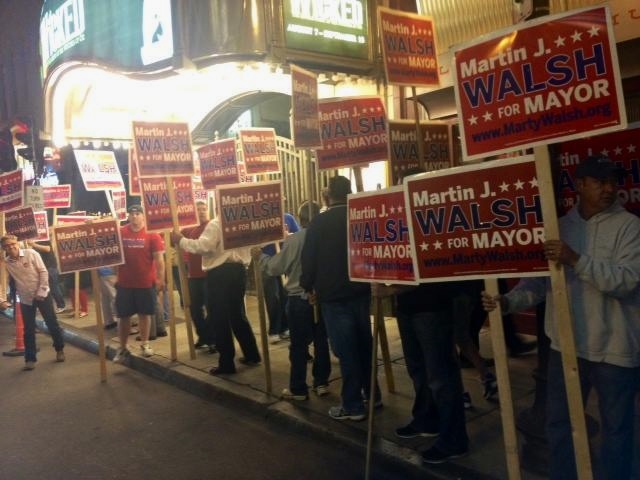
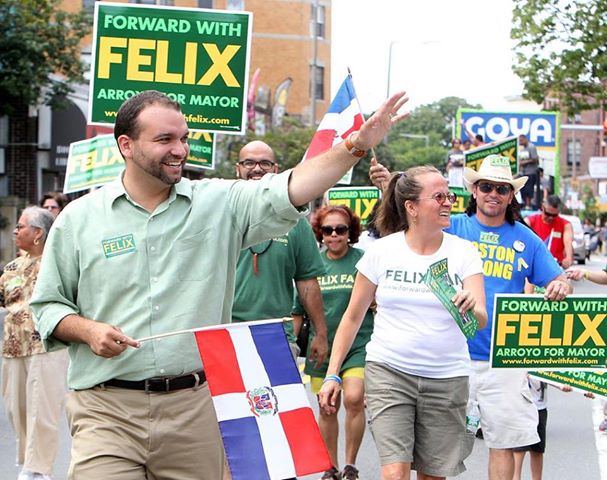
The Herald debate offered the candidates scant opportunity to explain at length or to imagine and create. With twelve on stage, it was difficulty enough to give the candidates time enough to say “hi.’ (David Wyatt almost didn’t say even that, bit that’s how he is at every Forum he decides to attend.) in any case, the real action in this campaign is no longer in the Forums but outside, on the street. Forums worked during August, when the campaigns were just beginning to ramp up. Now, the ramp is so up it tweaks the heavens. Every candidate with any semblance of seriousness spends all day now doing meet and greets, shaking hands at T stations and at supermarkets. The truly ramped up go to house parties two and three a night, shake hands at bingos, go to street parties, block parties, hold fund raiders, even rallies. And they door-knock, while their volunteers phone-call to voters from phone banks. They garner big endorsements and hold press conferences to announce them. And their volunteers do huge stand-outs — sign-holds — that you cannot miss. Sometimes competing stand-outs buffet the traveler along various neighborhoods’ main streets.

Image

^ the real campaign was outside the theater, on the street.

The many Boston City Council candidates are doing the same thing.

We will continue to cover the Mayor Forums as they take place — including two Forums tomorrow. That said, we will, from Wednesday morning on, shift our focus to covering the campaign where it is most heated: on the streets where voters live, dine, work, and shop.

—- Michael Freedberg / Here and Sphere