BOSTON MAYOR RACE : MONEY UPDATE, SEPTEMBER 7 THROUGH 13

Image

^ Dan Conley : tons of money being spent, but not much of it appears newly raised

—- —- —

Money being the life blood of political campaigns, let us see who has how much life, at least as reported to the Office of Campaign finance. The totals listed below represent money RAISED for the period September 7th  through this morning. They do NOT represent cash on hand:

Marty Walsh ………………… 80,167.02

John Connolly ………………  42,810.00

Dan Conley ………………….  27,853.55 (NOTE : Conley also reported 285,465.33 which, according to my sources, represents money that he already had, not new funds newly raised)

Charlotte Golar-Richie …   24,898.89

Bill Walczak ………………..   14,846.00

Mike Ross ………………….    14,355.00

John F. Barros ……………     12,612.69

(NOTE : I could find no new deposit reports filed by these candidates  Rob Consalvo, Charles Yancey, Charles Clemons, or David Wyatt. For Felix G. Arroyo, see UPDATE below.)

It is difficult without a poll in place to tell who will finish in what place in the September 24th primary. that said, is there anyone who will seriously argue that the top four money raisers listed above are also likely to finish top four, though not necessarily in the order shown, in the Primary ?

—- Michael Freedberg / Here and Sphere

UPDATE Sept 14, 2013 at 2.00 PM :  In the past 27 hours the following candidate deposits have been reported —

Marty Walsh —–  42,768.50

Dan Conley —-      32,675.00

Charlotte Golar-Richie —- 8,093.76

Felix G. Arroyo — 6,004.07

Mike Ross —– 1,520.00

MEEK AT THE MOVIES : Drinking Buddies ( 3 STARS )

Image

^ the gang’s all here : sexual tension in the mumble world of “Drinking Buddies”

—- —- —-

What happens when your best friend and co-worker is a member of the opposite sex and you’re hopelessly attracted to them but can’t pursue anything because you’re in a long-term relationship heading towards matrimony? That’s the plucky situ that Joe Swanberg’s neo-slacker essay plumbs, and it gets even more complicated when Kate (Olivia Wilde) and Luke (Jake Johnson) bring their significant others along for a couples get away in the woods. In the middle of the night, after some silly drinking games, the two, who both work at a Chicago micro-brewery, sneak down to the beach and forge a raging bonfire. The sexual tension’s aflame too, a veritable tinder box of unrequited passion, needy and raw and open to that game changing spark. You might feel sorry for their SOs, but they’re not so innocent themselves; earlier in the day, Jill (Anna Kendrick) and Chris (Ron Livingston) went out for a hike, drank some wine and after an awkward conversation about love, life and fulfillment, also rolled perilously close to the precipice of crossing over.

If there’s one thing painfully obvious (“My Best Friend’s Wedding” obvious), it’s that Luke and Kate are meant to be together; thankfully, Swanberg, who was one of the early adaptors of mumblecore filmmaking (the lo-fi indie film movement where production values, most notably sound, play second fiddle to the visceral and ideological elements), along with the Duplass brothers (“Puffy Chair”) and Andrew Bujalski (“Funny Ha Ha”), is after something a bit more nuanced and un-Hollywood. For inexplicable reasons Chris leaves Kate which further enables Kate and Luke’s hop-infused brew-mance. The pair, along with other vat rats from work, spend many a late night lighting up the dingy side of Chicago, while Jill, conveniently a teacher by trade, sits at home toiling away on art projects for her special needs students.

The crescendo of consequence seems ripe for revelation, but not all batches of brew are crisp and golden, and this one goes sour when Kate begins to find her sexual liberation (by bedding other men) and Luke, normally the hip jokester, doesn’t quite know how to react. It’s a piquant conundrum of conflict to chomp into, but then again, we’re tagging along with largely un-anchored people, who, with the exception of needing the structure of a (any) nine-to-five and a best friend or convenient SO to make their daily meandering meaningful, don’t seem to have any discernible dreams for the future, not even a bungee jump or a Pacific crossing to see the Great Wall of China. And here Swanberg’s unbridled character exploration begins to sag under the weight of its subjects’ pouty malaise.

Don’t get me wrong, Swanberg’s a competent director and committed to his game. He’s cranked out more than a dozen flicks since 2005 and prolifically appears in other mumblecore and mumble-horror directors’ films–most recently as an uptight yuppie in “You’re Next”. If you look back at Swanberg’s career, many of his early slacker-themed films like “Hannah Takes the Stairs” (which stared Mark Duplass, Bujalski and Greta Gerwig) center around disenfranchised young adults seeking self-gratification. “Drinking Buddies,” beyond some foamy frivolity, takes a slightly older generation and goes down a path beyond ‘the me’ and into the realm of commitment, responsibility and family.

The secret yeast that makes “Buddies” ferment and keeps it sharp is Wilde. She’s done her share of being a sultry side dish (“TRON: Legacy”), but here she’s able to showcase a verve and range few might have thought possible. Johnson too, best known from TV’s “New Girl,” with his darting eyes and sly smile, is apple to effortlessly connote character through the awkward conflict of his facial features. Unfortunately, the normally redoubtable Kendrick (“Up in the Air”) and curmudgeonly Livingstone (“Office Space”) have less to work with. Their characters feel like props, lazily constructed puppets imbued with domineering asexual unattractiveness to underscore the inevitability of Luke and Kate. At times it feels like a cheap trick, but in the end, Swanberg has the last laugh as the film ties up on a surprising and contemplative high note.

Just perhaps, the maestro of mumblecore is ready for the mainstream?
— Tom Meek / Meek at the Movies

BOSTON MAYOR RACE : THE BOSTON HERALD BLOWS IT

Image

^ Marty Walsh as Boston Building Trades Council Business Manager

—- —- —-

Yesterday in its editorial, the Boston Herald made two endorsements for Mayor: Dan Conley and John Connolly. I have no quarrel with their doing so. They should endorse. What upsets me is their going on to NON-endorse candidate Marty Walsh. That is harsh. Unfair was their reason : that until recently he has been the Boston Building Trades Council Business manager — a Union guy — and thus, said the editorial, not a friend of taxpayers.

This is bogus. Completely bogus.

Union workers pay taxes, don’t they ? They earn a solid paycheck, and thus they pay a lot of taxes. So what’s the Herald talking about ?

In a phrase : the prevailing wage law, commonly known as the Pacheco Law. By the Pacheco Law, workers on jobs pursuant to State-funded construction contracts must be paid the prevailing wage for union construction contracts made with private businesses.

What is so wring with that ? Yes, all taxpayers, not just union workers, pay into the higher hourly wage mandated by the Pacheco Law. Non-union workers would, it is true, cost less. And if that were the whole story, the Herald might have a point.

Except that that IS NOT the whole story. Union workers who earn the prevailing wage do not stuff their extra money into suitcases. They spend it. They enter the discretionary economy — where economic growth most flourishes — to buy discretionary things and thus help tons of businesses to exist, to hire their own workers, and — hopefully — to pay those workers well.

That is how a growth economy works and why a reductionist economy doesn’t. A growth economy isn’t just me and my wallet, you and your bills. A flourishing economy involves all of us who are in it. Money doesn’t stay put in any economy. It moves constantly, into my pocket, out of my pocket; into yours, out of yours; then on to the next and the next and so on. The more money that moves the more freely, the better an economy is for everyone.

To reduce construction workers — to reduce ANY workers, and here I specifically include fast-food workers, who are now seeking $ 15.00 an hour and should have it — to the lowest doable wage is to reduce the economy, to starve it of what it lives by. Is that what we want ? Really ? i think not.

Right now our economy is growing much more slowly than it should because a huge portion of the pay being earned in it is going to CEO’s and hedge fund managers an ever-decreasing amount of said pay is going to everyone else. An economy cannot grow — can hardly exist — if only a tiny few have money to participate in it. Is this not basic Economics 101 ?

Right-wing pundits blame unions for the problems besetting municipal budgets and the slow growth of private-sector jobs. They are wrong. Unions are nothing more than workers banding together to force reluctant employers to grant them fair earnings. Workers earning a collectively bargained income do not crater municipal budgets. That’s the consequence of many other events, the housing bear market especially.

As for employers’ wage policies, not all take a reductionist view. Many employers understand that a well-paid work team is an asset to a business. well paid workers don’t leave the job as quickly; and turnover is a huge — and largely avoidable — cost to businesses beset by it. Well paid workers also suffer less stress; and an unstressed work team is healthier, thus less likely to call out sick, and better motivated. How have these basic economic conditions been so sweepingly un-learned in today’s America ?

That Marty Walsh is a union guy is a good thing. Endorse him, or not, that’s fine. We at Here and Sphere haven’t yet endorsed, and it may not be Walsh whom we end up supporting. But please, do not dis-endorse him because he is and was a business manager for Boston’s Building Trades Council.

—- Michael Freedberg / Here and Sphere

NOTE : this article was updated on Sept. 13, 2013 at 11:12 EDT.

BOSTON MAYOR RACE : FORUM AT BOSTON TEACHERS UNION

Image

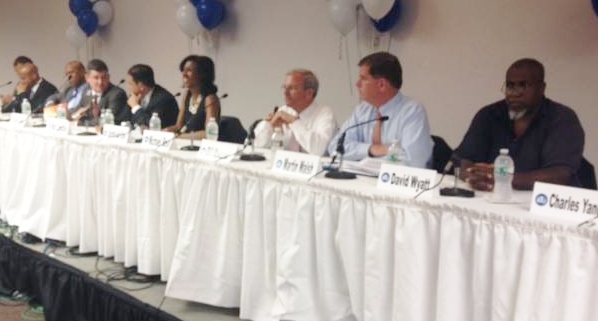
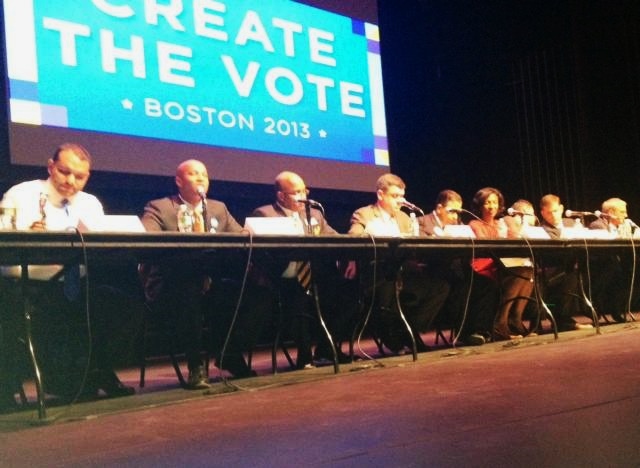
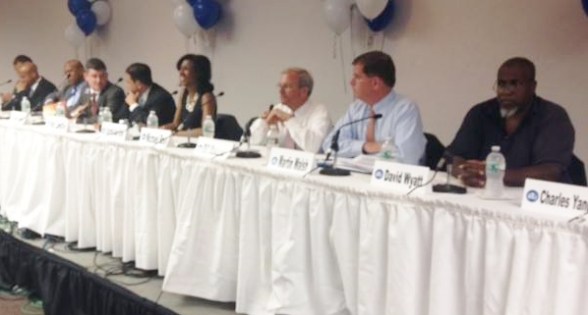
^ the lineup. next came the interrogation.

—- —- —-

Most of the candidate Forums of this campaign for Mayor have taken place at churches, conference centers, theaters, auditoria — public gathering places. Not so with the Forum called by the Boston Teachers’ Union (BTU). This one took place in their union hall and had the feeling more of an interrogation than a debate. The BTU feels threatened by developments in public education and advocacies for school change, and it made plain that it strongly disagrees with the direction and purposes, charter schools especially. BTU President Richard Stutman read portions of a 10-page manifesto — which in a printed handout was available on a literature table — of opposition to charter schools and to school reform by “corporate executives, entrepreneurs or philanthropists.”

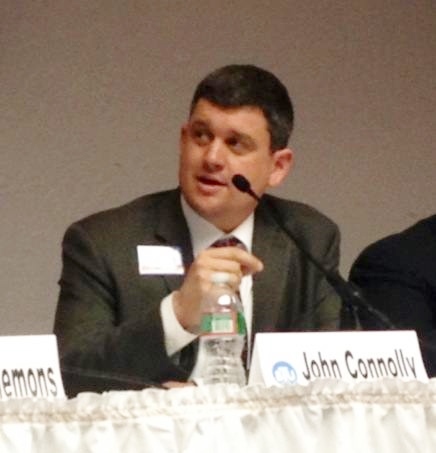
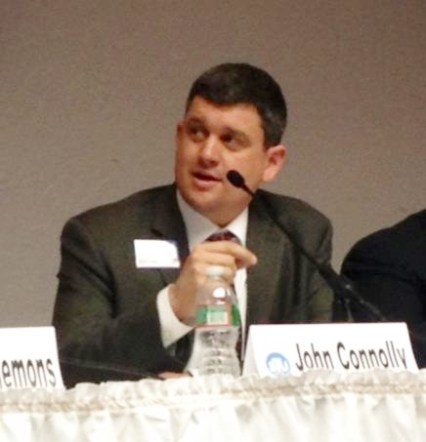
The union hall was full — of teachers, especially the union’s activists, and they knew exactly what they wanted to hear. And not to hear. Not surprisingly, some of the eleven candidates on hand — Dan Conley was the absent — told the BTU gathering what it wanted to hear and were loudly cheered and applauded. Quite the surprise was that John Connolly, who pointedly advocates school “transformation — his word — by corporate executives, entrepreneurs, and philanthropists (and by the Mayor), told the gathering exactly that, in well exampled detail. He gave reasons and stated goals, and he did not waver. He was received in almost total silence.
Image

^ John Connolly stood his ground.

David Bernstein — Boston’s premier political reporter (full disclosure: we both wrote for the Boston Phoenix), moderated. Being a playful and even ironic sort, he asked each candidate questions that would be hardest for them to answer; then picked out others of the eleven to give, he hoped, a competing view. It worked at first, but eventually the candidates began to interrupt, or to veer a response toward their agenda . Bernstein tried to cut off such manipulation but was not always successful. As he called upon the eleven in random order, occasionally he forgot one or two. Candidates had to raise their hands to be recognized.

The entire 90 minute event looked very much like a teacher and his class; appropriate, I suppose, for a Forum presented for teachers.

Still, many issues were raised : charter schools, the longer school day, arts and music, standardized testing (the MCAS), school kids’ health, parent involvement, diversity, students for whom English is a learned language, transportation, school construction and renovation. The diversity of responses was strong and plain to hear.

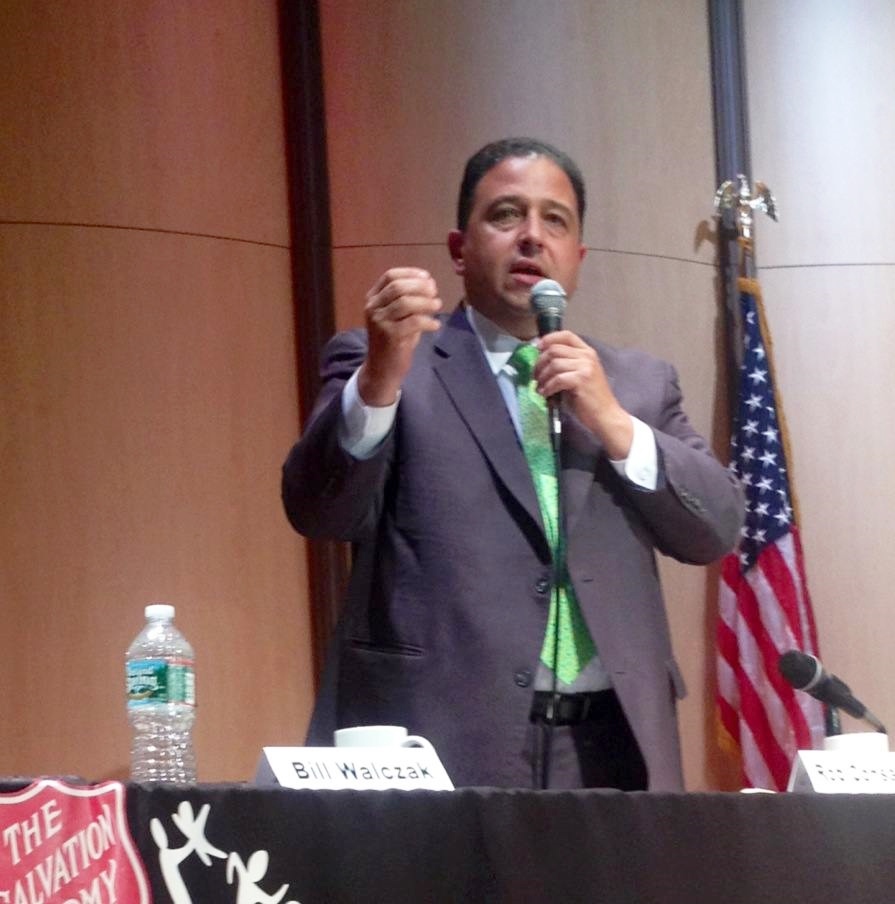
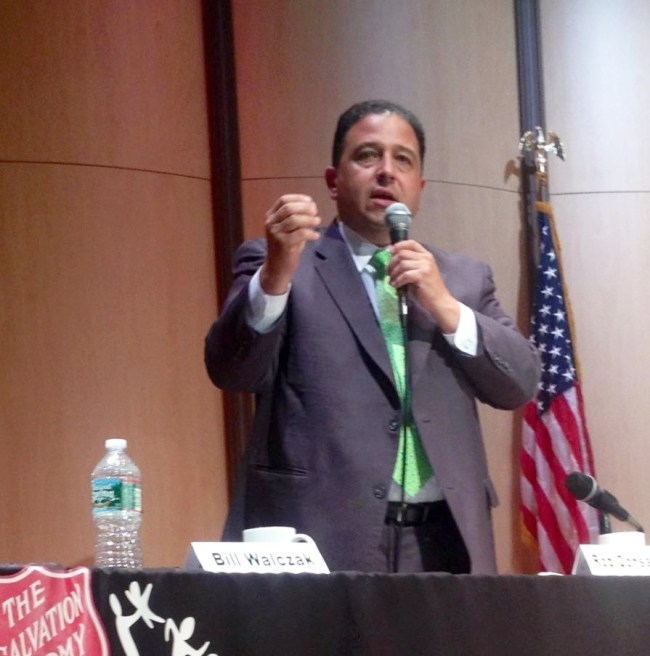
Rob Consalvo told the activists exactly what they wanted to hear, on every issue — charter schools too, of course — and passionately. as passionately was he cheered.
Image

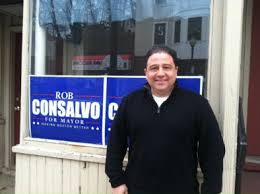
^ Rob Consalvo : the BTU agenda is his agenda  (photo taken at a previous Forum)

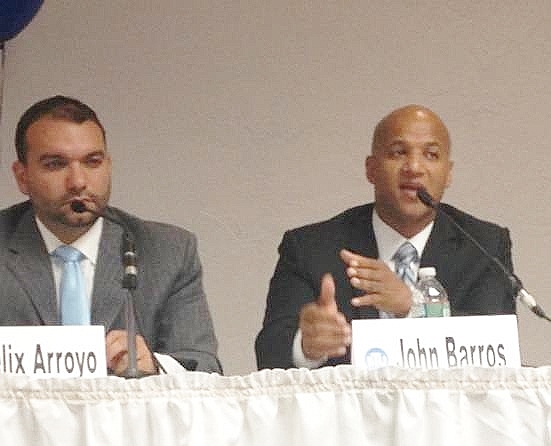
John Barros outlined school reforms and problems with the detail and insight that he has gathered as a member of Boston’s school committee. particularly true was his observation that the public school system has been asked to do what so many of society’s systems have failed to do and that this is unfair to the schools. Barros thanked charter schools for finding new and innovative methods which the regular public schools have then adopted.

Charles Clemons, who opposes more charter schools, noted that Boston people today are 56 % of color, and, noting that diversity in the BTU has failed to meet 1975 goals, asked, “how many of the people in this room look like Boston ?”

Bill Walczak did not mention casinos even once. He affirmed his work in connecting the charter school that he created to the city’s health system and saw that as a model for all Boston schools.

Marty Walsh, who sits on the board of a charter school, passionately defended the school’s role in creating “best practices” for the entire system to adopt. He rejected the BTU’s assertion that elimination of difficult students is systemic to charter schools. Walsh called for a program of school construction and for a meaningful longer school day.

Mike Ross insisted that standardized testing is crucial to assuring that students will acquire core knowledge, and he called for the establishment of a city technology high school, noting that google.com did not open a Boston office because it doubted being able to fill even entry-level jobs with Boston high school graduates.

David Wyatt made no attempt to get an answer in if not called upon and, when called upon, said little — he the Stoic; but he did support charter schools for bringing competition into education, and he endorsed standardized testing.

Charlotte Golar-Richie was occasionally overlooked but, when she interrupted to speak, supported an arts and music longer school day. As for charter schools, she found them useful but did not find a need to increase their number.

John Connolly’s points have already been noted.

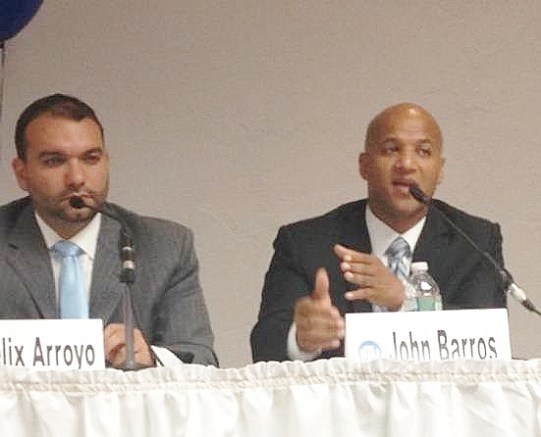
Felix G. Arroyo reminded the crowd that he is the husband, brother, and son of Boston public school teachers. He emphasized the language diversity, at home, that challenges so many Boston students in the classroom. He also saw an immediate need for arts, music, and crafts in the longer school day, noting how important crafts classes were to him.
Image

^ Felix G. Arroyo and John Barros : articulate and knowledgeable,  and not uncritically so, on public school concerns

Charles Yancey came late but made his time count. He called for the building of high schools which, he ranted, had been called for for years but nothing done. He would enforce a 1994 city ordinance granting school parents three days’ leave to visit their children’s schools and reminded the crowd of his mother, Alice Yancey, and how passionate she was about making sure that her son studied and learned.

And so it went. There was the beginning of a conversation about the City’s hugest and most intractable system. But only a beginning; with eleven hopefuls on hand, the school conversation stands at the sorting-out stage. Just as does the Primary itself.

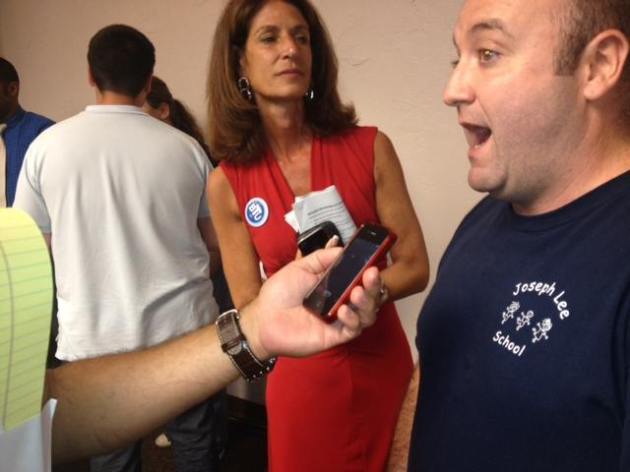
That the conversation is just beginning was obvious from the many issues that were not discussed : school assignment reform (and transportation costs), teacher pay, funding school reforms, even the assaults, by students, sad to say, that afflict teachers almost daily. Some of these issues were discussed after the Forum as teachers and various newsies (including me) conversed in small groups.
Image

^ teachers were eager to converse with newsies and the candidates after the formal Forum

The BTU knows that it is losing the battle of public opinion about school reform. It wants badly to be heard — respectfully but forcefully. I hear the BTU. I have long experience of politics involving Boston schools, and I have nothing but respect for the energy, the poise, the courage of teachers who on every school day face exactly what John Barros said : the problems of society dropped at the school door for teachers and principals to deal with even as they try to perform their teaching mission : the teaching of knowledge.

Any school reform that does not find a central mission for the teachers, and pay accordingly, and that does not accord the teachers the last word on creating a curriculum and a classroom format is a reform that begins on the wrong foot. Any reform that seeks to downplay the teacher solidarity that a Union assures them is no reform at all. How can school transformation be a good thing if its first strike is to the one security that teachers, often overwhelmed by school problems, can count on ? Let us seek to make teachers’ jobs easier, not harder.

That said, I do not agree with the BTU’s position that charter schools detract from the public schools. No matter what format and curriculum the teachers decide (and I hope it is they who decide), charter schools offer a useful “but look here.” Useful because not even teachers know all that needs be learned about what works to educate.

All of the above needs be said, and often. But right now there is voting to be done. So how will the BTU teachers vote ? They are not stupid. They knew who was pandering, who was seeking common ground, and who was confident of him or herself. By no means should Consalvo, who was so noisily cheered, assume that the teacher activists are in his corner. My impression of their cheering — and not only for him — was for the statement, not the candidate. The teachers have a pretty solid idea of who is likely to win and who isn’t. After the Forum, I spoke to several, and they were quite clear about that being a factor in their vote on Primary day.
Image

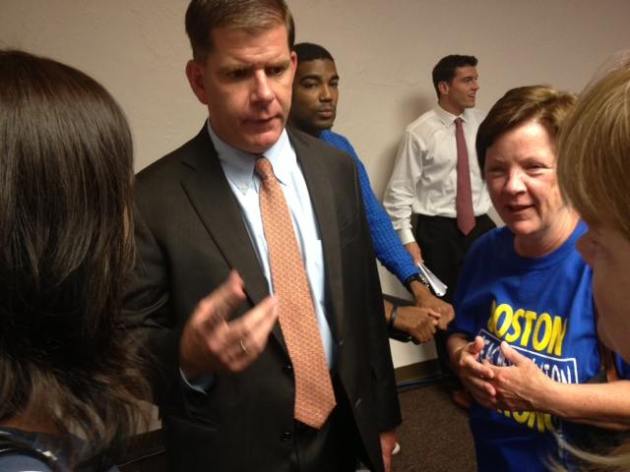
^ Marty Walsh found friends at a union gathering hours after being slammed as a unionist by the Herald.

—- Michael Freedberg / Here and Sphere

BOSTON MAYOR RACE : MANY HOPEFULS PERSUASIVE AT BEST FORUM YET

Image

^ Marty Walsh : passion and resolve, as always, detailed well

—- —- —-

The 200 or so NAACP activists who waited patiently for their Forum to begin — it was delayed by a prior debate event — were not disappointed. Simply put, this Forum was “best in show.’ Excellent questions were asked by the moderator, a well-known Suffolk University history professor, and almost all the 12 hopefuls responded with their most persuasive presentations this writer had yet heard from them.

That Marty Walsh and John Connolly, the two perceived leaders, argued eloquently for their candidacies, and in masterful detail, was no surprise. They’re the leaders of this campaign for a reason. Mike Ross, too, put his idealism into words of reformist eloquence. What we did not expect was to see Dan Conley and Rob Consalvo, often absent at these Forums, demonstrate that they, too, know what the job entails, what in it they intend to change, and why. Conley and Consalvo were matched, almost, by Charlotte Golar-Richie, who made several key points by John Barros, who with time given, explained his vision convincingly; and even by Charles Clemons, who spoke with passion his commitment to see the administration of Boston “look and speak like the city, it’s about time.” Bill Walczak managed to address every question asked of him without uttering his “no casino” mantra. And Charles Yancey, who often seems merely along for the ride, challenged many of his competitors — City Council council colleagues in particular — on point, with passion, and sometimes conclusively. Where has this Yancey been hiding these past two months ?

Candidates were divided into three groups of four, each of which was asked different questions, albeit on the same topic, which were: the economy, education, and public safety.

The moderator also addressed a general question to all: “If you are elected, what will that mean for the city ?” To which Marty Walsh gave perhaps the strongest answer : “My cabinet will reflect the (entire) city of Boston, including the top echelon and my police commissioner. (I’ll have) a chief diversity officer. (I see) City hall as an incubator for young people.” John Connolly, to be fair, made his “education Mayor” theme count in this context : “I’m a former teacher who has taught kids from every region of Boston. I will be a bold leader for every Bostonian, but it starts with our schools. i will transform our schools !”

Image


^ John Connolly : stuck to his education theme, but it’s a good one, and he applies it well to most questions

Other candidates missed the point and talked not of promoting a racially and gender-diverse City Administration — including the Police higher-ups — at every level but of of delivering city services equally to every part of the City. Delivery of services does matter, but it’s not the core issue of race and gender as these play out in Boston City Hall.

Of the three economy questions: Dan Conley answered his question, about minority businesses, best ; “(I propose) a second chance, after the bidding process, to give inner city businesses a second chance (at winning contracts).” John Barros gave the best answer to his question, about connectivity between kids from Dudley Square and innovation in Cambridge ; “We have 1000 jobs in the medical area that we can’t fill ! We can do this. (and) We need goals and programs for contractors. (Performance) bonding is an issue for them, they need accessibility to bonding.”

Image

^ Dan Conley : showed knowledge, plans, and much command of what is needed

The third candidate group was asked about under-employment among communities of color. Arroyo gave the best answer : “extend the school day to include arts and music….the ‘invest in Boston program’ needs to be used. It has a billion dollars, let;s use it !” Applause greeted his answer.

Image


^ Felix G. Arroyo ; not always at his best, but when he was, applause showed he knows what the voters want

The three education questions found Connolly ready and eager, answering a question about Boston showing a declining percentage of its teachers being of color : “Mentoring is important to getting students to decide they want to become teachers. Nothing is changing here, though. I am going to break down the dysfunctional bureaucracy at Court Street !” But John Barros’s answer bested Connolly’s : “we’re not even meeting the 1975 goals (established by the Federal Court). need to do three things : create robust recruitment of teachers; develop it; and show leadership in all four economies (levels) that our schools confront.”

Asked, “what are you looking for in a next superintendent, the third group of four’s strongest — if controversial — answer was Consalvo’s : “I don’t want the charter school cap lifted. we must focus on the Boston public schools. My super must be committed to the public schools. No outside group taking over and privatizing our schools !”

Image


^ Rob Consalvo : finally, some passion and some specifics, well argued.

Last came the public safety questions. Marty Walsh’s answer was one of the strongest given by any candidate to any question : “As soon as I take over. The higher (police) ranks need to look like the neighborhood. There’s a problem with trust. Being a police officer is a good career, it pays well. (But) young people need to be ready to take that civil service test. They must…the hierarchy of the Boston Police department must — will — look like the city !” Much applause greeted this answer.

Charlotte Golar-Richie then delivered her campaign theme and a knockout blow in one superb question: “There isn’t one police captain who is female. Don’t you think it’s about time we changed that ?” Laughter and applause greeted its truth.

Image

^ Charlotte Golar-Richie : “don’t you think it’s time we changed that ?”


Connolly focused not on the police department but on youth and violence : “Every killing there’s also survivors, the family. For them it never ends. We need to have public vigils to remember the victim. Long term ? It’s about mental health and school transformation. Schools are the way to opportunity.”

The next group of for was asked about the police commissioner, Consalvo and Walczak praised Ed Davis, the current commissioner. Arroyo ducked the personal point and focused on accountability : “15 of my current 19 campaign and office staff are of color or female. Judge me on what I am doing now !”

The twelve were then given one minute to sum up. Most spoke well, some eloquently. Yancey’s summation was the strongest speech I have heard from him. He affirmed his long Council experience — “30 years !” — as if it were his campaign theme (it is). He also cited education credentials, including a degree in public administration from Harvard. This son of long time Boston PTA voice Alice Yancey, whom I remember well as a strong leader for better school performance, finally lived up — rhetorically, anyway — to the assertive mastery his Mom always showed in public meetings. So where has this Charles Yancey been all these months ? It is very strange. as strange as the quiet, almost absent performance of David Wyatt, who seems more given to a soft sigh of resignation than to a candidacy he, after all, had to adventure upon; only to, now somehow, reject entirely. It’s almost that he wishes there were no such thing as a Mayor and a campaign.Very, very odd, is David Wyatt, an educator — and a Stoic.

—- Michael Freedberg / Here and Sphere

BOSTON MAYOR RACE : CONNOLLY, WALSH, ROSS DOMINANT AT ARTS FORUM; HERALD DEBATE LESS INSTRUCTIVE. BUT ….

Image

^ so many would-be mayors, so few Will-be’s…

—- —- —

Bostonians had not one but two Mayor Forums to attend to tonight. First came Create the Vote’s Forum on Arts, Culture, and Creativity. Half an hour later came the campaign’s first televised debate, hosted by Joe Battenfield of the Boston Herald. Nine of the twelve hopefuls answered questions at Create the Vote’s Forum — Dan Conley, David Wyatt, and Charles Yancey missed out. All twelve took part in the televised debate.

Very little ground was covered in either Forum that earlier Forums had not already addressed. There were, of course, some specific questions that several candidates gave obviously ad hoc responses to. Yet none of the candidates surprised. All gave answers, to every question, well within the range of their agendas already long since worked out in admirable detail. This was as true of the Herald debate — of which we saw only part — as of the Arts Forum.

Image

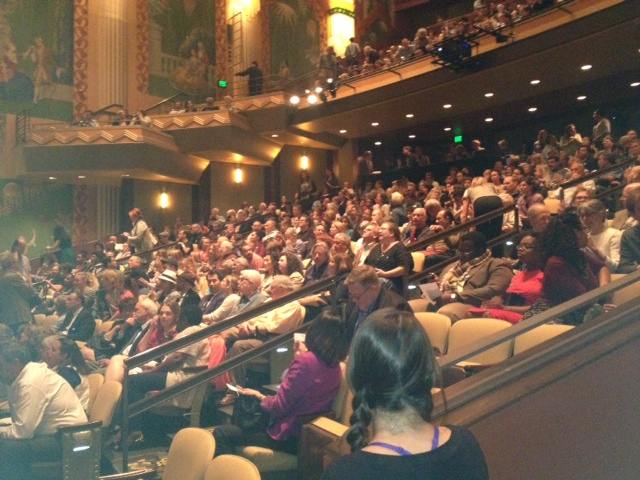
^ large audience — and fully aware of what it wanted to hear

The differences tonight were the size of the audience and the command that the various candidates demonstrated in applying their respective agendas to the specific questions. Here was surprise. Felix Arroyo’s soft-spoken, highly personal narratives did not often command the same attention in these Forum’s big-hall and aggressively moderated formats that he easily wielded in earlier, more intimate Forums. His best moment was his paean to the Jamaica plain Music Festival, which he had attended the previous day.

John Barros, too, gave less developed answers to questions than his usual. Barros has a message of change that requires time to explicate. Given little time, he resorted to quips and smiles as a kind of narrative shorthand that, probably, those seeing him for the first time missed the significance of. He also overreached noticeably when, in response to a question about arts classes in Boston schools, he said, “no kid should be allowed to graduate high school without at least one arts class.”

Surprising, too, was the Arts Forum audience’s applause for Bill Walczak, who repeated, with hardly any new elaboration, his usual mantras : he’s from Codman Square, and he’s against the casino.

Charlotte Golar-Richie had strong moments — “I will be an arts Mayor,’ she promised; “I aspired to BE an artist. I will partner with non-profits to raise arts funds, and I will establish a blueprint for the arts. It’s a social and an economic driver.” But her response to a question, “what were your two most memorable moneys in the arts,” was less inspired: “watching neighborhood kids do the Nutcracker.” Rob Consalvo’s responses sounded entirely generic — “we must assure every kid has arts classes…the budget must include cultural affairs” — except to that “memorable moments question, in which he cited his home area of Hyde Park for its Riverside Theater, perhaps Boston’s most notable community stage play company.

Image

^ no food in the foyer this time, but drinks were served and much conversation was exchanged.

In both Forums, command honors went to Marty Walsh and John Connolly; Mike Ross also spoke authoritatively at the Arts Forum. All three men have made it quite clear that they have a vision of the mayor’s office broad as well as deep, detailed as well as thematic.

Ross’s best moment — though he had many — was his response to the memorable arts question : “I am an oil painter. My oils hang on my walls at home…(Yes) arts in every school,” he added. “We need arts and festivals of the arts, and we need in our affordable housing plan housing that includes for artists !” Much applause greeted this answer, and justly; hardly any artist living in Boston is not one step away from not being able to afford the place he or she lives in.

Marty Walsh answered every arts question clearly, concisely, but his best, most original moment responded to a question “which city outside Boston do you look to for inspiration ?” “Montreal,” Walsh said without hesitation. “What they do: public arts and festivals all year round, all over the city. Here in Boston we struggle just to keep First Night !” He is right about Montreal, which hosts a Film Festival, the Juste Pour Rire comedy festival, one of the world’s largest international Jazz Festivals, and two Franco-folies festivals (of francophone pop music. Montreal’s not a city that many Mayor candidates would think of when answering this question. Walsh gets it.

His best applause arose from his answer to a question about raising the city’s arts budget. (Every candidate agreed that this should be done.) Said Walsh, “Change the culture of the BRA ! Create an office of economic planning so that arts can be included (directly) in planning !”

Connolly, too, answered this question memorably : “We spend one one-hundredth of a percent of our budget on the arts. Lobby the legislature for more funds ! we need to work with institutions (in the city), so that if they invest in the arts…and yes, use the capital budget, to build an arts infrastructure !” the applause was loud and long.

Connolly promised to raise the office of city arts commissioner to cabinet status and, as he says at every Forum, to “make the office user friendly, like an apple store.” The line continues to be a good one.

Image

^ John Connolly : good one-liners and a seriously thematic agenda

Entirely missing from the arts Forum was any discussion of performance difficulties in Boston : no late night transit, the 2:00 A.M. closing hour — and the milling around as clubs empty their patrons onto streets with no transport option except scarce taxis; fights sometimes ensue; or the expense of parking, the racism in Theater District nightclubs, problems with bouncers. Not to mention drug mishaps that shut down entertainment arts. Nothing of all of this was discussed at the only Forum where it seemed to be a vital part of the purpose…

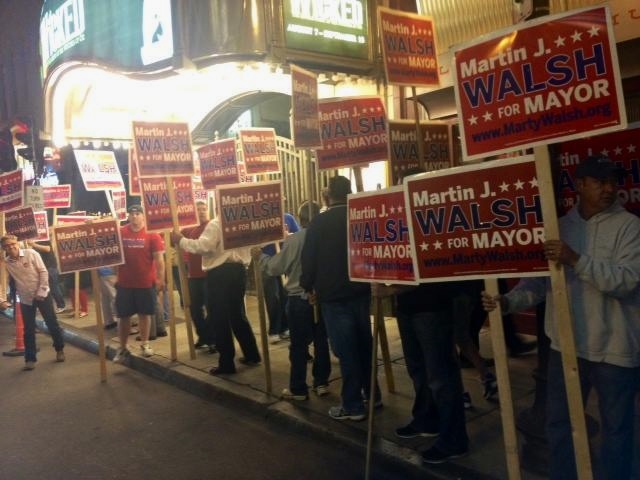
The Herald debate offered the candidates scant opportunity to explain at length or to imagine and create. With twelve on stage, it was difficulty enough to give the candidates time enough to say “hi.’ (David Wyatt almost didn’t say even that, bit that’s how he is at every Forum he decides to attend.) in any case, the real action in this campaign is no longer in the Forums but outside, on the street. Forums worked during August, when the campaigns were just beginning to ramp up. Now, the ramp is so up it tweaks the heavens. Every candidate with any semblance of seriousness spends all day now doing meet and greets, shaking hands at T stations and at supermarkets. The truly ramped up go to house parties two and three a night, shake hands at bingos, go to street parties, block parties, hold fund raiders, even rallies. And they door-knock, while their volunteers phone-call to voters from phone banks. They garner big endorsements and hold press conferences to announce them. And their volunteers do huge stand-outs — sign-holds — that you cannot miss. Sometimes competing stand-outs buffet the traveler along various neighborhoods’ main streets.

Image

^ the real campaign was outside the theater, on the street.

The many Boston City Council candidates are doing the same thing.

We will continue to cover the Mayor Forums as they take place — including two Forums tomorrow. That said, we will, from Wednesday morning on, shift our focus to covering the campaign where it is most heated: on the streets where voters live, dine, work, and shop.

—- Michael Freedberg / Here and Sphere

SYRIA : STRIKE THE CHEMICAL WEAPONS

Image


^ to slap a bad guy or not to slap ? the President has made it clear.

Three weeks ago Here and Sphere addressed the issue of Syria — of what, if any, should our nation’s response be to Bashir Assad’s uses of chemical weapons upon his own population, civilians almost all. We supported a response aerial only.

Today we reaffirm that position. We know now even more certainly that Assad, who tortures his people in “torture centers” — 27 of them, according to news accounts — and wages war upon them, has used chemical weapons on civilians numerous timnes. There is no reason to posit that he won’t do so again, as often as he likes, if no one does anything to stop him.

Death by chemical weapons — sarin gas, mostly — is slow and horribly painful. Of course, for a man whose torturers day after day inflict hurt and mutilation upon people to the point that they beg for death, killing by sarin gas is just another day at the office. Assad is a brute whose crimes, if we can believe the New York Times accounts, approach, maybe even surpass, those of the late Saddam Hussein. If even half of what has been reported is true, he is a war criminal every bit as criminal as those of Nazi Germany; he needs to be captured and tried at The Hague International Court.

That said, the ouster of Bashir Assad is an issue for another day. In the civil war that now rages over Syria, the U.S. can play no clear role. Assad is at war with a bewildering varierty of rebel factions, some of which would rule at least as lethally as he does. This war might go on for years.

Our responsibility here is simply to defend international rules of war — yes, there are such; no war can be allowed to be total — primary among which is the protection of civilians who have to live, or try to live, lives inundated by combat going on all around them. The international community also defends combatants from the worst of war crimes. That’s why the Geneva Convention exists, a protocol signed by almost every nation, including ourselves; it’s the Geneva Convention that first established a category called “war crime.” At Nuremburg in 1946, we and the other nations victorious in World war II, held a tribunal to adjudge defendants guilt or innocence of war crimes. Nuremburg wasn’t perfect, but it established a precedent that even when people go to war, civilization oversees their combat.

Thus we, the U.S., have every right to respond to Assad’s use of chemical weapons. We should do so. The question is, how ? And when ?

When, we assert, is NOW. This morning Saudi Arabia and Qatar signed on to our doing so. So has Germany. France was already aboard. None of these nations may deliver retaliation themsleves, but that is okay; we can do that. What we need is the approbation of nations, and now we have it.

As for the “how,” we say this: find Assad’s chemical weapons dumps and strike them. Eliminate the weapons. Eliminate the factories in which they are made.

Israel has already done it — more than once. When Israel intelligence found chemical weapons being transported toward Hezbollah’s redoubts in the Lebanese mountains, its air force struck. We can do the same and more.

Of course the long debate has given Assad tons of time to move his chemo and cloak his chemo factories. But they can be found. The rebels can find them — will find them. Once found, they should be struck, quickly.

That is all that we should do. We should play no part in this horrific civil war except to defend the international community and its standards; nor has President Obama called for any such involvement. As he and Secretary Kerry rightfully insist, the ultimate fate of Assad will be decided by Syrians.

—- Michael Freedberg

INTO THE ABSURD WITH “MOLLY”

Image

BOSTON, MA —- Until about two weeks ago we had no idea that “Molly” was something more than a girl’s name. Likely you didn’t know that either. Turns out we were missing the point.

“Molly” is the user’s slang for the drug MDMA, an amphetamine that has been used beneficially in some mental health therapies. How it came to be available, often in pills poisonously assembled by black market makers, we have no idea. How do any of these drugs, which doctors use under strict supervision, come to the street ? Yet they do.

Image

In the past week overdoes of “Molly” have killed several dance music fans, injured others, and caused the shut down of two major dance music clubs, the House of Blues, on Landsdowne Street, and Ocean Club in nearby Quincy.

Do NOT blame the clubs. They have a hard enough time dealing with unruly patrons, underage kids, acts with attitudes, and “promoters’ who want more favors than a club can afford to grant. The clubs area to be congratulated for forging ahead through an atmosphere full of ego, muscle, bling, and intoxicants.

One can blame the users of “Molly,’ and certainly those who sell versions of it ; the makers too. Criminal penalties exist, and they should. Anyone who makes and sells bastard versions of a drug that kicks up fake joys and imposes long and various after-effects — drugs that change the serotonin component of our chemistry —  deserves punishment indeed. Yet punishment can hardly halt the impulse in young people to seek out chemical unrealities. Unreality is the deity of the young. It was so for my generation, too.

The desire to intoxicate oneself is strong in the young.  Youth gathers in cliques and social circles, seeking reinforcement from each other of each other’s worth, attraction, belonging. Young people live among insecurity and absurdity. How can life not feel absurd when one doesn’t yet know who one is, or where one belongs, or what one is going to do after the intoxicants wear off ?

Absurdity, ah yes… It chases us relentlessly. It clings to our joys. We should have joys. Should celebrate them ! As Charles Baudelaire wrote 150 years ago, one can intoxicate oneself of poetry, or of virtue, of wine.  “it is necessary to intoxicate,” he proclaimed.  “At your choice. But intoxicate, always !” In other words, do not be unexcited by life. Do not be bored or indifferent.

Yes; but intoxication should lead to something higher than an upset stomach, nobler than a quack death. Who gains by those ? Absurdity only.

But the music of “Molly” life itself expresses absurdity in its shapes, its tones, its progressions. The music knows us so well. It mirrors to us our need for intoxicates; the need to find “Molly.

Dance music fans know very well that “Molly” is dangerous to imbibe. They know now — if they didn’t know it already — that it can kill you. Especially the street-made bastardizations of it can getcha. Yet the fans imbibe it anyway.

Do not be surprised at this. My generation knew that getting dead drunk on beer was not a good outcome, that it could set you way, way back, yet most of us got dead drunk anyway. It was a cool thing to do, for many. It was there. It was what we all talked about — that and fast cars — which were plenty dangerous, too. Cars and beer. were we  any different ?

Still, cars and beer did not stop the music. Today’s drugs might very well stop the music. Do not be surprised if some clubs find it not worth their while to re-open and thus risk more “Molly” overdose deaths and the huge liability that ensues. The profits to a club from a major DJ show are enormous, yet it’s just not practical for clubs to strip-search everyone at the door; indeed, it’s probably a violation of civil rights, not to mention that few people are going to go to a dance music club if they’re going to get strip-searched. Thus the music may well disappear from club performance.

If that happens, there’ll be a lot less “Molly” overdoses -=- and a lot less dance music. As for the absurdity of young life, out of which arise both dance music and “Molly,” it will continue. Full force in the souls and bodies of the young. Life is not only absurd; it is dangerous.

—- Michael Freedberg / Here and Sphere

BOSTON MAYOR RACE — THE MONEY, LOUD AND CLEAR

Connolly Walsh 1

^ much love and affection for John Connolly and Marty Walsh

—- —- —-

In this campaign, as in any other, the money report as campaign’s vote day approaches, does NOT lie.  Any more than a kiss and a hug lie.

With only 16 days remaining before primary day in this one, Boston’s 12 would-be Mayors have been adjudged clearly by donors. Two are out of it; three are losing ground badly. Three are trying hard to catch up. Two who were raising a ton of money are raising a bit less. and two are raking in money faster than a speeding bullet. Let’s look:

Out of It — David Wyatt raised less than 100.00. Charles Clemons less than 3,000.00.

Losing ground badly :

Charles Yancey had 21,504.68 on August 14th; raised  2459.25 from August 15th to August 31st; and had 22,263.93 at the end of the month.

Rob Consalvo had 128,024.51 on August 14th; raised 71,999.59 from the 15th through the 31st; and had a balance of only 66,376.46 as the month ended.

Consalvo local hq

^ Hyde park’s Rob Consalvo : feeling less loved than formerly

Trying to play catch-up :

John F. Barros had 56,566.70 BB on August 14th; raised 33,788.28 in the next 17 days; and had 68,946.48 as August ended.

Felix Arroyo had 158,579.39 on hand on August 14th, In the next 17 days he raised 31,852.32. At month’s end he had a very respectable 149,449.20.

Charlotte Golar-Richie reported a bit less than Arroyo. She had 132318.23 ; in the next 17 days she did well, raising 42,134.63. At month’s end, though, she still had less on hand than Arroyo. Just 125,355.52

Bill Walczak could boast of 131,419.97 in his account on August 14th. He then added another 36,627.00, giving him a respectable 113,819.10 at month’s end.

bill walczak 1

^ Bill Walczak : respectably liked and even a hug or two

Two who were raising tons of money now raised slightly less :

photo (38)

^ lots of love for Mike Ross, but a but fewer hugs this past week. (photo taken at last night’s Madison Park High School mayor Forum)

Mike Ross on August 14th had all of 486,135.08. From then till August 31, he took in 102,863.12, leaving him a still impressive 452,415.72 at month’s close.

photo (37)

^ Charlotte Golar-Richie : looking happier, at last night’s Mayoral Forum at Madison park high School

Dan Conley had money to spare on August 14th :  890,638.63. He took in less than previously, however. just  82973.80 Nonetheless, he still had lots of green at month’s end : 612,598.80

All of the above tell a fascinating story of donor assessment of their candidates’ chances. And if so, what do the donors of our top two candidates tell us ? They smell victory, and they are likely to be correct.

Marty Walsh had 560,670.62 on August 14th, He then proceeded to raise 276,500.05, more than three times what Conley raised. At month’s end he had 658,120.12, more than the previously over-funded Conley.

John Connolly refused an “outside” donor’s 500,000 ? He could afford to. On August 14th he had 727,725.46. In the next two weeks, during which the “outside” donor flap nicked his campaign briefly he took in 161,783.00. At the end of August he had 589,759.97 in his account.

The money lead boasted by Walsh and Connolly has continued. Admittedly incomplete reports for the first week of September show Walsh taking in 58,311.99 and Connolly 74,418. No one else gained anything like these sums. Golar-Richie did the next; donors gave her 14,400.00. Dan Conley took in 13,923.90; Mike Ross, only 7,417.00. Felix Arroyo reported 1,776.04. Consalvo ? His report remains to be filed. same for John Barros and Bill Walczak.

The campaign moves on, crushing some, squeezing others, challenging a few to outdo themselves — maybe — and gifting the lucky two with ever more signs of love and affection.

—- Moichael Freedberg

BOSTON MAYOR CAMPAIGN : RACISM INTERRUPTS

IMPORTANT UPDATE : Even as I wrote this story, the St. Patrick’s Day Breakfast issue was being settled. District Councillor Bill Linehan and Linda Dorcena-Forry issued a joint statement, that Senator Dorcena-Forry would, in fact, be hosting next year’ St. Patrick’s Day Breakfast. The dispute lasted all of two days.

However, the other half of this story — the Freedom House Forum for Mayoral candidates “of color” only, remains. And so I ask you all to read, below, what I wrote before news of the South Boston resolution broke…

The last thing that Boston’s Mayor campaign needs is an interruption by racism. Yet that is what has happened these past two days — through no fault of the candidates, let me make very clear. The 12 hopefuls running, and their campaigns, all speak for the new Boston, long since grown beyond a sadly racist past — 40 years ago and more — and have made this one of the most intelligent, forward-thinking issues conversations I have ever seen in the political arena. It has been citizenship at its high school, civics class best.

And yet the past intrudes. Some voters, and even some civic leaders, can’t help themselves.

First came the news that the committee that puts on South Boston’s annual St. Patrick’s day breakfast was divided on whether to invite its newly elected State Senator, Linda Dorcena Forry, to host the affair. South Boston’s State Senator has, ever since Bill Bulger’s time, done the honors; and all have been white and of Irish heritage; whereas Dorcena Forry is a person of color and of Haitian parentage; and lives in Dorchester Lower Mills. Of course, a case can be made that, as the breakfast is a South Boston event, a South Boston spokesperson should host it. Fair enough; and now, since the resignation of State Senator Jack Hart, South Boston’s City Councillor, Bill Linehan, has claimed host status. But that’s not at all the last word. Though never a rule of the breakfast, the area’s State Senator has hosted it for at least the last 20 years. Thus the problem of Linda Dorcena Forry.

Image

^ Linda Dorcena-Forry : South Boston’s next St Patty’s day breakfast host ?

Will she be invited to do what the District’s last three state senators have always done ? It would be next to impossible, were she not so invited, to avoid that race is the reason. It would be bad business indeed for the breakfast committee to accord any such prospect. Linda Dorcena Forry should host the 2014 St. Patrick’s day Breakfast. She will do just fine.

The above discussion was not till today on my task list. Indeed, I had intended not to mention the St. Patrick’s Day breakfast at all. To me it is a neighborhood affair, and that was that. And then came my discovery, at last night’s Mayoral Forum at the Reggie Lewis Center in Madison Park High School, of the Freedom House Mayoral forum flier pictured below. It forced me to set aside, for awhile, the excellent conversations at Madison park High about jobs, construction,l and schools. Please take a close look at it :

Image

Like you, I could not believe what I was reading. I was stupefied. “The First mayoral Forum for candidates of Color.” proclaimed the flier.

If the South Boston St. Patrick’s day breakfast is just a neighborhood affair, in no way a government-funded or public function — you have to buy a ticket — Freedom House’s Mayoral Forum is every bit a public function.

The flier adds insult to injury. “Free and open to all,” it proclaims. Open to all ? But not to all candidates ? What ARE they thinking ?

This is one Forum that Here and Sphere will, not attend. Nor should any of the candidates “of color.’ All should say “thanks, but no thanks.”
Then it will be time to address the matter of who will host the 2014 South Boston St. Patrick’s day Breakfast. After which the last strokes of old racism will, hopefully, fade away like what they are: the ghosts of failed, immoral attitudes.

—- Michael Freedberg / Here and Sphere