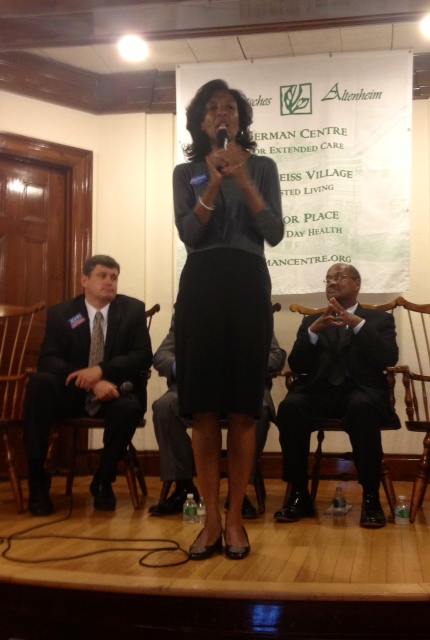
PROFILING BOSTON’S CITY COUNCIL CANDIDATES : PHILIP FRATTAROLI

Image

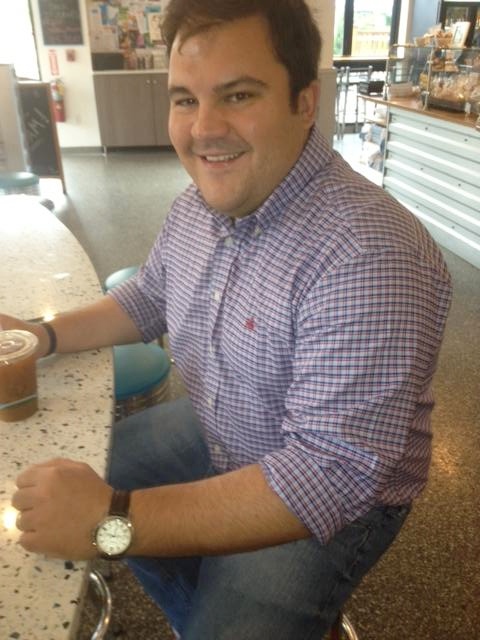
^ Philip Frattaroli ; at a restaurant, of course….

—- —- —-

Not many candidates for Boston City Council come from the restaurant business. Indeed, it’s hard for me to think of even one. Enter Philip Frattaroli, who owns and operates Ducali in the North End, where he lives in a “fifth floor walk-up,” as he puts it, a living situation not at all uncommon in that ancient part of Boston. restaurants, too, are common in the North end, but not since Dom Caposella, who after losing a race for State Representative, opened a fine dining spot named “Dom’s,” on Commercial Street, decades ago has North End politics and restauranting come together, as Frattaroli has now done at age 31.

Frattaroli was born in the North End — “how different it was !” he recalls — into a family that, like so many North Enders since 1900, had come from Southern Italy : the town of Avellino (Dad) and the Abruzzese (Mom). And, as Frattaroli tells it, they soon opened up a restaurant — and moved to Winchester, where their son graduated from high school.

“I grew up in the restaurant business,’ he says. “it was something i wanted no part of as a career, though. and when my brother was killed by a negligent driver, it changed how I looked at everything. So after college, I went to Suffolk Law School and then to practice law.” But the restaurant business came back into his life anyway “I came up with an idea for a place and so decided to get involved in my own restaurant. Thus Ducali.”

Being a small businessman, says Frattaroli, makes him “a candidate who knows what it might be to lose money.” And as a restaurant owner, “I know what a small (food) business has to go through, all the licensing, the city departments…I’m a lawyer, and it’s hard for me. imagine what it’s like for an immigrant.” But, he continues, “I’ve created jobs in the city, I’ve been through the 1010 Mass Avenue (inspectional services department) process. (Don’t forget) “the North End turned around (and became what it now is) because of small business.”

Having heard this assertion, I felt the need to ask him an obvious licensing question : “So, do you agree with Councillor Pressley’s Home Rule petition to give Boston power over its own liquor licenses ?”

Frattaroli responded at gtreat length. After all, this is the issue he lives by:

“Not sure I agree. To go to an uncapped liquor license system (means that) all the small businesses that have played by the rules will suffer. Their licence is their chef asset. Her home rule proposal needs to be modified. Somerville didn’t go to an uncapped system when they revamped their licensing a few years ago; why should Boston ?

“The licenses aren’t the problem, it’s where they are given out. Some neighborhoods have too many, some have none. Ten percent of all people (employed) in Boston are employed in the restaurant business. The goal here is (to not hurt them). With me, you have somebody who knows the business (and I’m saying that an) uncapped system is going to hurt the current restaurants. Keep some cap on the total.”

It’s clear from the above conversation that Frattaroli’s unique quality as a Councillor is his experience in the restaurant business. thus went Here and Sphere’s first question to candidates. the conversation continues (“HnS” for Here and Sphere):

HnS : What are your two top priorities as a Councillor at Large ?

Frattaroli : “First, small businesses and how the City treats them. Second, young families. We need to make the city easier for them to stay. This involves, first, better assignment process for schools. Schools have to be neighborhood schools. Second, sports programs in the schools, such as Boston Youth Wrestling. it’s proven that kids involved in wrestling don;t drop out of school, and wrestling, unlike basketball or football, is for kids of all shapes and sizes. third, late night transit. it;s better for the city and for safety and for the businesses. Lots of younger people work late and can’t get home.”

HnS : What about the BRA ? Replace or rerform ? If reform, in what ways ?

Frattaroli : “reform it. My friend bought a condo and had to pay the BRA a percentage of the buy price ! he BRA should be treated just like a government agency.

“There should also be transparency. How did the Seaport area get all big-chain, nationally owned restaurants, and none locally owned ? (We still don’t know the process of that.) And to get there you have to have a car — it’s too far to walk. Who planned that ? It all has to be reformed. I’m on the local neighborhood council, and we can’t find out what is happening. (As for the Council having a say,) the budget for the BRA. that is where we come in.

HnS : School reform : what on John Connolly’s school agenda do you favor ?

Frattaroli : “There’s data on what works. We have to replicate (that.) Innovation schools (work). (Take) the Eliot. The teachers there have given up some of their contract perks. We can’t (just) hold on to a system that protects vested interests. (I think of) a school in South Boston (that) had a teacher who was teacher of the year, yet the school had to let him go because he was the last one in !

“A longer school day ? As long as its used the right way, yes. We have to take best practices that work, and apploy them here.”

HnS : Lift the cap on charter schools ?

Frattaroli : “Yes, i think I’d vote to raise the cap. Competition is good. Restaurants are a meritocracy. (why not schools ?) Charter schools (apply) a lot of innovations.”

HnS : Marty Walsh says there’s a heroin epidmeic in Boston. Do you agree ?

Frattaroli : “There’s a drug problem. Whatever the drug is — it’s in society in general. The sports thing that I mentioned is so important (here). As a wrestler, as a kid, I was saved. I made sure that I was never not ready. Kids in sports have mentors. Especially the young men; it’s an important part of their coming of age.”

Frattaroli has had success raising money for his first run at public office. He has raised $ 70,000, he tells me, with a smile. It continues. “You’ll see,” he says. “On Monday evening there’s a fundraiser for me at Ecco in East Boston. the State Rep, Carlo Basile, will be there. Come and see how we’re doing !”

—- Michael Freedberg / Here and Sphere

PROFILING THE BOSTON CITY COUNCIL CANDIDATES : CATHERINE O’NEILL

Image

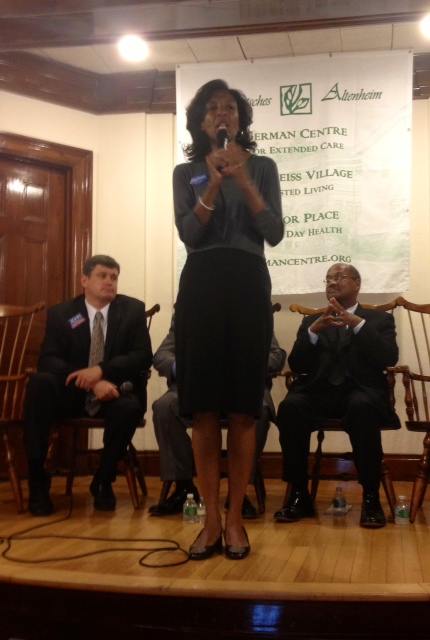
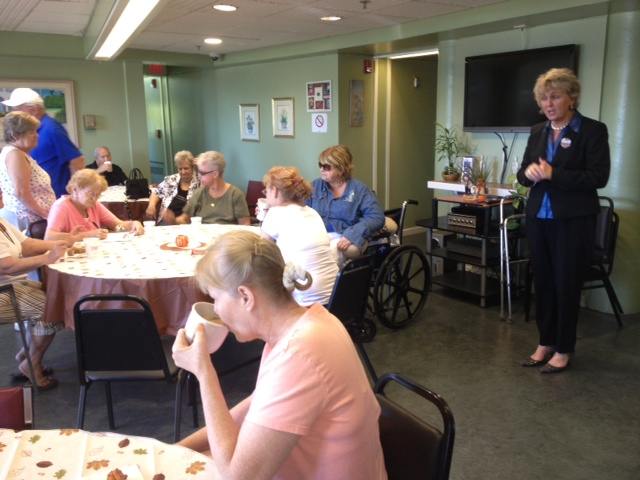
^ Catherine O’Neill, of the Lower Mills O’Neills, conversing with a roomfull of Seniors at Foley House, South Boston

—- —- —-

There’s something of a Dorchester revival afoot in the City of Boston, an irish-name revival too. Here, in a city decreasingly peopled by those of Irish-name, we see on the Council at-Large ballot a Mike Flaherty; a Stephen J. Murphy; a Jack Kelly, Marty Keough, Chris Conroy, and — by no means the least — the subject of today’s profile, Catherine M. O’Neill, of the large and well, well-known O’Neills of Lower Mills.

It would be hard to have been any sort of active Boston citizen these past forty years and not known at least one of Catherine O’Neill’s siblings. Her brother Tim has been a public prosecutor since the early 1970s; brother Tom was a legendary principal at Mattapan’s famed Solomon Lewenberg School. Brother Ted O’Neill has been well-known too, and her late brother Mike — known to hundreds of politically busy Bostonians as “wide Mike,” — who always reminded me of what the poet and playwright Brendan Behan must have looked like, a presence as physically awesome as he was likeable.

Catherine O’Neil has Mike’s fierce eyes and Viking face, and something of Tim’s soft forehead, and it’s hard to figure how this writer somehow did not meet her back when her brothers were a constant presence. Turns out that her career  followed an entirely different trajectory ; she’s a published playwright (that Behan connection ?) and a media person who hosted The Boston Connection, All About Boston, and the Dorchester Connection, all on BBN-TV.

O’Neill went to St. Gregory’s School — where her Dad was a janitor — for thirteen years, then got her degree from Suffolk University in communication and journalism. She also has a master’s degree in Fine Arts.

She never married — a loss for the best Boston men of my generation — but as a child growing up in a large family, it comes second nature to her to care about people. And so, when Elizabeth Warren, who knew of O’Neill from television , asked her to work on her Senate campaign, O’Neill was ready to take her caring into the formal political groove,

Cath O'Neill and Sen Warren

^ Catherine O’Neill with senator Elizabeth Warren

She found the experience to her liking, and after Warren was elected, went to work in the campaign of her Lower Mills neighbor, Linda Dorcena-Forry — wife of Bill Forry, whose father Ed was “Mr Dorchester News” for several decades — for State Senator. Dorcena-Forry was already the Lower Mills area’s State Representative; indeed, O’Neill had been her field director in her 2005 first campaign. Dorcena-Forry’s Senate campaign made history. She won over the South Boston candidate, becoming the first Dorchester candidate to do so, and the first person of color to represent the District.

O’Neill was now ready to become a candidate herself; and when Tom Menino’s decision it to run for a fifth Mayoral term opened up two of Boston’s four at-large Council seats, her time had arrived.

We chatted with O’Neill three times; stood with her as she greeted voters at a Marty Walsh rally in East boston; and saw her in action conversing with voters at the Foley House in South Boston. There was never a minute in which she did not connect eye to eye with voters together an d singly; the experienced media hostess this was ever in command, credible, likeable. Thus our first question — what special qualities do you possess to make you uniquely qualified as a Councillor ? — answered itself.  Not many Council candidates are published playwrights and accomplished television show hosts,

Our conversation continues (Here and Sphere as “HnS”) :

HnS : Your first priority as a Councillor ?

O’Neill: Seniors. My Mom is 93 years old. I know the needs of seniors first hand. Seniors need all the help they can get. Longer stop lights at crossings, better curb cuts. Safety of the neighborhoods !  I will be an advocate for seniors ~!

Here and Sphere (HnS) : Do you favor lifting the charter school cap ?

O’Neill: no, I do not favor it.

HnS : What school reforms do you favor ?

O’Neill: I think a longer school day is a good idea.

HnS : The BRA : replace / reform ? If so, how ?

O’Neill: There needs to be separation of planning and decision, so that the community can have input.

HnS : Speaking of safety, Marty Walsh has said there’s a heroin epidemic in the city. Do you agree ?

O’Neill : The first documentary I did, for BBN television — in 2001, produced and wrote — was on the heroin problem in the city of Boston. It was epidemic in proportion then, and I know we still have that problem with it in our city. The shame is not to be a heroin addict; the shame is not to do anything about it. Heroin addicts, and addicts generally, usually have no advocate. There’s nobody out there beating a drum for people who unfortunately are addicted to heroin.  and I…i would be an advocate. we need more beds for women (addicts too). I really do know a lot about his subject, because of my friend, now deceased, who was the head of the drug corps at South Boston District Court,. it was he who asked me to do the documentary.”

That O’Neill proved so conversant of Boston’s heroin problem surprised me. It probably shouldn’t have. It’s the kind of problem that a television discussion show, such as O’Neill hosted, wants to focus on. Proof that her television experience offers more than just show time to the City Council if she’s elected.

—- Michael Freedberg / Here and Sphere
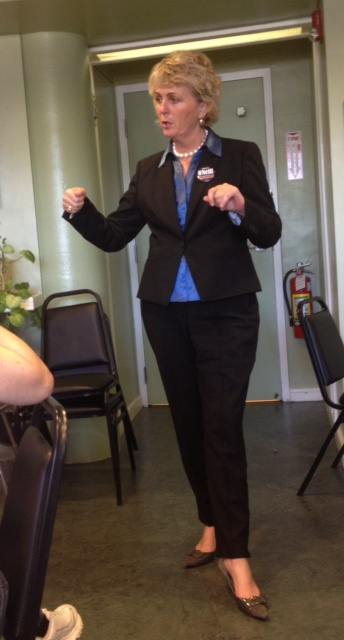
photo (62)

^ Catherine O’Neill advocating to Seniors at the Foley House on H Street in South Boston.

BOSTON MAYOR RACE : PRESSURE POLITICS TAKE OVER

Image

^ crunch time numbers cruncher : Charlotte Golar-Richie

—- —- —-

The City’s Black political leaders are gathering, it is reported, to try pushing some of the candidates of color out of the race for Mayor. This comes as no surprise. The surprise is that it didn’t happen sooner. Or even that it was needed at all. it should have been obvious to every one of Boston’s six candidates of color that if there were more than two, none would make it to November. Even with only two, it’s no guarantee. But with six ? And so the pressure begins to get to the obvious : have the “extras” drop out and endorse Charlotte Golar-Richie.

Good luck with that. Why should John Barros, her chief competitor within the Black community, drop out and endorse her ? His vision is very different from hers, his connections more like Connolly”s or Mike Ross’s. As for Charles Yancey and Charles Clemons, each has his own agendas that will seem better served by remaining in the race.

Image

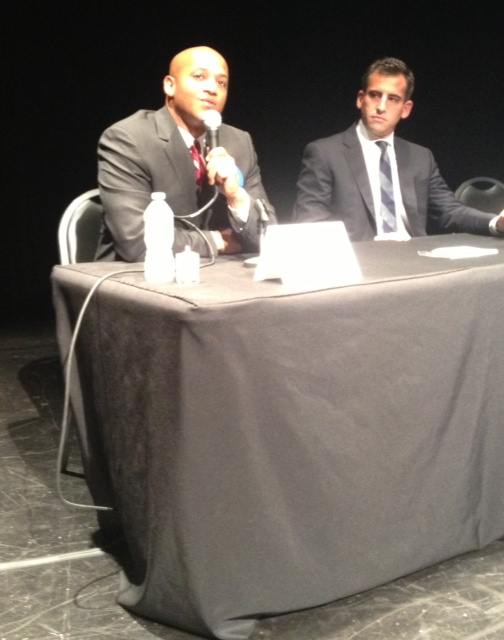
^  John barros (on left) : crunched out ? probably not

The intended recipient of said endorsements claims no part in this effort. That’s wise. No voter likes having a candidate trying to limit a voter’s range of choices. Yet Golar-Richie has been making a dedicated effort of late to bring Boston’s Black political “heavies” into her campaign and has had notable success doing so. She knows better than anyone that if six candidates of color remain in contention on September 24, it will be next to impossible for her to get the 22 % of the vote that some wise heads say will be the November entry point. And so the pressure, by her key supporters, if not by her, cannot be avoided.

Golar-Richie is hardly the only contender using pressure right now. Marty Walsh used the Greater Boston AFL-CIO’s annual Labor day breakfast to make his Labor banner a must for as many union activists as possible. Walsh’s chief rival, John Connolly, has brought forth several endorsements of note, the latest being State Representative Nick Collins of South Boston, who just this morning announced his formal support for Connolly at a press conference in front of the Perry K to 8 school on east Seventh Street in South Boston. At that conference Collins and Connolly emphasized the pair’s long collaboration on Boston Public School reform. Both also emphasized the needed for much more transparent city administration and a dedication to safe neighborhoods — a topic gruseomely dumped into South Boston affairs this past year.

Image

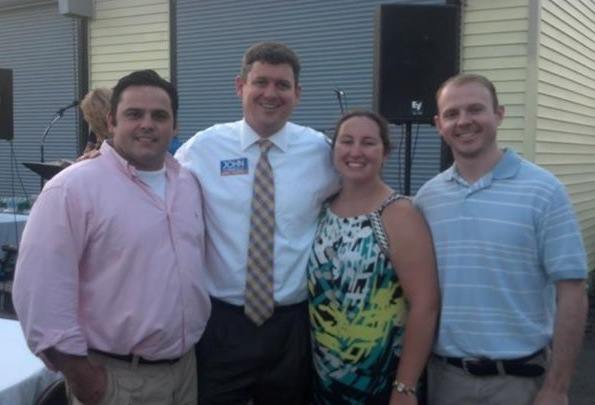
^ John Connolly with Rep. Nick Collins’s brother and Charles Levin at a recent South Booston Leadership conference. His endorsement by Nick Collins seemed likely, soon after this.

Connolly has made much, too, of endorsement by State Representatives Jay Livingstone (Back Bay, Beacon Hill), Carlo Basile (east Boston), and Ed Coppinger (West Roxbury). As his main competitor, Marty Walsh, is a State Representative too, these endorsements hurt Walsh as much as they aid Connolly. (Walsh, meanwhile, has the open support of State Rep Liz Malia and former State Senator Jack Hart.) But the main effect of these endorsements — none of which have yet gone to Dan Conley, who polls a strong third on most lists; will he get any ? — is to pressure the voters. If the pollsters are right, that fully one-third of all who are likely to vote remain undecided about who to choose, endorsements by elected Representatives are intended to push those undecideds to make up their minds. It will surely do that, at least for some.

There will be much more of this pressure coming. Boston’s State Senators ( Chang-Diaz, Dorcena-Forry, Brian Joyce, Mike Rush, Petrucelli ) have yet to choose. Congressmen Lynch and Capuano may weigh in. So might past legislators and major Boston civic associations. As long as the undecided vote remains sizeable, endorsements will be asked for- and probably given. The pressure is on now — on the voters, to decide, once and for all, who to send to the November final.

Image

^ Dan Conley : strong third in polls, but no big endorsements yet

The pressure is also on the twelve contenders. Surely all of them know that they either have a good chance of making “the cut,” are losing ground, or are as out of the running as can be. The candidates out of the running can shrug it off and enjoy two and a half weeks more of forums and speaking on the issues. The candidates one feels for are those who are losing ground. Mike Ross, Felix Arroyo, and Rob Consalvo all, at one time, looked strongly in contention. All have found themselves blocked, however — Arroyo by not receiving union endorsements he might have won, Consalvo by too small a base, Ross by not having command of his own, zipcar-bicycle-restaurants base — and, in Arroyo’s case, passed over by leaders and political activists who made his father a political success and did the same, at the Council level, for the son. Arroyo, Consalvo, and Ross have had to learn, perhaps painfully, that when one is running to be Boston’s all-the-marbles Mayor, people make an all-the-marbles choice of whom to be with.

Image

^ Mel King : should, by all philosophical coincidence, be with Felix Arroyo, but it appears that he isn’t.

And so, as we head into the typhoon of pressure, four boats remain afloat : Connolly, Walsh, Golar-Richie, and Dan Conley. Boston’s next Mayor will be one of these. The voters are beginning to realize it and to decide just who it is that they like.

—- Michael Freedberg / Here and Sphere
–MASTERING MOMMY’S MORNING MADNESS —

hereandsphere's avatarCoffee or Vodka?

–MOMMY’S MORNING MADNESS–

Dear Parenting 911: I have a 8-year-old daughter who just started 3rd grade. She has suddenly become MORE than independent. Ever since she started school — I have been allowed to pick her outfits — do her hair — and help with all other “School preparations” — now suddenly I am no longer invited or even allowed to HELP. I am not only perplexed by her sudden HATRED for my “awful taste”, in everything from hairstyles to clothing choices but I must admit I am slightly hurt — and feel almost angered at the way she speaks to me in the morning, and how long it takes her to “GET READY – On her own.” I am now always late to bring her to school — thus making me late to work. I feel like I have completely lost CONTROL of our super…

View original post 917 more words

FALL RIVER, FREETOWN — 6TH BRISTOL SPECIAL ELECTION — SEPT 10TH

Image

^ Fiola : state transportation funds will help Fall River. Steinhof : too much EBT and MBTA fraud going on to ask for new funds

Next Tuesday voters of Freetown and the North End of Fall River will go to the polls to choose a new State Representative. The vacancy results from the resignation several months ago of State Representative David Sullivan.

The candidates are David Steinhof, a third-generation Fall River dentist, and Carole Fiola, whose husband Ken Fiola is vice-president of Fall River’s Economic Development Office.

At a debate a few nights ago, as reported in the Herald News, Fiola said that she supports the State’s new gas and cigarette tax but not the software services tax; Steinhof favors n o new taxes. Fiola said that she supported the two taxes — but not the software tax — because Fall river needs new funds to improve transportation to and from the city’ Steinhof says that Fall River doesn’t need new funds because it’s already got a great, deep water port, as he put it.

Steinhof also said that with all the “fraud,” as he put it, going on in the EBT program and in the MBTA, the State can find funds by eliminating the “fraud.”

Polls open at 7 A.M. next Tuesday.

—- Michael Freedberg / Here and Sphere
BOSTON MAYOR RACE : THE FIGHT FOR VOTES

Connolly Walsh 1

^ The top two continue to be the top two.

—- —- —

Yesterday was a holiday, Labor Day.

Oh really ? Not for the serious candidates for Mayor, it wasn’t. They knocked on doors, stood out at supermakets meeting and greeting, held fund-raiders, made speeches. Still, it wasn’t as simple as that. There was method in their movements. they “worked their base.”

Marty Walsh, who has made every effort in this campaign to live up to his being a “son of labor,” gave a declaration-of-agenda speech at the Greater Boston Labor Council’s annual labor day breakfast.

Felix Arroyo, who has campaigned as tribune of the city’s needy, outlined his “pathways out of poverty” in a speech to public housing residents in South Boston.

John Connolly, of West Roxbury, greeted shoppers for ten hours at Roche Brothers on Centre street.

Charlotte Golar-Richie firmed up her support among the City’s old-line Black leadership.

Dan Conley schmoozed with a fellow District Attorney.

Rob Consalvo, of Hyde Park, held a huge bash in…Hyde Park.

photo (20)

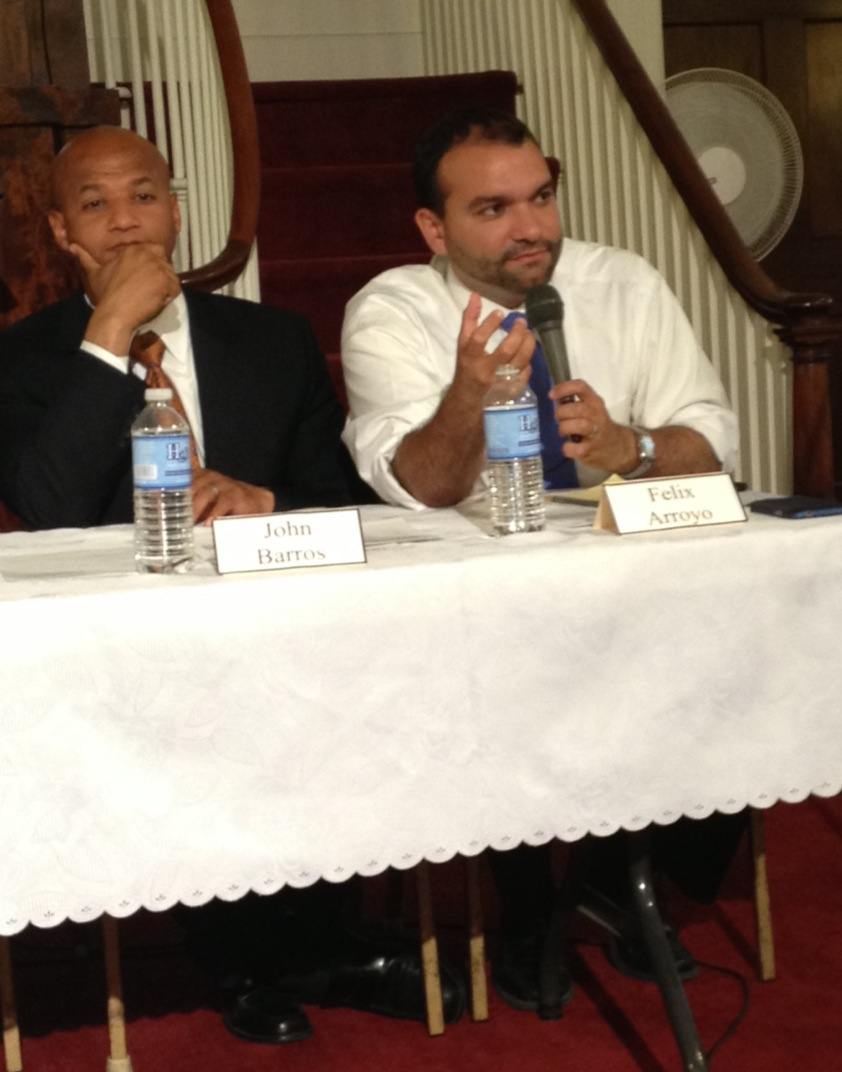
^ Felix Arroyo : is his “base” big enough ? Will it turn out in big enough numbers ?

That these folks campaigned to their “base” is no mistake. With three weeks left until Primary Day, and at least sevEn potential winners running, the time for Mayor hopefuls to campaign all across Boston has ended. They’d be kidding themselves if not. By now, the voters who are going to actually vote on September 24th have gotten to know many of the serious candidates fairly well. they probably like several. But a candidate can’t settle for being liked along with others. It is time now to assure the votes of those who know the candidate best — to “bank” them (as we used to say; and to keep those votes away from all rivals. That means visiting the “base” a lot now — again and again.

Still, no candidate with a serious chance of making it to the November final can afford to forget voters not in his or her “base.” Second-choice votes may well make the difference between making it to November and not. Consider, too, that even the two finalists will likely not get more than 20% of the Primary vote. Which means that the ultimate winner in November will owe a majority of his November vote to people who did NOT vote for him or her in the Primary. A serious candidate must work to become many voters’ second choice even now, before they will actually vote for that candidate. Fascinating !

Working for second-choice votes requires a candidate to not get too narrow with his or her theme. Narrow themes, like Bill Walczak’s “no casino” mantra, may win some first-choice votes, but they don;t sow many second-choice seeds. (Example : Mel King in 1983. He voiced the far left’a agenda as stridently as today’s Tea voices the far right.. Far left purism got King to the final but guaranteed his November defeat.) Several of the candidates in this Primary have voiced narrow themes, though none so stridently as King in 1983.

We have talked of a candidate’s “base.” What of their count ? At this point, the candidates’ bases can be counted with some confidence :

Marty Walsh has the largest base : organized Labor — to the extent that its members live in the City ; many don’t — and much of Dorchester, a strong showing in South Boston, and no less than second in Charlestown.

John Connolly has the next largest base : school reform-minded parents — and West Roxbury-Roslindale, which by itself will likely total 10 % of the city’s primary vote.

Consalvo Mayor

Rob Consalvo : loss of vision or clarity ?

All of the other candidates all have problems gathering a base big enough to measure up to Connolly or Walsh. There is, actually no way that Conley, Arroyo, Golar-Richie, Ross, or Consalvo can win the Primary on base votes only. Each draws significantly from the others — less so from Walsh and Connolly, because Walsh and Connolly are now perceived by many voters as likely to win the Primary; and voters who like one or both of Walsh and Connolly, as well as some of the other contenders, would defy voting behavior were they to vote for someone they perceive as not likely to win.

Of all the candidates trying to catch Connolly or Walsh, the one who has the strongest chance is Golar-Richie. As the only woman in the race, she has unique appeal to Boston voters, most of whom are female. Arroyo must win to nhis side many voters who do not often vote in City Primaries. Consalvo needs to find a campaign rationale. Dan Conley suffers from simply being too much like Connolly or Walsh in outlook and image. As for Mike Ross, he doesn’t have a message that resonates much beyond Downtown life.

photo (47)

^ Charlotte Golar-Richie : do not count her out. And if she makes it to November…..

For Walsh and Connolly, the task now is to speak broad themes, inclusive themes, and look as well as talk as Boston’s visionary and also ambassador to the entire economic world. They must talk big in magnet words and make voters look to a brighter day.

The chasers need to attack the leaders, question their themes, dispute their ability to do what they say they will do — and to show how they, the chasers, can do the big stuff better.

Soon we will see if they can do that.

—- Michael Freedberg / Here and Sphere

SALLY CRAGIN : LIFE IN TRI-TOWN

Image


Growing up in Lunenburg, MA, population around 5000 with no streetlights in my youth (now there are at least a half-dozen), I couldn’t wait to get to the big city. And when I got there I became a journalist, first a rock critic, than an arts reviewer. I’m writing about these experiences on the Phoenix alumni page on Facebook (email me at sallycragin@verizon.net) if you want the installments. It’s pretty funny — a coming of age story provisionally titled “Teenage Typesetter on the Night Shift.”

Of course now I’m a mom in a mini-van, making my living as Symboline Dai, STILL writing for the surviving Phoenixes (Portland, ME and Providence, RI). And I’m doing what I said I’d never do, which is living in my homeland.

My husband and I live in Fitchburg — yes, we’re a stop on the Commuter Rail. We have gorgeous Gilded Age housing stock for tiny, tiny sums (houses go from $40k to $200 and up), a great mayor, our friend Lisa Wong, and superb and constantly improving public schools. Recently, Fitchburg State College upgraded to a University, and I spend my Tuesdays overseeing Riverfront Children’s Theatre, which I co-founded with my mom. We have an 85 year old Community theatre, Stratton Players, tons of hiking trails, we’re 5 minutes from Mount Wachusett, you can finally get a decent cup of coffee, and I’m very active in ACE, a group I started. ACE Central MA is a volunteer group that assists the Shelter animals of north central Mass and presents school programs to ALL the kids in school (last year, more than 5000 kids heard our message). More at ace4animals.org.

So Here and Sphere’s editor asked for info on what’s going on here. Answer : Lots!
The Historical Piano Concerts up in Ashburnham is the big winner. They’ve been written up in the NYTimes, and years ago, when Patricia and Michael, the owners only had, say 30 historical pianos, I wrote a piece about them for the Globe. Their concert series is broadcast on public radio and takes place in an acoustically resonant Congregational Church in the center of Ashburnham. There’s more at fitchburgfun.blogspot.com, but here’s a sampling of what you’ll find this month….
Come visit!

Sally Cragin

SATURDAY, SEPTEMBER 7
FITCHBURG ART MUSEUM sponsors’ Nora Valdez’s public art celebration, 1 to 3 pm, Prichard and Main Street, Fitchburg, FREE. Public Art Installation, and discussion. Refreshments, dancing, fun, and food! FREE

SUNDAY, SEPTEMBER 8
Historical Piano Concerts from The Frederick Collection of Grand Pianos at 4 pm at Ashburnham Community Church, Ashburnham. 978/827-6232. piano.fred@juno.com. MIHAI TETEL, violoncello & IRA BRAUS, piano by Caspar Katholnig, Vienna, ca. 1805-1810 play Ludwig van Beethoven Twelve variations in G on See, the conqu’ring hero, WoO 45 (1796), from Handel’s Judas Maccabeus, HWV 63 (1746); Andante con variazioni in D for mandoline & harpsichord, WoO 44/2b (1796), arr. Steven Isserlis; Twelve variations in F, Op. 66, on Ein Mädchen oder Weibchen, and Seven variations in Eb, WoO 46 (1801), on Bei Männern, welche Liebe fühlen, both from Mozart’s Die Zauberflöte, K.620 (1798); Franz Joseph Haydn Divertimento in D (misc. movements transcr. by Gregor Piatigorsky); Luigi Boccherini Sonata No. 4 in A for violoncello & Bc, G4 (ca.1770).

THURSDAY, SEPTEMBER 12
>^^< STORIES AND SHELTER CATS, Fitchburg Library 4:30 pm (immediately after LEGO club). MEET a shelter cat, HEAR a cat story, MAKE a cat-related craft. Sponsored by ACE and Fitchburg Friends of Felines.

SUNDAY, SEPTEMBER 15
Annual Tori/Finnish Marketplace, 10:00 a.m.- 3:00 p.m. Finnish and Scandinavian wares and pastries, arts and crafts. Local vendors and folks from out of town. This is a great occasion to get holiday gifts, as well as unique crafts from overseas at really reasonable prices. The BEST bread in the world, “pulla” will be on sale. For those who grew up here, you may remember the Finnish Co-Op where the Post Office now is in downtown Fitchburg. That’s where I had pulla during my childhood and became Finnish-by-proxy. At the Tori, you’ll find beef stew, vegetable soup, hot dogs, coffee & Finnish coffee bread, Arctic sundaes. Finnish Center at Saima Park, 61 Scott Rd., Fitchburg, MA 01420. Call or email Maija at 978 582-7717 or mailis1@aol.com

—- Sally Cragin — Blog 810

LABOR DAY : LET’S WORK TOGETHER

Wilbert Harrison’s great song really does say it all.

“Together we’ll stand; divided, we’ll fall. Come on now, people, let’s get on the ball ! Let’s work together, every boy, girl, woman and Man !

“When things go wrong, as they sometimes do, the road to travel is all of you !”

On this Labor Day, when so many loud voices are abroad in the hand decrying those who suffer, those who want, those who work for wages so cheap that they must have public assistance to make do; when politicians think it good and proper to demean people for the lifestyles they live; when talk show charlatans insult everyone and get cheered for doing so; when governments in so,me states resolve to deny people they don’t like the right to vote and to make women’s health care their choice rather than the choice of those women actually being cared for — when all of these events seem impossible to excise from American civic life right now, it is good to recall that the saga of work and workers in our nation reaches its highest achievements when all have worked together. Businesses too. Shoulder to shoulder and one for each other, knowing that, indeed, divided, we will fall; and that together, we will stand. And prosper — every boy, girl, woman and man.

Note that Harrison says “every.’ He doesn’t distinguish between citizen and immigrant :

“Make someone happy, make someone smile; all work together and make life worthwhile.”

Let’s do this. we CAN do this.

All of you. all of us. So yes : let’s work together.

— The editors / Here and Sphere

GROWL, STRUT, ROLL AND RUB : SANTE’ @ ARC NIGHT-CLUB 08.31.13

Image

Sante’ — no real name given in his bio — had played Boston but once before last night’s two-hour set dropped by him on about 150 fans at Arc Night-Club. It’s likely, however, given the lascivious power of his music at Arc, that he won’t have to wait two years for a next visit.

Sante’ is no grizzled veteran of house music — he’s made his bones only in the past six years, based in Berlin, Germany — but he plays like one. The shape of hil set harked back to that of jazz bands back when jazz was dance music played live. Like those bands — Count Basie especially, and his legion of imitators — Sante’ laid down a deep, knees to the floor bass line, extended it, mercilessly until everyone surrendered to it, then complicated it with voice tools, a familiar tune or two, breaks and repeats. Always revisiting the basic groove so that his dancers wouldn’t lose their hold, Sante’ played Noir and Haze’s stomp-and-white-boy “Around,” and — much more usefully — several of his own, girl-and-guy hits — “Bad decision,” “411,” “Make Me,” and “Do You wanna 808” featured prominently — back and forth.

Using two CD players and two mixers, with no pc program, was enough for Sante’ to make his point. He played “for the love of house, for the love of beats, for the love of dance” — quoted the lines — in full sentimental cry. You could almost feel his texture, smell his fruit, rub thigh against the music and be groped by it in return. His bottom was low-note and big-bodied. his middle register varied from percussion to tweetie noises to growly voices — and combinations thereof. His upper octaves pouted and cooed, cried, screamed. Trippy effects and spacey atmospherics put everything, the low notes included, into a kind of perfumed fuzz box. this was music to grind to. Music to run up against, to make oneself horny with. And on and on it went, no stopping, a slow (120 bpm) grumble, sweaty, sleezy.

Sante’ danced as he mixed, as well he might. The great jazz bands’ horn sections danced, too, as they swayed, shuffled, swung. All of that could be felt in Sante’s set too — though, of course, re-phrased for today’s tastes by those fat big boom machines that sneeze the music onto you. But jazz trumpets and trombones had their mutes, to be inserted, or not, or stuttered into, out of, into the horn bell. Consider Sante’s paunchy speakers his DJ mutes. Because, again like a jazz band, Sante’ took his groove and complications well beyond standard progressions into a bewilderment of improvisation, a sandstorm of talk — bits of guy voice here, peeps of girl talk there — that kept on swerving into Sante’s groove line and out again. This was particularly the case with “Do You wanna 808,” his number one Beatport download, a track in which he over-tops frequent mix mate Ramon Tapia’s “Beats Knockin'” with girlies and guys, trippy breezes, glimmer, and melodic drollery. At Arc, he played it as seduction for seduction’s sake — an undertow into which every noise Sante’ could dream up got pulled. The dancers too. They loved all of it.

Image

At its most persuasive, Sante’s sound loomed translucent. It felt blue and looked blue. There was less magic to his pause breaks or to his breaks — twisting and squeezing the sound. A break making genius he is not. Still, there was always enough groove at hand to turn a dancer’s head and bring his or her body back to some of the strongest growl, grumble, roll, and rub that this writer has ever heard a young-generation house music DJ deliver.

Peru’s Ki Ke Mayor opened very much in Sante’ style : a two-hour set of growl anf grumble. There wa less roll and not much rub in Mayor’s blues beat, but that was to be expected. The opening DJ only teases the fans. Mayor teased most effectively.

—- Deedee Freedberg / Feelin’ the Music

MEEK AT THE MOVIES : SHORT TERM 12 ( 3 stars )

Image

^ Brie Larson as Grace, in Destin Cretton’s “Short Term 12”

—- —- —-

Not so long ago, for about two or three years, I taught creative writing to girls and young women who were wards of the state at the Germaine Lawrence School in Arlington, MA. These women had lived hard lives, drug addiction, rape, multiple pregnancies by the age of sixteen and abuse. A friend of mine who worked at the school and knew that I wrote, had grants and was looking for artists to help the girls shape their stories and find their inner voice. I was apprehensive at first, but agreed to do so and found it one of the most rewarding, eye-opening experiences of my life. I’m certain the girls did more for me than I did for them, but there would be times when a girl would not show up for class, and when I would ask why, I was routinely told it was because they had gone ‘on the run’ and was likely using or worse. There were also times when one would have a fit during our sessions and need to be restrained by the ready staff members in the room. It was violent and shocking to me, but overall, these women were raw, sweet and tough yet highly vulnerable. Fragile fierceness is what I called it.

I tell you all this because, in watching Destin Cretton’s consuming “Short Term 12,” a character study about the youth in a temporary home for troubled teens and the adults who run it, I kept having flash-backs to my time at Germiane Lawrence—deeply emotional, affecting ones. Cretton, who’s a young and promising director, actually worked in such a home; he gets the experience down right, and viscerally too, even if you were never aware such places existed or what they are like.

The sweet barb to the film is that two of the young adults who work at the facility (Brie Larson and John Gallagher Jr.) used to be in such a home themselves. The pair, Mason and Grace, are also in an uneasy relationship; yet on the job, they’re composed and in charge. So much so, that it seems as if much, after being in such a home, must have changed and gone right for them. Then, soon enough, we get glimpses into their not-too-distant pasts–mostly Grace’s–and the reality is not very pretty.

Not only do they have their own demons to contend with, but those of the kids; and they possess insight beyond any graduate degree hanging on a wall. In one telling scene Grace tells the resident therapist that one girl is being/has been abused by her father, because ‘she knows.’ Going by the book the therapist disregards what he considers conjecture and the ramifications are profound.

Much of the film grows like that — small moments laced with tension and consequence. Larson brings a gritty intensity to Grace; we see her full-bodied and real. She’s a survivor and a care giver. Both she and Mason do their jobs clinically, but underneath it all you can feel their emotional turmoil raging. That’s not to say the movie is a downer. There are many small quiet victories, but nothing overwrought, and it’s intriguing to watch how the adolescents at the home play off each other. As for the care givers, for you as viewer the film becomes more than just a job. You start to care for these kids, root for them, hope for a better day for them.

It’s a spellbinding realism that Cretton tapped into. I can’t imagine there’s a human being out there that can’t be moved in some way by “Short Term 12.” If enough people get out and see it, the film, even Cretton and Larson, may be hearing their names called in January.

—- Tom Meek / Here and Sphere