1st Suffolk & Middlesex : Turf, Turf, Turf

FullSizeRender

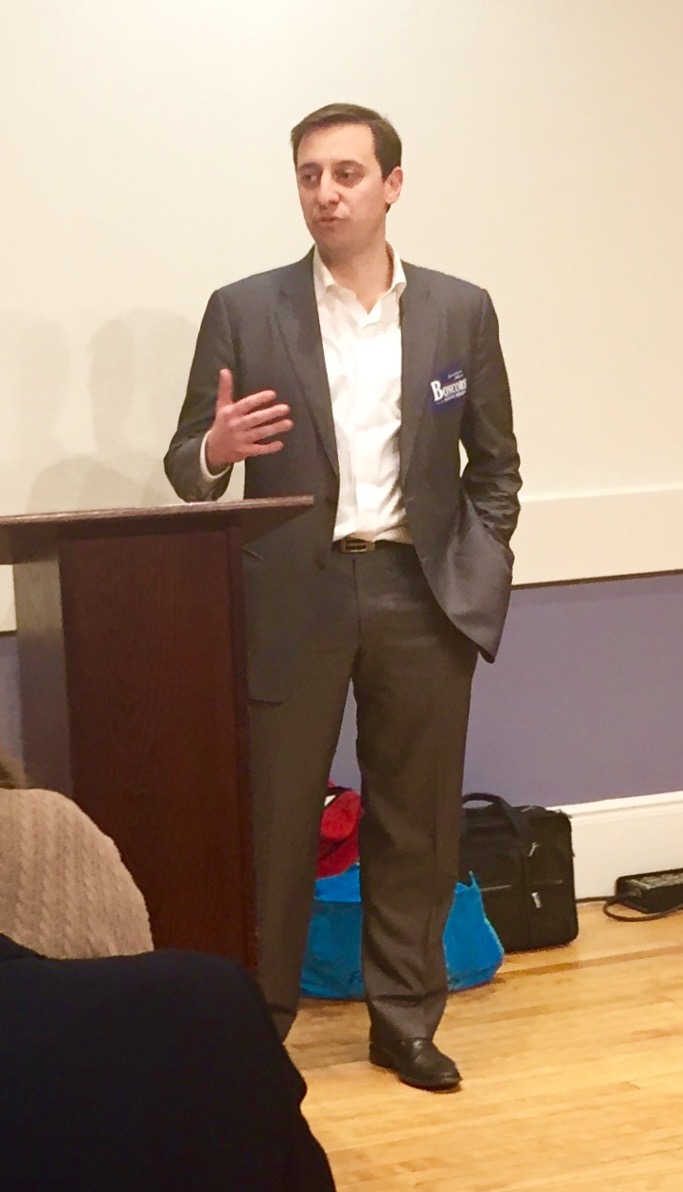
^ State Senator – Elect : Joe Boncore of Winthrop won last night’s primary

—- —- —-

We congratulate the winner of yesterday’s State Senate primary, Joe Boncore of Winthrop. Boncore had a huge and enthusiastic following from the beginning, and it only increased as primary day approached. But he did not win it by being just the good guy that he is. There was a shape to his win, one that drove this contest from the very beginning : turf.

Yes, turf. Where the candidate came from made all the difference. The winner, Joe Boncore, won three-quarters of his hometown of Winthrop’s massive vote; at the same time he received almost nothing in the Cambridge and Downtown Boston precincts. The candidates who won those precincts won few votes in Winthrop and barely registered in Revere — whose former Mayor, Dan Rizzo, overwhelmed everybody in his own city while fading to almost zero in Downtown and Cambridge parts. Rizzo slaughtered Boncore in Revere, Boncore trounced Rizzo in Winthrop. And so it went.

Turf determined turnout, too. There was much talk about “traditional” voters versus “new Boston”; but the East Boston precinct that borders Winthrop is as “traditional” as it gets : yet only 286 voters cast a ballot there, while in the Winthrop precincts immediately adjacent, close to 700 voters voted in each.

Winthrop, which totals about 12 percent of the District’s population, saw about 4100 ballots. Boston, whose precincts take up moire than 50 percent of the District, registered barely 5,420. A town of 18,000 people almost equaled the vote of Boston wards home to about 110,000 folks !

As primary day approached, it seemed that the charter schools cap lift dispute would decide who won. It did not. Boncore had the endorsement of those most opposed to charter schools, Rizzo the endorsement of charter school advocates. Yet I did not see any evidence, on the ground or in mailings, that troops of Teacher Union members or of charter school enthusiasts were knocking doors or filling up the audience seats at candidate Forums. The charter schools furor is fiercest in Boston; yet as I have detailed, hardly any Boston voters beyond the usual political junkies (of which I am one) cast a ballot.

Then there was the “Progressives.” At campaign’s outset, it seemed a wise strategy, for some, to position oneself as “the Progressive candidate”; and indeed, there was a “progressive” vote in yesterday’s numbers. Yet the three candidates who split the “progressive” vote found themselves turf candidates despite. All live in Boston; only one garnered more than a token vote beyond it, except in Cambridge, whose seven precincts were home to no candidate and thus could not vote turf.

To my thesis of “turf” there was one, partial exception : State Representative jay Livingstone, of Beacon Hill, had an additional obstacle to overcome, and could not : income. It was clear from the beginning that Livingstone would find it difficult to interest his very high-earning neighbors in a State Senate race, and so it proved. Turnout in his core precincts was among the smallest. How else ? Not many people earning $ 200,000 to $ 500,000 — a common income in a neighborhood of homes and condos fetching one to ten million dollars — care much who their State Senator is, even if the candidate seeking is their neighbor and friend.

Not all campaigns are equal; and of all the five who placed well, Dan Rizzo confronted the most obstacles. Last November he lost a bitter contest for re-election as Revere Mayor; some of that animus continued : Joe Boncore won 869 Revere votes to Rizzo’s 2643. He was not the sole Revere candidate : a City Councillor, Steve Morabito, competed for Revere votes; he took 549 votes that Rizzo badly needed — his campaign told me they needed 3,100 votes to win, and they were exactly right about that. Rizzo fell 457 votes short of his goal; he lost the contest by 399. Nor did it help Rizzo that Jay Livingstone won 753 votes in a city quite unlike his Beacon Hill home base.

Livingstone’s Revere result — he also won a respectable Winthrop vote — shows that turf could have been surmounted. Beacon Hill’s State Representative put together a following not lashed to zip code. But in a District as diverse as ours, the obstacles of turf and difference cannot be assuaged in brief time; and brief time was all that was available.

Elections are about the future; campaigns create the future’s political shape. But campaigns need time to gestate. There was scant of it in this contest, and so the result had as much to do with yesterday as with tomorrow. The shape of our tomorrow did develop during this brief contest; Diana Hwang to some extent, but Paul Roger, and Lydia Edwards above all — gave it voice, but so did Boncore, who brought a new generation– at least 15 years younger than Rizzo’s — of “traditional” voters onto the battlefield. For the time being, Joe Boncore and his following occupy the front lines of what our District is and will be.

—- Mike Freedberg / Here and Sphere


1st Suffolk & Middlesex endorsements : Livingstone, Rizzo, Edwards

IMG_2034

^ our number two endorsee, Dan Rizzo of Revere, has been the object of all manner of ambush campaigning. Why him ?

—- —- —-

With strong emphasis, we repeat our endorsements, for tomorrows’ vote in East Boston, Revere, Winthrop, North End, Chinatown, Beacon Hill, and Cambridgeport : because this contest has turned ugly in a big way, on many fronts, nasty and manipulative; a backsliding to the ways of local Boston elections 50 years ago.

We at Here and Sphere decry this development.

I personally have been accused of decrying it because the candidate recipient of most if it is one that Here and Sphere has endorsed. Some folks might believe that — and in fact one person, well known in political circles, thus accused me. In fact, we object to it whedrever it occurs:

( 1 ) last minute anonymous smears, usually from PACs,. often in language of insult and ferocity typically found in literature sent out by old line unions (but also common in right-wing screeds). Vested interests do not like the prospect of becoming un-vested, and they are fighting back without scruple. Unfortunately, old line unions are often terrible at reform and resort to vilification and lies where a readiness to embrace reform would be far wiser.

Rizzo has been targeted for smear — and for lawn sign vandalism and late night phone call dirty tricks — because he supports charter cap lift : an increase in the allowed number of charter schools, earmarked to districts designated as “underperforming”; the Boston Teachers Union, which has endorsed a major Rizzo opponent, doggedly rejects charter schools very existence. It has much to protect : a $ 1.03 billion Boston schools  budget bloated with almost 4 100 million in duplication costs, under utilization, feather bedding, and administrative wobble, not to mention a school day shorter than that of any other major school district in our state. Boston’s Schools Budget needs a Fiscal Control board, similar to the one enacted by the legislature to discipline the MBTA’s fat splatter spending; the last thing Boston’s Schools Budget needs is to continue growing as it has. This is of crucial significance right now because a new BTU contract is up for negotiation.

Thus the smear, the vandalism, the late night phone call caper. For the major union opposing Rizzo, the stakes are seven figures long.

It is possible that the instigator of ambushing Rizzo is not a union. But the fact is that he alone has made support for charter schools cap lift a major issue, as other candidates in the race have not.

We at Here and Sphere object– as vigorously as we can — to the last minute PAC smear, which in the name of unreforming, stubborn unions, accuse their target of some sort of class treason. That was the punch in the face given to John Connolly by the AFL CIO in the 2013 Mayor race, and it is the message of the present smear of Dan Rizzo: that someone who runs for office has done something damnable if he or she voted for, or endorsed, people from both parties.

In Massachusetts we vote the person. And endorse the person. Never the party. Given what partisan stubbornness has done to this nation, we in Massachusetts are right to do as we do.

I applaud candidate Rizzo — whom we have endorsed — for endorsing some Republicans. The ones he endorsed are damn good people. I voted for all three. I also voted for Obama in 2012, and for Maura Healey and Deb Goldberg in 2014, along with Governor Baker.  As did at least 400,000 of our voters who elected a superb diverse team of reformers.

That is how democracy delivers. PACs should be abolished, and their bigoted zealotry dispersed to harmless corners of hell.

One way that our District’s voters can do that is to vote for jay Livingstone, our top endorsee; or for Dan Rizzo, our second; or for Lydia Edwards, our third endorsee. Please vote wisely tomorrow. Good citizenship asks it of us all.


—- Mike Freedberg / Here and Sphere

1ST SUFFOLK & MIDDLESEX : THE LAST MINUTE ANONYMOUS SMEAR

Our intention at Here and Sphere was to NOT write again about the 1st Suffolk & Middlesex State Senate primary that takes place two days from now. We made our endorsements; that was that — so we intended.

That intention has now gone by the boards, thanks to a last minute, anonymous PAC smear sent by mail and received by many of our readers this morning. I wanted to post a photo of it below, but the facebook people who posted it have all removed it.

The mailer came from something called “MASS VALUES PAC. Like all such PACs, it hides under the skirts of cynical laws allowing ambush money into campaigns.

The mailing was red bordered and had photos of the three Republicans — Mitt Romney for Governor in 2002 (!), John McCain for President in 2008, and Scott Brown for Senator in 2012 — whom the candidate is condemned for having endorsed. The flier asserts that these endorsements mean that the candidate is not a “real” Democrat and “does not share our values.” This, folks, is garbage.

We condemn this smear, as we do all such. Unsigned last minute vomit has no place in a campaign, and we trust that the voters of our District know this and will reject the puke that someone has barfed into our mailboxes. The interesting question is, which candidate was it intended to help ? And who ordered it ?

Beats me. I know of no one in this seven candudate race insecure enough in his or her skin to okay an ambush. Who okayed it ? Maybe no one. Maybe it came on its own from a vested interest that does not like the prospect of our electing a State Senator who does not lick their butt.

The content of the smear also offends us. The anonymous voice wants to tell us that its targeted candidate is to be rejected because he supported three candidates running in three different, past elections — candidates who happened to have a different political party label attached to their names than the person herein smeared; that somehow he has committed an objectionable sin by choosing to endorse the three named other party candidates. Whereas in fact, all that he has done is to exercise a right basic to all of us : to support the candidates of his choice. (Disclosure : the smeared candidate is one o the three that we endorsed.)

The suggestion is made, in this same smear, that because the targeted candidate has exercised that right, that somehow he is less worthy of running in the Democratic primary that votes tomorrow. I ail to see the connection, and I reject its implication.

In Massachusetts, almost all voters, thank goodness, vote the person, not his or her party label,. as a result, we enjoy the overwhelmingly supported state reforms going on right now, most of them voted unanimously by the legislature. Is there anyone who would want otherwise ?

Our District also happens to be very much a “swing district” in which Republican candidates sometimes win and Democrats sometimes win. In most seriously contested elections, our District votes about 42 peecent Republican and 58 percent Democrat. As there are almost no registered Republicans in the District, its clear that the 42 percent that most credible GOP candidates get comes mostly from voters who identify as Democrats. It has been this way for at least the past 25 years, maybe since the 19th Century.

It’s so because in our District, registering as a Democrat, and voting in a Democratic primary, says nothing about the party platform, or party identity, of the voters who do so. Almost everyone in our District votes in the Democratic primary because that’s where the winner is chosen. Thus those who vote for many state-wide Republicans vote in the local Democratic primary just as do most Democratic voters.

Thus we see that the smear tossed at candidate Rizzo is as ignorant of history and of our District’s basic voting facts at it is contemptuous of the inclinations of our voters.

There’s no surprise in that. Unsigned last minute smears are always the work of ignorant, contemptuous minds. They’re to citizenship what ebola is to the body : a death stink that deserves to be shown the door by every voter who values democracy.

Reject this smear. Send its makers a strong message : you aren’t wanted in these parts, buddy; get lost !

—- Mike Freedberg / Here and Sphere

THE CITY COUNCIL’S BAD ADVENTURE

1 trobada anual

^ Barcelona’s “Consell de Cent” — 750 years since its founding; one year term, scant pay. But it works. Why is Boston’s Council moving in the opposite direction ?

—- —- ——–

Boston’s City Council has just voted to extend its term of office from two to four years. The vote was 12 to one. Only Council President Michelle Wu voted “no.”

The proposal has no chance; the Mayor has to OK it, and then it must gain a majority vote from each branch of the legislature and be signed by the Governor. Not damn likely.

Nonetheless, the proposal is a very, very bad one. Were it to pass, it would, in this age of citizen activism, almost guarantee frequent ballot referenda; maybe even recall elections. The Council argues that the interim election, in years when the mayor is not up for re-election, is expensive and useless, considering the small turnout of voters. Yet were the Council be unanswerable to the voters for four years, there might easily be MORE elections, not less.

As for the argument of expense — to the taxpayers — if taxes are not a duty when used to pay for holding elections, when are they a duty ? Elections are the basic DNA of democracy; fewer elections, less democracy. We probably can’t have elections every year, as city councils almost always did 100 years ago and more, but two years seems a good compromise between constant elections and rare. Two years to take a time out and seek voter approval, or not, of the Council’s record of…whatever.

City Councils, in the Western world, began almost 1000 years ago. Councillors, mostly merchants, artisans and workmen, were active, numerous, and termed to one year at a time. That’;s how it was throughout Europe, where the idea of having city leaders govern themselves took hold.

Perhaps Boston’s Council does need reform. Make it bigger — 25 members, as it was before the 1909 Charter Change, pay the members half of what they make now, and give them 18 month terms. Barcelona’s 13th Century “Consell de Cent” had, as its name states, 100 members. As an institution it lasted for 400-odd years and is back in business again. Venice’s Council lasted even longer. Why not have a Council of 100 in Boston, paid a lot less and drawn by design from artisans, workmen, and merchants ?

It’s also laughable that the Council speaks o expense where elections are concerned but is oh-so-ready to demand more and more taxpayer money for a Boston Schools budget that is already way too obese with inefficiencies, redundancy, and feather beddings. Our Schools Budget holds probably $ 115 million of excess poundage, but somehow that;s OK, while the approximately $ 1,000,000 cost of an election is “expensive.”

Who makes these decisions in the Council’s chambers ? Are they really that tone deaf ? That contradictory ? Do they think the voters of Boston are fools ?

I think the answers to those questions are ( 1 ) rogues ( 2 ) yes and ( 3 ) yes.

—- Mike Freedberg / Here and Sphere

ARE WE “TWO AMERICAS” ?


Click the map to create your own at 270toWin.com

^ towards a new political alignment based on policy, not ideology, in other words, with the existential divisions mostly resolved

—- —- —- —-

Much has been written these past couple years about there now being “two Americas” rather than one. There is some truth to the observation, but much more falsity in it. Those who look at legislation adopted, or partisan preference, look at mostly superficial or passing evidence. Legislation gets enacted because certain interest groups enjoy paramount power. But they won’t always have it. Circumstances change. In a nation as dynamic as ours, they change fast. We may not think so, because the current two-America politics has held sway since the 2000 election at least. I understand that for Americans, seeking overnight answers to everything, might find 16 years an eternity. It is not.

Two concerns currently divide America : ( 1 ) should religion be able to impose its beliefs on public law ? and ( 2 ) should economic inequality be relieved by enacting wage and union organizing laws, and should foreign trade be more or less free or subject to protective tariff ? Of these two areas of division, the more lasting is the second. There has never been, nor likely will ever be, general agreement on how best to regulate the nation’s economy. The history of these economic debates shows, however, that it is a policy division, not a societal one. The only reason that it looks societal is that supporters of each side has come into coalition with a side of the other division.

This, we already know. Commentators have for years now noted and analyzed the present coalitions of economic and societal. What I want to propose are that those two coalitions cannot last much longer, and that when they cease, our national politics — and electoral map — will change dramatically; and that the change will be a good thing.

Societies change before their politics reflects the changes. The political cleavages in place today took 30 years to develop. Organizing special interests for efficient focus on political structure can’t be accomplished in a week or a year.Thus the political organizing that determined the current “two Americas” represents social situations of 30 years ago and more. The leaders are no longer young; some are quite elderly. So are their core followers. Meanwhile, the societies of “red” states currently organized as such have changed quite a bit. Leadership of political churches is changing; of “pro-life” movements; of those who think same sex marriage a sin and thus unlawful. The demographics of “red” states are changing, too. Georgia, Arizona, even South Carolina and Utah, are becoming rapidly less white, or younger, or both; and among people of color, or young, or recent immigration, the “red state”: beliefs are alien.

I see the present intensity of political cleavage as, one the one side, acts of desperation seeking to prevent, or delay, inevitables. But the politics of delay or avoid never work. In a democracy, demography is indeed destiny. On the “blue” state side, the prospects look far less dire. Because they lack well organized “red state” interests, most “blue” states have adopted a politics reflecting demographic changes that have long since taken place.

In “blue” states, the big battle is the economic fight; and that is a matter of policy, not ideology. Business is a practical matter, not a creed; such ideology as there has been in the economic sphere — and for 100 years there was a mighty fight indeed — was resolved by 1989 at the latest, mostly long before that. Because the battles in “blue”: states are policy fights, not credal, and because business is not a temporary, lifestyle matter, “blue” state” voters have fought about ideas, not existentials; and ideas are tools, not identity. Blue state fights debate not who you are but how you are going to pay the rent.

The fights about economic matters – minimum wage, pay scales, stock market reform, union organizing, corporate tax rates and credits, the size of banks, trade pacts — will hardly be simple or polite. But no one in them will question the existential rights of anyone else. We have had fights of this sort all through our history. The Constitution represents for the most part one compromise concerning them. But we live in one economy; that is what the Constitution established.

The politics of who you are, and whether or not who you are is legitimate, I see ending soon; there will be less and less “values voters.” Which means that the politics of all our states will became politics of policy, not ideology; of paying the rent. When that happens, the color of the 50 states on Presidential election maps will change quite dramatically. And we will be one America again.

—- Mike Freedberg / Here and Sphere


SIGNIFICANT WIN FOR US ALL

FullSizeRender

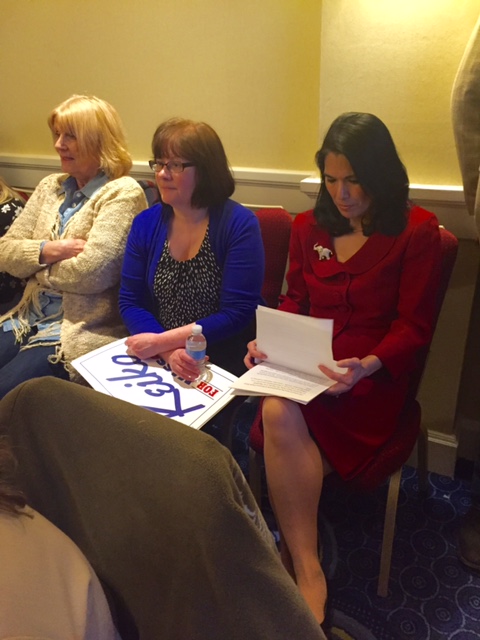
^ hard at work : Keiko Orrall prepares her speech to the GOP state committee at last night’s meeting, where she was elected National CommitteeWoman

—- —- —-

At the organization meeting last night, of Massachusetts’s Republican State Committee, Governor Baker’s candidate for National CommitteeWoman, State Representative Keiko Orrall, was elected by a vote of 41 to 37. The vote was close, as expected. In his campaign to secure a majority of the State Committee’s 80 members, Baker and his campaign team enjoyed only modest success. Yet modest proved enough to win last night’s big test.

Orrall outvoted the sitting National CommitteeWoman, Chanel Prunier. Most of my readers probably have no idea who Prunier is, or why a GOP National CommitteeWoman has any importance beyond party business. I’m going now to try to convince you that Orrall’s win over Prunier is very important:

First, Orrall is an elected State Representative; Prunier is a paid consultant to one or more advocacy groups which oppose marriage equality, LGBT civil rights, and, in some cases, women’s rights to control their won reproductive decisions (often described as “pro life”). Orrall, as a legislator, represents all the voters in her District; Prunier represents only her advocacy group. Should a political party be responsible to all the voters, or to an interest group ? For me, the decision is clear : a political party owes a duty to all the voters.

Second, the National CommitteeWoman sits on the GOP’s national committee and helps direct a national GOP agenda. Having an inclusive realist on the national committee rather than an interest group consultant benefits the party’s appeal beyond its base.

Thirdly, the change from Prunier to Orrall assures voters in Massachusetts that the Republican party seeking their votes values all voters equally, and their views on all the issues. You would think that would not need saying: but in the Prunier world, it was a principle overridden.  That Prunier’s advocacy also happens to be rejected by the overwhelming majority of Massachusetts voters adds injury to insult.

The Prunier approach elects a small minority of our 200 legislators at the expense of surrendering all the rest. It’s a politics of assured defeat.

During the 10 years of Prunier’s political ascendancy, she certainly played a major role in raising the number of GOP legislators from teens to the current 34. But at the same time, she pitted members of her advocacy groups against other GOP hopefuls, in primary fights that guaranteed defeat for all. Hers was NOT a policy of party building.

Keiko Orrall was one of the people whom Prunier recruited for candidacy; and at the time, the then inexperienced Orrall thanked Prunier for her help. That thanks became an issue in the National CommitteeWoman contest. Orrall was accused of disloyalty to the woman who had helped her to win a House seat. But I think that, over the years since, Orrall saw that Prunier’s “help” came at a huge price to the overall party prospect.

The party platform that Prunier and her state committee allies enacted in 2014 musdt have been the last straw to political realists like Orrall. It embraced all of Prunier’s advocacy group agenda, seriously embarrassing the Baker for Governor campaign. Gay voters, and supporters of women’s reproductive rights, major components of the Republican Party’s Governor campaigns since Bill Weld’s 1990 run, turned away; some came back as Baker made very clear his support for women’s reproductive rights and marriage equality; but others did not come back. On election day, Baker did win, but by less than two percent of the vote.

Baker and his running mate Karyn Polito obviously resolved that this situation could not continue; thus the long campaign to gain a majority of state committee members and to win the contest that was finally won last night. Significant public policy consequences ensue. Baker can move forward on all fronts without having to worry that he will face dogged opposition within his own party structure. He now has the kind of control of his own power base that Speaker DeLeo holds in the House.

His hand to negotiate an agenda is much stronger today than it was a few months ago.To all who want the Baker reforms to continue and to succeed, it is hugely important that Baker now holds a stronger hand to deal.

Finally, there’s a lesson in all of this that Masachusetts Republicans dare not overlook. Prunier and the advocacy groups who pay her were able to take over a party small in number, even empty of numbers in many places, and to exploit its smallness to their advantage. They were able to gain control of the party’s very structure and, mostly, to make the party an interest group : their interest group. That it has taken a sitting Governor with 70 percent-plus favorable ratings to defeat — narrowly — this takeover shows just how successful the Prunier venture has been.

There is one note of caution in last night’s Baker win:  it reasserts the primacy of the Governor in a party that has been oriented to winning only that office since 1990, and very successful at it. It is far from clear how the Baker, Polito, and Keiko Orrall party leadership can expand the party’s registered numbers beyond the current 11 percent or increase the party’s legislative numbers past the present one in five. Party enrollment is mostly determined by the big, national picture : and in Massachusetts, only Donald Trump, toxic to almost everyone, has shown ability to bring non Republican voters into the party.

There is also the paradox that, were Republican numbers to increase significantly, Democrats would become less willing to support Republican candidates for Governor. Right now, many Democrats are glad to become part of Baker’s team, because they, too, aren’t altogether happy with unchecked legislative power. Most legislators are chosen in party primaries with maybe 15 percent of all voters voting. In that small a turnout, vested interests can — and do — control the outcome, preventing needed reforms. We see this right now in the charter school cap lift fight, where teachers’ unions and their allies prevent charter cap expansion — overwhelmingly favored by the voters — because they can dictate to legislators elected in small voter turnouts. Thus many Democrats support Republican candidates for Governor, as a “whoa !” against control of the legislature by vested interests these Democrats dislike but cannot defeat in primaries.

These Democratic activists know that a Republican Governor whose support vote comes 75 to 85 percent from non-Republicans is answerable first to them, and that he knows it. Electing him has, in their minds, the right policy significance but is no threat to overall Democratic dominance of our state. If the new GOP state leadership succeeds at enrollment expansion, the election of Republican Governors could become more difficult, not less.

— Mike Freedberg / Here and Sphere


1ST SUFFOLK & MIDDLESEX : JAY LIVINGSTONE OUR 1ST CHOICE; RIZZO & EDWARDS NEXT

FullSizeRender

^ State Senate candidate Jay Livingstone with wife Julie and son Henry James at a Winthrop meet & greet

—- —- —-

No election that we at Here and Sphere have covered has been as difficult to evaluate as the seven-candidate contest to pick a successor to Anthony Petrucelli, who resigned in January as the District’s Senator. All seven candidates would give the District’s voters solid representation. But voters can only choose one; and so must we. Our choice is Jay Livingstone, who serves presently as Boston Ward 5’s Representative in the House.

This was not the choice that we expected to make. Livingstone, as a Beacon Hill / Back Bay legislator, stands well outside the core voter groups this District was drawn to favor and which its predecessor Districts have favored since the 1950s. But campaigns matter, and as this one has developed, Livingstone’s “outsider” situation has changed from disadvantage to advantage. That advantage, which I shall outline below, is the first reason why we endorse him.

I’m referring to a “campaign within the campaign.” Dan Rizzo, who served as Revere’s Mayor, faces off with Joe Boncore, Winthrop Housing Authority member, doing battle over the big-ticket schools issues that are agitating the entire state : ( 1 ) should the numbers cap on charter schools be lifted ? ( 2 ) should standard public schools receive more funds, and if so, where from ? Mayor Walsh and Governor Baker have weighed in heavily on Rizzo’s side, because he supports charter cap lift, as do they; meanwhile the Boston Teachers Union, charter schools’ most stubborn opponent, has endorsed Boncore.

The campaign over charter schools and school funding has driven Rizzo’s and Boncore’s campaigns into a corner — one that their intense, District-wide campaigning has not remedied. Schools issues are certainly major — to us at Here and Sphere as well; yet they’re hardly the only priority the District’s Senator must legislate. On these other issues, it’s far from clear where Rizzo or Boncore stand, or the priority that they will accord to : immigrant rights, the $ 15 minimum wage, additional opioid addiction legislation, MBTA reform, and state budget discipline. (Boncore’s BTU endorsement strongly suggests he will seek new taxes for a system that needs to cut costs, not expand them. On “just cause” eviction, a Boston matter, Boncore is clearly opposed [as are we], Rizzo hesitates, so far, to commit.)

The BTU contract is up for renegotiation right now; last thing Mayor Walsh needs is for the BTU to claim, at the outset of this negotiation, victory for its candidate in an election affecting four of Boston’s key neighborhoods.

Livingstone, meanwhile, has been free to talk, convincingly, about all sorts of legislative matters big and small; and he has done so, at Forum after Forum, with cool competence that demonstrates knowledge of issues and process. He has also amassed a sizeable army of volunteers, most of them quite new to local politics, but also some revered local families : people not consumed by one issue, nor swept into the tribal vortex of Rizzo versus Boncore — so reminiscent, to many, of the Mike LoPresti – Mario Umana grudge matches that divided this District not all that long ago. From Revere and Winthrop to the North End and East Boston, the Livingstone people I have met see him as I see him : comprehensively competent  and hard working.

The second reason that we endorse Jay Livingstone : he is the candidate most demonstrably committed to Governor Baker’s reforms. In the legislature this past year, Livingstone has voted for all of Baker’s major legislation : MBTA Reform, including the creation of a Fiscal Control Board and suspension of the so-called “Pacheco Law”; opioid addiction treatment; repeal of automatic driver license suspension for people convicted of drug use crimes; increased DCF staffing / funding;  and, biggest of all, both the FY 2016 and FY 2017 state budgets, including the “no new taxes, no new fees” criterion insisted upon.

Given his record to date, Livingstone could be a more reliable supporter of Governor Baker’s state governance reforms than Dan Rizzo, who although he does support charter school cap lift, does not, in Forums, always argue its case with as much conviction, or accuracy, as he could.

For both these reasons — his solid record of support for Governor Baker’s state reforms and budget principles, and his commitment to, and knowledge of, a variety of major legislative matters, we are proud to endorse Jay Livingstone to be the District’s next state Senator.

And what of the other six candidates ?

( 1 ) Of them, we have already discussed two. If schools reforms are the only mission that you will vote on, we urge a vote for Dan Rizzo: because we, too, support charter schools cap lift. It should also matter to schools-issue voters that Rizzo has the Governor’s confidence. That is no small matter in a District that enjoys strong ties to Baker politically and benefits from it.

( 2 ) As for the other four candidates, we would like to see their campaigns give voice to interests not so prominent in the big pictures I have outlined above. Of these, the most successful has been Lydia Edwards, an immigration attorney and East Boston homeowner, whose top priority is to give strong voice to those in the District who are not often heard, or heard at all : immigrants and low income workers. Those who operate the levers of political power in Massachusetts count votes ruthlessly; a sizeable vote for Lydia Edwards will convince the power people that there’s a constituency in this District that needs much more policy attention paid to it.

This is not to say that Diana Hwang, Paul Rogers and, to a lesser extent, Steve Morabito have not highlighted significant interests. They have. Hwang and Rogers both represent a new breed of technology-centered candidates using social media networking as a tool for policy progress. Yet I see this sort of campaign as a priority for a future time, not now. For now, the tried and true avenues to policy discussion and implementation hold sway, and in that venue, Jay Livingstone has the greatest command. For most voters in the District, he is the best choice.

—- Mike Freedberg / Here and Sphere


A STEP BACKWARDS ON SCHOOLS REFORM

spilka

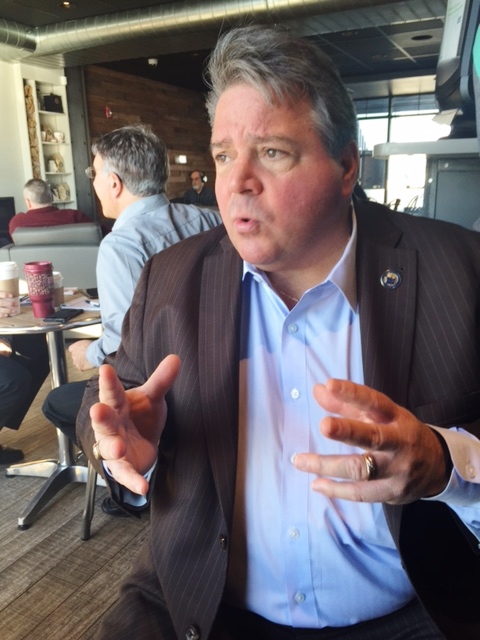
^ nice try, but no thanks : Senators Rosenberg, Spilka, and Chang-Diaz propose a charter schools “compromise” that makes things worse for them, not better

—- —- —-

The State Senate is proposing a Charter Schools bill that it calls a “compromise.” What say ? If I read it correctly, it makes the present inadequate charter schools situation worse, not better. Here’s the bill as it reads today. You make up your own mind whether I’m right or not : https://malegislature.gov/Bills/189/Senate/S2203

The Senate ways and Means proposal is titled “An Act enhancing reform, innovation and success in education.” Nice phrase, typical lavender word-wash. As I read the bill, its primary purpose is to commit the State to allocating $ 1.4 billion of state aid, every year, to each of our state’s numerous public schools districts. In exchange for said money kiss, the bill will authorize additional charter schools without a number limit, but only on condition that all charter schools agree to ( a ) add teachers and parents to their executive board and ( b ) suspend students at a rate no greater than the suspension rate in such school district as the charter school at issue is located.

Condition ( a ) sounds reasonable; but adding teachers and parents to a charter school board is likely to render its decisions more cautious than now, which is the opposite of what school reform needs. Condition ( b ) is simply a deal breaker. It is no business of the state, or anyone, how a charter school decides upon student discipline.

If Condition ( b ) were not already impossible to agree to, the $ 1.4 billion commitment would do the trick. How can the state commit funds it may not have ? Or is the Senate anticipating passage of the so-called “millionaire’s tax” referendum that will be voted at the November election ? That referendum calls for earmarking the anticipated tax revenue to school funding. It is sneaky of the Senate to try to lock into place revenues the voters have yet to agree to, in hopes that voters, knowing that the :ear marked” funds — which never do get earmarked — will in fact be committed to, thereby juicing the “yes” vote on this short-sighted tax grab.

Even if the referendum passes, and the $ 1.4 billion becomes available, is it in fact needed ? Critics of charter schools say that every student that a school district loses to charter schools lowers the amount of state aid it receives. MGL c. 70 offers a compensation formula for that “lost” state aid; but it makes no sense at all. If a district loses, say, 1000 students to charter schools, that’s 1000 less students it has to pay to educate. A district that loses students to charter schools should need LESS money, not more.

Boston’s Schools Budget — the subject of much parent and student rancor — is rife with inefficiencies, under-utilizations, and work rule anomalies that put a high price tag on absurdity. It requires not compensation, but drastic cost reforms. Mayor Walsh and his Education Chief, Rahn Dorsey are working out a ten year plan that will eliminate much of that waste. Why should the state now give Walsh an “aid” bath in which to sing money lullabies to waste ?

A major reason why we see steps backward such as this one, rather than forward, is because most members of the legislature are elected in party primaries with maybe 15 percent of all voters voting. Vested interests almost always control such small turnout elections, assuring that major reforms cannot get done unless there’s a huge public outcry as happened to the MBTA.

What the State should do — would do, if legislators had to face all the voters, not just 15 percent — in the matter of schools reform is to authorize Fiscal Control Boards, similar to the board now overseeing and managing the MBTA’s budget, so that waste and absurdity can be shaved down. Is there any doubt that nothing less than a fully empowered FCB is going to do the trick, given the resistance by vested schools interests to getting their dollars straight ?

Meanwhile, the Senate’s proposal does contain one positive feature : unified school enrollment. Mayor Walsh is already putting unified enrollment — charters and standard public schools all on the same lottery offer to parents — into place in Boston. The state would do well to authorize unified enrollment for all public school districts.

But not in the current proposal, please. I say this to Senators Rosenberg and Spilka : go back to square one, meet with Governor Baker, and give us charter schools  reform, not charter schools vitiated.

Thank you.

— Mike Freedberg / Here and Sphere


1st Suffolk & Middlesex : Disappointing Situation

FullSizeRender(1)

^ cool competence and no obvious weaknesses : StRep jay Livingstone at Ward 3 Democrats’ caucus

—- —- —-

An apo0logy is perhaps in order for my writing again, so soon, about our District’s State Senate election. I’m writing now because the contest is rapidly taking on final shape, one in which all the misgivings I have had about this race have come to pass.

Last night the ward 3 Democratic Committee held its endorsement caucus. None of the five candidates who spoke won the required two-thirds. Joe Boncore received 8 votes, Dan Rizzo 5, Jay Livingstone and Diana Hwang four each and Lydia Edwards 1 vote. All five spoke at length and answered questions.  To the extent that answers to those questions told me what the candidates are thinking, I was disappointed by all except Jay Livingstone. He, at least, spoke a cool competence about legislation actually in process on Beacon Hill and about what he and the House have been able already to do. That said, I am not sure that Livingstone has convinced anywhere near enough voters in the key portions of our District — East Boston, Winthrop, Revere — to gain the prize on April 12th.

The candidates who do look as if they have victory in their grasp — Joe Boncore and Dan Rizzo — both missed the mark last night and have frustrated me before that when it comes to major issues : schools funding, charter cap lift, taxes. Rizzo supports charter capo lift; b ut at the ward 3 meeting, he gave a weak and sometimes incorrect defense thereof. He used the figure 37,000 children waiting for a charter school,when the actual, corrected figure is 34,000; and while he spoke the charter cap lift side’s talking point — that it’s unfair to kids to have to wait for an excellent education — he avoided talk about the egregiously inefficient, often misdirected Boston Public Schools Budget. as Rizzo has proven to me that he knows his issues cold, it was disappointing to hear him speak so vaguely and with such little authority about the major issue on which he stands apart from the candidate herd. Rizzo has also had a hard time figuring out where to stand on “just cause” eviction — an indefensible housing policy that will require a senate vote on any Boston home rule petition that might actually get that far. I am not impressed.

Boncore does not want to be described as advocating higher taxes to pay for the Boston Schools Budget’s supposed shortfall; but if, at ward 3, he did not actually advocate, he sure did express support for applying to schools any revenue that will be arise via the “millionaire’s tax” initiative on this November’s ballot, assuming it passes. It distresses me to hear Boncore speak, time an d again, of the Boston Public Schools Budget, as if it actually is in shortfall. It is not. The $ 50 million that Superintendent Chang says is short is short because of several inefficiencies and anomalies in the budget that he, or the Mayor, or both of them together, could correct, if they had the guts to do so. In particular, $ 863.7 million of the Budget’s $ 1.03 billion goes to salaries alone, and the “cuts’ in Chang’s FY 2017 budget go almost entirely to school programs, only a pittance to salaries. Those salaries include about $ 13 million for teachers who aren’t teaching, at all, because no school principal will have them. In addition, many school facilities are badly under-utilized; but Chang is unwilling to consolidate them because vested interests might storm up an outcry that he seems unready to respond to.

Boncore either does not know of these difficulties, or avoids them because he is the endorsed candidate of the very body most unwilling to reform the Schools Budget : the Boston Teachers Union.

Boncore’s candidacy does have much to recommend it. He has an army of support, has worked doggedly to win more, and on issues other than the schools budget, he adopts the sensible position (he opposes “just cause” eviction, for example). But his willingness to accept higher taxes to support a budget that needs to spend less, not more, is irresponsible and one that, well, disappoints.

As for Diana Hwang, who has charisma to spare and a great life story, her candidacy has plenty of support — but from outside the District. Many power people support her (including a City Councillor and a State Senator)  but no big names from within our actual District. And her campaign’s relevance to actual people, in East Boston anyway, seems well summed up by my friend who today posted these words on his facebook page :

“I saw lots of beautiful Diana Hwang signs on the streets. (The women didn’t know anything about her, regardless.) Her campaign *looked* great. But I checked my phone and saw that, despite her great life story, her head is full of purely liberal and uninteresting ideas: support unions in *all* situations, higher taxes on the rich, more money for public schools, no support for charters, lots more government programs, expand MBTA service regardless of cost, blah, blah, blah.

What a shame! She seems like one hell of a great young woman. Too bad she can’t think outside the progressive box to help the awesome people I met at the park.”

This is where the seven-candidate, party primary platform assures such frustration. Hardly anyone beyond the District’s political community knows much about the seven candidates, or cares, and why should we ? Our interests aren’t being attended to, only the interests of the vested groups that can dictate to an election in which maybe 15 percent of the voters will vote and which will be won by whichever candidate can gain just four (4) percent of all voters. The seven-candidate, party format almost assures that our next State senator won’t represent many of us and will barely figure out the huge appeal, in our District too, of Governor Baker AND of the reforms he is fighting for, few of which any of the seven candidates seems ready to talk about, much less support.

Perhaps it will be Dan  Rizzo, who does at least support one major Baker initiative. I only wish he could argue for charter cap lift with more oomph and mastery of the reasons why, and of the out of whack Boston Schools Budget, which could use — badly needs — its own version of the MBTA’s disciplined Fiscal Control Board.

—- Mike Freedberg / Here and Sphere

1st Suffolk & Middlesex : Almost Time to Select

Boston Area

Boston Area

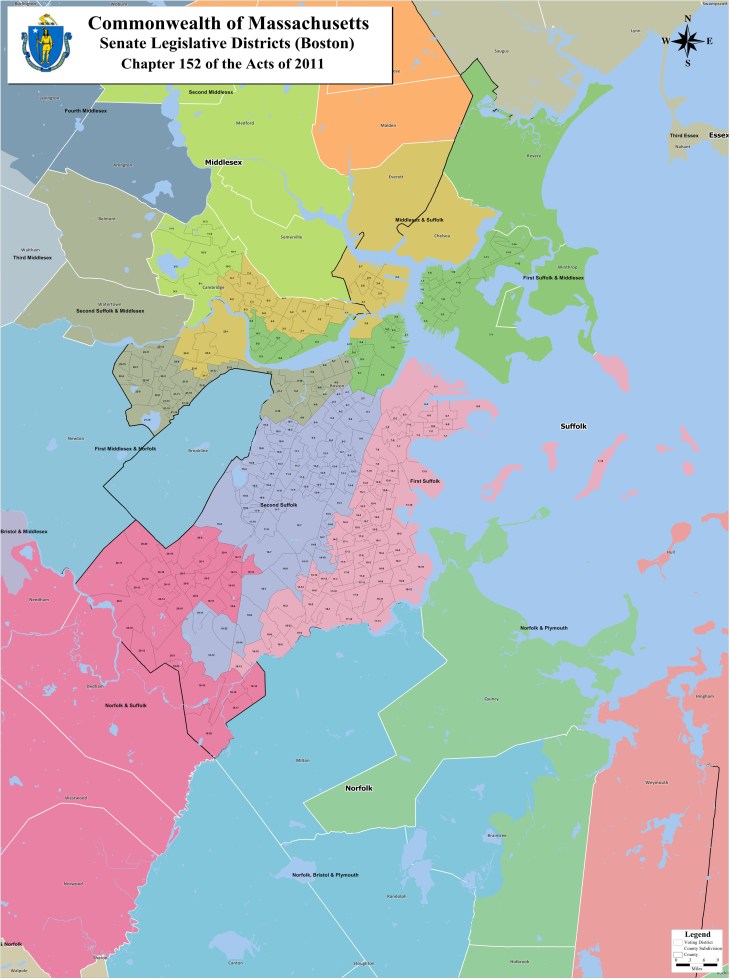
^ in Kelly green at the top of the map is the 1st Suffolk and Middlesex State Senate District. two weeks from today its voters will select a new State Senator. Who will we endorse ?

—- —- —-

The seven candidates must be tired. Exhilirated, excited, weary. But you know what ? So are we, the voters, all of the foregoing. Judging seven applicants for one job cannot be simple. In a District as multiplex a ours, it can’t be perfect either. Not for the voters and not for us at Here and Sphere. There IS no “perfect” candidate in this group. All have flaws. Most have made us glad, angry, disappointed, enthusiastic.

We’ve changed our minds about each and changed minds again. As I have written 600 times, I don’t like the platform : seven candidates means seven special interest groups — maybe more — rather than the one interest group that actually matters : all the voters. Only two weeks remain until voting day, and it’s still not evident that many voters except the permanent political class care much about any of the seven.

That said, as I am a political journalist (as well as a headstrong consultant), I belong, I guess to the political class; thus I care about the race, and for Here and Sphere, I will be assessing the seven for our endorsement article on April 5th. Here’s how I will do the judging :

1.Can the candidate actually win ? Not all the seven look as if they can. Ours is a diverse District, and very hard to travel, straddling as does both Harbor and Charles River. Some candidates have planted evident seeds in all the District’s varied parts; most have not.

2.Has the candidate a clear position on issues that will actually come before the State Senate as legislation ? Many candidates do not pass this test, on one issue or even more than one.

3.Has the candidate an understanding of what the State Senator job actually entails ? Hint : he or she is not going to be a City Councillor and so should not emphasize City and neighborhood issues.

For me, frustration abounds. One candidate whom I like a lot, and who grasps the issues well, seems stymied by the “just cause” eviction resolution now before the Boston City Council (and which is in fact a State Senate matter, as it cannot be adopted without the legislature approving a Boston Home Rule petition). Another candidate, who takes a firm stand on this issue, lands on the opposite side from me on charter school cap lift. A third candidate, who takes firm positions and does not aver, opts for positions very opposite from mine; yet can I not applaud said candidate for having the courage of significant convictions ?

In addition to frustration are a few imponderables : ( 1 ) the seven include one actual, sitting State Representative. Well funded as he is, you’d think he would be an easy winner in a divided field; but he represents a small-turnout slice of the District with a constituency almost completely unlike the rest of the District’s voters. At this point, it’s impossible to see him an easy winner. ( 2 ) in the March 1st Presidential primary, 5,008 voters took a GOP ballot and voted for Trump. How many of these remembered, or cared, to switch their enrollment back to “unenrolled” so as to be eligible to vote in THIS race ? And which candidates will be most hurt by the unavailability of Trump voters ?

Given the complexity of our District and the many candidacies, we are going to NOT endorse only one of the seven. As I see it, we will endorse three who pass at least a couple of the three tests I listed above. I also happen to personally like all seven. There isn’t a twerp among them; none is entirely unready. And so : I’ll have three for you.

I suppose this decision is a bit of a punt; but I see no fairness in paring down to one. Our readership is as diverse as the District, and I think we can cut the endorsement pie in three without need of an apology.

Stay tuned.

—- Mike Freedberg / Here and Sphere