MAGOV14 : JULIETTE KAYYEM GOES ON THE ATTACK

Image

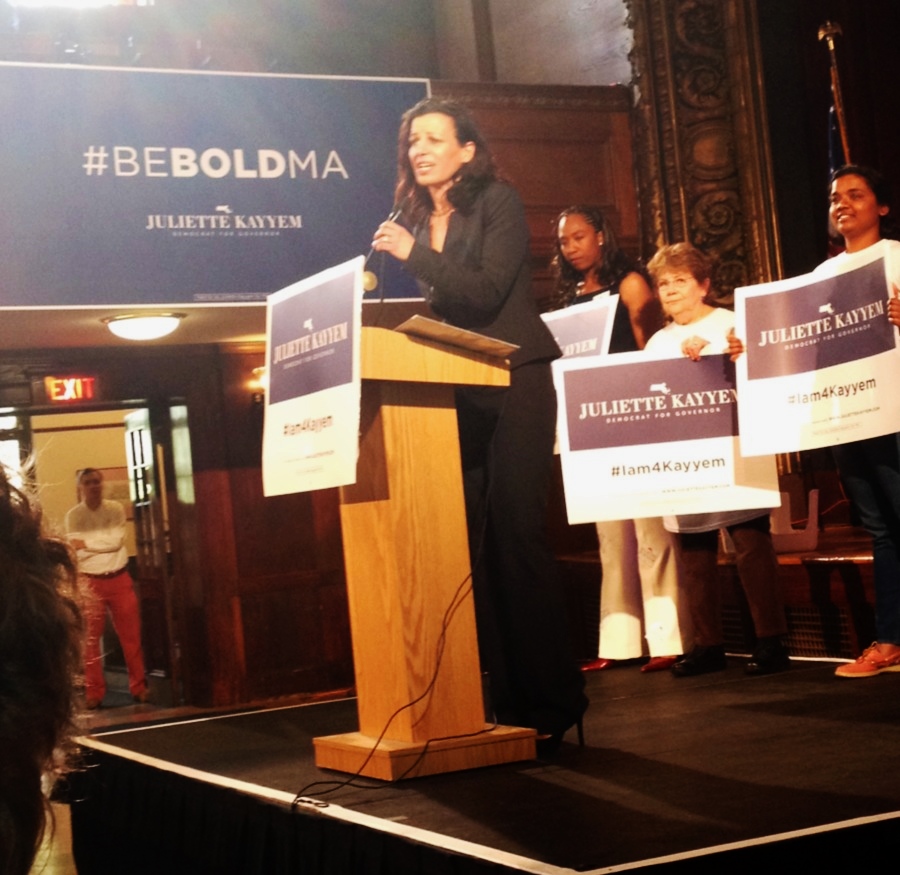
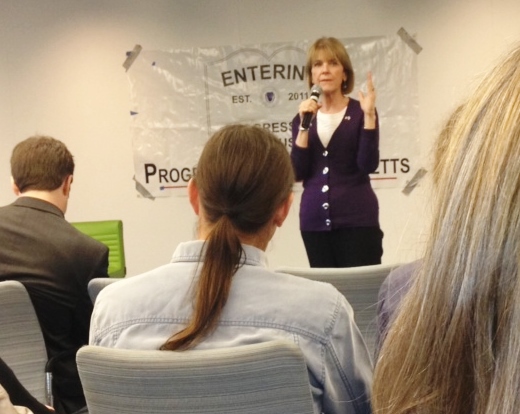
Arlington, MA, May 10, 2014 — Speaking a la stump to about 100 supporters at Arlington Town hall today, Juliette Kayyem spoke loudly of plans, not promises. Eager to distinguish herself from Martha Coakley, and to override Steve Grossman — the two perceived front runners –she exclaimed, in a finger-pointing voice, “nobody DESERVES to be governor ! We can’t just nominate the next in line, this is no time for caution, we have to be bold !”

“We’ve been cautious before,’ she scolded, “and what did it get us ? from 1990 to 2006 we lost every governor election to Republicans, who mostly ran this state into the ground !”

So much for being the first state to enact universal health care (Mitt Romney), the first Massachusetts governor to embrace gay rights (Bill Weld) and to begin the huge clean-up of our state’s rivers and harbors (Weld again). So much for Paul Cellucci and the huge paydays that the “Big Dig” gave to thousands of union construction workers. So much yet again for Bill Weld, re-elected in 1994 by the largest vote margin ever accorded a governor seeking another term.

But if Massachusetts Republicans thought it was they who Kayyem’s “J’accuse” speech had most in mind, they had it wrong. No Republican, not even Charlie Baker, was attacked by Kayyem as fiercely, or in detail,. as Martha Coakley. said Kayyem, “I sat next to Martha Coakley at a Forum and listened as she ducked the question of sex education in early school. ‘mmm, that’s hard,’ Martha said. Well, it isn’t hard ! Not when teen pregnancies are rising, especially in Western Massachusetts !”
Which, of course, is Coakley’s home area.

Kayyem was far from finished. At length she detailed Coakley blocking Governor Patrick’s gun control plans and delaying his moves for CORI reform. And having thus reminded everyone of Coakley’s “caution,” as she called it — I have a less kindly impression of her — Kayyem attached the “caution’ sign to Steve Grossman, whom she dubbed the kind “Beacon Hill insiders who we Democrats nominated and lost every time.” Which he is.

Kayyem was well justified in pointing out the insider and cautious nature of Coakley’s and Grossman’s candidacies and to contrast them with Deval Patrick’s outsider status, as she called it. Massachusetts voters at least since Bill Weld’s election have made very clear their unreadiness to elect Beacon Hill politicians governor, their insistence on governors un-compromised by legislative deals and big-contract administration.

The bold hopeful then delivered “plans, not promises” — a swipe, perhaps, at Don Berwick, who has promised almost everything, and with whose appeal to progressives Kayyem seemed determined to compete. Kayyem detailed plans for criminal justice reform education improvement, increased funding for social services, and — her signature — “better data management,” which she said means updating the entire state government’s technology, interface and transparency.

Of which proposal she claimed, “I am the only candidate to say this !”

It was an impressive speech, a campaign kick-off affair, by a candidate who has worked hard to become as convincing a political voice as she is a policy researcher. “This is not a time for caution ! We must be bold,” she insisted, over and over again…

Will it work ? Will Kayyem’s version of Bold succeed in gaining her a large enough following to challenge the Caution Twins ? It might. But I have doubts it’ll do much more than that. Here’s why :

1.Kayyem is not as clearly outside as she wants voters to see. She’s had a long career as a top-level policy advisor to one president and to Governor Patrick and advised the Bush administration on interrogation issues. The typical — the most credible — Massachusetts outsider candidate for governor comes from the world of business : Deval Patrick and Charlie Baker both, or from the “Governor GOP” party, whose entire existence is a kind of good-government watchdog agency, — and Massachusetts has many venerable.

2.Kayyem seemed at recent Forums to have accepted that she cannot be the candidate of the Democratic party’s progressives — that Don Berwick owns that role; and that her candidacy stood for realistic management and progress “for right now,’ as she retorted at one Forum to a Don Berwick flight of policy fancy. But her Arlington stump speech embraced the progressive agenda — and the label. I doubt it will change progressive minds.

3.Instead of excoriating Massachusetts’s recent GOP governors, she should have said something like this : “We Democrats have allowed the Republicans of our state to be more progressive, or more effective, than us. We nominated flawed insiders, next-in-line candidates, cautious conservatives, and they lost.

“Look at what Weld, Cellucci, and Romney did after beating us ! Their reforms should have been ours.

“We need to be practical reformers just as they were and, if possible, to do reform even better. Governor Patrick has been a great reformer, but we can do better than even he has done, on many many fronts. Because — believe me when I tell you — if we don’t do it, Charlie Baker will !”

THAT would have been bold. It would also have been the truth.

An insider can fib or fake the facts and get away with it. An outsider cannot. Especially when there’s an even stronger outsider waiting in the wings to see whom he will face in November.

—- Mike Freedberg / Here and Sphere

MAGOV14 : MASSACHUSETTS HAS FIVE (5) POLITICAL PARTIES, NOT TWO

1 charlie b aker and karyn polito

^ unified and focused : the Governor GOP’s ticket

—- —- —-

Americans grow up accustomed to the notion that we are a two-party democracy. Maybe so, but in Massachusetts that’s not the case. Here we live with two parties that both call themselves “Republican” but which have nothing at all in common– not agenda, not the offices sought, not even the same institutions or people. Our “Democratic” party also comprises two — even three — very different parties.

Those who enter the electoral lists without grasping these facts are very likely to lose elections — and to not understand why. But let us now look at and describe the five political parties that rule Massachusetts politics :

1.the Governor GOP.

this party is a very powerful, statewide party of at least 2,500 activists and thousands more supporters) dedicated to one task only : electing a governor. The Governor GOP is very good at what it does and is remarkably solid. Insurgents almost never penetrate it, and those who try find the door shut very firmly upon them. The Governor GOP’s institution is the state Convention, where Governor GOP delegates always control almost all the action.

Massachusetts voters (and many legislators) support the Governor GOP because (1) it nominates centrist candidates open to almost all and (2) the legislature is overwhelmingly Democratic, many of whom much prefer to line up behind the Speaker of the House to deal with a Governor GOP governor rather than find themselves pulled in different directions by the Speaker on the one hand the a Democratic governor’s supporters on the other.

On the issues, the Governor GOP aligns as closely as it can with majority Massachusetts sentiment.

1 Geoff Diehl

^ policy before people : the State Committee GOP projects itself onto St Rep Geoff Diehl

2. the State Committee GOP

The “state committee” GOP is a much smaller, almost entirely activist party whose goal is to control the Republican state Committee (the formal ruling body of a political party, as s set forth in Massachusetts election law) and thus the party platform, which it then uses to vet candidates for every state office except Governor. the “State Committee GOP” does not try to align itself with majority Massachusetts opinion — just the opposite. It works with policy advocates (such as Massachusetts Fiscal Alliance and Pioneer Institute) to advance views which it then asks its candidates to explain to the voters. “State Committee GOP” activists do sometimes win elections in very Republican-minded parts of Massachusetts, and that seems to satisfy this party’s purposes. That its policies might be disagreeable to most voters it attributes to the voters, not to the policies.

Perfect example of the state Committee GOP sees us : 80 % of Massachusetts voters support raising the minimum wage, and so does Governor GOP’s Charlie Baker. Yet 80% of GOP House members (23 of 29) voted AGAINST raising the wage; and the six who voted “yes’ were loudly attacked by State Committee activists.

The “State Committee GOP” is very good at what it does and may be even more impenetrable than the Governor GOP : because state committee members are (1) elected by very small numbers of voters,and thus its activists dominate and (2) candidates seeking to win actual elections don’t often run for a state committee seat because the vote base is so small.

1 Joe_Kennedy_III,_Elizabeth_Warren,_Barney_Frank

^ Congressional for life : Joe Kennedy and Barney Frank flank Senator Elizabeth Warren

The two Republican parties are well adjusted to their respective roles. The party that seeks a majority vote attunes itself to a majority; the party that seeks smallness adjusts itself to the very few. Massachusetts’s three Democratic parties work exactly the opposite. There is a “legislature Democratic party’ that is very good at accommodating to local sentiment; a “statewide Democratic party” that is disorganized in faction and completely unpredictable as to policy emphasis. There is also a “Congressional Democratic Party” that exists almost entirely independently of the first two Democratic parties, is ideologically unified (with one exception), and almost unbeatably good at winning office.

The “Congressional Democratic Party” wins easily, because its opponent, the national Republican Party, stands for policies that command barely one-third of Massachusetts voters if not less. Few of Massachusetts’s Congressional Democrats ever face a serious opponent; many of them command almost no field organization. They don’t have to, because almost every one in the other two Massachusetts Democratic parties supports them.

1 Speaker DeLeo and Gov Patrick

^ not unified, no coherence : Speaker Robert DeLeo versus Governor Deval Patrick

The difficulty rests with the two Democratic parties organized for in-state elections. Here, paradox rules. The “legislature Democrats” win three quarters of their elections –more, actually, because they don’t contest most of the one-quarter that the “State Committee GOP” wins –not on issues but simply because in most of Massachusetts the word “Democrat” simply means “running for office.” “Legislative Democrats’ are a hotch potch of views : progressive, centrist, even conservative and sometimes venal. Yet except for the progressives, who organize for issues just as much as the “State Committee GOP” (and who win about the same number of elections), the legislature Democrats mostly accept domination by the Speaker of the House and senate President. How can they not ? Left to themselves, they’re all over the lot about most everything.

So,too, is the “Statewide Democratic Party.” It has a terribly hard time winning the governor office because it has no focus or discipline, no tradition of solidarity and no ability to align effectively with — to cohere around — majority sentiment, because almost all of its candidates align that way and thus the alignment does not bring cohesion. The primary example of this party’s inability to cohere and focus is that whereas the Governor GOP selects a ticket — governor and lieutenant governor — early,. the Statewide Democratic party’s governor candidates have no idea who their lieutenant governor will be and thus scant opportunity to become a team, not to mention likelihood that the two will distrust, even dislike, one another or that the much less vetted lieutenant governor nominee will be a source for scandal. (It has happened, more than once, and quite recently too.)

These are the electoral facts of Massachusetts politics as I have seen them these past 40-plus years of activism.

By no means do I want to suggest that all Massachusetts elections will be decided by these structural factors. Statewide Democrats do occasionally elect a Massachusetts governor — we have one now — and State Committee Republicans do occasionally elect many legislators though never a majority). Republicans even win a Congressional seat now and then. Candidates do matter. Excellent ones can transcend the limitations of the parties that promote them. But the exception really does prove the rule here. we are a state of many political parties co-existing in electoral confusion and at cross purposes.

—- Mike Freedberg / Here and Sphere

MAGOV14 : CANDIDATES NIGHT IN BOSTON’S WARD 3

photo (1)

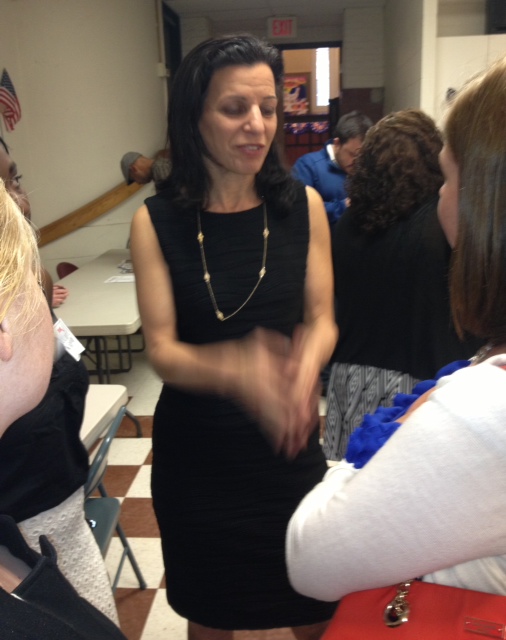
As politically savvy, now, as she has always been personally c harming : Juliette Kayyem at Boston’s Ward 3 Forum

—- —- —

About 35 activists in Boston’s Ward 3 gathered in a basement room of the Michael Nazzaro Center in the North End to listen to a line of Democratic candidates for governotr, attorney general, and lieutenant governor. the candidates were introduced by committee chairman Jason Aluia, spoke, then took questions. However brief each’s time, much ws learned. The candidates for governor, especially, now know what they are about, and why; the vagueness of January has left us, its place taken by almost jarring specificity.

Three governor aspirants spoke : Juliette Kayyem, Steve Grossman, and Joe Avellone. All have evolved — Kayyem the most.

photo (3)

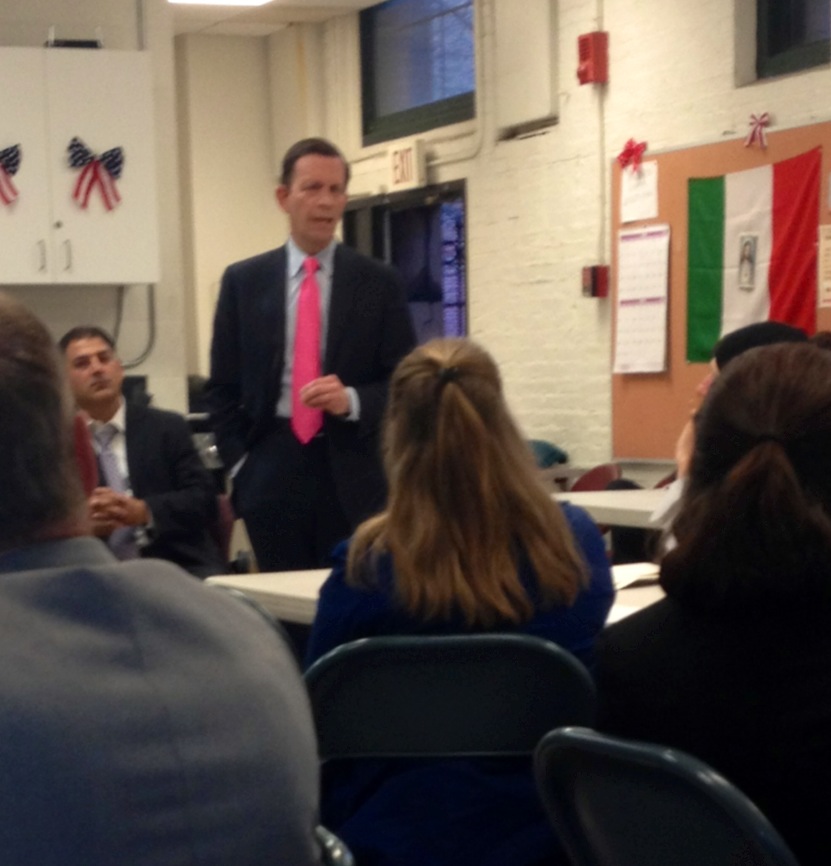
running against Charlie Baker, he is : Steve Grossman at ward 3 Forum

Grossman continues to have succinct answers in great detail for every issue given him, and he has shifted to “general election mode” ; half of his talk attacked Charlie Baker, whose campaign themes — at which Grossman guesses — he was happy to dismiss. Unhappily for Grossman, Baker’s themes aren’t at all what Grossman told ward 3’s Democratic activists they would be.

Avellone has long had his theme : fighting substance abuse — he’ll appoint a cabinet level officer of Recovery and Re-entry. Very good idea; and Avellone had no problem answering my question about the state’s 56 million dollar health connector disaster by calling for an immediate waiver from the Federal ACA. He’s the first Democratic governor candidate to do so.

Juliette Kayyem has grown enormously as a political leader and is evolving faster and more fully every week. This I had already seen. Last night she spoke with great clarity about criminal justice reform — which is coming to be her companion issue to “better data management,’ her first — in ways most voters have already come to agree with, bit which, as she said, has been taken up first by Republican governors “because they can; no one will accuse them of being soft on crime.” She’s right, and persuasive. how can Democratic activists in progressive Massachusetts refuse to demand reforms that Republican governors, no less, are already implementing ?

This is the second time, in as many Forums, that I have heard Kayyem evoke the example of Republican reform as a prod to the Massachusetts Democratic party ; last week, at the ProgressiveMass Forum, when quizzed about her role in Bush-era interrogation discussions, she cited John McCain as taking the same torture position that she advocated. And ;praised him.

I had a longish talk with Kayyem before the ward 3 Forum about how she would deal with the Speaker of the House, who rules all Massachusetts legislation, regardless of governors or anybody else. During our discussion Kayyem suggested ways of dealing but did not mention the method that I now think she has right at hand. How better to move the Democratic Speaker than to show that the reforms she wants are already being done by Republicans ? At the very least, this line of argument puts the Speaker on the defensive even.

Will Kayyem make this an explicit tactic ? We shall see. It has legs, if she wants them.

I also learned much at the ward 3 Forum about three of the Democrats’ Lieutenant Governor candidates. Here is potential embarrassment aplenty for whoever becomes the governor nominee, because none of the three has a resume even close to the long experience of local and state government possessed by Baker’s running mate Karyn Polito. Nor do they have any of her charisma. Still, two of the three spoke well and boast resumes strong on bureaucratic accomplishment.

James arena-deRosa and Steve Kerrigan both claim stints as Obama administrators, to which Kerrigan adds time as a staffer for the later Ted Kennedy. Arena deRosa spoke eloquently about his passion for politics (though to my knowledge he has never been a candidate before now), Kerrigan of his sense of duty. both men discussed a few of the major issues that their boss, the governor, might delegate to them to help with.

Still, neither man can possibly tell who that boss will be; where Karyn Polito have already had three months to synchronise and to combine their long and varied experience of state government both executive and legislative, it’s strictly guess work whether Arena deRosa or Kerrigan will get along with whoever the Democratic nominee is, much less blend well with him or her. And don;t scoff : I well remember how fully Mike Dukakis shunted aside his own lieutenant governor, Thomas P. O’Neill III, or how utterly Democratic governor nominee John Silber, in 1990, threw his running mate Marjorie Clapprood under the bus.

Mike Lake also spoke. His words had more smile in them than mile, however. I do not see a bright future for him as second clarinet to the first Democrat.

But to return to Juliette Kayyem : I have now seen and heard enough to be able to say it : she is my pick for the Democratic primary. This is not a formal Here and Sphere endorsement, as i have yet to talk of it with my partner. But it is my personal choice. Juliette Kayyem is best able to compete with Charlie Baker. She’s less rigid, intellectually or personally, than Steve Grossman, bolder than Martha Coakley, much more realistic than Don Berwick, and of wider experience and personal charisma than Joe Avellone.

—- Mike Freedberg / Here and Sphere

SCHOOLS REFORM : PROCEEDING DESPITE ALL

photo (32)

School reform will happen — in Boston. It is already happening, quietly, surely. Statewide, not so sure. Issues of curriculum, funding, and school innovation divide in several directions. But let’s look first at Boston.

Last year, few could have predicted that Boston school reform would proceed at all. Mayoral candidate John Connolly made “school transformation” his big issue. As schools are by far the largest budget item in Boston, and school parents the largest identifiable city-wide interest, Connolly’s choice of issue seemed a sure winner. It wasn’t, because Boston’s schools aren’t a single interest group. It’s administrators, teachers, custodians, parents, school buses, a school construction authority, and several types of schools dictated by State Law. The complexity of school interests sliced Connolly every which way, and he lost.

The teachers’ unuon badly misplayed its part in the Mayor campaign. The smart move would have been to endorse Connolly — for maing education his key issue and thereby gaining an inside position in the next mayor’s school policy discussion. Instead, the union backed two candidates who lost in the primary; only on election morning of the Final did it send out an endorsement of Marty Walsh, who, being a charter school board member, the union had not much wanted.

The Mayor has said very little about schools, but he did allocate the school department a four percent increase in funds; and Walsh’s two appointees to the School Committee have voted “yes” to three significant steps taken by John McDonough, the “interim superintendent” who doesn’t look like a reformer but is..

What are these three steps ? First, layng off about 100 central office administrators. Second, giving each Boston school principal full authority to hire, or replace every member of his teaching and support staff. Third, using public transportation — the T — to bring seventh and eighth grade studebts to school, thereby saving money (and acquiring a back door budget increase, as the T has agreed to transport students at its own cost) and somewhat lessening the impact of labor wars between school bus drivers and the company they work for (and who can forget the wildcat strike last Fall that stranded so many students for an entire school day ?)

These are significant reforms. Giving school principals complete hiring and replacement power changes the entire character of the principals’ job. No longer is she simply a high level monitor and a scapegoat for bad performance, now she can demand performance and see that it is given her. Using the T to transport students saves tens of millions of dollars that can instead be allocated to classrooms. Eliminating central office positions moves the burden of performance to the actual school where learning is demanded.

All of this is being put in place — though some say it’s not happening as thoroughly as McDonough’s office claims — by a man who speaks softly and looks even softer; a man who makes everyone involved feel liked and wanted even as he puts his very transforming agenda into place inch by inch.. Where John Connolly seemed to run at the school system like Teddy Roosevelt charging up San Juan hill, John McDonough gets every hill he faces to be on his side.

Example :

At the March 26th Budget vote, after two hours of “public comment” by parents and advocates enraged by the proposal to use the T to transport seventh and eighth graders — and with teachers’ union president Richard Stutman sitting grimly in the audience — the School Committee voted unanimously to do that and to approve McDonough’s staffing autonomy for school principals. “Shame on you !” shouted one activist, who then stormed out of the room.

McDonough’s response ? In that soft white-haired voice of his he applauded the parents and activists : “You’re the most involved parents I’ve seen in forty years,” he told them. “You get it.”

Yep.

McDonough is also preparing his schools for the newly adopted PARCC tests (PARCC stands for “partnership for assessment of readiness for college, a state-based initiative that will be ready for the 2014-15 school year) and is implementing the Common Core curriculum standards that have of late generated some controversy. No one that I am aware of is trying to stop him.

The controversy now attaching to the Common Core initiative is acting out chiefly at the State House. It comes chiefly by right wing Republicans who object to nation-wide anything, much less national education standards; some teacher groups are also critical. These do not like the significant instruction changes that common core standards entai, and they especially dislike that Common Core’s testing tends to dominate classroom instruction. I find these objections anecdotal only. Change is always hard for micro-managed institutions.

In Boston, much of the rancor about school change has come and gone. “We have had some difficult conversations,’ says McDonough, in his humble way. “Change is difficult.” But as he summed up the March 26th Budget meeting, “This is not about public schools versus charter schools. it’s about making all schools better.”

McDonough cannot have been happy to see Orchard Gardens school princiopal Anthony Bott quit his job for the coming year, for Bott has been one of the Boston system’s most successful turn-around leaders. Bott’s leaving has given McDonough’s critics — who think he’s not acting quickly enough, or comprehensively, to change how the school system operates. Nor could McDonough have been thrilled to see John Connolly reappear, after months of silence, at April 9th’s School Committee meeting, on behalf of his fellow Trotter School’s parents, who, as Connolly eloquently told the Committee, are upset about losing their Families Engagement Co-ordinator, a Mr. Alward, who, as Connolly said, “makes the school work.”

Mr. Alward is one of the 230-odd school personnel being cut in this year’s department budget — cuts that McDonough said “involved trade offs.” Schools are losing coaches, teacher aides, even, at the Curley K Through 8, a school nurse. And several families engagement co-ordinators. Few of these have available a spokesman as eloquent — or powerful — as an almost Mayor. In Connolly’s words : “We’re a turnaound school, the Trotter,” he said. Level four to level one. We’re now one of the best schools in the city, we knock the socks off those tests. That’s not going to happen if can’t keep families engaged — if we whittle away what works !”
photo (31)

Connolly is only the best known, though probably the most moving speaker, of the many Boston School parents who are angry about the layoffs of field personnel. As Heshan Weeramuni, of the Curley School parents group, puts it, “we’re losing school staff even as we’re gaining more students.”

Weeranmuni isn’t that impressed with the four percent budget increase provided by Mayor Walsh. “Over the years, as we’ve lost Federal funds and thus State funds,” he says,” we’ve actually seen a ten percent cut in funding, not an increase.

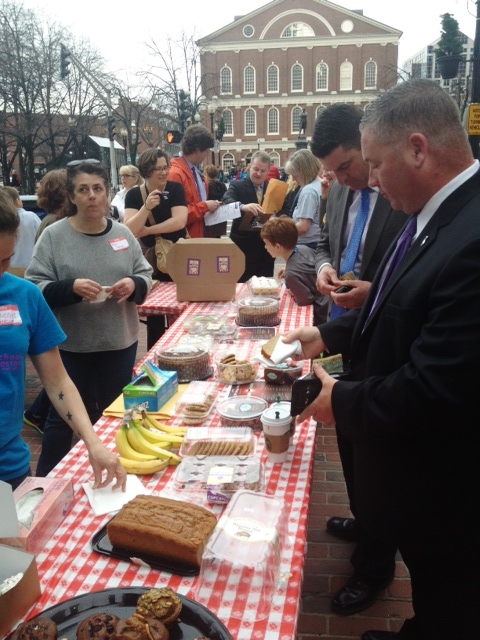
Weeramuni is active with a Boston school parents group led by karen Kast of Roslindale, who worked the Mayor election for candidate Rob Consalvo and, after Consalvo was eliminated, managed City Council candidate Marty Keogh’s campaign. Kast is an imaginative advocate for what parents call “full funding.” A “$ 61 million bake sale” that she helped organize recently drew much attention, as it took place on the back side of City hall, across the street from iconic Faneuil hall.

Kast is a leader in Boston Truth, a parents-and-teachers coalition militantly opposed to state legislation increasing the number of charter schools authorized in Massachusetts. A bill to do that sits stalled (as of this writing) in the legislatiure’s Joint Committee on Education, chaired by Wellesley State Rep Alice Peisch and by Jamaica Plain’s State Senator Sonia Chang-Diaz. The proposal — submitted by Boston State Rep Russell Holmes — seems unlikely to be enacted in its present form. Nor should it be. Titled “An Act To Further Narrow the Achievement Gap,” the bill calls for increasing the number of charter schools in “under-performing districts” — but not elsewhere. Yet the principals of under-performing schools get, by this legislation, exactly the powers that John McDonough has already established in Boston.

The bill also proposes a reimbursement formula, compernsation to Boston for students who choose to go to the additional charters, of IRS-like complexity.

For Boston, the proposed bill is otiose in one respect, contradictory in the other : why give a principal power to create the school that she wants, only to take away the effect of that power by putting more charter schools in competition ? Either the legislation wants under-performing school districts to do better, or it wants them to lose students. Which is it ?

I’m not sure the State’s administrators can answer that question. Certainly their take-over of two under-performing Boston schools, the Holland and the Dever, after these schools had already undergone a full year and more of McDonough-led “turn-around,’ suggets that the proverbial one hand doesn’t know what the other is up to.

Almost all of the State’s GOP, and many Democrats too, want more charter schools. That in itself is not a bad idea. The greater the availability and diversity of innovative schools, the better it should be for all the public schools. But many who advocate the loudest for more charter schools do so as a means of breaking the power of teachers’ unions. This cannot be a goal of education policy. Of course, schools do not exist to give jobs to teachers; still, teachers, there are; and the job we ask them to do is a difficult one, and vital. Union member teachers earn a good living; what benefit do we think we get if we block teachers from earning more ? Certainly not an economic benefit, and proabbly not an educational one. And if, as is true, the teachers in charter schools need not be union members, and thus cost less, is that a good ? I have never been convinced that asking workers to earn less is a benefit to anbody in any way.

If our state is to expand the allowed number of charter schools, it must be done generally — never only in “under performimg” districts, for that is to guarantee, even aggravate, their under-performance — and the expansion must benefit the performance of all schools. A diversity of school types must lead to the adoption of best practices, as these are experimented with; to an optimum length of school day; to courses beyond the Common Core basics : courses in civics, history, philosophy, the arts, sports, and more, such as emotional education and foreign languages. (One ‘Best practice’ that I like a lot is ‘dual language learning,’ in which students are schooled, daily and all day long, in English and another language. Chinese, French, Portuguese, Russian, Arabic — you name it.) And all of this must become the mission of all schools, of whatever type.

Until the legislature can forge an achievement gap-narrowing bill that sets forth a path to this end, without detours into special interest pleading, the Joint Committee on education should defer to act. Flawed legislation is always hard to repair, especially enactments that misdirect an institution as flex-averse as public education.

—- Mike Freedberg / Here and Sphere

MAGOV14 : FOR LIEUTENANT GOVERNOR, IT’S NO CONTEST

photo (71)

^ charisma and Italian heritage plus a strong political resume make Karyn Polito a significant presence for Charlie Baker

—- —- —

Voters vote for Governor, not Lieutenant governor. But were voters to focus on the subordinate part of the Governor ticket, it’d be no contest this year. Karyn Polito, Charlie Baker’s running mate, has more political clout than all four Democratic hopefuls combined.

Polito has been a Shrewsbury select-woman and was a five-term State representative. She ran statewide in 2010, for state treasurer, drawing 45 % of the vote in her losing effort. This year, as Baker’s running mate, she has raised significant money : 67,369.98 in February 2014, 181,378.96 in March, and 127,693.49 in April. She has 354,587.89 on hand as of May 1st. She also slammed the GOP convention door shut in her home area, the Worcester suburbs, on Baker’s rival, Mark Fisher. Though Fisher also lives in Shrewsbury, he drew zero — yes, zero — Shrewsbury votes at the convention to Baker’s 39.

Polito’s politics have evolved, from opposition to gay marriage and Tea Party friendly to mainstream, even somewhat progressive : today she asserts her support for marriage equality. Opponents have noted the rapidity of the shift and questioned its sincerity; but it’s what running mates always do if the “top of the ticket’ demands it. Sincere or not, it’s not easily taken back. Voters will allow a politicians’ views to evolve. They are less kind to backsliding afterwards. Committed to equality she is.

Baker has always been a civil rights progressive, and Polito is on his team. Her significance is by no means limited to money-raising. Entering a room, she turns heads, electrifies — Juliette Kayyem is her only charisma equal in this year’s election. I’ve seen it, it’s real. Polito is also the only person of Italian name — other than governor hopeful Joe Avellone — running for any statewide office this year. it matters.

Italian ethnic voting has faded plenty since 1960, when John A. Volpe used a then still huge and vibrant Italian community to win the governorship despite John Kennedy carrying Massachusetts for President by more than a million votes. Today, voters of Italian name are the grandchildren of 1960. As often as not, they are Italian in name only. Nonetheless, many do identify their Italian heritage, especially in the old Italian “heartland” on Boston’s north side and points north up Routes 28 and 1-A — and also in Worcester’s Belmont Hill neighborhood, where Volpe confidant Al Manzi once held political sway.

In these neighborhoods, Karyn Polito might as well be the governor candidate, not the running mate, given the intensity with which she is welcomed. I have seen this too — more than once.

Polito’s voters might make a difference if the governor contest is close — as it will be if Steve Grossman is the Democratic nominee. It wouldn’t surprise me at all if Polito brings Baker as much as three percent of the state’s vote.

That’s because, in contrast, the four Democrats running for lieutenant governor all look B-team, even C team. Until this year I hadn’t even heard of Leland Cheung, a Cambridge City councillor, or of Steve Kerrigan, who has been a selectman in the small Worcester County town of Lancaster (and whom I’ve actually met). As for James Arena deRosa, who knew ? Not I. The fourth Democratic lieutenant governor candidate is Mike Lake. Him, I’m familiar with, more or less. In 2010 he ran for Auditor, losing to Suzanne Bump in the Democratic Primary. Lake grew up in Melrose and has enjoyed a career, so his biography tells us, with United Way and now as an executive with a city-university partnership initiative at Northeastern University. All good; and in 2010 he did have visible support among activists. Still, his resume can’t compare with Polito’s.

As for money on hand, the four Democrats look like add-ons :

Mike Lake as of May 1 had 42,935.07 cash on hand.
Leland Cheung on this date had 87,199.63 on hand and raised 5,209.63 in April.
Steve Kerrigan had 180,903.84 but raised only 9,555.00 in April
James Arena DeRosa had 20,079.71 on hand and raised 4,475.89 in April

Why didn’t more significant Democrats run for Lieutenant Governor ? Warren Tolman, for example. He’s running for attorney general but would have been a very significant candidate. But he has traveled another road.

And for Karyn Polito and her running mate that has — so far — made all the difference.

— Mike Freedberg / Here and Sphere

UPDATE May 8, 2014 at 11 AM: Last night, at a candidate Forum in Boston’s ward 3, I had an extensive look at three of the Democratic candidates for lieutenant governor. Read my impression of them in my new post coming this afternoon.


CITIES AND HOUSING : CHANGNG THE GAME ENTIRELY

Image

Image

We were on our way to writing a big op-ed about why Massachusetts is best governed by a centrist GOP governor and the Democratic Speaker of the House, when, this morning, there appeared in the Boston Globe a Paul McMorrow piece that spotlights a societal shift of major significance, one that demands immediate discussion.

In his op-ed, Mcmorrow notes that the young people now gathering to work, shop, dine, party, and live in the downtowns of major cities are rendering the traditional single family home a thing of the past. McMorrow notes the building boom now going on in Boston’s central areas — from the Fenway to Seaport District and everything in between — , of apartment complexes, condominiums, and mixed-use mini-cities in which residential and commercial uses share. He applauds it. He calls for Massachusetts to shift from building single family homes to enabling the new living preference.

McMorrow is right, and I agree with his call.

The talented, socially active young people who are transforming downtown Boston completely live entirely differently from their parents and grandparents. Where the generations who grew up in the 1950s and the 1980s wanted to move far away from city downtowns, into those wonderful picket fence houses with driveways that Norman Rockwell used to paint, today’s young want to live, work, shop, dine, and socialize right next to one another. They work in collaborative competition, close and next to each other in emporia of start-up enterprises, and close-up collaborative competition is how they socialize as well. Even as social media and laptops enable people to work from home, the generation that lives by social media and smart phones wants, paradoxically, to be up close and personal with one another; to exchange ideas directly; to have conversations in real time and — indeed — to do everything up close in real time.

Prior generations sought privacy and fences, curtains drawn, and distance from their fellows. they want all their immediate concerns to exist enclosed within vast walls and rooms. That’s why, in so many 1980s-2000s exurbs, you see vast tracts of identical McMansions sitting on lots far too small. Inside was to be big, and outside didn’t matter, because you probably didn’t know your neighbor, and the commute to work took an hour or more each way, so there was no time to get to know neighbors. The generation before, of the 1950s-19609s, lived, family by family, in smaller homes on more cordial outdoor terms, but it too swore by Robert Frost’s famous line, “good fences make good neighbors.”

Today’s generation lives too great a diversity of lifestyles or cultures to accommodate to McMansions or to picket fences. In the center city, surrounded by parties and traffic, dining al fresco or indoors, partying till late at night or not, bicycling or walking, inventing or extending, the generation of 2010-15 cares less about what its living quarters are shaped like than how many different kinds of people (and different ideas) live close by. Young city dwellers want efficient space, in apartments one-third the size of McBoxes, even far smaller : micro apartments are very popular with single young people; they come really small, like the chihuahuia-sized Fiat cats of Europe;  as tiny as 350 square feet !

They are getting the living quarters they want. They have the money to demand it. What is less evident, and is not mentioned at all in McMorrow’s piece, is that the 2010-15 generation is beginning to transform the city’s basic institutions.

Good bye to the obsolete 2 AM closing hour. Hello, all night public transit.

Good bye to the five piece rock band. Hello, house music DJs.

Good bye to the dominance of cars. Hello, bicycle world : Hubway.

Good bye — I hope — to the racial segregation of downtown social life.

Good bye to the department store. hello, high end boutique.

Good-bye to the chain restaurant. Hello, the chef-owned trend spot.

Hello to District Hall, to Future Boston assembles, to Eventbrite.

But all of the above are changes in style and congregation. Much deeper changes are in store for how the city is governed :

1. Hello, interface mayor

2. hello, budgets on line and virtual council meetings.

3. good bye to the structured school classroom, hello to teacher-monitored on line learning, to apprenticeships, to study groups, to field trips (within the city).

The old, picket fence neighborhoods remain and will continue or some time. Some folks do like them. But today the center city once again drives the entire urban process. The change is radical and affects every part of city life,. it will have huge political consequences too, and these will push exurbia away from influencing how Massachusetts is governed, as surely (and for the same reasons) as the value of McMansions goes down because almost nobody wants to live that way anymore, 40 to 60 miles away from ‘the action,” slaves to automobile commuting, needlessly carbon foot-printing and isolated in huge and costly uselessness from their collaborators and competitors.

Builders went for McMansions because land costs left them no choice but to build oversized houses. That should have been the big clue that the single family home had lost its provenance. It probably would have made the point, except that 2000-06 was also the era of mortgage excess; and the marriage of house oversize and mortgage binge became a perfect storm of housing absurdity.

Today we see it.

The big changes at hand are big because they first have to wipe away that absurdity. this, they will do.The unanswered question is, what will become, in the new Massachusetts, of those who cannot afford city life, nor a 40 to 60 mile commute, and who lack access to the new city jobs ? Will we bring enough economic fairness to these people, for whom the new life of downtowns, tech jobs, and money so far has scant place ?

—- Mike Freedberg / Here and Sphere

MAGOV14 : IGNORE THE RHETORIC — THE 5 DEMOCRATS ARE VERY DIFFERENT

Image

^ confident enough to say what she is about : Juliette Kayyem (on right) at ProgressiveMass Forum

—- —- — —-

There’s a tendency on the part of so-called “conservatives” to dismiss the five Democrats running for governor as “all on the left.” That’s no more the case than to say Charlie Baker is “on the right.”

Fact is, the five Democrats differ immensely, on policy priorities, in political smarts, job resume, issues positions, personal style. Granted that the differences among them were not as evident at campaign’s start many months ago; each has evolved.

At the ProgressiveMass Forum yesterday, four of the five — joined by independent Evan Falchuk — made clear their evolved candidacies :

Don Berwick speaks rapid-fire his campaign of advanced position papers without offering any indication of how he plans to get from paper to fact. I’m told it’s all on his website.

Martha Coakley coolly touts her work as Attorney General, fighting foreclosure abuses, a situation which she sees as still the biggest destabilizer of our State’s economy.

Steve Grossman reminds voters of long age of former governor Mike Dukakis : detailed answers to just about every question thrown at him, earnestly delivered, no issue too arcane to miss his sweeping attention, no progressive ideal new to his long record of model citizenship. At the Forum he even talked about 1968 and the early 1970s, to a room full of people born mostly after 1984.

Juliette Kayyem, a generation younger than her competitors, looks the stylish, even athletic, cocktail party head-turner she is and speaks the realism — how to we get from here to there ? — that her rivals either avoid altogether or deem no big problem. Her big issue is true to type : “better data management.”

Joe Avellone did not speak at this Forum, but I have seen him frequently of late, and he too has evolved. The self-effaced, former Wellesley selectman now talks of drug abuse, recovery, and re-entry — a huge issue in our state and appropriate for Avellone, who, like Don Berwick, is a doctor.

Image

^ the foreclosure crisis still hurts the state : so said \Martha Coakley yesterday

Image

^ evolving to the Grad Tax ; Steve Grossman

The day also made clear that some of the Democratic hopefuls have devolved. Grossman, for example, started the year as the candidate of job growth and infrastructure spending — reluctant to seek new revenue but not ruling it out. at the ProgressiveMass Forum he sounded less reluctant to ask for new revenue and, surprisingly, stated support for a graduated rate income tax ; an issue that only Berwick had up till then advocated. What other issues surprises might Grossman adduce before Primary day four months from now ?

Image

demagoguing in Salem : Dr. Don Berwick on Fairfield Street

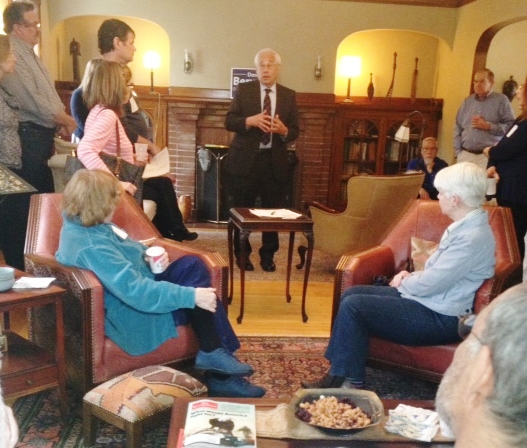
As for Don Berwick, his revelation moment occurred before the forum, at a meet and greet in Salem, my home town. there, speaking to about twenty guests (including a friend of my Dad and Uncle), Berwick answered a question about how would he defeat Charlie Baker if he we nominated by tying Baker to the odious Republican party platform — which baker opposes top to bottom — and by calling him “an insurance executive.”

These were unfair attacks, and especially unworthy of a candidate who touts his lifetime of caring about people and attachment to a co-operative citizenship. Berwick knows very well that Baker (and running mate Karyn Polito) strongly support marriage equality and women’s health choice; knows very well that in 2010 Baker’s running mate was openly gay Richard Tisei, first sponsor of the state’s now enacted transgender civil rights law. Berwick also knows very well, he being a doctor, that the insurance firm that Baker was executive of was Harvard Pilgrim Health care, the state’s best provider.

There are plenty of real issues that Baker and Berwick disagree about. It was either campaign inexperience or a real chink in Berwick’s soul for him to play the demagogue as he did. this was devolution.

As I see it, yesterday was Juliette Kayyem’s day. Asked, at the ProgressiveMass Forum, about her work on interrogation policy, as a Homeland security advisor during the Bush presidency, she did not excuse or back off but defended her work as vital to national security in the context of 9/11. She also mentioned that her policy paper mirrored the anti-torture views of John McCain, whom — said she to the room full of Progressives — “is often good on these matters.”

She is right about that, of course. And said so.

That took guts. it took confidence. She must surely be one of the first candidates, if not the first, to mention John McCain in a positive way to a room of progressive Democrats. I always like it when candidates confront a room of skeptics by conceding nothing of who she is or is about.

One final point. On the issue perhaps most important of all, to a potential Governor, there has been no evolution at all. Asked the question “if progressive legislation is blocked by conservative forces in the legislature, what will you do ?” none of the four Democrats at the Forum had a good answer. All evaded the question — or answered a different question. Because to give the real deal would undercut their pretensions. The real governor of Massachusetts is the person whom no one in the entire room mentioned by name : Mr. “conservative forces in the legislature,” Speaker Robert DeLeo. A Democrat.

—- Mike Freedberg / Here and Sphere

TOWARD A PARTICIPATORY ECONOMY

graph of minimum

An economy benefits best when almost everyone participates in it — the greater the participation, the better. The more customers a business has, the greater its revenue. The more money those customers have, the greater still.

This is not rocket science. it’s obvious. If a business can’t sell its products or services to customers because customers can’t afford to buy, that business is going nowhere. Some businesses sell only specialty goods or services that most people don’t need or want : yet these businesses, too, don’t want to see potential customers lacking money to buy.

For some reason, these basic facts of economy don’t seem to register with some businesses, or with their political mouthpieces. During the past decade or so we’ve seen an entire political party work overtime to keep money out of the hands of many, many potential customers. Though every statistic makes clear that consumer spending makes up 2/3 of the entire economy, these folks seem to think that the big economic problem is the nation’s budget deficit, or too much Federal spending, or too much intervention by the “Fed.” Exactly the opposite is needed, but these folks have other agendas

Fortunately, the mistaken-ness of this view has no longer anywhere to hide. We are headed, finally, toward a much more participatory economy than we have seen since 2005. Though the Federal government has been blocked from raising the national minimum wage from $ 7.25 an hour to $ 10.10, many states are raising it, some to an amount far higher than $ 10.10. In Massachusetts the new amount will be $ 11.00. The City of Seattle is preparing a rise to $ 15.00 an hour. Service workers are organizing nationwide to gain a $ 15.l00 an hour wage agreement. Some seek a $ 2 per hour wage. I applaud these moves.

Today, minimum wage workers need taxpayer help, via public assistance, to make ends meet. Public assistance provides low-wage employers with a huge perk. McDonald’s alone sucks $ 1 billion out of taxpayers’ pockets to pay workers what the company refuses to pay. Why should we subsidize this sort of thing ? We shouldn’t, and it looks now as though we won’t have to do so much longer.

Advocacy groups are beginning to focus on how quick-buck traders and maximize-profits money pools force publicly traded companies to cut workers’ wages, or keep them low; to view employees as a “cost item” rather than  what they are : a company’s major asset — and, basically, to squeeze corporate assets out of the corporate treasury and into their trade pockets.

Advocacy groups see these trading moves for what they are : liquidation, not prosperity.

Advocacy groups also are drawing attention to unfair labor practices, outsourcing and layoffs, denial of benefits, opposition to paid maternity leave or sick days, and outright theft of mandated overtime pay laws.

Progressive Democrats are beginning to organize an economic fairness agenda that encompasses all of the above reforms as well as pay equity for women, living wage laws, labor law enforcement, and reforms to the nation’s credit card regulations, bank fees, and bank deposit trading practices.

Just as important, more employers — including publicly traded major corporations — are starting to implement high-wage strategies, understanding that well-paid employees are loyal, motivated, healthier, and more innovative. All of which stimulate an economy.

I welcome all these moves and much more.

minimum wage

At $ 22.00 an hour, workers even in expensive cities like Boston could pay their bills without any taxpayer subsidy — freeing up that tax money to pay for vital public services such as education, transportation, and energy conversion, or even for a tax cut which would put more money in taxpayers’ budgets. At $ 22.00 an hour, workers could even do some discretionary spending that they can’t even contemplate now : buying a new car, a new cell phone, new furnishings for the home or apartment, summer camp for the kids, dining out at a restaurant, a night at the theater. All of which spends money into the economy, into businesses.

We call this state of things “prosperity.”

Prosperity does NOT mean an economy in which a few get rich and everyone else barely makes it. That is an economy of scarcity, not abundance.

The most pressing policy push in America today is to reward all work with sufficient pay to make work worth while, to give workers confidence in their work, to get them spending and free of public assistance. Even $ 22.00 an hour adds up only to $ 880 a week, pre-tax. That’s $ 3440 a month; even that sum is far from enough to pay basic bills if one lives in a city as expensive as Boston; but a two-income family at that level earns $ 6880 a month, and that is enough to pay basic bills even in Boston. Indeed, it’s enough to allow at least. some discretionary spending, even some savings.

At $ 15.00 an hour, a two-income family will earn $ 4800 a month — 35 percent of which, at least, will go to rent alone. A $ 4800 family won’t need public assistance, and, if no bad things befall, will pay basic bills, though with no margin for error. Is there some reason why our society can’t value work — all work — at least this much ?

A minimum wage of $ 15.00 seems local-option only. In smaller or less expensive cities, such a minimum wage might be too high. But I can think of nowhere that the proposed Federal minimum of $ 10.10 is not vitally needed.

It is going to happen.

The only reason that our economy continued to grow robustly after about 1975 was the introduction of credit cards., which offered consumers quick buying power. By 2007, consumer credit card balances comprised 20 percent of America’s entire GDP. (Yes, I said 20 percent.) Trillions of plastic money debt dollars enabled all kinds of businesses to grow enormously. It was fun while it lasted, but it was a false economy, and it has ended. Since 2008 consumers have been paying down credit card debt down fast enough to shave a full one percent off the nation’s GDP : 240 billion dollars a year. No wonder our economy is growing so slowly.

Paying workers the level of wage that I am advocating is a far solider, stabler way of growing the economy than inducing workers to borrow credit card debt. wage money is theirs. it does not have to be paid back. Our economy should never count credit card spending as a growth indicator. Growth comes from wages and income spent by those whose money it is. There can be no worthier national policy than to assure every working person sufficient money of his or her own to go about life a free agent.

—- Mike Freedberg / Here and Sphere

SO FAR SO GOOD :MAYOR WALSH’s ALL OUT FIGHT AGAINSTSUBSTANCE ABUSE

Image

^ it’s personal to him ; Mayor Walsh goes all out against substance abuse in the city

—- —- —-

If there’s one thing that newly installed Mayor Marty Walsh is doing really, really right, it’s his all-out attack on the scourge of substance abuse. A new policy paper issued by Walsh’s office tells the whole story, in this link :

http://next.cityofboston.gov/post/84249639798/improving-addiction-and-recovery-services

It’s hardly a new issue for Walsh. It is personal for him. He himself is a recovered substance abuser, and, at the very first “Mondays With Marty” that I attended, way back in mid-summer of his Mayor campaign, he made a statement that stuck with me : “there is heroin epidemic in Boston .”

I believed him because he had seen it.

We all know that substance abuse threatens to overwhelm communities; to snuff out many, many lives; to disable many more; to make employment difficult and family life all but impossible; and, thus, to over-burden the state’s already overtaxed DCF agency.

Make no mistake : you don’t like how DCF has been doing its job ? Then do something about our State’s substance abuse epidemic. Because until that wave is conquered, DCf will have far more families to intervene with than it can handle on the best of days.

Mayor Walsh has taken several worthy steps, as set forth in the link above, including equipping all first responders with the overdose antidote known as Narcan; holding drug abuse forums in neighborhoods across the city; and sponsoring take-backs of expired medicines. all that is needed now is for the public to know about them. Very few people attended a recent substance abuse forum in Jackson Square that I was at, and the people who did attend seemed more community activists than abusers or family members of abusers.

the people who need to be reached don’t easily come go substance abuse forums…

Still, the push back against substance abuse has started now. To that push I would recommend to Mayor Walsh the following initiatives :

1.make sure that substance abuse info forums are well publicized, on social media and with copious fliers at street level

2.co-ordinate with DCF, so that the families most impacted by substance abuse can receive help from city health workers as well as from DCF people

3.just as Mayor Kevin White hired Youth Workers, to meet with youth in socially vulnerable neighborhoods and support them, hire neighborhood workers specific briefed to intervene in the lives of drug abusers and their families — it being as much a public health problem as a public safety issue

4.co-ordinate all these efforts with the City’s public school staffs.

5.expand, promote, and support city sports programs. it’s my experience that kids involved in sports are less likely to take a bad path

6.because substance abuse isn’t only a youth issue — many abusers are 25 to 40 years old, co-ordinate intervention and outreach initiatives with neighborhood health centers, churches and mosques, community houses, and gyms.

7.Regularly convene meetings of the top staffs of all the institutions and organizations I’ve mentioned, to exchange ideas and to report both progress and failures.

Winning the fight against substance abuse will take many, many years of all-out commitment by many, many organizations as well as concerned citizens. I probably shouldn’t even say ‘winning,’ because the problem is world wide and cannot be extinguished by efforts merely local. But a sustained and ubiquitous local effort can definitely cut the substance abuse epidemic way, way back within one committed city.

—- Mike Freedberg / Here and Sphere

FIXING THE DCF : NO EASY TASK. THE BOSTON AREA CASINO : NO EASY PICK

Image

^ why is this woman smiling ? Olga Roche has resigned as DCF’s boss

—- —- —-

The big news this morning in Boston is that DCF Commissioner Olga Roche has resigned.

This was a certainty, once House Speaker DeLeo demanded it. Yesterday he did just that, at a press conference at which he angrily insisted that she go. The deaths of two more children in DCF (Department of families and Children) oversight had nothing to do with DCF budget cuts, said DeLeo.

State Senate President Therese Murray joined DeLeo’s call.

The failures at DCF have become all too tragic and known to all. We at Here and Sphere have called for the entire DCF system to be re-configured and upgraded. DCF’s methods are out of date, its technology 20 years behind the times at least, its staff communication hit or miss, its management slow to act. All of this can be changed, renovated, transformed. Can be and must be. 100 million in DCF budget cuts must be restored. The mandated case load limit for social workers must be enforced.

The resignation of Olga Roche will achieve none of that. Who will now run the agency ? No one with any career prospects would dare to say yes.

Some blame Governor Patrick for the failures of DCF and, in particular, for not firing Olga Roche sooner. I don’t agree with them. Governor Patrick knew well that firing Olga Roche would do nothing to make DCF a more responsive agency. The governor’s best course was, and still is, to set in motion a comprehensive review of DCF practices, recommend big changes, and then implement them.

The media are full of reports that DCF staff missed meetings with parents, misplaced faxes — faxes, in the age of twitter ! — missed communication, sloppy oversight. All true. But let’s remember that the families that DCF monitors are highly dysfunctional : drug abusers, neglecting their children, homes filthy; a mother who usually does not work and probably can’t, who lacks basic skills and isn’t attuned to keeping appointments or making them. It’s terribly difficult to get things done for, with, or by way of people in this state of advanced social crisis. A very high degree of pro-active social work is needed, backed up by very pro-active supervision.

Try doing it sometime.

Olga Roche has left the job even as I write. Her leaving satisfies the political imperatives, but it will, by itself, change absolutely nothing. It may even deceive the public into thinking that it was all Roche’s fault and things will now be much better. This would be a big mistake.

*** UPDATE : today Governor Patrick named Erin Deveney, a veteran manager at the RMV, to be interim head of DCF ***

The other big news concerns the Boston area casino license. Until recently, I felt quite certain that Steve Wynn’s Everett plan would easily beat out Mohegan Sun’s Revere project. Now I’m not so sure. The land upon which Wynn wants to build is owned, it seems, by at least one person with a criminal past, and, as it was once a Monsanto chemical Company facility, is filled with extremely toxic waste. The waste can be cleaned; the criminals, not so easy.

The named criminal, one Lightbody, says that he sold his interest in the Monsanto site long ago; but the Boston Globe reports that one of the present owners refuses to sear an affidavit that no current interest is owned by a person with a criminal record. the same Boston Globe report quotes Lightbody as having ownership of a nearby — and quite infamous — strip club “wrapped up tight.”

It’s all quite seedy, and given the public perception of casinos as havens of criminal money, it cannot be good news for Steve Wynn. Nor is the talk of high-price land purchases by the City of Everett, taxpayer paid.

This the momentum shifts over to Mohegah Sun and the City of Revere. First, the land on which Mohegan sun plans to build is already owned by their Suffolk Downs partner. To my knowledge, it contains no toxic waste. second, the City oF Revere has inked mitigation agreements with many communities (to be fair, so has Steve Wynn), with the prospect of more. The voters of Charlestown and Chelsea strongly support the Revere plan. So, too, does Mayor Walsh, although of late he has bargained for a host-community mitigation agreement rather than the smaller sum due a mere adjoiner. And though Revere’s recent casino vote produced only a 2 to 1 approval, as oppose to the 9 to 1 vote in Everett, Mayor Dan Rizzo has pushed every button available to make Revere’s “Yes” a loud one.

Mayor Carlo deMaria of Everett, no amateur in the pressure push game, has pushed back. Last night the Everett city council voted 10-1 to approve the Mayor’s Lower Broadway urban renewal plan, upon which the Steve Wynn casino projects depend and which includes a $ 35 million purchase of the Monsanto site (then to be resold to Wynn at the same price). Lower Broadway in Everett is a hotch-potch of industrial usages, non-use, blight and ugly. Renewing it to accommodate Wynn’s gleaming-glass, swimming pool and diamond dreams palace would sweep all that blankety-blank away. It’s a strong argument, and last night it won.

For deMaria last night’s vote was a crucial step toward victory. He will need many more, and these will be much, much harder to win. Mohegan sun is definitely in the game. Six months ago, i would not have predicted it.

—- Mike Freedberg / Here and Sphere