A NIGHT OF DEFEAT : THE CHARLOTTE GOLAR RICHIE TALK

Image

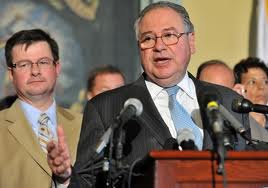
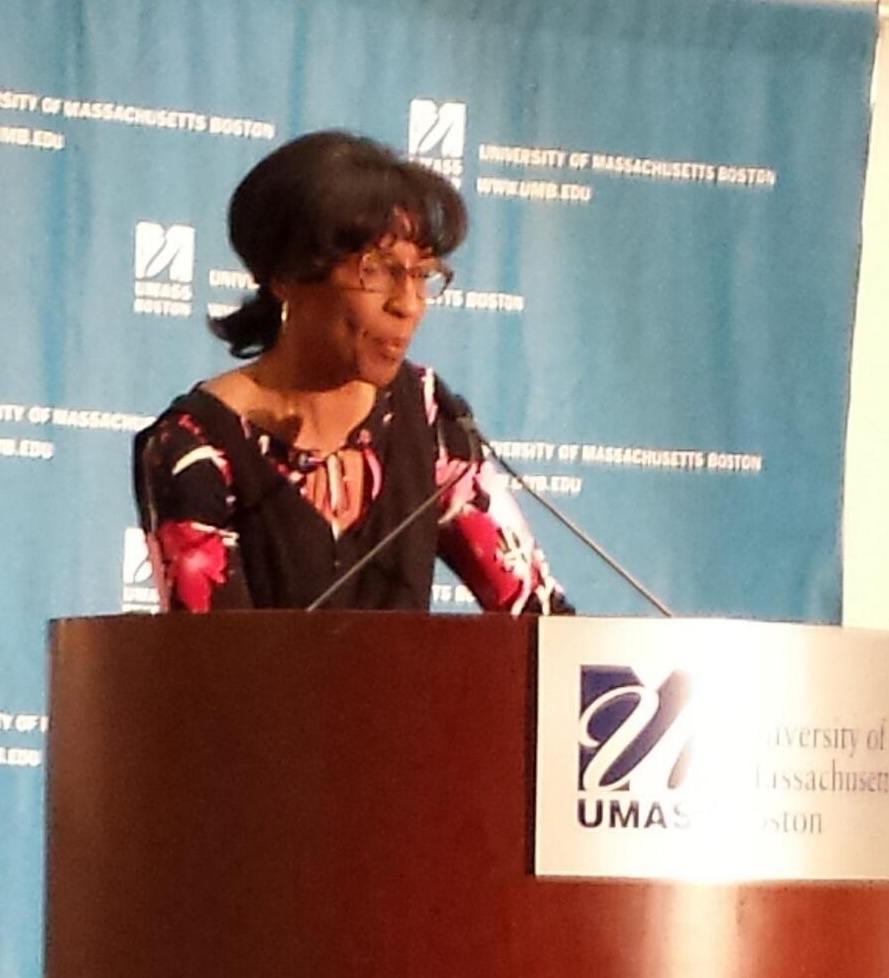
^ Charlotte Golar-Richie gives a talk : ‘all the isms are alive and well…racism, sexism…”

—- —- —-

The Mayor of Boston campaign of 2013 may be over, but evidently it’s not over. Last night Charlotte Golar-Richie, who finished third in the September Primary, was the key speaker at a conference hosted by University of Massachusetts’s Center for Women in Politics and Public Policy.

NOTE : If there were any doubt about the institutional colossi that encumber Boston politics, the very length of that host name — “University of Massachusetts Center for Women in Politics and Public Policy” — should set our heads nodding, But I digresss…

The topic for discussion was “Opening Doors : Women’s Political Leadership in Boston.” It seems a timely topic, given the prominence of several women in elected office within the City. One thinks of State Senators Sonia Chang-Diaz and Linda Dorcena-Forry (and of former State Senator Marian Walsh), of Councillors Ayanna Pressley and (newly) Michelle Wu, of State Representatives Gloria Fox and Liz Malia. One might also think of Abby Browne and Marian Ego, school committee members back in the day, and even of Elvira “Pixie” Palladino and Louise Day Hicks longer ago — but Palladino and Hicks were severely incorrect politically and thus not “women’ despite being women; and one could even mention the late, fishwife-mouthed Katherine Craven, a City Councillor, and State Representative Katherine Kane (who died about two weeks ago), both women in politics long before there needed be an educational institution hosting said discussion.

One could have mentioned all of the above; and mentioned the significant involvement of women in Boston politics well before that, from Abolitionist champions to Progressive era women of conscience to civil rights and civic leaders like Susan Story Lyman, Melnea Cass, Stella Trafford, Alice Hennessey, and my own mother. Mentioning all of these, one wonders what sort of “doors” still need to be “opened.’ Are they not already wide wide beckoning ? But no. Evidently the failure of one woman candidate to become Mayor of Boston trumps all of the successes that women in politics have had, are having, and, likely, will have in Boston.

In any case, the night being given over to defeat, it was quite appropriate for Charlotte Golar-Richie to trumpet the notes of defeat’s song :

“The isms are still alive and well in Boston…racism, sexism…along with that misogyny thing.’
“For women the stakes are high. Women of color, the stakes are higher.”

To which lament many Forum pundits added their oboe and bassoon :

Priti Rao : “I think there’s a lot of voter fatigue in this state.’
Joyce Ferriabough Bolling : “Charlotte lost because her base did not come out.”
Paul Watanabe ; “Globe’s editorial op-ed was devastating.”
The entire discussion panel : “EMILY’s list failed her.”

Golar-Richie then summed up this Sonata of Defeat by saying that she “opened the doors, someone else will have to walk through.”

As you have doubtless surmised, I shrug both my shoulders at Golar-Richie’s speech. Not once did she allow that perhaps she was not exactly an authoritative candidate. Not once did she acknowledge that in a field of twelve, whence eleven candidates ended up losing, she was hardly alone in being among the eleven. Why was Golar-Richie entitled — I use the verb on purpose — to a better result than the other ten losers ? Were John Barros, Dan Conley, Mike Ross, and Felix G. Arroyo not equally worthy candidates  ? Not to mention John Connolly.

Fact is that, in the 17,000-odd Forums that i attended at which Golar-Richie spoke, I found her performance wildly uneven ; strong one day, out of focus the next; vague sometimes, insightful at others. There was no such vaguery about Mike Ross, john Connolly, John Barros, Dan Conley, Marty Walsh, and even Charles Yancey and Rob Consalvo.

But in assessing Golar-Richie as a candidate there is no need to measure her performance at Forums. When her crunch time truly came, after the primary, and she had to decide, quickly, whether to endorse John Connolly or Marty Walsh, she flubbed the role. She delayed her decision, hemmed and hawed; when after some days she finally endorsed Marty Walsh, all of her support group went the other way, to John Connolly. Compare her handling to the focus and unity that Arroyo and Barros brought to their Walsh endorsements..

So, to respond to Charlotte : no, I do NOT think that “all the isms are in place.” Nor do I think that the bar is doubly high for women of color. Tell me how Michelle Wu’s finishing second out of eight, for City Council, on her first run ever for public office, demonstrates either of Golar-Richie’s assertions. Golar-Richie is simply WRONG. She did not fail to become Boston’s Mayor because she is a woman. She failed because she wasn’t a strong enough candidate.

And finally, Golar-Richie’s assertion that she lost because “all the isms are alive and well in Boston” disrespects Marty Walsh. Did he beat Golar-Richie because he is male, or because he simply had a stronger base of votes, as a sitting state representative and respected union leader ? Golar-Richie’s suggestion tells me what she really thinks of Walsh. It’s not pretty.

—- Michael Freedberg / Here and Sphere

MEEK AT THE MOVIES : Blue is the Warmest Color ( 3.5 STARS )

Image

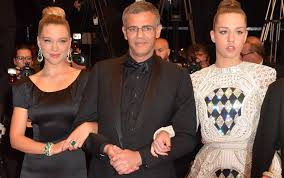
^ passion in a girls’ house : Abdellatif Kechiche and his two blues, Adele and Lea

—-      —-      —-

Abdellatif Kechiche’s beguiling portrait of passion and betrayal received much ado at Cannes where it won the top prize and garnered an NC-17 rating as it came ashore here in the ‘States. At three hours length, the French film, originally and more simply titled “The Life of Adèle.” is aptly just that, the tale of a young woman coming of age and her sexual awakening. The big brouhaha whelmed up over Adèle’s true love being another woman, and for the middle third of the film, as their relationship blossoms, the girls, one in high school and one in college, have torrid couplings under the noses of their parents. It’s pretty graphic too, with lip-to-labia contact, contorted scissoring and deep tissue rump massages.

The first of these protracted scenes feels apt and genuine as it’s fueled by ardor and emotion, but the follow-ons, by comparison, feel staged and exploitive. Still, it’s how the two women, Adèle (Adèle Exarchopoulos) and Emma (Léa Seydoux), meet and their journey that drive the film, not the over-the-top sex-capades. Adèle, fairly popular at school, has a quick, trivial interlude with a male classmate, who after achieving conquest, becomes cold and aloof. Then, out at a gay club with male friends, Adèle wanders into the abutting lesbian meet-market where she’s instantaneous shark bait. Across the bar, she and the blue-haired Emma (perhaps the impetus for the American title–and the fact, that Adele is almost always wearing a blue dress or like-hued attire) repeatedly lock eyes. The sharks circle closer and take their exploratory nips. That’s when Emma steps in and pulls Adele from a persistent plier, offering simply a sprig of earnest camaraderie, without pander or expectation, but also, clearly there’s desirous intent.

Nothing happens that night or for a while. Emma shows up after school one day and the two hang out and have lazy conversations about life and art — and for that very public schoolyard pickup, Adèle becomes ostracized by her classmates who demand to know if she’s a “dyke” or not. It’s not the only speed bump in their evolution. Emma has a significant other and Adèle struggles with her identity, but in slow intimate moments, Adele’s inhibitions give way to curiosity and it is she, not Emma, who launches the first kiss.
Following the fleshy entanglements of notoriety, the film jumps ahead a few years, Emma has completed art school and is looking for inspiration and her big break. With piercing celestial eyes, a noticeable gap between her teeth and icy blonde hair, she looks even more Bowie-like and is more focused and driven than her carefree, clubbing earlier self. Adele, still the youthful, broad-toothed ingenue has become a kindergarten teacher and the two live together in a cozy row house. Everything is near perfect; Adèle poses nude for Emma, the art community gathers to admire Emma’s paintings and are taken by the ravishing lipstick lesbian and muse who has unlocked Emma’s inner talent. It is here that success, alienation and infidelity become the serpent in the garden and the film turns sharply into a meditation on depression, disconnection and anger.

Interesting that all this insight of the inner workings of young Parisian lesbians comes at the fingertips of a seventy plus year-old Tunisian director. Kechiche’s other films, “Black Venus” (2010) and “The Secret of the Grain” (2007), dealt too with forms of class-ism, and while less intimate in the characters’ interactions, their insights were more intimate. In “Blue,” amid all the steamy sensuality and posturing about passion and irrevocable yearning, there’s something that never fully carries through. Emma changes and morphs into something less appealing, yet tangible and empathetic while Adèle remains at sea. Then again, not everything in life is tidy and neat, some people try new things to find out who they are and in the process hold much inside, much too tightly. It’s tres French and tantalizing in all the right ways, underscored by the way Kechiche ends the film with pointed ambiguity.

— Tom Meek / Meek at the Movies

MELEE IN MASSACHUSETTS : RUNNING THE NUMBERS ON NOV 10TH

photo (18)

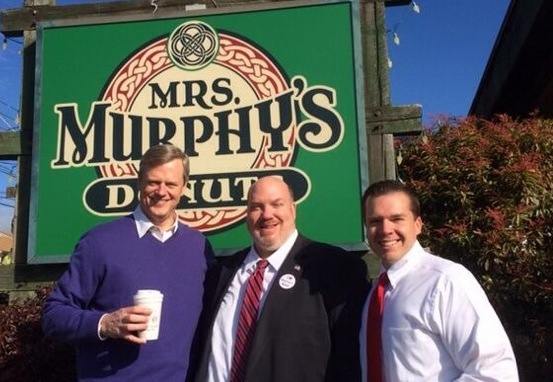
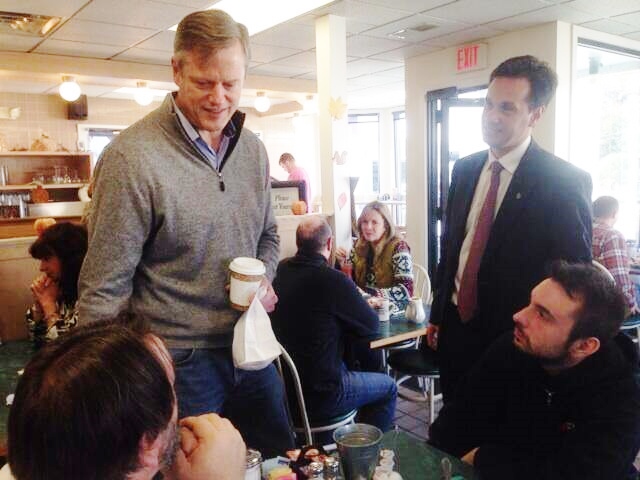
^ peopling and good-timing : Charlie Baker meting and greeting at the Water Street Cafe in Plymouth.

—-      —-      —-

As in all elections, money and people determine the race to choose Massachusetts’ next Governor. Even this early one can count some of each. That is what I shall be doing in today’s report and as often henceforth as the state of the race requires from me. So what do the numbers tell us at 11 : 30 AM on 11/10/13 ?

People ——-

Charlie Baker : 4004 twitter followers
32,056 Facebook Public Figure followers
Martha Coakley : 12,200 twitter followers
18,968 Facebook Public Figure Followers
Steve Grossman : 6,770 twitter followers
no facebook public figure page as yet
Juliette Kayyem : 4,244 twitter followers
1,161 facebook public figure followers
Donald Berwick : 1,876 twitter followers
1,799 facebook public figure followers
Joe Avellone : 336 twitter followers
no facebook public figure page as yet

Money —–

Charlie Baker : 107,643.62 cash on hand as of 10/01/13
261,370.36 receipts for the month
185,880.50 expenditures
203,133.48 cash balance on 10/31/13

Steve Grossman : 709,324.65 cash on hand as of 10/01/13
163,405.00 receipts for the month
119,034.42 expenditures
773,695.23 cash balance on 10/31/13

Martha Coakley : 283,192.95 cash on hand on 10/01/13
88,486.88 receipts for the month
59,141.22 expenditures
303,538.41 cash on hand on 10/31/13

Juliette Kayyem : 202,527.92 cash on hand on 10/01/13
95,572.46 receipts for the month
40,795.36 expenditures
257,305.02 cash on hand on 10/31/13

Donald Berwick : 264,649.83 cash on hand on 10/01/13
33,053.10 receipts for the month
102,542.03 expenditures
195,161.90 cash on hand on 10/31/13

Joseph Avellone : 121,494.72 cash on hand on 10/01/13
19,675.37 receipts for the month
39,294.95 expenditures
101,875.14 cash on hand on 10/31/13

These numbers all look small when one considers that it took $ 80 million to elect a United states Senator for Massachusetts in 2012. Even to elect a Boston Mayor, over $ 7 million was raised and spent. As I see it, two problems pressure all of these candidates :

photo (19)

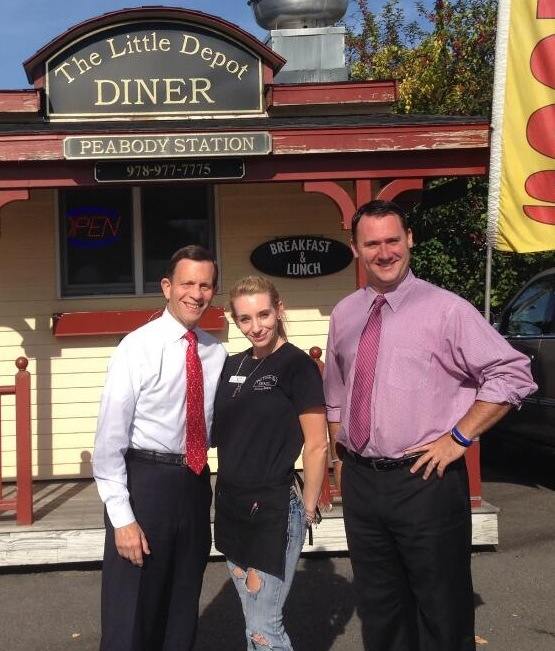
^ 775,693.25 in the bank — now some people too : candidate Steve Grossman (at the Depot Diner in Peabody with Mayor Bettencourt and the Diner’s owner)

1. five (5) noggins seek the Democratic Party nomination. The winner even of that battle faces a serious GOP opponent in a state in which four of the last five governors have been Republican (Weld, Cellucci, Swift, Romney). That’s long odds for donors with shekels to sprinkle.

2. Charlie Baker so far has no challenger for the GOP nomination, but his “strong favorite” status seems grievously imperiled by the toxic state of the Republican brand among Massachusetts voters and by the powerful tilt toward poisonous policies even among Massachusetts’s GOP primary voters.

DeLeo the Speaker

^ Robert DeLeo, Speaker of the House…. and the REAL Governor of Massachusetts

And hanging over all the hopefuls is the knowledge that Massachusetts is governed — even dictated to — by the Speaker of the House. Time and time again we have seen this. The Governor can want a piece of legislation more seriously than a heart attack ; it doesn’t matter a whit unless the Speaker wants it too. If he doesn’t, the Governor can just whistle Dixie.

The Speaker has this power because, by the rules of the house, he appoints all committee chairmen and all committee members. Until these rules are changed — which they never will be — the Speaker rules. Indeed, one wonders why people even bother running for Governor ? True, the position has a great deal of prestige attached to it. That plus the bully pulpit, a lot of voter comfort, and some public policy feel-good and perhaps a shot at becoming the POTUS. But heck, the future POTUS (ha !) can’t even get his judicial nominees appointed without sweet-bunning a majority of the Governor’s Council. Good luck with that, in an era when patronage jobs can’t be given without earning a slam column from the likes of Howie Carr.

Oh wait… the Governor does appoint cabinet members — worthy men and women, some of them my friends — to operate whatever the Speaker allows them. He or she also has power to commute sentences or award pardons : but the present Gov and his precdessor almost never have done so. What good is a power unusued ?

Of course our would-be US President DOES run the state Police. Which means that a wise governor keeps the “staties” from harrassing immigrants, whereas a Gov “severely conserative” can’t wait to eat immigrants for breakfast. I suppose that that does matter. But is it worth the tens of millions of good funds that will likely be spent to elect a Goverbor decent to or devouring of immigrants ?

It was fun to cover the Boston Mayor election. A Boston Mayor wields actual poweer — a LOT of power. The Governor wields a limp biscuit. Oh what joy this coming year is gonna be…not.

—- Michael Freedberg / Here and Sphere
MELEE IN MASSACHUSETTS : WHAT THE BLAZES IS CHARLIE BAKER THINKING ?

Image

^ serious politicking, at least this time : Charlie Baker (left)  joined the campaign of now newly elected, Western Massachusetts State Senator Donald Humason (center).

—-      —-       —–

The “brawl in Boston” being decided, attention now turns to the “melee in Massachusetts” : the first open race for Governor since 2006. It begins with Charlie Baker, because he has already run for Governor once, in 2010, and thus starts a fair bit ahead of the pack in terms of name recognition and state wide organization.

You would suppose that Baker, having already established himself as a credible governor — losing to Deval Patrick in 2010 by 6 points only — would be broadening his themes, addressing all the issues that face Massachusetts today, from transportation and infrastructure, to a higher minimum wage, to the needs of immigrants, environmental legislation, and serious reform of the legislature. You would indeed suppose that, but it seems that you would be wrong.

You might also think that he would be congratulating the US Senate for passing ENDA legislation, on a bi-partisan basis ; but so far, not a peep about ENDA from the man who in 2010 chose as his running mate Rich Tisei, the original Legislative sponsor of Massachusetts”s transgender rights bill (which is now Law, albeit without public accommodations protection).

For the past week I have regularly attended to Baker’s facebook pages and his twitter account, and all I can see is that (1) he visits lots of businesses (2) his tweets are re-tweeted by Tea types, including the  eliminate-a-social safety-net crusader Brad Marston (3) he has fewer twitter followers than a Boston City Councillor and (4) he has tied himself up in the demagogic and quite irresponsible movement to repeal the gas tax automatic adjustment — the tax with which Massachusetts will try to pay for at least some of the huge transportation and infrastructure needs that have accumulated during a decade and more.

If you don’t think that this repeal is irresponsible, just ask Jim Aloisi, who served as one of Massachusetts’s best informed Secretaries of Transportation.

Businesses are great, and it’s nice that Baker thinks so. but the impression he is giving is that he’s running for President of AIM, not Governor of Massachusetts.

Nobody likes to pay more taxes, but Baker’s lending his presence and name to the gas tax repeal suggests that he wants to be President of the Pioneer Institute or the Mass Fiscal Alliance, not Governor of Massachusetts.

Being liked by such as Brad Marston gives Baker the Marston vote, but it suggests that Baker seeks to become a fellow at the Cato Institute or the Koch Brothers’ several GreedPAC’s, not Governor of Massachusetts.

Of course it’s early in this campaign still. Maybe Baker is just fist bumping a few bumps on the Right Wing log.

Meanwhile, however, he has yet to respond to my Wednesday tweet : “what will you do as Governor to establish Innovation Centers in Roxbury and Hyde Park ?”

—- Michael Freedberg / Here and Sphere

NEXT : Martha Coakley

–10 Things EVERY family should consider doing this Holiday season —

hereandsphere's avatarCoffee or Vodka?

10 Things EVERY family should consider doing this Holiday season

Holidays

” First and foremost let me begin by saying, the following letter sparked an idea that I believe leads into something bigger — and more importantly —  tradition exploration, discovery, and building.”

 Dear: Parenting 911

My husband and I have been married for 5 years. We were both products of the states we were born in, Until my husband  Julian and I met. He came  from a Rhode Island home — to the foster home in which I lived near Boston, MA. We were both heading to college and were only resident’s at this home for a brief period together. As the oldest children in the home of 6 kids and one foster-mother, we grew close fast.  Being older also made the closeness very different from “foster-brother / sister” relationship — that would usually develop in these situations. Instead…

View original post 2,620 more words

BOSTON MAYOR : A STUNNING SHIFT — AND WHAT PORTENDS ; THE CASINO PERPLEX

Image

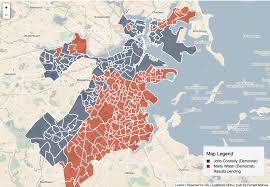
^ New Boston versus a revolutionary “old Boston’ alliance : breakdown of Tuesday’s vote by WBUR

—-      —-      —-

Thanks to the superb interactive map posted by WBUR, my final article about the Boston mayor race that elected Marty Walsh two days ago is made simple. All of my readers should look at the WBUR map and study it. The whole story is in it.

But now to my final thoughts :

1.Marty Walsh achieved office by revolutionizing Boston’s political alliances.

Always heretofore, Boston’s communities of color had voted in alliance with the City’s patrician, high minded, urban reformers, based historically in Beacon Hill, Bay Village, and the Back Bay. This alliance was the core of the old Republican party grounded in Abolition, a GOP that has just about vanished from the scene. It had, until Tuesday, lived on strongly in Boston city politics, even though now entirely within the Democratic party, at least since the 2000 election.

Walsh succeeded at breaking this alliance. Though he won almost no votes among high minded urban reformers — Ward 5 (Beacon Hill, Back Bay, Bay Village) was his worst in the City, worse for him even than John Connolly’s home ward — Walsh won the City’s Wards of color decisively, every single one of them. (I can, in fact, find only one majority black precinct that Connolly carried : Fort Hill in Roxbury).

Never before in a city election had Boston’s wards of color voted with the City’s “old Irish’ wards of which Walsh is the epitome. An abyss of contention divided the two communities. To win one was almost to guarantee losing the other. Attempts were made; but none succeeded as did Walsh’s work. The divide transcended party. Walsh’s base is the most Republican-voting part of Boston, the wards of color the most Democratic. Yet on Tuesday the two areas joined up to give Walsh his unprecedented win.

Of course the Republican votes of today’s South Boston and “Irish” Dorchester are completely different from the Republican votes of forty, sixty, 100 years ago. This is pro-life, socially conservative Republicanism, not Abolition and high-minded reform. And of course, the voters of color who moved their wards to Walsh aren’t the old, high-minded, enterprising, church-based descendants of Abolition and reform; they are union workers and those who seek to be. And of course, that is the connection : it was union labor politics that has brought the two communities together — an achievement that Marty Walsh can claim as his unique contribution. I seriously doubt that any other labor union politician could have done it. None is trusted as profoundly as is Walsh, both within union politics and without.

2. High-minded urban reform is far from defeated; indeed, it is Boston’s fastest growing political movement.

Led by John Connolly, who practically created the new version of it by his campaign, high-minded, urban reform all but captured City hall on its first try. The movement forged a base more solid than even Walsh’s and moved to its side one part — Charlestown — of the old “Irish” Boston that would have once been Walsh’s for the taking. And in fact, though a smaller achievement numerically than Walsh’s, the move of Charlestown into the urban reform camp proved just as formidable. Only Ward 5 and one other ward of the City produced a larger percentage increase in voter turnout from the primary. (More about that ward later.)

The new urban reform movement — “NURM,” let us call it — with its agenda of school transformation, enterprise innovation, bicycles and parks, public safety, and the importance of listening to those who are crying out — has firmly taken hold of all of the Downtown core of Boston : ( 1 ) Chinatown ( 2 ) the Waterfront (3) the Seaport (4) the North End (5) all of the South End, including its extension beyond Massachusetts Avenue into what used to be called “Lower Roxbury” and (6) all of Ward 5. And, as I said, Charlestown too.

Add to this the half of East Boston from Day Square to the Harbor; Jamaica Plain west of the Orange Line; Allston and almost all of Brighton; and a strong majority of West Roxbury and a smaller but still majority of Roslindale, and you have a significant voting bloc. And please note : NURM Boston is growing, while the areas in Marty Walsh’s coalition are receding. Case in point : that Fort Hill precinct. Roxbury is changing. it is becoming more entrepreneurial, racially mixed, socially connected to itself. Four years from now — eight, twelve — much of Roxbury will be voting with the South End. The same can be said of South Boston. From primary to final, John Connolly improved his percentage of the vote in the South Boston precincts closer to the Seaport. Four to 12 years from now much of South Boston will be voting like the Seaport, not against it.

Entrepreneurs both white and Black were the vanguard of John Connolly’s urban reform voting bloc. They weren’t just donors to his funds. They took leadership roles on the front lines of getting votes. from Greg Selkoe to Darryl Settles, Clayton Turnbull to BostInno, Akrobatik to Phil Frattaroli, business innovators fought and often won the battle, in a way that I had not seen since the late 1960s.

Their numbers will grow. I suspect too that so will their front line activism.

Image

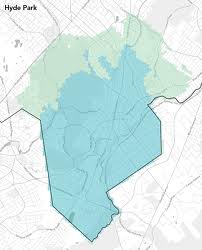
^ the Hyde park part of ward 18 : where the Connolly campaign was beaten

3. Ward 18 proved decisive, although it needn’t have.

The Connolly campaign got out-manoeuvered badly in ward 18 — 75,000 people, the largest ward in the City : all of Hyde Park and Mattapan and a part of Roslindale — and ended up losing every one of its 23 precincts.

Granted that none of Ward 18 is “new Boston” in any way, it was not at all assured to Marty Walsh.

Connolly’s problems in the ward began early. Because he announced his campaign while it still looked as if Tom Menino — who lives in ward 18 and was once its District Councillor — would run again, Connolly accorded the ward a lesser priority. Then, when Menino announced that he would not be running again, the area’s current Councillor, Rob Consalvo, stepped up. In the final, the area’s State Representative, Angelo Scaccia, endorsed Marty Walsh, along with several other local political leaders. And John Connolly ? He concentrated his effort so aggressively on the wards of color that, somehow, the power part of Ward 18 got back-burnered.

It should never have been thus. How can you plan to run for Mayor, even against a ward 18 man, and not assemble a ward 18 team early on ? Angelo Scaccia is not all-conquering. He has had many very close elections in his long career. So yes, you talk to Chris Donato, who almost defeated Scaccia not too many years ago. And yes, you pay a visit to Pat Tierney up on Fairmount Hill; you ask if her famous actress daughter Maura Tierney will consider doing a video in support of you. You go to Maureen Costello, Jack Scully, Paul Loconte, Bill Sinnott, Brad White, John Grady, Bill Broderick Jr., Tony Ferzoco, Al Thomas, Tim Lowney, Donny at the Bowling Alley, Joseph Pulgini (who ended up with Walsh, early too) — all whom I respected back in the day; probably I am missing many — and you say, “OK, I understand that you might not be with me if Tom runs but if he doesn’t run, are you with me ?” You do it early and you do it aggressively. And maybe many of the people I have named don’t join you; but some will. So, you build a team in the City’s largest Ward and you keep on building it.

John Connolly may have done some or even all of the above. But I saw no evidence of it. Connolly did, after the Primary, bring to his side Dave Vittorini, Councillor Consalvo’s aide; and Vittorini knows tons of people; but this was the Charlotte Golar-Richie situation all over again : the candidate’s workers went to Connolly, but the candidate him or herself either went to Walsh or stayed neutral.

Little wonder that Vittorini’s efforts were not at all enough to dent Marty Walsh’s Ward 18 campaign. Walsh brought Congressman Mike Capuano all the way from Somerville to Hyde Park to do his endorsement press conference. The Ward’s many BTU people — who loved Consalvo’s “the BTU agenda is my agenda” message — chose Walsh, of course. Thus it came about that on Tuesday Marty Walsh won ward 18 by at least 12 points. Won every precinct of it.

And now to the casino vote. Ward 1 — East Boston — almost doubled its primary vote total as 7324 voters cast casino yea or nay ballots. The nays had it. How was this possible ? How did a majority of people vote against jobs and money ? Who organized and paid for the “no casino’ campaign ?

The answer should be as obvious as the bad breath of a wino. Steve Wynn did it. I have no proof; nor do I need any. It was hugely in Wynn’s interest not to have a possible contending casino applicant right next door to his planned Everett casino — overwhelmingly approved by Everett voters. It would be malpractice for Wynn NOT to fund a “no casino” campaign in East Boston and, I have no doubt, to promise its organizers that there will be lots of juicy jobs in his Everett casino if the East Boston vote went to the “no” side. As it did.

Tuesday was a very very good day for Steve Wynn. Very good indeed.

—- Michael Freedberg / Here and Sphere
BOSTON MAYOR : MARTY WALSH WINS

Image

^ Boston’s new Mayor : Marty Walsh of Dorchester

—-      —-      —-

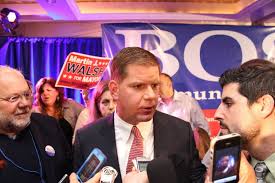
Yesterday at about 10 pm the result was in : Marty Walsh is the new Mayor of Boston.

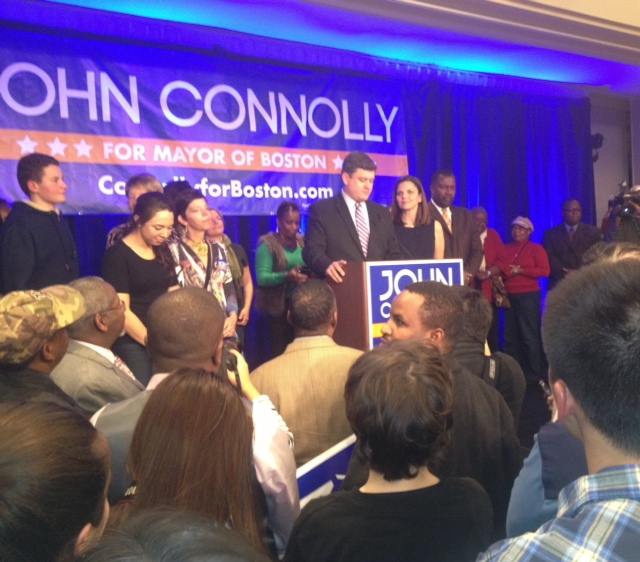
John Connolly conceded at about that time and, in his final speech to about 500 supporters at the Westin Hotel, said “I know Marty wants to do good things for Boston. He WILL do good things for Boston. He has my full support.”

And so the long campaign ended.

Unofficial City results give Walsh 72,514 votes to John Connolly’s 67,606. The margin of victory for Walsh was 3.49 % : a small margin but a telling one.

John Connolly won only the following :  the reform-minded “new Boston” Wards — 3, 4, 5, 9, and 21 plus Fort Hill (Ward 11, Precinct 1) and the Seaport Precinct in Ward 6 ; his home Wards 19 and 20; and his special, personal bastion in Charlestown (Ward 2). The City map of results suggests that he also won Ward 22. Everywhere else it was Walsh’s day.

Walsh won large in South Boston and huge in Dorchester, took about a 15 to 20 point majority in Wards 12 and 14, carried Wards 8, 10 and 11, held Connolly’s margin down in some parts of Roslindale west of Washington Street; and then defeated Connolly in the decisive Wards : very narrowly in East Boston (Ward 1 — by 3803 to Connolly’s 3739) and strongly in Hyde Park-Mattapan (ward 18). Walsh did especially well in the Readville part of ward 18, where Tom Menino lives but also Angelo Scaccia, the long-time State representative whose endorsement of Walsh may well have proved the most significant of all. Next most significant was surely the quiet blessing given to Walsh by Speaker of the House Robert DeLeo, who won twice yesterday : he helped Walsh carry Ward 1 (albeit narrowly) and he now gets Walsh out of the House, where he has been a thorn in the side of the last two speakers.

This result is no surprise. it has been in the cards for three weeks at least.

Walsh won because :

1.he had almost unanimous support in his “traditional Irish” base

2.vast money and people support from Labor (although not from all Unions; Local 103 stayed neutral)

3.even vaster national Labor PAC support in money

4.endorsements by three of the Primary season’s major mayoral candidates — all of them of color, and thus significant to the City’s voters of color; but also all of them tremendously beholden to labor unions, SEIU 1199 especially. Charlotte Golar-Richie, Felix G. Arroyo, and John Fl. Barros together gave the Walsh campaign an air of racial inclusiveness. Who will ever forget that iconic picture of them and Walsh walking together up a Dorchester street ?

5.endorsements by State Legislators , several community groups, and two (2) Congressmen, also answering to Labor constituencies, one who cam aboard early (Stephen Lynch) and the other (Mike Capuano), who saw the above endorsements happening and calculated that they had better get on board too

6.the decision by many people on the margins of work that they need a better job first, better schools later

7.institutional and money support from developers and contractors whose profits depend on the Boston building boom which requires building trades workers in order to build

8.even more entrenched institutional support from the colleges, zoning lawyers, BRA administrators, and lobbyists whose profits, epansion plans, and just plain connections and co-operation in planning and zoning matters help each other to do their do’s

9.endorsement by about 22 “progressive” Legislators, whose support allowed Walsh to magnify his limited, albeit genuinely heroic, “progressive” credentials

10.his own, low key personality and confidence in his authenticity, which stands out maybe best when  he doesn’t have a ready answer for a question — moments that happened a lot in his campaign.

11.the campaign’s 40 position papers, written with contributions from (says the Walsh campaign) 600 people, who thus became invested in their success and so part of Walsh’s GOTV army. These position papers, unleashed in the last two weeks, made Walsh look authentically Mayoral.

Image

^ conceding : John Connolly speaks

Against this vast array of established support, John Connolly could muster only (1) a citizen reform movement, one that had barely existed until his campaign coalesced it (2) his two personal neighborhood bases, West Roxbury-Roslindale and Charlestown (3) demonstrable mastery of the City budget and (4) his opponent’s binding arbitration bill, which almost derailed the Walsh campaign and gave Connolly a major issue.

Connolly also raised big money. He actually raised a bit more than Walsh did, though less in the campaign’s “crunch time.” He obviously looked a winner to many.

But it was not to be.

The newness of the citizen reform movement begun by Connolly’s campaign, its vulnerablity to entrenched push back, its untested status, and Connolly’s own air of high-mindedness — so long unheard in Boston’s municipal politics that many voters, likely, did not know what to make of it — all put Connolly on the shade side of the election sundial as soon as the Primary was over and voters started to look closely at what was what.

Frankly, that Connolly came so close to actually winning yesterday sends a strong message, i think, to Marty Walsh that he has a lot to prove; and to entrenched Boston power that while its strength remains barely good enough to win, its days are almost surely numbered as we move forward into the new era of non-union work ; of nightlife and nerdy ways ; of  schools that either do their best or see themselves lose all public conscience (and rightly so); and of  small innovative units collaborating competitively via conferencing and social media — as un-institutional a life as one can possibly imagine.

The break-up of entrenched power is coming. The power knows it. This time, it has held on — just barely. Next time, the liberation.

—- Michael Freedberg / here and Sphere

STORY UPDATED 11/06/13 at 7:55 PM

Akrobatik : Why My Friend, John Connolly, is the Only One To Lead our City


Image

^ DJ Akrobatik : guest columnist

—- —- —-

My friend John Connolly has been pegged as “the education candidate” which is just fine by me. John knows that in order to make progressive change, we must begin with our core, Boston’s youth. John has made education one of his top campaign priorities because it should be. Boston is a world-class city and in order to remain such Boston’s youth deserve a world-class education in a world-class public school system.

Recently I hosted an event at the Middle East in Cambridge that was packed to the hilt with bright, eager-to-party students from Harvard and MIT. My curiosity compelled me to poll the young crowd to find out how many of them were actually from the Boston area…. The result – Crickets. Of the 150 students in attendance representing two of the world’s most prestigious institutions, I counted three from the Boston area. Three.

As a local artist, born & raised in Boston, I was bothered by the lack of ‘Boston’ present in that room. I began to wonder why are there so few locals attending our most prestigious colleges and universities? Why does it seem as though there are pathways from all over the world leading young talent to these schools, but why are the young people born and raised in our own backyard outnumbered so drastically on campus?

John R. Connolly — to ue his full name — and I have talked a great deal about this situation. We have spoken about the variables that may be contributing to the lack of locals at these prestigious universities. We have discussed why certain obstacles are present and ways to overcome theses roadblocks. All of our discussions seem to consistently lead us back to one common topic, education. Throughout this Mayoral race, there has been a lot of talk about what can be done to make our city better, more progressive, and more like what a modern-day metropolis in America should be – but at the end of the day, we know that we must first build a solid foundation, our education systems.

By now you must be asking : “So, why is a rapper so vociferously supporting a mayoral candidate?”

Well, first off, I, DJ Akrobatik, am more than just a rapper. I am an educator, a concerned citizen, and most of all – a voter. I want my city to be better, and like John, I believe it starts with education. I am confident that with my help as well as that of others in the local arts community, we can bring this city the diversity of art it so desperately needs.
But beyond all of those reasons, John Connolly is my friend. I have known him since he was my quarterback in the huddle on the freshman football team at Roxbury Latin. I know his family. He and I have many, mutual, life-long friends. I have witnessed his progress in education and politics throughout his adult life. I trust this man will be an incredible leader for our city. He loves what we are and is passionate about what we can become under his watch.

Yes, Marty Walsh talks a fairly good game. He has some cool insights on what to do to make Boston’s streets safer. Thing is, when it comes issues like the safety of our streets, Connolly not only has cool sights; he has real solutions to the problem., Let me remind you that it was John Connolly, not Marty Walsh, who recently sat and mediated conversations with rival gang members. To me, these types of actions are solid indicators of a true leader.

Almost all of Boston’s elected officials of color, in particular those who lost in the primary election, have decided to publicly endorse Marty Walsh. In my opinion, this is some form of racial solidarity that is confusing and yet to be clearly explained. John Barros, Charlotte Golar-Richie, Felix Arroyo, and all of our City’s Elected Colors of Bennetton have stepped up to urge the minority communities of Boston to support Walsh. Not one of these officials seems to have presented a definitive reason as to why Walsh is their choice over Connolly. I can only assume that the reasoning is based on personal political agendas far more than it is about improving Boston. After all, none of these officials had anything good to say about Good Ol’ Marty as recently as July.

In closing, I ask the people to join me and vote John Connolly, for Mayor. It is my hope that sometime down the line, I will be hosting a Harvard /MIT event — and when I ask how many students hail from the Boston area, the voices respond, so many that it’s too loud for me to hear myself think.

Imagine that. And I will know I’ll have John Connolly to thank.

— Akrobatik / guest columnist

BOSTON MAYOR : FINAL DAY SIGNS

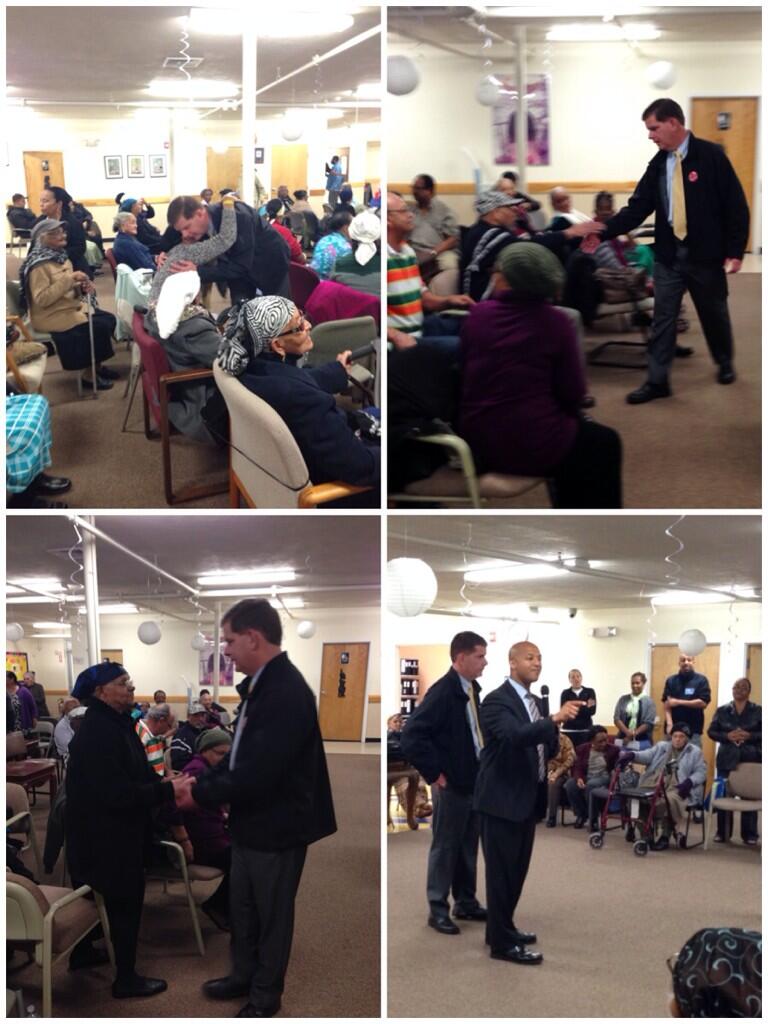
Walsh at Cape V Senior^ in search of the Undecided : Marty Walsh with John Barros meeting Cape Verdean Seniors

—-      —-      —-

Boston, November 4, 2013 — on this Final day of the campaign, with voting tomorrow, what are the two candidates doing ? When one looks, one sees two very different messages being sent.

Marty Walsh, whose campaign has built itself around numerous politicians’ endorsing him, has spent today in their company :

1.in South Boston with former State Senator Jack Hart

2.at the Holgate Senior Center in Roxbury with Councillor Tito Jackson

3.at the Cape Verdean Senior Center with John Barros;

4. with former St. Rep. Marie St. Fleur visiting Haitian Seniors; and and

5.in Walsh’s home area of Adams Corner, Dorchester with a bunch of officials ; State Rep. Dan Cullinane, State Senator Linda Dorcena Forry, and City Councillor Frank Baker.

Walsh’s trips to Senior Centers comports with poll findings that Seniors are significantly represented among the undecided vote still available.

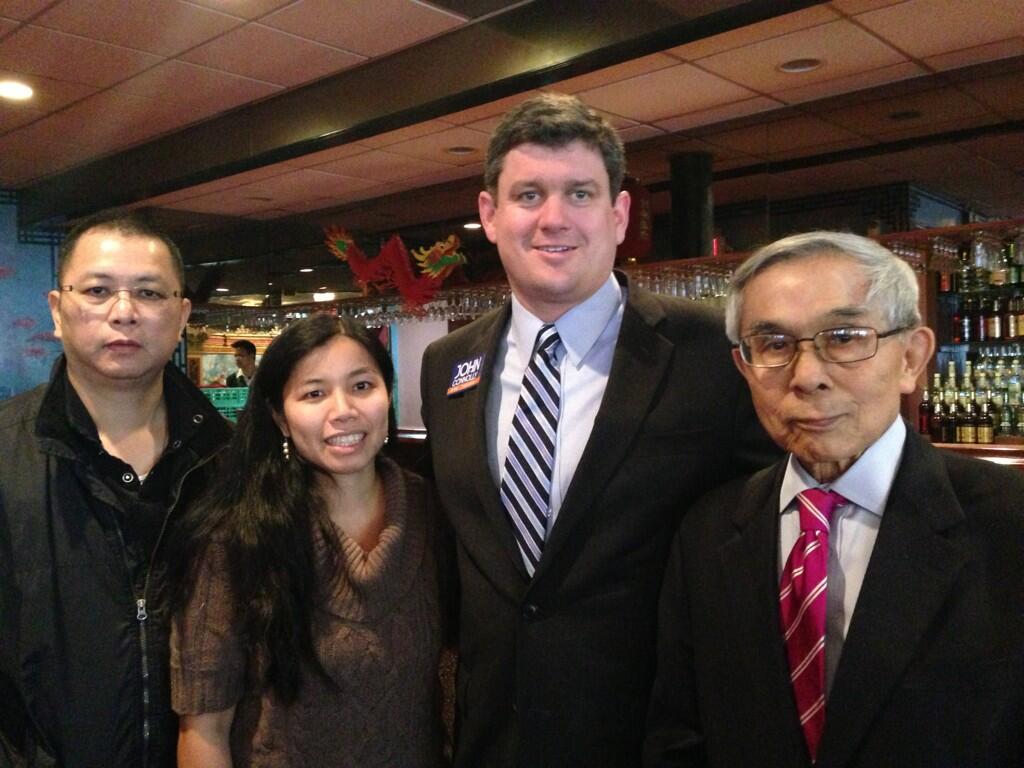
Connolly w Chin^ in search of Asian women, said to figure largely among the undecided : John Connolly with THE Frank Chin and Sherry Dong, this morning

Meanwhile, John Connolly, who has endorsers albeit far fewer than Walsh, is going about (with one event exception) by himself, being the Citizen against the machine.

Connolly started his day on CBS Boston’s morning show; went from there to Forest Hills Station to greet voters; then to Digitas Corp. to address technology innovators; then to Chinatown as guest of Sherry Dong and Chinatown’s “Mr. Big,” Frank Chin — his one big power endorsement event of the day; next to Centre Street in Jamaica Plain; then briefly to his Roxbury HQ to greet workers; then to The mall of Roxbury to greet voters, and, finally to McDonald’s, where the staff and regulars held a meet and greet for him. And his day continues.

Connolly’s visits, especially to the Taishanese Association, also comport with poll findings. According thereto, Asian women count high among the remaining undecideds.

And so it goes. The citizen reformer standing (more or less) alone against entrenched power versus …entrenched power displaying its power, each man in search of demonstrating his message to voters still unsure of which message to trust, or to endorse.

Tomorrow we will find out.

—- Michael Freedberg / Here and Sphere
No Seat At the Table

To all our readers : we now add Rodney Singleton;s view from Roxbury to our correspondent reports. just for you !

Mary Churchill's avatarRoxbury Calendar

Today’s panel discussion on the morning show about unions, diversity and a poll for mayor, served as fervent and substantive discussion on the radical difference between our two mayoral candidates, John Connolly and Marty Walsh and how our choice will impact communities of color. Indeed, last night’s debate around Marty Walsh’s union ties and arbitration is clearly the tip off!

Yes, many unions do great work, but given the current development boom and the prospect of that boom dominating the economy of our city, it’s fair to shine a light on only the trade unions, unions that have historically excluded people of color and continue to do so.

Which brings us to the man who would be mayor. For me, and trust for the vast majority of folks of color, the following excerpt from a story written by Bruce Mohl and Colman M Herman in this month’s Commonwealth Magazine speaks volumes:

View original post 340 more words