THE STRANGE CASE OF HILLARY HATE

awful

The thing most puzzling to me about this Presidential election is the prevalence of hate for Hillary Clinton. Its virulence, too. Whence does it arise ? Of course partisan overreach stokes much, but said overreach couldn’t find ground were there not voters — a great many — to fuel it.

I read the hate on social media especially. And there, after reading literally thousands of posts and comments, I find the answer : women.

Women do by far the majority of Hillary hate on social media. How can this be ? And again : the single most frequent reason raised by Hillary-hating women is the behavior of her husband. Because he violated his marriage vows — often — and, so the comments read, she fought fiercely to discredit the women that Bill Clinton seems to have dallied with, Hillary is blamed. Why is this a thing ? Isn’t it right that Hillary fought for her marriage any way she could ? Is that not praise worthy ? I say it is very praiseworthy.

It is said of her that by fighting for her marriage rather than divorcing or separating from Bill Clinton, Hillary ‘enabled” him. I find it scary that people feel entitled to judge the dynamics of someone else’s marriage. No one should ever do that. Nobody who isn’t in a particular marriage can know the workings of it, and even if they did know, it’s not their place to judge or butt in.

Why do Hillary hating women do this ? One suspects that many, many women are in sexual relationships in which the man betrays or belittles, and, looking for Hillary Clinton as a role model for push back — for freedom from a cad — because of her power and riches, they find instead an “enabler.” Far better that women should not look for role models, instead to be their own role model : but that is easier to say than be.

Then come the standard talking points : Benghazi, the e mails, the power politics wreaked upon Bernie Sanders. But I find all of these a convenient excuse, rather than the cause, for the basic generator of Hillary hate : women who feel disappointed — betrayed ? — by Hillary as an avatar of women’s love rights.

How easy it is, for women feeling betrayed by their wished for avatar to latch onto Trump as a convenient Hillary spanking. How better to beshrew Hillary than to salute a man who gropes women at will, has had three wives, treats women’s bodies like a fruit basket, and brags about it all ? One sees Hillary hating women for Trump glorying in baiting her duck : look, see ? My abuser of women is more brazen than yours ! And after all, your betrayer DID the wild thing, mine only talks about it !

And let us not forget the lessons of literature. It was not a feverish revel of men that, in Euripides’s play The Bacchae, tore a male interrupter in pieces. Truly, as the saying goes, “the female of the species is deadlier than the male. Why is this observation true ? My view is that as women’s lives have been squeezed small by the dominance actions of men, so women’s frustrations simmer very hotly, very very, and when they boil over, there’s no turning back, no cooling off.

And yet the election of Hillary Clinton as our next President will empower women. It will galvanize girls coming of age. It will change the dynamics, so that the dominances men have enjoyed will be seen for the manipulations they are. The women who hate Hillary may never reconcile with her triumph; even the masterful Queen Elizabeth could not assuage Mary Queen of Scots or her party; yet Hillary, like Elizabeth, has already her vast following of women who see her rise as far more important than her betrayal as a wife, for them she is THE role model, and that, I think, is major progress. And Hillary as President will be, for girls now born and those who will be born, even more the measure of women’s significance. The future of women will not be like the past, and the hate that buffets Hillary Clinton today will grow ever more beside the point.

—- Mike Freedberg / Here and Sphere


THE REPUBLICAN CONUNDRUM IN MASSACHUSETTS


Baker

^ Governor Baker presides : he is also trying to build a stronger Massachusetts GOP. But he faces obstacles big and numerous enough to defeat all his dreams thereof

—- —- —-

Political parties only matter if people take them as mattering. In Massachusetts, there’s few who do that. Which is a huge problem for activists who want to boost the Republican party in our state.

The one venue in which party does matter — a lot — in our elections is for Governor. In every election since 1990 except two, a plurality (or majority) of our voters has chosen the candidate whose name appears on the ballot’s Republican line. Why do our voters make this one exception to an otherwise single-party (and thus no party) vote ? My view, which I have written about often, is that voters want a Governor who is not a Democrat, in order to bring an independent power position into play, so that the state can reach policy consensus. Of the five Republican Governors who have held office since 1990, none personifies consensus more convincingly than Charlie Baker, which is surely why his favorability numbers hover at 70 percent.

Yet even spectacular in popularity, Baker has been unable to strengthen his party much. There are many reasons for this, and I will discuss them. First, let’s agree that electing a referee Governor is hardly a mandate to be politically partisan. Baker builds a Republican party at his peril. Yet it was the same for all his four predecessors, which is why few of them tried to do it, and the one who tried — Mitt Romney — failed badly.

Most Massachusetts voters belong to neither party : 53 percent overall, much higher percentages in the towns beyond Greater Boston — some have 80 percent of all voters not party enrolled. When these voters vote, the last thing they look at is which party line accompanies a candidate’s name. (For national office, that may not be true; the Republican national party has a terrible reputation here). Yet even those who might be inclined to vote for the Republican often do not do so, because (1) the Republican candidate is almost always lesser known (2) is almost always running against an incumbent and (3) often espouses policy positions rejected by the majority of voters.

As for party enrolled, only eleven (11) percent of Massachusetts voters are Republican, whereas 36 percent are Democrats. The disproportion is far greater among activists. My guess, gleaned from decades of intense campaign involvement, is that Democratic activists outnumber Republican ones at least ten to one; and those numbers are worsening, as the age demographic among Massachusetts Republicans is mortal. Most people you;’ll see at a Republican local event are over 60, even over 70. Candidates do not appear from nowhere; almost, all are of the activist group. Just on the numbers, Republicans are three times more likely than the Democrats to not have a candidate in a particular race. Then you add the demographics. Very few candidates for local office or the legislature make their first run at age 60, much less 70. Almost all are in their 20s. Of these, the Republicans have very very few.

Young ambitious people thinking of running for office know the numbers. Unless they are ideologically inclined to the Republican party — more on this point later — they almost always decide to run as a Democrat, because it is simply much easier to win that way. Who would choose to put her name on a ballot line that eleven (11) percent identify with, when instead she can seek a nomination that 36 percent go to ? The answer is as bad as the question is sad. Almost all who choose to run as Republican do so for ideological reasons. But the GOP is ideologically way, way out of step with the views of Massachusetts voters on almost every issue. And if a candidate with majority views does decide to run as a Republican ? She’ll almost certainly face passionate opposition in the Republican primary from those who hold the opposite, “true” Republican view. Why would any ambitious young activist ant to put himself into that squeeze ?

Now we come to Governor Baker. This is the math, and the dynamics, that he must confront. I have no idea what course he COULD take to build the Republican party — other than to continue doing the mostly exemplary work that he is doing — but such courses as he seems to have taken aren’t helpful. Last fall he commenced a campaign to unseat anti-Baker, radical right wingers from the Republican state committee. He fielded or endorsed approximately 57 candidates for the 80 state committee seats to  be elected at the March 2nd Presidential primary. Unhappily, a great many of his candidates were either Baker hires working at the State House or were existing state committee members hired for State House work. Is it any surprise that the opposition raised the spectre of patronage politics ? Raised it successfully enough to almost defeat the Governor’s campaign ? Nor did many of Baker’s candidates have deep roots in their district — some had only recently moved in; and many did not work the campaign the way you have to. State committee members are elected by State Senate District. To win  a state committee race you really have to treat it as a race for the State Senate itself. Yes, THAT intense. That means you have to want the job, you have to start running for it early, you have to raise at least $ 50,000, and you have to campaign full time everywhere; and you really ought to have roots in the district. Most of those Baker endorsees won who have roots and campaigned as you have to. Those who did not, or could not, lost.

Baker’s operatives would surely say to me, “but Mike, patronage people were all we had. There are so few cadres in our party.”

True enough. And that is the basic problem, the fundamental difficulty in all plans to build a Republican party in Massachusetts. If you don’t have candidates who want to win, and who can win, and who are prepared to do what it takes to win, you cannot even have a party, much less build it. And though patronage cadres are extremely valuable for campaign work, they’re usually lousy candidates. Voters understandably want representatives responsible to them, not to a patron. So, how does Baker find these ? Can he find them ? I am not optimistic.

And what if Baker, or a successor, were to succeed in building something stronger ? Immediately the election of Republican Governors would be put at risk, because our Republican Governors are elected by the activism of city and suburban Democrats, who can do this because the election of a GOP Governor does not in any way threaten Democratic dominance of state politics. That would not be true if our Republican party where large enough to threaten. If a Governor could build the Republican party to 25 percent or more of the vote, a thing most unlikely, Governor elections would look very different on the ground, but the Republican would surely lose, the election now being about partisanship rather than refereeing. And again : a local GOP cannot be built to the 25 percent of voters level without taking in the national GOP’s supporters. Which would make the GOP’s local difficulties worse, not better.

I do not know what Baker can achieve that will help rather than imperil his future. It would be nice to have at least enough activist Republicans, however, that his patronage, or his state committee members, aren’t amateurish, or bought and paid for, or both.

If you, dear reader, can think of a way to circumvent even one of these obstacles to growing the Massachusetts Republican party, I’d love to hear it. Until then, I accept living in political conundrum.

—- Mike Freedberg / Here and Sphere


GOVERNOR BAKER AND THE EEA AFFAIR

baker

^ Governor Baker has been put in the middle between Parker O’Grady (left) and State Senator Don Humason (right), whom O’Grady is challenging. (Photo from masslive.com)

—- —- —-

We’ve waited to opine about this matter until the accusations and reports had time to check and occasion to be checked upon. I refer to the news that an employee of the Department of Conservation and Recreation’s “EEA” Division — Energy and Environmental Affairs — was harassed by her mangers over her connection to a Democratic candidate for State Senate; that she is the fiancee of said candidate and was told to have her affianced cease his candidacy against the incumbent Republican State Senator, or else. It appears that there’s truth to these reports; that Governor Baker was not told; and that his own office has begun its own investigation as to what happened and who did it.

Said Baker,
/sites/all/themes/zen/js/html5shiv.min.js
“No one in our administration should ever, ever threaten anybody to engage in civic endeavors as a private citizen. Period. And I take that type of allegation really seriously. And like I said, let’s see what comes out of the investigation. It’s going to have a lot of input from our legal office and based on what comes out of that, we’ll make an appropriate call.”


/sites/all/themes/zen/js/html5shiv.min.js


/sites/all/themes/zen/js/html5shiv.min.js

That’s the state of things as I write. I have nothing to add to the facts, but I have plenty to say about them and about how they were handled.

First: the Governor was not informed. Look, guys : if you’re going to staff a State agency with patronage appointments — political people hired because of their commitment to the Baker team — that’s fine; patronage is necessary, or else politics will be left only to the ideologues. But if an agency is run by patronage employees,m expect politics to be played within it. Monitor the same. If politics arises, let the Governor know immediately.

The decision to staff an agency with political people has to be the Governor’s. It cannot be anyone else’s. Patronage is a controversial practice. The public is skeptical of it, and newspaper columnists feed that bias. So if you’re going to do it, you ought to SAY SO, and to monitor your decision carefully, so that said patronage hires don’t end up embarrassing you.

Second: The Governor’s immediate staff must include at least one, better yet more than one, political person who is on his core staff for just that purpose. Baker campaigned as Mr. Fix It, and he has been that; but if, as is evident now, he has also set up a political shop, the public is going to judge that aspect of him too, and he needs be as careful of it as he is of reforming the MBTA and the DCF. The phrase “Baker was evidently not told” should NEVER happen in an administration with a political component. The Governor should always be told; better yet, he should find out for himself. He shouldn’t wait “to be told.”

Third : patronage employees need to be told that they are just that : patronage employees, there for a political purpose, but until called upon, there to do the actual job they are put in. If the Governor wants a political staff — and that’s quite OK — he should hire one. If he wants said staff to do a regular state job as reward for doing politics, he should make it clear to said hires that they cannot mix the two commitments; that politics must be kept out of the state agency work.

Most elected officials know this. Most patronage hires know it too. But in the Massachusetts Republican party, experience of elected government is rare; few cadres have it; and thus they — and their elected boss — aren’r experienced in how to do it. This problem is not unique to Baker and Republicans. Mayor Walsh has sometimes found it difficult to keep political agendas out of city administration. Yet Baker faces a factor that Walsh does not : as a Republican, Baker stands on only 1 percent of  Massachusetts voters. There is no margin  for mistake.

Fourth : threats by a political employee cannot continue. Anyone at the EEA who made any sort of retaliation threat against Ms. Cynthia Lewis or anyone else needs to be warned, in writing, that any further recurrence will result in termination. The same message must be delivered to those in a position to inform the Governor. It’s axiomatic in patronage circumstances : any political appointee who embarrasses the boss is gone, no exceptions.

Finally : this editorial supports the use of patronage. If political parties forswear patronage, all those people who join campaigns in hopes of a job are told they’re not wanted. In which case only the ideologues remain. Today’s political parties suffer from too much ideology, too little continuity. Patronage gives politics stability and a connection to people other than think radicals and one-issue zealots. It is a conservative force. It should be used; but it cannot be used cavalierly, because the public dislikes it. Only if patronage employees contribute to good administration will they be tolerated by the voters.

This baker knows well. Time for him to establish ground rules for the politicals who he has put at the EEA — no exceptions.

—- Mike Freedberg / Here and Sphere

HILLARY CLINTON RISES TO THE OCCASION

hillary

^ he fumbled and punted, she scored several touchdowns : it was Clinton all the way last night,. But is that all ? Not so fast.

—- —- —-

Some of Hillary Clinton’s supporters were worried about how she would fare last night at the first debate, which is usually the crucial one. They need not have worried. She met the occasion and made it hers.

In retrospect, that was probably inevitable. No one who watched Clinton stand up to, and overpower the entire line up of inquisitors at her 11 hour Benghazi investigation hearing should have had any doubt that she could truck her way through 90 minutes of increasingly unfocused Donald Trump, blasting him several times that few who watched will forget.

What effect will her 90 minute demonstration of command of the issues and reliability have on the actual election ? Were the vote taken today it would affect the result a lot. Trump’s voters don’t care what he says , or how he says it, but undecideds do care. This year there’s an unusually large number of undecided voters; I cannot believe that they found reason last night to break for Donald Trump. One national poll asked “who won ?” and had the result at 62 to 27; another said 51 to 40. The 62 to 27 poll, by CNN, probably represents only the debate itself; but the 51 to 40 poll feels a lot like an actual vote preference. Trump has almost always polled at least 39 percent of the vote. Of late, he’s settled into a 44 percent base. A 51 to 40 poll says that last night cut that raised vote back, reducing him almost to his bottom. The debate really was that damaging to him.

Every segment of the debate, Trump was worse than in the previous. His ending was as discombobulated as it gets: he was mouthing gibberish. Along the way downhill he coughed up some truly cringe-worthy talks : his “birther” answer was  disgusting; his attack on Rosie O’Donnell petty; his statement that paying no taxes was “smart: was the opposite of presidential. He entirely blew the “First Strike” nuclear use question, and his statement that NATO members “should pay us for defending them” was batty. He rambled and ad-libbed the Iraq questions — and lied about his views, over and over again. Little wonder that Clinton began her summation speech by reassuring our allies that we will keep our treaty commitments.

One of Trump’s worst moments was his charging Clinton with not having the stamina for the job. This was an entirely willful accusation on his part; the moderator didn’t ask him about her stamina. Clinton blew him out with her answer : “after you’ve traveled to 122  countries…and endured eleven hours of Benghazi hearings, then you can talk to me about stamina.”

Actually, it was Trump who lacked stamina to go even 90 minutes focused, much less 11 hours.

Trump’s cavalier misogyny glared at the close, as did his word salads, and as it is last impressions that s tick the surest, he ended at his worst; and as last night’s debate was likely the first time most voters have seen him at length, these voters cannot have been edified by what they saw.

It’s hard to tell what the consequence, a week or five weeks from now, will be of last night’s show; but for now, Clinton’s performance has to boost her vote. It will enthuse her supporters (and they needed that), and it will move many undecided voters to at least lean her way. It may even trim Trump’s vote share a bit. Yet the election is NOT taking place now. Clinton remains a solid, perhaps too solid candidate of scant embrace : one thinks of Theodora, or the first Queen Elizabeth, even Maggie Thatcher : women leaders who have found their surest strength in rigid imperiousness and impenetrable command,. It has worked, and it probably will work here, now, in America, with its imperial central government. But I wouldn’t declare victory just yet. The male leadership model runs deep in our political conversation, and an egregiously flawed Trump unafraid to let all his flaws hang out has an air of authenticity hard to deny.

Difficult, too, to conceive two more dissimilar candidates to be commander in chief. In that abyss of difference lies the great, the vast election unknown.

Still : for now, Hillary Clinton rides high. Her supporters should be enormously happy this morning.

—- Mike Freedberg / Here and Sphere


HILLARY CLINTON FOR PRESIDENT : HERE’S WHY

clinton

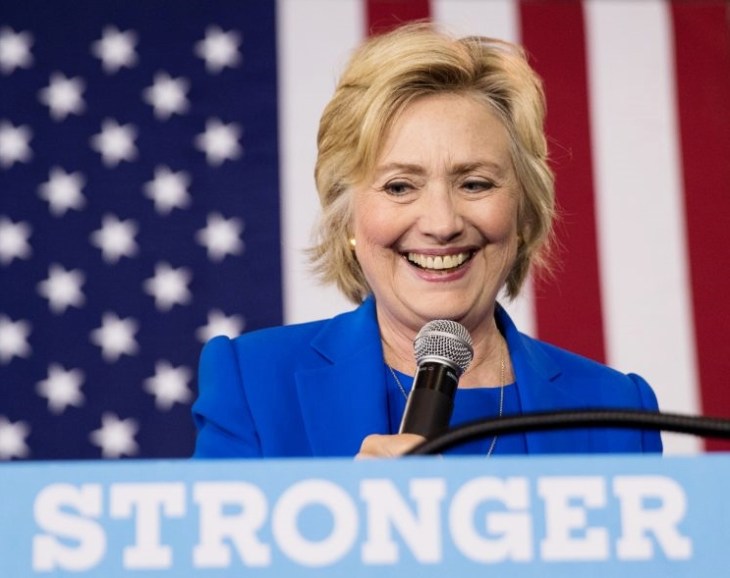
^ our endorsed candidate : Hillary Clinton

Here and Sphere endorses Hillary Clinton for President.

This is our first Presidential endorsement, one that we take as seriously, as we must. Our endorsement is a positive one; it is not predicated on the deficiencies, as they may be, of her opponents. That said, we present both sides : the positive for Clinton and the reasons why we reject her two chief opponents.

The Case for Clinton

If Clinton  is anything, it is safe. Safe and sure. She is cautious almost to a fault; never acts precipitously; thinks before she speaks; weighs, almost too much, the consequences of what she, as a major political figure, may say. These are not qualities fit to the feverish, impulsive world of outrage that has become an unfortunate norm, but they are vital ones to have in a President, who cannot be an internet pundit. A President needs first of all reassure the people that she is careful, in charge, and master of her mission.Especially in a world beset by complex competing tribalisms, lone wolf virgins, trade wars, and enormous migrations of people into all sorts of hells, the leader of the free world should be a refuge of safe.

Clinton’s play it safe method also benefits domestically. The nation is adjusting fairy well, actually, to large changes in social mores; it is adjusting to economic transformation. LGBT civil rights are winning the day almost everywhere — the price of opposition to them is unacceptable even to deeply traditional communities. The uproar over police disparagements (and worse) of Black people — an uproar fully justified — has the potential for open racial warfare; a safe President, especially one supported by 97 percent of Black voters, has the power to bring both sides to the table — as must be. Economic reforms are already in process or on offer : a $ 12 minimum Federal wage; charter school expansion; trade treaties; wise use of Federal debt; protections for consumers in the world of banking; labor’s rights to organize; innovation encouragement. On all of these, Clinton stakes knowledgeable positions likely to gain majority support. (On some, we disagree with her; but there’s time, later, to enter the debates over each). The bottom line is that nothing radical or otherwise disruptive is likely to occur in a Clinton Presidency.

Clinton has a resume in public life almost unmatched in its breadth and length. She may be anything but a fresh face, but she has the wisdom of long involvement and an ability to articulate complex policy superior to that of any Presidential candidate since LBJ.

Clinton is as tough at the helm as she looks when presenting her case. No enemy of ours has any doubt that Clinton will not shrink from using the full economic and military power of our nation if she feels she has to.

Clinton is already a world leader. Her four years as Secretary of State made her a highly respected presence in most nations; in particular, as advocate for the rights of women and of children, as enemy of slavery, as promoter of education and of freedom from disease. Her family’s Foundation, much maligned, with zero good reason, by her political opponents, has made a huge difference worldwide for women and children’s health and civil rights.

At home, too, Clinton stands squarely for all those advances that this nation has fought to win during the last 50 years : full civil rights, and respect, for people of color; women’s reproductive and equal pay rights; reasonable regulations of weapons; normalization of undocumented immigrants; and, most basically, for the Constitution’s fundamental assumptions : that the Federal government is supreme, not the states; that no state can nullify or undermine a Federal law; that the “comity clause” defeats any argument that one state can offer different rights to people than any other; if the “2 A” gives any rights, they are given to all, not just to white people; that the First Amendment means what it says about free speech, including most pressingly, the right of journalists to criticize all politicians as they see fit, including unfairly; that the 14th Amendment means what it says about the citizenship; of everyone born on American soil. It is a shame that this must be said, but one of Clinton’s opponents has sent many, many signals that Constitution’s prescripts do not apply.

It is also significant that Clinton would be our first woman President. By doing so, she will accustom Americans to seeing female personality and characteristics as leadership qualities. Time and again we have heard how all the political leadership role models are male. That needs to change. There is nothing about being male that makes one a superior leader. Anyone who has studied the history of England’s first Queen Elizabeth will know that inspired command of female qualities is indomitable. America needs to know and embrace it.

Lastly, Clinton is trusted and supported by the America of tomorrow : people of color, immigrants, women to whom women’s reproductive rights are important, entrepreneurs, the well educated, city people generally. If she is not immediately embraced by millenials, who see her as a pre-internet person, at least on the issues that millenials care about, Clinton is fully aboard.

For all of the above reasons, we proudly endorse Hillary Clinton for President.

The case against Donald Trump

Trump has offended almost everyone, on purpose; but I think most people get that, in the internet age, one can say almost anything, and it doesn’t matter. The basic message in Trump’s insult routine is that he spurns the common wisdom. That is a very appealing message for voters who find the ordinary way of doing things otiose at best and a huge obstacle otherwise.

Nonetheless, plenty of people take Trump’s racist, anti-Semitic, naive, cynical, indifferent, and blundering word salads seriously as license to do the same. Actual people get hurt thereby, not to mention the enormous distraction from the work of reform that these verbal, visual, sometimes physical push and shove inflict on a society that needs to be less violent, not more; and more focused, not less.

Nor can Trump’s insult routines shrug off his personal and business failings, which render him entirely unfit for any office, much less leader of the free world : his insecurity, his multiple frauds, his enormous financial obligation to Russian lenders and oligarchs, his misuse of foundation money (gotten mostly from other people !), his record of stiffing people who worked for him, and many more, even darker connections that bedevil almost any New York City real estate macher. Nor has he surrounded himself, it seems, with advisers any less compromised than he himself. A vote for Trump is a huge gamble; but a voter should remember the gambling axiom that in casinos, the house almost always wins. We urge voters NOT to take this gamble, not at all.

A word about Gary Johnson

The palpable unfitness of Trump, coupled with the awkward personality of Clinton have led many voters to support the Libertarian Party’s nominee (and his vice president, Bill Weld, our own state’s former, well respected Governor).

There is much to like about this team. They do not seek to impose religious tests or to turn Fundamentalist Protestant Theology into public law. They support LGBT civil rights. They don’t think a government should tell people what to smoke.

Yet the Libertarian platform reads weirdly. Retreat from the world is not an option, infrastructure cannot be delegated to private enterprise; commerce cannot go unregulated, nor can weapons and ammunition. Basically, the Johnson/Weld platform undermines basic Constitutional covenants just as radically as the Trump message. How does the Johnson’/Weld agenda comport with the 14th Amendment ? The 15th ? The Commerce and Supremacy clauses ? The Constitution’s grant of Federal exclusivity over immigration, admiralty, bankruptcy, the coinage of money, the authority to borrow money on the full faith and credit of the United States ? Frankly, the Libertarian agenda doesn’t accept any of these.

An American agenda should accept the Constitution and its Amendments. The Constitution has made us exactly what its preamble commanded : “a more perfect union … promot(ing) the General Welfare.” The Constitution has never had any easy time. ratification itself, in 1787, was a close run thing, and ever since, the Constitution has faced enemies bothersome, violent, mortal. Yet it has always triumphed and done us well, made us the nation that almost all people want to be part of. We support it. Only one of the three candidates we have discussed supports it. We endorse her : Hillary Clinton.

—- The EDitors / Here and Sphere


CITIZENSHIP AND “THE ESTABLISHMENT”

obama_signing_the_fair_sentencing_act

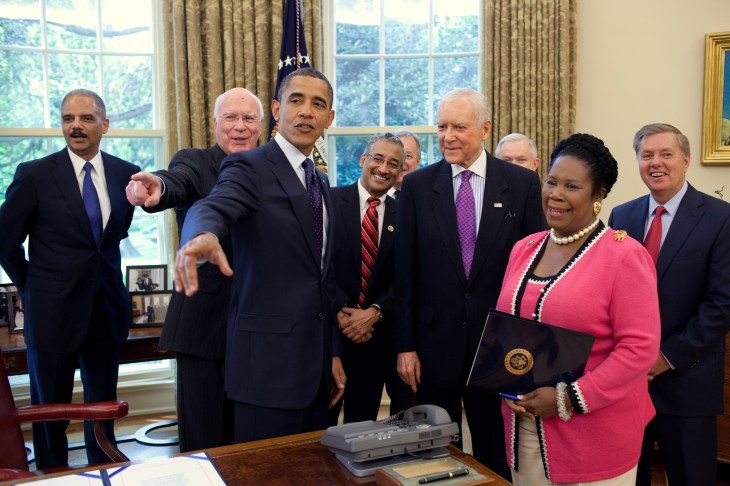
President Barack Obama talks with Members of Congress after signing the Fair Sentencing Act in the Oval Office, Aug. 3, 2010.

^ “the establishment.” It is everybody, not just you, and if you are a citizen, you are invited to be in it.

—- —- —-

Commonplace it is these days to revile “the establishment,” a term of political reckoning easier said than described. I suppose that what revilers mean is “the government,” which in turn musty mean the people who do what their job descriptions say they must do — including writing those job descriptions.

I’m speaking mischievously here. To revilers of “the establishment,” their pain is real. “The government” doesn’t, care about them; they know this. Why do they know it ? That’s an interesting question, but it’s kind of beside the point. Once a person becomes an habitual reviler of “the establishment,” his revulsion takes on a life of its own.The reviler becomes invested in his revulsion. We see this on social media, where a public platform authenticates his investment.

The reviler feeds the beast. Every day his outrage finds verification in some internet posting, or, if it’s a good news day, in some outside event that proves to the reviler that “the establishment doesn’t get it.” The recent bombing in New York City ? “The government didn’t get tough enough.” The President can’t re-enable the dying coal industry ? It’s his fault. I could go on well past your patience.

Revilers of “the establishment” aren’t completely cuckoo. Almost every Federal agency operates under a system oif disclosure, process, and guidelines that incorporate more of politics than of efficiency. The object seems to be to get done only stuff that offends no interest group, or no member of Congress. Federal employees often seem to spend more time complying than performing. Yet this is  a mis-impression. Most Federal employees I have interacted with are remarkably well spoken, well dressed, well mannered, and very, very competent.

The difficulty is in the job itself. We operate a humungously complicated society; how can the government that governs it be any less complex, and do the job of governing? It can’t.

So let me now say what the headline to this editorial suggests : “the establishment” consists of people who have, mostly, become “established” in government and/or political matters by participating; by stepping up to the tasks, and the challenges, and the reforms, and helping to do them. That’s really all that it takes : participation. I have never seen an “establishment” person tell someone who seeks to participate that he isn’t wanted, or that he can’t come aboard.

There’s no bar at all to anyone’s stepping up to political missions. Our society used to encourage it. We should always do so. A citizen has rights but she also has obligations to the society that has accorded citizenship to her. I think of citizenship not just as an end in itself but as an invitation.

Once a person — non citizens can participate too, except that they cannot vote — joins in a movement, or an advocacy group, or a campaign, she finds that everybody else aboard is just like her. “the establishment” isn’t made of space aliens. It’s people who live next door. And that’s true for almost every neighborhood. Even in our racially and income segregated society, participants in “the establishment”: live on almost every street, including yours, and mine.

But enough of generalities. Let us talk particulars. We all know that some government offices do not work well; resist change; sometimes actually injure the people they’re supposed to serve. Too easily government offices become the prime thing for those who work in them — just as the reviler of establishments becomes invested in his revulsion, so the employees of government offices become invested in the agency, serving it, not those it was created to serve. It’s up to the citizen to give them a heads up, even a spanking. And to get the agency reformed like crazy.

But we do this not to destroy the office but to make it do its job. As Governor Baker says, “at the end of the day, people want the services they want to have, done right.”

I leave you here for now. This is an editorial that bears lengthening. Tomorrow I will update.

—- Mike Freedberg / Here and Sphere


ANNALS OF THE BRA : AN END RUN ?

OLYMPUS DIGITAL CAMERA

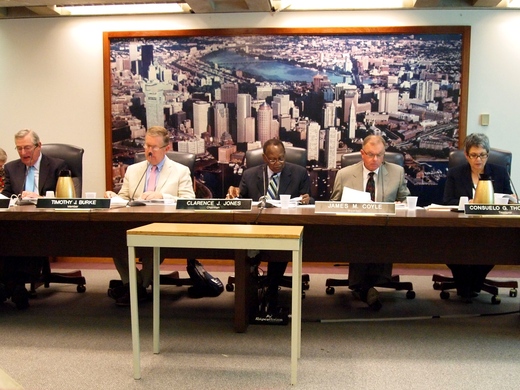
^ the Boston Redevelopment Authority Board : has it found a new tactic to win the development wars ?

The BRA, Boston’s Redevelopment Authority, oversees every move in the gamed of rebuilding Boston. It began life as a tyranny, in the 1950s, one man dictating “slum clearance” and the like; but over the last 60 years it has devolved into the opposite : a decider whose decisions are made by, or overturned by, a phantasmal entity called “the community,” which said chimera most decidedly is not.

Recently a very well informed source told me that City hall has found a way to get around the power now wielded by “the community”at the “community hearings” required by the BRA’s project approval process. I shall tell you all about it; but before I do, a few words more about that project approval process bear discussing:

BRA project approval requires the following tests: ( 1 ) architect’s plans ( 2 ) design review ( 3 ) zoning issues ( 4 ) “community” hearing ( 5 ) revision of project to comport with community objections ( 6 ) project approval by the Board — which step may or may not require an actual hearing. “Small projects” seldom require it; big ones seldom do not.

Developers understand these steps very well. (Those who don’t, do not get very far.) “Community” approval is the sticking place. Opponents of a project always show up’ supporters rarely do. Projects in South Boston, Dorchester, Allandale, West Roxbury, and Egleston Square demonstrate just how fatal “community” opposition can be.

I put “community” in quotes because it’s almost a given that those who oppose a project speak for a very small portion of the actual community — a concept which, in my mind, includes those who work in a neighborhood as well as those who reside in it. I’ve seen restaurants opposed by “the community,” when in fact said eatery would provide jobs to the neighborhood as well as amenity.

“Community” opposition at BRA hearings has in some cases broached issues way beyond actual project matters. In one City Council district I’ve seen demands made of developers on who to hire, at what wage; in one case, the developer was told to hire union workers and to allow that union to organize his workers. There may be a case for assuring these things; but a BRA project hearing is hardly the venue. The issue at a BRA hearing is the project itself, not reform of the entire society.

I’ve attended hundreds of BRA “community” hearings. The mindset of opponents is that the property in question is, basically theirs; that the developer who actually owns the property, and whose capital is at risk in it, operates at sufferance by an un-elected, self-chosen body of project vigilantes.

This mindset is hardly exceptional. It’s almost the norm. No wonder that the City may — if my source has the story right — have devised an alternative review procedure. It goes like this : ( 1 ) most projects require obtaining relief from the City’s zoning code ( 2 ) when someone seeks a zoning “variance,” abutters to the property have an automatic right to object. ( 3 ) “abutter” has always meant “owner of an immediately adjoining property.” You are an abutter if your property line is at any point the variance seeker’s property line also. ( 4 ) now, says my source, the City has changed the meaning of “abutter” for the purposes of zoning issues. Abutters will now include every property owner whose lot line comes within 200 or 300 feet of the variance seeker’s property line

At first look this change seems to make it harder, not easier, for a developer. But not so. Because the zoning variance is such a crucial issue, and because the Zoning Board of Appeal exercises its variance discretion vigorously, the increase in abutter numbers stops nothing; meanwhile, the enlarged abutter group creates a special interest within the potential “community” opposition.

The expanded abutter group has potential, also, to become “the community” for project hearing purposes. Whatever the involvement of local anti-development activists may be, the formal local opinion registered will be that of the enlarged abutter group — and not only at zoning variance hearings, crucial though they are.

One further point : Mayor Walsh has also established the planning and concept organization called “Imagine Boston 2030” and given it a website which has become the opinion point for thousands of Bostonians — far more than show up at all the BRA “Community” hearings combined. In the microcosm and the big picture, the City is cutting itself free of the anti-development ties that have hog-tied it for so long.

— Mike Freedberg / Here and Sphere


SOME PRINCIPLES TO COMMIT TO IN THE AGE OF LIES AND TROLLS

kasich

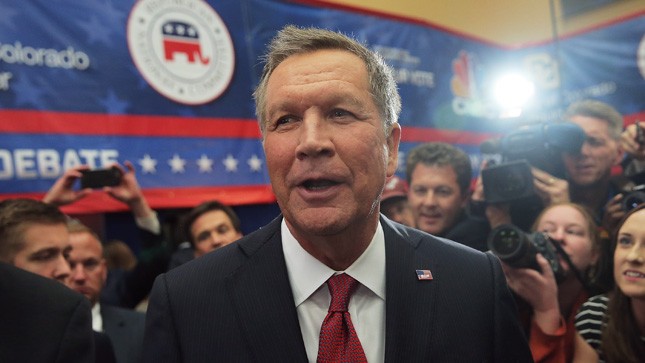
^ “I will not take the low road to the highest office” — John Kasich. A good principle to commit to

—- —- —-

We rightly condemn the Trump campaign for its cascade of lies, but lies are not his monopoly. Almost every super-PAC ad that I have seen, or read on twitter, tells lies. Lying about one’s opponent in an election seems almost an addiction. It’s one that we do not share.

It does no good to manipulate an election by lying. Winning by lying is to acquire no legitimacy at all. Because so many “consultants” authorize it — even encourage it — lying has become almost the norm. Ergo, the norm has no legitimacy.

That’s why those who support Trump because he attacks the basic legitimacy of our government have a point. A good point.

It’s hardly a good enough point to have us declare Trump anything but anathema. He is unthinkable. But his attack on the way we do our politics isn’t unthinkable at all. The major reason why his despicable lies are believed is because lying is so universal in our political conversation these days.

I just finished consulting to a campaign in which falsehood, or distortion, about our opponent was a ready temptation. We did not give in. We shunned the temptation. Yes, my candidate lost; but he did not lose the people’s respect, which is far more important personally and politically. Having taken the high road, my candidate has a future.

Trolls, too, offer nothing good to any conversation. Ignore them; block them. They’ll eventually go away, just as a buzzard gores away when there’s no carcass to beak upon.

All of which leads me to the following declaration :

1.Do not lie in campaigns, and do not fall for other’s lies.

2.If both candidates lie, choose the lesser liar (other things being equal)

3.Never express bigotry in a campaign. Never disparage an ethnic group, a social group or a nationality, or a sexual orientation, or a religion. Condemn anyone who does any of these.

4.Know, and be proud, that progress will advene in America, and that its enemies will fail.

5.Be a soldier of that advention, as much as you can.

6.Campaigns are seldom won on issues or platforms. They are won by temperament, character, competence, reliability.

7.Do not cast a protest vote. It has no shelf life.

8.In your won life, follow the rule of Rabbi Hillel, who famous told the student who asked him to “teach me the entire law and Torah while I stand on one leg,” “whatever is hurtful to you, do not do to your fellow man. That is the entire law and Torah; the rest is commentary.”

9.Do not confuse religion with truth. Truth is seldom ours to know. as the divorce lawyer’s famous saying goes, “there’s three sides to every question. His, hers, and the truth.”

10.Learn a subject before mouthing off about it. Economics, history, politics are awesomely complex subjects. Stand in awe of them rather than trample them by talking shit.

11.Life is a paradox. We see this with sex. Sex is a mystery beyond all comprehension. Guidelines for handling it we can establish, we caution, but rules — never.

12.Why does evil exist in the world ? Nobody has given a likelier answer than Augustine’s : “men do wrong because they want to.”

—- Mike Freedberg / Here and Sphere


INJUSTICE NATION

kipp

^ Injustice Nation —- KIPP Academy in the City : to the rest of the state, “not our problem”

—- —- —-

Absurd it may be, but skin color remains the prime root of injustice in America. Injustice has other tangles — immigrants, people living in poverty, the disabled and even the ill — but many of these coincide with skin color to make injustice an entire oak tree of roots.

Many of us like to decry skin color injustice, but no so many are ready to tackle the practicing of it. People who live under the gun of injustice live most likely in cities, and they are a major reason why so-called “conservatives” dislike cities. “Injustice nation,” as I shall call it, is discouraged and often blocked from moving to suburbs; fair housing laws we have, but not the living up to them. Injustice nation has universal health care now, but would not — will not — have it if the enemies of injustice nation have their way.

Injustice nation is feared by many police forces, many of whose officers live far from their beats, and the fear is mutual, as it almost cannot avoid being when the two live so far apart.

Injustice nation is blocked from paths to great employment, often harassed if its citizens get said jobs, and often paid less. Injustice citizens are often laid off soonest and find it hardest getting back to the work force.

Injustice nation has far less room to amass assets, to network into influence, to go about on foot or by car without being profiled, harassed, even arrested and sometimes worse.

Yet we expect injustice nation to “make it” somehow.

We do not see, or do not choose to see, the obstacles that injustice nation faces.

It is expensive to be a citizen of injustice nation. It is unhealthy too. Those who live in injustice nation and have money (via a good job) still pay more : to escape failing schools; to buy home and auto insurance, even life insurance; to travel to where the good jobs are; to buy groceries. It’s worse still for citizens of injustice nation who have small income. They cannot pay to re-register a car or to repair it, they can’t own, they have to spend three hours commuting through several bus and subway changes, they pay to be bailed out of jail, or to pay fines; they are more often arrested and so lose time and maybe a job; they have a much harder time finding a safe apartment to rent. They have less education and so cannot get hired by many jobs; and they live shorter and unhealthier lives because stress never leaves them, or their families.

If we see the protestors in Black Lives Matter overreach, or cross the lines of civic respect, much of it I attribute to endless frustration at their (or their neighbors) being constantly chafed and disrespected, feared, overlooked. I do not excuse the overreach (Colin Kaepernick’s spurning the Star Spangled banner, for example), but I do understand why it happens. And I say this: if you do not like what Colin Kaepernick did, work to make his gesture unnecessary.

All of the above leads me to two events now in process here in Massachusetts, both showing the necessity of overcom injustice and the difficulty of doing so.

The first event is the announcement, by Governor Baker, that the state will no longer permit prison guards to be stationed within the mental helath unit at Bridgewater Hospital for the Criminally Insane. Baker’s reform also scraps the correction mel for administering people in Bridgewater custody in favor of a mental helath treatment paradigm : https://www.bostonglobe.com/metro/2016/09/12/baker-plans-overhaul-criminal-justice-system-handling-mentally-ill/KIpXNF1YTfD81TEY1zWvjN/story.html

The difficulty that I mentioned is first, that it took seven years to get here after the death of Joshua Messier at the hands of correction officers, a death that was judged a  homicide; and sec ond, that as long ago as 1967, the movie “Titcut Follies” (link here : http://www.google.com/url?sa=t&rct=j&q=&esrc=s&source=web&cd=1&cad=rja&uact=8&ved=0ahUKEwiYrKX0oZTPAhXEZiYKHULnDyQQFggfMAA&url=http%3A%2F) %2Fwww.zipporah.com%2Ffilms%2F22&usg=AFQjCNEcqLK4R7SongtVXDls3aIjDfG4sw&bvm=bv.133053837,bs.1,d.eWE) cast horrific light on mistreatment of persons held in Bridgewater custody.

50 years to correct rank injustice seems a bit long, no ? But hey — out of sight, out of mind.

The other event I need to discuss is the current drive to secure, at the Novemeber election, a lifting of the “cap” on charter school numbers.

School choice is vital to parents and their kids who currently lack any choice but the underperforming schools that abound within the borders of Injustice Nation. Support for “lifting the cap” is almost universal among parents of color who live in our cities. Massachusetts citizens overwhlemingly support justice for people of color. Yet polls tell us that the ballot question now lacks a majority. Why so ? Simple : charter school expansion directly benefits only Injustice Nation. It offers nothing to the rest of us; thus nearly all of our 300-odd municipal school committees — excepting only school committees in our biger cities — have, under pressure from local teachers’ unions,  oppose charter expansion. After all, if a reform isn’t for you, but only for Injustice Nation, why support it ? So goes the reasoning, evidently.

They hide behind the lie that charter schools take money away from standard schools’ budgets.

This is a lie, no less a lie than Trump’s 1000 lies. Charter schools do NOT “drain money” from school districts. If a school district has 57,000 students, and 10,000 of them choose a charter school, that’s 10,000 less students that that district has to budget for. As it currently costs the Boston district about 22,000 to educate each child each year, if 10,000 of its students choose a charter school, that’s as much as $ 220,000,000 less that the Boston district needs allocate. Of course — I can my opponents sputtering in fury — 10,000 less students do not actually save Boston schools $ 220,000,000. Some school buildings, shorn of utilization, can be consolidated with other schools, but those  need be open, heated, lighted, and maintained; nor can twenty percent of teachers and classroom aides be laid off thereby. But some can be laid off, and school consolidation saves money, as does 20 percent less transportation costs.

Of course what CAN be done probably WILL NOT be done. If you think the teachers unions are laying an hysteria upon us now, wait till you see the typhoon of crap that hits Boston were it to do the economically right thing with its school budget.

Then we’d see for real who cares about city kids, city parents, city taxpayers.

Cities attract us, and they house the largest segment of us. So why aren’t their reforms paramount to all of us ? Today’s city people are tomorrow’s suburbanites. What do we not see about our refusal to accord city reforms primacy ?

Out of sight, out of mind. It’s a hard road to travel. But if YOU are not traveling it, no sweat. That is why Injustice lives on. That is why Injustice nation has borders. Our protests of it ring hollow.

—- Mike Freedberg / Here and Sphere


PARSING THE NEW WBUR ELECTION POLL

hillary

^ great Massachusetts numbers for Hillary Clinton, but equally great ones for Elizabeth Warren and Charlie Baker. The reasons are not hard to find

—- —- —-

We who live in Massachusetts are very lucky. Our politics tend to the bipartisan; the overwhelming majority agrees on most major issues. The internet’s free access has given trolls enormous voice, yet here in Massachusetts troll politics remain  a fringe annoyance.

WBUR’s new poll demonstrates it. The favorable – unfavorable ratings we give to Trump are 26/65: we get that he is entirely unfit to be anything, much le4s President. Meanwhile,  we give Hillary Clinton a 48 to 38 favorable – unfavorable rating : not great, but certainly on the correct side, for a woman whose major failing is to be kind of stiff, a steel-toed policy soldier (as I’ve called her on facebook recently). It’s hard to warm to a steel toed policy soldier, but our voters do get that being solid has more good to it than bad.

Given our perceptions of Clinton and Trump it’s no surprise that Clinton polls 60 to his 31, head to head — in the four way it’s Clinton 54, Trump 28, Johnson 9 and Stein 4. 60 to 31 is a bit wider a gap than Mitt Romney surrendered to President Obama in 2012 — Obama won our state by 63 to 37, almost the exact number that he beat John McCain by in 2008. Trump’s 31 falls about 20 percent short of Romney’s and McCain’s number — consistent with polls hsowi8ng that about 25 percent of Massachusetts voters who chose Marco Rubio, John Kasich, and Ted Cruz ion our primary are now voting for Clinton. (Disclosure : I am one such voter.)

31 percent is a modern-era low for a republican Presidential nominee in Massachusetts, and that low is well deserved, as we all now know far too well. I doubt that this poll finding is any surprise. The really interesting numbers it gives us belong to our in-state political leaders :

Favorability : Charlie baker 62 favorable 16 unfavorable; Elizaberth Warren, 53 / 36; Ed Markey, 40 / 16.

“Deserves re election” : Elizabeth Warren earns 54 yes, 29 no; Charlie Baker gets an almost identical 53 yes, 29 no.

I doubt it’s a coincidence that the 54 or 53 to 29 numbers voters accord both Warren and Baker are the same that voters give to Clinton and Trump. What matters most to Massachusetts voters at this point is not political party, but confidence in government. Trump has run the most anti-government Presidential campaign in modern history. To him and his key supporters, the entire thing is an enemy, to be “2A’d” if needed. In Massachusetts that position attracts 28 to 29 percent of our voters, and these people show remarkable consistency. They dislike Warren and Baker and of course Clinton — all three lions of governmental commitment and diligence. At the same time, 53 to 54 percent of our voters like Warren and Baker and Clinton. that two are Democrats and one a Republican doesn’t matter at all.

Today, American voters are divided not between Republican and Democrat but between those who grant legitimacy to our government and Constitution and those who want to — if need be — raise the cry of sedition against it. Fortunately for us in Massachusetts, the sedition party is two to one outnumbered and, most likely, non-existent in greater Boston.

I wish the same were true of the rest of the nation, but it isn’t. In many states, the sedition mindset draws a majority of voters. Say a prayer for our nation as we try to survive the existential threat posed by the Trump candidacy and the hatreds that have given it legs.

—- Mike Freedberg / Here and Sphere