BOSTON SCHOOLS : $ 975 MILLION FY 2015 BUDGET APPROVED

Image

^ bringing Boston Schools quietly but hugely onto a change path : Superintendent John McDonough

—- —- —-

The Boston School Department’s new fiscal year budget was approved last night — unanimously. Superintendent John McDonough now has $ 975,000,000 to allocate — a four percent increase from last year, thanks, as McDonough said at the meeting, to Mayor Walsh’s “generosity” — to the education of some 57,000 children.

You might suppose that a unanimous budget approval would have been quick and easy. It wasn’t. The vote came only after three and a half hours of what Committee Chairman O’Neill called “public comment.” Almost all of this commentary was testified by more or less the same advocacy groups — Boston Truth, Citizens for Public Schools — that have been fighting the entirety of school reforms that Massachusetts has instituted since the Bill Weld years. Charter schools, MCAS, “testing fatigue,” even the race card : all were adduced by a good 30 or so teachers, parents, and advocates seeking — “begging,” aid one witness — full funding for a school system that is making what McDonough called “difficult trade offs.”

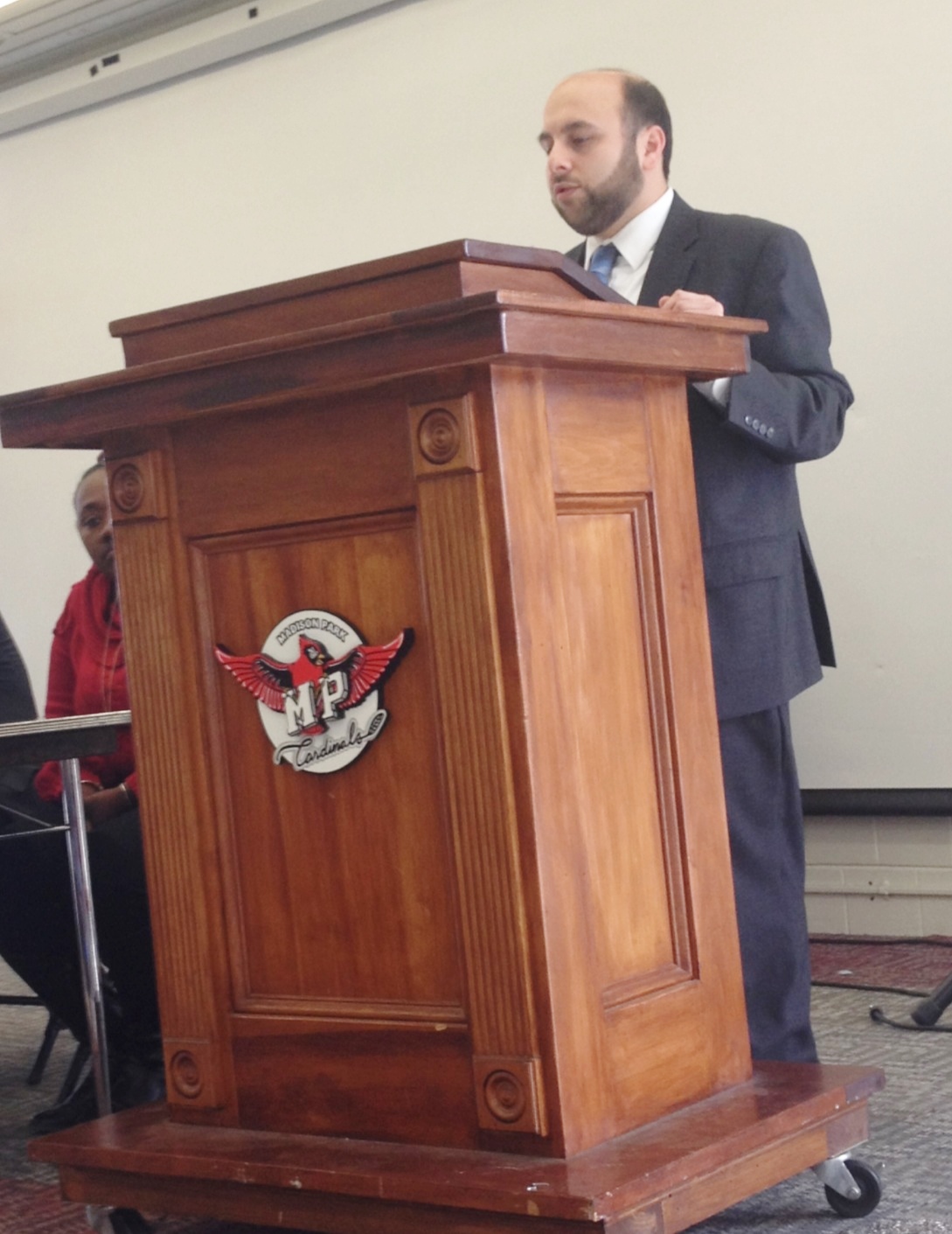
The Committee listened respectfully to every witness, many of them reading from prepared statements; a few read the same statement from the same yellow-green sheet of paper. For several months now, I have been listening to these citizens saying pretty much the same thing at rally after rally; I suspect the School Committee has heard it far more than that. Yet the seven committee members were more than ready to accord each witness full graciousness, despite the chants and shouts of a protest going on outside the hearing room, a protest loud enough that it was often hard to hear the speakers.

photo (12)

^ the unease was momentary : Chairman Michael O’Neill

I doubt that the protest made a favorable impression upon the Committee members. Chairman O’Neill showed his unease. But John McDonough didn’t move an eyelash. Boston Teachers Union president Richard Stutman at in the second row of the audience, a grin upon his face…

There was other testimony, including from Councillor Tito Jackson, who opposed the Department;s plan to use the T for transporting students. But the Principal of the Jackson-Mann school in Allston approved the plan, even as he noted how strange it felt that one of his teacher staff was in the room testifying against it.
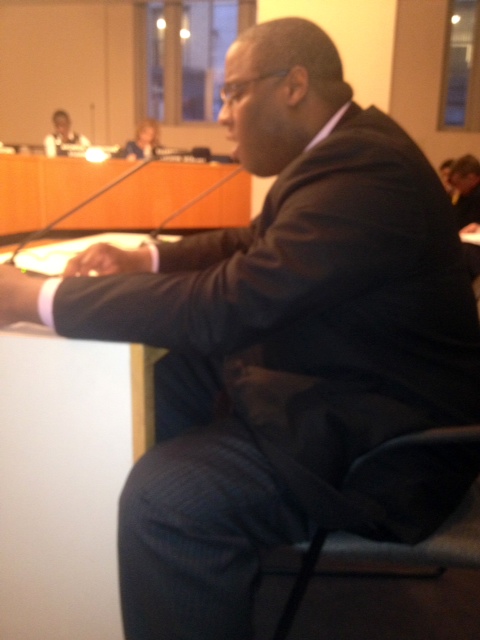
photo (13)

Parents, two officers of the NAACP, and two school bus drivers testified against McDonough’s T Plan, which envisions 7th and 8th grade students and contemplates 6th graders too. The most convincing witnesses cited safety concerns — convincing because the T isn’t safe in many Boston neighborhoods.

Only because McDonough’s staff researchers presented the Plan’s basis as thoroughly as possible were the Committee’s many questions answered. A compromise was added by Chairman O’Neill ; that the Plan be subject to a safety review to be presented to the Committee in 60 days.

Thus amended, the plan was adopted unanimously.

Many in the audience did not like it one bit.

It soon became apparent that that vote was the big one. The room fell quiet, and there was actually much less to-do on the Budget Vote itself. Committee members made brief comments and then came the unanimous vote.

After which John McDonough summed up the night’s doings. In his voice so quiet, almost without affect, as if there were no passions involved, just dry statistics, he spoke huge policy momentum in a few eloquent sentences:

“For months we have heard from you,” he said. “At hearings we have heard parents’ concerns. You get it. I applaud the involvement of so many passionate parents and teachers.

“This isn’t about charter schools or standard schools. it’s about making all schools better.

Am I happy with this budget ? No, i am not. I wish i could present a different budget. in the end, there is only so much revenue. Trade-offs have to be made. We have to close the achievement gap.

McDonough concluded : “This is NOT a budget cut ! Thanks to the generosity of Mayor Walsh, we have a four percent increase, whole other city departments are getting only one percent.”

Neither McDonough nor anyone else in the room mentioned that almost all of that four percent is slated to pay teachers’ pay raises negotiated in the last union bargain. Obviously not everyone drawing upon the $ 975 million budget is begging.

McDonough is determined to make big changes . I suspect that the teachers union contract is high on the list of changes he seeks. He seems to have the full confidence of the School Committee to do that and more. It will not be simple or quick. It can’t be. Listed prominently in McDonough’s Memorandum — handed out to all at the hearing — is this “priority” item :

“extending hiring autonomy to all schools to hire qualified, diverse candidates early, with $ 6.1 million supporting the success of our early hiring initiative and an additional $ 400,000 to support hiring diversity.”

Even Richard Stutman can’t stop this. it’s in the current teacher contract. Boston is also under court order to increase the diversity of its schools staff.

Yet Stutman has his troops, and they are getting the bulk of the budget’s additional $ 37 million. even as support staff positions are being cut in some schools.

This must change, but even larger changes are coming. Testing will increase; school competition too. Employers insist. So does an overwhelming majority of Massachusetts voters and probably a big majority of Boston voters too.

—- Mike Freedberg / Here and Sphere

UPDATED 03/27/14 at 3.3 PM

SCHOOLS REFORM : THE “ACT TO FURTHER NARROW THE ACHIEVEMENT GAP” — WHAT WE LIKE AND WHAT WE DON’T

Image

^ stalling the huge reform, maybe for good reason — one hopes ; St Senator Sonia Chang-Diaz

—- —- —-

Much energy from the usual suspects in schools reform matters has decried the exquisitely named “Act to Further Narrow the Achievement Gap” that now sits “stalled” in the legislature’s Education Committee. To find out why, and to assess the opponents’ arguments, one need first to actually read the proposed bill.

Please do so before going on to read my words. Here’s the link : http://www.bostonfoundation.org/uploadedFiles/Sub_Site/web_specials/Race_to_the_Top/An%20Act%20to%20Further%20Close%20the%20Achievement%20Gap%20(1.17.2013).pdf

You will have noted that the proposed new school law is twelve (12) pages long and has twelve (12) sections. Each has its points; some merit more discussion than others. As for the Bill in its entirety, you will have noted its language to be procedural. This is a law for administrators; not a law for teachers.

Were it a law for teachers, it would give some guideline, at least, for what teachers are to teach, and how, and in what spirit. This, the law does not do. It’s a law for superintendents, evaluators, testers, commissioners of education. All of which limits the law’s reform reach and thus details the devils.

The more a law clings to details, the more opposition it will draw. Each detail of an administrative directive inconveniences those who administer. From mastery of the process, they return to being beginners, having to re-learn all over again what it is they are supposed to do. Of course they don’t like it.

It would have been far wiser for the reform bill to set general goals and empower generally. Then the persons affected could work out for themselves how to devil the details; and all such work-out discussions would have given the affected persons personal input into making it work. This new law denies them that. It’s a directive — a tsarist ukase. Little wonder that the established interests are complaining and that key staff are opposing.

That said, the law commits to some very useful tasks :

It grants a superintendent strong power to make the administrative, staffing, and curriculum changes that he or she sees fit, the objective being to improve the performance of so-called “underperforming schools.”

It allows for additional charter schools, above the 140 charters already allowed by MGL c. 71 : but, unwisely, only in districts that fall within under-performance results specified in section 4 of the bill.

It identifies what school performance falls short of stated standards and thereby gives the superintendent a flash point at which to intervene comprehensively.

Let me note right away that everything the reform bill grants to superintendents, John McDonough is already doing as interim superintendent of the Boston Public Schools. This part of the reform law would be difficult for even the most change-averse teachers union to object to.

Much more controversial is Section 4’s creation of an under-performing school district exception to the 140 charter school limit in the current MGL cl. 71, section 89. In the context of the law’s drastic superintendent takeover of under-performing schools, this charter school exception feels like punishment : not only are the personnel of an underperforming school district to face an entire, superintendent make-over of everything they do, including keeping their jobs, but, with the charter school creation possibility, they are put in the position of losing students notwithstanding how they might improve performance under direct superintendent management.

It would be far wiser for the proposed school law to choose one or the other — superintendent takeover, or charter school creation — but not both. Superintendent takeover threatens the jobs of poor teachers; charter school establishment threatens all the affected District’s teachers.

The consequences of this provision in the proposed law leads it almost inevitably to its most objectionable provision : Section 2(g), in which superintendents are given the power, when confronting an under-performing school or district, to alter the compensation, hours, and working conditions of school staff. I don’t think it wise to threaten the pay of the very people whose enthusiastic support the law needs if it’s to work. as for hours of work, everybody agrees the school day should be extended; but i there any reasonable objection to the teachers’ insistence that they be paid for working longer hours ? I think not.

I’m also not a fan of that provision in Section 9 which, in case the Commonwealth is approaching its “net spending cap,” gives preference to charter school providers who operate in more than one municipality. Why so ? No charter school should be like a bank’s branch office, understaffed maybe and offering fewer services. I trust the proposers will explain ?

To sum up : the reform bill contains many valuable provisions, assuming that a bill almost purely administrative is advisable, and that micro-managing the administrative requirements is realistic. The charter school exception, however desirable, makes its entrance on the wrong foot and in the wrong way. it should be the subject of separate legislation and should NOT be tied to under-performance issues and administration. Heck ; if charter schools are good — and I strongly support them — why should only children in under-performing districts have extra access to them ? Has no one learned anything from the Special education experience ? parents, seeing that special need children could claim an individualized curriculum, did everything in their power to get their children designated as special needs so that they too could get an individualized curriculum plan. I can easily see, under this proposed law, parents seeking to have their kids’ school designated as under-performing so that their kids would have a better chance of winning a charter school placement lottery.

This is what happen when you try, by laws, to do too much. You end up with laws that work opposite to the intention, or which can’t get enacted at all because they coalesce many kinds of opposition.

Pare down the bill, make it less administrative, put its page after page of do-this detail — especially the per pupil tuition reimbursement formula ; my goodness me ! — into a regulation, and give the statute some room to flex and develop. Then offer it for enactment. Until then, I think not.

—- Mike Freedberg / Here and Sphere

BOSTON SCHOOLS, PART 2 : SEEKING A COMPREHENSIVE EDUCATION POLICY

Image

^ we first suggested it, now others are joining us : John McDonough as Boston’s new school superintendent

—- —- —-

Note : what you are about to read is my re-write of a column that I posted to Here and Sphere a few days ago. This is why I’m doing it:

1. In the days since I first wrote, the Boston Globe published a full page editorial addressing the complexity of school reforms now taking shape as state legislation; and Globe columnist Larry Harmon added his opinion that current Boston interim superintendent John McDonough should be given the permanent position. (Two months ago, I posted the same opinion. I was glad to see others taking up my suggestion.)

2.The Globe editorial arose in response to a strong push by public schools advocates that the state’s current limit on charter school numbers not be lifted. As I wrote in my original article,

“It pains me to read news recently that the chief reason why Massachusetts got busy creating charter schools was that 250,000,000 Federal dollars were at stake. I had thought that the creation of charters — schools privately run but publicly funded — was a matter of policy, not purchase. But now we read that bills in the legislature to expand the number of charter schools allowed is stalling, not because the policy has changed but because the Federal dollars aren’t there any more.”

Charter schools cannot be seen as replacing standard public schools. They were never intended as such and aren’t used as such now. Teachers unions and their allies want to push the notion of replacement because they somehow feel that education reform threatens their jobs. Their fears have some basis. In many states there’s been much legislation cutting back on public employees’ bargaining rights; and some corporate interests, backed by right-wing think tanks, want to use charter schools as a wedge to eliminate public, taxpayer-funded schools for all children. That agenda has some presence even in Massachusetts. Some business interests want aggressively to control the education of their potential future employees and are determined to get as complete control of the process, from K to graduation, as they can — and if not, to move operations elsewhere.

My inclination is to let such corporations go, if they choose to. Massachusetts’s pre eminence in higher education, research, and finance assure that we will always have plenty of enterprises who want to stay here, move here, set up shop here and continue here. This, of course, assumes that our education of all children continues to be the most rigorous and productive in the nation. To that end, I suggest the following :

1. charter schools should be encouraged and their numbers increased on a one or two at a time basis, by application to the State Commissioner of Education. Funding for charters must come from a combination of user fees, local aid, and taxes assessed state-wide for the purpose.

2. charter schools should continue to act as experimental places, innovating curriculum, teaching method, teacher hires, and student homework loads. Charters might even in some cases be boarding schools ; why not ? Charters cannot become routinized in anything or they cease to be what they were created to do.

3. budgets for standard public schools must be separately assured and planned without thought of what alternative schools may cost. Rivalry for funds cannot be permitted.

4. what succeeds at charter schools — the so called “best practices” test — should be applied in standard schools where and as feasible, and no standard school should see its routines written in stone, ever. Teachers in unions cannot be permitted to cling to work rules — including short school days — that impede pedagogic improvement. In this regard, John McDonough has shown the way by imposing a teacher recycling system that has already produced pedagogic improvement in the schools where he has put it in place.

5. School principals must be free to choose every member of their teaching staff — and of their school support staff too.

6. all schools must educate for two goals : employment and citizenship. The reasonable needs of reasonable employers must be met; the employers want capable hires, and the children want solid employment. Citizenship is the role that children will play as adults in community; to that end, schools must teach cooperative study and play, emotional education, social knowledge — including the role and risks in sex play — and basic civics including the role and process of democratic politics and government.

7. Testing is the only way that we can find out where education is or isn’t succeeding and how well or not. Tests should be semi-annual — no more frequent. Tests should include essay writing, reading comprehension, spelling, mastery of concepts both spacial and philosophical; mathematics and computation; American and world history; basic sciences; civics; and social knowledge including manners and dealing with emotions.

8. Tests need not be given as rigidly as the MCAS. Each school course can conduct its own course tests which can then be fed into the MCAS process and added into the total test score.

9. Teachers should be given the lead role in compiling such tests.

10. As many schools as possible — charter schools too — should be dual-language. Students whose first language is not English need it, and students whose first language IS English need to learn another language. It’s vital if we are to encourage cultural diversity and free American kids from cultural isolation.

So there you have it. What follows is the rest of my original article, slightly revised:

Mayor Walsh has added 39.6 million dollars to this year’s Boston Public Schools budget. Most of it will go to fund teachers’ pay raises. There will some millions left over. So, what does the phrase “taking resources away” mean now ? Probably just that the increased dollars won’t be coming from Washington. they’ll be raised locally. And that means that some other local aid funded need will have to make do with less.

Such is indeed the talk. In the Governor election going on in Massachusetts right now, all the talk is of local aid : increasing it; releasing 100 million dollars of it already collected but held; increasing it again. Candidates running for the State legislature or Senate all talk of local aid needs. The Department of Children & Families is in crisis; State transportation repairs and service upgrades cry out for attention; drivers’ licences for undocumented immigrants must be done. All these get mentioned ; but the big talk is, local aid, local aid, more local aid. You hear it whether the speaker is a Democrat or a Republican. Local aid now; the other matters can wait.

Charter schools were meant to be an alternative to standard public schools, not simply public schools with a new name. If charter schools do not do the job they were intended to do — significantly improve student achievement — they shouldn’t be funded, whether the Federal money is at hand or not. And if charter schools do do what they were intended as, they should be funded regardless of money from Washington.

Legislation to increase the number of charters being stalled now, those that do exist are kind of on their own, to prove their worth. Charter parents will have to speak out; to organize. Democrats for Education Reform, the local chapter of a nationwide group deployed to power up the alternative schools constituency, will have to get talking.

Did I mention curricula ? The battle is raging already to reject the national education establishment’s “common core” as being too difficult for children to master and too narrowly tested. Myself, having read through the “common core proposal, I find it a trope, a slice of common sense. Every society with schools at all has had a common core curriculum; it’s how that society prepares its children for the jobs it offers. this was as true of Rome in year 300 A.D. as of western Europe in year 1090 A.D. and 1500 A.D., and it was the basis of the New England School Law of 1634. Children must learn a common basic curriculum in order to do the jobs that will need to hire them; and to be good citizens. Is it difficult ? It always was. Life, too, is difficult. Tears come to one’s eyes as well as joy.

Kids can manage. They really can.

As for teacher pay and standard school budgets, in Boston these look paid for — this year. After that, a lot depends on who the next School Superintendent will be. The “search committee” is already on it, but for me, the best choice is John McDonough, the current “interim superintendent,’ who says he doesn’t want to be considered for the permanent job : but whom all sides respect and who can therefore best steer “standard Boston public schools,” troubled schools as well, into the next phase, alongside charters as they are and all manner of experimental school set-ups that innovators may successfully propose — as they surely will, and should.

—- Mike Freedberg / Here and Sphere

BOSTON SCHOOLS : IS FUNDING EVERYTHING, SCHOOL POLICY NOTHING ?

photo (36)

^ stalling on charter schools, ostensibly because the Federal $$$ aren’t coming : St Senator Sonia Chang-Diaz

—- —- —

It pains me to read news recently that the chief reason why Massachusetts got busy creating charter schools was that 250,000,000 Federal dollars was at stake. I had thought that the creation of charters — schools privately run but publicly funded — was a matter of policy, not purchase. But now we read that bills in the legislature to expand the number of charter schools allowed is stalling, not because the policy has changed but because the Federal dollars aren’t there any more.

At the outset of President Obama’s first term, the education bureaucracy was all het up about “race to the top” and such like programs to improve student achievement. Money was gushing, and so were expectations. Now the money is heaving dry, and expectations have taken a skeptical swerve. The talk now is of “taking resources away from standard schoolS,” not of “improving achievement.”

You would think that “Taking resources away from standard schools” is teacher-speak for : the teachers’ union’s next contract won’t have a pay raise equal to raises granted the latest police or Firemen’s union contract. Right now, it doesn’t mean that. Mayor Walsh has added 39.6 million dollars to this year’s Boston Public Schools budget. Most of it will go to fund teachers’ pay raises. There will some millions left over. So, what does the phrase “taking resources away” mean now ? Probably just that the increased dollars won’t be coming from Washington. they’ll be raised locally. And that means that some other local aid funded need will have to make do with less.

Such is indeed the talk. In the Governor election going on in Massachusetts right now, all the talk is of local aid : increasing it; releasing 100 million dollars of it already collected but held; increasing it again. Candidates running for the State legislature or Senate all talk of local aid needs. The Department of Children & Families is in crisis; State transportation repairs and service upgrades cry out for attention; drivers’ licences for undocumented immigrants must be done. All these get mentioned ; but the big talk is, local aid, local aid, more local aid. You hear it whether the speaker is a Democrat or a Republican. Local aid now; the other matters can wait.

But education can’t wait. kids grow up. They graduate from grade to grade. Time delayed cannot be made good. Charter school waiting lists grow bigger, and the once ready Federal money river no longer flows into them. Thus we hear more of the same old arguments that were adduced at the outset for why charter schools shouldn’t be : they winnow their students, eliminating those with discipline problems and unwillingness to adapt; they don’t serve English language learners; they expel kids who don’t shape up academically; they impose rigid discipline.

And so they do. Charter schools were meant to be an alternative to standard public schools, not simply public schools with a new name. If charter schools do not do the job they were intended to do — significantly improve student achievement — they shouldn’t be funded, whether the Federal money is at hand or not. And if charter schools do do what they were intended as, they should be funded regardless of money from Washington. Meanwhile, to look at how rapidly enrollment has climbed, it seems that charter schools have been a smashing success :

Image

Legislation to increase the number of charters being stalled now — the chief staller being Boston State senator Sonia Chang-Diaz, who serves on the senate Education Committee — those that do exist are kind of on their own, to prove their worth. Charter parents will have to speak out; to organize. Democrats for Education Reform, the local chapter of a nationwide group deployed to power up the alternative-schools constituency, will have to get talking. My own strong belief is that education in America needed badly to reshape itself enormously, to conform to the new workplace, new jobs, new technology and new communities of competitive collaboration. If schools exist to do anything, it’s to prepare students for the jobs of tomorrow (and for citizenship : but that’s a more traditional matter and doesn’t require an entire re-think). The best way to get schools shaped for that end is to try out many different shapes — school day lengths, curriculum choices, and out-of-school after-work — and see which one or ones meet the challenge. Charters, partnerships, collaborations, and, yes, standard public schools all have a seat at this particular table, and all should be set upon the task.

Did I mention curricula ? The battle is raging already to reject the national education establishment’s “common core” as being too difficult for children to master and too narrowly tested. Myself, having read through the “common core proposal, I find it a trope, a slice of common sense. Every society with schools at all has had a common core curriculum; it’s how that society prepares its children for the jobs it offers. this was as true of Rome in year 300 A.D. as of western Europe in year 1090 A.D. and 1500 A.D., and it was the basis of the New England School Law of 1634. Children must learn a common basic curriculum in order to do the jobs that will need to hire them; and to be good citizens. Is it difficult ? It always was. Life, too, is difficult. Tears come to one’s eyes as well as joy.

Kids can manage. They really can. as for testing, well : every job that a student is given as an employee is a test, believe me. So don’t complain; just do it. And please, don’t use lack of money as an excuse not to.

Time for Liam Kerr, Richard Stutman, Citizens for Public Schools, and Stand For Children to loosen up, set the past behind,and re-imagine the teaching of knowledge to children grasping at it.

As for teacher pay and standard school budgets, in Boston these look paid for — this year. After that, a lot depends on who the next School Superintendent will be. The “search committee” is already on it, but for me, the best choice is John McDonough, the current “interim superintendent,’ who says he doesn’t want to be considered for the permanent job : but whom all sides respect and who can therefore best steer “standard Boston public schools,” troubled schools as well, into the next phase, alongside charters as they are and all manner of experimental school set-ups that innovators may successfully propose — as they surely will, and should.

—- Mike Freedberg / Here and Sphere

BOSTON SCHOOLS : CHARTER SCHOOLS UNDER ATTACK AT CPS FORUM

Image

^ seeking answers to the challenge that charter schools pose to standard public schools : at the Citizens for Public Schools Forum

—- —- —– —–

For those who believe that competition among educational systems and methods is preferable to one-size-fits-all, the Forum held this morning by Citizens for Public Schools at Madison park High School made for painful listening. For three hours non-stop, two panels of speakers — ten in all — laid out multiple criticisms of charter schools : their performance, their selectivity, discipline, low pay for teachers, lack of community accountability. You name it : if there’s a schools issue, the ten speakers accused charter schools of failing it, and they detaile their indictment with statistics and power point charts.

The Forum attendees, who included State Representrative Liz Malia of Jamaica Plain and State Senator Pat Jehlen of Somerville, attacked charter schools for

1.not accepting their fair share of studebts with behavioral or learning disabkiloities

2.accepting a percehtate of English language Learhers (“ELL”s) far lower than that of the community each serves

3.using teachers who do not meet state certificastyion staheards for public school teachers, and not granting them collective bargaining vrights

4.performing no better, on tests and in graduation rates, than the standard public schools

5.violating, in their governance, the State’s open meeting law

6.imposing rigid discipline and dress codes upon studehts to the point of damaging studebts’ self-confidence and for the purpose of weeding out studehts who do not “fit the model.”

7.drawing millions of dollars away from standard public schools, leaving them under-equipped and lacking vital curriculum components such as arts, language, and technology

8.too great a focus on “teaching to the test” — the State’s MCAS exams, which public school teachers hate.

Image

“millions of dollars are being drained !” — the BTU’s Ed Doherty speaks at the CPS Forum

Ed Doherty, a past president of the Boston Teachers Union, held back nothing. “85 million dollars are being drained,” aid Doherty, “from the Boston schools budget” — perhaps forgetting that mayor Walsh’s projected school budget will be 39.6 million dollars larger than last year. “Charters send back to public schools misbehaving and underperforming students,” Doherty added, and “Teachers at charter schools should be teacher certified in the usual manner.”

Image

Roger Rice of META delivered the most effective criticism of charter schools ; that most of them enormously under-serve English language earner students

Of the other speakers, Roger Rice of META convincingly demonstrated that charter schools srve a portion of ELL’s far less than the percentage of ELL’s in the public school system. CPS’s Dr. Alain Jehlen illustrated charter schools’ discipline codes. Jerry Mogul, executive directory of an advocacy group, showed that charter schools sometimes fail special eduaction requuremebtrs. Roy Belson, Superintendent of Medford Public Schools, asked, “if the reason for charter schools is to close the achievement gap, shouldn’t they take kids who ARE the achievement gap ?” School Committeeman Charles Gallo of Lynn — who mentioned twice that he is running for the State Representative seat that Steve Walsh is leaving this month — simply said “we on the Lynn school committeeman signed a letter to the Governor saying, ‘no more charter schools. If only other school committees would do that.”

Image

^ Lynn school committeeman Charles Gallo : running for State Rep on a “no more charter schools” platform

Image

Daniella Cook : somebody wins and somebody loses should never be an education result.

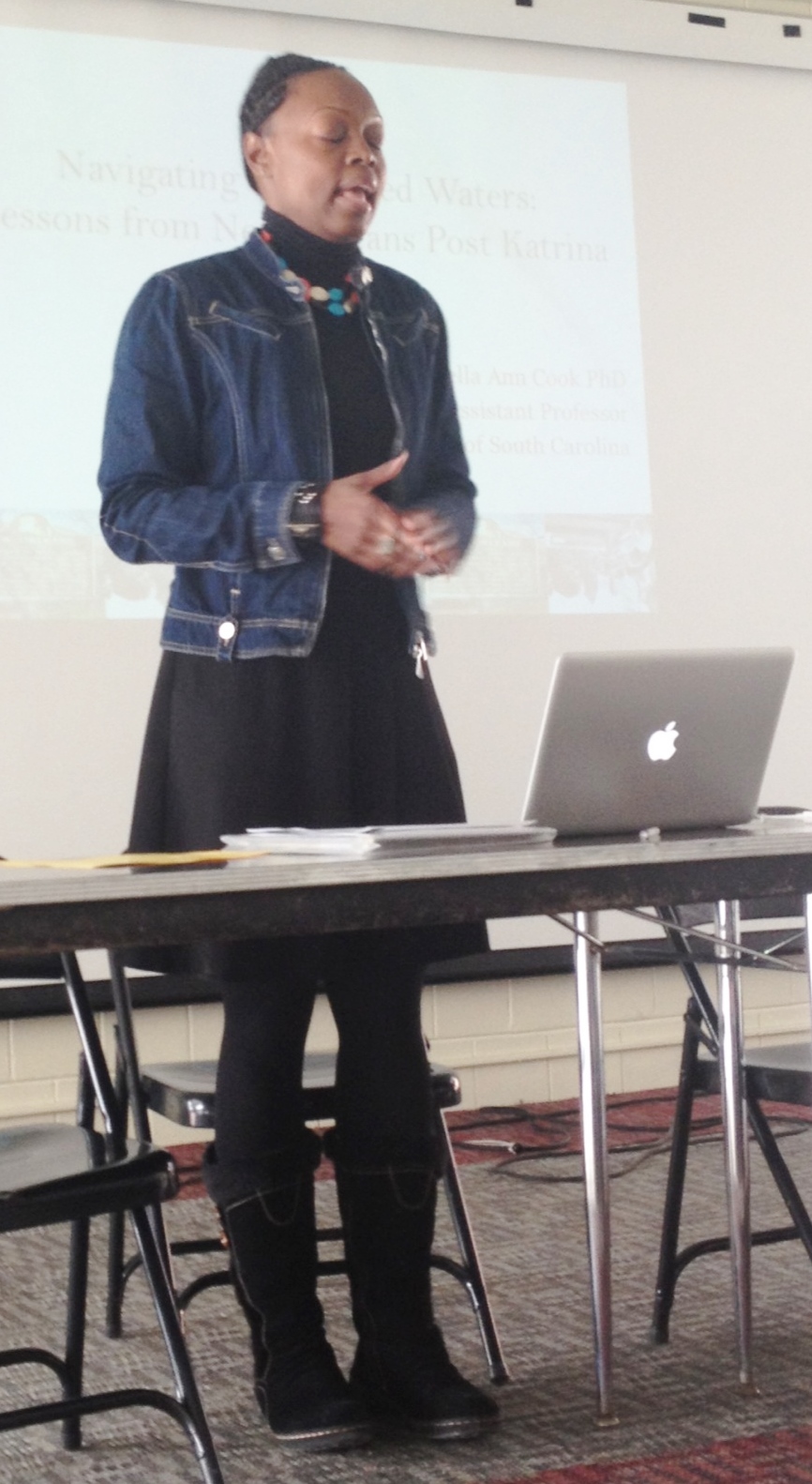
One speaker, Daniella Cook, a University of South Carolina educator, complained that with charter schools, “somebody wins and somebody loses” and “schools should not be market based.” She also played the race card : “We cannot talk about the proliferation of charter schools without talking race,” said Cook. “Charters are a racially based political economy.”

Less than 100 people attended the Forum. Many of these were part of the presentation. Does this mean that the anti-charter schools argument hasn’t much of a constituency ? Perhaps so. Charter schools were established in Massachusetts some 20 years ago not because they lacked support but because they have lots of it; nor do charters appear to be losing ground. Both of the final candidates for Boston Mayor were friends of charter school expansion. Those candidates who were not friends of charters finished back in the pack. Clearly the anti-charter argument is a minority view.

I have now attended four Forums since the Mayor election in which anti-charter school forces have convened their numbers and their arguments. Some of their points hit home : Charter schools should accept many more ELL’s. Charters should be slower to dismiss kids with behavioral issues. Charters should establish paent-teacher associations and encoyrage parents to participate.

For the rest of the critique, however, I have scant patience. (1 ) how is it racist to demand students be held to account by strict discipline and dress standards ? that kind of indelible, constant focus is exactly what kids — OK, let’s assume the stereotype for argument’s sake — from homes often anarchic or dysfunctional need. The parents know it and insist on it; the kids mostly agree, if not when they are kids, then long after, as adults. ( 2 ) why should public schools have first dibs on taxpayers’ education money ? The whole idea of charter schools — of school technique diversity in general — is that the standard public school model often does not work. ( 3 ) Why need teachers in schools other than standard public have to be certified “in the usual manner” ? Teaching is an art; many people have the art. Why not ask people beyond the standard to reach in their non-standard way ? ( 4 ) And what was former charter school teacher Barrett Smith, calling for when he said that “we must educate the whole child” ? This is one of those school-argot phrases that sounds good but rankles when a definition is attempted. To me it means that we educate kids to citizenship as well as employment. Obviously schools should do that.

But the “whole child” does not even COME to school. MOST of “the child” lives at home. Kids spend far more of their school years at home than in a school. Schools do not educate the “whole” child, only the part of a child that schools attend for about eight hours, five days a week, about nine months a year.

this is why I find the phrase “educate the whole child” most unhelpful.

I noted above that Mayor Walsh’s Boston Public Schools budget will be 39.6 million larger than last year’s. Yet almost all of this increase is going to pay for BPS teachers’ pay raises. Can there be any doubt that the many speakers who emphasized today the money that charters “draw away’ from standard public schiools are thinking — a lot — of the NEXT teachers’ unions contracts ?

The Boston Teachers Union — several of whose leaders were at this morning’s Forum — would be well advised to step back from its immovable wall of funding and work rules and try to figure out how to accommodate itself to an education world in which many systems and methods are encouraged; in which choice is essential to state education law; and in which innovation, of curriculum, school organization, and principalship, is sure to increase, not retreat ? Some good points were made today; but they’re as likely as not to be overwhelmed by anti-charter arguments fighting a losing battle.

One excellent suggestion was made by Lawrence school committeeman Jim Blatchford, who noted that in his city, some schools were setting up a teacher-management way of doing things. “we will see,’ he said with a smile, “if they’re ready to lead like that.”

Innovation there will more of; standard issue, less of. Yet as Daniella Cook said, quoting John Dewey : “what the best parent wants for his child, that’s what she should want for all children.” Dewey spoke in support of his innovation, that students should learn by  doing — that rote memorization of dates or speeches wasn’t enough, or practical, and too standardized for the varieties of childhood perceptions of the world. As Cook used the phrase, however, it seemed tio me to hang helplessly on the paradox of life and community. We want all children to have the best education, but we also want the ablest kids to receive an education geared to their ableness. And if we do that, we accentuate the “achievement gap” that the Forum participants claim to dislike. How can there not be an achievement gap if we abet the ablest to harness their abilities ? If we do that, the ablest kids will excel more and more and widen the achievement gap. But how can a society progressive, reformist, and innovation-bound — as ours is — not abet the ablest kids the best we can ? We cannot lead an innovation society with average kids alone. Indeed, if kids of average ability — or less than average — are our concentration, they will end up in a society falling behind others more dedicated to innovation : think Germany; think China. And that will have negative economic consequences for those kids and for their kids; and so forth.

There is no way to avoid the innovation challenge. John Connolly staked his entire campaign on facing the innovation world candidly, forthrightly. He refused to temporize. It cost him the election; a majority of voters looked at the education and workplace future that Connolly spoke of and recoiled from it. It’s a daunting prospect. And real it is. No amount of skepticism about —  no matter how many Forums protest against — education innovation, school competition, and system transformation will stop what is coming.

—- Mike Freedberg / Here and Sphere

Image

John Connolly at Raynise’s house party : his stark vision of what innovation will mean to education method and organization scared many

THE NEXT BPS SUPERINTENDENT ? JOHN McDONOUGH SHOULD APPLY

Image

^ the gentle face of an underestimated reformer ? John McDonough just might be he

—- —- —-

Who should be Boston’s next public schools Superintendent ? A recent article in Commonwealth Magazine got me thinking that it should be the man who already IS the ‘super” : John McDonough.

The 40-year BPS employee now holds that job on an interim basis. He has said he won’t apply for the permanent job. He should rethink that decision.

Mayor Walsh’s first budget plans a $ 39.6 million increase for the BPS. Most of that added funding will, however, be devoured by contracted pay increases for BPS teachers. Hardly any money will remain for facilities upgrades, new technologies, an extended school day. The allocation of these increased funds to pay hikes asks an obvious question : is the mission of Boston’s public schools primarily to raise teachers’ pay ?

For that question John McDonough has, says the Commonwealth magazine article, a workable response. If we are to pay teachers top dollar, and spend almost no added funds on anything else in the schools, the least we can insist upon is superior teacher performance. McDonough, says the article, has a strategy : give the principal of every Boston public school autonomy to hire whom he or she wants. He admits that his decision is risky. Because many of the system’s underperforming reachers have tenure, they cannot be fired. If no school principal wnats them they will simply have to be reassigned to something, or (as the Commonwealth story puts it) paid not to teach.

Paying union employees with contractual rights not to work is nothing new. When the nation’s railroads were losing their passenger customers, many railroad workers ended up being paid not to work. But the BPS situation is different : the number of “customers” — school kids — is increasing, not declining. What is wanted is not fewer workers but better workers. In short, the dreaded “performance evaluation” standard that the Boston Teachers Union resists.

It will be difficult enough for McDonough, the quiestest of leaders, to achieve such a huge changer in the culture of BPS work. His insider position might just make all the difference. When I first met him again — I had known him back in the day when I worked for elected school committeemen — on last year’s Mayor campaign, he was sitting at a table in the cafeteria of BTU headquarters, in the company of former BTU president Ed Doherty and current BTU activist Shirley Pedone — both long known by me. Neither Doherty nor Pedone is shy about pushing the entire BTU agenda; but they and McDonough go back a long time, obviously on a friendly basis, as fellow BPS employees. It matters. Difficult it is to imagine an outside superintendent hired by “nationwide search” being so easily casual with BTU activists.

Image

^ teacher by example : John McDonough at the Lilla G. Frederick Pilot Middle School

How many BPS bosses as readily liked by BTU activists as McDonough also have the confidence of John Connolly ?  One of Connolly’s campaign themes was to break up the central BPS bureaucracy. Yet, says Commonwealth, “John Connolly, who campaigned to be the education mayor, says he is a big believer in McDonough. ‘John was often the only high-level voice of reason inside BPS,’ Connolly wrote in a December e-mail while away on a post-campaign vacation. ‘He wants to do the right things and he knows BPS inside out. If John is given the backing, he won’t hesitate to clean house and make critical changes that really should happen before the next superintendent is hired.'”

This has already happened, as the Commonwealth article notes, at the John Marshall school on Corona Street in Boston’s Bowdoin-Geneva neighborhood. There an outside non-profit, Unlocking Potential (UP), was brought in to re-think and manage. UP terminated every one of the John Marshall’s employees and hired back only three. All of its new teachers were thus young — some very young. This had several beneficial consequences : ( 1 ) Because the new teachers were young, they were paid less even as BTU members, saving scarce budget money ( 2 ) Because the school day was longer, it engaged more of the students’ day to day life ( 3 ) because the teachers were so young, their method and technological awareness were up to date. (This latter is something that I have previously opined in favor of : that teachers of skills and skill thinking should be as young and new to teaching as possible, not the other way around.) Not surprisingly, a much higher percentage of John Marshall students — of whom 99 % are of color — achieved high marks. As for the teachers who were displaced, some found teaching jobs elsewhere, some took other work within the system, others left teaching entirely.

McDonough says that he will not allow displaced teachers to go unused. “There’s plenty of work within our system,” he told Commonwelath. Yet he knows that his principals’ autonomy decision makes teacher tenure — a core union contract principle — look an obstacle. The BTU won’t allow tenure to be put at risk in future contracts ; but McDonough, and only he, may just be able to negotiate a buy-out of some tenure, or a reclassification, so that tenure won’t force young, exciting, cutting edge teachers into not being rehired — as it famously already has done. I’m not bullish that a superintendent outside-hired could get this work rule reform done at all.

It’s going to be a difficult enough task even for John McDonough’s soft-spoken, career-long determination. As John Connolly remarked to Commonwealth, “‘That said, I am always wary of BPS statements about changes to teacher hiring and placement rules, timelines, and policy. There is so much off-the-radar deal making and just plain skirting of the rules behind the scenes that undermine supposed changes. In sum, I won’t believe anything has changed until I see it actually happening’.”

Connolly’s skepticism is warranted. The BTU opposes many of the changes that have already happened, much less those proposed. I see no sign, either, that Mayor Walsh wants a difficult enough City budget made even more difficult by any kind of fight with the BTU. At best, an outside hire will need much time just to learn what’s going on. at worst, she might stumble negligently into a huge avoidable fight. That won’t happen with McDonough at the helm.

—- Mike Freedberg / Here and Sphere

“A KID FROM TAFT STREET IS NOW MAYOR OF BOSTON !”

Image

^ taking the three-part oath as Boston’s 48th Mayor :Martin Joseph Walsh of District 3

—- —- —-

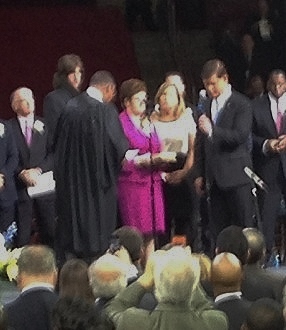
So said Marty Walsh after being sworn in as Boston’s 48th Mayor. Chief Justice Roderick Ireland swore Walsh in. Walsh’s Mom and brother and his gal-pal Lorrie Higgins stood by to watch the “kid from Taft Street” official become His Honor. It was a moving moment no matter which of the 12 Mayoral candidates you wanted. Walsh grew up without a big name, on a three-decker street, surrounded by temptations, some of which befell him. And now here he was, the City’s leader, holder of perhaps the most powerful elected office in Massachusetts.

Other men have traced the same kind of path from bottom to top. One thinks of Diocletian, Roman Emperor, yet born a slave, who rose, who educated himself. Or of Abraham Lincoln. Or Fiorello LaGuardia and Al Smith. It is, in fact, a commonplace of politics, that those on the bottom often believe in the system more truly than many on the top and who, aspiring, steel themselves to rise within it, no matter how long or painful the climb, and to become the steward of it and of all it represents. There have been innumerable Marty Walshes in history. And yet…it is still moving to see an actual Marty Walsh actually become Boston’s Mayor and to see the gathered thousands of Boston’s elite and non-elite actually there, in Conte Forum, to witness his becoming Mayor and to cheer it.

Image

^ Senator Elizabeth Warren delivering her remarks to “my friend Marty”

The powerful did not hang back. Senator Elizabeth Warren spoke eloquently about the passion that she and Walsh, so she said, share for alleviating inequality and the achievement gap. Governor Deval Patrick, choosing a light comic note, told Walsh that he would wake up from “a day of blur” but to savor the moment anyway. Cardinal Sean O’Malley of Boston also sat on stage. Yo Yo Ma performed the “Danny Boy Serenade” with dominant intensity and equally masterful delicacy. The entire City Council, all 13 members, sat on the other side of the podium and took its own oath. The front rows of the Forum found a seated multitude of descendants of former Mayors : Flynns, Whites, Fitzgeralds, Hyneses, Collinses — lending depth to the occasion’s topside.

Image

^ the gathered thousands included a huge segment from Dorchester, all of whom cheered loudly when their Councillor, Frank Baker, was sworn in.

Walsh then delivered an inaugural address sturdy and point by point clear. All the themes of his campaign took a turn : collaboration, diversity in staffing, improving education, ending the achievement gap, attacking violent crime, and assuring full equality to all Bostonians no matter what their sexual orientation, lifestyle or origin. He thanked “,my sisters and brothers in labor” — was roundly cheered — and almost in the next sentence said “let it be known that Boston is open for business.” Here he spoke of “innovation in every neighborhood, not just downtown” and of small business, start-ups, and businesses big.

It was a firm speech, confidently delivered, steady as she goes. Which may well be the defining tenor of Walsh’s administration.

And so you have it. Marty Walsh is your Mayor. Yep.

Image

Image

^ from Chelsea, with what mission ? new corporations counsel Eugene O’Flaherty, currently chairman of the State’s House Judiciary Committee

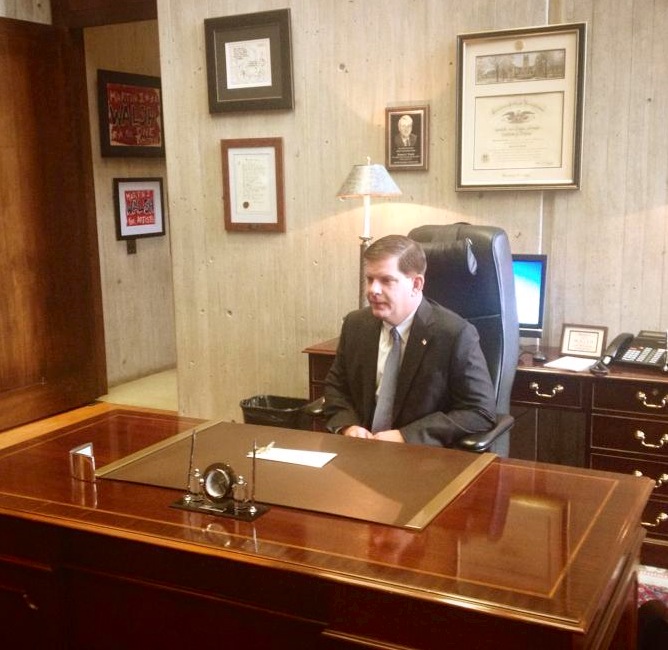
Hardly two hours had elapsed after that “yep” when an announcement was made at least as portentous as the inauguration itself : State Representative Eugene O’Flaherty, of Chelsea, is giving up his House seat and his House Judiciary Committee chairmanship, moving from Chelsea to Boston, and becoming Walsh’s chief corporations counsel : the city;s top lawyer. I admit that this choice surprised me completely. It was easy enough to believe that Walsh wanted O’Flaherty, who was first elected to the House in the same year as he (1996). The two men share much heritage. The difficult part for me was, why would O’Flaherty take the job ? He isn’t just a State Representative, he is one of the chamber’s key leaders. And also have to move house. There has to be a big story going on, and what it is, I can only speculate. It may involve the Steve Wynn casino project : O’Flaherty represents Charlestown, which Walsh did not come close to winning on election day and which will; be heavily impacted. Is O’Flaherty being asked to use his particular knowledge of the area to win the best mitigation package possible from Wynn, including — a top Walsh priority — construction jobs ? or perhaps to sue the Wynn project, or the Suffolk Downs Revere-only casino project if needed ?

We will soon find out.

We will also find out who Walsh chooses to head the other City departments. Of only one such did he say there would be a “nationwide search” : schools superintendent. Of course so. No Bostonian would want the thankless, frustrating job. (One of his two school committee appointments has already caused comment : replacing charter school principal Mary Tamer with labor lawyer Michael Loconto.) As the school committee appointment shows, not many Bostonians Walsh might name as superintendent would avoid raising an outcry from one interest group or another. Compared to schools superintendent, it’ll be easy to pick a Police Commissioner and one for the Fire Department. No nationwide search needed there.

—- Mike Freedberg / Here and Sphere

BOSTON SCHOOLS REFORM : THE ROLE OF PEDAGOGY

Image

^ the teacher overseeing “learning in community”

—- —- —–

In Part I of my look at how Boston should reform its Public Schools mission I focused on curriculum. I asserted that employers and citizenship must be accorded primary status in curriculum, and also must be the decider about competition among teachers and between schools.

Now for Part II, in which I discuss pedagogy — the means and methods by which teaching is done — because pedagogy is the province of teachers and only teachers. It is they who must use them. It is teachers who innovate teaching method. Teachers lead by example. They are the souls in which passion for knowledge lives.

Image

mathematics pedagogy : Building the Habits (Love) of Learning

As in so much of the world of thought and in the practice and theory education, Augustine (354-430 AD) was the first to write comprehensively about pedagogy. I cannot think of any writer then or since who has contributed more — even as much — to our understanding of what a teacher does, how, and why. It is well worth your time to read the following long passage from Wikipedia’s extensive biography of Augustine, who was a teacher all his adult life, a brilliant thinker, and (if anything) an even more brilliant writer :

“Historian Gary N. McCloskey ( says a passage in Augustine’s Wikipedia biography) finds four “encounters of learning” in Augustine’s approach to education:

1.Through Transforming Experiences;
2.as a Journey in Search of Understanding/Meaning/Truth;
3.Learning with Others in Community; and
4.Building the Habits (Love) of Learning.

“His emphasis on the importance of community as a means of learning distinguishes his pedagogy from some others. Augustine believed that dialogue/dialectic/discussion is the best means for learning, and this method should serve as a model for learning encounters between teachers and students. Saint Augustine’s dialogue writings model the need for lively interactive dialogue among learners.

“He introduced the theory of three different categories of students, and instructed teachers to adapt their teaching styles to each student’s individual learning style.

“The three different kinds of students are:
1. the student who has been well-educated by knowledgeable teachers
2.the student who has had no education; and
3.the student who has had a poor education, but believes himself to be well-educated.

“If a student has been well educated in a wide variety of subjects, the teacher must be careful not to repeat what they have already learned, but to challenge the student with material which they do not yet know thoroughly. With the student who has had no education, the teacher must be patient, willing to repeat things until the student understands, and sympathetic. Perhaps the most difficult student, however, is the one with an inferior education who believes he understands something when he does not. Augustine stressed the importance of showing this type of student the difference between “having words and having understanding,” and of helping the student to remain humble with his acquisition of knowledge.

“Augustine introduced the idea of teachers responding positively to the questions they may receive from their students, no matter if the student interrupted his teacher.

“Augustine also founded the restrained style of teaching. This teaching style ensures the students’ full understanding of a concept because the teacher does not bombard the student with too much material; focuses on one topic at a time; helps them discover what they don’t understand, rather than moving on too quickly; anticipates questions; and helps them learn to solve difficulties and find solutions to problems.

“Yet another of Augustine’s major contributions to education is his study on the styles of teaching. He claimed there are two basic styles a teacher uses when speaking to the students. The mixed style includes complex and sometimes showy language to help students see the beautiful artistry of the subject they are studying. The grand style is not quite as elegant as the mixed style, but is exciting and heartfelt, with the purpose of igniting the same passion in the students’ hearts.”

Augustine knew well what teachers today know and apply every day in the classroom : that different students require different means and methods. Augustine’s insight can thus be extended to Special Education as well. There are only two ways to apply Augustine’s individualized teaching. either you can separate the three categories of students and teach them apart, or you can bring them into the same classroom and work each group as they are. As Augustine counted highly the community setting, he would seem to favor the integrated classroom.

Can this work ? Augustine was the first education theorist to suggest a variety of teaching styles, each geared to a category of student. It must have been an exciting classroom, with Augustine teaching one way to one group of students and another way to another group, and all the students observing — even participating — in the diverse program. But Augustine did not confine his teaching to classrooms. He loved company at meals, and it is not unlikely that he had many of his students to dinner, thereat to instruct them, probably by improvisation upon the various pedagogic styles he wrote about (and certainly used).

I make the following additional observations to this examination of the greatest educational theorist’s pedagogy ;

1.None but a teacher could have conceived the pedagogic challenge as creatively as Augustine did, or as insightfully
2.certainly the employer of that time, the Roman imperial bureaucracy, could not have done it. Nor did it care to try. That was why it hired teachers. It was the teachers’ job to figure out how to educate students to the needs of Imperial administration.
3.assumed in all of Augustine’s education manual is that all teaching must met a standard of effectiveness. In his time, that was determined by the employer. The ineffective teacher lost Imperial favor, or students, or both. It was a self-evaluating system.

What we teach today has changed — though not as hugely as we sometimes assume — and schools now answer to a million employers, not only one. But Augustine’s pedagogic rule remains : that it is teachers, and only teachers, who must devise the means and methods by which will be taught the curriculum that the society and employers pay to have taught.

Teachers in Augustine’s day had no choice but to excel. They were not paid by the state. Their pay came from students’ fees. If a teacher had imperial favor, the fact was known, and he drew students; and these students paid. If he lost favor, the students’ parents saw that and sent their children elsewhere. Tenure ? There was no such thing. Every day, a teacher risked all. While it worked, it was the finest education system our civilization knew until modern times. Of course I do not suggest that we abolish tenure. far from it. That’s too much to ask of teachers who practice under the current system and have career time invested in it. But I do want to assert that tenure comes at a cost. A non-tenure system such as Roman education is self-evaluating. Evaluations in our tenure system depend upon who is doing the evaluating and answering for them to whom. Most of the evaluators are middlemen, not the society — and not the employers. But I suppose that, as in so much, inefficiency is the precious price that democratic government pays to a complex society of human fallibility.

Today we educate every child, not just the next generation of imperial administrators. We teach for a hundred different careers; we teach dozens of subjects. Scientific method was unknown. All students, of whatever  origin, learned in Latin. A unified administration was the rule then; diversity is ours now. Then, the stylus and tablet ruled; today, the digital device. Yet for all the differences between Augustine’s late imperial state and our always changing polity, teaching remains what Augustine knew it to be : teacher and student, teacher and students, learning for a purpose, a career, a better life and — perhaps — the love of learning for its own sake.

For Augustine, teachers ruled. So too for most of the educational theorists whose impact has been paramount since. Some theorists emphasize the school administrator — the principal. Some, the grading system and promotion from grade to grades. All these Augustine’s school took into account as well. The teacher yet ruled.

If the members of teachers unions could only accept their mission, embrace it as their unique contribution, risk all, and apply it within the larger context of society, competition, and employer curriculum, we would move a long way toward deploying education’s variety of means, methods, subjects, and standards in a context of challenge, innovation, and struggle as opposed to job security, curriculum debates, and one size fits all. It doesn’t. If Augustine knew that, why not us ?

—- Michael Freedberg / Here and Sphere

NOTE : You should read Augustine’s Retractiones as well as Peter Brown’s almost on-the-scene biography of Western Civilization’s most insightful social and psychological thinker — not to mention brilliant punster, superb speaker, and dramatic lecturer.

BOSTON : SCHOOL REFORM SLICED DICED AND…BLAND ?

Image

^ curriculum revolutionary : Irnerius of Bologna (1050-1125), who introduced new studies of law and so won the competition to draw students to his lectures

—- —- —-

“Today’s lesson, boys and girls, is ‘school reform : its history, its heroes, and its opponents.”

Thus sayeth the teacher. This shall be Part One of a Two-part course. Let the lecture begin :

No societal institution is harder to reform than schools. it has always been so. To take one huge example, when Greek began to be studied by European scholars in the 13th Century, its introduction, as a taught course, into the universities of that day — which taught all in Latin only — occasioned actual riots. Another example : teachers in medieval Europe were independent contractors, competing with each other (often viciously) for students (and student fees) — not collegial at all. Witness the revolutionary curriculum innovations — and career — of Irnerius of Bologna. Only when the advantages of coming together as a faculty showed themselves fatal to independent teachers seeking students did the faculty, collegial system become the standard. It took almost 300 years to make the point. One thing did NOT change : teachers worked on the margins, never far from wipe-out. If students did not sign up for their lectures, their teaching career ended. Something like that is still the case. Courses that attract too few students to pay the teacher’s salary get dropped from the curriculum.

You will of course notice that I am talking about “higher’ education. The situation with primary education was different and still is. Students in primary school learn the basics. These have hardly changed at all since Roman days — because the basics of civilization scarcely change. What does cahnge is the WAY in which the basics are taught, and, again, changes in method have come about only with much controversy and almost always far too late. Thus it is no great surprise to see that, today, in Boston, school reform movements meet big resistance, even counter-reformation.

Image

^ Cassiodorus (ca 485-585), the Arne Duncan of his day, as chief aide to Theodoric the Great and later, educational reformer. When he retired, his library of over 2200 books stocked a monastic school that he founded on his estate at Vivarium, near Catanzaro in the “boot” of Italy.

There have always been four major constituencies on the battlefield of school reform : parents; students; teachers; employers. it was so in Roman times — but the Roman system was a ducal, bureaucratic one in which schools prepared for only one career : oratory in the senate, oratory as a proctor (litigating lawyer), oratory in imperial administration. Parents fought to get their brightest children into a school well connected to imperial circles; teachers fought to get the imperial approval without which they could not teach in an imperially sanctioned school; students were force-fed and even beaten, learning by rote, marine-drill-sergeanted into a mindset sufficiently bureaucratic to win them a coveted post in the imperial or Senatorial circle. (if you want to taste something of the flavor of late Roman schools, read chapters 3 through 6 of Augustine’s CONFESSIONS.) To sum up ; in the Roman world, the employer entirely dictated what the school would teach, to whom, and how.

Is it thus so odd that today, in Boston, employers want a major say in how the City’s schools teach future employees ? Is it not a huge concern of theirs, that graduating students be able to meet the entry-level prerequisites, at least, of their hiring ? Kids do not graduate from twelve years of primary and secondary schooling just for graduating’s sake. They graduate to employment. Some may, it is true, go into the military — where they will be trained as forcefully as the Roman world trained its legions. A few may move directly to entrepreneurship. but for 80 to 90 percent of graduating students, employment awaits, just as it awaited the graduates of Roman academies.

Image

^ John Dewey : “learn by doing” — implanting the culture of apprenticeship learning into school methodology

As for employers dominating, even owning our schools, keep in mind that imperial or Senatorial patronage funded and staffed all the Roman world’s schools. Today we would not accord employers such dominance of our schools, partly because we have thousands of varying employers where Rome had only one. But we cannot, and should not, decry substantial employer involvement in the content and method of what our schools teach. We should invite it.

Our schools also teach one other major ethical learning : citizenship. In Rome, citizenship belonged to all, and it bestowed important rights. But citizenship imposes duties as well, and so long as the Roman world held together its schools taught what they taught not just as skills necessary to imperial employment but also as a responsibility of citizenship. The two obligations were not separate. In our world and our schools, citizenship is not so obviously an integral part of employment knowledge. It involves knowing history, the law, cultural diversity, tolerance, inquiry, participation in politics. Yet are employers not concerned that their employees be good citizens ? Young people who cannot accept diversity, or display good manners, or lack social graces, often make poor employees.

Image

^ Horace Mann : Massachusetts Congressman and education reformer — citizenship / civics as part of a core curriculum

I present this lengthy background as a platform upon which I now offer the education reform plan posted by incoming mayor Marty Walsh. Here it is as posted on his website :

“Marty’s plan is to immediately build on current strengths within Boston Public Schools, and simultaneously develop and implement a long-term strategy based on equity, access, accountability, transparency and collaboration to provide a top-notch education for all of Boston’s children. Success will require taking a hard look at current practice, the political will to make tough, necessary changes, and the collaboration of families, educators, and partners across the city to realize a shared vision.”

“In addition, Marty recognizes the achievement of students with disabilities can be accelerated by participation in inclusion classes with their differently abled peers. The Walsh Administration will continue support for current plans to expand the number of inclusion schools, and will increase support for principals and teachers to learn about co-teaching models, Common Core Standards and differentiating instruction.

“Embrace and Support the Implementation of the Common Core State Standards – The Walsh Administration will ensure each and every school has a plan to integrate the Common Core State Standards into daily instruction, prepare teachers to teach the standards, and help students demonstrate their knowledge and skills.

“Selecting the next superintendent is one of the most important decisions facing the new administration. It is critical that the superintendent fully embraces the Mayor’s vision and is committed to its success.

“Maintain a Mayoral-Appointed School Committee – Marty supports an appointed school committee. This is the best way to ensure a body that fully reflects all the stakeholders in quality public education, including those with direct experience providing education, and those who understand the importance of prioritizing the needs of the whole child in an urban school setting.

“Central office departments will be redesigned into streamlined cross-functional units and held accountable for how well they provide support and service to schools. School supervisors will closely monitor schools in order to know which school leaders to support, which to push, and which to grant autonomy so that each and every Boston Public School is among the very best schools in Massachusetts.

“The Walsh Administration will focus on “deepening the bench” of potential school leaders who know how to work with teachers to improve instructional practices tied to the Common Core State Standards.

“Strong partnerships with local colleges and universities, and support for accelerated programs that prepare teachers for urban schools, such as those offered at the University of Massachusetts Boston, will be developed to supply qualified candidates. Systems and incentive will be implemented to retain strong principal and teacher leaders with appropriate compensation.

“The Walsh Administration will be aggressive in working with federal elected officials and agencies, the Massachusetts State House, and corporate and non-profit partners to increase revenues for targeted programs.”

— so sasys Marty Walsh, officially.

photo (21)

^B George Perry, Jeri Robinson, and John Barros — Walsh’s Schools team. Is there a Cassiodorus in this triad ? Or just smiling faces ?

The Walsh plan has aroused plenty of opposition from anti-Common Core advocates. (Even though Massachusetts school standards are stronger than Common Core, which is thus irrelevant to Boston schools.) it also disappoints many who want a much more comprehensive overhaul of Boston Public School methods, curriculum, student assignment, and partnering. For me, the plan’s face is its blandness. It is cardboard. It avoids all of the difficult issues. It hardly mentions the most controversial or necessary. you won’t find in it the terms ’employer,’ “charter school,” “teacher evaluation,” “teacher selection,” “school competition.” It really is not a plan for reform at all. What I take from it is a message that we should TALK about reform. This, the City is doing. But then what ?

I find especially unfortunate the plan’s entire avoidance of competition. I know of no dynamic school system in which competition between schools — between teachers within those schools — was not an integral condition. Uncompetitive schools teach uncontroversial knowledge. Competition can be imposed upon schools and teachers only by employers — in the Roman world, the Emperor demanded, and that WAS the competition — or by the students and their parents, who, as in Abelard’s Paris and in the teaching city that was contemporary Bologna — pay their teaching fees to the best teachers. The competition then — years 1080 to about 1270 — was brutal, but knowledge advanced daringly and hugely. (we don’t call it “the Renaissance of the 12th Century” for nothing.) Much of the advance in knowledge was brought into those schools by independent researchers, often working in Muslim lands. The same is true today. Innovation Districts and their collaborative competitors are our era’s version of 12th Century’s wandering researchers. They and their knowledge, gathered from everywhere, should inform, revive, reconstitute our City’s public schools — curriculum, evaluation and pay, responsiveness to a rapidly evolving world of employers.

Or we can choose stagnation, blandness, and loss of the innovative daring that made Boston so different a city for so long.

—- Michael Freedberg / Here and Sphere

Tomorrow : the teacher and his or her career in a system committed tyo innovation, citizenship, and employment.

BOSTON : ON THE DEATH OF HERB GLEASON

Herb Gleason

^ aristocrat in Boston City hall : corporation counsel Herb Gleason, 1928-2013

—- —- —-

Herb Gleason of Beacon Hill died on December 9th. He was 85 years old and was, as Barney Frank recalls, “a man from the Boston aristocracy who deeply immersed himself in Boston politics in a wholly constructive way.” You should read the obituary that Bryan Marquard wrote for today’s Boston Globe and which features Frank’s quote. It tells Gleason ‘s life story and why — as Mayor Kevin White’s Corporations Counsel, most of all — he was important to the civic minded people of my generation.

My intention in this column is not to repeat that obit but to ruminate on Frank’s words and also on something that Gleason’s son David is quoted as saying of him : “He was very progressive in the real meaning of the word, the sense that government should benefit citizens.”

Today that “old Boston aristocracy” has almost disappeared. Those not yet born in its last glory days — the 1970s — probably have no idea what I’m talking about. No one uses the term “aristocracy” any more. “Child of privilege” — the term pinned on Jonn Connolly by Marty Walsh’s notorious AFL-CIO fliers — comes closest; yet A “child of privilege” can have parents who were themselves born into no privilege at all. The “Boston aristocracy” propagated its values (and its privilege) for many, many generations, one after another committed to the idea that wealth and privilege can never be their own justification; that being an aristocrat requires a man or woman to dedicate to the common good. The best-known Boston example of that aristocratic commitment is Robert Gould Shaw, son of Beacon Hill Brahmins, who coloneled the 54th Massachusetts Regiment of African-Americans and gave his life leading them into battle. Shaw’s life and death, thanks to the movie “Glory,’ now belong to the ages; but he was hardly the only exemplar, even in his own family : Barney Frank himself won his first elective office, State Representative from aristocratic Ward 5, with sponsorship by such as Shaw’s collateral descendant (by marriage) Susan Shaw Lyman.

There was much to criticize in the ways of the Boston aristocracy as it became defiantly snobby during the 1870s-90s. It was often anti-Semitic and hostile to Boston’s Irish. It was cruel to its own. Boys who could not shape up became “black sheep,” rarely forgiven. Its women had to suffer the unfaithfulness of husbands; many turned to hard liquor and spent days in a drunk. There was much ceremony — tuxedos and ball gowns to be worn — for the invited few, balls to be staged. Just as staged was the aristocracy’s speech. You knew immediately a Boston aristocrat by his or her pronunciations — consciously imitative of titled Britons. There was a list, too, of the accepted. Boston aristocrats proudly kept a copy of the “blue book” — the Social Register — on their desks or coffee tables; in it were the names, addresses, and current life status of those who “belonged.” And there was boarding school for every child — the most aristocratic of these quite consciously toff — a tumble into discipline for discipline’s sake which propagated itself all the way to the 1960, by which date  men like Herb Gleason (and women too) had reached adulthood.

For the majority of us, who were not Social Register, “that government should benefit citizens” was okay enough. It moved men and women to fight for child labor laws, women’s rights, slum clearance, hospital care open to all (there would be precious few Boston hospitals had not its aristocracy donated millions to their founding and expansion), pro bono legal work, libraries and books, the ACLU, racial integration, a city-girding parks system, bequests to the City for public purposes (think the George Robert White Fund), and service on all manner of City Boards. Taking a paid job in Kevin White’s administration, Herb Gleason went further. But so did John Sears — an aristocrat of aristocrats who also ran for mayor in the year that Kevin White won — when he accepted the job of MDC Commissioner. Yet the jobs taken by Gleason and Sears were a kind of civic-minded donation; each could have earned far more money in private law practice than they did as civic administrators.

All of this civic dedication by people born to great wealth or position seems so foreign to how we view the world today. We see people of great wealth now mostly as greedy self-seekers, or as celebrities fronting selfies. We cannot imagine today’s wealthy or famous sitting on library trustee boards, for example, or cleaning up Boston Harbor, or gathering signatures to raise the minimum wage, or protesting vote suppression — as so many did in the 1960s, even. And when we do encounter a “child of privilege” such as John Connolly was dubbed actually taking an interest in reform — in his case, school transformation — we’re not sure what to think.

Today when we hear of “children of privilege” in politics or civic affairs we’re as likley as not to think them out to serve themselves; to “skew the system” in their favor; to disenable, not enable, those in need. Perhaps that is one reason why John Connolly fell short of victory on November 5th. As said the AFL-CIo flier that i have already mentioned : “He’s trying to fool us.” There were plenty of successful people like that back in the day : but in those days they fooled no one — and didn’t try to. Yet always, from the decades of America’s founding right through the 1970s, critical numbers of civic-minded reformers of wealth and standing confronted the self-seekers at all levels. Today, when such a person appears on the urban horizon, he or she should be welcomed.

Civic-minded, progressive reform was never easy even in its aristocratic salad days. Machine politicians and those who kept them going — saloon keepers, contractors, industrialists, stock manipulators, work padrones, even criminal gangs — always pushed back. Only occasionally was urban reform successful. It was spectacularly successful, often, in New York, Chicago, and Los Angeles, and it was, finally, successful, after many failed attempts, in Kevin White’s Boston. Herb Gleason was a large part of that triumph, as were so many people from aristocratic Ward 5 — think Micho Spring,. Kathy Kane, Susan Lyman, Barney Frank, Stella Trafford, John Sears, David Morse, Joseph Lee, Parkman Shaw, Chris Lydon, Oliver Ames, and many many more. Is that spirit having a revival, with John Connolly as its vanguard ? I am hopeful that it will, and that Boston will advance once more, by the commitment to the City’s civic life of many more men and women like Herb Gleason. RIP, Sir.

—- Michael Freedberg / Here and Sphere