ANNALS OF DIPLOMACY : PRESIDENT OBAMA’S SURPRISINGLY SUCCESSFUL FOREIGN POLICY

Image

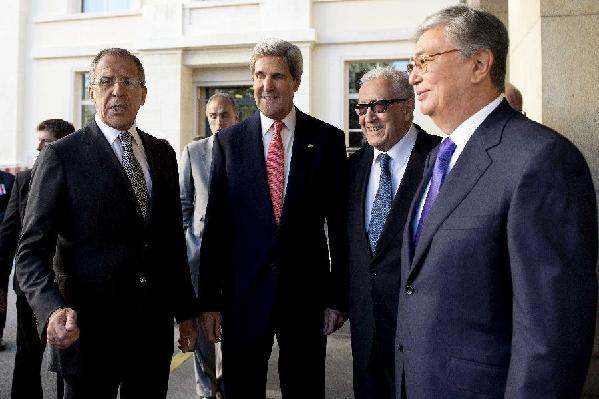
^ Syria peace talks to begin in Geneva — old-school diplomacy : John Kerry working with Russia’s foreign policy negotiators

—- —- —-

As the late George Kennan pointed out, in his book Russia and the West Under Lenin and Stalin, it is difficult for a democracy to conduct a successful foreign policy. The political demands upon the President inject domestic concerns into an exercise that isn’t domestic. Blocs of voters, of this or that ethinic origin, call upon the President (and his party), with an upcoming election in mind, to favor the nation or ethnicity whence these voter blocs came or to which they feel kinship. In war as in peace these electoral pressures lean upon the President’s decsion, angling them in a direction, perhaps, that, objectively considered, should not be the case. A prime example — hardly the only — is Israel. I have long argued that Israel’s foreign policy, no matter how compelling its case, must not be allowed dictate ours; but the significance of Israel sympathy, in both our political parties albeit differently in each, makes my argument difficult to apply. It was the same, with Russia, before, during, and after World war II. People were affronted, then pleased, then scared, by what the Soviet union seemed to represent; and these feelings led American policy makers to mistakes that could have been avoided.

Prime among the mistakes avoidable was our support of authoritarian dictators because these were opposed to communism. Of course they were; but they also opposed democracy, an ideal which we profess to the whole world, whose peoples often believe us. Perhaps we should not profess democracy to the whole world. Maybe that is the ultimate mistaken pressure by our domestic politics upon our foreign policy. Certainly the argument has been made by many among us, that we should support dictators who will keep lids on populations whose political ways cannot be predicted and of which many are anarchic at best, violent, cruel, terrible. The argument has merit; yet I disagree with it. Eventually dictators fall, and when they do, we have to live in the consequences.

There is no guarantee at all that peoples who overthrow a dictator will thank America for supporting their cause. A dictator makes almost every group his enemy. That his enemies can’t agree on almost anything other than his fall is his prime survival asset. Yet if America means anything in the world any more, it’s that we are a friend to ordinary people seeking normal lives; and among the enemies of a dictator these are almost always the majority. We refuse this lesson at our peril. Who, today, would not say no, if we could do it again, to the CIA’s role in overhrowing Iran’s Mossadegh government in 1953, an overthrow that has tainted Iran’s relationship with our country ever since ? This is a lesson that we have in fact learned; today our diplomacy supports and encourages peoples seeking freedom. The result is not always happy. Oppressive dictatorships are hardly a great school for teaching democracy — a culture of tolerance, of discussion, of differences equally respected. Yet are we wrong to encourage people to seek it ? Not at all. Too easily we forget how long it took the West to move from feudalism to oligarchy to revolution to democracy. Why should peoples elsewhere find the path any easier ?

The lesson I have outlined above has been learned by some of us; not much by others. Unhappily, most Republicans favor a foreign policy of supporting “friendly” dictators and of military first. This policy, they argue, worked with the Soviet Union, and it kept the peace in the Middle East for 50 years. And so it seemed to; but the Soviet Union collapsed largely of its own, bankrupted by its fear of our military might, morally ruined by its incompetence and rigidity, deafened by the din of outmoded theory. The most effective step against Soviet dominance taken by our Republican policy makers wasn’t military at all. it was six words spoken in Berlin by President Reagan : “Mister Gorbachev, tear down this wall !”

The voice spurred eastern Europe’s peoples. They believed Reagan. They also believed in themselves. Some three years later the wall did indeed come down.It was a superb moment in American diplomacy; yet in retrospect it was an easy moment. The Soviet union was already crumbling.

Far more difficult the moments of crisis, most unprecedented, to which the Obama Administration has had to respond : the “Arab Spring” ; the Syrian Civil war; Iran’s nuclear development ; relations with Russia ruled by the mercurial Vladimir Putin and with a secretive and cruel North Korea ; the antics of Hugo Chavez in Venezuela ; the fight against Al Qaeda. In every case where moves could be made — not much can be done about Kim Jong Un — the Obama Administration has moved very well indeed. We have managed relations with the uprising populaces of Libya, Egypt, and Syria about as well as these anarchic situations allowed. And if in Libya we miscalculated Benghazi — and still find it hard to keep up with its 26 shell games — we aced the big picture : most every tribe in Libya thanks us for our part in overthrowing Gaddafi. In Egypt, we avoided — while praising the Cairo “street” generally — committing fatally much to any faction, and thus we retain a fair reputation with all, even with the current military rulers. Secretary Kerry brokered a rapprochement between Netanyahu’s Israel and Erdogan’s Turkey without alienating Erdogan’s growing number of enemies.

Secretary Kerry — without realizing it at first, but once he did realize it, capitalizing superbly — found a means to a pact with Russia that ended the Syrian regime’s chemical weapons stores and use. Most important of all, Kerry and his Iranian counterpart Javad Zarif reached an interim agreement on Iran’s nuclear program, and that interim agreement is now working. Granted, that the agreements and pacts that Kerry has achieved were brought about by both sides — it really does take two to tango; yet one can’t get diplomacy without doing diplomacy. Which means that the two sides have to respect one an other and openly accord each other that respect. Kerry, like Hillary Clinton before him, has done that.

Kerry’s diplomacy has not been the same as Clinton’s. Hillary Clinton made the world’s women her special constituency. The world is full of cultures in which women take second, even third place; Clinton never missed an opportunity to condemn the downgrading of women or to call upon women to assert their rights. Kerry is not female and cannot speak as Clinton spoke. His diplomacy has been much more old school. It reminds me of the diplomatic practice of British foreign ministers of the 19th Century — a diplomacy of personal relationship, of flexibility and tolerance, a diplomacy also of money deals. We have never pursued such a diplomacy because America had never benn, until recently, a satisfied nation as was Great Britain after the defeat of Napoleon. Until recently, we have either been an expanding nation, even an imperial one, or we have — like Britain during the era of Napoleon — confronted by a huge world-encompassing enemy (or two : Mao Tse-dong’s China as well as Soviet union). Today all that is past. Amderica has finished expanding, and e no longer confront huge rivals. We exist now in a multifold world of many powers, just as did the Great Britain of Castlereagh, Palmerston, Gladstone, Disraeli, and Lord Grey, and it is to President Obama’s great credit (and to John Kerry’s), that our diplomacy fully recognizes our current situation and seems quite skillful at sailing upon it. I know of no current Republican who similarly gets what is really happening outside our borders.

As i write, Kerry is taking America into perhaps his most delicate negotiations yet : the Syria peace discussions set to begin in Geneva as son as all the details can be worked. we already see how hard this negotiation will be in the affair of inviting Iran. First invited, then dis-invited, evidently because President Obama objects. But if Iran were to be invited, how to leave out the Kurds, who have a major presence in eastern Syria (and the bordering part of Iraq) and are pressing a world-wide campaign on twitter and facebook demanding that that they be included. This may take months to manage, and no success is at all assured.

As a foreign policy president Obama has also been lucky. As George Kennan pointed out in the book i mentioned at the start of this column, it matters greatly who in a country is doing the diplomacy. Much of our diplomacy during the Lenin and Stalin years failed because the preconceptions borne by our foreign  policy people ill accorded with the facts. (So too did diplomacy then often fail because of false preconceptions on the Russian side.) Our policy people also badly misread the situation in Nazi Germany; and of course Nazi Germany misread us. There seems to be less misreading going on these days in the foreign ministries of major nations — ourselves as well. In large part that’s the result of the internet and social media. No nation gropes to understand other nations 1000s of miles away as they did in the 1960s, 1930s, 1910s. This is the setting in which President Obama finds his good luck. But it isn’t all luck. it’s also how open foreign policy people are to the facts unfiltered by preconception. The Obama foreign policy people read the facts better than almost anyone.

His political opponents disparage him so much that they do not see what he (and secretary Kerry) are achieving, or why, or are solely fixated on the fight against Al Qaeda, a fight on which all our policy makers agree (a fight that Obama has pursued with a warlike ruthlessness) and also because they do see Obama’s great policy mistake ; the NSA and its huge, wartime-ish overreach. Obama really does see the fight against Al Qaeda as all-out war; and it is ironic that, on this score, his Republican opponents, until reecntly so military-minded, want to scale back. On this issue, I happen to agree with Obama’s Republican opponents. The threat posed by Al Qaeda terrorists is not so mortal that we need compromise our civil liberties to fight them. It is time to curb NSA much more radically than Obama now proposes; maybe even to dismantle the department of homeland security, which seems to have inconvenienced many of us and violated the rights of some, to no great accomplishment. In these things, shrewd vigilance by all our people counts for much more than blanket micro-surveillance by headstrong bureaucrats. It would be a shame if Obama’s brilliant record, so far, of diplomatic accomplishment and near destruction of Al Qaeda were nicked and mocked by his insistence on a surveillance society.

—- Mike Freedberg / Here and Sphere

SOUND THAT WENT NOWHERE : BUTCH @ BIJOU BOSTON 01.17.14

Image

^ at least his massive overlay mixes felt strong : Butch at the Bijou mkix board

—- —- —-

The first Boston performance by Butch, one of the top attention-getting DJs of the past four years, should have been highly anticipated by house music adepts. Yet even at its fullest, the Bijou dance floor saw hardly 250 fans — and that number did not last long. That his big dance floor hit “:No Worries” — for a year or more, a staple of almost every DJ set — reigned almost three years ago, with follow up similarly successful, certainly hurt Butch’s numbers. That his set sounded nothing at all like his current top ten downloads at Beatport surely hurt his keeping even that small number grooving till closing time. What was he thinkling ?

Puzzling it was to hear Butch — real name Bulent Gurler, from the ancient, Roman city of Mainz on the Rhine River in Germany — play a set of low-note grumble, slow drag tempoed and almost unvarying. The mood was desultory, unfavorably different from the jokey flirtations that lift up his current top ten list. There you’ll find, for example,, “Foxy,” “Detox Blues,”Desert Storm,” “Highbeams,” and “Pompino,’ his number one : tracks of light step, a jerky shove beat, a dark grin, and all manner of sonar sparkle gracing some of house jmusic’s wittiest monologues, preaches, and repartee. At Bijou, Butch played almost none of it. His talk drops — he tooled up many — blended deep and almost inaudibly into the sound blanket. His beat tones kept on keeping on, with few of the fizz and sizzle streak breaks that delight his Beatport tracks. He didn’t evn play “No worriers” !

Instead of flirty shady house music, he played rumble growling techno. It proved not by any means a wise decsion.

Much of his unvarying sound fell so flat that I had to force myslef to pay attention. Nor did he use his mixboard much, to improvise a progression, stutter an eight-bar, or shine any glow on a talk drop. mlostly he just cued up a track and let it play itself — which would have woeked just fine had he played his masterfully chatterboxing top ten tracks and more. His talk drops — “sleep together amnd sleep the day,’ “the info babe, the info, baby’ and “we size you up” — could each have driven a catchy story in rhythm, had Bugtch cared to craft them; but he let the opportunity pass, every time. his set’s best attribute was the long, powerful overrlays with which he often led from one atrck to the next. Overlay music has soul power to move even the thickest heart, and Butch’s overlays had soul and heat both; but he let the power generated therein go undeveloped ; again an opportunity missed, a desire squelched. No wonder the club floor cleared out shortly after mid-set, leaving barely 50 peopl ein the room for the set;s last half hour. Which, frustratinghly, finished strongly on a massive overlay mix that sounded like a sigh and felt like a shrug.

Local DJ Tamer Malki’s opening set had more movement, more variety, and spri9ghtlier talk. It was more convincing a Butch set than Butch’s.

—- Deedee Freedberg / Feelin’ the Music

Image

^ some stayed to set’s end — but not many

THE NEXT BPS SUPERINTENDENT ? JOHN McDONOUGH SHOULD APPLY

Image

^ the gentle face of an underestimated reformer ? John McDonough just might be he

—- —- —-

Who should be Boston’s next public schools Superintendent ? A recent article in Commonwealth Magazine got me thinking that it should be the man who already IS the ‘super” : John McDonough.

The 40-year BPS employee now holds that job on an interim basis. He has said he won’t apply for the permanent job. He should rethink that decision.

Mayor Walsh’s first budget plans a $ 39.6 million increase for the BPS. Most of that added funding will, however, be devoured by contracted pay increases for BPS teachers. Hardly any money will remain for facilities upgrades, new technologies, an extended school day. The allocation of these increased funds to pay hikes asks an obvious question : is the mission of Boston’s public schools primarily to raise teachers’ pay ?

For that question John McDonough has, says the Commonwealth magazine article, a workable response. If we are to pay teachers top dollar, and spend almost no added funds on anything else in the schools, the least we can insist upon is superior teacher performance. McDonough, says the article, has a strategy : give the principal of every Boston public school autonomy to hire whom he or she wants. He admits that his decision is risky. Because many of the system’s underperforming reachers have tenure, they cannot be fired. If no school principal wnats them they will simply have to be reassigned to something, or (as the Commonwealth story puts it) paid not to teach.

Paying union employees with contractual rights not to work is nothing new. When the nation’s railroads were losing their passenger customers, many railroad workers ended up being paid not to work. But the BPS situation is different : the number of “customers” — school kids — is increasing, not declining. What is wanted is not fewer workers but better workers. In short, the dreaded “performance evaluation” standard that the Boston Teachers Union resists.

It will be difficult enough for McDonough, the quiestest of leaders, to achieve such a huge changer in the culture of BPS work. His insider position might just make all the difference. When I first met him again — I had known him back in the day when I worked for elected school committeemen — on last year’s Mayor campaign, he was sitting at a table in the cafeteria of BTU headquarters, in the company of former BTU president Ed Doherty and current BTU activist Shirley Pedone — both long known by me. Neither Doherty nor Pedone is shy about pushing the entire BTU agenda; but they and McDonough go back a long time, obviously on a friendly basis, as fellow BPS employees. It matters. Difficult it is to imagine an outside superintendent hired by “nationwide search” being so easily casual with BTU activists.

Image

^ teacher by example : John McDonough at the Lilla G. Frederick Pilot Middle School

How many BPS bosses as readily liked by BTU activists as McDonough also have the confidence of John Connolly ?  One of Connolly’s campaign themes was to break up the central BPS bureaucracy. Yet, says Commonwealth, “John Connolly, who campaigned to be the education mayor, says he is a big believer in McDonough. ‘John was often the only high-level voice of reason inside BPS,’ Connolly wrote in a December e-mail while away on a post-campaign vacation. ‘He wants to do the right things and he knows BPS inside out. If John is given the backing, he won’t hesitate to clean house and make critical changes that really should happen before the next superintendent is hired.'”

This has already happened, as the Commonwealth article notes, at the John Marshall school on Corona Street in Boston’s Bowdoin-Geneva neighborhood. There an outside non-profit, Unlocking Potential (UP), was brought in to re-think and manage. UP terminated every one of the John Marshall’s employees and hired back only three. All of its new teachers were thus young — some very young. This had several beneficial consequences : ( 1 ) Because the new teachers were young, they were paid less even as BTU members, saving scarce budget money ( 2 ) Because the school day was longer, it engaged more of the students’ day to day life ( 3 ) because the teachers were so young, their method and technological awareness were up to date. (This latter is something that I have previously opined in favor of : that teachers of skills and skill thinking should be as young and new to teaching as possible, not the other way around.) Not surprisingly, a much higher percentage of John Marshall students — of whom 99 % are of color — achieved high marks. As for the teachers who were displaced, some found teaching jobs elsewhere, some took other work within the system, others left teaching entirely.

McDonough says that he will not allow displaced teachers to go unused. “There’s plenty of work within our system,” he told Commonwelath. Yet he knows that his principals’ autonomy decision makes teacher tenure — a core union contract principle — look an obstacle. The BTU won’t allow tenure to be put at risk in future contracts ; but McDonough, and only he, may just be able to negotiate a buy-out of some tenure, or a reclassification, so that tenure won’t force young, exciting, cutting edge teachers into not being rehired — as it famously already has done. I’m not bullish that a superintendent outside-hired could get this work rule reform done at all.

It’s going to be a difficult enough task even for John McDonough’s soft-spoken, career-long determination. As John Connolly remarked to Commonwealth, “‘That said, I am always wary of BPS statements about changes to teacher hiring and placement rules, timelines, and policy. There is so much off-the-radar deal making and just plain skirting of the rules behind the scenes that undermine supposed changes. In sum, I won’t believe anything has changed until I see it actually happening’.”

Connolly’s skepticism is warranted. The BTU opposes many of the changes that have already happened, much less those proposed. I see no sign, either, that Mayor Walsh wants a difficult enough City budget made even more difficult by any kind of fight with the BTU. At best, an outside hire will need much time just to learn what’s going on. at worst, she might stumble negligently into a huge avoidable fight. That won’t happen with McDonough at the helm.

—- Mike Freedberg / Here and Sphere

#MAGOV : GROSSMAN BESTS THE FIELD AT LEXINGTON FORUM

Image

two strongest, but opposites in every way : Don Berwick and Steve Grossman at Lexington’s Governor Forum

—- —- —-

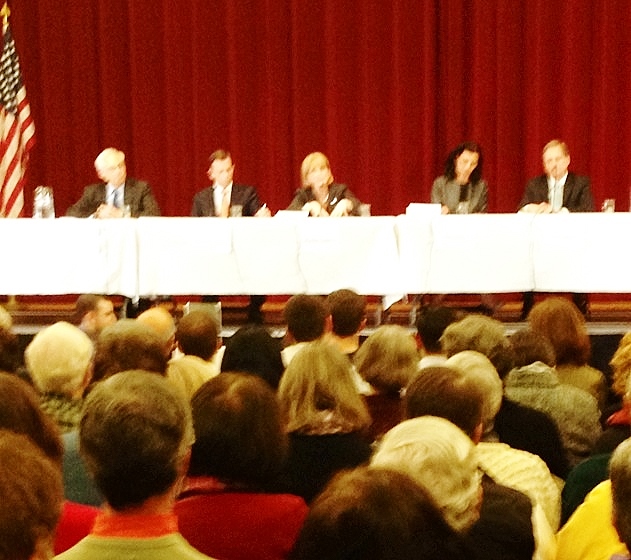
Close to 500 people took seats in Lexington’s Cary Hall to hear the five Democrats running for Governor respond to questions put by the town’s State Representative, Jay Kaufman. The Forum lasted almost two hours, sufficient time for the five to leave clear and very different impressions of what they are about.

Don Berwick, a doctor, sees almost everything as a health care or moral issue ; and as health care and government’s handling of it has roiled the whole nation, the Lexington audience saw it too. Applause galore graced his most fervent flights of pediatric concern. Curiously, he also arrives via the health issue route at favoring repeal of the State’s casino law. All four of his rivals took the opposite position: Grossman pointedly, for both the revenue and the jobs — as he said, ‘how will we replace the casino revenue ?” Coakley opposed Berwick definitively, noting that she has sued to prevent the casino repeal referendum entirely, as an unconstitutional interference with settled contract rights). Even the casual Kayyem said that no, we need casino revenue and jobs.

Many in the Lexington audience applauded Berwick’s anti-casino moralism. To this observer, however, Berwick the anti-casino repealer seemed a Democratic version of Ted Cruz repealing Obamacare. Not exactly the impression he might want to leave.

State Treasurer Steve Grossman addressed many issues on their own two feet, and spoke of immigrant rights, renewable energy, the Governor’s transportation bill, and mental health work, with detail confidently; but he too had his mantras : “I’m the only candidate on this stage who has actually created jobs” and “if we need to raise new revenue, I will do it.” Still, because he often spoke directly after Berwick, Grossman’s intense focus and decisive “this is what I will do as governor’ moments contrasted all to his advantage : Berwick, the moral conscience; Grossman, the man of authority. Berwick drew the loudest applause, and often; but as the Forum continued, Grossman began to draw applause as well — more and more. And if this Forum was about electing a Governor — which hopefully it was — Grossman deserved every kudo accorded him.

That said, was I the only observer who heard a strong likeness to Charlie Baker in Grossman’s “business and job creation” theme ?

Image

^ activists attentive : Cary Hall was full to the loges and balconies

Attorney General Martha Coakley spoke quietly, with a welcoming smile that belied the sarcasm in her many responses, in which she was trying to say, “as Attorney General, I’ve already been working all of these issues, of fairness, budgeting, immigrant concerns, and the big banks.”

Juliette Kayyem, a policy expert and former Obama Administration NSA official, looked gorgeous and spoke casually, almost intimately, as if at a houseparty among friends — a tactic that, to this observer at least, doesn’t work in a setting as structured as the Jay Kaufman Forum. Her informality dissipated her issues statements to the point that I found it hard to grasp what her positions actually are. On the issues that she did address directly her answers seemed tautologous. Berwick and Grossman — even Coakley — stated positions that one might disagree with. Thery took risks. Kayyem appeared to take none and to rely on her charm and personality — pleasant surprise to see in a bureacrat — as a kind of policy statement itself.

Image

^ personality as policy : Juliette Kayyem

Then there was Joe Avellone, a doctor and the CEO of a medical software firm, Parexel. I do not like to speak critically of a man whose candidacy lags so badly, but I have to : on the Lexington stage, Avellone spoke a soft voice that was hard to hear, talked without focus, and, as a doctor on the same stage with the eloquent Doctor Berwick, found himself beaten to the prize almost every time.

Distinctions were thus made, for all to see and appreciate. yet on the night’s most important question — “what will you do if the Speaker won’t sign off on legislation that you propose ?” — all five candidates ducked or evaded. Grossman noted that he has built up solid relationships with members of the legislature. OK, but that wasn’t the question. The question was about just one legislator, the Speaker. Doctor Berwick said, “I’ve met many of our legislators. They seem normal to me.” Laughter — but again, he did not say what he would do about the Speaker, who is not normal but THE Norm. And so it went. Granted that the question was somewhat unfair. In our state the Speaker of the house controls his membership entirely, to the point that no legislation can pass without his OK, and there is nothing that even the Governor can do about it. time and time again, under Speaker after Speaker, we see this happen. What could any of Representative Kaufman’s five guests really say, that would not embarrass them and show them, ultimately, as weak ? The office itself is weak.

Fortunately for the five, this moment of truth came early in the Forum. by the time the Forum ended, the candidates looked important again, their office worthy of activist attention in the party caucuses that begin less than a month hence.

—- Mike Freedberg / Here and Sphere

below : the obligatory Forum photo, complete with white band in the middle annoying every eye.

Image

OMG ! IN DORCHESTER : CARLOS HENRIQUEZ TO JAIL ; GENE GORMAN ON THE TRAIL

Image

^ not a good day for the 5th Suffolk’s Carlos Henriquez

—- —- —-

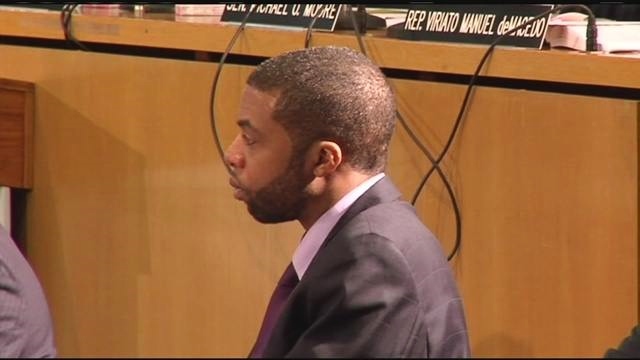
“OMG !” is how the website known as “buzzfeed” might put the big political news coming out of Dorchester yesterday. A jury in Medford found 5th Suffolk District Stater Representaive Carlos Henriquez guilty of two counts of assault and battery. After which the trial judge, Michele Hogan, sentenced Henriquez to two and a half years in the Middlesex House of Correction, six months to be served.

Henriquez was led out of the courtroom in handcuffs, a photo seen by everyone who read today’s Globe or Herald.

I got the word via my twitter feed at about 3:00 PM. Immediately after came a report that Speaker Robert DeLeo requested Henriquez’s resignation; Governor Patrick and Mayor Walsh soon followed. Republican leaders repeated the call — eager to pile on. Would have been wiser had they said nothing.

Will Henriquez resign his office ? It looks simple, but it isn’t. The voters have a right to elect, even re-elect, a person convicted of a misdemeanor. My opinion is that Henriquez should do what his District’s voters want. If they want him to resign, resign. If they are OK with him representing him, no one else has any right to overstep things. I have not sampled opinion in his District, but Henriquez’s troubles have not gone unnoticed among the District’s activists, and he is sure to hear that many of them have had enough.

The many exchanges that I had with Henriquez during the recent Mayor campaign didn’t exactly inspire me. Before the primary, he was nowhere to be heard from; after Arroyo, Barros, and Golar-Richie endorsed Marty Walsh, however, and were joined by some others, Henriquez was suddenly an apostle for Walsh, furious in his intensity, all over twitter chanting Walsh’s praises, arguing at length with Connolly people whom he knew ; and almost all of what the suddenly converted Henriquez said was 100 percent standard Walsh talking point. Not one word from his own experience or observation of a man who, after all, was his state house colleague AND political neighbor. I did not exactly form a high impression of Henriquez’s perspicacity, or loyalty, or his ability to convince anyone of anything.

None of the above is a crime; and, truth be, it seems to me excessive to sentence to jail a man with no criminal record on a misdemeanor conviction. Probation is what we usually do, and rightly. We seek reformation, not retribution. Did Henriquez not receive the mediation that we accord most misdemeanor defendants because he is a legislator ?

That said, resignation seems likely; Speaker DeLeo will seek expulsion if Henriquez doesn’t resign. Of all the State representative openings that have occurred in Boston the past year — five so far, this would be a sixth ! — this one offers truly fascinating possibilities.

One : Charlotte Golar Richie once held this seat. Might she run for it again, regain the political currency that she lacked last year, and, with the backing of communities of color — who very much want a Mayor of color as soon as feasible — run against Walsh in 2017 ?

Two : John Barros also lives in the District and owns Cesaria, a very popular restaurant on Bowdoin Street. Might he run and win and then become a Mayor candidate in 2017 on the same grounds that I posited for Golar-Richie ?

As of 2011, the District included Ward 7 Precinct 10; Ward 8, Precincts 5 and 7; Ward 12, Precinct 6; Precincts 1, 2, 4, 5, and 6 of Ward 13; all of Ward 15 except precinct 6; and Ward 17, Precinct 2. It seems made for Barros.

Of course, momentous possibilities may not come to pass. Both Golar-Richie and Barros campaigned exhaustingly last year. Both have the ear of Mayor Walsh. Who could blame them for not running for yet another office to possibly no great result ? The District does not lack for ambitious new names who will surely run. But whoever does run and win, one fact of the 5th Suffolk district stands out : low voter participation. In its 18 precincts, only 6547 people voted in the Mayor election — about 31 to 33 % of the total registration. Compare that to turnouts of 50 to 80 % in precincts where Walsh or Connolly held a base. Whoever the new 5th Suffolk representative is, he or she should make it a priority to engage the 2/3 of voters who didn’t respond to last year’s intense mayor campaign.

Image

^ better news, right next door, in the 13th Suffolk ; candidate Gene Gorman greets his supporters in Savin Hill

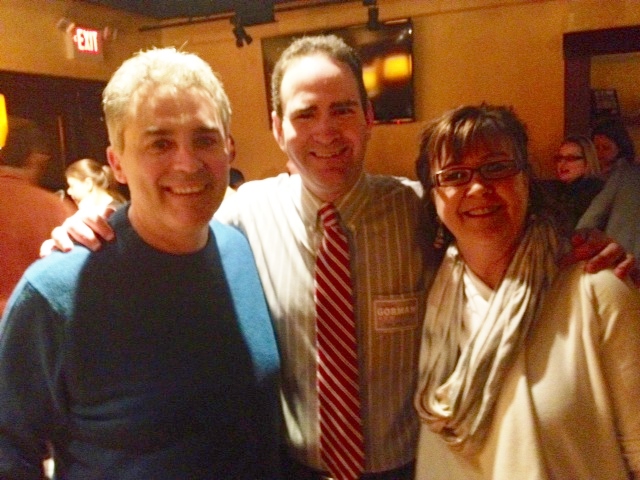
Meanwhile, the Dorchester State Rep seat that Mayor Walsh resigned, next door to the 5th, has a special election on tap; there are — it seems — six candidates in the race, and I attended a reception for one of them, Gene Gorman. The Harp & Bard, scene of many Dorchester political “times,” was plenty full at 7.30 Pm as Gorman, a first time candidate, spoke to the almost 100 people assisting. “Why are we here ?” asked Gorman, “Because we’ve embraced this idea of city life for a lifetime. it’s an important decision. Dorchester by choice.”

Gorman recounted how he, a North Carolina native who now teaches at Emerson College, moved to Savin Hill, because he chose to; and how, a few years ago, he and his wife decided “we wanted a little more room and so we found a house on Melville Park — in Dorchester still.” There, he said proudly, he “served on the governing board of the Robert Frost innovation school. They wanted to close it down. We parents protested , they kept it open, and now it’s a Level One school, one of the strongest performing schools in the whole system !”

Image

^ solid friends in “Dot” : Gene Gorman embraced by Jim and Millie Rooney — at the Harp & Bard on Savin hill Avenue

Gorman spoke of “progress and transformation” — John Connolly’s theme; and, as Gorman is one of the “new Bostonians” who Connolly’s campaign so appealed to, I almost expected to hear that Gorman had been a supporter. But no; he had volunteered for “Marty,” wrote policy papers for him, and served on Walsh’s Housing task Force during the Transition. Gorman has now resigned that work, to concentrate on the campaign. Judging from last night’s turn out and his own command of the effort, Gorman seems a serious contender even in a field boasting several candidates with major local clout.

—- Mike Freedberg / Here and Sphere

#MAGOV : COAKLEY ATTACKS BAKER; BAKER SAYS “THANK YOU”

Image

Coakley the Chin attacks more thin than win

—- —- —-

In this era of talk show politics, candidates have learned that they can draw attention by attacking opponents early and often. Attention practically erupts when the attacking comes from a surprise direction. It was so, yesterday, when Martha Coakley attcked Charlie Baker for — so she claimed — opposing the minimum wage hike now awaiting enactment by our legislature. Who expected to hear Coakley, the poster child for dull campaigning, signing chin music ?

Coakley’s attack certainly got Baker’s attention. His spokesman Tim Buckley shot back a quick response : that Baker is “open to raising the state’s minimum wage but aslo has other suggestions for putting more money in low-wage workers’ wallets : increasing the earned income tax credit and assuring such workers of longer hours.

To the knee jerk ear Baker’s response sounds like waffling. it isn’t. His earned income tax credot increase is a solid idea, and so is his assurance of longer hours. Too many minimum wage workers aren’t given a 40 hour work week. An employer doesn’t have to provide healh insurance and othetr benefits to workers on the job less than full time; many employers who pay low wages also use the short hours system to avoid incurring benefits. Voters who take the time to think seriously about Baker’s wage and employment ideas will find them quite reform=-minded.

Image

^ a smile on his face : “thank you, Chin, for attacking me !”:

Coakley’s attack, on the other hand, came sucker-punch fashion : slam bang and out. No policy nuance, no ideation, just the one raise the wage do-it. I am all for raising the minimum wage gto # 11.00 an hoiur; we at Here and Sphere have editorialized often in favor of the raise, and we will probably say so again and again. But is “raise up” the only move worth making ? Why should it be ?
Moreover, Coakley added the two talking points being talked by all the standard-issue Democrats : the rause is “good for working families” and “Baker favors the top one percent.” This is dumb stuff. Coakley must know better. I get the impression, actually,l that her attack wasn’t directed at baker at all but a her Democratyic rivals. Coaklehy isn’t runnihg against baker right now;. She is running against Steve grossman, Juliette Kayyem, Don Berwick, and Joe Avellone. Her by-the-book talking points are what Democratic Primary — not November election — voters like to hear.

Coakley must think that by attacking Baker, she’ll be heard first (and she has been) and maybe foremost and that her rivals will have to play catch-up — somehow: because they can’t catch up by attacking Baker : that would look to voters like copy-catting and, well, catching up. We will soon find out how Kayyem, Berwick, Grossman, and Avellone respond to Coakley’s two-bank billiard shot. The winner, one hopes, will be the Coakley rivals who refiuse to play her game at all; who continue to present their own issues and agendas, in their own time and place, gathering support at the upcoming caucuses from activists who want a confident winner, not an attack game tactician. But I could be wrong.

As for Baker, he should send Coakley a thank-you gift. To be attacked so loudly, by such a lamed candidate, this early as the caucvus and convention season ios about to begin, is a blessing. Baker has to be smiling a big smile as I write this column tonight.

—- Mike Freedberg / Here and Sphere

AN INSIDER LOOK AT “IMMIGRATION” — Pedro’s Story

hereandsphere's avatarMAN-CESTRY


–PEDRO’S STORY–

immigration

IMAGINE… That not EVERYTHING you “think” you’ve seen, read, or heard “might” NOT be true!!

“PEDRO’S STORY” —  an insider’s first hand knowledge — might make you re-think exactly that.

Immigration reform, citizenship, amnesty, undocumented workers, bipartisan deals…. These words and phrases are seen, read, and heard in every news, press, and media outlet repetitively ad nauseam. Yet not many people know what they “actually” mean. Sadly, fewer still can apply what they do” know” to events happening in our country.

Don’t worry, this is not a vocabulary lesson of epic proportions. This is a story about a young man. For the sake of keeping things fairly similar to the facts — we will call him Pedro.

Pedro Luis Vasquez hails from a village in the mountains of Guatemala. Its inhabitants lead a simple life, with few of the comforts that even poor…

View original post 1,118 more words

Daddy Day-Can’t — The first of a three part Top 3 FAQ’s of New Parents

hereandsphere's avatarCoffee or Vodka?

Question # 1 –TOP 3 FAQ’S OF NEW PARENTS

crying baby

Dear: Parenting 911

My wife and I recently had our first baby, Alivia is already 2 months old and incredibly smart — at least I think so.  She is very aware of my wifes presence, and seems to fuss the moment she is out of sight. I however do not get the same grievance when I leave or enter a room, where Alivia is learning all about her surroundings. I work long hours, BUT; I took off a whole month so as to help my wife care for our daughter. My wife Jennilynne had a very difficult pregnancy, and even harder delivery — resulting in a C-section. I woke with Alivia attempted to feed, change, and even bath her. Though I can truly say as I tried to bond with her — SHE ALWAYS WANTED MY WIFE!!!!! It didn’t matter…

View original post 953 more words

ANNALS OF SEDITION : BREAKING UP THE AMERICAN NATION

Image

^ says “liberty,” means “sedition” : Ted Cruz of Texas

—- —- —-

Before our very eyes, as we watch stupefied, the American nation is breaking up, shattering into its 50 component parts. Actually, we aren’t merely watching. We — the good guys, of course — are actively participating in the break-up. We have no choice but to do so, bcause it is being done to us by forces that will stop at nothing, including the unity of the nation, to have their way with us. The forces I speak of are the billions of dollars, unleashed by the Citizens United Supreme Court decision, to PACs that seek to shut down the Federal government, or to block it from working, and to purchase the election, in vulnerable states, of legislatures and governors hired to enact the billion-dollar agenda by which all money flows to the top, as the votes of those being sucked dry are suppressed as ruthlessly as their wages, hours, health insurance, and survival money are taxed and diminished inexorably.

Citizens United came at a time already portentous. The Republican party was already undergoing break-up, as extreme,y regressive donor groups assaulted the party’s governing core. The alarm bells should have sounded as far back as 2006, when the “right wing media entertainment complex,” as opponents call it, snuffed President Bush’s nomination of Harriet Miers to the Supreme Court. But the warning passed, and even in September 2008, when the House GOP Caucus opposed Bush’s economy-saving TARP program -which passed only because many Democrats voted for it —  the danger was not heeded. Today the regular GOP knows that it has been kidnapped into sedition; it wants badly to get off the break-up train, but as I see it, things have progressed too far for that. Only the Democratic party can stop right-wing sedition, and that only by defeating the GOP seditioners in the states they now control.

Good luck with that. The Democratic Party has a hard enough time defending its own turf right now. It can contest a few states currently dominated by right-wing sedition, but not many. The really dominated stares, such as Kansas, Indiana, Mississippi, Tennessee, Alabama, South Dakota, Oklahoma, and Texas, seem well out of reach, gone and moving even farther away.

Image

^ not ready to surrender : fighting sedition in North Carolina

Democrats are wont to blame GOP sedition on the significant vote provided to it by reactionary religion.  But these folks, who think they have a right to legislate and tell the rest of us how to live, would be a minor annoyance, a fringe fungus, were their numbers not blended into the “liberty” and “patriot” money bomb. For a while, we who live outside the regions purchased by the money bombers could stand amazed at what was going on. We could laugh at the “legitimate rape” comments, the antics of a Christine O’Donnell, the nazi-ish fulminations of a joe Miller, the selfie-ism of a Ted Cruz. We anger at the trash use of “liberty” to mean sedition and “patriot”: to mean gun brandishing; confident that our own, still respected civil rights are safe. But over the past year or more we have taken to travelling the same route — in the opposite direction. Our own money pools are now bombing the election wars and driving us, in states not Tea-publican at all, forward fast on all fronts : wages, union labor rights, civil rights, gun control, immigration.

We in Massachusetts, New York, Connecticut, Rhode island, Minnesota, Maryland, Hawaii, Washington, Illinois, maybe Oregon — and especially California, social justice’s go for broke democracy –recognize that the Constitution, in its very preamble, talks of “promoting the general welfare.” Not the welfare of only some, but of all ; because that is what “general” means. We recognize that if the rights and welfare of some are curtailed, so are the rights and welfare of all. We do not think that the Founding fathers were mistaken to commit to all, nor that it is wrong for us today to continue that commitment. We are glad for, not offended by, the social safety net. Most of us welcome immigration and dislike guns and ammo. We accept science.

Our money people mostly agree. Money interests in our states mostly understand that if everyone prospers, all prosper. And so we in the states where our views are shared by the monied classes among us are buying elections of like-minded legislators and governors.

Image

^ social justice goes for broke : Governor Jerry Brown of California

Yet we too are breaking up the nation. There is no longer one America but two; or should I say, fifty ? Such a fragmenting has always been implicit in our complex governing structure. The Constitition itself envisions states retaining significant local autonomy. Often that multifold autonomy has engenered leguslative experiment — recognized and written into many Supreme Court opinions by Justice Oliver Wendell Holmes, who valued legal empiricism. But just as often state autonomy invited ghastly injustices — lynching and Jim crow laws, for example — and put them beyond the reach of Constitutional protection. We as a nation were only able to interrupt those injustices when the Federal Congress enabled laws to do so; and as anyone who has read the history of America from 1900 to 1960 knows, such laws were almost always blocked by representatives of unjust states. The nation might well have shattered to pieces, as it had done in 1860; because injustice is ananthema to most Americans and most states. But two facts, the remembered defeat and horror of our Civil war and the common threat that a nuclerar armed Soviet Union posed to all of us, held our fractured country together : all in gress could agree on the arms race. Today that common threat is gone, and the horror and defeat of our Civil war looks unnecessary : why secede from the union, and risk war, when you can simply stop the nation cold and then legislate your 1850s agenda in the states your money bombers can buy ?

We in the social justice states forget that many in the pre-Civil War north wanted to part ways with the slavery South. Break-up of he Union was advocated by some. (It was in response to northern break-up sentiment that Daniel Webster delvered the Senate speech in which he magnificently said “union and liberty, liberty and union, inseparable.”) Only when South Carolina forced the secession issue to war –attacking F ort Sumter in Charleston Harbor — did the North commit to war. Today, we know better. Why not just let the states of injustice do their thing while we do social justice in our states ? At least in our states we can do what citizenship is supposed to do. And if by doing so we render the Federal governemnt even more hors de combat than it already was, well, that’s just how it is.

Thus what was once called “America” is becoming two very different countries. Unless our polity can reverse course very soon, the break up is going to be a fact for a long, long time — and will aggravate. Because it has consequences. People are not going to live oppressed in regressive states. They will move, if they can, to states of justice and opportunity. Their children will move too. The more people who leave the injustice states, the more unbeatably injust they will become : because those who leave take their votes with them. In the same way, the more people who move to the justice states, the more just these will be. Thus will time break our nation farther aapart and to pieces.

The consequences will be huge. And not in a good way. I wish I could see a different outcome. But right now I cannot.

—- Mike Freedberg / Here and Sphere

#MAPOLI : CRAP AND FURY IN CENTRAL MASSACHUSETTS

Image

^ PAC’d up talking points : Mike Valanzola of Wales

Image

^ talking the Tea from tax to tightwad ; James Ehrhard says that Stephen Brewer is  Brookline liberal

—- —- —-

As I cover this year’s Governor election, on a statewide basis, I am struck by the number of Republican state legislature candidates from Central Massachusetts who talk the same glib. From Sturbridge to Athol, Clinton to Chicopee, Winchendon to Uxbridge, Ware to Phillipston, you hear what the Cato Institute and its local farm teams, the Mass Fiscal alliance and the Pioneer Institute, have on offer. As if city-based, billionaire-funded policy pushers had anything to say to people living on or close to the edge in towns far beyond the technology quadrant of our state, towns lacking infrastructure, and sometimes health care,effective  schooling or even visibility — the region being vastly under-served by major media.

Ground zero for robo-think Republicanism may well be the State Senate seat now held by Stephen Brewer,a  Democrat who talks the “job creator” poop as glibly as any PAC-d up Republican. Brewer is waiting on the winner of two GOP opponents : Mike Valanzola of Wales and James Ehrhard of Sturbridge. Ehrhard sounds even more Tea-tongued than the rigidly PAC-i-fied Valanzola, and his negative tone doesn’t have much legs : in 2010 he lost a selectman race in Sturbridge by a vote of 1039 to 764. Valanzola in 2012 gave up, after two terms, his selectman seat in tiny Wales; but Valanzola is, so far, running by far the more intense campaign. Central Massachusetts’s Tea-friendly activists badly want the Brewer senate seat, and they have reason to be cheerful : the district’s towns include a bushel of towns that Republicans carry by 30, even 40 points. As Ehrhard points out, Scott Brown in 2010 and Charlie Baker in 2012 carried every one of the district’s 28 communities.

Still, it chills me to see candidates in this hardscrabble district talking Tea fury or  expensively hired bull-bleep. If any area of Massachusetts needs straight talk, and mucho state assistance on many, many fronts, its the Worcester, Hampden, and Hampshire senate district.

Image

^ Democrat on the Tea hot seat staring down PAC flux : 25-year Beacon Hill veteran Stephen Brewer of Spencer

The imposition of PAC-d up quackery isn’t by any means restricted to the Brewer race. Nor the venting of Tea. All Central Massachusetts groans of them. One would think that the Central Massachusetts GOP hopefuls whose facebook pages, twitter feeds, and campaign websites I surf would voice the voices of their towns (few are running in a city); but no : almost all churn out the exact same GreedPAC robo-call, or worse : cut taxes, repeal taxes; don’t raise the minimum wage ; make public assistance almost impossible to get; harass immigrants; go for your guns. Hasn’t anybody got anything original to say ? That suggests a mind at work, not just a lip ?

You confront one of the more aware of these sloganeers, as I have, and you get the answer ‘we need better solutions.” So how about suggesting some ? Maybe.

From the others, all you get is defriended or blocked. Debate not permitted in Central Massachusetts !

PAC-ism is the curse of politics today, especially toxic to regions lacking diversity in people, political party, or media. The Democratic party has PACs too, as we in Boston recently confronted; but these PACs have, it seems, made a decision not to shuttle resources to an area they do not need to win because they already own supermajorities in the legislature; a region lacking in Democratic reliables : Union members, educators, health care interests, and urban planners. Cato-ism thus has free rein — more or less — to rule the unpopulous midsection of our state.

The effect is to drive Republican victory in Massachusetts farther and farther away from  the big cities and from the issues and concerns that big city voters have. It’s a temptation that, right now, our GOP is hard-pressed not to surrender to, a message from the “Quabbin quorum,” so to speak, that will impact city people’s impression of GOP governor hopeful Charlie Baker as much and diligently as he rejects it.

Thus the Democratic party’s light touch in Central Massachusetts be pays big dividends for them.

After all, why not let your opponents voice stuff that doesn’t pass the nutrient test ? You’ve heard the same crap now since 2009. You know it by heart ::

1.”free up the ‘job creators’ to hire people.” Businesses do not hire because taxes are cut. They hire because demand for their product or service increases. Consumer demand amounts to TWO THIRDS OF THE ENTIRE ECONOMY. it can NOT grow if consumers’ income does not grow.

2.”cut taxes, slash public assistance, cut state spending.” How, pray, does it aid the economy to cut taxes ? Our economy cannot grow as it should if our roads, bridges, and transit are constantly in repair, jamming up traffic (no need for a Bridge-gate here, we have a kind of one going on, by itself, every day). Our economy cannot grow if state education spending cuts school needs. Our economy cannot grow if out of work workers can be retrained, can’t get unemployment assistance, can’t get to work because the transit system can’t do maintenance and car updates.

3.Don’t raise the minimum wage, mom and pop businesses will go bust.” That I doubt. If a business is so marginal that it can’t pay its employees enough to not need public assistance, it shouldn’t be in business at all. There may be some such; but there are far, far more working people — and most minimum wage workers are women — who can’t make ends meet, who can’t participate in the growth economy, whose low wages we taxpayers subsidize. This must stop.

4.”force the undocumented immigrants out” : talk about self-defeating ! Every immigrant, documented or not, is a consumer; every consumer maintains the economy.

5.”more guns make us safer.” This one I won’t even dignify. I’m done there.

Why, I ask, why is this haunch gunk being spread across Central Massachusetts, the state’s neediest region, where huge State investment is needed badly, in schools, transit, roads, career centers, and better wages ? A region where many people go unnoticed by any media — except when a tragedy strikes, such as the recent death of a Fitchburg area child in DFC foster care — and basically are left to fend for themselves ?

Expect very little of this to be said out loud in the Stephen Brewer contest with either the angry Ehrhard or the polished Valanzola. Under the table, however, the future of a very dry-rub region of our state will be profoundly affected. Because in theory, at least, Brewer is a Democrat, and he cannot be entirely overlooked, every day, by the big egos in the big city to his east.

—- Mike Freedberg / Here and Sphere
CORRECTION : an earlier version of this story had James Ehrhard being a  Sturbridge selectman, whereas in fact he lost that race in 2010, to Mary B. Dowling by 1039 to 764.

UPDATE 01/21/14 : four days ago, Stephen Brewer announced that he will not seek re-election. His very GOP-leaning seat is now open — maybe — for GOP pick-up.