BOSTON MAYOR RACE : LABOR, CONSTRUCTION, AND THE B.R.A.

Image

^ Local 26 Hotel Workers have endorsed Marty Walsh

—- — —-

On August 2nd, the Hospitality Workers union (Hotel employees) decided to endorse Marty Walsh for mayor rather than Felix Arroyo. This was a significant move. Arroyo had expected endorsement from a Union membership mostly people of color and not a construction trade, all of whose endorsing Locals have so far gone with Walsh, a former Building Trades leader.

The Hospitality Workers made a nuts and bolts ddecision that Arroyo, their sentimental favorite, could not win, but that Walsh can. That’a how it goes in crunch time.

You can make a good case, too, that hotel workers are bound to the construction trades. Why ? Simple : hotels have to be built before they can hire Hospitality workers. Much hotel building is going on in Boston, and more is planned. There’s construction of all kinds afoot, but when looking at the building boom and what it portends for construction workers, one shouldn’t overlook the hotel component. Thus the Walsh endorsement fits.

Image

^ construction jobs galore — hotel workers too 

Boston’s construction boom may be the most significant event affecting the election of a next Mayor. What to do about the City’s schools, and how to fit them into the City’s new, technology economy has wider provenance, but at greater length of time. Just as the school riddle boosts John Connolly’s campaign, so the construction boom lifts Marty Walsh.

He, alone of the twelve Mayoral hopefuls, seeks to replace the Boston Redevelopment Authority (B.R.A.), not just reform it (as John Connolly suggests) or tweak it merely (the position — no surprise — of most other candidates). Walsh told the Boston Globe, in response to its editorial board’s questionnaire, that he would replace the BRA with an economic development agency whose director would serve under a contract and be less accountable to the mayor’s office. Wrote Walsh, “Under my plan, the mayor will have less direct power; multiple current entities with similar responsibilities will be morphed into one, creating tax savings and eliminating duplication.”

Walsh’s BRA proposal would put economic development in Boston more into the hands of construction companies and workers than it has been. It also portends greater input for Boston neighborhoods.

His suggestion makes some sense. The current BRA, still much the same in its power relationships as when it was first created in 1957, answers to the Mayor and implements his policy goals. That mattered in 1957 and for a long time thereafter, when neighborhoods had not awakened to, or were formulating, their needs and identity. Walsh is saying that, today, a Mayor-controlled BRA works against the interests of Boston’s neighborhoods, which have found their own identities and needs now and want the power to pursue them.

Image

^ Boston, as the BRA sees it 

Still, the economic development agency that Walsh wants to create in place of the BRA, which in nits current form he would do away with, would give much power to the construction industry and construction labor along with local planning boards. This looks a lot like free-wheeling and, in part, a return to the 1950s, before Massachusetts instituted zoning laws. Today, all building projects must seek permits and zoning opinions at the City Planning Offices in 1010 Massachusetts Avenue. Would Walsh’s economic planning board engender a series of neighborhood permitting and zoning opinion agencies ? It could be. Under Mayor Kevin White, “Little City Halls” were set up in many Boston neighborhoods. Their authority was limited; their political outreach was almost limitless.

There would be good in localization of development planning but also much grief. And if Walsh does not foresee localization of zoning and development approvals, would his economic planning board be that different from today’s BRA ? What difference would it really make to have City development answer to the construction business rather than the mayor ? Would that be better for the city ? And what of the City’s centralized Water & Sewer Commission ? We would love to hear what Walsh has to say about these details of his plan.

Meanwhile, Walsh continues to accumulate Union endorsements and some high-fives from the City’s traditional businesses.

—- Michael Freedberg / Here and Sphere

BOSTON MAYOR RACE : EDUCATION WILL PLAY A HUGE PART, AND THAT MEANS…

Image

^ John Connolly : says he’s the “education Mayor.”

The big talk in this year’s 12-candidate Boston Mayor race is education. Sure, there’s much heat being spoken of casinos, griping about traffic — especially in the new Seaport District and in Charlestown — and alarm at what candidate Marty Walsh calls a “heroin epidemic in the city.” Still, the really big talk is about education : what to do, to improve all Boston schools, thus to graduate a work-force capable of doing the highly technologized jobs on offer at most Boston companies ?

It’s the education issue that has raised candidate John Connolly to the top in recent poll. It’s also John Connolly who has lifted the education issue to peak pitch. He was the only City Councillor to vote against the current Boston Teachers Union contract because it offered not a minute more of additional school time. Connolly’s campaign slogan is “education Mayor.” Alone of the twelve — so far — he has a slogan that matters.

So, what does the “education Mayor propose ? It’s well worth quoting from the Schools page of his “Ideas for Boston” platform (delivered, let me add, in seven languages including Viet Namese and Albanian).

With regard to extended time school days, Connolly says this :

“A Longer School Day with Full Enrichment — Currently, Boston’s school day is one of the shortest in urban America, leaving hundreds of hours of potential learning time untapped. We must use every strategy available to extend learning time in the Boston Public Schools. Along with more time in school, every child in Boston should have access to science, art, music, social studies, and physical education taught by qualified and talented professionals. I have called for a “Quality Baseline” to establish a list of courses to be offered at every school and the amount of instruction time in each course, in order to guarantee that all students have access to full academic enrichment.

“As Chair of the City Council’s Education Committee, I held hearings on the Boston Teachers Union contract where families and students called for extending the school day. During BPS budget reviews, I advocated for creative partnerships that could extend learning time at our schools. When the new teachers contract came to the Council without a single additional minute of instruction time, I was the only Councilor who voted against it. As mayor, I will negotiate a contract that extends the school day at every Boston Public School.”

Image

^ BTU President Richard Stutman : showdown coming in this mayor race

That’s pretty detailed, and bold, and sure to confront the Teachers’ Union (BTU), a group often stubborn and no more so than on the variety of school improvement proposals on offer now. The BTU has set itself against all kinds of innovation and experimentation in curricula and staffing. It is likely to not like what Connolly says about assuring teacher excellence :

“Finding and Keeping the Best Teachers and Principals — Excellent principals are the key to excellent teaching: a highly effective school leader can transform a struggling school or keep a strong school on track. Talented and qualified teachers need to be recruited, supported, and retained in the Boston Public Schools. In the City Council, I pushed to pass a resolution supporting state legislation that strengthened teacher and principal evaluations. As mayor, I will establish partnerships with local graduate schools to develop a principal pipeline that can prepare and train new innovative school leaders.

“Empowering School Leaders and Communities — Highly qualified principals and dedicated teachers are professionals who should be encouraged to innovate and improve their practice. Our new evaluation standards can ensure quality across the board, so as mayor I will use every possible strategy to get more funds and decision-making power directly to our schools. Our Pilot, Turnaround, and Innovation Schools have demonstrated that well-resourced schools that have strong leaders and site-based autonomies provide excellent instruction to our children and are highly sought by families. I will work to create more such schools across our city.”

Nowhere in Connolly’s statement on teacher excellence does the term “charter school” occur, but it’s on everyone’ s mind. (And not only in Boston.) The BTU fiercely opposes lifting the current “cap” on the number of charter schools allowed. Chiefly, that’s because teachers in a charter school need not be union members. The Union also dislikes the extended hours and curriculum intensity of charter schools. The BTU has good reason to fear charters. They have a solid record for graduating students much better prepared than in many “traditional” schools. Parents will, if given an option, often choose a charter school.  The charter school movement isn’t waiting; advocacy groups are pushing amendment of state laws to eliminate the “cap.” If they are not already aiding the Connolly campaign with money and advertising, they are strongly rumored to have such plans fully in place and ready to launch.

In today’s Boston there is no room for kids graduating poorly prepared. There’s no economy for them either. Rents all over Boston range from $ 1400 for one-bedroom apartments in the outer neighborhoods to $ 5,000 and up for 2 to 3 bedroom places in the Downtown area. eating out in most parts of Boston rings up a $ 20 tab per person — at least. Parking is expensive. So are the “ultra lounges” that today’s young adults socialize at. Sailing — indeed, all water sports — is not cheap at all. And, most of all, there are no jobs — other than janitorial — in much of Boston that do not assume complete literacy in laptops, i-phones, social media, and website usage. Even a waitress or bartender needs know how to enter an order into a pc or laptop. these are the facts no matter who you are, what your last name is, or what neighborhood you come from.

It will be entirely OK in the new Boston — as it always was — to have a city or state job, or to work for Boston Edison, or to work a bar or restaurant in the “neighborhoods.” Rest assured on that score. In the new economy, however, people traveling this route will be constantly outgunned in elections by the six figure salaries, the technology people, the developers and investors, the CEO’s of education, hospitals, and finance — all of whom are spending aggressively to keep themselves on top and to promote the economy that has made them.

Their spending, and their demands upon employees, assure that no Boston Mayoral candidate is going to get there without an education plan that addresses these facts of modern city life. Right now, John Connolly appears far, far ahead of his competitors on this battlefield.

UPDATE : This compliment to John Connolly does not mean that he’ s home free. Marty Walsh, who seems running a very close second to Connolly, may be a voice for union workers — whom Connolly seems to have cornered on school issues — but as the political voice of Boston’s unions, Walsh credibly tell Boston voters that there’ll be no path to reformed schools that fights the BTU every step of the way.

Others of the twelve Mayoral hopefuls have yet to take hold of the school reform issue. Its time has come. The school busing crisis of 40 years ago — transporting kids all across the City to achieve “racial balance” in a school system which in the late 1960s was highly segregated — has scant provenance in today’s Boston, in which people of color live everywhere in it and are thoroughly respected politically. School reformers’ work now is to move beyond school assignments based on “deseg” guidelines; to rekindle neighborhood schools: flexible, innovative, and committed to the technology world.

Doubtless we will hear useful policy suggestions from at least a few of Walsh’s and Connolly’s rivals, and soon.

—– Michael Freedberg / Here and Sphere

UPDATE 08/23/13 : the school issue has indeed exploded to prominence thanks to an advocacy group’s statement that it would inject $ 500,000 into John Connolly’s campaign. Connolly had not choice but to reject that money, and the issue faded; but school improvement issue now tops every Mayor candidate’s agenda.

BOSTON CITY COUNCIL RACE, A BAD IDEA IS PUT AND MUST BE REJECTED

Image

^ diverse fooderies : a bad idea posed by a City Council candidate would erase this picture

Political people pose bad ideas in every campaign. It seems to come with the territory and sets us back. In Boston this year, where some 19 candidates are running to fill four (4) at-large Council seats, one candidate — who has attracted much attention — has no put forth an idea which should sink her campaign pretty quickly : she suggests that new restaurant licenses be non-transferable.

Image

^ Michelle for Boston ? Not now she isn’t

Making restaurant licenses non-transferable would pretty much end the restaurant business in Boston except for the very rich. restaurants start up all the time. Most fail. While open, often as a family venture without big bucks, their vast diversity of cuisines makes life in the City a food adventure. Because there are in Boston today many food adventurers, some of these newly opened restaurants succeed, for a longer time than most. The City needs this kind of adventure.

In a Boston with non-transferable restaurant licenses, there will be a lot fewer food adventures. The one factor that makes opening a new restaurant less risk than otherwise is that, at least, the closing restaurant can transfer its license — to a new location, or by sale to a new owner. Such licences are valuable, because restaurant licences do not multiply like locusts. They are fairly few. Taking the value out of such licenses will only guarantee that the fat-cat restaurant chains and millionaire-backed, downtown eateries will not have to fight small adventurous food joints for the dollars of people going out to eat.

With this proposal now on the table of a candidate with a following, those massively financed food emporia are toasting in today’s six-figure salary downtown Boston, woot-woot-ing on twelve-dollar mimosas before eighty-dollar-a-plate dinners.

Some who read this op-ed may be likening restaurant licenses to the taxi licenses whose rarity and manipulations have caused such a scandal — justly — in Boston this year. In fact restaurant licenses are nothing at all like taxi medallions. There’s an extremely limited number of taxi medallions, and they have tended to be bought up by monopolists. and why not ? Every taxi ride is the same : passenger and fare. restaurants are in no way the same. Some may succeed, others don’t. The cuisine is different. No one accumulates restaurant licenses.

Restaurant licenses must be freely transferable and encouraged to be so. To negate their transferability is a very, VERY bad idea. We oppose it.

—- Michael Freedberg / Here and Sphere
MEEK AT THE MOVIES : THE BUTLER ( 3 stars )

Image

^ Oprah Winfrey and Forest Whitaker in “The Butler”

—- —- —-

In the wake of the George Zimmerman trial, you couldn’t ask for a better movie–or I should say, movies–to help carve out a common understanding at the middle of the racial divide. No matter how you took the Zimmerman decision, Ryan Coogler’s “Fruitvale Station” delivered an air tight version of the same story with the same tragic end, the main difference being that the shooting took place before an audience of cellphone cameras leaving no wiggle room for conjecture as to what happened between two men in the dark. But also, and more to the point, the “based on real events” docudrama eloquently tapped into the plight of a young black man struggling to succeed in a society reticent to give him a fair shake based on the color of his skin.

To underscore that, and for anyone who’s of the mindset that we’re beyond Civil Rights and Affirmative Action and that opportunity is out there for all to take on equal terms, sit through “Lee Daniels’ The Butler” and see if you still feel that way. Perhaps the best way to describe “The Butler” is as ‘a short painful history of the black man in America.’ The film centers on one man, who for the most part, grew up a slave in the early part of the 1900s and went on to wait upon eight Presidents as a staff server in the White House.

True, slavery was abolished, by Lincoln and immediately after his death, in the mid-1800s; but on the cotton plantation where Cecil Gaines was raised in Georgia, the emancipated laborers and their progeny were still treated as little more than disposable property. As a boy, Cecil witnesses his mother pulled from the field and hauled into a shed for a brief brutal interlude with a scowl faced plantation owner, and when Cecil’s father says something about it in the aftermath, he’s given a bullet to the head for protesting the rape of his wife.

There are several such atrocities that percolate throughout “The Butler,” even after Cecil (Forest Whitaker) has relocated his family up north and begun his tenure under Eisenhower (Robin Williams). And as much of an opportunity as working in the White House would seem, Cecil has a stormy house to contend with. His wife, Gloria (Oprah Winfrey acting for the first time in over a decade) is an alcoholic and carries on an inappropriate relationship with the smooth soothsayer next door (Terrance Howard), and his eldest son, Lucas (David Oyelowo) disagrees with his dad’s ‘don’t rock the boat’ stance and becomes an outspoken political activist. During the Civil Rights preamble he’s arrested repeatedly for riding on the ‘Freedom Bus’ and gets into a tangle with the Klan, and later, syncs up with the Black Panthers.

“The Butler” effortlessly sails through time, chronicling the evolution of the country and Cecil’s family. Under each new administration there are junctures where Cecil gets his one magic moment with the President, including Kennedy (James Marsden getting a passing grade on the accent) who asks him about his son and his activities. The conversation, as the film has it, goes on to have some small effect in Kennedy’s push for Civil Rights. Now if you’re rolling your eyes a little at this, you’d be somewhat right, as Cecil Gaines is a fictitious representation of Eugene Allen, who really did serve eight presidents. Still, for all its contrivances “The Butler” presents an interesting and compelling conveyance of American history through eyes of one man, in a setting where every social movement has a profound impact. It’s purposefully staged (perhaps too much so) with Cecil on the inside and Lucas, the rebellious yell, on the counter culture fringe.

The direction by Daniels’s and Danny Strong’s script (based on a Washington Post article by former Boston Globe scribe, Wil Haygood) often comes heavy handed and maudlin, but what they’re attempting — to compact so much into so little — is buoyed and bound by Winfrey and Whitaker. The two work superb together, as people drawn to each other yet pulled apart (over the years) by politics, work, addiction and ideals. The home is where the heart is, and Daniels and Strong get it. The wide-ranging cast includes Cuba Gooding Jr., Lenny Kravetz, Mariah Carey, John Cusack as Nixon and Jane Fonda killing it as Nancy Reagan.

— Tom Meek / Meek at the Movies

FROM OUR GUEST CORRESPONDENT : THE ALEC CONFERENCE IN CHICAGO

Note : Here and Sphere is proud to publish this brief informational report on the current ALEC conference — its Commerce, insurance, and Economic development task force meeting — by Jack Murphy of New York City. Murphy is a vocal and fearless advocate for progressive reform and a voice we hope to bring into the Here and Sphere family of contributing bloggers. as for ALEC, it has valid economic and entrepreneurial objectives, but its legislative proposals work against that agenda by excluding almost everyone who is not entrepreneurial from participating in the entrepreneur economy. ALEC also promotes legislation every bit as devastating to civil rights and social justice as Murphy here opines — legislation that makes the entrepreneur agenda that much smaller and less good for people than it can be and should be. we urge you to read Murphy’s report.

Image

—- —- —-
ALEC — the American Legislative exchange Council — has been its annual conference in Chicago where corporate lobbyists and conservative lawmakers will get together and will have a few drinks and “create more corporate friendly middle class destroying legislation”.

At the annual ALEC meetings corporate lobbyists sit down with conservative lawmakers to craft bills and then those lawmakers go back to their home states to get those bills passed and signed into law. According to Bloomberg Alec gets nearly 200 bills passed every year in state legislatures around the country. Alec was founded by men like Paul Waylick who infamously once said “he didn’t want everyone to be able to vote”. True to form Alec’s recent voter suppression ID laws are spreading from state to state like a bad cold.

Image

While Alec is primarily known for voter suppression ID and stand your ground shoot laws its reach goes much further. In addition, this conservative organization is well-known for:

1. Promoting voucher programs that drain public schools resources by using taxpayer dollars to subsidize the profits of private for-profit schools.

2. Alec also uses its model legislation to push laws to limit union rights.

3. It organizes labor primarily through so-called right to work for less laws.

4. Alec also spends a lot of time and money on repealing minimum-wage laws nationwide that invite increases in the minimum wage.

5. And as of late, Alec is taken to defending the bottom lines of the oil by creating model legislation that keeps us addicted to fossil fuels.

6. According to the Alec exposed website at least 77 bills have been introduced in 34 states, so far this year, that oppose renewable energy standards, promotes tracking operations and/or support the Keystone XL pipeline.

7. And, Alec is working right this minute to create more environment destroying model legislation that will keep the oil industry and the Koch Brothers rich.

—- Jack Murphy / Guest Correspondent to Here and Sphere

Image

BOSTON MAYOR RACE : 18 FORUMS UPCOMING … AND A NEW STATE REP FOR THE 12TH ?

Image

^ John Connolly vs. Marty Walsh : big battle shaping up

In case you doubt that the “sprint to Primary day” is really under way for the 12 Mayor candidates, get this : there are no fewer than eighteen — 18 ! — Mayoral Forums on schedule between today and September 19th.

No one wants to downgrade any Forum, but clearly, of those coming soon, the Main street Coalition’s Forum at the Strand Theater in Uphams’ Corner, on August 19th is key. Important, too,  are the Ward 10 (Mission hill and Hyde Square) Candidates Night on August 27th, the South End Business Alliance Forum on August 29th, and the Wards 19 and 5 Democratic Committee night on September 5. After that, it’s all big stuff, especially these : the NAACP’s Forum, 650 Dudley Street, on September 10th; Action for Boston Community Development’s Forum, 178 Tremont Street, on September 11; the Boston Teachers Union Forum that same night, at the BTU headquarters, 180 Mt Vernon Street near Columbia Point (Dorchester). Then comes the Back Bay Association’s Forum on September 16, and on September 19th, two biggies ; the Dorchester Board of trade, 780 Morrissey Boulevard, off Freeport Street, and a WBUR and Boston Foundation Forum at U Mass Boston in Columbia Point.

Image

^ Former School Committee member John Barros ; impressing many, and a chance to be heard on the big stages coming up

For some of the twelve, these Forums will be a last chance to get voters thinking beyond the “major” hopefuls. For the “majors,” it will be a voice-exhausting exercise in saying over and over again the themes and details that they are already speaking about, again and again, every night now.

Having had few opportunities to say their say in detail and at length, the last-chancers will doubtless impress many. Still, without meaning to sound dismissive, this writer feels, from long observation of major City campaigns, that for the last-chancers, these forums’ big significance will be that they catch the attention of the “majors,’ so that after the Primary, their support will be sought after. Which accords them and their supporters some palpable share in the agenda of whichever candidate finally becomes Mayor. Given that Boston has a strong-Mayor charter, by which the mayor appoints almost every key administrator and runs almost every City department, having skin in his or her game is no small thing for a last-chancer to gain.

There will also be some last-chancers who either do not get the point or who mishandle it. So be it in the political major leagues.

For the “majors,” the objective will be to not stumble, as Dan Conley now infamously did at a recent Black Community Forum, and to not misstate or overlook a policy position. Preparation will not be an issue; with so many forums coming on, no one is going to lose his or her forensic mojo. Still, these forums do not — cannot — overwhelm a major candidate’s time and thinking. He or she has several of his or her own campaign events on schedule, every day and night. it’s one huge, daily rush-rush-rush from here to there and everywhere, a series of stop-and-speak’s, strung across 17 hours of driving like knots on a rope. Such a candidate finds himself cramming on the ride to a Forum — when he or she’s not trying to catch 40 winks.

The good times of this campaign are over for the “majors” — the one on one talks with voters, the casual visits to city parks, neighborhood groups, restaurants, and small house parties. From here on, it’s thirst, palm cards, remembering voters’ names; it’s punishment, exhaustion, endurance, awareness missing nothing, plumping for funds — and reporters bothering them. But hey — this is the biggest of big leagues. Bring on the Forums.

As far as who the Big Two will be after Primary time, we saw nothing yesterday to change our view : John Connolly and Marty Walsh are it, with Rob Consalvo a credible alternative.

I give Consalvo that much because, at yesterday’s special Primary election to choose the 12th Suffolk State Rep’s Democratic nominee (to replace Linda Dorcena-Forry, now a State Senator), he had the most visibility of any mayor hopeful. At the seven city polling places (the District also includes also two precincts in Milton) and in lawn signs all over the Mattapan part of the District, Consalvo showed up.  So far as this writer has observed,he has all along  run the most thorough visibility campaign of the twelve. Were it not that a battle royal is already shaping up between Connolly and Walsh — political people throughout the City are talking about it; we’ll discuss why in future reports — Consalvo’s visibility effort would make all the difference. But that battle royal is taking shape, and fast, and the man from Hyde Park may get squeezed out.

Image

^ Rob Consalvo ; visibility dominant

The 12th Suffolk being a Dorchester/Mattapan thing, local favorite Marty Walsh had workers displaying his name — enthusiastically — at several of the seven polling places; supporters of Bill Walczak and Mike Ross also made a few appearances. John Connolly people, however, were not seen. This could not have been accident. Clearly Connolly had no intention of being measured against Walsh on Walsh’s home turf.

Now to that 12th Suffolk District special election. As we reported on our Facebook page at 9:00 PM last night, the Democratic nomination was won by Dan Cullinane, a former Marty Walsh aide from the Lower Mills neighborhood of Dorchester — as politically active a community as any in Boston. Surely Walsh had to be pleased.

Image

^ Dan Cullinane : Lower Mills victory

Cullinane’s victory party at the Ledge on “Dot Ave” was packed with about 100 supporters, including State Senator Brian Joyce as well as several members of the large and well-known Lower Mills O’Neill family, one of which, Catherine O’Neill, is running for Boston city Council city-wide. The O’Neills too had to be pleased.

Cullinane announced “diversity is the strength of our district’; and thanked, in particular, voters of Haitian origin, several of whom celebrated at his party : “merci, merci, merci,” Cullinane said, ‘and I can’t wait to visit Haiti !”

The new nominee won more than 60 percent of the vote against Stephanie Everett, who waas an aide to State Senator Sonia Chang-Diaz, and Marydith Tuitt, an aide to State Rep Gloria Fox. Cullinane now faces, on September 10th, two independent candidates, one from Milton and one from Mattapan, in a District as Democratic as almost any in the State. If elected, he will join the Boston delegation and bring it to full size again.

—- Michael Freedberg / Here and Sphere
BOSTON MAYOR RACE : THE SPRINT TO PRIMARY DAY HAS ALREADY BEGUN

Image

^ Marty Walsh at “Mondays for Marty” in Charlestown

—- —- —-

Six candidates, at least, of the twelve people vying to be be Boston’s next Mayor, have ramped up their campaigns big-time. Truly the sprint to Primary Day has begun.

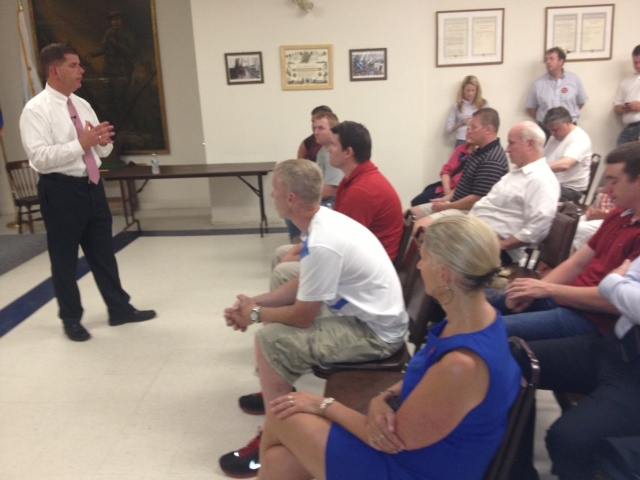
Every Monday, Marty Walsh holds a town hall with neighbors in those parts of the City he feels he most needs to win a spot in the final. we attended his Charlestown “Monday” last night and found it packed with neighbors with important questions — pointed questions,well informed — to ask of him. Other than Mondays, Walsh can be found shaking hands across the city, sending teams of volunteers to knock on doors, winning endorsements.

Image

^ John Connolly speaking to the West Roxbury improvement Association. Who says Boston voters aren’t focusing on this race ?

John Connolly is dashing across the city from event to event. Yesterday saw him in West Roxbury — addressing a crowd of 200 at the west Roxbury Improvement association forum — Roslindale, Brighton,. and “Eastie,” where State rep. Carlo Basile has endorsed him.

Image

^ Rob Consalvo has probably visited more and diverse community groups than any rival candidate.

Rob Consalvo sends out teams of door-knockers, attends forums, and does meet-and-greets everywhere along the long “spine” of Boston from Readville and Mattapan to the South End, North end, and East Boston .

Dan Conley’s campaign looks a lot like Consalvo’s, except that he has concentrated not on the ‘spine’ but on the extensions : South Boston, West Roxbury, Roslindale, Brighton.

Image

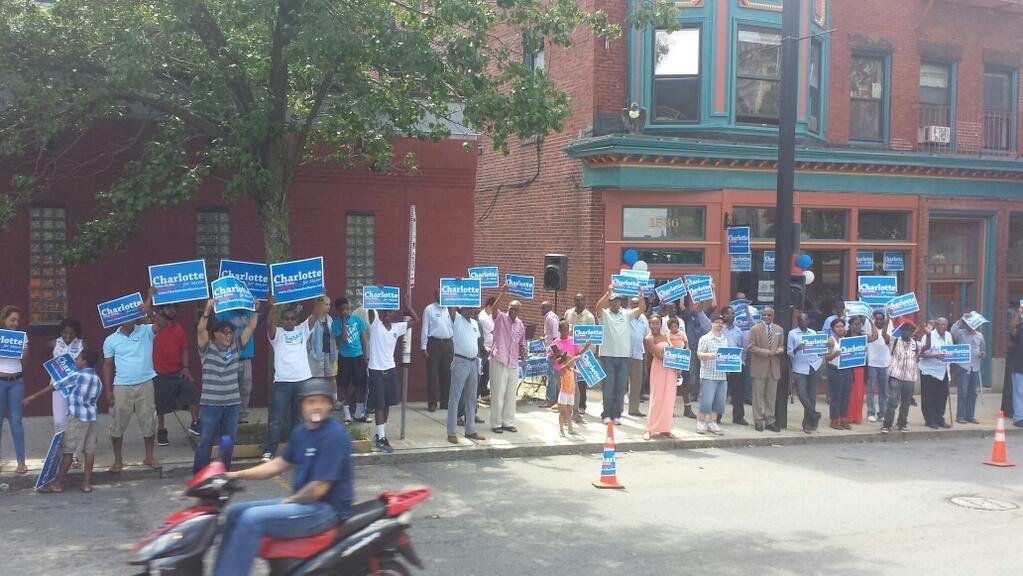
^ Charlotte Golar-Richie : ramping up big-time, finally. (HQ in Mission Hill)

Charlotte Golar-Richie, whose Dad, a retired New York judge, just died, has opened up five neighborhood headquarters, from Mission hill to Roxbury to Upham’s Corner, and though very slow to ramp up, is now fully engaged in the fight.

Image

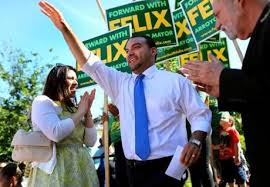
^ Felix G. Arroyo :  lots of shoe leather and enthusiasm — and union endorsements

Felix G. Arroyo has sent out more door-knocking teams than any of his rivals, and he often joins them. He has some strong labor endorsements and is earnestly pursuing others.

Three other campaigns, those of Mike Ross, Bill Walczak, and John Barros, have made a mark — Barros for his knowledge of the issues, Walczak for his opposition to casinos, Ross for his visibility in social media — but it seems very unlikely that they can catch up to the six top sprinters.

As for those six top sprinters, they are not all running equally. Arroyo and Golar-Richie still suffer from looking to constituencies internally divided, with many of their leaders undecided which way to go, unhappy about what looks likely to be the Final. Arroyo and Golar-Richie also have yet to convince many of the voters whom they will need that they have what it takes to address the issues forcefully and consistently. This was demonstrated at a Black Agenda discussion meeting last night, at the Dudley Branch library, where the participants spoke disparagingly of some, angrily about Dan Conley, unsure of the candidate they most would like to back, impressed chiefly with John Barros, whom they concede isn’t likely to win, and, interestingly, with Marty Walsh, whose labor support they appreciate.

While some vital components of an Arroyo or Golar-Richie candidacy struggle toward a decision, and as Dan Conley attempts to recover from a blow-up — and bad publicity — at a recent candidate forum, there is no hesitancy at all in the camps of the race’s obvious two leaders, John Connolly and Marty Walsh, or on the part of Rob Consalvo. They are running and running fast, hard, focused, backed by strong money and an army of supporters. Even though 70 %, probably, of all Boston voters are not part of these three men’s core vote, their 30 % of the total available vote are active and, thus, making inroads for their chosen candidate into the 70 %; so that by Primary Day — September 24 — if nothing changes big-time, a significant part of the potential Arroyo and Golar-Richie vote will go, not to them, but to the three “traditional Boston” leaders.

After all, no one, whatever kind of voter he or she is, wants to vote for someone who can’t win or who doesn’t look ready. We would have thought, when this race began, that “new Boston ,” with its 70 % of the likely vote, would carry the day and elect a Mayor. Some leaders of the “new Boston” are frustrated that that doesn’t look ready to happen; and they are expressing their frustration.

It looks as though their frustration will indeed be the case. We say it again : the Final looks to be a John Connolly versus Marty Walsh race — with Rob Consalvo the only alternative probability. Every day, this result looks more and more likely.

—- Michael Freedberg

RETHINKING INCARCERATION : THE DEPARTMENT OF JUSTICE ACTS

Image

The United States Attorney General, Eric Holder, announced this weekend that he is taking action to change the incarceration results of Federal prosecutions.

Specifically, he has memo’d all United Stated Attorneys to no longer specify the amount of drugs seized in criminal indictments, thereby avoiding mandatory sentencing laws that have led to a huge expansion, these past 30 years or so, in numbers of people incarcerated.

Holder’s action is a positive step indeed. Incarceration has for far too long ruled the justice system in our nation. As many have noted, America totals five percent of the world’s people but a full 25 percent of the world’s prisoners. This would be an intolerable condition, morally and otherwise, in any modern nation. How can it possibly be true of the country that we who live in it call “the land of the free” ?

Again, as many have noted, almost half of those incarcerated have committed non-violent, usually drug crimes. Others are elderly or have served the major portion of their sentences — terms handed to them by overly harsh, mandatory sentencing laws enacted thirty years ago and more. Trial judges used to have discretion in sentencing, as well they should, given that they see the entire trial process as it plays out before their eyes. Every case is different; discretion to the judge allowed him or her to include these differences into the record as it applied to sentencing. Mandatory sentence laws did both defendants and judges a great disservice, not to mention the harsh edge that it imposed on the entire system.

The 1980s were a time of obsession about crime brought about the advent, on the street, of “crack,” a smoked form of cocaine that drove its users to crazy acts. The same decade saw the rise of an hysteria that child-abuse was going on at day care centers. Many day care center people were prosecuted and hounded– lives ruined — as in the 1692 Salem witch trials (an d those of us who call Salem our native city know the horrors of that hysteria only too well.) As it turned out, every single one of these day care hysteria cases was overturned and the lives of those impacted restored to them as best could be. Incarcerations for non-violent offenses, however, have taken far longer to reform.

Holder supports his move by making it a cost issue. This is not mere eyewash. Incarceration costs states and the Federal government almost $ 100 billion a year. As almost two million of us are incarcerated, the dollar amount equals about $ 50,000 per prisoner — most of it being paid as wages to prison guards, wardens, medical people, and the maintenance of prison buildings and systems. Because there is huge money involved, the movement to reduce incarceration actually began, not with Holder’s recent move, but with conservative “red” states such as Texas. Obsessed by huge costs that must be paid for by taxes, these states have been first to remove non-violent offenders from the incarceration system wherever feasible. Little wonder, then, that the numbers of Americans incarcerated has fallen in each of the past three years — and the rate of decrease is accelerating.

Here and Sphere has no objection to using money issues as a reason to reduce incarceration. Nonetheless, we cannot avoid the moral and common sense concerns. In what way does incarceration of non-violent, mostly drug, offenders, supersede rehabilitation, community service, and detox centers ? Nor is it morally right that mandatory incarceration has fallen overwhelmingly on men of color. Almost one-third of all American men of color have been incarcerated at least once during their lives ! Indeed, more American men of color have experienced incarceration than were held in slavery at the timer of the Civil War. Men of color comprise five percent of the population but 40 percent of those in prison on death row.

Holder’s action will not alter the death row statistic; but his move will certainly and justifiably ease the disproportion that has put so many men of color on a path to long incarceration. For this, we applaud Holder’s action more loudly than because of its money saving.

Image

^ Judge Shira Schendlin of Federal Court for the New York District

Note : today, as we write this editorial, the news has come of a New York Federal Judge’s finding that New York City’s notorious “stop and frisk” police practice is unconstitutional. Specifically, District Judge Shira Scheindlin found that “stop and frisk” policy has profiled people of color, violating their civil rights protected by both the 4th and 14th Amendments to the Constitution. As Scheindlin said, “many police practices may be useful for fighting crime — preventive detention or coerced confessions, for example — but because they are unconstitutional, they cannot be used no matter how effective.”

One could add to the list of unconstitutional police practices the taser-ing of citizens, not to mention the shooting of unarmed suspects. Nonetheless, Scheindlin’s decision is most welcome and a timely companion to Attorney General Holder’s move. Perhaps the word ” justice ” will now begin to mean something just as well as something punitive.

—- Michael Freedberg / Here and Sphere

MEEK AT THE MOVIES : A SHARLTO COPLEY TWO=-FER — ELYSIUM ( 2.5 stars) and EUROPA REPORT ( 2 stars )

Image

^ Sharlto Copley in Elysium, with Jodie Foster and Matt Damon

For blockbuster fans out there, still hungry for a real summer hit to carry you into the fall, I’m sorry to inform you that “Elysium,” Neil Blomkamp’s follow up to “District 9,” isn’t the answer– perhaps about as worthy an answer as was “Pacific Rim.”. What the South African wunderkind, who wowed audiences with his stark, inventive first film (it garnered several Oscar nods, including a Best Picture bid) now has conjured is something that’s less a new, grim re-envisioning of the not so distant future (it’s 2154) than a retooling of the film that made him an A-list name. Unfortunately, the new movie is addled, by everything bloated and boxed up that Hollywood brings to such a project when it gets its hooks deep into an upcoming auteur.

The plot moves like a whiplash. LA is now a wasteland reminiscent of the South African ghettos that the wayward aliens in “District 9” inhabited, while the rich reside on the lush, luxury ring-world (thank you Larry Niven!) of the title that’s just a twenty minute shuttle ride up into the sky. Up there, universal health care is a reality, they have medi-pods that can heal anything — cancer, the clap — and can even rebuild your face should it get shot off : that’s if your brain still works. To get a medi-pod to heal, you must be a barcoded citizen of Elysium, so if you live on Earth, you’re living in the new Third World, and there’s no grand social program to cover your ass.

Forget any type of political deeper meaning as in “Logan’s Run,” or even “Oblivion.” The perfect outer ups and the ugly underneath are just plot garnish, a notch above McGuffin status. Max (Matt Damon), the intrepid hero du jour, is an ex-con with a heart of gold (yes that cliché) who accidentally gets irradiated on the job and, without much remorse from his employer, is given a vial full of pills and five days to live. Most people would roll over or go out with a bang, but not Max. To get up to one of those cure-all tanning beds, all he’s got to do is get a Robocop exo-skeleton welded to his frail body, shoot down a shuttle with an RPG, download the contents of a billionaire’s brain and save the poor. Not so easy, but also not so tough, as the few people we do see up at Elysium are candy-assed effetes, with the exception of Jodie Foster’s icy ministry of defense, a gal who’s, pretty much, an unfortunate blend of Donald Rumsfeld and Tilda Swinton.

The real trouble comes in the form of Kruger (Sharlto Copley, the star of “District 9”) a covert assassin, who, while at the beck and call of the Elysian powers, would just as happily slit their throats. He’s the wild one in an otherwise predictable house of cards. The film looks great, and I hope that the next time Hollywood out Blomkamp, they take the gloves off and let him get to it.

Image
^ Sharlto Copley in “Europa Report”

It’s tired and clichéd, but “in space no one can hear you scream,” is a cinematic truism–and even if someone could hear you, what could they do? “Alien” defined the maxim and many over the years, for example the macabre, but mediocre “Event Horizon” (1997), have tried to follow Ridey Scott’s trail with little success. “Europa Report” goes into that charted territory, employing a battery of “Blair Witch Project” cams, except they’re not hand held by an imperiled victim-in-waiting, but by various affixed video surveillance equipment in a space craft on a deep space mission to explore a distant moon orbiting Jupiter.

The crew’s a generic, international smorgasbord. They’d all barely be discernable if it weren’t for their various nationalities and race (among them Sharlto Copley, who gets his second space mission this week). Director Sebastián Cordero nicely uses quartered screen imagery to jazz up the action, and on Earth there’s Embeth Davidtz barking out orders and giving background from the confines of mission control. The journey out feels like Kubrick’s “2001: A Space Odyssey,” and when they get to Europa it turns “Blair Witch”—yeah there’s something out there on that frozen hunk of ice. “Europa” begins promisingly, but sails off an arty, jacked-up version of the “Lost Tapes” faux-documentary TV series that explores modern myth (blood suckers, sea monsters and poltergeists, oh my).

—- Tom Meek / Meek at the Movies

BOSTON MAYOR RACE : WHAT THE MONEY & VISIBILITY STORY TELLS US

Image

^ John R Connolly and Marty J. Walsh ; the top two by any measure

—- —- —-

A look at the OCPF (Office of Campaign finance) reports ending July 31, 2013 tells us that what we can assess on our own already is true: there are four tiers of candidacy among the twelve whose names will appear on the September 24, 2013 ballot.

At the bottom are Charles Clemons and David Wyatt, who have raised almost no money and spent hardly any.

The next tier, of candidates who have raised low six-figure money, or a bit less, includes names both expected and a surprise. It was always likely that Charles Yancey would fall far short. John Barros too. But who knew that Charlotte Golar-Richie, the only woman in the race, a former State Representative and a widely esteemed administrator, would barely make this tier’s cut ? Or that Felix Arroyo, whom many expected to see in the top tiers, would fall into this one ? Both Golar-Richie and Arroyo have raised less money than Bill Walczak, a community organizer and hospital administrator — highly regarded, and for many decades — but who has never run for any elected office.

The Walczak presence intrigues us. As the only candidate openly opposing locating a casino in Boston, has won to his side all those who  reject a development which would add many jobs and lots of tax revenue for the city. Whatever we may think of such opposition — and we decry it — it is the opinion of a vocal minority,and Walczak has it. His tactic is a common one for an underdog candidate to adopt. At this stage of the mayoral campaign, it makes sense for a candidate who at first glance looks overmatched to gain traction by bringing into camp at least one identifiable and committed constituency. This, Walczak has done.

Image

^ Bill Walczak the anti-casino candidate : raised 4 234,919.95. More than either Arroyo or Golar-Richie.

The downside of Walczak’s move is that almost everybody in the City wants to see a casino complex built here. Still, his move blocks rival candidates from poaching a following that probably totals six to eight percent of the Primary vote.

Next we have the tier of strong runner-ups. Here are three names, all important in the race ; Mike Ross, a District City Councillor, who has raised $ 625,579.88, much of it from real estate interests; District City Councillor Rob Consalvo, who reports $ 445,783.29; and District Attorney Dan Conley, who has amassed $ 698,307.64, reportedly mainly from lawyers.

The top tier belongs to just two names. Neither is a surprise. At-large City Councillor John R. Connolly has raised $ 834,242.96; State Representative Marty Walsh, $ 857,526.96. If money were the only fact in this race, the Final would contest these two, likely as close a vote as their money figures.

But money isn’t everything in politics. Visibility matters just as much. By “visibility” we mean not just what you can see but what you hear and feel: the grip of a hand on your wrist, as we like to say it. Visibility on the street used to be all; today, one has to add visibility on the internet. This changes the Boston Mayor outlook significantly. The “traditional” Boston voter has given Walsh, Connolly, Conley, and Consalvo their strong money and, so far, polling advantages. The other candidates with any chance of winning, however, must work on a different route. As they must look to young voters and to technology-driven Downtowners — who are almost impossible to reach with a door-to-door campaign — social media is their means. This is how life is lived today and not just in Boston. But can social media elect a Boston Mayor ?

On the street, the visibility victory goes to Consalvo, Walsh, Connolly, and Conley, in that order; and then to Arroyo. On social media, Arroyo does much better; and Ross, especially, has made himself a social site force. Presence on social media allow Arroyo and Ross to rank, at “omgreports.com,” fourth and fifth — higher than Rob Consalvo. Indeed, the site’s online voting function ranks Arroyo first. Still, even online, Walsh and Connolly place no lower than second and third; indeed “omgreports.com” ranks Walsh and Connolly the top two in overall presence, with Dan Conley third. And why not ? The “traditional” candidates have boldly put their issues agendas to voters both “traditional” and on-line — bolder by far than any of the “new Boston’ candidates has done. Connolly put his forth just yesterday, in seven languages, no less, on-line and on the street. The “traditional” candidates are not living in 1983. They all have significant, even commanding, presences in social media, on Facebook and Twitter. And so do their voters. It’s a new generation even in West Roxbury, Dorchester, and Southie.

Image

^ John Connolly : bold platform, presented in seven languages (including Viet-Namese, Albanian, and Caoe Verde Kriolu)

Money and visibility thus agree. The Final two will likely be John R. Connolly and Marty Walsh. It’s not impossible for Conley, Consalvo, or even Arroyo to edge ahead of either man, but it would definitely be news. Significant upward movement had better start to show really soon for the three candidates now trailing, but with a chance. Will there be such ? We await the August finance reports — and some well-researched polling results.

Image

^ Felix G. Arroyo : big street presence in many parts of the city. Is it enough ?

—- Michael Freedberg / Here and Sphere