MAGOV14 : FIVE VISIONS FIVE AT SEIU CANDIDATES FORUM


photo (45)

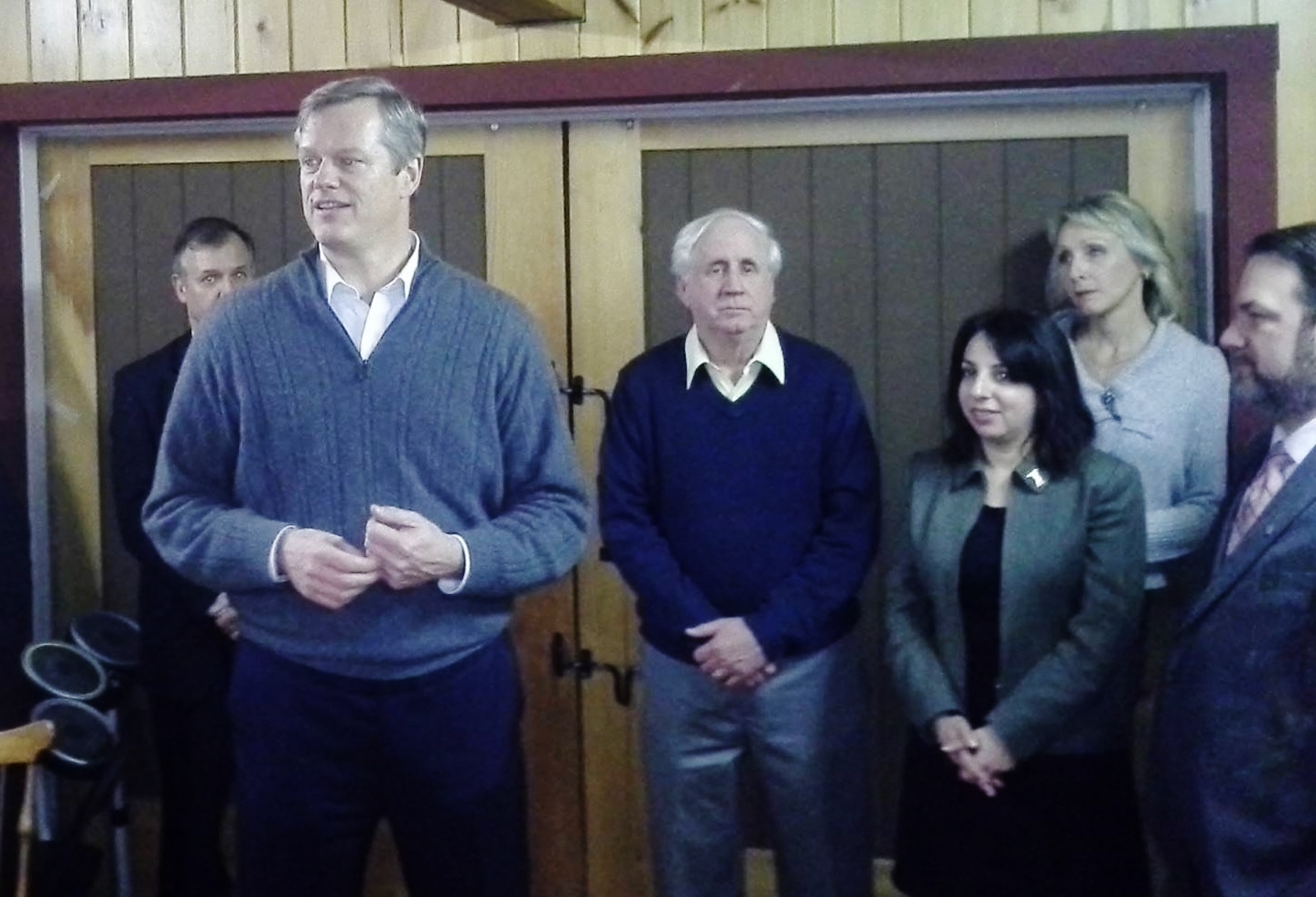
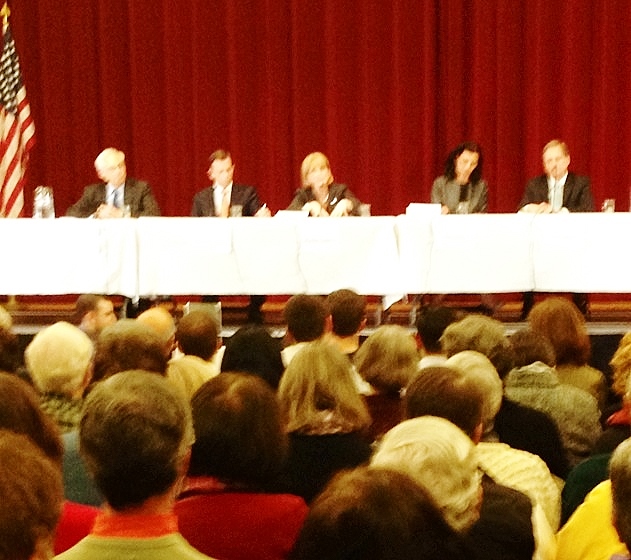
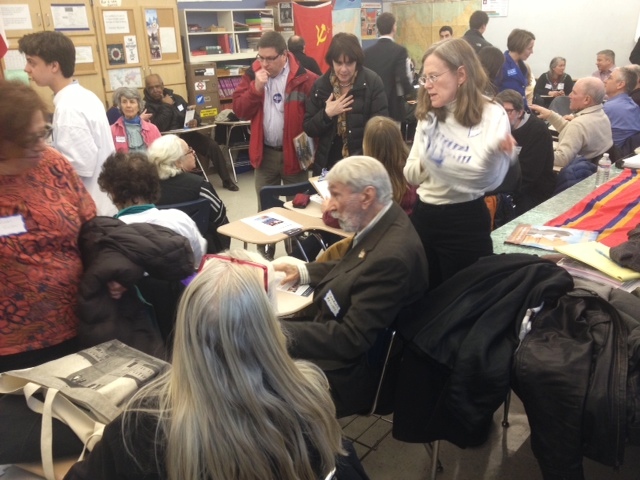
^ the Forum Five (photo courtesy of Chris Condon of SEIU local 509)

Since I last saw the Democratic Five at a candidates’ Forum — about six weeks ago — all have sharpened their profiles considerably. On stage at the SEIU (Service Employees International Union) candidates Forum today, there was lots of specifics, even some debate, and only a touch or two of the vague.

Specific, the five needed to be today. The SEIU’s members do the campaign grunt work and they have an agenda that they insist upon — and which they’ve proven, time and time again, they have the muscle to see enacted. Every one of the five badly wanted the SEIU endorsement. They want its game-on. They need it, and they made their need plain to the gathered attendees — at least 500 strong, a massive showing on a Saturday morning.

In return, SEIU members know which candidates have a chance to win the race and which ones probably don’t. So how did the five do ?
Image

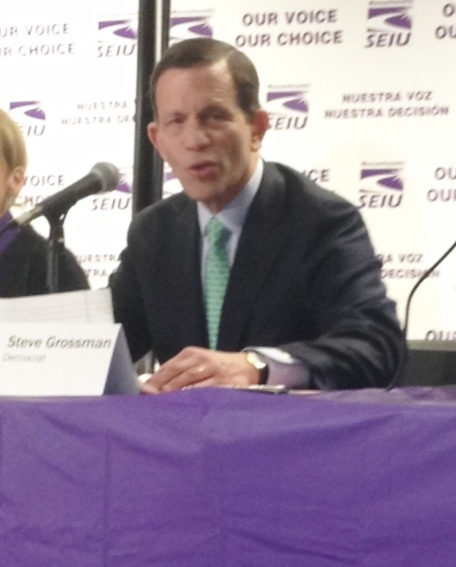
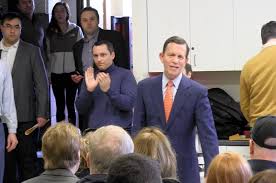
First, Steve Grossman.

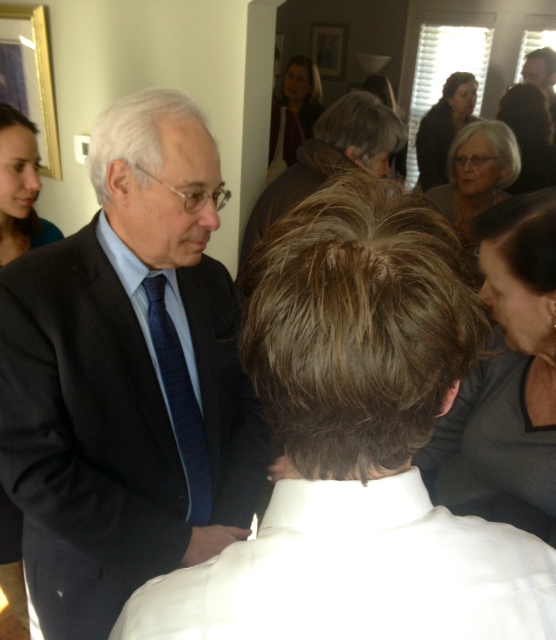
Grossman reminded the gathering — maybe too many times — that they had endorsed him before, and he had always kept his promises and “stood with” them on strike lines and issues fights. He gave voice to more specific agenda items than any of his rivals — policy points are his great strength. But he missed the point of one question — about restoring rights to ex convicts : the right the questioner wanted to hear about was voting right restoration — and, addressing the minimum wage, he said that “I will veto any minimum wage bill that includes an unemployment insurance give-back !” As this give-back is Speaker Robert DeLeo’s price for supporting the minimum wage hike, Grossman opened up the door to a running fight with the Speaker — who, like his predecessor during the entirety of Deval Patrick’s two Governor terms has proven that the Speaker always wins such fights. And that any Governor who fights him comes away weakened. Grossman either is just blowing smoke here, or he has ceded the entire minimum wage issue to Charlie Baker, the almost certain GOP nominee, who has said — no ifs ands or buts — that he accepts Speaker DeLeo’s give-back and can thus get the $ 11.00 per hour minimum wage hike enacted. (Baker has also made the issue of expanding the earned income tax credit his own, and it was interesting to see that at least two of the candidates, Coakley and Avellone, mentioned expanding earned income credits. Two months ago, no Democrat at Forums mentioned it at all.)
Image

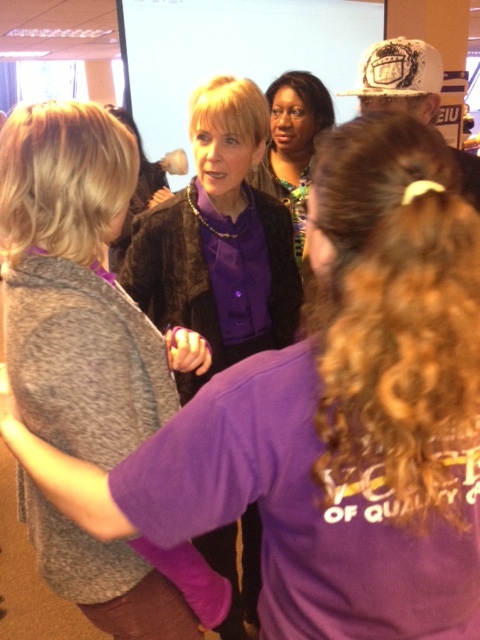
Second, Martha Coakley.

Coakley campaigns with a light touch and an eyes-up grin that often feels snarky. She took a middle route at the Forum : not endorsing driver’s licenses for undocumented people, refusing to grant bargaining rights point-blank to public defender lawyers, sliding away from Don Berwick’s single payer health insurance call. Coakley played careful lawyer : she made clear that she agrees with SEIU’s wage hike and immigrant rights agenda, but maybe not on as all-in a basis as SEIU would like to see. Coakley spoke personally about mental health issues, and with real life stories about income equality; and before the Forum began she posed for many pictures with SEIU’ers who smiled like crazy to be photographed with her. She even said “we have to improve the economy for everybody.”
Image

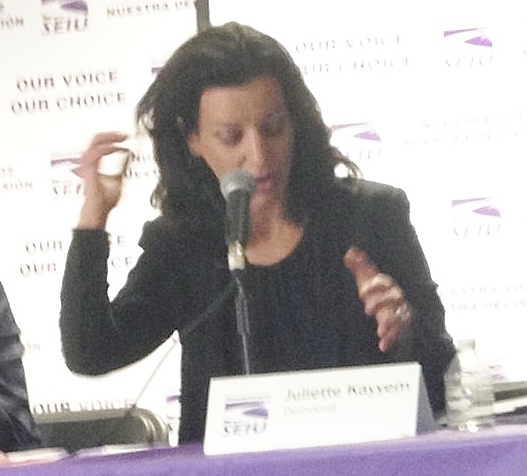
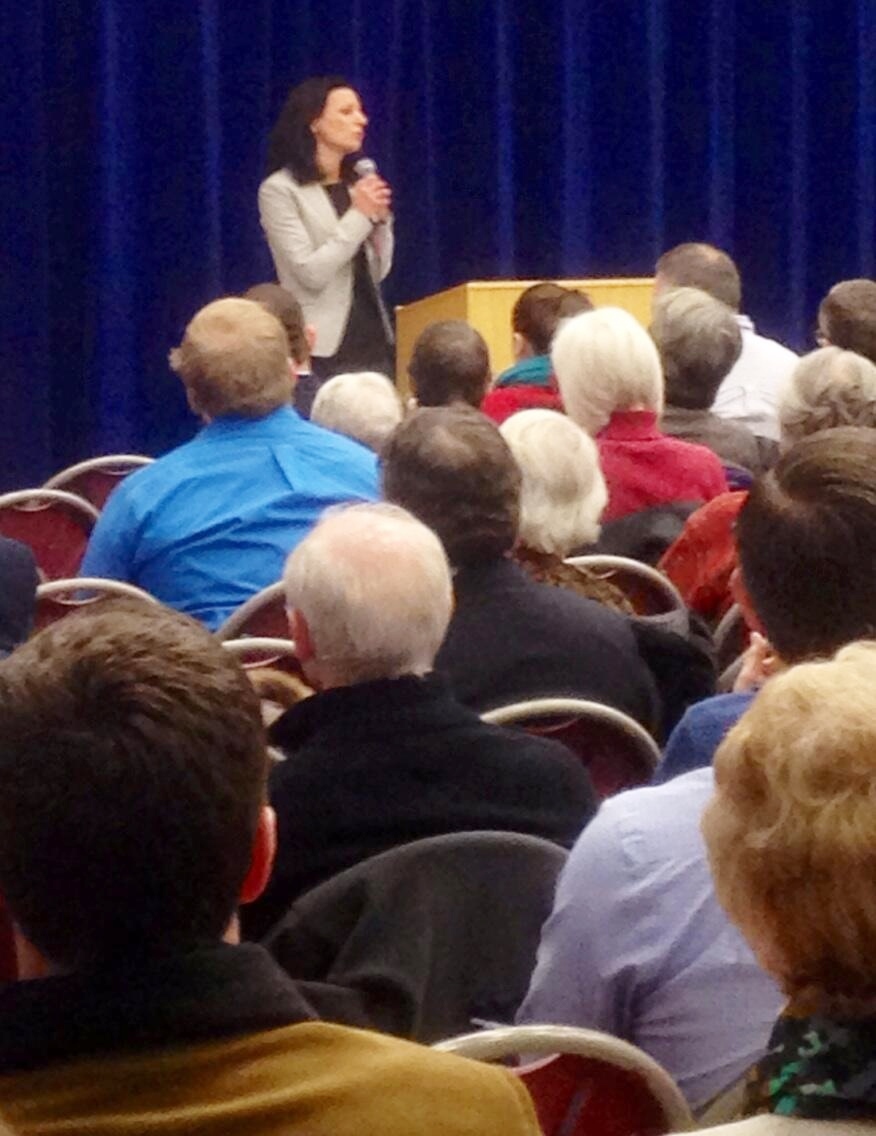
Third, Juliette Kayyem.

Kayyem continues to converse at times, in a Forum setting where conversation wanders off message. But she has become much, much more forensic in her approach; at SEIU she made big, clear points addressing criminal justice reform; she rejected Don Berwick’s single payer call, saying “even if it can be done, it can’t happen until 2018. we need a Governor for right now.” Obviously, Kayyem has realized that sweetness and glamour — which she owns in this race — must bring toughness and advocacy aboard. Yet the generalities continue. She said “Massachusetts has done well but we can do better.” Better how ? She posed an actual plan: “three points…Save, share, and grow. save money in criminal justice spending. share it by setting up a ‘green bank.’ Grow by investing in education and comprehensive immigration reform.”

Kayyem stressed her immigrant roots; that she’s a mother and wife; and — taking full advantage of being two decades younger than her rivals — that she is “the young generation ready to govern.”

Image

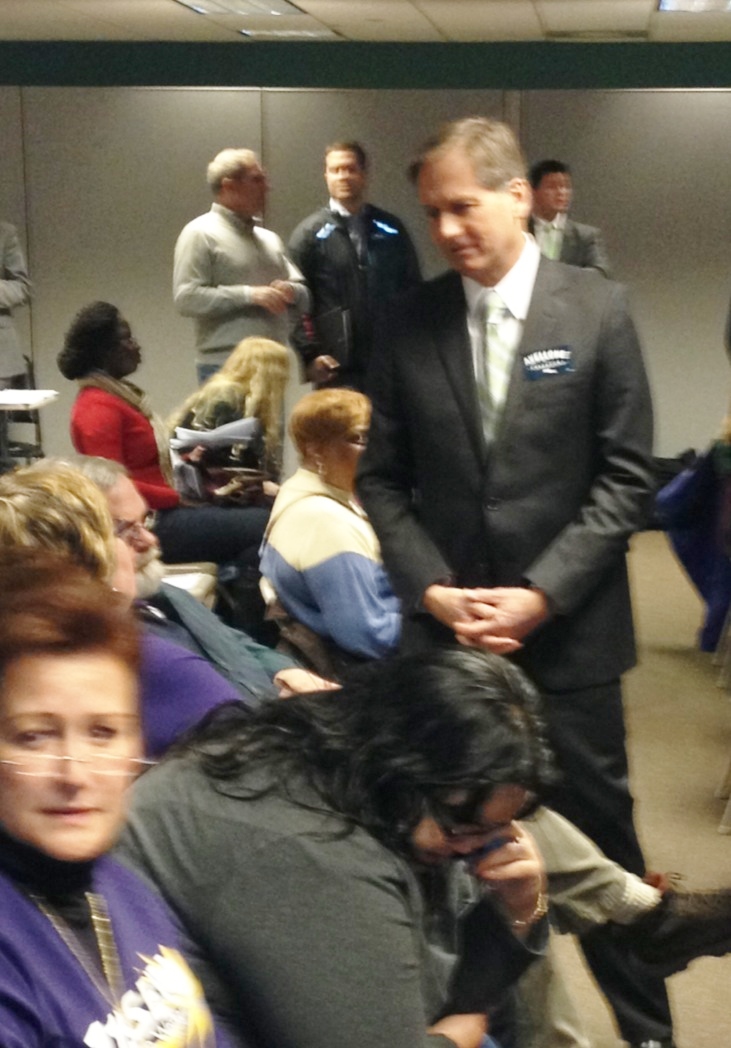
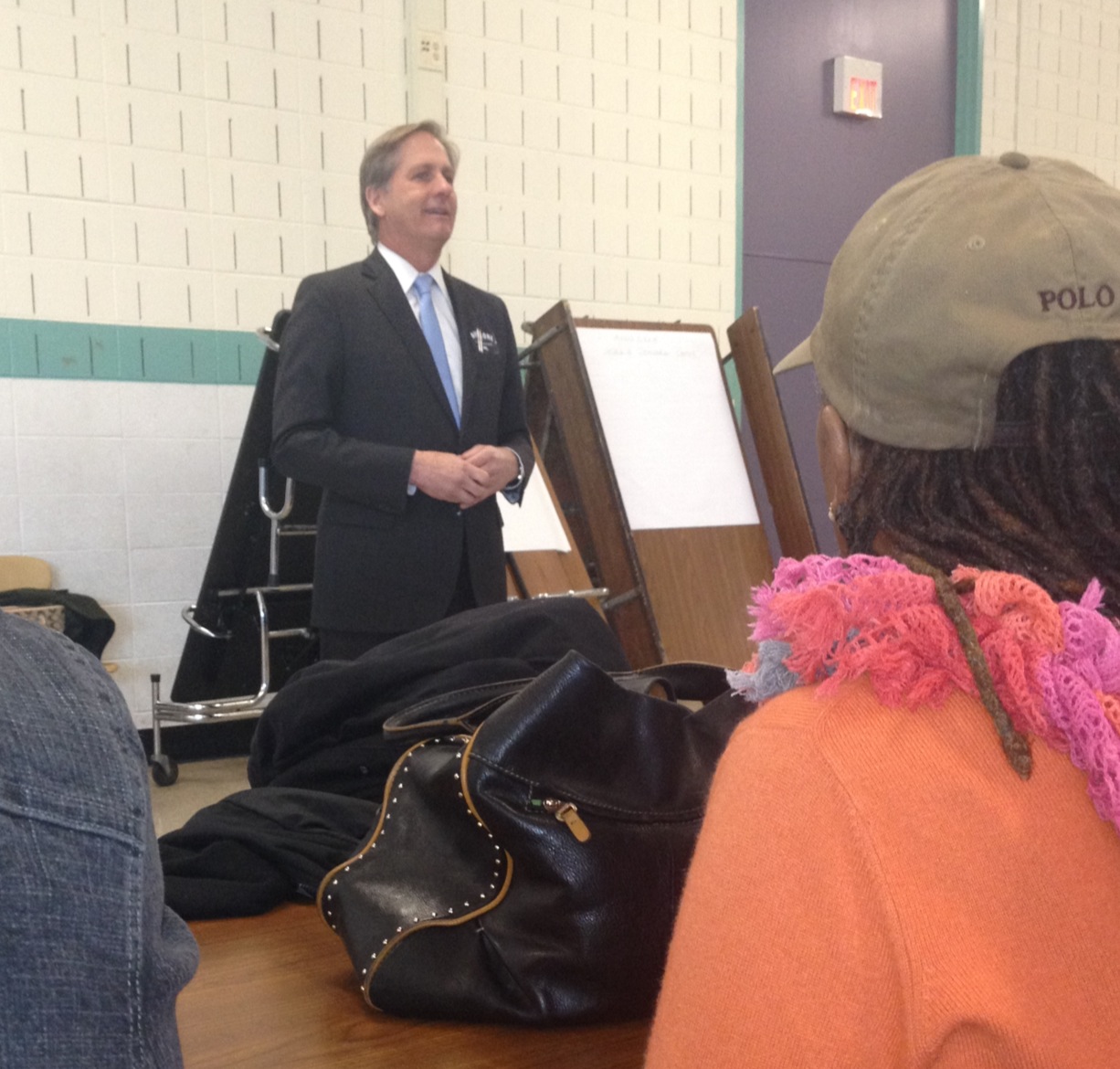
Fourth, Don Berwick.

Berwick has no peer when discussion turns to health care. If he were running for Massachusetts Commissioner of Health and Welfare, he’d win by acclamation. He decries our state’s health care failings — its waste, high cost, inequities — as rigorously as Baker is likely to do. Berwick also speaks to income inequity and the “low wage crisis,” as SEIU’s Forum hosts put it, as passionately as anyone, maybe more. But Berwick overshoots the progressive mark. His solution to the health care system’s failings is single payer — a worthy idea, but it isn’t going to happen soon, and as Kayyem said back at him, “we are electing a Governor for now.” Berwick also seeks a graduated income tax (though he didn’t call it that), an idea that Massachusetts voters quite a while ago rejected in two separate referendums and which would hardly entice to our State the businesses which every Forum candidate, Berwick included, say that Massachusetts needs.
Image

Lastly, Joe Avellone.

Avellone speaks authoritatively about the state’s drug abuse crisis, about recovery and re-entry, and about CORI reform. nd like all the Forum candidates, he supports raising the minimum wage and protection of low-wage workers’ bargaining tights, including extending them to hospital workers who don’t know have that right. Still, Avellone barely seems a possible Governor rather than what he has been, a town selectman. At no place in the Forum did he address the big picture, the massive responsibility sphere that we entrust to the state’s Governor. The Big Dogs of the Legislature would eat Avellone for lunch. So might the State House lobbyists. Avellone made some friends at the Forum; I doubt he won many members’ endorsement.

It was too bad that Charlie Baker wasn’t at the Forum. He had a delegate rally of his own to attend, in Saugus; and the GOP convention takes place next weekend. Still, an opportunity was missed. Baker could have addressed the health care issue authoritatively; the minimum wage and earned income credit; criminal justice reform; homelessness; schools reform; and jobs and innovation — even bargaining rights. It would have been an opportunity to expand his personal reach where a reformist candidate needs be : directly into the most important front of the labor movement, the fight against low-wage situations and all the burdens that low wage work puts on workers and taxpayers alike.

—- Mike Freedberg / Here and Sphere

MAGOV-14 : JULIETTE KAYYEM CLAIMS 2ND PLACE

Image

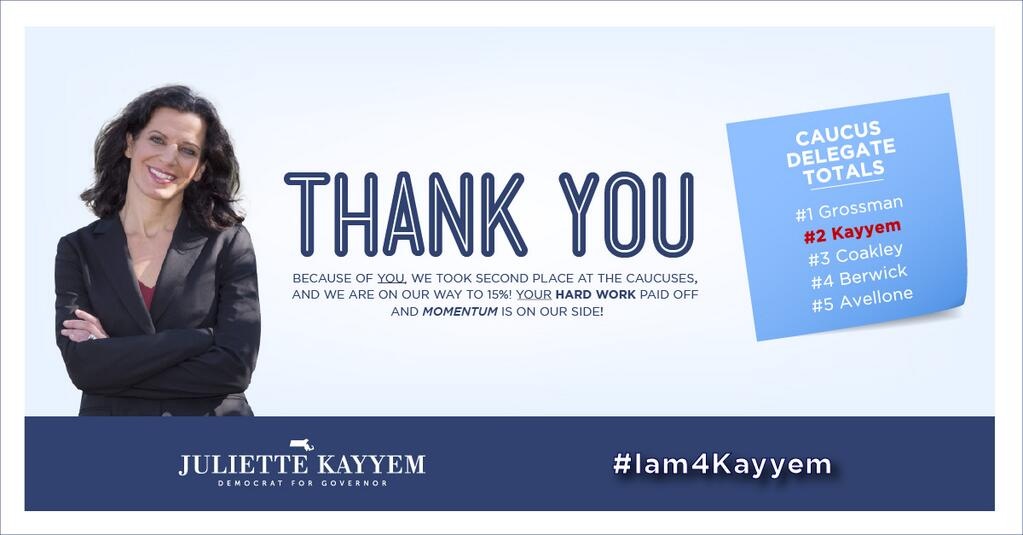
The photo above is not a meme. It’s real. Governor hopeful Juliette Kayyem claims to have won the second largest number of committed delegates as selected by the party’s caucuses, which have now finished.

This would be huge news if it’s a true count. The truth of it is diminished somewhat, however, by the number of uncommitted delegates chosen. In Kayyem’s photo, “uncommitted” is not listed. Many uncommitteds were chosen in the immediate Boston area, and many of these are said to be actually Martha Coakley votes. Maybe what’s being said isn’t so, but the number of uncommitted delegates is not small. A spokesman for the Kayyem campiagn says the uncommitteds total about 50% of all delegates elected.

But to say it again : Kayyem having more committed delegates than Martha Coakley is big news. Coakley leads all public polls of the Democratic nomination; she’s a sitting Attorney General with an heroic record using that office to fight predatory mortgage lenders, whereas Kayyem holds no office at all.

Coakley’s troubles with the activists in her party are well attested. Some of it began with her dispiriting campaign and loss of a US Senate seat to Scott Brown. Coakley continues to be “unexciting” (as one Newton caucus goer called her), on stage in Forums, an under-exposed photograph, and almost as wan in the fund-raising game. And there are many who have not forgotten Coakley’s handling of the Amirault family, Fells Acres day care scandal, or her over-charging prosecution of former State Treasurer Tim Cahill.

Hardly any activist wants to see Coakley as Governor.

Will activists’ dislike of Coakley translate to her losing the Democratic Primary ? That question will be answered if Kayyem wins the 15 percent of delegates needed for the ballot. Everybody agrees that Steve Grossamn has by far the largest number of committed dekegates and that, barring an ambhush, he will win the Democratic convention’s nomination. In the Primary, however, he now polls far, far behind Coakley. Winning the convention’s Ok will bump his poll numbers a lot. Having Kayyem on the ballot will, Grossman must think, cut Coakley’s primary vote still more.

Will Coakley fail to get to 15 oercent of the convention vote ? The answer has to be : she’ll make the cut easily. Those uncommitted votes may not all be hers, but many of them are. Not being Grossman votres, whose can they be but Coakley’s ?

By no means has Kayyem yet made the 15 pecent cut. second place in committed delegates she may have — more even than coakley; but the convention includes many delegates not elected at the caucuses. Might many of these by-pass both Attorney General Coakley and Treasurer Grossman, to plunk for Kayyem (or Berwick) ? It isn’t enough for Kayyem to win 15 peecent or more of the caucused delagres; she has to win 900 votes — 15 percent of the entire body of 6,000 delegates. When I called for a number, Kayyem’s campaign wouldn’t put a figure on her second pla ce claim. It probably doesn’t total 900.

Her task is still a hard one.

—- Mike Freedberg / Here and Sphere
DEMOCRATIC CAUCUSES — AND GOP TOO : IDEALISTS AND REALISTS

Image

^ Newton ward 2 caucus : idealists For Don Berwick, realists for Steve Grossman

—- —- —-

It’s hard to dig any message out of the five-candidate-for-Governor, Democratic caucuses that were held during the past month. Only after a full month of sitting in at about eight of those caucuses has a meaning become even hypothetically true, and it’s a cliched one : the Massachusetts Democratic party is split between idealists and realists. Or if you prefer, radicals and centrists.

This sort of division has ruled Massachusetts Democratic actives at least since John Silber, then Scott Harshbarger, then Shannon O’Brien, became the party’s nominees for Governor. Deval Patrick’s winning the 2006 Democratic nomination confirmed it. Yet in each of those cases, going back to 1990, the Democratic winner differed — in some cases sharply — about policy initiatives already contentious within the legislative calendar. This time the gulf between Democratic realists and idealists has widened. It was much in evidence at the City of Newton caucuses yesterday, where delegate candidates pledged to the quintessentially realistic Steve Grossman barely edged out delegate hopefuls pledged to this year’s idealist of idealists, Don Berwick.

Image

^ realistically idealistic : Steve Grossman at the Boston ward 3 caucus

Both men live in Newton, and between them they claimed the entire prize of almost 100 delegates. There wasn’t much sentiment for Juliette Kayyem at the Ward caucus that I sat in on (Ward 2) and none at all for Martha Coakley or Joe Avellone. Home town strength mattered, but it wasn’t the major fact. Of this campaign, Steve Grossman epitomizes realism, Berwick the radical. Kayyem has been a candidate of glamor and nuance : but nuance doesn’t seem to cut it. She’s made scant mark on any of the caucuses I have attended, yesterday’s included. at every caucus she has her team, wearing “I am for Kayyem’ T shirts” (whose grey base contrasts meaningfully with the bold white backing dark blue of Team Berwick); but Kayyem’s team gatherings seem, at leat at the caucuses I’ve sat through, unable to translate enthusiasm into numbers. As for Joe Avellone, he doesn’t even bring a team, much less win a delegate (tough news reports have him winning quite a few out by Worcester County).

Image

^ realistic outsider : Joe Avellone at Boston ward 14 caucus

Avellone is particularly weakened by being a candidate of realism who is also an outsider. This doesn’t work. A candidate cannot be persuasively realistic unless he or she is very much an insider. realistic goals presume the clout to get them done. Outsiders lack that. an outsider must be an idealist; must represent those who want the insider game shaken up. This, Don Berwick — or his helmsman –understands. He advocates all the wish-list that burns tyger-brightly (as William Blake once spelt it) in the night forests of Democratic progressives’ dreams : single payer health care, graduated income tax, green energy funding, sentencing reform, higher taxes to pay for transportation and infrastructure. He insists on them all; and the Democrats of idealist bent have responded. as recently as a month ago I thought that Juliette Kayyem, not Berwick, would be the third Democratic Governor hopeful to win the necessary fifteen percent of delegates or see her campaign end. Today I think it’ll be Berwick.

Image

^ nuance and glamour may not work : Juliette Kayyem addresses Newton Governor Fum

Kayyem might have easily taken the route that Berwick took. She would have trounced him had she done so. Kayyem has charisma galore and is stunningly beautiful : if you meet her and don’;t rmemeber it vividly, physically, you’re a zombie. But Kayyem seems to have played her resume both ways : Obama administration,. Homeland security official, and thus an insider who should be realistic; but also outsider — having never run for anything elective — who gets the progressive agenda. Gets it, but doesn’t necessarily advocate it; certainly not in the all-in, progressive or bust gambol that berwick has winged. Unhappily for Kayyem, it’s unconvincing for a novice candidate to present as competent and idealist. Even for someone already an office holder, it would be difficulty to be both, especially in this season, when voters disbelieve that office holders are competent and distrust that idealists really mean it. Thus the success of Grossman and Berwick : because Grossman has proven himself uniquely competent, and Berwick, as a doctor successful in private practice and government, has the health care issue credibly to himself as well as the bedside manner that we expect of a physician.

And what of Martha Coakley, whom the polls say is still the choice of most Democratic voters ? Among activists, at least, she is falling way short because she has already failed the competency test, as a candidate first of all, and seems to continue to fail it — her money intake lags badly as does her presentation at Forums. There she demonstrates that an idealist, she isn’t. On those issues where she takes uncompromising stands — abortion rights, a prime example — she seems to move by calculation, not conviction.

Coakley may well still win the Democratic Primary, though I doubt it. If Kayyem doesn’t make the fifteen percent, I do not see her supporters going to a candidate even more diffident than Kayyem and — as one caucus goer put it — “hardly exciting.” Some will go to Berwick; but i think most will move to Steve Grossman.

If Grossman becomes the Democratic nominee, he will face a Republican who does seem convincing both as an idealist and a realist. Idealist, because in today’s GOP — even in Massachusetts, where the party at Governor level remains progressive — it’s idealistic to support marriage equality, abortion rights, expanding the earned income credit, and raising the minimum wage to $ 11.00 an hour. realistic, because Baker accepts the unemployment insurance give-back that Speaker Robert DeLeo insists on as a condition of his bringing the minimum wage hike to a vote.

Image

^ leader and voice of the Governor GOP party, one of two MA GOP Parties : Charlie Baker with st rep Jim Lyons of North Andover and (on bottom right) Monica Medeiros, candidate in the Fifth Middlesex Senate District

Image

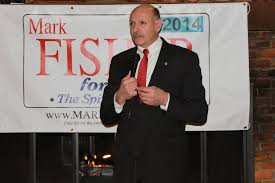
^ representing the “idealism” of the “left outs, the ignored” : Mark Fisher

It’s because Baker convinces both as idealist and realist that he will win his primary against a Tea Party opponent. Mark Fisher almost perfectly represents the idealist wing of today’s Massachusetts GOP. He goes as all-in on the Tea Party;s agenda as Don Berwick does on the Wish list of Progressives. Fisher rejects marriage equality, abortion rights, a minimum wage rise. Fisher dismisses undocumented immigrants as “illegals’ and promises to make life in Massachusetts as difficult for them as he can. Fisher bitterly brandishes “gun rights.” Indeed, Fisher — a classy guy one on one — projects, in his public pronouncements, an angry tone; he rocks his “salt of the earth, long ignored” voters as they rock themselves : angry to be ignored, lashing out at those who get the attention of officials who ignore them, pissed off at Turnpike toll takers, angry about taxes that they see being spent on Boston but not out where they live.

There is, in Fisher’s campaign, an idealism of sorts — he calls it “principles” — as off the table as Berwick’s; but what a toxic idealism it is ! Anger is not a policy, scapegoating people is not legislation, and opposition to marriage equality and women’s reproductive rights is anathema to a large majority of Massachusetts voters. Only within the State’s eleven percent who register GOP does Fisher’s “idealism” have legs. Just as the idealistic Berwick has won himself a significant activist following, so Fisher’s views comport with a significantly GOP activism.

Right-wing actives have captured the GOP State Committee; this we saw in last week’s 52 to 16 vote to adopt the “values voters” platform. But the views these people espouse, their wagons circled in redoubts of reaction like the so-called “Massachusetts Republican Assembly” — which blithely calls itself “the Republican wing of the Republican party” — no more command a majority of GOP voters than the progressivism of Don Berwick commands a majority of Democrats.

It would be unlikely to find a democratic activist as negative as Fisher’s left-outs. The Democratic party is Massachusetts’s governing party; no Democrat is a “left-out.” But our GOP, except on the Governor level, runs nothing.

In fact the gulf in our GOP between Fisher’s “left-outs” and Charlie Baker’s confident moderates derives directly from this split. In fact, the he Massachusetts GOP is nothing less than two entirely separate political parties : one, a Governor GOP party, dedicated to electing its Governor — a party to which a large majority of GOP voters belongs and whose followers do not see themselves as left out or ignored; and two, a “Grass roots” GOP, spearheaded by idealists who are indeed an interest left aside by an overwhelming State consensus on the issues these “grass roots’ actives care about.  care about. Statewide, the Grass roots GOP numbers barely five percent of all voters; but within the eleven percent registered as republicans they’re a significant number — polls say 39% of the GOP whole.

Not surprisingly, the Grass roots GOP dominates in those regions of the state most alienated from Boston, in which GOP registration (and like-minded “unenrolleds”) count a majority of all voters. Almost all the State’s 30 GOP legislators represent Grass Roots GOP communities. How could it be otherwise ? the Grass roots GOP’s stands on the issues make its election impossible in most Massachusetts areas, and in any case, the Governor GOP hasn’t much interest in winning legislative elections on its realist-suburb turf. It’s far readier to accept — and usually can count on — the support of Democratic legislative realists. Can’t do that if you’re running GOP candidates against them !

NOTE : it wasn’t always this way. During the period 1990 to 2006, when Massachusetts had four consecutive GOP Governors, the entire GOP grass roots was deployed on behalf of the Governor. But since 2006 the Governor has been a democrat. With the Governor GOP out of power, the grass roots GOP has been as left out and ignored as it claims to be, and its embrace of the politics of a minority had a certain practicality about it.

Though at what a price !

In the Democratic Party, the division between realists and idealists takes a very different shape, because both mindsets win elections and thus feel anything but ignored or left out. Their differences are those of a contract negotiation, both parties knowing that once a contract is agreed to, each side will have to carry it out; and are quite ready to do so because they’re already doing it.

It is good that Mark Fisher has arisen to give voice to the left-outs. If the rest of us take their anger, their bitterness, their disparagement of everything that “Boston” means to them — huge taxpayer dollars spent; public transit; enormous state government programs; social inclusion — indeed, celebration — of many lifestyles, languages, and immigrants of all conditions; bicycles and night life; rejection of gun culture; the Unions and high wages; devotion to quality of life issues — as seriously as they hate us, perhaps we can find a way to bring these voters back into the community we call “Massachusetts.” And perhaps not. We will probably never see Don Berwick’s single-payer health insurance adopted in Massachusetts, or his graduated income tax. Never might also be the timeline for Mark Fisher’s voters. And maybe that’s OK. After all, what’s an idealism good for if the realists can absorb it ?

—- Mike Freedberg / Here and Sphere

#MAGOV14 : THINGS GET NASTY FOR JULIETTE KAYYEM

Image

^ the charm offensive has its limits : Juliette Kayyem meets caucus push back

—- —- —-

Not even two days had passed after Democratic governor hopeful Steve Grossman accused rival Martha Coakley of being vague in her commitment to civil liberties than, this morning, I found my twitter feed filled with attacks upon a third Democratic contestant : Juliette Kayyem. One tweet said “Charming Kayyem favors ‘assassination as an instrument of intelligence and law enforcement.” Another, from the same twitter source, said “Charming Kayyem leading panel to legalize Torture ‘we were a room full of people who think it works’.” A third tweet from said source — “Bostonnish” — said : “If Kayyem hadn’t led effort to concoct legal cover for Bush -Era torture use, she wouldn’t be a charming accomplice to torture.”

“Bostonnish” sent me two more tweets of a similar nature. These were sent to me, evidently, as a response to my own tweet “if @Juliettekayyem had an agenda aspecific as her personal charm is masterful, she’d charm Spkr DeLeo — & win the election.” I am , of course, flattered to find that my tweets merit attack by an opponent of the candidate I happen to mention. Yet that’s not all there is to this story. Kayyem did work for the Deprtment of Homeland Security and has surely known that in the heat of this Governor battle she’d be challenged thereon. Big time : because the Homeland Security issue isn’t only about Kayyem. Edward Snowden’s revelations have made it clear that the war on terror has curtailed Americans’ privacy rights much, much more than we either knew or need to accept. The issue has also divided the Democratic Party. Had Snowden’s revelations been made of a Republican presidency, every Democrat would be ringing the tocsin. But no: the revelations were made of the Obama administration, and only on the very Left has there arisen any support for Snowden. Most Democrats find him a traitor.

This split matters for Kayyem especially, because the impact of her candidacy has been strongest among Democrats who consider themselves progressives — exactly the Democratic constituency among which the Snowden revelations have aroused the greatest anger. Now comes an attacker who connects Kayyem not to the Snowden revelations per se but to the Bush administration, no less, and to that part of the Bush government in which “enhanced interrogation” was defined, justified, and decked out in legal lipstick. Much of the Snowden revelations involved NSA measures begun in that Bush administration — though Obama expanded them. It would be hard to think of any political connection less appealing to Democratic progressives than to the Bush ’43 war on terror. For Kayyem, far more than for Coakley or Grossman — who so likely have no such connections — the attack made by “Botonnish” poses threat. And as I have 640 twitter followers right now, almost all of them political, “Bostonnish”‘s attacks will be seen by many.

Is there any truth to them, and, if so, how much truth ? I have read the two newspaper articles linked in the Bostonnish tweets. They do connect Kayyem to Homeland Security discussions on interrogation techniques — discussions in which she participated as part of a Harvard Law School professor’s symposium whose participants sought agreement on what interrogation techniques were permissible and to write their conclusions as a policy paper.

To the average voter, what I’ve just written may seem splitting hairs. Kayyem was involved in torture discussions, helped define “acceptable limits.” Nuff said. And to most voters, her participation therein as a policy advisor ruffles no consciences. unfortunately, the voters whose support Kayyem is seeking — and needs — may not take such a casual attitude of the matter. Though many Democratic progressives are the first to condemn Snowden as a traitor, and to accuse Bush’s Vice President, Dick Cheney — whose brief it was to secure policy approvals on interrogation techniques — of war crimes, other progressives dub Snowden a hero. There’s scant escape for Kayyem here. The Democrats who think Snowden a traitor hate Dick Cheney just as much as do the Democrats who think Snowden a hero; and Kayyem helped write policy papers for matters ultimately answerable to Cheney and Bush. The New York times article, from 2005, appended to one of my “Bostonniosh” tweets documents it.

What does Kayyem do about this ? If I were her advisors I’d tell her to discuss the matter thoroughly. She served the Obama administration as well as Bush’s — as did Bob Gates and others. She can say that she put “country first” — and if the man for whom that was a campaign theme — John McCain — is a case study in why our nation should oppose “torture lite” always, Kayyem did not make policy. She advised possible policy makers. And all of this happened many years ago.

photo (1)

^ beauty talks : Juliette Kayyem with Worcester St Reps Mahoney and O’Day

Also on her case is a report, in the Globe, that Kayyem missed voting in two elections during the time she was living in Washington. There’s some disagreement as to whether she registered to vote there or not. She says she did; the DC elections board has no record of it.

Myself, I find this matter small potatoes. so what if she missed two elections or if she did or did not register to vote in Washington while living there ? She is running for Governor, not “super voter.’ yet the small potatoes does highlight the bigger potato of her consultancy participation in the “torture bureaucracy.”

It is not my job to make excuses for Kayyem or to devise responses for her to difficult challenges. She has opted to play big league ball, and cannot complain if an opposing pitcher plunks her with a curve ball. Her response, however, will matter a lot in how Democratic progressives, as sensitive as any activists to heavy handed war measures, take Kayyem’s interrogation policy years to heart. Who knows ? Maybe they’ll shrug it off. Charm does have its way even with issues obsessives, and charm Kayyem has more than plenty of. But the average voter probably won’t shrug so readily — if Kayyem gets her name onto the average voter’s Governior ballot. This flap doesn’t make that task any easier for her.

—- Mike Freedberg / Here and Sphere

#MAGOV : CAUCUSES BEGIN ; BAKER STILL LEADS ALL THE DEMOCRATS. BUT…

Image

^ Still leading the pack, thus reason to smile : Charlie Baker in Leominster

—- —- —-

Massachusetts people are moving to pick a new Governor. The Democratic caucuses begin in a few days. The GOP meetings have already started. As I see it today, February 2nd, Charlie Baker leads the pack. His bold move, last week, to support raising the minimum wage by way of Speaker DeLeo’s legislation, ensures its passage; none of the five Democrats has yet made the same pact. Baker also supports expanding the earned income credit for lower-wage workers. None of the Democrats has even, to my knowledge, mentioned this initiative. Big advantage for Baker.

So is the $ 1,014,906.36 that Baker reported raising last year, with more to come, much more.

In charge finally, Baker stumbled a bit when the question of seeking the death penalty for Dzhokhar Tsarnaev was put to the candidates. All of the Democtrats said that no, the death penalty is not OK for any defendant in Massachusetts; we have abolished it. This is true and principled. Baker’s response ? That he has long advocated the death penalty in very heinous crime situations. His statement seems a step backward for our boldly progressive state. And where do the Feds get their sudden death penalty willingness ? Sirhan Sirhan assassinated Robert Kennedy ; he didn’t get a death peanlty. Is Tsarnaev more heinous ? Or do we simply live in miore barbarous times ? Certainly a great deal of outright barbarism unfolded here in Boston after the Marathon bombing. Who can forget the Antigone situation that arose over the burial of Tamerlan Tsarnaev ? It is not good, not at all, to see Baker play to the Creon mindset.

Advantage then to the five Democrats, as their party’s caucuses begin.

Image

^ heartfelt dedication to social justice : Dr. Don Berwick at a packed house party in West Roxbury yesterday

If yesterday’s Don Berwick houseparty on Chesbrough Road in West Roxbury was any indication of interest, the caucuses should be full-house. 75 locals crowded into every nook of the Chesbrough Road dwelling to hear the gentle, classy Dr. Berwick deliver his social justice speech and answer questions — most of them well informed. And Berwick isn’t even one of the two “majors.” Imagine how many are likely to caucus for Steve Grossman, our State Treasurer, or for Martha Coakley, now the Attorney General. Juliette Kayyem, too, with her personal charisma — 9,749 twitter followers as I write this — is sure to draw many to the hundreds of Democratic town and ward (each ward of a city holds its own) caucuses taking place between next weekend and March 2nd, the last day on which they can occur. So yes, for the five Democrats — Joe Avellone is the one not mentioned above — it’s now crunch time. Any candidate who can’t secure 900 pledged delegates — 15 percent of the total who will vote at the Democratic convention — won’t get his or her name printed on the Democratic Primary ballot.

We won’t know who has done that and who hasn’t until probably mid-March, when the Democratic State Committee tallies the results. But we can assess the five with reasonable objectivity by looking at their fund-raising. (Charlie Baker has yet to report January numbers.) Since January 15th, the day on which I last looked, this is how the five’s fund-raising tallies up :

Martha Coakley 168,951.23
Steve Grossman 153,695.00
Juliette Kayyem 84,679.20
Donald Berwick 50,260.00
Joe Avellone        36,365.64
Total Funds raised by the five —- 493,950.87
Per cent of total :
Coakley —– approx 34 %
Grossman — approx 31 %
Kayyem —– approx 17 %
Berwick —– approx 11 %
Avellone —- approx 7 %

Fund-raising isn’t everything, of course. But in MA, each donor is limited to $ 500 per candidate per year. Thus the list above represents a lot of people. The caucus-goers choices aren’t likely to differ radically from the donors’ picks. In any rate, it’s my working hypothesis as to who — as of today — will make the “15 % cut” and who won’t.

Image

^ charisma and a progressive smile gets Juliette kayyem lots of attention — and probably a spot on the Primary ballot…..

Image

^ or maybe it gets Kayyem second place on a Steve Grossman ticket ? we will see.

For Donald Berwick, who by my analysis falls short, it’s a good thing that the caucus process lasts for a month. He can step up his game in that time — probably needs to. Juliette Kayyem can’t rest calm, either, sitting at 17 % of the total. But then what ? Coakley and Grossman clearly dominate — no surprise there — which means that Kayyem may want to think about taking the Lieutenant Governor position on a Steve Grossman ticket — if offered.

It would be a very strong Democratic pairing. It represents about 50 % of the Democratic convention. The stars are beginning to align.

—- Mike Freedberg / Here and Sphere
#MAGOV : “WISH” LISTS vs. “DO” LISTS

Image

^ Just DO it : Charlie baker with Karyn Polito supporters in Leominster (photo by Baker campaign)

—- —- —-

The contest for Massachusetts Governor has taken on a definite shape during the past three days. The biggest shaping force has been Charlie Baker’s, given as his response to Governor Patrick’s state of the Commonwealth speech. Baker used the occasion to announce his support for raising the state’s minimum wage and for expanding the earned income credit. The news surprised almost everyone. It contradicted recent GOP orthodoxy — you know, the whole “job creators,” no ACA, no minimum wage legislation mantra — and also went beyond what most of the Democratic candidates have suggested. Baker also accepted Speaker of the House Robert DeLeo’s minimum wage raise requirement, that there be some give-back on umployment insurance contributions.

I wrote yesterday about Baker’s announcement and its implications ; these merit repeating. First, Baker established that he will join with Speaker DeLeo on minimum wage legislation. No Democratic candidate has yet done so; when specifically asked what they would do if the Speaker rdejected their legislation, all avoided answering. Second, by embracing doable (and very popular) legislation to relieve income inequity, Baker has vetoed all those GOP-ish advocacy groups (such as Massachusetts Fiscal Alliance) that oppose “using government to make people’s lives better” (as Mayor Walsh has stated his mission). And this may actually be the hugest consequence of Baker’s announcement. Right now I cannot think of a single Republican Governor, Senator, Congress person — or GOP candidate for these offices — who embraces minimum wage hikes and expanding the earned income credit. Whether Baker’s announcement has national GOP implications I can’t yet say; but for Massachusetts its consequence could not be weightier. He has taken the Massachusetts GOP back not just to Weld-Cellucci — whose administrations Baker was part of and mentioned in his talk — but (as my old colleague Peter Kadzis mentioned to me) to the days of John Volpe, Eliot Richardson, Frank Sargent, and Ed Brooke — almost 50 years ago — when the Massachusetts GOP was the reform party, the advance guard of using government to benefit people.

Granted, that Baker is free to take this stand because the Tea Party has never had much ground in Massachusetts — in 2010, Tea candidates didn’t even get the 15 % of votes at the Republican convention needed to get their names on the ballot — and because the huge right-wing greedPACs that have all but kidnapped the national GOP, knowing how un-Tea this state is, don’t involve themselves here. Baker needs no greedPAC money. He has almost out-raised the five Democratic governor candidates combined. T

Baker’s move all but assures that he will have significant Democratic support in the November election. That is how it used to be for the Massachusetts GOP in state elections, Why not again ?

And here is where my headline for today’s column comes into play : “wish list” candidates versus “do list.” Most of Massachusetts’s 166 Democratic legislators and State Senators are realists — do list people, not wish listers. Their voters want stuff done first, talk stuff later. Massachusetts voters are quite common sensed about this. We send our inspirational wish listers to Washington — none more arch-typal than Elizabeth Warren — to voice our noblest wishes, ideals, hopes for a juster social future. To Beacon Hill, we send our grubs and drones to do the grub and drone work. Nor is our thinking wrong. Deval Patrick’s entire two terms has shown just how powerless wish list eloquence is to move the Speaker of the house — no matter who he was or now is — to support legislation. To cite just two examples ; Governor Patrick wanted casino legislation badly. When Sal DiMasi was Speaker and opposed, no casino.. Then came Robert DeLeo, supportive, and lo and behold, casino legislation, no problemo ! Second example : Governor Patrick wanted an enormous, $ 2 billion transportation bill; Speaker DeLeo wanted a much smaller bill. Guess whose “transpo bill” got enacted ?

We like to think of today’s GOP as missing the point of governance, but the Massachusetts Democratic party misses the point too. In its rush to speak nobly of social justice and the higher purposes of civic life, the Democrats of Massachusetts talk just as unrealistically about governing as do the GOP right-wingers. Yes, there is a “progessive caucus” in the Massachusetts Democratic party, and there’s one in the legislature too. What have they recently achieved ? CORI reform, maybe. But every other advance enacted by the legislature belongs entirely to the realists : charter schools, an $ 800 million “transpo bill,” casino legislation — vigorously opposed by “progressives” and right-wingers alike (Ha!)– electronic toll taking, divorce law reform, mandatory sentencing amendments. I often get the impression that the social justice focus of many Massachusetts Democrats arises as a reaction to GOP right-wing talk rather than for its own sake. A genuine progressive movement would be far more broadly based, out among the people — as was the Progressive movement of 110 years ago — broad enough to affect, even command, both political parties, not just one.

The five Democrats running for Governor cannot break free of these conditions, and only one has really tried : Steve Grossman. In forums he talks real talk about realistic goals. Even he has yet to admit that only in sync with the Speaker can he accomplish anything. Even he has yet to tailor his policy suggestions to the Speaker’s — and just yesterday, the Speaker made clear that the coming year’s State budget would include no tax hikes or fee increases. Still, Grossman talks the business-climate, innovation talk that, until two days ago, was Baker’s core message. He also of course supports minimum age legislation though not the Speaker’s conditions). At Forums, Grossman swims in a sea of words : perfume from Don Berwick, chatty niceties from Juliette Kayyem, and quiet sarcasm from Martha Coakley, and often gains a measure of respect thereby : surely the Forum attendees, most of whom will vote in the coming caucuses, understand that Grossman is climbing the mountain, not paragliding onto it. Yet the impulse to high-minded wish lists runs strong in the souls of our Democratic activists; strong enough that Grossman, even if he becomes the Democratic nominee, will be forced to divide his campaign between talking dreams and picking priorities. Baker right now faces no such division. His party’s angry philosophers have been put to bed, freeing him to focus on a do list that the Speaker can agree with and which thus can actually be enacted into state law. That’s a winning message in a Governor election.

Especially with do-nothing gridlock gripping Washington so completely, voters want state government to get good stuff done. Baker has beaten Steve Gossman to the get-good-stuff-done milepost.

—- Mike Freedberg / here and Sphere

#MAGOV : CHARLIE BAKER MAKES A BOLD MOVE

Baker Jan 13th 2014

^ bold to the front of the discussion : Charlie Baker on income inequity

—- —- —-

Yesterday Charlie Baker, Republican candidate for Governor, made a bold move: he did the right thing. Bold, because doing the right thing doesn’t happen often in Republican campaigns these days.

This is what Baker said : “I agree with Governor Patrick that Massachusetts is a remarkable state with limitless potential, but also a place where far too many are struggling and others are falling behind.

But I believe we can grow our economy, improve our education system, and strengthen our communities without raising taxes again and depleting the Rainy Day fund. We did it during the Weld-Cellucci Administration, and it can be done again.

I also believe we should make work pay for struggling families by raising the minimum wage while also enacting pro-growth reforms like unemployment insurance reforms, and by expanding the earned income tax credit for Massachusetts workers.

Lastly, I think we need real focus on fixing our healthcare problems. Too many Massachusetts families are stuck in healthcare limbo – having been dropped from their health plan and unable to sign up because of a bungled transition to an inadequate federal law. We had a great state system that was working, and we should fight to preserve and protect it.”

Baker’s statement — first reported by my old Boston Phoenix colleague David Bernstein, now an editor at Boston Magazine — hit almost every mark that it aimed at. He supports raising the minimum wage, as does almost everyone : but unlike any of his Democratic rivals, he also accepts Speaker DeLeo demand for adjusting unemployment insurance.

That’s the way for a Massachusetts Governor — of any party — to get his legislation enacted. It’s the only way. The Speaker rules. It’s been that way in Massachusetts for decades. The Democratic candidates for Governor either don’t understand this or are unwilling to admit it. Asked by State Representative Jay Kaufman, at his Lexington Governor Forum recently, “what will you do if the Speaker declines to support your legislation ?” Every single one of the five Democrats — including both the flamboyant Don Berwick and the earnest Steve Grossman, ducked or evaded the question. They looked weak, weak candidates for a weak office.

Baker has beaten them all here. By endorsing the minimum wage, he supports a pressing issue that almost everyone in the state wants. By endorsing Speaker DeLeo’s version of the minimum wage legislation, he ensures its enactment. Game and set, Baker.

He did more. In the words that I quoted, Baker also advocated raising the earned income credit. Not one of the Democratic candidates — only Berwick has mentioned it — has put support for an increase in the earned income credit forward in a context of and on a path to enactment. Game, set AND match, Baker.

Baker both congratulated Deval Patrick and gave one critique — of Massachusetts’s flawed health care connector. For most Republicans, a criticism of how the ACA has been implemented would just sound same old, same old. Not with Baker. By stepping up to the income inequity issue as he has, and by congratulating Patrick for his achievements, Baker has given his one critique a context of fairness that will garner attention, not a shrug.

Three weeks ago Baker released a Homelessness Crisis Paper that was a model of thorough and benefit. No Democrat has even now offered anything close, although some have said fine words, Berwick especially. Indeed, Baker looks more like a governor right now than any of the Democrats except Steve Grossman. If they’re the two who make it to the November election, Massachusetts will have two solid choices, with Baker perhaps the bolder and more progressive. I would not, quite frankly, have guessed this outcome as recently as six weeks ago. And I am glad to have been wrong.

—- Mike Freedberg / Here and Sphere
#MAGOV : GROSSMAN BESTS THE FIELD AT LEXINGTON FORUM

Image

two strongest, but opposites in every way : Don Berwick and Steve Grossman at Lexington’s Governor Forum

—- —- —-

Close to 500 people took seats in Lexington’s Cary Hall to hear the five Democrats running for Governor respond to questions put by the town’s State Representative, Jay Kaufman. The Forum lasted almost two hours, sufficient time for the five to leave clear and very different impressions of what they are about.

Don Berwick, a doctor, sees almost everything as a health care or moral issue ; and as health care and government’s handling of it has roiled the whole nation, the Lexington audience saw it too. Applause galore graced his most fervent flights of pediatric concern. Curiously, he also arrives via the health issue route at favoring repeal of the State’s casino law. All four of his rivals took the opposite position: Grossman pointedly, for both the revenue and the jobs — as he said, ‘how will we replace the casino revenue ?” Coakley opposed Berwick definitively, noting that she has sued to prevent the casino repeal referendum entirely, as an unconstitutional interference with settled contract rights). Even the casual Kayyem said that no, we need casino revenue and jobs.

Many in the Lexington audience applauded Berwick’s anti-casino moralism. To this observer, however, Berwick the anti-casino repealer seemed a Democratic version of Ted Cruz repealing Obamacare. Not exactly the impression he might want to leave.

State Treasurer Steve Grossman addressed many issues on their own two feet, and spoke of immigrant rights, renewable energy, the Governor’s transportation bill, and mental health work, with detail confidently; but he too had his mantras : “I’m the only candidate on this stage who has actually created jobs” and “if we need to raise new revenue, I will do it.” Still, because he often spoke directly after Berwick, Grossman’s intense focus and decisive “this is what I will do as governor’ moments contrasted all to his advantage : Berwick, the moral conscience; Grossman, the man of authority. Berwick drew the loudest applause, and often; but as the Forum continued, Grossman began to draw applause as well — more and more. And if this Forum was about electing a Governor — which hopefully it was — Grossman deserved every kudo accorded him.

That said, was I the only observer who heard a strong likeness to Charlie Baker in Grossman’s “business and job creation” theme ?

Image

^ activists attentive : Cary Hall was full to the loges and balconies

Attorney General Martha Coakley spoke quietly, with a welcoming smile that belied the sarcasm in her many responses, in which she was trying to say, “as Attorney General, I’ve already been working all of these issues, of fairness, budgeting, immigrant concerns, and the big banks.”

Juliette Kayyem, a policy expert and former Obama Administration NSA official, looked gorgeous and spoke casually, almost intimately, as if at a houseparty among friends — a tactic that, to this observer at least, doesn’t work in a setting as structured as the Jay Kaufman Forum. Her informality dissipated her issues statements to the point that I found it hard to grasp what her positions actually are. On the issues that she did address directly her answers seemed tautologous. Berwick and Grossman — even Coakley — stated positions that one might disagree with. Thery took risks. Kayyem appeared to take none and to rely on her charm and personality — pleasant surprise to see in a bureacrat — as a kind of policy statement itself.

Image

^ personality as policy : Juliette Kayyem

Then there was Joe Avellone, a doctor and the CEO of a medical software firm, Parexel. I do not like to speak critically of a man whose candidacy lags so badly, but I have to : on the Lexington stage, Avellone spoke a soft voice that was hard to hear, talked without focus, and, as a doctor on the same stage with the eloquent Doctor Berwick, found himself beaten to the prize almost every time.

Distinctions were thus made, for all to see and appreciate. yet on the night’s most important question — “what will you do if the Speaker won’t sign off on legislation that you propose ?” — all five candidates ducked or evaded. Grossman noted that he has built up solid relationships with members of the legislature. OK, but that wasn’t the question. The question was about just one legislator, the Speaker. Doctor Berwick said, “I’ve met many of our legislators. They seem normal to me.” Laughter — but again, he did not say what he would do about the Speaker, who is not normal but THE Norm. And so it went. Granted that the question was somewhat unfair. In our state the Speaker of the house controls his membership entirely, to the point that no legislation can pass without his OK, and there is nothing that even the Governor can do about it. time and time again, under Speaker after Speaker, we see this happen. What could any of Representative Kaufman’s five guests really say, that would not embarrass them and show them, ultimately, as weak ? The office itself is weak.

Fortunately for the five, this moment of truth came early in the Forum. by the time the Forum ended, the candidates looked important again, their office worthy of activist attention in the party caucuses that begin less than a month hence.

—- Mike Freedberg / Here and Sphere
below : the obligatory Forum photo, complete with white band in the middle annoying every eye.

Image

#MAGOV : COAKLEY ATTACKS BAKER; BAKER SAYS “THANK YOU”

Image

Coakley the Chin attacks more thin than win

—- —- —-

In this era of talk show politics, candidates have learned that they can draw attention by attacking opponents early and often. Attention practically erupts when the attacking comes from a surprise direction. It was so, yesterday, when Martha Coakley attcked Charlie Baker for — so she claimed — opposing the minimum wage hike now awaiting enactment by our legislature. Who expected to hear Coakley, the poster child for dull campaigning, signing chin music ?

Coakley’s attack certainly got Baker’s attention. His spokesman Tim Buckley shot back a quick response : that Baker is “open to raising the state’s minimum wage but aslo has other suggestions for putting more money in low-wage workers’ wallets : increasing the earned income tax credit and assuring such workers of longer hours.

To the knee jerk ear Baker’s response sounds like waffling. it isn’t. His earned income tax credot increase is a solid idea, and so is his assurance of longer hours. Too many minimum wage workers aren’t given a 40 hour work week. An employer doesn’t have to provide healh insurance and othetr benefits to workers on the job less than full time; many employers who pay low wages also use the short hours system to avoid incurring benefits. Voters who take the time to think seriously about Baker’s wage and employment ideas will find them quite reform=-minded.

Image

^ a smile on his face : “thank you, Chin, for attacking me !”:

Coakley’s attack, on the other hand, came sucker-punch fashion : slam bang and out. No policy nuance, no ideation, just the one raise the wage do-it. I am all for raising the minimum wage gto # 11.00 an hoiur; we at Here and Sphere have editorialized often in favor of the raise, and we will probably say so again and again. But is “raise up” the only move worth making ? Why should it be ?
Moreover, Coakley added the two talking points being talked by all the standard-issue Democrats : the rause is “good for working families” and “Baker favors the top one percent.” This is dumb stuff. Coakley must know better. I get the impression, actually,l that her attack wasn’t directed at baker at all but a her Democratyic rivals. Coaklehy isn’t runnihg against baker right now;. She is running against Steve grossman, Juliette Kayyem, Don Berwick, and Joe Avellone. Her by-the-book talking points are what Democratic Primary — not November election — voters like to hear.

Coakley must think that by attacking Baker, she’ll be heard first (and she has been) and maybe foremost and that her rivals will have to play catch-up — somehow: because they can’t catch up by attacking Baker : that would look to voters like copy-catting and, well, catching up. We will soon find out how Kayyem, Berwick, Grossman, and Avellone respond to Coakley’s two-bank billiard shot. The winner, one hopes, will be the Coakley rivals who refiuse to play her game at all; who continue to present their own issues and agendas, in their own time and place, gathering support at the upcoming caucuses from activists who want a confident winner, not an attack game tactician. But I could be wrong.

As for Baker, he should send Coakley a thank-you gift. To be attacked so loudly, by such a lamed candidate, this early as the caucvus and convention season ios about to begin, is a blessing. Baker has to be smiling a big smile as I write this column tonight.

—- Mike Freedberg / Here and Sphere
#MAGOV : AS THE CAUCUSES APPROACH, WHO’S HOT AND WHO’S NOT ?

photo (6)

Today, January 11th, Democratic governor hopeful Don Berwick tours the West. His day begins in Athol, moves to Orange, then over the mountains to Williamstown; the afternoon and evening find him in Springfield, Chicopee, and Palmer. That is a lot of driving, but how else is a statewide candidate to reach out to activists spread across three counties that, combined, comprise about 20 % of Massachusetts’s population ? You can’t helicopter it; trains don ‘t carry people any more; taking the bus seems just a bit wack. So you drive. Berwick has been driving a lot lately. Cape Cod has seen him quite often, the Merrimack valley, even Tea party-laden Worcester County. Tireless he is, this medical man who has a bedside physician’s touch for people he meets.

Peripatetics alone should earn Berwick a high place in the list of hot political properties. Berwick has also attracted solid money this month : $ 62,849 since January 5th. Yet a fourth place man he seems. Attorney General Martha Coakley has twenty times the state-wide clout, as she wields the investigatory poewers of her office. State Treasurer Steve Grossman has the big bucks — don’t be fooled by his raising only $ 13,122.96 this past week; his mid-month report is likely to show a solid dollar haul.. Whoever you talk to, they’ll tell you that Grossman and Coakley own the top two spots in the Democratic part of the governor race. Then there’s Juliette Kayyem. She hasn’t raised as many shekels even as Berwick, much less Coakley or Grossman — though her last week’s $ 39,115.68 merits notice — but on social media she’s the champion of charisma — has more followers than anyone but the seasoned Coakley and, if current tends continue much, will soon pass her too. Kayyem is a physical presence too : eye-catchingly fashionable, and willing to push the style envelope, she could easily be an Oscar actress. She’s the female version of Scott Brown — and a policy wonk besides.

photo (8)

If all else were equal, Kayyem would easily grab the largest number of Democratic delegates at the upcoming caucuses and go on to face Charlie Baker — no slouch in the charisma department himself. But Democratic activists run Masachusetts; they are not amateurs, and no matter how strongly Kayyem may appeal to their idealistic paint, many — probably most — listen not to their paint but to their posts and beams, the basic structure that is the State government which they build and maintain. The carpenter in them knows that Coakley or Grossman already occupy the building and know where its doors and stairways turn up.

Dr. Berwick at least has the health care constituencies to himself. They’ve been his go-to all his adult life and into his government career. They know him, and he knows them. Who does Kayyem have to compare ? I suppose that social media is in itself an interest group these days; and very much a Democratic-leaning one; and them, she has. I run into Kayyem supporters when I’m online far more frequently than supporters of Berwick, Grossman , and Coakley combinbed. But social media people do not overlap very well with caucus goers, many of whom are elderly or professorial and temperamentally at odds with social-speak. Thus both Kayyem and Berwick are toughing it out speaking to 50 people at a gathering or even just 20. It’s like building a sand castle one grain at a time, but there’s no other way for them to climb the castle wall within which lurk Grossman and Coakley.

The caucuses lead to the Democratic convention, at which a candidate must win 15 % at least of the voting delegates. If not, their names won’t be on the Primary ballot. Important to caucus goers are the policy plans, articulated at length, that both Berwick and Kayyem are issuing on their websites. (Grossman too.) A delegate may or may not give kudos to any of these plans; but their issuance at least assures a potential delegate that the candidate offering them is ready — maybe — to govern on Day One. But who to commit to ? We will soon know.

photo (7)

I mentioned Charlie Baker. How is he doing, you ask ? From where I sit typing, he looks doing quite well. He and his running mate Karyn Polito have raised as much money as the Democratic money champ, Steve Grossman. Baker even has a primary cahllenger, a Tea party true believer — “gun rights,’ anti-immigrant, “voter ID,” blame-the-poor : the whole Tea-angry talk show — whose presence in the Republican race frees up Baker to be the moderate problem-solver that Massachusetts voters like.

Baker has given us much more lollipop than the chippy curve he pitched at folks four years ago. He presses the flesh and seems to like it. He mixes with people. He visits cities, even Boston, and talks city issues almost like a Mayor. He has begun to offer policy papers as worthy as, or better, than those of Kayyem, Berwick, and Grossman. He is running almost as if he were competing right now with all four potential democratic winners; and in fact he is competing with them right now. The Tea party, which will, hopefully, split off to one of the several protest candidates on the November ballot, represents about one third of Republican voters. The other two thirds, who form Baker’s core, amount to no more than eight percent of those who will vote for Governor in November. He’ll need to convince plenty of Democrats that he is a better choice than Grossman, Coakley, Kayyem, or Berwick; and the surest way to do that is to do it now, when all four are in the field.

Massachusetts voters often choose Republican governors as a check on our one-party legislature. The four governors prior to Deval Patrick were all GOP. Baker has history on his side. Yet it still might not be enough. Grossman and Kayyem look very strong to me at this time, as strong as Baker; and Berwick stands not far behind them.

—- Mike Freedberg / Here and Sphere