BOSTON MAYOR FINAL : “LEADERSHIP STYLE” ?

Image

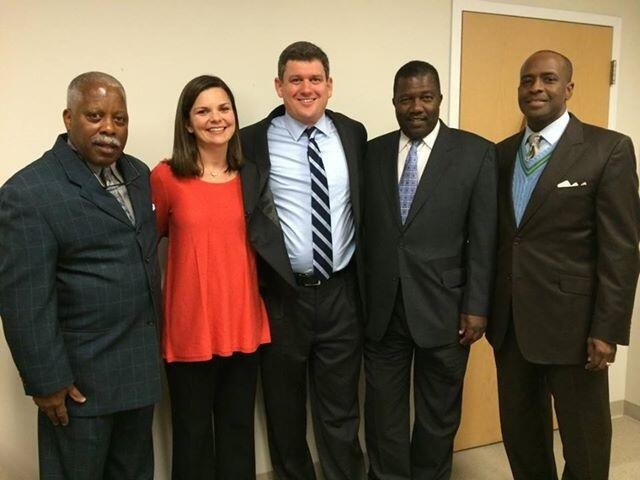
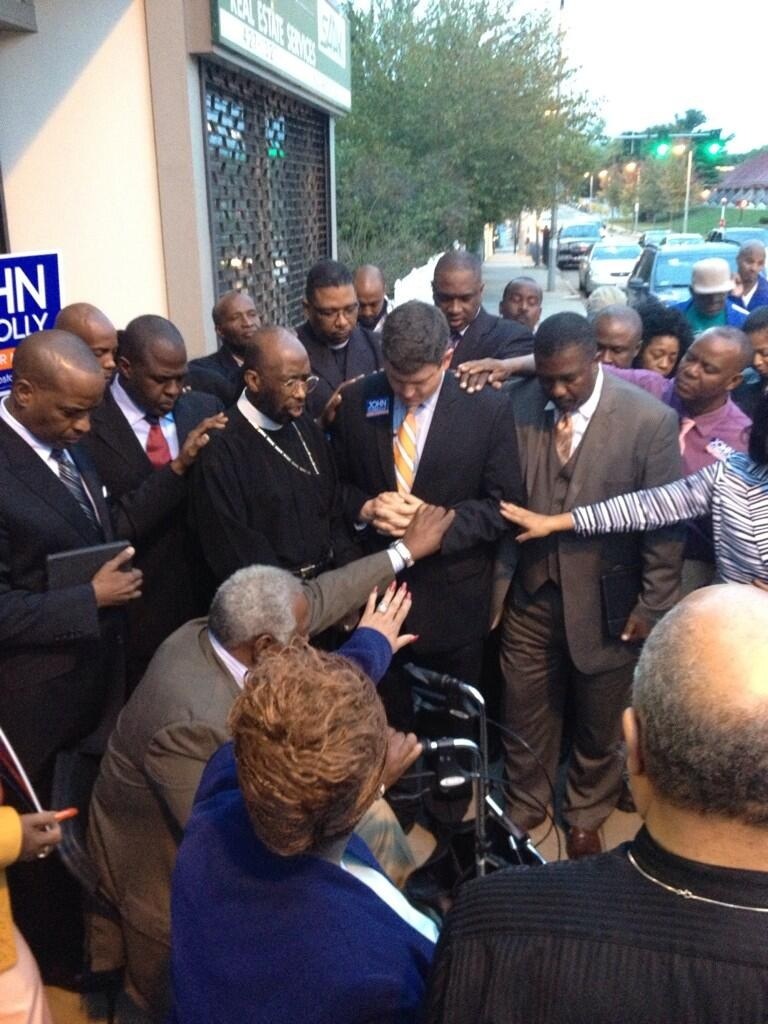
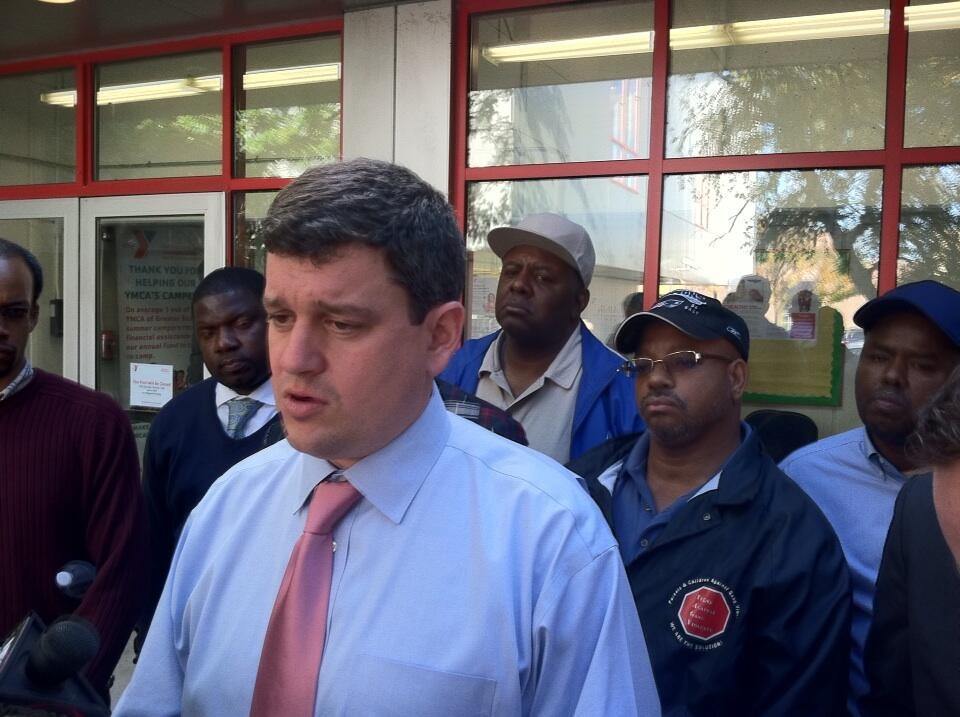
^ in governance, substance IS style. john Connolly meeting with gang members and Ministers in Roxbury yesterday

—- —- —-
So now the Mayor race is about “leadership style” ?

What is this ? A fashion show ? An audition for Downton Abbey or such like ?

To read some big name columnists, or to surf my facebook wall, one would think so. it is said — by Marty Walsh supporters — that some elected officilas in Boston’s communities of color are endorsing Walsh because they don ‘t like John Connolly’s leadership style. A good friend of mine — who knows politics much better than that — also made that point to me this morning.

I would like to differ. I would submit that the idea that some elected officials of color have endorsed Marty Walsh is because of “leadership style” is a rather plump grade of effluent.

Politicians don’t endorse because of style points. They endorse because it serves their interests to do so. What are their interests ? One : getting re-elected. two : responding to their most active and vocal constituents. Three : their own policy agendas. Four : all three of the above.

More credible is the suggestion that elected officials of color have endorsed Marty Walsh because he has an urgency about him. This does seem to be the case. We wrote about that exact aspect of Walsh’s campaign almost a month ago. Walsh is urgent, Connolly long-term. Walsh wants stuff now. Connolly wants now to be just the beginning of a vision, a direction. Walsh’s message resonates with people who need help immediately. Connolly’s gains those who say “yes, right now is important; but what next ?” This too we wrote about back in September and again in our editorial endorsing John Connolly. You see it in how the candidates talk about employment. Walsh says “jobs.” Connolly says “careers.”

Between these two visions there is no easy common ground. It depends how you live your life. If you need more money right away, and getting it sets to one side steps you need to take to gain a career, you must choose either the money right away or the career steps. You probably can’t do both. In many of Boston’s communities of color, where incomes remain below average and unemployment (or under-employment) above average, voters are conflicted in just this way. That is why one sees elected leaders of these communities often endorsing Walsh while at the same time many of the actual activists are going with Connolly. The elected leaders hear the cries of urgency. The activists are building a future.
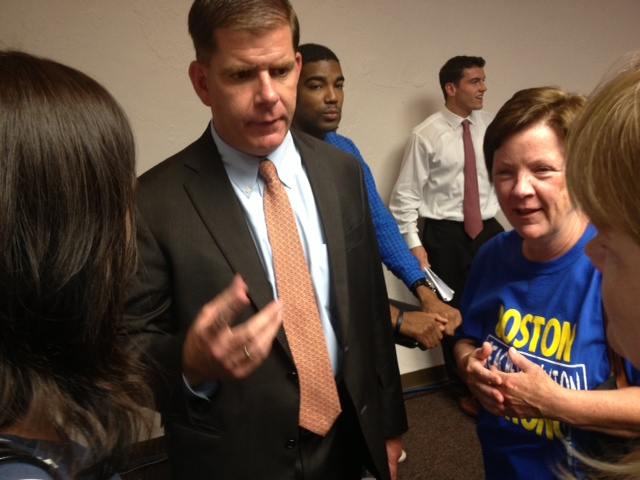
photo (4)

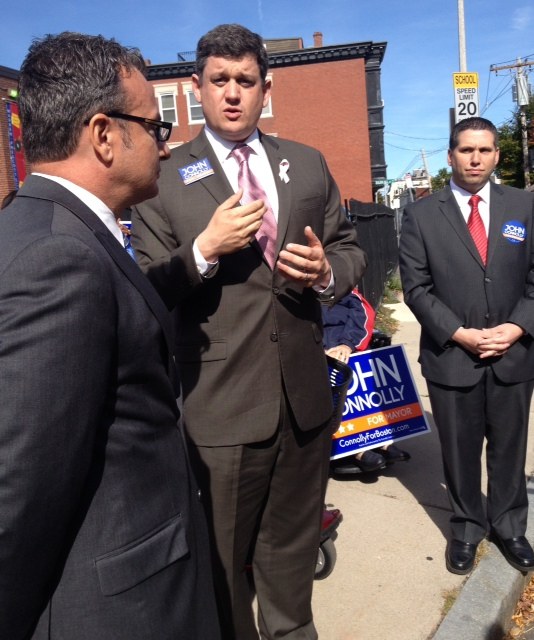
^ urgency — and union jobs now ; Marty Walsh has plenty to offer

The elected leaders are responding to the cries of urgency because that is what constituent service is all about. People building a future can’t do it by calling an elected official’s office for help. Elected officials aren’t set up to build people’s futures. That’s what city administration and state offices of economic development do. But elected officials are set up to assist constituents in need — of neighborhood legal services, an addiction intervention, a problem at school, etc. Thus, in the Mayor’s race, some elected officials of color are picking the man they think will respond most quickly and helpfully to constituent help calls.

But there is a flaw in their analysis (assuming this is in fact how they see Walsh versus Connolly). The Mayor, no matter how sincerely he wants to remedy ills, can’t do it himself. His administration does that. And that is why when I was looking at the campaigns with an eye to recommending an endorsement to my Here and Sphere partner, I looked at how the two campaigns ran. Because, for me, in every campaign for an office essentially administrative, how the campaign is set up and carried out says a lot about how the man or woman will set up and administer when he or she is elected.

With the Walsh campaign I saw a well-managed street presence but a difficult internal process and a message full of contradictions.

With the Connolly campaign, i saw an efficient schedule, a state of the art volunteer outreach, and a campiagn message superbly focused and presented.

I not only saw this. I wrote about it back in mid-September.

May I ask, if “leadership style” — i.e., constituent services — is the avatar here, how come the many, many elected officials who have endorsed John Connolly missed what the elected officials of color now with Walsh see ? Is delivery of city help to people needing it any less important to Sal LaMattina than to John Barros ? Less important to Nick Collins than to Carlos Henriquez ? And what of the many elected officials who are endorsing neither ? Do they simply not give a damn about their constituents’ need for such services ?

Or is it that the elected officials supporting John Connolly want better schools — which will take years to accomplish ; look at the problems now engulfing the Dever and McCormack schools in Marty Walsh’s State representative District — so that their constituents’ children can have great careers ?

Whereas those backing Marty Walsh would rather not take on the Boston Teachers Union – as Connolly has — with school reform and see less political kerfuffle — if Walsh becomes Mayor  — in securing for their people a huge favor : union membership in the building trades and thus jobs now in the Boston building boom while it lasts ?

—- Michael Freedberg / Here and Sphere

NOTE : a suggestion has also been published that John Connolly was merely ‘stylin'” when he invited the Boston Globe to accompany him as he met with gang leaders in Roxbury — “using them as props,’ said the detractors.  This is the sheerest garbage. I propose that said gang leaders were thrilled to have their stories register upon the City’s biggest newspaper. They weren’t “props,” they were the REASON. ‘Nuff said on that one.


BOSTON MAYOR FINAL : THE CONNOLLY CAMPAIGN

Image

^ “the next mayor has to come in dedicated to bridging the equity gap” — John Connolly speaking at a huge rally in Jamaica Plain tonight

—- —- —-

NOTE : Here and Sphere has endorsed John Connolly for Mayor. I’ve done my best to be objective in this report. You decide.

Two weeks ago, as Marty Walsh struggled to become something other than “the union giuy” and as John Connolly began to amass a large and diverse war chest of people and money, it looked as if the November result would be not close. The prospect looks different now. Walsh found a way to change the conversation — instead of “the union guy” he is now “the progressive tribune of workers’ rights” — and four major Boston politicians of color (three of them former Mayor candidates) have endorsed him, with more such to come soon. Which has forced Connolly to change HIS conversation too.

Until Walsh’s change began to show itself, Connolly had been “the education candidate.” As Boston public schools are by far the largest and most expensive city function, and as there are some 57,000 Boston Public School parents, being “the education candidate” seemed a shrewd choice. It was. It got him into the November Final. But being the education candidate is no longer big enough, and Connolly has had to expand his message hugely.

It has taken him two weeks to do so. I think that he has been stunned, after all the years of bold outreach to Black Bostonians (less apparently so to Boston’s Hispanics), to watch as one after another Black politician endorses his opponent. Yes, his campaign kept on reaping that outreach; yes, it has won him many endorsements by Black religious leaders and by some political action committees. In particular, almost the entire campaign apparatus of Charlotte Golar-Richie joined his campaign, and some supporters of John Barros as well, even a few supporters of Felix Arroyo. But his campaign to Boston’s communities of color has proved much harder than seemed likely a month ago, and Connolly has had to change his approach. I think this has saddened him; one hears it in his remarks. I don’t think he is happy to compass winning by the votes of upscale white people. It’s not what he spent years preparing to be.

as he worked to speak to the changed electoral landscape, Connolly’s speeches stayed close to the education theme. But then came the big break-through : almost the entire leadership of Boston’s “Italian” wards came aboard his campaign. And though the endorsers talked not about issues specific to their neighborhoods — no bread and butter city administration stuff — but about better schools, in speeches that often sounded canned, a smile returned to Connolly’s cheeks and an excitement to his voice.

The endorsements of Connolly by Councillor Marc Ciommo, former Councilo candidate Philip Frattaroli, State Senator Sal DiDomenico, former Councillor Paul Scapicchio, North End State Representative Aaron Michlewitz, and — most importantly of all — by Councillor Sal LaMattina (East Boston State Representative Carlo Basile had early on joined the Connolly side) strengthened Connolly’s hand considerably. He was no longer just the candidate of mostly white young techies and concerned publiic school moms. News came of a fundraiser hosted by said Carlo Basile at which, it was said, $ 100,000 was donated to the Connolly brand. At the same time another fundraiser, by Roslindale real estate developer Vinnie Marino — said to be very close to Mayor Menino — raised yet further funds, and it was announced that Connolly had imbibed a whopping $ 610,000 total during the two weeks just ended.

This turned many heads. What the turned heads now s aw — and heard — was a Connolly on wide angle. Jobs — he said “careers” — safe neighborhoods, all of us connected to one an other, it was all part of his new speech. In the First Debate, on Tuesday night, the new, confident, bold Connolly was on full display as, in a voice pitched high and somewhat melodic — his passion voice =– he spoke of education, certainly ( and often ) but even more masterfully about city finances, revenue, union contracts, and budgets. Suddenly listeners saw not “the education mayor” but the Master of City Money. At many turns in the city finances discussion he had Walsh on the ropes.

This was a surprise to me — probably to many. At numerous Mayor Forums and at “Mondays with Marty” I had heard Walsh speak authoritatively about many city issues and, of course, State House legislation. Less so at the First Debate. He seemed cautious — as well he might be after Connolly’s revelation of a bill that Walsh has filed, five times, to take away from City Councils the power to review labor arbitrators’ contract awards. For that revelation has been at least as significant in moving Connolly beyond being a mere “education Mayor” as any other move he has made or that has been made on his behalf. At the Debate, Walsh could not escape its implications. the mire that moderator Jon Keller asked city budget questions, the ,more that Walsh’ s union-friendly legislation came to mind.

But at street level, Connolly’s attack on Walsh’s labor legislation has opened him to accusations by Walsh supporters that he is “not a progressive,” maybe even a “Mitt Romney in Robert Kennedy words,” as one notable Walsh spokesman said. That the attack has hurt was seen tonight when, at a huge rally in Jamaica plain, Connolly said “I’m sick of being told I’m not a progressive ! Giving a good education to every child in the city, that IS progressive !”

It was a superb speech, the best i have heard Connolly give. He spoke of careers; of “bridging the equity gap”; of the City being “two different cities, one safe, one unsafe.” He made fun of himself. He talked of his teaching career (“despite what you see about me on the internet, yes, I was a teacher,” he grinned.) He talked of restaurants and liquor licenses; of streamlining the city bureaucracy; and, yes, of school reform in all its details including, pointedly, a longer school day. The crowd cheered him; cheered each of his points — and well they ought, because he stated them with a clarity I had yet to hear him bring so much of. He sounded less the slogan-eer, more like… a Mayor. It was a speech just that commanding, pitched perfectly at his fan base of upscale young urbanites and concerned school parents.

Image

^ the Mayor of upscale young urbanites and concerned school parents greets his voters at tonight’s Jamiaca Plain rally

This speech, along with his campaign tactics talks (brimming with insight and laughs) to supporters at donation gatherings, bring Connolly a conversation changed utterly. It’s big presence, a podium persona. Can Walsh raise his game to this level ? we shall soon find out.

—- Michael Freedberg / Here and Sphere

BOSTON MAYOR FINAL : BOTH MEN WIN 1ST DEBATE

Image

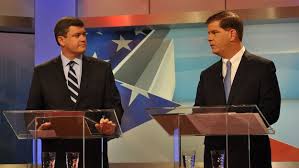
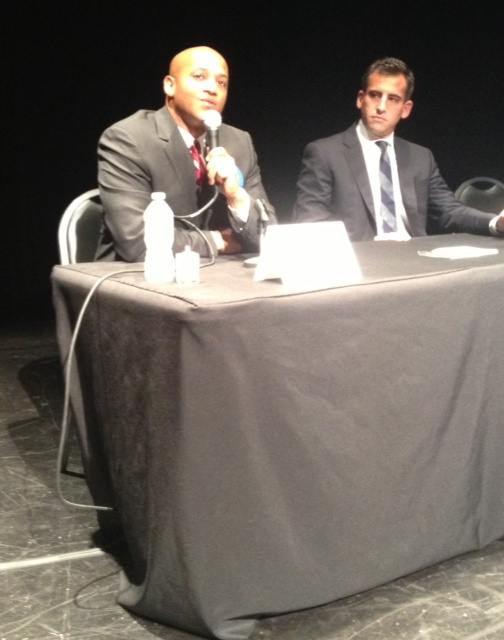
^ John Connolly — Marty Walsh : first face off of three

—- —- —-

Boston’s first face to face between John Connolly and Marty Walsh was a winner for both men. John Connolly was the clear winner on presentation and policy discussion. Walsh, however, also won, by simply showing up and holding his own, most of the night, and occasionally on top. He benefited by being the lesser known of the two. It’s always that way in a first debate. the underdog always wins; and with 18 to 23 percent of Boston’s voters undecided — so say the recent polls — Walsh almost couldn’t lose. and as he was always articulate and quite knowledgeable during the Forums held before Primary day, it was pretty clear that he WOULDN’T lose.

That Walsh won last night we see by twitter follower numbers. Since the debate began, Walsh has picked up 64 new twitter follows, Connolly 40. (Numbers as of 10.40 AM today.) Small evidence, but palpable. Last night Walsh increased his support more than Connolly did.

Still, Connolly did gain. He stayed reasonably close to Walsh only because his policy presentation commanded the night. The first five questions were about education, Connolly’s issue; education came up again later, and often. He also dominated Walsh on city finances and budget issues. How could he not ? It gave him the opportunity to raise “the union issue,” Walsh’s riskiest attribute, in a context that emphasized its risk. But there was more. Walsh exhibited a lack of understanding of admittedly technical finance matters. He tried to attack Connolly for not being present during a certain city union contract negotiation ; Connolly pointed out that by law he was not allowed to be there, in the negotiating room. Responding to a question about raising City revenue, Walsh talked about bringing in new businesses — but on a regional basis. How would bringing new businesses to Somerville — a city that he specifically cited — add revenue to Boston ? The question was not asked of him.

My observers pointed out that, in discussion of the bill that Walsh has filed to remove City Council review power over arbitrators’ union contract awards, when pressed on its effect, he said “no comment.” It was the big talking point for most journos. Myself, I found it a proper answer. That hill, House 2467, is one that hangs over Walsh’s campaign like a storm of belfry bats. Far better to shut up than to talk of it.

That bill will come up again, though. two debaters remain. Walsh will no longer be the lesser known man. Unless Walsh quickly finds a way to master the details of city finances, and to deflect the effect on them of higher city worker pay awards, and to explain away House 2467, the contradictions in his campaign will stand out for all viewers to grasp, much to his detriment.

Image

^ Pastor Bruce Wall, Meg Connolly, John Connolly, Pastor Minyard Culpeper, Pastor William Dickerson

Meanwhile, Connolly is deepening his connection to Boston’s Black community and widening it, to people not often reached by anyone, and in ways I haven’t seen since John Sears ran for Mayor in 1967. That was before the huge social and political split that took place during the fight over Boston school segregation and school busing, a crisis whose passions took almost two generations to abate. Connolly’s achievement — worked at over many, many years — seems to me to have entirely swamped Walsh’s endorsement by Charlotte Golar-Richie. In campaigns as serious as this one, years and years of hard won trust and connection, on a very personal level too, can not be turned aside by a two-month embrace, no matter how noble and sincere the outreach.

—- Michael Freedberg / Here and Sphere

BOSTON ELECTION FINAL : SOME THOUGHTS ABOUT THE OFFICE OF BOSTON MAYOR

Connolly Walsh 1

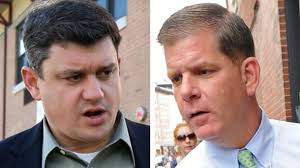
^ to the office of Mayor : which one ? and Why ?

—- —- —-

Ten days ago I wrote that Marty Walsh had to change the conversation big-time or he risked being beaten by a lot. A few days later I wrote of the contradictions and conundrums in his campaign. He has now responded. He has changed the conversation AND resolved the contradictions. He is now the Candidate of The Labor Left

It is likely not a winning hand. It is certainly not a hand for a Boston in which union households in toto amount to about 14 % of the total vote. But it is a better hand than the fuzzy and disorganized hand that he had been playing. And because it is a better hand, it merits a better answer; and that it is getting, from the much more broadly based, more contemporary, more freewheeling campaign of John Connolly.

Here and Sphere, for which I write, has already endorsed John Connolly. My intention now is not to repeat that endorsement. It speaks for itself. My topic today is to examine the office of Boston Mayor itself : what do we expect our Mayor to be ? And not to be ? And why ?

Under the current City charter, the Mayor is all powerful. He (and it will be a he) appoints all administrative heads, oversees all departments, has enormous appointive power all the way down the organizational chart, and thus controls the City budget even though the Charter gives the City Council the final vote — though the Mayor can veto it.

Given the vast powers that a Boston Mayor has, it is small wonder that every interest group in the city wants him on its side. in such situation, there are only two arrangement options ;

1.The mayor can be an honerst broker amongst these interest groups, independent of any of them, or perhaps loosely aligned, from time to time, with one or more.

2.The Mayor can be the captive of one or more interest groups, elected so completely by them that he has no independence, or very little, but is, rather, that interest groups’ instrument.

It doesn’t take very much imagination to see which version of Mayor is portended by which of the two campaigns now hotting up. Personally, I prefer the first version, and I suspect that so do most Boston voters. It is not fun when an office as dominant as Boston mayor is the policy instrument of one interest group — unions especially, given that unions’ sole interest is to increase wages. (Increasing wages is a very worthy goal. But it is the epitome of narrow; a Mayor’s policy goals should be wide.) a major reason why I — most voters — prefer the independent-Mayor version is that interest groups develop an internal momentum of their own leading to either increasing radicalization or to factionalism. Radicalization alienates more and more voters from government (and should). Factionalism makes government a beehive of back-stabbing, a boiler room of inefficiency and contradiction. No one with any sense of civic governance should want a Mayor bullied by radicals or burlesqued by faction.

A City with a powerful-mayor charter can survive these political ills. Most people simply get on with their lives. The City may annoy them, or impede, but because most people live in the private sector and make most of thir life decisions on their own all day long, a mis-mayored city can hardly break them. But wouldn’t it be so much better to have a Mayor who enables rather than impedes ? Gives some aid to every interest group but all aid to none ?

John W Sears

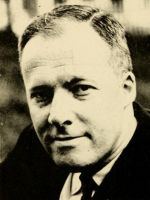
^ John W. Sears, 1967 : “I play center field.” It’s still the model for what a Mayor of Boston should be.

Because so much effort, and so many people, are needed by a Boston Mayor candidate in order to win election to the office, a surge by interested people cannot be avoided. Indeed, the involvement of interested people is a good thing. But all surges risk going too far. it’s up to the candidate to stop that. It is political malpractice to aid and abet it.

—- Michael Freedberg / Here and Sphere

BOSTON MAYOR FINAL — CHARLOTTE’S ENDORSEMENT ANALYZED

Image

^ center field and left field : Charlotte Golar-Richie and Marty walsh

On Saturday morning at 10 A.M., at a rally called by herself, Charlotte Golar-Richie endorsed Marty Walsh for Mayor.

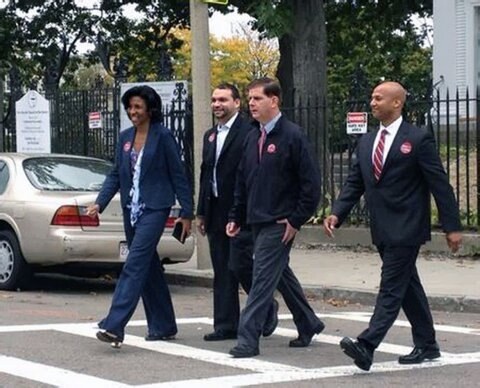
With her at the endorsing conference were Felix Arroyo and John Barros, both of whom had already endorsed Walsh a few days prior. Seeing the three of them walking with Charlotte Golar-Richie to the conference like the Beatles — as Dorchester’s Joyce Linehan put it — on their Abbey Road LP cover was quite the experience. It seemed a seminal moment in Boston city politics : the Four Horsemen of the “Working families” Apocalypse…

Walsh’s face wore a stun, as if he too couldn’t quite believe he now had the support of the Primary ballot’s three leading candidates of color. Frankly, I was stunned too. But not for long. Hardy had Golar-Richie finished speaking when the news broke that basically her entire campaign staff — finance chairman, field director, and the staffs of several of her local headquarters — were all joining the John Connolly campaign.

Now I was beyond stunned. What the dickens was going on here ? You endorse one guy, and essentially all your people go to work for the other guy ? The same day, no less ?  Surely Golar-Richie had to know. And if so, what was the significance of her endorsement ? I began to ask myself some questions :

1.Why did Golar-Richie not endorse at the same time that Barros and Arroyo did ? Reportedly they asked her to join with them. But she did not. Why ?

2.Why did she wait three full days thereafter — during which time the CUPAC and Black Ministerial Alliance, both of which groups had backed her in the Primary, publicly endorsed Connolly — before finally doing what Barros and Arroyo had asked her to do on Tuesday ?

3.Why did she not endorse John Connolly, since almost all of her staff did so ?

Only Golar-Richie herself knows the answer to these questions. Maybe she will tell us. until she does, however, a few answers suggest themselves simply by the nature of the events. What i think happened is this :

1.Golar-Richie did not want the impact of her endorsement to be diluted as part of a group. She would endorse alone and draw all the attention.

2.She was always a careful candidate whose campaign hallmark was caution and flexibility to all sides –in keeping with her persona as a manager impartial. Thus the waiting period, during which she “carefully assessed” Connolly and Walsh. “Careful assessment’ would lend gravitas to her decision when it came.

3.Meanwhile, she was known to have been one of Menino’s choices to succeed him, and she had been part of his administration; and Menino had already and obviously chosen to give help to Connolly. The period of “careful assessment” allowed her staffers quietly to make their arrangements to join the Connolly camp and thus put a smile on Menino’s chin.

4.Now having assured her staffers of a safe haven — and herself of having gifted Connolly the meat of her campaign — she was free at last to take care of a significant task of personal politics :  ( a ) an endorsement of Connolly by her would allow Arroyo and Barros to box her out, among voters of color (if she chooses to run for elected office again) as not being for “working families”; of favoring the “banker’s candidate” — the ‘school privatizer” — as folks in various camps close to Barros, Arroyo, and Walsh were aleady saying; and ( b ) an endorsement of Walsh would prevent that. Thus Walsh it had to be. A gamble, but a well planned one.

I am guessing that the feverish phone calls back and forth that the Herald’s Peter Gelzinis said took place from Thursday into Friday were about that very issue. Charlotte’s Menino friends told her to get with Connolly : and so she pondered, and gave her staff (and the PAC’s) time to do exactly that. Meanwhile, Charlotte’s Walsh-supporting friends told her to endorse Walsh or be boxed out. And so, once the backstage work was safely done, she endorsed Walsh.

Simple. Shrewd. The reward of caution.

Many smart politicians play both sides of a divide. It’s one of the most successful ways to occupy the political center. Occupying the center — what former Boston Mayor candidate John Sears calls “Playing center field” — was Golar-Richie’s campaign theme, its tone, its distinction, its claim to seriousness. She owns it, and as long as she can “play center field” without errors, she’ll be a serious force in political baseball no matter which man becomes Mayor.

—- Michael Freedberg / Here and Sphere

BOSTON MAYOR FINAL : CHARLOTTE DECIDES

Image

^ Abbey Road (as Dorchester’s Joyce Linehan says) : Charlotte joins Team Walsh

—- —- —-

The picture that heads my column is one that I admit I never expected to see in this Mayor election. Charlotte Golar-Richie, the quiet, cautious, middle of the road administrator, endorses Marty Walsh, her opposite in every way.

It’s a big boost for Walsh and will certainly have an effect on the November 5th vote. Until Golar-Richie came forward, Walsh’s campaign looked lost and losing. Just in the first five of Boston’s 22 wards he looked down by 10,000 votes. Now that margin looks quite less.

I opine thus not because of the mere fact of Golar-Richie’s endorsement but on account of WHY. The answer is not simple or obvious. Sure, there are personal issues and policy differences that have developed over the years of Connolly’s service on the Council, between him and some activists who certainly Golar-Richie talked to. But i prefer not to think that Golar-Richie chose because of personal stuff. She’s bigger than that. And her endorsement speech offers a wider clue : she talked about Walsh being a Mayor for “working families.” That phrase never crossed her lips during the Primary. They are Walsh’s theme. So who was she saying them to ?

There’s answer for this question too : she was saying them to the union activists who oppose the school reforms that John Connolly wants. These reforms have drawn the ire of Teachers’ Union activists since they were first bruited. Yet they are exactly the reforms being advocated by President Obama’s education secretary, Arne Duncan, and, in Massachusetts by Democrats for education reform.

Why would union activists, Democrats all, oppose so resolutely reforms being proposed by a Democratic President ? In the twitter-sphere — and the blog-o-sphere — one finds out. There one finds a growing anger among progressive people against the radicalized GOP and also against a President whom these activists see as “giving away too much” to the GOP. The radicalization of the GOP is, as Bill Moyers writes astutely, the big political story of the year. Almost as big a story is the like radicalization taking ground inside the Democratic party. You cannot radicalize an electorate in only one direction; voters who differ aren’t going to just sit still and let a radical party take over — or block — the nation ‘s direction. Activists DO things. And so activists on the progressive tip are doing.

In Boston’s Mayor election that has now come to mean opposing a school reform led by Democrats ! The verbal overkill abounds : that Connolly’s school agenda means “privatization” of the public schools, that it’s “some outside group” doing it, that “he’s a jerk,” etc etc. In fact, John Connolly is about as traditional a patrician urban reformer as you can find. What is there in his suggestions for a longer school day, greater leeway for principals to choose teaching staff, core curriculum, and support for charter schools as an alternative, that requires raising the hue and cry ? Horace Mann’s school reforms of the 1840s were no less ambitious, nor the much more radical reforms advocated by John Dewey 110 years ago. 50 years from now, John Connolly’s reforms will look as obvious as Dewey’s and Mann’s reforms 50 years after their day.

The older a nation and its institutions become, the harder it is to reform them. Our nation has aged greatly since 1840, 1900, even since 1965. Reforming our associations today seems almost impossible to do; those vested in them simply WILL NOT change. We see it in Washington, where he Tea party opposes everything and anything that will make this nation fairer and better. Now we see it here in Boston.

Reform of Boston’s schools should begin with the teachers; and with the parents; but for too long there has been disconnect — indeed, a widening of it — that has made school reform a bridge broken; and John Connolly, himself a former teacher and a public school parent, has stepped in to span the reform forward. For this he has incurred the enthusiastic support of school parents, and the support of education-agenda Obama Democrats — and the ire of teacher activists and many economic progressives.

I have had personal experience of this disconnect. I read the Boston Teachers’ Union ten-page schools manifesto several times. For some months I have tried to moderate between friends in the Union and the Connolly agenda. I suggested that the BTU should endorse Connolly, saying we differ on how to reform the schools, but we are one in making schools the top city priority.” I failed. I hope we can still talk and be friends.

I suspect there are many, involved in Boston’s civic matters, who are saying something like.

The education-issue split in the Massachusetts Democratic party seems a portentous event. Add to that the economic split : progressive activists dislike the Obama administration’s ties to big finance. In Boston, some fear that John Connolly is the banker candidate. The business development candidate, he surely is. It’s where Boston is headed and has been headed for at least the last dozen years. But Connolly is by no means a Koch Brother or ALEC guy. He might say, in his own words, that the business of Boston is business, but Connolly’s business looks as if it will be a business culture tolerant, diverse, and open to all who have talent; with all lifestyles fully respected; a “green” business culture and one that supports living wage legislation. This is controversial ? Seems that it is.

The Tea Party first arose in very “red’ states, where the “reformers” were all GOP. Massachusetts is a very “blue” state. Here the Democratic party is almost all, and, as the people of a democracy usually find themselves on the opposite side of issues, splitting the Massachusetts Democratic party is the only option. But ; if that were all that is now happening in this mayor election, it might be set aside afterward. it isn’t. The national Democratic party is splitting too, as progressive activists, tired of President Obama’s cautious generosity of style, are taking the matter of opposing Tea regression into their own hands. We see it in Texas with Wendy Davis, in California thanks to Governor Brown, in the talk of nominating Elizabeth Warren for President rather than Hillary. We see the fight everywhere against Wal Mart and for a much more livable minimum wage.

Yet John Connolly agrees with progressive activists on all those issues — passionately and uncompromisingly so. Only on the issue of school reform do he and the activists differ; and that one difference is now enough to cast him as the activists’ bogeyman, the evil enemy. To those who have watched the Tea party demonize conservative GOP Senators who “aren’t conservative enough,” it all looks depressingly familiar.

This is what Charlotte Golar-Richie has decided to take sides with. People do what they are gonna do.

—- Michael Freedberg / Here and Sphere

BREAKING : Just as I began to post this column, word came that Charlotte’s campaign field director Darryl Smith, AND her Finance chairman Clayton Turnbull are BOTH going to work for John Connolly. Talk about timing !

Image

^ Golar-Richie’s Field Director announces that he is joining John Connolly : (Connolly seen here with former Council candidate Philip Frattaroli and his Dad.)

BOSTON MAYORAL : THE MARTY WALSH CAMPAIGN

NOTE : Here and Sphere, for which I write, has endorsed Marty Walsh’s opponent. The following article is my own opinion, however.

Bartlett yard Marty Walsh

^ Courage and a voice for working people : Marty Walsh at Bartlett Street Bus Yard

Courage is the word that comes to my mind when I think of Marty Walsh and his campaign. For a guy who seems almost introverted, who really doesn’t sense the social wave, who comes from a part of Boston that is visibly shrinking in reach and number, to run for mayor of a City I don’t think he really understands seems an act of huge courage. This is a good thing. By no means do I disparage Walsh’s public persona. It has won friends of all sorts in the Legislature. It has elevated him to the top among those who know him best. I have, in previous columns, called Walsh “a hero of civil rights.” This he definitely is.

His courage — to break loose of the hermetic cultural world in which he grew up; to see himself as one and the same with people living very differently from how life along “Dot Ave — has brought Walsh almost to election as Mayor of Boston. He bested ten rivals in the Primary with a total vote that topped his Final opponent, John Connolly. As he himself claimed it, at a large outdoor rally on election eve : “Tomorrow we will top the ticket !”

But…. Walsh is a “union guy” — was business manager of the Boston Building trades Council — and has built his campaign on continuing the current downtown building boom and the jobs it provides. There is nothing at all wrong with this. The building boom is real. It is good for all Bostonians. It creates jobs, good paying jobs for workers who then spend that money into the city’s economy. All good. But the more that Walsh is a union guy, the less he is the man of courage; the less he is one brave man breaking free of — fighting against — the Old Boston and its old ways.

His challenge, as a Mayor finalist is, how does he bring Boston labor unions into the new Boston, the coming Boston of business innovation, business lifestyle, business politics ? Indeed — as many voters are asking — is becoming Mayor the best way even to do this ? At times in the past month or so, Walsh has talked — sermonized, almost — about recruiting businesses to Boston; taking them from Texas, South Carolina, from all over; of opening up a Boston office of business recruitment. This sounds odd speech coming from a union guy. Few of the businesses he would be preaching Boston to are union shops. There are, by percentage, fewer Union households in Boston than there used to be. In Walsh’s business recruitment world, they will be a smaller percentage still.

At which point Walsh’s courage begets contradiction.

And conundrum : for if union households would decline in numerical importance in a Walsh-for-business Boston, there would be no decline at all in the importance of the Police and Firefighter Unions, or of the Boston Teachers Union. Or of the School Bus Drivers Union. Need I say more : and into the two recent labor union events that have angered almost all Boston — Walsh too — came the news, via John Connolly, that Walsh has five times filed a bill (H. 2467 this year) to make labor arbitration awards final, taking review power away from municipal councils. A request was made that he withdraw the bill. He declined to do so.

Walsh’s strategy now, as a finalist, is to bring to his side working-class voters of diverse origins and skin color. He has John Barros’s endorsement, and he has Felix G. Arroyo’s endorsement — and his strategist, Doug Rubin — and now often voices the message that was Arroyo’s : pathways out of poverty by way of better schools and safer neighborhoods. It’s a good message. It builds upon Walsh’s own story and upon his support base. The Boston building boom should provide building trades jobs for Latino Bostonians, Cape Verdean Bostonians, Viet Namese Bostonians, all Bostonians. And yet…

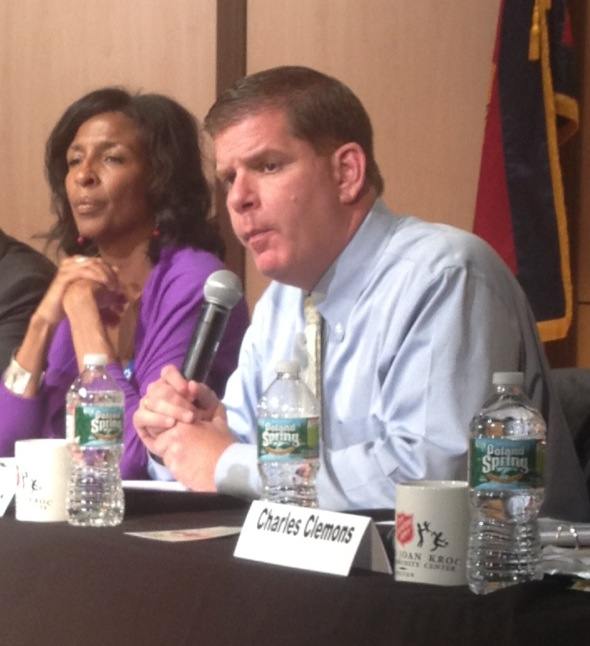
…the argument did not work for Arroyo in the primary and seems unfitted to what Boston is like today. It is a message not too different from Mel King’s and Ray Flynn’s in 1983. But Boston has become much more entrepreneurial in the past 30 years. (And Mel King himself is close today to Charles Clemons, who was a Mayoral candidate and is a radio entrepreneur with an economic point of view almost Republican.) Boston today is more prosperous than in 1983, more upper middle class. No social group desires radical school improvement more passionately than the upper middle class — and those who would join it. Upper middle class parents push their children to excel. Sometimes they overdo it, but that is what the new Boston often is. Achievement, and bicycles. Downtown boutiques — and advanced courses in every high school grade. Diversity and social metro-lifestyle — because all entrepreneur brains have worthy ideas to pick up on. Upper middle class parents like new ideas. And they’re in a hurry to get them.

Marty Walsh understands this dynamic well, I think. But he cannot be its voice. Because it already has a voice, a man who is of it and personifies it : John Connolly. Thus Walsh has chosen the only course left for him : to voice for the people who would like to be in a hurry but can’t be because they have too much other stuff — dysfunctional homes, kids going astray, language barriers at home, working three jobs to make ends meet; that sort of thing — on their plate.

It is good that Marty Walsh is committing to be the voice of those trying to catch up to the people in a hurry. No one speaks it with more personal conviction. But in doing so, he has, ironically, narrowed his reach. Because John Connolly’s campaign extends far beyond upper middle class parents. He has brought to his side Boston Wards very different from upper middle class — Charlestown, East Boston, North End, much of Roxbury and Mattapan — for whom access to the Mayor’s office and the Mayor’s ear is vital. Connolly looks like the winner to these constituencies, including some which did not vote for either him or Walsh in the primary. They can see how things shape, and they are surely correct in thinking that their support assures a Connolly victory and thus access to his office and ear. And yesterday both Communities United’s PAC and the black Ministerial Alliance endorsed him.

photo (12)

Against this dynamic and this perception, Marty Walsh now fights courageously, doing proud those who believe in him.

—- Michael Freedberg / Here and Sphere

BOSTON MAYOR FINAL : THE ITALIAN VOTE ? YES INDEED

Image

^ Two Sal’s Two : John Connolly receives the Yes — at Warren Prescott School in Charlestown

—- —- —-

Today at 1:30 PM John Connolly received endorsement from two Sal’s : State Senator Sal DiDomenico, representing Charlestown and parts of Allston-Brighton, and District One City Councillor Sal LaMattina. Aboard the Connolly campaign they join State Representative Carlo Basile of East Boston, former District One Councillor Paul Scapicchio, District Nine Councillor Mark Ciommo, the North End’s State Representative Aaron Michlewitz, Susan Passoni, and top Menino fundraiser Vinnie Marino of Roslindale.

Yes, dear reader, as you can see, there is an “Italian vote” even in supposedly Irish Boston. And it counts. But first, indulge me in a little trip through Boston social history :

1. Voters of Italian name continue to reside, chiefly, in most of the Boston places that their grandparents lived in : much of the North End; half of East Boston; Readville; one precinct of Ward 6 in South Boston; a significant scattering in Roslindale, Fairmount Hill, and West Roxbury; and a tight little area hard by Brighton Center, to which Italians from the region of Frosinone and San Donato came, three generation ago, to work in quarries. They amount to about 14 percent of all Boston voters.

2. Because the ancestors of most Boston voters of Italian name arrived in Boston later than the forbears of most Bostonians of Irish name, voters of Italian name still show some connection to ethnicity.

3. Since voters of Italian name proved strongly outnumbered by those of Irish name, the custom grew in Italian-name neighborhoods of backing for Mayor not an Italian candidate –who was presumed unlikely to win — but an Irish name candidate who would make a deal with the Italian communities — by way of their political leaders. Italian-name voters tended to vote as a family group; and, not knowing particularly well the Irish-name candidates — who almost always lived elsewhere in the city — they followed their leaders’ recommendation. More than once, the “block” vote in Boston’s Italian-resident areas won the Mayor’s office for the Irish name candidate -chosen by those leaders. It was stupendously true in 1959 — when Collins beat Powers -and importantly so in 1967, when Kevin White beat Louise Day Hicks.

Scroll forward again to now. We have John Connolly and Marty Walsh. Walsh lives in Dorchester, far from any Italian-name neighborhood. John Connolly lives in West Roxbury, at opposite remove from most Italian-name sections of the City. It is a very 1959 situation.

Yes, via social media and a flood of news sources almost every italian-name voter of 2013 knows at least something about both men. Yet few voters know them well. In this voting situation, sponsorship by a trusted local leader can still make a difference. One or two such sponsorings might not turn many heads in this the internet era; but six or seven leaders of same heritage banding together — plus an issue; in this case, school reform — surely will turn lots of noggins.

There was an issue in today’s Sal and Sal endorsement. The event took place outside Charlestown’s \Warren Prescott school, and both Sal’s talked of their working together with Connolly on school reform agendas.

Image

^ LaMattina — Connolly — DiDomenico

Connolly’s band of Italian name pols may even arouse the really BIG Italian name I have yet to mention, a guy you are probably already thinking : Tom Menino, the only Italian-name Mayor that Boston has ever had. What will he do in this election ? Will he do ANY thing at all in it ?

I think that he will. I think that he is already doing it. The events taking place seem to prove that he is involving himself mightily. They cannot be an accident. One endorsement, maybe. Seven ? Not just chance. Menino is indeed involved. And not just among “The Italian vote.”

Did I say “just” the “italian vote” ? It matters a lot more than “just.” Come to the Columbus day Parade this Sunday as it winds through the North end, and you will see much. Come to the after-party at Filippo Restaurant (hosted by Philip Frattaroli, who was a City Council candidate this year). But most of all, think of the families that stand out. In Brighton, Salvucci, Mummolo and Cedrone; in the North End, Passacantilli, Anastasi, Coppola, Anzalone, Langone; in East Boston, Buttiglieri, Aiello, Aloisi, Mangini, Lanzilli, Faretra, Marmo. Readville : Scaccia, LoConte and Pulgini. Fairmount : Pagliarulo and of course Rob Consalvo. From Roslindale, Vadala, Iantosca, and Ferzoco; from West Roxbury, Settana. And the Iannella’s….

So what’s it all add up to ? Pretty basic if you ask me. Yes, the race between Walsh and Connolly is turning into a battle of economic classes (as we all knew it would be). But not every Boston voting bloc identifies by economic class. The “Italian vote’ has almost always — as my list above shows — identified by family and neighborhood. John Connolly is smart to pursue, in this matter, the strategy that won the 1959 race for John Collins and the 1967 race for Kevin White.

Come to think of it, Kevin White looked a lot like Connolly, lived in the same area, pursued a “new Boston vision” just as Connolly is doing, talked the language of “downtown,” and — again like Connolly — came from a family long involved in Boston politics. And had the good sense to court East Boston’s Mario Umana. For the Kevin White of 2013, it’s “so far, so good.” Only 26 days remain until we know if it’s good enough.

Tomorrow : The Walsh strategy

—- Mike Freedberg / Here and Sphere

photo (8)

^ City Council colleagues : LaMattina and Connolly

BOSTON MAYOR : SCHOOL BUS DRIVERS SEND A MESSAGE

Image

^ no school bus today for 57,000 Boston public school kids

—- —- —

Marty Walsh must be thinking the election gods have cursed him. On the very morning that he has two important endorsements to announce, the Boston school bus Drivers’ Union stages a walkout and totally steals everybody’s attention. And who is the candidate of school transformation ? To whom parents turn this morning for guidance ? John Connolly. And at his facebook page they find it, comprehensive and helpful.

Yes, Marty Walsh put out a statement condemning the walkout. Of course he did. But so did John Connolly. and while Walsh’s statement said what need saying, Connolly’s added a vision as well as a reason for condemning the walkout. For Walsh, it’s “let’s get back to the task at hand.” For Connolly, it’s “let’s get back to the task at hand because, given the huge achievement gap in our schools, we must do it.” (emphasis added)

Yes, the job that you signed up to do, you need to do. But even more so, there should be a reason, a goal, a mission, that motivates you to do that job. Score a big one for John Connolly.

The School Bus drivers’ walkout really hurts Walsh. His message has been, “look, I’m a union guy, the union folks trust me, they will listen to me.” Maybe some of them will. More likely is that union workers are supporting Walsh not for his sake but for theirs. Today’s job action makes that point clearly enough — as if the huge BPPA arbitration award hadn’t already made it. And what was the huge labor issue that led to the drivers’ work stoppage ? Simply that they object to a GPS mobile application that enables school parents to track a school bus in real time.

For THAT, the drivers disrupt everyone’s day ? Listen, drivers : the rule is that a parent needs to be at her child’s bus stop when the bus arrives, to pick up said child, or else the bus drives off with the child still inside, and then the parent must do a ton of work to find out when the bus will return. If a parent can track that bus in real time, she will be less likely to not be there when the bus arrives at her stop. I don’t think that’s exactly hard for even a driver to figure out.

But enough. The School Bus Drivers not only dinged Marty Walsh badly, they also stole the spotlight from two big endorsements that he received later this morning : Felix Arroyo and John Barros. the Arroyo endorsement was expected. Walsh already has Arroyo’s top advisor, Doug Rubin, guiding him to key parts of Boston’s communities of color. Arroyo’s Dad, Felix D. Arroyo, was a long time ally of Ray Flynn, a candidate from much the same place as Walsh and of much the same support base. (I’ll have more on this subject in a later article.)

Image

^ John Barros (on the left) : today announces that he supports Marty Walsh for mayor

More surprising is John Barros’ embrace of Walsh. Barros’ education ideas and city vision parallel John Connolly’s almost exactly. So why has he tossed his lot in with Marty Walsh ? I have no hot poop on this issue, but I’m guessing it went something like this :

( 1 ) Barros’ portfolio is education; because Connolly’s theme is education, and his mastery of the issue is so thorough, Barros likely saw no need by Connolly for his advice; whereas with Walsh ? It wouldn’t surprise me at all if the High Schools proposal that Walsh released only two days ago was forged in consultation with Barros. A Walsh administration would have plenty of need for Barros’s education knowledge.
( 2 ) Barros also cares greatly about development of the Dudley Square area. As Walsh’s mantra is the Boston building boom and construction jobs, it would make sense that Barros asked for, and received, specific commitments by Walsh to Barros’s Cape Verdean community that it would get plenty of those construction jobs — and also some construction contracts.

Barros has every right to make the choice he has made. My problem with it is that it undercuts his visionary mission. He has opted for some specific — but small — gains now rather than taking the large, long-term, transforming view with Connolly : a vision that he advocated passionately at numerous Forums. Barros had better hope that he can impart to Marty Walsh and his core advisors some part of the long view that for months he advocated.

If not, he has contradicted himself.

—- Michael Freedberg / Here and Sphere

BOSTON ELECTION : JOHN CONNOLLY FOR MAYOR

Image

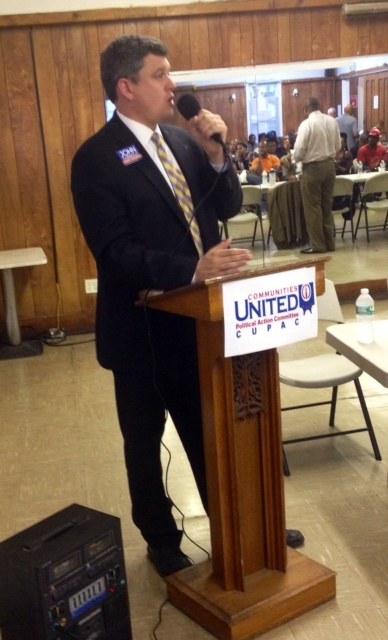
^ John Connolly at the recent CUPAC Forum

—- —- —-

Six months ago, when we launched Here and Sphere, we posted our mission statement : to be a voice for progressive, inclusive, visionary politics everywhere that our online journal could reach.

Little did we know that Tom Menino, Mayor of Boston, would soon announce his retirement, opening up one of the most powerful offices in all of urban America to new leadership and handing Here and Sphere a major story to cover, one that would command our mission for the rest of the year.

Twelve candidates qualified for the ballot. In more than a dozen Forums they answered questions and spoke their agendas. We reported on many of these Forums. At least seven of the candidates would have made a fine Mayor. It was a campaign of ideas, most of them progressive, many of them truly visionary. Since the beginning of August we brought this story to you. Hopefully you found value in our reportage, insight in our opinions.

The two candidates who won the September 24th Primary excelled at almost every Forum. It was no mistake of the voters to choose Dorchester State Representative Marty Walsh and City Councillor (at-Large) John Connolly of West Roxbury. Yes, many voters wanted to see a candidate of color in the Final; we understand why. So do John Connolly and Marty Walsh. Both have reached out to Boston’s communities of color, listened to the frustration, addressed the questions, even the hostile ones. We congratulate them both.

But now it is time to choose not two but one. Proudly we choose John Connolly to be Boston’s next mayor. He has our full endorsement, and here is why :

1.Reforming all of Boston’s schools is indeed the major issue facing Boston. John Connolly made it his issue and has put forth this campaign’s most comprehensive and well-detailed agenda for school reform. And how not ? He was a teacher himself and is a Boston public school parent. Name your school issue : the longer school day; giving principals flexibility in choosing teachers; charter schools as an alternative; family involvement in school plans; school assignment reform : Connolly addresses them all in depth and with conviction.

Connolly and the Boston Teachers Union (BTU) differ widely on what reforms to pursue; still, he and the BTU can agree. They both want education to be the next Mayor’s top priority. Of late, Connolly has been proposing reforms, in some areas, that comport closely with the BTU’s recommendations. The disagreement is not so much Connolly and the BTU as it is the BTU versus public school parents. We look forward to seeing Connolly moderate exciting meetings between Boston’s school parents and education professionals.

2.Segregation in Boston’s social life remains a huge problem, and John Connolly seems to understand the emotional and psychological dimensions of this segregation — and is prepared to confront it — quite better than his opponent. The battle for civil rights is not won when laws are enacted, important though these are (and Marty Walsh was a hero of the fight to enact them). As Connolly noted at a recent Forum in Boston’s Black community, Boston restaurants and night life remain deplorably segregated, with consequences economic as well as social; because, as Connolly noted, young people of color and talent see Boston nightlife segregation and say “no thank you” — and go elsewhere to live. This must change.

3.Relations between the City’s Unions and the rest of Boston taxpayers can never be kumbaya; but John Connolly is in a much more independent position, when the fire-fighters or police come demanding, than Marty Walsh. The Unions that have endorsed Walsh love him; they campaign for him wherever and whenever he needs them. It says a lot about Walsh’s strength of heart (and we have seen it at times too). Yet Walsh’s greatest strength has proven his greatest weakness. Questions were already being asked — and answered vaguely — how he could stand up to Union contract demands, much less reform the Police and Fire leadership, given his almost total dependence on Union support, when all of a sudden Connolly brought up a bill that Walsh filed as a State Representative : House Bill 2467 would take away from City Councils (not just Boston’s) the power to review arbitration awards and, if need be, disapprove. Under Walsh’s bill the arbitrator’s decision would be final.

This is bad law. No un-elected official should have final say over municipal finances. Walsh says that if it came to that, he would always put the residents first. He surely means it. But it’s the Unions’ call, not his. With House 2467 at their hand, their call would be final. We like Walsh’s labor supporters. Many are our friends. But being Mayor is a matter of duty first, friendship later.

Lastly, the vision thing. Boston’s next Mayor will lead the city into the future for four years, maybe eight. John Connolly has vision at his fingertips. He sees a different city, one that is being created even as we write, shaping a very different, more tolerant, prosperous, and structurally diverse city. It will take a mayor of vision to guide the shaping so that the new city is what we want it to be rather than a matter of chance. Marty Walsh has great plans in some cases; selling City Hall and developing City Hall Plaza as a commercial zone is perhaps his most brilliant. But Walsh has yet to articulate a grand vision of what he wants Boston to be six, twelve, 20 years from now. His matter of fact-ness meets current city needs nicely. But what then ?

No such question need be asked of John Connolly. He sees a city of bicycle people — and of car people; a technology center; a city of integrated social life; of education that helps to repair social unwellness rather than being a recipient of it. He sees the new Boston. He gets it. We endorse him to take our city to it.

—- The Editors / Here and Sphere