BOSTON SCHOOLS : $ 975 MILLION FY 2015 BUDGET APPROVED

Image

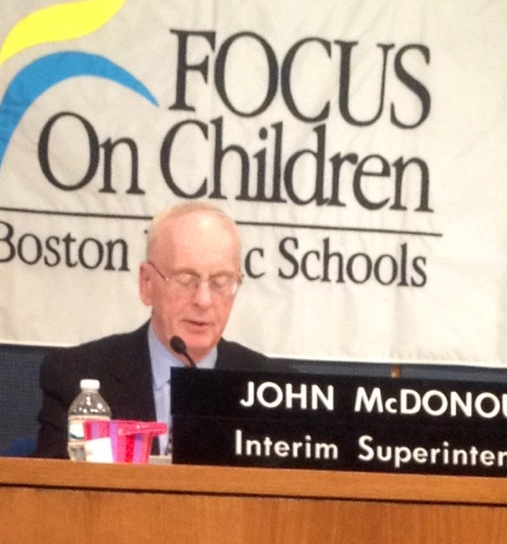
^ bringing Boston Schools quietly but hugely onto a change path : Superintendent John McDonough

—- —- —-

The Boston School Department’s new fiscal year budget was approved last night — unanimously. Superintendent John McDonough now has $ 975,000,000 to allocate — a four percent increase from last year, thanks, as McDonough said at the meeting, to Mayor Walsh’s “generosity” — to the education of some 57,000 children.

You might suppose that a unanimous budget approval would have been quick and easy. It wasn’t. The vote came only after three and a half hours of what Committee Chairman O’Neill called “public comment.” Almost all of this commentary was testified by more or less the same advocacy groups — Boston Truth, Citizens for Public Schools — that have been fighting the entirety of school reforms that Massachusetts has instituted since the Bill Weld years. Charter schools, MCAS, “testing fatigue,” even the race card : all were adduced by a good 30 or so teachers, parents, and advocates seeking — “begging,” aid one witness — full funding for a school system that is making what McDonough called “difficult trade offs.”

The Committee listened respectfully to every witness, many of them reading from prepared statements; a few read the same statement from the same yellow-green sheet of paper. For several months now, I have been listening to these citizens saying pretty much the same thing at rally after rally; I suspect the School Committee has heard it far more than that. Yet the seven committee members were more than ready to accord each witness full graciousness, despite the chants and shouts of a protest going on outside the hearing room, a protest loud enough that it was often hard to hear the speakers.

photo (12)

^ the unease was momentary : Chairman Michael O’Neill

I doubt that the protest made a favorable impression upon the Committee members. Chairman O’Neill showed his unease. But John McDonough didn’t move an eyelash. Boston Teachers Union president Richard Stutman at in the second row of the audience, a grin upon his face…

There was other testimony, including from Councillor Tito Jackson, who opposed the Department;s plan to use the T for transporting students. But the Principal of the Jackson-Mann school in Allston approved the plan, even as he noted how strange it felt that one of his teacher staff was in the room testifying against it.
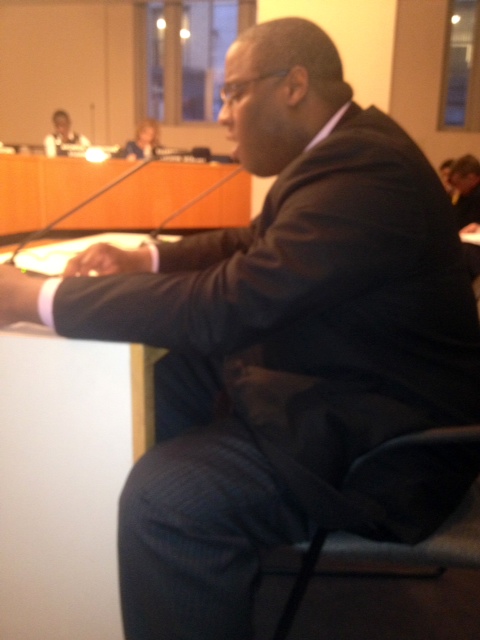
photo (13)

Parents, two officers of the NAACP, and two school bus drivers testified against McDonough’s T Plan, which envisions 7th and 8th grade students and contemplates 6th graders too. The most convincing witnesses cited safety concerns — convincing because the T isn’t safe in many Boston neighborhoods.

Only because McDonough’s staff researchers presented the Plan’s basis as thoroughly as possible were the Committee’s many questions answered. A compromise was added by Chairman O’Neill ; that the Plan be subject to a safety review to be presented to the Committee in 60 days.

Thus amended, the plan was adopted unanimously.

Many in the audience did not like it one bit.

It soon became apparent that that vote was the big one. The room fell quiet, and there was actually much less to-do on the Budget Vote itself. Committee members made brief comments and then came the unanimous vote.

After which John McDonough summed up the night’s doings. In his voice so quiet, almost without affect, as if there were no passions involved, just dry statistics, he spoke huge policy momentum in a few eloquent sentences:

“For months we have heard from you,” he said. “At hearings we have heard parents’ concerns. You get it. I applaud the involvement of so many passionate parents and teachers.

“This isn’t about charter schools or standard schools. it’s about making all schools better.

Am I happy with this budget ? No, i am not. I wish i could present a different budget. in the end, there is only so much revenue. Trade-offs have to be made. We have to close the achievement gap.

McDonough concluded : “This is NOT a budget cut ! Thanks to the generosity of Mayor Walsh, we have a four percent increase, whole other city departments are getting only one percent.”

Neither McDonough nor anyone else in the room mentioned that almost all of that four percent is slated to pay teachers’ pay raises negotiated in the last union bargain. Obviously not everyone drawing upon the $ 975 million budget is begging.

McDonough is determined to make big changes . I suspect that the teachers union contract is high on the list of changes he seeks. He seems to have the full confidence of the School Committee to do that and more. It will not be simple or quick. It can’t be. Listed prominently in McDonough’s Memorandum — handed out to all at the hearing — is this “priority” item :

“extending hiring autonomy to all schools to hire qualified, diverse candidates early, with $ 6.1 million supporting the success of our early hiring initiative and an additional $ 400,000 to support hiring diversity.”

Even Richard Stutman can’t stop this. it’s in the current teacher contract. Boston is also under court order to increase the diversity of its schools staff.

Yet Stutman has his troops, and they are getting the bulk of the budget’s additional $ 37 million. even as support staff positions are being cut in some schools.

This must change, but even larger changes are coming. Testing will increase; school competition too. Employers insist. So does an overwhelming majority of Massachusetts voters and probably a big majority of Boston voters too.

—- Mike Freedberg / Here and Sphere

UPDATED 03/27/14 at 3.3 PM

SCHOOLS REFORM : THE FIGHT OVER FUNDING — AND AN ANALOGOUS CASE

Image

Image

^ top : St Rep Alice Hanlon Peisch

^ bottom : St Senator Sonia Chang-Diaz

—- —- —-

Reform comes hard to a system engraved in granite and embedded in the cement of habit. This is what a proposed “Act to Further Narrow the Achievement gap” faces as the Joint Committee on education, chaired by the two women pictured above, decides how to report the bill ; favor or not favored.

Today in Massachusetts many citizens are trying, in many ways, to make our already top-ranked schools even better. We are doing this because, as solid as our schools perform compared to those of other States, we are falling behind against school systems in many other Nations. In the global economy, those students from other lands can take the high-skill jobs that companies more and more require. We want our own children to compete for these jobs. The proposed legislation  is one such way. With it, the fight to improve our schools gathers force.

That force now confronts the force of habit. By which I mean, the system created by Horace Mann, as Massachusetts’s first Secretary of Education, more than 170 years ago.

Mann called for common schools to be established in every town and city, schools that would bring together children of all backgrounds and conditions. this was education for citizenship as much as, if not more than, education for employment.

Education for citizenship will always be fundamental to a society self-governing. By which I mean, schooling children in community, to become a community, to instill lasting commitment to discussion, tolerance of differences, and a common heritage of knowledge.

Citizenship, however is only one of education’s two crucial objectives. Employment is the other. It may even be more important than citizenship. If kids graduate unable to compete for the best jobs — which then go to students from other nations — their citizenship suffers too. And what does it say of us who enable such an outcome ?

No parent worth his or her soul prefers his or her kids to spend 16 years and more in school and not acquire the necessary knowledge and skills to compete for the best jobs. Schools are funded with taxpayer money. For most Massachusetts communities, the local school budget takes up almost half of all taxes collected. add to that large local aid payments by the state, from State tax collection (and yes, from the Lottery). We pay these taxes because we want top schools for our kids. It’s a first priority.

And so any argument that impedes our State from improving school performance must fail.

The question is not, what did Horace Mann do in 1840, but instead, “what would a Horace Mann do today ?”

Employment education in Horace Mann’s time was provided, in almost all cases, by apprenticeships. Students hired out to a craftsman, or attorney, or merchant, to work in his office and gain the job knowledge first hand. the parent paid the master to hire his c hild as an apprentice.

Thus Horace Mann’s common school could concentrate on education for citizenship, teach basic reading, writing, and arithmetic, and feel its job well done. Not so today.

Today we ask taxpayer-funded schools to do what apprentice systems did 170 years ago. But one thing has not changed : even as every craft required discrete knowledge, and thus separated apprentices in one craft from those in another, so education for employment today cannot help but separate out students on one job track from those on another. Thus we come to charter schools and all kinds of innovation schools. Add to that vocational schools, technology schools, arts and music. All have been mentioned. All are needed by students seeking the best jobs.

About this there can be no dispute. The difficulty arises in the usual place : funding. Every student who goes to a charter school or other innovation school generates a reimbursement payment to the public school system that he or she is now not attending. But the compensation formulas will — according to Northeastern University’s PHRGE paper on the subject — leave public schools short by 37 % of full reimbursement. that 37 % shortfall means a cut in funds available to standard public schools.

Parents of children facing that shortfall have a right to be upset. Except that the 37 % isn’t — indeed, can not be — the whole answer. If a public school system is short, say, 500 students, because the 500 are going to school elsewhere, then how can that public school not need less money than what it had projected ? presumably it doesn’t cost the same to educate 10,000 kids as it costs to educate 10,500. There’s 500 less school books to buy, and, probably, a few less teachers to teach.

And you know what that means. Now you know why there is so much vociferous opposition go the proposed charter school cap lift. Not because it unfairly targets school districts designated as underperforming, but because it threatens teacher jobs.

What to do ? For answer I turn to an analagous case : railroad reform in he 1960s. When the – nation’;s railroads moved from coal to diesel — technological change ! – the railroad workers’ unions insisted that the rail lines continue to employ and pay the now unnecessary firemen. this was called “featherbedding,” and it was.

To put an end to this practice, the rail lines agreed to buy out the rights of the firemen . It meant paying each a huge limp sum equal to several years’ earnings.

I propose that our charter cap lift school reformers own up to the teacher union problem four square and offer to buyout the contracts of teachers when and as charter school student numbers increase to a point that it lowers the cost of publicly educating them. It will expensive, but that’s the price of moving past an entrenched system without wreaking injustice upon the people who’ve committed to that system.

The current legislation includes significant superintendent power to bring about this result, but it does not go the last, significant step.

I also propose something else : that charter school students — indeed, any students whose education is publicly funded — be required to take at least a few courses in a standard public schools, so that they can broaden their education for citizenship even while perfecting their education for employment.

—- Mike Freedberg / Here and Sphere

5TH SUFFOLK DISTRICT : FOUR VISIONS AT CANDIDATES FORUM

Image

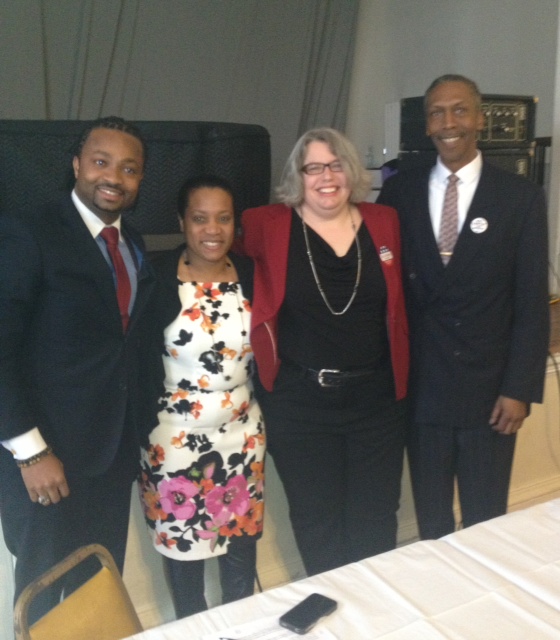
^ 4 visions 4 : from Left : Evandro C. Carvalho; Karen Charles-Peterson; Jennifer Johnson; Barry Lawton. (a fifth candidate, Roy Owens, did not participate in the Forum)

—- —- —=-

Yesterday afternoon voters of the 5th District had this campaign’s only opportunity to see, on one platform answering questions, four of the five candidates who seek to represent them. About 100 of the District’s residents showed up. There was plenty of enthusiasm among them — which was a good thing, because every one of the four needs to up his or her speaking craft.

That’s OK; I don’t expect candidates for State Representative, in a special election hurriedly called after the February 5th expulsion of Carlos Henriquez following his domestic violence conviction, to be silver tongued orators or think tank masters. This was a neighborhood event, and its candidates sounded like neighbors.

Moderated diligently by Boston Neighborhood News’s Chris Lovett, all four candidates — Evandro C. Carvalho, Karen Charles-Peterson, Jennifer Johnson, and Barry Lawton — managed to give Forum attendees a pretty fair impression of who they are, why they are running, and what they are likely to work on as the District’s State House representative. Still, all had some difficulty focusing on State legislation matters rather than concerns more appropriate for a City Councillor.

This was true even of Barry Lawton, who in his opening remarks said “i am the only candidate on this stage who has written legislation” — which he likely did as a staffer to former State Representative Royal Bolling, Jr. — but then proceeded not to mention even one piece of legislation that he would sponsor if elected. Lawton did have plenty to say, however, about vacant city lots, jobs, and his long experience as an activist.

Evandro C. Carvalho did make at least one potential legislative point — to include expansion of vocational education in state school reform bills — but, curiously, given his history as a Suffolk County prosecutor of gun crimes, failed to mention the very detailed gun control legislation now before the legislature’s Public safety committee.

In fairness to Carvalho, neither did any of the other three candidates mention, much less discuss, this legislation. it was a curious omission considering the urgency, in neighborhoods of the 5th District, of curbing gun violence.

Karen Charles-Peterson at first spoke in the quiet voiced generalities that anyone who heard her chief political backer, Charlotte Golar-Richie, during lat year’s mayor election is quite familiar with. But half way through the Forum she suddenly became a different Peterson. She had sat; now she stood up. as Barry Lawton spoke loudly, with hand gestures like a preacher, so now did  Charles-Peterson. She ended strongly, announcing that “I will take all 40,000 residents of this District with me to the State House” and “I will give everyone my personal cell phone number, call me any time.” Charles-Peterson also discussed aid for the small businesses that string the length of Bowdoin and Hancock Streets, in the center of the District. that said, neither she nor any of the four, except Jennifer Johnson, uttered the place name “Uphams Corner” — despite its being the major crossroads of the District.

And now I come to Jennifer Johnson. Ostensibly she’s an unlikely candidate ; Caucasian in a District largely of color and an authentic issues voice among candidates unclear about which issues matter, and in what way, to a legislator. Johnson’s far from  being the polished, focused speaker she will need to be if she’s to make issues heard and understood; but she spoke in some detail about the formal, even bureaucratic, task that small businesses face as they seek loans; about how and why business development matters to a District among the lowest income of all; about how to frame affordable housing agreements with developers; about raising the minimum wage (strangely, this initiative, so vital to the District, was hardly mentioned by the other three candidates)and, most fascinating of all, about technology : connecting technology enterprises to the District and to schools, and the District to technology jobs.

Johnson could easily have delivered her remarks to the chamber of commerce or a Business round table. Odd it felt to hear a 5th District candidate talking enterprise and cutting edge innovation. But why not ? She called herself a  “Kennedy liberal,” a phrase as attuned to business success as to social justice. Would it be too much a reach to say that the two reinforce each other ? (It was shrewd of Johnson to talk so much about business. Business development was John Barros’s signature, and by talking it, Johnson sought to take up the banner of a man who was given 2,071 votes — first place — from the District in last year’s mayor race.)

There was plenty of applause for Johnson, and for Charles-Peterson; but the day’s noise prize was won by Carvalho, who, with John Barros unavailable, has picked up the banner of Boston’s Cape Verdean community. It dominates the 5th District, and if Carvalho spoke softly, seemed to be thinking out loud, and often rambled, he could afford to do so; his vote is energized and likely will be the largest bloc on the April 1st Primary day. Alone of the four, his vision seems to be : who i am. Or to phrase it another way, If I win, all Cape Verdeans win.

At the Forum, it worked. And though I think that the District’s Cape Verdeans could as well as any other District residents use the technology advocacy that Johnson would surely put in play, getting to that may well take much more time than the one week that remains for voters to consider who best can be their political clout — to the City or at the State House. Nor will there be another Forum to help them. Yesterday was it.

—- Mike Freedberg / Here and Sphere


MAGOV14 : AT CONVENTION, CHARLIE BAKER GIVES THE SPEECH HE HAD TO GIVE

photo (6)

“we can do better. We MUST do better” : Charlie Baker accepting the GOP convention’s nomination

—- —- —-

Today at Agganis Arena Charlie Baker accepted nomination by the Massachusetts Governor GOP. Indeed, he won 85.25 % of the delegates’ votes and thus avoids a primary.

I say “Massachusetts Governor GOP” because our state actually has two, completely separate Republican parties. The Governor GOP is attuned to winning elections for Governor and usually does win them. The Governor GOP appeals to most MA voters. It supports marriage equality, women’s right to choose, a rise in the minimum wage, environmental justice, and state action on transportation, public education, safety net, health care, and homelessness issue.

The other Massachusetts GOP, what I shall call the “party platform GOP,” accepts none of these agendas. The Party Platform GOP does not care about winning elections. Its concern is for what it calls “core values” and what most of the rest of us would call bigotry, selfishness, and accusation.

The Party Platform GOP had a candidate for Governor — a classy guy in person, let me make clear, but a man who called himself Tea Party — and who made no bones at all, in his nomination speech, about supporting every paragraph of the odious Party Platform. He said so.

He got 14.75 % of the delegate vote.

By falling short of even getting onto the ballot, the Party Platform candidate demonstrated to every voter in Massachusetts that the Tea Party’s views have no place in Massachusetts’s Governor GOP politics.

That was an important thing for the Governor GOP to make clear to Massachusetts voters. But this was, for Charlie Baker, only a prerequisite. Baker’s acceptance speech had also to advocate reforms that a majority of our State’s voters might want to sign onto.

He did this.

He spoke of disfunctional government ; and indeed the Patrick administration has mishandled the administration of much, from DCF to the Department of welfare to the utter failure of the State’s Obamacare online connector, not to overlook scandal in the State’s Crime Lab, the Probation Department, and patronage hires. Baker promised to do better — “do better” was his theme, really — and he took time to show that, as an administrator for Governors Weld and Cellucci, he had already done so.

Bill Weld joined Baker on the stage and anointed him. It mattered.

Baker spoke to many issues that the five Democrats have basically had to themselves recently : closing the schools achievement gap; a better plan for the homeless than putting them in hotel and motels; and educating a workforce able to fill the jobs that already exist but go unfilled for lack of applicants who can meet the requirements.

He grabbed hold of the reform of government mission — big time. Reform of government has always been first-call for the Massachusetts Governor GOP. Baker raised these stakes as high as possible, saying that the entire State administration needs “to be brought into the 21st Century. We must change the way the state does its business now ! This isn’t 1960 !”

His point has legs. It mirrors what John Connolly said, time and again, in last year’s Boston Mayor race : that it;s not enough to make incremental change; we must transform government, because the world we live in is transforming. Either we do it or it will be done TO us. Like Connolly in that mayor campaign, Baker specifically referenced the Patrick administration’s many failures of technology. “We can do better,” said Baker, time and time again.

He is right. we not only can do better, we must do better.

The convention loved it.

photo (7)

under a confetti sky : Karyn Polito (L) and Charlie Baker (R) rejoicing

Baker said that Massachusetts doesn’t necessarily need new revenue; that the state can slim down and become smarter in how it administers and thus cost less, without having to skinflint key initiatives. This wasn’t the usual GOP no-taxes-ever point, not at all.

He laid down the gauntlet to his Democratic rivals, none of whom has come to grips with the details of state administration — partly because criticizing the Patrick administration is a bridge too far for candidates of Patrick’s political party.

Granted, that on a couple of matters — the huge cuts we’ve made to the DCF budget, and local aid cuts — Steve Grossman has in fact criticized Governor Patrick. I give him full credit for that. Don Berwick, too, has criticized the state’s ACA health connector as aggressively as Baker could ever do. I give Berwick full credit for THAT. (as both Baker and Berwick have made bones as health care administrators, a debate between them on this issue would be immense.) Yet these are details. On the issue of who can best administer the Governor’s future, Baker holds the prize

But being the best administrator is only half the battle. Just as important is which policies and legislative initiatives is the Governor to administer ? Of this, Baker said almost nothing.

His five Democratic rivals all adduce worthy policies, and large empathy for constituencies who need empathy and then action; and their suggestions have wide support, even majority support. Baker will have to stake out ground in these policy fields and do so boldly.

Nonetheless, Baker, by today’s speech has assured that his Democratic rivals will have to address stuff they don’t want to address or look like part of the problem, not of a solution.

Game on.

—- Mike Freedberg / Here and Sphere

below : the convention arena was full for the proceedings

photo (8)


#MAGOV14 : DON BERWICK BEST AT ENVIRO-FORUM

Image

^ best at the Enviro-Forum and emerging as quite practical too : Don Berwick

—- —- —

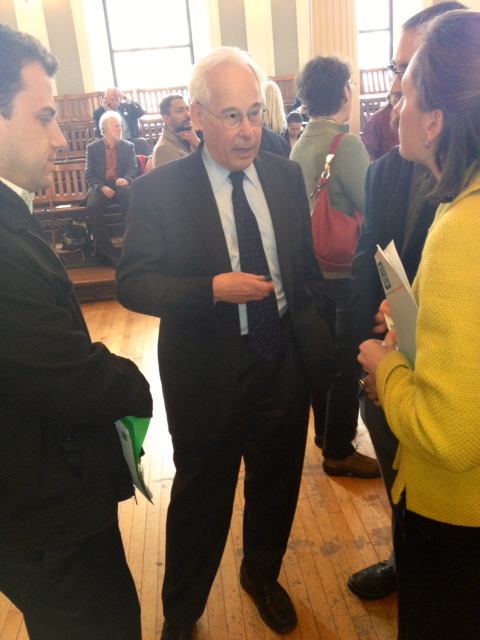
The iconic Speakers’ Hall at Boston’s Faneuil Hall hosted a good 500 environmental issues citizens at a candidates Forum earlier today. All five Democratic candidates participated; Charlie Baker did not; but yesterday he announced that he too was taking the Forum’s “1 % pledge” to dedicate at that much of every year’s State budget to what the Forum calls “environmental justice.”.

Moderating the Forum were the Boston Globe’s Derrick Jackson and former Romney administration official Douglas Hoy. Each asked hard questions, as the advance fliers for the Forum promised. Unhappily, it was hard to hear what they were asking. Foy spoke as if at a dinner table. Nor were all of the candidates’ answers audible.

Nonetheless, what I did hear left a sufficient impression.

For every single question, Treasurer Steve Grossman had ready a well prepared answer, almost too well prepared. Even when answering the Forum’s last question — which Derrick Jackson said was a throwaway — of water issues, Grossman spoke a full brief  on what he would do to safeguard the state’s water supply, delivered as rigidly as a water pump whose attendant had flicked the “on” switch.

Image

Steve Grossman : needs to tone it down a few hundred pegs

Juliette Kayyem continues to converse at length, as if presenting a suggestion at a think tank symposium, rather than say “this is what I will do as Governor.” (One exception : she will oppose the ballot initiative that would repeal gas tax indexing.)

Joe Avellone continued to emerge from his very grey personality and to get usefully specific on several topics, including the gas tax, carbon tax, and the state’s “20,000 gas leaks,” as he was the one to point out, ending with “fix the gas leaks !” Even then, however, he sounded more the local town official he once was than a Governor evoking the big picture.

Martha Coakley attuned better to the questioners’ intentions than at prior Forums. She gave the best answer on Jackson’s “fish versus fishermen” question and often played The Flexible Thoughtful One, against Steve Grossman’s Mr Know It All. She also made clear that she was not about to commit, on the spot, to the Forum’s many yes or no pledges.

Don Berwick gave the best answers to most of the Forum’s questions and showed that, while he is the Democrats’ purest progressive, he is not just a dreamer. Alone of the five he said that no, he would NOT divest the State’s investment money from corporations not environmentally green. And why ? His answer was as smart as it was obvious: “I’d rather continue to be a shareholder and work to change corporate policy from within.” Berwick made the other four look spineless.

The Forum wamted everything. It wanted wind power, a carbon tax, fish over fishermen, conservation of land, of forest, and of water; it wanted fossil fuel usage cut back. It wanted alternatives to cars. And, as usual with groups that want everything, it looked selfish, and it was good to see some of the candidates — even Steve Grossman, who rejected cutting the gas tax because “we need it to do our transportation work” — sometimes say no. Particularly embarrassing were the candidates’ jellyfish answers to “what have you personally done to lower the carbon footprint” or “what was your most recent recreational activity.” I so wanted one of the five to announce, “my most recent recreational activity ? I drove a stock car at a NASCAR race !”

That said, the Forum left me far more uncertain than I had been of which Democrat is actually likely to be an effective Governor. My opinion had been Steve Grossman; but I am beginning to tire of his overly prepared advocacy. Can he not just once grope for an answer, or say, I will have to think about it ? Is he really just Governor Bot ? I have found Martha Coakley to be snarky, but today, after listening all Forum long to Governor Bot, she sounded remedially human in comparison. And as the two Democratic biggies made no secret of differing sharply with each other, personally as well on policy, I found myself on Coakley’s side troublingly often. As for the others, I am frustrated still. I would love say Juliette Kayyem is it : she is THAT stunningly chic and charismatic. But her persona is so much the think tank participant, almost never I Am The Leader. She should plug into some of whatever Steve Grossman is bot-ing.

Image

^ one on one is Juliette Kayyem’s forte’

This leaves Joe Avellone, who simply lacks the bigness of vision for this race, and Don Berwick, who has hitched his lucky star to several pie in the sky adventures — no casinos, single payer health insurance, a graduated income tax — that won’t happen and, except for single payer, probably shouldn’t. Yet Berwick showed at this Forum — and has, at times, at others — that he can be very smoothly practical when he has to be. I have imagined the Big Dogs of the legislature laughing Don Berwick off, as they let him talk and then do what they were going to do anyway — because they, not the Governor, have the power. After toady, I think Don Berwick just might be able to play cards with them — even win a few games.

—- Mike Freedberg / Here and Sphere

SCHOOLS REFORM : THE “ACT TO FURTHER NARROW THE ACHIEVEMENT GAP” — WHAT WE LIKE AND WHAT WE DON’T

Image

^ stalling the huge reform, maybe for good reason — one hopes ; St Senator Sonia Chang-Diaz

—- —- —-

Much energy from the usual suspects in schools reform matters has decried the exquisitely named “Act to Further Narrow the Achievement Gap” that now sits “stalled” in the legislature’s Education Committee. To find out why, and to assess the opponents’ arguments, one need first to actually read the proposed bill.

Please do so before going on to read my words. Here’s the link : http://www.bostonfoundation.org/uploadedFiles/Sub_Site/web_specials/Race_to_the_Top/An%20Act%20to%20Further%20Close%20the%20Achievement%20Gap%20(1.17.2013).pdf

You will have noted that the proposed new school law is twelve (12) pages long and has twelve (12) sections. Each has its points; some merit more discussion than others. As for the Bill in its entirety, you will have noted its language to be procedural. This is a law for administrators; not a law for teachers.

Were it a law for teachers, it would give some guideline, at least, for what teachers are to teach, and how, and in what spirit. This, the law does not do. It’s a law for superintendents, evaluators, testers, commissioners of education. All of which limits the law’s reform reach and thus details the devils.

The more a law clings to details, the more opposition it will draw. Each detail of an administrative directive inconveniences those who administer. From mastery of the process, they return to being beginners, having to re-learn all over again what it is they are supposed to do. Of course they don’t like it.

It would have been far wiser for the reform bill to set general goals and empower generally. Then the persons affected could work out for themselves how to devil the details; and all such work-out discussions would have given the affected persons personal input into making it work. This new law denies them that. It’s a directive — a tsarist ukase. Little wonder that the established interests are complaining and that key staff are opposing.

That said, the law commits to some very useful tasks :

It grants a superintendent strong power to make the administrative, staffing, and curriculum changes that he or she sees fit, the objective being to improve the performance of so-called “underperforming schools.”

It allows for additional charter schools, above the 140 charters already allowed by MGL c. 71 : but, unwisely, only in districts that fall within under-performance results specified in section 4 of the bill.

It identifies what school performance falls short of stated standards and thereby gives the superintendent a flash point at which to intervene comprehensively.

Let me note right away that everything the reform bill grants to superintendents, John McDonough is already doing as interim superintendent of the Boston Public Schools. This part of the reform law would be difficult for even the most change-averse teachers union to object to.

Much more controversial is Section 4’s creation of an under-performing school district exception to the 140 charter school limit in the current MGL cl. 71, section 89. In the context of the law’s drastic superintendent takeover of under-performing schools, this charter school exception feels like punishment : not only are the personnel of an underperforming school district to face an entire, superintendent make-over of everything they do, including keeping their jobs, but, with the charter school creation possibility, they are put in the position of losing students notwithstanding how they might improve performance under direct superintendent management.

It would be far wiser for the proposed school law to choose one or the other — superintendent takeover, or charter school creation — but not both. Superintendent takeover threatens the jobs of poor teachers; charter school establishment threatens all the affected District’s teachers.

The consequences of this provision in the proposed law leads it almost inevitably to its most objectionable provision : Section 2(g), in which superintendents are given the power, when confronting an under-performing school or district, to alter the compensation, hours, and working conditions of school staff. I don’t think it wise to threaten the pay of the very people whose enthusiastic support the law needs if it’s to work. as for hours of work, everybody agrees the school day should be extended; but i there any reasonable objection to the teachers’ insistence that they be paid for working longer hours ? I think not.

I’m also not a fan of that provision in Section 9 which, in case the Commonwealth is approaching its “net spending cap,” gives preference to charter school providers who operate in more than one municipality. Why so ? No charter school should be like a bank’s branch office, understaffed maybe and offering fewer services. I trust the proposers will explain ?

To sum up : the reform bill contains many valuable provisions, assuming that a bill almost purely administrative is advisable, and that micro-managing the administrative requirements is realistic. The charter school exception, however desirable, makes its entrance on the wrong foot and in the wrong way. it should be the subject of separate legislation and should NOT be tied to under-performance issues and administration. Heck ; if charter schools are good — and I strongly support them — why should only children in under-performing districts have extra access to them ? Has no one learned anything from the Special education experience ? parents, seeing that special need children could claim an individualized curriculum, did everything in their power to get their children designated as special needs so that they too could get an individualized curriculum plan. I can easily see, under this proposed law, parents seeking to have their kids’ school designated as under-performing so that their kids would have a better chance of winning a charter school placement lottery.

This is what happen when you try, by laws, to do too much. You end up with laws that work opposite to the intention, or which can’t get enacted at all because they coalesce many kinds of opposition.

Pare down the bill, make it less administrative, put its page after page of do-this detail — especially the per pupil tuition reimbursement formula ; my goodness me ! — into a regulation, and give the statute some room to flex and develop. Then offer it for enactment. Until then, I think not.

—- Mike Freedberg / Here and Sphere

MAGOV14 — FORUMS, CHARLIE BAKER, & MONEY BOMBS

Image

^ huge SEIU candidates Forum last Saturday that Charlie Baker by-passed despite “repeated invitations sent,’ the SEIU program painfully  made known.

—- —- —

Hard on the heels of last Saturday’s hugely attended SEIU Forum on the “low wage worker crisis” comes a Governor Candidate Forum at Faneuil hall this Friday. It begins at noon. The subjects this time are Energy, the Environment, and the Innovation Economy.

You would think that GOP leader Charlie Baker would want to be on stage at Faneuil hall. Its topics are his bread and butter. 28 citizen organizations are sponsoring the Forum. How can a serious candidate for Governor decline to participate ? As Baker also declined the SEIU Forum ? I ask the question rhetorically, because Baker has indeed declined both.

This is what one would expect of the rejectionist GOP, the Tea Party that looks upon Massachusetts’s broad and diverse citizenry as an enemy.

Baker isn’t Tea Party at all. Just the opposite. So what gives ? His apologists say that he is visiting people and neighborhoods everywhere; fine and good; but that is what Scott Brown did for his entire three years as our Senator, and it didn’t get him re-elected.

As I see it, by not participating in an issues Forum set up by citizen organizations that expend much time and money to make them happen, you send a message entirely negative, a disrespect for citizens who care, as well as for the issues that they care about. We’re not talking gun nuts here, or rabid anti-taxers. We’re talking citizen reform — core of what the Massachusetts GOP has always been best at.

Skipping out of such events is the wrong thing to do. It makes me question the seriousness of Charlie Baker’s candidacy.

That Baker has the GOP convention on tap this Saturday is no excuse. His nomination is assured, and it could only enhance his candidacy to speak sharply on the issues at very public Forums widespread reported in the media.

Had Baker a huge money advantage, a case could be made that he is the people’s choice already and needn’t participate in Forums where his candidacy might find itself challenged. I think this a wrong argument, because why shouldn’t his candidacy be challenged ? if Baker cannot respond to challenges — many of them — on a face to face basis, he shouldn’t be running. In any case, he does not hold a vast money lead. The six candidates — the five Democrats and Charlie Baker — reported the following donations, expenses, and ending balance for the month of February :

Charlie Baker

beginning 562,808.84
receipts 209,425.05
expenses 184,735.99
ending bal 587,497.90

Steve Grossman

beginning 1,048,299.70
receipts 91,091.67
expenses 129,780.51
ending bal 1,003,619.86

Martha Coakley

beginning 494,328.43
receipts 184,245.04
expenses 175,951.68
ending bal 502,619.79

Juliette kayyem

beginning 160,119.47
receipts 65,038.58
expenses 108.454.20
ending bal 116,701.85

Don Berwick

beginning 174,376.01
receipts 116,670.06
expenses 139,326.80
ending bal 151,819.27

Joe Avellone

beginning 142,166.73
receipts 14,718.37
expenses 35,512.55
ending bal 121,372.55

Charlie Baker raised more money than anyone in February, but not by much more than Don Berwick, and his money on hand pales in comparison to what Steve Grossman — the clear Democratic caucus winner — commands. Baker barely has more money than Martha Coakley, whose fundraising in February picked up significantly.

Baker’s donations also arise from the usual sources ; CEO’s, high powered lawyers and developers, and residents of old-line GOP towns like Boxford, Hamilton, and communities in the Mid-Cape (Cod). In his February list I couldn’t find even one donor from Baker’s home town of Swampscott. It’s possible that I missed one; but there sure weren’t many. It’s possible, too, that big name Governor GOP donors already maxed out ($ 500 per year per person) in January; I hope so, because I saw very few such on Baker’s February list.

Meanwhile, donors to the five Democrats span pretty much the entirety of diverse Massachusetts, including even CEOs. Massachusetts works best when we pair an innovative GOP Governor with an institutional boss, Democratic House Speaker. But to get that pairing, Baker will have to step it up and be BOLD. He has been a leader on many issues this time around — look at his support for the Minimum wage hike, contrary to GOP orthodoxy — but as i see it, he needs to be bold on everything. And bolder.

—- Mike Freedberg / Here and Sphere

UPDATE : The Boston Globe today opines that Charlie baker will get more than enough delegates to keep his Tea Party rival off the Primary ballot. this has been my view for at least the last ten days. It makes me all the more bewildered why Baker has avoided attending and speaking at major Citizen Forums. Is he afraid that if he does, the anti-everything GOP that he has spent the last three years buying off will rise up and snarl ?

5TH SUFFOLK SPECIAL ELECTION : EVANDRO CARVALHO

Image

^ Team Carvalho. Evandro is second from left in back row.

—- —- —-

Of the four candidates seeking votes on April 1st, a mere 16 days from now, Evandro Carvalho may be the most traditional. He is of Cape Verdean lineage and, in a field with three candidates who are not Cape Verdean, hopes that his lineage will push him to the top. This is ethnic politics as it used to be.

It’s a feasible, even sensible, plan, because the 5th Suffolk District includes almost all of Boston’s Cape Verdean voters. They vote. In last year’s Mayor Primary, John F. Barros — Cape Verdean and a resident of the District –captured 2,071 votes within the 5th Suffolk’s precincts. He finished first of the then twelve Mayor hopefuls, almost 600 votes ahead of number two, Charlotte Golar-Richie, and 1300 ahead of Felix G. Arroyo, who finished third.

I interviewed Carvalho by telephone and then next day visited him at his Bowdoin Street headquarters. There, hard at work with laptops, voter lists, and canvassing packets were his field staff and his parents. Carvalho was on his way to door-knock, with his campaign aide alongside, and so I couldn’t supplement the phone interview — in which Carvalho told me of his work as an Assistant Suffolk county District Attorney — working for District Attorney Dan Conley — posted to the Roxbury District Court. There he prosecuted gun crimes — certainly one of the 5th District’s major concerns. As his hand out card adds, “there he saw first hand the cycles of poverty and violence that put our young men and women in the system” —  he means the criminal justice system. It’s what all the 5th District’s candidates talk about, and it is real. The 5th’s Bowdoin-Geneva neighborhood is one of Boston’s most violent.

Carvalho could make a fair case for electing him based on his prosecutorial experience alone, but he spends more time talking to me about education. “I am for universal pre-kindergarten,” he affirms, but is not “sure what to do about the charter cap. We have to keep funding the Boston Public Schools, and we need more of vocational career schools.” Schools funding is an issue that galvanized last year’s Mayor election and will certainly commit a large chunk of the 5th District Representative’s work on Beacon Hill.

He also supports raising the minimum wage to $ 11.00 an hour and wants to see a jobs and development initiative in the District — he’s glad to welcome such an initiative to Dudley Square, which lies just outside the 5th Suffolk, if as some reports have it, the initiative actually happens. But just as important are “more construction jobs within our community, and we just have to make it easier for people within the community to get access to loans, perhaps in partnership with the City.” The loans he has in mind are business loans, a major need throughout the 5th Suffolk, most of whose commercial streets feature only Mom and Pop store fronts of no great prosperity.

This is an issue which he certainly will be able to discuss — probably already has — with John Barros, who now serves as Mayor Walsh’s Chief of Business Development. Carvalho never comes out and says so, but one of his strongest appeals is to the Cape Verdean solidarity that centers on Barros, a local hero.

Carvalho doesn’t know yet which House Committees he’d like to serve on. He’s completely focused on getting elected. Can he ? The votes are there to make it happen, if they vote on April 1st. One advantage Carvalho definitely has : his votes are going to be his even if, as expected, expelled Representative Carlos Henriquez runs again in September once he’s out of jail. Henriquez commands a following that feels he got a raw deal. But Henriquez is not Cape Verdean. The votes that Carvalho gets will be his no matter what. He seems likely not to be just a temporary office holder.

This might just seal the deal for Carvalho, who as a prosecutor is the opposite of the man he seeks to replace

. —- Mike Freedberg / Here and Sphere

Image

MAGOV14 : FIVE VISIONS FIVE AT SEIU CANDIDATES FORUM


photo (45)

^ the Forum Five (photo courtesy of Chris Condon of SEIU local 509)

Since I last saw the Democratic Five at a candidates’ Forum — about six weeks ago — all have sharpened their profiles considerably. On stage at the SEIU (Service Employees International Union) candidates Forum today, there was lots of specifics, even some debate, and only a touch or two of the vague.

Specific, the five needed to be today. The SEIU’s members do the campaign grunt work and they have an agenda that they insist upon — and which they’ve proven, time and time again, they have the muscle to see enacted. Every one of the five badly wanted the SEIU endorsement. They want its game-on. They need it, and they made their need plain to the gathered attendees — at least 500 strong, a massive showing on a Saturday morning.

In return, SEIU members know which candidates have a chance to win the race and which ones probably don’t. So how did the five do ?

Image

First, Steve Grossman.

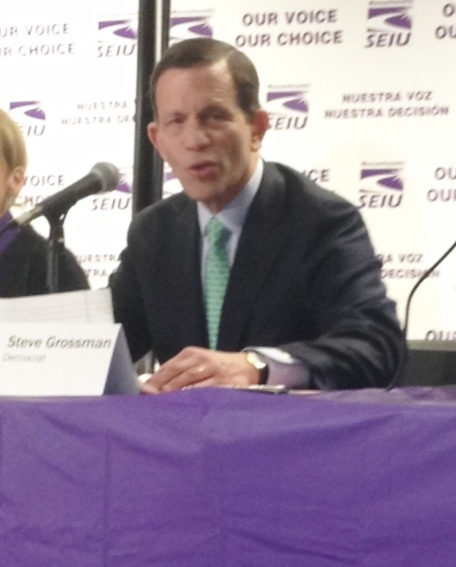
Grossman reminded the gathering — maybe too many times — that they had endorsed him before, and he had always kept his promises and “stood with” them on strike lines and issues fights. He gave voice to more specific agenda items than any of his rivals — policy points are his great strength. But he missed the point of one question — about restoring rights to ex convicts : the right the questioner wanted to hear about was voting right restoration — and, addressing the minimum wage, he said that “I will veto any minimum wage bill that includes an unemployment insurance give-back !” As this give-back is Speaker Robert DeLeo’s price for supporting the minimum wage hike, Grossman opened up the door to a running fight with the Speaker — who, like his predecessor during the entirety of Deval Patrick’s two Governor terms has proven that the Speaker always wins such fights. And that any Governor who fights him comes away weakened. Grossman either is just blowing smoke here, or he has ceded the entire minimum wage issue to Charlie Baker, the almost certain GOP nominee, who has said — no ifs ands or buts — that he accepts Speaker DeLeo’s give-back and can thus get the $ 11.00 per hour minimum wage hike enacted. (Baker has also made the issue of expanding the earned income tax credit his own, and it was interesting to see that at least two of the candidates, Coakley and Avellone, mentioned expanding earned income credits. Two months ago, no Democrat at Forums mentioned it at all.)

Image

Second, Martha Coakley.

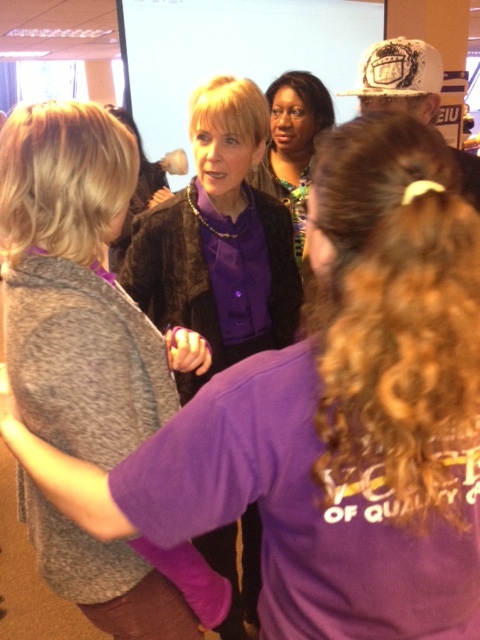
Coakley campaigns with a light touch and an eyes-up grin that often feels snarky. She took a middle route at the Forum : not endorsing driver’s licenses for undocumented people, refusing to grant bargaining rights point-blank to public defender lawyers, sliding away from Don Berwick’s single payer health insurance call. Coakley played careful lawyer : she made clear that she agrees with SEIU’s wage hike and immigrant rights agenda, but maybe not on as all-in a basis as SEIU would like to see. Coakley spoke personally about mental health issues, and with real life stories about income equality; and before the Forum began she posed for many pictures with SEIU’ers who smiled like crazy to be photographed with her. She even said “we have to improve the economy for everybody.”

Image

Third, Juliette Kayyem.

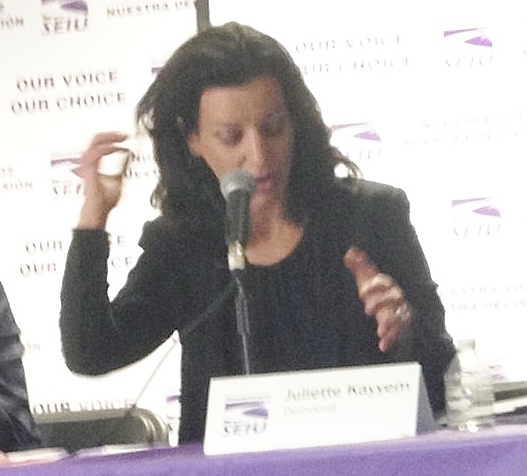
Kayyem continues to converse at times, in a Forum setting where conversation wanders off message. But she has become much, much more forensic in her approach; at SEIU she made big, clear points addressing criminal justice reform; she rejected Don Berwick’s single payer call, saying “even if it can be done, it can’t happen until 2018. we need a Governor for right now.” Obviously, Kayyem has realized that sweetness and glamour — which she owns in this race — must bring toughness and advocacy aboard. Yet the generalities continue. She said “Massachusetts has done well but we can do better.” Better how ? She posed an actual plan: “three points…Save, share, and grow. save money in criminal justice spending. share it by setting up a ‘green bank.’ Grow by investing in education and comprehensive immigration reform.”

Kayyem stressed her immigrant roots; that she’s a mother and wife; and — taking full advantage of being two decades younger than her rivals — that she is “the young generation ready to govern.”

Image

Fourth, Don Berwick.

Berwick has no peer when discussion turns to health care. If he were running for Massachusetts Commissioner of Health and Welfare, he’d win by acclamation. He decries our state’s health care failings — its waste, high cost, inequities — as rigorously as Baker is likely to do. Berwick also speaks to income inequity and the “low wage crisis,” as SEIU’s Forum hosts put it, as passionately as anyone, maybe more. But Berwick overshoots the progressive mark. His solution to the health care system’s failings is single payer — a worthy idea, but it isn’t going to happen soon, and as Kayyem said back at him, “we are electing a Governor for now.” Berwick also seeks a graduated income tax (though he didn’t call it that), an idea that Massachusetts voters quite a while ago rejected in two separate referendums and which would hardly entice to our State the businesses which every Forum candidate, Berwick included, say that Massachusetts needs.

Image

Lastly, Joe Avellone.

Avellone speaks authoritatively about the state’s drug abuse crisis, about recovery and re-entry, and about CORI reform. nd like all the Forum candidates, he supports raising the minimum wage and protection of low-wage workers’ bargaining tights, including extending them to hospital workers who don’t know have that right. Still, Avellone barely seems a possible Governor rather than what he has been, a town selectman. At no place in the Forum did he address the big picture, the massive responsibility sphere that we entrust to the state’s Governor. The Big Dogs of the Legislature would eat Avellone for lunch. So might the State House lobbyists. Avellone made some friends at the Forum; I doubt he won many members’ endorsement.

It was too bad that Charlie Baker wasn’t at the Forum. He had a delegate rally of his own to attend, in Saugus; and the GOP convention takes place next weekend. Still, an opportunity was missed. Baker could have addressed the health care issue authoritatively; the minimum wage and earned income credit; criminal justice reform; homelessness; schools reform; and jobs and innovation — even bargaining rights. It would have been an opportunity to expand his personal reach where a reformist candidate needs be : directly into the most important front of the labor movement, the fight against low-wage situations and all the burdens that low wage work puts on workers and taxpayers alike.

—- Mike Freedberg / Here and Sphere

THE SALLY CRAGIN REPORT : WHAT TRI-TOWN’S UP TO IN MID-MARCH 2014

Image

Still here! On the sphere…. Which is increasingly snow-covered.

Here are some bullet-points from the North County. Where you can ski. Cheaply or for free.

Wachusett has their end of season deal where you get a full pass for $139. I was there with my kids last weekend skiing on a senior pass (hey, it works) but a good friend who works there is adding my crew to her friends and family pass for the rest of the season and now I’m out of my mind with frustration because since then it’s rained, or I’m busy. We got 3 inches last night so the hope is to GET THERE sometime this weekend. We’ll see. . . .

—- —-

In other news, our friend Representative Stephen DiNatale just sent out a reception card for an April event. He was the first person to speak out against a group trying to impose a charter school here when we had public hearings at the library. Yes, I know. Many of you are in Boston and have a different view of charters. Out where we are, the formula is such that cities like Fitchburg, Lawrence and Lowell, Fall River, Holyoke and Springfield and Worcester have a lot of English language learners, special education, transience and poverty and special ed.

Guess what ? by the way the state currently reckons things, we’ll ALWAYS be in the bottom ten percent. Senator Patricia Jehlen of Somerville is working on a communication to go to the Commissioner requesting that district scoring methods be altered to reflect a more accurate assessment which includes GROWTH versus ACHIEVEMENT.

What does that mean? Growth means that a student who comes in September with all those needs (ELL, SPED, etc.) and works hard with talented and dedicated teachers and rises from “failing to the lower end of “proficient” or even the upper end or “exemplary” will be judged on that. Not on whether he had a good day with the MCAS. That’s achievement and that measures one day, not 180 days.
—-
What else ? Time to take my daughter to school.

NOTE : the file that Cragin refers to in this portion of her report could not be opened with our software. Wen we locate a program to o[pen it, we will embed the file in this story. Thank you for your patience — the editors.)

Here’s Hector and Theresa and Bear. (sorry if pic is fuzzy! Everyone moves quickly…)

This is a picture of Bear (the little pup), his owners Hector Vargas and CNA Theresa Neuhaus. These three have joined our ACE in the Schools program as Bear is a service dog. ACE stands for Animal Care and Education. We help shelter animals, animals in need and educate school children and families about pet care responsibility.

Hector was born with spina bifida and has been in a wheelchair his WHOLE life. Bear alerts him whenever a seizure is coming on OR tries to get him to revive from a seizure AND alerts Theresa, who is Hector’s live-in CNA and a friend of his from high school. It’s an extraordinary story. Bear was at Fitchburg Animal Shelter last fall, and Shelter Manager Amy Egeland knew that Bear had a “special purpose,” but she didn’t know what that was until Theresa called looking for a service dog for Hector.

Hector grew up in Fitchburg, and is currently 37 years old. He had troubles in school but eventually received his diploma and every day fights some really serious health battles.

This morning, Bear, Hector and Theresa spoke to two groups of kids at Memorial middle school today and kids got to meet Bear afterwards. All told, more than 600 kids!! Thank you Hector J. Vargas and Theresa Neuhaus for sharing your story. It touched a lot of kids and Bear was really great in an unpredictable environment. The kids asked great questions including how many cats and dogs the Shelter saves and what food to feed their pet.

We are encouraging ALL the kids at ALL the schools we speak to to start an ACE club!! The sad part of this visit was hearing from too many kids about neighbors who tether a dog on a porch or outside. However, it is great to get clear information to kids — that their pets will live LONGER if spayed and neutered and that if you can’t take care of an animal it’s okay to surrender to the Shelter rather than turning it out. Smart kids, smart questions, a great morning for all.

And enormous thanks to Hector and Theresa who took the Mart bus to Parkhill Plaza and then hoofed it all the way to Memorial. They are a great team and the kids who heard their story were very affected by it.

— Sally Cragin / The Tri-Town Report