THE REFUGEE CHILDREN : AROUSING MASSACHUSETTS’S DARK STRAIN OF UGLY NATIVISM

1 refugee chilren

^ 1,000 refugee children : a threat to white picket fence, suburban fantasies ?

—- —- —-

By the narrowest of margins, according to Boston Globe’s poll of opinion on the refugee children coming to Massachusetts, our State passes the moral test.

It appears that a bare 50 % of voters support Governor Patrick’s plan to shelter 1000 refugee children temporarily, with 43% opposed. The poll also finds that only 52 % of Massachusetts voters favor a path to citizenship for immigrants here undocumented.

Not surprisingly, the poll finds that 79 % of Republicans oppose Massachusetts housing the children. More surprising is that only 69% of Democrats favor the children. Independents are evenly split; younger voters more inclined to favor the children than older.

You should read the entire Globe article : http://www.bostonglobe.com/metro/2014/07/22/voters-wary-immigration-split-patrick-plan/215sbf5pmQCVkgdzoxUVoI/story.html

Some observers want to say that the poll’s findings contradict Massachusetts’ reputation for progressive views. I disagree with this. On immigrant matters, Massachusetts voters have always exhibited a nativist, even violently bigoted, strain, beginning with opposition to Irish Catholic immigration in the 1830s-1840s and continuing with opposition to Italian and Jewish immigration in the period 1900-1919. Who can ignore the burning, in Charlestown, of a Catholic convent, in the late 1830s, by Protestant nativists ? Or the rise of the anti-Catholic “know nothing” party in the 1850s ? Or the Sacco-Vanzetti case that roiled Massachusetts for seven years beginning in 1920 ?

Allied to our nativist strain has been, at times, an equally fierce slice of out and out racism. Who can forget the school busing crisis that beset Boston in the 1970s and poisoned the city for almost twenty years ? Or that the suburbs, asked to share the desegregation burden — and it was a big one — refused to do so ?

Housing segregation has also been — continues at times to be — a dark presence in our state. Though our cities are strongholds of amazing diversity of peoples, the suburbs almost entirely lack the presence of people of color and of diverse origins. Much suburban policy is directed to keeping diverse peoples out. It is there that one finds movements to repeal the MGL c. 40B housing law. Suburban gate-keeping is why the Blue line has never been extended, as it should be, to the North Shore; why the Orange Line has never has made it past Forest Hills — to West Roxbury and Needham, as has been proposed in times past; and why communities constantly fight — by means fair and foul — the construction of affordable housing.

The same division also affects lifestyle civil rights for people living in Massachusetts. Though our cities have fully embraced and mainstreamed LGBT people, most of our suburbs have not. It’s one reason why Massachusetts still hasn’t enacted full civil rights protections for transgender people despite 17 other states having done so. Progressive we are, on economic issues; on diversity issues, we barely pass the moral test.

A Republican candidate for statewide office — his name John Miller — issued a statement yesterday in which he made plain that to him, the refugee children are first of all a public health crisis and a budget burden. Not a word about their humanity ! It made me angry to read his statement. It makes me angrier still to know that an actual candidate said it.

Guess what, Mr. Miller ? The refugee children are not coming to your picket fence Ozzie and Harriet-ville. They are coming, almost all, to our cities — our overcrowded, triple-decker, public school, dance culture, pig-roasting, ghetto-fab — cities, as their predecessors always have.

Myself, I welcome the children. I wish all 57,000 would come here and impart their enthusiasm and diversity to cities already enriched by thousands of Viet Namese refugees, Haitians, Cape Verdeans, Somalis, Trinidadians, Iranians, Albanians,Koreans, Syrians, Iraqis, Bosnians, Irish. Ride the bus into Boston, and you will see them — taking always the hard road, because we deny them drivers’ licenses, to hard and thankless jobs. Ride the “T” and you will see them again. They keep our society going. They are our drive train, the diesel for our engines, the stokers in the stokeholds. I take my hat off to them and wish their children a rapid rise to the top of a nation that should be grateful for their coming here and thankful as hell if they choose to stay here and make us a better and more imaginative society.

I only wish that those who do not, like me, live in our cities, could see what I see, feel what I feel. Maybe someday.

—- Mike Freedberg / Here and Sphere

MAGOV14 : CHARLIE BAKER’S BEST POLL NUMBERS YET SEND A MESSAGE

photo (15)

^ being a Massachusetts governor means speaking Massachusetts language : Charlie Baker speaking Massachusetts-ese to voters at a meet and greet

—- —- —-

The Boston Globe’s new poll of Massachusetts’s Governor election yields Charlie Baker his best numbers yet. He now polls 36 percent, while his likely Democratic opponent, Martha Coakley, draws only 39 percent.

Last week, the same poll had it Coakley 40, Baker 35. And that poll was a better Baker result than the previous Globe poll, which showed Coakley at 40, Baker at 32.

Clearly, Baker is amassing support, and doing so the best way : slowly, gradually, one voter at a time, so to speak. He is doing it as it should be done : by increasing his own support, not by taking support away from an opponent.

The strongest campaigns take care to run themselves : not to negate the other guy or gal, but to create a Yes and add many Yes’s to it. Positive support is hard to lose. Voters voting against one candidate can be swayed easily; their loyalty is to “dislike,” not to a candidate. Baker will surely take votes from people disliking his opponent, but he much prefers — or should much prefer — votes that want him no matter who the opponent is.

Baker seems to understand that in Massachusetts, voters for offices other than national do not vote party, they vote the man or woman. And though in November, there’ll only be two candidates, it’s much wiser for a candidate to run against all of his or her rivals than to pray for the “right” November opponent. Baker is doing that. He is running as if he, Coakley, Grossman, and Berwick were all in the same primary. This is how one wins in Massachusetts.

One runs for Governor of Massachusetts not on a party basis, because the issues aren’t party issues. 80 % of Massachusetts voters know what they want : a positive agenda, progressive but not pie in the sky, well managed, reformist, sensible and flexible, on issues economic, administrative, judicial; on energy policy, criminal justice, immigration. The one issue that almost all Massachusetts voters agree should be uncompromised is civil rights. A governor must voice passionately full rights for every sort of person. A governor candidate who trims on civil rights is in trouble; one who opposes them is toast.

Because 80% of Massachusetts voters agree on what they want and to what degree, the deciders become (1) who can do the job the best (2) whose priorities do we want and (3) who can best work with the Legislature to get them done.

None of this is a party matter. Baker gets this. His campaign has been devoid of party bias. He is campaigning in Massachusetts language and doing so convincingly.

Baker is quite lucky that none of his three opponents matches his command of Massachusetts-speak. Berwick cannot do so because his policy agenda is too radical. Coakley cannot do so because she speaks vague rather than competence. Steve Grossman can’t do so because his support rises from the Democratic party voters who insist on being Democrats first. The party Is their agenda, as it is not for at least two-thirds of Massachusetts voters. Only of late — probably too late — has Grossman begun to sound less like a Democrat and more like a Massachusetts. He remains far, far behind Coakley in the new Boston Globe poll.

But now to the Poll and its message about Baker.

Baker’s favorable-unfavorable-not well enough known numbers are 47 to 18 to 35.
Coakley’s numbers in this regard are 54 to 37 to 9.
Grossman’s numbers here stand at 33 to 14 to 52.
Don Berwick’s numbers embarrass his progressivism : 10 to 5 to 85.

Head to head, Baker gets 36 percent to Coakley’s 39; 37 to Grossman’s 29; and 42 to Don Berwick’s 18.

On the issues, Massachusetts voters differ hugely from voters in “red” states :

Do you own a gun ? 66 % say no, only 30 % say yes.
Should we have stricter gun control ? 47 % say yes, 35 % say we have enough; only 15 % say we should have less gun control.
Should the casino law be repealed ? 51 % say no, 41 % say yes.
Do you feel safe at night ? 96 % ay yes, only 4 % say no.
Do you feel safe walking your neighborhood at night ? 84 % say yes, only 13 % say no.

Clearly Massachusetts voters are not ruled by fear and thus are not obsessed by guns. Indeed, far more people (37 %) have a very unfavorable opinion of the NRA than the 17% who have a very favorable opinion of it.

28 % of our voters identify as liberals, 28 % as conservatives, although of the 39% who identify as moderates there is a 26 to 39 lean toward conservative. Query, however, what Massachusetts voters mean by “conservative.” i doubt that they mean Tea Party or Koch Brothers. Probably more a state of mind than a political agenda.

Massachusetts voters are optimistic about themselves and their community, pragmatic, open minded, wanting reform but not repeal — a way of saying “decided questions should remain decided” — and ready to think as citizens, not loners. Thinking as citizens, Massachusetts voters want a governor who knows what he or she believes in, who can articulate an agenda authoritatively, who speaks the phrases of flexibility, open to new facts and situations, able to change his or her mind if need be, to walk back inadequate remarks without hedging; a shrewd dealer and a good guy or gal who treats everyone as a friend and neighbor.

As you must already have surmised, that is a description of Charlie Baker.

—- Mike Freedberg / Here and Sphere

BOSTON MAYOR : MARTY WALSH MAKES HIS MARK, AND IT’S A STRONG ONE

photo (37)

^ embracing the diversity of everybody : good guy Mayor Marty Walsh

—- —- —-

It took some time, as we knew it would, but after seven months in office, Marty Walsh has definitely put his stamp on our City. It’s a strong stamp inbdeed, one with much good in it. Let us take stock of his strong moves :

1.He appointed a chief of staff, daniel Koh, who is a technology whiz of established brilliance

2.He appointed is best campaign operative, Joe Rull, to be his personnel boss. Rull will hold walsh staffers to account and demand — and get — their uttermost.

3.He has given full backing to Boston Public Schools superintendent John McDonough as “Mac” gradually recreates, top to bottom, how Boston’s schools operate.

4.He appointed as Police Commissioner the best of the likely candidates, Bill Evans, and followed that by appointing the City;s first Police Chief of color, Officer Gross.

5.He added both Felix G. Arroyo and John F. Barros, both mayoral candidates in 2013, to his management team in important policy roles.

6.He has established a real time on line connection to Boston voters and made sure that the City knows of it.

7.He has gotten the MBTA to offer late night service on weekends (albeit not as extensive as hoped for).

8.He has fully embraced the diversity of City life — and diverse people and made sure that all know that they are as cherished as any other City resident.

9.He has made himself a civil rights leader of passion and almost combative intensity.

10.He won from Local 718 Firefighters a new contract that does not break the City budget. He also appointed the best of likely candidates, Joe Finn, as our new Fire Commissioner.

11.He provided the Uphams Corner area, badly in need of funds infusion, a large grant for establishing an arts center at the Strand theater.

12.In a move straight out of “The Last Hurrah,” he, son of Irish immigrants, told the still Yankee-ish Beacon Hill, which has often viewed itself as exempt from City directives or even common social decency, that he will install legally required handicapped accessibility ramps in the area, and do it now : no ifs ands or buts.

Much remains to be done. Walsh’s Mayor staff still hasn’t mch diversity. The City continues to be often unsafe, its nightlife discouragingly segregated, its schools in transition, its neighborhoods unevenly developing, its internet connectivity patchy in places, its jobs growth still stacked against the City’s poorest neighborhoods. Taxi reform has yet to unfold from its currenty “investigation” stage. Traffic jams beset the entire Central Artery. The BRA hasn’t yet a new director. Much of the City’s technology remains several phases behind the times.

But many of these are, challenges well beyond the power of any Mayor to remedy. To remake Boston’s most entrenched failings Walsh will need lots of help from Beacon Hill and Washington. Huge income inequality impedes the City, and it is worsening every day. There’s little that Mayor Walsh can do about it, though the recent law raising our state’s minimum wage to $ 10.50 an hour (up again to $ 11.00 in 2016) will help him, a little.

Walsh will have to tackle the BRA, and soon. He will need to make clear to devlopers that they will no longer command tyhe City’s tax rules. Housing devlopment needs to rfocus, from luxiury condominum projects to dwellings for middle and working class families. Boston has done a marvelous job of becoming an entrepot for the money successful. It now needs to become a good home for those for whom money success remains a pipe dream.

That said, Walsh has made a good beginning — about as strong a first half year as could be expected, maybe, of any new Mayor. Optimistic I now am about what he will achieve in the coming two years before he readies facing the city’s voters in 2017. i actually look forward to the City that he will be shaping in that coming time frame.

— Mike Freedberg / Here and Sphere

MAGOV14 : BERWICK AND GROSSMAN DOMINATE SKILLS FORUM; BAKER ABSENT

photo (55)

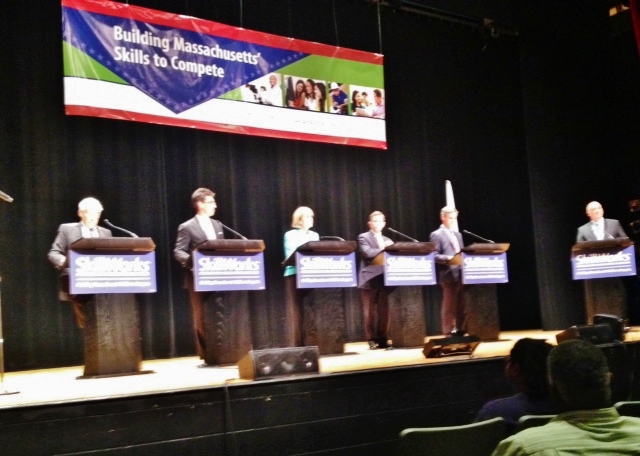
^ the five, but no Charlie Baker at Boston Foundation’

s Skills Forum at Roxbury Community College …

—- —- —-

The big news about the Boston Foundation’s Skills Forum on Wednesday night at Roxbury Community College is that Charlie Baker wasn’t there.

Every time looked at the five candidates who were there, or listened to them answer a question, all i could think was that the 200 or so people in attendance weren’t going to find out what the candidate most likely to be our next Governor has to say to Boston’s Skills community.

Even though his name was never mentioned, Charlie Baker had to be on everyone’s mind.
All the more so as many of the five — Don Berwick, Evan Falchuk, Martha Coakley, Steve Grossman, and Jeff McCormack — gave answers sometimes informative, occasionally innovative, once in a while brilliant, but also often vague or off topic.

Questions were asked by Forum moderator Peter howe and by some who he called “real people” : audience people, including young graduates, business hopefuls, and owners of growing start-ups, many of them immigrants.

photo (54)

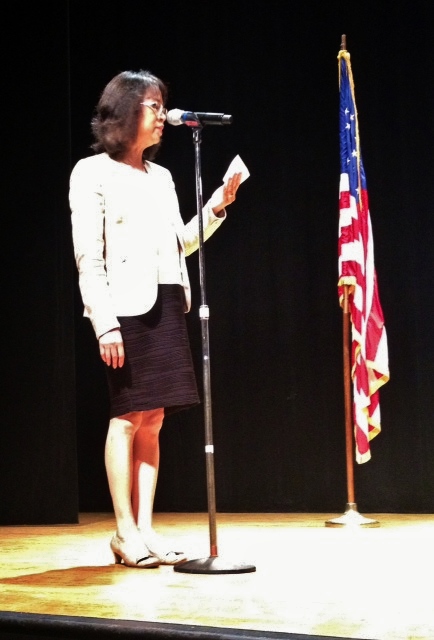
^ Agnes Young of new tech firm Equitron Inc., asks question

Don Berwick hit the evening’s home run when, in answer to a question posed to all, “what was your first job and what did you learn from it,” he said “I was a waiter at a summer resort in my home town, and I will never forget how hard that work was. Which is why I support a living wage !” Much applause ensured, the event’s loudest.

Still, Steve Grossman, who is never vague and rarely jejune, produced a much more detailed internship proposal — paid internships, half from business and half by the state — than Berwick’s generality answer.

Grossman also attacked Martha Coakley for her support of secure communities and her refusal to endorse driver’s licenses for undocumented immigrants — ‘it’;s a public safety issue,’ Grossman insisted — and thereby evoked from the usually vague Coakley a pointed, feisty response : “Steve, you insist on misrepresenting my record 1 Yes, I supported secure communities at first, as did Mayor Menino. It then seemed like a good idea. Since then, we learned that it wasn’t, and i withdrew my support. as for driver’s licenses, we need to co-ordinate that with the Federal government. i am already looking into that.”

I fully expect to hear more clashes between Grossman and Coakley as Primary day approaches. We also now know that Coakley is fully capable of, and quite ready to, defend her positions, whether or not we agree with her.

Les dramatic, but informative, was independent candidate Jeff McCormack, who gave a business start-p executives’ answers to many questions. Being a governor is by no means the same as steering a start-up business, but McCormack was right to suggest that the next governor apply performance measurement — what we usually call ‘evaluation” — to state administration. i suspect that Charlie Baker will do all of that and more.

Forum attendees also heard from Evan Falchuk, who seeks to create a third party in Massachusetts, although it’s not clear what a Falchuk party stands for other than being a third path. he said that we need to elect people who are actually committed to doing what they tell the voters they will do : easy to say, but complete;ly oblivious to the complexity of the political process. Falchuk also took a demagogic swipe at Charlie Baker (without naming him) that did lttle to enhance his alternative politics.

So where WAs Charlie Baker while all of this was going on at a Forum whose stated purpose was to promote job growth, business opportunity, and connectedness for young school graduates ? Out meeting voters, actually. He and running mate Karyn Polito attended two fund raiders, both on the North Shore, including one at Longboard, a Salem waterfront restaurant, hosted by Young Professionals of the North Shore.

Baker is concentrating a sizeable part of his campaign on the North Shore,. it’s his home base, and he is working it deeply and broadly. Carrying Essex County by a big margin is essential to his win strategy, and from what I have seen of it — quite a lot, actually — the plan is working.

Still, it would have been good to see him at a Forum. He has eschewed most of these. I wish he would change his tactic. He can handle all of his rivals and should do so face to face.

—- Mike Freedberg / Here and Sphere

SCHOOLS REFORM : THE SENATE KILLS A BAD CHARTER CAP LIFT BILL

photo (36)

^ State Senator Sonia Chang-diaz : her Senate version of Russell Holmes’ charter cap lift bill was amended with poison pills, and as intended, these killed it.

—- —- —-

Yesterday, the Massachusetts State Senate killed, by a 26 to 13 vote, a charter cap lift bill much changed from the proposal that the House voted for by 113 to 33 a few months ago.

The bill voted down in the senate included, if i am to credit the Globe’s cot Lehigh, who wrote of it, many provisions that made no sense and were rightly voted down. Its transportation formulas, funding compensation,  attrition rules, and equivalents guaranteed that charters enabled under this law would not really be charters at all, or would fail.

Much of the Senate bill’s content was put in because of protests by teachers’ unions and groups allied therewith. My friend ed Lyons has called these provisions “poison pills,” and he’s right. they were meant to kill, and they did.

Undoubtedly, the teachers’ unions will view yesterday’s charter cap lift vote as a victory. It isn’t. Yesterday’s vote will only anger charter school supporters and assure a huge issue for this year’s Governor race — except that almost certainly both candidates will voice strong support for increasing the number of allowed charter schools, this assuring that yesterday’s vote will be a defeat for the teachers’ unions.

Ever since i began my in depth coverage of last year’s Boston Mayor race, it became apparent to me that teachers’ unions were going to take the route, not of spearheading reform, but of intransigence in opposition to the school reforms that almost everybody in Massachusetts wants. This is a shame and quite beside the real point, which is that public schools in low income neighborhoods and most communities of color do not work because of deep-seated racism and class bias. Poor people have almost no political power, even in supposedly progressive Massachusetts; and people of color have not much more. Almost all the problems besetting our public schools arise from this.

The charter school cap lift bill arose from the state’s communities of color, whose district schools are among the worst in our state. We need to assure, probably by legislation,l that public schools are funded equally, regardless of income level of the district or the racial composition of the student body; and we need to assure that schools especially in low income and COC districts are accorded the best, most committed teachers. Today these schools often get the worst. Let me repeat : this is a matter of institutional, cultural racism and class. it can be broken by assuring full hiring autonomy to the superintendent AND to the individual school principal. Raising the charter school cap does nothing to solve this cultural bias; indeed, raising the cap — for “underperforming districts,” mind you — aggravates it, in two ways ; (1) by taking the most ambitious students out of low income or COC public schools and by taking funds away from those schools, thereby assuring they will continue to draw the worst teachers. Of course my solution will probably not work, as the poor have no political clout at all in a Citizens United America, and COC people have not much more. All the clout lies in the upper income suburbs, whose people have zero interest in improving the schools that other kids go to and thereby increasing the competition (with the high income kids) for college admissions and, eventually, good jobs. Heaven forfend that low income or COC kids should actually compete with Johnny from Belmont and Mary of Wellesley !!!
Charter schools — innovation schools generally — should be accorded all respect and opportunity, both as laboratories for reinventing how we educate and as best practices alternatives. I support their existence. But reform of schools — transformation of them, as John Connolly eloquently said — must arise from within the public school environ, not in opposition to it. he Horace Mann idea, that all kids of a community larn together and grow up together,. and thus become a more positively bonded community, is a noble one, a democratic ideal that fulfills our nation’s most basic premise : that all kids matter equally and must be given the same level of primary education.

Innovation education may allow kids to grow their own life missions, diversely and more : but schooling is also about citizenship, and the common school teaches it by demonstration and example and does so better than any alternative method. It must be maintained and cherished. Looking to charter schools as an escape from bad public schools is an act of desperation, not improvement. looking to charters as a way to bust unions is an act of selfishness. And in such a con text, charter schools will look more and more, to teachers’ unions, as a threat rather than a boon. we are traveling the road of education disaster if we do not stop and recalibrate our political GPS.

Yesterday’s Senate vote should be taken as an opportunity to do just that.

—- Mike Freedberg / Here and Sphere

OF BUFFER ZONES AND IMMIGRANT KIDS

1 abortion protesters

^ the reality of no buffer zones ; perfect strangers getting in the face of women seeking pregnancy counseling

—- —- —-

Much there is in today’s news here in Massachusetts about immigrant children being sent here for ICE detention and of the legislature’s crafting a law to replace the recently struck down Buffer Zone Law.

Both situations present Massachusetts people with basic questions about what kind of a society we are. Being a “values state,” we are well situated to make the right decision. Below, I will write what I think we should do. First, however, a few words about today’s Boston Herald, which screams loud headlines about the busloads of immigrant children being sent to detention at county lock-ups in our state : the gist of Herald immigrant headlines is that “we don;t want these dirty foreigners bringing their diseases into our society.” Yes, to the Hera;ld, immigrants are pests, locusts of a plague, so to speak. And there are voters out there who think the same, or worse, of immigrants driven to refuge with us.

When you actually look past the “plague of locusts” headlines in the Herald, however, what you read is much ado about nothing. The Governor says that it’s an ICE contract with local sheriffs — he’s not involved. The sheriffs want the Feds to pay for the kids they must house. Steve Grossman attacks Charlie Baker for not voicing our state’s concerns in Washington. Charlie Baker berates the Governor for not doing so. Martha Coakley says she isn’t sure of what the ICE is up to.

Yawn…

Meanwhile, the kids await closure. Will they be welcomed into our society to grow up safely and, maybe, prosperously ? Or be sent back to parents who sent them here for safety ?

I see no good resolution to these questions. I see failure on our society’s part, and it hurts me.

Meanwhile, the legislature is hurrying to enact a new abortion clinic law that will provide women seeking pregnancy counseling space within which no stranger can assault, harass, intimidate, or imcede their access. The proposal includes a moving 25-foot protection zone and specified hours during which protesters can protest. The bill also enacts quite severe criminal liability for those who assault, harass, or intimidate women coming to pregnancy clinics.

Will this new proposal succeed where our 35-foot Buffer Zone Law did not ? I think the criminal liability sanctions will be approved, because no free speech rights give speakers any right to assault, harass, or intimidate anyone. The moving 25-foot zone, and the restriction of what times of day protests can take place, may not survive, however. If panhandlers can get in one’s face by way of the First Amendment,and if Jehovah witnesses can ring my doorbell every morning to find out if I know the Bible, why can’t abortion protesters ? I really think there’s no good answer to the intimidation of women seeking abortion counseling than a large police presence at clinics, all day long, to keep the peace. At great expense to taxpayers.

I hope that I am wrong.

—- Mike Freedberg / Here and Sphere

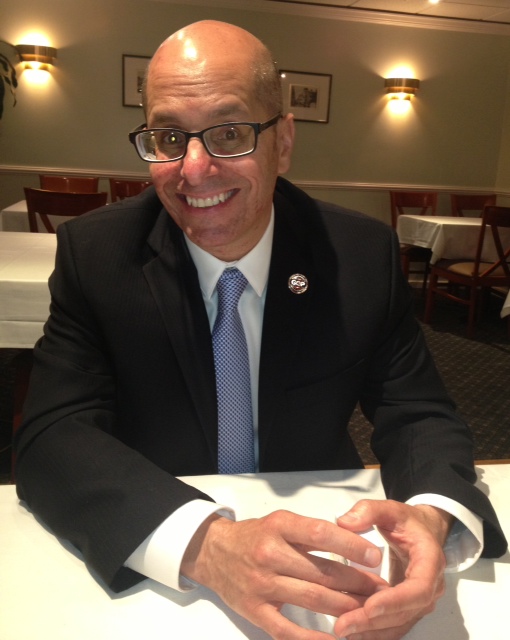
ELECTION 2014 : DAVID D’ARCANGELO TALKS TO HERE AND SPHERE

photo (53)

In Massachusetts we elect our state records keeper. We call him the “Secretary of the Commonwealth.” You may have visited its office, on the 17th floor of the Ashburton Place state office building. Probably if you did so it was to file corporation papers or to search an election tally on behalf of a candidate. The Secretary of the Commonwealth keeps both.

Anyhow, it’s 2014, and this year — every fourth year — we elect who that records keeper will be. For the past 20 years or so Bill Galvin has been the man. Once a state legislator from Boston’s Brighton section, Galvin developed a reputation as the man most knowledgeable about Massachusetts election statistics and laws and used that reputation to win the records keeper job. He has not been seriously challenged since — or, if he has, I cannot recall it.

This year Galvin finally has a meaningful challenger, Malden City Councillor David D’Arcangelo. Davis the 44 year old son of Tony D’Arcangelo, who in the 1960s was a protege of then Governor John Volpe, living in East Boston and, in 1968, running fir state Representative in “Eastie,’ a campaign that I, then just a kid, worked on — and reported from, as a stringer or AVATAR, then Boston’s outrageous alternative weekly.

David D’Arcangelo talked at length recently about his late Dad — a pixie of a man but tough as they came — and then about his own race this year against Secretary Galvin. It hasn’t been easy and isn’t easy now. The media, he says, aren’t interested, and there isn’t much money. He is right about that. OCPF reports through June 30, 2014 show D’arcangelo raising a total of $ 19,856, with $ 4,185 on hand; meanwhile Bill Galvin has raised about $ 68,000 in the same period and has $ 641,969.33 iun his account.

Still, the voters don’t know or care much which of Galvin and D’Arcangelo is the rich guy and which the poor boy. If Galvin is doing a good job, as the voters see it, he gets re-elected. If not ? Then D’Arcangelo has a chance. And a chance he does have, because as D’Arcangelo points out, the Secretary’s website is as opaque as it gets, offering both too much information and too little and very hard to navigate from its dense and non-transparent front page.

“The people have a right to transparency,’ says D’Arcangelo, using one of this year’s election’s most popular campaign themes. “The state’s websites don ;t work, or they’re hard to figure out, difficult to navigate. The Secretary’s is one of the worst. We deserve better. it’s 2014 !”

D’Arcangelo is right. So, what will he do about it ? “You ‘ll see an entirely new website built,’ he says. “using current technology. The Secretary should have a facebook page and a twitter presence. Does Galvin have these ? Not that i can see.”

Of course D’Arcangelo is right; in 2014 any elected official should communicate directly with the public on facebook, twitter, even — says D’Arcangelo — via instagram.

D’Arcangelo expands upon the transparency theme. “Galvin has purchased substantial public service announcements, but you can’t find out what he paid for them the source of the funds, or even see the announcements themselves. These are public records and should be accessible to all. If i am elected, they will be !”

Again, D’Arcangelo is right. The Secretary’s public service announcements are public records, easily abused by an elected office holder wielding them to promote his name. It’s a borderline decision, and one I do not second guess for any public official. Still, the public has a right to know their cost and who produced them, and to see the announcement tapes.

Transparency and modernization may not seem sexy to the average voter, but communication immediacy is how we live in the age of facebook and twitter, and most voters do get that. If D’Arcangelo can capture even a minute or two of the public’s attention, he can put Secretary Galvin’s continued election to office seriously at risk. And get some answers to his challenges.

—- Mike Freedberg / Here and Sphere

#MAGOV14 CHARLIE BAKER STUMBLES. RECOVERS — AND POLLS WELL

1 Baker and Coakley BG

^ Baker stumbles, recovers, and polls well ; Martha Coakley pounces — but mishandles even that.

—- —- —-

Charlie Baker, GOP candidate for Governor, got a huge present yesterday : a new Boston Globe poll according hm his best numbers yet. In a matchup with likely Democratic nominee Martha Coakley he now gets 35 to her 40, with a full one-quarter of voters still undecided or supporting one of the non-party candidates.

This was good news indeed — and there was more: I’ll discuss it below — especially after days in which Baker, running as the accomplished manager of state government, stumbled in his management of himself.

On Wednesday he told the Boston Globe that “Hobby Lobby doesn’t change a thing in Massachusetts, because our own health care law accords women all their health care needs.”

Immediately all three Democratic candidates charged Baker with going South on women’s health care — Coakley, in her typical classless fashion, used Baker’s remarks to fuel a fundraising letter.

Actually, all three Democrats didn’t know the whole story. On Wednesday night Baker’s wife Lauren and his running mate, Karyn Polito, were on stage at NARAL’s “Supreme rally.” Both gave me — I was there as a WGBH journalist — statements in which they made very clear their outrage about both the Hobby Lobby and Buffer Zone Law rulings. I thus knew that the statement that Baker gave to the Globe could not be the entire picture.

photo (51)

^ GOP Lieutenant Governor candidate Karyn Polito at Supreme rally : she gave me this statement : “I have always supported women’s rights to access health care and am here to protest the Supreme Court rulings !”

Next day, in fact, Baker reversed his remarks. He agreed that there might be some corporations in Massachusetts that would qualify under the Hobby Lobby ruling (in which the Court gave closely-held corporations an exemption from the ACA’s requirements on Freedom of Religion Act grounds)  for an exemption from providing women employees full access to contraceptive health care. “If that happens,” Baker said, “my administration will provide these women contraceptive health care through public funding.” Baker also encouraged Governor Patrick and legislators to devise a new abortion clinic “protection zone” in light of the Buffer zone law being struck down.

All good; and, in fact, the misspeak gave Baker a chance, in the full glare of news, to make clear his uncompromising support for women’s full access to health care, including pregnancy care.

That part of the flap will end; and it’s likely that Baker will now have many media opportunities to repeat his strong support for women’s health care. But he did stumble; and as the “competent manager’ candidate, Baker should not be stumbling how he manages his own statements. It better not happen again. Baker needs to be sure of himself, to speak his true mind and not to try to hedge — which is what I think he was attempting. Vital issues like women’s health care cannot be compromised away or smoothed; a Massachusetts governor has to be vocal, strong, morally sure of the right thing — as was Mayor Marty Walsh in his speech at the Supreme rally. Baker would do well to study vidclips of that speech and to adopt Walsh’s indignant moral certainty about the rights of women and of all. it’s what we expect, — and always have expected — here in Massachusetts, of our political leaders.

And now to the Boston Globe poll. If its findings are accurate, Baker stands in a very good position to be our next governor :

His favorable-unfavorable rating is 47 favorable, only 18 unfavorable. Yes, 20 percent of voters still don’t recognize his name. that needs be worked on.

Coakley’s numbers ? Not quite as good as Charlie’s. 54 favorable;le, 36 unfavorable. But only 6 percent of voters don’t recognize her.

Coakley’s the dominant Democrat.  Steve Grossman’s numbers are 32 percent favorable, 13 unfavorable, 55 percent unsure or don’t know him. Don Berwick, for all the news noise he has made, barely registers with voters : 10 percent favorable, 4 percent unfavorable, a full 86 percent unsure or don’t know him. Two months from primary day, Martha Coakley absolutely commands : 53 percent to Grossman’s 17 and Berwick’s 5.

The poll also shows that Massachusetts voters feel optimistic about our state’s economy and lifestyle. Asked to agree or disagree with the statement “living in Massachusetts is very expensive but worth it,”  a full 65 percent say it’s worth it, only 30 percent say it isn’t worth it.

Those who oppose casinos will also have to accept that their view is, thankfully, a minority position. 51 of voters say “keep the casino law in place”; 41 percent say repeal it.

Charlie Baker in this poll looks well positioned, despite all — despite the national GOP’s depressing negativity–  to be our next Governor : IF he can win a majority of the 20 percent still undecided. He will find himself leading voters who are glad to live in Massachusetts, even at great expense; who feel confident about the future; who care a lot about women’s health care rights, and who want an open, tolerant, liberal society — and will have it, well managed from the State House, assuming the manager candidate doesn’t fumble his advantage away.

—- Mike Freedberg / Here and Sphere
MAGOV14 : MONEY TALKS, AND HERE’S WHAT IT SAYS

1 Baker and Coakley BG

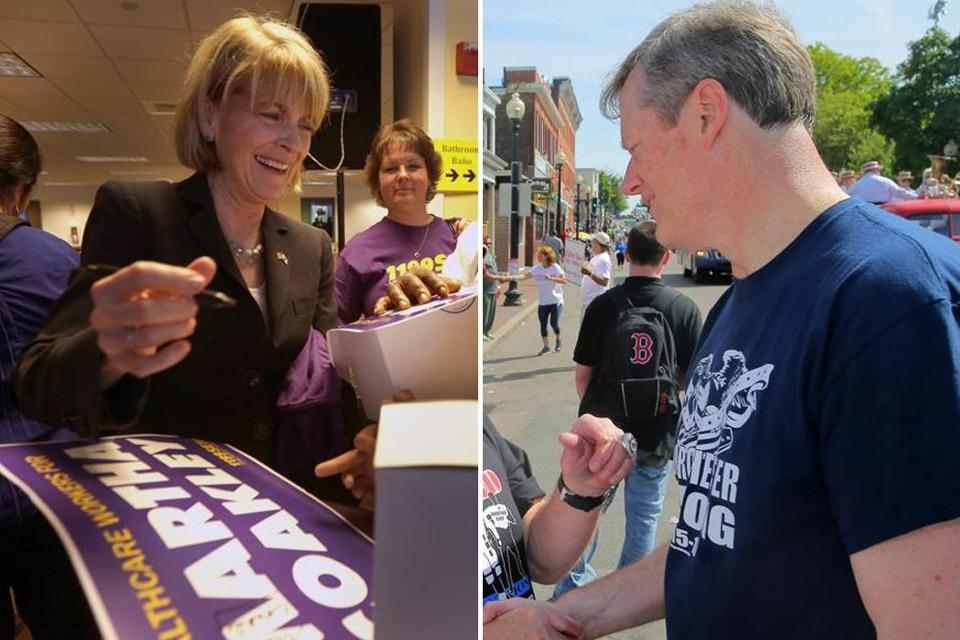
^ Charlie Baker(right) trails Martha Coakley (left) in votes but he has already won the money campaign. He had running mate Karyn Polito have on hand more money than all three Democrats combined.

—- —- —-

Recent polls of the Massachusetts governor race show that Charlie Baker and his running mate Karyn Polito have plenty of catching up to do. If Attorney General Martha Coakley becomes the Democratic nominee, as seems most likely, Baker and Polito will find themselves nine to twelve points lacking. Much of that gap represents votes now going to independents Jeff McCormack and Evan Falchuk : about 13 percent, a tally larger than the gap between Baker and Coakley. Yet there is no reason at all to suppose that all these votes would be Baker’s were the two independents not in the race.

Yesterday i analyzed the huge catching up that baker and Polito will have to do if they are to win over Martha Coakley in November. Today I will analyze the strengths of the Baker/Polito campaign. First of all is the money. Below is what the four chief governor candidates reported for the second half of june :

Baker began the month at $ 881,184.92; he raised 311,968.50o; spent 84,998; and ended the month with $ 1,108,155.42.

Baker’s running mate Karyn Polito began the month with 421,284,48; raised 123,25.62; spent 43,536.75; and ended june with 500,953.15

Add Baker’s and Polito’s ending balances together, you find $ 1,609,108.57 — a huge amount compared to numbers reported by the three Democrats :

1.Martha Coakley began mid-June with 447,673.29; raised 134,155.23′ spent 91,572.33; and ended june with 490,296.19.

2.State treasurer Seve Grossman began mid June with 896,059.85; raised 103,993.19; spent 68,156.92; and closed out with 931,897.02.

3.Don Berwick reported 199,547.55 at mid June; raised 82,343.39; spent 57,012.30; and ended with 224,878.64.

the advantages here are all to Baker and Polito, and hugely so. because :

1.The Democratic candidates for Lieutenant Governor also raised money, but i do not parse it because on the Democratic side there is no team. None of the three Democratic candidates for Governor knows who his or her running mate will be, and none can team up with either of the two whose names will be on the Primary ballot.

2.Baker alone has raised more money, and has more on hand, than either of the three Democrats. Adding in Polito’s totals, the team has far more money on hand than all three Democrats combined. these are telling figures, because all the money raised by the candidates so far comes almost exclusively from individuals, not PACs, and represent actual voter support.

Baker continues to lack in votes what he gains in donations. Nonetheless, his — and Karyn Polito’s money raising represents solid strength which, if it continues, can reach a kind of “critical mass” as voters begin to feel the issues strength of the Baker/Polito campaign. I have said all along that Baker possesses two critical advantages : first, he has an actual running team mate and can thus project to voters both how he will govern and why he will be able to govern. Second, he and Polito have amassed an independent power following, easy to assess through their donor list, with which to confront Speaker DeLeo when legislation is at issue.

This argument has not registered with many voters yet;l with most it night never register, as such. But baker and Polito can project it by way of their focus on management and innovation — a major campaign theme for Baker at least since his party’s convention back in March. Being able to get Speaker Robert DeLeo to advance the governor’s legislative agenda is no minor matter,. it’s the essence of being governor in more than name only. Governor Patrick has time and again had his legislative priorities rejected or amended almost beyond recognition; and Democratic Progressives have made no bones about being shut out of the Speaker’s agenda. If Baker — by his argument, his bio, or his vast fundraising base, or by all of these — can convince activist voters that he can move the Speaker as the three Democrats cannot, he can win this election, even though the polls right now do not show it.

He will have to regroup. The success that he seemed to have, at the beginning of June, in drawing city voters yo his side has faded. He needs to recover his city voter groove. He also needs to convince women voters that their health care concerns will be a priority for him. Polito will have to be the point person, a role that she is marvelously capable of. Indeed, if Baker wins, it will be because of Karyn Polito, both for her fundraising strength and her appeal to Worcester area voters and women generally.

—- Mike Freedberg / Here and Sphere

#MAGOV14 : THE BUFFER RULING AND THE HOBBY LOBBY DECISION


1 Baker and Coakley BG

photo (69)

^ difficult days for Charlie baker, good days for Martha Coakley and Don Berwick

—- —- —-

Two rulings handed down by the Supreme Court last week threaten to affect Massachusetts’s Governor election significantly. the boost Martha Coakley — already a clear favorite –and Don Berwick, and they set back those of Steve Grossman and Charlie Baker.

The Hobby Lobby ruling has the wider impact. Because it allows corporations to deny contraceptive health care to women on grounds of “deeply held religious faith”: — faith that permits men to obtain Viagra, by the way — it arouses all women voters : score for Coakley. but because the High Court also suggested that women could obtain contraceptive health care from the Federal government as part of Medicare, it seemed to endorse the “single payer” (Medicare) system : and that’s a score for Don Berwick, who has made adoption of “single payer a priority of his campaign.

The Buffer Zone Law ruling — it was found unconstitutional by 9 to 0 — probably impacts the campaign even more deeply. The law at issue was our state’s. Hobby Lobbys there are none here, and few corporations that would use religion as a route to denying health care to women. But every woman who seeks clinical advice on a pregnancy is now faced with being confronted by perfect strangers getting into these women’ s most personal private body business. It;s not a prospect that anyone I know would welcome. It has happened to me, on other matters. I was able to see off, with a pleasantry or an unanswerable question, these interrupters of my life. Women confronted so might not be so lucky, nor want to chance it. And even though the Buffer Zone Law ruling was unanimous, and certainly correct from a first amendment point of view — after all, as a supporter of the ruling pointed out to me, the Curt allows panhandlers to be in our faces, what’s different here ? — women affected won’t take it as such. They will feel, see, almost smell the confrontations they now must put up with, ad they can’t like that the Court put them in that space.

Martha Coakley defended the Buffer Law fiercely. She has promised to forge a different means of safeguarding women from such confrontations. So has Governor Patrick. i hope they find a way, because otherwise it means hiring hundreds of special duty police to patrol outside pregnancy clinics.

While Coakley has gone on the attack — as she should — Charlie Baker has said nothing. He has avoided the issue. I fully understand. It aggravates his weaknesses. As the GOP candidate, he heads a coalition that includes the state’s “pro life” voters, who tolerate his solid pro-choice position because they suspect that he will, at least, listen to them and will not make protection of women’s health rights a priority, and because they know that Coakley, Berwick, and Grossman will in fact make women’s health care a priority. I think these Baker voters are right, and that’s the problem; I suspect that the crucial block of women voters who will decide this election also know it.

Or, if they didn’t know it, or care much, because women’s health rights are so firmly established in Massachusetts, they do now care because even in Massachusetts those tights are now threatened by Supreme Court decisions.

Baker has not had a good two weeks. Today’s Boston Globe poll has him losing to Coakley by 40 to 31 and drawing only 9 % of Democratic voters. In Massachusetts a GOP candidate usually needs 18 to 20 %^ of Democrats to win — in his 2012 loss, Scott Brown won 12 % of Democrats. (I shall analyze the Globe poll in a separate column to come later today.) The recent WBUR poll had even les good news for Baker. It showed him losing to Coakley 42 to 28; and though it also shows him beating Steve Grossman and trouncing Don Berwick, Coakley has maintained a strong lead almost throughout this year and can only get stronger as a result of the High court rulings. Baker’s campaign has also begun to narrow its focus : business, business, business. we all like businesses; but Massachusetts is a “values” state — fortunately our values are entirely progressive ones — and for Baker to not step to the forefront of voicing Massachusetts values is to concede the election. No more can — or should — a Massachusetts election be only about business than it can be only about Labor.

When a candidate narrows his focus, retreating to his core, as did the campaign of Scott Brown in 2012 after polls turned against him, it’s a sign that he is being pushed out of the center. Baker ran a smart, aggressive, ground breaking campaign until mid-June, one that connected him city voters, voicing city voters’ concerns and turning the flank of a very suburban, high-income Democratic Primary. now that has all changed. The Democrats have taken back much of the city voter action. they’ve held Forums in the city, dug deeply into voters who have been theirs all along until for six months or so they were ignored.

Baker will still do better in the big cities than Scott Brown did. He can’t be dislodged in Essex County, and he likely has a solid core of support in Worcester. In Boston, too, he holds strong cards in several ethnic communities. But I see no sign right now that the receptivity to baker that held sway six weeks ago still rules. How can it after these two Court rulings ? For women voters, it’s now war time. And war time means, fr these women, supporting Martha Coakley, like her or not. My guess is that the Court rulings gain her two to four points — a lot in what might have been a close election.

The only person who I see with a chance to stop Coakley is Don Berwick. In a Democratic Primary, his strong advocacy of single payer now makes timely sense, compelling sense. and if he is not a woman, as is Coakley, he is trusted by Democratic activists, as Coakley is not, and addresses Massachusetts values far more eloquently than Coakley and with passion that she utterly lacks. Given that Grossman cannot out-woman Coakley or even begin to compete with Berwick’s passionate advocacy, it would mot surprise me to see Berwick win the Primary.

Could he then beat Baker ? In such a race baker would be the Coakley : the hard to pin down, long explanation, out of focus candidate — versus Berwick, the ultimate heat of passion candidate. Baker could win that comparison if he sounds wise and competent, as he usually can, and Berwick sounds like a hell-burner, as he often does.

As far as I can tell right now, this prospect is Baker’s only chance of winning the office he is so naturally fit to perform.

—- Mike Freedberg / Here and Sphere