REGULATING THE MILITIA

 Blumenthal
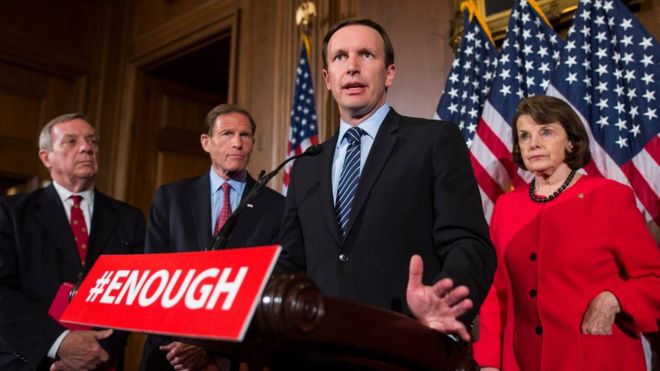
Senator Chris Murphy of Connecticut : a vote was taken, but no action…yet

Content

“Gun Control” is back in the national conversation. As always happens after an horrific mass shooting, the 80 to 90 percent of us who want weapons regulated more strictly are raising our voices. So far, every time we have spoken up, nothing has been legislated. I think this time it will be different.

Yes, the four gun regulation bills voted in the Senate on Monday were all defeated. Few offered more than a token advance. But this was a first move in what I think will be a much more effective campaign to restore traditional regulation of weaponry and ammunition.

Before I explain why I think this, I’d like to examine the Second Amendment, whose words gun rights people think support their cause. They are mistaken, historically and legally. Their individualist view of the “2 A” is actually quite  new. Until about 40 years ago, few serious policy advocates argued for it.
What does the “2 A” mean ? Its ungrammatical syntax presents a challenge, but Federal Courts have analyzed it at length using both textual analysis and historical record. Justice Stevens, in particular, wrote an exhaustive op-ed about the “2 A” a few years ago; I post a link to it here : https://www.google.com/url?sa=t&rct=j&q=&esrc=s&source=web&cd=1&cad=rja&uact=8&ved=0ahUKEwiZ07z9qLnNAhXJ0h4KHRsADu4QFggcMAA&url=https%3A%2F%2Fwww.washingtonpost.com%2Fopinions%2Fthe-five-extra-words-that-can-fix-the-second-amendment%2F2014%2F04%2F11%2Ff8a19578-b8fa-11e3-96ae-f2c36d2b1245_story.html&usg=AFQjCNHVwAOq6gRAKKqJgbF4zMAvDkJ5YA&bvm=bv.124817099,d.dmo
I shall write my own analysis next, but first let me quote the “2 A” itself :  “A well regulated Militia, being necessary to the security of a free State, the right of the people to keep and bear arms, shall not be infringed.”
What do these words mean ? First of all, they form part of the Constitution’s  Bill of Rights : Amendments whose purpose is to bar the Federal Government from doing certain things : in the case of the Second, creating a standing army of professionals or mercenaries — as most armies of the 1770-1790 period were — who were, for the most part, not drawn from the citizenry and who frequently were inimical to it. The “2 A” doesn’t even speak of a Federal armed force; it talks of the security of a free State. In 1789, there were thirteen free States.
As the armed forces thus sanctioned were to be STATE forces, so the STATE in which they were formed was charged with assuring they be “well regulated.” That the “2 A” gives its sanction to STATE regulation, and not to individuals, is made clear in that its wording is taken directly from a similar clause in the 1689 English Bill of Rights, in which an INDIVIDUAL right to keep and bear arms is granted to Protestant citizens to “have arms for…a right to own arms for individual use and to bear these same arms both for personal use and defense.” Those words were left out of our “2 A.”
They were left out, almost certainly, because the English Bill of Rights dealt with a government headed by a Catholic king who waged religious war against a mostly Protestant citizenry. Whereas our Constitution, and our Bill of Rights, were negotiated by the very citizens who would be entrusted with government. All that the “2 A” wanted to establish was that in the new arrangement of power, armed force would be a State matter rather than a Federal one. Of “individual” rights, there is no word. (That no “individual” right was contemplated, was shown when, in 1794, President Washington called out State militias to pout down the Whiskey Rebellion.)
You will note, also, that the “2 A” speaks of “the people”, collectively, not of individuals. It addresses the bearing of arms by battalions and regiments, not by isolated individual persons.
The Second Amendment’s purpose was ended by Federal conscription in our Civil War. Federal conscription was accompanied by Federal armories and troop barracks (the quartering of mercenary armies in private houses was a major grievance, addressed in the Third Amendment, which is complementary to the Second). And though the 1863 draft ended, wars with Western Indian tribes required that a Federal cavalry be kept in being (such a force, General Custer led to disaster at Little Big Horn.) By the time of the First World War, a Federal conscript army, with armories and barracks, was firmly and finally in place, to which the various State militias were auxiliary as a National Guard.
The “2 A” having been rendered moot by conscription and a standing army, Courts have labored to figure out what application it could possibly have left. That the keeping of weapons by citizens could be regulated and restricted was never in legal doubt; and many such Federal laws were adopted and upheld. As far as I can tell, however, the “2 A” retains a residual meaning that can guide the law of weapons regulation, and it is this :
As the Amendment’s purpose is to encourage each State to organize a citizen militia, and to see it well regulated, each state can make its own laws governing who may be admitted to the State militia, and under what conditions, and restrictions, and with what training. The only thing a State evidently can NOT do is to not organize a militia at all. And as the Amendment authorizes only an organized and regulated militia — expressly NOT individual decisions as to whether to bear arms or not — the State, and the Federal Courts, can restrict such individual arms bearing to such ever degree they deem wise, saving only that individuals can never, except under regulation, be absolutely barred from participating in the State militia.
Application of the “2 A” is complicated by the 14th Amendment. Because equal protection of the laws, State and Federal, is guaranteed to all who live within our nation’s jurisdiction, no state militia regulation or individual weapon bearing restriction can be arbitrary or whimsical. Weapons restrictions must apply equally to all persons.
An opposite view of the “2 A” has gained power during the 40 years since gun manufacturers and their supporters took control, of the NRA — an organization which had always been a supporter and enforcer of gun restriction legislation. This new view of the “2 A” grants individuals an un-infringeable right to keep and bear arms wherever and whenever, and arms of all kinds. This view was that of the English Protestants in 1689; it was most emphatically NOT the view of those who vted to ratify the Constitution.

There are excellent policy reasons why this view of the Second Amendment cannot be allowed. It sanctions vigilantism. It views law enforcement as the enemy. It implies sedition.

No government can permit the existence of armed individuals, claiming the right to own whatever weapons they want, and to use them whenever and upon whomever they deem the need. We have a criminal justice system to do that. We create law enforcement departments to do that. We encumber all such agencies with strict rules of conduct (much of it prescribed by the Bill of Rights !) and with being agents of, and answerable to, all the people. No person may on his or own hook claim for him or herself these powers. But that is precisely what the individualist view of the Second Amendment asserts.

So far, the small minority of Americans who advocate this view have had the political field to themselves. Backed by big money from the makers of weapons and ammunition, and fueled by activist passion, they have overwhelmed the efforts of those who support stricter weapons laws. This imbalance of power is shifting at last. Big, big money is coming into play on behalf of weapons restrictions, there are more regulations activists than ever, and in the context of a national election, the traditional view of “2 A” legislation is almost certain to win the day.

It can’t come soon enough.

Can greater diligence monitoring weapons usage stop assaults like that at Orlando ? Maybe, and maybe not — yet. There are some 320 million guns out there, an d the mindset that you are better off if you shoot first and not wait for the police.

But this view is immensely wrong. In a  real world shooting situation, “a good guy with a gun” will almost certainly not be able to (1) unholster (2) unlock the safety (3) identify the target (4) aim (5) hit the target (6) without hitting others and (7) when the responders come, and they see said “good guy” moving tactically with a gun, they are going to shoot him or her because they have no way to know who is the good guy and who isn’t.

Enforcing the peace is much, much better left to duly authorized, trained officers. Yes, it takes time for them to arrive; stalling tactics need to be trained for. Can officers rescue everybody ? No. No human institution can do that or promise it. There thus remains room for worry and for argument; but no such argument can use the Second Amendment, because its old words support the traditional view.

— Mike Freedberg / Here and Sphere

UPDATE : The force bills forf which House Democrats demonstrated yesterday lead this issue into a dead end of debates about due process, probable cause, and reasonable cause as we debate the Patriot Act and its dangerous implications for personal freedoms. No such discussion can be decided, or should be had, because as I have shown above, there IS NO right for any private citizen to own or keep militia weapons except within restrictions which the “militia amendment” urges. The Federal Congress is quite free to restrict or regulate private ownership of such weapons as it sees fit.  -30-


FIXING THE T : WHEN NOT TO OUTSOURCE

mbta warehouse

^ the T’s parts warehouse. (photo : Boston Globe)

—- —- —-

Three recent MBTA reforms bring us to the devil details which should not be handled in the same way despite the public’s desire to sweep the old ways aside.

First is the T’s parts warehouse; second, bus maintenance; third, its “money room,” where employees count cash fares. MBTA management has suggested outsourcing all three operations, saying that ‘where we do not have expertise,” it would save money to do so.

I’m not sure that saving money is the only issue here,  nor the chiefest. I’m not opposed to outsourcing a T operation. Keolis operates the Commuter Rail (and does the job not always the best, by the way), and the T’s advertising is handled by ad agencies. So let’s look at the three operations that operating manager Brian Shortsleeve seeks to outsource :

1.The parts warehouse. Journalists covering this matter say that the TY’s warehouse operation has a much too long turn around time, and that warehouse staff don’t readily know what parts they have in stock nor how to find them. That seems to be a matter of technology. The T’s warehouse, so it is reported, uses 30 year old data programs.

I don’t see why that is the warehouse staff’s fault. I don’t see why the T can’t upgrade its warehouse data programs. T managers say that updating will cost several million dollars; maybe so, but it’s a one time fix , not an ongoing expense. No one can say that the T’s warehouse workers do not have the right expertise. They have it and more. Yes, they are members of the Carmen’s Union that has fought the T’s necessary reforms; so what ? Reforming the T cannot be a cover for breaking the union.

My decision : upgrade the T warehouse’s data program and do  NOT outsource its work.

2.Bus Maintenance. The T’s new Budget analyst, Pioneer Institute, highlights the T’s maintenance costs as a source of savings. By Pioneer’s standards, the T’s maintenance costs run almost double the national average for similar transit systems.

(Read the Pioneer paper here : http://www.mbta.com/uploadedfiles/About_the_T/Panel/PioneeronMBTABusMaintenanceCosts.pdf )

Unfortunately, the statistics cited do not take into account labor bargains or cost of living. If the T’s maintenance workers earn an average of some 4 111,000 — and several earn quite a bit more, the cost of living in Boston is at least double that in Minneapolis, a city whose transit system Pioneer cites constantly. I would much prefer to see an analysis of the T’s maintenance costs compared on a regional cost of living basis.

The Pioneer analysis also cites overstaffing of the maintenance operation and, at the same time, a higher rate of maintenance failures than in comparable transit systems. The problem here is work rules established in the union contract bargained by the T’s maintenance workers. I find this part of the Pioneer paper persuasive : yet if we have collective bargaining — and we do, and should — then it is up to the T’s management to secure worker acceptance of more effective work rules on performance and staffing. Union contract bargaining can be strongly affected by public po0ressure — the recent Verizon contract is a classic case — and that public pressure can work in both directions. Let’s at it. I will be the first to recommend a revised maintenance worker contract bringing performance into line and cutting down overstaffing.

I do NOT see the need for outsourcing this operation.

3.The “Money room” T  management says that the fare counting and automated fare collection operations employee about 250 too many workers who could be better used as bus drivers (where a shortage often exists), and that a private company can better handle this work; the union responds that the T’s fare counters do the job that they’re supposed to do and also that the two operations, money room and automated fare machines, operate incompatible software. Why not change that, says the union’s chief, James O’Brien.\

He’s right. For example, machines exist that collect fares from riders before the board a subway car; yet in its Green Line expansion reconfiguration, the T, citing cost, has opted not to install these machines. Why not install those machines with software compatible to the T’s money room ? Again the T says that doing so costs money the T doesn’t have — it faces, so T management asserts, about an $ 80 millio0n shortfall.

I find the T’s position very short-sighted.

That said, clearly the union has to give; has to agree to revised work rules; has to allow reassignment of its members to operations where they are most needed. Unions are often stubborn about reform. With the T, reform is urgent on all fronts. Let the union rethink its work rules and thereby prevent outsourcing that almost certainly will bring its own problems much less easily solved than problems in-house. A new T union contract is at hand. I look forward to seeing major reform affecting its outcome.

Is outsourcing never preferable for the T ? Of course it can be useful. Operations like advertising, real estate management, website monitoring, social media, and data programming are not core MBTA operations. These can be outsourced to private companies and probably should be.l

—- Mike Freedberg / Here and Sphere

SOLEMNLY UNITED

FullSizeRender

^ Governor Baker at yesterday’s #Vigil on Boston’s City Hall plaza spoke of solidarity with the LGBT community and the people of Orlando

—- —- —-

Thousands of us, we of Boston, gathered quietly at City Hall Plaza last night in #vigil for the 49 young LGBT people gunned down in Orlando, Florida. To the gunman’s act of hate we responded in an act of together love.

I was there; how could I not be ? But who am I but one heart of thousands of hearts, two arms to hug everyone near to me hugging me also and likewise.

Being there calmed my soul; I think it salved the souls of all of us. Our wounds may not be of the flesh or mortal, but they are hurts very deep nonetheless. It was good to express all of this in solemn communion.

Our leaders — Governor Charlie Baker and Mayor Marty Walsh — spoke simply the phrases that needed saying, sentences of communion. As Baker spoke it and then tweeted it: “:Solidarity in the face of hate & terror. We stand as one w/ the LGBT community & the ppl of Orlando.” His tweet was RT’d 206 times and “liked” 356. The reactions continue.

Mayor Walsh spoke it too : “Tonight we saw the very best of Boston, standing together in solidarity w/ broken hearts & open arms for #Orlando.” 345 people so far have RT’d the Mayor’s tweet; 632 have “liked” it.

We of Boston have been here before. After the Marathon Bombing three years ago — an attack praised by the Orlando killer — we gathered in huge numbers proclaiming ourselves “Boston strong.” But then, our “strong” was laced with physical anger, some of it frighteningly brutal, even barbaric (protesting the funeral home doing one of the attackers’ burial, a replay of Euripides’s 2500 year old play Antigone !). This time there has been none of that. It wasn’t our city this time, and the dead, being LGBT (and mostly Hispanic), are controversial to some, unlike the three innocents nail-bombed dead at the Marathon.

Thus the viscerally angry, who all but savaged our grief three years ago, were not present at City hall and, so far, have not been heard from except, tangentially, in the venom of Trump. And so the #vigil at City hall was as close to pure as any crowd event I have seen, pure in the sense of united in love grieving without the box cutters of hate. No one swore vengeance. No one called out an enemy, pointed a scapegoat. No one spoke of getting a gun. Hate may kill, but it cannot kill us all and it will not deter us from living our lives in the fullness of respect.

And to those who hate did kill, and to their grieving families and friends, we dedicated our bodies present and accounted for in solemn solidarity. Like a tree that stands by the waters, we shall not be moved.

—- Mike Freedberg /  Here and Sphere


“YES” TO COMMON SENSE GUN REFORMS

Orlando

^ victims of the killer : LGBT, but also almost all Hispanic

—- —- —-

Once again, an horrific mass shooting forces us to discuss the regulation of guns and ammunition. The killings in Orlando, Florida seem a work of bigotry as well as terror, and of a kind — terror in the name, misguidedly, of Islam — made much of by folks on the right. I will discuss this point later. But first, a look at the law regarding guns and ammo: because the many mass shootings that have wounded our nation these past several years  were enabled by military grade weapons in the hands of civilians.

I see no justification whatsoever for individual civilians to possess military grade weapons and ammo. The very nature of such weapons demands their possession and use be strictly confined. Every argument to the contrary cannot stand.

It is said, “guns do not kill people, people kill people.: True; but people cannot kill people without weapons to do it.

It is said, “the only that stops a bad guy with a gun is a good guy with a gun.” Yes, but that is why we hire police and sheriffs. We do NOT entrust the stopping of bad guys to roving vigilantes, and for very good reason: to do otherwise is to make them judged, jury and executioner. We have the criminal justice system to do that, because we are a nation of laws, not of anarchy.

It is said, “the Second Amendment gives individual people the right to own and use weapons.” No, it does not. The Second Amendment was enacted in order to prevent the Federal government from hiring a standing army of mercenaries, such as fought against us in the Revolution and were often quartered, ith guess what consequences, in private homes. Indeed,k the clause in the 1688 English Bill of Rights whence the language of the Amendment was taken included an individual right, words that were expressly NOT INCLUDED in the “2 A.”

The “2 A” addresses service in a militia, an army of civilians called to duty. Such armies have almost all become part, now, of the standing Armed Forces. The move from militias to standing, conscript armies became universal in Western Civilization during the period 180 to 1875, complete with barracks, so that no soldiers would be quartered in private homes. Today, therefore, the “2 A” is quite obsolete and either should be repealed or radically amended.

The Second Amendment was always understood as addressing service in a militia. Not until the 1980s did the notion arise that it contained a private right to keep and bear any kind of weapons without careful regulation. Civilian ownership of military-grade weapons and ammo is still controversial — t.hank goodness. We oppose it under any forseeable circumstances.

Private ownership of guns and ammo has become an established custom; I accept the fact. What I do call for is sensible regulation, to include the following :

1.successful completion of a municipally approved gun safety course

2.obtaining adequate liability insurance for weapon ownership and use

3.background checks at time that weapon purchase is sought, with no exceptions, said checks to be renewed every five years after purchase. Inclusion on a terrorist watch list to be an absolute (but appealable, because terrorist watch lists can err) bar to ownership of any gun-type weapon

4.no military grade weapons or ammunition under any current circumstances.

I recognize that guns in a rural setting, unlike in big cities and suburbs, serve useful purposes such as hunting and that rural communities are the first to insist on strict community control of weapon use.

At least 90 percent of Americans support some or all of these simple recommendations. All or most must eb adopted, and soon.

And now back to the Orlando massacre. The killer seems to have targeted gay (LGBT) men and women; thus his crime was one of hate as well as terror. No one has yet remarked something else: everyone of his victims, of the names so far released, was Latino. The killer’s hate thus spans two communities of Americans.

Much out=rage has emerged from the Trump camp, and from the radical right generally, accusing “Islamic terrorism” and calling for a ban on all Muslims coming to America. I see no such outrage from the radical right in cases where the killer is a white person and native. There the cry is “mental health issues.” The hypocrisy is infinite.

On the other hand, the radical left vents its outrage upon killings by native whose people and often downplays that by “others.” If we can’t even agree that all mass shootings are evil and must be stopped, without demonizing entire groups, how can we ever remedy the problems ?

Mass killings carry out two agendas that our society cannot tolerate. First is our allowing people to own military grade weapons. Second is tolerance for hate. Though the Orlando killer acted pervertedly in the name of Islam, radical perversions of Islam are hardly alone in calling for LBGT people to be killed. The same call arises from radical pastors claiming to be Christian. Is it not time for the entire nation to reject ANYONE who calls for killing this or that sort of person ?

America is a nation enhanced by its diversity. And, as Mitt Romney said at the beginning of this horrible political year, “every religion enhances the national character.” Those who seek — mostly from the radical right — to exclude any faith community or immigrant culture from our nation of all is an enemy of the American mission. We must be clear about who we are. We should be proud of what our nation is and ready to defend and promote it and to turn back those who would poison our pluralism in the name of nothing good.

And at the same time, and for the same purpose, we must enact common sense guns and ammo controls.

—- Mike Freedberg / Here and Sphere

THE WOMEN TAKE COMMAND — AND IT’S ABOUT TIME

BESTPIX - Hillary Clinton Holds Primary Night Event In Brooklyn, New York

NEW YORK, NY – JUNE 7: Democratic presidential candidate Hillary Clinton arrives onstage during a primary night rally  (Photo by Drew Angerer/Getty Images) ***

—- —- —-

96 years ago, Americans wrote women’s right to vote into our Constitution. Last night, a woman finally won the Presidential nomination of a major political party.

It has taken that long. Perhaps no form of polity better preserves the customs of a people more effectively than universal suffrage democracy. We have it, and if you examine voting patterns, you quickly see that America’s political sentiments have barely changed at all since after the Civil War. The two parties have almost completely exchanged constituencies, but the divisions of 1896, for example, are the same divisions today. Thus it is that no Black candidate won the Presidency until 133 years after  the adoption of Civil Rights Amendments. Likewise, 96 years stand between women achieving the vote and staking a major Presidential nomination.

Yet the America that Hillary Clinton seeks to lead has more female voters than male : 52 percent, enough to claim victory, were gender the only factor. My own view is that the three women who now dominate American political discourse — Elizabeth warren, Michelle Obama, and Mrs. Clinton — would merit their dominance even if women were a minority of voters; leading the majority, however, their three voices command every voter’s attention.

So what do Clinton, Warren, and Obama want ? Because what they want, we are very likely to get :

First, all three are Democrats. There are significant women in the Republican party — Governor Nikki Haley of South Carolina comes to mind — but none yet dominates the nation.

Second, all three women embrace the America of today and tomorrow : civil rights for gay people and transgender, reproductive rights for women, respect for languages and cultures (call it “e pluribus unum,” a phrase that ought to find its way into our coinage) and for the immigrants who come to us in many such guises; an America of pay equity in which every working person can spend into the discretionary economy and in which people living o9n the margins need not feel marginalized; an America where excellent education for all kids is a priority for the Federal government as well as local jurisdictions.

Third, a nation that refuses to tolerate health care denials; that values healthy lives in the workplace; that sees addiction as a health issue, not a criminal doing.

Fourth, the principles of motherhood and sisterhood : love before hate, caring before you’re-on-your-own, fierce defenses of home and community, a hatred of violence and weaponry, an understanding that togetherness is strength, not cowardice.

Lastly, the three women’s dominance represents on behalf of other constituencies in America who feel less than fully listened to : people of color, Hispanic voters, immigrants from all nations, low-wage workers, the uninsured; the homeless and the addict in recovery.

You may disagree with these positions and be skeptical of these values, but they cannot be denied or dismissed as not relevant. At last !

As the three women hold major values in common, so they voice them very differently. Senator Warren is the forensic accuser, a female Charles Sumner (whose Massachusetts Senate seat she holds) as single-minded about financial abuses as Sumner was about slavery. Michelle Obama avatars world-wide women’s rights, with eloquence and elegance, just as did her predecessor First Lady, Eleanor Roosevelt. Clinton is the tough, resolute, manipulative politico, a female version of Richard Nixon (who, as most of us fo9rgfet,k was one of the most effective, liberal Republican presidents ever as well as a foreign policy innovator).

I can’t think of a single male politician right now, other than the outgoing President, Barack Obama, who thus dominates the nation’s political future, although I can think of one who seeks loudly to stop it from happening.

This is not to say that America does not have, or value, male politicians with much of the future in their hands. Several Senators and Governors come to mind, even a few mayors, and a couple dozen Congressmen. Yet for now, the future shape of America is being voiced, and thus molded, by a trio of outstanding political women. Of whom the Democratic nominee for President is the one we’re all now paying attention to.

—- Mike Freedberg / Here and Sphere

SUFFOLK COUNTY ELECTIONS : A SURVEY

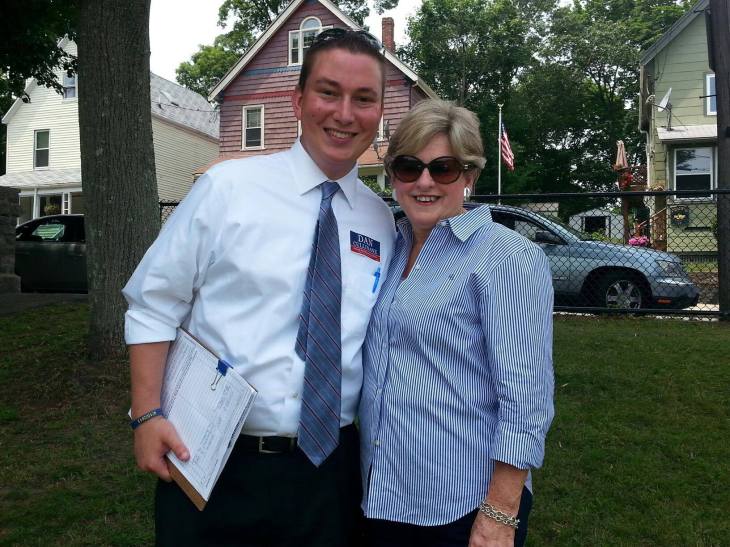
Dan Cullinane

^ facing two challengers in September 8th’s primary : Dan Cullinane of the 13th Suffolk

—- —- —-

September’s Democratic Primary hasn’t a whole lot on offer for Suffolk County voters. The County includes Winthrop, Revere, Chelsea, and Boston. Since Boston is a bee swarm of politicals, you’d expect a whole lot of hiving afoot; but you would be wrong. The State is electing no Senator, and the statewide offices, from Governor to Auditor, aren’t before the voters until 2018. We ARE choosing Congress-people, but Mike Capuano and Katherine Clark, who represent about half the County, have no challenger. The same is true for Suffolk County’s six State Senators. Joe Boncore, Bill Brownsberger, Sal DiDomenico, Linda Dorcena Forry, Sonia Chang Diaz, and Mike Rush move to November unscathed.

Add to that almost all of Suffolk County’s State Representatives. Roselee Vincent, Adrian Madaro, Dan Ryan, Speaker Robert DeLeo, Aaron Michlewitz, Nick Collins, Byron Rushing, Jay Livingstone, Mike Moran, Kevin Honan, Dan Hunt, Russell Holmes, Jeffrey Sanchez, and Ed Coppinger have no challenger that we are aware of.

Which does not mean that Suffolk County voters can take the day off. There ARE two major County-office races : For Sheriff, between incumbent Steve Tompkins and challenger Alex Rhalimi (disclosure : I am Rhalimi’s consultant); for Register of Deeds, a multi-candidate contest featuring former City Councillor Steve Murphy; Dorchester activist Paul Nutting (disclosure : I am Nutting’s consultant); Jamaica Plain lawyer Katherine Forde; Dorchester attorney Stephanie Everett; Jeffrey Ross, who ran for City Council in 2013; and at least one independent, John Keith, who lives in the Seaport District. All of these “Deeds” hopefuls have one or another measure of credibility.

There’s also a Congress race, but not in September. On November’s ballot, the 8th District’s Stephen Lynch faces Republican Bill Burke, an oilman from Quincy.

In addition to the many September candidacies I have already listed, there’s a three-way race for Governor’s Councillor, for those who care about an office that few voters can identify. (The eight Governor’s Councillors vote on confirmation of nominations for judge and other judicial posts as well as approval of state contracts.) This contest pits incumbent Terry Kennedy against two North End activists, Stephen Borelli, a retired Brighton District Court clerk, and Anthony DiMeo, whose name I had not heard before this race. The District includes five State Senate Districts: beginning with my own, the First Suffolk and Middlesex, and extending east past Lynn and North to Haverhill.

Of the four contested State Representative contests, one concerns an open seat: the 7th Suffolk’s Gloria Fox is retiring after 34 years of service. Three women are running : Mary-dith Tuitt, an aide to Fox (Tuitt also sought a State Representative seat, in 2013, in another District); Chyna Tyler, who was an aide to Senator Chang Diaz; and Monica Cannon, an activist backed by Roxbury’s Councillor, Tito Jackson. In the 2014 election, Fox faced two worthy challengers; 2260 voters cast ballots. I would guess that number will increase, but by how much ? Certainly not by the amount one hopes for. The 7th is perhaps Massachusetts’s most unrepresentative House District. At least a third — maybe more — of its adult residents are students who hardly ever vote in local elections: but they count in the population base for one man, one vote District inclusion. As a result, given a 15 percent turn out even in the District’s heartland, the House member for the 7th will almost certainly be elected by a tiny minority of those she is charged with representing.

Below : the 7th Suffolk’s Mary-dith Tuitt, endorsed by Senator Linda Dorcena Forry

Marydith

The other multi-candidate Suffolk County House seats don’t really have a contest. Incumbent Liz Malia of the 11th Suffolk faces Charles Clemons, who ran for Mayor in 2013 and City Council in 2015; Clemons is personable (disclosure : we are friends), but it’s difficult to see him mounting any sort of challenge to the diligent Malia, one of Boston’s best-connected elected officials. The 5th District, Dorchester-based, features three candidates: incumbent Evandro Carvalho faces a newcomer, Melinda Stewart, whom I have never met; the winner faces perennial candidate Althea Garrison, who many years ago did represent the District. Angelo Scaccia, of Hyde Park, faces an equally new challenger, Anthony Solimine of West Roxbury. Lastly, incumbent Dan Cullinane of the 13th Suffolk District, faces two challengers, Carlotta Williams and Jovan Lacet. Cullinane is one of the State’s most authoritative, hard working House members; but his District s overwhelmingly majority people of color, and his Haitian constituents — some of them — seem anxious to elect a Haitian.

Which brings me to the two County contests, Sheriff and Register of Deeds.

As I am consulting to a candidate in each race, I am in no way an objective reporter of these races. I will say that the Steve Tompkins and Alex Rhalimi Sheriff race involves two very different men, one African American, the other a Moroccan immigrant. Tompkins made his mark in sales and public relations, before being appointed Sheriff, and is a master communicator with a bold vision of what a Sheriff can be; Rhalimi, who holds a Master’s Degree in Criminal Justice, started and operated — for 17 years — his own business and has an executive’s attention to detail and tireless drive. This is a race the voters are probably enjoying, as they should.

As for the Deeds battle, it must confuse voters who scarcely think of this position as an elected one. Why should a voter choose Nutting, or Everett, or Ross, or Forde, or even Murphy, for that matter ? As a nine-term former Boston Councillor, Murphy has all the name recognition a candidate could want; but it is unclear why he, a policy maker, should occupy a position purely ministerial office like Deeds. I find the other candidates (including, of course, my client Paul Nutting) much more fitted to this office, and I think it likely that the voters will  come to that same conclusion as the September 8th, Thursday primary day approaches.

—- Mike Freedberg / Here and Sphere


WHAT CHARTER SCHOOLS EXPANSION IS REALLY ABOUT

FullSizeRender(1)

^ leading the charge for charter school expansion : the Governor and his rally troops of kids

—- —- —- —-

As many of you already know, there will be an initiative on this November’s ballot, seeking to expand the number of charter schools allowed by Massachusetts law. The expansion will affect only school districts which are determined, by the State’s Department of Education, to be in the bottom 25 percent according to the State’s performance tests. Doubtless these tests are themselves liable to much criticism of standards applied, but that’s an issue for another day. In this article I want to focus singly on the rationale for charter school expansion, and to critique the political partisanship that some are adducing in its support.

For me, charter school expansion serves two cardinal policy goals : first, it offers children in under-performing districts an effective, disciplined alternative path to an education assuring their readiness for highly skilled employment upon graduation; second, it promotes that education can no longer be ruled by one common standard — that in the innovation economy, many styles of pedagogy, and many sorts of curricula, will enable students, themselves of diverse4 cultures and states of preparedness. Yes, we do educate students for citizenship, as well as employment, and for citizenship, a common curriculum creates community. But diverse employment curricula do not per se exclude citizenship learning and should not be advanced as an argument against innovation schools.

Funding is the big argument being debated in charter school expansion . The mantra of charter school opponents is that they divert public funds — taxpayer dollars — away from public schools and into the hands of private entities. This argument is false.

First, charter schools are public. Any child who wins the selection lottery can attend.

Second, those charter schools that allow private, for profit companies to manage them are no different from the MBTA allowing private firm Keolis to operate its Commuter Rail. The MBTA is a state agency answerable to taxpayers. Why are its operating decisions any different from those of taxpayer-answerable charter schools ? 

Third, charter schools do not divert taxpayer dollars from standard schools. Every child who attends a charter school is one student less that the standard school has to pay for educating. The diversion argument results from standard schools maintaining capacity that, because of charter schools (and others), is no longer used but, needs be heated, air conditioned, cleaned, and monitored. School districts should never maintain such excess capacity, doable only because the taxpayers have no choice but to pay for. As standard school enrollment goes down, so should the district budget.

To sum up : we accept that education is a taxpayer responsibility because schooling our children properly is vital to the progress of the enti8re community and cannot be left to the chance of economic markets. In return, taxpayers this charged have every right to demand that their tax dollars be applied as effectively as feasible, and applied fairly, too: schools that fail, students of color, or from non-English language homes, must either be reformed or replaced; nor can there be any tolerance for the sorts of inefficiencies that tie down a district budget such as Boston’s $ 1.03 billion 2017 proposal.

The huge Boston budget is especially outrageous considering how many students of color — some 87 percent of all Boston Public School students — now clamor for admission to a charter school, where academic performance can rise to the State’s top quintile rather than  hunker in the bottom quintile, as does the Mattahunt Community School (thanks to friend Ed Lyons for this comparative statistic.) Too easily, students in low-income zip codes get shafted by school budgeters trying to fund redundancy instead of classroom needs — not to mention home visits by teachers, a longer school day, and nutritious lunches, rather than duplicative teaching payments, overcapacity, and more.

I understand that vested interests feel their situations insecured by these imperatives. In particular, teachers who now enjoy rigid work rules face enormous redeployment and re-configuration of their job duties. That, however, is a challenge for teachers’; unions, not for the public. Teachers unions badly need new, flexible, imaginative leadership, and it is there, too: but it has been difficult to get such new leadership elected by the rank and file. That will have to change, if teachers’ unions want to be part of education’s transformation rather than run over by it.

Lastly : all of my above argument pleases Republican supporters of charter school expansion, who would love to make charter schools their party’s issue, at the expense, so they say it, of Democrats. This is an unwise objective. Were charter school expansion to become a partisan, Republican issue, it would be harder, not easier, to accomplish: few Massachusetts voters are Republicans, a majority belong to no party, and many of those who are registered in a party don’t see politics in partisan terms. Plus : charter school expansion is supported by a great many Democrats, including many leaders : this effort is a bipartisan one.

If Republican supporters of charter school expansion want to benefit politically from their work on the issue, they should work it for the issue’s own sake. The voters will not be electing you because you are a Republican but because you support policies that they support. You may care that you are a Republican, but almost nobody else does. Policy progress is what our voters care about. Everything else is coincidence.

—- Mike Freedberg / Here and Sphere

IN MASSACHUSETTS, CIVIL RIGHTS WINS THE DAY

FullSizeRender

^ official roll call vote on yesterdays’ “TransBillMA,” which adds gender identity to the list of public accommodations protected classes

—- —- —-

Of all the 50 states, Massachusetts, so most of us feel, ought to be the first in civil rights matters. Yesterday, when the House voted 116 to 36 to pass the Transgender Public Accommodations bill before it, we became the 19th state — not the first — to do so.

We have done better in the past. In 2003 we were the first state to declare same sex marriage constitutional. In 1780 we were the first state to abolish slavery. We were the first state in which municipalities outlawed segregation of schools by race. We led the Abolitionist cause the eventually fought slavery to its end. But we were not the first state to grant women voting rights : Wyoming beat us by many years. Our civil rights record is uneven.

Because we have so often led the nation in civil rights — because we early embraced the Republican party, which was created for the very purpose involved — we have acquired a reputation which our actual politics belie. Yesterday’s vote came only after months of delay and maneuver, indeed after its public accommodations provisions had been cut out of our state’s 2011 law adding gender identity to the class of civil rights protections. Why was this ? The answer is  at hand, .though it embarrasses to face it.

If we are the iconic civil rights state, we are equally the iconic state of social hysterias. Anyone who grew up in Salem., as I did, knows only too well the hysteria of 1692 — the date alone tells all — in which hundreds of ordinary people were accused of witchcraft, condemned on proof-less evidence, and imprisoned. Twenty were hanged, one man pressed to death. Another died in Salem jail. The thing ended only when Governor Phelps, supported by big-city merchants, ordered it ended. (Big city merchants ? Yes, even then, business progressivism fought battles with street scapegoaters.) Not long after, those who did the accusing began apologizing; so did one of the judges, Samuel Sewall.

260 years later, as I grew up in Salem, people with relatives on the witch side still were not at ease with people whose ancestors had done the accusing. Of course, by then, Nathaniel Hawthorne had written The Scarlet Letter, and other stories in which rush to judgement and delusional hysterias were the antagonist. And we had all read Hawthorne many times. Despite that, we — many of us — were swept up AGAIN, in the 1980s, by the day care child abuse hysteria, which in Massachusetts led to the trial, conviction, and imprisonment — on testimony by children (as in the witchcraft trials !) induced and suggested, of three Amiraults, one of whom died in prison before her son and daughter were set free, barely.

Those of us who thought Massachusetts people had learned — twice — not to succumb to hysterical fears erected upon nothing watched stupefied as hundreds of screaming protestors stormed the State House yesterday to protest — to stop — the “TransBillMA.” as it has been hash-tagged. What was the hysteria this time ? That if transgender people are allowed to use the bathroom of their choice, pedophiles will have license to prey upon children “in a private vulnerable moment,” as some wrote in facebook posts. It was impossible to respond that pedophiles preying upon children has always been illegal; that police chiefs from all across the state say there is no substance to fear of transgender people; that if there is any fear involved, it is for assaults upon transgender people, not by them.

It was so impossible that if you did talk back, the screams grew louder, the accusations more unhinged. Exactly as happened in 1692.

I won’t go into the gist of the facebook comments, many of which brazenly, bluntly deny transgender people their existence or which presume to tell transgender people who they are, as if anyone has such a right. They don’t.

Thus the House voted as it did. 8 of 32 voting Republicans supported the bill, 108 of 120 voting Democrats. (The roll call vote is pictured above for those who want to know how their representative voted.)

The House bill now goes to a Joint Conference with the Senate, which voted 33 to 4 to pass a different version of the same bill. At the Conference, the differences will be settled, after which the final bill goes to Governor Baker, who supports and will sign the House version or something like it.

The vote is so overwhelming that you wonder why it took so long to get it done. But anyone who saw the mobs of feral screamers, or who read the vulgar comments on facebook, had to shudder at what our Representatives’ phone messages must have been like these past several months. Even though every poll shows Massachusetts voters supporting the “TransBillMA” by two to one, it took courage, and resolve, to bring it forward and vote it Yes. We are Massachusetts : not at all the state first in civil rights but something more accursed, a state with an unsure streak deep within us, a readiness to credit fears, rumors, untruths; a society in which many people can say, with0ut blushing, that “a small minority should never dictate to the whole” even though we know damn well that — as one facebook respondent pointed out,  the Pledge of Allegiance’s words “with liberty and justice for ALL” means FOR ALL

—- Mike Freedberg / Here and Sphere


INCOME INEQUALITY IN MASSACHUSETTS : WHAT TO DO ?

Baker

^ Governor Baker chairing a policy working group early in his term. He will need to chair a lot more of these if he’s to take on income inequality in Massachusetts

—- —- —-

On Sunday I participated in a podcast whose topic was : income inequality, and what, if anything, should Governor Baker propose about it ? As the hosts, Jeffrey Semon and Ed Lyons, are both active Massachusetts Republicans, the appeal to Governor Baker was understandable. I am afraid that I set it back, a bit, by reminding Ed and Jeff that income spreads are a macro problem, that there is little that ANY Governor can do about it. Which does not mean that Baker cannot make a difference.

I’ll suggest later initiatives that I think Baker can commit to, if he likes. But first, let’s examine the inequality situation generally:

1.It does not exist everywhere. As I pointed out during the podcast, there’s isn’t much inequality in old-line, low cost cities like Fall River. There’s no hi-tech, very little of the gig economy; rents are one-fourth of Boston’s rate; food doesn’t cost much. Most workers earn enough to afford Fall River, and work of the physically demanding kind that Fall River people are used to keeps on coming : Amazon just opened a huge warehouse on the City’s northern border; at least 500 people will be hired, and Amazon pays well. You can’t outsource warehouse work, or delivery; Amazon’s Fall River jobs thus seem quite secure. And so it goes in a city where life is lived as if 50 to 100 years ago.

2.Income equality looms largest in the big cities becoming huge hubs of technology innovation. Boston is one such, maybe the prime example. The proximity to major post graduate education and research brings all manner of innovation enterprises into Boston; and innovation jobs pay extraordinarily well. How can they not ? Those who have the skills are few, compared to the demand; and the demand for advanced programming and engineering is growing fast. Meanwhile, Boston’s $ 150,000 to $ 500,000 technology earners — and the lawyers and financial people who work with them at equally high salaries — are peopling Downtown and neighborhoods close to Downtown, for a variety of irresistible reasons; and they are doing so amid service workers — including delivery people, janitors, backroom facilitators, data clerks, and call center support teams — who earn not much more than their predecessors earned 20, 30 years ago.

Every wants to “keep up with the Joneses,” and the service workers who easily socialize with the high earners — they’re of the same age group — are under huge pressure to live in the trendy neighborhoods, despite having scant income to pay the rent; to max out their credit cards on high-end clothes and shoes that the high earners can pay cash for; to buy $ 12 drinks at trendy bars; to flaunt the latest smartphone with an unlimited data plan; and to do all of this while paying, or deferring, huge student debt burdens. Service workers earning $ 12 to $ 17 an hour can’t really keep pace with geeks earning $ 150 k, but how can they not strive to do so ? Who wants to take oneself out of the social whirl ? Once you do that, you’re out forever, because, first, you’re not missed and second, those on the whirl dare not reach down to rescue you: social whirls don’t work that way. They’re ruthless at winnowing out, just like the television’s versions : think Project Runway or RuPaul’s Drag Race.

3.Eventually, however, most $ 12 to $ 17 an hour service workers do get winnowed out: by marriage if by nothing else, or by single motherhood, or simply by coming to the limits of one’s credit cards. (as recently as 2007, total consumer credit card debt comprised 20 percent of the ENTIRE national economy. It’s quite a bit less now, which is one reason why we have had slow economic growth.) And once a $ 12 to $ 17 an hour worker is winnowed out, life becomes a series of barriers, every one a payday crisis : paying parking tickets, or not being able to renew your car registration; paying the credit card or having it cancelled and your credit rating fouled; paying the electric bill, the cable TV bill, the cell phone bill (miss a payment, and, unlike with electricity, it gets shut off, no mercy), the car insurance, and on and on.

All of these, a $ 150,000 to $ 500,000 earner has no trouble paying; and lest you the low-income worker be cast out utterly, you pay for them too; because to lose communication with those living the prosperous life is to become almost irretrievably isolated. And powerless. As you find out when the first emergency hits — car repair, a tax lien, trip to the emergency room, the plumbing breaks — and there’s no money to pay for it, which means you have to borrow, if you can.

4.These are the social facts that make income inequality almost unbearable in 2016 America. Worse exists, too. Not every city is a huge innovation hub like Boston. Smaller, old industrial cities, especially in the “Rust Belt,” have seen jobs disappear even as rents and house prices remain high from when they were more or less prosperous. Or else house prices have fallen so low that a renovator can’t get his money back — and in any case, there are no new jobs coming, because the new jobs — and the service jobs that flock to them like bees to a hive — are all going to the innovation hubs.

5.Lastly, there’s the situation of immigrants, those with documents and those without. Immigrants are ready and willing to work the vilest jobs for the lowest, minimum wage pay, and they can survive in the big cities by doubling, tripling up in apartments which although overcrowded, are less so than the shacks and hovels they left behind. Still, though immigrants survive, they wield almost zero political clout. many officials, don;’t even know they exist. Theirs is almost entirely an aspirational life : but at least t.hey do, most of them, have firm aspirations. There is scant aspiration in the backwaters of formerly industrial places.

We also need to rethink the value of work. Service jobs are not going away, nor are the people who work them. Pay service workers enough so they’re not merely living paycheck to paycheck — enough to spend into the discretionary economy — and they will feel prouder of their job, and even elicit respect from those they serve. The health care cost of living a life of the margins cannot be a good thing for our economy or our social cohesion. Nor can the stress itself. Many low-wage workers have to work two jobs; how can that be any good for their families if they have one, or their health, or their work performance ? Pay workers enough so that they can do one job rather than two jobs less well. Besides : if a worker only has to work one job in order to live a decent life, the other job becomes available for somebody else who perhaps doesn’t have even one!

What to do about these matters ? It’s time now to propose stuff that Governor Baker might want to commit to. It isn’t much, because a Governor cannot create an entire economy. All that Baker can do is to tweak the momentum. Here’s a possible list :

1.commit capital funds to building as many units of rental and ownership housing as the state budget has money for. Baker has already begun to do this. If we cannot guarantee hourly age workers higher incomes, we can at least trim the demand over supply imbalance in this most basic of markets. This initiative assumes, of course, that NIMBYs do not nix the nearby construction of such housing.

2.He can sign onto the “Raise Up” campaign for a $ 15/hour minimum wage. (My own preference is for a two-zone minimum : $ 12 outside greater Boston, $ 18 within it) Not only would this move, teamed with big new housing construction, render low-wage workers’ lives economically freer, it would also transform many from recipients of an EITC (earned income tax credit) into taxpayers, thereby giving the State the additional revenue it needs to complete the MBTA’s $ 8 billion worth of”state of good repair” infrastructure obligations.

3.Baker understands the importance of education excellence in getting city graduates to the high-earning jobs. Lifting the charter school cap, which he supports, is a first step in assuring this. Closing the achievement gap between Caucasian and Asian students on the one hand and students of color on the other will at least assure an equal opportunity for high-salary employment. That said, assuring inner City students of an education escape route does nothing to boost the incomes of those who have to take service jobs. To this end, Baker’s Workforce Development department can ( 1 ) encourage employers to locate facioliti9es close by to where potential employees lived ( 2 ) support unionization of service industries such as home health aides, retail clerks, wait staff, and farm workers; and ( 3 ) join with Senators Warren and Markey as they seek legislation to reduce student debt burdens, even forgive them (as John Kasich made this an issue priority in his recent Presidential campaign, Baker need not be limited in this work by partisan considerations).

4.He can think outside the box when attracting business to locate in Massachusetts. Wooing and winning GE was a terrific coup, but GE fits the high-tech assumptions that rule us.What about crafts ? We already host a vast number of craft brewers — and have enacted legislation to make their distribution easier — and these provide quite a few highly skilled, well paid jobs. I would add high fashion to our craft portfolio. For example : right now, $ 1000 shoes (Louboutins cost that much, most of them bought with credit cards) are made in Northern Italy, by craftsmen who have inherited the craft from tens of generations past.  Why can’t an entrepreneur from Boston, seeing the vast and growing market here for high-end luxury, go to Northern Italy and learn the craft ? That is what Francis Cabot Lowell did, in 1810, bringing back what he learned in English textile mills to build his revolutionary new factory in the city they soon named after him. Where is 2016’s Francis Cabot Lowell ?

FullSizeRender

^ $ 1000 Louboutins : you see them everywhere. Why not make them here ? At least why not a high end fashion craft industry here in Boston ? Extremely well paying jobs serving the even better paid folks who are driving everything’s prices

—- —-

We do have Joseph Abboud, and his enormous factory in New Bedford. And we do have a large and growing “Fashion Week.” Why not a local Louboutin ? (we were once the world’s major shoe manufacturing region, after all.) After all : given how many high earners Boston now houses, does it not make sense to manufacture what they want right here, saving transportation and import costs ? Not to mention that craft jobs pay very, very well, as the income figures for Northern Italy attest. This is an initiative that Baker can get to without the slightest political cost.

Will Baker commit to any of these ? Has he his own income fairness agenda with perhaps other options to advocate ? I do no0t know. But I do know that his re-election campaign will benefit by getting out front on these difficult matters.

—- Mike Freedberg / Here and Sphere

A VERY BIG DEAL INDEED

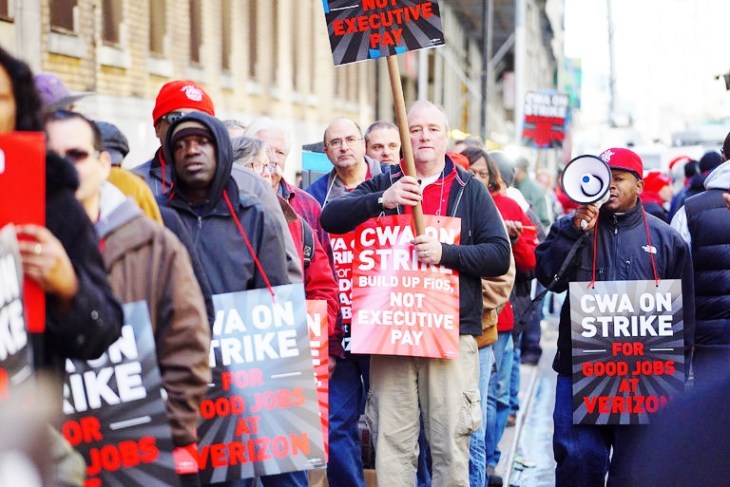
1 VERIZON workers

^ winners — but the company won, too, defeating the stock speculators who pushed the firm to this brink

—- —- —-

Yesterday came the news most of us have been waiting to hear : Verizon and its employees have agreed to a deal — in principle. If the terms published online hold true, this deal is a big one in every way. It establishes the following agreements:

1.Verizon Wireless employees are granted full authority to form a union.

2.Verizon employees not only will not see their jobs eliminated and outsourced to India, they will in fact be strengthened with higher wages ad full benefits uncut and not subject to a 30 year accrual limit.

3.perhaps most importantly, Verizon, by agreeing to these terms, admits that stock speculators pressuring the firm to “maximize shareholder value” quickly do NOT have first call on the company’s structure and employment decisions.

Publicly traded enterprises cannot allow speculators to pirate the company to their own ends. It isn’t much benefit to a company to offer its stock to the public if the eventual result is seeing huge pools of quick action money wresting the value of such companies into their nets. Capitalism was never intended to be speculation. Capital is given the freedoms we accord it because entrepreneurs need capital in order to bring their ideas to market, for everyone’s good, including the workers who create, produce, market and serve entrepreneurial ideas. Verizon has now explicitly recognized this vital principle. Its agreement is a capitalist one.

You can read the agreement here, as reported so far : http://www.nytimes.com/2016/05/28/business/verizon-strike-unions-accord.html?_r=0

That stock speculators have diverted the nation’s entrepreneurial assets to their own purposes solely, to the detriment of all else about our capitalist economy, is hardly a new story. Corporate “raiders” have been raiding capitalist assets for thirty years at least. To date, nothing serious has been done, by way of major legislation, to block, or impede, speculative arrogance. I have written several editorials in this blog suggesting legislation to push speculation back, but so far few opinion makers have taken up my ideas. That is OK if firms begin to do what Verizon has now done.

The problem is that it took a union — a solidly led, determined, deeply embedded union — to force Verizon to a capitalist decision. Publicly traded companies that don ‘t have a strong union within them lack this defense. Perhaps it is time for policy makers to encourage union formation at big corporations : first, to give employees a stronger voice in making major economic decisions affecting them, but second, to give the company itself a stronger hand in pushing speculators back. Few speculators will put up their impatient pools of money if they see the money being held hostage to other forces, at long time frames.

Perhaps, too, if publicly traded firms can put a union or two in place, and thereby commit some economic power to their employees — as well as said employees staying on the job for a long time — they will force impatient money pools out of the hurry game altogether. Capital investment rarely produces its optimum in a hurry. It takes time for an enterprise to organize, to grow, to mature its market. But why is this bad ? Anybody who invests money in stocks finds out pretty soon that the biggest gains come to those who invest for the long term. Look at warren Buffett : the $ 1 million that he invested SIXTY years ago (!) in Berkshire hathaway is now worth some $ 62 BILLION. There aren’t ANY speculator money pools that make anything like that level of gain.

Speculators know this; but the wealthy individuals who entrust huge money to speculator firms want quick action. It may not be a 62,000 percent return; but if a speculator can make 50 percent on his money in a year, he is a very happy money pooler, sure to attract many more billions of hurry-up dollars into his corporate cannibalism and thereby increase his “management fee” exponentially.

That is the rapid greed that capitalism is up against. Absent major Federal reforms — which are not likely to happen in our lifetime — the only power available to stop it is corporate managements willing to see their employees become stronger, organized, and in charge of the arena that speculators want to sell out.

—- Mike Freedberg / Here ad Sphere