BUSY MONTH FOR GOVERNOR BAKER

Baker

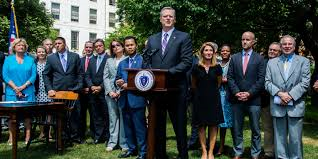
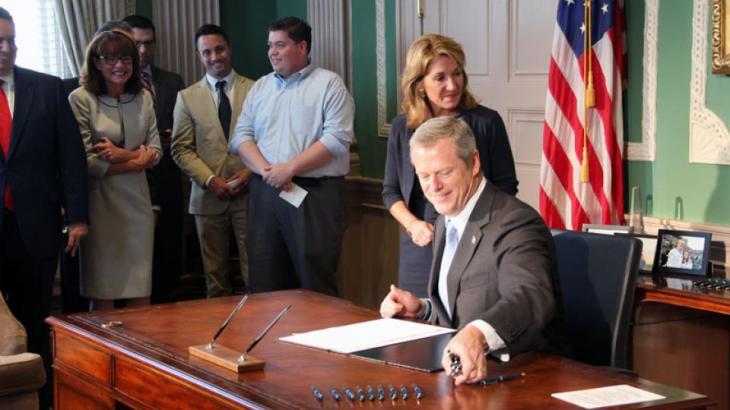
^ Governor baker, with Lieutenant Governor Polito, at signing ceremony for Comprehensive Energy Legisaltion

—- —- —-

While the follies and disgraces of Trump occupy our taste for scandal, quietly and with humble fanfare, Governor Baker has been signing into law significant reforms of state administration. This month alone, he has signed the following legislation:

1.Pay Equity Legislation : http://www.mass.gov/governor/press-office/press-releases/fy2017/governor-baker-signs-bipartisan-pay-equity-legislation.html

2.Regulations governing Uber and Lyft (ride-hailing): http://www.masslive.com/politics/index.ssf/2016/08/gov_charlie_baker_signs_law_regulating_uber_and_lyft_in_massachusetts.html

3.Renewable Energy – Comprehensive Energy Diversity : http://www.mass.gov/governor/press-office/press-releases/fy2017/governor-baker-signs-comprehensive-energy-diversity-law.html

4.Municipal Modernization legislation : http://wamc.org/post/gov-charlie-baker-signs-municipal-modernization-bill#stream/0

5.Job Creation and Economic Development legislation, including allocation of $ 1 billion to make it happen : https://malegislature.gov/Bills/189/House/H4569

6.And of course, on July 8th, Baker signed the transgender people’s civil rights bill commonly known as the “TransBillMA” : http://boston.cbslocal.com/2016/07/08/massachusetts-signs-transgender-bathroom-bill-law/

It would be difficult to find a 30-day period, in any state or city, much less the Federal government, in which as much reform has been accomplished, across so many fields of action. Many of these six enactments were voted unanimously in the legislature. It would be difficult, maybe impossible, to find any legislative activity comparable.

All six new laws faced much debate in the legislature and Senate; many underwent significant modification — the Uber/Lyft and #TransBillMA in particular — especially in the Senate, where a majority seeks reforms well beyond present consensus, especially respecting taxes and fees; but ultimately reform voices were able to find common ground with more cautious minds, and the result is a remake of Massachusetts state administration as transformative as anything done since the 1970s, an period equally reformist. Bipartisan reform was that decade’s priority, and the same is true of reform now. We are lucky to have it.

Perhaps the Economic Development bill, an appropriation act, is the most surprising in which to find bipartisanship. Its first allocation is a big one : 

“7002-8006 For the MassWorks infrastructure program established by section 63 of chapter 23A of the General Laws …………………..…………………………. $500,000,000”
Hillary Clinton has proposed almost the exact same program for the nation, albeit much larger:$ 550 billion, not million. Yet here we are.
Also featured is item 7002-8080, appropriating $ 23,622,000 for a long list of separate infrastructure works in a multitude of the state’s towns and cities. Environmentalists  ill certainly be pleased to see this allocation :

“7002-8021 For the Brownfields Redevelopment Fund established by section 29A of chapter 23G of the General Laws ……………………..……………..…………… $45,000,000”
MassDOT gets $ 109,500,000 to build the Paul Conley “megaships” port terminal; and $ 45,900,000 goes to upgrading schools in Chicopee and the Blackstone Valley — thereby helping keep a promise that Baker made in his 2014 campaign to boost t.he state’s “gateway cities” ability to participate in the new economy that has Boston booming.
The Uber/Lyft and Comprehensive Energy bills are compromise affairs in which no interest received all that it wanted but all were accommodated sufficiently to support improvement of the economy, not obstacles to it. The Uber/Lyft bill includes a fee for service that baker agreed to, and it includes the following regulations (as re\ported in the Boston Globe) but not fingerprinting of drivers :
“drivers for Uber, Lyft, and other on-demand transportation companies will undergo a two-part background check — one conducted by the companies, one by the state. Drivers will also undergo a second vehicle inspections in addition to the annual personal motor vehicle check, and their cars will be outfitted with decals. The companies will be required to carry commercial insurance while trips are in progress. In some respects, the rules solidify into law the practices Uber and Lyft already employ, while other aspects are not currently undertaken by the companies.”
As for the Comprehensive Energy Bill, it enables many competing initiatives and advances the state’s obligations to the world-wide Global Warming situation; at the same time, it leaves some hard questions unanswered : can there be  a carbon tax system that is not regressive ? can we move forward from dependence on natural gas fuel ? Senator Marc Pacheco, for example, noted that while he supports the bill, “we have a long way to go.” Still, the bill jump starts two new alt-energy industries and provides rate payer relief as well as acquiring hydro power from Quebec. As Governor baker’s press release put it :

­

#topnav {
filter: none;
}

“Consistent with the Baker-Polito Administration’s previously filed legislation authorizing the procurement of hydropower generation, An Act Relative to Energy Diversity (H. 4568) requires utilities to competitively solicit and contract for approximately 1,200 megawatts (MW)  of clean energy generation – base load hydropower, onshore wind and solar supported by hydropower, standalone onshore wind, solar, or other Class I renewable resources. In addition to recognizing the necessity of hydropower generation to provide reliable generation to meet Massachusetts’ energy demand and achieve the greenhouse gas emissions goals of the Global Warming Solutions Act, the legislation signed by Governor Baker allows for the procurement of approximately 1,600MW of offshore wind. The bill spurs the development of an emerging offshore wind industry to create jobs and represent the largest commitment by any state in the nation to offshore wind.”
 So there you have it: progress on civil rights, energy, infrastructure, regulation of ride-sharing, municipal reform, and pay equity for women in the workplace. And all of it enacted on a bipartisan, mostly unanimous basis. This is the difference between focused, careful leadership and scatter-shot, petulamt, irresponsible kvetch. And if, in all of what has been accomplished one step at a time, you see a large likeness to the M/O of one Hillary Clinton, you are not hallucinating. Baker and Clinton have very similar philosophies of governing. The Boston Globe’s Yvonne Abraham, two years ago, noted shrewdly  that Baker was running for Governor “as essentially a Clinton Democrat.” That this particular “Clinton Democrat” happens to be a Republican, and a classic Massachusetts Republican at that, only shows that good reform is not the possession of one party only but is the heritage of us all.
—- Mike Freedberg / Here and Sphere


OVER-WEIGHING THE SUPREME COURT

hewitt

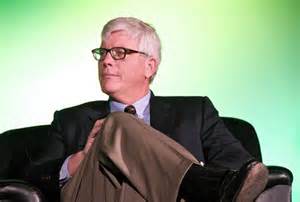
^ Hugh Hewitt : the “:right’s” intellectual leader is no such thing.

—- —- —-

Often in political discussions these past two years I have read that the Supreme Court is the ultimate election test. It is no such thing.

Ideologues on both sides alarm us with warnings that if “the other side” wins the election, the Supreme Court “is lost for a generation.” I don’t believe that for a minute; but even if the alarmists are right, and the “side” that wins the Presidency is one whose Supreme Court opinions you detest, that’s no reason to support a man like  Trump or to oppose him, as Hewitt suggests it is.

(That said, this editorial is nOt about Trump, It is about the Supreme Court and elections.)

The Supreme Court cannot DO anything. It can only prevent things from being done. Our Federal government is in serious trouble if its most important branch is the one that can only stop stuff, never do any. It is even more serious trouble if the Court is subverted by political objectives to become not a judicial body but an adjunct of “stop” Congresses.

Hugh Hewitt, a “conservative” talk show host, in the following article, renders the Supreme Court a political body and is glad to do so. Read him at length: http://www.washingtonexaminer.com/counting-the-cost-of-a-supreme-court-lost-to-the-left/article/2598810

For Mr. Hewitt’s entire argument — which I will destroy later — there is one quick answer : you don’t like the kind of judges you assume Hillary Clinton will appoint ? Then confirm Merrick Garland.

Garland’s name never appears in Hewitt’s paragraphs. Of course not.

Hewitt is held to be the “right’s” intellectual heavyweight. His article says otherwise. It’s filled with assumptions, none of which one is required to accept, and with red herrings: it’s not an argument at all, just a series of hysterias.

For example : Hewitt does not like “living Constitution” jurisprudence, but rather than argue for why not, we’re given an ugh.

Again : Hewitt assumes that Hillary Clinton will nominate “far-left” judges : not because she will — I doubt she will, and even if she does nominate them, the Senate is not likely to confirm — but because it’s one of his alarm bells.

Alarm bells may inform ideologues like Hewitt, but the facts of real life defeat them. No matter who is nominated to the Supreme Court, he or she knows what the country wants and that a Court decision can stop it only for so long. That is why Court nominees who seem to belong to one “side” or another end up, usually, as something quite else when they become Justices.

Justices usually know that the Constitution cannot be interpreted, in the year 2016 for example, as if it were 1787. They know that the history of the nation since then cannot be abolished, that it has become an integral part of the culture we are brought up in. Justices know, too, mostly, that their decisions affect the future, not the past. Justices understand, mostly, that their task is to figure out how the Constitution’s precepts and grants of power apply to laws enacted now, not in 1789. They understand also, mostly, that the nation today is not at all the nation that ratified — barely — the Constitution in 1787; and that the one part thereof that remains the same is its principles : promoting the general welfare, equal protection of the laws, citizenship of all who are born here, liberty, the Supremacy Clause. We are a nation, not 50 separate states.

Hewitt makes much of”originalism,” a method of Constitutional interpretation. Its theory is that we should apply the Constitution’s words as they were understood in 1787, when written. Is that really possible ? And even if it is, how does applying 1787 meanings to life today work out ?  Life, like words, develops and alters, adapts to unknowns, recalibrates itself. Somehow, Constitutional application must recognize these developments. Otherwise, the complexity of civic life in a diverse nation, with hundreds of paths contemporaneosuly pursued by this one or that one, will lose connection with the Constitution altogether. (Something of this sort is already happening. Trump’s supporters — and not only his —  include many who do not accept the First Amendment, the Supremacy Clause, or the 14th Amendment, among other precepts.)

“Originalism” is undermined by life itself. Words change meaning because words are public, and the public uses words in the moment, not yesterday. Words are public and they are equal because our ears hear every spoken word equally well. The ear knows no class system. It hears the immigrant equally with the aristocrat, the prisoner and the guard, the employed and the employer. The Constitution and its Amendments are written in words.

As I posed in an earlier editorial, the major decision made about our Constitution was to have it written. Many nations, including Great Britain, follow unwritten Constitutions; those that do enjoy constitutional development adjusted to actual life — to custom, if you will. Language changes over time : our spoken English is not that of Shakespeare or Chaucer, is not even that of Hawthorne and Faulkner. (And Latin became French, Italian, Catalan, Romanian, Spanish and Portuguese.) Spoken language is free to respond to the justice of the moment and does so because it cannot do otherwise: if so, it would not be understood. And the spoken word affects the written word, because when we read the written word, we speak it silently in our mind; and if what is written doesn’t sound right, it jars us and makes us quizzical. So much the more when we speak the written word. Read the Constitution aloud sometime, and you will immediately hear phrases that do not sound quite right, words and sentences that need to be read again in order to be understood, if at all.

That is where the Justices come in : interpreting the Constitution’s written word for citizens who use the language as spoken far more regularly than written.

Originalists like to say that there are no rights in the Constitution that are not explicitly enumerated therein. But this cannot be true. If this were true, then those rights that have taken shape since the Constitution was enumerated would have no home in law and would exist by custom only, thereby developing an unwritten constitution alongside the written one. That would be a far more radical situation than to find said rights within the written Constitution.

The Originalist argument is internally contradictory; and as the Constitution is a guideline for the laws of actual life, contradiction does it no good.

So much for Constitutional interpretation, the power of the Court, and alarm bells.

To sum up : voting for Trump to protect use of the Supreme Court as a stopping agent is futile and misapprises the role of our Federal government. Congress cannot be stopped fo0rever. Hugh Hewitt never mentions that, if Hillary Clinton is elected President, her Supreme Court nominations will hardly be her most powerful power. She will likely have a Congress with a Democratic majority, and she and it will be able to DO things all day long, far more things than any Supreme Court can ever stop. If there is an argument for voting Trump, THAT, not the Supreme Court, is the argument to use.

—- Mike Freedberg / Here and Sphere


GOOD AND BAD IN THE BLACK LIVES MATTER MOVEMENT

BLM photo

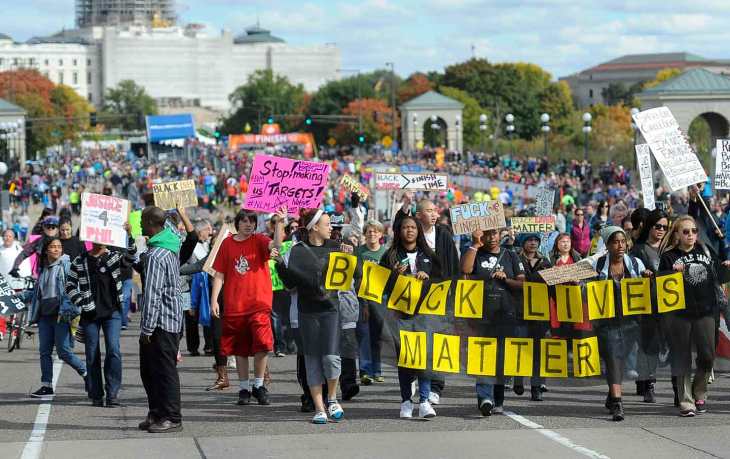
^ Black Lives Matter : from irrefutable justice movement to inflammatory left-wing agenda

—- —- —-

We at Here and Sphere support the basic ideal of Black Lives Matter : that the skin color of a person should have no bearing at all on the respect and fairness with which he or she is treated and regarded by the society and by its law enforcement officers; and that disrespect, and worse, by the society and its law enforcers is a serious breach of society’s covenants : against which appropriate action ought be taken.

I think that most of America gets this and supports it. I think that most law enforcement people get and support it too. Officers and Black Lives Matter protesters have in many cases joined hands; and why not ? We’re all in this together.

The movement has an opportunity to remake much that today is misguided about law enforcement and people of color. It has the nation’s attention; and many people have also noticed that most of the incidents that roil us have begun with a 911 call, often hysterical, usually full of misinformation. The way that 911 calls are received and processed needs great reform. In some communities, a 911 call is made simply because the caller sees a person of color walking on his or her street. Police forces need to treat such calls skeptically; many already do, but many treat them as harbingers of danger.

Police departments need establish a workable procedure for communicating with those who they stop and for processing the stopped person’s response. That procedure should be published, so that all in the jurisdiction know what is likely to be done by the police person who stops you. And of course, the procedure must be the same for all persons. Police commissioners must also make sure that every officer on his or her force understands the procedure and swears an oath to it. Compliance must be scrupulously monitored. The communities thus policed must be a partner in this effort. Too often they have not been; have been, instead, seen as a danger, whereas in almost all case, the communities being policed are an ally.

All of the above, the Black Lives Matter movement has brought to the nation’s attention, and I applaud it for doing so.

If only this were the entire story; but as with so many reform movements, it is not the whole story. It appears that the leaders of the “BLM” movement have morphed it into a movement of general political revolution, much of whose tenets I reject, as should you.

Before I continue, let me decry this development. I have seen it before. A justice movement, singularly focused, makes it=s case and begins to persuade; but then, its mission incomplete, activists within it decide to expand the mission into all sorts of other grooves, along with imposing a division — most likely racial — between the movement’s prior activists. Not surprisingly, the movement thus complicated and radicalized alienates most people and fails itself and its original mission. Something of that has befallen “BLM.”

Specifically, “BLM” has recently promulgated its “six point platform.” A few points, I agree with. Others I roundly reject. These I will dcscuss, but first, you should read the platform in its entirety now : https://www.google.com/url?sa=t&rct=j&q=&esrc=s&source=web&cd=1&cad=rja&uact=8&ved=0ahUKEwjwjdjn_azOAhUKJCYKHdyzBiQQFggcMAA&url=http%3A%2F%2Fmashable.com%2F2016%2F08%2F02%2Fblack-lives-matter-movement-coalition-policy-goals%2F&usg=AFQjCNE8a9MXanzlsN2gsfFi0o8Xkxc82A&sig2=IgvvTZjPMimmNrHVQRbtZA&bvm=bv.129391328,d.dmo

Point Number One : End the war on black people. abolish the death penalty, yes. Demilitarize police forces, yes. Eliminate money for bail, no.

Point Number Two : Reparations. This demand has been made before, by other groups. BLM’s language is filled with buzzwords, rage, and distortions, probably because the entire demand is unworkable and unquantifiable in justice terms given the complexity of Black Americans’ rise to success over time.

Point Number Three : Invest/Divest : “move money away from police and systems of incarceration and put into “long term safety strategies” such as employment and education. With this, we can, or should, all agree. The only difficulty is that BLM’s education agenda calls for eliminating charter schools — exactly the schools that offer success to Black city kids.  I have no idea how this union-originated demand worked its way into a justice agenda, but it has. I reject it. So should you.

Point Four : Economic Justice : to BLM, economic justice means doing away with the Trans Pacific Partnership. Again, I do not see what this labor union goal has to do with justice for Black People. To be fair, this section also calls for a national and local effort to bring jobs to the “most economically marginalized Black people.” Assuming that people can be so categorized, and identified, I think that Hillary Clinton’s $ 550 billion infrastructure plan might help.

Point Five : Community Control : this was tried during President Johnson”s “Great Society” initiative. It led to graft, embezzlement, and small cliques controlling who got the money and who did not. And who, exactly, is “the community” ? This is a buzzword used by pressure groups in all sorts of settings to bogard proposals that all sorts of locals support but do not have the time to attend long and boring “community hearings.” To the extent that “community control” means control of government agencies, I do not see how that can be done short of full blown racial apartheid. (I may add that much of the BLM rhetoric assumes racial apartheid. This is of course not new. Many Black people’s justice movements — the colonization movement, Marcus Garvey, the Black Panthers — have sung the despair’s tune of racial separation.

Point Six : Political Power : most of the demands in this section, I fully agree with : universal voter registration; same day voter registration; voting day holidays; voting rights for formerly incarcerated people. But other point can never be agreed to : pre-registration of 16 year olds and local voting for undocumented people. I am all for immigrant integration into our society, undocumented too; but voting is , perforce, exclusively a right of citizenship. No non-citizen can ever be allowed to vote in citizen elections.

Though certain of this six point platform should be supported, its enlargement undermines the initial agenda, one that was well focused and impossible to argue against. Thus expanded, there’s almost certain to be some component that potential  supporters cannot support. Usually this leads a movement to “Leninization” : those who aren’t supporters of it all get viewed as enemies of it all and are expelled or dismissed.

I have encountered BLM activists whose zeal for their own revelation about justice takes them well beyond their comfort zone. I well recall arguing on twitter with one such BLM activist who was certain about everything and combatively dismissive of me for not sharing her enthusiasm and her buzzwords. She started telling me about her neighborhood, assuming that I, being an old white guy, could not possibly know anything about it. But in fact I knew more — much more — about her neighborhood, and happenings in it, than she: which ended the discussion.

BLM seems staffed by many like that twitter person, full of aggression, phrases, and zeal, but lacking much ground. “Full of passionate intensity”,” as the poet once wrote, makes for ready coalition of like zealots; and as is usually so about zealots, many fly to the far fringes of political objectives. So much for the original mission.

Citizens seeking change are free to present whatever change they like by any means they like; I have no problem with it here, except that BLM, doing so, has made a movement that was irresistibly just into a whirlwind of wham and bam.

UPDATE : I greatly prefer that this editorial  not end on a down note. The original goal of “BLM” is one that we all should support : the guaranteeing equal respect and justice to residents of all skin colors, in particular Black persons. If “BLM” really wants to achieve that end, it should concentrate its volunteers on “GOTV”: in Black Belt starts of the South most of which are poised to vote Democrat in this election. Were such states to vote “blue,”: it would bring political revolution and, almost certainly, a justice revolution with it, one that might well accomplish the goals of the 1960s Civil Rights movement — which achieve much but left much yet undone.

—- Mike Freedberg / Here and Sphere


HOW DO WE PAY FOR THIS ?

arts

^ among the Budget vetoes overridden was several million dollars for the Arts. (photoi by Boston Globe)

—- —- —-

Two weekends ago and again this past weekend, in all night sessions, the Senate and House overrode a large number of the hundreds of line-item vetoes Governor baker delivered to the state’s FY 2017 Budget. Everybody went home happy, and the voters affected went to bed happy. So far, so good.

But not me. I have an uneasiness. How do we pay for this happiness ?

The state House News Service summarized the dispute in an article thus : “Baker said he vetoed $256 million because the Legislature’s $39.15 billion spending bill underfunds accounts by about $250 million. The underfunded accounts include public counsel for indigent defendants, emergency assistance to the homeless, and winter road-clearing, Baker said, predicting bills “we think we’re going to have to pay for no matter what between now and the end of the year.” Baker said he “felt bad about” vetoing certain spending. “There’s a lot of very worthwhile stuff that was on that veto list but we have to have a balanced budget,” he said. The governor described a “tremendous amount of scrambling” to deal with a $480 million fiscal 2016 revenue shortfall and said he was “very nervous” about a similar situation occurring in the fiscal year that began on July 1. Defending his veto decisions, he said, “We can’t have another year where we’re just chasing the revenue number all year long. It creates enormous instability for everyone.”

“Highlighting a major difference of opinion with the governor, House Speaker Robert DeLeo last week suggested the Legislature could override all of Baker’s vetoes and the state budget would still be balanced. House leaders are still determining which veto overrides to initiate.

You can find a complete list of the Budget appropriations vetoed by baker at this link : http://www.mass.gov/anf/docs/anf/vetoes/fy17/parchment.docx I warn you that it makes for very dry reading. Still, as the state Budget is paid for with your money — your taxes and state fees — at least some of us may want to read the how much, the why, and the why not’s that went into the Governor’s decisions.

Baker is right : there is in fact a lot of “worthy stuff” that he felt the need to veto, or to cut back. There always is. The needs of Massachusetts residents are many and expensive, and sate government owes residents a duty to resolve these needs as fully as feasible. But the money has to be there; and baker’s claim of a $ 480,000,000 revenue shortfall sounds plausible given the very slow growth of the nation’s economy and that the Budget I grounded in “no new taxes or fees.”

At some point, Budget needs — “worthy stuff” — are going to have to duke it out with the mantra of “no new taxes or fees.” That point has not arrived yet. Baker’s view is that the voters will not grant additional revenue until they see that government is delivering value for the taxes already authorized. I think Baker gauges voter sentiment correctly.  Which means that either Speaker DeLeo is right, and there’s enough revenue to pay for the overridden items, or there isn’t, and the appropriated items may well go unfunded. After all, if the state treasurer hasn’t the funds, she can’t pay out the checks.

Julie Cox and Charles Samuels, writing in JD Supra Business Advisor, report that the legislature overrode some $ 97 million of Baker’s $ 162 million in Budget vetoes: The legislature overrode $97 million of Governor Baker’s $162 million proposed vetoes in the FY16 budget. The legislature restored $5.25 million in cuts to the UMASS system, after high profile lobbying of the legislature by new UMASS system president Marty Meehan. Also on the education front, the legislature unanimously restored $17.6 million for full-day kindergarten programs targeted at underperforming schools.” $ 97 million isn’t $ 480 million — the amount that baker expects state revenue might fall short — but it’s not minor. Can the funds be found without new fees or taxes ?

Perhaps the answer will arrive in Baker’s Supplemental Budget. Every year the Governor files a Supplement. Until that happens this time, we’re left with a lot of very “worthy stuff” re=funded in principle, making a lot of voters justifiably happy, but leaving the actual happy spot in fingers-crossed territory as we wait to find out if the happiness can be paid for — or is just wishful thinking.


—- Mike Freedeberg / Here and Sphere


STEADY AS HE GOES

CB

^ as if Governor Baker didn’t have enough to do, he has been forced to referee the Attorney General’s new weapons regulation.

—- —- —-

There has been much brou haha about Attorney General Maura Healey’s new regulation respecting weapons illegal in Massachusetts. Inevitably Governor baker has been asked to opine about the matter. This has led to accusations seeking partisan advantage in an issue that should be the essence of public safety. One such accusation is that Baker has changed his position on the matter — has “backtracked” from supporting the regulation, as he seemed to do in his first statement. Let us see if there’s any leg in this accusation.

Here’s how Governor Baker has addressed AG Maura Healey’s new assault-weapon regulation :

Six days ago he said this —-

“Baker appeared to largely support Healey’s decision, although he said Healey should make available a list of which guns are banned. “The big issue in the short term is going to be the confusion around which weapons this applies to and which weapons it doesn’t apply to,” Baker said. “And my hope is at some point there’s going to be a list, and people will know of which ones are on and which ones are off.”

More broadly, Baker said Healey has the authority to decide which weapons are considered assault weapons under Massachusetts state law. “If people are in fact selling weapons that violate the Massachusetts assault weapons ban, then that should be dealt with and people should do something about it.”

Yesterday he was reported to be saying this —

“Governor Charlie Baker is asking Attorney General Maura Healey to provide more information on the new gun rules.

Last week, Healey called for eliminating the sales of so-called copycat weapons, which have been altered to get past the state’s assault weapon ban.

The governor says the notice needs to be clarified in order to protect responsible gun owners.”

Is there is a difference in these two statements by Baker ? A “backtracking,” as some partisan Democrats have claimed ? I do not see one. As I read it, The Governor’s position isthe same : the Attorney General has the authority and the jurisdiction — but clarification is in order.

I fully support the purpose of the new regulation : to get control of copycat weapons that may, by leaving off one part or another, slither through a regulatory loophole. I agree, too, that her purpose works from existing law and does not require new legislation. Still, the consequences of the regulation for gun dealers and for those who own weapons legal when bought but now illegal are not simple. In particular, what happens to gun dealer inventory that now cannot legally be sold ? Thus I agree that Healey needs to clarify her regulation.

Making progress on weapons regulation is a tricky business. Backing off from the armed vigilantism that has almost captured the entire nation, even though 80 to 90 percent of us oppose it, means actual changes for actual people. It wasn’t easy to defeat cigarettes. It took decades to do so. It will surely take even longer to get the tic of gun addiction out of people’s necks. Those who favor unregulated weapons everywhere may amount to barely ten percent of the people, but that ten percent are passionately organized and ready to  intimidate anyone who threatens their outlawry . Their opposition can only be pushed back one tiny, tiny step at a time. Healey may well have acted a bit too brusquely. She may well find that the Governor’s caution helps her, and so helps us — and helps the cause of weapons regulation.


—- Mike Freedberg / Here and Sphere

PUTIN, TRUMP, AND NAPOLEON

napoleon

^ ah yes, the man on a white horse, come to save us all.

—- —- —-

If you read the history of Britain’s long struggle against Napoleon, from 1790 to 1815, you will be amazed, since everyone now counts Napoleon an egomaniacal, destructive ogre, to find that a large segment of British public opinion supported the Ogre and hoped for his victory of British troops. Right up to the week before the decisive Waterloo victory, British Whigs were carping for “Boney” to smash the redcoats; not long before, these same politicals were poo-pooing the Duke of Wellington’s classic Peninsula campaign and doing everything they could to destroy his reputation.

It is disheartening to see a significant number of a proud nation’s political leaders rooting for its defeat.

I mention these matters from 150-odd years ago because something of the same has awoken in our own election campaign. On the one side, we have Hillary Clinton, fighting for just about the entire range of progress that is mortally opposed by progress’s enemies; on the other side, a devilish, maybe psychotic demagogue who loves Russia’s Vladimir Putin and says so and whose campaign manger, the odious Manafort, has money ties to Putin and his thugs — former KGB poisoners who now steal their nation’s assets and who murder their opponents, including journalists. Given that Putin has been our enemy, and Europe’s enemy too, these past ten years or more, and that he is doing his best to undermine our nation at home and overseas — yes, Virginia, the Cold War is back — you would think that a candidate for President would hurl political obscenities at Putin, not send him orange cheeto kisses. But you would be wrong.

Not since Aaron Burr, who was in 1804 our vice president, tried to engage the Spanish in creating him a separate frontier nation, has a presidential contender toyed with treason. How did this happen to us ?

Burr made his treasonous pact for personal, money advantage. Trump and his gang are doing so because he hates the tolerant, inclusive, diverse America that is coming to be — and is glad to arouse all those who hate it as he does — and because he, like Burr, believes himself the only person in the political universe who counts. And because he admires Putin’s government of thuggish embezzlement. And if that is Trump himself, what can we say about the substantial following that wants him ? Despite the dictatorship of threat and payback and the outright thuggery that he almost boastfully announces ?

Better dictatorship and thuggery, in their minds, than to see people who do not look like them, or live as they live, or who are not macho males, or who came to this country uninvited to seek a better life, take power and make America something new in which they, the Trump campers, might not be able to lord it.

And the fear. The gun-toting cowboy response. The fear of bogeymen and aliens. Putin nation.

Trump’s thuggery has been called “weaponized politics of nostalgia.” Shrewd observation, but incomplete. The Trump dictatorship of armed vigilantes, violent bigotry, closed door policies, personal hucksterism, fraud, and insult of everyone perceived as weak is politics of the jackboot. It is nothing American, and those who seek nit want nothing to do with America; indeed, they seek to end America, the nation and the idea.

America is more an idea than we realize. It is an ideal, one that we have almost always aspired to; a nation in which liberty and union go together and in which all men (and women) are created equal, a nation in which the General Welfare is the goal of government, a nation creating itself, all hands on deck.

It’s a noble idea and an heroic ideal, which is why so many millions want to join us, to help build something better. Yet an idea and an ideal are all that America ultimately is. If enough people who vote here do not want America, it won’t be; it will go away. Right now, we see that almost half the voters want something other than America and are willing to vote for a man who sells out to Putin and his gang of thugs, to line his wallet, if that’s what it takes to get America out of their lives.

An enemy is within us; Putin loves it; and we had better wake up to what is being done to our blinded nation before it is too late.

—- Mike Freedberg / Here and Sphere


THE SADDEST OF THEM ALL

trump

^ the saddest man in the moral universe

—- —- —-

There have been hundreds of sad political days during the past four years of life in America, but last night was the saddest of them all. In his acceptance speech of the Republican party’s nomination for President, Donald Trump defiantly spurned everything that it means to hold high office in a great nation.

He identified many challenges that — so he claims — we face, some of them chimerical, most of them misconstrued, the rest overblown. He offered no solutions : probably because how can you have solutions to tasks that aren’t real, or are misidentified or are molehills spoken of as mountains ?

He spoke several outright howlers. Perhaps the absurdest was his claim to protect LBGTQ people from….ISIS ? Oh I see : he was thinking of the club shooting in Orlando.  Horrific that was, but LBGTQ people face far more immediate persecutions from members of Trump’s own party (though admittedly not death, unless you give credence to the ravings of a fringe).not to mention from the Supreme Court judges he promises to appoint or from his supposed opposition to same sex marriage.

Assuming that you believe him. I don’t.

He doesn’t like trade deals — so he says — even though our export economy benefits enormously from them and despite his manufacturing his Trump brand clothing overseas via trade deals.

He doesn’t like immigrants or Muslims, though he loves immigrants’ low wages (which he wants to lower further — assuming you believe him; I don’t).

He ascribed all of our nation’s problems to people who are not like us, whatever that means. To his followers, it means you know what. To him ? Just a convenient rubber ducky to bust — although the Roman Emperor Marcus Aurelius identified the tactic 1900-odd years ago. “There are three stages of growing up,” he wrote in his Meditations. “first, you blame other people for your troubles. Second, you blame yourself. Third, you do something about them.” Trump squats squarely on step one — grinning in your face, because he knows you’re falling for a gimmick he doesn’t believe for a minute.

Trump wants America to be first. So he said. What does that mean ? That we win Olympic competitions ? that we build more warships than anyone else ? That we build bigger banks than the Chinese ? That we expand the national debt ? That we bomb as many brown-skinned people as possible back to the Stone Age ? that we torture terrorist prisoners till Assad sends him gushing letters of admiration ?

Assuming, of course, that you believe anything he said.

Perhaps I should give him a pass, however. How could he offer any actual solutions, or lay out any agenda items, as nominees always do in their acceptance speeches, when the platform adopted by the convention  is binders full of oppressions against this group or that gender ? Even Ted Cruz might break up laughing were he to mouthe the platform item by item. Conversion therapy — really ?

“I am your voice,” he said. I heard him say it. But actually, he is not. The people he claims to be the voice of — working people with scant education and thus few options in the skill economy — he has stiffed time after time, or defrauded by the thousands, or used and used up as he played the New York City real estate game, a field of smarm and violence, criminality and dog eat dog, parlaying his Dad’s millions of dollars into billions of dollars — won and lost, lost and won as cavalierly as the carelessness with which he has diddled his campaign of insult and bile.

The people he claims to be the voice of need better than a dilettante.

Chutzpah, however, Trump has. What else was it but unmitigated gall for him to say to “his” people, “I’m With You” ? But I suppose that’s what a con man MUST do. Only by saying “I’m With You’ with utter conviction utterly believable can a huckster stiff you, defraud you, pick your pocket.

Sixty years ago, Lyndon Johnson, who knew his fellow politicians well, said that demagogues are always pointing fingers at scapegoats and while they have your attention turned, they’re picking your pocket.

That is Trump.

How sad, how unutterably sad, how uselessly sad, is it that  major political party has given its nomination for President — which it only gives every fourth year; make a mistake, and it has to wait yet another four — to a slim-mouthed, hate-pouring, scapegoat sculpting, incompetent accident ! To a man whose graveyard epitaph will read “picker of pockets.”

—- Mike Freedberg / Here and Sphere

FIXING THE T : GOVERNOR BAKER’s STATEMENT

Baker

^ Governor Baker lays out his long and detailed, full transformation plan for a  very different MBTA future  –if he gets his way

—- —- —-

It’s not often that, when addressing a major public issue, I feel justified in letting an elected official’s response speak for itself. When it comes to the MBTA, however, and where it stands after 16 months or so of Governor Baker’s management, there really is nothing to add to his lengthy address reprinted in its entirety below. Baker was elected as Mr. Fix It, with the managerial experience and know-how to accomplish the fixes, and this address makes clear that he has a detailed grasp of the T’s many, many shortfalls  and of the kind of effort that will be needed to get them fixed

One can argue about some aspects of baker’s assessment. I’m not convinced that the best solution for the parts warehouse’s inefficiencies, or the sad condition of the money counting room, is to outsource the work. Capital upgrades seem equally useful, thus preserving the know-how of the T’s current workers and letting it continue to be used. Still, it’s hard to differ with most of the under-performance examples cited by Baker, nor to dispute his plan to eliminate the mindset that adapts to these failures rather than correcting them.

And now, to the very long Baker statement itself. You can read it here  — http://www.mass.gov/governor/press-office/press-releases/fy2017/gov-baker-addresses-progress-and-future-of-mbta-reforms.html — or in full in this article :

GOVERNOR BAKER’S LOCAL GOVERNMENT RESOLVE


FullSizeRender

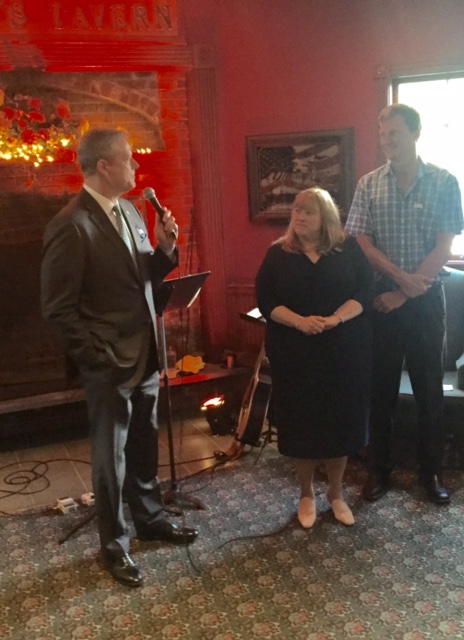
^ local government apostle : Governor Baker at kickoff, 70 miles west of, Boston,of St Representative Susannah Whipps Lee’s re-election campaign. (Worcester Sheriff Lew Evangelidis on the right)

—- —- —-

On July 18th, at a campaign kickoff for State Representative Susannah Whipps Lee of Athol, Governor Baker spoke as one seldom hears from mainstream elected officials these days. I wish that all my readers could have heard what Baker had to say and how he said it. I can’t reproduce his speech here, nor anything like it, but I will do my best, in this article, to bring his message to you.

“It’s a long way from Beacon Hill to the rest of Massachusetts,” Baker said, speaking to activists in Lee’s District 70 miles from Boston. “We get that, Karyn Polito and I. It’s why we do not just tell communities how to do things but instead encourage communities to implement State policy in their own way.

“Because,” Baker added, “government works better when it’s local. People judge how they’re doing based on how things are going in their won community.” If we want people to feel that life is working for them, Baker was saying, we need always to remember that to the people we are governing, “works well” means working well in that community. “This is why,” said Baker, “Lieutenant Governor Polito and I give so much attention to community compacts.” (More than half the 351 cities and towns in Massachusetts have signed these compacts, intended to upgrade local government’s practices and modernize its outreach.)

Usually, these days, when one hears talk about local government it’s in a context of distrusting either State or nation or both. Baker intended no such distrust, nor to evoke any; he is, after all, Governor, not a selectman. Nor was there the slightest overtone, in anything Baker said, of untying any locality to “Beacon Hill.” Baker’s point was to strengthen “Beacon Hill” by committing our “351 towns and cities” to carrying each its own burden, on its terms, in tandem with one another and, perhaps, sharing practices with one another.

That said, Baker was just as firm, in his words, that all politics is local, just as the late Tip O’Neill famously said; that participation in democracy begins in the precinct and carries out its most necessary missi0ns in the precinct, door to door and neighbor with neighbor. He was saying all this, of course, because Susannah Whipps Lee represents towns little visited by “Beacon Hill” deciders but in which actual people live, who are — so Baker insisted — just as important to the State as those who live in the Capital City : and so, he wanted to add, is their representative, Susie Lee.

These were points crucial to Baker’s talk : distance matters, more than it should, perhaps, but it matters, and its presence creates a burden upon the equality of those who live distant from “the center.”

This burden can probably never be lifted; but baker’s theory of governing from locality to center, rather than the other way around, alleviates as much of this inequality as is practicable. His theory takes onto his shoulders, as Governor, some of that burden, and the over 200 Athol, Orange, Templeton, Warwick, Wendell, and, yes, Phillipston activists who heard him, in that restaurant room 70 miles uphill from Boston seemed to thank him for  bringing more to them than just a Beacon Hill gesture.

GOVERNOR BAKER VETOES…

baker-budget

^ signing the FY 2017 budget does not mean it’s easy or fun time for Governor Baker

—- —- —-

The legislature enacted a state budget for fiscal 2017 that somehow managed to expand funding for crucial state services despite there being no new taxes — as well as a significant revenue shortfall. Not surprisingly, the budget which Governor Baker agreed to sign leaves several state services under-funded.

But not to worry : Baker will submit a supplementary budget to fund those shortfalls. To quote his message :

“We have identified several underfunded accounts, such as the Committee for Public
Counsel Services and the Emergency Assistance program, which we know we will need to fund at higher levels during FY17. In addition, we remain committed to our obligation to fund Other Post-Employment Benefits (OPEB) at $77 million versus the reduced amount of $26 million in the conference committee report.
In conjunction with today’s budget signing, we are filing an FY17 supplemental budget
for the underfunded accounts plus $5 million for substance abuse services to further support our ongoing efforts to combat this epidemic, as we filed in House 2 and believe is necessary.
To accommodate the spending and revenue differences with the conference committee
report, we are making corresponding corrective measures in order to balance the budget and maintain fiscal stability. We are vetoing $256 million in line-item and outside section spending, including $60.6 million across 497 earmarks. Of the 200 outside sections presented in the conference report, we are signing 141, vetoing 36 and amending 23.”

Baker had more to say. He vetoed a variety of line items, igniting several fires of complaint :

“I am reducing appropriation amounts in items of section 2 of House 4450 that are
enumerated in Attachment A of this message, by the amount and for the reasons set forth
in that Attachment;
“I am disapproving, or striking wording in, items of section 2 of House 4450 also set forth
in Attachment A, for the reasons set forth in that Attachment;
“I am disapproving those sections of House 4450 itemized in Attachment B of this
message for the reasons set forth in that Attachment; and

“Pursuant to Article LVI, as amended by Article XC, Section 3 of the Amendments to the
Constitution of the Commonwealth, I am returning sections 12, 24, 36, 54, 63, 73, 108,
111, 113, 115, 133, 145, 148, 157, 168, 179-181, 186, 191, 194, 196, and 201 with
recommendations for amendment. My reasons for doing so and the recommended
amendments are set forth in separate letters dated today which are included with this
message as Attachments D to W, inclusive.”

So much for the verbiage. Let’s talk about a few of Baker’s more controversial vetoes.

First : an entire series of Courts and Legal Administration reductions made, in his words, “to the amount projected to be necessary.” (Projected by Baker’s Office of Administration and Finance, no doubt.) Of all these reductions, one stands out : a decrease of $ 16,757 in the Recidivism Reduction Pilot Program. I would think that, recidivism being a major difficulty for prisoners facing re-entry into the community, this line item would be increased, not cut. Also cut : $ 211,328 from the Community Corrections Administration’s $ 21,132,834 appropriation and $ 5,000 from the $ 500,000 District Attorney Heroin Pilot Program.

Second, Baker vetoed several appropriations involving voter registration and early voting. Much was made, in news reports, of the $ 4000 cut from the state’s $ 400,000 early voting program. More troubling to me is Baker’s $ 58,549 cut to the state’s approximately $ 6,000,000 Central Voter Registration, given the enormous expansion of voter registration for November’s unnerving Presidential vote. What was his reasoning ?

Third, Baker ( 1 )  almost eliminated an Economic Empowerment program which he termed “not recommended. I would like to know why. Doubtless Workforce Development Chief Ron Walker has an answer ? ( 2 ) cut by more than half the Massachusetts Cultural Council’s $ 14 million appropriation. Funding for the Arts is always easy to cut. That does not mean it should be cut. Given the current pessimism and isolation afoot in the state’s public life, I’d expect artistic expression to expand, not cut back.

Fourth, Baker made substantial reductions — over $ 2,000,000 — in the Budget’s various Environmental Protections appropriations; reductions in fisheries and waterways management; state parks and recreation funds (over $ 5,000,000); and an enormous reduction in the Transitional Assistance account : $ 23,590,222, reducing the appropriation to 167,625,494. I have no idea on what information Baker has made this determination.

Fifth : Baker vetoed significant funds for two health programs that he has, in the past, made top priorities : HIV/AIDS Treatment and Prevention, cut by $ 917,485 to $ 32,217,113, and Substance Abuse Treatment, cut by $ 1,764,000 to $ 123,928,987. Many other health and mental health accounts received cuts to the “amount deemed necessary.”

The list goes on. Travel and Tourism, higher education, state university incentive grants, Northern Essex Community College expansion, Department of Fire Services, the State Police Crime Lab, all the Sheriffs, the Council on Aging, Delivery System Transformation — all found their budget appropriations cut.

Much of this veto activity undoubtedly represents back and forth negotiation between Governor and legislature, as always; overrides will surely ensue, restoring the funds cut ? But maybe not. For many of his item reductions or outright veto, Baker states “not consistent with his recommendation.” Evidently Baker has his own ideas on how state services should be set up. We already know that he is remaking MBTA administration quite radically. Is this the basic objective of his more significant vetoes ? It makes sense if so. Structural reforms seem needed in many state departments in which lines of authority and job description don’t take into account the cost-efficiency rigors of “data management.” Many of baker’s vetoes and cuts were made because they didn’t comport with his recommendations. Could it be that before he accepts the funding, he wants the structure that will expend them to be his choosing ? If so, his vetoes and cuts are far more significant than they look at first glance.

Baker made clear from day one that he wanted to reform state administration from the bottom up, structurally; to redeploy how state government delivers services. His  FY 2017 vetoes and cuts look like wedge moves toward that goal.

As Baker’s restructure reforms deepen, expect many battles between Baker and the legislature and with the constituencies who value every dollar appropriated to their priorities, not to mention more dollars not granted at all. The Supplemental FY 2017 budget request will certainly tell us more about Baker’s long-game intentions. It should be a dramatic show.

—- Mike Freedberg / Here and Sphere

UPDATED : as of 10.20 AM 07/19/16