BOSTON ELECTION : MIKE FLAHERTY PROFILE

Image

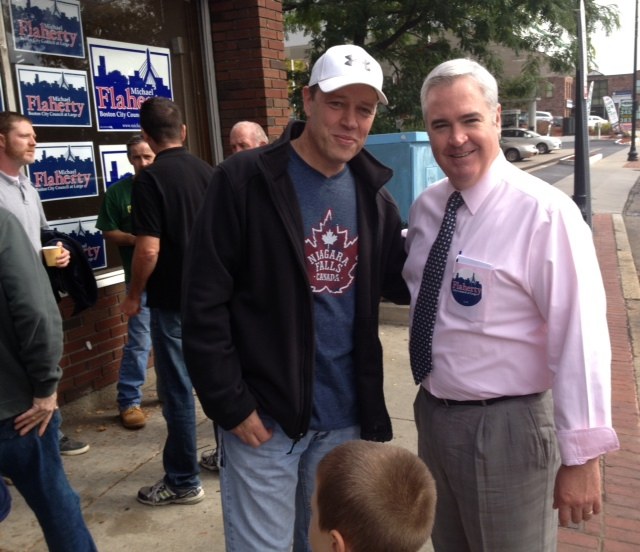
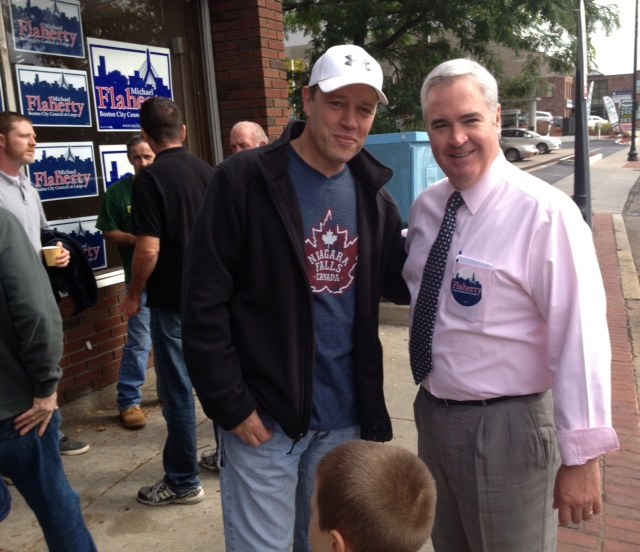
^ Mike Flaherty opening his West Roxbury headquarters

—- —- —-

o sooner in our interview did I ask Mike Flaherty, candidate for an at-large Council seat, about the BPPA award — the arbitrator’s grant of a 25.4% raise that aroused much outrage across the city — than he raises the papers he’s been holding and says, “I’ve got a copy of the arbitrator’s decision tight here. Been reading it this morning.”

Chance ? Probably. But as the saying goes, “chance favors the prepared mind.”

Flaherty is prepared. He touts his experience — was on the Council for ten years, including a stint as Council president, before running for Mayor in 2009 and losing a comeback Council bid in 2011 — and proves its value as he answers my questions.

Marty Walsh’s proposal to move City hall and sell the builoding, then evelop the plaza ? “No,” says F;laherty. “I was against Mayor Menino’s proposal to move it to the Seaport district. Right now it anchors to Faneuil Hall, it is accessible to all. The location is stellar.

“My proposal,” Flaherty contiunues, “is to make City hall a green model, retrofitting the building. Open the building up ! Right now much of the buiulding is clozsed. There are hallways that lead to nowhere. open it up.

“as for the plaza, it is technically owned by the BRA., you are limited in waht you can do, b ecause the MBTA lies directly underneath and limits what you can do with founbdations.”

Flaherty goes on to consider the huge engineeing challenges of building skyscraper office towers on top of three MBTA subway lines — and the cost of it. He makes a solid caze that even at 125 million to 150 million salae price the costs might make it a losing proposition.

Clearly he won’t be supporting Marty Walsh’s proposal were Walsh to become Mayor. So of course I now ask him how he feels about John Connolly’s scholol regforms ? Does his eperience lead him to effecgtive ctitique thereof ?

“John and i arer like minded on school issues,” Flaherty says — as he then gpoes on to make aproposal of his own, on e I have not heard yet ftom Conniolly ; “I woiuld like to see us crerate a Year 13 — withy an SAT test component, because without it they just barely get throiugh to a state school. It’s if many thousands of kids come to our universities, but unless they go to an exam school the Boston kids don’t get in.

“Year 13 could be a aprtnership with a college and college prpofessors. Maybe the program includes adopting a school building and contributing to our tax revebue.”

Flaherty also supports a measure that Connolly does mention : “we need a great trade school. We used to have Bodton Technical. now the best trade school is in Worcester” — he says this as if it were a huge scandal — “It shoiuld be in Baoton !”

Flaherty isn’t an uncritical fan of the MCAs. “It’s ane valuation of teachets too and thyus i,mpacts how they teach.”

We return to talking about the BPPA award. Flaherty hasn’t merely read it. “The police deserve a raise,”he says, “and I would send this contract back for further negotiations. I would insist on mandatory, random drug and alcohol testing.” He also discusses several aspects oc the award off the record; and though I cannot publish what he discussed, I can say this ; he knows the Patrolemens’ contract a lot better than the public may think its City Councillors do.

Flaherty also touts his record of outreach to every corner of the city, one that he proved to me at events I attended in neighborhoods that, historically, South Boston guys had scant interplay with. And a South Boston guy he is. His dad was a Southie State Representative back in the day, and Flaherty remembers those days — but does not cling to them. Flaherty practices politics in the present and seems doing well by it. In 2011 he did not make a Council comeback — as he says, “it was hard. There were four incumbents and they ran as a team. There’s two open seats this time and a completely different dynamic — but in this year’s Primary he finished a strong second.

A win on November 5th seems assured — and for good and valid reasons.

—- Michael Fredberg / Here and Sphere

BOSTON MAYOR FINAL : BOTH MEN WIN 1ST DEBATE

Image

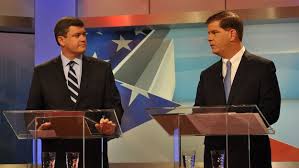
^ John Connolly — Marty Walsh : first face off of three

—- —- —-

Boston’s first face to face between John Connolly and Marty Walsh was a winner for both men. John Connolly was the clear winner on presentation and policy discussion. Walsh, however, also won, by simply showing up and holding his own, most of the night, and occasionally on top. He benefited by being the lesser known of the two. It’s always that way in a first debate. the underdog always wins; and with 18 to 23 percent of Boston’s voters undecided — so say the recent polls — Walsh almost couldn’t lose. and as he was always articulate and quite knowledgeable during the Forums held before Primary day, it was pretty clear that he WOULDN’T lose.

That Walsh won last night we see by twitter follower numbers. Since the debate began, Walsh has picked up 64 new twitter follows, Connolly 40. (Numbers as of 10.40 AM today.) Small evidence, but palpable. Last night Walsh increased his support more than Connolly did.

Still, Connolly did gain. He stayed reasonably close to Walsh only because his policy presentation commanded the night. The first five questions were about education, Connolly’s issue; education came up again later, and often. He also dominated Walsh on city finances and budget issues. How could he not ? It gave him the opportunity to raise “the union issue,” Walsh’s riskiest attribute, in a context that emphasized its risk. But there was more. Walsh exhibited a lack of understanding of admittedly technical finance matters. He tried to attack Connolly for not being present during a certain city union contract negotiation ; Connolly pointed out that by law he was not allowed to be there, in the negotiating room. Responding to a question about raising City revenue, Walsh talked about bringing in new businesses — but on a regional basis. How would bringing new businesses to Somerville — a city that he specifically cited — add revenue to Boston ? The question was not asked of him.

My observers pointed out that, in discussion of the bill that Walsh has filed to remove City Council review power over arbitrators’ union contract awards, when pressed on its effect, he said “no comment.” It was the big talking point for most journos. Myself, I found it a proper answer. That hill, House 2467, is one that hangs over Walsh’s campaign like a storm of belfry bats. Far better to shut up than to talk of it.

That bill will come up again, though. two debaters remain. Walsh will no longer be the lesser known man. Unless Walsh quickly finds a way to master the details of city finances, and to deflect the effect on them of higher city worker pay awards, and to explain away House 2467, the contradictions in his campaign will stand out for all viewers to grasp, much to his detriment.

Image

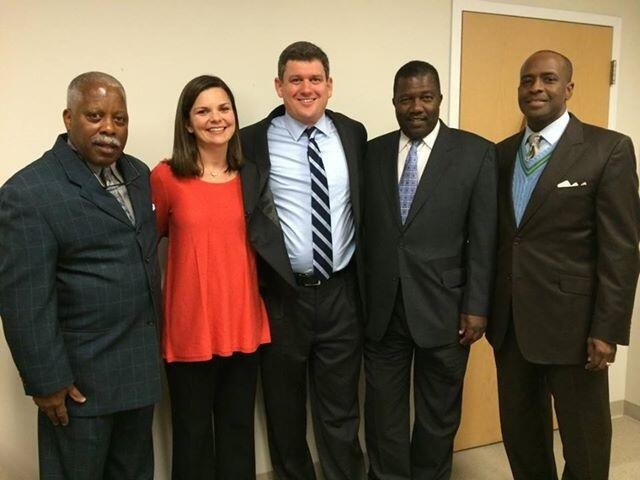
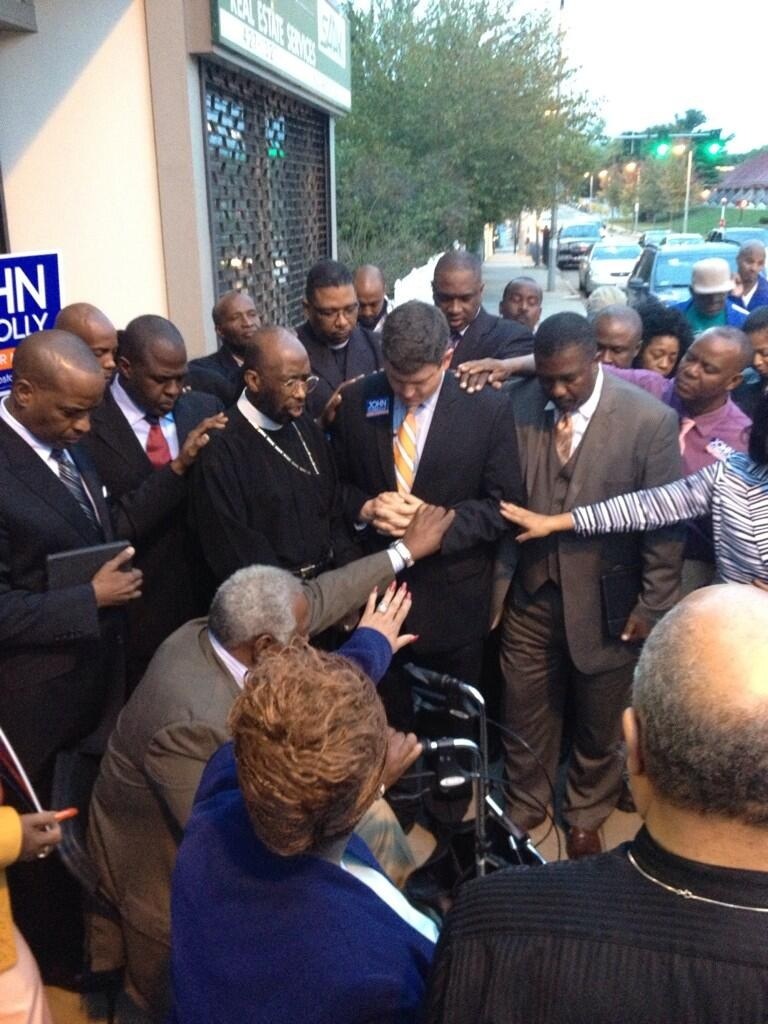
^ Pastor Bruce Wall, Meg Connolly, John Connolly, Pastor Minyard Culpeper, Pastor William Dickerson

Meanwhile, Connolly is deepening his connection to Boston’s Black community and widening it, to people not often reached by anyone, and in ways I haven’t seen since John Sears ran for Mayor in 1967. That was before the huge social and political split that took place during the fight over Boston school segregation and school busing, a crisis whose passions took almost two generations to abate. Connolly’s achievement — worked at over many, many years — seems to me to have entirely swamped Walsh’s endorsement by Charlotte Golar-Richie. In campaigns as serious as this one, years and years of hard won trust and connection, on a very personal level too, can not be turned aside by a two-month embrace, no matter how noble and sincere the outreach.

—- Michael Freedberg / Here and Sphere

BOSTON ELECTION FINAL : SOME THOUGHTS ABOUT THE OFFICE OF BOSTON MAYOR

Connolly Walsh 1

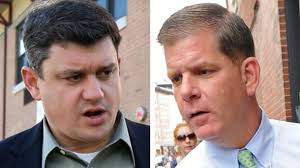
^ to the office of Mayor : which one ? and Why ?

—- —- —-

Ten days ago I wrote that Marty Walsh had to change the conversation big-time or he risked being beaten by a lot. A few days later I wrote of the contradictions and conundrums in his campaign. He has now responded. He has changed the conversation AND resolved the contradictions. He is now the Candidate of The Labor Left

It is likely not a winning hand. It is certainly not a hand for a Boston in which union households in toto amount to about 14 % of the total vote. But it is a better hand than the fuzzy and disorganized hand that he had been playing. And because it is a better hand, it merits a better answer; and that it is getting, from the much more broadly based, more contemporary, more freewheeling campaign of John Connolly.

Here and Sphere, for which I write, has already endorsed John Connolly. My intention now is not to repeat that endorsement. It speaks for itself. My topic today is to examine the office of Boston Mayor itself : what do we expect our Mayor to be ? And not to be ? And why ?

Under the current City charter, the Mayor is all powerful. He (and it will be a he) appoints all administrative heads, oversees all departments, has enormous appointive power all the way down the organizational chart, and thus controls the City budget even though the Charter gives the City Council the final vote — though the Mayor can veto it.

Given the vast powers that a Boston Mayor has, it is small wonder that every interest group in the city wants him on its side. in such situation, there are only two arrangement options ;

1.The mayor can be an honerst broker amongst these interest groups, independent of any of them, or perhaps loosely aligned, from time to time, with one or more.

2.The Mayor can be the captive of one or more interest groups, elected so completely by them that he has no independence, or very little, but is, rather, that interest groups’ instrument.

It doesn’t take very much imagination to see which version of Mayor is portended by which of the two campaigns now hotting up. Personally, I prefer the first version, and I suspect that so do most Boston voters. It is not fun when an office as dominant as Boston mayor is the policy instrument of one interest group — unions especially, given that unions’ sole interest is to increase wages. (Increasing wages is a very worthy goal. But it is the epitome of narrow; a Mayor’s policy goals should be wide.) a major reason why I — most voters — prefer the independent-Mayor version is that interest groups develop an internal momentum of their own leading to either increasing radicalization or to factionalism. Radicalization alienates more and more voters from government (and should). Factionalism makes government a beehive of back-stabbing, a boiler room of inefficiency and contradiction. No one with any sense of civic governance should want a Mayor bullied by radicals or burlesqued by faction.

A City with a powerful-mayor charter can survive these political ills. Most people simply get on with their lives. The City may annoy them, or impede, but because most people live in the private sector and make most of thir life decisions on their own all day long, a mis-mayored city can hardly break them. But wouldn’t it be so much better to have a Mayor who enables rather than impedes ? Gives some aid to every interest group but all aid to none ?

John W Sears

^ John W. Sears, 1967 : “I play center field.” It’s still the model for what a Mayor of Boston should be.

Because so much effort, and so many people, are needed by a Boston Mayor candidate in order to win election to the office, a surge by interested people cannot be avoided. Indeed, the involvement of interested people is a good thing. But all surges risk going too far. it’s up to the candidate to stop that. It is political malpractice to aid and abet it.

—- Michael Freedberg / Here and Sphere
HOUSE AS BASIC AS CHICAGO BLUES : PROK & FITCH @ 360 PROVIDENCE 10.11.13

Image

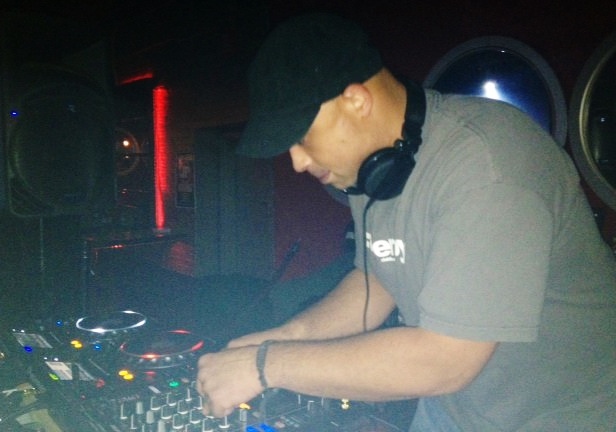
There are some DJs and mix duos who trick up their house music as gussied as a drag queen. Others bend the genre out of shape, or clink it to other genres, or paint it with melody, all in search of a signature sound that, far too often, sounds more simpering than signifying. Then there are the DJs who strip house music down to its basics, simplify it, clip it to one tone, one stride, one vision in search of a connection instinctive as a nerve ending. Prok & Fitch proved at 360 in Providence to be of the latter sort and masterfully so. They didn’t beat around the bush, wander off, get all persnickety. From the beginning of their set at about 12:15 A.M. until well on toward 2:00 AM, they dropped a stride and strut, a push and push, a scoop and stomp : all of them low and grumbly and of a texture thick enough — without feeling like a cake mix.

360, by the way, is a new dance-music arena and a good one. Dark and spacious with a DJ booth as open to the fans as a handshake and a hug. It’s no frills, just the space and some lighting — an ideal match for the basic blues sound that was dropped upon it at this performance.

The two DJs began with a chant of “you don’t stop, no you don’t stop” — from their “After the World” track — and so it went for the many — but not quite enough — fans who danced into second wind and beyond. Using four CD players and mixing in teamwork — few solos by either man — the Londoners blended and cut, clippd the reperat bitton, squeezed the tone knob, and quick-cut the beat parade. Occasionally they flubbed a mix (I noticed one quite sloppy segue at 1:15 A.M.); but they made good the mistake so quickly that few minded. That’s one of the advantages of playing house music in basic mode: the mix flaws heal rapidly. It was that way with 1950s Chicago blues. In that most dependable of rigidly restricted, scream and ramble-effect genres, you knew what was coming, and when, and almost how’; and if a bass line went south, the guitar was there to kick it north again, and you liked the effect; it lent salt to the music ‘s pepper, spit to its shine.

Prok & Fitch have made so many tracks so similar — yet so grabbing — that they were able to salt their own pepper almost the entire night. One heard, I think, segments of their two Todd terry remixes (“Can You feel It’ and “Something Going On”), their collaboration with Roger Sanchez (“Take You There”), two collaborations with the UK’s Filthy Rich (“Time To Jam” and “Justified”), and many others of their prolific oeuvre. It was a spirit-chaser night of — so to speak — stride strut, leg lug, hip flip and brain sprain, without digression. Pause breaks were few; streakies, none. They poked the mix board all set long, but only to guide the music, not bust it open. As basic as a Bo Diddley jam, as sure as a Littler Walter, as double-played as a Howlin’ Wolf, they played house music pure and sure, and found within the genre itself all the drive and soul that lies within it, ready to pounce. Laying down the law of house. It was a set not to be missed.

Local DJ Marcus Christian, whom i had never heard play at length, opened with a set as basic and bluesy as Prok & Fitch’s. He perhaps mixed his sound with a bit more bending than they did; but the textures thus toyed with at low frequency led direcyly gto the bass and blaster work of the main men. Very well done.

—- Deedee Freedberg / Here and Sphere
Image

MEEK AT THE MOVIES : We Are What We Are ( 2.5 STARS )

Image

^ generations of cannibals in your backyard ; Bill sage as Papa Parker in “We Are What we Are”

—- —- —-

Human consumption (as in flesh of, not spending habits) onscreen isn’t so disturbing when it’s a vampire or a werewolf gnawing on your fellow being as an hors d’oeuvre, but bring that in a little tighter, where man’s dining on man for sustenance and it becomes down right creepy. Even the understandable plight of the “Alive” survivors who chomped on frozen stiffs to keep themselves going in the high Andes, educes a shudder; and there’s still reports of ritual cannibalism among remote tribes in Borneo, but what if it was next door, and not something perverse and of a sick mind like Jeffery Dahmer, but a long standing family tradition executed in the name of God?

Meet the Parker family. They feel like lost cast members from “Little House on the Prairie,” yet live in the modern suburban remotes of upstate New York. Mom (Kassie Depaiva) handles everything culinary, from the ritualistic harvesting to the careful trimming and lengthy rendering process, which results in a savory stew, but right off the bat, mom has a seizure in the middle of a flash storm, vomits up heaves of blood, and is gone. Her grisly duties then fall to her daughters, Iris (Ambyr Childers) and Rose (Julia Garner), though after the death, father (Bill Sage) declares a period of abstinence, which allows for the macabre outer sheen of the film to ebb and the edgy backstory of how the Parkers came to their generations old practice, to fill the strange now as the girls struggle to come of age (a time of sexual awakening for Iris) and dad goes through maniacal mood swings and Parkinson-like fits.

The film directed by Jim Mickle, who amused with the quirky vampire hunter saga “Stake Land,” is fairly loyal remake of the 2010 Mexican film of the same title. That cult staple was set in the impoverished barrios of Mexico City and Mickle’s relocation to the drab Catskills brings home the grim affect with greater visceral resonance. He also leverages hurricane season (the 2011 storm Irene was upon the area when he shot the film) as a cleaver plot device as the rising waters from the ongoing storms begin to unearth and expose the bones of the Parkers’ past feasts.

Little of the barbaric practice makes it onto the screen for much of the film, but the traces are ever there; be it the missing person reminders that pop up in conversation or an information flash (reminiscent of “Prisoners”), the muffled whines that come from the Parkers’ root cellar or the inquisitive coroner (Michael Parks) who starts putting together the pieces–literally.

If the plausibility of that sounds a bit hard to swallow, Sage does an effusive job of making the sell as the righteous propagator and controller. Childers too lends credibility as a young woman torn between wanting love and a normal life and familial obligation to her aggrieved father and siblings. It’s her burgeoning courtship with the bashful deputy (Wyatt Russell) and the coroner’s personal need for answers that become the catalyst for the hellish denouement that will not sit well with the squeamish.

In the mix too is Kelly McGillis, barely recognizable as the frumpish next door neighbor who shows Parker’s young son (Frank Gore) compassion, administering bedside TLC and remedies to the boy bedridden with shakes and a fever. She thinks it’s a just common cold from the bluster and rain outside, but it’s hunger from the abstinence–a point that’s driven home and sets off a light in her head when the anemic seeming towhead suddenly chomps down on her thumb with frenzied lust.

For an indie cult-horror film, “We Are What We Are” succeeds modestly much in the same way “You’re Next” did. It transcends the genre’s trappings and makes the most of its humble resources with confident craftsmanship and nuanced subtly that embosses character and demonstrates care. It’s not going to re-script the genre by any stretch, but for those who have the yen, it is a sating bowl of gruesome gruel.

—- Tom Meek / Meek at the Movies

BOSTON MAYOR FINAL — CHARLOTTE’S ENDORSEMENT ANALYZED

Image

^ center field and left field : Charlotte Golar-Richie and Marty walsh

On Saturday morning at 10 A.M., at a rally called by herself, Charlotte Golar-Richie endorsed Marty Walsh for Mayor.

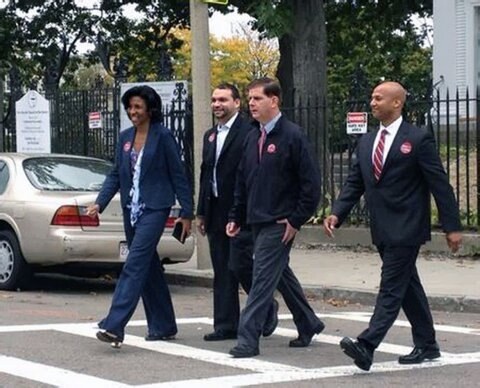
With her at the endorsing conference were Felix Arroyo and John Barros, both of whom had already endorsed Walsh a few days prior. Seeing the three of them walking with Charlotte Golar-Richie to the conference like the Beatles — as Dorchester’s Joyce Linehan put it — on their Abbey Road LP cover was quite the experience. It seemed a seminal moment in Boston city politics : the Four Horsemen of the “Working families” Apocalypse…

Walsh’s face wore a stun, as if he too couldn’t quite believe he now had the support of the Primary ballot’s three leading candidates of color. Frankly, I was stunned too. But not for long. Hardy had Golar-Richie finished speaking when the news broke that basically her entire campaign staff — finance chairman, field director, and the staffs of several of her local headquarters — were all joining the John Connolly campaign.

Now I was beyond stunned. What the dickens was going on here ? You endorse one guy, and essentially all your people go to work for the other guy ? The same day, no less ?  Surely Golar-Richie had to know. And if so, what was the significance of her endorsement ? I began to ask myself some questions :

1.Why did Golar-Richie not endorse at the same time that Barros and Arroyo did ? Reportedly they asked her to join with them. But she did not. Why ?

2.Why did she wait three full days thereafter — during which time the CUPAC and Black Ministerial Alliance, both of which groups had backed her in the Primary, publicly endorsed Connolly — before finally doing what Barros and Arroyo had asked her to do on Tuesday ?

3.Why did she not endorse John Connolly, since almost all of her staff did so ?

Only Golar-Richie herself knows the answer to these questions. Maybe she will tell us. until she does, however, a few answers suggest themselves simply by the nature of the events. What i think happened is this :

1.Golar-Richie did not want the impact of her endorsement to be diluted as part of a group. She would endorse alone and draw all the attention.

2.She was always a careful candidate whose campaign hallmark was caution and flexibility to all sides –in keeping with her persona as a manager impartial. Thus the waiting period, during which she “carefully assessed” Connolly and Walsh. “Careful assessment’ would lend gravitas to her decision when it came.

3.Meanwhile, she was known to have been one of Menino’s choices to succeed him, and she had been part of his administration; and Menino had already and obviously chosen to give help to Connolly. The period of “careful assessment” allowed her staffers quietly to make their arrangements to join the Connolly camp and thus put a smile on Menino’s chin.

4.Now having assured her staffers of a safe haven — and herself of having gifted Connolly the meat of her campaign — she was free at last to take care of a significant task of personal politics :  ( a ) an endorsement of Connolly by her would allow Arroyo and Barros to box her out, among voters of color (if she chooses to run for elected office again) as not being for “working families”; of favoring the “banker’s candidate” — the ‘school privatizer” — as folks in various camps close to Barros, Arroyo, and Walsh were aleady saying; and ( b ) an endorsement of Walsh would prevent that. Thus Walsh it had to be. A gamble, but a well planned one.

I am guessing that the feverish phone calls back and forth that the Herald’s Peter Gelzinis said took place from Thursday into Friday were about that very issue. Charlotte’s Menino friends told her to get with Connolly : and so she pondered, and gave her staff (and the PAC’s) time to do exactly that. Meanwhile, Charlotte’s Walsh-supporting friends told her to endorse Walsh or be boxed out. And so, once the backstage work was safely done, she endorsed Walsh.

Simple. Shrewd. The reward of caution.

Many smart politicians play both sides of a divide. It’s one of the most successful ways to occupy the political center. Occupying the center — what former Boston Mayor candidate John Sears calls “Playing center field” — was Golar-Richie’s campaign theme, its tone, its distinction, its claim to seriousness. She owns it, and as long as she can “play center field” without errors, she’ll be a serious force in political baseball no matter which man becomes Mayor.

—- Michael Freedberg / Here and Sphere

“You must get to work” : PEG ALOI INTERVIEWS JETHRO TULL’s IAN ANDERSON

 Ian anderson (1)

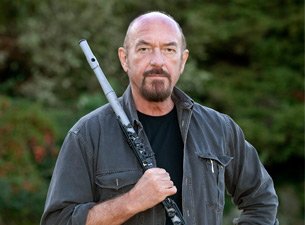
It was my privilege and pleasure to talk with Jethro Tull’s Ian Anderson about his new album, “Thick as a Brick Two” and his methods of writing, among other things, for Here and Sphere.

Mr. Anderson is a remarkably articulate and erudite conversationalist. This is just a short segment of our conversation. I hope you in Boston try to see the performance at the Wang Theatre tonight !

Peg Aloi:  First of all, I must confess that in 1983, when I was a sophomore in college, I dressed as you for Hallowe’en. I believe you had short hair at the time, but mine was long, so I opted to dress as you, circa 1977, that “Songs From the Wood” era.

Ian Anderson: Oh, well, then, I suppose if I was a kind of pugnacious guest and given to outbursts of an informal nature, then in response to that the question has to be dreadfully obvious: did you get laid?

PA: Well, I was dressed as a man, so….hmmm, I can’t actually remember! I guess I’d have had an opportunity to understand what that whole groupie thing is all about.

IA: I don’t actually have much experience with groupies, as I don’t usually enjoy the post-performance social scene; I am that sort of party pooper who leaves after half an hour and goes back to my lonely hotel room to read a book. After all the years of touring I have done, that kind of wild party just seems like a really excessive evening that I have never been in tune with. It is nice to be on stage with the band, however.

PA: Perhaps like many Tull fans of my generation, my favorite album and one that was really very formative in my musical tastes was 1977’s “Song’s From the Wood.”

IA: That album is still mentioned as one of the most formative for many fans. It was a long time coming, and I had an interest in the contemporary folk music of the ‘60s and ‘70s. But it wasn’t until 1977 that we made an album that was strongly folk influenced, in the sense that it drew upon elements of culture and mythology which we set not authentically to English folk music, but used musical elements that would make those lyrics work. If “Thick as a Brick” is Jethro Tull’s progressive rock album, then “Songs from the Wood” is our folk rock album, if you want to go down that road.

PA: So, once you began working on “Thick as a Brick Two,” you apparently wrote the entire concept album in about two or three weeks. Why, after hesitating about wanting to do this project, do you think it all came together so quickly?

IA: I do try to write quickly. When I am sitting down to write a whole album I do sit down to work every day and I simply get to work. There’s no point in hanging ‘round and waiting for the muse to visit you. You must get to work and look for inspiration, and happily, it comes. I had a deliberate deadline, and I’d start working at 9 am, at the beginning of January, and basically had it complete within a ten day period. And that is about how long it should take: in reality you come up with the bulk of the lyrics and then you write about four or five minutes of the music every day, and then you refine the ideas and work on the arrangements, and work on it to get it locked down. I suppose if you went into it and did not manage to write three minutes of music a day, I can’t see the point of continuing to do it. You just have to get to work.

PA: You mentioned in an earlier interview that you think the music world has become more accepting of the progressive rock genre; I wanted to ask what you think of the progressive rock revival that seems to be going, or if you’re familiar with the Wyrd Folk movement or some of the efforts made to promote this kind of music in recent years, like Mark Coyle’s work with The Unbroken Circle or Woven Wheat Whispers, or bands like Pearls Before Swine, Fuschia, The Strawbs, or artists like Mina Doi Todd or Devendra Banhart or In Gowan Ring.

IA: I would not exactly call it a progressive rock revival because that term is still a bit problematic. It’s a journalistic term really; in 1969 I did not have a problem with being in a progressive rock band, but some time around 1972 the term “progrock” became a word commonly used by critics to poke fun at bands like Yes or Emerson Lake and Palmer as a way of criticizing their rather excessive musical showing off. So that was part of what gave progressive rock a sort of dirty name. Then when punk came along in 1976 it sort of swept away the cobwebs of progrock and it went away for a time and it really took a while for it was treated with some dignity and affection again. That is not to say that those progrock bands did not play great music, but it was often underpinned by the need to to show they could play their instruments better than other people. It did take a while for progressive rock to become respectable again, and now you have a whole new generation of musicians in their 20s whose musical tastes are evolving, which s right and proper. The other day I tried to describe the more experimental music happening today and I decided the best definition was to say it’s music for people who get bored easily. Let’s face it, most pop music does get a bit boring, and many people want something more, so hopefully with the experimentation going on now they don’t need to look too far.

“Whatever Happened to Gerald Bostock?” (Thick as a Brick 2), as well as “Thick as  Brick” will be featured in Ian Anderson’s performance at the Wang Center, Boston, October 12. Tickets available via Stub Hub.

— Peg Aloi / Here and Sphere correspondent

BOSTON MAYOR FINAL : CHARLOTTE DECIDES

Image

^ Abbey Road (as Dorchester’s Joyce Linehan says) : Charlotte joins Team Walsh

—- —- —-

The picture that heads my column is one that I admit I never expected to see in this Mayor election. Charlotte Golar-Richie, the quiet, cautious, middle of the road administrator, endorses Marty Walsh, her opposite in every way.

It’s a big boost for Walsh and will certainly have an effect on the November 5th vote. Until Golar-Richie came forward, Walsh’s campaign looked lost and losing. Just in the first five of Boston’s 22 wards he looked down by 10,000 votes. Now that margin looks quite less.

I opine thus not because of the mere fact of Golar-Richie’s endorsement but on account of WHY. The answer is not simple or obvious. Sure, there are personal issues and policy differences that have developed over the years of Connolly’s service on the Council, between him and some activists who certainly Golar-Richie talked to. But i prefer not to think that Golar-Richie chose because of personal stuff. She’s bigger than that. And her endorsement speech offers a wider clue : she talked about Walsh being a Mayor for “working families.” That phrase never crossed her lips during the Primary. They are Walsh’s theme. So who was she saying them to ?

There’s answer for this question too : she was saying them to the union activists who oppose the school reforms that John Connolly wants. These reforms have drawn the ire of Teachers’ Union activists since they were first bruited. Yet they are exactly the reforms being advocated by President Obama’s education secretary, Arne Duncan, and, in Massachusetts by Democrats for education reform.

Why would union activists, Democrats all, oppose so resolutely reforms being proposed by a Democratic President ? In the twitter-sphere — and the blog-o-sphere — one finds out. There one finds a growing anger among progressive people against the radicalized GOP and also against a President whom these activists see as “giving away too much” to the GOP. The radicalization of the GOP is, as Bill Moyers writes astutely, the big political story of the year. Almost as big a story is the like radicalization taking ground inside the Democratic party. You cannot radicalize an electorate in only one direction; voters who differ aren’t going to just sit still and let a radical party take over — or block — the nation ‘s direction. Activists DO things. And so activists on the progressive tip are doing.

In Boston’s Mayor election that has now come to mean opposing a school reform led by Democrats ! The verbal overkill abounds : that Connolly’s school agenda means “privatization” of the public schools, that it’s “some outside group” doing it, that “he’s a jerk,” etc etc. In fact, John Connolly is about as traditional a patrician urban reformer as you can find. What is there in his suggestions for a longer school day, greater leeway for principals to choose teaching staff, core curriculum, and support for charter schools as an alternative, that requires raising the hue and cry ? Horace Mann’s school reforms of the 1840s were no less ambitious, nor the much more radical reforms advocated by John Dewey 110 years ago. 50 years from now, John Connolly’s reforms will look as obvious as Dewey’s and Mann’s reforms 50 years after their day.

The older a nation and its institutions become, the harder it is to reform them. Our nation has aged greatly since 1840, 1900, even since 1965. Reforming our associations today seems almost impossible to do; those vested in them simply WILL NOT change. We see it in Washington, where he Tea party opposes everything and anything that will make this nation fairer and better. Now we see it here in Boston.

Reform of Boston’s schools should begin with the teachers; and with the parents; but for too long there has been disconnect — indeed, a widening of it — that has made school reform a bridge broken; and John Connolly, himself a former teacher and a public school parent, has stepped in to span the reform forward. For this he has incurred the enthusiastic support of school parents, and the support of education-agenda Obama Democrats — and the ire of teacher activists and many economic progressives.

I have had personal experience of this disconnect. I read the Boston Teachers’ Union ten-page schools manifesto several times. For some months I have tried to moderate between friends in the Union and the Connolly agenda. I suggested that the BTU should endorse Connolly, saying we differ on how to reform the schools, but we are one in making schools the top city priority.” I failed. I hope we can still talk and be friends.

I suspect there are many, involved in Boston’s civic matters, who are saying something like.

The education-issue split in the Massachusetts Democratic party seems a portentous event. Add to that the economic split : progressive activists dislike the Obama administration’s ties to big finance. In Boston, some fear that John Connolly is the banker candidate. The business development candidate, he surely is. It’s where Boston is headed and has been headed for at least the last dozen years. But Connolly is by no means a Koch Brother or ALEC guy. He might say, in his own words, that the business of Boston is business, but Connolly’s business looks as if it will be a business culture tolerant, diverse, and open to all who have talent; with all lifestyles fully respected; a “green” business culture and one that supports living wage legislation. This is controversial ? Seems that it is.

The Tea Party first arose in very “red’ states, where the “reformers” were all GOP. Massachusetts is a very “blue” state. Here the Democratic party is almost all, and, as the people of a democracy usually find themselves on the opposite side of issues, splitting the Massachusetts Democratic party is the only option. But ; if that were all that is now happening in this mayor election, it might be set aside afterward. it isn’t. The national Democratic party is splitting too, as progressive activists, tired of President Obama’s cautious generosity of style, are taking the matter of opposing Tea regression into their own hands. We see it in Texas with Wendy Davis, in California thanks to Governor Brown, in the talk of nominating Elizabeth Warren for President rather than Hillary. We see the fight everywhere against Wal Mart and for a much more livable minimum wage.

Yet John Connolly agrees with progressive activists on all those issues — passionately and uncompromisingly so. Only on the issue of school reform do he and the activists differ; and that one difference is now enough to cast him as the activists’ bogeyman, the evil enemy. To those who have watched the Tea party demonize conservative GOP Senators who “aren’t conservative enough,” it all looks depressingly familiar.

This is what Charlotte Golar-Richie has decided to take sides with. People do what they are gonna do.

—- Michael Freedberg / Here and Sphere
BREAKING : Just as I began to post this column, word came that Charlotte’s campaign field director Darryl Smith, AND her Finance chairman Clayton Turnbull are BOTH going to work for John Connolly. Talk about timing !

Image

^ Golar-Richie’s Field Director announces that he is joining John Connolly : (Connolly seen here with former Council candidate Philip Frattaroli and his Dad.)

BOSTON MAYORAL : THE MARTY WALSH CAMPAIGN

NOTE : Here and Sphere, for which I write, has endorsed Marty Walsh’s opponent. The following article is my own opinion, however.

Bartlett yard Marty Walsh

^ Courage and a voice for working people : Marty Walsh at Bartlett Street Bus Yard

Courage is the word that comes to my mind when I think of Marty Walsh and his campaign. For a guy who seems almost introverted, who really doesn’t sense the social wave, who comes from a part of Boston that is visibly shrinking in reach and number, to run for mayor of a City I don’t think he really understands seems an act of huge courage. This is a good thing. By no means do I disparage Walsh’s public persona. It has won friends of all sorts in the Legislature. It has elevated him to the top among those who know him best. I have, in previous columns, called Walsh “a hero of civil rights.” This he definitely is.

His courage — to break loose of the hermetic cultural world in which he grew up; to see himself as one and the same with people living very differently from how life along “Dot Ave — has brought Walsh almost to election as Mayor of Boston. He bested ten rivals in the Primary with a total vote that topped his Final opponent, John Connolly. As he himself claimed it, at a large outdoor rally on election eve : “Tomorrow we will top the ticket !”

But…. Walsh is a “union guy” — was business manager of the Boston Building trades Council — and has built his campaign on continuing the current downtown building boom and the jobs it provides. There is nothing at all wrong with this. The building boom is real. It is good for all Bostonians. It creates jobs, good paying jobs for workers who then spend that money into the city’s economy. All good. But the more that Walsh is a union guy, the less he is the man of courage; the less he is one brave man breaking free of — fighting against — the Old Boston and its old ways.

His challenge, as a Mayor finalist is, how does he bring Boston labor unions into the new Boston, the coming Boston of business innovation, business lifestyle, business politics ? Indeed — as many voters are asking — is becoming Mayor the best way even to do this ? At times in the past month or so, Walsh has talked — sermonized, almost — about recruiting businesses to Boston; taking them from Texas, South Carolina, from all over; of opening up a Boston office of business recruitment. This sounds odd speech coming from a union guy. Few of the businesses he would be preaching Boston to are union shops. There are, by percentage, fewer Union households in Boston than there used to be. In Walsh’s business recruitment world, they will be a smaller percentage still.

At which point Walsh’s courage begets contradiction.

And conundrum : for if union households would decline in numerical importance in a Walsh-for-business Boston, there would be no decline at all in the importance of the Police and Firefighter Unions, or of the Boston Teachers Union. Or of the School Bus Drivers Union. Need I say more : and into the two recent labor union events that have angered almost all Boston — Walsh too — came the news, via John Connolly, that Walsh has five times filed a bill (H. 2467 this year) to make labor arbitration awards final, taking review power away from municipal councils. A request was made that he withdraw the bill. He declined to do so.

Walsh’s strategy now, as a finalist, is to bring to his side working-class voters of diverse origins and skin color. He has John Barros’s endorsement, and he has Felix G. Arroyo’s endorsement — and his strategist, Doug Rubin — and now often voices the message that was Arroyo’s : pathways out of poverty by way of better schools and safer neighborhoods. It’s a good message. It builds upon Walsh’s own story and upon his support base. The Boston building boom should provide building trades jobs for Latino Bostonians, Cape Verdean Bostonians, Viet Namese Bostonians, all Bostonians. And yet…

…the argument did not work for Arroyo in the primary and seems unfitted to what Boston is like today. It is a message not too different from Mel King’s and Ray Flynn’s in 1983. But Boston has become much more entrepreneurial in the past 30 years. (And Mel King himself is close today to Charles Clemons, who was a Mayoral candidate and is a radio entrepreneur with an economic point of view almost Republican.) Boston today is more prosperous than in 1983, more upper middle class. No social group desires radical school improvement more passionately than the upper middle class — and those who would join it. Upper middle class parents push their children to excel. Sometimes they overdo it, but that is what the new Boston often is. Achievement, and bicycles. Downtown boutiques — and advanced courses in every high school grade. Diversity and social metro-lifestyle — because all entrepreneur brains have worthy ideas to pick up on. Upper middle class parents like new ideas. And they’re in a hurry to get them.

Marty Walsh understands this dynamic well, I think. But he cannot be its voice. Because it already has a voice, a man who is of it and personifies it : John Connolly. Thus Walsh has chosen the only course left for him : to voice for the people who would like to be in a hurry but can’t be because they have too much other stuff — dysfunctional homes, kids going astray, language barriers at home, working three jobs to make ends meet; that sort of thing — on their plate.

It is good that Marty Walsh is committing to be the voice of those trying to catch up to the people in a hurry. No one speaks it with more personal conviction. But in doing so, he has, ironically, narrowed his reach. Because John Connolly’s campaign extends far beyond upper middle class parents. He has brought to his side Boston Wards very different from upper middle class — Charlestown, East Boston, North End, much of Roxbury and Mattapan — for whom access to the Mayor’s office and the Mayor’s ear is vital. Connolly looks like the winner to these constituencies, including some which did not vote for either him or Walsh in the primary. They can see how things shape, and they are surely correct in thinking that their support assures a Connolly victory and thus access to his office and ear. And yesterday both Communities United’s PAC and the black Ministerial Alliance endorsed him.

photo (12)

Against this dynamic and this perception, Marty Walsh now fights courageously, doing proud those who believe in him.

—- Michael Freedberg / Here and Sphere
BOSTON ELECTION : CITY COUNCIL AT-LARGE FINAL — A FIRST LOOK

Boston’s City Council has little power via the present City charter. Such little as it has is most effectively directed to questioning the Mayor’s agenda. Even though the Council almost always gets onto the Mayor’s side on such, merely by questioning it awakens the City’s voters to agenda items that might not win most voters’ favor. And they are less easily brought aboard the Mayor’s agenda than are the Council members.

Every Mayoral agenda contains items that voters might justly question. That’s why we, at Here and Sphere, in making our endorsement and suggestions for the Council, rank a candidate’s potential independence first of all. We want the Council to answer to constituencies that the Mayor’s agenda does not favor. We see the Mayor’s proposals and the Council response as a kind of labor negotiation, one in which a common middle ground is reached. For that reason, we especially insist that the at-Large (city-wide) elected Councillors demonstrate this independence.

Image

^ Jack Kelly : independence almost assured — we endorse ! (photo  by Kelly campaign)

Which is why we balance our endorsement of John Connolly for Mayor with an endorsement of jack Kelly as a city-wide Councillor. He will be as comprehensive a “voice for labor’ as anyone of the eight candidates on the ballot. None, to our knowledge, has received as many Union endorsements as has he. Moreover, Kelly is not only a “voice for labor.” He has Planned Parenthood’s endorsement, that of District Four Councillor Tito Jackson, and the support of at least two Boston Globe columnists so far.  And just today, he gained endorsement by Ramon Soto, who was an at-large Council candidate himself.

Kelly addresses issues only after careful study — no Council candidate is more thoughtful. His enjoyment of people is infectious; everybody sees it. If anyone in this year’s election has the inner stuff to enthuse almost everyone, it is Jack Kelly.

The other seven candidates include four of the seven who we “suggested” in the Primary. The three who missed the cut — Chris Conroy, Catherine O’Neill, and Phil Frattaroli  — will, we hope, be heard from again. The four “suggested’s” who did make it — incumbent Ayanna Pressley and newcomers Annissa Essaibi George, Marty Keogh, and Jeff Ross, all of whom we like a lot — now find themselves in competition with three whom we did not suggest. These are serious contenders : incumbent Stephen J. Murphy; former Councillor Mike Flaherty; and one newcomer, Michelle Wu.

Image

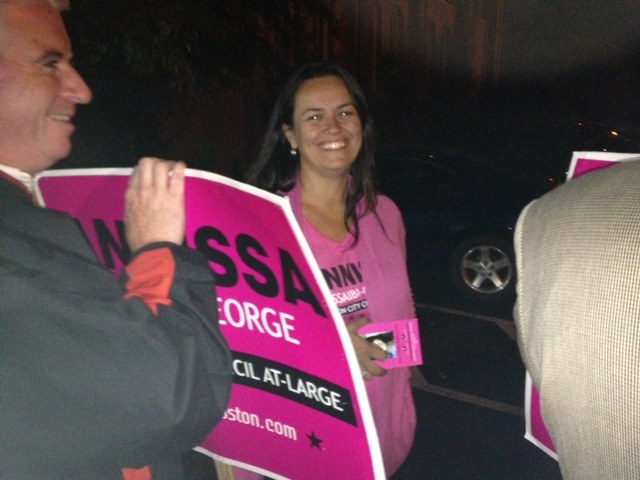
^ Annissa Essaibi George : very Dorchester and as “Dot” is Boston’s largest neighborhood, that’s reason enough to like. we do.

photo (24)

^ Jeff Ross : hard work and a proven, long time commitment to Bostonians needing a voice

photo (43)

^ Marty Keogh : the voice of Wards 18 and 20 — is it enough ? we hope it is.

We continue to like our four “survivors.” We understand that at least one, even of them, will not be elected in November. Yet we cannot simply dismiss Flaherty, Murphy, and Wu any longer. So how, at first look, do we judge their candidacy ?

Image

^ strong in every neighborhood of Boston : Mike Flaherty

1.Mike Flaherty has put together a citywide vote as uniformly strong as any Council candidate. And city-wide strength is something we want to see in a city-wide candidate. It’s almost as important as independence.

After failing to win election in 2011 — having lost badly in 2009 when he challenged mayor Menino — Flaherty has won back all the voter confidence that had appeared no longer his. We would be very surprised if Flaherty does not win back his Council seat, and we will be doing a Profile of him next week. In which we will take the temperature of his independence of mind.

photo

^ Stephen Murphy : what has he yet to do that he has not already done ?

2.Stephen J. Murphy has been a personal friend of this writer for almost our entire adult lives. Indepenence from Mayor Menino is built into his soul. Murphy’s mild, gentlemanly manner belies a passionate commitment to traditional Boston ways and agendas — into which he has, much more smoothly than I thought likely, blended all kinds of “new Boston’ constituencies. Murphy seems to say, “you may be think you’re one of those ‘new Bostonians,’ but you’ll fit right into traditional Boston, I will take you there, and you will like it.” No one else on the Council could have done this important mission as successfully.

My only question of Murphy’s continuing on the Council is whether or not his work hasn’t been fully accomplished. What has he still left to do that others can’t do ? I will be asking him this question in a coming profile.

Image

^ Michelle Wu : impressive bio

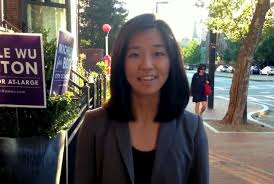
3.Michelle Wu. She was said to be all over the city; we have all seen her worn-out-shoes news story. Yet I, despite being all over the City at street level myself, since the beginning of August, only met Wu for the first time at the Roslindale parade. Where did she wear out those shoes ?

The Wu candidacy puzzles me. She took fourth spot in the Primary by a huge margin : how did she become so well known ? so well thought of ? Better known than marty Keogh ? Better thought vof than teacher and neighborhood activist Annissa Essaibi George ? More worthy a progressive than Jeff Ross ? Her personal story is impressive : harvard Law School graduate and care provider for her widowed mother. Her political story seems even more to the point : she was a campaign staffer for Senator Elizabeth Warren, the most popular politician in Massachusetts.

Yet others in this year’s Council campaign worked for Warren as well. All, even Jeff Ross, who grew up on the West Coast, have longer and deeper attachment to Boston than Wu, who only recently moved to the City. Why the Council ? To me, at first look, Wu seems better fitted to head a city administrative department than to be a elected voice. If the theme is “new Boston,” Ross, to our mind, fits the bill much more profoundly than Wu. Surely her biography and Warren connection impressed many voters who don’t accord their Council votes a policy importance. To me, using a Councillor vote to congratulate an impressive personal achievement is to disrespect the Council. A Councillor should be more than a graduation day photograph.

That said, we will be talking to Michelle Wu next week and asking her what there is about her candidacy other than a very impressive bio.

—- Michael Freedberg / Here and Sphere