MEEK AT THE MOVIES : All is Lost ( 3 STARS )

Image

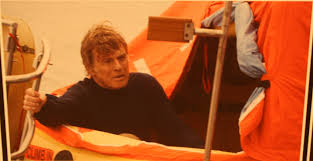
^ nameless upon the sea shall he chance : Robert Redford as “Our Man” in J. C. Chandor’s “All Is Lost”

—- —- —-

Open vastness can be an aesthetic wonderment, breathtaking to behold, like the dark cold of outer space in “Gravity” or the endless desert in “Lawrence of Arabia,” but given a rip in a suit or a missed rendezvous at an oasis, that hypnotic intoxication with the serene forever can quickly become the edge of a hapless demise where outside intervention becomes a mathematic improbability and personal perseverance, the only shot at salvation.

In his sophomore effort, “All is Lost,” young filmmaker J. C. Chandor, who received an Academy Award nomination for his bold debut “Margin Call,” employs the sea as his beauteous hell. The film’s title is a shard from a letter written by a hopeless yachtsman adrift at sea in a life raft. No, this is not the second coming of “The Life of Pi”; “All is Lost” is not that existential, though the lone character, who has no name (the credits list him as ‘Our Man’) does go through an existential crisis of sorts. He also endures a series of Jobian trials that would force most people to just cash in their chips and go swimming with the sharks.

The imperiled seaman is played by none other than Robert Redford. Who, well into his later years, has the handsome grizzled look of one who has been at sea for some time. Not a salty old tar mind you, but the preppy, pleasure cruising version of Hemingway’s ‘Old Man,’ dressed ruggedly effete in cable knit sweaters and Bermuda accoutrements.
When we first catch up with Our Man penning his letter, we make just a tang of his hopelessness and sense of imminent demise before the story back-jumps eight days. Our Man now comfortably rests in a well-stocked, thirty-nine foot yacht somewhere in the Indian Sea. But the tranquil moment falls ephemeral to a sudden disturbance that rocks his boat violently from the side, the way that Bruce, the pet named shark in “Jaws,” effusively, fatally weakened the Orca. Examination atop reveals that a shipping container from a passing cargo ship has fallen off and ruptured his hull, and, without the divine intervention of a foaming mad Robert Shaw wielding a baseball bat, has also trashed his communication systems too.

So there he is, marooned on the high seas, and we don’t know much about Our Man. We don’t know if solo cruises in exotic and far flung places is something he does on a regular basis, or who exactly might be waiting for his letter back home. What we do know is that he’s confident at sea and at terms with himself as he takes to mending the ship’s hull calmly and methodically. He’s no MacGyver per se; there’s no presto-magico invention to save the day, just slow knuckle-breaking work and hopeful trial and error validation.

The repair merely stays his execution, as violent tempests and other extreme maladies close upon Our Man. Redford’s understated and nuanced performance along with Chandor’s simple, yet embraced rendering of the open ocean both as celestial body and chalice of death, fill the film’s sails with wonderment and purpose. There’s nothing else, and both players are on their game. In each ensuing ‘it can’t get any worse’ (and it does) scenario, you can always see in the corner of Redford’s eye a faint trace of fear. It’s a brilliant touch. Like Sandra Bullock’s astronaut in “Gravity,” his sailor knows, that to give into panic would result in his immediate demise and that calm perfunctory progress is the only way to remain alive and afloat. That struggle plays palpably upon the storied actor’s face without word or unnecessary exposition. In saying nothing it tells us oceans about the man who’s name we don’t even know.

If there’s any short coming to “All is Lost” it comes in the ending, which is neither a closed loop nor satisfactory. Perhaps Chandor was reaching for something more. It’s a bold but hollow grab. No matter, the film still showcases the talents before and at the helm and will only add to Chandor’s nascent reputation as one to watch.
— Tom Meek / Meek at the Movies

BOSTON MAYOR : NATE SILVER-ING THE CONNOLLY-WALSH NUMBERS

Image

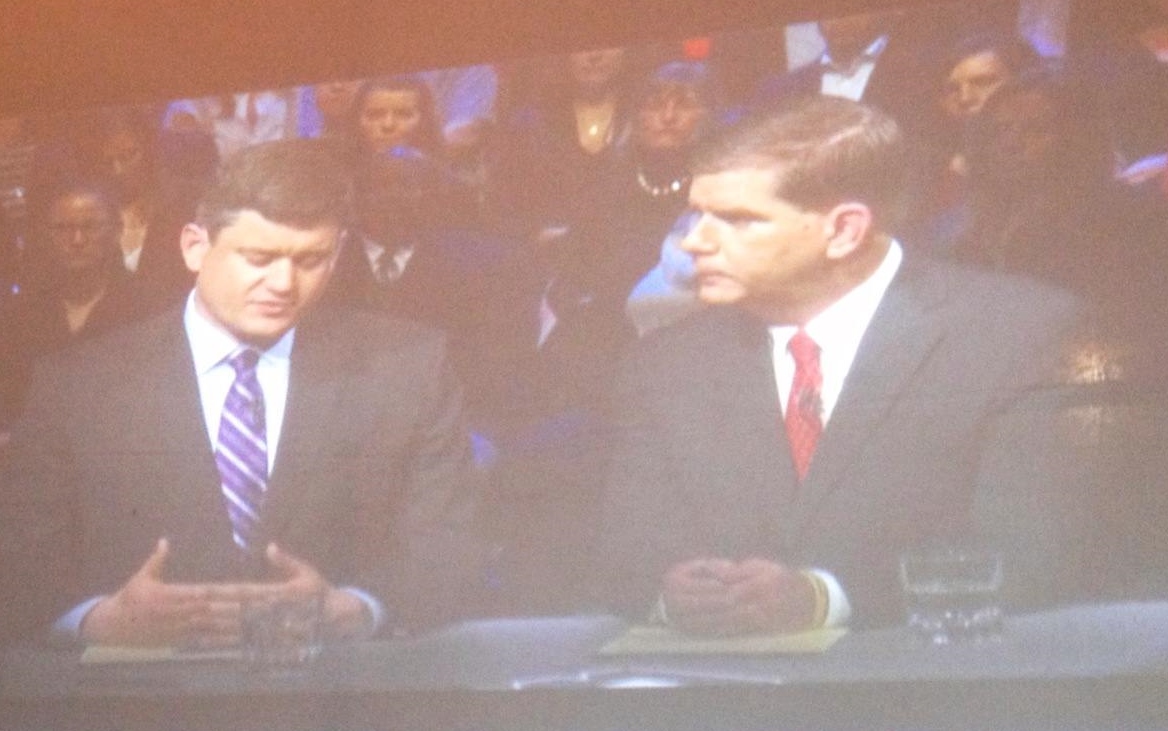
John Connolly — Marty Walsh ; time to prospect the numbers

—- —- —-

Enough polls have been taken of Boston’s Mayoral Final now that we can already conclude much about the race. By the numbers, taking the average of all five recent polls, John Connolly holds a lead of about 43.4 % to Marty Walsh’s 37.3 %. The remaining 19.7 % of voters say they’re undecided. The next ,most important statistic is how steady the two candidate’s support has been. Since the first Final polls appeared, Walsh has polled either 36 % or 37 %, with the exception of one poll that gave him 39 %; Connolly, meanwhile, has polled 44 % or 45 % since before the primary, although two of the five recent polls showed him backing to 41 and 40 % respectively. And in those two polls, his lost voters did not move to Walsh. They became undecided. Walsh’s okay performance in the first debate moved some, his endorsement by a platoon of well-known’s moved the rest — but as i said, not to him; only to undecided.

My former editor in chief at the Boston Phoenix, Peter Kadzis, says that the race is now all about Walsh; that Connolly is “holding on” — his words — and Walsh is moving ahead. I see it just the opposite. Connolly’s support seems consistent, unshakable. The question in the minds of the 55 to 60 % of voters not yet moving to Connolly is whether he really SHOULD be the next Mayor. They are either giving Walsh a second look or — more likely — just learning who he is and willing to hear more. that does not translate, in my mind, to “moving Walsh’s way.”

A closer look at the Globe poll’s numbers seems to weaken Kadzis’s argument. If the poll’s “leaners’ are added to the committeds, Connolly has 47%, Walsh 38% of the vote, with only 15% undecided. this is a significant gap. A candidate who is 9 points down with only 15% undecided practically has to win every undecided vote or else lose.

The poll also suggests that all the energy that Walsh put into winning his spate of endorsements hasn’t helped him much,. Though he gets Arroyo’s September voters by 15 to 9, and Barros voters 13 to 9, he loses Charlotte Golar-Richie voters 19 to 26. Winning his three endorsers; votes by 47 to 44 won’t cut it.

No poll yet done reflects Connolly’s commanding performance in the second debate, held two nights ago. My guess is that that debate moved a measurable chunk of the 14.7% undecideds to Connolly. Even if that is true, however, even if a new poll shows the race Connolly 46-50 and Walsh 37-40, the race is far from wrapped. This is not a presidential election, where almost every voter is sure to vote. many voters won’t bother unless they are TAKEN to the polls. Which means organization, a field army, as all pollsters take care to point out. Walsh is the field-army candidate. That his army may be mostly union activists is a problem impression for him to risk, but on election day that doesn’t matter. Even if the burliest union guy who ever snarled on a picket line shows up at your door to take you to the polls, you will go, because yes, you know it’s your duty to do so. And your almost uncast vote will count just as much as the most dedicated supporter’s.

How much is a dedicated field army worth ? In the many Boston city campaigns that I field-directed, each election day door-knocker could bring eight to ten voters to the polls, of whom maybe half would not have voted without that contact being made. The biggest precinct organization I ever worked with had about 16 people aboard. So, assuming all 16 do their job all day long, good “field’ can add about 64 votes to the total. Walsh probably can’t do much “field” in Wards 4, 5, and most of 3, but in the other 19 he can do plenty. They total 227 precincts. If all his “field people” do their job all day, they can add 227 x 64 = 14,528 votes to the total turnout. that equals about 9.5% of the likely final turnout number.

Of course his “field vote” WON’T total 14,528, for four reasons:

1.On Primary day his people already turned out almost all its vote, in walsh’s strongest precincts. There isn’t much new vote there to get.

2.Some voters whom “field people” bring to the polls don’t vote for that candidate. Not many, probably, but some.

3.All of Walsh’s field people can NOT “do their job” all day long. Traffic, missed communication, voters not answering the door — the fog of election war degrades even the finest field organization. From personal experience I can attest that if Walsh’s field works accomplish two thirds of their goal, they’ll have done well.

4.Connolly may not have a ready-made army of union activists, but he is hardly without committed, hard-working volunteers. Whatever vote Walsh people bring to the polls, Connolly can bring at least half that.

My conclusion ? Walsh can probably add about 8,000 votes to the total, Connolly 4,000. Which gives Walsh a net plus of 4,000 votes. that will likely be about 3 % of the total turnout.

in the Primary, of course, that 4,000 additional vote was good enough, with 12 candidates on the ballot and nobody having a huge number, to move Walsh past Connolly into first place. He managed slightly over 20,000 votes on that day. His field 4,000 comprised 20 % of it. No such bump will Walsh get on November 5th. If he is to win — and he well might — he will have to EARN it, not bring it.

— — —

Image

^ 1967 : Tony D’Arcangelo, who was John Sears’s East Boston guy in that campaign

Image

Melnea Cass : what Clayton Turnbull and the Black Ministers have been to John Connolly, she was to John Sears in 1967.

Image

^ John Sears, 1967 :much of what John Connolly is this year, he was in 1967.

POST SCRIPT : Is this 1967 again ? It seems that it is. Then we had a patrician urban reformer, John Sears — a Republican, even — running against the ultimate, South Boston Irish traditionalist, Louise Day Hicks. Sears did not win in the Primary — being a Republican hurt — but Kevin White, who did win, stepped right into Sears’s shoes. And what sort of voters did Sears command ? The young and well educated voters of Wards 3, 4, and 5; italian voters; and the black community. Does this look familiar ? Of course it does. John Connolly has John Sears’s vote, to which he has added his own Wards 19 and 20 and his mother’s home Ward 2 in Charlestown.

It almost amazes me to see how little has actually changed in Boston’s voting patterns and community alliances. The one thing that Has changed is the political party. in 1967, high-minded, education-oriented, parks and green, visionary urban reform was the hallmark of the Massachusetts Republican party — and still very much in power — as was the party’s solid connection to Italian voters and the Black Community (Melnea Cass, after whom the Boulevard was named, was a pillar of 1960s Black Boston — and was, in those days of senator Ed Brooke, a Republican state Committeewoman very active in the Sears campaign.) Today, the policy and community descendants of the 1967 Republican party are almost all Democrats : Obama Democrats, in fact. But then, is Barack Obama himself not precisely the educated, urban, high-minded reformer who would have been that kind of Republican two generations ago ?

— Micahel Freedberg / Here and Sphere

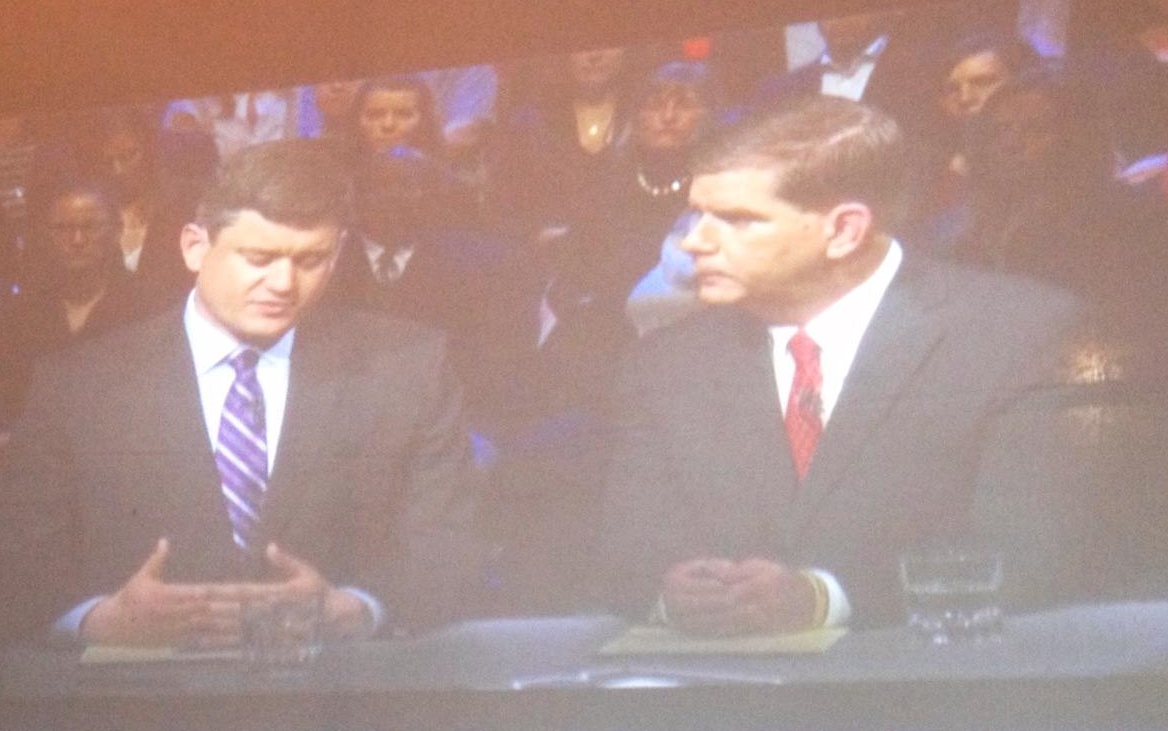
BOSTON MAYOR 2ND DEBATE : CONNOLLY PROVES A MASTER OF CITY FINANCE

Image

^ Master of City budgets : explaining. Master of labor negotiation ; listening.

— — —

John Connolly easily carried last night’s second Mayor debate, but not for any of the hot button reasons being touted in the blog-o-sphere or news media. He did not win it because he crushed Marty Walsh on the “smear flier” matter. He didn’t win it because Walsh had no good reply to co-moderator Margery Eagan’s question as to why he hasn’t withdrawn his State Legislature bill to abolish city Council review of arbitrators’ awards. Nor did Connolly win it when Walsh made the mistake of saying his many endorsements by elected officials came from “a lot of my friends,” thereby reducing their prized blessings to an act of buddy-buddy.

Nor, even, did Connolly win it because he spoke eloquently while Walsh seemed unwilling at times to talk (David Wyatt ??) and when he did talk, often came across as chromosomically clumsy. After all, our current, beloved mayor, Tom Menino, epitomizes clumsy.

So forget all of the above for the moment. The reason that John Connolly won this debate, and a big part, too, of his mastery of the first debate, was his commanding knowledge of the city budget — its finances and its process. Time and time again, when Walsh tried to tie Connolly to this or that Council decision, Connolly proved Walsh’s attacks untrue, or misinformed, even clueless, at times, about how the City’s financial decisions are made, or why.

Mastery of the city budget isn’t just dry leaves. It’s the very essence of what City government is all about. Indeed, budgets are the core of all governemnt. It’s why we have governments and how they operate. Voters may well excuse Walsh’s clumsy debating ; especially because he is not the incumbent. Voters do expect a Mayor to speak authoritatively and readily on City matters, but a guy not yet Mayor is accorded some slack. But given another guy who is also not yet mayor, and who knows the City’s most basic function in and out and can explain it in a way that makes it seem as crucial as it is, voters cannot help but notice who is ready to govern and who might need some on the job training.

Rarely was Connolly’s mastery of the city budget on display before the primary — though I do recall one instance of it, in which, at Forum, he crushed one opponent who simply did not know the budget at all. Connolly’s entire campaign was predicated on school transformation — his phrase — and he became “the education candidate.” Yet last night he was asked few questions about education, though these he responded to with focus and passion, and, quite frankly, these questions probably did not matter much to voters watching. They already know where Connolly stands on education in the city, and they are learning quite rapidly that Walsh, too, has a well-thought-out city education plan. What they did NOT know – indeed, what I too did not sufficiently grasp — was that Connolly has such command of City budget matters. During the primary, at dozens of Forums, it was Dan Conley who made city administration has hallmark; Connolly rarely spoke of it.

But that was then. The fact is that because of his Budget process prowess, Connolly has now moved very close to becoming the man who will operate it for the next four years.

Post script : It is not that surprising to find that Walsh is no match for Connolly as a city budgeter. in a city labor negotiation, the labor negotiator says ; ‘this is what we want. How you do it is your problem.” Walsh is now looking to switch to the other side; to it being HIS “problem.’ it’s not an easy switch to make, especially when there’s a guy already there who knows the “problem” inside and out.

Walsh has one week to get in this game. he has the support of three current City Councillors : Felix G. Arroyo, Frank Baker, and Tito Jackson. They had better teach him fast. And he had better be ready to explain what they teach him.

Not all the Greater Boston Labor Council — hardly an “outside group” to a man who has been part OF it for many years — anti-Connolly fliers in the world can save the City Budget Day for Marty Walsh. Not all the local 1199 members door-knocking — and thus reinforcing voters’ perception of Marty as “the union guy” — can do it. Nor all the picket-line stand outs. This campaign has so far showed itself unwilling to learn anything about what voters outside its circle of interest are like. Can they do it now ?

— Michael Freedberg / Here and Sphere

BOSTON MAYOR FINAL : THE COMMUNITIES OF COLOR COME OF AGE POLITICALLY

Image

^ a classic stump speech ; Clayton Turnbull saying it real for John Connolly

— — —

Boston’s voters of color — black, brown, or yellow — have come of age in this campaign like never before. Whoever wins on November 5th, the breadth and sophistication of participation in it by voters Black, Hispanic, Caribbean, or Asian far surpasses anything that Boston has seen at least since the Abolitionist Era. Yes, you can say that these voters’ participation in the election of Barack Obama in 2008 (and in 2012) was strong, broad, and passionate. But Obama is himself a person of color. The participation this time is to the campaigns of two “white guys.” One man fairly well known, the other hardly at all.

Image

^ the way it’s done — but until this year, not so much : State Senator Linda Dorcena-Forry going all out for Marty Walsh (with Felix G. arroyo at his side)

Not only the community leaders have participated, though they have upped their game in this respect. The new development is the participation of every sort of voter of color : union activists, church congregations, business leaders, hip hop DJs, restaurant and club promoters, artists, social networks, political operatives, contractors, and just plain folks. And not only are they participating; they are doing so with an issues agenda. On twitter and at facebook I have read their posts about the contest. Their observations show a knowledge of what’s at stake, and what’s behind the scenes, that matches anything I’ve read by anyone who isn’t a media pro — and show as shrewd a knowledge of the politics as even some media people. Nor is the participation in communities of color merely social mediating. Large numbers of folks are door-knocking, doing meet and greets (i.e., house parties), phone-banking, even fund-raising — for these two white guys who would be Mayor.

Image

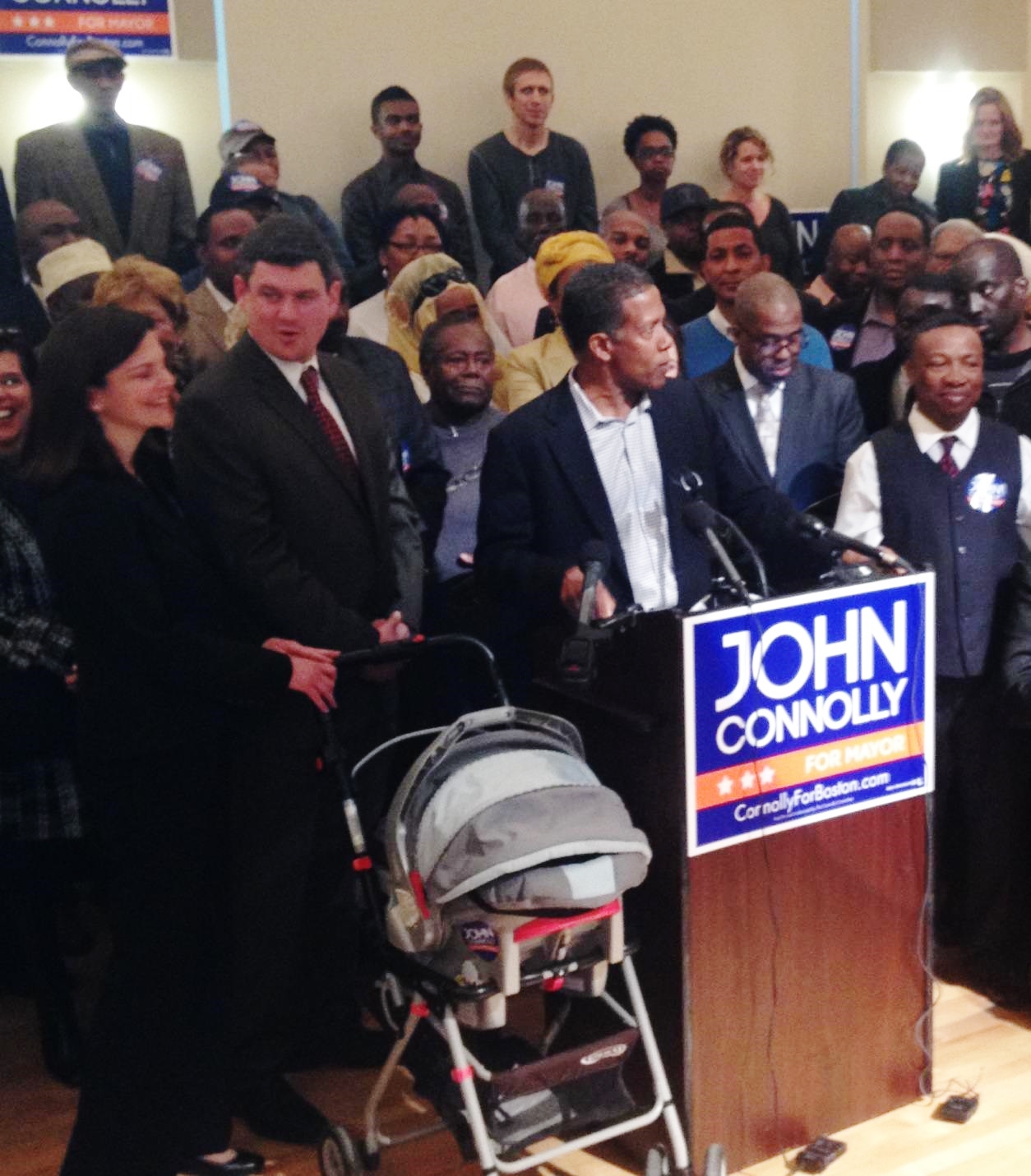
^ into the heart of the matter : Pastor Bruce Wall and friends stand with John Connolly

As one who, back in his political operative days in Boston, was often given the task of co-ordinating the City’s Black wards (in those days it was 9, 12, 14 and part of 13 and 15), I well remember when Black participation — the City then had few Hispanic or Viet Namese voters, and Chinatown was an entirely different matter — in a major city election consisted of paying hired volunteers “walking money” to pay to people who would stand at the polling places on election day and hold a sign or pass out palm cards. The candidate himself would rarely visit the Black wards, and what Black leaders there were did not protest this. They expected it. The candidate really had no reason to visit. “Covering the polls” on election day, if you could actually get it done in most of those 40 or so precincts, was usually good enough to win the day. And after that, it was usually good enough for a Mayor to hire a couple of Black ward leaders, to appoint one as an election commissioner, and, eventually, to hire Black youth workers. Even after the horrific crisis over school busing, in the mid-1970s, this situation prevailed.

Change began with Mel King’s campaign in 1983. King was then a state Representative, but not just that. He had a long history of involvement with progressive (indeed, very Left-wing) activism in Boston running back to the 1960s with the implementation, in Boston, of a local adjunct of President Johnson ‘s anti=poverty programs. King had a large following ranging from Robert Kennedy-inspired “white progressives” to activists in the black community, and, with their support and votes King reached the Final election — the first Mayoral Black candidate to do so. Ray Flynn, of South Boston, eventually won the election; but he made a serious effort to visit Boston’s Black neighborhoods and to connect with its leaders. Few votes for him resulted, but there were some; and there were activists who supported him, some quite vigorously. Once elected, Flynn brought those activists into City government. And more : he added Felix D. Arroyo — father of Felix G. Arroyo — into his administration at a high level and also connected as widely as he could with King supporters.

Image

^ what Ray Flynn started with Felix D. Arroyo, Marty Walsh has summed up with Felix G. Arroyo.

What Flynn began, Menino built upon; but his building work was administrative. It remained electorally untested, for the most part. That phase has now definitively ended. Boston’s communities of color — and communities of new immigrants — are stepping now into the contact sport that is election politics and are being wooed by both Walsh and Connolly with an intensity that assures that henceforth the “communities of color” vote will be as necessary a part of any City campaign as “the Italian vote” has been for the past 60 years.

The prejudice evident in the Sacco-Vanzetti crisis of the 1920s, and its tragic end, made integration of Boston’s Italian vote into city politics a necessary goal. It took 30 years to complete that process. It has taken the city almost 40 years, after the “busing” crisis, to integrate its “communities of color” vote similarly, but it has now been done.

If nothing else comes out of this intense and sometimes nasty campaign, the work of integrating communities of color into Boston’s political establishment is an victory the city can take pride in.

— Michael Freedberg / Here and Sphere

BOSTON MAYOR FINAL : ENDORSEMENTS AND “MOMENTUM”

Walsh endorsed

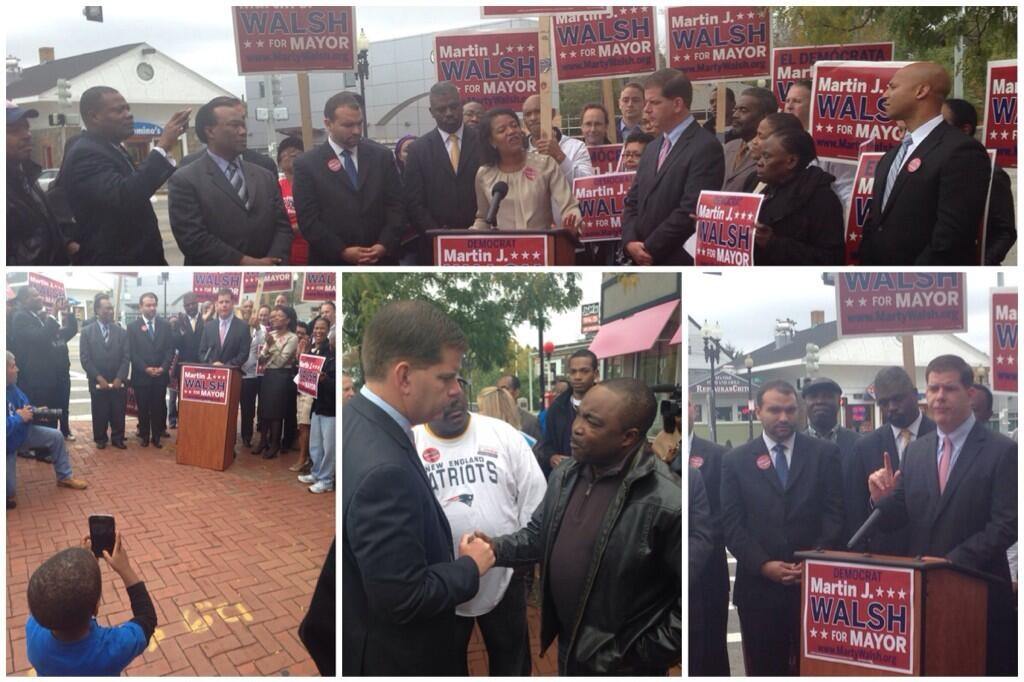
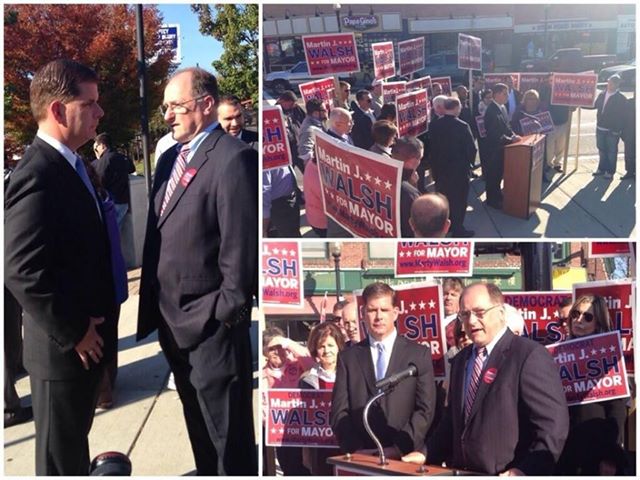
^ receiving the blessing : Congressman Mike Capuano says that Marty Walsh is OK

— — —

It is said, by Marty Walsh’s campaign, that it has “momentum.” Well ? What campaign doesn’t ? Every campaign worth a shiny ha’penny moves ahead with its things to do and tries to move more mightily. What “Team Walsh” — this year’s cant for “volunteers” — really means is that are catching up. As evidence they cite the bushel of endorsements they’ve received from current or past elected officials. (By my count, it’s now Connolly 9, Walsh 16.) But winning the endorsement skirmish comes at a price., In the 1959 Mayor election, John E. Powers had all the endorsements, John Collins none.

Collins won.

At a time when many people are fed up with elected officials’ inability to keep promises, and when many more no longer believe what an elected official says, having endorsement by elected officials as your big magillah may not be the win-win the endorsee thinks it is. Already Connolly is doing the John Collins move : pointing out in his speeches that, as he said this morning at a rally, “so many politicians have endorsed Marty Walsh I almost expect Barack Obama to endorse him !” (He laughed. So did the entire room.) “All I’ve got,” he continued, are the people !” Saying it as he nodded to the 170 or so leaders and people gathered to support him.

There does seem to be a gathering strength to Walsh’s campaign. I sense it. He is drawing larger gatherings than Connolly (although today’s rally at Roxbury’s Hibernian Hall drew plenty) and has more of them. Connolly continues to do house parties — tons of them — but at house parties he reaches 20, 30, maybe 4r0 people. Walsh at his rallies reaches 100, 200, even 300. This is what you’d expect, of a candidate scantly known to most voters but now endorsed by “big names.” Tons of voters must be asking “who is this Walsh ? I never heard of him before. But Big Pol # 6 is supporting him ? Guess I ought to go see what he’s all about.”

This is good politics. Marty Walsh has huge clout with the unions local and national, but his name recognition doesn’t match up to the clout. So, use the huge clout to draw the voters’ attention to (1) who you are and (2) that you have huge clout. It’s a simple tactic, and it is working. Walsh is by now a known name probably throughout Boston. It also impresses voters that the Endorsing Big Pols are, in some cases, working their supporters on his behalf and even are working themselves. This gives credence to the message that Walsh Has Clout.

Clout matters. Voters like to kn ow that their mayor is a Big Gun, a Giant who can make the State House salaam and the Feds say “Yessir !” Don;t we all want that Strong a Mayor rather than a merely local biggie. So the Walsh message does resound.

Of course the Big Pols pushing his clout have a purpose to their passion. I have written about their purpose often during this campaign — no need to revisit it right now. Today I’m merely recognizing that it is there and that voters are weighing seriously a man they hardly knew or didn’t know at all even two months ago.

Connolly today^ John Connolly endorsed by few, supported by many. But HOW many ?

John Connolly’s task is harder. As he is already fairly well known, having been elected to the Council citywide three times, he does not evoke voter curiosity as to who he is. The voters already know who he is. What Connolly has to do is say, “you know me, you know what I’m about, now I’m asking you to support what I’m about.” The phrase “what I am about” implies a MOVEMENT, not just “momentum.” But it is not easy to move people. If it were, there would be hundreds of Jesus’s and Mohammeds; but  there were only two. Movements rarely arise. Even at the lower intensity of political movement they come only now and then. Gene McCarthy for President was such a movement. Reagan in 2000. Obama in 2008.

All these were geared to huge national purposes. City politics does not rise to that level. John Connolly seeks to lead a school transformation movement (and, since the Primary, has connected it to several mother reforms and transformations). Yet at today’s rally, Connolly’s endorsers talked of his “independence’ and that he would give the community of color “not just an ear but a seat at the table” and “not just a seat at the table but a partnering.” To me it sounds like nuance.

Can Connolly’s school transformation and nuanced view of access to power beat Marty Walsh’ s “this who I am, and I have clout” ? We will see. Myself, I say this : IF it weren’t for the contradictions in his campaign, and the smallness of the single interest that it represents, Walsh would be the winner on November 5th. If.

Of course, if if’s were horses, beggars would be riders.

—- Michael Freedberg / Here and Sphere

BOSTON MAYOR FINAL : IT’S CONTACT SPORT NOW

Image

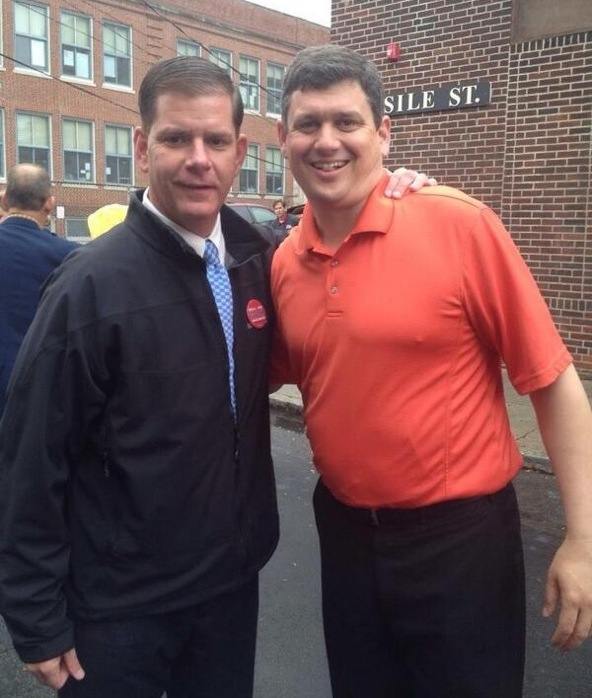
^ friends maybe : Marty Walsh and John Connolly at the Rozzie Parade

— — —

My friend Gerry Seely, who worked more Ward 20 campaigns than I care to count, used to say “politics is a contact sport.” How right he was, and is. He loved the contact. So did I. That’s how we proved ourselves.

I know that many of you reading this are now asking : what does this phrase mean ? What IS “contact sport politics” ? Answer : take a look around you right now.

The Connolly campaign has built and is still building a huge organization of door knockers, house party hosts, social media posters, fund-raisers, sign hangers, etc. Precinct captains have been chosen; precinct organizations are forming. Soon the campaign will have — if it is on a success path — at least a dozen workers per precinct, all of them out there taking the Connolly message to every voter in their precinct.

The Walsh campaign is doing the same thing. Its tone is different, and Walsh is deploying his people on different platforms than is Connolly : less social media, more face-to-face. But the basics are the same as for Connolly : door knocking, sign hanging,. hose parties, meet and greets. all of it done in the precinct (there are 255 in Boston now) by precinct organizations.

you can’t have 24 people, let’s say, going about one single precinct — each has from 1500 to 2000 voters only — without them encountering one another’s work or even face to face. Thus the “contact sport.”

Passions arise in campaign organizations, because it takes huge physical effort, day after day, with few breaks, to do what campaign organizations musty do. Constant strain begets constant intensity. It becomes easy to think of the rival candidate’s organization as people to be bested, beaten, defeated. Those of us who engaged in campaigns all the time learned to hold our passions in check, more or less. we saw the rival organization as soldiers in the same war, and while we delighted in defeating them, when it was all over they were our buddies : we had both gone through the same test. plus, we both knew that though one of us won this time and the other of us lost, in the next campaign — which might begin the next week — they might win and we lose.

The problem comes when contact sport occurs between organizations peopled largely by first-timers. This campaign is such a one. how could it not be, when there hasn’t been an open race for mayor since 1993 ? Almost everybody working a precinct in this campaign is new to the game. It’s a truism that in politics, most workers do their best work in their first campaign. They’re more enthusiastic, less jaded, and because they are “fresh,” voters who meet them trust their involvement more than they do the “political pro’s.” Thus, campaigns want as many first-timers as they can get. his the Connolly and Walsh campaigns have done.

It becomes a huge management problem to keep the first-timers cool on the street; to police the behavior of rookie precinct organizations bumping into one another. As I have written, one of the key tests, for me, in whom I want as Mayor is how well he manages the day to day of his campaign. So far it’s really been no contest. The Connolly campaign has kept its cool from word to street. I’ve seen no disparagement of Marty Walsh, indeed just the opposite. Nor have I heard, even once, of Connolly volunteers leaning on Walsh supporters. The opposite has not been true.

Reading that sentence, you may respond that because Here and Sphere has endorsed John Connolly, i have a bias. I do have one. But as a reporter, I never let that bias control my finger on the laptop keyboard. In the Connolly campaign I see a cool excitement, a readiness to do the task at hand without animus,a discipline extraordinary, really. In the Walsh campaign I see — have seen since I first began to cover this election nine weeks ago — a passion so intense that it bursts its bonds. It lies at the heart of the contradiction that is his campaign. How to be union but not too union ? How to be excited but not so excited that you alienate people ?

Walsh supporters can feel very intimidating. At a distance, that’s OK; it’s even fun to watch. But up close, in the precinct, block by block and house next to house, it leads to confrontation. At which point “contact sport” backfires.

This campaign has already reached that point. The agendas of the two candidates differ hugely. They live on opposite sides of the city, draw from bases that have little contact with each other.

The next two weeks will require a ton of leadership example from the top if we aren’t to end up cleaving the city in half for many years to come.

—- Michael Freedberg / Here and Sphere

MEEK AT THE MOVIES — The Fifth Estate ( 2.5 STARS )

Image
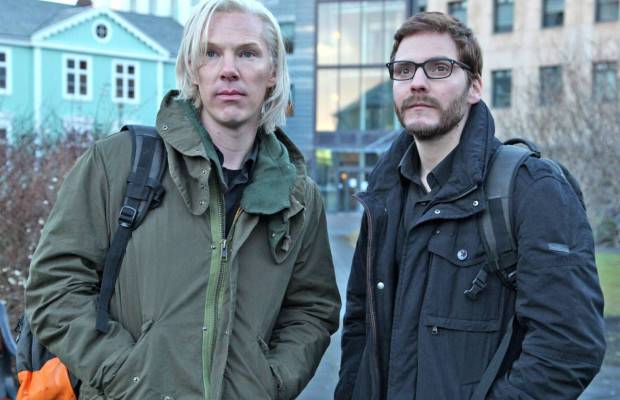
^ no soul to sell ; Benedict Cumberbatch as Julian Assange (with Daniel Bruhl) in Bill Condon’s “The Fifth Estate”

—- —- —-

WikiLeaks, the renegade news outlet that takes hacked secrets from government agencies and publishes them to the world sans redaction while protecting the identity of the whistle blower through an elaborate ‘submission platform,’ that’s so secure, even the publisher doesn’t know the identity of the leaker. That site’s notoriety achieved its apex when it published reports exposing US intelligence assets abroad and crass snippy inter-office memos from those in the State Department trashing world leaders. But that’s just the background and part of the denouement in “The Fifth Estate” which is really more a character study of WikiLeaks founder Julian Assange and his meteoric rise to international infamy.

Assange is played by Benedict Cumberbatch (Khan in the last “Star Trek” chapter) who in long white locks and with piercing blue eyes looks somewhat ethereal or other worldly, like the fair-haired elves in the “The Lord of the Rings” trilogy or the calmly maniacal Julian Sands in the “Warlock” films. Cumberbatch’s Assange is a hard beast to wrap your hands around. He’s guff, arrogant, but at the same time an idealist who spends time in Africa trying to expose corrupt governments stealing money from the people and killing anyone who questions their brutish entitlements. The film’s window of insight into Assange’s mystifying persona is his early collaborator Daniel Berg (Daniel Brühl who played Niki Lauda in “Rush”), who at first idolizes Assange and his mission but later has clashing ideological differences over what to do with the Pentagon papers Bradley Manning leaked to them (it was Manning who exposed himself in a chat room).

The film is directed by Bill Condon, who had notable successes with “Dream Girls” and “Gods and Monsters,” and recently has been involved in the hackneyed “Twilight” series. Condon keeps things clicking along with Twitter-brisk editing and plenty of acerbic Assange diatribes. He makes sitting at a desk and hacking away against the clock a time bomb-beating experience. As far as composition goes, the film looks great, but there’s not much insight into Assange’s past. His stories of his white hair and his long unseen son (near adulthood) seem arcane and piquant at first, but then they feel like ploys used by Assange to manipulate others. And that’s the fatal fault with “Fifth Estate.” Assange is an asshole and you can’t wait for him to get his comeuppance. The well-heeled documentary filmmaker Alex Gibney earlier this year came out with “We Steal Secrets: The Story of WikiLeaks,” which got at Assange and the WikiLeaks story more satisfactorily. What Condon was aiming for is unclear. It postures well and Cumberbatch is riveting as the media shaping reptile, but in all the plumbing of the journalistic ethic and mad dash globe hoping, there’s just no soul to sell.

— Tom Meek / Meek at the Movies
BOSTON MAYOR FINAL : “LEADERSHIP STYLE” ?

Image

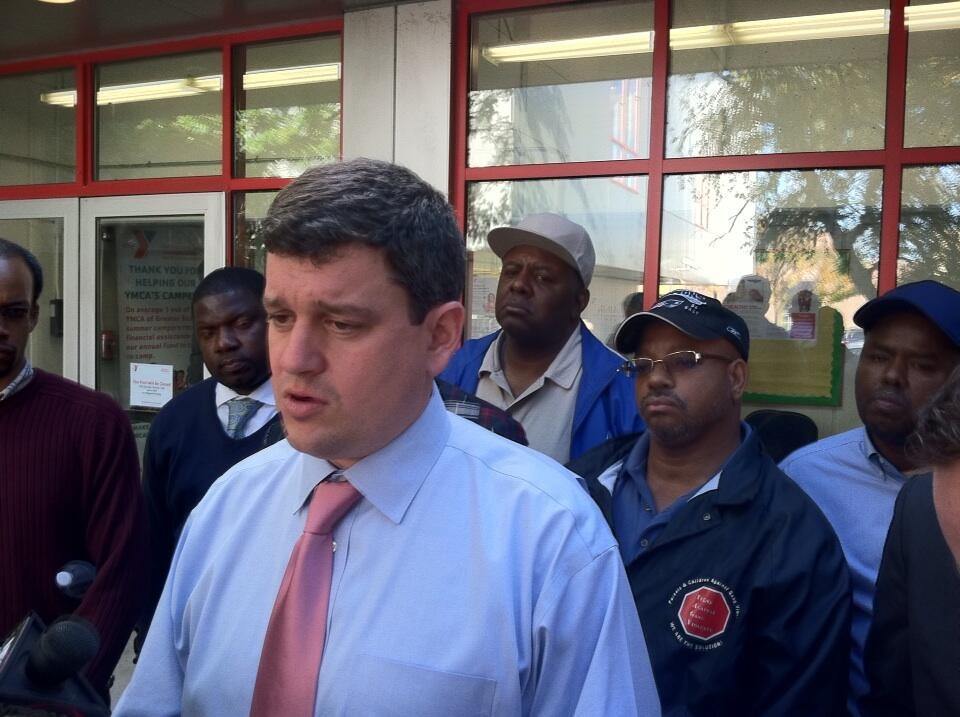
^ in governance, substance IS style. john Connolly meeting with gang members and Ministers in Roxbury yesterday

—- —- —-
So now the Mayor race is about “leadership style” ?

What is this ? A fashion show ? An audition for Downton Abbey or such like ?

To read some big name columnists, or to surf my facebook wall, one would think so. it is said — by Marty Walsh supporters — that some elected officilas in Boston’s communities of color are endorsing Walsh because they don ‘t like John Connolly’s leadership style. A good friend of mine — who knows politics much better than that — also made that point to me this morning.

I would like to differ. I would submit that the idea that some elected officials of color have endorsed Marty Walsh is because of “leadership style” is a rather plump grade of effluent.

Politicians don’t endorse because of style points. They endorse because it serves their interests to do so. What are their interests ? One : getting re-elected. two : responding to their most active and vocal constituents. Three : their own policy agendas. Four : all three of the above.

More credible is the suggestion that elected officials of color have endorsed Marty Walsh because he has an urgency about him. This does seem to be the case. We wrote about that exact aspect of Walsh’s campaign almost a month ago. Walsh is urgent, Connolly long-term. Walsh wants stuff now. Connolly wants now to be just the beginning of a vision, a direction. Walsh’s message resonates with people who need help immediately. Connolly’s gains those who say “yes, right now is important; but what next ?” This too we wrote about back in September and again in our editorial endorsing John Connolly. You see it in how the candidates talk about employment. Walsh says “jobs.” Connolly says “careers.”

Between these two visions there is no easy common ground. It depends how you live your life. If you need more money right away, and getting it sets to one side steps you need to take to gain a career, you must choose either the money right away or the career steps. You probably can’t do both. In many of Boston’s communities of color, where incomes remain below average and unemployment (or under-employment) above average, voters are conflicted in just this way. That is why one sees elected leaders of these communities often endorsing Walsh while at the same time many of the actual activists are going with Connolly. The elected leaders hear the cries of urgency. The activists are building a future.

photo (4)

^ urgency — and union jobs now ; Marty Walsh has plenty to offer

The elected leaders are responding to the cries of urgency because that is what constituent service is all about. People building a future can’t do it by calling an elected official’s office for help. Elected officials aren’t set up to build people’s futures. That’s what city administration and state offices of economic development do. But elected officials are set up to assist constituents in need — of neighborhood legal services, an addiction intervention, a problem at school, etc. Thus, in the Mayor’s race, some elected officials of color are picking the man they think will respond most quickly and helpfully to constituent help calls.

But there is a flaw in their analysis (assuming this is in fact how they see Walsh versus Connolly). The Mayor, no matter how sincerely he wants to remedy ills, can’t do it himself. His administration does that. And that is why when I was looking at the campaigns with an eye to recommending an endorsement to my Here and Sphere partner, I looked at how the two campaigns ran. Because, for me, in every campaign for an office essentially administrative, how the campaign is set up and carried out says a lot about how the man or woman will set up and administer when he or she is elected.

With the Walsh campaign I saw a well-managed street presence but a difficult internal process and a message full of contradictions.

With the Connolly campaign, i saw an efficient schedule, a state of the art volunteer outreach, and a campiagn message superbly focused and presented.

I not only saw this. I wrote about it back in mid-September.

May I ask, if “leadership style” — i.e., constituent services — is the avatar here, how come the many, many elected officials who have endorsed John Connolly missed what the elected officials of color now with Walsh see ? Is delivery of city help to people needing it any less important to Sal LaMattina than to John Barros ? Less important to Nick Collins than to Carlos Henriquez ? And what of the many elected officials who are endorsing neither ? Do they simply not give a damn about their constituents’ need for such services ?

Or is it that the elected officials supporting John Connolly want better schools — which will take years to accomplish ; look at the problems now engulfing the Dever and McCormack schools in Marty Walsh’s State representative District — so that their constituents’ children can have great careers ?

Whereas those backing Marty Walsh would rather not take on the Boston Teachers Union – as Connolly has — with school reform and see less political kerfuffle — if Walsh becomes Mayor  — in securing for their people a huge favor : union membership in the building trades and thus jobs now in the Boston building boom while it lasts ?

—- Michael Freedberg / Here and Sphere

NOTE : a suggestion has also been published that John Connolly was merely ‘stylin'” when he invited the Boston Globe to accompany him as he met with gang leaders in Roxbury — “using them as props,’ said the detractors.  This is the sheerest garbage. I propose that said gang leaders were thrilled to have their stories register upon the City’s biggest newspaper. They weren’t “props,” they were the REASON. ‘Nuff said on that one.

WHAT IS A FAMILY WHEN THE RULES HAVE CHANGED?

hereandsphere's avatarCoffee or Vodka?

family banner2

Dear: Parenting 911

My husband and I both are active members of our communities’ youth outreach programs. One of which is a half way house / group home for displaced or abandoned youth.  We have a secondary facility that has the goal of helping families through crisis and “hopefully” equipping them with the necessary skills, and basic needs — as  well as all the assistance , and resources we can find them.

Well about a year ago, a drug addicted mother and her two very young children found themselves at our doorstep. Of course we DID NOT refuse them despite our lack of room. These two young “babies” then 4 and 5 had really been through it — more than most children EVER will see at that age.  First we sought out drug treatment for the mom — counseling for the family unit — along with individual counseling for each…

View original post 783 more words

BOSTON MAYOR FINAL : THE CONNOLLY CAMPAIGN

Image

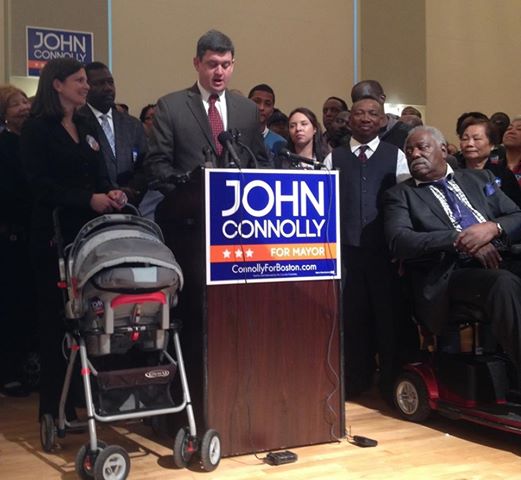
^ “the next mayor has to come in dedicated to bridging the equity gap” — John Connolly speaking at a huge rally in Jamaica Plain tonight

—- —- —-

NOTE : Here and Sphere has endorsed John Connolly for Mayor. I’ve done my best to be objective in this report. You decide.

Two weeks ago, as Marty Walsh struggled to become something other than “the union giuy” and as John Connolly began to amass a large and diverse war chest of people and money, it looked as if the November result would be not close. The prospect looks different now. Walsh found a way to change the conversation — instead of “the union guy” he is now “the progressive tribune of workers’ rights” — and four major Boston politicians of color (three of them former Mayor candidates) have endorsed him, with more such to come soon. Which has forced Connolly to change HIS conversation too.

Until Walsh’s change began to show itself, Connolly had been “the education candidate.” As Boston public schools are by far the largest and most expensive city function, and as there are some 57,000 Boston Public School parents, being “the education candidate” seemed a shrewd choice. It was. It got him into the November Final. But being the education candidate is no longer big enough, and Connolly has had to expand his message hugely.

It has taken him two weeks to do so. I think that he has been stunned, after all the years of bold outreach to Black Bostonians (less apparently so to Boston’s Hispanics), to watch as one after another Black politician endorses his opponent. Yes, his campaign kept on reaping that outreach; yes, it has won him many endorsements by Black religious leaders and by some political action committees. In particular, almost the entire campaign apparatus of Charlotte Golar-Richie joined his campaign, and some supporters of John Barros as well, even a few supporters of Felix Arroyo. But his campaign to Boston’s communities of color has proved much harder than seemed likely a month ago, and Connolly has had to change his approach. I think this has saddened him; one hears it in his remarks. I don’t think he is happy to compass winning by the votes of upscale white people. It’s not what he spent years preparing to be.

as he worked to speak to the changed electoral landscape, Connolly’s speeches stayed close to the education theme. But then came the big break-through : almost the entire leadership of Boston’s “Italian” wards came aboard his campaign. And though the endorsers talked not about issues specific to their neighborhoods — no bread and butter city administration stuff — but about better schools, in speeches that often sounded canned, a smile returned to Connolly’s cheeks and an excitement to his voice.

The endorsements of Connolly by Councillor Marc Ciommo, former Councilo candidate Philip Frattaroli, State Senator Sal DiDomenico, former Councillor Paul Scapicchio, North End State Representative Aaron Michlewitz, and — most importantly of all — by Councillor Sal LaMattina (East Boston State Representative Carlo Basile had early on joined the Connolly side) strengthened Connolly’s hand considerably. He was no longer just the candidate of mostly white young techies and concerned publiic school moms. News came of a fundraiser hosted by said Carlo Basile at which, it was said, $ 100,000 was donated to the Connolly brand. At the same time another fundraiser, by Roslindale real estate developer Vinnie Marino — said to be very close to Mayor Menino — raised yet further funds, and it was announced that Connolly had imbibed a whopping $ 610,000 total during the two weeks just ended.

This turned many heads. What the turned heads now s aw — and heard — was a Connolly on wide angle. Jobs — he said “careers” — safe neighborhoods, all of us connected to one an other, it was all part of his new speech. In the First Debate, on Tuesday night, the new, confident, bold Connolly was on full display as, in a voice pitched high and somewhat melodic — his passion voice =– he spoke of education, certainly ( and often ) but even more masterfully about city finances, revenue, union contracts, and budgets. Suddenly listeners saw not “the education mayor” but the Master of City Money. At many turns in the city finances discussion he had Walsh on the ropes.

This was a surprise to me — probably to many. At numerous Mayor Forums and at “Mondays with Marty” I had heard Walsh speak authoritatively about many city issues and, of course, State House legislation. Less so at the First Debate. He seemed cautious — as well he might be after Connolly’s revelation of a bill that Walsh has filed, five times, to take away from City Councils the power to review labor arbitrators’ contract awards. For that revelation has been at least as significant in moving Connolly beyond being a mere “education Mayor” as any other move he has made or that has been made on his behalf. At the Debate, Walsh could not escape its implications. the mire that moderator Jon Keller asked city budget questions, the ,more that Walsh’ s union-friendly legislation came to mind.

But at street level, Connolly’s attack on Walsh’s labor legislation has opened him to accusations by Walsh supporters that he is “not a progressive,” maybe even a “Mitt Romney in Robert Kennedy words,” as one notable Walsh spokesman said. That the attack has hurt was seen tonight when, at a huge rally in Jamaica plain, Connolly said “I’m sick of being told I’m not a progressive ! Giving a good education to every child in the city, that IS progressive !”

It was a superb speech, the best i have heard Connolly give. He spoke of careers; of “bridging the equity gap”; of the City being “two different cities, one safe, one unsafe.” He made fun of himself. He talked of his teaching career (“despite what you see about me on the internet, yes, I was a teacher,” he grinned.) He talked of restaurants and liquor licenses; of streamlining the city bureaucracy; and, yes, of school reform in all its details including, pointedly, a longer school day. The crowd cheered him; cheered each of his points — and well they ought, because he stated them with a clarity I had yet to hear him bring so much of. He sounded less the slogan-eer, more like… a Mayor. It was a speech just that commanding, pitched perfectly at his fan base of upscale young urbanites and concerned school parents.

Image

^ the Mayor of upscale young urbanites and concerned school parents greets his voters at tonight’s Jamiaca Plain rally

This speech, along with his campaign tactics talks (brimming with insight and laughs) to supporters at donation gatherings, bring Connolly a conversation changed utterly. It’s big presence, a podium persona. Can Walsh raise his game to this level ? we shall soon find out.

—- Michael Freedberg / Here and Sphere