ELECTION 2014 : DAVID D’ARCANGELO TALKS TO HERE AND SPHERE

photo (53)

In Massachusetts we elect our state records keeper. We call him the “Secretary of the Commonwealth.” You may have visited its office, on the 17th floor of the Ashburton Place state office building. Probably if you did so it was to file corporation papers or to search an election tally on behalf of a candidate. The Secretary of the Commonwealth keeps both.

Anyhow, it’s 2014, and this year — every fourth year — we elect who that records keeper will be. For the past 20 years or so Bill Galvin has been the man. Once a state legislator from Boston’s Brighton section, Galvin developed a reputation as the man most knowledgeable about Massachusetts election statistics and laws and used that reputation to win the records keeper job. He has not been seriously challenged since — or, if he has, I cannot recall it.

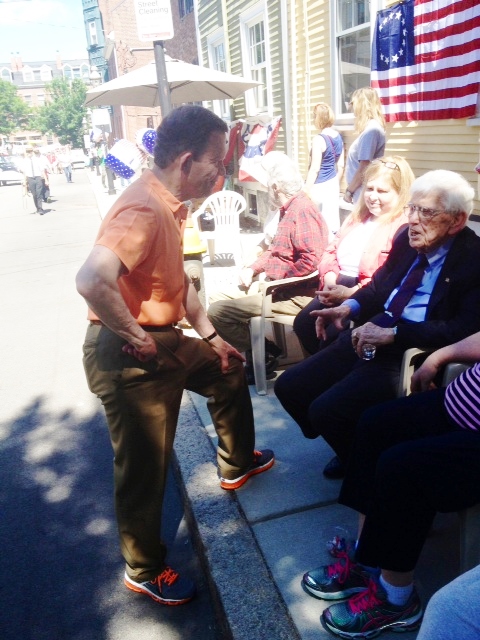
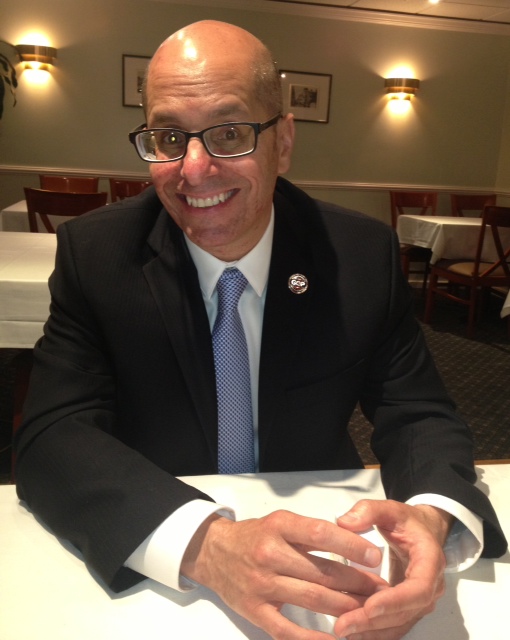
This year Galvin finally has a meaningful challenger, Malden City Councillor David D’Arcangelo. Davis the 44 year old son of Tony D’Arcangelo, who in the 1960s was a protege of then Governor John Volpe, living in East Boston and, in 1968, running fir state Representative in “Eastie,’ a campaign that I, then just a kid, worked on — and reported from, as a stringer or AVATAR, then Boston’s outrageous alternative weekly.

David D’Arcangelo talked at length recently about his late Dad — a pixie of a man but tough as they came — and then about his own race this year against Secretary Galvin. It hasn’t been easy and isn’t easy now. The media, he says, aren’t interested, and there isn’t much money. He is right about that. OCPF reports through June 30, 2014 show D’arcangelo raising a total of $ 19,856, with $ 4,185 on hand; meanwhile Bill Galvin has raised about $ 68,000 in the same period and has $ 641,969.33 iun his account.

Still, the voters don’t know or care much which of Galvin and D’Arcangelo is the rich guy and which the poor boy. If Galvin is doing a good job, as the voters see it, he gets re-elected. If not ? Then D’Arcangelo has a chance. And a chance he does have, because as D’Arcangelo points out, the Secretary’s website is as opaque as it gets, offering both too much information and too little and very hard to navigate from its dense and non-transparent front page.

“The people have a right to transparency,’ says D’Arcangelo, using one of this year’s election’s most popular campaign themes. “The state’s websites don ;t work, or they’re hard to figure out, difficult to navigate. The Secretary’s is one of the worst. We deserve better. it’s 2014 !”

D’Arcangelo is right. So, what will he do about it ? “You ‘ll see an entirely new website built,’ he says. “using current technology. The Secretary should have a facebook page and a twitter presence. Does Galvin have these ? Not that i can see.”

Of course D’Arcangelo is right; in 2014 any elected official should communicate directly with the public on facebook, twitter, even — says D’Arcangelo — via instagram.

D’Arcangelo expands upon the transparency theme. “Galvin has purchased substantial public service announcements, but you can’t find out what he paid for them the source of the funds, or even see the announcements themselves. These are public records and should be accessible to all. If i am elected, they will be !”

Again, D’Arcangelo is right. The Secretary’s public service announcements are public records, easily abused by an elected office holder wielding them to promote his name. It’s a borderline decision, and one I do not second guess for any public official. Still, the public has a right to know their cost and who produced them, and to see the announcement tapes.

Transparency and modernization may not seem sexy to the average voter, but communication immediacy is how we live in the age of facebook and twitter, and most voters do get that. If D’Arcangelo can capture even a minute or two of the public’s attention, he can put Secretary Galvin’s continued election to office seriously at risk. And get some answers to his challenges.

—- Mike Freedberg / Here and Sphere

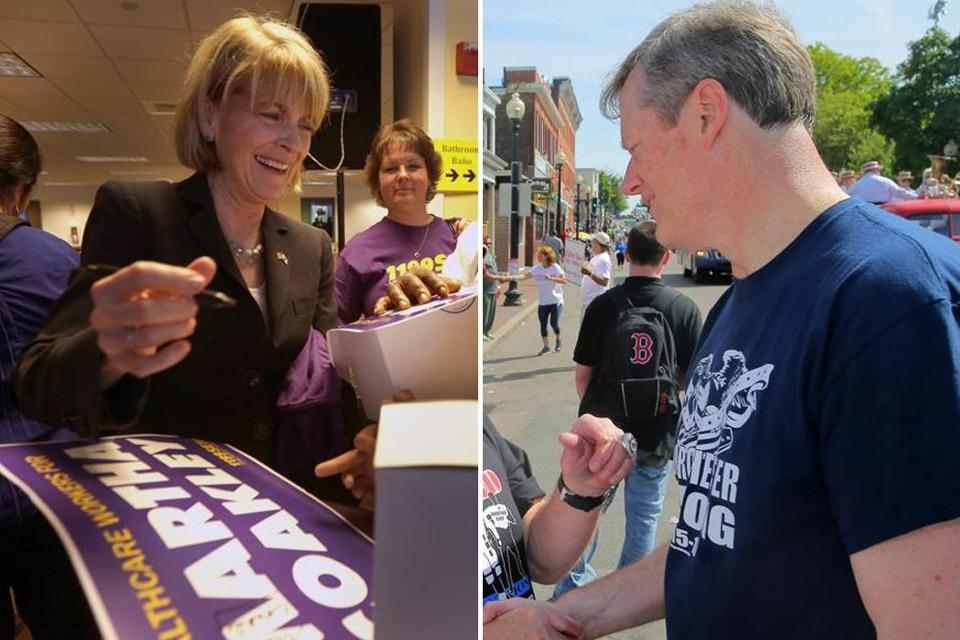
#MAGOV14 CHARLIE BAKER STUMBLES. RECOVERS — AND POLLS WELL

1 Baker and Coakley BG

^ Baker stumbles, recovers, and polls well ; Martha Coakley pounces — but mishandles even that.

—- —- —-

Charlie Baker, GOP candidate for Governor, got a huge present yesterday : a new Boston Globe poll according hm his best numbers yet. In a matchup with likely Democratic nominee Martha Coakley he now gets 35 to her 40, with a full one-quarter of voters still undecided or supporting one of the non-party candidates.

This was good news indeed — and there was more: I’ll discuss it below — especially after days in which Baker, running as the accomplished manager of state government, stumbled in his management of himself.

On Wednesday he told the Boston Globe that “Hobby Lobby doesn’t change a thing in Massachusetts, because our own health care law accords women all their health care needs.”

Immediately all three Democratic candidates charged Baker with going South on women’s health care — Coakley, in her typical classless fashion, used Baker’s remarks to fuel a fundraising letter.

Actually, all three Democrats didn’t know the whole story. On Wednesday night Baker’s wife Lauren and his running mate, Karyn Polito, were on stage at NARAL’s “Supreme rally.” Both gave me — I was there as a WGBH journalist — statements in which they made very clear their outrage about both the Hobby Lobby and Buffer Zone Law rulings. I thus knew that the statement that Baker gave to the Globe could not be the entire picture.

photo (51)

^ GOP Lieutenant Governor candidate Karyn Polito at Supreme rally : she gave me this statement : “I have always supported women’s rights to access health care and am here to protest the Supreme Court rulings !”

Next day, in fact, Baker reversed his remarks. He agreed that there might be some corporations in Massachusetts that would qualify under the Hobby Lobby ruling (in which the Court gave closely-held corporations an exemption from the ACA’s requirements on Freedom of Religion Act grounds)  for an exemption from providing women employees full access to contraceptive health care. “If that happens,” Baker said, “my administration will provide these women contraceptive health care through public funding.” Baker also encouraged Governor Patrick and legislators to devise a new abortion clinic “protection zone” in light of the Buffer zone law being struck down.

All good; and, in fact, the misspeak gave Baker a chance, in the full glare of news, to make clear his uncompromising support for women’s full access to health care, including pregnancy care.

That part of the flap will end; and it’s likely that Baker will now have many media opportunities to repeat his strong support for women’s health care. But he did stumble; and as the “competent manager’ candidate, Baker should not be stumbling how he manages his own statements. It better not happen again. Baker needs to be sure of himself, to speak his true mind and not to try to hedge — which is what I think he was attempting. Vital issues like women’s health care cannot be compromised away or smoothed; a Massachusetts governor has to be vocal, strong, morally sure of the right thing — as was Mayor Marty Walsh in his speech at the Supreme rally. Baker would do well to study vidclips of that speech and to adopt Walsh’s indignant moral certainty about the rights of women and of all. it’s what we expect, — and always have expected — here in Massachusetts, of our political leaders.

And now to the Boston Globe poll. If its findings are accurate, Baker stands in a very good position to be our next governor :

His favorable-unfavorable rating is 47 favorable, only 18 unfavorable. Yes, 20 percent of voters still don’t recognize his name. that needs be worked on.

Coakley’s numbers ? Not quite as good as Charlie’s. 54 favorable;le, 36 unfavorable. But only 6 percent of voters don’t recognize her.

Coakley’s the dominant Democrat.  Steve Grossman’s numbers are 32 percent favorable, 13 unfavorable, 55 percent unsure or don’t know him. Don Berwick, for all the news noise he has made, barely registers with voters : 10 percent favorable, 4 percent unfavorable, a full 86 percent unsure or don’t know him. Two months from primary day, Martha Coakley absolutely commands : 53 percent to Grossman’s 17 and Berwick’s 5.

The poll also shows that Massachusetts voters feel optimistic about our state’s economy and lifestyle. Asked to agree or disagree with the statement “living in Massachusetts is very expensive but worth it,”  a full 65 percent say it’s worth it, only 30 percent say it isn’t worth it.

Those who oppose casinos will also have to accept that their view is, thankfully, a minority position. 51 of voters say “keep the casino law in place”; 41 percent say repeal it.

Charlie Baker in this poll looks well positioned, despite all — despite the national GOP’s depressing negativity–  to be our next Governor : IF he can win a majority of the 20 percent still undecided. He will find himself leading voters who are glad to live in Massachusetts, even at great expense; who feel confident about the future; who care a lot about women’s health care rights, and who want an open, tolerant, liberal society — and will have it, well managed from the State House, assuming the manager candidate doesn’t fumble his advantage away.

—- Mike Freedberg / Here and Sphere
MAGOV14 : MONEY TALKS, AND HERE’S WHAT IT SAYS

1 Baker and Coakley BG

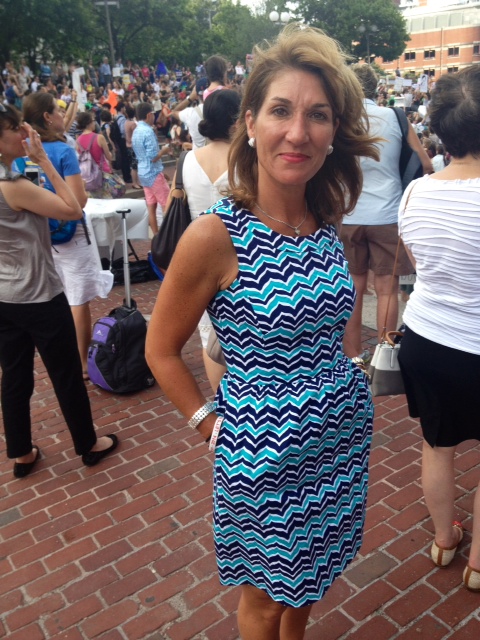
^ Charlie Baker(right) trails Martha Coakley (left) in votes but he has already won the money campaign. He had running mate Karyn Polito have on hand more money than all three Democrats combined.

—- —- —-

Recent polls of the Massachusetts governor race show that Charlie Baker and his running mate Karyn Polito have plenty of catching up to do. If Attorney General Martha Coakley becomes the Democratic nominee, as seems most likely, Baker and Polito will find themselves nine to twelve points lacking. Much of that gap represents votes now going to independents Jeff McCormack and Evan Falchuk : about 13 percent, a tally larger than the gap between Baker and Coakley. Yet there is no reason at all to suppose that all these votes would be Baker’s were the two independents not in the race.

Yesterday i analyzed the huge catching up that baker and Polito will have to do if they are to win over Martha Coakley in November. Today I will analyze the strengths of the Baker/Polito campaign. First of all is the money. Below is what the four chief governor candidates reported for the second half of june :

Baker began the month at $ 881,184.92; he raised 311,968.50o; spent 84,998; and ended the month with $ 1,108,155.42.

Baker’s running mate Karyn Polito began the month with 421,284,48; raised 123,25.62; spent 43,536.75; and ended june with 500,953.15

Add Baker’s and Polito’s ending balances together, you find $ 1,609,108.57 — a huge amount compared to numbers reported by the three Democrats :

1.Martha Coakley began mid-June with 447,673.29; raised 134,155.23′ spent 91,572.33; and ended june with 490,296.19.

2.State treasurer Seve Grossman began mid June with 896,059.85; raised 103,993.19; spent 68,156.92; and closed out with 931,897.02.

3.Don Berwick reported 199,547.55 at mid June; raised 82,343.39; spent 57,012.30; and ended with 224,878.64.

the advantages here are all to Baker and Polito, and hugely so. because :

1.The Democratic candidates for Lieutenant Governor also raised money, but i do not parse it because on the Democratic side there is no team. None of the three Democratic candidates for Governor knows who his or her running mate will be, and none can team up with either of the two whose names will be on the Primary ballot.

2.Baker alone has raised more money, and has more on hand, than either of the three Democrats. Adding in Polito’s totals, the team has far more money on hand than all three Democrats combined. these are telling figures, because all the money raised by the candidates so far comes almost exclusively from individuals, not PACs, and represent actual voter support.

Baker continues to lack in votes what he gains in donations. Nonetheless, his — and Karyn Polito’s money raising represents solid strength which, if it continues, can reach a kind of “critical mass” as voters begin to feel the issues strength of the Baker/Polito campaign. I have said all along that Baker possesses two critical advantages : first, he has an actual running team mate and can thus project to voters both how he will govern and why he will be able to govern. Second, he and Polito have amassed an independent power following, easy to assess through their donor list, with which to confront Speaker DeLeo when legislation is at issue.

This argument has not registered with many voters yet;l with most it night never register, as such. But baker and Polito can project it by way of their focus on management and innovation — a major campaign theme for Baker at least since his party’s convention back in March. Being able to get Speaker Robert DeLeo to advance the governor’s legislative agenda is no minor matter,. it’s the essence of being governor in more than name only. Governor Patrick has time and again had his legislative priorities rejected or amended almost beyond recognition; and Democratic Progressives have made no bones about being shut out of the Speaker’s agenda. If Baker — by his argument, his bio, or his vast fundraising base, or by all of these — can convince activist voters that he can move the Speaker as the three Democrats cannot, he can win this election, even though the polls right now do not show it.

He will have to regroup. The success that he seemed to have, at the beginning of June, in drawing city voters yo his side has faded. He needs to recover his city voter groove. He also needs to convince women voters that their health care concerns will be a priority for him. Polito will have to be the point person, a role that she is marvelously capable of. Indeed, if Baker wins, it will be because of Karyn Polito, both for her fundraising strength and her appeal to Worcester area voters and women generally.

—- Mike Freedberg / Here and Sphere

#MAGOV14 : THE BUFFER RULING AND THE HOBBY LOBBY DECISION


1 Baker and Coakley BG

photo (69)

^ difficult days for Charlie baker, good days for Martha Coakley and Don Berwick

—- —- —-

Two rulings handed down by the Supreme Court last week threaten to affect Massachusetts’s Governor election significantly. the boost Martha Coakley — already a clear favorite –and Don Berwick, and they set back those of Steve Grossman and Charlie Baker.

The Hobby Lobby ruling has the wider impact. Because it allows corporations to deny contraceptive health care to women on grounds of “deeply held religious faith”: — faith that permits men to obtain Viagra, by the way — it arouses all women voters : score for Coakley. but because the High Court also suggested that women could obtain contraceptive health care from the Federal government as part of Medicare, it seemed to endorse the “single payer” (Medicare) system : and that’s a score for Don Berwick, who has made adoption of “single payer a priority of his campaign.

The Buffer Zone Law ruling — it was found unconstitutional by 9 to 0 — probably impacts the campaign even more deeply. The law at issue was our state’s. Hobby Lobbys there are none here, and few corporations that would use religion as a route to denying health care to women. But every woman who seeks clinical advice on a pregnancy is now faced with being confronted by perfect strangers getting into these women’ s most personal private body business. It;s not a prospect that anyone I know would welcome. It has happened to me, on other matters. I was able to see off, with a pleasantry or an unanswerable question, these interrupters of my life. Women confronted so might not be so lucky, nor want to chance it. And even though the Buffer Zone Law ruling was unanimous, and certainly correct from a first amendment point of view — after all, as a supporter of the ruling pointed out to me, the Curt allows panhandlers to be in our faces, what’s different here ? — women affected won’t take it as such. They will feel, see, almost smell the confrontations they now must put up with, ad they can’t like that the Court put them in that space.

Martha Coakley defended the Buffer Law fiercely. She has promised to forge a different means of safeguarding women from such confrontations. So has Governor Patrick. i hope they find a way, because otherwise it means hiring hundreds of special duty police to patrol outside pregnancy clinics.

While Coakley has gone on the attack — as she should — Charlie Baker has said nothing. He has avoided the issue. I fully understand. It aggravates his weaknesses. As the GOP candidate, he heads a coalition that includes the state’s “pro life” voters, who tolerate his solid pro-choice position because they suspect that he will, at least, listen to them and will not make protection of women’s health rights a priority, and because they know that Coakley, Berwick, and Grossman will in fact make women’s health care a priority. I think these Baker voters are right, and that’s the problem; I suspect that the crucial block of women voters who will decide this election also know it.

Or, if they didn’t know it, or care much, because women’s health rights are so firmly established in Massachusetts, they do now care because even in Massachusetts those tights are now threatened by Supreme Court decisions.

Baker has not had a good two weeks. Today’s Boston Globe poll has him losing to Coakley by 40 to 31 and drawing only 9 % of Democratic voters. In Massachusetts a GOP candidate usually needs 18 to 20 %^ of Democrats to win — in his 2012 loss, Scott Brown won 12 % of Democrats. (I shall analyze the Globe poll in a separate column to come later today.) The recent WBUR poll had even les good news for Baker. It showed him losing to Coakley 42 to 28; and though it also shows him beating Steve Grossman and trouncing Don Berwick, Coakley has maintained a strong lead almost throughout this year and can only get stronger as a result of the High court rulings. Baker’s campaign has also begun to narrow its focus : business, business, business. we all like businesses; but Massachusetts is a “values” state — fortunately our values are entirely progressive ones — and for Baker to not step to the forefront of voicing Massachusetts values is to concede the election. No more can — or should — a Massachusetts election be only about business than it can be only about Labor.

When a candidate narrows his focus, retreating to his core, as did the campaign of Scott Brown in 2012 after polls turned against him, it’s a sign that he is being pushed out of the center. Baker ran a smart, aggressive, ground breaking campaign until mid-June, one that connected him city voters, voicing city voters’ concerns and turning the flank of a very suburban, high-income Democratic Primary. now that has all changed. The Democrats have taken back much of the city voter action. they’ve held Forums in the city, dug deeply into voters who have been theirs all along until for six months or so they were ignored.

Baker will still do better in the big cities than Scott Brown did. He can’t be dislodged in Essex County, and he likely has a solid core of support in Worcester. In Boston, too, he holds strong cards in several ethnic communities. But I see no sign right now that the receptivity to baker that held sway six weeks ago still rules. How can it after these two Court rulings ? For women voters, it’s now war time. And war time means, fr these women, supporting Martha Coakley, like her or not. My guess is that the Court rulings gain her two to four points — a lot in what might have been a close election.

The only person who I see with a chance to stop Coakley is Don Berwick. In a Democratic Primary, his strong advocacy of single payer now makes timely sense, compelling sense. and if he is not a woman, as is Coakley, he is trusted by Democratic activists, as Coakley is not, and addresses Massachusetts values far more eloquently than Coakley and with passion that she utterly lacks. Given that Grossman cannot out-woman Coakley or even begin to compete with Berwick’s passionate advocacy, it would mot surprise me to see Berwick win the Primary.

Could he then beat Baker ? In such a race baker would be the Coakley : the hard to pin down, long explanation, out of focus candidate — versus Berwick, the ultimate heat of passion candidate. Baker could win that comparison if he sounds wise and competent, as he usually can, and Berwick sounds like a hell-burner, as he often does.

As far as I can tell right now, this prospect is Baker’s only chance of winning the office he is so naturally fit to perform.

—- Mike Freedberg / Here and Sphere

A DISGRACEFUL SUPREME COURT DECISION

1 Ruth Ginsburg

^ Ruth Ginsburg, Dissenting justice. From her dissent, these words :  “In a decision of startling breadth, the Court holds that commercial enterprises, including corporations, along with partnerships and sole proprietorships, can opt out of any law (saving only tax laws) they judge incompatible with their sincerely held religious beliefs,” Ginsburg wrote. She said she feared that with its decision, the court had “ventured into a minefield.”

—- —- —-

On Monday, the Supreme Court, by a 5 to 4 majority, ruled that the owner of a corporation may, on the grounds of religion, deny an employee insurance coverage for contraception therapy. You may read the Court’s opinion by clicking this link :

Click to access 13-354_olp1.pdf

The link also gives Justice Ginsburg’s fervent, eloquent, definitive dissent, a dissent that I hope every American who is not lashed to the mast of orthodoxy reads, not once but often !

The decision is as black a mark on the Court’s record as any decision it has made since the early 1930s. By what theory, however arrived at, can it be lawful for an employer to interpose its boss’s religion between its employees and health insurance coverage ? A company’s employees do not sign on to an employer boss’s religion. They sign on to work a job. Even if a boss lets prospective employees know in advance of hiring that his religion will refuse the employee certain insurance coverage, he is in the wrong. By what law can he discriminate against employees who do not consent to his religion ?

That’s the basics; but it’s not the whole story of this tragic decision. Note that the coverage denied is for women’;s health care — not men’s.  That’s because in most religions, and always in the rigid religions,  men are OK and women are not. Men have rights, women have burdens.

The decision is also ironic. Who’d have guessed that the five who made this finding’s majority opinion would advise women to seek contraceptive insurance coverage from the Federal government ? As Robert Reich pointed out not an hour after I had already done so, the five justices offer women insurance through Medicare — single payer !

Which is the big, unspoken consequence of this decision. In a sense, the five justices have a point : the ACA plays into the whims and quirks of every employer that offers health insurance. The ACA made a huge mistake in not simply expanding Medicare to cover everybody — which is the system in every other first world nation — and be done with a Rube Goldberg world of employers, private insurers, health care exchanges, websites that don’t work, confusion and complication.

Should have, but didn’t, because President Obama wanted to compromise.

Compromise ? With the absolutists of religion there is no compromise. it’s their way or damnation.

The Burwell decision is a tipping point in the nation’s social history. we will now either slide backward into theocracy and all of its cruel history of torture and death — visit the 1600s some time — or we will (1) reverse the Burwell decision and (2) go single payer insurance, so that bosses with personal agendas will never again bar anyone’s door to a basic civil right : health care as doctors and all other health professionals advise it.

To get to this, we will have to elect a Democratic President in 2016, and re-elect her in 2020 — we dare not trust the Republican party of today, most of which applauds this bad decision — because only she will appoint justices who will put human rights and needs ahead of private pique and thus assure that the law equally advances the aspirations, rights, and dignity of actual human people.

—- Mike Freedberg / Here and Sphere
IN MISSISSIPPI, A GAME-CHANGING NOMINATION

Image

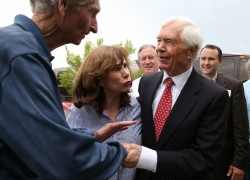
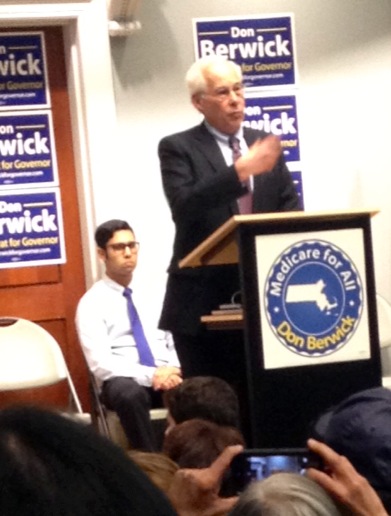
^ nominated to a 7th term, with major black voter support : Mississippi’s Thad Cochran

—- —- —–

Last night, voters in Mississippi made history. By re-nominating Senator Thad Cochran to a seventh term, in the manner and with the voters that they did it, Mississippians who voted in the Republican primary gave their Senator an entirely new coalition as well as the chance for a new term.

In the article linked below, the Washington Post’s Chris Cilizza expresses amazement that Cochran was able to bring to his side at lest 10,000 Back voters. Amazing it was; but Cilizza doesn’t mention the bigger point : Cochran now becomes the only GOP senator in the entire nation ti owe his GOP nomination significantly to Black voters. this is as big a deal as it gets.

Link to Chris Cilizza’s Washington Post column here : http://www.washingtonpost.com/blogs/the-fix/wp/2014/06/24/how-thad-cochran-won/

For almost 50 years now, and increasingly, the GOP has gotten along without important Black support. T>he party that was of Abe Lincoln, that was the home of civil rights and Black advancement — and remained significantly that right into the Richard Nixon years — has become the party almost entirely of Caucasian voters. Almost no Blacks shape its policies, its platform, its language. Almost no Black voters vote for its candidates. and thus the GOP of the last 50 years has behaved like a man with only one arm, or one leg ; doing only half the job a major political party is supposed to do; and this at a time when the other major political party, the Democrats, became the party of pretty nearly everybody.

The GOP of the last 50 years had no choice but to act by half only. As black voters left it, what remained to the GOP was what the party had to lead. A party has no choice but to begin by voicing what its core voters want. That’s how the ;party’s nominees for office are chosen. Voters who don’t participate in the choosing do nor enter that conversation.

It was that GOP, the GOP laid waste to by Thad Cochran’s victory, in which the Tuesday loser, Chris McDaniel, represented so negatively. He deserved to lose: and with the giant effort made by Cochran’s team, he did lose.

Image

^ gone for now and probably for a long time ; the politics of White voters only.

In Mississippi now, all of that has changed. How big was Black participation in yesterday;s win by Cochran over his tea Party challenger ? As Cilizza notes, voting in the 24 Mississippi counties whose vote is 50 percent Black or more rose by a full 4o percent; where in the state’;s other counties it rose only by 16 percent. The extra 7500 votes picked up by Cochran from Black Mississippians more than equalled his margin of victory.

Nearly all the Black Mississippians who assured Cochran’s victory are Democrats and will likely remain so. But for Cochran, they now have a stake in his success, and he in their participation. Big results are likely to follow. First, Cochran is likely now to become the first GOP Senator to vote for a new Voting rights act. Second, Cochran is likely to pursue the education funding, job training programs, and housing support that his Black core of supporters want. third, other GOP candidates in Mississippi are likely now to seek out the votes of those who gave Cochran his nomination : if only because if they don’t, their GOP opponents will.

Even bigger consequences may well follow. Black voters in other deeply red states may decide that they, too, need participate in a GOP primary in the states that allow open primary voting). After all, what to do ? Be let out entirely of the decision, or become the big decider ? And thus the national GOP faces huge change : because no group has a greater ability to impact a GOP nomination than Black voters, almost entirely out of the party’s loop for so long.

It was always going to be in the South — the deep South especially — that this revolution had to occur if at all. The GOP has become such a party of the South that whatever changes it there changes its direction generally; and Black voters of the deep South have the greatest numbers to bear upon the GOP. Cochran’s victory may not be replicated in other states; nothing is inevitable in politics. But the potential is there. the GOP stands at the edge of a huge revolution, which, if it happens, will utterly change — and all for the better — the entire nation’s policy future.

—- Mike Freedberg / Here and Sphere

PRIDE BECOMES FACT AS GAY BCOMES FULLY MAINSTREAM

photo (37)^ fully mainstream and fully appreciated : Mayor Marty Walsh with drag troupe on Boston Pride Day

—- —- —-

In Massachusetts at least, gay, lesbian, and transgender people — once a separate category stamped “LGBT” — have become fully mainstream. A Pride parade featuring same sex couples, lesbians on bikes, and beautiful trannys, is now a family day like any other parade. At the Salem parade yesterday I saw trannys with their parents, one pretty tranny had her nine year old daughter in tow (see the photo). Every elected official in the City was either at the parade or at the “Pride flag” raising a month ago.

It’s the same in Boston. There, Pride week featured a drag show, after which Mayor Walsh posed with the troupe for a photo op.

photo (36)

^ beautiful tranny Kelly with her proudly beaming young daughter

But the story that says it all comes from Salem. Yesterday, openly gay ward 4 City councillor David Eppley (see photo) told of how, knocking doors in last year’s city election, he introduced himself to an 80-year old lady at her door only to have that elderly woman say to him, “oh yes ! I’m voting for you. i met your husband at the polls in September !”

Just like that.

photo (38)

^ Salem City Councillor David Eppley (with Paisley Rojagato)

That gay, lesbian, and transgender people now know that they are filly accepted as neighbors, friends, partners, citizens, even elected officials, is a terrific thing for our community as a state. Because after all, people are people no matter what sort of gender or sexual preference life they lead. Gay, lesbian, and transgender people are parents, citizens, community volunteers — everything that anybody else is. And the people of Massachusetts have embraced it fully.

It seems so simple now, so obvious. But thirty years ago, for trans people, is wasn’t obvious, it wasn’t even thinkable. For gays, the same ostracism fifty years ago.

You don’t have to go back that far, though. Just ten years ago it was hugely controversial for Massachusetts to enact a marriage equality law. The spew of toxic hate leveled at gay people during that debate was sickening to see, to hear, to feel. A referendum was demanded, and only narrowly did the legislature refuse to offer one, siding with marriage equality supporters who said, correctly, that “our civil rights are not a matter of majority vote !”

Even more recently — just two, three, four years ago — an even more disgusting barrage of hate was shot at trans people testifying at the legislature’s hearings on a transgender rights law. One Kris Mineau, a name for us all to remember as we remember segregationists and anti-Semites, led a pressure group that captured the votes of 32 of 33 GOP house members in opposing the transgender rights law that was enacted. that same 32 even wrote an open letter to the Governor asking that the new law not be enforced.

The hate did not end there. this winter our state’s GOP state committee adopted a platform — the vote was reportedly 56 to 12 — affirming “traditional marriage.’ Of transgender rights, it said nothing : because the state committee does not accord trans people any such rights.

Yes, the Chairman of the state GOP, Kirsten Hughes, rejected the platform. And Charlie Baker and Karyn Polito, running for governor and lieutenant governor, have made it known in the most definite words and ways available, their full embrace, legally and otherwise, of gay, lesbian, and trans people. Yet it was depressing that Baker and Polito felt the need to do so — though clearly they did have to.

But things in this arena have changed almost day by day. Six months ago, a gay GOP candidate was thought bold simply to be openly gay. Now, Richard Tisei, running for Congress in the 6th District, posts a campaign ad featuring his husband, Bernie Starr. Tisei stole the show at Salem Go out Loud’s equality Forum on Friday night — how could he not ? And in attendance were GOP activists long known to me, men and women who would not that long ago have avoided such a venue for such a purpose.

The state’s GOP is even becoming trans friendly. It helps that there is at least one totally public trans person among its activists. I think, in fact, that the smartest GOP activists are glad to know that their ranks include a public tranny. They know that today inclusion is the dynamic, trans the thing to be — Laverne Cox of “Orange Is the New black” really has tipped the point; but this point had already been surging even without her, as drag shows become the rage — drag kids the fad — in every city, town, suburb, and burg of our state.

Gender and sexual preference remain huge issues for people living with them; but today they’re no more a matter for legal or social exclusion than a teenager’s acne or a young adult’s loss of a limb or lung. We’ve learned to live with people as they are, not just as they are supposed to be; and that’s a good thing, a very VERY good thing indeed.

—- Mike Freedberg / Here and Sphere

6TH CONGRESS DISTRICT : EQUALITY FORUM FRAMES THE ISSUE

1 John Tierhey

photo (35)

^ top : Congressman John Tierney. bottom : challenger Rich Tisei

—- —- —-

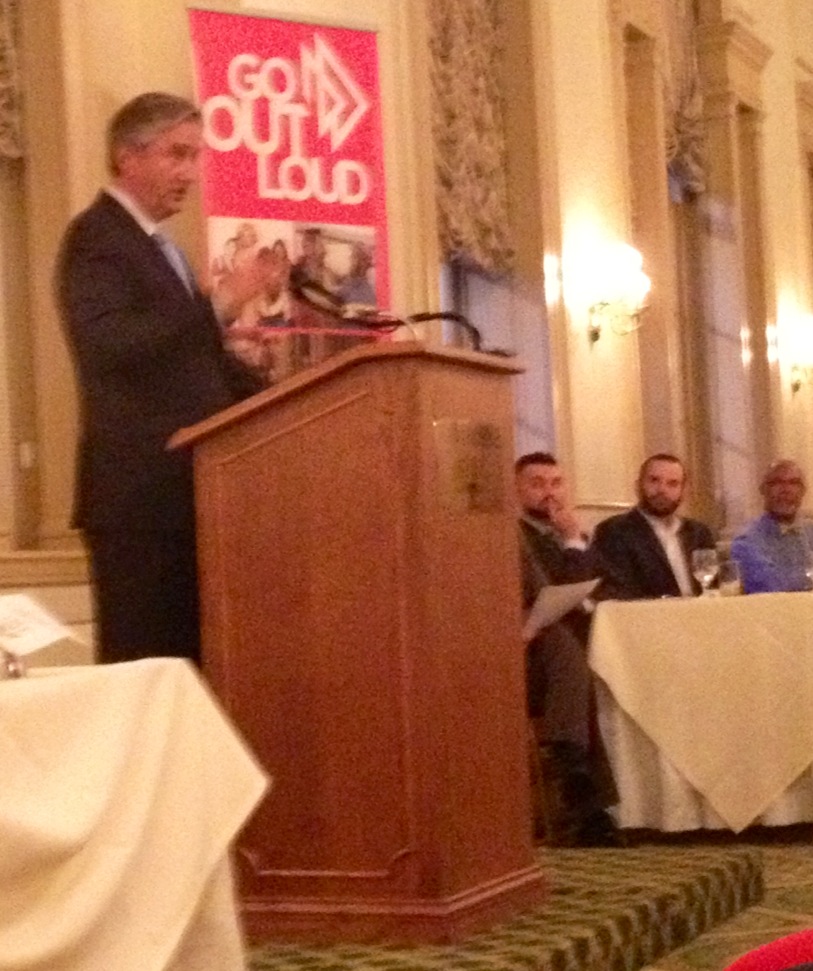
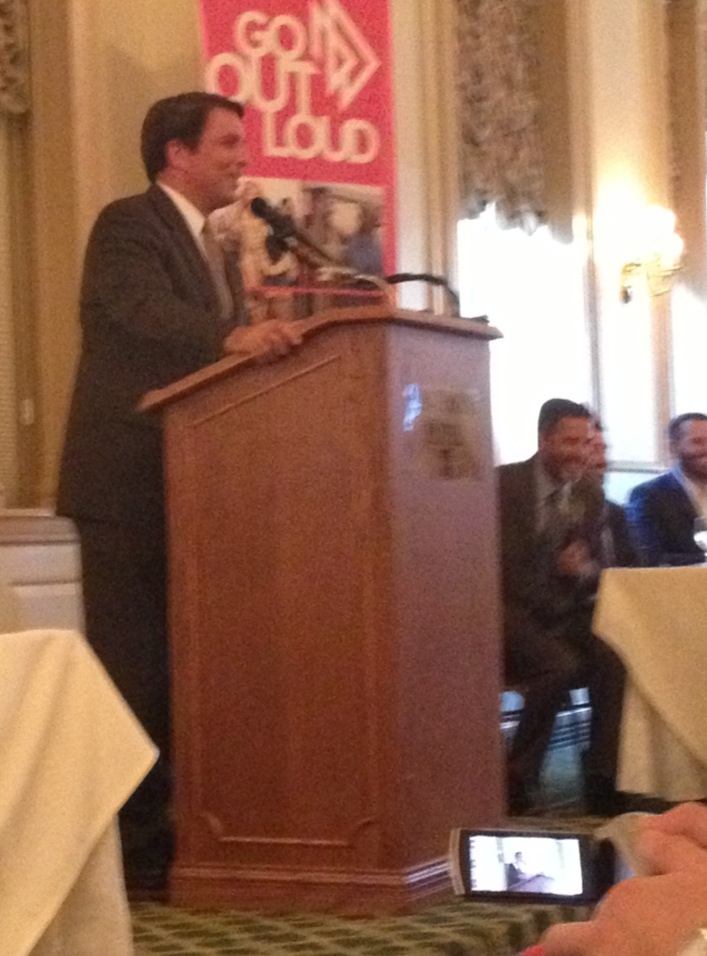
Who could have predicted, twenty years ago, that a time would come when candidates running for Congress would all appear — and be glad of it — at an issues Forum hosted by gay activists ? So it was, last night, that at the Hawthorne Hotel’s main ballroom in Salem, all five candidates seeking to represent the 6th Massachusetts District spoke their speeches and answered questions posed by Go Out Loud’s Chris Sicuranza.

Present at the table were all four Democratic primary candidates : (1) Marisa deFranco, a feisty, street-talking attorney who has gained a large reputation as an immigration lawyer and also represents many LGBT clients (2) John Devine, whom I had never met or heard of until last night and who spoke much too quietly to be heard (3) Seth Moulton, of Marblehead, the night’s most eloquent speaker by far but who, when faced with giving specific answers to Sicuranza’s questions, faded to gray; and (4) John Tierney, the nine-term Congressman, who needs no introduction and who had a bully-f0rce cheeri9\ng section on hand to applaud his succinct, authoritative remarks.

Equally present was the Republican challenger, Rich Tisei, whose 24 year career in the state legislature and Senate saw him, among other work, participating in our state’s pioneering legislation on gay and transgender rights.

Tisei had a huge advantage for a gay activist Forum: he is openly gay and married to a man who sat in the front row and of whom, as he told the full room of people, “I wouldn’t be where I am today without his love and support.”

Questions were asked of all five candidates, concerning specific gay rights legislation they would support, issues of housing and job discrimination, and the problem of homeless gay youth — homeless often because their families have rejected them. These questions were answered more or less effectively : the more effective answers came, not surprisingly, from Tierney and Tisei. Still, none of these questions had any effect on the central issue raised at the Forum by these two leading candidates :

Argued Tierney : “Yes this Congress did nothing. You want a Congress that does something ? change the majority. Don’t send Rich Tisei to Congress, because one man cannot change the GOP caucus.”

Tisei’s response : “Yes, send me to Congress because my being in the House GOP caucus changes it right there. Also my record of bipartisanship.”

Both arguments make sense. T^ierney is right : Congress will do nothing useful as long as the current GOP remains in the majority. Tisei is equally right ; putting an openly gay Congressman into the house GOP caucus DOES change the caucus irrevocably. (Note : Tisei won’t be as alone as Tierney thinks. openly gay Carl DeMaio, of San Diego, California, is sure to be elected. He leads the polls in his Congress district by ten points.)

So, which man’s argument do I choose ? It’s a terribly difficult choice. John Tierney has been an excellent Congressman, right on all the issues, tireless in attending our District,; and the troubles faced by his wife on account of her rather criminal brothers should not — must not — be held against him. On the other hand, changing the House GOP caucus seems to me a vital national mission. Our nation cannot rise to the occasion if it has one progressive political party and another that wants to regress. We need two progressive parties, differing on priorities and methods but not on the ultimate goal of a more just, inclusive, welcoming society.
Re-electing John Tierney will NOT change the majority. The GOP now controls the House by a majority of about 50. It is not likely to be ousted, now or in the forseeable future. Thus Tisei has the better practical argument : change the house GOP caucus. It’s also the more vital national mission. For the entire nation’s sake, the GOP must change — must change a lot. Only Republicans can change it.

The election of Richard Tisei is a strong start. I am glad that both he and Tierney framed the election in these terms.

— Mike Freedberg / Here and Sphere

MAGOV14 : DIVISIONS AND UNITIES SHAPING THE OUTCOME

2 Speaker DeLeo3 Cha Baker

^ allies even though neither can admit it : the two men who dominate Massachusetts state politics today : Speaker DeLeo and GOP governor candidate Charlie Baker

—- —- —-

No one should have been surprised to see Don Berwick, the most vocally progressive Democratic candidate, win 15 percent of the Democratic convention vote last Saturday. The surprise was that he won much more : a full 22 percent, only one point behind second place finisher Attorney general Martha Coakley, who leads all polls but whom activists remain skeptical of and rightly so).

Berwick now commands a solid position in the Democratic field. Fringe he may once have been seen. No longer. He continues to win power endorsements, adding State Senators Ken Donnelly and Dan Wolf to his list. Wolf would have been a leading candidate himself, had the state’s Ethics Commission not caved his candidacy (as you may recall). His endorsement of Berwick will certainly matter for the Democrats’ September primary.

Berwick is surging because Democrats of an ideological bent want to be heard and felt and listened to. Progressives, as they style themselves, see that the state’s legislative leadership — all of it Democratic — does not share their concerns or support their agenda and that that leadership has the power to snuff progressive voices out. Time and time again i have heard progressive Democrats complain — bitterly — about “the legislative leadership,’ by which, of course, they mean Speaker Robert DeLeo. Berwick is the progressives’ answer to what they see as DeLeo’s shutting them out.

The current Speaker is definitely no progressive. His constituency is business. That and traditional labor, but business first of all. It’s about the money. Business interests have the ear of Speaker DeLeo — a fact he does not try to hide. As such, he is no friend of tax increases; when Governor Patrick last year called for $ 2 billion in new revenue for his Transportation Bill, the DeLeo-led House gave him $ 500 million, and that grudgingly.

That said, DeLeo’s business friendly agenda is no departure at all from the priorities of past speakers who, if anything, have been even more conservative than he.

In a state as Democratic voting as Massachusetts, business interests cannot afford to be exclusively, even primarily, Republican. Business has huge money to spend on lobbying its agendas, and it does so. Almost always, these past 25 years, business lobbying has dominated both the governor and the Speaker — the State’s two most powerful elected offices. In few states, if any, does the partnership between state government and local business go this far this successfully. Significantly that’s because a large portion of the state’s well-paying jobs, in building trades, health care, and education, arise from state government funds and legislation. In Massachusetts, the interests of business coincide with the interests of a great many wage earners and salaried people, and these people dominate the ranks of our state’s political activists. it’s no surprise at all that the current Democratic governor campaign has concentrated on the upper income suburbs of Boston and on the City’s highest income wards.

Unfortunately for Speaker deLeo, the state’s high-income voters (and some of its businesses are not uniformly as tax-skeptical as he is. Our state’s Progressives inhabit primarily the upper income city wards and suburbs. as such, now that they have hit upon the Governor primary as a vehicle to make themselves seriously felt, Democratic progressives have managed, with Don Berwick, to seriously inconvenience the Speaker and his very powerful legislative and lobbying allies. most of these would, I suspect, like to see Steve Grossman the Democratic nominee. They know him and they believe they can bring him to their side. In this they aren’t wrong. Grossman talks “job creator’ talk so aggressively you’d think he was Mitt Romney.

Yet even Grossman now calls himself “the progressive job creator.’ Obviously he sees himself being gouged from the left.

the division between the DeLeo constituency and the Progressives is causing big problems for Martha Cockney. Who, exactly, are her voters ? certainly not the progressives; almost certainly not the DeLeo people. as i see it, her voters are the non-involved, people who know her name and he work as Attorney General and not much else. Will that work in a Primary, in which the involved vote big time, the less involved not so much ? maybe so; because Coakley is the only woman in the race, and she polls very strongly with women voters. But we will see.

Meanwhile, as the Democrats split between progressives and DeLeo-ites, Charlie Baker is presenting a campaign perfectly attuned to alliance with DeLeo on business interests and also with DeLeo on labor issues. it is axiomatic in Massachusetts that only a Republican governor has a power base independent enough to face the Speaker on equal terms. the Progressives tally about 25 to 33 percent of Democrats, maybe 15-20 percent of all voters; much less than Charlie Baker’s 30-32 percent core.) Beyond the axiomatic, however, is baker’s current campaign, in which support for a $ 10.50 minimum age — the nation’s highest — is accompanied by expanding the earned income tax credit and initiating some tax credits to corporations for hiring welfare recipients and offsets to the wage hike. if you read Baker’s plan — see the link below ** — you’ll find it remarkably like what Speaker deLeo wants to enact. What is more, baker is having success bringing city voters to his side, communities of color included and several ethnic communities. He’s doing it in Boston and in Worcester and in Lynn, next door to his home town of Swampscott. Baker’;s Lynn campaign has drawn no media attention at all, but recently he has held several Lynn rallies at which hundreds of folks — mostly communities of color and immigrants — have gathered. Lynn is usually a 7500 vote victory for a democrat. I think Baker will carry Lynn this time. A 7500 vote turn around isn’t that big, but it is significant of Baker’s concentration upon Essex County generally : his home base, and one that he is pushing hard to win, as he probably must.

** Link to Charlie baker’s economic plan : https://charliebaker2014.com/opportunity

Some Democrats want to compare baker’s campaign to that of Scott Brown in 2012. The comparison is false. The Baker campaign is sui generis and quite ground breaking ion its unification of many voter groups who have much in common that has not been attended to by our state;s governor campaigns since at least 1994 if ever. While the Democrats split, the baker campaign unifies. i suspect that Speaker DeLeo is quite happy to see it. Nov ember’s result is beginning to take shape.

—- Mike Freedberg / here and Sphere

MAGOV14 : THE DEMOCRATS CHOOSE STEVE GROSSMAN. BUT…

photo (34)

^ Democratic convention nominee Steve Grossman chats up legendary Charlestown pol Gerard Doherty on Union Street, at Bunker Hill Day parade

—- —- —

On Saturday Democratic activists made their choice for our state’s next governor emphatically known. They want Steve Grossman.

Grossman, who currently serves as state Treasurer, won about 35 % of delegate votes. His nearest rival, Attorney General Martha Coakley — once thought the front runner — received only 23 % of votes, barely edging Don Berwick, who won 22 %. Juliette Kayyem, my pick, won 12 %, Joe Avellone 7 %.

The delegates were not rong to favor Steve Grossman. He is well prepared, has every issue at his immediate command, articulates the details in easily understood sentences. He has a long history as Democratic activist, an even longer history operating a family business, understands jobs and economic priorities. Other things being equal, he would be a very strong governor.

But other things are not equal.

First, the real governor of Massachusetts is the Speaker of the House, currently Robert DeLeo. What DeLeo wants for legislation, gets enacted. what he does not want, does not get enacted. time and time again he — like his predecessors — has shown Governor Patrick who the real power is in the State House.

Second, Democratic legislators — there are 130 of these — do not like to be out in a vise between the Democratic Speaker and a Democratic governor. Much easier for them to work with a GOP governor, because then the Democratic party’s State House power is concentrated on the Speaker, and all can follow his lead, unpressured by a Democratic governor’s competing constituency.

The one requirement, for this scenario to work, is that the GOP candidate for governor be credible, as a leader, as a politician, as a vote getter. Charlie Baker this time around is proving himself that and more. He is, simply put, running the most voter-appealing, solid outreach campaign — to big city neighborhoods especially — that I’ve seen from our GOP at least since 1998, the year that gave us the late Paul Cellucci.

Baker has also raised a vital issue : major reform of the state’s technology. Almost every branch of state government needs it. Technological obsolescence is one big reason why DCF, for egregious example, has failed. Baker also supports the $ 10.50 – $ 11.00 minimum wage raise up, with significant add ons that will help low-income families and small businesses too. I’ve seen nothing like it from any of the Democratic governor hopefuls.

This is a fact that even Steve Grossman cannot compete with. For all his command of issues and all of his solid ties to Democratic activists, he still represents division, not unity, in the State House. And unlike Deval Patrick, he is not Black, or an outsider, and doesn’t move the heart of civil rights activists from Salem to Pittsfield and everywhere in between.

Only a GOP governor has an independent power base, in the 63 % of Massachusetts voters who aren’t Democrats, sufficiently large to force the Speaker to deal. This too is a fact. it is the single most important fact in choosing a Massachusetts governor. Right now, my money says that Charlie Baker will win in November by 52 % to 48 %. the polls point to that result as well.

Let the game begin for real.

—- Mike Freedberg / Here and Sphere