#MAGOV : AN OPEN LETTER TO MARK FISHER

On Thursday I received a letter from the “Committee to Elect Fisher for Governor.” Since I am Here and Sphere’s politics reporter, I had heard of Mr. Fisher — had surfed his facebook page, in fact, and not favorably. I wondered why he would be writing to me. I read his letter. Half way through it, I was moved to answer him. As I read to its end, I found in it truly serious questions about what our politics is all about and thus decided to answer him by what political people call an “open letter.”

“Dear Candidate Fisher :

“You write me because of my ‘service to the Republican Party,” for which I thank you. I am, as you note, a registered Republican, as were four generations of my forbears. The Republican party meant something to my Dad, Grand Dad, and Great Grand-Dad, and it has meant something to me since I first became active just out of college. I thus looked in your letter for some commitment on your part to what it has meant to us. I found none. What I did find, I reject.

“You say that you were moved to run for Governor because Governor Patrick “re-opened the tolls on the western part of the Mass Pike.” You then say that “tolls are great for only…Patronage,’ and you decry the men and women who work as toll collectors.

“A candidacy that starts by denigrating people who work is a strange candidacy. Toll collectors work hard under sometimes horrible weather conditions and at all hours. If they earn an average of $ 76,000 a year, as you write, that is hardly a king’s ransom ; but it is enough for them to participate in the consumer economy that keeps our economy — and their family’s lives — moving forward.

“You also miss the larger needs that the resumed tolls address. Our state’s roads and bridges badly need repair, and our public transit facilities break down all the time for lack of money to maintain them, much less upgrade them.

“You talk about ‘conservative values.’ I’m not sure what ‘conservative’ means any more, but on your facebook page you cite several agendas which defame whatever defensible adjective you want to ascribe to them.

“You would deny to women control over thrir own bodies and health care, something that neither you nor I have any right to do and a contravention of the policy of every Republican Governor this State has had in my lifetime.

“You want gay and transgemder people to not have the full civil rights that all citizens are entitled to and which the Republican party was created to fight for. Your position is an affront to all people of good will and incompatible with a Republican nomination for any office.

“You talk about ‘gun rights.’ Such talk was offensive long before Columbine, Aurora, and Newtown, not to mention George Zimmerman. To talk of ‘gun rights’ now is to pit yourself against the entire society which your candidacy seeks to govern. Mr. Fisher, guns HAVE no rights. people have rights. And our society has the right to be free of individuals with loaded guns putting everyone in fear and worse — for what ?

“You dehumanize the people you call “illegal immigrants.” you say they cost the state almost two billion dollars. Mr. Fisher, that’s just wrong. As Jeb Bush — a Republkican — said at this year’s CPAC conference, ‘undocumnted immigrants are a boon to the economy. and because of their young demographic, they’re also how we rescue Social security.’

“Mr. Fisher, undocumented workers pay more in taxes in one year, every year, than Mitt Romney has paid in his entire lifetime. Do you have any idea what the life of most undocumented peope is like ? I have seen them standing outside in summer or the cold, at dawn every day, across from Home Depot in my city, hoping to be hired for a day’s pay. Undocumented people — and immigrants similar — take the subway to work at 5 AM, working at the toilet-cleaning and janitor jobs, in office buildings hospitals hotels and universities, for pay that until recently was minimum wage. Yet you decry these people ? Mr. Fisher, they are heroes.

“Reading what you think of the least among us, do you have the slightest idea what is entailed in governing the 6,000,000-plus people who live in Massachusetts ? The Governor  has to administer our roads, bridges, transit system; to maintain our clean water and environmental quality; to assure a strong public school curriculum; to operate the State’s parks, beaches, courts, district attorneys, prisons, half-way houses, career retraining centers, welfare offices, retirement, veterans affairs, and a variety of administrative agencies, licensing divisions, tax collection, and more. All of these exist because in our extremely complex, diverse, and changing society that we call Massachusetts, capable administration keeps our intricately adjustable State moving forward with as little friction or confusion as human capabilities reasonably manage.

“I read nothing, in all your campaign talk, of any plans to improve, reform, or add to any of these Governor’s responsibilities; indeed, nothing of any of the public policy issues that activists everywhere are discussing and proposing. All the other Governor candidates who I am following have plenty of policy suggestions : where are yours ?

“I can only conclude that your candidacy isn’t about us, the 6,000,000 and more. It’s about you. It is ALL about you. As you say near the end of your letter, “in the past I would vote and then complain.” But “my circumstances have now changed.”

I, I, my, me, and mine ! Mr. Fisher, I hate to tell you, but being Governor is NOT about you. It”s about everyone, diversely, equally respected and all of us together.

Sinerely, Michael Freedberg / Here and Sphere

#MAGOV : A SURGE OF ROMEOS FOR JULIETTE

Image

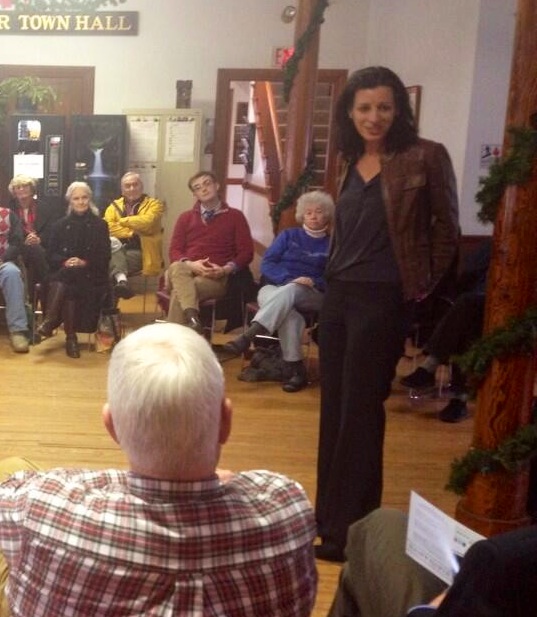
^ much love for Juliette : Kayyem speaks to Democratic activists in Barnstable last Sunday

—- —- —-

In the parlance of now, there is much love afoot for Juliette Kayyem, one of five Democrats exerting to be that party’s nominee for Governor of Massachusetts. At 10.24 AM on this December 13, 2013 morning, Kayyem has gained 1,089 twitter followers since I first checked the numbers on November 10th. No rival compares. Don Berwick has added 374; Steve Grossman, 194; Martha Coakley, about 600; Joe Avellone, 67. (On the Republican side, Charlie Baker has added 307 followers, while Tea Party Mark Fisher’s newly posted twitter account has 36 followers.)

Kayyem’s total twitter following stands at 5,321 ; about 1600 behind Grossman’s and way behind Coakley’s 12,400 ; but she already tops Baker’s 4,311 and Berwick’s 2,203. As for her presence on facebook, Kayyem trails the “big’ names, yes ; Charlie baker has 32,317 “Likes”; Martha Coakley, 19,193. But Kayyem’s 3,469 isn’t far from Steve Grossman’s 5,520 and leads both Don Berwick’s 2,011 and Mark Fisher’s 1,367. Adding these numbers up, Kayyem has risen to the top of the “second tier” already. So what is going on, that has produced slo many Romeos for this Juliette on our State’s 2014 political scene ?

Charisma first. You need only look at her pictures to see that she connects to people. She leans forward to them, not back away or ramrod straight. She’s casual, even slangy, gets the humor on the net and gives it back. She casts better as the candidate of “now” than any of her rivals — only Charlie Baker has a similar degree of “now”-ness.

Second, her issues and how she addresses them. Of course no one should expect a candidate to accomplish, if elected, what he or she proposes in a campaign ; government isn’t that simple (witness Mayor-elect Marty Walsh’s back-walking his “overhaul the BRA” proposals). But you can tell a lot about how a candidate will approach the office he or she seeks by the temper and content of his or her campaign proposals. Here’s what Kayyem’s website says about “reforming the Criminal justice system” — as pressing a need as there is in State governance right now :

Massachusetts cannot continue to imprison more and more of our citizens at an ever increasing cost. This trend is not fiscally sustainable, it often doesn’t make sense from a law enforcement perspective, and it does not reflect the kind of Massachusetts we want to be. Juliette will make sure that our criminal justice system becomes more evidence based and less wasteful; more rehabilitative and less purely punitive; and, perhaps most importantly, more focused on integrating those who have served their time back into society as productive citizens rather than ignoring their problems once they leave a correctional facility. In order for the Commonwealth to seize the opportunities of the future and build inclusive and productive communities, we must do better when it comes to our criminal justice system.”

Then there’s health care, a huge issue nationally and thus one that we in Massachusetts also talk about, even though for us universal health care has been a given for almost a decade. Kayyem says this :

Massachusetts is a national leader in ensuring that all residents have access to quality, affordable healthcare. As governor, Juliette will work to: Continue to bring technological advancements to Massachusetts’ health care system that will bring the cost of health care down while improving service; and Reduce health disparities in the Bay State’s underprivileged communities.”

Note that last sentence. How many candidates these days for high office ever talk about the difficulties faced by people living in poverty ?

Don Berwick, who is a doctor, confronts the health needs of poor people at least as directly as Kayyem; on other issues of fairness and civil rights he stands, ahead of what Kayyem has published so far. But from the huge love now being accorded Kayyem online — and the immense schedule of meet and greet events with activists that she is pursuing, all of them drawing large crowds — one has to conclude that in person, Kayyem persuades that she — the person she is — will be most able, as Governor, to do what she talks of. One need only ask the large crowds who have recently met her up close in Melrose, Brewster, Franklin, Barnstable, Worcester, and, especially, at the “JPProgressives’ candidates’ night at Doyle’s Cafe in Jamaica plain.

Or perhaps it’s the “Elizabeth Warren” effect ? Until recently, Massachusetts voters had hardly ever elected a woman to high office. Then came Senator Warren, and now Congresswoman Katherine Clark — the State’s third female Congress member. Massachusetts Democrats, at least, are acting like converts do : once seeing the light, they become more than merely enlightened; they become apostles. It helps that, in Kayyem, they have a candidate with a resume and education approaching Warren’s. Especially is Kayyem the object of a ton of Romeos in contrast to the dry and reticent Martha Coakley, the memory of whose befuddled 2009 US Senate campaign has hardly dimmed at all and whose current campaign for Governor hasn’t generated much better.

If you haven’t yet paid much attention to Juliette Kayyem — or to the race for Governor in general — it’s time now to do so. The Democratic party caucuses begin in less than two months. The Republican meetings follow soon after.

NEXT FOR #MAGOV : the mid-December OCPF fund-raising and expenses report

—- Michael Freedberg / Here and Sphere
#BOSPOLI : A SILLY KERFUFFLE

Image

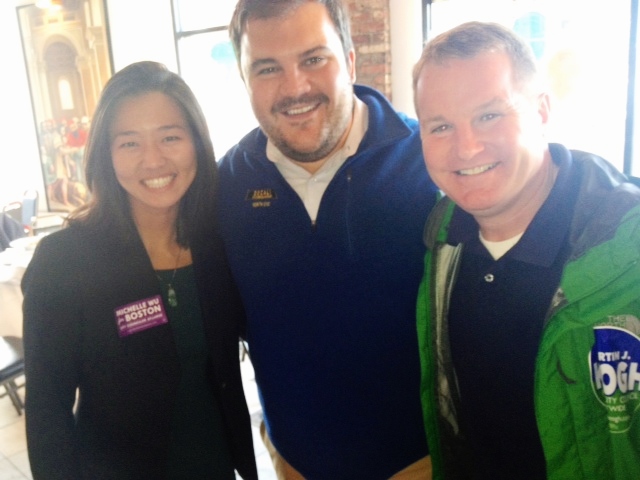
^ a Councillor, not a Don Quixote ; Michelle Wu (with Philip Frattaroli and Marty Keogh at the Frattaroli family’s post-Columbus Day Parade reception

—- —- —-

There’s much flap going around now,as silly a brouhaha as I’ve observed in this entire Boston campaign cycle, including an op-ed by my old Boston Phoenix colleague Yvonne Abraham, to the effect that Councillor-elect Michelle Wu shouldn’t vote for Bill Linehan as the new Council President.. Supposedly she should vote for a Councillor who “shares her agenda.” Today’s Globe quotes several persons, described as “progressives,’ who promise not to support Wu for re-election if she votes for Linehan. This is zealotry of the Tea Party kind, to which the Left, as we’ve seen in the past, is hardly immune. One quoted voice even says that “Unless (Wu) changes her mind…she’s a one-term city councillor.”

This is rubbish. It’s also as silly as a political kerfuffle can be. Boston’;s City Council has no power that the mayor doesn’t want it to have. It can propose, it can debate, it can re-arrange the musical chairs by which Council Committee chairmen are chosen; but it can’t do a damned thing of significant importance without the Mayor thumbing up.

Sure, individual Councillors can have an independent impact, if they’re willing to get frozen out by the Mayor. John Connolly pursued an independent course. Others have done so. But when the chips are on the table, and the Mayor’s agenda is at stake, you will no more find a majority of the 13 Councillors opposing than you’ll find a sting ray in your briefcase on Christmas eve.

So what’s the big deal here ? Let’s try a little political reality, for a change, and lose the ideological version of cgi-created film monsters.

The rule governing voting for Council President has long been : “vote for the weakest.”

In this case ( 1 ) Bill Linehan is no threat to run for Mayor against Marty Walsh ( 2 ) ramping up either Tito Jackson or Matt O’Malley to Council President — both of whom want the honorific — would be a threat and ( 3 ) ramping either man up to Council President would impede the 2017 (or 2021) mayor race plans of the REAL potential candidate of significance. (It’s Jackson’s and O’Malley’s very strength as Councillors that make them musts-to-avoid as Council President. Get my meaning ?)

Image
^ Matt O’Malley of Council District 6 : his record-breaking vote makes him unelectable as a Council President

Most important, Linehan has no base at all independent of Mayor-elect Walsh’s core support and thus has no power to oppose him on any item of import.

THAT is how Council Presidents are chosen. Stupid indeed is the newly elected Councillor who bucks that reality; and Michelle Wu is far from stupid. I applaud her acumen in this matter.

As for being re-elected, Wu’s husband notes that even if you subtract her entire vote from wards 4, 5, 11, and 19 she still won by 14,000 votes. This is an apt subtraction, because 2015 will be a Council-only election, and in these, the voters of Wards 4, 5, and 11 turn out far fewer voters than they do in a Mayoral election. Wu’s re-election will be decided in Wards 20, 18, 2, 16, and 17, and of course also in Chinatown’s Ward 3 Precinct 7. All of these feature constituencies very different from the wards identified with Tea Party Leftism or comfortable urban reform. And you know what else ? Wards 4, 5, 11, and 19 contain plenty of voters who aren’t Tea-Left. Of the 15,000 or so voters who will likely turn out in 2015 in those four wards, Wu will comfortably win at least one-third — probably more. She may slip from second to third or even fourth (though I doubt that); but re-elected she surely will be, assuming that she does the job of city-wide Councillor in painstaking daily detail. Which I have no doubt at all she will do.

— Michael Freedberg / Here and Sphere
BOSTON SCHOOLS : THE SOUND OF ONE HAND CLAPPING

photo (19)

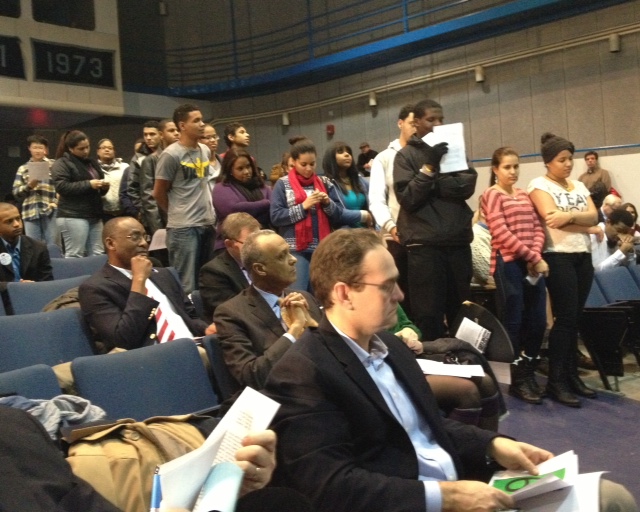
^ Boston public school students lined up to testify and support the issues on order at Mayor-elect Walsh’s education Hearing

—- —- —-

Last night Mayor-elect Walsh’s Transition team held its Education Public Hearing, at English High school in Jamaica Plain. For two hours, from 5.30 Pm to 7.30, three of Walsh’s Transition Team menbers, including his Education Team chairman, John Barros, heard testimony from at least fifty witnesses. Students, school parents, teachers, advocates all spoke.

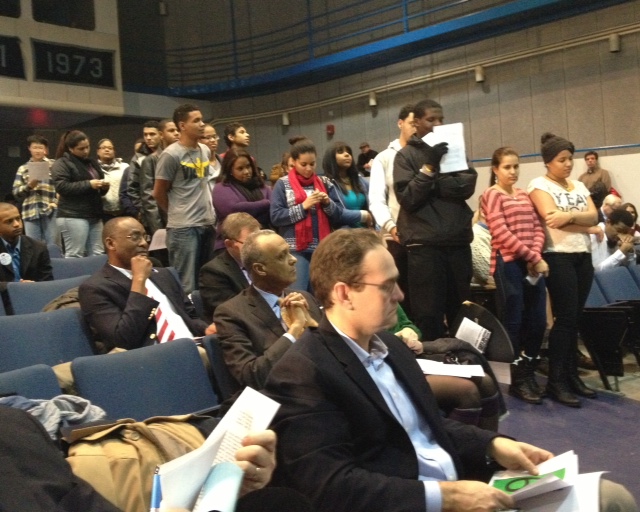
Less people attended than came to the previous night’s education rally held by Boston Truth. There were at least a hundred vacant seats at English high’s auditorium. listening to the testimony, it was easy to tell why. With hardly any exceptions — more on these later — every witness said basically the same thing : more funding for public schools, downplay charter schools. It was the sound of one hand clapping.

photo (19)

^ plenty of vacant seats : the elephant wasn’t in the room

There isn’t much to learn from a soundless sound and hardly much more from hearing the same message repeated again and again, with only the age, gender, or skin color of the speakers differing (and these aren’t policy matters, although identity issues were raised by some of the witnesses).

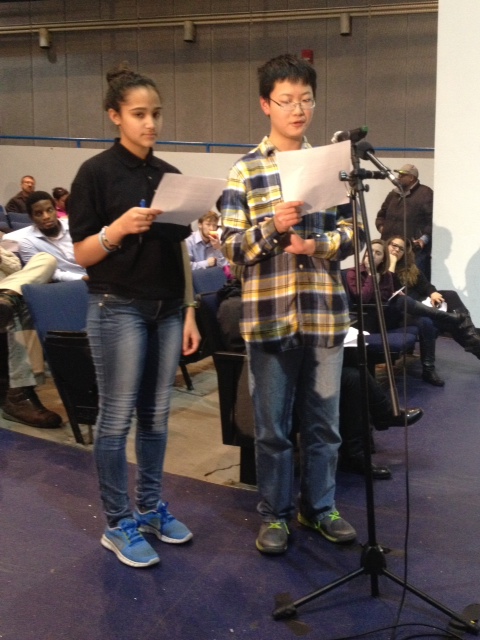
photo (17)^ Boston Latin student (and Student Advisory Council President) testifying against charter schools and thus, basically, that there shouldn’t be any additional Boston Latin schools. “Making history,” wrote one activist about my post of this photo 🙂

It was especially odd — unsettling, too — to hear the students who testified. How does a 17-year old Boston Latin student — smart, yes; Chairman of the Studernt advisory Group; but — acquire an interest in curbing the number or funding of charter schools ? Did he learn his view in debate at school ? Was he coached to his position ? Quite possibly, because he read his testimony from a prepared statement. I found his testimony manipulative. Contradictory, too ; after all, Boston Latin, the City’s totally competitive exam-entry school, is the ultimate “charter” school. Was he really telling us, not that charter schools are bad, but that Boston Latin doesn’t like having its exceptionalism duplicated ?

photo (21)

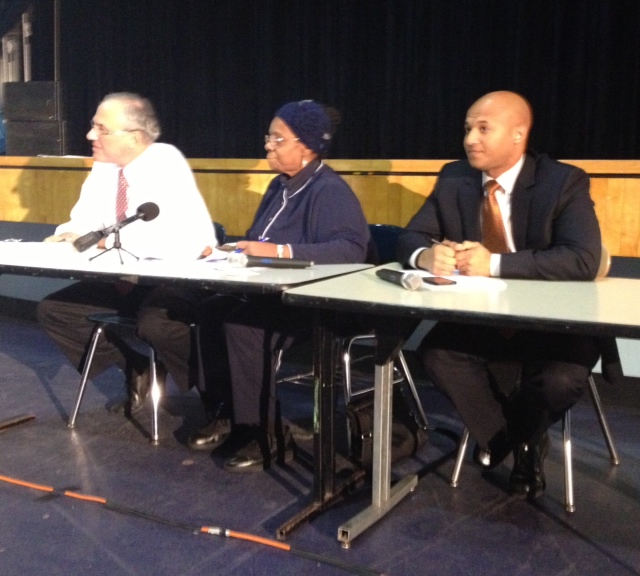
^ respectful : Education Transition team members George Perry, Jen Robinson, and John Barros (Team Chairman)

The Transition Team members, George Perry, Jen Robinson, and John Barros, listened respectfully to all. Barros, at least, knows all these issues masterfully. At numerous Mayoral Forums during his candidacy for the office he heard, and responded to, all manner of school reform agendas. Last night surely tried his patience. At times I saw a bored look in his eyes. Did he really need to hear the applause given the various witnesses — the louder, the more in agreement — by the Hearing’s audience, heavy with Boston Teachers Union members (including its President, Richard Stutman, and its organizer, Jessica Tang, who testified) and Boston Truth activists, in order to get the evening’s message ?

photo (16)

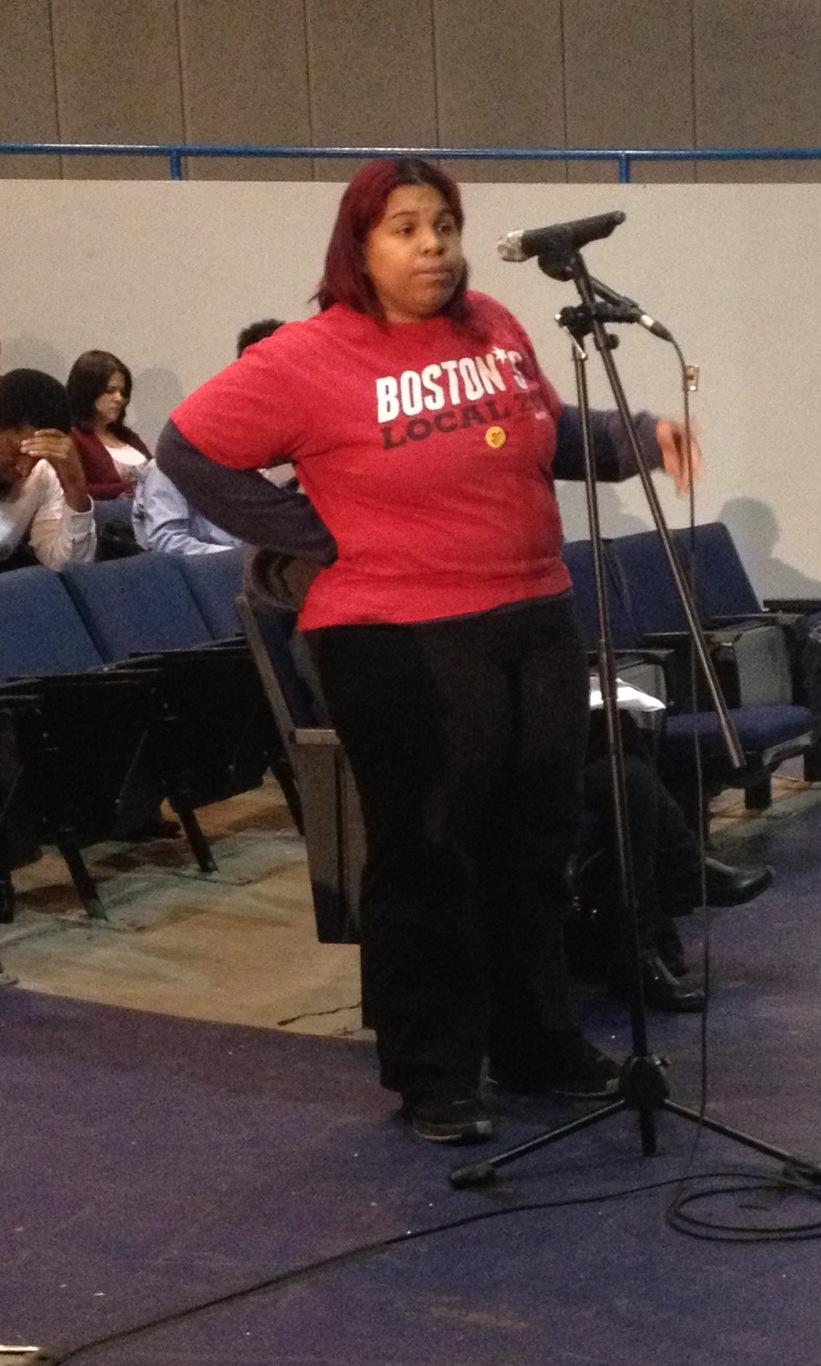
^ “I’m a Boston public school parent,” she said, and told of her difficulties getting her child properly assigned to a school convenient to her home. I wondered : Hadn’t she asked Councillor Connolly to help with that — as did so many Boston school parents ? Then I noticed her LOCAL 26 T shirt…

Fortunately for those who might have expected the incoming Mayor’s Education Team to hear a diversity of views rather than a one-hand clap, a few witnesses did offer opinions credibly their own. Jason Williams, an executive with of Stand for Children, hoped that Mayor-elect Walsh would continue his commitment to charter schools, noting that as a legislator, Walsh worked to increase their number. Applause ? None. Another witness, who said that he was a Boston Harbor captain, suggested that BPS should offer 6th grade students a course with sailing experience. Applause ? A few. Karen Kast, organizer of Boston Truth, challenged Mayor-elect Walsh to keep his campaign promises. Aplause ? plenty.

Most interestingly, Mary Pierce, who heads a special eduaction advocacy group, voiced her personal experience of frustrations dealing with Boston School Department administration. This was risky territory : reform of Boston Schools administration was a centerpiece of John Connolly’s education agenda. A door was opened — a bit; but the moment passed.

Sometimes the elephant is in the room; sometimes he is not in the room. John Connolly was the elephant not in the room. Other than Jason Williams, there likely wasn’t a single person testifying (or applauding) who on November 5th stood with Connolly’s 48.5 % of the vote.

Education became a key issue in the campaign entirely because John Connolly made it so. Most of the other candidates would gladly have left it aside — Walsh too — to be dealt with at the State House. Connolly made sure that Boston schools would be front and center — the decider — on election day. The major effort now being assembled by the Boston Teachers union and its allies, to push the schools reform agenda in its direction, would likely not be taking place had John Connolly not forced school reform sharply, radically forward.

This history makes many people wonder why the Mayor-elect even bothered to have an Education Hearing last night. As I was preparing to write this column, I found on my facebook page the following comment (excerpts follow) by friend Lisa Moellman :

“At 5:30 on a school night, just before Christmas — thry are stacked so that BTU representation/agenda dominates. picking up and feeding kids, holiday commitments prevent so many parents from participati9ng. Why would Walsh hold these important forums…at a difficult hour….? Why not the first weeks of January when actual diversity of participation could happen ?”

Why, indeed ? Myself, I think it’s public relations — Walsh’s showing the voters (and the media) that “he will listen to the people.” Nothing more, nothing less. Education is an issue that Walsh wants to put aside as much as possible ; to hand over to whichever poor sucker accepts becoming his new School superintendent, so that Marty can get on with his first priority : keeping the Boston Building boom alive and expanding, so that his building trades workers — including the many new hires that he will insist upon — can keep on earning hefty pay checks.

As for public schools and charter schools, compared to the issue debate that took place the prior evening at Boston Truth’s gathering, and much more so at every Mayoral Forum during the campaign, last night was a complete waste of auditorium heating oil.

—- Michael Freedberg / Here and Sphere

UPDATE at 3.11 PM 12/11/13 : am informed that during the 20 minutes prior to my arrival at the Hearing at 5.50 PM, other opinions, including from representatives of charter schools, were given. These sure didn’t last long. Still, it’s good to know that the Hearing wasn’t completely one thing. — MF

BOSTON SCHOOLS : ASSERTIONS AT BOSTON TRUTH

Image

^ “Reclaiming the Promise” table discussions at Boston tTruth’s schools-reform meeting last night

—- —- —

Truth is a risky word for an organization to name itself. Who knows the truth ? At best we can approximate — maybe. So there I was, last night, at Madison Park High school, where a new “Boston Truth” coalition, with at least 200 people on hand — held its first “discussion session” on how to achieve its stated objectives as set forth in a four-page brochure from which I will quote from time to time as I write this report.

200 people meeting on a wintry night made an impressive beginning. As one of “Boston Truth”s key organizers is a dear friend, I was glad for her, proud of her part in the accomplishment. On hand were many Boston Teachers Union activists, students, retired teachers, union organizers, some members of the press, and two political figures at least : Eric Esteves of the Boston NAACP, who intends a candidacy for State representative from the 7th Suffolk District (in which the meeting was held), and Marty Keogh, who ran for Boston City Council this year and finished seventh.

The meeting began with several public school students advocating — from scripts provided them — one or other of Boston Truth’s stated goals. “Public schools are public institutions,” for example; “Our voices matter,” spoke another. A third pupil recited : “strong public schools create strong communities.”

It seemed odd to watch students speaking mission statements scripted, but there they were. They very much enjoyed themselves. One after another they spoke, were applauded; then all took stage together, holding their placards, applauded by all, photos snapped.

The meeting divided into discussion groups of six or seven to a table; I joined the group that included Marty Keogh — he seemed the most likely to say something quotable. This proved not easy to get to, however; it wasn’t made clear what we were to discuss, or what conclusions our “discussion group” was to come to — there wasn’t an agenda, and the table monitor of my group did not impose one. People were reluctant to speak. Two women offered school-parent and teacher experiences; everyone asserted approval of the brochure’s goals. We were getting nowhere fast.

So I decided to speak up. “There isn’t a thing in these stated goals that anybody would disagree with,” I said. “What the City is arguing about right now is, how do we get there ?” A lady sitting two to my right responded. “We need equity,’ she said. “Schools shouldn’t have to compete against one another.”

“In that case,” I asked her, “How are parents to tell if their kids are receiving the education they need ?”

“Oh they can tell,” the lady answered me. “they get a feel for what the climate is. A rigorous curriculum. Parents can tell.”

In other words, parents DO judge schlools competitively.

I then opined that (1) the biggest issue facing schools — the acculuration that kids receive, or don’t receive, at home — is beyond the power of any school to control and (2) one way to encourage the parents of school age kids to focus on home preparation is to have strong PTAs — these were Boston Schools’ glory, back 50 years ago : now, hardly at all. At this assertion Marty Keogh finally spoke up and spoke well : “school assignment designations need to change,” said Keogh. “You can’t have a PTA if kids are transported all, over the city, parents can’t drive such distances to do PTA. Need neighborhood schools !”

Keogh even addressed the issue whence arises school competition — exactly as I had hoped. “Testing ? Yes, testing,” he said. “we need some way of deciding if a school is performing.” He and I discussed the matter — we were getting somewhere, at last.

Image

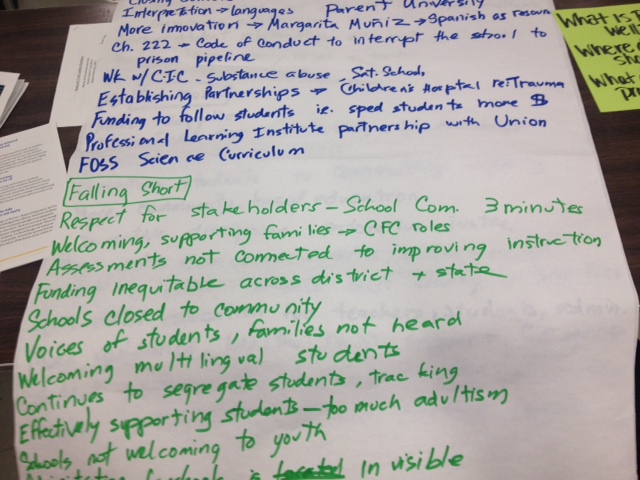
^ agenda scripts at Boston Truth schools-reform rally last night

Other than Keogh’s unscripted discussion, the meeting, as far as I could tell, dedicated almost all of its words and energy to assertion, not discussion. it was more a rally of the already convinced than a session for persuasion. Everywhere in the room were “BTU” campaign buttions, BTU literature, workers’ rights handouts, organizing fliers. That’s fine if you treat school reform issues as a job action, not a policy debate. But a job action will not do anything to move the debate toward even a partial consensus. It doesn’t seem to me, from last night’s talk, that the BTU, especially, has moved one inch off its insistence on its own program of school future: no competition among schools, no change in evaluation systems, no change in work rules, less testing of kids, of teachers, of principals; and full funding for all schools regardless. All it has done is to gain allies, mostly from union organizings and union-friendly school parents.

Tonight Mayor-elect Marty Walsh holds HIS Schools reform town hall meeting, at English High School in Jamaica Plain. it will be interesting to hear what his transition task force on eduaction has in mind that can move the discussion beyond stand-pat.

— Michael Freedberg / Here and Sphere
Image

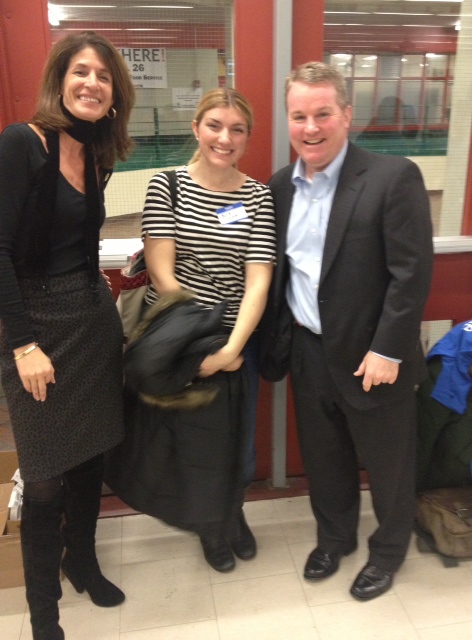
^ Marty Keogh spoke well, indeed, best in show. (with Angela Cristiani and Jacqui davis)

TOWARD A REALITY ECONOMY : MINIMUM WAGE HIKE — AND MORE

Image

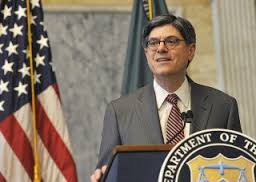
^ new regulations governing big bank trading almost in place : Treasury Secretary Jacob Lew announcing

—- —- —-

Twice, since Here and Sphere’s inception last May, we have editorialized in favor of raising the legal minimum wage. To those editorials I refer you, if you’re interested : you’ll find them in our Archives section. Today, however, I want to expand upon the economic realities and policy choices that command our support for raising the minimum wage substantially. I understand that economic talk can be boringly statistical. But would you prefer exciting talk that was false or a fantasy ? After all, we’re talkiing the family’s income here; so I hope that you and I can be real for a while ? “Yes,” you tell me ? Good. Now for some facts :

1.Many political economists recently have written about the rapid increase of income inequality in America. Money is flowing ever faster to the top 1 % of earners and away from the bottom FIFTY (50) percent. Today the top 1 % of earners take in ten times greater a pecentage of America’s entire national income than it did fifty years ago. If current increase rates continue, the top 1 % of earners will soon control more income than the bottom SIXTY percent.

2.Incomes for the bottom 60 % of earners has barely grown at all in the past 30 years. That of the top 1 % has increased almost 100-fold. (Former Clinton economic adviser Robert Reich recently opined on this point. His column is well worth reading.)

The trend I have outlined has serious implications not just for the bottom 60 percent of earners bit for the entire economy. People whose incomes aren’t growing much at all can’t grow the economy without taking on more and more debt. The advent of credit cards in the late 1970s began a splurge of plastic money that eventually grew the spending economy by a full 20 percent of GDP. That splurge was the only reason that most Americans were able to grow their spending and thus grow the economy. But that splurge ended abruptly in 2008, and total credit card debt has fallen in almost every month since. Because credit card spending constituted 20 % of America’s 2008 GDP, a fall of merely 10 % in total credit card debt shaved a full 2 % off total GDP. Little wonder that since 2009 our economy has grown a slow 2.7 %; and little wonder that with consumer spending — which totals 2/3 of the ENTIRE economy — not growing at all, job growth has been slower than needed.

So the questions are ; ( 1 ) how are we going to get most family incomes growing again ? ( 2 ) how are we going to grow the economy fast enough so that businesses need to hire more people ? and ( 3 ) how can we assure that these new hires will benefit the economy rather than impede it ?

To these questions the Republican party, ever since the Bush ’43 years at least, has had one answer only : lower taxes for everyone. For most of us, so that we can spend more; for the top 1 %, because they are businesses owners, and the more money that business owners have, the more jobs they will create.

The first part of the GOP policy — lower taxes for most of us — did not work beause the added money in most of our pockets was far outstripped by the rush of income to the top 1 %, by price increases, and by credit card debt payments. The second part of the GOP policy was false to begin with. Businesses do NOT create more jobs because their owners have more money. They increase jobs because there is increased consumer demand for their products and services. If businesses see more money come in, while demand for their offerings barely grows, they put that money in the bank. They don’t invest it in new plant or research. They park it.

Today this huge accumulation of “parked money” — economists estimate it at FOUR TRILLION dollars (!) — overhsngs our economy like a mountain of tumors. And there it will stay, until the factor that totals TWO THIRDS of our entire economy — consumer spending — picks up significantly.

Parked money robs the economy in two ways. First, it does not spend and so generates no hires. second, it attracts money and financiers to its management : and reecently that has meant using parked money to speculate in trading markets, in search of arbitrage, the most useless of economic events. “Arbitrage” is simply the differences in the value of money in one place, or one time — or both — rather than another resulting from inefficiencies in communication. At the time of the Napoleonic wars — 200 years ago — when the Rothschilds first realized that profits could be made in arbitrage by acquiring information more rapidly than their trading rivals, arbitrage forced the world’s money markets to work together : out of which our present, world-wide economy has developed. Today, however, the inefficiencies that profit an arbitrageur are slight, and the huge amounts of money chasing them a damaging diversion from uses of money far better for the people who live in this arbitraged economy.

What is needed now are ( 1 ) to flow money back into the paychecks of consumers and ( 2 ) to tax the advantages of arbitrage so that investment of money now parked becomes more profitable than arbitraging it.

It really is that simple. We do the ( 1 ) by increasing the minimum wage so that full workers don’ need public assistance to make ends meet and can even earn enough to participate in the discretionary spending economy ; by banning so-called “payday loans” and other loan schemes that prey on the survival conditions in which many of us live; and by assuring workers paid sick leave and single-payer health insurance, so that most of us don’t have to stress over life situations that deflect our work vigor and enthusiasm. If we then do ( 2 ) , we make it clear to those with large money that it benefits them to invest it, not park it, and to hire — and pay decently — knowing that everyone who is hired can then become an effective consumer of what invested money produces.

The more of us who are able to consume effectively, the stronger the economy. One reason why this is so is that someone who earns 50 times as much as another doesn’t spend 50 times more money. He or she spends maybe 30 times more. The rest of the money is saved, either out of prudence or because after one has bought one’s luxury stuff there isn’t anything else to buy. For most of us, however, almost every dollar available needs be spent, on necessities and on things useful to a normal life, such as a smarter suit of clothes (so that one looks successful, which is often needed in the businesses world) or a newer car (which won;t need repair down time any time soon)>

The above is, more or less, the economic policy of today’s Democratic Party. Apologists for the GOP policy sometimes call Democratic economic policy “socialism.” It is nothing of the kind. It is simply smart commercial regulation, an application of capitalism to the real deal rather than to what isn’t real at all. Which is why we prefer it.

Not to mention that paying full time workers a decent and useable wage is the right thing to do.

—- Michael Freedberg / Here and Sphere
BOSTON POLICE PAY RAISE : THE CITY COUNCIL SETS A TRAP

Image

^ trapped — and not by a thing called love : Mayor-elect Marty Walsh

—- —- —-

At my first hearing of it, the Boston City Council’s unanimous 12-0 vote to grant a 25.4% pay raise to the Boston Police Patrolmen depressed me enormously. (The 13th vote, John Connolly, woiuld have been a No, but he is on vacation; he told the Boston Globe that he would have come back and cast his No vote if it was going to make a difference.) Why even HAVE a Council if it’s going to take a hike when the City’s funds are on the line ? 25.4% is DOUBLE the pay raise granted to almost every other of the City’s many employee unions.

Reasons for the vote were trotted out by Councillors trying not to look wind-twisted ; none makes any sense, including the Quinn Bill of 1998, by which the Patrolmen gave up certain pay raises in exchange for education-furthering bonuses. 1998 ? Really ? Come on, guys. Comic indeed was Councillor Pressley’s statement that she voted yes because she “didn’t want to begin a race to the bottom.” I don’t think it’s racing to the bottom to reject an award double that granted to other city unions. Pressley also praised “the huge sacrifices” that Patrolmen make to ensure citizen safety. Does she mean the “sacrifice” of doing public works details for which the Patrolmen get paid most generously, details that no other state requires be handled by uniformed police officers ? If you include those plum puddings, the average Boston patrolmen — as pointed out in Farah Stockman’s damning op-ed in the Boston Globe two days ago — grabs yearly pay of about $ 109,000 ! Many earn north of $ 175,000. Some scoop over $ 200,000.

These are scandalous numbers.

I am the last journalist to want public employees to earn skimp money — far from it — but Boston Police pay exceeds any argument of fairness or necessity. There has to be balance between city employees and city taxpayers — and as columnist Stockman also pointed out, most Patrolmen move out of the City as soon as their ten-year in-city obligation terminates, which means that most of them aren’t even city taxpayers — and a raise double that of other city employees is a ramp that will repercuss like crazy when the other city Unions come calling at contract renewal time.

My thinking had reached this point, when suddenly I realized that the Council had done something more portentous. They had laid a trap for the incoming Mayor, Marty Walsh. He cannot be pleased.

It is Walsh who will now have to decide how to adjust the Patrolmen’s huge pay raise to the City’s budget deficit. Walsh has said there may be layoffs. For a Union guy, that cannot be a happy message to send to his core supporters, many of whom are looking to be hired, not sent home

Next year the FireFighters of Local 718 will be coming to the table with their pay raise demand. Local 718 was the first city union to back Marty Walsh in his Mayor campaign. It was at Local 718’s request that he filed his now infamous House 2467 bill to strip City Councils of the power to review arbitrator awards — a bill that almost cost him the election. Walsh deferred whenever in the campaign he was asked about closing under-worked City fire-houses. His ducking this issue was noted by editorialists.

Walsh was already going to have a hard time negotiating Local 718’s next contract demand. By voting 12 to 0 to give a 25.5% pay raise to the patrolmen, the Council has boxed Walsh into a Local 718 corner he almost certainly cannot get free of. How can he not let Local 718 do its damnedest and thereby earn the dislike to City taxpayers ? How will he not paint himself forever as exactly “the Union guy” that people other than his core supporters saw him as ? Local 718 can, if it wants, save his ass. It will cost them pay to do it. Is that likely ?

I may of course be wrong. Walsh may find a way to wiggle free of Local 718. Even so, he cannot be happy wth the ugly leg trap that yesterday’s Council vote has placed in his path.

A foundation for the 2017 Mayor election is being laid now. Yesterday’s vote placed the cornerstone.

—- Michael Freedberg / Here and Sphere
#MAPOLI : BAKER TAKES A RIGHT TURN…AND OTHER VEERINGS

Image

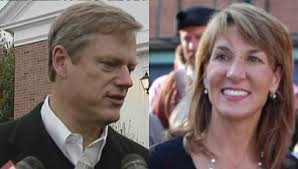
the would be Governor stoops for a spot of Tea : Karyn Polito to be Charlie Baker;s running mate

—- —- —

A number of high-visibility Massachusetts pols did the attention-getting unexpected today. Perhaps the biggest such event of the day, however, was not a happy move and had the feeling of a surrender  : Charlie Baker, who almost certainly will be the Republican nominee for Governor next year, anointed one Karyn Polito as his Lieutenant Governor sidekick.

Who IS Karyn Polito ? A former State Representative from Shrewsbury and the 2010 Republican candidate for Treasurer. And why her ? It is speculated that Baker chose her because ( 1 ) Baker lost women voters in the 2010 Governor election by 24 points and ( 2 ) she is popular with the Worcester County Tea folks. As I wrote three days ago, Polito recently spoke at an event on the South Shore at which the featured guest was one Allen West, a stridently contemptuous, Tea party favorite and one-term (defeated) Florida Congressman. Polito is said to have praised West in her own speech at that event. That would be reason enough to wonder why Baker would link his candidacy to Polito, who served as campaign chair for Michael Sullivan’s right-wing US Senator campaign earlier this year. Sullivan’s opposition to marriage equality (and of course to transgender civil rights) mirrored Polito’s own recent legislative record. (Baker’s campaign says tat Polito has since come around and now shares his views on social issues.)

All of this represents a huge shift for Baker, who in 2010 chose as his running mate Richard Tisei, an openly gay State Senator who vigorously supports lifestyle civil rights — indeed, he was the original legaislative sponsor of the transgender rights bill that was enacted as law last year. As it happens, Polito, too, has made her own huge shift. During the Romney years she was — like almost all Massachusetts Republicans — strongly pro-choice and supportive of marriage equality. Of course we all know what Mitt Romney did in the years since he left he Massachusetts governorship. Polito has simply followed his example, bowing her reformist record to the voices who want to repeal all reform.

Such is the politician whom Baker has chosen as his symbol this campaign cycle : a gravatar of reaction, a face of opposition to nearly everything the GOP has stood for in Massachusetts since it was founded. Well might I call the Baker-Polito ticket “anti-Republican.”

Baker had other options. He could have chosen State Representative Geoff Diehl, a social progressive who spearheads the “Tank the Gas Tax” movement. He might have gone really bold and picked Pamela Julian, leader of the League of Women Voters and a force in Boston. Elizabeth Childs of Brookline was a possibility. I would have preferred any of these.

Will this ticket likely succeed with Massachusetts voters ? As hardly anybody votes for a Lieutenant Governor, in the end it probably won’t matter to anyone who isn’t a political junkie. But it should. A successful candidacy gives the angry anti’s of the Tea party a credibility that right now they thankfully lack.

Connolly w Chin

^ John Connolly as WHAT ? Mayor Walsh’s new school superintendent ? Not damn likely

No sooner had I digested this swig of political castor oil than news came that, in an interview by radio host Jim Braude, Mayor-elect Marty Walsh said that he “absolutely do(es) not rule out asking John Connolly to be his new superintendent of schools.”

WTF ? Immediately came the waves of outcry from the teachers union activists, the Diane Ravitch groupies, and the opponents of charter schools and US Secretary of Education Arne Duncan. That was to be expected. But I too, a supporter of Connolly and his “school transformation” vision, found the suggestion a red herring — or maybe a sly nick. Connolly is screwed by this knee-chop remark no matter how he responds — IF he does respond. His best response being to not respond at all. Clearly John Connolly has a ton of career options better than the tainted biscuit that Walsh so suavely served up.

Whoever agrees to be Mayor Walsh’s superintendant of schools is bound to disappoint almost everyone : school parents wanting big reform, the Teachers Union opposing every reform except its own politically unlikely agenda, the administrators, principals, kids — you name it. Boston’s public schools need significant reconfiguration; almost any new superintendent won’t be able to get it done. Why should John Connolly descend into that vortex ?

photo (5)

^ Guess who is heading to Israel as a guest of the ADL ? Yup, Council Felix G. Arroyo.

No sooner had I digested the Connolly suggestion than Councillor Felix G. Arroyo announced that he is visiting Israel next week as a guest of the Anti-Defamation League. This surprised me. Most politicians allied with the Labor Left — and Arroyo is definitely there — are supporters of the Palestinians, not the ADL. So what is up ? Politicians make trips to Israel when they have high officer in mind. Might Felix G. Arroyo be thinking of running for Lieutenant Governor ? It would make sense. He would enhance the Democratic ticket no matter which of the four likely hopefuls becomes the nominee. He’d be an inspired choice. Is Arroyo on it ?

—- Michael Freedberg / Here and Sphere
NOTE : this is article was updated December 5, 2013 at 8:00 am.

#MAGOV : THE FIGHT FOR CONTROL OF THE BAKER CAMPAIGN

Image
^ Charlie Baker 2013 : taking it to real people in the real world

—- —- —-

GOP Governor hopeful Charlie Baker tweeted at 9:55 AM this morning :

“Visiting the team at the Dimock Center to discuss health and social service issues with one of Boston’s top provider groups.”

With that tweet — the first, since the campaign began, that i have seen in which he addresses health issues, and in Boston, no less — Baker pretty much said to the GOP right-wing “Game On !”

Baker does face a fight from the Right. He faced one, as Governor nominee, in 2010 too : but then, the GOP had a Senator, Scott Brown, who wielded his power to tamp down that year’s  Tea candidate, with complete success. This time there is no Senator Scott Brown in office, and the GOP right-wing looks far stronger. Its candidate in the Special Senate election, Michael Sullivan, won 33 % of the vote in the GOP Primary. Today’s Right uses all the social media linkages. A new pressure group,” Mass Fiscal Alliance,” is importing the Cato Institute’s anti-social safety net propaganda — devious stuff — into the boil.  The Right has also spurred a ballot referendum called “Tank the Tax,” collecting well more than the 68,000-odd voter signatures needed to be printed on the 2014 state ballot. This effort expanded the right wing’s reach beyond the Michael Sullivan voters into the 15 % vote that libertarian-ish Dan Winslow won at that Senate primary and even into the 51 % garnered by non-ideological Gabriel Gomez.

Baker’s challenge has steepened in the past week thanks to two developments : ( a ) one Max Fisher, a Tea Party member from Worcester County — ground zero for right-wing doom-saying in Massachusetts — announced his candidacy for Governor and ( b ) Karyn Polito, also of Worcester County, and a former State Representative, announced her candidacy for Lieutenant Governor.  Fisher’s candidacy doesn’t scare a whole lot, but Polito’s does. She was a Sullivan supporter and — so reports today’s Boston Globe — spoke at a right-wing event honoring one Allen West, whom some may remember as an outspokenly hateful one-term Florida Congressman. West is a hero to the folks who sling the word “patriot” around as if mouthing a phrase with seven bleepable letters. That Polito would even be in the same county as such a man, much less speak in  his honor, casts a pall upon the GOP’s Governor prospects, already damaged in Massachusetts by the contemptuous 2012 Presidential campaign and all but poisoned by the recent government shut down.

Yet now, on the very morning of the Boston Globe article entitled “Running Mate Issue Gets Thornier for Baker,” Baker tweets about health care and social service ! It caught my attention, and it should catch yours. Either he sees Polito as his shield against the angry right, freeing him to discuss issues that matter to the vast majority of voters, or he is sending the right — and Polito — a message that he will not be intimidated, will in fact move aggressively away from right-ism and make IT his bogey man, as it already is for most Massachusetts voters.

We will soon find out which of the two courses Baker has chosen. Meanwhile, the fight is on, as anyone following Worcester County Tea-publican’s facebook threads and anti-Obama tempests should know.  The right has its guns locked and loaded, and how ! It is itching to win one… As accomodative Republicans mix on the same floor as power-groupies and the Right wing contempt machine, the Massaachusetts GOP convention of March 22nd should be a barn-burner.

It may come down to the supporters of state Representative Geoff Diehl, of Plymouth County. Though Diehl has got aboard the “Tank the Tax” referendum drive, to great effect, I sense that his instincts favor the reasonable side. He proclaims himself a “Charles Sumner Republican” in a context strongly advocat-ive of civil rights for all, including voting rights — the original GOP message. My guess is that at the Convention, Diehl’s supporters find an alternative Lieutenant Governor nominee to Polito; and by all means they go with Baker, not Max Fisher. The Republicans of Plymouth and Norfolk Counties are not Worcester Tea guns. My sense is that they congratulate Charlie Baker speaking to Boston area voters. I also sense that Baker sees these South Shore Republicans the same way that I do. Baker has tweeted his outreach to all voters, in social settings, as well as to business groups and innovators, who he addresses no differently from how Democrats Steve Grossman and Don Berwick speak.

We might even see more of Baker out and about in Boston. Meets and greets, perhaps. Wouldn’t that be something ? Baker of course wants to steer clear of the ballot referenda. He wants not to become the grinch of welfare “reform.” He does not want to be talking “2nd Amendment.” Would you ?

No, Baker wants to talk innovation, health care, empowerment for immigrants, school reform, the huge numbers of homeless that the State now houses;  transportation improvements — all the issues that matter to most Massachusetts voters. He wants to move Massachusetts forward, not backward. The question is, will be allow himself to do that ?

We will soon find out what Baker is thinking — I may well have it wrong. In any case, don’t count out Geoff Diehl. His is a name you’ll be hearing a lot more of.

—- Michael Freedberg / Here and Sphere
A BAD REFERENDUM — AND WE OPPOSE IT

Image

^ Geoff Diehl (R-Abington) : a good guy makes his pact with an unserious rant

—- —- —-

Massachusetts voters going to the polls next November face at least two referendum questions. One, we support : raising the minimum wage to $ 11.00 an hour. we have already editorialized our reasons for casting a “yes’ on this referendum. The  proposal, we strongly dislike. This one seeks to cancel the three percent gas tax hike enacted earlier this year, by which our state will fund all sorts of needed road and public transit repair and upgrades.

That “Transpo Bill,” as it has come to be known, has already taken one hit : repeal of the software tax included in the original enactment. We agreed that taxing technology was a wrong idea. Technology should be encouraged and aided, not nicked. It is different with the gas tax. Driving wears and tears our roads and bridges; their upkeep is a public charge –and we make it so because driving keeps the economy moving, pun intended — and thus the gas tax.

The same people who initiated the software tax repeal now initiate the gas tax repeal. This time, their motives are suspect. From what they say at facebook and on twitter, they appear to oppose all public spending, or to view it suspiciously, as if public spending were a kind of con man come to scam us. Many of these opponents are Tea sorts, who view public spending as extortion money paid to “moochers” and “illeagl aliens.” We’ve already seen their impact upon the EBT program, a food-buying fund by which those living on the margins try to survive.

A referendum that begins with this mindset is tainted ab initio. By two arguments, its sponsors seek to justify it. We reject both :

1. they tell us that gas tax revenue is often spent by the state on programs other than road and bridge repair and transit upgrades. True enough, but so what ? This happens because the anti-public spending crowd denies the state funds that it needs for those other programs, many of them immediate, such as policing, courts, and administration, to pay for which the State’s Commissioner of Administration and Finance simply decides to defer road and transit work. Denying the State new gas tax revenue is going to worsen this situation, not improve it.

2. they say that pegging gas tax increases to the cost of living index is “taxation without representation.” Representaive Geoff Diehl (R-Abington), one of the repeal referendum’s leaders, and usually one of the really good guys, actually tweeted last night that every single “COLA” hike, every year, should be voted on by the legislature !

Keep in mind that the gas tax hike itself is three percent. On a 20-gallon fill-up at current gas prices — about $ 3.35 a gallon — that’s a tax of $ 2.01 per fill up. the usual “COLA” hike these days runs about two percent. two percent of $ 2.01 = $ 0.04 ! For four cents a fill up we’re to call the legislature into session to vote ?

The entire argument crashes and burns. We already peg our sales tax to prices; and prices go up, automatically, without the legislature voting. That the gas tax hike takes effect without a legislative vote is simply to tie it to the price of gas. Otherwise the gas tax hike would be assessed upon gas only at the price of gas on the day the tax hike took effect.

The referendum proponents already know this. They know the whole flap is a nullity. Its  REAL purpose is to raise the hue and cry against “moochers” and “illegal aliens,” anti-spenders’ favorite scapegoats, and thus to help elect no-spending legislators in Districts outside the Boston media zone, within which the unseriousness of this device would be fully and quickly debunked.

Someday, if and when the no-spending crowd actually adduces a serious reason — and attacks upon its scapegoats’ desperate lives is both flip and despicable — for why they oppose taxes to fund State spending, we will listen respectfully to their arguments and maybe even agree. I’m not holding my breath.

—- Michael Freedberg / Here and Sphere