WE SAY YES : RAISE THE MINIMUM WAGE

Image

^ collecting signatures : in huge amounts, too, to do the right thing

—- —- — — — —

Yesterday, a group of activists known as RaiseUpMass announced that they had gathered 275,828 (!) signatures on petitions to place on Massachusetts’s 2014 ballot a referendum hiking our state’s minimum wage to $ 11.00 an hour. The pay rise would take place in stages, achieving the $ 11.00 level by 2016.

We strongly support the proposal. We will advocate a Yes vote all the way until election day. RaiseUpMass says that more voter signatures than the already awesome total are arriving at its headquarters. We like this.

For far too long, workers in low-skill and service jobs have seen their take home pay stand pat, or increase by measly amounts and then only after years of service. So low is the pay of many thousands of workers that they and their families need EBT, section 8 housing certificates, food stamps and the like in order simply to survive. These aids paid for by taxpayers — who thus find their tax dollars subsidizing the low-wage policies of low-pay businesses. Why should taxpayers have to do this ? And, given the current climate in which some Massachusetts legislators seek votes by demonizing the poor, why should low-wage workers have to beg taxpayers for survival money ? Life is hard enough for low-wage workers without having to worry which vital assistance program upon which they depend will be cut next week.

Let us say it clearly : no full-time worker should ever have to need public assistance just to make basic ends meet.

The rise to $ 11.00 is not enough. That it will take three years to reach that figure is not good. Still, passage of this pay hike law gives low-wage workers assurance that their continued hard work will we rewarded somewhat. We can hope that the Legislature enact legislation filed by State Rep. Denise Provost of Somerville : it calls for a rise to $12.50 an hour by 2016. At that figure, a full-time low-wage worker would earn $ 500 a week, $ 26,000.00 a year. A family with two such workers would then earn enough to enter the discretionary spending market. Consumers’ discretionary spending is what really boosts the economy. Survival spending — for food, rent, utilities, and clothes — matters, but discretionary spending — for cell phones, cable television, a car, summer camp for the kids, day care, maybe even a movie or a restaurant — pumps the economy much more. Getting as many people as possible into the growth economy should be a vital policy goal. Enacting a $ 12.50 wage will get us there.

The American economy faces no threat graver than huge income inequality. How can an economy grow best if less and less people can participate in it except on the margins ? The top one percent of earners have taken lots of lumps lately for the gross hugeness of their pay checks, but they seldom get nailed for the worst consequence thereof : that multi-million-dollar incomes simply CANNOT be spent. Even the most expensive food, homes, cars, and vacations only cost so much. All the rest of these multi-million pay checks gets shoveled into hedge and private equity funds, where the money simply rolls over from one paper investment vehicle to the next in search of arbitrage. It is money TAKEN OUT OF the real economy. It stunts economic growth.

Investment money that invests only in paper self-defeats. Investment money should invest in businesses; innovation; real people doing real things. A lot of investment money does do that, but nowhere near enough.

Because investment multi-millions, left to themselves, simply attract to them more and more of the money that should be funding the economy, legislation must set at least a bottom limit on how much of the economy’s money excess earnings can take. A reasonably capitalist economy cannot, and should not, legislate pay equality. But we can, and should, legislate a minimum pay sufficient to free full-time workers from needing taxpayer dollars.

So be it.

Lastly, we reject the arguments of those who oppose minimum wage legislation. They adduce that raising the minimum wage will stifle employment of teens. Well ? We like teenagers as much as anyone. we approve of their wanting to work. but the first obligation of our society’s economy is to families — to adult, full-time wage earners. Scant wages earned by teenagers won’t do anybody any good if they come at the expense of mothers, fathers, uncles and aunts who can’t make ends meet without public assistance that can be cut any time “welfare reform” politicians decide to throw poison darts at it.

As for businesses that complain that higher work pay will force them to close or lay off workers, we repeat what Boston mayor candidate John Barros said at a Forum : “If you can’t afford to pay your workers fairly you can’t afford to open a business.” Another way of saying this is, “you don’t like unions ? You don’t fancy the intimidation and violence that often accompany job actions ? Then don’t force workers to go that route in order to get decently paid !”

We’ll say it again: vote “yes” on this referendum !

— Michael Freedberg / Here and Sphere

PS : while we’re at it, yes : we also support paid sick leave.

MELEE IN MASSACHUSETTS : TIME FOR “THE MANAGER”

Image

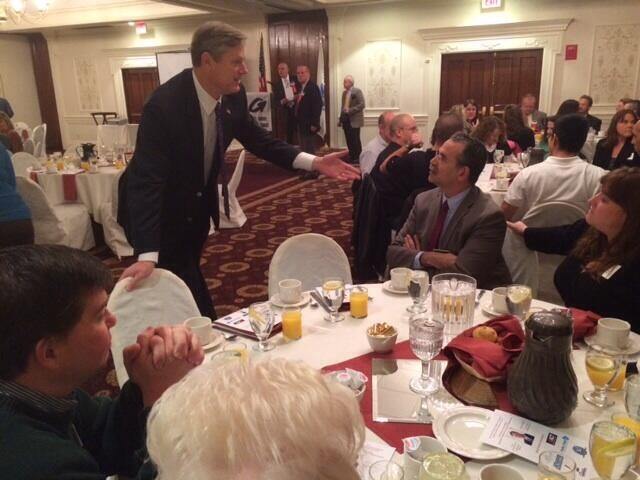
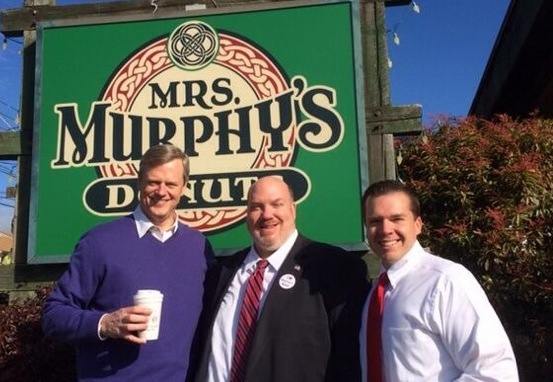
^ Pressing the flesh and speaking : Charlie Baker at the Greater Gardner Chamber of Commerce’s breakfast this morning

—- —- —

How quickly things change in politics ! Two weeks ago, as the GOP-induced government shut down ended, Charlie Baker, as the Republican candidate for Governor, looked poisoned. Today, as the President finds that his managerial failings have tanked the people’s trust and imperiled his signature legislation, the ACA, Baker as the Republican looks almost anointed. It’s Baker’s hour. All that he has to do now is not flub the moment.

So what do I, Coach Michael, suggest of his star receiver ? Just this :

1.Baker made his all-pro status as an excellent manager. precisely what President Obama is not.. Almost as exactly what Governor Patrick also has not been. The contrast shouts itself.

2.In a state like Massachusetts, heavy with institutions and even weightier with institutional government collaboration, being an excellent manager matters tremendously.

3.None of the Democratic candidates for Governor except Steve Grossman comes even close to Baker’s mastery of institutional management.

4.Managerial competence may be a dry theme, a calorie-free kind of Diet Coke, but with managerial failing so luridly splayed across the Washington wide screen, the story achieves epic dimensions. Being competent, we see, does matter — Odysseus, not Achilles.

Charlie Baker must run as the Manager in Chief.

It makes sense within the Republican context too. The GOP even in “forward” Massachusetts has been flayed by theorists, whipped by negativity, bent to the purposes of anti-tax mind block, extorted by gun zealots, roasted by social-issue regressives. to the point that we have almost forgotten that in Massachusetts for the past 60 years at least, “Republican” meant civil rights, social justice, big projects, and benefits for all. The record, in that context, from John Volpe and Frank Sargent to Bill Weld, Paul Cellucci and, yes, even Mitt Romney stands ; but has been obscured, if not overwritten, by recent GOP “party of no.” But the GOP is a palimpsest, not an eraser board; and the Republican past is there, in full cry, once we scrape away the negative overlay. As the Master Manager, Baker scrapes away the “no” and substitutes a “yes.”

And there is, in Massachusetts state governance, much to be managed. i cite the following challenges :

1.the vast transportation improvements for which money was approved, contentiously, this year.

2.the 1.4 billion affordable housing bond that St. Rep. Jay Livingstone shepherded through to passage this week.

3.public school transformation, which became almost a defining issue in the Boston Mayor election

4.establishing innovation Districts, in Roxbury, Hyde Park, and probably Central Massachusetts, similar to Boston’ Innovation District already working.

5.assuring immigrants in Massachusetts that they’ll be welcomed into the community — and thus the economy — rather than harrassed out of it.

So the question is, “will Charlie Baker run as the Master Manager ?” Or, “Has Baker sufficient rigor to steer clear of recent Republican apoplexies ? The discipline to not get deflected, even once, throughout an entire campaign ?” The personality to stray positive, to be Mr. good Guy always ? If so, he will very likely be Massachusetts’s next Governor.

That said, Baker’s potential Democratic opponents are not sitting on their duffs. Juliette Kayyem is barnstorming the entire state, talking to Democratic activists — and drawing significant numbers of them to hear her pitch. Donald Berwick is doing the same : drawing less numbers, but making a distinctive, and very moving case, for the Governor as moral leader, the voice of “do the right thing.” In contrast Steve Grossman is proceeding more matter-of-factly, but raising the most money; and Martha Coakley — the common wisdom’s front runner — is presenting herself on big stages, the candidate of institutional presence. (This seems to me not at all a wise strategy. Voters even in institutional Massachusetts don’t readily cozy up to candidates garbed luxuriously in ceremony.) Then there’s Joseph Avellone, an affable and intelligent guy, successful in medicine and business, but very underfunded and quite — so far — the underdog even among underdogs.

The Democrats will choose their candidate at a party convention, whence a candidate must draw 15 % of the delegates’ votes in order to have his or her name appear on the Primary ballot. (A candidate can also get to that ballot by submitting 10,000 valid voter signatures.) My guess is that none of the five has anything close to a majority, and that at least three and possibly four, will make it to that ballot. All the more reason for Baker to run as the master manager and not get squeezed into this or that policy crevasse.

Baker’s easiest opponent to beat ? Martha Coakley.
His toughest to beat ? Probably Juliette Kayyem
His most down-to-the-wire closest fight ? Steve Grossman.

But wouldn’t be fun were the voters of Massachusetts to have the choice of Charlie Baker and Don Berwick ? So far, as I see it, that’s the best outcome for voters who put high-minded state reform first on their civic agenda.

—- Michael Freedberg / Here and Sphere

MELEE IN MASSACHUSETTS : RUNNING THE NUMBERS ON NOV 10TH

photo (18)

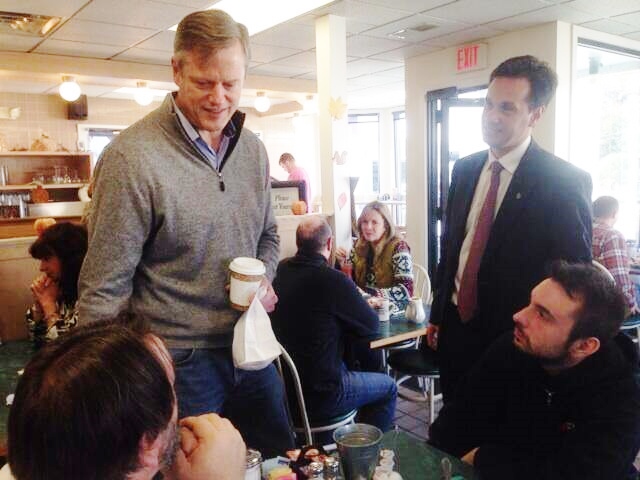
^ peopling and good-timing : Charlie Baker meting and greeting at the Water Street Cafe in Plymouth.

—-      —-      —-

As in all elections, money and people determine the race to choose Massachusetts’ next Governor. Even this early one can count some of each. That is what I shall be doing in today’s report and as often henceforth as the state of the race requires from me. So what do the numbers tell us at 11 : 30 AM on 11/10/13 ?

People ——-

Charlie Baker : 4004 twitter followers
32,056 Facebook Public Figure followers
Martha Coakley : 12,200 twitter followers
18,968 Facebook Public Figure Followers
Steve Grossman : 6,770 twitter followers
no facebook public figure page as yet
Juliette Kayyem : 4,244 twitter followers
1,161 facebook public figure followers
Donald Berwick : 1,876 twitter followers
1,799 facebook public figure followers
Joe Avellone : 336 twitter followers
no facebook public figure page as yet

Money —–

Charlie Baker : 107,643.62 cash on hand as of 10/01/13
261,370.36 receipts for the month
185,880.50 expenditures
203,133.48 cash balance on 10/31/13

Steve Grossman : 709,324.65 cash on hand as of 10/01/13
163,405.00 receipts for the month
119,034.42 expenditures
773,695.23 cash balance on 10/31/13

Martha Coakley : 283,192.95 cash on hand on 10/01/13
88,486.88 receipts for the month
59,141.22 expenditures
303,538.41 cash on hand on 10/31/13

Juliette Kayyem : 202,527.92 cash on hand on 10/01/13
95,572.46 receipts for the month
40,795.36 expenditures
257,305.02 cash on hand on 10/31/13

Donald Berwick : 264,649.83 cash on hand on 10/01/13
33,053.10 receipts for the month
102,542.03 expenditures
195,161.90 cash on hand on 10/31/13

Joseph Avellone : 121,494.72 cash on hand on 10/01/13
19,675.37 receipts for the month
39,294.95 expenditures
101,875.14 cash on hand on 10/31/13

These numbers all look small when one considers that it took $ 80 million to elect a United states Senator for Massachusetts in 2012. Even to elect a Boston Mayor, over $ 7 million was raised and spent. As I see it, two problems pressure all of these candidates :

photo (19)

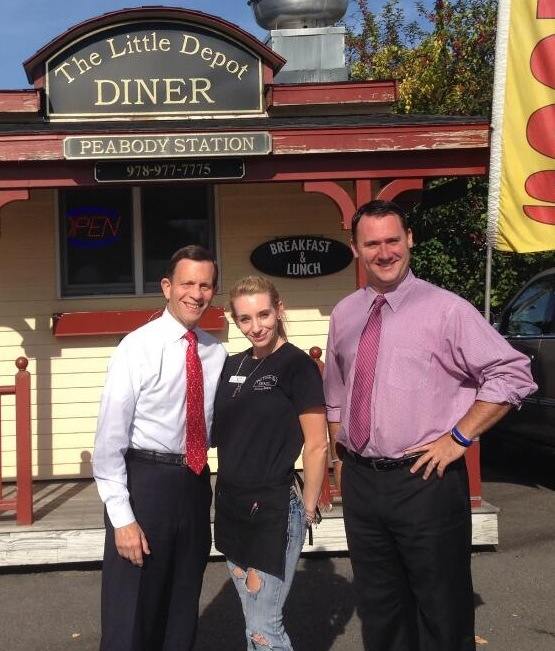
^ 775,693.25 in the bank — now some people too : candidate Steve Grossman (at the Depot Diner in Peabody with Mayor Bettencourt and the Diner’s owner)

1. five (5) noggins seek the Democratic Party nomination. The winner even of that battle faces a serious GOP opponent in a state in which four of the last five governors have been Republican (Weld, Cellucci, Swift, Romney). That’s long odds for donors with shekels to sprinkle.

2. Charlie Baker so far has no challenger for the GOP nomination, but his “strong favorite” status seems grievously imperiled by the toxic state of the Republican brand among Massachusetts voters and by the powerful tilt toward poisonous policies even among Massachusetts’s GOP primary voters.

DeLeo the Speaker

^ Robert DeLeo, Speaker of the House…. and the REAL Governor of Massachusetts

And hanging over all the hopefuls is the knowledge that Massachusetts is governed — even dictated to — by the Speaker of the House. Time and time again we have seen this. The Governor can want a piece of legislation more seriously than a heart attack ; it doesn’t matter a whit unless the Speaker wants it too. If he doesn’t, the Governor can just whistle Dixie.

The Speaker has this power because, by the rules of the house, he appoints all committee chairmen and all committee members. Until these rules are changed — which they never will be — the Speaker rules. Indeed, one wonders why people even bother running for Governor ? True, the position has a great deal of prestige attached to it. That plus the bully pulpit, a lot of voter comfort, and some public policy feel-good and perhaps a shot at becoming the POTUS. But heck, the future POTUS (ha !) can’t even get his judicial nominees appointed without sweet-bunning a majority of the Governor’s Council. Good luck with that, in an era when patronage jobs can’t be given without earning a slam column from the likes of Howie Carr.

Oh wait… the Governor does appoint cabinet members — worthy men and women, some of them my friends — to operate whatever the Speaker allows them. He or she also has power to commute sentences or award pardons : but the present Gov and his precdessor almost never have done so. What good is a power unusued ?

Of course our would-be US President DOES run the state Police. Which means that a wise governor keeps the “staties” from harrassing immigrants, whereas a Gov “severely conserative” can’t wait to eat immigrants for breakfast. I suppose that that does matter. But is it worth the tens of millions of good funds that will likely be spent to elect a Goverbor decent to or devouring of immigrants ?

It was fun to cover the Boston Mayor election. A Boston Mayor wields actual poweer — a LOT of power. The Governor wields a limp biscuit. Oh what joy this coming year is gonna be…not.

—- Michael Freedberg / Here and Sphere

MELEE IN MASSACHUSETTS : WHAT THE BLAZES IS CHARLIE BAKER THINKING ?

Image

^ serious politicking, at least this time : Charlie Baker (left)  joined the campaign of now newly elected, Western Massachusetts State Senator Donald Humason (center).

—-      —-       —–

The “brawl in Boston” being decided, attention now turns to the “melee in Massachusetts” : the first open race for Governor since 2006. It begins with Charlie Baker, because he has already run for Governor once, in 2010, and thus starts a fair bit ahead of the pack in terms of name recognition and state wide organization.

You would suppose that Baker, having already established himself as a credible governor — losing to Deval Patrick in 2010 by 6 points only — would be broadening his themes, addressing all the issues that face Massachusetts today, from transportation and infrastructure, to a higher minimum wage, to the needs of immigrants, environmental legislation, and serious reform of the legislature. You would indeed suppose that, but it seems that you would be wrong.

You might also think that he would be congratulating the US Senate for passing ENDA legislation, on a bi-partisan basis ; but so far, not a peep about ENDA from the man who in 2010 chose as his running mate Rich Tisei, the original Legislative sponsor of Massachusetts”s transgender rights bill (which is now Law, albeit without public accommodations protection).

For the past week I have regularly attended to Baker’s facebook pages and his twitter account, and all I can see is that (1) he visits lots of businesses (2) his tweets are re-tweeted by Tea types, including the  eliminate-a-social safety-net crusader Brad Marston (3) he has fewer twitter followers than a Boston City Councillor and (4) he has tied himself up in the demagogic and quite irresponsible movement to repeal the gas tax automatic adjustment — the tax with which Massachusetts will try to pay for at least some of the huge transportation and infrastructure needs that have accumulated during a decade and more.

If you don’t think that this repeal is irresponsible, just ask Jim Aloisi, who served as one of Massachusetts’s best informed Secretaries of Transportation.

Businesses are great, and it’s nice that Baker thinks so. but the impression he is giving is that he’s running for President of AIM, not Governor of Massachusetts.

Nobody likes to pay more taxes, but Baker’s lending his presence and name to the gas tax repeal suggests that he wants to be President of the Pioneer Institute or the Mass Fiscal Alliance, not Governor of Massachusetts.

Being liked by such as Brad Marston gives Baker the Marston vote, but it suggests that Baker seeks to become a fellow at the Cato Institute or the Koch Brothers’ several GreedPAC’s, not Governor of Massachusetts.

Of course it’s early in this campaign still. Maybe Baker is just fist bumping a few bumps on the Right Wing log.

Meanwhile, however, he has yet to respond to my Wednesday tweet : “what will you do as Governor to establish Innovation Centers in Roxbury and Hyde Park ?”

—- Michael Freedberg / Here and Sphere

NEXT : Martha Coakley

FALL RIVER, FREETOWN — 6TH BRISTOL SPECIAL ELECTION — SEPT 10TH

Image

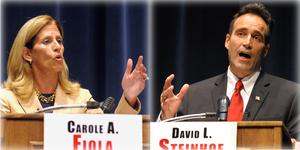
^ Fiola : state transportation funds will help Fall River. Steinhof : too much EBT and MBTA fraud going on to ask for new funds

Next Tuesday voters of Freetown and the North End of Fall River will go to the polls to choose a new State Representative. The vacancy results from the resignation several months ago of State Representative David Sullivan.

The candidates are David Steinhof, a third-generation Fall River dentist, and Carole Fiola, whose husband Ken Fiola is vice-president of Fall River’s Economic Development Office.

At a debate a few nights ago, as reported in the Herald News, Fiola said that she supports the State’s new gas and cigarette tax but not the software services tax; Steinhof favors n o new taxes. Fiola said that she supported the two taxes — but not the software tax — because Fall river needs new funds to improve transportation to and from the city’ Steinhof says that Fall River doesn’t need new funds because it’s already got a great, deep water port, as he put it.

Steinhof also said that with all the “fraud,” as he put it, going on in the EBT program and in the MBTA, the State can find funds by eliminating the “fraud.”

Polls open at 7 A.M. next Tuesday.

—- Michael Freedberg / Here and Sphere

BOSTON CITY COUNCIL RACE : JACK KELLY OF CHARLESTOWN

Image

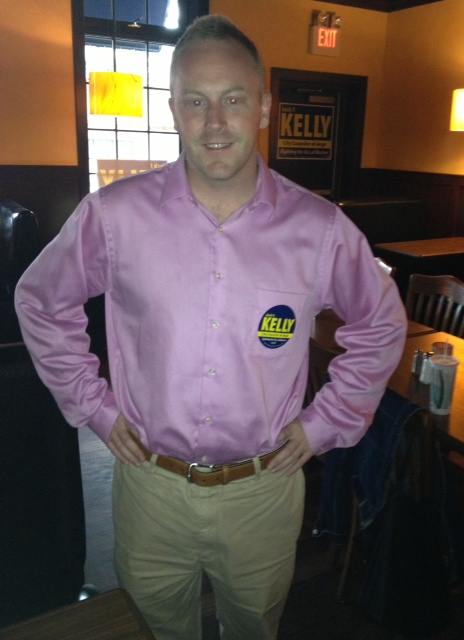
^ At-large Council hopeful Jack Kelly at a recent “friend raiser” in Dorchester

—- —- —-

Note : Here and Sphere will make an effort to interview as many City Council candidates as we can reach. This effort must, unfortunately, come second to our coverage of the Mayor race — coverage which starting on Monday will continue every day right through to the September 24th Primary. We will, however, do what we can with the time that we have. First up is Jack F. Kelly III, who was born and grew up in Charlestown, the son of two working patents : a Verizon worker Dad and a Mom who has worked for Boston Public Schools for over two decades.

We first met Kelly at a block party in West Roxbury early last month. About two weeks ago we attended a “Mondays for Marty Walsh” town hall in Charlestown, where we heard first hand the concerns that that neighborhood has with the City’s powers that be. Given the smallness of Charlestown — but its long significance in Boston’s political life too — it was our decision right then that Jack Kelly would be our first City Council interview.

We talked to Kelly at a fund[-raiser event in the Savin hill section of Dorchester — an event he prefers to call a “friend raiser.” What follows was the substance of our talk :

Here and Sphere (HnS) : “What’s your campaign’s chief issue ?”

Kelly : “public health; fighting drug addiction, HIV and hepatitis C. It’s what I do currently, working for Mass General (Hospital). We have to increase the presence of community health workers.”

HnS : “so you agree with what Marty Walsh said that night in Charlestown, that there’s an heroin epidemic in Boston ? He didn’t overstate ?”

Kelly : “Absolutely. No, he did not overstate things. Drugs are everywhere and I see it in my work and know of it in the ‘Town. (Keep in mind that) fighting the drug plague is fundamental to (public) safety.”

Note : Kelly knows the drug menace personally. as his campaign bio puts it, “After graduating from high school, my life took an unexpected turn. Like many kids in my generation throughout Boston, I became addicted to…Oxycontin. for several years I struggled with …addiction… (until) on October 12, 2003…with the help of my community, prayers, and addiction programs, I became sober and began my life again.”

HnS : “fighting drug addiction and diseases like HIV and hepatitis is hardly the usual City Councillor undertaking.”

Kelly : “That’s why i can be heard. It has to be addressed.”

HnS : “Turning to other issues, the various casino proposals are an issue in Charlestown. What is your position ?”

Kelly : “it’s an issue everywhere in the city. I favor an East Boston vote only, not city-wide.. Traffic’s an issue; we will deal with it. The one casino I do NOT want in any circumstance is the Everett proposal. The traffic impact would be intolerable. Any casino has to be in Boston, but you know what ? Why not have it on one of the Harbor islands ? Doesn’t that make the most sense ?”

HnS : “School improvement has been john Connolly’s big issue, one that has given him citywide strength. And that means charter schools. What’s your position on legislation to lift the ‘cap’ on how many charter schools we can have ?”

Kelly : “Definitely school improvement. I favor increasing the number of charter schools but not eliminating the cap entirely.’

HnS : “Partial ‘cap’ lift ?”

Kelly : “Yes.”

HnS : “one thing that John Connolly specifically cites in his school improvement agenda is that the school day should be longer. Your view  is ?”

Kelly : “i agree; but teachers must be compensated for a longer day.”

HnS : “The Boston Globe two days ago focused on the various mayor candidates’ positions on the BRA. Changing the BRA seems on everybody’s mind. What do you think should happen ?”

Kelly : “i want more transparency and for the city council to have a vote on who the new director will be. And by more transparency : all meetings with developers should be videotaped and shown online to be posted on (the websites of) affected neighborhood(s) and their civic association(s).”

HnS : “But you don’t advocate replacing the BRA ?”

Kelly : “correct.”

HnS : “Lastly, a numbers question. You come from Charlestown, one of the City’;s smallest neighborhoods. How can you win citywide ?”

Kelly : “It’s not just Charlestown. It’s the entire City Council District that I’m from, that includes East Boston and the North end. We haven’t had anybody elected city-wide since John Nucci;. It’s about time.”

HnS : “How can you do it ?”

Kelly : “I’m strong in South Boston, Dorchester, West Roxbury. I have friends all over the city, from labor. I was an ironworker after I became sober, a Local 7 member. I also know people everywhere in Boston from being Charlestown Neighborhood co-ordinaor for Mayor Menino. Look at my union endorsements !”

NOTE: Kelly has major union support. His campaign website notes the following union endorsements : Teamsters local 25; Teamsters 122; Laborers 223; IBEW Locals 103 and 104; Heat and Frost Insulators and Asbestos Workers local 6; Plumbers and Gasfitters Local 12; Plasters and Cement Masons local 534; Custodians Local 1952; Pipefitters Local 537; Sprinkler Fitters Local 550; Sheet metal workers Local 17. (Of these, the most significant might be the Custodians union. Most custodians live in the city — unlike the members of many construction Locals —  and they are numerous; and almost all of them vote every election.)

HnS : “Thank you for talking to us !”

We will likely cross Kelly’s campaign path often as we go about Boston neighborhoods this alt month of the Primary campaign. (indeed, we have already met up with him often.) Still, it’s an uphill fight for the first time candidate, even given his already wide-ranging political resume: in addition to being a neighborhood co-ordinator in Mayor Menino’s administration, Kelly was an elected Hillary Clinton delegate to the 2008 Democratic Convention — considering the size and strength of the Council field. Incumbents Stephen Murphy and Ayanna Presley are running for re-election; former Councillor Michael Flaherty seeks to return to that body. To win the one remaining at-large seat, Kelly must top Lower Mills native Catherine O’Neill (now a resident of Savin Hill); Marty Keogh, a well known West Roxbury attorney; , former Senator Warren campaign staffer Michelle Wu, a South End resident, North Ender Philip Frattaroli, former District Councillor Gareth Saunders; neighborhood co-ordinator Ramon Soto, a Mission Hill resident; and nine others.

His unique candidate profile and personal witness of major public health issues just might do it.

—- Michael Freedberg / Here and Sphere

CORRECTION : this article has been corrected. The original article said that Kelly favored a city wide vote on a casino proposal. In fact, he favors only an East Boston, neighborhood vote. This change has been made in the article that you have read.

THE BEST EVER : FRIDAY NIGHT @ PORTUGUESE FESTA – NEW BEDFORD

Image

^ Hathaway Street welcomes you

—- —- —-

“The best ever.”

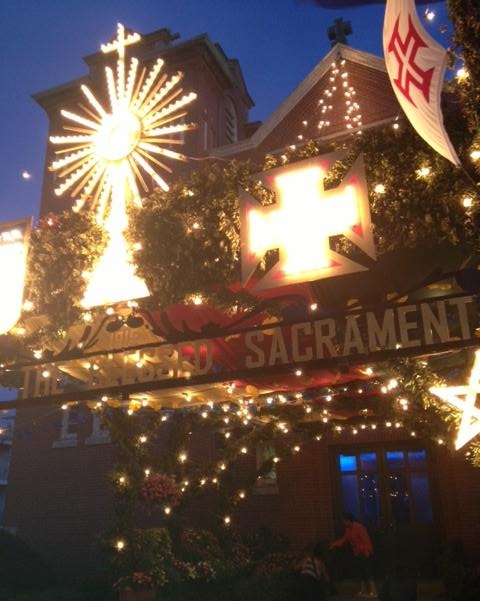
That’s how The Local Vocal’s editor, Heather Cornell, described this year’s Friday night bash at the annual Madeiran Festival held in and by Blessed Sacrament Parish, the tall-spired, Iberican Gothic cathedral that sits on Acushnet Avenue north of downtown New Bedford.

Image

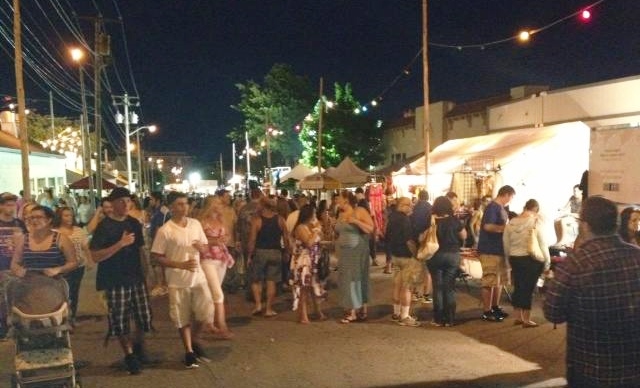
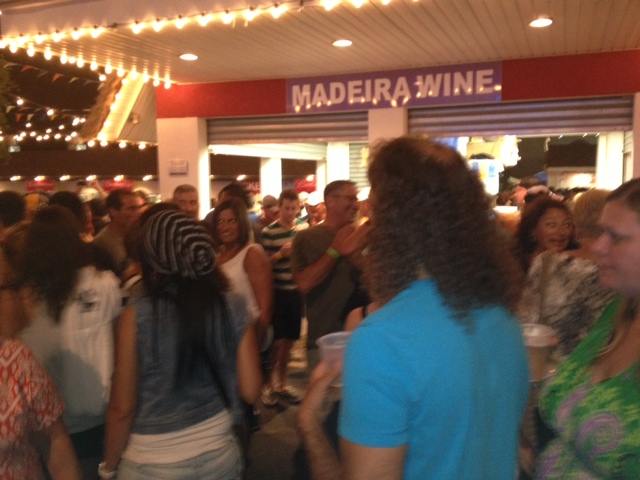
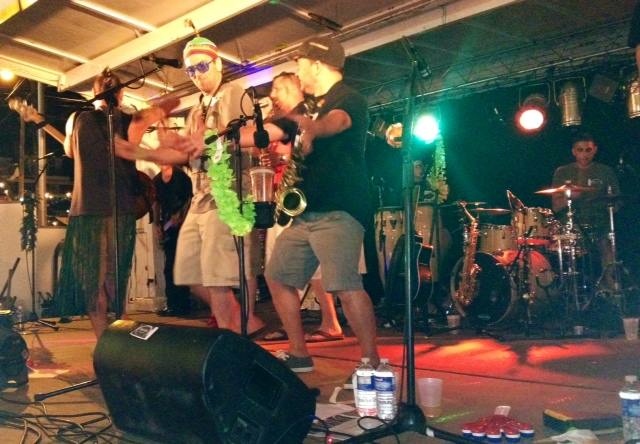
We were there, too; walking through the huge crowds of happy people — of all ages, skin colors, shapes, and fashion tastes — listening to the bassline humm of a strobe-lit rock band; drinking sangria and eating cacoila and pork butts at the food pavillion; tapping foot to the music of a screaming, hip-hoppy blues rock ensemble on the Madeira Avenue stage; shopping T shirts at the concessions on Hathaway Street; and — maybe best of all — walking up and down Davis Street, Whitman Street, and Madeira Avenue, past the Club Porta Delgada and St. Michael’s — vroomed by motorcycles — between rows of multi-deck houses in, on, and in front of which one met ordinary people celebrating life, tight shorts, tank tops, and the neighborhood.

Image

^ tambours and guitars led processional through the crowd. Love those caps !

This was what a Festival should be. A celebration of one’s self, one’s community, one’s tastes and enjoyments, in the heart of the neighborhood and not pushed off to some bland park on the outskirts. A Festival squeezed in among where people actually live — that’s how they do it in Europe, in cities where people live cheek by knee in buildings that hug each other; living among cooking aromas wafting past cigarette smoke, bumping on slang conversations, sliding over a multitude of immigrant dialects. Obviously it works here in Massachusetts too.

Image

^ screamy blues-based hip hop rock band. Where DID they get those caps ?

The Festival continues today and tomorrow. A schedule of events and locations can be found at the Festival website. It would be a really really unfortunate decision if you decide not to come to it and be part of it. So just come. You will be Madeiran for a day — maybe longer.

NOTE : the Festival lives outdoors. If it rains, you’ll get wet. And you won’t mind it one bit.

—- Mike Freedberg, for The Local Vocal

Image

THE “TRANSPO” TAX : WHAT THE GOP’s “NO GAS TAX” REALLY MEANS

Image

^ State Senate Minority Leader Bruce Tarr introduces “Republican Alternative” Transpo Bill

Our Republican legislators would have you believe that Massachusetts’s new “transpo” tax just enacted into law is an outrage upon our wallets. It isn’t.

As a friend of ours posted this on his Facebook page today : “I did some math after hearing all the chatter about the 3 cent per gallon increase in the gas tax. My daily commute is about 52 miles, round trip. Based on 20 gallons of gas per week, my personal tax increase is 60 cents a week or $31.20 per year. Hardly enough to even notice, let alone impact the economy. Besides, I’ll happily pay an extra $31 to avoid potholes and falling bridges.”

More even than our friend, we go everywhere by car. It’s what you do when you’re a journalist. Probably I’ll do about 400 miles a week. My gas receipts total about 150.00 a week — almost 50 gallons. The tax ? $ 1.50 a week = $ 78.00 a year. That’s less than I spend on ice cream or on the Lottery. And yes, my travel expenses are paid for : but as I am an owner of Here and Sphere, the money still comes from me.

Sure, we already pay a gasoline tax and other state taxes besides. But the new gas tax, which is earmarked for road and bridge repair and for repairs and improvements to our public transit rail system, benefits all of us. Roads and bridges are not free, and those who depend on public transit to get to their jobs — or just to get around — would cost the rest of us a lot more if they had no public transit and thus could not work. Thus the taxes that we have enacted will positively impact the economic life of our state — in a big, big way.

What is the Republican alternative ? Just this : 1. no new transpo tax at all. 2. pay for the needed transpo upgrades and repairs by repealing the “Pacheco Law.”

Sounds good — but it isn’t.

The Pacheco Law guarantees that construction workers will be paid the prevailing wage paid on construction projects receiving Federal funds. The prevailing wage is a union-bargained, contractually agreed wage that we in Massachusetts have imported into our own, state-funded construction projects. The Pacheco wage is a high one, much higher than a non-union contractor would likely pay, given that Massachusetts construction projects are subject to a public, low-bid process.

By seeking repeal of the Pacheco Law, the GOP means to reduce the income of construction workers.

I can’t think of a more damaging economic policy than to lower the pay of people who work and consume. Well paid construction workers don’t hide their pay checks in mattresses; they spend it — big time.

Many Massachusetts people are down on construction workers because of the huge cost overruns and occasionally poor workmanship during the “Big Dig” in Boston. As poorly managed as the “Big Dig” expressway project was, it put huge amounts of money, over many years, into the wallets of thousands of construction workers, whose spending boosted our economy in all sorts of ways : houses, boats, second homes, big new trucks, tool purchases, vacations, clothes, home remodelings, and more.

The GOP’s plan would set back the state’s economy. Taking money out of the hands of workers, it takes money out of the business these workers spend at. It is bad policy, and demagogue-ing the “forever” gas tax as they are doing — calling now for a repeal referendum — only adds ignorance to injury.

—- Michael Freedberg / Here and Sphere

CRIME AND ITS FASCINATIONS : SOME THOUGHTS ON THE THREE MURDER PROSECUTIONS NOW UNDER WAY IN MASSACHUSETTS

PART THREE : THE TRIAL AND TRIAL PREPARATION — IMPEDIMENTS

Image

^ Carmen Ortiz, United States Attorney for Massachusetts, already under fire for over-charging Aaron Swartz

Part III in this Here and Sphere series was going to focus on Punishment. But given the obsessive passions afoot with regard to the Zimmerman Case, its presentation, preparation, and verdict, we have changed the plan. Trial preparation and presentation require a strong look from us.

Thanks to TV shows like “Law and Order” especially, most Americans know a lot about what happens in a criminal case long before it goes to trial. “Law and Order” is particularly valuable because its drama includes plenty of mistakes made, bad decisions, incompetent or overreaching lawyers, disagreements about evidence, and such like. On the defense side there is always the problem of what to emphasize and how. Prosecutors face election and find themselves forced to go the route on cases in which their voting public has great interest. The media pounce on criminal cases of great interest; they cannot avoid it, nor should they. This too has consequences for justice, most of them unhappy. “Law and Order” retreats from none of it. The picture this show puts in frame is often stereotyped — but never false.

“Law and Order” succeeds because crime unthinkably violent or unjust arouses great passions. Whence arises the rush to accuse, which almost always brings more injustice.

The rush to accuse and judge has ruined many a life : one thinks of the Duke LaCrosse team fiasco, the Atlanta security guard falsely accused of bombing a fair, the national security scientist wrongly accused of sending anthrax letters, the Tawanna Brawley accusation that a NY County prosecutor had raped her. One could add many, many more such incidents.

False accusation is no minor break in the social fabric. “Thou shalt not bear false witness” is one of Moses’ 10 commandments, the ground rules of Jewish tribal law. No social mistake outranks false accusation as an act of barbarity. Still, false accusation arises from people’s knowledge that grievous crimes do occur; and who can tell, at the outset, whether an accusation is false or true ? That is why we have police detectives and investigators and why we pay them good money. To separate the false accusation from the likely true one.

Public outcry has engendered more incompetent or unwarranted prosecutions than we can count. In the 1980s it was day care centers abusing children : every case brought was eventually reversed or compromised — in Massachusetts, the Amirault Family of Fells acres — after ruining the lives of the accused. In the 1930s – and before that — it was people of color in the South accused of rape. In the 1920s it was Sacco and Vanzetti — right here in Dedham, Massachusetts.Bartolomeo sacco 1

^ Bartolomeo Vanzetti and Nicola Sacco, prosecuted almost certainly wrongfully and executed after seven (7) years of world wide protests.

In 1692 in my home city of Salem, also in Massachusetts, it was men and women accused of witchcraft.  In the South, from the late 1880s until the Second World war, many black men didn’t even get an unfair trial but were simply lynched…

a lynching

^ injustice at its most passionate…

To return to the present, New York City’s Brooklyn prosecutor is now investigating 50 convictions based on what looks like perjured testimony, doctored confessions, and prosecutorial misconduct.

David Ranta

^ David Ranta, freed in NY after serving 22 years for a rape he almost certainly did not commit

A victim is required. No matter who or how. Prosecutors and police staffs work with that as a backdrop. It is not pretty and it is wrong.

Jurors, too, feel the heat. Juries in high-passion criminal cases are sequestered and their names impounded. We do this so that passion people cannot threaten or otherwise intimidate jurors, at trial and after verdict. It is a wonder that, given this pressure, people are willing to serve as jurors at all.

In the time of Henry VIII, jurors gave a verdict unfavorable to the King at their peril. We, today, are the King.

The moral of the story is plain: the public should — must — reserve judgment; prosecutors and police must seek justice, not convictions; and juries must never be afraid to decide a case as THEY see it, not as WE see it.

In the Zimmerman matter, which we have discussed in separate editorials, very little went as it should. Injustice, incompetence — you name it. Now we turn to Massachusetts and our own three murder prosecutions. Hopefully, we will do much better than tyhe Zimmerman prosecutors and police staffs.

The three cases now under way –James “Whitey” Bulger, Dzhokhar Tsarnaev, and Aaron Hernandez — fascinate us. Murder most foul can never be grasped. It is always open and shut ; was it done, or not ? By this person, or someone else ? Murder is simple — and a mystery beyond resolution.But never beyond opinion.

Most of us have already formed an opinion as to the accuseds’ guilt and of appropriate punishment. Because this is Massachusetts, we ought be fairly sure that the prosecutions will be competent and NOT tainted by misconduct, although our history in this regard is not auspicious. We are proof that being politically progressive is no guarantee of being just about justice.

Image

< J. W. Carney, lead defense attorney for James “Whitey”Bulger

The big danger, though, is that all three men’s juries will feel pressured to reach a certain verdict rather than another. To that end, we commend the Bulger prosecution for its methodical presentation and its readiness to provide to the defense such evidence as our law requires it to disclose. We shall see if the Tsarnaev prosecution meets this standard.

Image

< Bristol County District Attorney Sam Sutter, who will prosecute the Aaron Hernandez case.

Stay tuned.

— Michael Freedberg / Here and Sphere

NEXT : PART FOUR — MEDIA ISSUES

CRIME AND ITS FASCINATIONS : SOME THOUGHTS ON THE THREE MURDER CASES NOW IN MASSACHUSETTS NEWS

PART TWO : DID HE REALLY DO THAT ?

Image

how COULD he do that : Albert deSalvo

On the very morning of my writing Part II of this series comes the news that Albert deSalvo, who in the years 1962 to 1964 scared every woman in Boston as the mysterious “Boston strangler” and was eventually convicted (though only of an unrelated rape) — he died in prison long ago — has been confirmed by DNA evidence to be, in fact, the Strangler. And so revives to us in Massachusetts the memory of one of our state’s most vilified criminals ever. A man who invaded women’s homes, raped them, and then strangled them : it happened to thirteen in all — eleven by the “Strangler” —  though he was convicted not of any of these but of another rape entirely.

The crime amazed us. This wasn’t murder as such. The strangling was only the wrap-up of crimes beyond understanding.

Murder, we all understand. Is there anyone out there — well, HARDLY anyone — who hasn’t at some point in his or her life said, or wanted to say, “I will KILL you” ? We get angry. Anger is the crank that starts most engines of violence. Most of us control the anger, stifle it, move beyond it. Still, the desire to kill is there, dormant, waiting.

Other crimes of violence are harder to understand. Most of us do NOT have the desire to rape, or assault, or commit arson or mayhem. Who says, or wants to say, “I will RAPE you” ? Or “i will burn down your house” ? Not very many of us. Nor do we know someone whom we can imagine raping or burning a house. It’s a puzzle.

Thus the fascination we have with crimes of rape, arson, or mayhem is different from that which we feel for murder. “Did he REALLY do that ? How could he have ? What sort of person IS he ?” These are what we want answers to, what we watch rape, arson, or mayhem trials to find out.

Unhappily, trials seldom give us any objective answers to these questions. What we do get is the evidence — much of it horrific and as beyond imagining as the crime itself — and a picture or pictures of the accused, all of it prejudicial pro OR con. The “perp’ we end up seeing, and judging, is a creation of our perceptions, our own values. This has consequences. The murderer, we are glad to consign to prison for life. the rapist, however, many of us want to torture. He who commits mayhem or assault, we would like to see assaulted or mayhem-ed. The arsonist, not so much; all that he draws is pity and wonder — arson seems a purposeless crime. But it too, like rape and mayhem, we puzzle to grasp. It’s a mystery. And we all love reading mystery stories. Over and over again. the same holds true for rape, arson,and mayhem trials. the accused remains a puzzle even after all has been testified to, shown in pictures, argued over, and decided.

It is so with Albert deSalvo. Though we know the whole public part of his story — and knew it over and over again for decades — we know none of the private story. Why did he do it ? how could he do it ? Probably not even he could have told us. Likely he did not know why. as for how could he ? He just did. Perhaps that was all there was to it. He did it because he could.

COMING NEXT — PART THREE : PUNISHMENT

—- Michael Freedberg / Here and Sphere