
An economy benefits best when almost everyone participates in it — the greater the participation, the better. The more customers a business has, the greater its revenue. The more money those customers have, the greater still.
This is not rocket science. it’s obvious. If a business can’t sell its products or services to customers because customers can’t afford to buy, that business is going nowhere. Some businesses sell only specialty goods or services that most people don’t need or want : yet these businesses, too, don’t want to see potential customers lacking money to buy.
For some reason, these basic facts of economy don’t seem to register with some businesses, or with their political mouthpieces. During the past decade or so we’ve seen an entire political party work overtime to keep money out of the hands of many, many potential customers. Though every statistic makes clear that consumer spending makes up 2/3 of the entire economy, these folks seem to think that the big economic problem is the nation’s budget deficit, or too much Federal spending, or too much intervention by the “Fed.” Exactly the opposite is needed, but these folks have other agendas
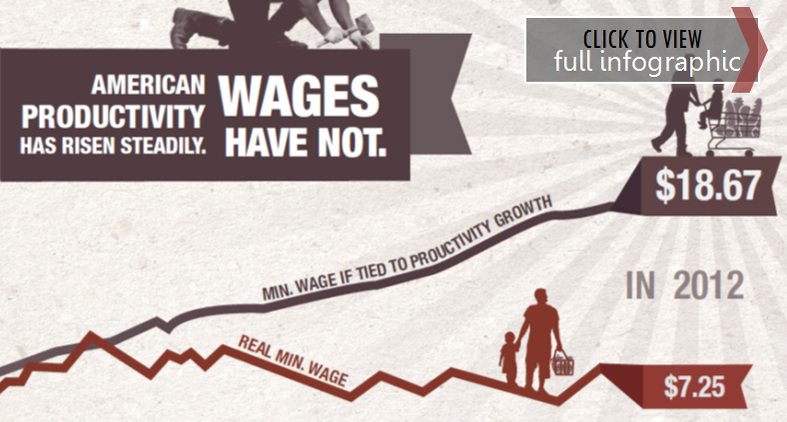
Fortunately, the mistaken-ness of this view has no longer anywhere to hide. We are headed, finally, toward a much more participatory economy than we have seen since 2005. Though the Federal government has been blocked from raising the national minimum wage from $ 7.25 an hour to $ 10.10, many states are raising it, some to an amount far higher than $ 10.10. In Massachusetts the new amount will be $ 11.00. The City of Seattle is preparing a rise to $ 15.00 an hour. Service workers are organizing nationwide to gain a $ 15.l00 an hour wage agreement. Some seek a $ 2 per hour wage. I applaud these moves.
Today, minimum wage workers need taxpayer help, via public assistance, to make ends meet. Public assistance provides low-wage employers with a huge perk. McDonald’s alone sucks $ 1 billion out of taxpayers’ pockets to pay workers what the company refuses to pay. Why should we subsidize this sort of thing ? We shouldn’t, and it looks now as though we won’t have to do so much longer.
Advocacy groups are beginning to focus on how quick-buck traders and maximize-profits money pools force publicly traded companies to cut workers’ wages, or keep them low; to view employees as a “cost item” rather than what they are : a company’s major asset — and, basically, to squeeze corporate assets out of the corporate treasury and into their trade pockets.
Advocacy groups see these trading moves for what they are : liquidation, not prosperity.
Advocacy groups also are drawing attention to unfair labor practices, outsourcing and layoffs, denial of benefits, opposition to paid maternity leave or sick days, and outright theft of mandated overtime pay laws.
Progressive Democrats are beginning to organize an economic fairness agenda that encompasses all of the above reforms as well as pay equity for women, living wage laws, labor law enforcement, and reforms to the nation’s credit card regulations, bank fees, and bank deposit trading practices.
Just as important, more employers — including publicly traded major corporations — are starting to implement high-wage strategies, understanding that well-paid employees are loyal, motivated, healthier, and more innovative. All of which stimulate an economy.
I welcome all these moves and much more.

At $ 22.00 an hour, workers even in expensive cities like Boston could pay their bills without any taxpayer subsidy — freeing up that tax money to pay for vital public services such as education, transportation, and energy conversion, or even for a tax cut which would put more money in taxpayers’ budgets. At $ 22.00 an hour, workers could even do some discretionary spending that they can’t even contemplate now : buying a new car, a new cell phone, new furnishings for the home or apartment, summer camp for the kids, dining out at a restaurant, a night at the theater. All of which spends money into the economy, into businesses.
We call this state of things “prosperity.”
Prosperity does NOT mean an economy in which a few get rich and everyone else barely makes it. That is an economy of scarcity, not abundance.
The most pressing policy push in America today is to reward all work with sufficient pay to make work worth while, to give workers confidence in their work, to get them spending and free of public assistance. Even $ 22.00 an hour adds up only to $ 880 a week, pre-tax. That’s $ 3440 a month; even that sum is far from enough to pay basic bills if one lives in a city as expensive as Boston; but a two-income family at that level earns $ 6880 a month, and that is enough to pay basic bills even in Boston. Indeed, it’s enough to allow at least. some discretionary spending, even some savings.
At $ 15.00 an hour, a two-income family will earn $ 4800 a month — 35 percent of which, at least, will go to rent alone. A $ 4800 family won’t need public assistance, and, if no bad things befall, will pay basic bills, though with no margin for error. Is there some reason why our society can’t value work — all work — at least this much ?
A minimum wage of $ 15.00 seems local-option only. In smaller or less expensive cities, such a minimum wage might be too high. But I can think of nowhere that the proposed Federal minimum of $ 10.10 is not vitally needed.
It is going to happen.
The only reason that our economy continued to grow robustly after about 1975 was the introduction of credit cards., which offered consumers quick buying power. By 2007, consumer credit card balances comprised 20 percent of America’s entire GDP. (Yes, I said 20 percent.) Trillions of plastic money debt dollars enabled all kinds of businesses to grow enormously. It was fun while it lasted, but it was a false economy, and it has ended. Since 2008 consumers have been paying down credit card debt down fast enough to shave a full one percent off the nation’s GDP : 240 billion dollars a year. No wonder our economy is growing so slowly.
Paying workers the level of wage that I am advocating is a far solider, stabler way of growing the economy than inducing workers to borrow credit card debt. wage money is theirs. it does not have to be paid back. Our economy should never count credit card spending as a growth indicator. Growth comes from wages and income spent by those whose money it is. There can be no worthier national policy than to assure every working person sufficient money of his or her own to go about life a free agent.
—- Mike Freedberg / Here and Sphere



 Here and Sphere