BOSTON MAYOR RACE : CONNOLLY, WALSH, and ARROYO IN COMMAND at SOUTH END BUSINESS ALLIANCE FORUM

Image

^ Charles Clemons, John Connolly, and felix Arroyo at SEBA Forum

—- —- —

Last night’s Mayoral Forum at the Calderwood Center on Tremont Street asked the most pointed questions and addressed more topics than at any Forum we’ve observed so far. It being the South End, heart and stomach — excellent hors d’oeuvres were served in the foyer — of the “new Boston,” comprehensiveness was to be expected. Basic just won’t do for a locus of million-dollar condos.

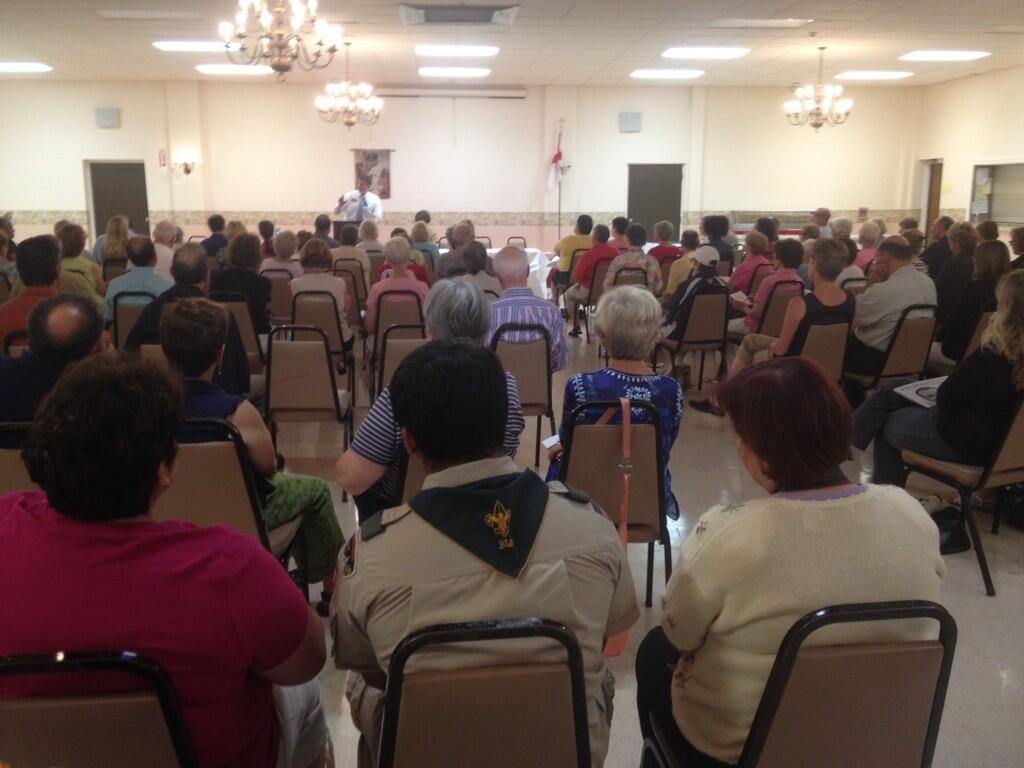
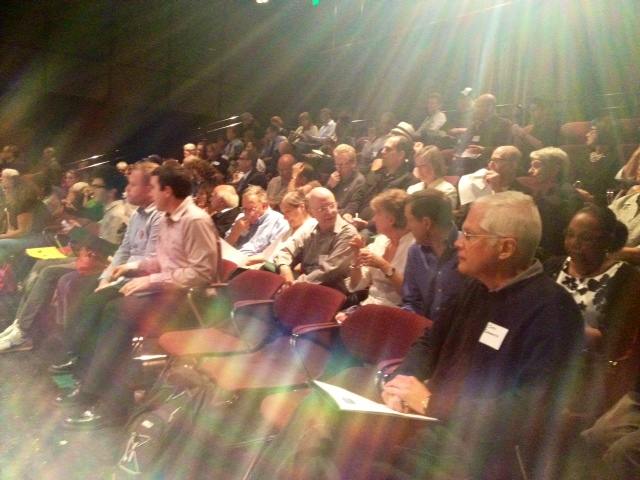
Hosted by the South End Business Alliance — SEBA — the Forum gathered an audience of about 200. it was a well informed group, with definite preferences: favorable answers from the candidates drew approving cheers and applause; unfavorable ones were given the silent treatment. There was plenty of each.

That said, this Forum made clear what has portended for some time now : that the leading candidates, according to polls, are leading for good reason. They have greatest command of the issues — big and not so big — and of how to address them. Connolly, Walsh, and Arroyo made their points with specificity, each man inputting his own expertise and vision, each speaking his own language — and doing so with persuasive conviction. For Connolly, that meant the most modern of cities : zipcar, apple store, user-friendly, bicycles, lifestyle diversity — and biolab 4. For Arroyo, it meant a city in which pathways out of poverty are a priority. Marty Walsh saw a partnership city, between business and labor, the Mayor working in team with the City Council and with the Boston delegation to the state Legislature.
Image

^ an audience informed and knowing what they want

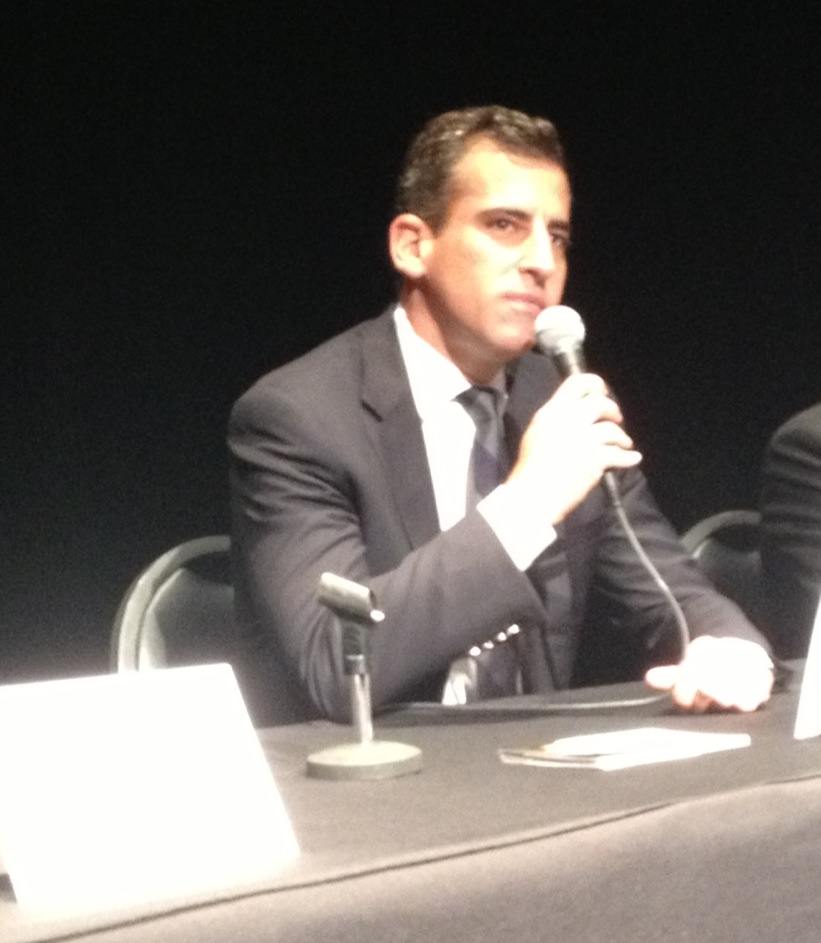
The other candidates on stage — Charlotte Golar-Richie worked the foyer but did not sit in; Consalvo and Wyatt made no appearance at all — answered less strongly. Mike Ross, who has spoken eloquently at earlier Forums, seemed less in command here — perhaps it was the questions, which did not fit his vision of fun city — restaurants, liquor licenses, and neighborhood nightlife. His best answer fitted that slot : “Yes I am a supporter of food trucks (which SEBA’s restaurant members don’t like), but keep in mind that some good food trucks have stepped up to be bricks-and-mortar restaurants.”
Image

^ Mike Ross : food trucks to restaurants
Image

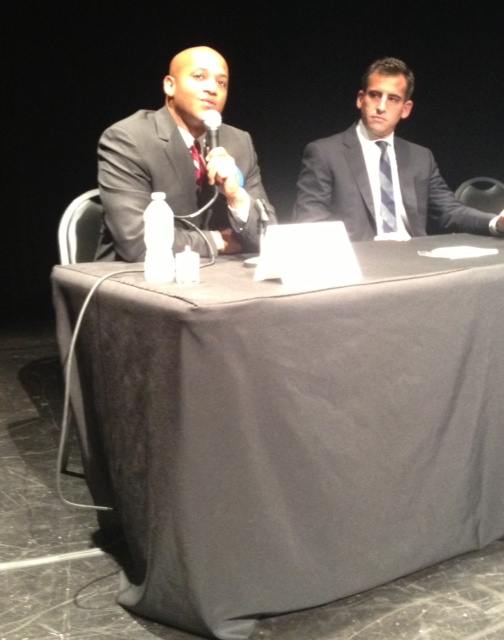
^ John Barros : seeing City hall from his neighborhood (Mike Ross to his right)

John Barros and Bill Walczak spoke from the viewpoint of their particular experience ; schools for Barros, the Codman square Health Center for Walczak. The tactic made their answers sound provincial. a Mayor should see the neighborhoods from City hall. Barros and Walczak did the reverse : looked at City hall from a neighborhood. And Walczak, as always, offered his “no casino” mantra.

Dan Conley stayed at the Forum only long enough to respond to a twenty-question round robin of “yes, no, or thinking about it” quickie answers to this or that one-word issue : casinos, liquor licenses, South Boston parade, audit the city, change the BRA, and such like. As for Charles Yancey and Charles Clemons, each made a couple of notable points — specific to their personal resumes — but both lacked preparation, and it showed.

Each candidate was asked what was his proudest moments, in public life and in his work. Marty Walsh answered thus : “protecting jobs. We passed legislation which has allowed technology companies to bring in new jobs that for he most part were in California. But hey, it wasn’t just about me. (It’s) working with a team. It’s not just you, it’s going to be working collaboratively.”

Then Felix Arroyo : “my proudest moment on the Council ? There was an attempt to close our city’s libraries. I was instrumental in stopping that. Before that, the work that I did in organizing janitors. They were making eight dollars an hour,. now they’re making fifteen.”

Connolly : “most important council work ? getting a strict energy efficient city code passed. as an attorney, my proudest moment wa represennting a client, pro bono, two guys here in the South End (who were victims) in a gay-bashing case.”

Another not so typical Forum question was then posed ; ‘have you started thinking about who you would include in your administration — in your cabinet — as Mayor ?” The strongest candidates gave the most intriguing and thoughtful answers.

Walsh : “a new superintendent of schools first…the hierarchy of the Police department should be revamped. Look at the Fire department too. Include all the city in my discussions and decisions.”
Image

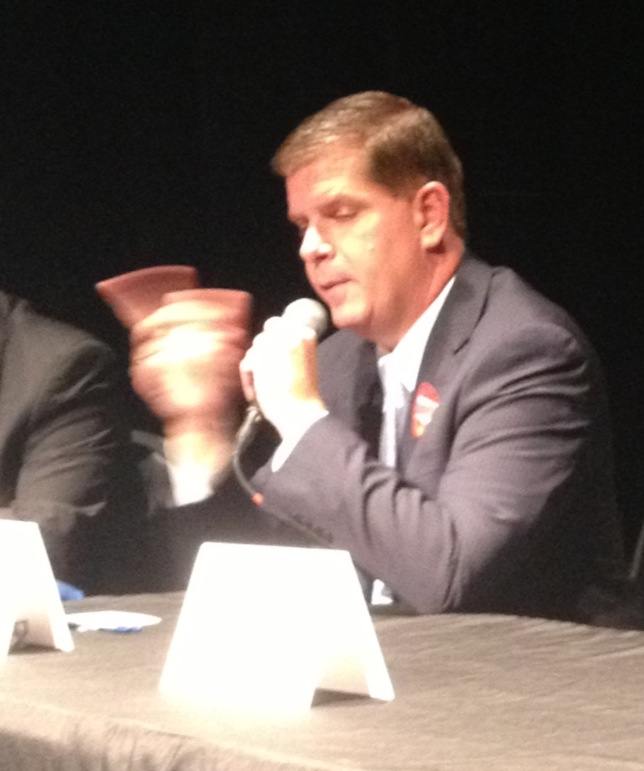
^ Marty Walsh : vows big changes at the Police department

Connolly : “new generation, new leadership. Superintendant of schools — how about one who is non-traditional ? A city-wide summit on public health. Begin overhauling city hall to be user-friendly.”

Arroyo : “A diverse cabinet that shares my values. A superintendant of schools who knows that you have to work with everyone.”
Image

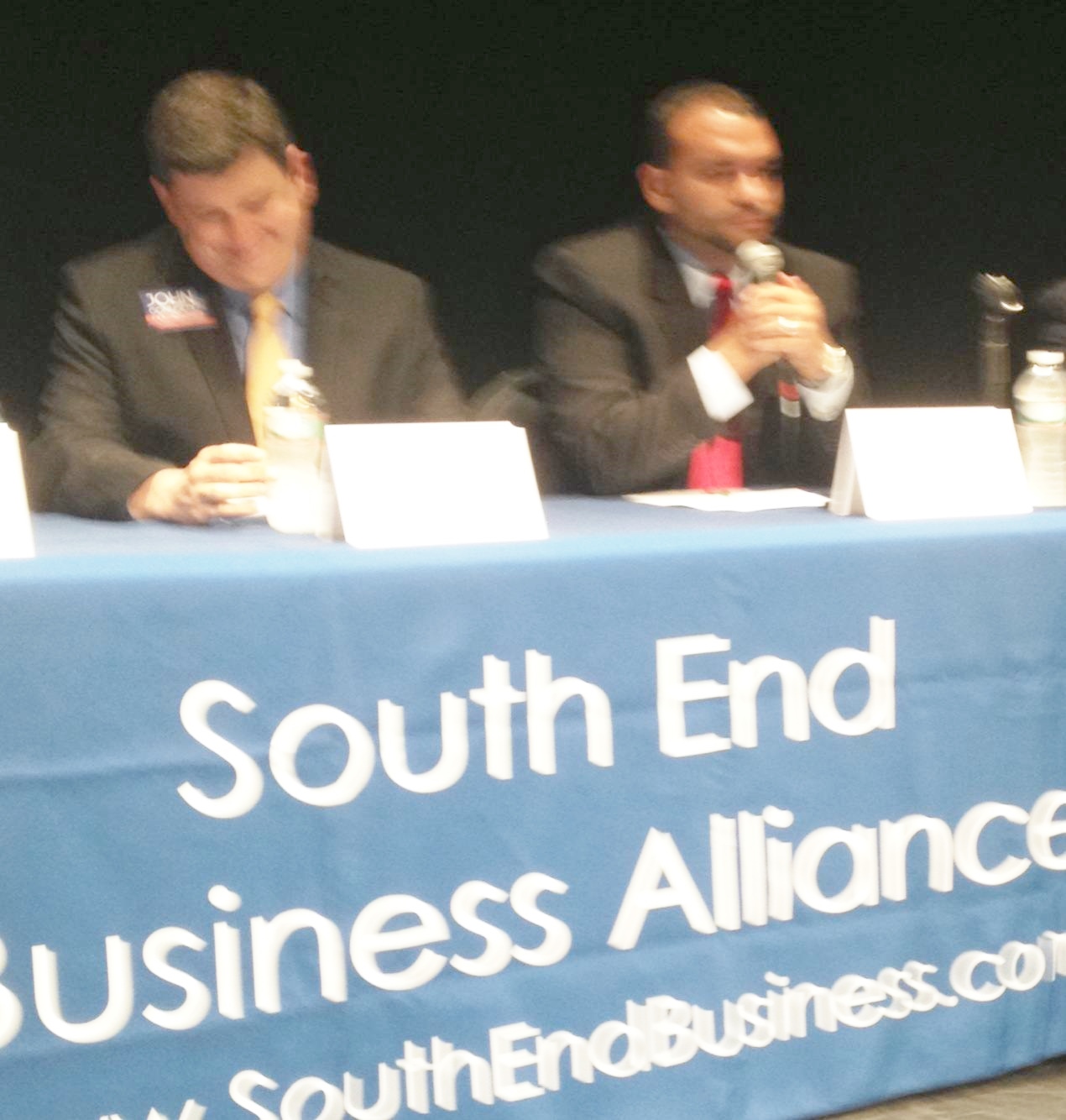
^ john Connolly and Felix Arroyo : will they work with the Council ? So they say…

Next came a question guaranteed to elicit an unreal answer: “how will you as Mayor work with the City Council ?”

Connolly : “We are better when we disagree. I want a council that is bold and independent. Disagreement makes us better.” (to which I comment : “sounds good, but that’s not how it plays out. The Mayor may let the council gripe, but he has the power and the Council doesn’t.”)

Arroyo — “The Council is there because the voters put them there. But more importantly” — and here he pointed to the Forum audience — “I want to work with YOU !” (to which I comment : “a slick way of ducking the question !”)

Walsh : “The city council is a partner. I would also include the Boston legislative delegation and also legislators from around the state. The mayor can’t do it alone, he’s not a dictator.” (to which I comment “no, but the Mayor often thinks he is.”)

By this time the Forum had shredded badly. Conley first, but then Ross, Barros, Clemons, even Connolly, one after the other, had to leave to attend other events. Only Arroyo and Walsh said they were here for the duration.

They all apologized, of course. But as the race is now well into crunch time, every candidate with any chance at all has more events on his or her daily schedule than could be attended in three days. And so it goes. rush, greet, rush, talk, rush, talk, greet, talk, rush. You want to keep up ? You will have to rush, rush too.

—- Michael Freedberg / Here and Sphere

BOSTON MAYOR RACE : WALSH, ARROYO, BARROS and ROSS DOMINATE YOUTH GROUP FORUM

Image

^ the Nine : Yancey, Wyatt, walsh, Walczak, empty chair (Ross came later), Golar-Richie, Clemons, Barros, Arroyo

—- —- —-

Nine of the 12 candidates running to be Boston’s next Mayor took their seats at tonight’s Youth Group Forum held at the newly steepled parish Church on Meeting House Hill in Dorchester. About 150 residents of the neighborhood sat in the old New England pews to listen as the Mayors-to-be answered questions posed by speakers selected by the Cape Verdean Community UNIDO’s Youth Leadership Academy.

Dan Conley, John Connolly, and Rob Consalvo did not participate.

Questions to the candidates addressed dual-language education, school reform and preparation for technology jobs, and how to curb violence in the community. Mike Ross — who arrived late, but apologized — gave strong answers; even stronger, John Barros and Felix Arroyo, whose eloquence is second no nobody’s on behalf of those who live in Boston but lack access to the best. Strongest of all, surprisingly, was Marty Walsh, who had obviously prepared himself for the types of questions likely to be asked him. He spoke deliberately, in detail and with feeling, applying his work as a legislator and stating his goals for changing how the Mayor’s office confronts the problems that this Forum’s youth sponsors will be dealing with.

One issue that has turmoiled Boston voters recently, that of a longer school day, was settled. All the “major” candidates called for a longer school day, even Felix Arroyo, who has aligned himself with the Boston Teachers Union most closely of all the hopefuls. He, Walsh, and Barros gave the directest answers on what a longer school day should focus on. Barros’s call for a two-shift teaching force might roil the BTU a bit, however.

Image

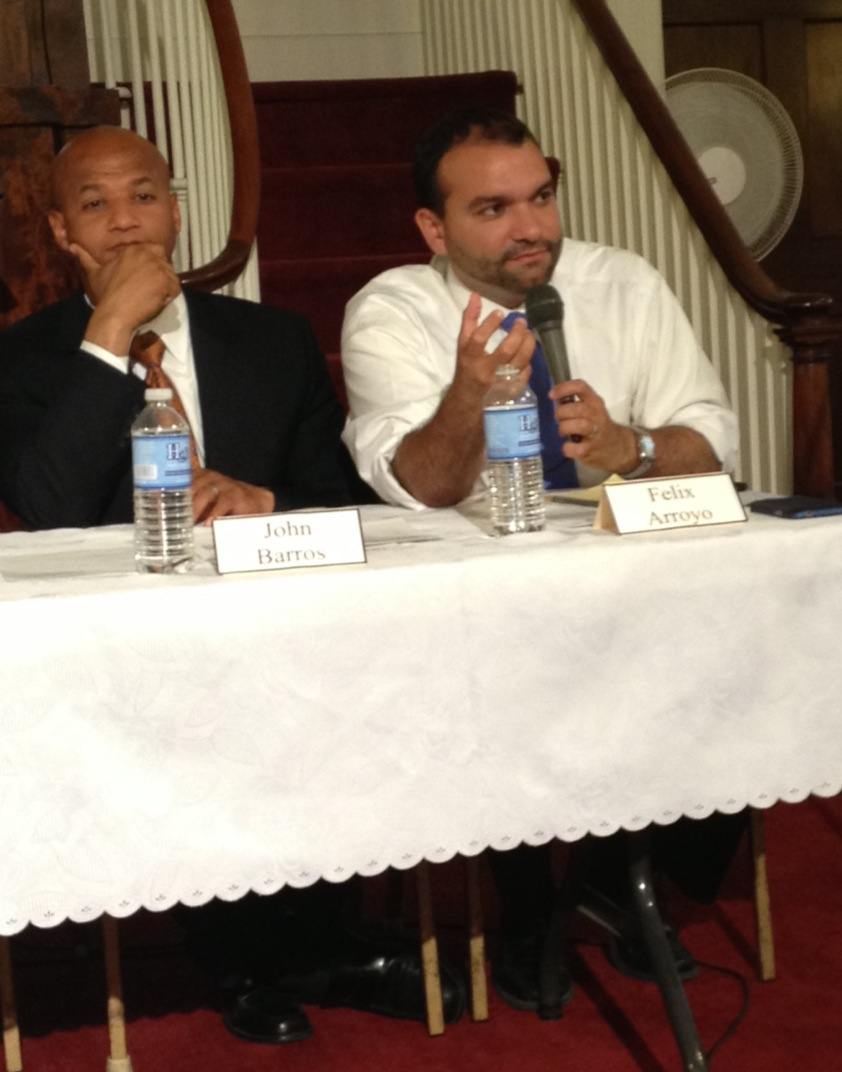
^ John Barros (Felix Arroyo on his right): “for the longer school day we should have teacher shifts, an early shift for the morning and lunch hours and a late shift for the afternoon.”

On the question of dual language schools, Both Arroyo and Barros spoke with personal experience. Said Arroyo,  “I grew up in a subsidized apartment with immigrant parents who spoke ‘espagnol.’ I know what it’s like to grow up among kids who I did not understand because they spoke English… we have only four dual language schools. Parents of all backgrounds want dual language education. Look at the Hernandez School, it works well. I look for the day when we have many different language’d dual-language schools. French, Cape Verdean Creole, even Mandarin. Why not mandarin ?”

Image

^ Felix Arroyo (John Barros on his left) speaking to the schools issue : “every Boston school child deserves the best education because every child is a best child.”

Barros ; “I’m a son of cape Verdean immigrants. When I joined the city’s school committee, and in my work, I fought to assure that all Boston public school students learn English fully.” These sentiments were of course reiterated by other candidates at the forum, of whom Charlers Clemons nloted that he was ideally suited to understand the disconnecvgt between studenyts who come to bostyon with anoyher language and the Ejglish-language adyuklt world. “Not by language but by my heritage. My father descends from slaves brought here on slave ships; my mother from the Brewsters on the Mayflower.”

It was a memorable, if not conclusively Mayoral moment. And led almost inevitably to Walsh’s comment : “My parents didn’t face a language challenge, but they were challenged too. Both had less than a high school diploma.” Walsh, who grew up and still lives in the Dorchester section directly abutting Meeting House Hill, discussed the funding process for dual language education and his part in it as a 16-year legislator. He concluded with a challenge: “We should have two different kinds of dual-language schools. When a child’s first language is English, we should have them learn another language !”

Image

^ Marty Walsh ; “with a longer school day we shouldn’t just have more classroom but also some programs, the arts.”

The question on preparation for graduating to the City’s best jobs brought this comment by Arroyo : “The next mayor has to have as a priority closing the ‘achievement gap.’ And it begins very young. If a child falls behind in the third grade, even , it is already too late. We need to teach financial literacy, too, to all our children.”

Walsh ; “we don’t just need to change our city’s jobs policy for the kids, We need to rewrite it. Right now we’re being sued because our city jobs policy doesn’t meet the US Constitution !”

Many of he candidates mentioned Madison park High School — the technical high school closest to Meeting House Hill — in their answers to this question. Barros ; “We absolutely do invest in technical High schools in Boston. Now we have to make sure that Madison park has a technology center. And more ; Boston residency, for Boston jobs.”

Charles Clemons, a former Boston police officer, was skeptical ; “residency policy ? It has never been enforced. We give parking tickets and licensing fines but we don;t enforce residency. Why not ?”

The forum moved on to discussing the problem of violence in the Meeting House Hill neighborhood and others.  Many of the candidates addressed the issue well.

Mike Ross had now joined the group and, with his usual grasp of big-picture basics, said : “there’s diversity needed (on the police force). It’s not OK that there is not one police captain of color nor one who is female….the opposite of violence is opportunity (for kids at risk).”

Image

^ Mike Ross : was at another event; apologized for coming late; and, as always, spoke well and to the point

Arroyo : “there’s a short term strategy and a long term strategy. Short term : back to community policing. Police bicycling through the community. Long term : if we are not serious about ending the cycle of poverty we’re not serious about reducing crime.”

Walsh, who has said “there’s a heroin epidemic in the City right now,” gave this pledge : “(if I’m elected,) The first meeting that i will have in my office will be on violence. we have to attack this problem one street at a time, one family at a time.”

I have highlighted the answers given by candidates Walsh, Arroyo, Barros,and Ross most of all because they addressed the questions, gave answers which signal that some thought has taken place in the brains about these issues, and demonstrated seriousness about doing the job, not just campaigning for it. The other candidates present either gave rambling, conversational responses — Charlotte Golar-Richie — or ones that seemed too narrowly focused, locally and in minutiae — Charles Clemons and Bill Walczak. Others of the nine on stage seemed to be talking more to themselves than to the voters. One wonders why they are running. At this stage, with less than five weeks till Primary day, there’s no time left for candidacies that won’t, or can;t command the issues on a large scale. Mayor of Boston is the most difficult political job, maybe, in all New England. Fumble-itis, vagueness, and circuitous thinking are NOT in the job description.

BOSTON MAYOR RACE : CONNOLLY RECOVERS NICELY; WALSH FOCUSES; THE FIELD GETS SOME MOJO

Image

^ John Connolly : what schools flap ?  — here he is in East Boston

—- —- —-

We will admit it : we didn’t think that John Connolly would be able to surmount the huge flap over a $ 500,000 “outside” money dump that that smothered his campaign. But he has.

We thought sure that his schools agenda would look less reformist, — as a result of his being gifted by Stand for Children, an Oregon-based advocacy group debunked by some for relying hugely on corporate money of a seriously regressive sort — than insidious. For about three quarters of a day, it looked like we had it right.

But then, in less than an evening, Connolly struck back, fully. Supporters rallied to his side — publicly and unreservedly. He touted his “green-ist” credentials as the campaign voice of Boston’s “park people.” Big-name Democrats like Ian Bowles stepped up.  And he rejected the $ 500,000 for once and all, in a statement that left little doubt that he was quite angry at being ambushed by a group purporting to support his candidacy.

How effective was Connolly’s response ? Rival Dan Conley congratulated him on rejecting the money. THAT good.

Connolly also benefitted by an over-reaction by Felix G. Arroyo, who not only touted his support for Boston Teachers (and their Union, the BTU),which was OK, but then proceeded to assert that as Mayor he would work to eradicate poverty in Boston. Oh really ?

So here we are, on August 22nd, with a Mayoral Forum, taking place tonight at the newly re-steepled white church on Dorchester Center Hill, and 32 days left before Primary Day, and all is back on course. What WERE we thinking ?

Yes, a few doubts linger about Connolly’s commitment to school reform that isn’t a corporate take-over. You can see the doubts in his Twitter feed. But he is confronting the doubters, indeed, allowing their doubting tweets to stand in his Twitter list for all to read. this is a smart move.

Image

^ Marty Walsh on L Street : pressing some Wards 6 and 7 flesh and moving on up

Meanwhile, in South Boston, Marty Walsh is taking care of some unattended business. Last night former Senator Jack hart co[-hosted a huge party for him; during the day, Walsh greeted voters along L Street. Jon Connolly has cozied big-time up to South Boston’s State Representative, Nick Collins. Bringing Jack Hart into play allowed Walsh to send Connolly a message — and one to Coll;ins as well. It has always seemed sure that the strongly labor-backed Walsh would dominate in South Boston, but lately that primacy has come into doubt. Today there seems less doubt in play.

The Walsh campaign moves ahead to another neighborhood where support from his fellow State Representative has eluded him : East Boston. In this case, the legislator (Carlo Basile) has actually endorsed a rival. So, on Monday Walsh will host a “Mondays with Marty” in East Boston. It will be interesting to see who and how many come to hear him speak.

Image

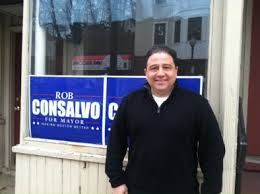
^ Rob Consalvo : neighborhood schools. In Kenmore Square ?

The rest of the Mayor race’s bigger hopefuls seem finally to have found their stride. was it the Connolly flap that tweaked them ? It seems so. Many of his rivals suddenly became advocates for neighborhood schools (Consalvo), or opponents of charter school increases (Ross), or voices for public school teachers and the under-performing schools (Arroyo). Golar-Richie pushed a women’s safety agenda — significant certainly,l in light of the murder of Amy Lord, not to mention the killing, in nearby Waltham, allegedly by Jared Remy — Jerry Remy’s son — of his girlfriend.

Image

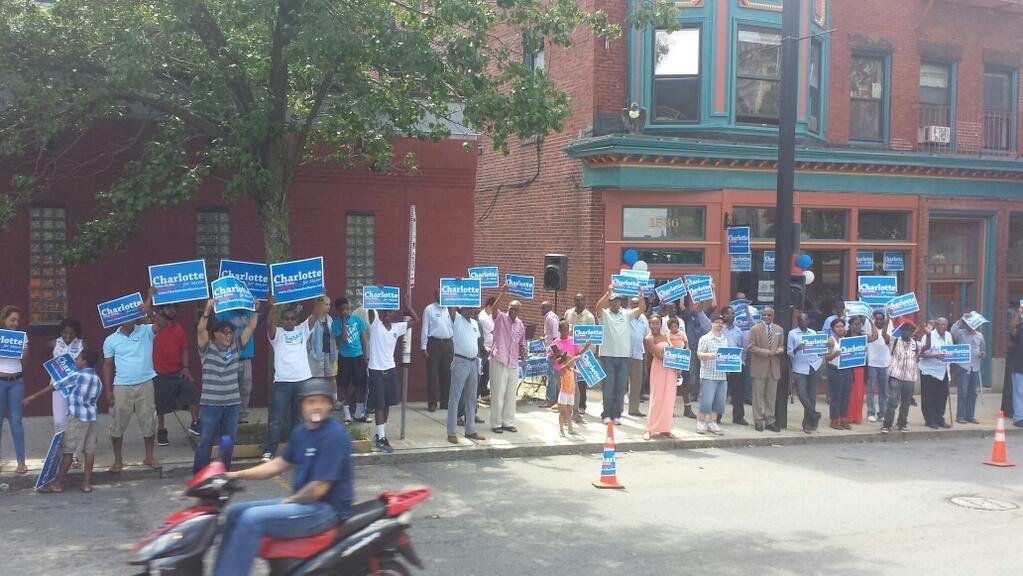
^ Charlotte Golar Richie in the North End,. with St. Rep. Aaron Michlewitz.

Connolly also launched his first television ads. So has Consalvo. Marty Walsh probably has them running also, though we haven’t yet seen any.

Every night now, Boston voters have a vast choice of campaign events to drop in on, or events of their own for candidates to appear at (for us at Here and Sphere too). Every day there’s a meet-and-greet — or three, or five — going on somewhere in the City. It’s all out sprint time, indeed a typhoon of sprints, as the campaign approaches the first week of September and all that that portends for political weather.

—- Michael Freedberg / Here and Sphere

Meranwhile, top rioval marty walsdh is tak

BOSTON MAYOR : ROSS, CONNOLLY, ARROYO, AND WALSH IN COMMAND AT MAIN STREETS COALITION FORUM; DAN CONLEY EFFECTIVE TOO

Image

^ the Twelve : Arroyo, Barros, Clemons, Conley, Connolly, Consalvo, Golar-Richie, Ross, Walczak, Walsh, Wyatt, Yancey

—- —- —-

Supporters of Mike Ross, John Connolly, Felix Arroyo, and Marty Walsh can sleep well tonight.  At the Forum held by the Main Streets coalition of 20 Coalition members, their candidates spoke well informed on every topic asked, indeed eloquently at times. Each seems to have his vision of the mayor’s mission well in place, and each saw the questions — mostly the concerns of small, neighborhood business, because that is what the Main Streets program is about — authoritatively in their particular mission’s terms. Dan Conley spoke effectively too, albeit in detail only — no grand themes did he embrace.

At a Forum, a candidate uses forensic skills. Speaking at a podium or into a microphone isn’t all that matters to a campaign — far from it — but voters do want to know that the candidates they are assessing can speak to the issues on voters’ minds and do so boldly, without resort to talking points. At the main Streets Coalition Forum, held in Upham’s Corner’s Strand Theater, the five candidates so far mentioned aced the test. If only the theater had been more full. It holds easily 1200 people, but most seats were empty. Let’s say that 300 were in the room, many of them supporters of local favorites John Barros, who lives nearby; Charlotte Golar-Richie, who lives almost as close by as Barros; and Felix Arroyo.

The evening had its highlights. Each of the effective speakers chalked up several.

On the question of what to do with the BRA, Marty Walsh and John Connolly answered well. Said Walsh : “Certain things are working, but much is lacking. Costs of construction don’t get figured properly. Main Streets organizations aren’t told where to apply to fill slots on their boards.” Connolly gave this answer : “going into the BRA should be like walking into an apple store : serve the customer. We should utilize technology to make the BRA’s services more user friendly. There should be a time limit on all BRA Board members. we should know how the BRA plans to create jobs and housing.”

Image

^ John Connolly ; an apple store government, with equity funding for small businesses

Even stronger was Ross’s answer : “Remove all affordable housing plans from the BRA. We shouldn’t decentralize the BRA in the middle of a building boom, but affordable housing must be the first principle of any developer’s plans.” Conley’s answer was also memorable : “the BRA has a lack of predictability, accountability, transparency. I will publish all BRA decisions on my website. Splitting the BRA would hurt its effectiveness.”

Image

^ Dan Conley : no big vision, but much useful reform

As these answers make clear, the candidates are divided on whether planning should be a separate process from that of BRA approval. The voters will have to decide that one for themselves.

On the permitting and licensing process, all of the effective speakers agreed that it takes far too long to navigate the process and costs far too much to get so many city agencies to sign off a plan. Ross said it best : “We need less bureaucracy ! in this city it should take 30 days — no more — to get a business permitted. No business owner should have to call an elected official to get his business open !” Walsh added this : “27 permits to get an outdoor vending business licensed. That’s just not right !” Arroyo made much the same points, though more gently. You could hear the frustration in Ross’s and Walsh’s words; clearly they have heard horror stories galore from business people in Boston.

Image

^ Mike Ross : “restaurants are ambassadors for a neighborhood.”

The candidates were asked if they support Councillor Ayanna Pressley’s home rule petition to the State legislature to have all of Boston’s Licensing Board appointed by the mayor; under current law, the Governor appoints a member. All the “major” candidates said yes, but Ross’s answer stood out. It just might have been the best by any candidate to any question posed : “Must say to you that the legislature is very reluctant to give this power up. But restaurants are ambassadors for a neighborhood. If people are visiting a neighborhood in the city and can’t have their hosts take them to a local restaurant because there isn’t one, that hurts the neighborhood.” On which point Arroyo noted that Mattapan, for instance, has almost none of the 1000 liquor licences in Boston, ‘and,” said he, “that’s just plain wrong.”

Image

^ Arroyo : the people’s candidate. And why not ? it worked for Scott Brown.

Finally, the candidates were asked about funding for small neighborhood businesses. Here Walsh gave the most effective answer : “Small banks need to give back to the community they’re in. The Mayor can make a difference by picking where the City deposits its money.” Arroyo noted that he has legislation filed to require banks to disclose how much and where they lend out money into the neighborhood they serve. Connolly made his own characteristic, tech-savvy point : “We should be talking equity investment, not just lending, to be available to local businesses. Call it a ‘buy Boston’ program.”

So there you have it. Connolly sees the Mayor as the director of an Apple store and maybe the entire Apple business, too. Walsh’s Mayor would bend city agencies to the needs of the construction boom and the businesses it is empowering. Arroyo as Mayor will serve people where they live, informally as they live, and make these living informalities his priority. Dan Conley will work quickly to de-mystify the arcane ways of City Hall and City planning. And Mike Ross will do much the same as Arroyo, but with a broader vision that includes developers as well as informal people.

Image

^ “traditional” Marty Walsh : authority and command even at a new-Boston Forum

Ross was the evening’s good surprise. I did not expect him to give voice as eloquently as Arroyo to the frustrations that average people have with City Hall: but he did so. Arroyo spoke from the heart; Ross spoke from the heart and the head; his is the true voice of classic urban progressive reform in this campaign, a voice that recalls the great urban reform speakers of a hundred years ago. Unfortunately for Ross, there aren’t all that many 2013 voters who speak, or respond to, the voice of classic urban reform.

The evening also surprised in a bad way :

Rob Consalvo spoke much too quickly and lowered his eyes most of the time. He needs to look up and speak deliberately; say less words, more meaning.

John Barros disappointed. We had heard that he has the most eloquent vision of a city in progress; at this Forum he retreated from boldness to a kind of guy-next-door friendliness. That persona might elect a City Councillor; as a would be Mayor it failed.

Charlotte Golar-Richie continues to see herself as an administrator — more capable than the current, but an administrator most of all. That is not a message to win votes. Voters want an advocate, not a manager. The Mayor can hire managers.

—– Michael Freedberg / Here and Sphere

BOSTON MAYOR RACE : THE STRATEGY OF FELIX G. ARROYO

Image

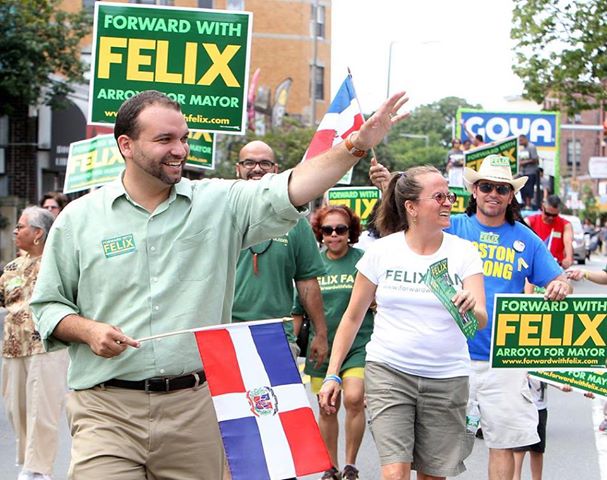
^ Felix G. Arroyo at the Dominican Parade. (photo by Eroc Arroyo-montano)

With only 35 days remaining before the September primary, Boston’s candidates for mayor had better be presenting — or mirroring — a really Big Story or they have no chance of finishing in the top two.  John Connolly’s Big story is being the “education Mayor.” Marty Walsh’s big theme is “Boston’s construction boom, its businesses and laborers.”

Only one other candidate seems to have a really big Story in hand: Felix G. Arroyo. His story appears a social-issue, left-leaning one. He is pushing to be THE candidate of Hispanics, of committed left-leaning labor, and of the lesbian, gay, and transgender communities. Given Boston’s overwhelmingly left-leaning, socially progressive voting record, Arroyo’s big story makes election sense. Of course it’s the only story available to him, given Connolly’s and Walsh’s dominance of the other two big Boston stories. Yet Arroyo has surely not chosen this path because there was no other for him. His life bio almost dictates it. His father, Felix D. Arroyo, achieved major political success in Boston by winning to his side almost all of the Left and building upon it. Arroyo junior would have been ill-advised not to have followed his Father’s successful — and well remembered — course.

That said, Arroyo junior’s story line confronts obstacles that Walsh’s and Connolly’s don’t. First, the election for mayor is not a national election in which Presidential and Congressional issues command the voter. Boston’s Mayor ballot doesn’t even list political parties — and in fact eleven of the 12 candidates are Democrats, including all of Arroyo’s major rivals.

Second, because social issues do not divide Boston as they do the nation — almost all Boston voters are socially progressive and look favorably upon organized labor — it is NOT Arroyo versus everybody else. Connolly has significant support from the constituencies that Arroyo needs, and even Marty Walsh, supported by openly gay State Representative Liz Malia, has a flag planted in the socially liberal camp too.

Third, the issues in a Mayor election don’t fall neatly into progressive against conservative. Trash collection, casino development, the BRA, school improvement, snow removal, traffic issues, and zoning have their own dynamic. The Mayor administers the city; he does not legislate wages, labor union rights, abortion, or pay equity. He is a bureaucrat, not a preacher to the nations.

There is no progressive or conservative way run a Boston city budget. The voters demand services, and that is that. These have to be paid for, and they are. And though yes, the Mayor can set a socially progressive tone, or not, and establish strong outreach to LGBT people, or not, no one is going to be elected Mayor this year who isn’t completely committed to social progressivism.

Lastly, few voters in a city election want to vote for a candidate who looks unable to win. The perception that Arroyo is not likely has already cost him a union endorsement and is likely to move voters favorably disposed to him to give him more kudos than votes.

I am not saying that Arroyo can’t get past the Primary; there is a large enough “new Boston” vote that indeed he can. Yet even as a “new Boston,” he is cornered. Its vote is by no means mostly his. Charlotte Golar Richie and, it appears, both Mike Ross and John Barros will have significant support therefrom — support that for the most part could be Arroyo’s were Ross, Golar-Richie, and Barros not in the race. But they are.

I make one final observation : Arroyo’s campaign story reminds us of Mel King’s themes in 1983. King, too, was a candidate of the Left — the very far Left. in 1983, being far Left got King into the final. But King was the only far Left candidate — and the only candidate of color — running in 1983. This time there are three significant candidates of color on the ballot. Moreover, King’s far left views guaranteed his overwhelming defeat in 1983. Today, Boston has moved left; such views would not automatically spell November doom. They would, however, still generate strong opposition from a Boston business community enjoying a huge building boom — and the popularity that comes with it. Furthermore, downtown Boston is heavy with technology people, finance executives, and education and medical people who, thirty years ago, either didn’t exist or mostly lived in the suburbs. These voters are surely socially progressive, but far Left views on labor and the economy don’t speak their language of prosperity and enterprise.

Arroyo may yet gather to him, in a 12-candidate primary, enough voters to threaten the current two leaders. I like his enthusiasm and also sense a pragmatism in him (as in his Dad) that belies his image as a left-leaning ideologue. (Mel King he isn’t.) Arroyo would, I think, make an exciting Mayor, one who could bring the current Boston prosperity to many who have yet had the opportunity to participate. The excitement that i feel for Arroyo as Mayor surely excites his followers. If he does not make it past the Primary, as looks highly likely, he will have a significant say ion which of the two finalists does win the prize.

—- Michael Freedberg / Here and Sphere

BOSTON MAYOR RACE : 18 FORUMS UPCOMING … AND A NEW STATE REP FOR THE 12TH ?

Image

^ John Connolly vs. Marty Walsh : big battle shaping up

In case you doubt that the “sprint to Primary day” is really under way for the 12 Mayor candidates, get this : there are no fewer than eighteen — 18 ! — Mayoral Forums on schedule between today and September 19th.

No one wants to downgrade any Forum, but clearly, of those coming soon, the Main street Coalition’s Forum at the Strand Theater in Uphams’ Corner, on August 19th is key. Important, too,  are the Ward 10 (Mission hill and Hyde Square) Candidates Night on August 27th, the South End Business Alliance Forum on August 29th, and the Wards 19 and 5 Democratic Committee night on September 5. After that, it’s all big stuff, especially these : the NAACP’s Forum, 650 Dudley Street, on September 10th; Action for Boston Community Development’s Forum, 178 Tremont Street, on September 11; the Boston Teachers Union Forum that same night, at the BTU headquarters, 180 Mt Vernon Street near Columbia Point (Dorchester). Then comes the Back Bay Association’s Forum on September 16, and on September 19th, two biggies ; the Dorchester Board of trade, 780 Morrissey Boulevard, off Freeport Street, and a WBUR and Boston Foundation Forum at U Mass Boston in Columbia Point.

Image

^ Former School Committee member John Barros ; impressing many, and a chance to be heard on the big stages coming up

For some of the twelve, these Forums will be a last chance to get voters thinking beyond the “major” hopefuls. For the “majors,” it will be a voice-exhausting exercise in saying over and over again the themes and details that they are already speaking about, again and again, every night now.

Having had few opportunities to say their say in detail and at length, the last-chancers will doubtless impress many. Still, without meaning to sound dismissive, this writer feels, from long observation of major City campaigns, that for the last-chancers, these forums’ big significance will be that they catch the attention of the “majors,’ so that after the Primary, their support will be sought after. Which accords them and their supporters some palpable share in the agenda of whichever candidate finally becomes Mayor. Given that Boston has a strong-Mayor charter, by which the mayor appoints almost every key administrator and runs almost every City department, having skin in his or her game is no small thing for a last-chancer to gain.

There will also be some last-chancers who either do not get the point or who mishandle it. So be it in the political major leagues.

For the “majors,” the objective will be to not stumble, as Dan Conley now infamously did at a recent Black Community Forum, and to not misstate or overlook a policy position. Preparation will not be an issue; with so many forums coming on, no one is going to lose his or her forensic mojo. Still, these forums do not — cannot — overwhelm a major candidate’s time and thinking. He or she has several of his or her own campaign events on schedule, every day and night. it’s one huge, daily rush-rush-rush from here to there and everywhere, a series of stop-and-speak’s, strung across 17 hours of driving like knots on a rope. Such a candidate finds himself cramming on the ride to a Forum — when he or she’s not trying to catch 40 winks.

The good times of this campaign are over for the “majors” — the one on one talks with voters, the casual visits to city parks, neighborhood groups, restaurants, and small house parties. From here on, it’s thirst, palm cards, remembering voters’ names; it’s punishment, exhaustion, endurance, awareness missing nothing, plumping for funds — and reporters bothering them. But hey — this is the biggest of big leagues. Bring on the Forums.

As far as who the Big Two will be after Primary time, we saw nothing yesterday to change our view : John Connolly and Marty Walsh are it, with Rob Consalvo a credible alternative.

I give Consalvo that much because, at yesterday’s special Primary election to choose the 12th Suffolk State Rep’s Democratic nominee (to replace Linda Dorcena-Forry, now a State Senator), he had the most visibility of any mayor hopeful. At the seven city polling places (the District also includes also two precincts in Milton) and in lawn signs all over the Mattapan part of the District, Consalvo showed up.  So far as this writer has observed,he has all along  run the most thorough visibility campaign of the twelve. Were it not that a battle royal is already shaping up between Connolly and Walsh — political people throughout the City are talking about it; we’ll discuss why in future reports — Consalvo’s visibility effort would make all the difference. But that battle royal is taking shape, and fast, and the man from Hyde Park may get squeezed out.

Image

^ Rob Consalvo ; visibility dominant

The 12th Suffolk being a Dorchester/Mattapan thing, local favorite Marty Walsh had workers displaying his name — enthusiastically — at several of the seven polling places; supporters of Bill Walczak and Mike Ross also made a few appearances. John Connolly people, however, were not seen. This could not have been accident. Clearly Connolly had no intention of being measured against Walsh on Walsh’s home turf.

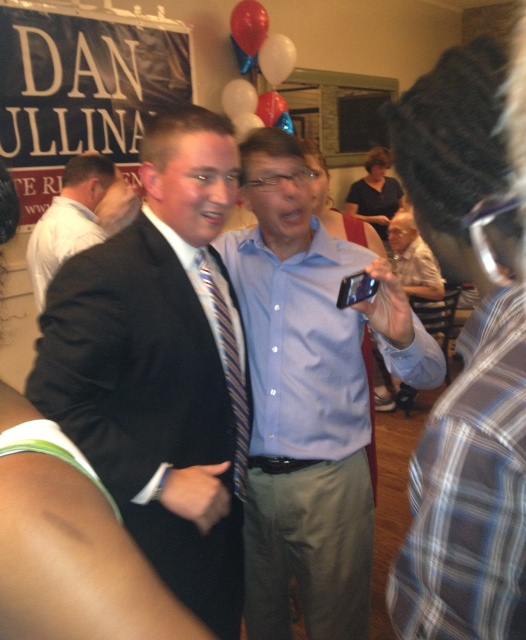
Now to that 12th Suffolk District special election. As we reported on our Facebook page at 9:00 PM last night, the Democratic nomination was won by Dan Cullinane, a former Marty Walsh aide from the Lower Mills neighborhood of Dorchester — as politically active a community as any in Boston. Surely Walsh had to be pleased.

Image

^ Dan Cullinane : Lower Mills victory

Cullinane’s victory party at the Ledge on “Dot Ave” was packed with about 100 supporters, including State Senator Brian Joyce as well as several members of the large and well-known Lower Mills O’Neill family, one of which, Catherine O’Neill, is running for Boston city Council city-wide. The O’Neills too had to be pleased.

Cullinane announced “diversity is the strength of our district’; and thanked, in particular, voters of Haitian origin, several of whom celebrated at his party : “merci, merci, merci,” Cullinane said, ‘and I can’t wait to visit Haiti !”

The new nominee won more than 60 percent of the vote against Stephanie Everett, who waas an aide to State Senator Sonia Chang-Diaz, and Marydith Tuitt, an aide to State Rep Gloria Fox. Cullinane now faces, on September 10th, two independent candidates, one from Milton and one from Mattapan, in a District as Democratic as almost any in the State. If elected, he will join the Boston delegation and bring it to full size again.

—- Michael Freedberg / Here and Sphere
BOSTON MAYOR RACE : THE SPRINT TO PRIMARY DAY HAS ALREADY BEGUN

Image

^ Marty Walsh at “Mondays for Marty” in Charlestown

—- —- —-

Six candidates, at least, of the twelve people vying to be be Boston’s next Mayor, have ramped up their campaigns big-time. Truly the sprint to Primary Day has begun.

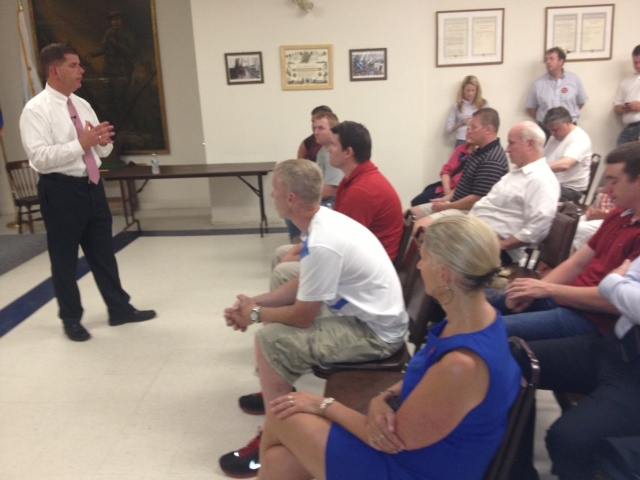
Every Monday, Marty Walsh holds a town hall with neighbors in those parts of the City he feels he most needs to win a spot in the final. we attended his Charlestown “Monday” last night and found it packed with neighbors with important questions — pointed questions,well informed — to ask of him. Other than Mondays, Walsh can be found shaking hands across the city, sending teams of volunteers to knock on doors, winning endorsements.

Image

^ John Connolly speaking to the West Roxbury improvement Association. Who says Boston voters aren’t focusing on this race ?

John Connolly is dashing across the city from event to event. Yesterday saw him in West Roxbury — addressing a crowd of 200 at the west Roxbury Improvement association forum — Roslindale, Brighton,. and “Eastie,” where State rep. Carlo Basile has endorsed him.

Image

^ Rob Consalvo has probably visited more and diverse community groups than any rival candidate.

Rob Consalvo sends out teams of door-knockers, attends forums, and does meet-and-greets everywhere along the long “spine” of Boston from Readville and Mattapan to the South End, North end, and East Boston .

Dan Conley’s campaign looks a lot like Consalvo’s, except that he has concentrated not on the ‘spine’ but on the extensions : South Boston, West Roxbury, Roslindale, Brighton.

Image

^ Charlotte Golar-Richie : ramping up big-time, finally. (HQ in Mission Hill)

Charlotte Golar-Richie, whose Dad, a retired New York judge, just died, has opened up five neighborhood headquarters, from Mission hill to Roxbury to Upham’s Corner, and though very slow to ramp up, is now fully engaged in the fight.

Image

^ Felix G. Arroyo :  lots of shoe leather and enthusiasm — and union endorsements

Felix G. Arroyo has sent out more door-knocking teams than any of his rivals, and he often joins them. He has some strong labor endorsements and is earnestly pursuing others.

Three other campaigns, those of Mike Ross, Bill Walczak, and John Barros, have made a mark — Barros for his knowledge of the issues, Walczak for his opposition to casinos, Ross for his visibility in social media — but it seems very unlikely that they can catch up to the six top sprinters.

As for those six top sprinters, they are not all running equally. Arroyo and Golar-Richie still suffer from looking to constituencies internally divided, with many of their leaders undecided which way to go, unhappy about what looks likely to be the Final. Arroyo and Golar-Richie also have yet to convince many of the voters whom they will need that they have what it takes to address the issues forcefully and consistently. This was demonstrated at a Black Agenda discussion meeting last night, at the Dudley Branch library, where the participants spoke disparagingly of some, angrily about Dan Conley, unsure of the candidate they most would like to back, impressed chiefly with John Barros, whom they concede isn’t likely to win, and, interestingly, with Marty Walsh, whose labor support they appreciate.

While some vital components of an Arroyo or Golar-Richie candidacy struggle toward a decision, and as Dan Conley attempts to recover from a blow-up — and bad publicity — at a recent candidate forum, there is no hesitancy at all in the camps of the race’s obvious two leaders, John Connolly and Marty Walsh, or on the part of Rob Consalvo. They are running and running fast, hard, focused, backed by strong money and an army of supporters. Even though 70 %, probably, of all Boston voters are not part of these three men’s core vote, their 30 % of the total available vote are active and, thus, making inroads for their chosen candidate into the 70 %; so that by Primary Day — September 24 — if nothing changes big-time, a significant part of the potential Arroyo and Golar-Richie vote will go, not to them, but to the three “traditional Boston” leaders.

After all, no one, whatever kind of voter he or she is, wants to vote for someone who can’t win or who doesn’t look ready. We would have thought, when this race began, that “new Boston ,” with its 70 % of the likely vote, would carry the day and elect a Mayor. Some leaders of the “new Boston” are frustrated that that doesn’t look ready to happen; and they are expressing their frustration.

It looks as though their frustration will indeed be the case. We say it again : the Final looks to be a John Connolly versus Marty Walsh race — with Rob Consalvo the only alternative probability. Every day, this result looks more and more likely.

—- Michael Freedberg

BOSTON MAYOR RACE : WHAT THE MONEY & VISIBILITY STORY TELLS US

Image

^ John R Connolly and Marty J. Walsh ; the top two by any measure

—- —- —-

A look at the OCPF (Office of Campaign finance) reports ending July 31, 2013 tells us that what we can assess on our own already is true: there are four tiers of candidacy among the twelve whose names will appear on the September 24, 2013 ballot.

At the bottom are Charles Clemons and David Wyatt, who have raised almost no money and spent hardly any.

The next tier, of candidates who have raised low six-figure money, or a bit less, includes names both expected and a surprise. It was always likely that Charles Yancey would fall far short. John Barros too. But who knew that Charlotte Golar-Richie, the only woman in the race, a former State Representative and a widely esteemed administrator, would barely make this tier’s cut ? Or that Felix Arroyo, whom many expected to see in the top tiers, would fall into this one ? Both Golar-Richie and Arroyo have raised less money than Bill Walczak, a community organizer and hospital administrator — highly regarded, and for many decades — but who has never run for any elected office.

The Walczak presence intrigues us. As the only candidate openly opposing locating a casino in Boston, has won to his side all those who  reject a development which would add many jobs and lots of tax revenue for the city. Whatever we may think of such opposition — and we decry it — it is the opinion of a vocal minority,and Walczak has it. His tactic is a common one for an underdog candidate to adopt. At this stage of the mayoral campaign, it makes sense for a candidate who at first glance looks overmatched to gain traction by bringing into camp at least one identifiable and committed constituency. This, Walczak has done.

Image

^ Bill Walczak the anti-casino candidate : raised 4 234,919.95. More than either Arroyo or Golar-Richie.

The downside of Walczak’s move is that almost everybody in the City wants to see a casino complex built here. Still, his move blocks rival candidates from poaching a following that probably totals six to eight percent of the Primary vote.

Next we have the tier of strong runner-ups. Here are three names, all important in the race ; Mike Ross, a District City Councillor, who has raised $ 625,579.88, much of it from real estate interests; District City Councillor Rob Consalvo, who reports $ 445,783.29; and District Attorney Dan Conley, who has amassed $ 698,307.64, reportedly mainly from lawyers.

The top tier belongs to just two names. Neither is a surprise. At-large City Councillor John R. Connolly has raised $ 834,242.96; State Representative Marty Walsh, $ 857,526.96. If money were the only fact in this race, the Final would contest these two, likely as close a vote as their money figures.

But money isn’t everything in politics. Visibility matters just as much. By “visibility” we mean not just what you can see but what you hear and feel: the grip of a hand on your wrist, as we like to say it. Visibility on the street used to be all; today, one has to add visibility on the internet. This changes the Boston Mayor outlook significantly. The “traditional” Boston voter has given Walsh, Connolly, Conley, and Consalvo their strong money and, so far, polling advantages. The other candidates with any chance of winning, however, must work on a different route. As they must look to young voters and to technology-driven Downtowners — who are almost impossible to reach with a door-to-door campaign — social media is their means. This is how life is lived today and not just in Boston. But can social media elect a Boston Mayor ?

On the street, the visibility victory goes to Consalvo, Walsh, Connolly, and Conley, in that order; and then to Arroyo. On social media, Arroyo does much better; and Ross, especially, has made himself a social site force. Presence on social media allow Arroyo and Ross to rank, at “omgreports.com,” fourth and fifth — higher than Rob Consalvo. Indeed, the site’s online voting function ranks Arroyo first. Still, even online, Walsh and Connolly place no lower than second and third; indeed “omgreports.com” ranks Walsh and Connolly the top two in overall presence, with Dan Conley third. And why not ? The “traditional” candidates have boldly put their issues agendas to voters both “traditional” and on-line — bolder by far than any of the “new Boston’ candidates has done. Connolly put his forth just yesterday, in seven languages, no less, on-line and on the street. The “traditional” candidates are not living in 1983. They all have significant, even commanding, presences in social media, on Facebook and Twitter. And so do their voters. It’s a new generation even in West Roxbury, Dorchester, and Southie.

Image

^ John Connolly : bold platform, presented in seven languages (including Viet-Namese, Albanian, and Caoe Verde Kriolu)

Money and visibility thus agree. The Final two will likely be John R. Connolly and Marty Walsh. It’s not impossible for Conley, Consalvo, or even Arroyo to edge ahead of either man, but it would definitely be news. Significant upward movement had better start to show really soon for the three candidates now trailing, but with a chance. Will there be such ? We await the August finance reports — and some well-researched polling results.

Image

^ Felix G. Arroyo : big street presence in many parts of the city. Is it enough ?

—- Michael Freedberg / Here and Sphere

BOSTON MAYOR RACE : SIX WEEKS TO GO

Image

^ Rob Consalvo outside one of his local headquarters

—- —- —-

It’s getting nitty now, and gritty, the 12-candidate race to elect a new Boston Mayor. Candidates and their armies are knocking on doors, talking to voters one on one — which is the ONLY way to do it. The lawn signs wars are crowding fast. The money is in, and many key endorsements, ones that actually can deliver votes. Nor, fascinatingly, is anyone dropping out. It’s too late to do so, as the Primary ballots have already been printed. The rumors of Dan Conley moving away to run for Attorney General did not pan out. (This is good news for Rob Consalvo.)

Image

^ Dan Conley : staying in mayor race

Indeed, Conley, like Rob Consalvo, Marty Walsh, Felix Arroyo, and, probably, the other “major” candidates, have already begun to open local headquarters in the neighborhoods they are counting on; and to staff them. (Haven’t seen a John Connolly local HQ yet, but very likely soon.) With local headquarters open, the candidates who have them can ramp up their reach out to voters as yet uncontacted, or contacted but uncommitted. From local headquarters phone banks can be more precisely targeted than from a central office.

Image

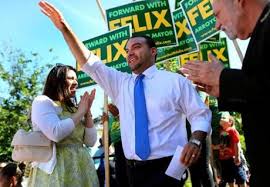
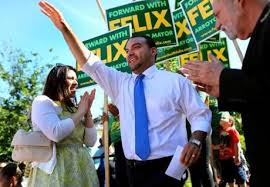
^ Felix Arroyo : “forward with Felix” showing up at last in the neighborhoods that count

The ‘majors’ are also scheduling regular weekly ‘events,’ such as Marty Walsh’s “Mondays With Marty” and Felix Arroyo’s regular meet-and-greets at locations key to his campaign. Rob Consalvo is making his headquarters openings an “event.” Surely John Connolly and Dan Conley are doing the same. For these candidates, “events” are occasions to raise the enthusiasm level of their already committed voters — and campaign volunteers — and to bring to the committed-vote level voters who have shown interest. In other words, the fun and games times in this campaign are over. From here on it’s all about commit, commit, commit and identify a vote and keep it identified all the way to Primary day.

Image

^ Marty Walsh : “Mondays With Marty” in every neighborhood ?

So much for the “major’ candidates. What we do not understand, frankly, is the stance of the other candidates. Why are Charles Clemons, John Barros, and Bill Walczak still in this race ? And what of District Councillor Mike Ross, who has raised much money from real estate interests but doesn’t seem so far to have gathered an observable following ? Unfortunately, neither question has a ready answer. Clemons, Barros, Walczak, and even Ross surely knew that they were almost certain not to get to the November Final, yet they ran anyway. Is it about introducing oneself to voters ? Hard to see the advantage in making a first impression as an election loser. More likely they see that for the Final, the votes they do manage to win on Primary day will give them influence as the two finalists compete to win their support. Sometimes that campaign purpose succeeds.

Image

^ Mike Ross : lots of money, so far not many visible votes

The above discussion did not mention candidate Charlotte Golar-Richie. Her campaign remains the most puzzling of all. As the only woman in the race, as a person of color, and as a widely accomplished city and state administrator, she has all the credentials a next Mayor would want to possess and an identifiable, sizeable constituency. Yet her campaign hasn’t made itself felt much. She lacks money. She is only now beginning to be visible in the lawn sign wars. She has key endorsements, but they were won early and do not so far seem to have brought her many votes. Nor has she dominated the news. How could she, when, as reporter David S. Bernstein has pointed out, she has only the vaguest of messages and no platform ? The other “majors’ have both message and platform. It matters.

Image

^ Charlotte Golar-Richie : disappointing campaign so far

In a campaign like this one, which will reach almost every voter, most of them at the door, a candidate has to make himself or herself FELT as well as seen and heard. We used to say, “make them feel your grip, just as if you were grabbing them by the wrists.” Walsh, Consalvo, Connolly. Arroyo, and Conley are doing that; so far, Charlotte Golar-Richie hasn’t. Time for her to get tough. A Mayor of Boston HAS to be that.

Prediction : right now we see Rob Consalvo looking stronger, possibly moving to second place; Connolly weaker. Walsh still a good bet for second, even first place. Dan Conley fourth. None of the eight “new Boston” candidates has a chance if all stay in the race — and with the September ballots already printed, all remain in it.

—- Michael Freedberg / Here and Sphere

BOSTON MAYOR RACE : INTO THE FAR TURN NOW

Image

^ a John Connolly – Marty Walsh final ?

August will arrive this week, leaving only seven weeks until Primary day, at which the two Boston Mayoral Finalists will be chosen. At this point the preliminaries are over; the race is taking on a distinct shape; and those on the wrong side of the taking are beginning to get shelved. It’s the beginning of crunch time. Where does the race stand as the crunch starts ?

Polls have been taken and published. These show that John Connolly, Marty Walsh, Dan Conley, and Rob Consalvo occupy a “top tier” — grabbing from 8 % to 12 % of the assured primary vote — and that Felix Arroyo, Charlotte Golar Richie, and Mike Ross make a “second tier,” each at 5 % of the assumed vote. Four other candidates, Charles Yancey, John Barros, Bill Walczak, and Charles Clemons, also draw a measurable vote.

No surprises in any of this — nor is it a surprise that the “new Boston” candidates are splitting among themselves a vote that, if unified, would assure such candidate making it to the Final.

Arroyo, Ross, and Golar-Richie, their support totaled, easily top the “traditional” field. Indeed, their potential vote should be larger than polled: because the polls taken have tended to concentrate on the most assured voters — namely, the “traditional” voters. Surely, if one or other of the “new Boston” candidates is seen as having a solid chance of winning, “new Boston” voters will turn out in larger than polled numbers. Being seen as a solid potential winner is the major indicator, in almost every election, of a candidate’s ability to turn out voters.

Image

^ Felix G. Arroyo : solid contender if the “new Boston’ vote unifies

Image

^ Charlotte Golar-Richie : a sure winner in November If she can get to the Final

Unhappily for “new Boston,” this Primary  offers no fewer than six viable “new city” candidates. None has made a move to drop out. The six probably draw about 20 % of the polled sample, and on Primary day might garner measurably more. It will do no good, however, if all six continue in the race. All six will lose. This is a disappointing prospect and one that we at Here and Sphere decry. We feel that it is time for Boston to elect a “new Boston” Mayor, “new” voters representing at least two-thirds — probably more — of the entire city vote.
If no “new Boston” candidate withdraws soon, before the ballot is printed, the chances are strong that the Final will choose between two “traditionalists.” Currently the top two candidates in polls are City Councillor at Large John Connolly, at 12 %, and state Representative Marty Walsh, at 11 %. We feel that’s an accurate picture. Walsh, a four term Representative, has a solid Dorchester base extending strongly now into South Boston and, somewhat less strongly, into Jamaica Plain, West Roxbury, and Roslindale. He has won the backing of Local 18, the Boston firefighters’ Union. As for John Connolly, son of former Secretary of State Michael J. Connolly, he lives in Ward 20 — which will likely cast ten to 12 % of the entire Primary vote — and has shown broad city-wide support besides. Connolly is waging an active house party and issues campaign, focusing on Boston Schools parents. He can also count on much trust from city workers and their families gained during his terms on the Council.

Dan Conley, the Suffolk County District attorney, has by far the most money, but his city wide support seems surface at most; huge publicity for him, thanks to the many murder investigations under way, does not seem to have added anything to his image as a possible Mayor. Crime, after all, is a huge issue, but not a big Mayoral issue. Schools, development, zoning, and culture seem the issues most germane to the mayor’s office. (NOTE : a report in today’s Herald opines that Conley might switch to run for Massachusetts Attorney Geerral if Martha Coakley, as expected, declares for Governor, Conley has not responded yet.)

Image

^ superb campaign but not enough ? Rob Consalvo

Then there’s Rob Consalvo, who holds the district Council seat that Mayor Menino held from which he won election as Mayor. Consalvo has the problem of bringing together a widely dispersed — and much less ethnic than it used to be — “Italian” vote, from East Boston, the North End, and Hyde Park, and of lacking much city-wide familiarity. That he has nonetheless managed to poll close to the top vote-getters is a credit to the detail and mastery of his very professionally directed campaign. Can Consalvo, thus well directed, perhaps make it into the final ? Probably not.

Which leaves Boston to choose between two men as different as similarly backgrounded people can be. it will, actually, somewhat resemble the 1983 race between David Finnegan and Ray Flynn to choose who would face “new Boston” candidate Mel King. Finnegan lived in West Roxbury, Flynn in South Boston, and as one shrewd observer said, it was a race between “discount store cashiers” and “Boston Latin School.” The same class gulf may well apply to a Walsh versus Connolly Final. The Flynn and Finnegan fight was heated and often bitter — the two men seemed to despise one another. Expect nothing less if a Walsh versus Connolly Final imposes itself on a City that can use some drama not arising, thank goodness, from murder indictments and trials.

—- Michael Freedberg / Here and Sphere