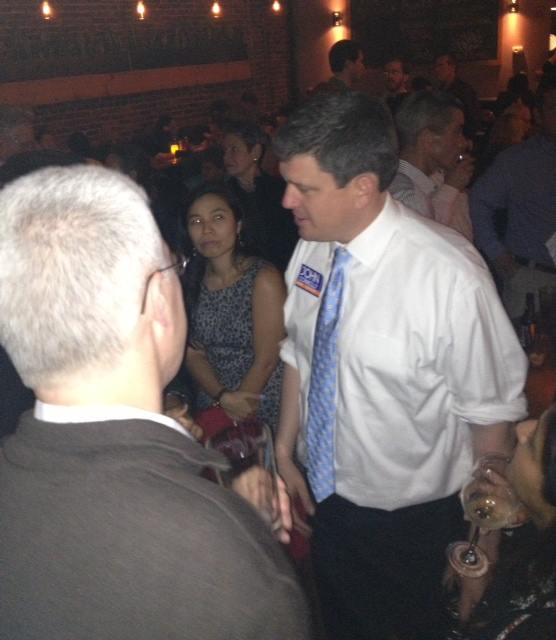
BOSTON MAYOR : ADDITION, NOT SUBTRACTION

Image

^ addition versus subtraction ? Politics at its most basic lesson

—-  —-  —-

My friend Dan Winslow, an insurgent, civil rights Republican to whose US Senate campaign I consulted before gearing up Here and Sphere, liked to say to me, “addition, not subtraction.” Every time I groused about our campaign finding favor with this or that constituency whose agenda or outlook I disagreed with, he would say it to me : “Addition, not subtraction.”

Winslow has since left the State Legislature — a huge loss for imaginative politics in Massachusetts and for a constructive GOP — but his observation remains so true. In our democracy of many, many communities, interests, and individuals, the successful campaign draws from many people different. More singly defined campaigns tend otherwise. There are so, so many voters; hardly any single interest can compass more than a small portion. It’s a losing situation in almost all cases. And once the “everybody else” begin to not see themselves within that single interest, the single interest campaign is cooked.

In this election, there is a single interest campaign almost feral in its singularity. Martin Walsh is a fine, fine man, and a hero of civil rights and personal struggle. By no means should any one disparage him. His friends follow him passionately : that says a whole lot. But as a candidate — on the large picture — he has defined single interest politics. He is a labor leader, labor unions are his career, his expertise, his theme, his following. Articulate he is — though not in debate — and, on many issues, extremely well informed. But everywhere he goes it is palpable that his goals are labor union goals. Labor union’s goals are not, however, everybody’s. Union labor comprises about 14 % of Boston voters. That is a mighty small minority. And the City’s wisest labor leaders know it. They know that if union labor is to advance it must join with other constituencies, other interests, and add to a coalition, not stand alone.

Marty Walsh has worked tirelessly in his campaign to attract other interests. He addresses arts issues, school issues, diversity, interfaith, even innovation; has commissioned 40 position papers, 37 of which his campaign reports are now written; has won to his side many politicians from Boston’s communities of color plus some State Legislators and two Boston Congressmen. Clearly he knows that without allies, his labor union following cannot win.

Walsh has bet the farm, that his outreach will not expose labor’s numerical weakness. This is to risk a lot.

He has allowed labor unions to become a major issue in this campaign; and that is bad for labor unions ; because labor unions aren’t exactly popular with most of the public, even in Massachusetts. Strikes send an unpleasant message of intimidation and intransigence. Take the school bus drivers’ walkout, for example. Yes, Walsh condemned it. But the impression made was not an untrue one. Everyone also remembers the Verizon strike, with its images of angry picketers and stories of vandalism. Nor have Boston’s public worker unions exactly made friends and influenced people. Arbitrators’ awards that risk the City’s finances and portend cuts in other City services make City unions look militantly selfish. Same too for the Boston Teachers’ Union (BTU), which so far refuses to accept that school transformation will happen and that it would be better to help forge it rather than doggedly resist it.

Walsh rejects none of it. How can he ?

Thus his campaign has put labor unions under public scrutiny, in all their stubbornness, their resistance to change, their adversary attitude to everybody else. The passion, the heavy-handedness, the rush of politicians to get with Walsh because they don’t want to break with labor — all of it has been a disaster for labor because it has engendered criticism of labor unions from people who would not have gone down that road, and because those criticisms have now become the common perception.

Labor actually emerges weaker from this campaign than had Walsh not become a candidate. As the respected leader of a powerful force in the city, Walsh had enormous influence. As a candidate, he has risked that influence upon a pitiless test : the judgment of the voters.

ALL the voters.

Meanwhile, John Connolly keeps on adding to his following the “everybody else” who are not members of City labor unions or followers of Walsh’s labor-allied office holders.

—- Michael Freedberg / Here and Sphere

BOSTON MAYOR : PAY PARITY, PAR, PAY EQUITY ? WHO KNEW

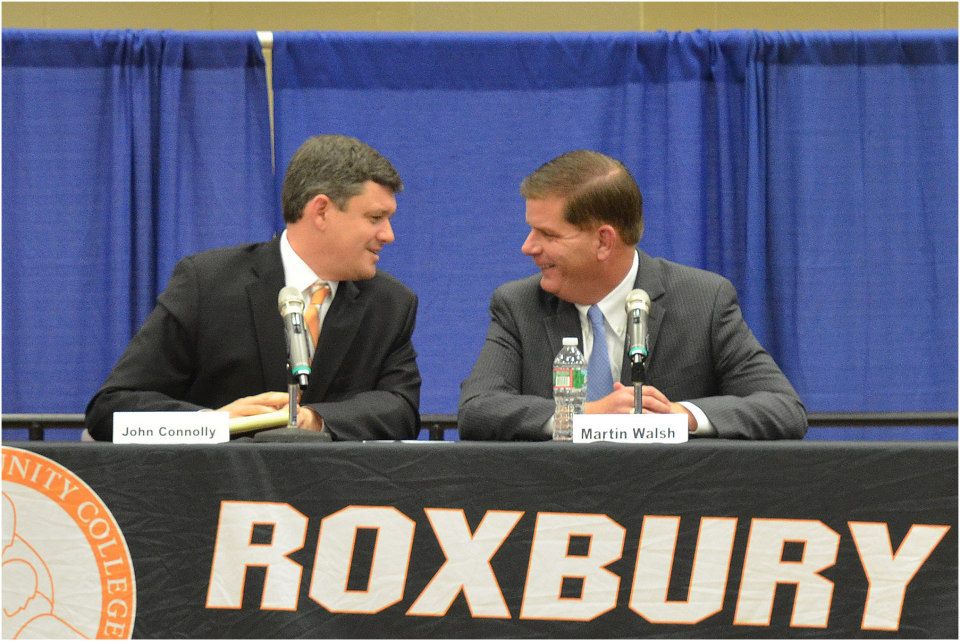
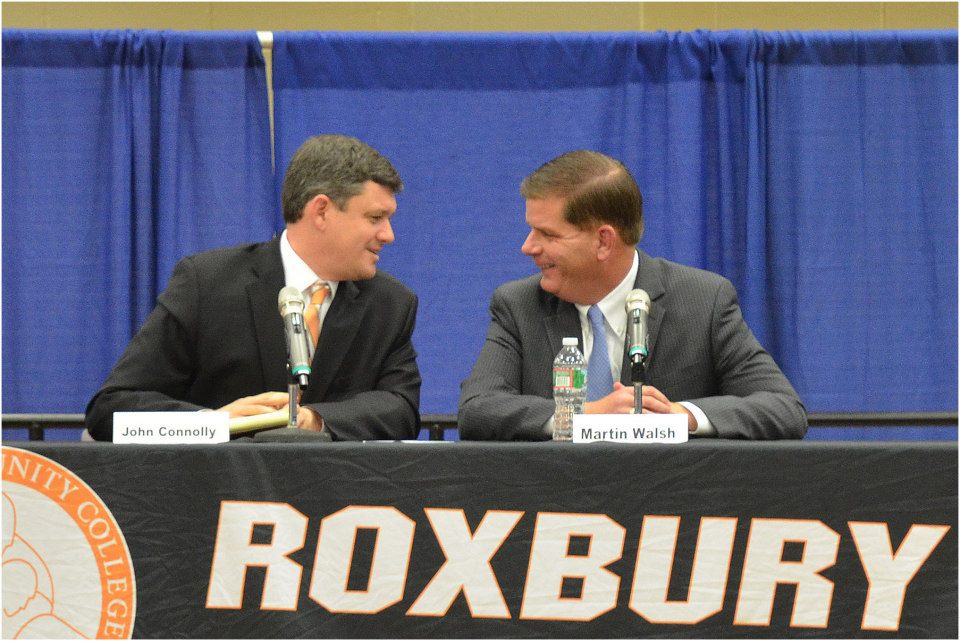
John C Marty W Roxbury

^ The Budget Master versus the Union Master : who will do a better job of untangling City union contracts ? (photo by Chris Lovett of BNN, posted at FB)

—-   —-   —-

Who knew that the labor contract concept of “pay parity” would become a defining issue in this year’s mayor campaign ? I doubt if many voters know even what “pay parity” is. I sure didn’t, and I’ve spent half a lifetime swimming in Boston city politics. Yet we DO know that negotiating contracts with the City’s public employee unions — some 33 of them, I think — is one of the Mayor’s top responsibilities; and the two finalists both come well equipped to master such negotiations. Marty Walsh is himself a labor leader, and John Connolly a master of the city’s budgets and finance. Thus the “can he negotiate a city worker contract ?” question would seem to be easily answered “Yes.” But it isn’t.

The question became hard to answer on the day, about three weeks ago, when the arbitrator deciding the new Boston Police Patrolmens’ Association contract announced a raise of 25.4% over six years. The City heard the news and went into emotional hemmhorage. $ 80,000,000 this award would cost ? And what now when the Fire Fighters Local 718 came to the table next year ? how much would they want ? After all, their last contract negotiation had gone past arbitration to rejection by the City Council and, finally, a raise that just barely missed forcing the City to close its libraries.

Dropping this bomb into the middle of a heavily populated Mayor campaign looked sure to affect the outcome. Suddenly everyone wanted to read Arbitrator Buckalew’s 1-page decision. In it we meet the concept of ‘pay parity.’

The decision does not explain how Buckalew applied the concept, but — I beg you bear with me — it goes like this : ( 1 ) most agree that Boston’s Police and Fire fighters should get something like pay parity ( 2 ) but do we apply parity to their base pay, or do we factor in their second job income ( 3 ) if we factor in the extra income of both groups, the award achieves pay parity : each union’s members earn 107,900 to 109,000 a year in total ( 4 ) but wait : the Fire fighters’ extra income isn’t from public employment, it’s from second jobs; whereas the Police extra income comes from overtime and details, most of it public payroll work ( 5 therefore it’s unfair to include the Fire Fighters’ second job income in calculating pay parity ( 6 ) but if you don’t, then the Police pay is almost 60% higher than what the Fire Fighters earn from public work.

You got that ? Read it again. Then cough.

A link to the Arbitrator’s Decision follows. i know that you cannot WAIT to read it, but just in case you do want to read it, here it is :

Click to access Scanned%20BPPA%20Award.pdf

Unhappily, the only mention of pay parity in the entire 11-page award is found on page one, in which the arbitrator awards a “one time parity adjustment” of $ 2000 payable on January 1, 2014. Other than that, he does not talk of parity, but simple math says that he based his parity award on base pay, not total pay. The 25.4% six-years of pay raises, too, build upon base pay. This seems fair enough — were it not that both the Fire fighters and the Police earn an average annual pay about 40,000.00 higher than base. By what justification do these two work groups merit pay raises much more generous than those granted the City’s other 30 unions (Boston Teachers Union not included) ? Given the outsize award, the certainty that the Fire fighters will next year demand their own base-pay parity adjustment, and the high degree of union activism in this year’s campaign, what avails the City’s voters but to expect a large attack upon City budgets and solvency ?

After all, Tom Menino, even with his 83 % approval rating assuring re-election every four years, could not halt the growth of Police and Fire fighter pay awards. How will a Mayor who depends utterly on union support do so ?

Still, why need it come to this ? There is another scale for determining workers’ pay ; pay equity. We apply it when measuring how workers in approximately equal jobs are to be equally paid. Can we not find a way to apply pay equity to the contract negotiations of Boston’s police and Fire fighters ? (not to mention the City’s other unions.) Fire fighting isn’t police work, and vice versa, but the two careers share much ; on duty, off duty; life-threatening work; calls upon a moment’s notice; working from district stations. Both careers require passing an exam. Both require skill in emergency response. It would be so much easier to settle both unions’ contracts in one negotiation applying pay equity. And more : the pay equity principle would, eventually, once the City’s tax revenue can fund it, bestow a needed raise upon workers in the unions not blessed as are the Police and Fire fighters.

But that would mean change — reform — thinking outside the box : a concept just about as foreign to Boston City governance as scientific evidence is to a Creationist.

This must change. City governance needs to be re-thought, and soon, because as the society it governs is changing rapidly, if city governance does not change, it will be an obstacle rather than an empowerment. Much of Boston governance already is an obstacle. That much has been made clear by at least half of the 12 Mayor hopefuls who competed in the Primary.

Which leads us to the question ; who can better untangle the City’s labor conundrums : the Union Master, Marty Walsh, or the Budget master, John Connolly ? Guess we will soon find out.

—- Michael Freedberg / Here and Sphere
BOSTON MAYOR : WHY JOHN CONNOLLY IS THE PROGRESSIVE AND MARTY WALSH ISN’T

Image

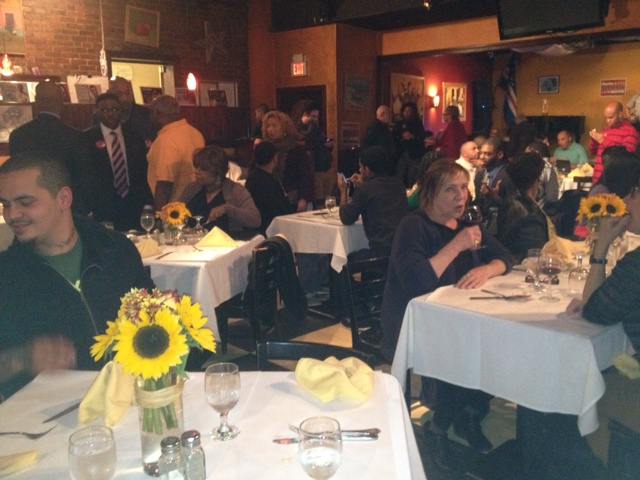
^ Old politics, good friendship at Ward 15 Democrats’ dinner rally for Marty Walsh (at John Barros’s restaurant Cesaria on Bowdoin Street, Dorchester)

—-   —-    —-

Much is being made, in this second phase of Boston’s Mayor campaign, of who is the progressive candidate. Marty Walsh’s campaign has claimed the title. John Connolly’s supporters beg to differ. I agree with John Connolly’s supporters. Connolly is the progressive. Here’s why:

To be a progressive, a candidate has to offer progress. A progressive must seek to change things, evolve, develop, innovate. Boston is changing even as I write, and we need to elect a guiding hand for that change rather than allowing it to be a matter of chance. The change begins in the campaign itself. In that regard, Connolly has already delivered. Not since the 1967 election — to which I often refer — have I seen such an uprising of new activists; indeed, activists almost of an entirely new culture. Many are new to Boston. Few have any awareness of, much less connection to, the old tribal, ethnic, neighborhood insularities that defined Boston politics for 100 years at least. The new activists live in the world at large. Their Downtown is a European-ized marketplace of ideas, goods, talk, and music. Their neighborhoods, too. Radically they do not live the past. Radically they are about creating a future device by device, code by code, connection by connection, and creating social circles based on that connectivity, code, and device creation.

Perhaps not since Americans of 1910 to 1930 created the car, the radio, the national highway system, subways, and the movie and music industries has a generation of Americans so utterly rewritten the book as these new Bostonians are re-writing our city’s annals. Connolly is their avatar, their political voice, their trekkers’ guide, their enabler.

The word “Progressive” first came to use in the 1890s and continued into the 1920s. It was a vast movement with five components : reform of government; civil rights; conservation of natural resources; school reform, and financial regulation. Progressivism also had a temperance component that has long since dated — nobody today would take a hatchet to saloons as Carrie Nation did — but it retains a moral fervor, directed now to a celebration of skin color, cultural, and lifestyle diversity.

The moral component of progressivism is present in Marty Walsh’s campaign, but is the cutting edge of Connolly’s. Walsh has himself been a hero of civil rights fights, but Connolly has lived it. So far, so good for both.

But when we look at government reform, schools, and conservation — today, green agendas, bicycles, and parks — the win goes to Connolly. Looking at the two campaigns’ cultures, it’s no contest.

Marty Walsh is far the less radical of the two candidates. His agenda seeks adjustment, not transformation. He is the candidate of an interest group which itself has but a single agenda : jobs and better wages. (Not that jobs and better wages are not important. Of course they are.) He doesn’t grasp what Downtown is all about — and admits it; a likable humility to be sure — and has nothing to say about the kind of Boston he envisions four, eight, 20 years from now. I question whether he thinks ahead at all. It is said that Marty Walsh has helped a lot of people. I believe it. He is all about helping others. His heart is in it. But that is a 1900 ward boss’s definition of politics. You can’t today just help people, because for everyone you help in a huge city there’s 1000 others you can’t get to. And even then, what ? The Mayor has to see the future for everyone and build them a road to it.

Attending the Ward 15 Democrats’ dinner rally for Marty Walsh last night at John Barros’s restaurant Cesaria, I found great food and several dear friends from the old politics. It was like going back to the 1983 Mayor campaign : politicians, laborers, ward heelers. Face to face and hugs. All great people, I have sweated precinct work with many of them (or with their predecessors). Theirs was — still is — a politics of the physical, just as was and is their labor. Boston was built by their ancestors, long-shored by their parents. But it was distressing to me to see just how back in time many of these folks walked. And yes, I walked with them back then. Theirs was for a long time my politics too. But the City has changed, and is changing, and if I do not change with it, that’s my fail.

Image

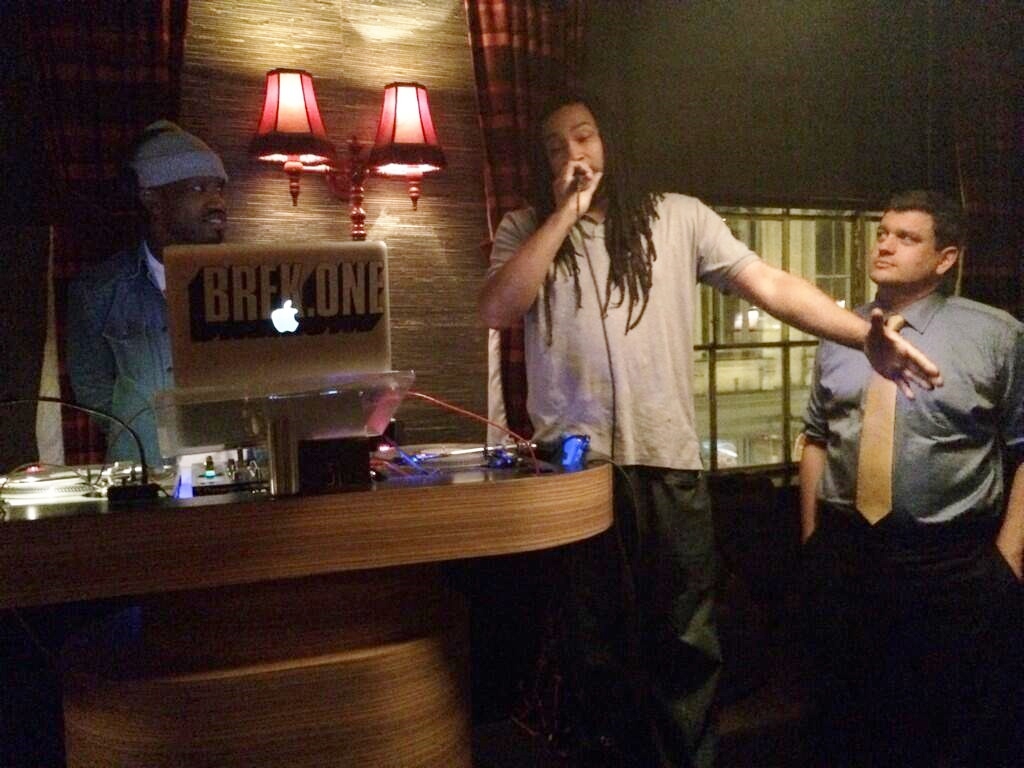
^ new beats, new dance, new politics ; BREK.ONE SUPREME dropping a set at GEM and introducing John Connolly

At the same time that Ward 15 Democrats were gathering, John Connolly’s new-city supporters were dancing at GEM Night Club, downtown, to the beats, rumble, and strobe light dark plush of DJ’s Akrobatik and BREK.ONE SUPREME.

I do not mean to disparage Marty Walsh’s Ward 15 people. Not at all. The next Mayor of Boston badly needs to bring them into the new City being made even as I write — made, re-made and made again so rapidly that what ripens obsolete today will rot like a mummy before you know it.

It may well be that entrusting the leadership of Boston to a radical transformer like Connolly is too risky for a vote base that seeks immediate security first; that dares not chance tomorrow’s job for next year’s career; that sees admission to a union as the ultimate accomplishment. Understood. But to call the urgency of Walsh voters progressive is a mistake. It is a politics of safety and security, of resistance to change because it sees — has learned to know — economic change as a grave threat.

It is a threat — if one takes it as such. It is hard to chance jumping onto a moving train. But what do you do otherwise ? Those industrial jobs are NOT coming back, and the well-paying union jobs at Verizon and National Grid won’t all survive technology change forever. Even the Boston building boom — the rain that water’s Marty Walsh’s political crops — won’t last forever. What then ? If not the John Connolly, technology future, what then ?

— Michael Freedberg / Here and Sphere

BOSTON MAYOR : APPLE STORE-ING at the BOSTON INNOVATION FORUM

Image

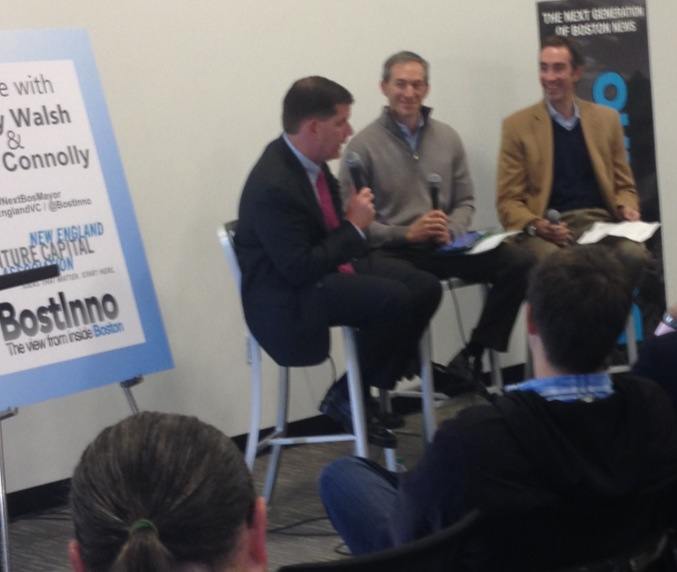
^ Marty Walsh at his humble and practical best : at BostInno Mayor Forum

One candidate speaks the syntax of hi-technology, the other means well. The folks who bring us the media publication BostInno — voice of the “Innovation District,” Inno for short — know the difference. They go first-name with john Connolly, who helped set up the Inno; with Marty Walsh, not so readily. Yet at this morning’s Forum the moderators clearly appreciated Walsh’s humility and readiness to listen to the concerns of people very different from his base. Walsh’s 45 minutes of question and answer showed him at his best : not exactly ready with the answer, and willing to be seen as such. And when an answer was given, it proved practical; and the Forum attendees appreciated Walsh’s practicality and laughed at his self-deprecations. But his answers also proved revealing.

Walsh offered no radical transformations, sees no major shifts. He will bring new kinds of people into his circle of advisors. There will be diverse conversations, diverse decision making. Clearly, Walsh sees access to the Mayor’s ear as his top priority.

Some questions that Connolly would have dined on, Walsh ducked. Asked “how will you win the support of THIS community as you have the unions,” Walsh said “Innovation will be central to my cabinet.” To, ” a question about keeping the city open late at night, he offered “if people want to get a meal late or to install a juke box” — he laughed : “do they still call it that ?” — “it’s a matter of permitting.” Quizzed on what will be his Big Idea — the moderators cited New York mayor Bloomberg creating a technology campus high school — Walsh said “not sure….growing the City is what I’m focused on.”

At other points, however, Walsh outlined regionalized economic initiatives, innovation districts all through the city, arts festivals all weekend; and spoke of them all easily and in detail. Within his comfort zone, Walsh commanded the Forum-goers’ quiet attention, just as he had throughout the marathon of Forums held prior to the Primary. He may not win any debate prizes, but at the BostInno Forum he showed once again that when interviewed, he is an appealing figure.

Image

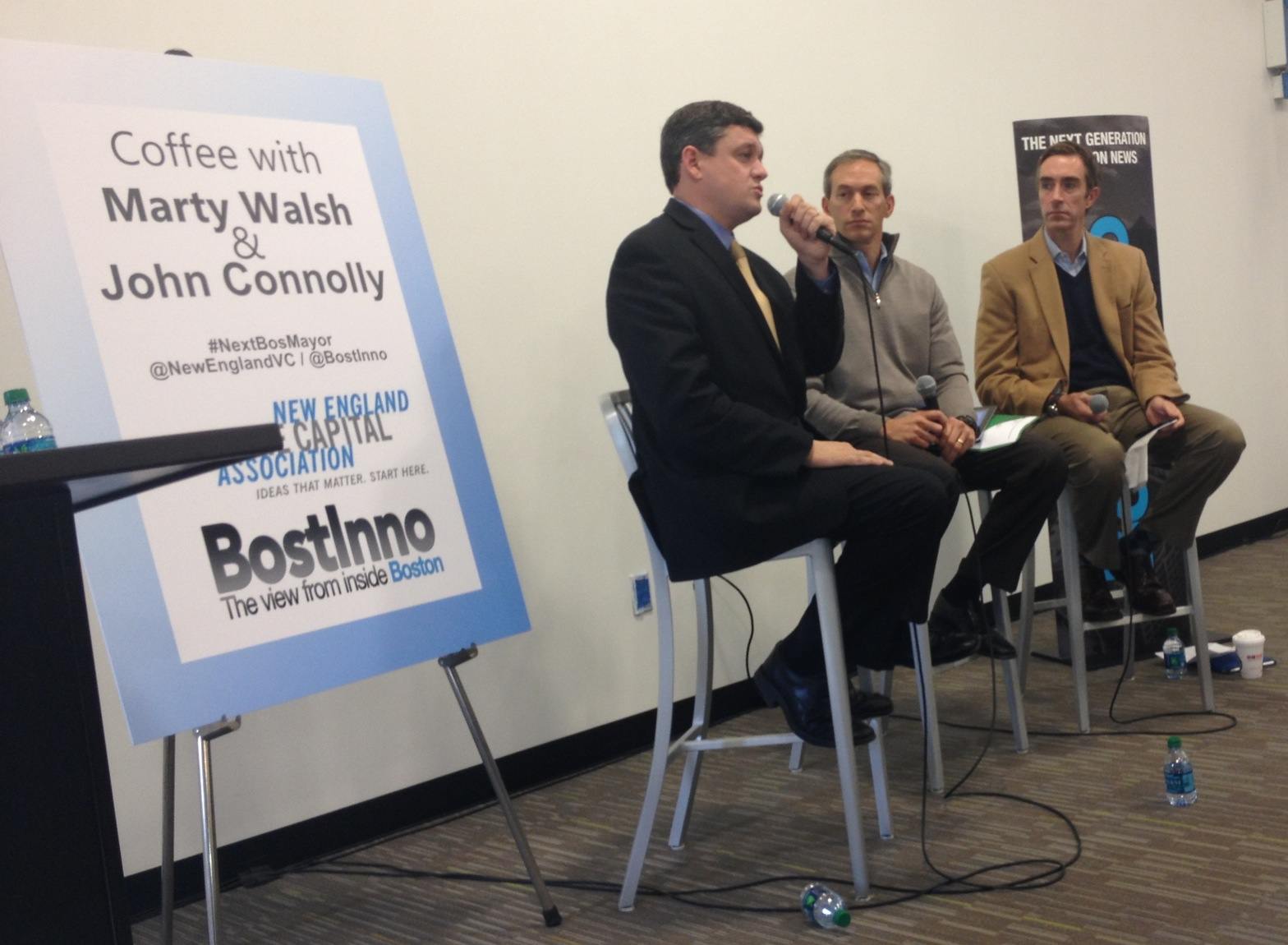
^ the passionate bold innovator : John Connolly being moderatored

Then it was John Connolly’s turn. He too ducked the toughest question. Asked how he would handle fights with the Teachers Union, he responded “I want to fundamentally alter the culture in city administration, make it like the apple store” — which is his mantra: but sweet ear candy to the folks at this Forum. He also gave boiler plate answers to many questions and talked on too long, in a drone that dissipated the drama. It wasn’t the strongest start I have heard from him, not at all. But then he found his feet and began to assert, as only he can do.

“We aren’t preparing kids to compete in today’s economy…We need highly talented principals… and reforming the teacher contract. We have one of the most antiquated contracts in the country. We have to change it. Seniority cannot be the only way to choose teachers.”

So why, asked the moderators, haven ‘t you changed it ? Connolly replied thus: ” on the Council I don’t get to make any decisions. All we (the Council’s education Committe, which Connolly chaired) could do was be a watchdog…and to redirect some resources. (And) we had hearings on the teachers’ contract. A thing that they hadn’t thought possible. We had parents testify, we even had teachers come in and say that the teachers’ contract was wrong.”

Connolly then mentioned Walsh’s bill to take away from City Councils the power to review labor arbitrators’ awards. He said “The mayor has to represent the whole city…be independent…he can’t just represent one interest. My opponent’s legislation would damage the City’s bond rating and hurt city programs.” He was then asked the same question that was asked of Walsh : “what is your Big Idea — like the Mayor Bloomberg technology campus ?”

Connolly smiled that broad teddy bear smile.”My big idea ? It’s that every child in Boston get a quality education !”

The Forum people loved it. Connolly was among friends, and the rest of his time on stage was devoted to technology advance questions, innovation district questions, late night open hours discussion. It was less a Q and A than an office conversation.

— Michael Freedberg / Here and Sphere

BOSTON MAYOR 2ND DEBATE : CONNOLLY PROVES A MASTER OF CITY FINANCE

Image

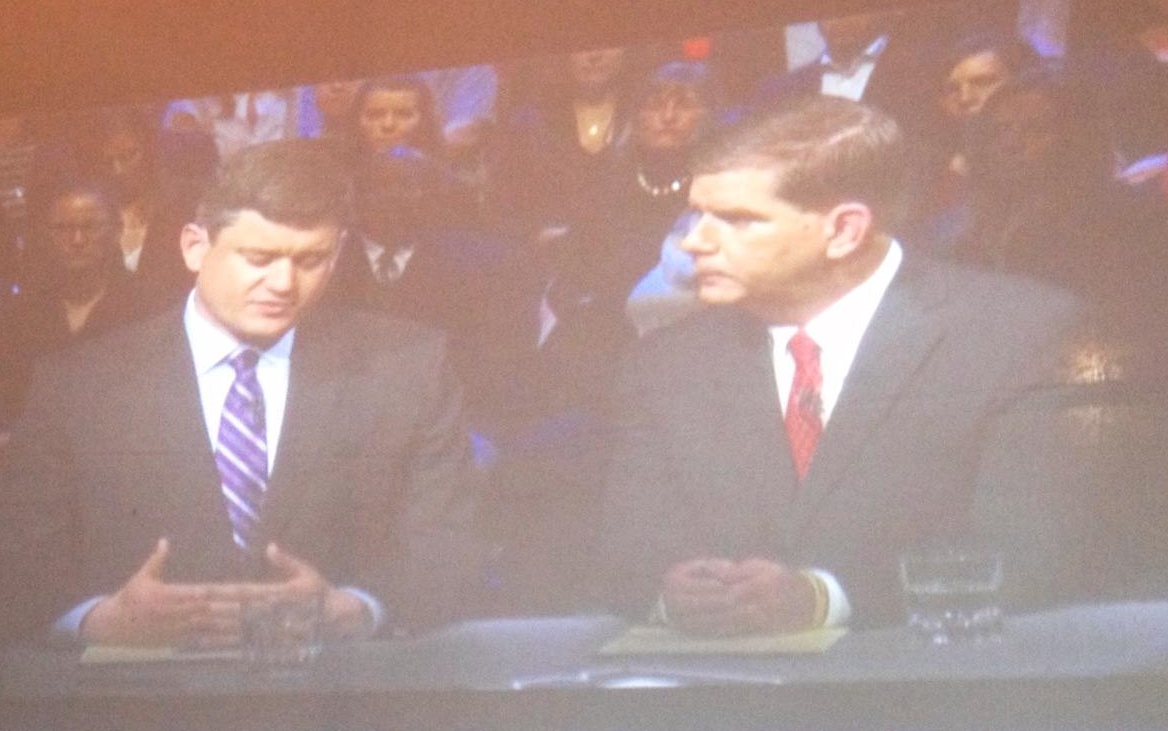
^ Master of City budgets : explaining. Master of labor negotiation ; listening.

— — —

John Connolly easily carried last night’s second Mayor debate, but not for any of the hot button reasons being touted in the blog-o-sphere or news media. He did not win it because he crushed Marty Walsh on the “smear flier” matter. He didn’t win it because Walsh had no good reply to co-moderator Margery Eagan’s question as to why he hasn’t withdrawn his State Legislature bill to abolish city Council review of arbitrators’ awards. Nor did Connolly win it when Walsh made the mistake of saying his many endorsements by elected officials came from “a lot of my friends,” thereby reducing their prized blessings to an act of buddy-buddy.

Nor, even, did Connolly win it because he spoke eloquently while Walsh seemed unwilling at times to talk (David Wyatt ??) and when he did talk, often came across as chromosomically clumsy. After all, our current, beloved mayor, Tom Menino, epitomizes clumsy.

So forget all of the above for the moment. The reason that John Connolly won this debate, and a big part, too, of his mastery of the first debate, was his commanding knowledge of the city budget — its finances and its process. Time and time again, when Walsh tried to tie Connolly to this or that Council decision, Connolly proved Walsh’s attacks untrue, or misinformed, even clueless, at times, about how the City’s financial decisions are made, or why.

Mastery of the city budget isn’t just dry leaves. It’s the very essence of what City government is all about. Indeed, budgets are the core of all governemnt. It’s why we have governments and how they operate. Voters may well excuse Walsh’s clumsy debating ; especially because he is not the incumbent. Voters do expect a Mayor to speak authoritatively and readily on City matters, but a guy not yet Mayor is accorded some slack. But given another guy who is also not yet mayor, and who knows the City’s most basic function in and out and can explain it in a way that makes it seem as crucial as it is, voters cannot help but notice who is ready to govern and who might need some on the job training.

Rarely was Connolly’s mastery of the city budget on display before the primary — though I do recall one instance of it, in which, at Forum, he crushed one opponent who simply did not know the budget at all. Connolly’s entire campaign was predicated on school transformation — his phrase — and he became “the education candidate.” Yet last night he was asked few questions about education, though these he responded to with focus and passion, and, quite frankly, these questions probably did not matter much to voters watching. They already know where Connolly stands on education in the city, and they are learning quite rapidly that Walsh, too, has a well-thought-out city education plan. What they did NOT know – indeed, what I too did not sufficiently grasp — was that Connolly has such command of City budget matters. During the primary, at dozens of Forums, it was Dan Conley who made city administration has hallmark; Connolly rarely spoke of it.

But that was then. The fact is that because of his Budget process prowess, Connolly has now moved very close to becoming the man who will operate it for the next four years.

Post script : It is not that surprising to find that Walsh is no match for Connolly as a city budgeter. in a city labor negotiation, the labor negotiator says ; ‘this is what we want. How you do it is your problem.” Walsh is now looking to switch to the other side; to it being HIS “problem.’ it’s not an easy switch to make, especially when there’s a guy already there who knows the “problem” inside and out.

Walsh has one week to get in this game. he has the support of three current City Councillors : Felix G. Arroyo, Frank Baker, and Tito Jackson. They had better teach him fast. And he had better be ready to explain what they teach him.

Not all the Greater Boston Labor Council — hardly an “outside group” to a man who has been part OF it for many years — anti-Connolly fliers in the world can save the City Budget Day for Marty Walsh. Not all the local 1199 members door-knocking — and thus reinforcing voters’ perception of Marty as “the union guy” — can do it. Nor all the picket-line stand outs. This campaign has so far showed itself unwilling to learn anything about what voters outside its circle of interest are like. Can they do it now ?

— Michael Freedberg / Here and Sphere

BOSTON MAYOR FINAL : THE COMMUNITIES OF COLOR COME OF AGE POLITICALLY

Image

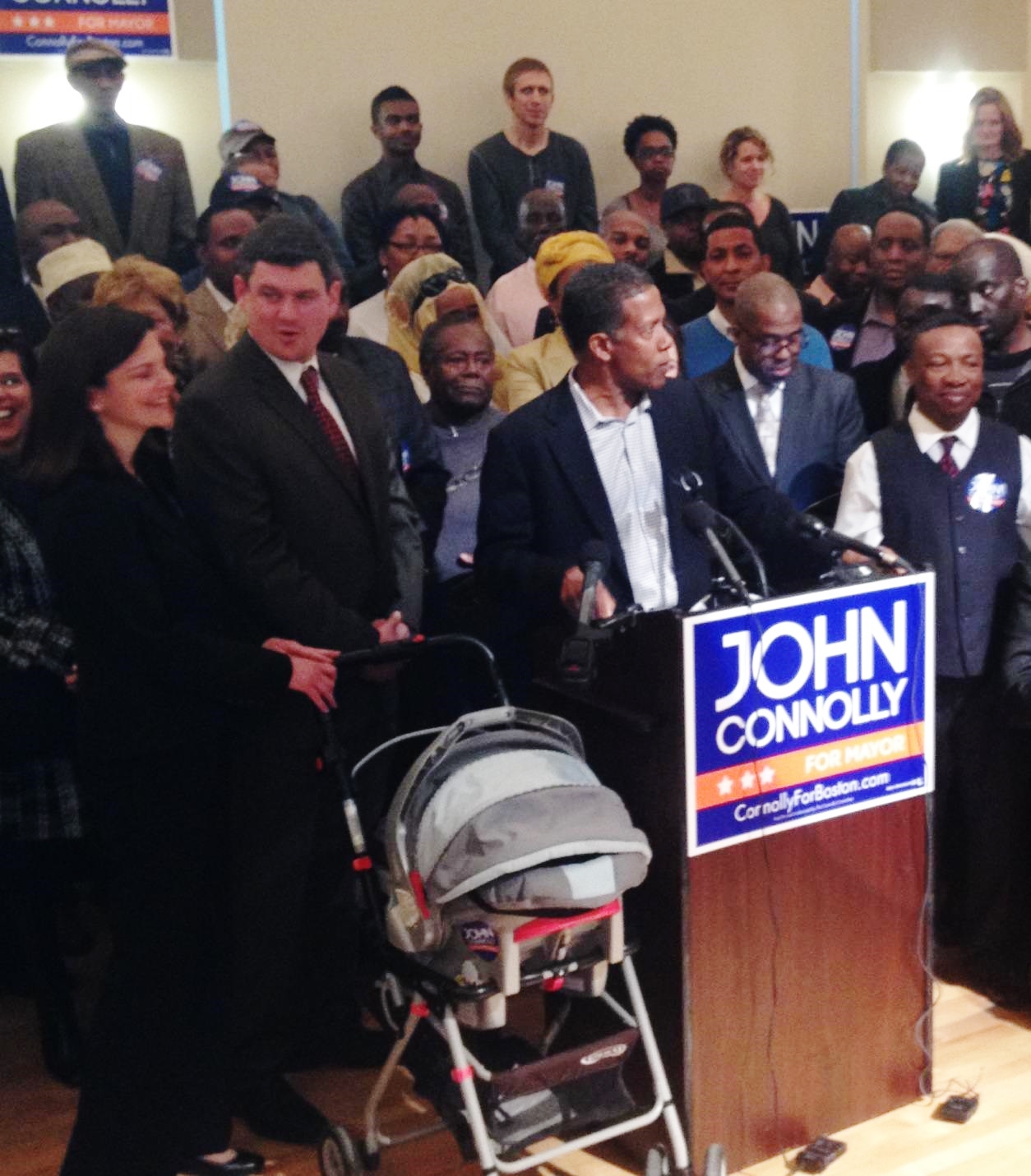
^ a classic stump speech ; Clayton Turnbull saying it real for John Connolly

— — —

Boston’s voters of color — black, brown, or yellow — have come of age in this campaign like never before. Whoever wins on November 5th, the breadth and sophistication of participation in it by voters Black, Hispanic, Caribbean, or Asian far surpasses anything that Boston has seen at least since the Abolitionist Era. Yes, you can say that these voters’ participation in the election of Barack Obama in 2008 (and in 2012) was strong, broad, and passionate. But Obama is himself a person of color. The participation this time is to the campaigns of two “white guys.” One man fairly well known, the other hardly at all.

Image

^ the way it’s done — but until this year, not so much : State Senator Linda Dorcena-Forry going all out for Marty Walsh (with Felix G. arroyo at his side)

Not only the community leaders have participated, though they have upped their game in this respect. The new development is the participation of every sort of voter of color : union activists, church congregations, business leaders, hip hop DJs, restaurant and club promoters, artists, social networks, political operatives, contractors, and just plain folks. And not only are they participating; they are doing so with an issues agenda. On twitter and at facebook I have read their posts about the contest. Their observations show a knowledge of what’s at stake, and what’s behind the scenes, that matches anything I’ve read by anyone who isn’t a media pro — and show as shrewd a knowledge of the politics as even some media people. Nor is the participation in communities of color merely social mediating. Large numbers of folks are door-knocking, doing meet and greets (i.e., house parties), phone-banking, even fund-raising — for these two white guys who would be Mayor.

Image

^ into the heart of the matter : Pastor Bruce Wall and friends stand with John Connolly

As one who, back in his political operative days in Boston, was often given the task of co-ordinating the City’s Black wards (in those days it was 9, 12, 14 and part of 13 and 15), I well remember when Black participation — the City then had few Hispanic or Viet Namese voters, and Chinatown was an entirely different matter — in a major city election consisted of paying hired volunteers “walking money” to pay to people who would stand at the polling places on election day and hold a sign or pass out palm cards. The candidate himself would rarely visit the Black wards, and what Black leaders there were did not protest this. They expected it. The candidate really had no reason to visit. “Covering the polls” on election day, if you could actually get it done in most of those 40 or so precincts, was usually good enough to win the day. And after that, it was usually good enough for a Mayor to hire a couple of Black ward leaders, to appoint one as an election commissioner, and, eventually, to hire Black youth workers. Even after the horrific crisis over school busing, in the mid-1970s, this situation prevailed.

Change began with Mel King’s campaign in 1983. King was then a state Representative, but not just that. He had a long history of involvement with progressive (indeed, very Left-wing) activism in Boston running back to the 1960s with the implementation, in Boston, of a local adjunct of President Johnson ‘s anti=poverty programs. King had a large following ranging from Robert Kennedy-inspired “white progressives” to activists in the black community, and, with their support and votes King reached the Final election — the first Mayoral Black candidate to do so. Ray Flynn, of South Boston, eventually won the election; but he made a serious effort to visit Boston’s Black neighborhoods and to connect with its leaders. Few votes for him resulted, but there were some; and there were activists who supported him, some quite vigorously. Once elected, Flynn brought those activists into City government. And more : he added Felix D. Arroyo — father of Felix G. Arroyo — into his administration at a high level and also connected as widely as he could with King supporters.

Image

^ what Ray Flynn started with Felix D. Arroyo, Marty Walsh has summed up with Felix G. Arroyo.

What Flynn began, Menino built upon; but his building work was administrative. It remained electorally untested, for the most part. That phase has now definitively ended. Boston’s communities of color — and communities of new immigrants — are stepping now into the contact sport that is election politics and are being wooed by both Walsh and Connolly with an intensity that assures that henceforth the “communities of color” vote will be as necessary a part of any City campaign as “the Italian vote” has been for the past 60 years.

The prejudice evident in the Sacco-Vanzetti crisis of the 1920s, and its tragic end, made integration of Boston’s Italian vote into city politics a necessary goal. It took 30 years to complete that process. It has taken the city almost 40 years, after the “busing” crisis, to integrate its “communities of color” vote similarly, but it has now been done.

If nothing else comes out of this intense and sometimes nasty campaign, the work of integrating communities of color into Boston’s political establishment is an victory the city can take pride in.

— Michael Freedberg / Here and Sphere

BOSTON MAYOR FINAL : ENDORSEMENTS AND “MOMENTUM”

Walsh endorsed

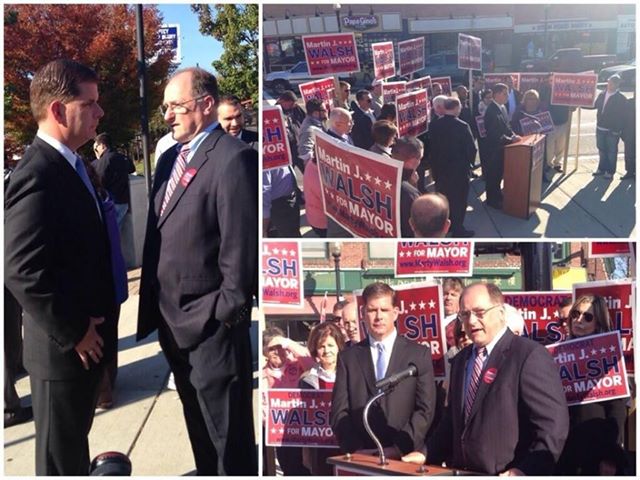
^ receiving the blessing : Congressman Mike Capuano says that Marty Walsh is OK

— — —

It is said, by Marty Walsh’s campaign, that it has “momentum.” Well ? What campaign doesn’t ? Every campaign worth a shiny ha’penny moves ahead with its things to do and tries to move more mightily. What “Team Walsh” — this year’s cant for “volunteers” — really means is that are catching up. As evidence they cite the bushel of endorsements they’ve received from current or past elected officials. (By my count, it’s now Connolly 9, Walsh 16.) But winning the endorsement skirmish comes at a price., In the 1959 Mayor election, John E. Powers had all the endorsements, John Collins none.

Collins won.

At a time when many people are fed up with elected officials’ inability to keep promises, and when many more no longer believe what an elected official says, having endorsement by elected officials as your big magillah may not be the win-win the endorsee thinks it is. Already Connolly is doing the John Collins move : pointing out in his speeches that, as he said this morning at a rally, “so many politicians have endorsed Marty Walsh I almost expect Barack Obama to endorse him !” (He laughed. So did the entire room.) “All I’ve got,” he continued, are the people !” Saying it as he nodded to the 170 or so leaders and people gathered to support him.

There does seem to be a gathering strength to Walsh’s campaign. I sense it. He is drawing larger gatherings than Connolly (although today’s rally at Roxbury’s Hibernian Hall drew plenty) and has more of them. Connolly continues to do house parties — tons of them — but at house parties he reaches 20, 30, maybe 4r0 people. Walsh at his rallies reaches 100, 200, even 300. This is what you’d expect, of a candidate scantly known to most voters but now endorsed by “big names.” Tons of voters must be asking “who is this Walsh ? I never heard of him before. But Big Pol # 6 is supporting him ? Guess I ought to go see what he’s all about.”

This is good politics. Marty Walsh has huge clout with the unions local and national, but his name recognition doesn’t match up to the clout. So, use the huge clout to draw the voters’ attention to (1) who you are and (2) that you have huge clout. It’s a simple tactic, and it is working. Walsh is by now a known name probably throughout Boston. It also impresses voters that the Endorsing Big Pols are, in some cases, working their supporters on his behalf and even are working themselves. This gives credence to the message that Walsh Has Clout.

Clout matters. Voters like to kn ow that their mayor is a Big Gun, a Giant who can make the State House salaam and the Feds say “Yessir !” Don;t we all want that Strong a Mayor rather than a merely local biggie. So the Walsh message does resound.

Of course the Big Pols pushing his clout have a purpose to their passion. I have written about their purpose often during this campaign — no need to revisit it right now. Today I’m merely recognizing that it is there and that voters are weighing seriously a man they hardly knew or didn’t know at all even two months ago.

Connolly today^ John Connolly endorsed by few, supported by many. But HOW many ?

John Connolly’s task is harder. As he is already fairly well known, having been elected to the Council citywide three times, he does not evoke voter curiosity as to who he is. The voters already know who he is. What Connolly has to do is say, “you know me, you know what I’m about, now I’m asking you to support what I’m about.” The phrase “what I am about” implies a MOVEMENT, not just “momentum.” But it is not easy to move people. If it were, there would be hundreds of Jesus’s and Mohammeds; but  there were only two. Movements rarely arise. Even at the lower intensity of political movement they come only now and then. Gene McCarthy for President was such a movement. Reagan in 2000. Obama in 2008.

All these were geared to huge national purposes. City politics does not rise to that level. John Connolly seeks to lead a school transformation movement (and, since the Primary, has connected it to several mother reforms and transformations). Yet at today’s rally, Connolly’s endorsers talked of his “independence’ and that he would give the community of color “not just an ear but a seat at the table” and “not just a seat at the table but a partnering.” To me it sounds like nuance.

Can Connolly’s school transformation and nuanced view of access to power beat Marty Walsh’ s “this who I am, and I have clout” ? We will see. Myself, I say this : IF it weren’t for the contradictions in his campaign, and the smallness of the single interest that it represents, Walsh would be the winner on November 5th. If.

Of course, if if’s were horses, beggars would be riders.

—- Michael Freedberg / Here and Sphere

BOSTON MAYOR FINAL : IT’S CONTACT SPORT NOW

Image

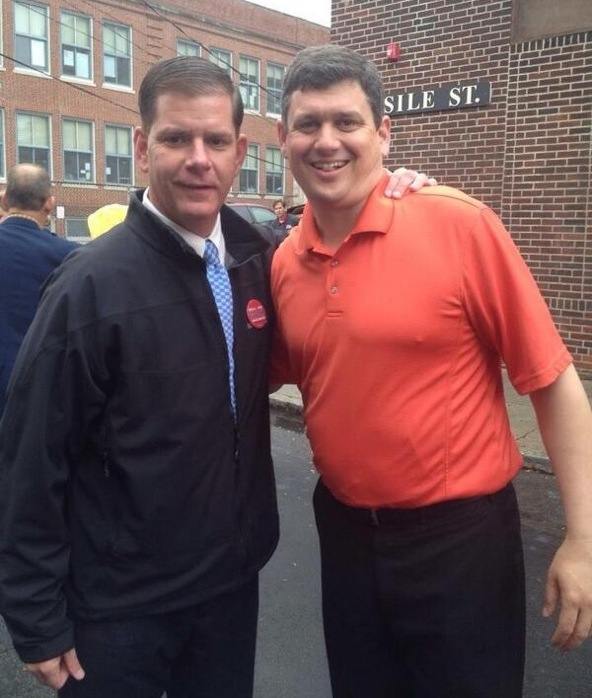
^ friends maybe : Marty Walsh and John Connolly at the Rozzie Parade

— — —

My friend Gerry Seely, who worked more Ward 20 campaigns than I care to count, used to say “politics is a contact sport.” How right he was, and is. He loved the contact. So did I. That’s how we proved ourselves.

I know that many of you reading this are now asking : what does this phrase mean ? What IS “contact sport politics” ? Answer : take a look around you right now.

The Connolly campaign has built and is still building a huge organization of door knockers, house party hosts, social media posters, fund-raisers, sign hangers, etc. Precinct captains have been chosen; precinct organizations are forming. Soon the campaign will have — if it is on a success path — at least a dozen workers per precinct, all of them out there taking the Connolly message to every voter in their precinct.

The Walsh campaign is doing the same thing. Its tone is different, and Walsh is deploying his people on different platforms than is Connolly : less social media, more face-to-face. But the basics are the same as for Connolly : door knocking, sign hanging,. hose parties, meet and greets. all of it done in the precinct (there are 255 in Boston now) by precinct organizations.

you can’t have 24 people, let’s say, going about one single precinct — each has from 1500 to 2000 voters only — without them encountering one another’s work or even face to face. Thus the “contact sport.”

Passions arise in campaign organizations, because it takes huge physical effort, day after day, with few breaks, to do what campaign organizations musty do. Constant strain begets constant intensity. It becomes easy to think of the rival candidate’s organization as people to be bested, beaten, defeated. Those of us who engaged in campaigns all the time learned to hold our passions in check, more or less. we saw the rival organization as soldiers in the same war, and while we delighted in defeating them, when it was all over they were our buddies : we had both gone through the same test. plus, we both knew that though one of us won this time and the other of us lost, in the next campaign — which might begin the next week — they might win and we lose.

The problem comes when contact sport occurs between organizations peopled largely by first-timers. This campaign is such a one. how could it not be, when there hasn’t been an open race for mayor since 1993 ? Almost everybody working a precinct in this campaign is new to the game. It’s a truism that in politics, most workers do their best work in their first campaign. They’re more enthusiastic, less jaded, and because they are “fresh,” voters who meet them trust their involvement more than they do the “political pro’s.” Thus, campaigns want as many first-timers as they can get. his the Connolly and Walsh campaigns have done.

It becomes a huge management problem to keep the first-timers cool on the street; to police the behavior of rookie precinct organizations bumping into one another. As I have written, one of the key tests, for me, in whom I want as Mayor is how well he manages the day to day of his campaign. So far it’s really been no contest. The Connolly campaign has kept its cool from word to street. I’ve seen no disparagement of Marty Walsh, indeed just the opposite. Nor have I heard, even once, of Connolly volunteers leaning on Walsh supporters. The opposite has not been true.

Reading that sentence, you may respond that because Here and Sphere has endorsed John Connolly, i have a bias. I do have one. But as a reporter, I never let that bias control my finger on the laptop keyboard. In the Connolly campaign I see a cool excitement, a readiness to do the task at hand without animus,a discipline extraordinary, really. In the Walsh campaign I see — have seen since I first began to cover this election nine weeks ago — a passion so intense that it bursts its bonds. It lies at the heart of the contradiction that is his campaign. How to be union but not too union ? How to be excited but not so excited that you alienate people ?

Walsh supporters can feel very intimidating. At a distance, that’s OK; it’s even fun to watch. But up close, in the precinct, block by block and house next to house, it leads to confrontation. At which point “contact sport” backfires.

This campaign has already reached that point. The agendas of the two candidates differ hugely. They live on opposite sides of the city, draw from bases that have little contact with each other.

The next two weeks will require a ton of leadership example from the top if we aren’t to end up cleaving the city in half for many years to come.

—- Michael Freedberg / Here and Sphere
BOSTON MAYOR FINAL : “LEADERSHIP STYLE” ?

Image

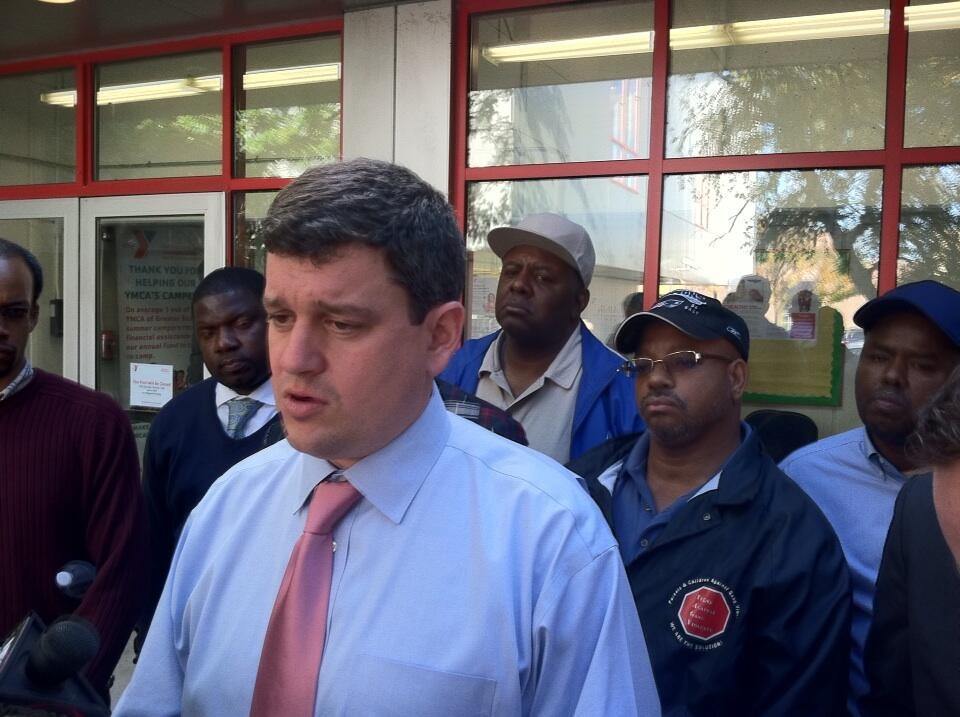
^ in governance, substance IS style. john Connolly meeting with gang members and Ministers in Roxbury yesterday

—- —- —-
So now the Mayor race is about “leadership style” ?

What is this ? A fashion show ? An audition for Downton Abbey or such like ?

To read some big name columnists, or to surf my facebook wall, one would think so. it is said — by Marty Walsh supporters — that some elected officilas in Boston’s communities of color are endorsing Walsh because they don ‘t like John Connolly’s leadership style. A good friend of mine — who knows politics much better than that — also made that point to me this morning.

I would like to differ. I would submit that the idea that some elected officials of color have endorsed Marty Walsh is because of “leadership style” is a rather plump grade of effluent.

Politicians don’t endorse because of style points. They endorse because it serves their interests to do so. What are their interests ? One : getting re-elected. two : responding to their most active and vocal constituents. Three : their own policy agendas. Four : all three of the above.

More credible is the suggestion that elected officials of color have endorsed Marty Walsh because he has an urgency about him. This does seem to be the case. We wrote about that exact aspect of Walsh’s campaign almost a month ago. Walsh is urgent, Connolly long-term. Walsh wants stuff now. Connolly wants now to be just the beginning of a vision, a direction. Walsh’s message resonates with people who need help immediately. Connolly’s gains those who say “yes, right now is important; but what next ?” This too we wrote about back in September and again in our editorial endorsing John Connolly. You see it in how the candidates talk about employment. Walsh says “jobs.” Connolly says “careers.”

Between these two visions there is no easy common ground. It depends how you live your life. If you need more money right away, and getting it sets to one side steps you need to take to gain a career, you must choose either the money right away or the career steps. You probably can’t do both. In many of Boston’s communities of color, where incomes remain below average and unemployment (or under-employment) above average, voters are conflicted in just this way. That is why one sees elected leaders of these communities often endorsing Walsh while at the same time many of the actual activists are going with Connolly. The elected leaders hear the cries of urgency. The activists are building a future.

photo (4)

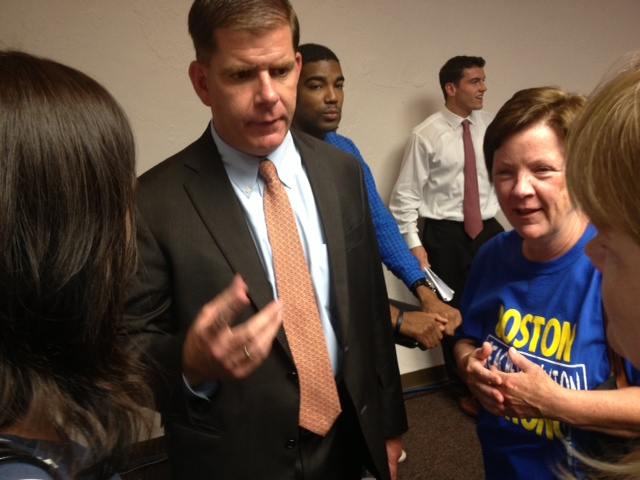
^ urgency — and union jobs now ; Marty Walsh has plenty to offer

The elected leaders are responding to the cries of urgency because that is what constituent service is all about. People building a future can’t do it by calling an elected official’s office for help. Elected officials aren’t set up to build people’s futures. That’s what city administration and state offices of economic development do. But elected officials are set up to assist constituents in need — of neighborhood legal services, an addiction intervention, a problem at school, etc. Thus, in the Mayor’s race, some elected officials of color are picking the man they think will respond most quickly and helpfully to constituent help calls.

But there is a flaw in their analysis (assuming this is in fact how they see Walsh versus Connolly). The Mayor, no matter how sincerely he wants to remedy ills, can’t do it himself. His administration does that. And that is why when I was looking at the campaigns with an eye to recommending an endorsement to my Here and Sphere partner, I looked at how the two campaigns ran. Because, for me, in every campaign for an office essentially administrative, how the campaign is set up and carried out says a lot about how the man or woman will set up and administer when he or she is elected.

With the Walsh campaign I saw a well-managed street presence but a difficult internal process and a message full of contradictions.

With the Connolly campaign, i saw an efficient schedule, a state of the art volunteer outreach, and a campiagn message superbly focused and presented.

I not only saw this. I wrote about it back in mid-September.

May I ask, if “leadership style” — i.e., constituent services — is the avatar here, how come the many, many elected officials who have endorsed John Connolly missed what the elected officials of color now with Walsh see ? Is delivery of city help to people needing it any less important to Sal LaMattina than to John Barros ? Less important to Nick Collins than to Carlos Henriquez ? And what of the many elected officials who are endorsing neither ? Do they simply not give a damn about their constituents’ need for such services ?

Or is it that the elected officials supporting John Connolly want better schools — which will take years to accomplish ; look at the problems now engulfing the Dever and McCormack schools in Marty Walsh’s State representative District — so that their constituents’ children can have great careers ?

Whereas those backing Marty Walsh would rather not take on the Boston Teachers Union – as Connolly has — with school reform and see less political kerfuffle — if Walsh becomes Mayor  — in securing for their people a huge favor : union membership in the building trades and thus jobs now in the Boston building boom while it lasts ?

—- Michael Freedberg / Here and Sphere
NOTE : a suggestion has also been published that John Connolly was merely ‘stylin'” when he invited the Boston Globe to accompany him as he met with gang leaders in Roxbury — “using them as props,’ said the detractors.  This is the sheerest garbage. I propose that said gang leaders were thrilled to have their stories register upon the City’s biggest newspaper. They weren’t “props,” they were the REASON. ‘Nuff said on that one.

BOSTON MAYOR FINAL : THE CONNOLLY CAMPAIGN

Image

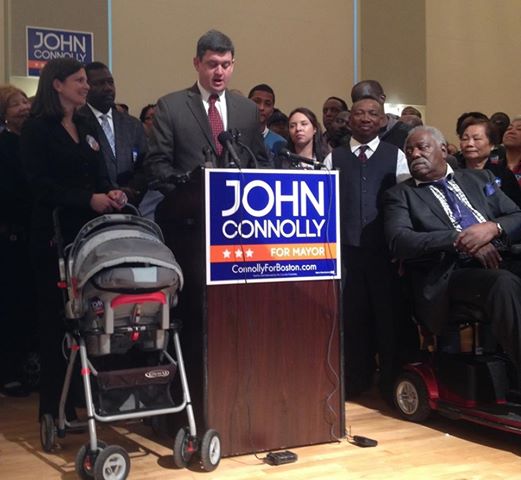
^ “the next mayor has to come in dedicated to bridging the equity gap” — John Connolly speaking at a huge rally in Jamaica Plain tonight

—- —- —-

NOTE : Here and Sphere has endorsed John Connolly for Mayor. I’ve done my best to be objective in this report. You decide.

Two weeks ago, as Marty Walsh struggled to become something other than “the union giuy” and as John Connolly began to amass a large and diverse war chest of people and money, it looked as if the November result would be not close. The prospect looks different now. Walsh found a way to change the conversation — instead of “the union guy” he is now “the progressive tribune of workers’ rights” — and four major Boston politicians of color (three of them former Mayor candidates) have endorsed him, with more such to come soon. Which has forced Connolly to change HIS conversation too.

Until Walsh’s change began to show itself, Connolly had been “the education candidate.” As Boston public schools are by far the largest and most expensive city function, and as there are some 57,000 Boston Public School parents, being “the education candidate” seemed a shrewd choice. It was. It got him into the November Final. But being the education candidate is no longer big enough, and Connolly has had to expand his message hugely.

It has taken him two weeks to do so. I think that he has been stunned, after all the years of bold outreach to Black Bostonians (less apparently so to Boston’s Hispanics), to watch as one after another Black politician endorses his opponent. Yes, his campaign kept on reaping that outreach; yes, it has won him many endorsements by Black religious leaders and by some political action committees. In particular, almost the entire campaign apparatus of Charlotte Golar-Richie joined his campaign, and some supporters of John Barros as well, even a few supporters of Felix Arroyo. But his campaign to Boston’s communities of color has proved much harder than seemed likely a month ago, and Connolly has had to change his approach. I think this has saddened him; one hears it in his remarks. I don’t think he is happy to compass winning by the votes of upscale white people. It’s not what he spent years preparing to be.

as he worked to speak to the changed electoral landscape, Connolly’s speeches stayed close to the education theme. But then came the big break-through : almost the entire leadership of Boston’s “Italian” wards came aboard his campaign. And though the endorsers talked not about issues specific to their neighborhoods — no bread and butter city administration stuff — but about better schools, in speeches that often sounded canned, a smile returned to Connolly’s cheeks and an excitement to his voice.

The endorsements of Connolly by Councillor Marc Ciommo, former Councilo candidate Philip Frattaroli, State Senator Sal DiDomenico, former Councillor Paul Scapicchio, North End State Representative Aaron Michlewitz, and — most importantly of all — by Councillor Sal LaMattina (East Boston State Representative Carlo Basile had early on joined the Connolly side) strengthened Connolly’s hand considerably. He was no longer just the candidate of mostly white young techies and concerned publiic school moms. News came of a fundraiser hosted by said Carlo Basile at which, it was said, $ 100,000 was donated to the Connolly brand. At the same time another fundraiser, by Roslindale real estate developer Vinnie Marino — said to be very close to Mayor Menino — raised yet further funds, and it was announced that Connolly had imbibed a whopping $ 610,000 total during the two weeks just ended.

This turned many heads. What the turned heads now s aw — and heard — was a Connolly on wide angle. Jobs — he said “careers” — safe neighborhoods, all of us connected to one an other, it was all part of his new speech. In the First Debate, on Tuesday night, the new, confident, bold Connolly was on full display as, in a voice pitched high and somewhat melodic — his passion voice =– he spoke of education, certainly ( and often ) but even more masterfully about city finances, revenue, union contracts, and budgets. Suddenly listeners saw not “the education mayor” but the Master of City Money. At many turns in the city finances discussion he had Walsh on the ropes.

This was a surprise to me — probably to many. At numerous Mayor Forums and at “Mondays with Marty” I had heard Walsh speak authoritatively about many city issues and, of course, State House legislation. Less so at the First Debate. He seemed cautious — as well he might be after Connolly’s revelation of a bill that Walsh has filed, five times, to take away from City Councils the power to review labor arbitrators’ contract awards. For that revelation has been at least as significant in moving Connolly beyond being a mere “education Mayor” as any other move he has made or that has been made on his behalf. At the Debate, Walsh could not escape its implications. the mire that moderator Jon Keller asked city budget questions, the ,more that Walsh’ s union-friendly legislation came to mind.

But at street level, Connolly’s attack on Walsh’s labor legislation has opened him to accusations by Walsh supporters that he is “not a progressive,” maybe even a “Mitt Romney in Robert Kennedy words,” as one notable Walsh spokesman said. That the attack has hurt was seen tonight when, at a huge rally in Jamaica plain, Connolly said “I’m sick of being told I’m not a progressive ! Giving a good education to every child in the city, that IS progressive !”

It was a superb speech, the best i have heard Connolly give. He spoke of careers; of “bridging the equity gap”; of the City being “two different cities, one safe, one unsafe.” He made fun of himself. He talked of his teaching career (“despite what you see about me on the internet, yes, I was a teacher,” he grinned.) He talked of restaurants and liquor licenses; of streamlining the city bureaucracy; and, yes, of school reform in all its details including, pointedly, a longer school day. The crowd cheered him; cheered each of his points — and well they ought, because he stated them with a clarity I had yet to hear him bring so much of. He sounded less the slogan-eer, more like… a Mayor. It was a speech just that commanding, pitched perfectly at his fan base of upscale young urbanites and concerned school parents.

Image

^ the Mayor of upscale young urbanites and concerned school parents greets his voters at tonight’s Jamiaca Plain rally

This speech, along with his campaign tactics talks (brimming with insight and laughs) to supporters at donation gatherings, bring Connolly a conversation changed utterly. It’s big presence, a podium persona. Can Walsh raise his game to this level ? we shall soon find out.

—- Michael Freedberg / Here and Sphere