ANNALS OF THE ECONOMY : THERE’S A BANGLADESH IN YOUR FUTURE


Image

^ what “job creation” really means : The Bangladesh-ization of America

—- —- —-

Not since the Plessy v. Ferguson, “separate but equal,’ 1896 decision has a Supreme Court decision done as much damage to the moral structure of our America as Citizens United. By opening the arena to flooding by billions of secret, mostly selfish, anarchic dollars, this decision has put democracy itself under attack. I am hardly the first editorial writer to say this; worse is that I’m surely not going to be the last. Almost every event since that decision was made shows huge disconect between what our people need and what governments are doing about it, because the vast billions given the green light have moved ruthlessly to capture as many governments as they can and to stymie the rest as much as possible.

Those billions could not have done their destruct without the votes of millions to get destruction elected. How did this happen ? How did the Koch Brothers become the effective demlons of our time ? Dedicated to deconstructing the Anerican economy as we know it, impoverishing the already poor, making vulnerable many millions more, and curbing the civil rights of all ? Can that many voters really be induced to vote against their own fundamental interests ?

Yes they can.

Similar happened in 1933-38 in Germany. The method used was to scapegoat “the other” — first the Jews and the Communosts, then the labor unions, then press and speech freedoms, churches, liberty itself. Always the word was “we are freeing Germany of influences alien to our Fatherland.”

No like madness yet portends here in America. Diversity is us, it is part of our national epic. We are all immigrants, and we celebrate “e pluribus unum” — one out of many. Democracy, too, seems as fundamental to our politics as food to our stomachs. All of us at least profess voting to be the single most basic civil right. And yet….

Consider that, in many states, all that stands between basic rights and the denial of them is Federal Courts. In those states — all of them under the power of “Republican” governments — a torrent of laws has been enacted that (1) impose religion agendas on education, women’s health, and personal lives (2) make it more difficult for low-income people to vote (3) burden lower income workers with sales taxes, lighten the taxes of high income earners (4) deny health insurance coverage to people Medicaid eligible (5) harrass undocumented immigrants (6) refuse to do basic infrastructure repair and (7) cut social services to families in need. Federal Courts have done heroic work overturning many such laws as unconstitutional, yet even so, the damage lasted for the long time it took to win a Court decision.

The only way such a government could be elected is by persuading a majority that those whom it views as a problem are a minority, a small minority, and that lie for the majorioty will be better once that minority is cast out.

I do mean “cast out.” The goal of such governments is, first, to get as much as possible of “the minority” to leave the state, just as Black Americans left the Jim Crow, lynch law South in huge millions of numbers 60 years ago and more. The second purpose, as uring Jim Crow, is to intimidate those who stay so they will work for pittance wages.

One thing only has changed : the methods. 100 years ago the means was terror — and lynching was as terrible as it gets. Today the means is to scapegoat a minority and then use the atx and safety net powers of statre government to impoverish that minority into political impotence. In a political system completely ruled by money, those who have none have no political power. Very simple.

The masters of the Southern — and Plains — states now ruled by secret “opportunity” billions will tell you that they want to make their states as tax friendly and wage-low as possible so as to draw in businesses seeking low-cost everything. They will tell you that such businesses are “job creators.” Myself, I see them as job destroyers. The good-paying jobs, they eliminate. as for the low-pay work, who wants work that pays almost nothing, in a state that won’t provide you any kind of public assistance to supplement your less than survival wages ?

Yet the economy policy under way in states like Louisiana, Kansas, North Carolina, and Alabama has a point : to make these states a kind of Bangladesh or Malaysia, where workers get paid next to nothing and live on nothing in slave-labor factories making goods for sale in high-income economies. This is what the “job creators” mean when they talk aboiut bringing back manufacturing jobs to America. Why NOT create a Bangladesh right here if you can do so ?

As our society splits between low earners and the very high income — as middle earning jobs disappear and, with them, the businesses that serve middle incomes — it kind of makes sense for a state hundreds of miles from America’s high-income coasts to become a Malaysia of coolies crowding into factories making high-end goods for export to New York, Massachusetts, California, Baltimore-Washington, and Seattle. And believe me, that is how it is going to be. The tycoons who run basic goods-making firms don’t really want to depend on factories thousands of miles away in countries whose govenments are corrupt and beyond the tycoons’ power. Why do that, when you can tycoon right here in states run by you and whose voters — those allowed to be such — are grateful to have even the nothing jobs you offer, because the state they live in won’t fund or make affordable the education you need to seek a better paying job ? After all, were they do do that, they might just do it : get that taxpayer-funded education and then leave the state for where the good jobs are.

There is a kind of perverse strength in being at the bottom. The bottom has economic advantages — which is why there Is a bottom at all. It perpetuates itself, almost impervious to raising up, because raising up would destroy it.

As for the technology jobs which pay so well, yes : you will find technology centers in some Bangladesh states. North carolina has a large technology corridor, as does Texas. In both states, however, technology districts gather around higher education institutions — the core of whatever effective political opposition exists therein. It can’t be helped. Even a Bangladesh state needs communication infrastructure competitive world-wide. An American Bangladesh state can tolerate this level of political opposition. It hasn’t anywhere near a majority of the votes, and its entrepreneurs are too attuned to the huge financial demands of maintaining their technological edge.

Image

^ technology jobs ; for the intellectual mandarins needed even by Bangladesh States

Robert Reich, in his ongoing Facebook status editorials, sees the economic consequences of political stymie and the political consequences of economic inequality. So far, however, he does not seem to have recognized how the two forces are likely to evolve into an America divided between coolies and mandarins — Bangladesh versus Hong Kong, Malaysia against South Korea. (Or Shanghai, China, versus China’s hinterlands. Or Sao Paulo, Brazil versus the favelas of Rio.) Perhaps Reich just lacks an answer; if so, I share his lack. These are huge economic changes, historic, maybe the most important events going on in the world right now, changes which no nation or coalition of countries is likely to evade for much longer.

The middle class that made democracy possible and equality more than a pipe dream is losing all its gains these past 150 years — retreating to its origins, 1000 years back, in the professions : teaching, lawyering, medicine, government advisors. That was a powerful middle class, but a small one, vital to governance but politically at the mercy of kings, podestas, and Popes. That sort of middle class, devoid of well-paid manufacture and service, is what the future holds. Your grandkids’ America is very unlikley to be anything like yours.

—- Mike Freedberg / Here and Sphere

BOSTON POLS : CAUCUS — WARD 20 ; AMBITION — 5TH SUFFOLK

Image

^basic democracy : Democratic state chairman Tom McGee of Lynn instructs West Roxbury’s ward 20 caucus

—- —- —-

There may be secret money in the Big Picture, but at the small level where actual people live, vote, and run for office, the money doesn’t taint. Whether it’s caucusing in West Roxbury or manoeuvering a run for State Representative in Dorchester, you find politics basic, the real deal, activism for its own sake. So it was, this morning at Boston Ward 20’s Democratic Party caucus, attended by almost 200 people. So it has been the past two days, since the House expelled Carlos Henriquez, leaving the 5th Suffolk State Representative seat vacant awaiting seekers.

But first, the caucus. I chose Ward 20’s because it is Boston’s biggest voting ward; many were sure to attend to elect 29 delegates to the Democratic convention. The caucus met in the community room at West Roxbury’s Police Station. Attendees and candidate volunteers filled every nook — the hallway too. The State Party chairman was there, Tom McGee of Lynn; so were two competing slates of delegates, a Don Berwick group led by Helen Bello — who hosted the huge Berwick house party that I wrote about recently — and a Juliette Kayyem list led by an old friend, Paul Nevins, an employment lawyer. A group of independent names was nominated too, well known people sure to draw votes on name alone; and attendees voted as much for names they knew as for any slate; there wasn’t at all the structure that I had expected of this meeting. It seemed as much a meet and greet as an election.

Image

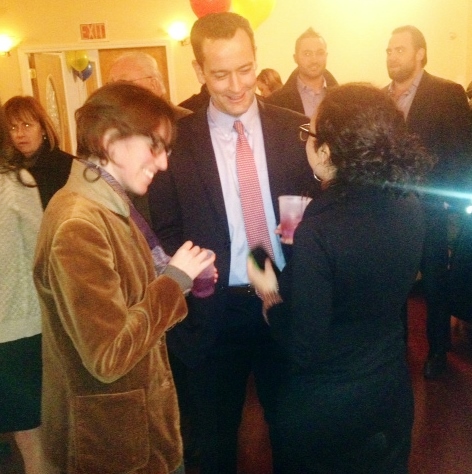
^ Ward 20 state Representative Ed Coppinger discusses matters with Here and Sphere follower Michelle Von Vogler

There was voting, but mostly there was conversation as faces familiar or new worked the room. State Senator Mike Rush was there, as was West Roxbury State Representative Ed Coppinger. Governor candidate Martha Coakley worked the room for about 20 minutes, then left. District Attorney Dan Conley shook hands. So did Congressman Steve Lynch. Old friends Carole White (Kevin White’s sister in law) and Marilyn LaRosa were elected; I noticed Helen Greaney in the room and Greg Haugh also — two other Haugh’s sought election as delegates — and Ann Murphy, still glamorous as ever, now working as an aide to Mike Rush. A couple of Boston Teachers Union activists signed in — but I did not see Ward 20’s biggest BTU name, Ed Doherty — and people from both the Connolly and Walsh mayor campaigns.

Circulating as well were four who ran last year for City Council : local resident Marty Keogh, Jack Kelly, and winners Steve Murphy and Michelle Wu. It was a “good hit,” as pols say of an event well worth being seen at.

UPDATE ON DELEGATES ELECTED : Thanks to Rob for posting to me the entire list, mostly of the usual Ward 20 activists (including two Haugh’s and a BTU active, City Council candidate Marty Keogh, a Marty Walsh cabinet member — Alejandra St. Guillen — and at least one State Employee) and two Don Berwick delegates. Take a look :

Female Delegates:
Alyssa Ordway – 75 votes
Carole White – 74
Ann Cushing – 71
Cathy Fumara – 68
Helen Haugh – 68
Diana Orthman – 68
Marilyn LaRosa – 65
Patricia Malone – 65
Anita Salmu – 65
Margaret Sullivan – 63
Josiane Martinez – 60
Alejandra St. Guillen – 59
Sue Anderson – 58
Heather Bello – 26
Hema Kailasam – 21
Jennifer McGoldrick (Alternate)
Pamela Keogh (Alternate)

Male Delegates:
Robert Orthman – 69 votes
David Isberg – 66
Steve Smith – 66
Marty Keogh – 65
Bill Smith – 64
Kevin Walsh – 64
Bill MacGregor – 63
George Donahue – 62
Joe Haugh – 60
John Fumara – 59
Leo Connell – 58
Tom Hanktankis – 58
Patrick Murray – 58
Larry Connolly – 56
Bob Tumposky – 56

(UPDATED 02/09/14 at 10.45 AM)

—- —- —-

And now to the 5th Suffolk District, in Dorchester, where the expulsion of Carlos Henriquez has left a gaping hole…

Image

will he be the first Uphams Corner state Rep since Jim Hart 40 years ago ? John Barros may become a candidate in the 5th Suffolk special election… But so might the woman pictured below, Karen Charles of the Bowdoin-Geneva neighborhood :

Image

The 5th Suffolk State Representative seat in the Massachusetts House won’t be vacant for long. Already the hungry are circling, impatient, guessing and out-guessing. The big news is that John Barros, who ran for mayor last year and impressed many, is seriously considering a run. Barros lives in the heart of the District, owns a successful restaurant in it,. and would be an elite voice for 40,000 people very much in need of one. Barros is not, however, the only notable who is thinking publicly about running. There’s also Karen Charles, who works at WGBH (full disclosure : WGBH’s Peter Kadzis was my editor at the Boston Phoenix and remains a friend professionally and personally), and who, with her husband Kevin Peterson, an NAACP activist, make a formidable team of articulate reformers and who are said to be close to Charlotte Golar-Richie, who once represented the 5th Suffolk, still lives in it, and who was, like Barros, a candidate in last year’s Mayor campaign.

In that Mayor campaign, Barros won 2,072 votes in the 5th District’s 20 precincts; Golar-Richie won 1,465. Barros thus starts with a 600 vote advantage. That isn’t the entire story, though, Felix Arroyo won 570 votes in the District; and Carlos Henriquez, of Hispanic origin like Arroyo, is said to intend running again to reclaim his seat. Even if he does not run, the 570 Arroyo votes seem up for grabs, not to mention the 313 won by Charles Yancey and the 495 won by John Connolly. (Marty Walsh’s 640 votes might split between Barros and a Golar-Richie-backed candidate, as both she and Barros helped Walsh win the Final).

That said, Barros certainly would enter the race as the favorite no matter who else decides to run — including Henriquez himself. The two men are said to be close friends as well as political allies, and some speculate that if Henriquez runs — and he probably will — Barros will not. We shall see. Whatever the case may happen, this is a District that badly needs an A-list voice. It has always had a working-class majority even in the days, not too long ago, when much of it was Roxbury Red Raider country. The “5th” includes the entire Bowdoin-Geneva neighborhood, one of Boston’s most impacted by gang violence; a stretch of Blue Hill Avenue that Red Raiders knew as “Cherry Valley,” once almost entirely blighted but, of late, enjoying the beginnings of a resurgence (as anyone familiar with local hot-spot Merengue Restaurant knows); Upham’s Corner and half of Jones Hill (where I had my first adult job, working as go-fer to state Rep. Jim Hart); and, of Roxbury, the north side of Dudley Side from Hibernian Hall eastward, all the way past the Governor Shirley mansion to and including “the Prairie” ball field (where Red Raider teams played Park League baseball and football). None of the district is high-income; not much of it is middle-income. Everyone benefits from having an eloquent and respected voice in the legislature, but the people of the 5th Suffolk would benefit more than most.

There will be a special election to fill the vacancy. It will be called soon — the date of it as yet unknown but probably early May. It will be a short campaign, a local effort, politics at its most basic and not much different from that Ward 20 caucus that I attended this morning. More voters to reach, yes, but not much more structure. It also looks now to be the most attention-getting time that the 40,000 people of the “5th” have gained in many, many years if ever. Let the democracy of it begin.

—- Mike Freedberg / Here and Sphere

MISDEMEANORS TO THE FORE : THE HOUSE EXPELS CARLOS HENRIQUEZ

Image
^ “impaired judgment” ? the 5th Suffolk’s Carlos Henriquez addressing the Massachusetts house during debate on expelling him

—- —- —-

Not very often do you see a Legislature vote to expel a member. It hasn’t happened in Massachusetts since the late 1970s, when State Senator Joseph DiCarlo was booted for taking bribes. I well remember that day. DiCarlo was a boisterous, dominant presence, the Senate’s majority leader. His crime was a felony, a high crime by any legislature’s definition. Expelling him was a big deal, a giant of politics crashing and burning.

In contrast, yesterdays 146 to 5 vote — to accept the House Ethics Committee’s unanimous resolution to expel the 5th Suffolk District’s Carlos Henriquez — seemed like small potatoes. Yes, his conviction on two misdemeanor counts of assault and battery on a woman was serious. He should have resigned. Had he any concern for the well-being of his 40,000 constituents, many of them needing a full-time legislative voice, he WOULD have resigned. Of this affair he has made many statements. He is innocent, he says — again and again. Not once has he grasped that that isn’t the point ; that the point is his 40,000 constituents. Not once, in his “I am innocent” statement on the floor of the house yesterday did he address a bigger picture. Indeed, he had the temerity to say that domestic violence is a serious crime and cannot be tolerated !

Having delivered this message, he then walked out of the House, an insult to every member and, I suppose, intended as such.

Debate on the Ethics Resolution — H. 3894 — lasted more than an hour. Speaker DeLeo, on whose complaint the Ethics Committee was acting — seemed ready to let his members speak as long as they liked. Several did. Most supported the committee recommendation, some sadly, a few angrily. Over the top was Malden’s Chris Fallon, who shouted his disapproval of domestic violence, very much the candidate — as he is — seeking a state Senate seat, the one vacated by newly elected Congresswowman Katherine Clark.

Image

^ cogently arguing for censure, not expulsion : Russell Holmes of the 6th Suffolk District

Representative Russell Holmes, of the 6th Suffolk District bordering Henriquez’s 5th, offered an amendment to the Ethics Committee’s resolution. He asked that the House censure Henriquez, not expel him. Holmes’s amendment made two strong points : that with parole, Henriquez will be out of jail by mid April, well before a special election to replace him occurs; and that his crime did not explicitly violate the House Rules and thus could not warrant expulsion.

Image

^ “this is a sad day for us all, i don;t enjoy this task at all” : Ethics Committee Acting  Chairman David Nangle of Lowell

The Ethics Committee’s finding, that Henriquez had violated Rule 16A, which addresses a member’s impaired judgment, did seem strained. Arguing the point, Reps. Garrett Bradley and David Nangle (acting Ethics Chairman) asserted that, being convicted of a crime of domestic violence, Henriquez’s ability to judge domestic violence legislation was impaired. Really ? if anything, his judgment on such legislation has probably become more acute. As for Henriquez being free of jail by mid-April, Bradley and Nangle argued that that was not the point; that Henriquez is quite free to seek re-election to his seat and to be allowed to take his seat if elected.

They’re right on this. It has happened in other legislatures, including Congress.

Yet even if the Ethics Committee’s Rule 16A argument stretched things, there was a general sense in the House that Henriquez no longer had any credibility to address domestic violence matters and that, by his continued insistence on innocence and not resigning, Henriquez had impaired his own judgment on the matter. Representative Ted Speliotis of Danvers voiced the feelings of many when he noted that, by walking out before the end of debate, Henriquez had insulted the “institution.”

No one, not even Russell Holmes, argued with the Ethics Committee’s finding that domestic violence is a serious matter and cannot be taken lightly by the House. Accepting this argument, the House now deems expulsion no longer limited to felonies; that a misdemeanor conviction of domestic violence is full grounds for expelling a member. As Representative Bradley said, “we’ve never faced this situation before, this is a case of first impression.”

But to return to Russell Holmes’s amendment : it was defeated with only 10 members voting “Yes.” Among the Yeas were Representatives Gloria Fox, Byron Rushing, Carl Sciortino, Denise Provost, Holmes himself, Benjamin Swan, John Rogers, and Angelo Scaccia.

Holmes himself said that Henriquez should have resigned. Little wonder that the actual expulsion vote was even more one sided. Voting not to expel were only Carl Sciortino, Denise Provost, Gloria Fox, Benjamin Swan and, after some hesitation, Holmes too.

A special election for the 5th Suffolk District has been called.

—- Mike Freedberg / Here and Sphere

IN CHARLESTOWN : EVERETT MAYOR CARLO DE MARIA WINS AT WYNN CASINO MEETING

Image

Three hundred people, at least, attended last night’s Wynn Casino public meeting at Charlestown High School. The meeting lasted more than two hours, as representatives of the Wynn project spoke, then City of Boston officials and consultants, then local elected officials and residents.

Much was explained, about traffic flow and overflow, new uses of Sullivan Square — which is slated for extensive reconfiguring, dredging of the Mystic River, disposal of contaminated dredgings, public transportation, and noise impacts. Consultants illustrated their concerns about traffic queuing; Boston Transportation Commissioner Jim Gillooly weighed in on Sullivan Square’s competing outcomes ; District Councillor Sal LaMattina expressed that it was “very insulting that you (Wynn) don’t have an answer to the traffic problem.” A Wynn representative answered LaMattina : “It’s a 100 million expense that makes the project unfeasible. Others cause much of the traffic.”

Image

^ “very insulting that you haven’t solved the traffic problem” — District Councillor Sal LaMattina

Image

^ “would you prefer a stadium ? More people, no mitigation ?” — Mayor Carlo deMaria of Everett, the Wynn casino’s host city

And so it went. then came Everett Mayor Carlo deMaria, who, for me, commanded the night’s key moment. “You know,” said deMaria — reminding the audience that he had Charlestown relatives too and that “many of your families live in Everett” — “there’s noises and smells coming from both sides of the (Mystic) River. This project is the best for all of us. Mitigation and jobs.” Then deMaria delivered the bomb : “Others have approached me about use of that land ; scrap yards, a stadium — the New England Revolution wants to build a stadium there. Many more people. No mitigation.”

Sometimes it takes a slap down that painful to get a message across to people who fear the future. “Hey,” deMaria was telling them, “I’m the Mayor over there, 92 % of my people voted for this, I am gonna do it, and if you say no, I will build a stadium that you will like even less.”

The audience got the message. Some residents spoke in favor of the Wynn plan. As one resident said, “Wynn is the best casino operator we have.” Another pointed out that casino traffic was mainly nighttime, not rush hour. Of other objections to the Wynn casino, little was heard. It was Carlo deMaria’s night. And Steve Wynn’s.

—- Mike Freedberg / Here and Sphere
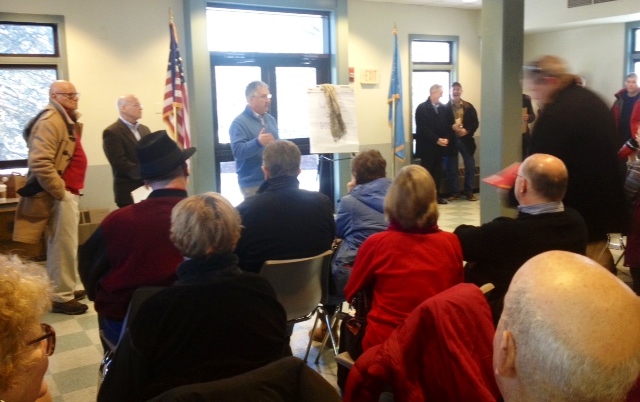
13TH SUFFOLK : CAMPAIGNING IN THE DARK, COLD & SNOW

Image

^ door-knocking alone on a winter cold day ; John O’Toole working Savin Hill’s Grampian Way

—- —- —-

Six men seek the State Representative office that Marty Walsh resigned to become Boston’s Mayor. Since the beginning of January, they’ve ben out and about meeting voters. It’s hard enough to run a race with five rivals on your case. Try doing it in a Boston winter !

If you look closely at the snap of John O’Toole above, you’ll see that he has a voter list in his hand, and a pen. He isn’t just door-knocking. He is seeking out specific doors, at which he is trying to meet a “good voter” — someone who will almost definitely vote in the cold-blast election he is moving toward.

This is campaigning the way one-finger hunt and peck typing is writing.

You HAVE to door-knock. A door here, another door there, two doors on the next street — a lot of walking. With the sun setting at 5 pm — as early as 4.25 pm when January began — by the time that voters get home from work, it’s already dark. Many voters won’t open their door when it’s dark, older voters in particular. The most reliable voters are the older voters. How do you meet them ? OK, you can door-knock older voters on the weekend, in the daytime. Oh wait : only four weekends remain before the March 4th election Tuesday. Five weekends have gone. How many voters can you door-knock, anyway, on a weekend ? If you work seven hours on Saturday and seven on Sunday — Saturday night and Sunday morning aren’t wise times to door-knock — you can knock maybe 120 doors. (In Dorchester, houses are packed so closely together that, at least, you don’t have to walk much to go from one door to an other. it’s all right there for you.) Of those 120 doors, if you’re lucky there’ll be 60 people at home. Nine weekends of 60 voters means you’ve met 540 voters.

But 11,635 13th Suffolk votes were cast in last year’s mayor election…

So let’s say that of the 540 voters you meet, one of four commit to you — 135 votes — and of those, 15 agree to volunteer. The 15 each host you a coffee party, at which you might meet 25 people — of whom some won’t live in your District, while others you’ll already have met. Maybe of the 25 voters in the room, 15 can actually vote and are new to you. Why even bother ? Answer : because maybe 3 of those 15 will volunteer for the campaign, and, just as significant, the house party host, to get 25 people in her living room, will probably have sent out 250 invites, all of which publicize your name.

Of course in winter a snow blast can cancel that houseparty on you.  Oh well…Image

^ speaking intensely to listeners cool : “PJ” McCann at the Columbia/Savin Hill Civic association on a snowy night Monday

During the week, you can only door-knock from 6 pm to 8.30 pm, all of it in the dark. Some houses don’t have street numbers; on many that do have them, the numbers are hard to read in the dark. More time wasted on logistics — but you keep at it, and on each weekday night you can door-knock maybe 80 doors, meet 40 people, commit maybe 20 votes. It does add up, slowly. Each week, if all goes well, you commit 100 votes.

You warm your feet later. On March 5th.

Sounds somewhat good, all this one-at-a-time work : but it isn’t even that good, because every voter you meet is also meeting, or thinking about, your five rivals. Of these voters, only those who actually volunteer for your campaign are your votes for sure. Those who only commit verbally can end up going to one of your rivals. My rule of thumb is that each rival can take ten percent of your committed non-volunteer votes. If this rule of thumb holds, each week you only commit 50 votes on the weekdays and 67 each weekend. By March 4th, that totals 1,053 committed votes that do not go elsewhere.

Image

^ is going everywhere in a parka enough ? is shivering each snow gust with a hat on ? Dan Hunt intends to find out.

There’s also the weather. Many of the six have campaigned on snow days; but in the snow everything moves more slowly. The only advantage is that more people will actually be at home when you door-knock. You’re happy to have even that advantage, because in this kind of campaign there aren’t many advantages available.

If all goes well — and in campaigns much usually doesn’t — by March 4th you’ll have those 1,053 committed votes plus maybe another 500 who you’ve met here and there, out and about, or who’ve read your literature and like it, or whose best friend is supporting you. So now it’s time to get these 1,553 people actually to vote. Sounds easy, but it isn’t. In a special election, with nothing else happening, if two thirds of your voters vote, you have been graced by the election gods.

And what if there’s a nor’easter on voting day ? Unlike school, elections don’t get canceled. But I digress…

Will that number — 1,036 — be enough to win ? Probably not. In a District as politically attuned as Dorchester, there’ll be a substantial number of voters who vote simply because there’s an election happening; voters whose preferences none of the six knows. As many as 2,500 such voters can do their duty. You had better win a fat portion of them.

Image

^ warm among friends — but most times, handshaking in snow : Liam Curran says he “will not be out-worked”

My guess is that 1,850 votes wins the race. Maybe less, because as I see it today, there’s two strong candidates and two gaining strength rapidly. Even the fifth candidate is moving vigorously, knows how to campaign, and speaks eloquently about city life. The five candidates could end up winning 1,600 votes, 1,450, 1,350, 1,250, and 1,000 respectively. (The sixth candidate is running on stickers. Who knows how many will be counted ?) That’s a total of 6,650 votes — a large number for a special election in March, but par for the course in a neighborhood as politically energized as Dorchester. Energized by the indomitable campaigning love of those who, like Dorchester pols before them going way, way back, take to the streets, eateries, senior citizens groups, civic association meetings, and house party living rooms in search of elected office.

—- Mike Freedberg / Here and Sphere
Today HNS and the Local Vocal find out if all is fair in 3rd district court

hereandsphere's avatarThe Local Vocal

When faced with a possible heavy handed sentence for a crime that is merely hearsay will the court once presented with a fact based case of a life changed around — actually opt for an alternative other than more prison time? Check out a local New Bedford non-Profit Youth program, it’s proposal and more. Today presented on behalf of a young man — will good or evil win? We will let you know, when the verdict is in.

Here is the link check it out and give us your feedback!

South Coast A.G.E.N.T.S

http://southcoastagents.wordpress.com/

View original post

#MAGOV : CAUCUSES BEGIN ; BAKER STILL LEADS ALL THE DEMOCRATS. BUT…

Image

^ Still leading the pack, thus reason to smile : Charlie Baker in Leominster

—- —- —-

Massachusetts people are moving to pick a new Governor. The Democratic caucuses begin in a few days. The GOP meetings have already started. As I see it today, February 2nd, Charlie Baker leads the pack. His bold move, last week, to support raising the minimum wage by way of Speaker DeLeo’s legislation, ensures its passage; none of the five Democrats has yet made the same pact. Baker also supports expanding the earned income credit for lower-wage workers. None of the Democrats has even, to my knowledge, mentioned this initiative. Big advantage for Baker.

So is the $ 1,014,906.36 that Baker reported raising last year, with more to come, much more.

In charge finally, Baker stumbled a bit when the question of seeking the death penalty for Dzhokhar Tsarnaev was put to the candidates. All of the Democtrats said that no, the death penalty is not OK for any defendant in Massachusetts; we have abolished it. This is true and principled. Baker’s response ? That he has long advocated the death penalty in very heinous crime situations. His statement seems a step backward for our boldly progressive state. And where do the Feds get their sudden death penalty willingness ? Sirhan Sirhan assassinated Robert Kennedy ; he didn’t get a death peanlty. Is Tsarnaev more heinous ? Or do we simply live in miore barbarous times ? Certainly a great deal of outright barbarism unfolded here in Boston after the Marathon bombing. Who can forget the Antigone situation that arose over the burial of Tamerlan Tsarnaev ? It is not good, not at all, to see Baker play to the Creon mindset.

Advantage then to the five Democrats, as their party’s caucuses begin.

Image

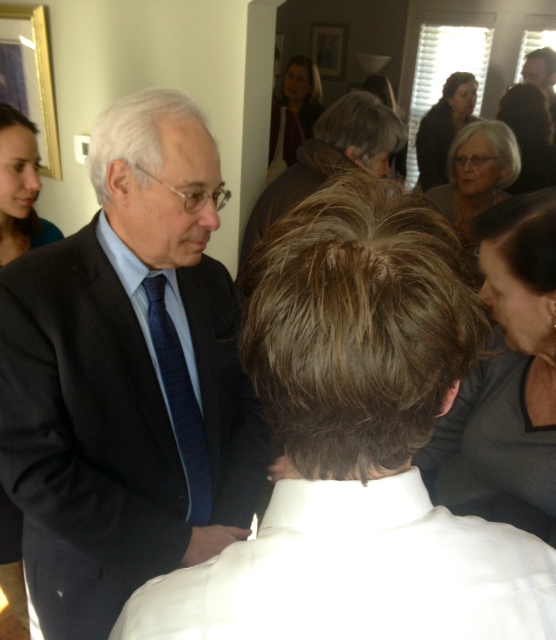
^ heartfelt dedication to social justice : Dr. Don Berwick at a packed house party in West Roxbury yesterday

If yesterday’s Don Berwick houseparty on Chesbrough Road in West Roxbury was any indication of interest, the caucuses should be full-house. 75 locals crowded into every nook of the Chesbrough Road dwelling to hear the gentle, classy Dr. Berwick deliver his social justice speech and answer questions — most of them well informed. And Berwick isn’t even one of the two “majors.” Imagine how many are likely to caucus for Steve Grossman, our State Treasurer, or for Martha Coakley, now the Attorney General. Juliette Kayyem, too, with her personal charisma — 9,749 twitter followers as I write this — is sure to draw many to the hundreds of Democratic town and ward (each ward of a city holds its own) caucuses taking place between next weekend and March 2nd, the last day on which they can occur. So yes, for the five Democrats — Joe Avellone is the one not mentioned above — it’s now crunch time. Any candidate who can’t secure 900 pledged delegates — 15 percent of the total who will vote at the Democratic convention — won’t get his or her name printed on the Democratic Primary ballot.

We won’t know who has done that and who hasn’t until probably mid-March, when the Democratic State Committee tallies the results. But we can assess the five with reasonable objectivity by looking at their fund-raising. (Charlie Baker has yet to report January numbers.) Since January 15th, the day on which I last looked, this is how the five’s fund-raising tallies up :

Martha Coakley 168,951.23
Steve Grossman 153,695.00
Juliette Kayyem 84,679.20
Donald Berwick 50,260.00
Joe Avellone        36,365.64
Total Funds raised by the five —- 493,950.87
Per cent of total :
Coakley —– approx 34 %
Grossman — approx 31 %
Kayyem —– approx 17 %
Berwick —– approx 11 %
Avellone —- approx 7 %

Fund-raising isn’t everything, of course. But in MA, each donor is limited to $ 500 per candidate per year. Thus the list above represents a lot of people. The caucus-goers choices aren’t likely to differ radically from the donors’ picks. In any rate, it’s my working hypothesis as to who — as of today — will make the “15 % cut” and who won’t.

Image

^ charisma and a progressive smile gets Juliette kayyem lots of attention — and probably a spot on the Primary ballot…..

Image

^ or maybe it gets Kayyem second place on a Steve Grossman ticket ? we will see.

For Donald Berwick, who by my analysis falls short, it’s a good thing that the caucus process lasts for a month. He can step up his game in that time — probably needs to. Juliette Kayyem can’t rest calm, either, sitting at 17 % of the total. But then what ? Coakley and Grossman clearly dominate — no surprise there — which means that Kayyem may want to think about taking the Lieutenant Governor position on a Steve Grossman ticket — if offered.

It would be a very strong Democratic pairing. It represents about 50 % of the Democratic convention. The stars are beginning to align.

—- Mike Freedberg / Here and Sphere
#13TH SUFFOLK : DORCHESTER LOOKS FOR THE NEXT MARTY WALSH

photo (6)

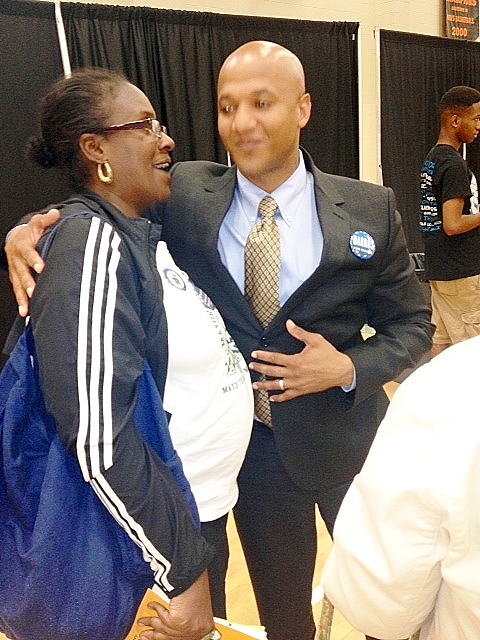
^ first into the race, and looking like the man to beat : Dan Hunt, at the Dorchester Board of Trade’s B2B event last night

—- —- —-

Having seen their State Representative elected Mayor, 24,286 voters (numbers from City of Boston Election department website) of the 13th Suffolk State Representative District are looking for the next Marty Walsh. Or at least the 11,358 voters who cast a ballot in the November Mayor election are looking. On March 4th they’ll find out just who that man will be.

They will be choosing among Liam P. Curran, Tony Dang, Gene Gorman, Dan Hunt, Paul L. “PJ” McCann Jr, and John K. O’Toole.

It isn’t quite that simple, and none of the six candidates says it, but the thought is there on everyone’s mind. Most of the six worked actively in Marty Walsh’s mayor campaign; most of their supporters worked in it too. And if there really can’t be another Marty Walsh, these activists definitely want their new Representative to command attention as Walsh did.

Most of these 11,358 voters would like the new Representative to be, like Walsh, a people person; always there to help; to knock on doors and meet voters one to one; to hang out locally in a favorite cafe or other eatery; and, almost certainly, to be a Union member or, if not that, very attentive to Union Labor matters. They would like the new Representative’s priorities to mirror Walsh’s : curbing urban violence, helping schools to close the achievement gap, advocating “transparency” in governance.

I say “most of these voters” because the race is somewhat complicated by the presence in this District of Quincy’s Ward 3, Precinct 3 (the North Quincy T station area) and because in the November election 2,727 of the District’s Boston voters chose John Connolly. In a close race –and I think the result will be close — these odd-men out voters, who are not looking for the next Marty Walsh, could make the difference. If they vote at all.

But now it’s time to asses the six. Which of them fits the bill best ?

photo (3)

^ very like Marty Walsh : Liam Curran

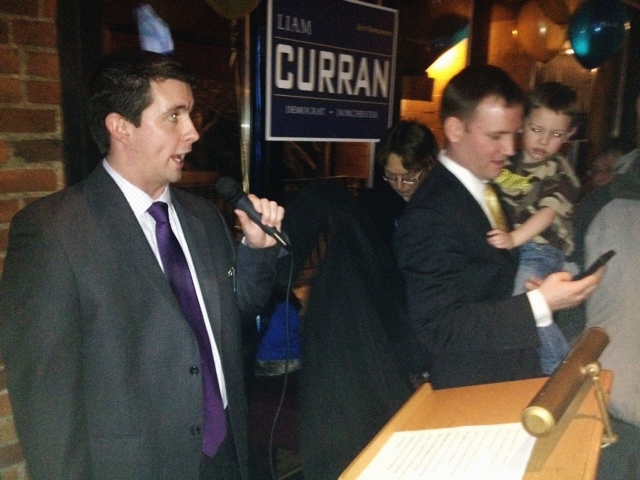
Most like Marty Walsh : Liam P. Curran. He has a union Labor background, grew up in Walsh’s Little House neighborhood and St. Margaret Parish, and even looks a lot like how Walsh appeared at the time of his first campaign 17 years ago.

photo (5)

^ his campaign is picking up and so is his speaking : John K. Toole at last night’s Dorchester Board of Trade event

Best speaker : three of the six rate highly. Liam P. Curran spoke eloquently and in detail at his campaign kick-off last night. But John K. O’Toole also spoke passionately and in detail, about local aid funding, at the Dorchester Board of Trade B2B night. and Gene Gorman, at his kickoff two weeks ago, spoke eloquently about being “Dorchester by choice’; and knowledgeably about housing and school transformation issues.

photo (9)

^ John Connolly-type appeal in a Marty Walsh District : “PJ” McCann at his campaign kick off

Biggest visible support : John K. O’Toole had over 250 supporters — he says 283 — at his campaign kick off last week. “P J” McCann drew well over 200 supporters, as well, to his kick off on Tuesday night.

Most political clout : (1 ) Dan Hunt. He’s chairman of the ward 16 Democratic committee, was a State House aide, worked a significant role in the Walsh Mayor campaign, and has the support of City Clerk (and former Dorchester City Councillor) Maureen Feeney as well as many other activists well known to the political community. He’s also the son of Jim Hunt, who has for over 40 years been a political and neighborhood activist in Dorchester’s Pope’s Hill section. (2) Liam P. Curran, as a lawyer, worked in Boston City government as an Assistant Corporation Counsel, and ‘s brother in law is Chief of staff to Boston city Council President Bill Linehan. (3) “PJ” McCann’s Dad is a veteran BRA executive.

Union Labor support : ( 1 ) Liam P. Curran is a Local 223 laborers Union member. ( 2 ) John K. O’Toole is a member of the Plumbers Union and has the support of Harry Brett, its long time business agent. (3) Tony Dang, an MBTA Police officer, is probably a memeber of one of the several MBTA Unions.

photo (4)

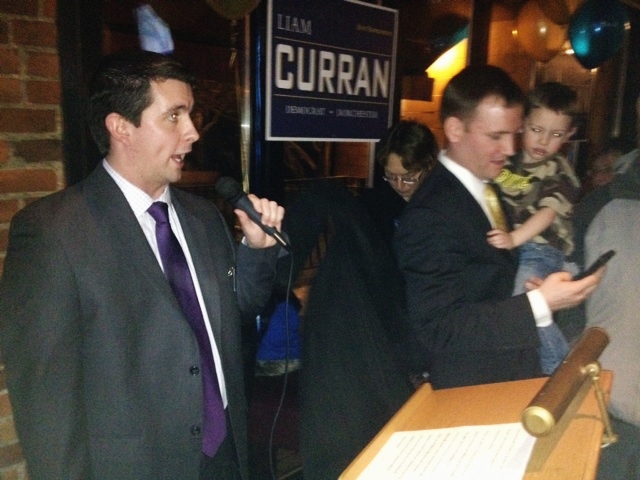
^ enthusiasm of the Marty Walsh kind : Liam Curran mobbed by supporters at his campaign kick-off at. the Blarney stone last night

Most enthusiasm : of course all six candidates command enthusiastic support, or they couldn’t be running. But I was struck by the intensity of Liam Curran’s support at his kick off last night. He drew only about 130 people, but they cheered his speech loudly and constantly, spirited like the go-get-’em, sports-fan crowds that I saw at Marty Walsh’s events. And sure enough, Mayor Walsh’s brother was there, very visible and very much a fan.

Geography : Advantage to “PJ” McCann the only candidate with an address in the Ward 13 part of the District, its spiritual core and the home base for each of the District’s last five representatives. Four of the candidates live in Ward 16 and will likely split its admittedly large vote. Gene Gorman lives in the larger of the District’s two Ward 17 Precincts, the Melville park neighborhood close by Codman Square.

The race grows intense now. Door-knocking has been going on all month, through snow and extreme cold. Nobody is at all tired. If anything, the young people who are doing most of the grunt work are warming to the tasks ahead : house signs, house parties, stand outs, phone calls, meet and greets, more door knocking — after all, they did all this for Marty Walsh, and they have the can-do, will-do feel of confident winners.

photo (8)

^ probably behind in numbers, but an eloquent “new Bostonian” : Gene Gorman at the harp & Bard two weeks ago

So who do I think it will be ? I’ve done no polls, knocked on no doors, but from what I have seen — and reported to you in this column — I rate the six in this order as of today :

1. Dan Hunt — he has clout and longevity; also, he started by far the earliest, and that matters
2. PJ McCann — he has Ward 13 next to his name and a great resume
3. John K. O’Toole — has run before and is well known, but he hasn’t Ward 16 to himself and also waited a long time to decide to run
4. Liam P. Curran — he is maybe too much like Marty Walsh to build his own identity; still, he has the spirit behind him, a well-connected brother in law, and it will surely be known that Walsh’s brother supports him (and Walsh’s Mom, as reported by Dorchester News journo Gin Dumcius). Curran can rise, maybe a lot.
5. Gene Gorman — he isn’t native to Dorchester and lives in a corner of the District
6. Tony Dang — is running a sticker campaign, almost an impossibility

There’s a lot beginning to happen in this race that everybody politically attuned is watching. In two weeks I will update this report.

—- Mike Freedberg / Here and Sphere
NOTE : The presence of one Quincy voting precinct in the District boggles the mind. It’s also a very low turnout area. Of 1186 voters in the precinct, only 159 voted in Quincy’s Mayor election last year. Will even that few show up in this special election ? It’s absurd.

CORRECTION : An earlier version of ,my story identified Tony Dang as a Boston Police officer. He is in fact an MBTA Police officer.

MEEK AT THE MOVIES : LABOR DAY ( 2 stars )

Image

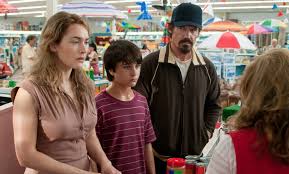
^ a meal and a weekend, but it doesn’t digest ; Kate Winslet, Gattlin Griffith, and Jason Brolin in “Labor Day”

—- —- —-

A good meal can solve a lot of things, and the leftovers too, mixed with canned goods from the pantry can sate as well, but not so much in Jason Reitman’s uneven romantic hash that’s chockfull of disparate parts, stock elements and daubs of cliche.
Reitman, who once served notice as a quirky indie director along the lines of Wes Anderson, with his acerbically big tobacco satire “Thank You for Smoking” (2005), held the line steadfast with “Juno” (2007) and “Up in the Air” (2009). Even “Young Adult” (2011) bore his droll punchy fingerprint, which is why “Labor Day” is such a puzzler, a change-up royale and by-the-numbers affair that lacks air, style or wit.

All of Reitman’s previous works were carefully hung on the framework of a situational dark comedy infused with varying degrees of romance. “Labor Day,” of all things, is a dark romance with a deep vein of crime drama to propel it. Perhaps Reitman saw the project as something new to challenge his skills, or maybe he simply couldn’t pass up the opportunity to work with Kate Winslet and Josh Brolin, two of film’s most complete and capable thespians of the moment.

Those two performers become the film’s saving grace. Brolin recently clocked a yeoman effort that gave legs to Spike Lee’s remake of Chan-wook Park’s “Old Boy.” He delivers this time as well, assuredly with simmer, compassion and just the right amount of intimidation as Frank, an escaped con who, at a thrift store in a deep New Hampshire enclave, takes a woman and her son captive. It’s the mid 80s, so Frank doesn’t have to contend with a texting adolescent to give him away or a viral internet trend to alert folks of his wanted status.

TV news flashes do provide a bit of an obstacle, but they’re also a means to inform viewers that Frank is serving eighteen years for murder–the details and complicated nuance of which are meted out sparsely by intermingled flashbacks that infuriate as much as they enlighten. Frank gains his freedom by jumping out a second story window of a hospital following an appendectomy. As a result he’s got a weeping wound in his side, while Adele (Winslet), the woman he takes captive, has a hole in her heart, lazing around her house, too inert to do anything. Her twelve-year-old son Henry (an effective Gattlin Griffith) pretty much sees after himself, but the sleepy old Victorian they share, as evidenced by the overgrown lawn and general state of disrepair, isn’t so lucky.

So there you have it, Frank’s physically damaged and Adele’s emotionally scarred (she had several miscarriages after Henry, became depressed and her marriage dissolved) and in that, the one can heal the other if the lurking police don’t intercede first. Following the carjacking, Frank ends up back at Adele’s house where holing up becomes hanging out. Besides fixing the front porch and dry wall, he proves pretty good in the kitchen, whipping up a tangy chili out of nothing, and pie? Boy can he bake a pie.
The film’s peach pie scene is one for the ages. Never before, not since “Ghost,” have hands on hands taken center stage with such inflamed hyperbole. In “Ghost,” it played to the texture of the film. Here, with such fine actors so debased, it feels soft-core cheesy and wrong. “Let’s put a roof on this house,” Frank growls as a trembling Adele fumbles with a pancake of thick dough. Reitman, who penned the script from Joyce Maynard’s novel, must have thought the scene smart and leaven with innuendo and metaphor, but as is, it has the sensory effect of chocolate mousse made from a package of stale Hersey Kisses.

Food becomes a reoccurring yet unbridled motif, and a point of bonding for Frank and Henry. Frank even teaches the boy to throw a baseball, and there’s a touching scene with the handicap kid from around the corner who’s allowed to play third base, but of course, the police loom and the film, as the title tells us, is limited to a long weekend.

The good news is that as the film sails into its final chapter, the pace, as well as Reitman’s directorial skills, pick up. Winslet too, who is so shell shocked and unkempt for so long, seizes the opportunity to blossom and fills the screen with her fully ripe, yet restrained sexuality. She and Brolin, like Frank in the kitchen, take what’s there, and with sweat, integrity and resolve, make the best of meager makings that have been dealt to them.

— Tom Meek / Meek at the Movies

#MAGOV : “WISH” LISTS vs. “DO” LISTS

Image

^ Just DO it : Charlie baker with Karyn Polito supporters in Leominster (photo by Baker campaign)

—- —- —-

The contest for Massachusetts Governor has taken on a definite shape during the past three days. The biggest shaping force has been Charlie Baker’s, given as his response to Governor Patrick’s state of the Commonwealth speech. Baker used the occasion to announce his support for raising the state’s minimum wage and for expanding the earned income credit. The news surprised almost everyone. It contradicted recent GOP orthodoxy — you know, the whole “job creators,” no ACA, no minimum wage legislation mantra — and also went beyond what most of the Democratic candidates have suggested. Baker also accepted Speaker of the House Robert DeLeo’s minimum wage raise requirement, that there be some give-back on umployment insurance contributions.

I wrote yesterday about Baker’s announcement and its implications ; these merit repeating. First, Baker established that he will join with Speaker DeLeo on minimum wage legislation. No Democratic candidate has yet done so; when specifically asked what they would do if the Speaker rdejected their legislation, all avoided answering. Second, by embracing doable (and very popular) legislation to relieve income inequity, Baker has vetoed all those GOP-ish advocacy groups (such as Massachusetts Fiscal Alliance) that oppose “using government to make people’s lives better” (as Mayor Walsh has stated his mission). And this may actually be the hugest consequence of Baker’s announcement. Right now I cannot think of a single Republican Governor, Senator, Congress person — or GOP candidate for these offices — who embraces minimum wage hikes and expanding the earned income credit. Whether Baker’s announcement has national GOP implications I can’t yet say; but for Massachusetts its consequence could not be weightier. He has taken the Massachusetts GOP back not just to Weld-Cellucci — whose administrations Baker was part of and mentioned in his talk — but (as my old colleague Peter Kadzis mentioned to me) to the days of John Volpe, Eliot Richardson, Frank Sargent, and Ed Brooke — almost 50 years ago — when the Massachusetts GOP was the reform party, the advance guard of using government to benefit people.

Granted, that Baker is free to take this stand because the Tea Party has never had much ground in Massachusetts — in 2010, Tea candidates didn’t even get the 15 % of votes at the Republican convention needed to get their names on the ballot — and because the huge right-wing greedPACs that have all but kidnapped the national GOP, knowing how un-Tea this state is, don’t involve themselves here. Baker needs no greedPAC money. He has almost out-raised the five Democratic governor candidates combined. T

Baker’s move all but assures that he will have significant Democratic support in the November election. That is how it used to be for the Massachusetts GOP in state elections, Why not again ?

And here is where my headline for today’s column comes into play : “wish list” candidates versus “do list.” Most of Massachusetts’s 166 Democratic legislators and State Senators are realists — do list people, not wish listers. Their voters want stuff done first, talk stuff later. Massachusetts voters are quite common sensed about this. We send our inspirational wish listers to Washington — none more arch-typal than Elizabeth Warren — to voice our noblest wishes, ideals, hopes for a juster social future. To Beacon Hill, we send our grubs and drones to do the grub and drone work. Nor is our thinking wrong. Deval Patrick’s entire two terms has shown just how powerless wish list eloquence is to move the Speaker of the house — no matter who he was or now is — to support legislation. To cite just two examples ; Governor Patrick wanted casino legislation badly. When Sal DiMasi was Speaker and opposed, no casino.. Then came Robert DeLeo, supportive, and lo and behold, casino legislation, no problemo ! Second example : Governor Patrick wanted an enormous, $ 2 billion transportation bill; Speaker DeLeo wanted a much smaller bill. Guess whose “transpo bill” got enacted ?

We like to think of today’s GOP as missing the point of governance, but the Massachusetts Democratic party misses the point too. In its rush to speak nobly of social justice and the higher purposes of civic life, the Democrats of Massachusetts talk just as unrealistically about governing as do the GOP right-wingers. Yes, there is a “progessive caucus” in the Massachusetts Democratic party, and there’s one in the legislature too. What have they recently achieved ? CORI reform, maybe. But every other advance enacted by the legislature belongs entirely to the realists : charter schools, an $ 800 million “transpo bill,” casino legislation — vigorously opposed by “progressives” and right-wingers alike (Ha!)– electronic toll taking, divorce law reform, mandatory sentencing amendments. I often get the impression that the social justice focus of many Massachusetts Democrats arises as a reaction to GOP right-wing talk rather than for its own sake. A genuine progressive movement would be far more broadly based, out among the people — as was the Progressive movement of 110 years ago — broad enough to affect, even command, both political parties, not just one.

The five Democrats running for Governor cannot break free of these conditions, and only one has really tried : Steve Grossman. In forums he talks real talk about realistic goals. Even he has yet to admit that only in sync with the Speaker can he accomplish anything. Even he has yet to tailor his policy suggestions to the Speaker’s — and just yesterday, the Speaker made clear that the coming year’s State budget would include no tax hikes or fee increases. Still, Grossman talks the business-climate, innovation talk that, until two days ago, was Baker’s core message. He also of course supports minimum age legislation though not the Speaker’s conditions). At Forums, Grossman swims in a sea of words : perfume from Don Berwick, chatty niceties from Juliette Kayyem, and quiet sarcasm from Martha Coakley, and often gains a measure of respect thereby : surely the Forum attendees, most of whom will vote in the coming caucuses, understand that Grossman is climbing the mountain, not paragliding onto it. Yet the impulse to high-minded wish lists runs strong in the souls of our Democratic activists; strong enough that Grossman, even if he becomes the Democratic nominee, will be forced to divide his campaign between talking dreams and picking priorities. Baker right now faces no such division. His party’s angry philosophers have been put to bed, freeing him to focus on a do list that the Speaker can agree with and which thus can actually be enacted into state law. That’s a winning message in a Governor election.

Especially with do-nothing gridlock gripping Washington so completely, voters want state government to get good stuff done. Baker has beaten Steve Gossman to the get-good-stuff-done milepost.

—- Mike Freedberg / here and Sphere