THE PRESIDENT OPENS 5 MILLION DOORS

1 President Obama 1

President Obama says “benvenido, amigos !” to 5 million of us. A great night in our nation’s history

—- —- —- —- —- —-

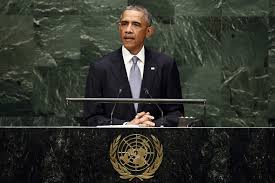
Last night President Obama took it upon himself to open five million doors to five million people who have waited a long, long time for those doors to open. They have waited worrying every minute, unsure of anything besides a hope and maybe a dream. Those dreams have now come true, the hope made good.

Republicans, caught unable to take even a first step toward a single one of those doors,. erupted in volcanoes of outrage that the President would do such a thing. By executive order, no less. They called him Emperor, Tyrant, Dictator. Probably some called him names unprintable. All because the President stepped forward to do a doorman’s job; to welcome five million among us as the guests they are and to offer then a chance to stay. To work. To get ahead with their lives minus fear of being sent back to the awfulness whence they came.

This is what Republicans railed against.

To hear them talk, their complaint is all about process. The President overrode the law, they say. He acted hastily. He overstpped his powers.

David Gergen wrote a piece for CNN in which he said that although Executive Order is quite OK for a President to use in times of emergency and as commander in chief, the presence in our country of 11 million undocumented, technically “illegal” immigrants is no emergency; and that therefore President Obama had no justification for taking emergency action about it.

The presence of so many millions of people, on insecure status and subject to immediate deportation, is not an emergency ? Really ? I say that Gergen is wrong.

We are talking about 11 million people without drivers’ licenses, yet many of whom do drive, without license or insurance, a great risk to those who drive on the roads alongside them.

We’re talking 11 millilon people who can only work under the table, defenceless against wage theft, extortion, blackmail.

We’re talking 11 million people who cannot get public assistance, whose children cannot be certain of going to school, who cannot legally work, who often work off the books and thus pay no taxes ; who cannot get health insurance and thus are 100 percent a taxpayer cost in emergency rooms; 11 million people who comprise a good three percent of the entire economy — because everyone in an economy is part of it, legality making no economic difference– and whose deportation would by itself throw the economy into recession.

That, dear reader, sounds a lot like emergency to me.

As for the Republicans, who hate Federal spending and want to shut down every program except their own, they’re ready to waste billions and billions of dollars sending National Guard troops to the Mexico border, along with thousands of newly hired border agents, all in search of an impossibility. Billions of dollars that could be spent on infrastructure, on health care, on veterans’ services, on NLRB enforcement, on OSHA, on Civil Rights and voting rights enforcement, on national parks and the Coast Guard.

That, dear reader, sounds a lot like insanity to me.

So, no : i do not agree with David Gergen. I do not agree that the continued precarious existence, year after year after year, of Congress refusing to do anything about it, in America of 11 million people and their families is not an emergency. It is one.

Last night was maybe the best of Obama’s Presidency. He has often missed the bus, frequently mismanaged the Federal bureaucracy, almost always fails to explain his policies, compromises them to pieces; but last night he expressed his policy eloquently, addressed a crisis boldly, took the best of this nation’s soul and gave it shape, measure, and tone. He made us a moral nation again, a nation of welcomers, where before we had turned our backs upon those who risked all to get here and be part of us.

Six million still remain in the shadow. There is work to be done. Maybe someone will do it. Maybe not.

That said, America’s soul sleeps tonight in peace. It basks in harnony. Thank you, Mr. President.

—- Mike Freedberg / Here and Sphere

AS GOVERNOR, CHARLIE BAKER SHOULD BE SKEPTICAL OF OUR WISH LISTS

FullSizeRender (13)

listening : Charlie Baker is doing a lot of that lately

—- —- —- —-

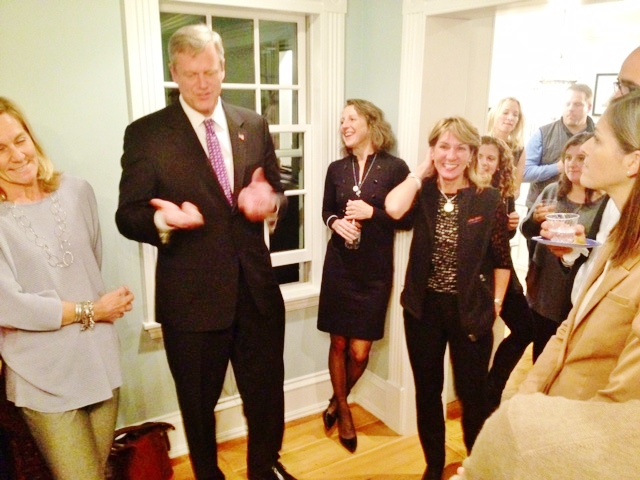
Charlie Baker hasn’t even taken office yet, and the voters of Massachusetts are already besieging him with their wish lists of what he should do; what he should prioritize; what he shouldn’t do; and probably who he should and shouldn’t be. I suppose it’s only natural for everybody to bring forth their personal petitions. For many, the Baker administration presents an as yet open vista of possibilities upon which all can gaze, dream, implore.

That everybody — of an electorate that barely accorded Baker a majority — seems to feel that he will listen to them is a good thing and a bad thing. Good it is that everybody has faith in the system, that those who we elect, even by a slim number, will take our petitions sincerely to heart. bad it also is, however, that universal expectation must surely lead to almost universal disappointment ; because Baker is governor, not god. He cannot do much more than reform state administration. All else will be advocacy of matters where the ultimate Decider is the Speaker of the House.

Let me pour the cold water of numbers on the heat of petitioning the Governor :

1. The new House of Representatives will have 35 Republicans, 125 Democrats. That’s a veto-proof majority by far.

2. The Speaker of the House apppints all members of every committee. Robert deLeo has never been known to fail, when he cares to get involved, at wielding his total command of every member.

3. Much of what the voters are petitioning the Governor about — civil rights, the 2024 Olympics, transportation funding, transportation construction, charter schools, energy policy — are matters of legislation. The Governor has a bully pulpit to speak from, yes; but the Speaker was never much moved by Deval Patrick’s bully eloquence; I doubt he will suddenly crumple for Baker’s.

I see no sign that legislative progress is going to be any more generous in the coming session than it has been in the priors. Most legislators actually agree with the Speaker that reforms on all fronts probably aren’t much good if the state can’t deliver the services already enacted into law.

The priority for Baker is to put into shape the one task that he (very properly) made his campaign theme and which he can actually do : reform the way the state delivers its services, alter the culture of state agency task sheets, make the state budget transparent, build user-friendly online interfaces between the state and those who live in it. These things, Baker needs no legislative permission to accomplish. They’re all his.

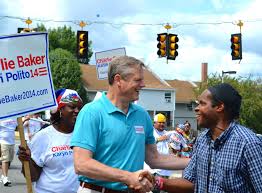
Other than that, Baker can continue his mission to city people, especially people of color and ethnicity, for whom state government often feels like something alien than a boon that belongs to them. This is a calling that Baker obviously feels deeply. His visits to city communities haven’t stopped even after election day. Nor has he failed even once to talk about the crisis of addiction afflicting our state and the mission of recovery.

If Baker can infuse people of color and, or ethicity, or those suffering from addictions or who are beginning recovery, with a strong dose of optimism about career, health, family, and life work, he’ll be a very significant governor even if nothing else of his agenda gets past the bogs and obstructions he will almost certainly face.

Let Charlie Baker do HIS work. There’ll be plenty of opportunity later for him to do yours.

—- Mike Freedberg / Here and Sphere

SEAPORT SQUARE, YES; BUT NONE FOR BOSTON’S HOMELESS

FullSizeRender (14)FullSizeRender (15)

^ the seaport Square project; Mayor walsh saying it’s a great day

—- —- —- —-

Attending Friday’s ground-breaking party for Seaport Square’s 60 million dollar development, I could not but think of the meeting, only two nights prior, held barely a mile away,at which was discussed the situation at Long Island, where a homeless shelter for hundreds was closed without notice because the bridge to the Island was condemned.

At the Seaport Square event hundreds of well dressed developers, architects, executives, elected officials — Charlie Baker came by, as did City Councillors Flaherty and Linehan, State Representative Nick Collins, and State Senator Linda Dorcena Forry — and friends of the Seaport District drank complimentary, high-end beverages and ate delicious hors d’oeuvres as they talked about, or viewed photigraphs of, the Square’s ambitious, multi-use edifices. There will soon be hundreds of residences; thousands of feet of retail space; and a commodious theater, the first to be built in Boston in many years.

No expense was spared to make this ground-breaking a party to savor.

John Hynes of the Boston Group, who emceed the ceremony, called the project “as transformative to Boston as the Prudential and Copley place.” It would, he said, create 3,000 construction jobs and lead to 1,300 jobs on site once open.” Mayor Walsh, the event’s key speaker, said “this is the largest development this city has seen in decades.”

FullSizeRender (13)FullSizeRender (16)

Charlie Baker spoke with Michael Flaherty amid a crowd of over 100 celebrants

Big it is; maybe as big as Hynes and Walsh assert, though the Prudential Center was prettty darn impressive in its own right. It created something where before there had been basically nothing (just rail yards). Seaport Square will not create a neighborhood, simply top it off. Still, yes, impressive.

Hynes also said “the Seaport is the darling of the international investor commnity right now.” And that, I want to say, is the point. Money goes to money : and the Seaport is all about capacious money. It houses, entertains, invites meetings of the many younger Bostonians who work in the city’s prosperous technology, financial, legal, and architectural professions; in consulting and public relations; in networking and trade shows; in the restaurant industry and, yes, in government;  and almost all of whom earn lavish incomes that can handle 40-dollar dinners, 25-dollar parking fees, and 3,000 to 5,000-dollar rents to live there.

Scant wonder that the “international investor community” views the Seaport as a “darling.” Money likes investing in money. It likes those who have money to spend and who do spend it.

City Hall likes money, too. Huge tax revenues will accrue to Boston’s city budget from Seaport Square. The construction jobs that begin today support Mayor Walsh’s core constituency. They can only be grateful that Walsh’s administration has guided the Square project past what Hynes called “years of disappointment and delays” to the beginning of work at last.

Yes, it was a happy crowd of one hundred.

Meanwhile, at Blackstone Community Center scarcely two nights prior, an even larger crowd of desperately homeless people and harried service providers screamed, begged, insulted a room full of City officials to get them somewhere to live as winter approaches them huddled on streets, curled up under bridges, heat-hunting on subway grates and sewer vents. At that gathering there was no food, no happiness, few people well dressed, no congratulations, no ceremony, no money. No international investors smiled; and the several elected officials who did attend seemed to offer an “I have no words” personal presence in support of people who have very little of anything, not even of hope; people living on the edge of health crises and utterly vulnerable to robbery and assault — because that’s how it is when one is homeless. Predators do not feed on Seaport Square, with its security staff and surveillance cameras. They prey on undefended bodres sleeping on slabs of stone in blanket packs.

By no means do I claim that Mayor Walsh does not give a damn about Boston’s battalion of suddenly homeless evictees from a closed long Island shelter. He does care. But any assistance his administration accords to Long Island’s people will be hard to put in place. It’ll be scraped together in buildings now unused and, most likely, out of the way (as was Long island itself). That’s how it is when you’re a dishevelled embarrassment and your life’s a cost burden to a society that can’t move fast enough when the clientele is people who look fabulous and carry acres of diamonds in their pockets.

—- Mike Freedberg / Here and Sphere

BOSTON : NO END IN SIGHT TO THE LONG ISLAND BRIDGE CRISIS

FullSizeRender (2)FullSizeRender (4)

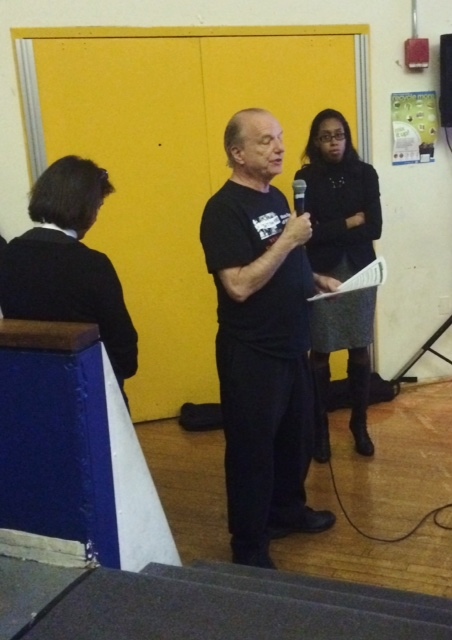
^ homeless veteran tells his story; Michael Kane testifies

—- —- —-

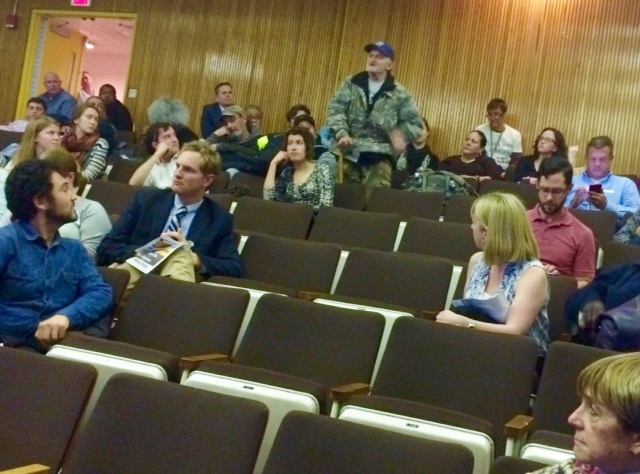
Hundreds of concerned residents of Boston, many of them homeless, crowded into a fourth story auditorium last night at the Blackstone Community Center, in Boston’s South End, to decry the crisis that the October closure of Long island Bridge has occasioned.

Condemnation of the bridge — a structure well beyond safe usage — let several hundred shelter seekers without the Island hospital as a place of refuge. Equally as many people, recovering addicts and alcoholics, depended on the hospital for treatment and care; they too found themselves cast adrift by the bridge closure, which happened with — so it seems — without any notice at all to those affected.

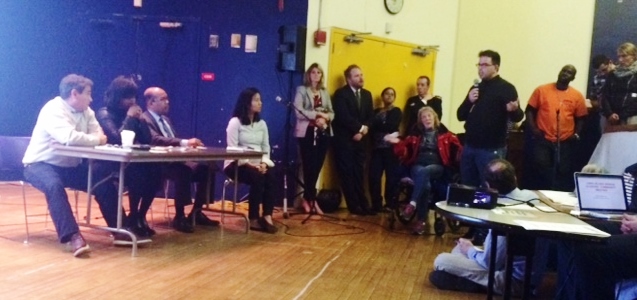
A month later, and still homeless or without the care they need, the hundreds who remain shut out testified 0ne by one : pleaded, demanded, ranted at City officials and at the four City Council members who put themselves on the firing line — Frank Baker, Ayanna Pressley, Charles Yancey, and Michelle Wu. Some who testified did so politely, but none spoke without intense emotion.

FullSizeRender (3)

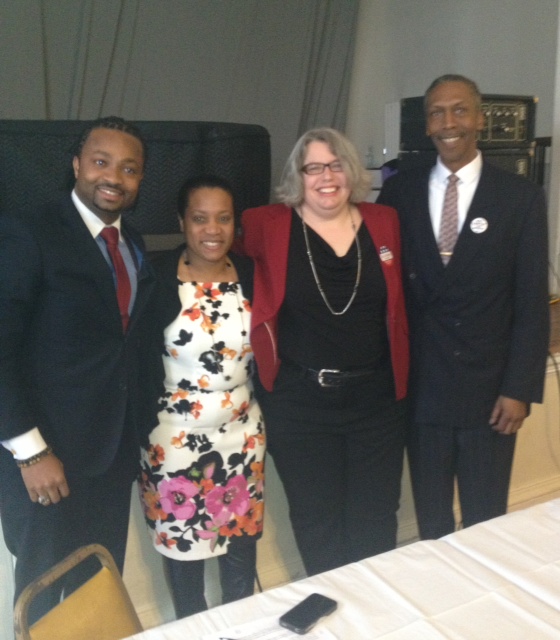
^ from the left : Councillors baker, Pressley, Yancey, Wu

Several advocates for the homeless spoke, and several people who operate shelters — none more purposeful than long-time housing activist Michael Kane, who, a while ago, was a City Council candidate himself and who demonstrated detailed knowledge of the City’s housing issues : the new Mayor’s affordable housing plan, which Kane argued is inadequate; funding issues for placing homeless people in homes; and suggestions how to add new funds — Kane called for the City to create 500 housing vouchers for the 500 evicted from Long Island.

Kane, like most of the speakers, addressed question s directly to the our Councillors; but few answers were given, even by Pressley, probably because not even she had any answers to give. Nor did the City’s representatives, who included former Mayor candidate Felix G. Arroyo — now the City’s Director of Human Services — who as a candidate made the City’s housing crisis his signature issue. Yet not even he seemed to have any answers to the crisis questions : when will the bridge be reopened ? when will the hospital operate again ? Where will the displaced people live ?

FullSizeRender (5)FullSizeRender (6)

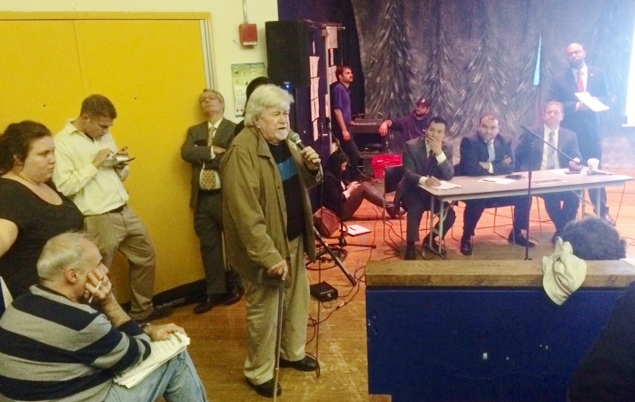
^ testifying — pleading, shrieking even; State Representative Byron Rushing listens

Several State Representatives were in the room. The speakers they listened to must have shocked : women in recovery, suddenly cut off from treatment; a homeless veteran, looking much older than his years, who testified to life on the streets in cold weather; another homeless man who has bounced from one shelter to another dealing with untrained counsellors and burdensome shelter rules; and several women whose testimony ranged from pitiful to shrieking, as they acted out their crisis situation.

Not often do we get to hear frrom, and see, homeless people gathered, testifying to City officials. For most of us, these folks either don’t exist, or do’t count, or annoy. Last night those who were in the Blackstone auditorium had to sit for several hours and listen to many, many witnesses to what it means to battle one crisis after another, hardness that most of us never have to deal with.

The bridge will be fixed. That was promised. But when ?

The crisis continues. people are living in gymnasiums, without lockers for their valuables and goods, without caregivers and with no idea of when their ordeal will end.

—- Mike Freedberg / Here and Sphere

NOTE : the following lknk takes you to the Bridge Closing story at WBUR.

http://www.wbur.org/2014/10/09/boston-long-island-bridge

SOME FINAL THOUGHTS ON THE ELECTIONS IN MASSACHUSETTS

FullSizeRender1 Susannah Whipps LeeDebGoldbergphoto (26)photo (9)

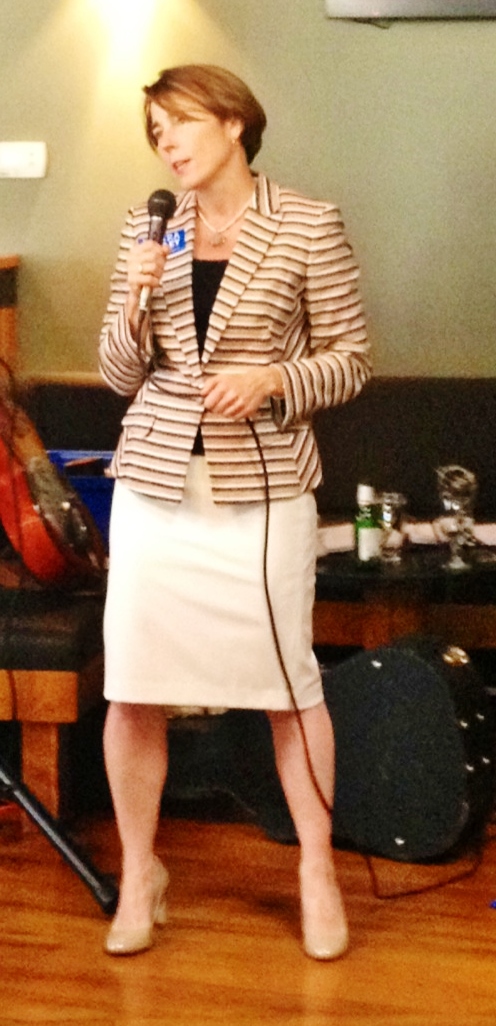
^ new leadership after months of democracy in action : Charlie Baker; State Rep-elect Susannah Whipps Lee; Deb Goldberg; Maura Healey; State Rep Evandro Carvalho (on left of photo)

—- —- —- —-

The election of a new Massachusetts Governor had already begun before choosing a new Boston Mayor had ended last November. For the past two years, thus, the people of Boston, especially, have ben called to democracy in action. So were we at Here and Sphere.

It was an intense two years, passionate and almost physical, as democracy often is when it takes hold of our society. Opposing ideas were debated, hotly; different interest groups took differing paths, butting heads and leaving some hard feelings. Candidates stood up; some got knocked down, others prevailed. Tens of thousands of activists took on the challenge; many woked on it full time — 17 hours a day for those closest to the candidate, seven days a week, for months without stopping.

That’s what it takes to make democracy work. Nothing is automatic where citizenship in action happens. There are no short cuts. Because every person has one vote to give, every person with a vote has to be talked to, one person at a time. No short cuts. The effort overwhelms all but the most committed.

No matter how much lazy money gets dropped into campaigns, no matter how egregious, false, or ugly the advertising purchased by ignorant money, the real campaign takes place between candidate and voter or campaign worker and voter, or both. Voters aren’t stupid. They know when they’re being had. They get when they’re being respected. They grasp the difference.

Most voters also vote for the best candidate. In Massachusetts it’s the way we do. Partisans tend to forget — or to deny — that voters do this. Those of us who dive into political battle and issues discussion need to rememeber that : the voters decide. we only make the case. we’re the laywers, the voters are the jury.

Sometimes those of us who thrive by campaigning tend to think that we are the big dogs; that we are the deciders of history — “opinion leaders,” as candidate consultants call us. We are not. All that we are doing, in all the hours, weeks, mionths that we put into a campaign, is to prepare the case for our candidate(s) so that the voters can decide better — or so we hope.

For now, the work is done. Charlie Baker is our Governor, Karyn Polito the new Lieutenant Governor. Maura Healey will be our Attorney General, Deb Goldberg our Treasurer — fresh leadership for a society constantly renewing. The next Massachusetts legislature, too, will feature many new faces and a larger contingent of Republicans (36 in the 160 member House, 6 of the Senate’s 40) : debate will actually occur and point to policies more widely inclusive than had been the case.

As for the next campaign — city elections in Boston and elsewhere — it won’t begin till next February or March. So things sound quiet now. There’s time to reflect, to rest up, to enjoy the Holidays; to be glad that we participated and that we helped make democracy work in a society that trusts the people and is trusted by the people.

—- Mike Freedberg / Here and Sphere

THE GOP SENATE : FREE TO ACT, OR UNFREE TO DO ANYTHING ?

1 Mitch M1 Joni

^ do you have confidence in this man ? Or in the controversial new Iowa Senator Joni Ernst ?

—- —- —- —-

Republican partisans who we talk to say that the newly GOP United States Senate will be able to actually legislate, as it has not been able these past few years. I would like to believe it, but I do not.

Were Senators free agents, legislation could happen. It could equally have happened during the last session of Congress. There were 100 Senators then as there are 100 now. What has changed except which party has the majority ?

That the Senate and House are both now solidly in GOP control does not, in any way, portend legislation. It portends confrontation, because the President is no more going to sign GOP legislation than he was ready to do so last year. Why shoiuld he ? President Obama’s party opposes the sorts of legislation that the national GOP wants, and he is right to do so.

Were the Senate free agents, conferences might well produce legislation that the President can sign. But the Senate is not free to act. Every Senator — certainly every one elected on Tuesday — is the captive of huge money, of greedy millions of special interest money that has no intention of compromising on anything, because their membership lists and donations depend on confrontation and division. These PACs are not instruments of legislation. they are machines of conquest.

That goes or Democratic Senators too.

A United States senate campaign today costs upwards of ten million dollars; some cost 50 million, even 100 million. The candidates on whom that sort of money is spent are entirely the captive of it. And make no mistake : the PACs dumping vast millions into campaigns want theitr way. Their way or the highway.

in all this, the public interest goes a-begging. It is homeless. It has no shelter, no address, no voice. All there is — all there can be — is for one group of big-money mansions to oppose each other, because each oversized piece of ugly real estate wants the other defeated. That is not a recipe for compromise, not an arena for legislation.

That said, the size of the GOP successes on Tuesday truly astounds. The party added nine (9) senatd seats and bulked its majority in the House. New GOP Senators now represent Iowa, Colorado, North Carolina, Arkansas, Montana, South Dakota, West Virginia, Alaska, and will likely soon represent Louisiana. New GOP Congressmen were elected in NY, IL, GA, and more. The GOP is today the party of the legislative branch, just as the Democratc party was the legislative party for 60 years. The consequences will be enormous and permanent. Even though the GOP of 2014 was a realistic party, not a Tea crazy affair, its agenda is the opposite of what America should now be doing.

The national GOP of Tuesday opposes all moves for economic justice, workers’ rights, women’s reproductive rights, immigration reform, energy alternatives, climate action, civil rights and voting rights. it is a party of reactionary oligarchs who view “the 47 percent” every bit as negatively as did Mitt Romney and who will stop at nothing to demand that its elected puppets enact as much regressive legislation as possible. And just think about what GOP control means for the Supreme Court !

There won’t be debt defaults or government shutdowns, no; but there will be incremental action to dismantle everything fair that our nation has put in place since the 1930s, even since the 1890s.

Pundits assert that the totally GOp-controlled legislature will have to compromise and enact or it risks being the party of “nO’ and that a Democrat will be elected President in protest. My vi8ew is the opposite : that the GO-p ;legislature wants a Democratic President, because then it can oppose her with all question, whereas a GOP President may have other priorities than  the GOP legislature and create conflict — just as it did during the President vies of George Bush 41 and George Bush 43.

Besides, it is easier to scare up 100 million dollar donations to stop a Democratic President than to explain to fat cats why they should donate to opposing a Republican President.

I am not optimistic about what the future holds even if Hillary Clibton is elected President in 2016.

—- Mike Freedberg / Here and Sphere

CHARLIE BAKER IN BOSTON, PART 2 : THE FIGHT FOR BOSTON AND A NEW GOP

FullSizeRender (1)FullSizeRender

^ Charlie Baker, his wife Lauren, and running mate Karyn Polito at a new-Boston-ish meet and greet in Charlestown

—- —- —- —-

Tuesday’s results in the Governor election make very clear that a fight, begun in last year’s Mayor election, continues over what kind of politics will direct the Big City’s future, a fight that will also determine whether the Massachusetts GOP can acquire some lasting measure of public policy power.

To be specific : Baker’s vote improved most over Scott Brown’s 2010 vote in precincts carried by John Connolly in last year’s mayor election. Though Baker won some precincts carried in that race by Marty Walsh, Baker’s vote in Walsh precincts either stayed the same as Brown’s or went down.

Baker drew greatest strength in precincts that epitomize the new, prosperous, technology Boston. He was a Downtown, Charlestown, North End, Waterfront, South End, West Roxbury candidate. Sound familiar ? It should. John Connolly was the same.

Granted that Baker did much better than Connolly in most of the “old Boston” precincts; but where he lost ground, or gained none, in those precincts from Brown’s 2010 achievement, he topped Brown significantly in the John Connolly part of Boston. And why not ? Both men spoke the language of citizen reform, of innovation, opportunity, technology, and social and cultural liberalism. Both men spoke of enterprise, prosperity, envitronmental conscience, effective government.

All of these policy pursuits are gaining election day strength in the City. For decades, Boston politics had been dominated by inward-looking, skeptical, pessimistic people who distrusted big ideas, and the world beyond Route 128, and who eschewed change; people much more interested in holding onto what they had than chancing or risk-taking. This mindset provened just enough to give Marty Walsh, the candidate of skepticism, at-home, and security, a narrow win over Connolly. But that was then.

Where Connolly won 48.5 percent of Boston voters while Baker won only 30,.1 percent, only a careless mind dares overlook the similarity — even iddentity — of their policy messages. And may I say that their shared message is very likely to be the message of a transformed Republican party, at least here in Massachusetts ? The new generation of Massachusetts GOP operatives and policy thinkers wants “the cities” to be the heart of a new Republican agenda, and they are taking their view to the street. They did it all year long, with only a baker candidacy to cling to; now Baker is governor.

Baker will realize a lot of what the new Republican activists want; upon that prospect, many new-Republican candidacies are already being bruited, Boston-minded and Boston-based. If what you hear from these new, Baker-ist voices sounds a lot like what John Connolly spoke of, do not be surprised at all. Reform, innovation, opportunity, choice, and inclusion are in the air, even as Massachusstts’s Democratic party struggles to appeal beyond its base in labor union conservatism (especially that of teachers unions) communitioes of color, and advocacy groups defensively protectve of rights that no significant person in Massachusetts is threatening.

Baker carried 42 of Boston’s 255 precincts. It would not surprise me at all if a Republican statewide candidate even more boldly innovative than Baker carries 80 Boston precincts — maybe even a majority of them. The key will be which policy voice can win the votes of the City’s communities of color. The Republican party of 60 years ago was home to these voters : it can happen again. The Democratic party should take heed, though likely it won’t. Parties on the way down rarely do until it’s rather too late.

Right now, the Massachusetts Democratic party is collapsing in upon its base, just as the national GOP did during the period 2004 to 2012. The Coakley campaign was a campaign to the base, consciously so and eerily regressive. Not since I was a kid had I heard campaigners talk of “vote the Democratic ticket.”

What sort of message is “vote the ticket” ? Massachusetts voters want policy proposals and candidates who they judge capable of making them happen. They don’t want “tickets.”

A party that speaks of “vote the ticket” is well on the road to minority status in an independent-majority state like ours.

—- Mike freedberg / Here and Sphere

CHARLIE BAKER IN BOSTON : INROADS TO “NEW BOSTON”

Baker in RoxBaker 2

Charlie Baker’s 30.1 % of the Boston vote has been compared by most pundits to his 2100 vote, but the real comparison should be to Scott Brown’s 30 % in the 2010 special election that he won over Martha Coakley. In 2010, Baker was running against an incumbent seeking re-election. That’s an entirely different election from one in which no incumbent is running. I’d rather look at two races, both open seats, in which Martha Coakley was the candidate : because she is the Democrat, and Boston is supposed to be a Democratic citadel.

Looking at the two races, it’s clear that Charlie Baker succeeded in winning some moderate progressive votes that Scott Brown could not. The two men ended with almost the same percentage – Baker did slightly better, Coakley a couple of points worse – but the shape of the Baker vote was noticeably more moderate – call if reformist – than the Brown vote.

Baker succeeded even as he held onto almost all of the votes that Brown won in Boston’s most conservative neighborhoods.

In South Boston, Brown beat Martha Coakley 6343 to 4790; Baker bested her by 5908 to 4373.

In slightly less conservative West Roxbury, Brown beat Coakley 6205 to 6071; Baker beat her by only 5997 to 5989.

In Charlestown, a community moving noticeably into the “new”, Scott Brown lost to Coakley by 2915 to 3086. Baker almost topped her : 3128 to 3205.

Baker did much better in the North End than Brown managed. We like to think of the North End as little Italy, but most of these four precincts’ voters today are young professionals. In any case, Brown lost them to Coakley 1825 to 1961; Baker carried them handily., 1814 to 1553.

Baker also measurably bettered  Brown”s results in the South End — quintessential “new Boston.” Brown lost the South End to Martha Coakley 4044 to 9864, about 28 % for Brown; Baker upped the ante : 4867 to 8694, about 38 % for Baker. Charlie also did better than Scott brown in the Seaport District — Boston’s trendiest community. Brown lost to coakley 423 to 714 : 36.8 % of the vote. Baker won 40 % of the precinct’s 1352 votes.

Stronger still was Baker’s improvement in Beacon Hill and the Back Bay. Brown lost these nine precincts 2909 to 4826; Baker almost won them : 3258 to 3610. (This despite – or maybe because of — St Rep Jay Livingstone, a smooth trendy guy, campaigning for Coakley wearing Union/SEIU drag.)

It helped Baker in these socially liberal precincts that he was not running on national issues in which the GOP has alienated so many. But votes are votes; Baker needed every one.

Baker’s seven to twenty point improvement in “new boston” precincts mirrored his eight to 20 point improvement in Boston’s western suburbs south of Route 2 : he lost Newton by 20, not 31; won Needham, Wellesley, Weston, and Wayland, towns no GOP candidate had carried since the 1990s.

These too were crucial gains. Without them, and his Roxbury vote, Baker would have lost the race.

Baker campaigned intensely in Roxbury. Despite having practically every political person in the area against him, and a campaign appearance for Coakley by First Lady Michelle Obama, Baker won more than double the percent of voters that Brown was able to get. Granted that the numbers for baker were still a drubbing : 621 to 7106. But that was much better than Brown’s 316 to 7169. Better, too, was baker’s total in Ward 14, the heart of Black boston. Scott Brown won only 3.5 percent : 207 to Coakley’s 5077. Baker doubled that, winning 7 percent : 411 to 5715.

The same is true of Baker’s relative success in Jamaica Plain, perhaps Boston’s most progressive neighborhood. Where Brown was beaten 1735 to 11,874, Baker won 2154 to Coakley’s 10,600. Brown managed 13 percent in Jamaica Plain; Baker, 18 percent. He needed every vote.

Baker campaigned very visibly to Boston’s ethnic communities. The Mattapan vote shows that he managed a slight, but still vital, increase among Haitian voters. Brown lost Ward 18’s ten more or less Haitian precincts 504 to 6162 : 8.4 percent of the vote. Baker lost these same precincts by 696 to 6561 : 10.5 percent.

A two percent increase may not seem like big fish : but two percent was Baker’s margin statewide. It mattered.

Moreover, Baker’s campaign to Boston kept Coakley from improving her 2010 performance in our state’s biggest city even as, in her targeted cities outside the Boston area, she \bettered her 2010 percentages significantly.

In other parts of the city – Hyde Park, Roslindale, Dorchester, East Boston, Brighton – Baker and Brown won more or less the same percentage of vote. Baker won 36.5 percent in Brighton, brown 35.3 percent. Roslindale did Baker no favors : he lost its 12 precincts by 2119 to 6196. Brown actually did a bit better : 2175 to Coakley’s 5952. Hyde Park fared worse for Baker. He lost the neighborhood 1844 tio 3825, where Brown numbered 1988 to Coakley’s 3361. But these disappointing numbers were nonetheless enough, when added to Baker’s success in neighborhoods closely associated with “new Boston,” to give him that 30.1 % of the Boston vote without which his statewide margin might have fallen to recount territory.

The final total Boston results for the two men look so similar :

Brown 46575 Coakley 105544

Baker   47584 Coakley 104759

Yet appearances can deceive.

—- Mike Freedberg / Here and Sphere