GOVERNOR BAKER : THE TRANSITION TEAMS AND WHAT THEY TELL US

FullSizeRender (33)

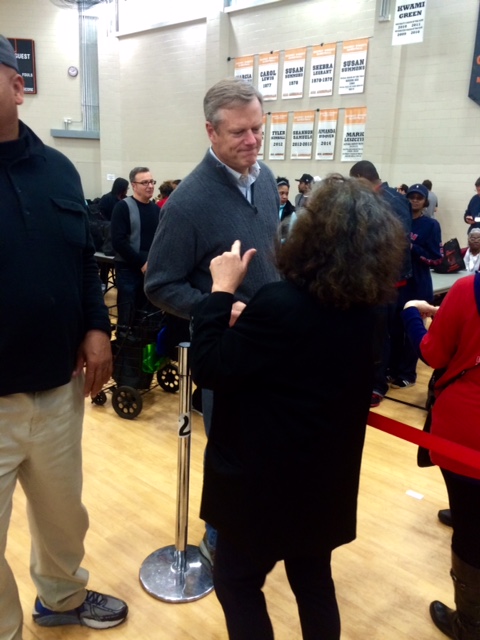
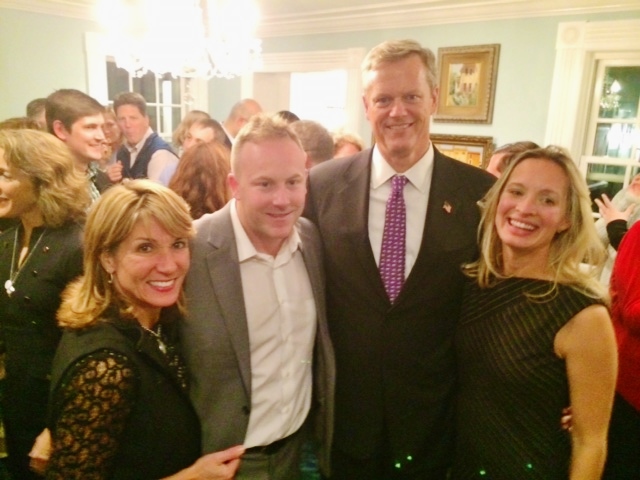
^ transition team member (Health Team) Jack Kelly of Charlestown with LtGov Karyn Polito (l) and the Governor (r). To his right, Rebecca Love

—- —- —- —- —-

He hasn’t been sworn in yet — that date is January 8th — but Charlie Baker’s 170-plus transition teams tells us a lot about how he will govern as well as who he will call upon to deliver his goods.

The first task is to read the list of names, so here it is, in a link to the news story in which it was announced : http://www.bostonglobe.com/metro/2014/12/11/advice-charlie-baker-wants-lots-names-many-transition-committees/WkDAsvFlXN6aKvMSS1bm3K/story.html

There are five teams mentioned in the media story : Schools; Better Government ; Jobs and the Economy; Health; and Community. This list by itself tells us what Baker’s agenda priorities will be. None is a surprise. His entire campiagn focused on these five areas of concern, of purpose, and of his personal expertise.

The difficulty arises with the specific names chosen, or, should I say, with who, or what kinds of people, were not chosen. Because politics is so bound up with the personal – it is through people, after all, that things get done — it matters when entire interests get left out, or when other interests are over-represented. In this regard, many activists will take issue with who Baker has chosen and not chosen.

Most likely to generate controversy are the members of his Jobs and the Economy committee and the Community Committee. More about that later. First, his Schools team.

The composition of this team will not please opponents of lifting the charter school cap. It’s weighted almost entirely in favor of school innovation, including charters, and having former MFT (Massachusetts Federation of Teachers) head Paul Toner aboard seems almost a declaration of war with the current MFT head, a teacher union firebrand who ousted Toner from his much more flexible approach to the State’s education decisions. That said, it’s a big plus to see Chelsea Public schools superintendent Mary Bourque named as well as legendary Boston Latin School headmaster (emeritus) Michael Contompasis. Good, too, that almost everyone on this team is a city person. it’s in the cities that the “achievement gap” resides and in the cities that it must be solved. I am betting that this team will advocate transformations of education as radical as those proposed last year by Boston mayoral candidate John Connolly, who, even though not named to the schools team (probably a mutual choice), has to be quite pleased with its orientation.

As for the Community Team, why are so many real estate people on it ? Is this not really a Housing and development team more than a “Community” team ? Housing is definitely a public policy priority; but for “Community,” an even higher priority is personal clout and credibility. It seems to me that a Governor would want his “Community” committee to feature the people who campaigned most effectively for him and who are now looked to by the voters who listened. Yet the only people on this committee who fit that description, so far as I can tell, are Paul Treseler of west Roxbury, Robert Lewis and Chris Jones of Roxbury, Marc Laplante of Lawrence, Kevin Mullen of St Brendan’s Dorchester, and Bing Broderick of Haley House. All are terrific choices : but why are Meghan Haggerty of Dorchester, John Sepulveda of East Boston, Phil Frattaroli of the North End, Kristen Phelan of Downtown not named ? Why not Marty Keogh of Hyde Park and West Roxbury ? Why no Haitian or Cape Verdean ? No Viet Namese ? Why no major Hispanic leader ? Why no one from South Boston, Fall River, Lynn, Pittsfield ?

and why so many advocacy group spokespeople ? I thought the object was to go directly to the voters, not to them via opinion brokerages, as it were.

Perhaps Baker’s thinking that every political person he might name has as many enemies as followers, because that’s how it is when you are a precinct-level campaigner. The more effective you are, the more neighbors you have defeated. Yet activists are not fools. They expect their winning neighbors to have the Governor’s ear, and most of them want that to happen, because the entire neighborhood benefits from it.

I think that Baker has missed an opportunity by not making his “Community” team less about housing and more about outreach and input.

Baker’s Jobs and the Economy team also puzzles. How can the Governor seek advice on jobs and the economy but not include at least a couple of labor leaders ? Yes, almost every labor union in the Boston area passionately opposed Baker — and were quite foolish to do so. Yet much of their opposition had to do with control of the Democratic party looking to the 2016 presidential nomination. Every union leader with half a brain understands that the Governor, especially a building-boom man like Baker, has plenty to offer to union rank and file. Obviously you do not ask advice from a stubborn oppositionist like Robert Haynes, or open doors for the AFL-CIO’s negative-campaign stink bombers. But it was, i think, a bad decision not to have at least one leader from Local 26 Hotel and Hospitality workers on the Jobs and Economy team, or someone from SEIU. These unions are not irrevocable enemies of the Baker agenda, not at all.

Perhaps these reasonable unionists preferred to stay outside the inner circle, and perhaps they and Baker agreed thereby. If so, good enough. As it is unionists do have one strong transition team advocate in Chelsea City manager Jay Ash, who is a co-chair of the Jobs and Economy committee, and another good advocate in building trades leader Mark Erlich, of the Council of Carpenters.

To sum up : Baker clearly intends to govern through institutions, agencies, and bureaucracies first of all. I would have preferred a more informal, people orientation, but bureaucracy and agency are how our state is organized these days. Badly organized, too.

It takes agency minds to reform agency cultures and procedures. Baker is himself an agency mind. He promised to make bureacracies and agencies work better. Whatever his economic and education biases — and these are quite clear — at least the stuff that he wants will get done and the services he wants will be delivered, to those who need them most.

—- Mike Freedberg / Here and Sphere

FALL RIVER MAYOR RECALL : DEBATE AT BK’S TAVERN

Fall River mayor recall : Last night’s Mayor recall debate brought out all the attacks and accusations…at last.

hereandsphere's avatarThe Local Vocal

FullSizeRender (32)

^ Mayor Flanagan, nose in the air; to his right, six of his seven challengers : Shawn Cadime, David Dennis, Sam Sutter, Ronald Cabral, Paul Anderson, Mike Miozza

—- —- —- —-

You don’t get recall elections unless there’s some serious anger going on in a city’s publioc affairs. Serious indeed are the accusations that gave rise to Fall River’s mayor recall election, and last night, at BK’s Beacon Tavern, the full gamut of anger and accusation was unleashed at Mayor Flanagan by several of his challengers.

As negatives are haht a recall is about, and not good when unvoiced, it was healthy to hear what is being said, off stage, all over the city about mayor Flanagan voiced in full public view at the WSAR-hosted Forum. And there is plenty : surprise cuts in the city budget, a pay-as-you-throw recycling initiative instituted without any City Council input; a “culture…

View original post 769 more words

BAD POLICING : THE CRIMINALIZATION OF POVERTY

1 poverty is not a crime

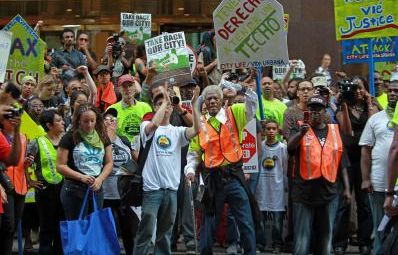
Poverty is not a crime : protesters appealing to reason. is there any reason out there ?

—- —- —- —-

Those who wonder why people of color distrust the police need not look only to bad policing. First look might go to the criminalization of poverty.

If you want to own a car — and having a car enables you to move much more freely than by public transit, thus to get to work more quickly and to more places — your cost doesn’t end with the purchase (or the lease). There’s insurance to buy, a driver’s license to pay for and, if you get a parking ticket, fines to pay, all of which tote up penalties in a hurry if not paid on time. There’s also the excise tax, and its penalties that add up forever.

As a recent Harvard Law BULLETIN article (link provided below) pointed out, these fines and penalties put much money into the coffers of cities and towns. And because they are criminal, they can — or could until recently — land people in jail if they’re not paid. Add to that “probation fees” and, in some cases, making people in jail pay for their incarceration, as well as profit or the private firms often hired to enforce these burdens, and you’ve got quite a racket going at the expense of people who haven’t much money ever.

Link : http://today.law.harvard.edu/fighting-unequal-justice/

This particular abuse has been pushed back, thanks to the young lawyers profiled in the Harvard Law article, but many other criminalizations of poverty remain. The driver’s license fee, the penalties for renewing a license late, the risk of driving without insurance because you can’t afford it. And none of this even begins to address the penalties we place on people who are under court order to pay child support, or the penalties we impose on people who sometimes sell their food stamps (EBT in Massachusetts) because they haven’t the money for home heat or clothes for the kids or whatever.

And if you end up with a criminal case and live in poverty, you have to get to court on time, even though you may not have transportation to get there, and to wait in court (or at the probation officer’s office) all day long only to be told to come back in a month, for another all day wait; all of which means a day off from work or, just as likely, no chance to hold a job at all because you’re always having to be in court.

Nor does the criminalization of poverty end there. people who liove in financial crisis every day often lash out. Domestic violence abounds in families living on the edge ; partly because nobody has any security at all, or because they can’t handle the disrespect that comes with argument, or because police are called to the house when an argument erupts, or because families in crisis sometimes turn to drug dealing (or to thievery) because the money is just that good and they simply want to have it. And o course we, the “normal” people, see all this and our first thought is to blame the poor or being…not like us.

And it’s true : public assistance to families in poverty is paid with taxpayer dollars, and so we taxpayers, not unjustly, insist that those dollars be spent as we enact by law they be spent; and we cry “foul’ when some of those dollars are spent differently. Unfotunately, our outcry also reinforces the deparation of poverty people from the rest of us and so adds the barrier of distance to that of penalty.

This is the ground upon which police now come into communities of poverty ; many of which are people of color, because just skin color, in our society, is all too often an occasion for separation; and people of color who live in poverty are thus doubly separated. Then, into their lives, all too oten come police, most of whom are not people of color even in cities where people of color are the greater number. Even the most professional of police, the best trained and the wisest, are still too justly seen as agents of the criminal enforcement system that imposes all those fines, penalties, burdens, obstacles, and frustrations upon people who at the best of times live in the moment, when they’re not being visited by child welfare agents or truant officers, landlords looking for back rent, or utility people coming to shut off the gas because the bill has gone five months unpaid.

Why do we impose the most financial penalties upon the people least able to pay them ?
You tell me. I certainly have no answer for it.

But one thing I do know : those whose everyday lives have been made criminal, for profit or punishment or just because — see the police quite opposite from how gthe rest of us see them. It’s a wonder that people of color haven’t taken up the hue and cry long before now — except that people who love every day of every year in crisis lack all political power; are not heard; are not seen ; tend to vote in fewer numbers; and thus do not exist, for us or, sadly, even for themselves.

For the time being it looks as though the greater society we live in is ready to make big reforms. To police practices, and maybe to the culture of criminalized poverty as a whole. I hope it happens. The next time, things won’t be so simple.

—- Mike Freedberg / Here and Sphere
BAD POLICE : THE CIVIL RIGHTS ISSUE OF OUR TIM

1 boston protesters

^ protests for very good reason. Police civil rights violations must stop !

—- —- —- —

NOTE : this story is Part One of a Two-part Series on Civil Rights Injustice in Today’s America.

—-

So many civil rights denials occur every day in our struggling nation that it’s almost unfair to single one of them out as “the.” Yet that is what we face. We know right now — should have known all along; why didn’t we ? — that bad police are the single most crushing civil rights problem this country confronts.

Confronting, indeed. From Ferguson, Missouri to New York City, from Cleveland to the Carolinas, and at various places in between, one bad police event after another injure our attention.

Some of these bad-police incidents seem the result of mistake. Some can be explained by the event itself. Many others, however, defy justification. There is none for such as the shooting, in Cleveland, of a 12-year old boy with a toy gun; for the chokehold killing of Eric Garner, in New York City; for the tasering of a boy named Bryce Masters — an event that has gone viral on social media; for the beating up of a woman in a Texas town jail by officers at that jail. Nor can there be anything but punishment and Justice department takeover of the Cleveland, Ohio police force, callousness run rampant, evidently, through the entire department.

Many of these bad police events are racial. Clearly many police departents view people of color as suspects simply because. The phrase “driving while black” became famous for a  reason ; drivers who are of color get stopped far, far more often than white drivers. People of color get harrassed almost no matter who they are. Can we forget the Cambridge cop who arrested Harvard Professor Henry Quarles a few years back for breaking into his own house (because he had forgotten his door key) ?

Quarles is a man of high influence; he knows the President, and the Pres8ident came personally to Quarles’s defernce. Black citizens who lack such clout have no kind of luck.

Over and over again, Black citizens are stopped by police, harrassed, even abused, occasionally injured, sometimes shot and killed. Who can forget the cop who, in North Carolina a few years ago, killed a Black college football player who had been in an auto accidernt and approached the policeman for help ?

In that case, as in the matter of the woman punched in a Texas jail, prosecution followed. So too has NYC prosecuted bad police, sometimes successfully. Yet for every such success far more cases never have consrquences. We are stunned — as we should be — that a Staten island grand jury just this week refised to indict the NYC cop who put Eric Garner in a chokehold and killed him, an event fully captured on a clear, gruesome video.

As the Garner tragedy shows, Black people are also far more likely to be arrested for minor matters. Garner was selling loose cigarettes ! Why did that “crime” demand an arrest at all ? Most police forces would have simply cited him a ticket to appear in court. (It is said that neighbors complained about Garner. Does that justify his being arrested rather than cited to court ? I think not.)

The Garner matter will now be investigated by the Federal Justice department, as the Cleveland police department has been and as that of Fergiuson, Missouri is now undergoing. This comes none too soon.

The Justice Department should conduct a review of the parctices and culture of every major city police departement in the nation. If it finds a pattern of infraction, it should bring civil rights cases under Title 18 — laws that exist for a reason.

Police departments must hire officers of color. The department must “look like the neighborhood it serves,” as progressive Mayors now phrase it.

Police departments must rigorously train new officers, review its officers’ adherence to rules of engagement, discipline those who violate these rules, prosecute when warranted, dismiss from the force officers who do not conform. Nor can a police department make excuses for officers who break the law.

Too many police departments view their situation as “us against them.” That must change. The police must see themsleves as both us and them, exactly as do the rest of us.

One further point. We the people are right to protest these violations and to do so vigorously, passionately, But blocking highways and public transit, or shutting down shopping malls, is not at all part of rightful protest. This movement needs the public’s support. It has no business making life difficult for the rest of us. Keep the egos in check, lose the moral contempt, and focus your eyes on the mission.

—- Mike Freedberg / Here and Sphere

TOMORROW : THE CRIMINALIZATION OF POVERTY : FOR PROFIT

THE ERIC GARNER CASE : THIS TIME, NO POLICE JUSTIFICATION — NONE AT ALL

https://www.google.com/url?sa=t&rct=j&q=&esrc=s&source=web&cd=1&cad=rja&uact=8&ved=0CCAQtwIwAA&url=http%3A%2F%2Fwww.youtube.com%2Fwatch%3Fv%3Dj1ka4oKu1jo&ei=-aGAVMn2MI60yASn1YLYBA&usg=AFQjCNGt0NZKksT6iG1dfxNm_K9aqWEo4A&sig2=2iQJaizktthKkewyFo1Hgg&bvm=bv.80642063,d.aWw

^^ you can see it all right here, the entire grisly killing.

—- —- —- —-

This time there is no mitigating evidence. This time, unlike with Michael Brown, a camera filmed the entire sequence. It’s all right there for everyone to watch.

This is how NYC police kill a man.

They’re actually quite accustomed to it. Unarmed Black men get shot by NYC police with some regularity. many die. A New York Times article published just yesterday told the sad history of killings of unarmed, totally innocent public housing occupants by NYC police patrolling stairwells and hallways. Nor are these all that NYC police have killed, or abused, or harrassed as amatter of speciic policy.

Some have actually been charged, convicted, and jailed. The torture of one Abner Louima, in Brooklyn, who was sodomised by police using a broom handle, resulted in two policemen convicted of felonious assault and battery.

But not this time.

This was no Michael Brown matter. Eric Garner did not assault the officer,m did not reach for his gun, did not punch him in the face. The officer in that cases had some justification; in this case, none at all. You can see why, right there, in the video.

Picture it : a large man is arrested for selling untaxed cigarettes. that alone makes one go, WTF ? You arrest a man or selling cigarettes not taxed ? Why can’t you just write him a citation and tell him to appear in court ? is it necessary to arrest him ? Not that we cn see.

But not only is Eric Garner arrested for this heinous, shocking offense (!), he is then put into a chokehold that violates the NYC Police Department’s own rules, and is held in that choke hold until he dies. You can see it all, every detail, on the full length, clear video.

The officer, one David Pantaleo, told a Staten Island grand jury that he had no intenhtion of killing Mr. Garner. Probably so; but kill him bhe did; and by pursuing actions of harrassmnet that the NYC police have been pursuing, against Black men, for many, many years as a matter of express policy.

Those harrassments violate the civil rights of people and are intended to do so, a policy of keeping a full court pressure on against men o color no matter who they are or where. The goal has been, hit them for the small stuff and they’ll not dare to do the big stuff. That’s like saying, kill them, and they’ll definitely commit no crimes.

In this country we accept that crime takes place even though it should not, because the alternative is a police state in which no one has any civil rights unless the police grant it. That is not America.

A Federal Grand Jury will now sit. It should indict Mr. Pantaleo. He should be tried; he should be fired from the NYC police. If convicted — of manslaughter, probably — he should be sentenced. Police must understand — must learn — must accept — that they cannot just take any measures they feel like taking against whomever they feel like taking them. An unarmed man accused of a minor, economic, entirely non violent crime is violently killed. This is not OK.

Repeat : it is NOT OK.

— Mike Freedberg / Here and Sphere

THE POLICE AND THE COMMUNITY : TRUST CANNOT BE ONLY ONE WAY

1 Ron JohnsonFerguson protesters

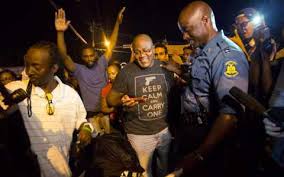
Without ^^ this (captain Ron Johnson at Ferguson) we get this ^

—- —- —- —

Because of the events that have taken place in Ferguson, Missouri, and aggravated by protests all across the nation, proposals for reform of police practices have arisen loudly enough to command our attention. Some proposals make sense; others do not.

The Ferguson events make clear that its police and the citizenry distrust one another profoundly. The Michael Brown matter should never have happened. A policeman who didn’t view his patrol as an mass of fear and danger would probably not have sassed Brown the way a prison guard barks at an inmate. Had Brown not acquired a distinct dislike of police, he probably would not have responded as recklessly as he did.

We have all seen the vidclips; seen the militarily-geared Ferguson police treat protesters as the enemy; seen them wreak war on peaceful citizens and on the media — a foolish move, and one that went far to put all police forces at odds with citizens. It is not surprising that we, the citizens, now demand that police practices reform big-time.

The President has suggested that police forces no longer arm themselves with military gear. that seems common sense to me. Just as our Armed Forces may not be deployed for police duty, so should police should not be outfitted as Armed Forces.

Unhappily, many police forces face criminals who are also armed militarily. Our utterly unjustified “Second amendment” chickens have come home to roost. We cannot have 310 million guns, of all kinds, loosely on the streets, with no public safety controls, as the NRA and its hate-mongers demand, without forcing police to take up even stronger arms. The police of no other first world country face anything like the gun mania that holds much of America in thrall. Police in many European nations went about, until recently, completely unarmed. Terrorism has changed that, yet even now European police hardly ever look like the 101st Airborne Division, as do many American police forces.

Thus the President’s suggestion — and I repeat that it’s a good one — cannot advance unless at the same time the nation moves to collapse the trafficking in guns and ammo that infects so much of this nation.

Other suggestions make no sense at all. Of these, I especially object to body cameras for police people. If we ask the police to trust the community they sleeve — and we should and must ask this — then likewise the community must trust the police. It’s not a one way street.

Which brings us to the real issue in all this : racism. I don’t buy the mantra that most police are racists. but I do buy that they see a lot of Black crime. The number one cause of death among young Black men is murder. Black men have a very hard time in America, almost no matter who they are; can we blame them if they become angry about it ? I’m glad they get angry about it. But their anger often infects every other Black man’s life with danger, real and present danger..

The police see this going on and, because police are trained to be suspicious of things going on, they draw the conclusion that all Black men must be seen as suspects. It’s a wrong conclusion to draw, and often a deadly one, but it’s not a senseless conclusion for police to make, given the violence that murders so much of Black America.

The best trained police forces understand that the violence they deal does not inure to being Black and male; that it arises from poverty and racism; and that it cannot simply be policed out of existence. The best police forces have many Black oficers on staff, even Black captains and supervisors. And this is a reform that is in our power to make successfully. The mayor of Ferguson now promises to make his city’s police force representative of a community that is 70 percent Black.

That won’t be the sole answer, but it will build mutual trust between police and people. On that, all else in police work utterly depends.

—- Mike Freedberg / Here and Sphere
THANKSGIVING FOR ALL THAT WE HAVE AND ARE

1 Thanksgiving 1621

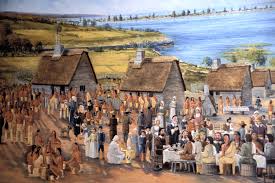
William Bradford, Edward Winslow, Elder Brewster, Myles Standish, and Thomas Morton — names all Massachusetts knows well — led the Pilgrims in giving thanks for survival and for bounty on that November day in 1621, with Indians as fellow participants.

—- —- —- —-
On this day, the 393rd Thanksgiving since our Pilgrim predecessors first celebrated survival in their new home overlooking Plymouth Harbor, we give thanks, as all of you are doing, for all that we have and all that we are.

We give thanks for being alive, active participants in the great experiment we call “America.”

We give thanks for having friends and family, as most of us do; and to those who do not have friends or family today, we ask that you give us the privilege of being friebnds and family to you.

We give thanks for the food that we have been accorded today; and to those of you who do not have food accorded, we ask that you allow us the honor of bringing it to you, so that you can smile as we are smiling.

We give thanks for our democracy, which even when imperfect is always capable of being more perfected ; because at the very least, that’s what democracy has that no other society knows : an invitation to every hand on deck to set the ship of state better on course.

We give thanks for all of our neighbors and community, the more diverse the better ; for every person bears within his or her soul a precious part of human society, human ways, human wisdom.

We give thanks for the amazing safety in which most of us live, protected by two vast oceans that make it very difficult or those who hate us to get at us. And we give special thnaks for our troops serving duty overseas, far from home and family, so that our nation may breathe easier, prosper and sleep well at night.

For all this we give thanks and say thank you; and hopefully we, and many more of us, rescued from want or loneliness, will do the same next November.

And now that we have said our thank yous, it is time to go eat, and drink, and toast good cheer. We’ll get back to you tomorrow.

— The Editors / Here and Sphere

THE FERGUSON MESSAGE : REFORM THE NATION’S POLICE FORCES AND DO IT NOW

Ferguson protesters

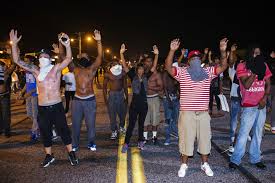
^ hands up ! — Ferguson protesters took to the streets all across a stunned nation

—- —- —- —-
The news from Ferguson, Missouri yesterday was to say the least disappointing. A grand jury refused to second-guess a police officer’s actions that led to the death of an unarmed teenager.

I purposely left out the names here, of Michael Brown and Darren Wilson, because this sort of event has happened a lot these past few years. The Brown and Wilson confrontation was not an exception. Just the opposite. It happened in Westchester County. Happened in North Carolina. Happened in New Orleans at the time of Katrina. Happened in New York City, more than once. I doubt that these are the only instances.

Some of those instances were, if anything, even more grievous than Brown and Wilson. The officer who killed a college football player, a young Black man in North Carolina killed a man who had been in an auto accident and was approaching the policeman’s car seeking help.

Can there be any doubt that too many police see young Black men as dire threats simply because they are young, Black men ? And if few young Black men get killed by police, hundreds — thousands — more get stopped, or frisked, or hassled in some way simply because they are young, male, and Black.

The situation is hardly limited to police. President Obama has recounted, sadly, eloquently, his own experience, as a young Black man, of car doors being locked as he crossed a street, or of pedestrians moving out of his way. Black taxi drivers talk of rides who pay their fare but shy away from touching the driver’s hand. Black shoppers get hassled all the time by salespeople at high-end stores. Even Oprah has told of being the recipient of such treatment.

Too many Americans see Black people as a danger, not a neighbor. Police grow up in that environ. And yes, most of America’s police are not Black.

But, some will argue, Michael Brown actually was a danger. He was big, he was the aggressor at first, he had a long criminal record, he was hardly Trayvon Martin. True enough. No one, I hope, is suggesting that Darren Wilson should have offered him a cup of coffee. Wilson seems to have had plenty of cause to use force.

Yet the situation need not have escalated that far. When Wilson saw Brown walking in the middle of the street he did not need to wise-ass him, as his words sure sound like. Nor did he need to back up his cop-car and block Brown’s path. Those were inflammatory actions.

Doubtless Wilson had learned, as a Ferguson police officer, that the way to keep the peace on his city’s streets is to intimidate people. It works, because most people being intimidated by an armed policeman do whatever the cop orders. Most people know that if they do not do that, bad things might happen. Unfortunately for Wilson, Brown was not intimidated but inflamed.

Brown’s attack took Wilson by surprise. Clearly it did. Nothing in his experience as a Ferguson policeman had prepared him for a man who would not be intimidated, who would, in fact, attack back.

A serious attack it was : Brown simply lost it. Surprised, Wilson lost it too. Whatever training he had undergone in handling confrontations, it went out the window. There seems scant need to shoot Brown twelve times — once in the top of his head would have been enough — to have stopped Brown’s attack, but twelve bullets Wilson did fire. This was anger, not police work. This was road rage.

One can speculate all over the place as to why Wilson lost it. One can also speculate about why Brown risked his own life by attacking. Fact is that neither man acted in a vacuum. There was clearly a history, in Ferguson, of animosity between police and the Black community. We saw this animosity in full force in the aftermath. We saw it last night.

Hopefully the anger that has arisen, much of it fully justified, will force America’s police departments to change their entire cultures. First, police forces need to hire many more people of color : every community, including communities of color, deserves to be policed by its own citizens. The next step is to require police people to honor the communities they protect; to see those whom they are protecting as allies, not foes.

This step is a must. It has to be done and done now.

Some observers have pointed out that many young Black men are in fact a threat, that 90 percent of Black men who get murdered are killed by other Black men. Sadly this is true even in parts of Boston. But how does it help, if the police in communities of color treat all of its residents as if they too are criminals ? Residents should be a police force’s eyes and ears; but because there is so much disconnect between many police forces and the communities they work in, eyes stay shut and ears hear nothing. It is simply easier to adapt to truly badass young men than to invite an alien police into the situation.

The cry went up : “black lives matter.” yes they do. all lives matter. All lives should matter, first of all to police forces hired to protect those lives. Police departments need to be reconfigured from the ground up, communities and police need to be knitted together; Mayors and the Courts, Civil Rights attorneys, clergy and concerned citizens — police officia;s too — must demand it and see that it gets done — now. Otherwise we are done as a civil society.

—- Mike Freedberg / Here and Sphere

NO WAY TO CREATE A ROXBURY INNOVATION DISTRICT

We were at last night’s Neighborhood Innovation District Committee meeting and found its session unhelpful, even contrary, to what is needed. Read our report.

hereandsphere's avatarRoxbury Here

FullSizeRender (21)FullSizeRender (18)

^ lots of committee, not much connection ; the “NIDC” meets at Boston Public Library

—- —- —- —- —-

Last night I attended a meeting of the so-called “Neighborhood Innovation District Committee,” a group of about 15 well-knowns who have been tasked with etablishing an “Innovation District,” as we now call technology research parks, in Roxbury. Unhappily, the meeting made the creation of such a district harder to achieve, not easier.

The committee couldn’t even define what “innovation” means without swerving well off the rails. Committee member Ed Glaeser — who has written brilliantly about Boston’s history and surely knows better — asserted that “innovation; should apply to all kinds of business enterprises : food stores, handicrafts, retail. This is nonsense, as was his assertion that what was wanted is “an innovation district with a heart.”

Dear Ed Glaeser : what an innovation district needs is a profit.

One…

View original post 725 more words

FOR CHARLIE BAKER, 2018 BEGINS THE DAY HE TAKES OFFICE

FullSizeRender (17)photo (1)

^ Charlie Baker today at Tito jackson’s Turkey Give-away; Juliette Kayyem may just be his toughest 2018 opponent

—- —- —- —- —– —– —–

The good thing is that he knows it. That plus his mere 40,000 vote victory, assure that as Governor, Baker will be extremely focused on mastering the task that he set himself and of which he became the symbol : making state government perform better.

H has another task that is driving him, a mission. Baker was surely disappointed to receive only about 9 percent of the vote in Boston’s Black community. That was nicer than Scott Brown’s 2010 special election total of about four percent; but considering the many, many campaign stops that Baker made in Roxbury, Grove Hall, and Mattapan, 9 percent had to hurt.

What has Baker done about this ? Plenty.

He has returned to Boston’s Black community numerous times since the election. He visited The Base at least three times, the Reggie Lewis center at least twice, and Grace Church of all Nations on one spectacular Sunday. And these are only the events that I am aware of. Surely I missed some, as I am not privy to the Governor’s schedule.

Baker is relentless about this. I think he wants actually to win Boston’s 40 or 50 black majority precincts come 2018. That would be a revolution. I see much evidence that he is determined to accomplish it.

Baker has also visited numerous other Boston events, of all types and in almost all neighborhoods. I see no reason to think he won’t continue to do the same all the way to the 2018 re-election year.

For all his Boston effort, Baker won only 30 percent of the City’s vote — the exact same prcentage that Scott Brown carried in 2010 when he won a US Senate seat. if Baker is to expand his re-election margin beyond the tightrope two-percent that he won three weeks ago, he can find no better place to get that done than in the communities of Boston where his vote has almost no place to go but up.

Granted that on november 4th he received about 19,000 votes from Bostonians who otherwise vored a straight Democratic ticket. Senator Ed Markey and Maura Healey for Attorney General won 80 and 81 % respectively; Coakley only 66 %. Baker has already won a significant vote bloc to his side.

Can he keep it ? Expand it ?

The voters of Boston are as connected to the real deals as any in Massachusetts — much more so. Baker is raising their expectations of him high, high, high. Granting him an A for effort will not be enough to meet those expectations; and the Capitol city has a Mayor who did everything he could to prevent a Baker victory. Mayor Walsh has much incentive to keep Baker from brandishing any policy that he, Mayor Walsh, does not agree with. For the time being, as the Baker administration remains an unrealized, big vista, Walsh is playing the friendship card with all the smile that he has in him. Baker, too. Soon enoiugh we shall see the next phase.

For now, Baker probably has the advantage : in 2017, when Walsh seeks re-election, his chief opponent is likely to be a person of color, and, very likely, given Baker’s full scale romancing Boston’s Black voters, a Baker ally.

Outside the city of Boston, the 2018 campiagn — yes, already begun — isn’t so personal. There, all that Baker need do is to get the job done, and to do it in a way that the voters see it. So far his cabbinet appointments met that test. All are well able, some superbly, to change Beacon Hill from sloppy tpo smooth. The only entanglement that may annoy voters in the Route 128 belt and east of Route 495 is policy. Many pressing issues have potential to throw Baker’s re-election way off track : charter schools, transportation funding, clean energy initiatives, in state tuition for undocumented immigrants (or for those given work perniots pursuant to President obama’s executive order). Baker has already signalled that he will play these divisive matters cautiously. Some voters may not like that.

The personal will also arise outside Boston (and in it) if the 2018 Democratic nominee has a better grasp of current social norms than Martha Coakley did. Coakley seemed even more of a 1990s person than the sports-bar-loving Baker : a hair-do’d cocktail party conversationalist In comparison, Juliette Kayyem and Maura Healey spoke the language of now, looked up to date, sleek as a Fort Point bistro.

Right now Maura Healey looks like Baker’s 2018 opponent; but the work of an attorney general, as we have seen time and agian, runs in the opposite direction from that of a governor. i see Juliette Kayyem as much the more plausible candidate, if she is of a mind to run again. She knows policy, she thinks outside the box, she understands the appeal, in Massachusetts, of Republicans as Governor and is not afraid to borrow Republican governor ideas — and to say so. Which makes her much more electric than the other Democratic candidates — even Healey — who don’t seem to grasp what the Massachusetts Republican party is about and why it has Governor appeal : non-ideological, good-government reform.

She’s also a realist. As she tweeted, to discouraged Democrats on November 5th : “this election is not a tragedy, it’s democracy.”

Her only weakness is that she seems so quintessentially a north-of-the-Charles River, academic, think-tank-y presence quite different from what Boston voters are used to. But then Mike Dukakis was like that, too, and he won three elections as governor.

He was also the embodiment of good government reform.

No wonder Baker is paying so much attention to the voters of Boston.

—- Mike Freedberg / Here and Sphere