BOSTON’S PUBLIC SCHOOLS TAKE ONE STEP FORWARD

1 Walsh announces

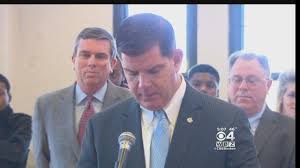
^ at a Roslindale High School press conference, Mayor Walsh announces the 40 minute school day lengthening. School Committee chairman Michael O’Neill (L) and Boston Teachers Union President Richard Stutman (R) stand behind him.

—- —- —- —- —-

Yesterday Mayor Walsh delivered — with much fanfare — a deal to extend by 40 minutes the school day for 60 of Boston’s public schools. Walsh, superintendent McDonough, Teachers Union president Stutman, and school committee chairman O’Neill all signed on.

The proposed deal — the Union must still vote to approve it — generated instant wide-ranging discussion on social media — proof, if any was needed, of just how much schools reform matters to so many of us.

The deal orders 20 schools to extend the day net year, then 20 more the year after, and another 20 in the third year. The staggered implementation will lessen the budget impact of the plan’s $ 12,500,000 cost, that being the $ 4,484 stipend paid to each teacher in the schools affected. In addition to the 40 extra minutes of classroom time, teachers will have fifteen added minutes for professional development.

Mayor Walsh can take some pride in accomplishing this step forward : his predecessor had tried but not been able. Without a doubt Walsh’s reputation as a respected powerful labor leader gave him both the clout and the know-how to win Stutman’s confidence. Labor leaders know, too, that if they do not reach agreement with Walsh, a potential 2017 opponent will be able to say — with great effect — “see ? we elected a labor leader on his promise to reach agreenments with the unions, and he couldn’t or wouldn’t.”

Walsh has done so, with the Police, the firefighters, and the teachers : the big three of city labor unions.

I also feel quite sure that the election of Charlie Baker as governor, and Baker’s selection of Jim Peyser, a charter schools advocate, as his Education secretary, made this deal a necessity for the Union. Stutman knows, as we all do, that Peyser and Baker are going to make major education reform a statewide priority — and that Baker owes the Union almost nothing, electorally. There will be school choice, and experiment in many directions, and the one-size-fits-all school will be put to its mettle as never before.

Stutman also knows that, of all the school reforms that reformers want, a longer school day enjoys the widest support.

Hurdles remain. Will the Union membership approve the deal ? That’s not guaranteed. Second, how will the extra time be used ? 40 minutes adds up to one extra month a year of instruction — Walsh said so — but doled out by eyedrop amounts, it’ll be little felt day to day.

Charter schools often feature eight-hours of daily instruction. That’s how it was in the schools that my parents sent me to. This deal extends Boston’s elementary school day to six hours and forty minutes. is that enough to teach English, math, softward coding, history, science, a foreign language, civics, and, maybe, the arts ? I wonder.

Giants steps beckon. If we are to accomplish Baker’s two goals, closing the “achievement gap” and preparing graduates for actual jobs, we need to establish a school culture of hard work, focus, dedication, experiment, and to challenge students to think beyond their comfort zones. we need them to be well fed, properly clothed, physically secure in school, free from bullying, with proper textbooks and equipment; with a curriculum attuned to real world needs; with testing at least once a term; courses attuned to expectations of homeowrk and that that homework will be done. None of these can happen without gaining the full commitment of parents or guardians, nor without equal access for all children in all classrooms.

Those are the steps we must climb. This small step barely begins the ascent. It needs to lead to a next step, and a next, and a next after that.

Will we climb the challenge, step after step after step ? Will we ?

—- Mike Freedberg / Here and Sphere

SCHOOL TRANSFORMATION IN MASSACHUSETTS : THE GATHERING ST

1 Jim Peyser

^ Jim Peyser, education reformer, is Charlie Baker’s pick to get school transformation done. It will not be easy.

—- —- —- —-

No sooner had Jim Peyser been named Education Secretary by incoming Governor Charlie Baker than the attacks began. Upon him, upon Baker too. Suddenly the bipartisan Baker became “a Republican after all” — as if school reform were important only, or even chiefly, to Republicans.

Peyser’s a no-nonsense guy who means to loosen the rigid parameters of education in Massachusetts — rigidity which brooks no reforms, no imagination to remedy mis-educations of  many children in our state. His appointment was certain to bring protest, and it has.

Witness the mantra now seen on twitter : “keep public education public.” Or this one : ‘the school privatization movement.” These are poison pills for a mission that needs good health if it’s to achieve its mission.

“Public education” is education paid for with public — taxpayer — funds. No more, no less. It is NOT part of the definition of “public education” that public funds be administered and taught only by members of teachers’ unions.

Nor is it part of that definition that there be only one publicly-funded curriculum per district, one school day length, one system of staffing, one way of administering, one form of classroom assignment, one transportation method.

The only reason that singularity came to be the norm for taxpayer-funded education is that, during the era, over 150 years ago, in which public schools were established, it was bold simply to establish one such system, where before there had been none. And the only reasons that singularity has persisted right up to the present, are that any bureaucracy, once established, tends to entrench; second, because industrial economy favored educating almost everyone in the same way and in the same place. Unity was needed to bind together an industrial nation’s economy.

Today, all of that has changed. What is needed is diversity ; because much of today’s workplace today is fragmented into small units of intelligence and experiment. This is particularly true of the jobs that require highly educted entrants. As for mass employment, in service jobs, even they aren’t as ‘mass’ as they used to be, because every service sector requires different specific knowledge : home health aides, fast food workers, retail staff, delivery drivers, and the like.

In order to educate children for the aggressively varied workplaces of today (and tomorrow), public funds need to sponsor schooling systems that vary accordingly. “One size fits all” just won’t do. Nor can our state any longer tolerate having staff dictate what is being taught, and where, and how.

The big push back arises neither from fragmentation nor diversity but from the fight for funds. The people whose careers and hopes are fully invested in the one size fits all system fear that in the new, diversity system, where school styles are pitted against one another to see which gets the job done best, those schools that don’t get the job done — or are judged by the state education bureaucracy, to not be getting it done — lose funds, whence kids and staff suffer.

That, at least, is the argument. Let us look to see if has any benefit.

Is there anyone who seriously argues that public money — taxpayer money — should underwrite the invoices of schools that fail ? If so, please step forward and identify yourself.

By any measure, some schools are failing. Job postings in all kinds of businesses are going unfilled because not enough high school (or college) graduates in our state have even entry level skills needed to do them. Class size in many schools is too large for even a great teacher to control all. Textbooks are out of date. Many children arrive at school speaking a different language from English. Some have psychological impediments. The Special education law imposes an enormous burden of time upon teaching staff and designers of curricula.

Perhaps worst of all, many school systems cannot establish the most basic quality controls. In Boston, superintendent John McDonough has managed with great skill, and fighting the teachers’ Union at every turn, to impose a rule by which every school principal can hire his or her own staff. Why has this even been an issue ?

Quite contrary to the mantras being lobbed in all corners of the discussion zone by anti-charter school people, the push for diversity of education initiatives does not come from “the Republicans.” Most Republican-voting communities have publicly funded schools that work fairly well. No ; the push for school transformation comes from communities of color, whose schools are the most likely to be failing; to employ the least effective teachers; to have the poorest equipment. And it comes from the upper-income, liberal suburbs, where school experimentation is seen as vital to the success chances of kids being educated.

And now the “school privatization” thing. What this means is, first, that the teaching force, in charter schools, and likely in other experimental school initiatives, are not required to belong to a union; and, second, that the operation of many diversity initiatives will be entrusted to organizations other than the state itself.

School unions are right to be upset about having to compete with non-union employees; but they should take it as a challenege, not as doom. As for entrusting the management of some school initiatives to non-profit organizations, why not ? School district administrators have all they can handle — then some — managing standard schools, with all of their staffing, discipline, truancy, work rule, school day, curriculum, school plant, transportation, and school lunch issues. School district administrators must be extremely grateful to have some part of their enormous burden shifted onto other shoulders.

It will become quite obvious, as Peyser takes on the challenge of transforming our schools, that who the constituencies for change actually are belies every argument profferred by the anti-reform forces. And if “the Republicans” happen to be right about the need for school reform, and its direction, and that in many cases school employee unions stand doggedly against, then good for “the Republicans” for being correct for once.

The fight will be stormy. Last year’s Charter Cap Lift bill failed because, first, it allocated compensation funds to school districts for every child being moved into a charter school, and that compensation formula bears no relation whatsoever to the actual budget consequences of such removal. second, it failed because the Senate version of the bill contained amendments that tied the charter cap lift to preconditions that negated the entire purpose of the lift. These objections were placed in the Bill as attempts to placate the opponents of charter school expansion.

Those who prepare the next charter expansion bill should present a bill that serves reform, not anti-reform. Otherwiuse why even bother ? I cannot imagine what it will take, however, to get a useful charter expansion hill through the legislature. Speaker DeLeo, who listens to the constituencies that support school transformation, surely wants such a bill; and usually, what the Speaker wants, he gets. But then there is the Senate, where a new, “progressive” President takes office; and Stan Rosenberg, who represents a union-friendly District in which Baker received lss than 20 percent of the vote, need not fear the Governor’s voters and is unlikely ever to oppose the uncompromising opposition of the state’s teachers’ unions.

Jim Peyser has a very hard task ahead of him.

—- Mike Freedberg / Here and Sphere
THREE CHARLIE BAKER CABINET POSITIONS REMAIN UNFILLED

FullSizeRender (17)

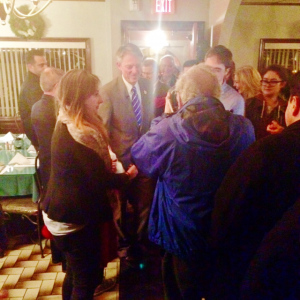
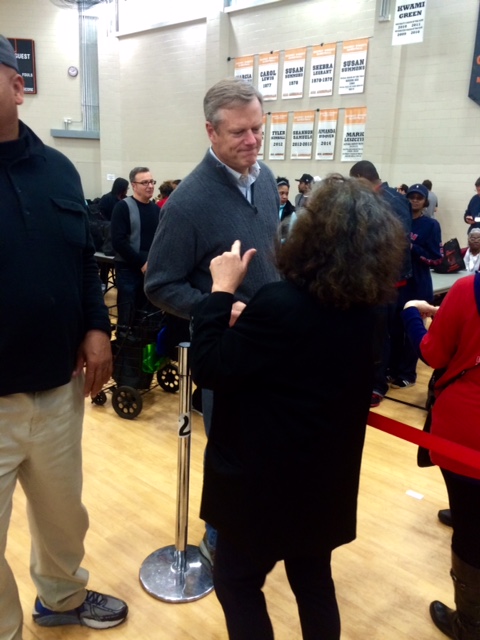
^ Charlie Baker : meeting the people while trying to decide who to entrust with people’s transportation and Education expectations

—- —- —- —- —- —- —-

No one has yet been selected to head up the state’s Public Safety, Education, and Transportation portfolios. This should not surprise. They’re the three most difficult departments to succeed at, Education and Transportation hardest of all.

My guess is that the Schools brief will be the next picked. There’s at least a transition team tackling the entirety. For Public Safety and transportation, no such luck. of the two, Transportation looks the harder. The funding isn’t there; who knows if it will be ? Nor has Baker’s team figured out its transportation priorities. That’s no surprise either. Whatever project they want to work on first, supporters of the others will balk.

If Transportation is actually many separate interests, so is Education. Schools look simple at first : we need to close the ‘achievement gap’ and to align our schools with approproate employment. But very quickly as one moves into the issue it’s painfully obvious that “schools” is really several interests, some of which oppose one another, many more of which work at cross purposes. Education’s complexity and internal battling killed the mayoral campaign of John Connolly, who made education his big issue, only to find out that it isn’t one issue at all.

Do we lift the cap on number of allowed charter schools ? Or do we de-emphasize charters and place our emphasis, once again, on stahdard public schools ? If we lift the charter school cap, do we require charters to change their selectivi9ty, codes of discipline, and foreign language student access ?

Do we require a longer school day, and, if so, what curricula should the added school time pursue ?

Do we expand MCAS and PARCC testing, keep tests at current levels, or de-emphasize them ?

Do we require our state’s pumped-up version of Common Core curriculum stahdards, or do we teach to another curriculum standard ?

How do we apply the anti-bullying law without over-managing school society ? What degree of free expression do we allow to students, and in which grades ?

How do we transport kids to school ? In Boston, the supeeintendent’s decsion to use public trsnit to get 7th and 8th grade kids to school aroused major opposition.

How do we make higher education more affordable ? Do we allow undocumented immigrant kids the same in-state tuition accorded to other kids ? If not, why not ?

I cannot see any of these major school issues being resolved uickly or without political cost to Baker. Yet resolving most of them is vital to his goals of closing the “achievement gap” and of assuring that schooling readies kids for actual employment. Whomever Baker appoints Commissioner of Education need only look at current commissioner Mitchell Chester’s difficulties and frustrations, decisions reversed, others mistaken.

Lastly : will the new Education Commissioner be someone from high school or grade school background, or a higher eduaction name ? Whichever direction Baker chooses, the other may feel itself second-placed.

And now for Transportation. Where do we apply first ? The MBTA, which needs better cars, new tracks and signalling, lines extended (and these, soon), and stronger pension mangement ? Or do we rebuild our bridges — thinking especially about bridges now that Boston has had to close down the Northern Avenue and Long island bridges because they’re dangerously deficient — and fix roadways ? In this regard I think especially of the white-paint lane dividers which, on many highways, haven’t been repainted in years and can’t be seen any longer at night — a very dangerous proposition.

Can we actually build the long-awaited South coast rail line, currently sidelined by state and Federal environmental impact studies ? What status do we accord bicycle traffic, which is increasing rapidly in the big cities ? How will the state’s alternative energy interests, who seek an end to use of fossil fuels, affect future road and transit planning ?

The proposed Boston 2024 Olympics will require significant changes in Boston’s transit lineage and scheduling. Do we have the fubnds to accomplish therse changes ? Lastly, can the legislature enact — would Governor Baker sign — any kind of transportation tax to replace the gas tax index that waas voted out by a November referendum ?

I do not envy the person who gets handed Baker’s transportation portfolio. The “DOT” is a varsity-grade agency, stafed by dedicated, knowledgeable, savvy people. How do we best use the smart people who oversee our state’s transportation systems ? I am waiting to see who it will be and how he or she intends to do the job.

—- Mike Freedberg / Here and Sphere

THE MOST INTRACTABLE ISSUE : AFFORDABLE HOUSING

1 seaport housing1 hyde park houses

affordable housing ? Not in Boston. Lots of the photo on the left, almost none of the photo on the right

—- —- —- —–

Most of us agree that housing is a human right. But how to bring it about ? Because housing is not free, having it is not automatic for everybody. There should be no such phrase a “homeless person,” but there is.

There also shouldn’t be any riddle is, how to find housing that one can afford that’s also safe and, or not a two hour commute from where I work ? So what do we do about it ?

It’s easy to find affordable housing, but almost all of it, at least in Massachusetts, lies distant indeed from everything else in one’s life. Or it can be had by moving away from where one lives out to where the affordable housing beckons. For most, that’s not an option. Why should one have to move away from family and friends ? Why can’t we have affordable housing where we already live and work ?

There are two ways to bring that about. One is to impose rent control. Boston tried that 40 odd years ago. It didn’t work. The other way is to build so much housing that rent prices (and sale prices for buyers) decline over time. This method, we are beginning to try. I doubt that it will work either.

Land acquisition costs are what they are : in Boston, hugely high. As for rents, what landliord is going to ask less rent than the market accords him ? And waht home builder is going to sell for less than he feels a buyer will pay ?

Building affordable housing means defying the market. Boston’s economy is working quite well for those who earn a six-figure income, and because many affluents now want to live in center city — or as close to center as they can get — rents and sales prices have risen higher and higher; even during the 2007 – 13 real estae market collapse, center city sales prices rose without a break.

The City can require a developer to offer a portion of his planned living units at a price agreed to be “affordable” — more on this term later — but nothing can prevent that “affordable” unit from moving up in price as the market moves up.

Well meaning, or politically smart developers are now winning BRA approval for projects of this mixed-price type. Neighborhoods like them. We’ll see how long they survive as such.

Ultimately, the only event likely to establish a supply of “affordable” housing is for people with six figure incomes to change their living habits; to move out of the city, as happened after World War Ii, leaving center city with a huge inventory of vacant apartments and unsold residences. Right now, the opposite is happening.

And what, exactly, does “affordable” mean ? For people with six figure incomes, a $ 3,000 monthly rent, or an $ 800,000 condo price, is affordable. Can you handle that ? I know that I can’t. I don'[t meaaure up. Clearly, in a political context, “affordable” means “housing for those who people who, like me, don’t measure up.”

We can create housing with prices susidized (by Federal programs accessible via HUD, for example), but such housing rapidly acquires a neighborhood identity as such, amd as those who live in such housing are perforce visibly lower income than people who live nearby in “market rate” housing, subisdized housing becomes ghetto-ized, socially if not racially.

Or we can continue to tolerate having the Boston area’s “affordable” housing be 30, 40, 60, 80 miles away, forcing those who have to worry about “affordability” to endure commutes of up to two hours (and more) each way, to get to work, with the added transportation costs long travel imposes.

Mayor Walsh has called for Boston to add as many as 53,000 units of “affordable” housing in the next decade. He may well achieve the number, but how will he keep it in place ? The only ways that I can foresee Boston becoming hospitable to ‘affordable” housing are — to repeat myself — for the city’s economy to decline, or for people to once again decamp to leafy suburbs as happened after World War II.

Boston today is a luxury wallet’s dream. It is hot, it is trendy, it is gleaming with well off young professionals and those who service their high-end desires. If you can’t cope, you will simply have to find some other way — and all the wishes and hopes of well-meaning politicians can do nothing about it.

—– Mike Freedberg / Here and Sphere

OPTING OUT : WHY AREN’T MOST VOTER

Voters In LineA few voters

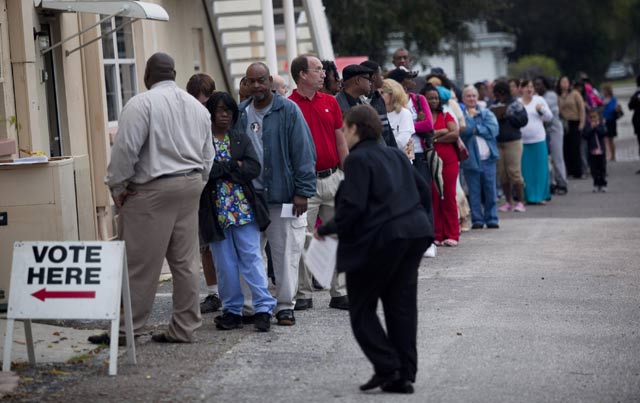
for some citizens, voting still matters a lot. Enough to wait in line., But to most of us, voting is something we just don’t do any more.

—- —- —-

As the 2016 Presidential election approaches, I can’t but wonder if it will engage more than a minority of American citizens. Heck, barely a majority even of registered voters will likely bother to cast a vote. About 50 percent did so even in 2012, when America’s first Black president sought re-election. Not much more tan that voted in 2008 despite enormous enthusiasm in communities of color.

What is going on ? Why are Americans not voting ?

We all know that in the mid-term election a month ago, about 27 percent of voters voted. The percentage was much less than that for all citizens — maybe as many as half of all American citizens aren’t on the voter lists. Why not ?

Not so long ago, American elections claimed turnouts of 70, even 80 percent of voters. In Massachusetts, 70 to 80 percent was the norm; sometimes, back in the 1920s and 1930s, 90 percent voted in many communities of Massachusetts. This time, the state turnout was barely 50 percent — 37 percent in Boston, same percent as voted in the city’s big mayoral election in 2013. Mayor elections once drew 60 to 70 percent of voters. Not now. Why not ?

What are the consequences of this non-participation ? Do they really matter much ?

I say that the consequences are enormous and do matter a lot. But first, the reasons why citizens aren’t voting :

( 1 ) politics has become enormously less participatory. Forty years ago and more, for example, almost all campaigning involved labor intensity. Doing a state-wide mailing required thousands of volunteers to fold brochures, insert them in envelopes, lick and stamp the envelopes, bag them bulk mail bags.. Today those huge mailings are done by hired mailer firms. Meanwhile, advocacy and single-issue interest groups do almost all the door knocking and GOTV work non election day. Ordinary volunteers aren’t needed or sought.

( 2 ) campaigns now cost so much money that candidates and their key people spend vast time raising money, thus much less time seeking out voters or doing voter registration drives. Registering people to vote is hard, slow, diligent work. Few people have time now to do it. Interest groups are focused on their already existing members. Party committees don’t organize registration drives. So no one does them. Black churches make for an exception; but even they can only reach people who are, or are related to, congregants. As newly registered voters are more likely to turn out than not, the lack of voter registration work holds down potential turnout.

( 3 ) the almost disappearance of political patronage has left campaigns without a ready source of dependable volunteers. First, it, used to be that many people, especially in cities, joined campaigns in order to seek patronage. That happens much less now. Second, patronage people can be counted on to do campaign work and are known; no time needs to spent finding them and training them how to do campaign work. Gratis volunteers need to be identified, and that comes chiefly from door knocking that today occurs much later in campaigns and chiefly by interest groups.

( 4 ) the dominance, in campaigns, of advertising has made citizens think of campaigns as a commercial imposition on them and done by strangers, not neighbors. People hate commercials. Campaigns whose major activity resembles commercials turn voters off rather than engage their enthusiasm.

( 5 ) Negative advertising is not only commercial, it’s bad gossip. The message of every negative ad is that politics is dirty and degrading, a whiff from the lowest of life. Not many voters want anything to do with that, nor should they. Voters, like all citizens, want to participate in doings that inspire them and make them feel that they are bettering their condition. Activities that proffer the opposite, people avoid like the plague.

( 6 ) Lastly, many voters feel that campaigns don’t really matter; that the powerful and the wealthy own the system and the process, so why bother.  In this, the voters are right. Every one of the first five causes that I have listed arise from this biggest of all burdens on our democracy. Patronage was a sure way for the ordinary person to benefit from politics. Participation was an easy way for  such a person to get noticed. Advertising shuts down the voices of ordinary voters. Money excludes all who don’t have much of it.

We instituted universal suffrage in order to enable everybody to participate more or less equally in directing our nation and its government., For the past 30 years we have done just about everything guaranteed to make universal participation feel useless, look unnecessary, make a waste of time and smell dirty., Is it any wonder that most of us now see it that way ?

Those who still vote are almost all people with a stake in the system and the process : activists, insiders, interest groups, political groupies, campaigners, candidates and their families.

I see no prospect that this trend will reverse. It’s not a happy time for those of us who believe that every vote should be cast and that each vote must count.

—- Mike Freedberg / Here and Sphere

FALL RIVER MAYOR RECALLED; SAM SUTTER ELECTED

Read our report on Sam Sutter’s victory in Tuesday’s Mayor recall.

hereandsphere's avatarThe Local Vocal

FullSizeRender (4)FullSizeRender (3)

Mr. Smith goes to City Hall : victorious Sam Sutter enters his victory party at the legendary Clipper Restaurant on South main Street

—- —- —- —-

Yesterday 16,557 Fall River voters cast ballots in that city’s first ever recall election. On the recall question itself, the result wasn’t close. 10,631 voted “yes” to recall the city’s three-term mayor, Will Flanagan; only 4,669 voted “no.”

On the second question — who should be elected the city’s new mayor — the result wasn’t really close either. 6021 people voted for Bristol County District attorney Sam Sutter, 4393 for Flanagan. So that’s it, Sam Sutter will be Fall River’s new mayor.

A third candidate, Seekonk town manager Shawn Cadime, received 3,068 votes. City Councillor Mike Miozza won 2,298 votes. Both men had plenty of volunteers helping. Cadime had the city’s firefighters, a campaign organizer from Boston, and a team of policy people…

View original post 570 more words

ON CUBA, AT LAST THE RIGHT MOVE

1  H Uppmann 21  H Uppmann

You are authorized, once again, to buy, and bring back to America, up to $ 100 worth of the best cigar in the world : Cuba’s H. Uppmann

—- —- —- —-

Two nights ago President Obama announced that after 56 years, our nation and Cuba would restore full diplomatic relations. To effect this chanhe, he is sending Secretary of state John Kerry to Havana almost immediately, to negotiate the opening of an American embassy.

Many observers hail this decision as a big deal. To us, it’s simply common sense. It should have been done long ago, but everyone’s been afraid of angering the Cuban-American vote, virulently anti-Castro regime (for very good, personal reasons), and concentrated in Florida, a state with 29 electoral votes and almost always winnable for either party. as we see it, Obama decided to change the policy or three reasons : first, Pope Francis asked both parties to do so — and Pope Francis is a man whom all people of good will respect. Second, the confrontation policy hasn’t worked at all other than as a display of pique. Lastly, I think Obama decided that with Jeb Bush likely to run for President, Florida’s 29 electoral votes will be his whatever : thus the opening of relations with Cuba will not, of itself, hurt the 2016 Democratic candidate.

Whatever the calculation, the new policy helps the world move forward. Even as so many parts of the world are going to the mattresses, vicious with brutal tribal wars, we two nations are moving toward peace, communication, and great cigars.

There is plenty to not like about the Castro Brothers rule over Cuba even now. Human rights mean little to them; the economy struggles; few Cubans have internet, or businesses, or cars newer than the Meyer Lansky era; or any but local freedoms. The new agreement between America and Cuba will change this situation but slightly, yet not insignificantly. Cubans will now have internet access; US travelers are freer now to visit Cuba; they’ll also be able to use their credit cards to buy; and Cuban nationals with bank accounts outside the island will have thiose accounts unbloocked.

Lastly, two American prisoners, jailed in Cuba for whatever, have now been released,and three Cubans held in American prison have been freed as well.

We celebrate this common sense and wise initiative by President Obama and Cuba’s Raul Castro. History will surely reward them. As for me, I’m going to light up an H. Uppmann.

—- Mike Freedberg / Here and Sphere

OIL PRICES FALL, SOLAR GUYS SIGH

1 oil at 2.49

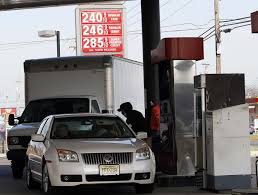
gasoline at $ 2.40 a gallon ? not there yet, but we will be soon. Enjoy the fun while it lasts

——– —- —-

As everybody with a car key knows, gasoline pdices have fallen in the Boston area by at least one third. Gallons that cost us about $ 3.70 last year now go for $ 2.50.

Those of us who drive, celebrate. Those of us who don’t, are missing the fun. Actually, it’s more than just fun. It’s a big deal. Oil is the world’s one vital, immediately fungible commodity, upon which a major part of all the world’s cash is spent and invested. Millions of people work in the oil industry; thoiusands more in natural gas extraction and delivery. It is indeed a big deal; and when the oil price shifts as enormously as it is now doing, big consequences ensue.

More about those consequences later. First I want to outline why the huge oil price drop is taking place. The answer is simple : oil supplies rarely disengage from demand by even one percent. Most oil transactions are cash deals in which delivery is immediate. No one in the entire chain of oil – to – market inventories much, because liquids bulk huge; there’s not much place to put them. Once extracted, oil moves ceaselessly from delivery to refinery refinery to terminal, terminal to dealer to customer.

Oil’s constant, super efficient movement from extraction to consumption has the same effect, when supply and demand shift, that a stalled car has on traffic on a freeway. It doesn’t take much of a ripple to upset the oil market — and thus its pricing.

This time, however, oil prices have fallen not because of a break in demand — nothing unusual has happened there — but because of over-supply. Saudi Arabia, which still controls about one-quarter of the world’s oil and dominates the OPEC cartel of oil-producing nations, has refused to cut back production even as US production of oil has reached its highest level in decades. (Fact : we’re now an oil exporter nation.)

Even as consumers now use more gasoline than they might have a year ago, over-supply has left much produced oil without a buyer except at cut-rate prices. So the question arises : why are the Saudis doing this ?

In part their decision is political : a 33 percent fall in crude prices has seriously hurt the economies of two major Saudi enemies, Iran and Russia. Not to mention Venezuela, whose economy, dodgy even with oil at $ 120 per barrel, has lost all of its clout (hello, Cuba) now that oil fetches varely $ 60 per barrel.

The Saudi decision also has an economic motive : fracking, as a method of oil extraction, has become so inexpensive that it has enabled Canada and the US — we invented the process — to produce oil as cheaply as, or more cheaply than, the Saudis can o by traditional drilling.

Our two nations, Canada and we, threaten to outflank the Saudis’ dominance of oil markets. The Saudis are fighting back, trying to downgrade oil prices to where it becomes unprofitable for us to extract by fracking. (“Fracking'”is short for hydraulic fracturing, a water-pressure method by which shale and tar sands are dissolved and the oil held within them extracted.)

The struggle going on around oil costs has given a huge boost to the economy, enabling consumers to spend much more on stuff other than gasoline and heating oil than last year, and this at a time when incomes are increasing nationwide. But the same struggle is causing major diusruption to alternative-energy initiatives. no sooner has the cost of producing solar power become competiive with fossil ful prices than fossil fuel prices have suddenl dropped big time.

Yet the big issues in fuel politics remain. Sio,me day they will become vital again : alternative fuel prices don’t have the sme up and down volatility as do oil and gas ; the millions of people who work in the oil and gas industry can’t readily be redeployed ; alternative energy doers not subject us to the vicissitudes of international politics ; carbon emissions are still a major world climtae impact; and the innovation necessary to create a nationwide alternaive-energy grid will, of itself, enormously boost and reshape the nation;s economy.

There’s every reason to want America to move to a fuel grid that isn’t oil or gas. And not only America. This is the world’s issue. The dislocation is going to be huge as it is : what happens to the millions who now owrk in oil and gas ? What becomes of the businesses — the transport, extraction, and refining businesses in particular, and the oil traders working world-wide — and of the huge billions of dollars that move through them ?

Right now we are enjoying a ton of fun driving cheaply and buying lots of other stuff that we had not expected to afford. I wonder what the next chapter in the long and dramatic epic of oil will tell of.

—- Mike Freedberg / Here and Sphere

THE TORTURE REPORT : FROM DISHONOR TO REFORM

1 mccain and cheney

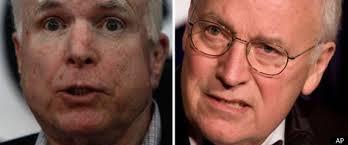
John McCain : restoring our nation’s honor; Dick Cheney : not his best moment at all

—- —- —- —- —-

Senator John McCain summed the torture mess up : torture is not who we are; we cannot do what the enemy does because we are not like them, we are better than that.

McCain was a victim of torture himself. He knows that tortured men will say whatever their torturers want to hear. He knows that the intelligence gained by torture is no intelligence at all. He also knows that it violates laws our nation has enacted, treaties we have signed, conventions we have committed to. He knows that it breaks our nation’s word.

He passionately supports the release of the “torture report”: by the senate ihtelligtrnce Committee. So do I. The timing has political implications, perhaps, but to me, any time is a good time for our nation to hold a kind of “truth and reconciliation” conversation. Because as the report makes clear, for the years that torture ruled, we had no honor. And without honor, who are we ? No different, no better, than our enemies.

McCain asked, “you tie a man to the floor until he freezes to death and you don’t think that’s torture ?”

All this, we know. You know it, I know it. So let the nation’s soul. searching begin. Build a legacy of apology, of “never again.” And what next ? How do we gain the intelligence that we need to fight wars against terrorists ? If not to squeeze and frighten captives, what is the CIA tasked to do ? Here’s my answer :

1 .Intelligence for war is a military matter. It should be conducted by the Army, the Air Force, the Navy, the Marines. By SEALS. By Rangers. By judge advocate corpspeople. That’s how it was done in World War 2 and in Korea. If America calls upon our armed forces, it is armed forces that we should task to do “intel.”

Our armed forces obey the rules, treaties, laws, and conventions, if only because they know that if we do not treat captives as we have promised, our foes won’t treat our people properly either. Even then, there are abuses. can we forget Abu Ghraib ? But Abu Ghraib happened in a time when we “took the gloves off.” The message was sent, and our troops dearly paid the price.

Military interrogators have a superb record of gaining “intel.” The success of military campaigns depends on their doing it the right way. Can’t we let the military do its job and not have bureaucrats do its job for it ?

2. The CIA has no business operating in military mode. it has no business operating prisons or sending war captives to other nations’ prisons. The CIA’s mission, at founding, was to gather “human intel.” The CIA is tasked to recruit informants, behind enemy lines or in terrorist havens, to tell us, of their own observation, what is going on in the enemy camp.

Perforce much of what such agents tell us is mistaken, or half mistaken. It’s up to CIA specialists to assess the “intel” thus gathered.

As we have learnbed from the report, the most effective “intel” gained by the CIA was old-fashioned human intelligence. Couldn’t they see that ?

Just as the CIA should not be doing the work of our military, so it should not be doing the work of our State Department. The CIA has no business engaging in political games overseas, no business undermining foreign governments, no business hanky-pankying with black marketeers or arms dealers.

No military man, no matter how capable, should ever be appointed CIA director. The CIA must never be even slightly militarized.

A man whom I admire highly tells me that he knows great people in the CIA. I believe him. The problem is not that many CIA people are highly thought of, it’s what the CIA directors task them to do.

Lastly, no executive officer, not even at the highest level, should ever be allowed to misuse the CIA as Vice President Cheney evidently did, in those horrible days after 9/11, when much of our government lost sight of its strength and fell into the fear trap that we are now exiting. If one can believe what is being reported, the President himself was not informed of all the actions commanded by Cheney. If that is true, it was an impeachable offense, and Cheney should even now be censured for it.

In the wake of Cheney’s commands, superficially authorized by the President, government lawyers drew up exculpatory memos that violate all kinds of oaths lawyers are supposed to swear to, not to mention subverting the nation’s honor and making it harder by far to win the war. For which, these lawyers should be strongly censured too.

Some who feel as I do have called or prosecution of the people responsible for ordering these acts. I disagree. The nation needs to recover its honor, not lash out. The torture report and the reforms I suggest fully heal our soul.

—- Mike Freedberg / Here and Sphere
THE OMNIBUS SPENDING BILL : WHY ALL THE OBJECTING AND FUSS ?

1 Reid and McConnell

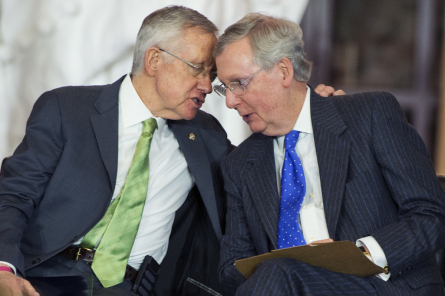
been a long time since we’ve seen this : Senators Reid and McConnell discussing rather than slinging insults at each other

—- —- —- —– —-

Yesterday the US Senate voted 56 to 40 to enact the $ 1.1 trillion dollar FY 2015 Budget Bill that has caused so much political ruckus and loud-speak. We stand with those who voted for the bill, and here’s why.

The bill contains many provisions we do not agree with. That is certain. But in an era of Federal budget retrenchment, when the argument for deficit reduction has carried the day — not that we agree with it, but it is what it is — it is axiomatic that people can’t expect all their Federal initiatives to be funded. Much good stuff is left out; some has been cut. Yet the process does not end here. Funds not appropriated in the “Omnibus” budget bill can always be restored later.

The vote was almost perfectly bipartisan. 27 Republicans voted Yes, 18 No. 24 Democrats voted Yes, 21 No. State seemed to matter more than party. in almost every state, Senators voted the same way, regardless of party, either Yes or No. This solidarity included ME, NH, MA, RI, NJ, PA, MD, MI, MS, AL, GA, OK, CO, NM, NB, SD, ND, OR, ID, WY, MN, IA, OH, IN, VA, NC, DE, RI, VT, AR, AZ, and AK. Senators differed — again, regardless of party — only in CA, HI, NY, CT, FL, LA, WI, KS, TX, UT, NV, MT, KY, SC, MO, WV, and TN.

From the volume of noise being raised on the spending side, you’d think the “Omnibus’ were the end of the road. It isn’t.

Much noise has also been bruited on the cut-spending side. This seems less justified. The cut-spending folks succeeded in paring much that probably shouldn’t be cut, from the size of military pay raises to funds for the EPA, IRS, and “Race to the Top.”

In addition, Senate opponents of the Dodd-Frank Act, which placed significant restrictions on the use of ordinary bank depposits to fund derivatives trading, succeeded in cutting back that Act’s application to hedge trading by farm businesses. Supporters of Dodd-Frank — notably our Senator, Elizabeth Warren — treated this change as a cataclysmic event requiring the threat of a government shutdown rather than approve. Really ?

Perhaps the most curious adjustment in the Omnibus bill is to expand the size of allowable donations to political committees — from $ 32,000 to $ 320,000. has nothing to do with the Federal budget; it’s in the Omnibus only because — so the story has it — the GOP is worried about funding its 2016 nominating convention. I’m not sure what to make of this provision, but again, I don’t think it’s a cause for raising the hue and cry. It’s simply a result of Citizens United, a ecsion controversial to be sure.

The bill makes almost no change at all in the parameters of deficit-reduction budget policy established two years ago by Congress after way too much drana hopefully not to be revisited. We have not read its entire 1,600 pages,l but we have read a detailed synopsis of its provisions as provided by the House Appropriations Committee chairman, Harold Rogers. It might be worth your while to read what’s actually in the bill, and not in it, before you unleash the four winds of hell against it. Here’s the link :
http://appropriations.house.gov/news/documentsingle.aspx?DocumentID=393925

I suppose you can justify the noise and opposition as a means of maintaining a constituency for a different budget policy than deficit-reduction-first. Unhappily, that policy change seems less crucial now than it did back in 2009-12, when the regressed national economy seemed to me to require deficit spending big-time. Today, with the economy rapidly improving — albeit unequally — deficit reduction makes good sense. Those who object to a deficit-reducing budget now object too late.

It would not surprise me at all if the next chapter in the nation’;s Budget drama were one of expansion, as rapidly increasing Federal revenues allow Congress to restore appropriations — such as military pay and EPA funding — that have been reduced in the 2015 Omnibus. And maybe even to amend the Budget objectives legislation enacted in 2011-12.  After all, a big election is coming, and realism is once again the majority outlook in Congress despite the clamor coming from the irreconcilables.
—- Mike Freedberg / Here and Sphere