TRANSPARENCY, AUTHORITY, AND THE OLYMPIC GAMES BID

1 Baker and Walsh

^ authority gratuitously compromised versus authority fully asserted : Mayor Walsh and Governor Baker

—- —- —- —-

We’ve opined at length about why we support bringing the 2024 Summer Olympic Games to Boston, I have no intention of revisiting any part of our brief in favor. The purpose of today’s editorial is to address significant. governance issues that the Games controversy has highlighted and about which mistakes have been made.

The first issue is “transparency.” During the past few years the notion has gained traction that governments should be “transparent,” which is to say that government records should all be readily available to the public and that, to the extent feasible, communications between government officials — and even among subordinates — should be public as well. This objective sounds apple pie, a good government move. Like most such moves, however, it needs limitation in order not to overreach. Because the second issue is “authority.” It too needs to be respected.

Elected executives must be accorded a zone of confidentiality protecting their communications with one another as well as communications made by subordinates. If elected executives don’t have such zone of confidentiality, their authority of office is vitiated. The state’s Constitution (and the City Charter of Boston) empower elected officials. We either allow Charter’s and Constitution’s powers to work, or we undermine both officials, City Charter, and Constitution.

Opponents of the 2024 Games bid seek publication of all manner of documents well within the Mayor of Boston’s zone of confidentiality. The Mayor yesterday ceded this vital principle to them; it was a huge mistake on his part which, if not corrected by an appropriate Executive Order, will leave him powerless to make the most important mayoral decisions : land use decisions. Because if developers and proposers of projects like Boston 2024 can’t be sure that their proposals and negotiations will be confidential during the negotiation stages, no developer or proposer will make any such proposals. That will hurt the Mayor and severely injure the City’s economic boom.

The Mayor appears to fear that voters do not trust him, do not trust government, do not trust the games committee. Opponents have indeed said so, often and loudly. I think the Mayor has over-reacted; nonetheless, he is not wrong to confront the distrust issue,. It is the ebola in today’s American body politic, of which Trump is the most toxic symptom; many more such symptoms abound. Voters distrust Congress, some distrust the President; some distrust our democracy itself, the economy, and every institution of political health. It is wrong, however — hugely wrong — to respond to ebola by offering up your body to it.

There are plenty of voters — a majority, perhaps — who either believe in the Mayor or who want to, voters who are ready to gird up for battle by his side; voters who want change and who look to Walsh to get it done. These supporters include developers and boom-economy businesses that see prosperity in the offing if the Mayor can get the City to that point. The Mayor needs to be these voters’; leader, not their white flag of surrender.

Unfortunately, the Mayor has placed himself at the head of the Transparency Arny. It is difficult for him now to step aside from that army and say, “wait just a minute, you’re taking transparency too far.”

Yet the current “transparency army” is his sworn political foe. Can he ever win their trust — except by letting them run his show ? That would be a final mistake. Their agenda is the opposite of his : ” no development boom, no neighborhood change, no new economy, no education transformation, no Mayor with authority.”

Mayor Walsh can still recover his power. He should, as soon as feasible, issue the following Executive Order :

“Notwithstanding the decision that we made to make public certain documents relating to the Olympic games proposal, that were presented and discussed in confidentiality, it is now City Policy that negotiations and proposals made to the Mayor by developers and event proponents shall be conducted entirely confidentially, including any and all documents and communications made pursuant thereto, by My office or by those who work for My Office and other City agencies and departments where I so order; and no such proposal or negotiation shall be made public until and unless an actual agreement is reached in such form and of such content as shall, according to the City Charter, require a vote of the Council.”

—- —-

Meanwhile, support for the Games looks to have increased on account of last night’s debate. That is no surprise; supporters have been the underdog, and an underdog almost always wins a first debate simply because it gets to make its case, to people who may only have known characterizations leveled at it by the opponent. The controversy now moves to Governor Baker, on whose decision all attend — exactly as he should want it. How he will decide, I cannot tell. One thing however is sure : discussions he is having leading up to his decision are being held in the confidential zone, where the authority of governance rests and must rest.

—- Mike Freedberg / Here and Sphere

A BIG MISTAKE, BUT NO SURPRISE

1 Stan Roseberg speaks

^ He has a plan, but it’s the wrong plan, and it won’t happen — yet : State Senate President Stan Rosenberg

—- —- —- —-

Those who want Massachusetts government to spend more money have taken exactly the wrong approach to arriving at their desire : they want higher taxes.

Specifically, Raise Up Massachusetts, an advocacy team that successfully pushed for hiking the State’s minimum wage, now proposes something far less sensible or likely : it wants to almost double the state income tax rate on high earning workers. Those affected will be asked to pay 9 % of their income in taxes rather than the present 5.15 %.

The proposal isn’t very likely because, first, it requires a Constitutional amendment, as Massachusetts does not allow different tax rates for different people. Twice in the 1990s advocates sought such an amendment; both times it was soundly defeated. Second, the proposed amendment cannot appear on the ballot unless tits supporters present some 64,750 valid signatures, after which at least one quarter of the entire legislature must, in two separate sessions, vote to advance the proposal. Will this happen ? Not as long as Robert DeLeo is Speaker of the House, it won’t. Governor Baker also intends to oppose it actively.

The State Senate is another matter. Its leader, Stan Rosenberg, has made it a point to advocate “progressive” causes, especially those which spend more state money and/or which bolster the protected position of public worker unions. So far, Rosenberg has lost every significant battle to the solid alliance of Governor Baker and Speaker DeLeo. Rosenberg is not deterred. As I wrote for Here and Sphere months ago, Rosenberg is playing a long game, one in which losing, for the time being, is perfectly acceptable as long as he can provide a beachhead for “progressives’ and, slowly but surely, increase their power within the Democratic Party and the State House. Rosenberg may well have 2022 in mind; both Baker and DeLeo will likely be finished by the end of that year. It may well take that long for him to achieve his aim, and he seems acclimatized to a long battle.

The tax hike move is also the wrong way to achieve higher state tax revenue. Grabbing an additional $ 40,000 and up from the 14,000 earners who will be affected hurts these earners but does not in any way assure those dollars will be well spent. Baker doesn’t need the extra funds — yet — and a succeeding governor will likely not have Baker’s singular persuasiveness and skills as a budget manager. To grow state tax revenue the right way — assuming that’s needed — we should do the following:

1.improve the state’s primary and secondary education, so that graduates are ready to do at least entry level jobs that will be needed — or to handle the still more demanding “gig” economy that portends even now. Governor baker has already proposed education reforms that will head Massachusetts toward this major policy goal.

2.raise the state’s minimum wage to $ 15.00 an hour,  in Boston maybe even to $ 22.00 an hour. Workers earning this sort of money rather than the present $ 10.50 minimum will actually pay taxes rather than be recipients of the expanded EITC. They’ll also be able to spend into the discretionary economy, thereby boosting the taxable earnings of others ! Raise Up already pursued this wage raise course successfully; why are they now changing the policy ?

3.keep the building boom going in Boston and extend it to gateway cities. A Building Trades union worker earning $ 150,000 pays $ 7,500 or so in state taxes; that same union worker laid off pays no taxes and in fact needs public assistance. This means supporting the Boston 2024 Olympics, Imagine Boston 2030, and the Governor’s Gateway Cities municipality-state compacts.

Please note that my plan for growing the economy is not a standard, right wing “job creators” argument. I am fully aware that consumer demand grows the economy; that the more that people earn, the more they can spend, and that that in turn causes more hiring and more earnings, thus more state tax revenue. My plan fits the Left-wing scenario no better than it accedes to the Right side. But it makes sense.

Of course, that might be the problem., Sensible isn’t an especially sexy point of view in these temper tantrum days of revenge taxes, blame games, and facile illusions.

—- Mike Freedberg / Here and Sphere

GOV BAKER’S MBTA REFORMS BEGIN TO TAKE HOLD

Baker FCB

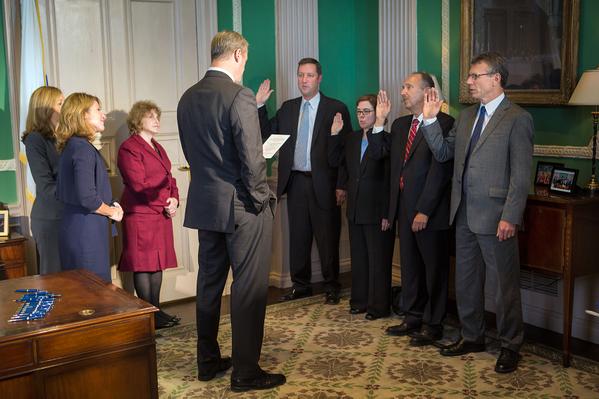
Governor Baker swears in members of the MBTA’s Fiscal Control Board

—- —- —- —-

Last Friday, Governor Baker appointed the five members of the Fiscal Control Board (FCB) that will oversee every detail of MBTA operations. On Monday they held their first meeting. It is now Wednesday, and already the FCB has issued a significant, innovative order to improve transit service to the public.

The FCB ordered that the $ 7,500,000 in non-performance fines paid by Keolis, the company that operates the MBTA’s CommuterRail lines, will be used to hire additional Keolis staff, to do a variety of things not being done well enough or at all; in particular, additional fare collectors will be hired.

Failure to collect several millions of Commuter Rail fares was an issue raised at the Hearing held by the Legislature’s Transportation  Committee, at which the Governor;’s MBTA reform legislation was testified about — including extensive testimony by the Governor himself. There, the Governor expressed a resolve not to have to hear of non-collection of Commuter Rail fares ever again; and State Senator Tom McGee, chairman of the Committee, responded in kind : “believe me, we don’t want to heart of it again either.”

The FCB’s move almost guarantees that fare collection will be a problem solved.

Some have complained that the $ 7,500,000 was not allotted to track and switching repairs first., I find the complaint misplaced and uninformed. Three weeks ago Governor Baker announced that he was postponing a $ 200,000,000 order of new trains for the Fairmount CommuterRail line so that those very track and switching repairs could be made.

If this level of complaint previews the criticisms that Governor Baker can expect of his MBTA reform, there will truly be nothing to see there. Yet there’s worse. Today a State Senator posted on facebook that the FCB’s fare collector hiring is an example of “privatization” and thus to be decried. Is he serious ? In what way is it “privatization” to use Keolis money the better to do Keolis’s job ?

Or perhaps the Senator is telling us that Keolis, a private company, shouldn’t have been hired in  the first place (by the previous administration, let us recall) and that instead the Carmens’ Union should run the CommuterRail ? I almost wonder why that sounds like a very, very bad idea.

The FCB is going to rethink how the MBTA is run. It is not going to accept an inefficient practice when there’s an efficient one available. It is not going to cling to a process that opens doors to failure when there’s processes available that have fewer exits. The FCB is going to evaluate what works, and who; and what does not work, and who. The public has a right to nothing less, and the Governor is right to insist that MBTA personnel remember who they’ve been hired to serve — and at what level of taxpayer cost.

The FCB’s thoroughgoing overhaul of the MBTA’s workplace culture prerequisites what is needed next : new cars and trains, T line expansion, and the personalization of ridership service. And guess what / Better T service is good for T employees, too, including the Carmen’s Union’s own survival — whether or not they realize it so far.

—- Mike Freedberg / Here and Sphere
OF SUBPOENAS AND POWERS OF A BOSTON MAYOR

Tito

^ requests subpoena : District 7 Councillor Tito Jackson

—- —- —- —-

Yesterday City Councillor Tito Jackson requested that a subpoena issue to the Boston Olympics Bid Committee, and to Mayor Walsh, to produce a document that Jackson feels entitled to see, a document that opponents of the Olympics Bid feel will evidence some sort of scandal and thereby destroy the Bid entirely.

The full Council will have to vote in favor of Jackson’s request, or it fails. I do not know how that vote will go, and this editorial will not opine on it. Our story here is a different one. The question we ask is, “what right does a Councillor, or anyone, have to see documents that, in our view, lie securely within the Mayor’s executive confidentiality (and which in this case have been superseded by later proposals) ?

As we see it, the Mayor is elected, and fully empowered, to make decisions for the City and to conduct negotiations on the City’s behalf also. In exercise of his chartered powers, the Mayor conducts negotiations that may feature proposals and counter proposals of all sorts and at many times. In the case of the Olympics bid, the Mayor has conducted such negotiations for at least eight months now and has entertained at least two full proposals. We know of these two because the Bid Committee has made the first proposal partially public and the second entirely so. The Bid Committee was under no obligation, in our view, to make either of these proposals public and did so purely in order to elicit public support.

The Bid Committee also argues that other portions of its proposals are subject to confidentiality agreements made between it and the US Olympic Committee, which oversees bids made by American cities and are therefore not to be made public. The argument is a sound one.. Which is why things now stand at the subpoena request stage.

Our view is that the internal confidentiality of Bid Committee proposals is an example of why the Mayor, in his negotiations with this or that entity, is accorded non-disclosure discretion.The Mayor cannot conduct negotiations freely if he has to worry that a portion thereof (and in this case, a proposal that has been superseded) will be made public during the negotiation stage. We support the Mayor’s authority in this regard.

The situation is no different, as we see it, from that which recently arose with President Obama’s Trans Pacific partnership (TPP) negotiation, wherefor he requested fast track authority not to have to submit any TPP treaty to Congress until the negotiation was complete. Unions put up a dogged fight to deny him that authority, but the President triumphed in the end, and justly : because he is empowered to conduct international negotiations, and to do so he needs full power to conduct them as he sees fit.

The principle is this : duly elected and empowered executive officer cannot be hindered in his or her powers simply because opponents of the negotiation oppose it.

Opponents of the Olympics Bid have every right to advocate their position, in whatever forums they deem useful for advocating. But their advocacy cannot intrude upon the powers of the Mayor.

My guess is that the mistakes made by the Bid Committee — and definitely, making public a bid proposal as a means of generating support for the Bid has been a huge mistake — assure that any major negotiation involving the Mayor and a group as significant as an Olympics Bid Committee will be made entirely privately, behind closed doors, so that “the public” will hear nothing at all about them, until an agreement has been reached. At which point it gets presented to the Council for debate and a vote — but not a moment before.

Nor will any sensible entity that seeks business with the City ever again put its proposal to the public during the negotiation stage. What sort of reckless naif would even think of doing so, after what we have seen happen to the Boston 2024 bid committee ?

—- Mike Freedberg / Here and Sphere

BOSTON THE MAYOR REFORMS THE BRA

Imagine Boston 2030L

^ (L) Imagine Boston 2030 — trumping the BRA ? (R) Brian Golden, the new BRA Director

—- —- —- —-

Mayor Walsh has moved recently to change the way the Boston Redevelopment Authority (BRA) operates. We applaud his moves.

First, he replaced the BRA’s long time chief planner Kairos Shen, whose tenure began in 2002. (To read the full story of Shen’s removal, click this link : http://www.bizjournals.com/boston/real_estate/2015/05/kairos-shen-forced-out-amid-power-shift-at-bra.html ) Shen was a Menino man to the core, as were the two BRA board members that Walsh replaced this week:

“Out are two who served for years during the administration of the late mayor Thomas M. Menino: Consuelo Gonzales-Thornell, a construction company owner on the board since 1989, and former Reebok executive Paul Foster, appointed in 2006.In their place, Walsh nominated Priscilla Rojas, an audit manager at John Hancock, and Carol Downs, the co-owner of a popular restaurant in Jamaica Plain.”

A recent audit — the second by Walsh — of BRA administration found it “dysfunctional” : https://www.bostonglobe.com/business/2015/07/15/audit-boston-redevelopment-authority-must-change/7JDJXrrmnLKGVebyhRJZPN/story.html

All of these moves and critiques of the agency that governs all of Boston building and development point to a dramatic re-purposing. And there is indeed much to be re-purposed. The agency’s community-input design review process has lost its point, as almost all design review meetings are commanded by people who either oppose the project or want it built to their purposes, not the developer’s. There have been disputes about affordable housing, which Walsh wants to build much more of. Some meetings have clamored for more, some meetings for less, some even for none at all.

Local politicians, taking advantage of the current BRA “public meeting” conditions, have made demands of developers that stretch the envelope, even rip it to shreds; projects have ended up cancelled as a result.

The Boston 2024 Olympics Plan, tenuous already because the Bid Committee didn’t really expect to be picked by the IOC  and was palpably unready, has been nitpicked almost to death by opponents at design review meetings which evince, in terminally toxic  form, the distortions endemic to the current state of BRA design review.

To any observer with any sense of  BRA history, the current situation cannot continue. Developers cannot have their rights as risk investors vitiated by project opponents. A proponent shouldn’t have to move heaven and earth to crowd a design meeting with its supporters — as Roxbury Latin School recently had to do — in order to not see its years of planning come to naught. Yet that is where we are, because, 60 years ago, the BRA of Mayor Collins’s years held absolute power to wipe out entire neighborhoods — power that bit by bit and protest by protest was wrested from it, to the point that now the opposite incoherence prevails.

At the same time that Walsh has moved to take the BRA in a direction of his choosing, he has initiated an entirely separate City Plan, ImagineBoston2030 — a movement with its own, quite different public comment accommodation and its own agenda, including the building of 53,000 units of housing by 2030. For 2030, the community input -process is being handled online, via the Mayor’s interface website, and in person at “IdeaThons.” Thousands of Bostonians have given 2030 their personal feedback.

Walsh’s direct approach to publicizing 2030 circumvents the BRA design review meeting, captured as most of them are by opponents of projects, yet at the same time is the opposite of the dictatorial BRA of 1960. This way, the Mayor gets the City he wants, and gets it without imposing his vision idiosyncratically, favoring one developer over another, as Menino often did.

My guess right now is that Walsh envisions ImagineBoston2030 establishing the vision, the plans, and the public support for seeing them happen, leaving the BRA review process to play a purely design and zoning role. If this is Walsh’s goal, it’s entirely deserving of our support — and yours.

—- Mike Freedberg / Here and Sphere
MASSACHUSETTS FORWARD : THE GOVERNOR’S AGENDA

FullSizeRenderFullSizeRender (1)

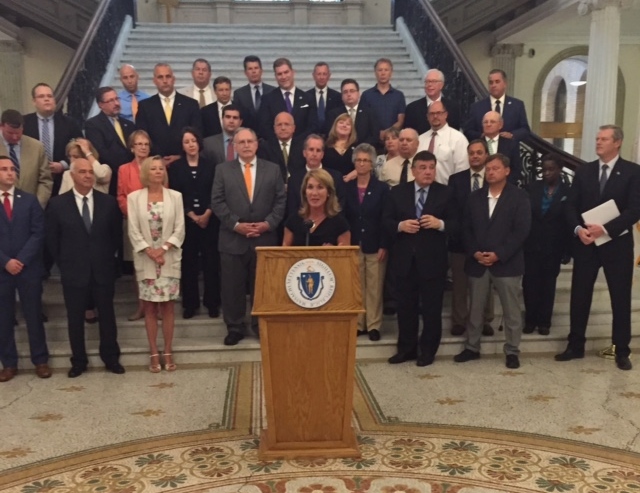
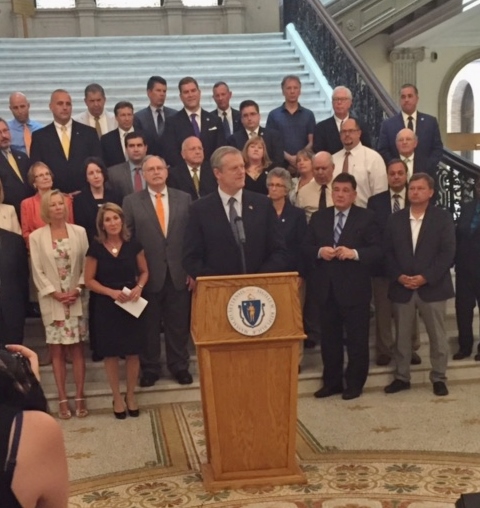
Community Block Grants awarded : by Governor Baker (L) and LtGov Polito (R)

—- —- —- —-

Yesterday Governor Baker and Lieutenant Governor Polito ceremoniously distributed Community Block grants to about 40 Massachusetts municipalities, most of them among the State’s neediest. Distributing the Federally funded grants — averaging $ 710,000 — annually is among the happiest of Baker’s and Polito’s duties; and the event, taking place at the foot of the State House’s Grand Staircase, was the opposite of contentious.

From Adams and Amherst to Athol, Greenfield, and Erving, from Southbridge and Ware to Chesterfield, Cummington, and South Hadley, and from Avon and Everett to Chelsea, West Springfield, Amesbury, and Wales, officials smiled as they opposed for a dozen cameras photographing their receiving the Grant checks.

Community Block Grants get applied to the most pedestrians of needs : renovating buildings, adding space to Senior Citizens centers, cleaning up parks and sports fields, fixing sidewalks and repairing roadways. These things matter a lot; small annoyances often matter more, in our daily lives, than big ones.

Much that Baker and Polito do these days is happy, and rewarding, and occasion for mutual thank-you’s; governing isn’t all dispute and division. Yet soon enough, the Baker and Polito team will re-enter the battlefields. This morning, in the Boston Globe, bakers’ priorities going forward were enunciated; he spoke of them also last night, at an intrergvi8ew-forum at Suffolk University. All will occasion much conflict; Baker enters upon these priorities, however, with a strong burst of public confidence in his leadership.

First up is charter school expansion. A bill to lift the charter school cap on allowed numbers thereof failed in the State senate last year. It passed the House but was amended into uselessness in the Senate before being voted down. This time, there may well be a cap-lift referendum placed on the 2016 ballot. If so, says Baker, he will support it.

This is good news. The system of education set up almost 170 years ago, of one size fits all common schools, no longer satisfies the needs of the technology economy, with its fractured, differentiated specialties requiring small size, diverse knowledge. Nor can we any longer allow instructors to not submit their work to competency evaluation. Prospective employers will no longer accept graduates who aren’t ready for entry-level jobs, or who haven’t basic proficiency in English, mathematics, languages, technical, and history. Students need to be tested, moved forward, challenged; need to be encouraged to innovate and — just as important — to be good citizens and not disruptive of others. Most charter schools do all of these task effectively, which is why parents want their children  entered into charters. The problem is that we’re about 30,000 charter seats short.

Baker will find significant opposition awaiting his preference. Teachers’ unions and their public school parents allies resist expansion of charter schools because they say that charters draw money away from standard public schools that would otherwise be accorded them. This op-ed isn’t the place to address that debate, only to note that it will take place, and that Baker won’t have overwhelming support, as he had for his comprehensive MBTA reform package.

Baker will also have plenty of state administrative reforms to see about. Management failures and contractor incompetence continue to bedevil the Registry of Motor Vehicles, DCF, and many areas of the Department of Health and Human Services — in particular, the agency is still not deployed to deal with Opioid addiction as a health matter rather than a criminal one. Baker has time and again stressed how important he feels it is to alleviate the Opioid addiction crisis; he is right about that, and my information is that major decisions about this are coming quite quickly.

While all of these significant Baker priorities become actual — and maybe face pushback, especially his charter school commitment — the question of the Boston 2024 Olympics walks into the picture too. Whether or not Boston should host the 2024 Summer games has become the most heated political dispute I have seen in the City since charter reform 35 years ago. Opponents have injected their anger into City government itself; and the Mayor’s supporters have responded almost as passionately.

Baker has taken notice — how could he not ? — and has engaged an independent body to evaluate the Boston Olympic Bid and report their findings to him. This suggests that he will opine about the bid — support it or defer to. My guess is that he may take a position but won’t make it his big deal. After all, it is mainly a Boston issue, even if some prospective Games venues locate quite distant from the City. So why should he risk getting chewed up by a brawl that isn’t unavoidably his ?

In particular, I do not see the Governor taking a strong position on the games Bid referendum that evidently is slated to appear on the November 2016 ballot. (note : there’s talk, of having this state wide referendum on a different date. Nothing specific about that yet, however.) Baker may well say how he will vote on said referendum, but I doubt he will call out his Team to work one side or the other of it. And why should he ? the charter school referendum will be difficult enough. “One big fight at a time” is a pretty wise axiom.

—- Mike Freedberg / Here and Sphere

WE SAY : TIME TO PRIORITIZE ALTERNATIVES TO FOSSIL FUEL

From Governor Charlie Baker’s office a few days ago came the following announcement :

“We have filed legislation to increase access to clean, cost-effective

To which was attached, at the @MassGovernor twitter account, the following meme :

clean energy

Included in the Governor’s announcement was this statement by Vivien Li, one of Boston’s busiest and most diversely committed activists : “Diversifying energy production makes sense as Massachusetts works to reach its Global Warming Solutions Act targets,” said Vivien Li, President of the Boston Harbor Association. “The legislation proposed by the administration strikes an important balance by including hydroelectric power and Class 1 RPS-eligible resources without overwhelming the market with one form of generation. I commend the Baker-Polito Administration for its leadership in helping to address impacts of climate change within the Commonwealth.”

As Li’s quote shows, Baker’s legislation calls upon hydropower to alleviate a full five percent of all the carbon reductions the state has committed to achieve by year 2025. Five percent may not sound like much, but it represents, according to Baker’s announcement the equivalent of removing 1,200,000 cars from our highways.

This substantial infusion of hydropower will come from Canada, where water energy abounds. It will be imported from Quebec via a system known as “Northern Pass,” Much publicity has accrued to the Northern Pass route of high-wire electricity lines; now, it seems, these will come to be.

I’ve viewed alternative energy proposals skeptically. Fossil energy employs millions and represents  major portion of the national economy. It is fairly cheap, compared to the cost of alternatives.  It is not to be parted with casually or soon. Until recently, I have not seen the need to move away from fossil fuels, nor any method of doing so that won’t burden city people. But now I do see a need.

What I have seen is the situation in West Roxbury, where Spectra Pipeline proposes to run a gas transmission pipe under streets directly adjacent to the Lorusso Family’s Quarry, known to all as West Roxbury Crushed Stone.

Blasting goes on at the quarry. It’s how quarries operate. That Spectra was unable to procure a different pipe route — has had to propose one having a substantial risk of pipeline damage from quarry blasting — tells me that it’s time to reduce dependence on natural gas.

Spectra would hardly have committed to a pipe route so dangerous were it not that the Boston area lacks natural gas supply significantly enough to impede the economy. We do need almost double the amount of gas currently available in present pipeline capacity. This is where the Governor’s hydropower legislation helps out. If Boston can buy its energy shortage via imports of hydropower, it will not need to require extra gas pipelines.

The Spectra pipeline comes despite a high incidence of gas leaks in existing pipelines. Fixing those existing lines would relieve some of Boston’s gas shortage.

Folks who purchased homes adjacent to the Lorusso Quarry did so despite the quarry being their immediate neighbor. I therefore dismiss complaints they voice about it. But these same people did not assume an expectation of having a gas pipeline routed underneath their street and hard by the quarry. They should not now be asked to acquiesce in it.

That things have come to this level of snag seems to me to make it urgent to unlock, at least somewhat, from fossil fuel and to commit the State to other energy sources., We should support the Governor’s legislation.

The Governor filed his bill in the State Senate, where strong support flourishes for alternative energy initiatives  In that body one meets Senator Jamie Eldridge (D, Middlesex & Worcester), perhaps the state’s leading advocate of, and expert in the policies of, alternative energy. I look forward to see how Eldridge shepherds the Baker hydropower bill to a positive legislative outcome.

—- Mike Freedberg / Here and Sphere

BOSTON 2024 : HOW TO GET TO YES, AND

Mayor WalshNoBoston

^ Mayor Walsh and 1000s of volunteers versus “the same five people” should be a no-brainer. We’ll soon find out IF.

—- —- —- —-

Immediately after I wrote my most recent article concerning Boston’s 2024 Olympic Games bid, a new WBUR poll appeared in which support for hosting the games moved up slightly from the previous poll showing support in negative territory. Support continues in negative territory, but the current Plan’s decision to use venues in the state’s gateway cities appears to have helped. Though opposition leads support, in Boston itself, by 53 to 40, statewide it’s 50 to 40, which means that outside of Boston the number is probably closer to 44 to 40.

That’s still negative; and as the International Olympic Committee (IOC) wants to see positive support for the games showing up in polls by September, the Bid Committee has much work to do, and quickly. Can it accomplish this task ?

Were this a governor campaign, such as last year, a 10 to 13 point deficit would be no big matter. Charlie Baker was down almost 20 points to Martha Coakley in mid-July of 2014; yet by mid September he had overtaken her in polls and stayed ahead all the way to his small but significant win. But this is NOT a Governor campaign.

To turn around the present 10 to 13 point deficit, and move to a five to ten point positive, the Bid Committee would, ordinarily, unleash a statewide media buy of major intensity; would print up brochures and deploy volunteers to canvass voters; would get the editorial boards of the state’s major newspapers fully on board; and, if possible, would win Boston’s Mayor and Governor Baker to back the Bid argument. So far I see no evidence that the Bid Committee is ready to do any of these, or that it has the funds on hand to do it.

Yet I said “ordinarily.” The drive for a positive result in September of this year is not an ordinary circumstance. The actual decision will be done by a voters’ referendum in November 2016. That is when the media and canvassing effort will get going. All that is at stake this September is a poll number, a much more ephemeral thing.

Its ephemerals can easily become substance with just a few — but hugely significant — developments. None of the big influencers have weighed in as yet. The Governor has said nothing; Mayor Walsh supports the bid, but with major reservations (at least formally; in fact many of his team, are working devotedly to win the Bid). The Globe has written positively about the new Bid Plan, but it has yet to say “back the Bid.” The Boston Herald has only recently begun to shift from opposition to support, driven largely by its distaste for the antics of the most visible opponents; its editorial page seems far away, even now, from recommending a Yes.

Change these four influences, and you’ll almost certainly change the current poll numbers significantly.

I say this because while the Olympics currently draw a negative, I don’t believe the public has written its Olympics opinion in stone. This is certainly true outside Boston proper; yet even in Boston, where almost all of the passionate opponents live, hardly anyone you meet talks about the Olympics, and when you raise the subject, almost all say “undecided.”

How could things be other ? People have read — maybe — about the Plan, about its shortcomings, about its complexities and its unsolved conundrums; but people in Boston also like sports, and they are passionate about it. Why has that passion not yet shown up in support for the Bid ? As I see it, most Bid supporters don’t view the Bid as controversial and so aren’t energized to fight for it. The sentiment seems to be, “It’s a great thing, why isn’t it ?” That was certainly the feeling back in January, when the Bid was first widely bruited; and if the opponents have arisen out of nowhere to high fury, the Bid’s supporters have not changed. They liked the Bid then and like it now in about the same way : a good thing but not something to go to war over.

The opposition HAS gone to war. It has way , way overreached, angering the mayor and engaging in tactics both selfish and rude (and seen as such). The opposition’s methods and noise remind many of Tea Party offensiveness; and for very good reason. They’re the same : bogard public meetings, obstruct everything, chant slogans, answer argument with insult, fling ad hominem attacks, harass, distort. (That the Bid Committee has engaged in a kind of BRA design review tactic, by which every neighborhood touched by the Games’ plans feels endangered, hasn’t helped matters.)

How over the top have they gone ? One No-Boston activist calls the games “a disaster” and run by “Scamsters.” Another threatens Court Action (which she has no standing to bring) to stop the Bid Committee’s upgrading of Quincy Point Park, a State-owned acreage much neglected, parts of it in full disrepair.

The public , however, hardly noticed any of this, until Black Lives Matter activists took over Mayor Walsh’s home street at 4 AM one morning, waking up everybody. Though the Black Lives Matter agitators are not NoBoston — and one capable NoBoston advocate has specifically noted the distinction — the demonstrators did not limit themselves to Black Lives Matter issues. They agitated about the Olympics, too. And thereby brought perhaps unwarranted dislike upon the No Boston argument, and in the most attention-getting venue available.

Now everybody notices; and, handed the opportunity, the Mayor has gone on the offensive against NoBoston’s tactics for public meetings, talking (correctly) “the same five people taking over public meetings where people are trying to discuss the details.”

The No-Boston activists would be hard pressed to win a fight with Boston’s popular Mayor even if they were numerous and not confrontational. Flinging ad hominem attacks, slogans, and 4 AM rudeness at him, they have no chance.

Meanwhile, in this context of  quite outlandish opposition by a small few versus a huge body of Boston 2024 volunteers (and more signing up every day), just two specific points move most Bid opposition : the Games must call upon no taxpayer dollars except for infrastructure and security, and no tax breaks should be accorded developers of the Games’ Widett Circle stadium and post-stadium housing proposal. Solve the no-tax issue, and very likely most of the big influencers come aboard the Bid. Solve the tax-break offer, and a significant number of skeptical Bostonians say “”Ok, why not do the Games ?”

The Games Bid can get to Yes in the polls very quickly once the major pieces start falling into place. Will they ? We’ll soon see.

—- Mike Freedberg / Here and Sphere

NOTE 07/15/13 — : I have significantly updated the 4 am demonstration at Mayor Walsh’s home portion of this story in  light of reliable information given me.

WHY IS THE BOSTON OLYMPICS BID EVEN CONTROVERSIAL ?

FullSizeRender

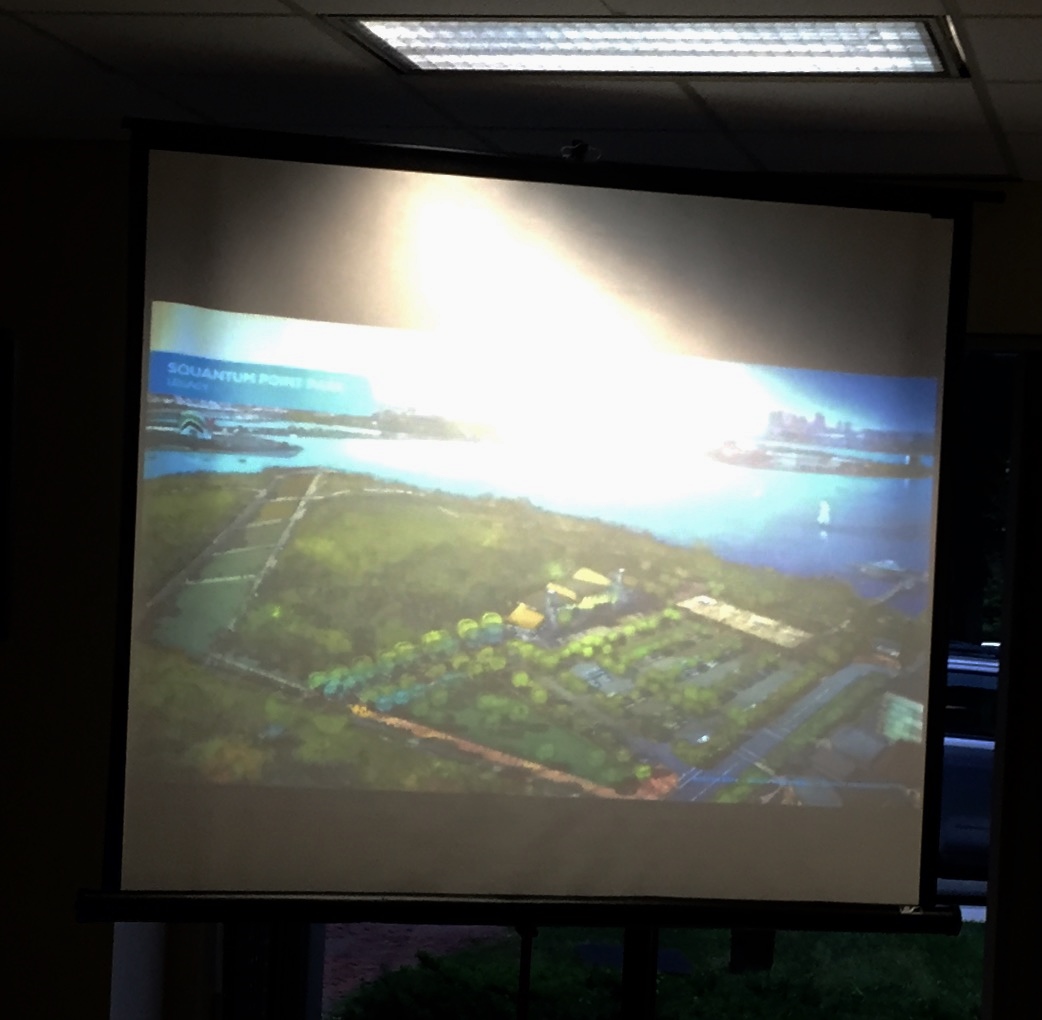
^ The Bid Committee’s proposed volleyball site : Squantum Point Park, a currently under-ussed plot of State owned land.

—- —- —- —-

Last night I got angry at the public Boston 2024 meeting held in Quincy’s Marina Bay. When an old guy like me gets angry, people notice, and some did. And that’s OK. I get angry sometimes. Few occasions have aroused more anger in me than the opposition to our City hosting the 2024 Olympics. What the blazes is this opposition all about ?

As I see it, having our City host the 2024 summer games is an enormous honor, a great blessing for our city that puts us on the tourist A list and confirms our status as America’s most sports-minded metropolis. Hosting the Games means big, big infusions of money and jobs, development of undeveloped land, transportation improvements, all sorts of new thinking, new suggestions, new concepts. It sounds tacky to call it a flower blossoming, but the symbol isn’t overblown.

Yes, it’s also a three week party. Is that bad ? Cities all over the world hold huge public festivals, week long parties and even longer. I’ve been to quite a few, in three or four of those cities, and I enjoyed everything, even the traffic and the overcrowded hotels, the late night noise, the restaurants so full it was hard to get served. Enjoyed it all.

Given all of the above, I was surprised, enormously, to find opposition arising, months ago, to the Games bid. I’m even more surprised now, to find said opposition hardening into obstruction and reputation-smearing. The opposition is small, but it is loud and has caused distant observers to wonder, what the dickens is going ON in our city ? It’s a question I too ask. Sometimes I ask it angrily. Last night I blew out an FY at one remark being made, quite over the line, by an opponent who, during questions, chose to read a statement calling the personal bona fides of the Games Bid Committee into question.

(Disclosure : I have friends who work for the Bid Committee and I value their friendship. I know them to be honorable and hard working civic activists. If this compromises my “objectivity,” so be it.)

The Bid Committee has had to revise their Plan and fill out its extremely complex details of transportation, traffic, land use, housing, land acquisition, construction, security, staffing, and environmental permitting — all of that — ad hoc while being sniped at every minute on every detail by people who want the Bid to fail and are using their sniping and obstruction to push it to failure.

I still have no idea why they are talking this stance, or why they are pushing it beyond the envelope of opposition into determined obstruction and accusation. Who would not want our city to take in billions of dollars in tourist money, to not have billions of investor dollars spent upon infrastructure, housing, and construction; would not want to see the thousands of jobs the games will require ? would not want to see our rather aging, overly neighborhood-narrow city break out of its social confines ? would not want to enjoy the party ?

The reasons adduced make no sense. Displacement ? Just the opposite it. Minions of corporate profit ? Corporations earn profit by doing things, things that require employment. And so on.

Last night in Quincy, the hearing on using Squantum’s Point Park for volleyball competition quickly lost focus. Part of that was faulty presentation. The Committee talked for half an hour about the games in Boston before even mentioning the Quincy proposal. The Committee also sounded defensive. It talked about “legacy investments” rather than the Games themselves. Not one word of joy or excitement did I hear, not a sentence about sports. Why not ?

Given the defensiveness of the Committee;’s presentation, and the focus on “legacy,” with only a brief address about Point Park, it was probably inevitable that the “public comment” was entirely bogarded by the “Opposition”: for its usual purposes : obstruction, petty critique, demeaning the Committee’s bona fides.

Still, there were a few statements by supporters, and a handful of appropriate questions — one in particular, by a local newsman, about traffic problems between North Quincy T stop and Point Park. Those questions, however, seemed overtalked by the opposition’s well-rehearsed focus on obstruction, petty critique, and smear. Those of us who wanted actually to learn the Committee’s Plan for renovating Point Park, and for bringing spectators to the proposed stadium on site,came away quite frustrated to sit through negativity for its own sake when what was wanted was to explore best ways of making it work.

If the Committee is to going to hold more public meetings, and I guess that it is, it should establish these rules : 1. no one who has delivered an opposition speech during public comment time at one meeting should be allowed to deliver it again at other meetings — one time per customer  2. questions should be questions, not speeches of opposition (or support). 3. one question means one question, not two or three. 4. The Committee should never sound defensive or focus on mind-numbing administrative detail rather than the wide vista of sport and excitement.

Perhaps these rules of engagement might lead to public meetings worth attending.

—- Mike Freedberg / Here and Sphere
NOT PERFECT — BUT DEFINITELY GOOD

reason to smile

reason to smile : the two amigos get a budget done AND significant MBTA reform

—- —- —- —-

The FY 2016 Budget deal just announced by Massachusetts’ s legislature gives the Governor almost all of what he wanted. It’s even more a tremendous victory for House Speaker Robert DeLeo, who early on backed almost all of the Governor’s agenda and secured enactment of everything that he backed. Into the budget DeLeo placed the MBTA reforms that he and the Governor supported and thereby managed to get them past the State Senate’s quite different MBTA legislation.

The $ 38.1 billion budget adopts several principles that probably would not have passed but for Governor Baker having won the 2014 election : no new taxes or fees; expansion of the earned income tax credit; and MBTA reform that establishes both a Fiscal Control Board with power to direct the entire MBTA operation and a three-year set-aside of the Pacheco Law (which mandates that the State Auditor must first approve any proposed MBTA outsourcing). Baker deserves great political credit for advancing these principles clearly, for sticking to them, and for persuading the public to support them. This is how governance should work.

To read the budget proposal itself, click this link to the Boston Globe’s story : http://www.bostonglobe.com/metro/2015/07/07/state-budget-negotiators-reach-deal/rmTDZFxHlaLKmBeXz1X6iI/story.html

So : how did we get here, and what comes next ? The first — how did we get here — is quite the story. That the Governor and Speaker allied their goals so closely, and that the Speaker was able to win unanimous (!) support in the House for these goals, results almost certainly from the leadership challenge raised months ago by Senate President Rosenberg. The Speaker responded to that challenge forcefully in a Boston Globe op-ed, and by persuading the House that its authority as a body was at stake : how else did he get the House’s “progressives” to vote for a budget featuring no new taxes and fees, when new taxes are one of Massachusetts Progressives’ top goals ? Equally, DeLeo “triangulated” : by allying with the Governor and bringing his entire body of 160 members with him, he outgunned the Senate and isolated it. This, despite the Senate’s brilliant “Massachusetts Conversations” Forums held all across the State and well attended, as well as fully reported in the media.

As for what comes next, a separate Transportation bill is working through legislative committee processes and will probably be voted upon within a month. Hopefully that bill will reinforce the powers granted to the Fiscal Control board by the Budget agreement. Changes to the MBTA’s collective bargain arbitration system may portend : the T’s unions are the only public worker groups in the State whose contract arbitration awards do not require approval by an elected body. As for the T’s pension system, reform of its accounting system are already under way., led by former Governor candidate Steve Grossman, who understands the T pension as well as anyone.

Beyond this, we will have to see if the T reforms enacted into law actually get established. Sounds coming from the Carmen’s Union — and backed by other unions in the state — suggest they will fight implementation of the Fiscal Control Board’s orders every step of the way : the power to outsource, and the power to mandate new work rules. Make no mistake : T operation needs complete overhaul top to bottom, union workers and salaried managers both. I suggest the following rules of work :

1.Overtime approvals need to be signed off by two (2) levels of supervisor. No worker should be allowed to work more than 20 hours of overtime a month except in case of a declared emergency

2.Inventory foremen need to be bonded personally liable for missing inventory.

3.The equipment repair shops need to be performance monitored and evaluated quarterly.

4.Unexcused absences must be subject to discipline set forth in an employee handbook that every worker (including salaried) must sign for and admit to having read in full.

5.All T employees should be expected to work diligently, to treat the public with courtesy always, and to work as  a team, monitoring each other’s performance. Merit pay raises need to be written into any new Carmen’s Union contract.

6.Mini-buses need be called into service for low-ridership runs.

7.Only after every reasonably feasible efficiency has been put in place, and the riding (and taxpaying) public has been convinced that the T has changed, can there be new revenue for expansion of the system, for purchase of new trains and buses, and for wage raises for employees who meet stated performance objectives..

The above reforms should help give Boston an MBTA that works for those whom it is supposed to serve.

And now, a caution : by no means should T reform be an arena for union-busting, any more than it should be a call for union stubbornness. It does the Carmen no favor to pit themselves against everybody else in the State, nor does it do the economy of the State any good to call for an end to the Carmen’s wage protections. The Carmen do a difficult job as it is, and they will be called upon to do a job still more burdensome. They should be rewarded financially for doing that job, if they do do it; not punished or demonized. Breaking the union is not a goal of the Governor. It certainly is not on the Speaker’s task sheet. Those who advocate it — and I see them commenting all the time in social media — need to back off and rethink what they are about. Likewise union intransigence — and I see this, too, in social media — will not stand either. The public isn’t having it.

Extremism has become almost the norm in today’s internet-real time political discourse. I reject it. The legislature has rejected it. The budget and T reforms it has agreed to have not aced the challenge, but they are have enabled us to get there. That is good enough for me, and it should be good enough for you.

—- Mike Freedberg / Here and Sphere