THE STATE’S FIRST FOOD PLAN IN 40 YARS

Urban Farming

^ farming big-time in Boston’s South End

—- —- —-

Every time I think Governor Baker can’t possibly do something, he does it. I’ve said this before, I say it again.; case in point : the State’s first “food plan” since 1974.

The Plan has not been fleshed out yet. It is available online, however, in draft form, for comment and finalization. You can read its current state at this link : http://www.mafoodplan.org/

Though the Plan is being administered in the State’s far west, around and beyond the Connecticut River valley, it offers enormous possibilities for food growth in the immediate Boston area as well — for urban farming in particular. During the 41 years since Governor Sargent ordered the State’s most recent food plan, urban farming has grown well beyond prediction. Alkl over Boston, even in densely built East Boston, urban gardens, some of them quite large, have been planted and developed. Today Farmers’ Markets set up shop in many Boston neighborhoods sell locally grown produce. There’s even wineries, and of course many local breweries. New farm gardens are being dug, fertilized, and seeded all the time. Ask Kannan Thiruvenghadam, who just this summer planted a farm — with much community help — at 24 Sumner Street in the heart of East Boston’s downtown. The Eastie Farm has its won facebook page and a dedicated cohort of harvesting volunteers. (the harvest took place on Saturday).

This weekend was harvest time all over Boston, from Fort Hill’s Thornton Street farm to large “victory gardens” all over Mattapan, the South End, and the Franklin Park section of Dorchester. In large respect, Boston’s urban farming movement already carries out the goals itemized in the Baker administration’s food plan :

“The Massachusetts Department of Agricultural Resources (MDAR), the Massachusetts Food Policy Council, and the Metropolitan Area Planning Council, in collaboration with the Pioneer Valley Planning Commission, Franklin Regional Council of Governments, and Massachusetts Workforce Alliance, are currently working with constituents across the state to develop the plan.

The plan will identify goals and strategies to:

•Increase production, sales and consumption of Massachusetts-grown foods;

•Create jobs and economic opportunity in food and farming, and improve the wages and skills of food system workers;

•Protect the land and water needed to produce food, maximize the environmental benefits from agriculture and fishing, and ensure food safety; and

•Reduce hunger and food insecurity, increase the availability of fresh, healthy food to all residents, and reduce food waste.

The Food Plan clearly understands the necessity of involving our State’s communities of color and of low income in every part of the new farming. Its plan asks the following questions :

•How can we improve the viability and prosperity of Massachusetts agriculture?
•How can we increase access to fresh, healthful and affordable food, in ways that achieve greater equity along lines of race, class, and income?
•What can we do to make food system able to withstand stresses related to climate change?

I do not get the sense, reading the plan, that it advances the interests of large farms only. In any case, Massachusetts has few such “agri-businesses.” We have Ocean Spray, the nation’s largest cranberry harvester, yet even Ocean Spray is anon-profit collective; and cranberry farming is the essence of specialty food. Our large apple orchards don’t approach the monster size of those in upstate New York. We have few dairy farms of any size; the ones I’m familiar with, the Shaw Family dairy in Dracut and Garelick near the Rhode Island border, enjoy only local market dominance.

Instead, I see the new Food Plan as the culmination of an urban farming movement that has transformed Boston, as vacant lots — and rooftops — have given rise to crop growing tiny, medium,and large, as the pictures I have excerpted from Urban Farming’s webpage attest.

Urban Farming 3

It’s not at all a minor movement. In Boston alone, thousands of residents grow crops, doing all of the hard work themselves and harvesting with help from neighbors and volunteers. There’s even an urban farming school on Linwood Street in Roxbury’s Fort Hill — with a two acre crop lot attached — where young people interested learn to become crop growers for real. The Baker administration’s Food plan appears at the right time to advantage this school, and the conversation that will flesh out the Plan seems almost to have come to pass to involve these kids — and those already veterans of farming in the City.

Let the conversations begin.

—- Mike Freedberg / Here and Sphere

TIME FOR ACTION : CRIMINAL JUSTICE REFORM

FullSizeRender

^ taking a bold lead on criminal justice reform : Suffolk Sheriff Steve Tompkins hosting a Boston City Council hearing inside Suffolk jail

—- —- —- —-

One issue that has stepped back behind the MBTA, DCF, and opioid addiction crises is criminal justice reform. Now, however, this reform must be brought forward.

Specifically, we at Here and Sphere support the following measures :

( 1 ) ending mandatory sentencing. Judges must have discretion, as every case is different. As for non-violent drug crimes, what purpose is served by refusing judges the discretion to take note of the actual facts before him ?

( 2 ) end solitary confinement except for the safety of the prisoner or for documented disciplinary offenses during incarceration. Prison life is hard enough, given the constant restrictions, humiliations,a nd dangers. Adding soliatry confinement tgo a prisoner’s mental stress can drive him to madness and leave him damaged, hardly likely upon release to adjust to freedom and the workplace.

( 3 ) end incarceration for most non-violent drug crimes. Of course this reform pre-supposes a probation staff free of political patronage and a caseload not so large that it cannot be hand led well.

( 4 ) end the system of using inmate labor at pay less than  the minimum wage. Why should a prisoner be denied the value of his or her labor ? Not to mention the unfair competition this poses for employers.

( 5 ) enforce prison guard work rules including treatment of prisoners. guards who violate the civil rights of prisoners — and worse — should be terminated, no exceptions. Particularly there can be no tolerance at all for guards assaulting or raping prisoners.

( 6 ) monitor and enforce the rights of prisoners in need of medication to receive said medication as rapidly as feasible. Any prison official who ignores a prisoner’s call for medical attention should be vigorously disciplined.

( 6 ) prisoners scheduled for re-entry in six months or less should have available to them a re-entry course, of education, job training, and psychological support, so that on re-entry day he or she is ready to tackle the challenges of freedom.

( 7 ) enforce the rules of court governing criminal trials, so that prosecutors and their experts either make available all exculpatory evidence to defense, and rapidly, or face disciplinary action by the Board of barf Overseers. We simply can NOT allow potential innocent defendants to be wrongly convicted based on prosecutorial manipulation. The more than two-year Aisling McCarthy case also violates principles of speedy trial guaranteed in the Constitution.

( 8 ) women prisoners should have other incarceration options than the horrific Framingham correctional facility. Women prisoners face situations unlike men’s. Pregnancy and motherhood, during incarceration, are a fact and call for conditions of custody that will accommodate the demands thereof.

( 9 ) trans gender prisoners must be accommodated to incarceration that will not put their safety and mental health at risk. Incarceration itself is punishment enough, for every prisoner. It should not entail additional dangers and debilities entirely avoidable. Let me add that prisoners who assault or rape other prisoners must be swiftly and assuredly punished and isolated from the general prison population.

( 10 ) re-entry is difficult enough. Released convicts should be able to seek employment unburdened by having their driver’s license suspended because of their conviction. CORI reform has so far fallen short. We have made it easier for a convicted person to “seal” his or her record, yes; but the waiting period thereof is five years after completion of original sentence — parole does not count. A paroled prisoner should have his or her five year waiting period begin on the day of parole (excepting only that if he or she is re-incarcerated due to a parole violation, the waiting period is extended until said prisoner is finally released).

Let us also not forget that incarceration and re-entry affect a far greater percentage of people of color than of Caucasians. I understand that this is a painful fact to read again and again, but fact it is.

I am quite sure that the above list does not cover every convicted person’s common sense fairness requests, but these do offer a start. Bills to accomplish much of what we suggest have been filed and await action by the House and Senate. They should wait no longer.

—- Mike Freedberg / Here and Sphere

BOSTON SCHOOLS : “UNIFIED ENROLLMENT” NO SIMPLE MATTER

FullSizeRender

trying not to be the point man : Boston Public Schools’ Rahn Dorsey being nice at Boston Compact’s “unified enrollment” meeting at Mattapan Public Library

—- —- —-

Last night i attended a meeting hosted by the Boston Compact to discuss the Boston School District’s proposal to establish a “unified enrollment” system, whereby parents will choose among several schools offered, as always, except that henceforth the list will include charter schools as well as standard public schools.

Why Boston’s School; Department (BPS) needs an outside, non-profit organization to barnstorm its proposed enrollment system, I have no idea. Can’t the 500 central office staffers at BPS Headquarters find at least a few among them to do this ? As it turned out, two BPS staffers participated in the meeting, led by Rahn Dorsey. So why Boston Compact ?

Granted that the Boston Compact people I met or saw at the Mattapan public Library affair seemed competent, and polite, attentive and sensitive, very emblematic of corporate sensitivity training in action; nonetheless, the “unified enrollment” proposal doesn’t seem to require a booster any more than an egg needs eggo.

The proposal boils down to this : parents will now find, on their “individually prepared” (as Dorsey described it) list of school choices appurtenant to their home’s zip code, charter school choices as well as standard school choices arranged in three tiers.Sounds good, but any parent who chooses the charter school in her “individual” list will still have to compete by lottery, and that lottery will, so far as I know, still be city-wide.

Which immediately raises an almost impossible question : the Governor’s bill to create up to 12 new charter schools a year specifies that they be created only in “underperforming” school districts. This raises a huge red flag for Boston, where the loudest outcry for increased charter school seats arises. Because Boston really is not just one school district. Boston has many top performing schools, many second tier, many thi9rd tier, and many schools the State rates as needing intervention. How, if the “unified enrollment” charter school choices go into a citywide lottery, does that lottery assure that the parents choosing a charter choice reside in an under-performing zip code ?

I ask this because the BPS enrollment policy puts a premium on choices that are as close as possible to the parent’s home address. Will parents’ charter school lottery chances be enhanced if she lives in a zip code with more under-performing schools than not ? Is it even legal for BPS to make that kind of discrimination ?

In sum, how in practice will BPS assure that the addition charter school seats to be allotted via Governor Baker’s bill actually get to the parents most desperate to have them ?

To this question I could get no answer last night. I wasn’t even permitted to ask it. But ask it I am doing right now. I wonder if I will receive any answer at all, much less a workable one.

And I still do not get why BPS needs Boston Compact to negotiate a responsibility that is BPS’s solely.

—- Mike Freedberg / Here and Sphere

BOSTON CITY COUNCIL : WHO WE LIKE, AND SOME INSIGHTS

FullSizeRender

At-Large Council candidates : Annissa Essaibi George, Mike Flaherty, Ayanna Pressley, Michelle Wu, Stephen J. Murphy

—– —- —- —-

Last week I posted that we at Here and Sphere were not going to endorse anyone, because I know all the candidates well, have advised two, and am therefore not an objective observer. Yet it would be unfair to our readers to beg off entirely. Therefore I will now post our recommendations.

Before I do that, you may want to examine the money facts. Here, from the State’s campaign reporting website, are each candidate’s ending balances and money amounts raised since September First :

at-Large —– Mike Flaherty : raised $ 27,715; balance on hand 207,244.37

Annissa Essaibi George: raised, $ 33,442; balance on hand, $ 57,624.83

Stephen J. Murphy : raised $ 18,211; balance on hand $ 41,852.45

Ayanna Pressley : raised $ 28,450; balance on hand $ 57,946.69

Michelle Wu : raised $ 33,150; balance on hand $ 46,419.86

District 4 : Andrea Campbell : raised $ 35,242 balance on hand $ 31,285.27

Charles Yancey : raised $ 18,106 balance on hand $ 26,533.26

Money isn’t the entire picture, but donations do message the level of confidence that people who are wiling to part with dollars have in the candidate they give to, or in his or her prospects — which amounts largely to the same thing. My assessment of the five at Large candidates was formed, for this editorial, before I researched their fundraising. That the fundraising facts mirror my assessment tells me that I’m not completely crazy making the evaluations you are about to read.

Boston elects four at-large Councillors. Five are running in this election. Of the five, two stand out : Mike Flaherty and Annissa Essaibi George. You ought to give them two of your four votes.

Mike Flaherty has a command of City administration quite extraordinary. His grasp of what the City does, and how, he has brought to every neighborhood and its voters, even handed, favoring none, respecting all, and ready to assist all neighborhoods (and social interest groups too) with the kind of enthusiasm that assures all that he gets it and enjoys following through. It’s also a big plus, as far as I am concerned, that Flaherty enjoys a solid political relationship with Governor Baker at a time when State administration reform extends significantly into Boston.

Annissa Essaibi George brings to the Council two major City interests not really represented : the City’s school teachers, of which she is one, and its small business owners, particularly women who own said businesses (and she is that also). George also connects to the City’s new generation of Boston-born activists in a way no other of the five quite does. She speaks neighborhood Boston accent — which is authentically her — yet she’s no stranger to Downtown’s high-income parts, and she also has many routes to Governor Baker’s ear : several of his post-election Transition Team support her. Call her a natural coalition-builder, and you won’t be wrong.

Stephen J. Murphy, Ayanna Pressley, and Michelle Wu : all exhibit strong points, and, as I see it, all have flaws.

Pressley seems the strongest : her successful home rule petition to restore to Boston city control of liquor licenses is a huge achievement for business and social growth, and her current campaign expands upon what she rightly calls “the power of us.” Yet at a recent Forum she came out, in writing no less, for re-instituting rent control in Boston. This is a huge mistake. Rent control was a disaster on all fronts when we tried it in the 1970s. Pressley needs to rethink her position.

Stephen Murphy continues to be the Councillor best positioned to bring old Boston voters into sync with new Boston people, yet he has an ad hoc, gut-reaction approach to issues that sometimes makes one wonder what the blazes he was thinking. Murphy certainly knows City finance; ask him about City capital expenditures or bond issues, and he’ll convince you. He also supports the Council pay raise for the right reason: as other City workers have gotten big pay raises,the Council merits a raise also. If only finance were the sole issue that Councillors have to make sense of…

.Michelle Wu works harder than anyone, has no peer at one on one conversation, and uses social media as shrewdly as any elected person I know. But what, exactly, is her main issue ? I have yet to hear. In addition, her very soft speaking voice makes it difficult, at a Forum, to hear what she is saying, nor does she show a focus. Wu hasn’t yet found her sweet spot in public policy.

If you choose to vote for any two of Murphy, Pressley, and Wu, by all means do so. But vote for Mike Flaherty and Annissa Essaibi George first.

—- Mike Freedberg / Here and Sphere

FIGHTING OPIOID ADDICTION : GOVERNOR BAKER BREAKS NEW GROUND

FullSizeRender

Governor Baker announcing his “every tool in the toolbox” legislation to fight opioid addiction. (the man to his left is the sign language interpreter)

—- —- —

Last week Governor Baker filed his legislative response to the opioid addiction epidemic that claimed more than 1,000 lives in Massachusetts last year, Much of it breaks new ground; some of it seems drastic. Chiefest of these parts is its allowing civil commitment of addicts, against their will if need be, similar to the civil commitment law that already allows it for the suicidal.

Before I discuss Baker’s legislation further, I suggest that you read his office’s synopsis of significant provisions:in what Baker calls “The Act Relative to Substance Use Treatment, Education and Prevention (STEP)”:

•Limits Prescribing Practices for First-Time Opioid Prescriptions: ◾The first time a patient obtains a prescription for an opioid or when they see a new doctor, the patient will be limited to a 72-hour supply.
◾This section provides an exception for emergency situations and permits the Department of Public Health to identify additional exceptions to the 72-hour limit.

•Allows Clinicians to Treat and Assess Patients for 72-hours: ◾Creates a new pathway for treatment of individuals with substance use disorder by allowing clinicians to retain a patient for 72-hours so they can attempt to engage the patient in voluntary treatment or seek court ordered involuntary treatment.
◾Instead of limiting the “front door” to obtain involuntary treatment for a substance use disorder to the court system, the bill makes hospitals as a new “front door” that can provide access to involuntary emergency treatment for an initial 72-hour period. This provision parallels existing law that permits a 72-hour period of involuntary treatment where a physician determines that a person suffers from a mental illness and poses a serious risk of harm.

•Strengthens the Prescription Monitoring Program (PMP): Requires every practitioner, including emergency room clinicians, to check the prescription monitoring program (PMP) prior to prescribing an opiate.

*Mandates Controlled Substance Training for Practitioners: Requires that practitioners who prescribe controlled substances receive five hours of training every two years related to effective pain management and the identification of patients at high risk for substance use disorder.
•Requires Educational Training on Substance Misuse for Coaches and Parents: All public schools subject to the Massachusetts Interscholastic Athletic Association rules are required to provide training for parents, coaches, trainers and parent volunteers, physicians and nurses on the dangers of opioid use during the annual mandatory head injury safety training program.
•Amends the Civil Commitment Statute (Section 35 of Chapter 123 of the General Laws): ◾Removing the provision allowing the civil commitment of women to MCI-Framingham for substance disorder treatment.
◾Requiring the department of public health to identify for the court the facility where a bed is available for the treatment of an individual committed under section 35;
◾Expanding access to treatment beds by authorizing the department of mental health to identify DMH licensed beds, with enhanced security comparable to that now maintained at the Men’s Addiction Treatment Center, in Brockton, and the Women’s Addiction Treatment Center, in New Bedford, that are available to treat individuals with a substance use disorder who have been committed under section 35;
◾Clarifying the executive branch’s existing authority to transfer patients between facilities while the patient is committed under section 35 and receiving treatment services.

•Requires Insurers to File Opioid Management Policies: Mandates insurers regulated by the Division of Insurance (DOI) to file policies annually to encourage safe prescribing practices.
•Improve Access to Recovery High Schools: Recovery high schools (RHS) provide a safe, sober and supportive learning environment for students who have been diagnosed with a substance use disorder. Currently, students attending a RHS do not receive funding from the Commonwealth to cover transportation costs. This act requires the Department of Public Health and the Department of Elementary and Secondary Education to develop a transportation plan for students who attend a recovery high school.

13 steps, some controversial, deliver a full frontal attack on a crisis that Baker, as a health care guy, has embraced as a state service priority. Certainly addicts (and addict advocates) will be glad to see that female addicts will no longer be committed to the Women’s Prison in Framingham. This alone makes Baker’s legislation a godsend. The 72-hour period, prescription limitation makes solid sense as well : do NOT prescribe more pain killer pills than a patient absolutely needs, short term. Baker, at his press conference, cited cases where prescriptions for up to ninety (90) opiate pills were given. He’s right; that’s way too much. In many cases the majority of those pills end up on the street, sold for cash and bartered illegally from there; and if not ? 900 pills is more than enough to shanghai an addict.

Expanding the number opf treatment beds, so that addicts can be cared for rather than  made criminals, is something that addiction voices are pleasing for. One of the most prominent of such voices, Jack Kelly of Charlestown (whom I often consult on this issue), a former City Council candidate and recovered addict, also says he thinks the forced commitment of addicts — the bill’s most controversial part — is a good idea.”You have to start somewhere,” he said to me. Kelly also likes the entire legislation : “it’s not perfect, but it’s good and it’s a start,” were his words.

The Governor baker noted, at his press conference, that he hears addict stories all the time. Kelly’s is one such. He and the Governor have conversed at length about the addict situation and about recovery. Chris Herren, too, whose promising NBA career was erased by addiction, has the Governor’s ear when addiction is on his agenda. With Kelly and Herren as advisors, or sources of first hand information about what the addict life is like, Baker is well positioned to get this challenge right and to see a response through to success.

—- Mike Freedberg / Here and Sphere
BOSTON: CITY COUNCIL AT LARGE — ISSUES AND ANSWERS

FullSizeRender

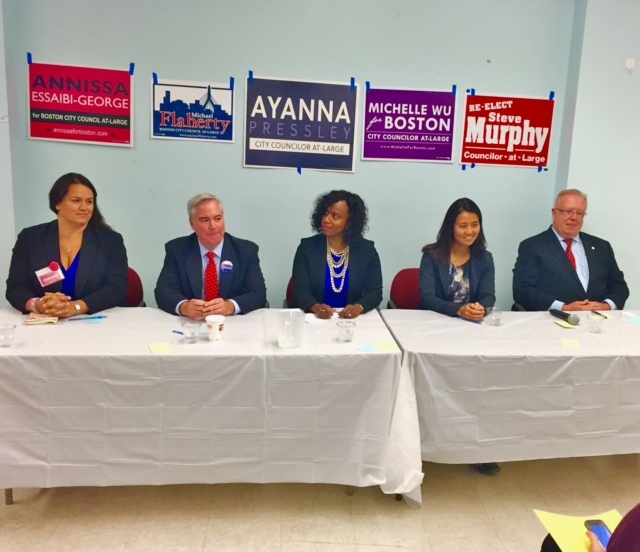
From Left : Michelle Wu, Mike Flaherty, Stephen Murphy, Annissa Essaibi George at DotOut Forum last night at Savin Bar & Grille

—- —- —- —-

Last night the Dorchester-based group DotOut held its candidates Forum at the Savin Bar and Grill. The candidates were asked five questions, and all answered them. I will now give my own answers to those questions, on behalf of Here and Sphere readers, and note the at-Large candidates’ coincidence or lack thereof.

Question One : Mayor’s Office of Workforce Development calculates that the living wage in Boston is $ 14.11/hour. Massachusetts minimum age is currently $ 9.00/hour…. In your view, what role should the City Council play in regulating the minimum wage in the City of Boston ?

Answer : I agree with the City’s finding. I support the $ 15.00/hour wage that is the subject of an upcoming ballot initiative. By law, the State regulates wage issues; the City cannot. Advocacy on the State-wide level is my response. I’m doing it.

Best candidate answer : Murphy 1, Flaherty 2, Pressley 3. Wu and Essaibi George gave general but not specific answers.

Question Two : Governor Jerry Brown of California signed the “California Fair Pay Act”…that will force employers to prove that pay is based on performance rather than gender. While federal and state legislation has largely stalled in this area, what steps can the City Council take to help address the gender wage gap ?”

Answer : Boston can pass a City ordinance establishing pay equity as City policy and enforcing it as to businesses in dealings with the City. On the state level, I support the Attorney General using her authority to protect wage equity by bringing suit against employers accused of violating it.

Best candidate answer : Pressley 1, Essaibi George 2, Wu 3. Mike Flaherty answered generally, Murphy even more so.

Question Three was a question about Pre-Exposure Prophylaxis, an HIV treatment option whereby persons with a high risk of exposure to the disease even though not yet carrying it, can take up to one pill a day as a prevention measure.

Answer : I support the City making residents aware of this option through including it on its Department of Health website.

Best candidate answer : all five candidates answered approximately as I have.

Question Four : Last year’s unprecedented snow crippled the T for far longer than anyone could have predicted. Boston.. residents bore the brunt…especially those…who are most vulnerable. Some of the solutions being proposed include fare hikes (which)…would have highest impact on the most vulnerable. Understanding that the T is managed at the state level, what will you do to be an effective advocate for your constituents as…to the MBTA ?

Answer : I support the full palette of measures being put in place by Governor Baker, including systemic reform, infrastructure repair, management detail, outsourcing of late night and low-use routes, and oversight of expenditures, work performance, and fare collection. For City T riders, one measure I’d like to see is enclosure of outdoor T kiosks so that people waiting, sometimes for up to 20 minutes, for a bus or train can have safe protection from cold and weather.

Best candidate answer : Mike Flaherty 1, Essaibi George 2. Pressley and Wu mentioned continuance of late night service. Murphy noted the state’s neglect of T repair during the past 15 years.

Question 5 : asked whether Councillors support re-instituting rent control as a measure to protect affordability of Boston housing.

Answer : Rent control was a disaster when we tried it in the 1970s, a failure for every reason. It created a large and expensive bureaucracy, fostered under-investment an d neglect by rental owners, and in some cases encouraged corruption, as tenants of rent controlled units subleased parts of their living space to others at whatever they felt like charging. Fact is that you cannot take the value out of real estate., If you try to block it here, it resurfaces there. Fortunately it is now barred by state law.If we want to assure availability of affordable housing, build more affordable housing.

Best candidate answer : Essaibi George. Flaherty touted an initiative of his own. Wu and Murphy mentioned support for a “just cause” eviction ordinance. Pressley, however, actually supports reinstituting rent control — an unfortunate position completely at odds with her mostly business-encouraging agenda.

My overall impression is that few of the at-Large Council candidates are wiling to address these issues bluntly, with analysis that goes deeper than today’s urgency. I suppose that is why they are candidates, and I am not. Nonetheless, few gave answers entirely lacking in authority. Readers can be confident that none of the five is a fool. In today’s political climate, that’s encouraging.

—- Mike Freedberg / Here and Sphere

GOVERNOR BAKER MAKES A HOUSING DEVELOPMENT PITCH

IMG_0898

Governor Baker at Mass DOT Headquarters announcing his state-owned real estate use plan. (photo by Jay Ash)

—- —- —- —-

From Governor Baker’s office I just received the following press release. I quote almost all of it, as it speaks for itself :

Baker today outlined the administration’s Real Estate Asset Leveraging (REAL) Strategy for developing unused or underutilized Commonwealth properties into new opportunities for affordable or market-rate housing, reducing government expenses, increasing revenue without taxes, capital investment in state properties, economic development, or open recreational space. Across our state agencies and authorities, the Commonwealth highlighted 42 near-term opportunities for public-private partnerships at an open house for interested parties.

“As the Commonwealth’s largest property owners, state government has an opportunity to leverage underutilized real estate to build housing and conserve open space, while driving economic growth and stronger communities across Massachusetts,” said Governor Baker. “We are excited to invite the private sector and community partners to participate in this process and look forward to unleashing their creativity and innovation to better use public land for the good of the Commonwealth.”

Kick-starting much State-owned land into beneficial uses was something baker mentioned from time to time during his 2014 campaign. Specifically he talked of it when campaigning in Boston. He held out an offer to the mayor : ease the permitting process, come up with a plan, and we will provide the land, cheaply.

At the time, I noted the wisdom of Baker’;s offer,m economically and politically. It promised partnership between tate and city, Baker and Walsh, Republican and Democrat.,

That promise has already become a Baker motif. This step takes the motif to a more difficult place, as the development of vacant land is probably the singled most contentious matter for voters in Boston, a city already dense with building. Yet if certain to arouse controversy, Baker’s offer bonds nicely with Walsh’;s own Imagine Boston 2030 plan to build 53,000 units of “affordable” housing. All that’s needed now is to know where the state-owned parcels are located.

There certainly is a need in Boston for housing that doesn’t cost a yacht’s worth of money. Average rental prices in most of the City show at least $ 2,100 a month for a two-bedroom apartment, in many neighborhoods more than that. I fully approve of the economic boom that has lifted Boston rents; after all, better a boom and good jobs than bust and no jobs. For residents, however, even good jobs may not keep up; thus the affordability movement is a present priority.

Mayor Walsh recently has proposed to raise the percentage of affordable units in any project seeking BRA approval. Baker’;s offer to lease — or sell ? — state-owned parcels to developers in Boston puts ground under future developers’ feet.

Can Baker require that at least some development built on state-owned land be developed for sale, not rental ? That would help the situation. Home ownership is one of the most stabilizing factors in neighborhood life. We shall see what Baker says.

Baker’s press release detailed the steps he plans to take :

· An inter-governmental REAL working group, spearheaded by the Executive Office for Administration and Finance, to meet regularly to evaluate proposals, develop ideas and ensure efficiency and timeliness.

· One stop shops at key landholding agencies to better manage Commonwealth real estate assets.

· Engagement of a private consultant to assist the Commonwealth in developing the next wave of parcels and partnerships in order to build a pipeline of projects.

· Reactivation of the sparingly used Asset Management Board as a flexible tool to work with the private sector on long-term leases.

· More effectively managing thousands of leases on state land in a more professional and progressive manner.

Over 40 initial properties were identified today for the solicitation of proposals, including:

· Opportunities in Boston to invest in high value properties for retail and housing.

· Parcels in Northampton ready for redevelopment.

· Major development parcels near highways in Plymouth, Carver and Taunton.

· Potential partnerships with the MBTA and MassDOT for fuel sales, ATMs and new service plazas.

· Green investment projects for anaerobic digestion and new solar installations.

· A renewed collaboration with our Sale Partnership Communities, who are redeveloping closed state hospitals in partnership with the Commonwealth.

· Opportunities to upgrade statewide telecom infrastructure.

· Online database featuring all available properties in one page that includes each project name, acreage, how long they have been available and anticipated release.

As yhou can see, Baker’s land use proposal will not happen overnight or be ready for roll out any time soon., Baker is the ultimate detail man, who makes moves one at a time, a fuss budget of preparation  like General Montgomery in World War II. The beauty of his caution is that he’s unlikely to have to retreat because of mistake. The less than beauty is that the initiative will move forward so gradually as to not appear to be moving at all.

It will be safe, not sexy.

That said, I fully approve Baker’s idea. That state-owned land lingers unused helps no one.  If he;’s right that his land-use initiative can increase state revenue, all the better. I’m not sure that lease will be the preferred legal vehicle for developers taking an interest, but from those who are willing to lease, income will indeed accrue to the state. Why not take it ? I see earned income, if it’s available, as always a wiser bet than taxes.

Lastly, I quote the press release;’s final paragraph, in which you can see how just how bureaucratic is the hold now in place upon the unused lands that Baker seeks to put to profitable purpose :

“The REAL Strategy was announced at an Open for Business event hosted by the Baker-Polito Administration and attended by representatives of businesses and key state agencies, including the Executive Office for Administration and Finance, Executive Office of Energy and Environmental Affairs, the Executive Office of Housing and Economic Development, the Massachusetts Department of Transportation (MassDOT), the Massachusetts Bay Transit Authority (MBTA), the Massachusetts Port Authority (Massport), MassDevelopment and DCAMM. Of the Commonwealth’s over 20,000 properties, approximately 15,000 are held by DCAMM, 4,000 by the MBTA and 1,700 by MassDOT.”

So much process to kick start, so much initiative to generate. Let’s see where this proposal goes, and if.

—- Mike Freedberg / Here and Sphere
BOSTON CITY COUNCIL : DISTRICTS 4 AND 5

FullSizeRender

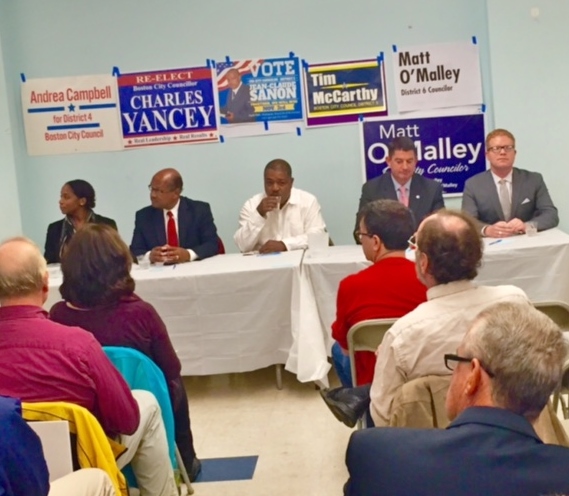
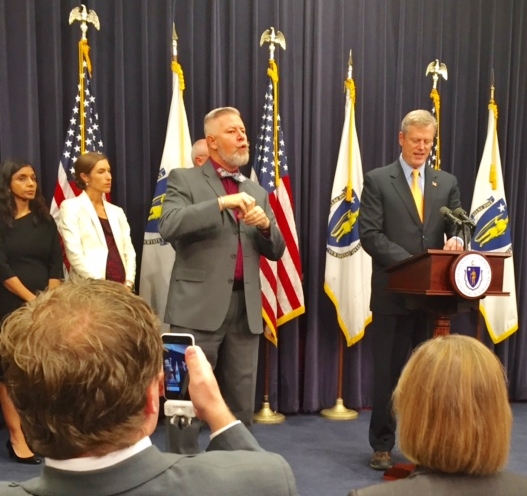
^ District candidates. From Left : Andrea Campbell and Charles Yancey, District 4; Jean Claude Sanon and Tim McCarthy, District 5; Matt O’Malley, District 6

—- —- —-

Two days ago I wrote about the at-large City Council candidacies represented at Monday night’s Forum in Roslindale. This time I will analyze the two District races presented.

District 4 enjoys a classic contest between a long time incumbent and an aggressive challenger, a generational battle with 33-year old Andrea Campbell taking on Charles Yancey, age 67 and the Council’s longest-serving member. District 5’s race reprises that of 2013, as Jean Claude Sanon and Tim McCarthy competed to succeed Rob Consalvo. McCarthy won that race by about 7 to 5.

This time, Sanon appears not to have the strength that he wielded in 2013. Then, he had almost universal support from his Haitian community, which represents about a quarter of all District 5 voters. This time, McCarthy seems to enjoy a fair level of support from Haitians active in the District. Certainly McCarthy has worked almost 24-7 to gain such credibility, and it was no surprise that at the Forum he was able to read off a long list of city facility upgrades he secured for every corner of the District (he made sure to mention every corner of it by name). Sanon, meanwhile, was unable, at the Forum, to articulate what he would, or could, do differently.

This was a surprise to me, as in 2013 I watched Sanon, a long-time community activist,speak out with conviction about the aspirations and expectations of his supporters. He did so at one Cleary Square rally I attended, where, backed by Ayanna Pressley, Felix G. Arroyo, State Senator Linda Dorcena Forry, former State Senator Bill Owens, and others, he challenged his community to vote in strength for this, that, and that. No such event has occurred this time that i am aware of.

Most candidates at Forums pack the room with supporters to cheer them on; Sanon had few in the Forum audience

The District 4 race, by contrast, featured two intense, well funded and heavily organized candidacies. At the Forum, it showed. Campbell the Princeton graduate and  Yancey the Harvardian responded with clarity and authority to the questions asked. Each played his role expertly : Yancey the long-term Councillor with a compendium of accomplishments, Campbell the challenger articulating a new agenda. (Disclosure : I too am a Princeton graduate and have played a seminal role in organizing Princeton alumni for her campaign.)

Yancey recited his resume smoothly and referenced the person who gave him his entree into politics, his formidable mother Alice Yancey, a long-time Boston Public Schools activist; Campbell narrated her own up-from-poverty life story, at least as compelling as Yancey’s,

Campbell is quite the policy wonk herself. Forum emcee Rachel Poliner asked all candidates a question about Boston’s affordable housing future, only Campbell cited that morning’s Boston Globe front page story in which the mayor announced that he would require a higher proportion of affordable units be included in future development.

Yancey and Campbell have become beneficiaries of activist participation beyond the usual in such local races.  Yancey’s referencing his Boston Public Schools mother signals the vigorous support he is now receiving from opponents of charter school cap lift; meanwhile, Campbell, whose statements about schools suggest that she is open to charter cap lift, has become a focus for District 4’s many charter cap lift parents — and their support organizations. As support for the Governor’s charter cap lift legislation (and for the ballot initiative to do the same) runs almost universal in Boston’s communities of color (COC), and as District 4 has a COC majority, Campbell would seem to have the better position.

Certainly she had the better position in the primary, in which she routed Yancey by 1892 votes to 1159. I can’t recall seeing a District incumbent beaten by that big a percentage. And Campbell has only added strength; Suffolk Sheriff Steve Tompkins has put himself and his whole organization on the line for her, in a way that I don’t often encounter.

What, then, do I predict for these two races ? Here’s my best shot : in District 5, McCarthy bests Sanon by two to one. In District 4, Yancey closes the gap — triples his vote — thanks to a much larger voter turnout, but Campbell more than doubles hers and wins it all, 4,440 votes to  3,480.

—- Mike Freedberg / Here and Sphere

BOSTON CITY COUNCIL CITYWIDE : EVALUATING THE CANDIDATES

FullSizeRender

^ at large Council candidates at West Roxbury-Roslindale Progressives Forum  : Annissa Essaibi George; Michael Flaherty; Ayanna Pressley; Michelle Wu; Stephen Murphy

—- —- —- —-

Last night I attended a candidates Forum, hosted by the West Roxbury-Roslinale Progressives group, at which all five people seeking Boston’s four city-wide Council seats spoke and took questions. The room was full; As quiet as this election — voting day is November 3rd — may seem, it is not quiet for activists. THe Forum lasted for two hours — District Council candidates held court first — and not one person left the room.

So : what do I think of the five, Annissa Essaibi George, Michael Flaherty, Stephen Murphy, Ayanna Pressley, Michelle Wu ? It’s not a question I answer easily. I’m friendly with them all; good friends with two; have advised Ms Essaibi George; and share with Michael Flaherty a commitment to Governor Baker. Nonetheless, I’ll do my best to write this article fairly.

Using a grade system A, B, C, D, and E, I will rate the five on the following bases : ( 1 ) command of an issue identifiably his or hers ( 2 ) relationship with Mayor Walsh ( 3 ) relationship with Governor Baker ( 4 ) knowledge of the City government functions. After I’ve done that, I’ll assess their campaigns — and the personality of the candidate — as I’ve seen and heard them.

( 1 ) Command of an Issue identifiable to the candidate : A : Ayanna Pressley, who secured home rule success for the City to take charge of its liquor licenses and who now advances three issues, of community empowerment under the rubric “the power of us.” B: Annissa Essaibi George, whose tandem advocacy of small business growth and public education comports credibly with her status as East Boston High School teacher and small business owner. C : Michael Flaherty, for whom authoritative command of city issues and services is such that it has become a campaign theme in itself. D : Stephen Murphy’s theme — which he expressed in last night’s opener — is longevity. If re-elected he’ll serve his 10th term. I’m not sure that that theme works in a year when voters want complete newbies, not long-serving professionals; but you go with what you have. E : No disrespect to Michelle Wu, but I have yet to hear her say what she has that makes her stand out. Wu comes across extremely modest and frustratingly soft spoken. Those make her  a charming person, but as I see it, a Councillor needs to speak up and to act boldly.

( 2 ) relationship with Mayor Walsh : given the Council’s lack of final power under our City Charter, it behooves every Councillor to be liked by the Mayor. Nor is it easy to tell who stands where in his regard. Perhaps the best measure thereof is the Councillor’s own political strength. As I see it, this rating goes like this : A : Annissa Essaibi George, because she comes from the part of Boston that is the Mayor’s base ad has many of the same core supporters that he has, and because her priorities comport well with his. B : Michael Flaherty : he and Walsh share the same neighborhood base; and his command of the City almost guarantees that this first-term Mayor should enjoy his advice. Yet it was not that way between Flaherty and Walsh’s predecessor. C : Stephen Murphy : I don’t see him as especially in sync with Mayor Walsh but neither do I think Walsh sees Murphy as a problem. D : Ayanna Pressley’s relationship with Mayor Walsh looks to me more frenemy than not, as she is often mentioned as a credible 2017 challenger, given that she has the deepest support of these five among former Connolly voters. E: Michelle Wu : I’m not clear on what sort of relationship she has with Walsh. I doubt that it’s an adversarial one.

( 3 ) relationship with Governor Baker : A : Michael Flaherty, who endorsed Baker in his 2014 campaign, worked his endorsement, and cited his relationship with  Baker pointedly at last night’s Forum when asked a question about state-related Council issues. B: Annissa Essaibi George. Her husband is a max donor to Baker’s coffers, and Essaibi George herself enjoys solid support from Team Baker’s star members within the City. Today, alone among Council candidates, she attended Baker’s opioid addiction legislation press conference. C: Stephen Murphy : he recently attended a major Baker fundraiser and asserts a friendship with the Governor going back to 2010. Curiously, he didn’t mention his closeness to Baker at last night’s Forum while answering the question about state related issues, in which he touted a bill to give Boston Police jurisdiction over the Seaport District (Massport police now patrol this growing neighborhood.) One might have thought that the quality of Murphy’s relationship with Baker would be important to the bill’s passage. D: Michelle Wu : as with the Mayor, I have no idea what sort of relationship Wu has with Baker, if indeed she has one. I have never seen them  together in person or in a photo. E: Ayanna Pressley : during last year’s campaign she was all in for Martha Coakley, and her constituency is one that Baker did very poorly with. She and Baker seek much the same future for Boston’s communities of color, but their supporters hardly overlap at all, nor their ways of advocating.

( 4 ) knowledge of City government and its functions : you’ve read enough, if you’ve lasted this far, to know the answer here. So I will just give a grade. A : Michael Flaherty B: Ayanna Pressley C: Stephen Murphy D: Michelle Wu  E: Annissa Essaibi George, simply because she’s a challenger, not an incumbent.

So how do I sum up the candidacy of each according to my criteria ? On grades alone, it’s Michael Flaherty first — 2 A’s, a B, and a C. Second is Annissa Essaibi George : B, A, B, and E. Third goes to Ayanna Pressley : A, D, B, and E. Fourth : Stephen Murphy, with three C’s and a D. Last is Michelle Wu : two D’s and two E’s.

But any candidacy consists of more than objective ratings. There’s the person. Michelle Wu may rank fifth in my assessments, but she is a power in one on one meetings, works doggedly hard, runs authoritative social media, and has a smart office staff. Murphy, on the other hand, can be quirky and is given to unusual campaign priorities. Who the blazes advised him, for example, to call, in last night’s Forum, for a moratorium on development in Boston, when the building boom is the biggest single provider of good jobs ?

Meanwhile, Essaibi George has a local, neighborhood-ish, tomboy quality about her that gives her electric appeal to all kinds of people in her general age group — which just happens to be the City’s core age quadrant, people 35 to 50; Ayanna Pressley epitomizes the up-up, you-c an-do-it inspiration message of that same core age group, but less neighborhood-ish, more attuned to Black church tradition. It’s a powerful voice in a city with a large, centrally located population of color (not to mention Pressley’s professional woman’s look and stance, appealing to all corners of new Boston.

And then there’s Michael Flaherty : old Boston born and resident (in Southie, no less) but a civic reformer not that different from Governor Baker (though less the health care guy, more the BRA chief) and the consummate administrative professional, persuasive to many levels of voters in every neighborhood. Flaherty seems a throwback to the age of Mayors as administrators first, policy preachers second. It’s a dying political art, but Flaherty keeps it alive and prospering.

—- Mike Freedberg / Here and Sphere
TWO UPDATES : CHARTER SCHOOL LEGISLATION ; ENERGY MATTERS

CB at charter hearing

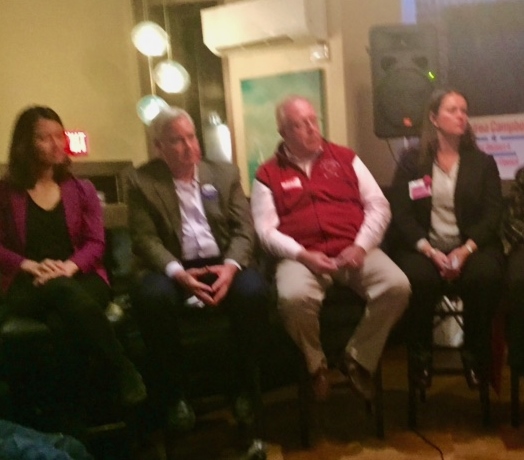
^ Governor Baker testifying in support of his legislation to allow 12 new charter schools annually in underperforming school districts

—- —- —- —-

Yesterday will be marked as the day that charter school cap lift legislation died, leaving next year’s ballot initiative as the only recourse.

I say this despite the superb organizing and passionate appeal made by Governor Baker and his team in preparation for the day’s hearing before the Education Committee chaired by State Representative Alice Peisch.

Baker’s legislation will die because it does not have Mayor Walsh’s support. Walsh wants a charter school cap lift, but at a different pace than Baker calls for, and with a very high price attached : $ 55 million in compensation money for Boston’s school department budget. That’s not happening, any more than Walsh is getting millions from Everett casino operator Steve Wynn.

Walsh’s cross purposing Baker’s charter cap initiative allows the Mayor to have it both ways. He seems to support the charter school movement and its many Boston supporters — with fine words : “I support a charter cap lift,” said he at the hearing — but in fact his fine words assure that there will be no charter cap law enacted, thereby allowing him to satisfy, if not thrill, the Boston Teachers Union (BTU) and its dogged anti-charter school agenda. BTU President Richard Stutman sat in the audience and smiled. i saw him there smiling.

Walsh’s decision to give lip service to charters but the prize to charter opponents puts the entire burden on next year’s ballot initiative. Will it pass ? It well might. The organizing group Great Schools Massachusetts is developing a serious ground game for it. My guess is that Walsh will be Ok with a successful referendum. He’ll get some charter school cap lift — which he has always wanted — yet the blame, from Boston’s very vocal anti-charter forces, will fall on Baker, not on Walsh, as he faces re-election.

Such an outcome might even satisfy Governor Baker. His organizing will solidify his support among Boston’s many charter school supporters (though not from all ; see next paragraph) going into his own 2018 re-election fight. In particular, Baker is likely to gain a pretty effective ground game in Boston’s communities of color (COC), where charter school cap lift enthusiasm runs strong. COC charter advocates filled the auditorium at yesterday’;s hearing.

Curiously, Baker’s legislation was ignored by the charter advocacy group known as “DFER” — Democrats for Education Reform. Tweeting the hearing, DFER leaders did not even mention Baker’s presence. This seems par for the clumsy course, given DFER’s mishandled support of John Connolly in the 2013 Mayor election, followed with similar amateurism :when Walsh won, the group cravenly praised him as an education reformer. DFER also played a major role in the twitter troll defeat of Boston 2024’s Olympic Games bid so strongly backed by the Mayor whose education policy they now praise. Obviously DFER wants to make happy with the city’s heavily favored Mayor rather than oppose him further.

—- —-

Meanwhile, the owners of the Pilgrim Nuclear Plant yesterday announced that they will close it in mid-2019, if not sooner. Immediately this closure puts paid to nuclear power playing any role in Massachusetts’ energy future. It also makes natural gas supply paramount. This is not the outcome that most clean energy advocates want. Gas pipeline proposals have aroused ferocious opposition from the communities affected; I support some of that opposition.So what will hapepn ?

Governor Baker issued this statement right away : “Our Administration will work closely with Pilgrim’s leadership team and federal regulators to ensure that this decision is managed as safely as possible, and we will continue to work with ISO and the other New England Governors to ensure that Massachusetts and New England has the baseload capacity it needs to meet the electric generation needs of the region.

“Losing Pilgrim as a significant power generator not only poses a potential energy shortage, but also highlights the need for clean, reliable, affordable energy proposals which my administration has put forward through legislation to deliver affordable hydroelectricity and Class-I renewable resources.

“The closure of Pilgrim will be a significant loss of carbon-free electricity generation and will offset progress Massachusetts has made in achieving the 2020 greenhouse gas emission reduction goals, making it more challenging to hit these targets. I look forward to working with the legislature to make our proposal for clean, base-load generation law, as it represents a diversified and balanced approach that will be needed to achieve the commonwealth’s greenhouse gas goals.”

The tone of baker’s statement says it all. Energy policy for Massachusetts is now back to the drawing table — to square one, as our policy makers try to figure out how to make up for the major power loss facing a state already experiencing intolerable power supply shortages.

—- Mike Freedberg / Here and Sphere