1st Suffolk & Middlesex : Signs and Numbers

Lydia

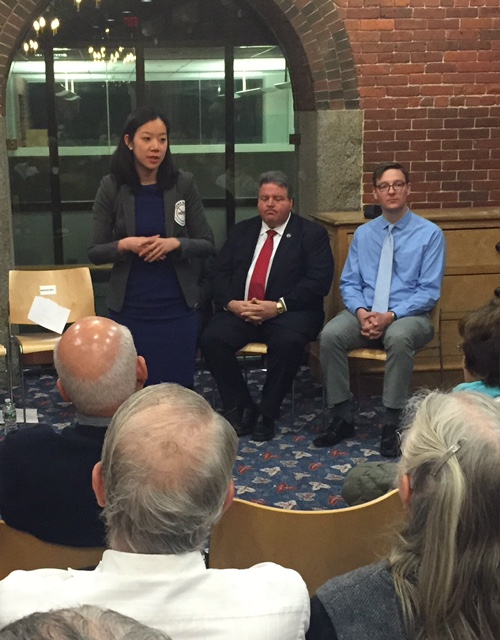
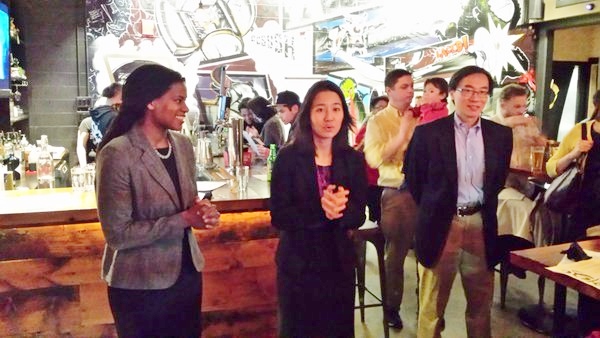
^ Senate candidate Lydia Edwards (l) with Councillor Michelle Wu, in Chinatown — in whose precincts 450 voters chose a Republican ballot on March 1st and are now potentially ineligible to vote in the Senate race

—- —- —-

With five weeks remaining, our District’s contest to choose a new State Senator continues to be a battle of interest groups in which the concerns of ordinary voters – and of interest groups not intricately aligned with the Democratic Party — will likely play no part.

Every time I write about the shape of this race, I decry how it is playing out; and this article is no exception. The race among seven (7) people is a classic example of unrepresentative electing. How can any ONE of them fail to NOT SPEAK for most of those who vote in it, much less all the voters ? 4000 votes probably wins it. That’s about four (4) percent of all the voters in the District and, likely, about 20 percent of those who actually vote on April 12th.

In covering the race respectfully, I almost feel complicit in its manipulations. Yet one cannot only rant. There is a contest, and it has a shape. Here’s some numbers to give it a modicum of contour :

1.social media outreach. Each of the seven candidates has facebook page and a twitter account. As of an hour ago, here’s the number of followers for the seven:

Dan Rizzo : 2665 facebook “like,” 2102 twitter followers. Total : 4,767

Jay Livingstone : 867 facebook “likes,” 2,107 twitter followers. Total : 3,064

Steve Morabito : 1,274 facebook “likes,” 1,083 twitter followers. Total : 2,357

Diana Hwang : 939 facebook “likes,” 596 twitter “followers.” Total : 1,535

Lydia Edwards : 1,212 facebook “likes,” 212 twitter followers. Total : 1,424

Joe Boncore : 1,176 facebook “likes,” 55 twitter followers. Total : 1,231

Paul Rogers : 235 facebook “likes,” 170 twitter followers. Total : 405

Social media is not everything. Lawn and balcony signs are also going up all over the district. Unfortunately, my axiom here almost always holds true : “the candidate with the most house signs loses.” Who has the most house signs ? My daily perusal of the District says Boncore 1st, Rizzo 2nd, Livingstone 3rd, Hwang 4th, Morabito 5th. I have seen few Edwards signs and only one for Paul Rogers.

Events also matter — meet and greets and headquarters openings. All of the candidates have had these. Boncore probably the most, then Livingstone, then Hwang, then Rizzo, then Edwards and Morabito. Rogers entered the campaign late but is beginning to join the event cycle.

All the candidates have gained interest-group endorsements. Whether these will generate actual votes is hard to say. In last year’s East Boston state representative race, interest groups fared poorly. I suspect the same will be true this time. Interest groups are good, in this sort of contest, only for donations and lawn sign housekeeping.

Oddly enough, I see scant sign of campaign “consultants” on anyone’s behalf. What role could a “consultant” play, in any case ? Identify your voters, keep them,  get them to the polls. Speak smartly at Forums. Remember to say “thank you” to those who attend your events or volunteer for the campaign. What else is there to do ?

There’s one additional numbers factor that I doubt anyone in this contest has thought of. At the March 1, 2016 presidential primary, 1,561 voters in the Boston part of the District cast votes for Trump, taking a Republican ballot to do so. In Revere, 2,280 voters cast a ballot for Trump. In Winthrop, 1,167. That’s a total of 5,008 Trump votes. If trump statistics hold true here as they do elsewhere, two-thirds of those votes came from voters who are not registered Republicans. So my question is, how many of the 5,008 did not remember to sign a registration-switch card, after voting, and now are ineligible to v0te in the Senate race ?

Add to that a big part of the 3,500 other ballots that chose the GOP primary and you’re talking a lot of voters potentially disfranchised from choosing a state Senator. The special interest groups, of course, just love that !

The Revere number should especially worry Dan Rizzo and Steve Morabito, but the Winthrop number (and East Boston’s 785 Trump ballots, should worry Joe Boncore. I doubt seriously if many Livingstone, Hwang, Edwards, or Rogers voters voted in the March 1st GOP primary, much less for Trump.

You may consider this observation nit-picking, but in a seven way primary in which not many voters will vote,as many as 5,008 voters, previously eligible but now ineligible, is no small thing.

Had one of the seven cared to entrust his or her candidacy to all the voters, by running as an independent for the May 10th actual election, we wouldn’t have this tripped-up situation. But we do have it now. And you are asking why I dislike this entire contest ?

—- Mike Freedberg / Here and Sphere


KEIKO ORRALL, THE #MAGOP, AND LOYALTY

keiko

^ State Representative Keiko Orrall at the State House

—- —- —-

The battle to remake Massachusetts’s Republican organization has become a fire fight. On facebook you see it — you almost feel it — as insults are thrown and people quickly block each other. All in pursuit of who will be the party’s next National Committee-woman.

I presume that you, dear reader, care who Massachusetts’s GOP National Committee-woman is. I can easily understand if you don’t even know what a national committee-woman does. As I’ve written before : you should care. The party’s national committee-woman (and her counterpart, the national committee-man) take a lead role in crafting the party’s issues platform and in recruiting candidates. Thus the job has significant public policy consequences for all of us.

Which is why Governor Baker has made this fight and why he will see that it is won by the candidate whom he wants.  That candidate is State Representative Keiko Orrall, of the 12th Bristol District, challenging the current office holder, Chanel Prunier of Shrewsbury, a political operative for an anti-LGBT advocacy group.

Yesterday one of Prunier’s key supporters made the contest one of “loyalty.” Orrall, he said, had been supported by Prunier when she, Orrall, first sought election to the legislature. “So much for loyalty,” he argued.

OK, then : if this contest is to be about loyalty, let us talk about the loyalties of his own candidate. I ask the following questions  :

1.Is Prunier’s first loyalty to the Massachusetts Republican party or to the special interest group that pays her a consulting fee ? Certainly the party’s national committee-woman should owe first loyalty to the party, true ?

2.Was Prunier showing first loyalty to the Republican Party when she took the lead in crafting a party platform with social issue provisions in line with those of the advocacy group that pays her ? Provisions that almost derailed Charlie Baker’s candidacy because the overwhelming majority of voters reject that platform ?

3.Has Prunier given first loyalty to the Republican party when she scans the mailing list of her advocacy group to find and field primary opponents to the party’s best candidates, thereby forcing them to spend time and money to prevail in a low-vote primary rather than  campaign to all the voters ?

4.Was it loyalty to the Republican party, that Prunier and her allies on the state committee — many of them from the advocacy group that pays her — never lifted a finger to help a certain State Senate candidate opposed by them, who ended up losing a very winnable Senate seat by 398 votes ?

5.Was it loyalty to the Republican party that Prunier refused to endorse Baker for election or that another group she takes a leadership role in actively opposed his candidacy all the way to Election Day and still opposes him ?

6.And how was it “loyalty to the Republican party” that, during a special election for State Representative in the very District that Prunier lives in — won narrowly by Hannah Kane, the GOP candidate –she gave Kane not the slightest speck of assistance ?

You be the judge.

The Prunier supporter who asked that “loyalty” decide this choice will probably respond, “yes, but Mike : you support all those scandalous social issue views that Prunier does not; so of course you oppose her.”

To which I say : “yes indeed, I do support all those scandalous social issue positions that Prunier is paid to oppose. But guess what ? Keiko Orrall does not support them either, yet I support her. You know why ?

“I support Keiko Orrall because she will be loyal to the party as a whole, will be loyal to our Governor, who is after all, our leader and holds the most powerful office in our state; because the goal of our party is not to advance the interests of this or that paid advocacy group but the interests of all the state’s voters.

It is indeed a question of loyalty.

—- Mike Freedberg / Here and Sphere
 

STUDENT WALKOUTS AND POLITICAL WAR

bps

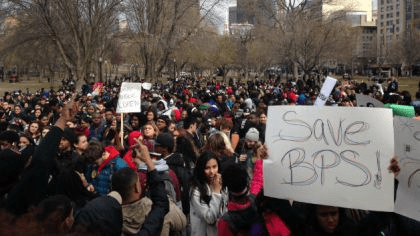
^ 2000 Boston public school students fight for the continuation of a misrepresented yesterday

—- —- —-

You may have seen or even taken part in the recent “walkout” by about 2500 Boston Public School (BPS) students and their producers. Certainly they wanted you to see them. They succeeded.

The question I ask is, why this job action ? The stated purpose was to protest “$ 50 million in school budget cuts.” This was a falsehood. The 2017 Boston Public School budget has NOT been cut. It has been RAISED, by about 1.7 percent. BPS is the ONLY Boston city department receiving an budget increase.

What the much decried $ 50 million is, is a shortfall. Boston’s 2017 schools budget falls short, by that amount, of full funding current expenses.

You can link to the Superintendent’s January budget memorandum here : http://www.bostonpublicschools.org/cms/lib07/MA01906464/Centricity/Domain/4/Familybudgetletter.pdf

It is not surprising that the BPS establishment does not liked receiving 50 million fewer dollars than it deems necessary. It is probably not surprising that, by way of complaining against the shortfall, said establishment would shout a falsehood.

Falsehood has become the M/O of establishments defending indefensible vested interests.

IF you recall a few years ago, Democrats in Congress responded to a decrease in the GROWTH of entitlement budgets by calling that decrease in growth rate a “cut.” It was, of course, no such thing : but the Democrats had no scruples about misleading voters in  search of their agenda. Similarly, in 2014’s 6th District Congressional election, a group supporting Seth Moulton accused his opponent of “voting against veterans”: because said person voted against an entire budget proposal that happened to contain one item about veterans.

Given this history of politics by falsity, it was probably to be expected that the BPS establishment should turn to falsehood — knowing falsehood — and the intentional misleading of students and parents, in hopes of bogarding the 50 million dollars it asserts is needed to balance the 2017 BPS budget.

Well, then, three questions arise :

1.IS the 50 million actually needed ?

2.If it is needed, why did Mayor Walsh decide not to allocate it, knowing that a feral opposition would arise, as it did to his plan to bring the 2024 Olympics Games to Boston ?

3.If Walsh knew the outcome of his shortfall allocation, why did he do it anyway, given that next year is his re-election year?

I have written about this topic already. You may want to revisit that article : https://hereandsphere.com/2016/01/16/boston-school-budget-2017-unanswered-questions/

There, I asked why the Mayor decided to not allocate 50 million dollars given that city revenue is growing faster than the schools budget. I opined that his decision was part of a long term plan to remake Boston’s schools by forcing school administrators to make tough decisions : consolidation of under-utilized facilities; eliminating wasteful anomalies in the teacher’s union contract; outsourcing much school management to corporate partners. In that same article, I supported all such purposes, but I decried that the Mayor did not make his intentions known to Boston voters

Much of last week’s “walkout” drama could have been avoided had the Mayor taken the gamble of letting his long game be known. But politicians rarely do that. Making your long game known allows the opposition to organize against it at length. So it becomes a question of, how can I, the Mayor, get to where i am going with the less political damage ? By disclosing my full game or by taking it one step at a time ?

So much for Question 3. What about Question 1 : is the 50 million “shortfall” actually needed ? Answer : it is needed, if you do not change the way BPS is administered and staffed. ( 1 ) Under-utilized buildings require maintenance — the custodians’ union is just as powerful as the Teacher’s union — and utilities. It is inexcusable to expend BPS money on inefficiency and things unnecessary, when classroom equipment, books, laptops, and librarians can’t be paid for ( 2 ) paying about 300 teachers who do not teach because no school principal will accept them costs about $ 24 million of the 50 million “shortfall.” Why are they not laid off ? ( 3 ) there is duplication in BPS management. We have a Superintendent and his staff, and we have, at City hall, an Education Chief and his staff, a chief who seems equally responsible for the direction of BPS if not more so than the actual Superintendent. Why do we have such duplication ? (It does not help matters that said Education Chief is also a partisan political activist, a member of the Ward 18 Democratic Committee. Why is an administrative official permitted to engage in partisan politics ?

In short, my answer to Question 1 is that the 50 million dollars being argued about are not needed except because of situations no one has the guts to reform. In this regard, it doesn’t help that BPS has a new Superintendent, Tommy Chang : a well-meaning and personable man with zero constituency of his own and zero abiility to marshal one. How missed is John McDonough ! “Big Jawn,’ as a lifetime BPS employee and Boston native, had an enormous constituency and was reforming every part of school management, inexorably and doggedly and was bale to do so without arousing “walkouts” and self-serving drama. Chang has none of McDonough’s power, nor has he shown McDonough’s shrewdness. He looks like a PR hire and has been rendered barely tourist status by Mayor Walsh appointing an Education Chief — Rahn Dorsey –who has the clout that Chang does not have and will likely never be accorded.

So much for Questions 2 and 3. What now will happen with BPS budgeting ? My guess is that the Mayor is setting the table both for his re-election and the next teachers’ union negotiation.His school budget opponents have actually aided his plan, by assuring that school budget matters will be front and center in the 2017 Mayor campaign. Here all advantage will lie with the Mayor, because most voters are taxpayers, and most taxpayers do not want to pay for inefficiency and anomaly; nor do they care much for outmoded school facilities and an in explicable charter school reimbursement formula. The Mayor actually set forth his campaign argument, as reported in the following article published yesterday : https://news.wgbh.org/2016/03/08/politics-government/walsh-bigwigs-dont-believe-negative-boston-public-schools-hype

If Mayor Walsh intends to make his re-election a referendum on education reform in the City, he puts himself on the same path as Governor Baker, whose entire identity is reform of government services, their administration and their finance. That, to me, is a very good path for Walsh to walk. But to walk it to victory, he will need to convince voters that he is a master administrator with a clear standard for assessing administrative success. Governor baker has done so for almost two years now. It’s his identity. Walsh had better start working on his reformer persona right now — the internal, City hall reforms are already well in place, by the way — if he hopes to conquer the many beasts of fact or logic that tangle the city’s biggest public service problem.

—- Mike Freedberg / Here and Sphere


END GAME

FullSizeRender

^ Baker’s choice : State Representative Keiko Orrall of Lakeville

—- —- —-

Governor Baker had a fairly good day on March 1st. In the GOP primary, his battle to take firm control of the party’s State Committee succeeded — not completely, but sufficiently enough. He now counts on about 49 to 50 of the committee’s 80 members, to write a useful platform and to do one major piece of unfinished business : electing a new GOP National Committee-woman.

Before I discuss this fight — the end game — I ought to tell you what a GOP National Committee-woman does and why she is important:

1.the national Republican party is governed by a committee, just as is the Massachusetts GOP. Each state has two seats on that committee, a man and a woman. Their role is to raise funds for national campaigns; to write a national party platform; and to see that in their state, well-qualified candidates are found and guided for seats in Congress and the United States Senate. In addition, the two national committee members are ex-officio members of the state committee.

2.It’s an important position in the hands of a person with the commitment and the connections to do it effectively.

3.Until 2012, Massachusetts’s national committeewoman was Jody Dow, of Brookline (disclosure : I worked for Dow for many years and in many campaigns and we are still personal friends), a woman of means who was also GOP state committee-woman for Brookline and Newton, two of our state’s most politically powerful communities. There, Dow was well respected and completely in tune with the political sentiments of both municipalities. After almost thirty years of party activism, Dow decided not to run again.

4.In her place was elected one Chanel Prunier, from central Massachusetts, age 33, and of an entirely different political cast. Prunier is probably the most powerful activist in social conservative circles, with connections to anti-gay rights money and cadres. In her position as a paid operative for Massachusetts Family Institute (MFI), perhaps our state’s most potent opponent of marriage equality, women’s reproductive rights, and transgender civil rights, Prunier has access to its list of activists, which she has used to recruit and field candidates committed to the MFI agenda.

Prunier is worshipped by her supporters, a network that extends through most of the state outside the immediate Boston area. She is a tireless operative when she wants to be — a fellow warrior — and a daunting opponent; only a sitting Governor, probably, has the power to defeat her.

She has had notable success recruiting such candidates and occasional success getting them elected to the legislature. But her most significant political success, until March 1st, was to recruit candidates for our GOP state committee seats — and to see many elected — from which place the Prunier group enacted, in 2014, a party platform incorporating MFI’s agenda. This platform was given wide news coverage and seriously embarrassed Charlie Baker, whose campaign supported every right the MFI opposes.

The Prunier-dominated state committee also raised primary opponents — many of them nuisance candidates merely — to GOP legislative hopefuls who support those rights, thereby diverting candidate energy to the mere 11 percent of voters who are Republican and in one case, probably costing the party a State Senate seat (lost by 398 votes).

She also draws upon a group called “the Massachusetts Republican Assembly” (MARA), which espouses extreme right wing positions — often voiced as venomously as the Trump campaign — entirely at odds with 70 to 80 percent of Massachusetts voters. MARA has no connection whatsoever with the Republican party whose name it uses but diverted many Governor votes in the 2014 campaign to one Scott Lively. These were votes that Baker could well have used; his victory margin was less than two percent out of 2,100,000 voters cast.

Prunier’s defenders say that she has built “the grassroots” of our state’s GOP. Is it a plus to have built up opponents to the Governor, or is it a minus ? is it a plus, or a minus, to give our GOP an identity loathed by most of our voters ?

The Prunier people often talk of downsizing Massachusetts government, as if its size were the issue rather than its effectiveness. Do they realize that, if Massachusetts government were small, we would never elect GOP Governors, given that the GOP counts only 11 percent of our state’s voters ? That we elect GOP governors because the voters want a non-Democrat to keep an independent eye on a VERY LARGE state budget ?

Given Prunier’s record, as much opponent of the GOP as leader of it, and radical rather than feasible, it is no wonder that many, many Massachusetts GOP activists, including legislators, have had enough. Is it too much to say that the entire purpose of Baker’s effort to win control of the state committee was to replace Chanel Prunier ? Is it any surprise that that effort has commanded the commitment of the vast majority of our GOP leadership ?

The only problem was to agree upon a candidate. Many names were circulated; I had my own favorite. In the end, so my sources tell me, Baker himself picked the challenger : State Representative Keiko Orrall of Lakeville in Plymouth County.

No sooner had the word come late yesterday than I was informed that Orrall already had the necessary 41 votes in hand. If so, the end game is won.

All of this happened very, very quickly, and no word of it leaked, at least not to me. It was done very, very quietly — which I suppose is how it has to be done. But Prunier cannot have had any illusions that she would avoid a challenge. She cannot complain now that one has deployed itself so formidably.

Why, you may ask, does any of this inside the party kerfuffle matter to the average voter ? It matters a lot, because the platform of a party says a lot about what its activists hope to enact into laws that govern us all. We cannot have a party whose dominant activist owes first loyalty to a pressure group and not to the party she professes to lead. Especially not if the pressure group she owes first loyalty to opposes rights passionately supported by the vast majority of our state’s voters. To take that course is to ensure defeat. To stick to that course is to ensure dissension : because most Republican candidates want to win voters’ votes, not fend them off.

I know Keiko Orrall somewhat. She is no liberal; she and I disagree on many, many issues. But her first loyalty is to the state GOP, not to a pressure group. She also understands that Governor Baker is to be applauded — not criticized —  for his outreach, his tolerance, his reforms and innovations. Whatever Orrall’s views on social issues, she understands, and accepts, that people in our state prefer inclusion to division, tolerance to condemnation, of people for who they are.

On April 5th, the state committee meets to elect its national committee members. The game ends there and then.

—- Mike Freedberg / Here and Sphere
 

OPEN LETTER FROM ANNA PANZA-DICENSO OF RINO’S PLACE

045 - Rino's
We at Here and Sphere are angry at the imposition the City plans to placer upon parking in gthe Eagle Hill neighborhood of East Boston.

To that end, we are glad to reprint the following facebook post by Anna Panza-Dicenso, owner of the fabled neighborhood restaurant Rino’s Place.

Anna Panzini-Dicenso

Ok here goes! I’m about to open up a can of worms…..

Hello EBOD, as you see my name is Anna! My husband Tony and I are the owners of Rino’s Place. We have been in business for nearly 30 years. We have never once had an issue with our liquor license, we have done nothing but good for East Boston. We have donated many of dollars, gift cards to the locals school and organizations, I have donated plenty of food to our local Church, to the Meridian House. We even feed the homeless who come to us when they are hungry.

The reason for my post and this is strictly being written to the Eagle Hill Association, and any one
Involved in moving forward with this resident permit parking that is taking affect starting in April. I would like to know who started this, I would like to know when & where were these meetings taking place, I would to know who voted, I would like to know who approved it, I would like to know if every person who lives in the area considered “Eagle Hill” were notified, I would like to know why wasn’t my business as well as others notified?? Yes, I would like to know a lot of things.

This came to my attention as I was reading it here on Facebook.

As I stated I own a business. My husband and I don’t live in East Boston, nor does most of my employees. My business is how I feed my children, and how I clothe them. My business is how I pay my mortgage.

With that being said I would like to know where my husband is going to park, I would like to know where my employees are gonna park, I would like to know where are my customers gonna park?? Yes, those are more things I would like to know!

What is the purpose of this? I have made numerous calls and yes it was all in good faith. I was told that hurting small business was not their intent. I was told that there will be at least 2 parking spots on each corner of each street at my intersection that would be a “2 hour visitors parking spot”, the funny thing is, is that any person with a resident permit could park there!! Well that defeats the purpose.

I have spoke to many of people who live in the Eagle Hill area who was not even aware of this going into affect!!

So tell me what are you people looking for? Do you think when you arrive home from work you’ll have a spot waiting for you, do you think it will save your spot after a snow storm? No, that’s right you assume it’s gonna keep people from parking on Meridian Street and walking home to Chelsea, and you think it’s gonna stop people from parking 2-3 weeks at a time and going to the airport for vacation!!! Yup, that’s what I was told. Strange ha?? That’s what I was told was happening up on good old Eagle Hill.

It won’t be nice when I come down to visit my mother that I can only stay a short time, or on a holiday when all your guest need to keep moving their cars every 2 hours….because a handful oh Eagle Hill residents said they had too!

What a joke. I was born and raised in East Boston and I have every right to speak my mind! I, as well as many others are very upset over this. I am ready to move forward with any measure that may need to be addressed concerning this.

I know I’m gonna get a lot of negative feed back from this post, and it’s ok! Like I said I’m ready for it.

Anna DiCenso

TOUGH MEDICINE AT THE “T”

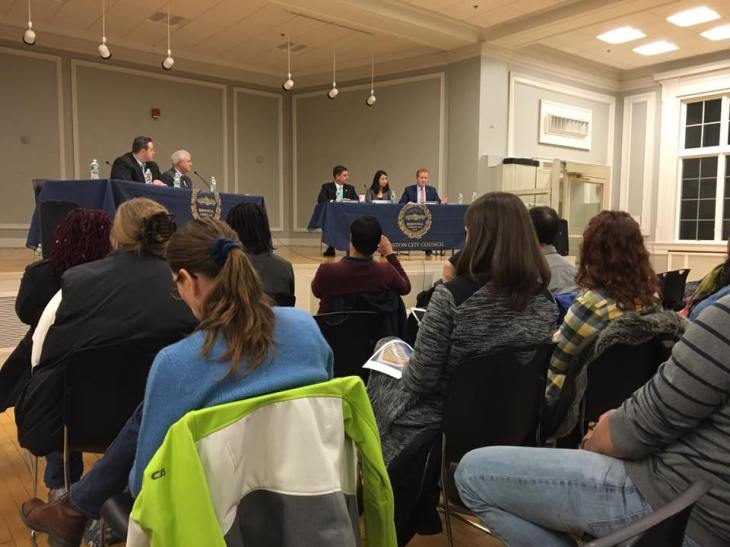
T hearing

^ Boston City Council hearing on proposed MBTA fare increase. (photo via Tim McCarthy from Christina DiLisio)

—- —- —- —-

Both Mayor Walsh and Governor Baker — he via his MBTA Fiscal Control Board — now call for raising rider fares. It’s tough medicine. The expected increase of ten percent brings a T ride to $ 2.31, a bus trip from Salem to Haymarket to $ 4.95, a round trip commuter rail ticket from $ 4.20 to $ 4.65. Over a month’s commuting, a ten percent increase costs each rider about $ 7.50 additional — $ 90 for a full year.

(Read Mayor Walsh’s argument in favor of fare hikes here : http://commonwealthmagazine.org/transportation/walsh-backs-mbta-fare-hike/ )

I suppose that an additional $ 90 isn’t a hard hit given the 60 percent DECREASE in the price of gasoline since last winter. But what if gasoline prices were to rise back up again ? The prospect worries me. I suspect it worries you.

That said, I support the fare rise, on one condition : that gt serviced NOT bed cut back. It is very unwise for T management to ask riders to pay more, yet at the same time eliminate late night service. It is worse than unwise. It insults. Pay more for less is about as bad a vibe as there is in the world of customer service.

Provided, however, that T service is not cut back — is actually expanded, as the T completes its committed Green Line extension to West Medford — the fare rise makes sense. Even after system-wide cost reforms that have saved about $ 100 million this year the T’s operation runs a deficit of about $ 84 million. (By deficit, I do not mean “loss.” The t is not a business and does not seek a profit. Shortfall from the T’s fare and tax revenues is what it faces.)

The MBTA is a public service paid for by taxpayers, riders, and pay-ins by municipalities that the T serves. All have a stake in kno0wing that their paid money will satisfy T operations; that the T will not, by mismanagement, or sloppy accounting, or by inside manipulations,. fall short of budget seeki8ng more funds than we all have committed to. The T cannot be a prodigal son wasting his allowance and begging Daddy for more. It must live within its allowance. If it doesn’t, are we not right to say “no more” ?

“No more”: is what the voters of our state have said. we have been heard, and today’s T is managed completely differently from yesterday’s. Cost sloppiness has been fixed. Inside scams have been exposed and will be ended. Unused T assets are being used. Disciplined accountability is in place and will likely stay in place for quite a while. Today, we the public can probably trust the T to do its job diligently.

If that is true, and I think it is, we can now grant the T additional revenue. A fare increase won’t solve the T’s massive “state of good repair” backlog, but it might very well do away with budget shorts. As long as the proposed fare increase treats every rider, and every route, equitably — I read that this basic fairness is not being applied — then let us do it.

—- Mike Freedberg / Here and Sphere

1st Suffolk and Middlesex : Punting at A One-Issue Candidate Forum

FullSizeRender

^ surrendering to an ambush : Diana Hwang, with Dan Rizzo and Paul Rogers alongside.

—- —- —-

We all know how single-issue pressure groups have carved up our politics into tapas-sized bites of this and that. But until last night, I had never seen a one-issue candidates Forum. Now I have.

At the Pilot House on the North End Waterfront, about 75 people showed up to hear five of our District’s seven candidates (Steve Morabito and Lydia Edwards did not attend) promise to oppose the building of a luxury hotel on Lewis Wharf. A few other matters were mentioned during the Forum — waterfront flood control chiefest — but the 75 attendees only wanted that one pledge : no hotel on Lewis Wharf. “Yes or no,” as one questioner demanded.

( for those who want to know more about the Lewis Wharf development, which I fully support, click this link : https://www.bostonglobe.com/business/2015/06/05/boston-developer-proposes-room-hotel-north-end-lewis-wharf/GrWVrfyCwNwA7n23agGuBL/story.html )

All five candidates acceded to the demand — some more craven than others. Paul Rogers and Diana Hwang — even former Revere mayor Dan Rizzo, who knows better — support the idea that “the community” should decide what is built and where. In other words, the private owner of land has no right to do as he wishes — within zoning laws, yes — with his won property, into which he or she has invested his or her own capital, and upon the development of which he or she is risking that capital.

In other words, socialism. Community ownership.

And who, pray tell, is “the community” ? I doubt that it includes the restaurants that would benefit from several hundred new hotel guests to draw from. I doubt it includes Uber drivers, taxis, bellhops, hotel staff, and construction workers, all of whom would benefit from the hotel and many of whom live in the neighborhood.

(And what of state, legislative issues ? Not one word was offered. All talk was of city issues, as if the candidates were running for District Councillor.

Folks : we are electing a State Senator to do legislative work on B eacon Hill. We are NOT electing a City Counciollor !)

Candidates Joe Boncore and Jay Livingstone seemed to recognize that many interests are involved in new buildings. Though both agreed that “the community” should have input, each was reluctant to just say yes to the audience’s demand.

After the Forum, I spoke with a few friends who were present. They agreed with my view. Too bad not one of the candidates had the stones to say, when asked, “no, I cannot make that pledge. New construction is  big boon to many people in the city and the neighborhood, and there must be a way to approve it.”

But this is what happens when you elect a State Senator in a seven-way party primary with maybe 15 percent of all voters voting. We of the 1st Suffolk and Middlesex are reaping the shabby detritus of a campaign proceeding along the wrong route in the wrong jalopy.

— Mike Freedberg / Here and Sphere


GOVERNOR BAKER AND THE STATE COMMITTEE FIGHT : ANALYSIS

Vincze

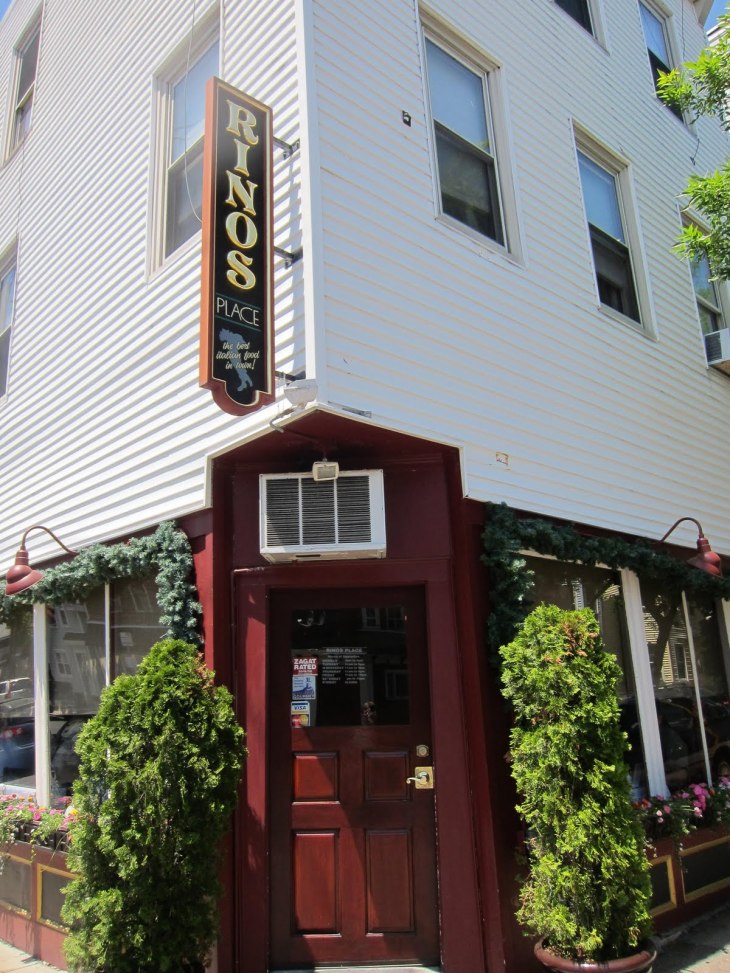
^ Janet Mahon Vincze : a superb candidate who almost overcame two big campaign disadvantages. Read my analysis below.

—- —- —-

Yesterday I posted my first look at the big fight that Governor baker undertook, to obtain control of the Massachusetts Republicans state committee: a fight that he appeared to have won, but not as decisively as he should have. A Governor as popular as Baker should sweep through his own party’s executive committee. So why didn’t he ?

Before I answer that question, I want to repeat what I opined yesterday : that the Republican party’s state committee writes the party’s platform and so generates public policy consequences for all of us, no matter what our political enrollment. If this level of “inside game” interests you — I hope it does — please read on, as I itemize the reaons why his campaign fell short of the totality it sought.

1.Baker has only been Governor for 14 months. A campaign as difficult as this one takes a lot longer than 14 months to prepare. During most of those months, Baker has faced one state administrative challenge after another; he has hardly had time or space to think through the obstacles to a successful state committee take-over.

2.Recruiting candidates who could win — defeating committee people already in office — was a challenge that Baker barely met. In too many cases, he recruited people scarcely known, or not known at all except to his core team, to face an incumbent well known to the party activists : and it is party activists who care most about a purely party office like state committee.

3.Many of Baker’s candidates work for his administration. They were open to attack as a “hackarama,” and were thus attacked by the hucksters of talk radio, who, in this anti-government year, rendered Baker’s employee candidates unclean. Smart it was, of Baker’s opponents, to “pledge” not to take a job in his administration (as if he would ever offer one to them) knowing that thereby they risked nothing and gained plenty.

4.More than half the voters in the Republican primary at which the party’s state committee was elected were “independents,” not actual Republicans. Baker’s team could campaign to the Republicans; but which of the state’s 2,500,000 independent voters could his people campaign to ? There was no way at all of knowing which of them would take a Republican ballot.

5.Given that more than half the actual GOP electorate was, in many committee districts, not actual GOP voters, it was especially important to recruit “known” names — preferably current office holders or recent candidates for State Senate — and from major towns or cities : because for many voters, a ballot for as invisible office as state committee  the candidate’s home town wins the math. Unfortunately, too many baker candidates were not “known” names; and many came from small communities, putting them at a big disadvantage.

6.Many Baker candidates did not grasp the paradoxical challenge of an office insignificant to the public but elected from an entire State Senate District. The race has to be run as if the candidate is running for State Senator itself – all the “independents” need to be campaigned to — and so voter ID, GOTV, mailings, advertising, and phone banking must all be done. Yet at the same time, special effort must be taken with the district’s GOP activists, who are few in number and usually quite unrepresentative of the vote as a whole. In a Senate District there might be 500 GOP town or city committee members. The endorsement of each really matters to a state committee election. A state committee candidate should think of these 500 or so activists the way a major office candidate thinks of donors : you must call each one, often, until they either say yes or no. That takes time away from campaigning to the 7500 to 25,000 voters who will cast actual ballots; and given the oddity of most GOP activists’ political views — not to mention their disconnect from the electorate at large — the time spent romancing them can work against the wider campaign.

7.Baker was not honest about why he was taking on this challenge. His campaign theme was “elect a team who will all work together for reform.” Great — but he never spelled out why those he sought to beat were not “working together” for said reforms. It was duck soup for his opponents to say that they were the “real reformers,” or to pledge fealty to politics treasured by most GOP voters :” the Second Amendment” and all the “social issues.” Bringing in the Second Amendment was genius. It bolstered the opposition’s claim that in addition to being the “real reformers,” they were also the “liberty” team. Given the blandness of the Baker theme, the opposition looked to many voters as if they, not Baker, were the actual party builders. Of course everybody involved knew that Baker undertook this effort for very ideological reasons : removing committee people responsible for writing the party’s right wing, 2014 platform that embarrassed Baker’s election. Baker should have asked voters to stand with him on the issues that he espouses. He chose not to.

Nonetheless, Baker did manage to elect a majority of stated committee members. Of his 52 candidates, 29 or 30 won, 22 lost. It should have been much more decisive. I’ll look at three races that should not have been lost :

Janet Mahon Vincze. Vincze faced two huge disadvantages. First, she hails from a small Middlesex County town, North Reading, in a very large District almost all of which is in Essex County. Second, her opponent, Angela Quinn Hudak, is the wife of the man who in 2010 ran for Congress in every town in the District and thus was a very well known name. Vincze was a superb candidate (disclosure ; she is a treasured friend of mine) who listened to me when I told her of the obstacles she faced. She campaigned tirelessly and drew enormous activist support and almost won, losing by 372 votes out of 21,000 cast. This was a superb result; but could not Baker find a fine candidate from the Essex County core, and one who had run for office before and had a name well recognized ? Vincze has a big future in state politics if she wants it; but this was the wrong race to send her into.

Ed McGrath should never have come even close to losing his state committee seat (based in Framingham, and Ashland) to the opponent who beat him, a man from a small town, where Framimngham cast over 4000 GOP votes; an opponent loathed in party circles and whose negative campaign lived up to that loathing. But McGrath’s goose was cooked when he was appointed to high office on a state administrative board and was thus nailed in the “hackarama” attack wielded by right wing talk radio; and he faced, in Marty Lamb, an opponent tireless in his efforts and not shy about decrying him as such.

David D’Arcangelo , a Malden City Councillor and state committee challenger, suffered the same fate as McGrath, at the hands of an opponent whose campaign literature boasted how he would not accept a job in the administration and how he was the “real. reformer” who would be “responsible only to the District’s Republican voters.” No matter that it is vital for GOP activists to accept jobs working for our GOP Governor — if not us, then who ? Robert Aufiero never had to answer that question, because the Baker campaign never explained why working in his administration is a plus for a GOP activist, not a detriment. It was also false of Aufiero to define his responsibility as being only to GOP voters. A state committee member owes a duty to ALL the voters, to recruit great candidates and give them a platform to run on that they can win with., But Aufiero was never called  out.

That was the bad news. There is also good news :

Where big names were recruited, and “hackarama” could not be pinned on them; where they came from significantly sized communities; and where they understo0od the dimensions, large and tiny, of a state committee race, Baker’s candidates mostly were elected. He now owns a clear majority of the committee membership and can rewrite the bad platform — and elect a new national committeewoman, one who is not a paid employee of a group that rejects marriage equality, opposes women’s reproductive rights, and denies the existence of transgender people.

—- Mike Freedberg / Here and Sphere

.


CAN THE MASSACHUSETTS GOP STATE COMMITTEE BE MADE IMPORTANT ?

valanzola

^ victory at least in part : Reed Hillman, who defeated one of Governor Baker’s worst state committee opponents, and committee newcomer Lindsay Valanzola

—- —- —-

This noon, with full results still not communicated, it appears that Governor Baker has won a clear majority of the 80-member Republican state committee, the body that runs the GOP in our state and also writes its platform. I shall analyze the results later and also the campaign that Baker and his political generals deployed. But before I do that, I want to ask basic questions : is the state committee at all important ? If not, can it be made important ? If so, how ?

Certainly Baker thinks the GOP state committee important, or he would not have committed $ 400,000 (the figure I’ve been told) and months of his time to winning a majority of it. Yet doubts linger. As only eleven (11) percent of Massachusetts voters are registered Republicans, even all of them aren’t crucial to elections. How can their committee be any more so ?

State committee members are elected by Senate District. Republicans hold five, maybe six, of the State’s 40 Senate seats. In many Senate districts, registered Republicans number about six per cent of all voters or fewer. Why should such a tiny number of voters get to set party policy ? Worse, in those Districts, where almost no voters are eligible to serve on the state committee — only party members can run — those who do end up winning, with maybe 1000 people casting GOP ballots (while 35,000 voters cast ballots in the Democratic primary) almost always tend to be thoroughly out of key. That is a recipe for defeat.

In one Boston Senate District, the last Republican to run, in a 2013 special election, was beaten ten (10) to one. As you might expect, he opposes marriage equality and women’s rights and is, so far as I know, silent on civil rights and racial justice. That, in a District where 50 percent of the voters are people of color.

Why should a state committee seat with a vote equal to all other committee members be accorded someone from a District with almost no Republicans, and where those who are Republicans espouse views toxic to the other 90 to 95 percent ?

Why should the Governor be forced to spend money and time seeking to win a state committee seat where his party has barely any presence at all — and where almost every activist, though registered Democrat, strongly supports him ? Indeed : how is the Governor to find a Republican in such a  District attuned enough to election victory, to seek a state committee seat held by a ten to one loser ?

I suggest that Chapter 55, our election law, be changed to create party state committees apportioned by number of Republicans per District, so that my District might have its two members, but a Senate seat in the Route 495 belt, with 10,000 registered Republicans, might have ten committee members. If the law can’t be changed, then the party should change its own rules. Because as things stand now, the GOP state committee, membership tilted so far to the out of step and so disproportional, gets to write a party platform.

It’s the 2014 party platform that the Governor rejects, and rightly so; a platform that almost derailed his election, and which contains several items, social and economic, that almost no voters in Massachusetts agree with : and which even a majority of Republican voters reject. It was that platform that moved him to challenge its members.

Make no mistake : it was an effort that he needed to do. A major party’s platform has public policy consequences. Even if the Governor ignores it — as he did — it is there, in the public’s mind, moving them to question his commitment to his own agenda. In fact, can there be any doubt that Baker would already have called for passage of the transgender public accommodations civil rights bill now held up in the House, had he not had to look over his shoulder at a state committee controlled by his opponents ?

Why should Massachusetts people have to wait to see their civil rights protected because a tiny party’s state committee opposes the Governor ? After all, baker is Governor of all the people, not merely of the 11 percent who register as Republicans. Numbers matter : in his narrow 2014 victory, Baker drew a full 78 percent of his votes from people who are NOT Republicans. 78 percent. Yet an entire group of Massachusetts residents must wait for civil rights because a portion of the other 22 percent of Baker’s vote elected an even tinier state committee that rejects these rights.

The example I cite is an extreme one, but it symbolizes what the Republican state committee is : an obstacle to forward reform, and to the Governor whose mission it is to see those reforms put firmly in place.

Given these facts, the campaign deployed by Baker’s team lacked force. Much of it looked ad hoc : candidates unknown to the voters, who had Baker’s endorsement but nothing else; candidates who failed to deliver their nomination papers properly made out, or with sufficient signatures; candidates unready for social media campaigning; and no answer to the clever — and obvious — opposition message.

Baker’s message was a bland one built of caution : he spoke of reform and of building a  team effort. In fact, everybody knew that the real reason for his campaign was the anti-marriage equality, pro-life, economically backward platform that embarrassed him in 2014 and which he wanted no part of for 2018. I say that everybody knew it, but Baker never said it. He never marshaled the huge support available to him on the issues, support that would have gone to the mat for him seeking a more forward, inclusive platform. Instead, all he was able to arouse, for a slate that included far too many Baker hires to state government, was “team loyalty”; and this was devastated by right wing talk show hucksters as a “hackarama” state employees.

Baker’s opposition borrowed his reform message, calling themselves “real reformers,” They pledged to never take a job in state government — which was easy, as Baker would certainly never hire any of them — and to be “responsible only to the District’s Republican voters.” That was clever. Of course it was also utterly wrong; a state committee person  owes a responsibility to all the District’s voters, to recruit great candidates and to listen to every one.  But given the insular, siege mentality of Republican voters who know themselves fatally outnumbered, the pledge sounded like Colonel Travis stating his readiness to die at the Alamo rather than surrender.

Dying for the cause has great appeal to vastly outnumbered Republicans. Given that mindset, it’s kind of a miracle that Team Baker appears to have won a majority of the 80 seats in a body which, despite his win, seems more Alamo than Victory.

I hope that Baker’s 2018 pre-election message will be much, much bolder, and more passionately progressive, than the state committee sideswipe he manged to get by with. Because the day is coming, and fast, given the disaster for the national GOP, when there will be no room even for a brilliant Governor like Baker, or for his party locally. I advised Scott Brown, after his 2010 victory, to run against the national party; said the same thing to Senate candidate Dan Winslow in 2013; and am saying it to Governor Baker now. Be an insurgent, for our people’s sake,m and we will follow you and rescue the GOP at least locally from its terrifying fatalisms.

—- Mike Freedberg / Here and Sphere
DEVOLUTION AND MASS SHOOTINGS

devolution

^ symbol of today’s US politics as a kind of mass shooting : Dylan Roof, the accused Charleston, South Carolina murderer

—- —- —- —-

With the rise of Trump, our American Constitution faces an existential crisis. For thye past seven years,m the Republican opposition in Congress has done everything in its power to keep the Federal government from operating. As a result, power has devolved to the 50 states, where one-party governments, of one sort or the other, have set up policies to their liking overwhelming the opposition.

I happen to approve the policies established by Democratic party majorities; they carry forward the progress promises enacted into national law 70 to 160 years ago. The opposition to them is so total that there no compromise is thinkable. The same, I admit, is true in states ruled by today’s version of the Republican party. Majorities there impose policies that cannot be compromised with.

We have become two nations, rendering the Federal government almost moot. It operates many many agencies but does so in what feels like a sleepwalk, their legitimacy rejected., their effectiveness vitiated by lack of funds. The Federal judiciary, too, has been stymied. No nomination to the Supreme Court will be entertained at all ? That is rebellion, but only half our people seem to care or realize.

Thus glued to a stop, the Federal government soldiers ahead on neutered auto-pilot, and half the nation doesn’t seem to mind one bit, because the states still retain all their power and are using it — for good or for evil.

Into this devolution walks Trump. He spits hate at everybody and every institution, uses the power of his mouth to destroy our democracy, and gets cheered by those who want it destroyed, who hate it, hate every office holder, hate their jobs, hate their unions, hate themselves even. It’s like a mass shooter who kills everything in sight, including his family who, not that long before, he had loved; and then shoots himself.

Little wonder that mass shooters now define America, distinguish it from all other ordered nations, define us as a people. Our politics is a mass shooting politics.

Once Trump has wreaked his destructions, on the mission voted him by his millions of destroyers, and there is no Federal government left to tear down or zap, and he himself stands at bay hated by the people who empowered him, the 50 states will still remain; and they will be the foundation upon which a new version of Constitutional America can be rebuilt. It will surely not be what we grew up with. It will be more devolutionary; in parts of it, civil rights and economic fairness will reign; in other parts, oppression and injustice. But it will be a nation, of sorts. I am not sure I want to live in it, but some people will find said halving as comfortable as the Abolitionists expected of an 1840-60 America from which the slaver states had seceded.

—- Mike Freedberg / Here and Sphere