EAST BOSTON : TRIUMPHS AND CHALLENGES

FullSizeRender

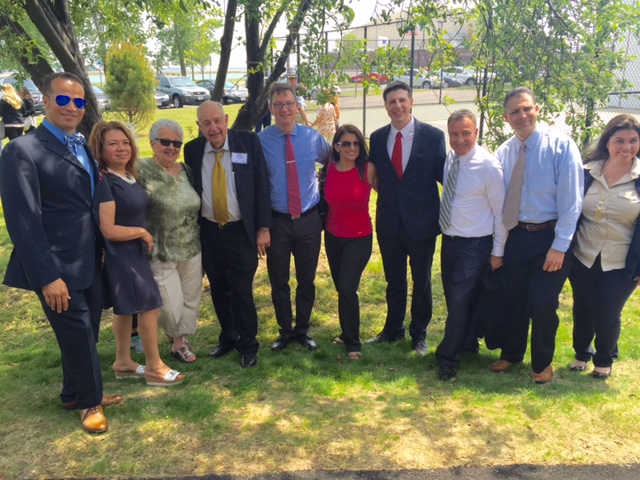
^ Establishment : East Boston leaders at the Greenway ribbon cutting : Alex Rhalimi , Cecelia Bardales, Mr and Mrs Buddy Mangini, Paul Rogers, Joanne Donatelli, State Representative Adrian Madaro, City Councillor Sal LaMattina, former State Senator Anthony Petrucelli, and Sheri Raftery

—- —- —-

Yesterday was a heady day in East Boston, the neighborhood that my Mom’s parents came to in about 1896. First was the 8th Annual Community Breakfast at the Salesians, who give so much to Eastie’s boys and girls; at least 400 people attended, including Lieutenant Governor Polito, Governor baker’s chief secretary Carlo Basile, and just about all of Eastie’s leaders, elected and otherwise. Then, at 12.45 pm, Mayor Walsh presided at ribbon cutting the extension, to Constitution Beach, of our “Greenway” walk and bike path. Again, many community leaders attended, including some who missed the earlier event. It was a day of activism and progress.

Ever since East Boston’s ship piers became destination for immigrants coming to Boston — starting in about 1840 — the neighborhood has boomed; but 1950 it housed over 40,000 people, and today it counts maybe a few more than that. But as people came, investment left; when my Aunt Elizabeth came back to Eastie for my Mom’s funeral in late 1969, she having decamped to a childless marriage in Cleveland, Ohio in 1926, she noted that every building she remembered was still there, even every business.  Not so today. Aunt Liz would scarcely recognize today’s Border Street, Lewis place, Peabody Park, Central Square, Wood Island. Or our people ! When Aunt Liz left, Eastie was Irish and Jewish, Italians just beginning to find their way over from across the harbor; today, 90 years later, Eastie has become overwhelmingly Latino and even somewhat Arabic, not to mention folks from other exotic origins. You can’t roam through Eastie’s heart without being tempted by restaurants of many cuisines or having your head turned by many languages.

This is the East Boston we read about in histories of immigrant Boston, a history which actually lives and, if precedent can predict, portends a brilliant future of innovation, enterprise, and community citizenship ahead for many decades. But…..

I say “but” because recent elections have almost passed East Boston by.

This April we participated in choosing a new State Senator. 2751 of us voted. Last year, in the City Council election,. only 1895 (!) voted. In March of last year we chose our new State Representative : 3561 voted. Almost completely absent from these totals — all of them less than one in five of our registered numbers — were voters of recent immigrant origin. Nor does the registration total account for numerous Eastie people who haven’t taken even that step.

It takes a lot of hard work to establish a Greenway, or to organize the Salesian breakfast and charitable mission. Councillor LaMattina made a point of noting the 20 years of advocacy needed to accomplish the Greenway : and Greenway leader Chris Marchi confirmed the intensity of that =sustained effort. I am quite sure that it will require just as much sustained effort to bring our immigrant citizens into the voting process and to the po9lls on an election day; but i am equally sure that this effort is as necessary as was the Greenway effort,. It is great that we now have walking and bicycling access to most of Eastie’s waterfront. But our community cannot secure its rightful influence, as a community of maybe 50,000 people now, unless we vote in numbers impossible for our public decision makers to brush off.

Our recent vote totals, and the faces who dominate at our leadership events, make clear that our immigrant majority has yet to command its numerical place. Granted that in Presidential elections, all our voters vote; doubtless the coming of Donald Trump will energize an even larger turnout — it is doing so quite fervently, in fact. But community solidarity must exist in every year, not merely those i n which Presidents are chosen. We suffer if we have a community in which 20 percent act while 80 percent do not. I recognize that most immigrants in East Boston work two, even three, jobs beginning at 4.445 A.M.’s bus into Haymarket Square; and that working 70 hours a week to provide for a family leaves scant time for the public effort of voting : leaving home, going to the voting place,m voting, and coming home again can take up an hour, even longer.

So far, a few candidacies have failed to energize more than the usual fraction of East Boston’s immigrant vote. The challenge remains. It’s a challenge bigger than the Greenway, longer than the Salesians, and equally if not more important to our community success.

—- Mike Freedberg / Here and Sphere


EXAMINING BOSTON’S SCHOOLS BUDGET

walkout

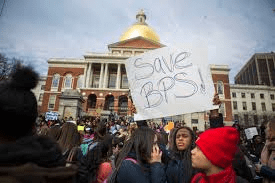
^ conned and used : students walkout to protest a very strange Schools Budget decision

—- —- —- —-

Political hay has been made recently by some who see the Boston Schools Budget as a lift off for their space ship of ambition. News cameras have brought student walkouts to our attention; social media has gone batty with back and forth accusation an d glorifying. You may, like me, decry the use of students to heat an agenda to the boiling point; or you may like boiled agendas. Whichever your taste, you may find it instructive to take a hard look at Boston’s Schools Budget and to ask hard questions of its accountants.

I will try to do just that. Myself, I find Boston’s Schools Budget bloated with redundancy, lame with misappropriation, lazy and in some cases absurd. Before you read further, however, I urge you to examine the FY 2017 Budget yourself right here : https://drive.google.com/a/bostonpublicschools.org/file/d/0BzsLEoKGiYp2T3huMmxONFJZVkt6dTZQZFhjNHVxUS1Fd0ww/view?pref=2&pli=1

Several line items puzzle me.

1.Why is there $ 11,706,729 in per diem payments to substitute teachers, when included in the $ 409,514,539 being paid to “teachers” is about $ 13 million paid to about 100 teachers who have no teaching assignment, because no principal will have them ? (Note : the approximately $ 13 million paid to said 100 non-assigned teachers is not itemized in the FY 2017 Budget accounts. If you did not know about them, you would not see the $ 13 million at all. Note, too, that the $ 140,298,023 accounted as “employee benefits” includes some amount — probably about $ 3 million — paid as such to the 100 non-assigned teachers.)

2.Why does the utilities account allocate about $ 20,258,000, up about $ 1,142,000 even though fuel costs have come way down ?

3.Why does the Budget include $ 1,222,095 for “renting space,” when the Department maintains significantly under-used buildings of its own, given that its buildings anticipate about 93,000 students, while current enrollment is 57,000, or 54,000, depending on whose statistics you read ?

4.Why does the Budget allocate $ 14,686,707 for “repair and maintenance,” of such under-capacitized space ? Consolidating buildings and selling off the rest would save much money in this account as well as accord the City a Capital Budget windfall to help pay for the new schools construction now under way.

5.Why must the Budget allocate $ 94,949,554 for Transporting 53,000 to 57,000 students — assuming that it does, in fact, transport all of the students so enrolled ? Granted that this figure amounts to about one dollar per school day per student, a bargain amount. Still, all of it is being paid by the taxpayer. Should not parents be asked to share the cost ? Of course taxpayers should be obligated to pay for the education of society’s children, for all sorts of reasons moral and economic; but transportation is not education. It wouldn’t even be necessary were it not for our City’s sad history of intentional racial segregation. of its schools 40 years ago and more; today, however, some 87 percent of students covered by the BPS budget are of color. Isn’t it time to restore the neighborhood school 9and the great Parent Teacher associations — PTA’s — that invigorated them long ago ? And to put an end to misapplication of most of that $ 94 million, that could be used for classrooms, as the protesting students want and deserve ?

Overall, I see the Boston Schools Budget misapplying as much as $ 150 million of its $ 1.03 billion allocation. Half that amount could make a lot of Boston Schools classrooms great places in which to learn what charter school students learn via budgets much, much smaller. One wonders at the strangeness of the decision, by the City’s Budget Office, to leave classrooms about $ 50 million short of what they say they need instead of cutting at least $ 50 million from Budget items unjustifiable by any rational standard.

As it proceeds with its capital plan to consolidate 126 very old school buildings into 90 new ones, and to establish uniform enrollment on a hotch potch school choice system — both of which moves I fully support — the City would be well advised to restore classroom funds to high priority and eliminate — or at least pare back — the duplicative or unneeded Budget allocations that have no justification at all beyond vested interest stubbornness.

—- Mike Freedberg / Here and Sphere
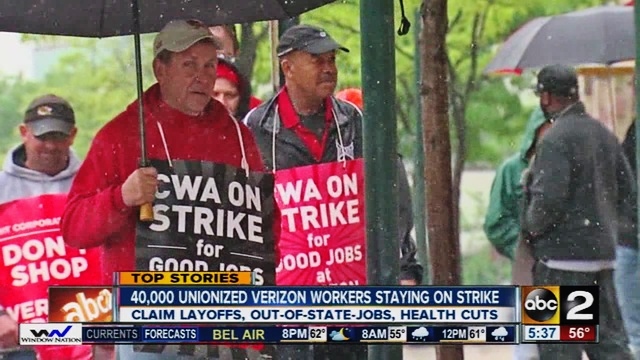
VERIZON WORKERS HAVE THE BETTER ARGUMENT

Verizson

We’ve looked at the Verizon (stock symbol VZ) situation for a few weeks now and read statements by both the company and its union. An examination of Verizon’s latest 10-Q SEC filing does not support the company’s position, that financial stress forces VZ to fire its call center employees and outsource the work to India. To demonstrate my conclusion, at the end of this report, I reprint, from Yahoo’s finance pages, the 10-Q filed last month, a report which says it all.

If you study this report you will see that Verizon income is not suffering, nor does it appear to face any downturn. Operating income is holding steady, expenses as well; the firm’s EBITDA (earnings before income tax, depreciation and amortization) run about 22 percent of revenues, good enough to support a dividend distributed from an AFTER TAX 15 percent profit.

If VZ’s after tax profit came in at about five percent, or less, there would be an argument for slashing employee costs; although even then, I think it a foolish economy to fire long-established, home front employees in favor of poorly paid, overseas workers hard to monitor and/or discipline. With profit at 15 percent, no such argument makes any sense at all. VZ must keep its domestic call center people and accord them all the wage and benefits that top quality workers merit. In addition, VZ should allow its wireless employees to unionize if they wish to form one. VZ should welcome that its wireless employees want to stay on the job rather than create the expense and distractions of worker turnover.

I cannot imagine that VZ’s top managers do not understand all of the above. What, then, can possibly be driving them to disrupt the firm’s operations, as they have ? It seems that the initiating force is investor desire to “maximize” value, i.e., to wrench VZ stock from the high $ 40s to, maybe a temporary $ 60 per share based on cutting employee costs.

If stock speculation by vast pools of wanderlust money is the force at work upon VZ, it should be cut down. Speculation of publicly traded stock is the single most damaging feature of our macro economy today. Speculative manipulation, and rapid-fire trading upon temporary inefficiencies, aids no one but the speculators. The money pushed into quickie manipulations doesn’t invest in a product, doesn’t aid a service, doesn’t assist employees, doesn’t innovate the economy. It is an entirely inbred self serving of money for moneys’ sake. It is NOT capitalism. I am not sure what kind of ism it IS.

It may be many years before the ills of speculation are curbed (and they can be curbed, by tax rules, by SEC regulations, by Federal Reserve margin requirements, and by corporate governance law reform), the only weapon that the capitalist economy has is a workers’ strike. Make no mistake ; a company’s workers are an asset. A MAJOR asset. Their skill, their reliability, and yes, their good earnings are vital to the probity and market power of an enterprise. Verizon workers striking are doing the work of capitalism, and we who support the indomitable power of capitalist operations should thank the striking Verizon workers.

— Mike Freedberg / Here and Sphere

Verizon’s first 2016 quarter 10-Q SEC report :

VERIZON COMMUNICATIONS INC – 10-Q – 20160428 – INCOME_STATEMENT

    
Service revenues and other    $   28,217      $   28,611   
Wireless equipment revenues      3,954        3,373   
Total Operating Revenues      32,171        31,984   
Operating Expenses     
Cost of services (exclusive of items shown below)      7,614        6,988   
Wireless cost of equipment      4,998        5,108   
Selling, general and administrative expense      7,600        7,939   
Depreciation and amortization expense      4,017        3,989   
Total Operating Expenses      24,229        24,024   
Operating Income      7,942        7,960   
Equity in losses of unconsolidated businesses      (20     (34
Other income, net      32        75   
Interest expense      (1,188     (1,332
Income Before Provision For Income Taxes      6,766        6,669   
Provision for income taxes      (2,336     (2,331
Net Income    $ 4,430      $ 4,338  

MAYOR WALSH’S ORDEAL IS OURS TOO

FullSizeRender

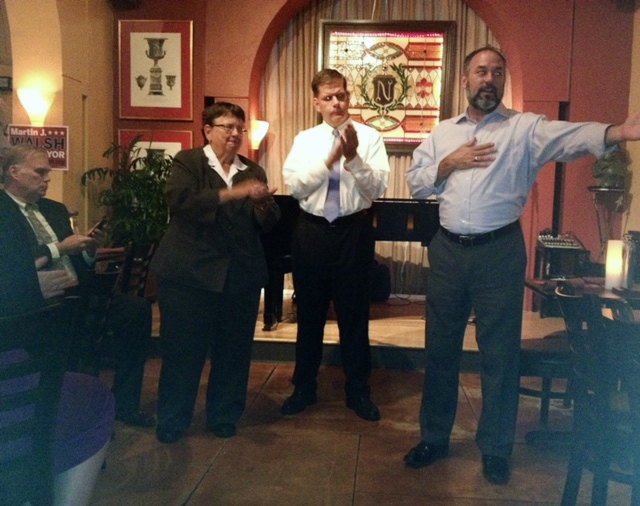
^ then candidate Walsh, with State Representative Liz Malia and (r) Ken Brissette, at a Club Cafe fundraiser on September 12, 2013 (photo by this writer)

—- —- —-

It was hardly unexpected; yet the indictment of Ken Brissette, by the Feds in Massachusetts, stunned me nonetheless. It had been twenty years since a top City of Boston official was indicted and almost forty since corruption was challenged throughout a Mayor’s administration.

The indictment not only accused; it implied. Much can be read into its simple but suggestible sentences. (Read the indictment itself here : https://www.scribd.com/doc/313153213/Brissette-Kenneth-Indictment )

Who were the “more than one other City official” who made the demands, upon arts companies — so the indictment seems to say — that Brissette is charged with ? If these others did the same, why were they not also indicted ?

Did Brissette demand, on his own hook, that Boston Calling hire union workers or else get no permits ? It seems unlikely that a department head, as Brissette was, would make such a risky — illegal, according to two officials who are said to have warned him –demand on his own whim. Especially after being warned of its illegality — as the indictment states took place — Brissette had to know that to continue doing what he is said to have done would put the Mayor at risk. After all, wasn’t the purpose of the warning, from the City’s then Director of Operations, to make sure that Brissette didn’t dirty the Mayor ?

At this point I wish to engage in some speculation about what probably took place. I state right here that nothing I am about to speculate arises from evidence; but I am not looking to put the law on anyone. All I want to do is to emphasize the drama of it all, because when power is on the move, the motives and relationships of those who move it speak vividly, as Shakespeare, for one, knew so very well. So let me begin :

1.Ken Brissette is not simply a City department head (Office of Tourism and Entertainment). During the 2013 Mayor campaign he hosted a significant fundraiser for Mayor Walsh, one that I attended (see my photograph above). At the time, Walsh’s rival., John Connolly, was close to gathering the support of almost all of Boston’s gay activists — a significant voting block. Walsh had only State Representative Liz Malia; Connolly had much more support. Then came Brissette’s fundraiser, at Club Cafe, with Malia delivering a passionate speech about how Walsh, as a legislator, had made the difference in securing marriage equality from a ballot challenge. Walsh then spoke, to a gathering of more than 50 gay community leaders. Walsh did not win a majority of gay voters on election day, but he halved Connolly’s expected lead.

2.The “Director of Operations” referred to in the Brissette indictment is Joe Rull, who field-directed Walsh’s election team. (disclosure : Rull is a friend of mine whose friendship I treasure. I know no person more effective or honorable than he.) No one who worked the 2013 Walsh campaign had any doubt of Rull’s authority. None could possibly doubt his authority once Walsh became Mayor. A warning  call from Rull to Brissette, as the indictment states was made, would have been suicidal for Brissette to not heed. Yet according to the indictment, he went ahead anyway. And was not disciplined.  Whence arises two questions : ( a ) did Rull make that call to dissuade Brissette or simply to give Mayor Walsh cover ? ( b ) if Rull meant the call to be a warning, not cover, did Brissette read it wrong ? Did he read it as a “cover call “?

3.That’s not the end of it. Rull eventually left his powerful position at City hall to join the action team at Boston 2024. Some speculated that he had lost a “power battle” with Walsh’s Chief of Staff, Daniel Arrigh Koh; that Rull’s traditional politics style did not fit Koh’s technocratic methods. This seemed a reasonable explanation. Rull is old school, as am I. But now I wonder. Rull was a Menino man; and I am wondering if the call he is said to have made to Brissette was a Menino kind of call, in short, a warning in fact and not a “cover call” : because Menino always did things the right way, and integrity is Rull’s reputation as well. And if it was a warning, did that not sit well with the Mayor, because ?

To repeat : who were the other City officials referred to in the indictment (“at least one other official…”) ? How come Brissette was charged and not they ? Are they co-operating with the investigation as it pursues yet other officials not named or even alluded to ?

No one will say or probably will ever say. These are the sorts of secrets, if they are true, that people in politics take to their grave. Yet the questions that I have asked are being asked right now by everyone in city politics, because everyone in it has been faced with similar situations, and all of us have had to figure out just how we would respond when the facing faces us.

Beyond the personal, I ask these questions because as long as they hang in the air, the entire careful arrangement of Massachusetts governance is at risk. Walsh and Governor Baker are basically a team, and their togetherness has allowed both men to effect major reforms and to advance a strongly pro-business agenda on every front. Walsh’s firm support assures Baker of a big vote in Boston come 2018, just as it assures Walsh of a strong taxpayer and business vote in his own upcoming re-election. Were Walsh now to be weakened — or to no longer be Mayor — much of this would change radically, for Baker too. The most likely alternative Mayor, Michelle Wu, disagrees profoundly with Baker’s charter schools program and with his pro-business, no-new-tax principles. And a weakened Walsh faces a likely re-election opponent even more radically anti-Baker than Wu would probably be.

Will there be other City official indictments ? Will Walsh’s conduct as a major Labor leader in 2012 — which is also being investigated by the Feds — be his downfall ? I have no idea, but until these questions are resolved, Walsh will have to push his re-election campaign against the tide of a passionately uncompromising minority. So far, Walsh has by far the upper hand, because City taxpayers want no part of the teacher’s union’s contract tactics and because the City’s strong charter schools constituency stands solidly behind him. Walsh has enjoyed favorability numbers as high as Baker’s despite major defeats ( Boston 2024, Indy Car Race, several political endorsements ). His potential opponent, however, has his own strong following, and a big issue : the Boston Public Schools budget. Still most of the public gives Walsh A for effort — and an A for results. He will need its life-giving self-confidence, and more of it, but also some luck, and better newsdays, if he hopes to prevail against the various swarms now gathering against him.

—- Mike Freedberg / Here and Sphere


WARNING SIGNS FOR THE MASSACHUSETTS GOP

Massachusetts

^ the 2016 caucuses brought many people into a previously too small GOP, but it will onloy make the Massachusetts situation worse

—- —- —-

Ever since Bill Weld’s election in 1990, Massachusetts has elected only Republican Governors, with one exception, for very solid, institutional reasons unique to our state. So it was in 2014, when our voters chose Charlie Baker — narrowly, but Republican candidates for Governor have won by even less, and not that long ago. Until this year the likelihood was for this habit would continue well into the future. I no longer think so..

The rise of Trump has changed the entire mindset of Massachusetts Republican voters. Until Trump came into view, the majority of Massachusetts GOP voters were quietly conservative politically — not very ideological — but well aware that, to win, a GOP Governor candidate would need to be much less so; and said conservatives were willing to accept a Cellucci, a Romney, and a Baker rather than not have a GOP Governor at all. As recently as 2013, Gabriel Gomez — hardly a conservative; he voted for Obama in the 20123 election — won 51 percent in the primary of that year’s United States Senate race.

Yet the danger signs had not long to wait.

In the 2010 Republican race for Governor, the “tea party” candidate, opposing Baker, won eleven percent of convention delegates, falling short of the ballot. At the 2014 convention, an even more right wing candidate, with hardly any campaign money — a candidate who had no chance whatsoever of winning the election —  secured enough votes to get his name onto the primary ballot. Earlier this year, Governor Baker, as a sitting Governor no less, moved to take control of the Republican state committee and won barely enough seats to do so. Opposed by right wing interest groups and talk radio hucksters, some of Baker’s candidates were beaten, including some seeking re-election. Finally, although Baker was able to get his candidate for national GOP committee woman elected, over a paid employee of a right-wing special interest group, the vote was far too close for comfort : 41 to 37.

All of this took place during the rise of Trump but prior to his becoming the presumptive GOP nominee for President. Since that time, Trump has taken over, and his sort of voter — angry, bigoted, nativist, heavy-handed and uninterested in political nuances — has taken over caucuses and overwhelmed a party grown very small and even non-existent in many parts of the state. During the controversy involving transgender civil rights and the chimera of bathroom crime, the newly repopulated Republican ranks have become a mob of ignorance and hate, of shameless smarm and dog whistle bitterness. I doubt that the noisy drool will smile upon Governor Baker signing the transgender civil rights bill that will pass the House overwhelmingly in a few weeks.

That mindset, of reckless negativity — of uninhibited vulgarity and rot-gut bigotry, and proud of it, no less — will almost surely become the norm for the many thousands of voters who have moved into the Massachusetts GOP : a party whose thin to non-existent corpus was easy to bulldoze. True, Governor Baker does have a solid following, of those who work in his administration and who value access to his staff and even to him; nor is his following small. But his following isn’t much benefit to the local GOP, as but much of it comes from outside the GOP. Baker’s huge war chest of money and his solid record in office will probably win him a 2018 primary: but a recent Suffolk University poll showed Baker’s favorable-unfavorable rating worse among Republicans than with any other major voter group.

Granted, that even among Republicans his numbers are 65 favorable to 16 unfavorable, easily good enough for 2018’s primary. But my guess is that, as Baker has stated clearly his unwillingness to support Trump, and given his quite reformist record in office, he stands very outside the mindset parameters of this seasons’ GOP voters. I think they realize it. By 2018 it can only get worse : while voters obsessed with defeat are flocking into the GOP, tolerant voters are leaving it. Just as many — of a demographic that has gotten older and older during 40 years of no replenish at all — are dying.

It’s hard now to recall that as recently as 1966, the Massachusetts GOP was the natural party of government, reformist in spirit, optimistic, honorable, and sometimes boldly innovative.

In Boston and surrounding communities, registering as a Republican has, for 30 years, been a statement of outsider status. If you vote in the Boston area and register as a Republican, you are barred from almost every election that takes place : in the Democratic primary. If you register as a Republican, you don’t choose a State Senator, a State Representative, a county officer. You almost certainly don’t choose a Congressman, nor any of the State’s Constitutional offices except Governor.

For 26 years, that one office has been enough to assure voters who register Republican that they have a significant, if outsider, part to play in the state’s governance. But what happens if the new majority of Republican voters dislikes state governance, period ? Adopts positions, and chooses candidates, that assure defeat by spitting on everything that most of our voters want ? Where does Karyn Polito, in 2022, find a path to a winnable nomination ? And if not Karyn Polito, who else has a better path ?

The Republican party in Massachusetts can NOT become the manipulated instrument of right wing talk show hucksters, anti-everything gripe-sters, and the intentionally out of it. It cannot become known for outrageous views that guarantee pariah status. But right now that’s exactly what it is becoming. It’s already almost impossible to have a sensible policy discussion with Massachusetts GOP activists. What could you say to a party 80 percent of whose legislators opposed last year’s $ 10 to $ 11 minimum wage hike that is supported by 80 percent of voters ? How can you talk about transgender civil rights, supported by two to one of our voters, when of five GOP State Senators, only one voted in favor ?

What future can there be for a political party that opposes what four out of five voters want ? Talk show hosts can do that, because they attract an audience by being outrageous, offensive, ugly. That’s how they gain attention and thus advertising dollars. But a political party cannot win elections by vulgar huckstering. Trump will soon find that out : but will his voters see it ? Probably not.

It will be a shame if Massachusetts’s Republican party collapses to tempest in a teapot infamy. All of the importantly serious policy debates — charter school cap lift, alternate energy sources, MBTA expansion, flood waters and climate control, housing expansion — are taking place within the Democratic party and its activists; other than they, only the Governor and his team participate, and when he does so, he does so well outside the inly-working, imploding GOP that seems set to end our era of GOP Governors.

— Mike Freedberg / Here and Sphere

HOUSING : IN GREATER BOSTON, AN INTRACTABLE ISSUE

Building-Boom

^ hot or not ? right now Boston is hot hot hot, and many of us don’t like that because we have to pay for it

—- —- —-

The current panic about housing availability in Greater Boston is not new. For the past 30 years we’ve had to live with soaring house prices and skyrocketing rents. What happened ? Back in 1970, the typical Boston house sold for $ 20,000; $ 50 a month rents were common. Today, the typical Boston house sells for $ 400,000 to $ 650,000 and the average two-bedroom rent runs $ 1,800 to $ 2,800. That’s a 20 to 30-fold house increase and a rent rise of 90 times. To frame it another way, in 1970 a house cost an average of two times annual income; today, five times. Rents in 1970 equalled about six to ten percent of monthly income; today, 33 to 50 percent.

To fizz this relentless bubble, Boston has tried rent control, which made things much worse. We’ve tried condominium conversion — which has made renting more difficult. We’ve built all manner of homes — but almost exclusively for the high end buyer : because land to build upon costs the same whether you’re building a $ 300,000 house or a $ 650,000 McMansion; so builders built McMansions. Building permits are issuing all over the City, but it isn’t working. Prices are still going up. (Yes, during the mortgage collapse of 2008 to 2013, prices went down; in some neighborhoods,m way down. But today they’ve fully recovered, and in the City’s priciest spots they’ve moved way higher than ever.)

What are we going to try next ? No one is building houses in the suburbs, because today’s typical home buyer wants to be in the City — as c lose to Downtown as possible. Live Downtown, and you don’t need a car; your friends all live nearby, the nightclubs and boutiques can be walked to, and all that money that suburban people spend on cars, car insurance, garaging and gasoline can be spent by you on high end clothes, $ 1000 Louboutin shoes, $ 50 to 75 a plate “fine dining,” $ 150 per ticket arts events, $ 500 a ticket Mayor Walsh birthday parties, and a night at the trendiest craft brewery. Or on your monthly $ 6000 mortgage payment for your condominium in the Seaport or South End. It’s an attractive life, even if you have to work 80 hours a week to afford it. And because so many of us now live it, all the services (and their employees) that serve Downtown life also locate in Downtown. So is this trend unstoppable ? Maybe so.

Unfortunately, not all of us can afford the Downtown Life. We all know that incomes in America are diverging : high incomes are earning more, middle incomes less, bottom incomes the same. Our political leaders know this too. Both Mayor Walsh and Governor Baker have called for building thousands of new “affordable” houses and condominiums; Walsh cites 5000 new house build permits in 2015 alone. As for Baker, even as I write, he is announcing “significant housing production in…his upcoming capital budget plan. As his budget office puts it, “The  capital investment follows last week’s announcement by Governor Baker of  a new $100 million workforce housing development fund established in partnership with MassHousing to support the creation of 1,000 new units of moderately-priced housing.”

Yet even these City and State resolves don’t seem enough. Mayor Walsh is calling for 53,000 new residences to be built in Boston by the year 2030; he may well get more than that built; but the City’s population has grown by at least 90,000 people since 2010, and judging by the thousands of building proposals now awaiting BRA action, perhaps 50,000 to 100,000 more people will flock to Boston by that time. Where will they live ? From the rent rises going on all over Boston, it looks as if these new residents will live where current residents will no longer be able to afford.

One wants to stabilize rents so that that “displacement” does not happen; but how ? Rising rents mean significant renovation, upgrading, modernization of residences : today’s $ 2,000 apartment is a haven of luxury compared to the antiquated, firetrap apartments that rented for $ 50 a month 45 years ago. Nor do today’s $ 650,000 houses compare at all to the flimsy, plywood walls, cheap windowed, miserably applianced stuff that buyers of $ 16,000 ticky-tack homes had to accept in 1970. What landlord is going to invest capital for major improvements if he or she can’t recoup the investment and maybe more ? Perhaps building Federally-financed house complexes, of the row house type built during the past two decades all over Roxbury and Mattapan, will serve; yet strong objections from neighborhood activists are stopping many such proposals, or else are altering their affordability agreements. Not everybody even in the city’s communities of color wants to see more “affordable” housing built in the neighborhood.

My own sense of things is that significant new housing will be built but nowhere near enough to resolve the demand. We had better face it : Boston is “hot,” and the suburbs are not, and being “hot” means enjoying prosperity even if it costs almost more than the enjoyment thereof rewards us. So who will raise the average wages of Boston workers, so that we can all savor the flavor of price boom prosperity that I cannot see any good end to ?

Nor is returning to the cheap price cheap stuff that prevailed in Boston 50 years ago an answer either. Those who decry the building boom and its supply bottlenecks are really telling us that we should become undesirable again. I think not. The building boom must continue; it must expand; it must overpower demand. It must do so within Boston city limits. This is our problem to solve. It is not the suburbs’ problem. Someday the suburbs will face the problem. I do not want that. That would mean that Boston is no longer “hot.”

—- Mike Freedberg / Here and Sphere


THE PRESIDENT ACTS


trans

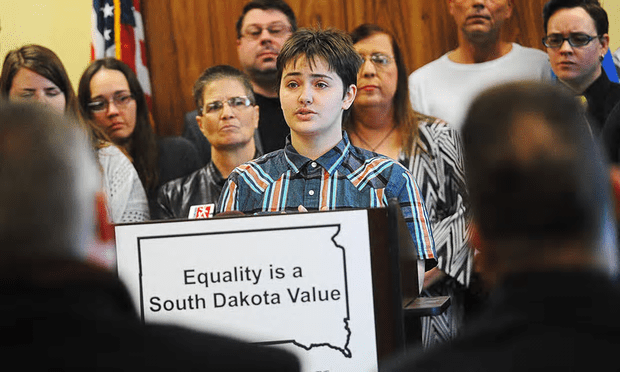
^ equal rights for all is not only a South Dakota value

—- —- —-

Pursuant to authority directed in Title 9 of the nation’s Civil Rights acts, President Obama has directed the nation’s schools to enforce the civil rights of transgender students. We applaud his taking this action.

The Directive Order can be read here : http://www.cnn.com/2016/05/12/politics/transgender-bathrooms-obama-administration/index.html

By his order, schools are directed to assure transgender students full access to the bathrooms and locker rooms that accord with their gender identity, the lives they actually lead.

What he has ordered enforced, we in Massachusetts already do, successfully, pursuant to regulations issued by the Commissioner of Education in keeping with the Civil Rights Act adopted here in 2011. It is a shame that in many other states a Presidential order is needed; but such is the case. Without his order, the rights of transgender students would depend on which state they live in. It is exactly that sort of outcome that 148 years of Federal civil rights laws have determined to prevent. It is basic to our nation that the civil rights accorded to all be the same no matter where we live. All really does mean all.

Too many times Americans have had to fight, even die, to assure this principle fundamental to our nation. I do not get why there is opposition. In what way does the civil rights of a person impede those of another person ? They do not impede it.

I was very young when, in the 1960s, thousands of Americans risked assault and even death in  order to assure voting rights in every state. Opposition was violent. Anyone who thought that the full rights of African Americans was assured once and for all by the Civil War and Reconstruction’s laws found out that that battle had to be fought all ovce4r again. It was. And victory went to the side of civil rights for all.

Yet it is one thing to establish the law, another to change minds. Today we see that the minds of the South continue unchanged : and not only in the South., Despite that civil rights for all is our nation’s foundation principle, many Americans don’t approve. I wonder what they do approve. What do they think America is ? Rights only for some ?

Too many Americans think that civil rights should be accorded on;y to people whom we approve of. As if we have a right to judge them. But that is NOT our national principle. Our principle is that everybody has the same basic civil rights; our approval of the persons is irrelevant to the rights all people possess.

Our Constitution and the laws enacted pursuant to it, as amended, was established to assure that basic national principle be uniformly operative throughout. As the Preamble states : “to promote the general Welfare.” it does NOT say “to promote the welfare only of those we approve of.” That this is so is why I often assert that objectors who cite the Constitution as a source are in fact opposed to the Constitution rather than supportive of it.

All of the above I adduce for one chief reason : to show that the order issued by President Obama, to assure the civil rights of transgender students, is not only well within his powers (pursuant to Article II of the Constitution) but is, in fact, his duty, legally and morally, to do. He has now done it. All Americans of good will should applaud him. Transgender kids in  particular should thank him. Their lives will be safer and surer, bolstered by the law and thus by the common sentiment of the entire community — a force far more powerful than the fears and discomforts of a few.

The President’s order is far from final victory. Some states are pushing for laws preventing people from amending the male or female check box on their birth certificate. Others are passing laws specifically ordering discrimination against transgender people. All such bills are utterly un-Constitutional, but it will take years to litigate them (and even then hard-line resistors will continue to erect barriers), and in the meantime transgender people will be at severe risk from bullies and haters who deny the very existence of transgender.

The fight for our nation’s foundation principle goes on.

—- Mike Freedbereg / Here and Sphere

BOSTON’S BUILDING BOOM IS A GOOD THING

DOTBlock^ DOT Block : the Building Boom brings adventure and movement to a city too much attached to “Place”

—- —- —-

Every day, almost, my friend John Doherty, President of IUPAT Local 35, posts news of yet another building project approved by the Boston Redevelopment Authority (known to all as the “BRA”). Doherty has a point. Every new project keeps his members at work painting and developing and earning good money.

I do not see why that is a bad thing. I do not see why any of Boston’s numerous new building is a bad thing. We live in a city, or we work in it, or we do both. Cities are dynamic things. They change. It’s why they exist. Commerce is their purpose, change the result; the process, the benefit. The workers earn good pay, the risk capitalists profit, the city draws in more and more commerce, and that in turn draws in more and more people : because people want to do things and to earn a better life doing them.

Almost every part of Boston is changing now. Mattapan and Hyde park haven’t yet seen it, but every other neighborhood throbs with the sounds of construction. Shirley Leung’s story in todays’ Boston Globe Business section tells it : https://www.bostonglobe.com/business/2016/05/12/boston-development-boom-moving-beyond-downtown-neighborhoods/zlwc3n64bW2HoVVeAuyYEI/story.html

As Leung points out, the Building Boom’s new phase involves housing — lots and lots of it, enough maybe to reverse the present shortfall of supply and thus reverse the stupefying rise in rents and prices that has, during the past 20 years, made Boston residence almost unaffordable except for very high earners.

To get to that point, of course, has come more and more to threaten certain residents’ sense that where they live should forever remain as is. All over Boston, neighborhood activists complain about developments. Either they’re too expensive, or they’re too cheap. They bring noise, traffic, density. They have too many floors. They block sunlight. They “displace” people. And on and on.

We’ve seen the complainers and heard the nay’s. Every BRA proposal must, by the rules, be submitted to “community input:” at required “public comment” hearings. These hearings are perfectly attuned to the agendas of opponents, who always show up, whereas supporters of the proposal usually do not, because few developers have the time or the staff on hand to marshal them. Much of the objection to development is bare “NIMBYism” — “not in my back yard” — but the argument of “displacement:” also arises. This is a more serious argument and merits the response I’m about to make.

It is true that Boston’s Building Boom has boosted housing prices and rents enormously. How can it not ? It costs money to build : land costs, architect renderings, construction contracts, building materials, permitting, labor, utility hook-ups, marketing, brokering. None of these comes cheap. You want construction to be done right; you want high quality materials and amenities. Land costs are high because it is scarce — nobody’s creating any more of it — and why should its owners take less of a selling price than the market accords ? Meanwhile, residents facing “displacement” have to pay nothing for simply staying put. Residents get all the benefits that the Building Boom brings, by way of higher value for their homes, or newness to their neighborhood, yet they pay nothing for it. If you ask me, residents make out like a bandit when development comes calling.

Still, residents have a legitimate beef when development upgrades their neighborhood. As rents go up, rental residents may not be able to afford what’s asked by landlords. As house prices go up, owners have to decide whether to cash in and leave or to stay put and not cash in. Thus the “displacement” outcry.

Boston is a city easy to love. It’s hard to face leaving it, even moving to a different neighborhood of it, merely because prices push you. But would any of us prefer the alternative, the dead, often vacant, sometimes unsafe, bleak, jobless city that was Boston 30 and 40 years ago ? I suppose some of us would. We’re all too ready to romanticize that Boston, of tribal loyalties, neighborhood self-sufficiency, hardscrabble dollars, and cheap housing. It wasn’t as great as we make out. It was hard to make a living unless you knew someone. Tenants had few legal protections. The BRA dictated. That era has gone, probably for good reasons, and today tenants have far more power than formerly, while the City itself — the neighborhoods, too — bustle with boutiques, outdoor dining, and streets crowded even at night with pedestrians and sight-seers. The new Boston isn’t merely a home, it’s an adventure; an exciting, risk taking, innovative adventure; an exploration.

I’ll admit that Boston adventure means expanding one’s reach beyond one’s beloved old  neighborhood; it entails investment, newness, tear downs, and re-invention. Yet there’s also nothing stopping you from making the change rather than letting someone else impose change on you.

In the new Boston, you have to get out in front or be run over ? Game on.

—- Mike Freedberg / Here and Sphere

IMMIGRANTS : BASIC TO THE MEANING OF AMERICA

robles

^ celebration, shine, and optimism : Veronica Robles and friends at El Planeta newspaper’s Power Meter 100 party last night

—- —- —- —-

Nothing in today’s cascade of negativity repels me more than the assault on immigrants. So strong is this assault that it has generated an entire Presidential campaign: that of Donald Trump, whose candidacy would not even exist, much less arrive at the GOP nomination, were it not for hatred of immigrants. Like Trump votes, the assault on immigrants rears almost everywhere. I see it even in East Boston, our city’s premier immigrant neighborhood. But it has always lurked, and often erupted, inexplicably in the nation whose very meaning is “immigrants.”

Why assaults upon immigrants and immigration occur, I can not answer. There seem to be dozens of reasons. Which of them — jobs, language, “they don’t look like us,” religion, etc., or the latest outcry, :”they’re illegal !” — weighs most heavily, I have scant idea. Yet I hear them all. I always respond to posts of immigration hate. I feel a duty to do it : my own ancestors were immigrants, as were yours. An attack on immigration is an attack on YOU.

I first responded, years ago, by quoting Emma Lazarus’s poem engraved on the Statue of Liberty’s pedestal : the one that talks about “send me your poor, your hungry, your tired, etc., yearning to be free.” Today, every supporter of immigration quotes that poem. We should quote it. Is not the Statue of Liberty an icon of patriotism ? As much so as the flag that people drape their facebook profile photos in ? As much as The Constitution which is so often pictured, especially by people who haven’t the vaguest idea of what the Constitution is about and who, in most of their politics, oppose much of it ? I say the Statue of Liberty is the FIRST of American icons, because for over 120 years it has been the first image that most arriving people have had of the nation they have come to be part of.

True it is, that today, more people come to join us by way of the Rio Grande River valley, and the southwest’s desert, than by the Statue on Ellis Island in New York Harbor. Yet I venture that most of these, too, have the Statue’s image in their minds and hearts even if they do not the actual sculpture as they arrive. And this, they should have, because everyone who arrives in America of good will arrives to seek the better life the Statue of Liberty symbolizes.

Those who come here — who leave everything behind and, often, risk their lives to come to America do so because they believe the future will be better. They are optimists. America always was an optimistic nation; most of it still is. That optimism is the sum total of immigrants’ souls and hearts. It is the immigrant spirit in action. When Ronald Reagan, the greatest optimist of all, spoke of “America’s best days lie ahead” or “It is morning in America,” he spoke what immigrants say and so spoke for almost all of us.

To rail against immigrants, as Donald Trump does, is to rail against the nation itself. The negativity of it turns American optimism inside out : is our nation headed for disaster ? For the dustbin ? That is what opponents of immigration tell us. Some of them say it explicitly; all believe it. I have no idea why they believe it. In immigrant communities I see dynamism, invention, enterprise; I see celebration; I hear music; I feel excitement. How else can a man or woman get up at four in the morning and take a 4:45 AM bus to work, to clean toilets and empty dirty laundry hampers, in office buildings and hospitals ? To work in restaurant kitchens and as busboys; to stand outdoors on a winter day waiting to be hired for day labor ? To clean airplanes at Logan Airport ?

The immigrants who I see and hear go to these dirty, messy, sloppy jobs, or stand in the cold for hours on end, seemingly without complaint. Yet I hear anti-immigrant people say that immigration was all right 100 years ago, because there was no welfare state, but now immigration is not OK because … welfare. Where does that notion come from ? I hear it despite the unavailability of any form of welfare to people without papers or a state-issued ID. As for immigrants who have documents, if they work for $ 10/hour in a city where apartment rents run at least $ 1,600 per month, why shouldn’t they receive public assistance in order to survive ?

Those who decry welfare assistance for low-wage earning immigrants miss the point. Today’s struggling immigrant is tomorrow’s successful skilled worker and is the parent of an entrepreneur. (Immigrants start more — many more — businesses than native-borns.) We should invest some of our dollars in them !

Immigrants renew our communities and, with their languages and cultures, broaden the national menu of choices for how to live. Innovation is peculiarly an American practice ? If it is, it is so because we are immigrants.

Too many of us who were born in America, to American-born parents, have lost our way or become tired, or disillusioned, because the struggle to get ahead is to difficult in an unforgiving economy. This is real, and it exists, and we exist in it. But to give up — to turn on one another, as the Trump voters have, is no answer. You can’t give up. “When the going gets tough, the tough get going:” is a cliche, perhaps, but cliches are usually true. You can’t give up, and you can’t view your neighbor as an enemy. He or she is much more likely a friend. Especially so if he or she is an immigrant, documented or not.

We who were born here, of ancestors born here, should learn to be more like our immigrant neighbors than they should become like us. Our community, city, state and nation would be much the better for it.

—- Mike Freedberg / Here and Sphere
DON’T BE INTIMIDATED BY THE INTERNET

Today - Season 62

^ ^ con game on the intreret : Sarah Palin has a ride she wants to sell you. Don’t get aboard.

As anyone reading this article surely knows, the creation of an online world of voices and noises has brought all manner of personal illusions and gripes to the fore. Whereas before the internet most of said noises were edited out, so that they never reached beyond the personal space of those who harbored them, today “personal space” ha s become public space. Thus we find ourselves invaded by locusts and wasps, cockroaches of absurdity, rodents of the false. It would be nice to9 hire a kind of cleaning lady, to dust away online’s dirt, but none is coming to your kitchen or to mine. We have to live with smells foul, sights ugly.

Which does not mean we have to stand for it. In particular, we cannot abide cockroach politics. The Republican nominee for President uses cockroach politics to turn people’s heads : we should turn his head away. He insults everyone; we should refuse to hear it. On facebook, when putridity is posted, hide it; block it; report it. When supporters of the cockroach post kaka, block them. You don’t need to read insult, look at accusation, listen to snot.

The very few — very, very few — who insist on placing toilet bowls on your brain can seem many times more numerous than they are when seen in online code print. Do not fall for it. It is true that when one person takes a dump, 1o0 people can smell it. But that does not mean that 100 people are dumping. Do not be fooled by the foul.

In the real world, where everyone has one vote and one vote only; where every life has equal life in it; where each of us decides what to do and how and when to do it — in this,. the real world, not the online facsimile of it, all of us determine what will happen : the noisy and the quiet; the stink bomb and the essence of lilac. Each of us, we all count.

One person may arrogate to himself, by kidnapping your attention, temporarily the lives of many; but it is kidnapping nonetheless. D o not let it happen to you. The rise of talk show entertainment, in which talk hosts say the most outrageous things they can, to get attention and this advertising dollars, have made exaggeration commonplace. They lie because it sells. They are hucksters merely, and so are the new bred of fake politicians who use the talk show shtick to yank your attention out of your control and into theirs. Do not let them do it.

This year’s election will not be decided by scoundrels and kidnappers. Stink will not win it, nor dumps. Most of us want to do the right thing. Most voters want to vote for the best candidate. There are at least 150,000,000 voters; how many of them are online on any day ? Any week ? Any month ? Maybe a third of them, likely less. The published polls make clear that even the most interruptive loudness barely affects most voters. As it should be.

If I may, I want to assure all of you, dear readers, that the candidate who best represents, voices, and details progress for our nation will win our votes. I fully expect her to be Hillary Clinton, who is so reviled in the talk universe because she is so accomplished and so feared by those who feel threatened by change, by progress. Mrs. Clinton is far from a perfect human being — but are we any more perfect, in our lives of stuff-happens ? We do the best we can with what we have to do it. So, for the most part, has she. Those who find Mrs. Clinton “unacceptable” need to ask : who, then, Is acceptable ? Surely not the vulgarian, her branding iron opponent.

Soon enough we will understand that what is said online tends to hyperbole, away from fact. Hyberbole is exciting, fact is boring. That’s why insult and vilification turn our heads while facts feed us a sleeping pill. What of it ? Let government be boring as it does the jobs we ask of it. Loud noise is but a grown up’s temper tantrum,. a cry from the sandbox : “I WANT MY MARBLES !” Sorry — democracy is not established to serve the whims of crybabies. Someday those of us who have fallen for cry-baby politics will realize that we’ve been cheapened, cheated, chowdered.

Do not fall for the hot pot. Lukewarm is far healthier. In politics as in pot roast.

—- Mike Freedberg / Here and Sphere