A PLATFORM FOR THE MASSACHUSETTS REPUBLICAN PARTY

Baker

^ Governor Charlie Baker : building a political party in his image and accoprding, mostly, to his priorities and style

—- —- —-

We haven’t read the entire platform approved by the national Republican party’s Cleveland convention, but those sections we have read, we strongly oppose. There isn’t much else we can do about the Cleveland platform, but here in Massachusetts there is plenty that we CAN do. We can craft a platform of our own, for the Massachusetts Republican Party. I now propose one. You will recognize it as being prettty much (though not exclusively) in Governor Baker’s image. And why not ? There would not now BE an idebntifable Massachusetts Republican party, with a personality all its own (and it has one), but foir Baker.

So here it is, my platform for the Massachusetts Republican party

Preamble : we the Republican Party of Massachusetts are a party of reasonable reform. We seek the doable before the impossible, the likely befoire the unlikely. We offer a platform .that is useful to all citizens, that includes everyone, that values the dignity and sacrednes of everyone. We adopt the statement in the Preamble to the Federal Constitution, that our purpose is to promopte the general welfare.

( 1 ) civil rights. We defend and promote the civil rights of everyone, citizen and non-citizen, to enjoy equality at law; to be employed; to not be discriminated against by any public accommodation, employer, landlord of housing, hospital or other health care provider, and place of education, by reason of national origin, skin color, gender identity, sexual orientation, or religious faith.

( 2 ) basic human rights. We defend the basic right of all people to control their own bodies; to not be subject to cruelties; or to imprisonments, indictment, restraints, searches or seizures without due process of law. Included herein, we defend the basic right of women to control their own reproductive decisions. By this provision we do not express any judgment upon lifestyles or sexual and gender identities, and while we would rather that women accept an occurring pregnancy, we recognize that continuing a pregnancy is her personal decision to make.

( 3 ) workers, unions, and wages. We support the $ 15/hour minimum wage, or a two-zone version thereof: one zone at $ 12/hour, the other at $ 15/hour. We do so because ( a )  it is vital to the economy that people who work full time should not have to require taxpayer assistance to make ends meet ( b ) because, earning a living wage, workers will pay taxes rather than draw an EITC tax credit, thereby expanding the State’s revenue and ( c ) workers earning a living wage can spend into the discretionary economy, thereby boosting all sorts of businesses. We also support the right of workers to form unions and to use unions to advance their employment interests.

( 4 ) administration of state government. How much to appropriate in a State budget, and to which services, is a decision for the legislature and Governor to make. We insist, however, that they impose the principle that a taxpayer dollar spent must deliver a dollar of value. Constant monitoring of state appropriation and expenditure, with full transparency for budget provisions and decisions, including their publication, is essential to our principle.

( 5 ) public health and criminal justice reform. We affirm that opioid addiction, as for all chemical addiction, is a health crisis, not a criminal one. To that end we guarantee to addicts a bed and a treatment option; and we support the inclusion of the addiction and recovery community itself in advising, administering, and publicizing all treatment programs, including opioid prescription limitation.

( 6 ) infrastructure. Diligent maintenance of our state’s roads, bridges,and public transportation systems must be a top priority in the budget and administration of what is allocated. In particular, the MBTA’s backlog of debt must be paid down as swiftly as feasible, and the MBTA employees’ pension must be subject to the same regulations aas all other public employee retirement funds.

( 7 ) immigration. We encouarge immigration into Massachusetts, which is a major port of entry for people seek a new life in America. We acknowledge that immigrants lacking documnetation work very hard at often disregarded jobs and pay taxes just like anyone else. We applaud them for their efforts and will work to regularize thir legal status as well as complete their documentation.

( 8 ) state-paid education. Providing an excellent school to every child is a basic state obligation. We support the charter school movement as well as the creation of inmnovation schooling of many kinds. Curriculum is a natter for each individual school distruct, subject only to the state Department of Education’s curriculum essentials, which all districts must implement. We also support early eduaction and fgunding it adequatelky, as the earlier a child begins education, the better achiever he or she becomes.

( 9 ) the environment.  Clean water is a basic service that the State must fund, monitor, and deliver. We support full funding and staffing of our state parks — for many, the only feasible recreation option. As climate change is real, and the state’s long ocean front leave thousands of homes at risk, we support reasonable efforts to restrict carbon emissions. We support transitioning our energy supply, as rapidly as feasible, from oil and gas to hydro, wind, solar, and, where workable, nuclear. We support the legislature’s recent energy bill, enacted now into law.

( 10 ) gun control. We recognize the individual’s right, within the purview of the Second Amendment, to keep and bear arms: but that right is qualified first by the words of the Amendment requiring a “well regulated militia.” We agree therefore that militia weapons be well regulated and not a public danger. We support the enactment of a rigorous gun safety course, that all applicants for a gun carry permit must take and pass. We also require that guns and ammunition be kept under lock and key when not upon one’s person and their whereabouts be known at all times; that any lost weapon be immediately reported to the local police; and that all applicants for a carry license, and all purchases from any vendor who maintains a business be subject to background check in the ordinary course. We also oppose the private, non-police and non-military ownership of weapons designed for combat and combat-like situations. We also make it clear that keeping the peace is a police function; and that persons who are not duly authorized police officers take justice action upon themselves strictly at their own risk. We discourage any such action.

( 11 ) voting. No civil right is more important than the right to vote. We support automatic  registration online, or at RMV offices, post offices, and ceremonies of naturalization of citiznes. Voting should be made easier, not more difficult.

In sum : I recognize that the Massachusetts Republican Party platform hereabove presented may be incomplete. I invite you to suggest other provisions. Let us do this. Becabuse if we don’t, those we oppose will do it to us.

—-Mike Freedberg / Here and Sphere


HOUSING THE NEW BOSTON


starter homes

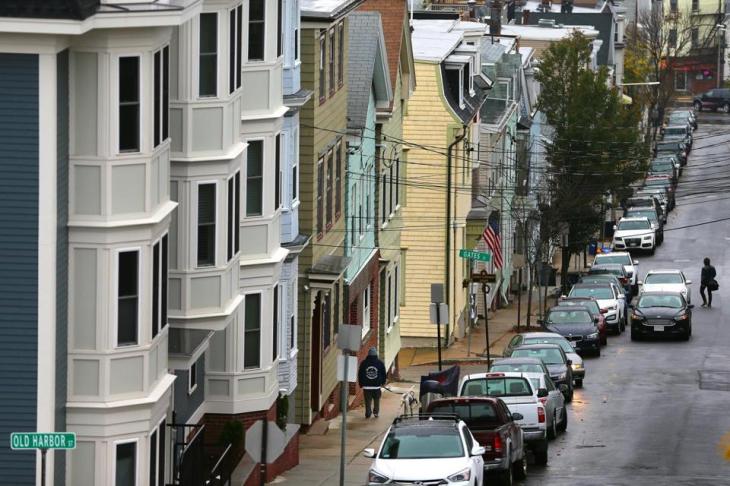
^ “starter homes” circa 1880-1910 in “Southie” : where and how will Boston build them now ?

—- —- —-

That Boston is growing — rapidly — has not caught our governments unaware. Both Governor Baker and Mayor Marty Walsh have called for building thousands of new homes, condominium units, and rental spaces, and both men have taken steps to make that happen. Still, as my twitter follower Molly Goodman of Jamaica Plain noted — retweeting a Boston Globe story: link here :  http://www.bostonglobe.com/business/2016/07/08/house-hunting-greater-boston-good-luck/DgOt0DeBaQBtmFRaOweHfI/story.html?s_campaign=bostonglobe%3Asocialflow%3Atwitter–  where are the “starter homes” ?

Answer : there are hardly any. Almost all the home-building in Boston so far has targeted the high end. And the VERY high-end. How could it not ? Land acquisition costs for a $ 250,000 house are the same as for a $ 1 million spread, and the construction cost for the luxury item isn’t that much greater than for the cheapo version. Developing ANYTHING in Boston also requires huge patience and a team of consultants to shepherd through the BRA design approval stage, the “community” review charade, and the permitting labyrinth. Far better to maximize one’s cash haul than to go through six stages of bureaucratic hell for small beer.

Not even the Mayor, for all his chartered power, can force thousands of home units through thee hells. Any building contemplated in Boston either changes the environ of an empty lot or assaults the vested interests of one with structure upon it. The slapstick pie of a “community” review makes clear right away that those who want everything to stay exactly as it is will swarm to sting change proposals to death. I don’t care what you, the developer, are planning — housing for veterans, market-rate rentals, “affordable” condos, a mixed-use structure, even environmentally sexy upscale dream cottages : sixty people who live nearby will fill the review meeting with every manner of objection, from utility lines to conservation impacts to traffic density scandal, and they will keep you tied up in meeting after meeting until you tell your investors that “heck, this crap ain’t worth it.”

And yet the City grows, despite.

It grows because the arrangements of new businesses right now demand it: closeness to the workplace, no car lifestyle, socializing and shopping within walk or biking distance, and all one’s peers and pals equally nearby. As the most desirable skilled workers congregate, so the businesses must congregate, too; and both mayor and Governor encourage it, and have to, because the new businesses 9and the new million-dollar pleasure domes) bring plenty of new tax revenue to keep the City;’s schools from collapsing, not to mention the public transportation chatchki. All of this is as obvious as gust of perfume at the cosmetic counter; as are the $ 2,200 to $ 5,000 rents that knuckle you in the la-banza.

Thus the call for “starter homes.”

Once upon a time, starter homes — cheapo boxes with maybe 900 square feet of living space — were the urban norm. (You can see them on the streets across from the George Wright golf course on West Street in Hyde Park, hundreds of dachsund-size dwellings built in the 1949 to 1959 decade.) But they were built on vast and unbuilt land surrounded by yet more of the same. Nor was there then any mechanism by which opponents could interpose: the BRA was yet to be. Tens of thousands of these $ 6000 homes — yes, $ 6000; that was the price of a starter home back then — were built in Boston’s outlying neighborhoods, just as, forty to sixty years earlier, homes at a wage-earner’s price were built all through Dorchester, Mission Hill, Roxbury, and Brighton; and still earlier, in East Boston and “Southie.” Life was so much simpler then. Thousands of newly immigrated wo0riuers needed homes ? Homes were built and sold — bingo ! — on land formerly farmed and sold to developers for what was then lottery prize money (but which would today hardly buy you an economy car), and neither the farmers nor their neighbors complained or had any say in the matter.

It was easy. The city’s merchant and manufacturing elite wanted their workers housed, and those workers had the votes, and the builders were mostly immigrant workers too, and all coincided. Today not so. The entrepreneurs want their workers close, but the builders have to foot the bill, and those who already live on the parcels that would be built upon have pride of place. So : what to do ? You tell me.

If Mayor Walsh really means to get his 53,000 housing units built — and I think his number is at least 53,000 short — he ought to use his powers to get it done :

( 1 ) establish a new approval process in which proponents have just as easy time of it making themselves heard as do the opponents in today’s review charade. Imagine Boston 2030 is already doing this online.

( 2 ) take derelict properties by eminent domain and condemnation and auction them off for affordability-covenant housing; do the same for derelict industrial properties between Massachusetts Avenue and Norfolk Avenue in “Ward 8”

( 3 ) fill in tidal flat land extending out from Columbia Point (and maybe also from Castle Island), as our ancestors did in the Back Bay, for the express purpose of building affordability-priced housing of various kinds (condos, two family homes, three deckers, and singles)

( 4 ) approve the Widett Circle area for as much housing development as feasible, with associated shopping and amenities

( 5 ) cut the land acquisition cost to $ 1.00 per parcel, so that developers aren’t forced to seek the top end customer.

( 6 ) enact a $ 15/hour minimum wage, so that full time workers who live in Boston, or who want to live in the City, can actually afford, eventually, to buy an affordable home and pay a mortgage. ( Even at $ 15/hour, affording a starter home will require two incomes. Assuming a slightly higher wage of, say, $ 18 an hour for the two workers, that’s a monthly earning of about $ 5500: which just happens to be the median family income in Boston right now.)

We should be planning for 100,000 units of housing; that number would by itself so increase the supply as to hold prices back — and halt the dangerous ascent of rents — and we should prepare for the infrastructure, utility service, and school choice and innovation requirements that so many new residents will want and need. Remember : growth means change; life is change; supposedly, we like life; let’s see if our liking of life is more than just happy talk.


UNIONS AND BOSTON CITY HALL

Walsh

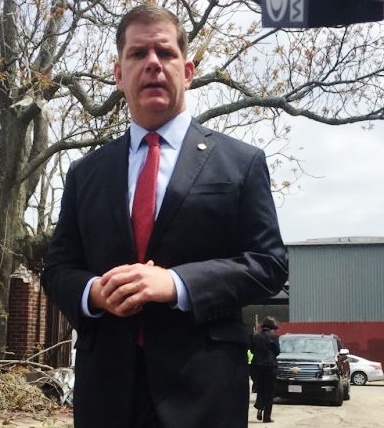
^ Mayor Walsh : a former labor leader who, as Mayor, cannot do “job actions.” And now knows it

—- —- —- —-

Responding to indictments of Boston City administrators Ken Brissette and Tim Sullivan by the United States Attorney’s office, some who oppose the accusations are saying not only that City Hall is not at fault in the matter but that City officials should actively encourage union hiring and union organizing. I cannot agree.

Private industry employment is none of any government’s business. The only exceptions are rules basic to all employment : minimum wages, safety concerns, paid leave and the like, as well as wage theft and workplace abuses. These are matters for the Attorney General, not for City Halls.

Association is protected by the First Amendment and by similar clauses in state Constitutions. But authorized does not mean prescribed. It is up to the associators to decide whether to associate; and firms whose employees do not associate are not to be penalized thereby, nor preferred.

City Hall certainly has a mission to attract business into the City. But attracting business does not mean telling those businesses how to manage their hiring. A City that attempted to impose such a condition would soon find itself losing businesses, not gaining them. (It has already been tried in Boston.   Two years ago a hotel developer cancelled his development when a City Councillor, at a public meeting, demanded, as a condition of his support, that the hotel be a union shop.)

Labor Law governs the organizing of unions. It neither discourages nor encourages one or the other choice. This is how it should be. Those who form businesses are free to decide how best to address their employee relationships; and they are free to campaign against the formation of a union. Those who seek to organize a union, or to maintain one, must make their case.

Other nations may do this differently; in Germany, unions are preferred, at least in large firms, as a matter of public policy. Yet even in Germany, the government does not intervene to force a decision, or to dictate to firms seeking government licenses. Much more the case in our nation, where no law or public policy permits governments to impose labor agreements upon  businesses, much less demand it.

Our law on these matters may change; but until that happens, no government official can do what Brissette and Sullivan are accused of doing, and no government head can order it or encourage it. If it is to be a condition of Boston city contracts that a firm hire a union work force, that rule must be enacted via home rule petition. My sense is that such a petition won’t pass the legislature any time soon; nor can I support it. Nor do I think such a law would or should survive Constitutional scrutiny. Yet even if I am wrong, until such law is enacted and court approved, City Hall must be scrupulously workforce neutral in the matter of approving applications by companies for city licenses.

As for the case itself, which some union activists are protesting — saying that the accused can’t have extorted because they asked “nothing for themselves” — since when is it not extortion for A to force B to pay money to C ?

—- Mike Freedberg / Here and Sphere

A PRIMER ON CIVIL RIGHTS

Civil Rights Governor

^ Charlie Baker of MA : a civil rights Governor

—- —- —-

The civil rights of transgender Americans aroused a contentious debate here in Massachusetts, one that led up to Governor Baker signing Senate Bill 2407 into law. The arguments advanced by opponents tell me that a lot of Americans do not understand what civil rights are all about.

First : “civil rights” for transgender people are NOT “favoring the 1 percent over the rest of us,” as opponents claimed. Civil rights are not a matter of numbers. Every single person, individually, is guaranteed his or her civil rights, as basic as the civil rights of a million people.

Second : the civil rights of one person NEVER impedes the civil rights of another. Opponents of civil rights for transgender people liked to say that such rights violate the “privacy rights” of others. This is false. First of all, “privacy” is not a civil right; it is grant that can be limited, and is; and it may, in some cases, be taken away entirely. None of this can be done to a civil right. Ensuring the civil rights of one class of persons enhances the civil rights of all people. As civil rights are, by definition, those rights that the society guarantees to all and each, the guarantee works in both directions : each person in the society respects and defends the civil rights of all, and all defend and respect the civil rights of each. Civil rights are reciprocal rights.

(Opponents of civil rights for transgender people who say that bathroom rights impact other people’s privacy are correct — but beside the point. Civil rights are paramount BY DEFINITION.)

Third : civil rights are different from basic human rights. The right not to be murdered, or tortured, raped, or kidnapped, or subject to cruelties — rights to life and to not have crimes  malum in se committed upon one — are basic to any society whether it guarantees civil rights or not. They are yours no matter what. Civil rights are contractual: covenants of citizenship according to the compact made and ascribed to by those who live in a society. Civil rights can differ from one society to another. We in America have ours. We’ve fought wars, and many have died, to assure our rules:  the right to vote; to have equal protection of the laws; and to have equal access to the services and benefits offered to the public by enterprises, organizations, governments and individuals, as well as the many rights enumerated in Amendments 1 through 8 of the Constitution; and we assure them to each and all.

As for the phrase “right to privacy.” it suffers from imprecise ascription. Many Supreme Court majority opinions concerning contraception, abortion, and sex between consenting adults seem to suggest that privacy is a right. Opposing Justices — Scalia being the most vocal — say there is no such right in the Constitution. What, then, is the right that Courts call “privacy” ? The true answer is to be found in cases such as one (I cannot find the citation) in which Justice Frankfurter described certain rights as those whose violation “shocks the conscience.” The shocks that he alluded to are rights which he, and I, referred to earlier as basic human rights — which even prisoners and inmates of asylums possess. The most basic of these rights is to control one’s body and be sacrosanct in it. I see no difference, legally, between protection from infliction of cruelty and control of one’s sexual and reproductive functions. It would be far stronger for Courts to refer not to privacy but to “basic human.”

So there we are. Civil rights are societal contracts. Basic human rights are inviolable by anyone. And both are reciprocal : each to all and all to each; but different.

—- Mike Freedberg / Here and Sphere

JUDGING THE STATE’S FY 2017 $ 39.1 BILLION BUDGET

Baker budget 17

^ The Governor does not look happy to have to assess a FY 2017 State budget almost $ 500 million short

—- —- —-

A few months ago, Governor Baker proposed a FY 2017 state budget totaling $ 39.5 billion. It included spending increases to fight the opioid addiction crisis, early education, the DCF, Transportation, and local aid. Then came news, from revenue analysts, that tax revenues would fall short of estimates, by some $ 486 million. Perhaps this news was too dire, but the legislature cannot risk that; and so the year’s budget was reduced to $ 39.1 billion, and that is what the legislature voted — unanimously — just before the deadline date.

This link to Joshua Miller’s Boston Globe article itemizes the expected budget allocations and cutbacks : https://www.bostonglobe.com/metro/2016/06/29/state-budget-plan-avoids-dramatic-cuts/J0UpYwp6mG6bcn1t50TGpN/story.html

Various news sources report the revenue shortfall will be higher : $ 750 million to $ 950 million. Little wonder that Governor Baker may well take the full ten day review period to decide what cuts to make. One department that seems sure to take a hit is the State’s Sheriffs. How will the fourteen Sheriffs expand opioid addiction treatment with less money than they already receive ? How increase their education, mental health,m and job placement programs, so vital to successful re-entry into the community by those in custody ?

Somehow, the State will have to make up for the lost revenue. (Much of it is attributable to stock market losses occasioned by the United Kingdom’s recent “Brexit” vote, which caused stock markets to plunge, wiping out taxes on trading profits.) User fees will help. The T’s July 1st fare increase helps. (Note that the FY 2017 budget caps future fare increases at 7 percent rather than ten percent every two years.) And yet…

…as Senate President Stan Rosenberg notes, “the State cannot cut its way to growth.” Infrastructure, early education, the opioid addiction epidemic, T repair and both T and CommuterRail expansion, the proposed North-South Rail connection, and, yes, the 14 Sheriffs will require additional spending. Which means addition revenue. There are two choices now on offer : ( 1 ) enact the two-tier tax initiative to be voted at the November election — an initiative we oppose or ( 2 ) institute a $ 15/hour minimum wage, which will transform maybe 500,000 workers from EITC (earned income tax credits) recipients to tax payers. We support this proposal, for revenue reasons and many more socially valuable benefits it would bring.

Massachusetts cannot long continue to fund the voters’ needs on current revenue sources unmodified. I suspect that when it comes time to debate FY 21097’s Supplemental budget – and there WILL definitely be a big one — the revenue source squeeze will be on everyone’s debate plate. It should be.

— Mike Freedberg / Here and Sphere
 

AMATEURS AT CITY HALL

1 Walsh 2016

^ Mayor Walsh does not look happy (photo Masslive)

—- —- —-

Two City of Boston officials, Ken Brissette and Tim Sullivan, now ind themselves in hot water for acts that neither man may have fully understood the consequences of. I suspect they now know. I suspect, too, that other officials in City Hall know that operating a government is not a license to browbeat those you are dealing with.

Si here we are ; the United states Attorney has charged Brissette, the City’;s director of tourism and special events, and Tim Sullivam, administrator for inter-governmental affairs, with violating a Federal statute 18 USC 1951, of which I quote the relevant language dealing with extortion :

“(a) Whoever in any way or degree obstructs, delays, or affects commerce or the movement of any article or commodity in commerce, by… extortion or attempts or conspires so to do, or …threatens physical violence to any person or property in furtherance of a plan or purpose to do anything in violation of this section shall be fined under this title or imprisoned not more than twenty years, or both.

“(2) The term “extortion” means the obtaining of property from another, with his consent, induced by wrongful use of actual or threatened force, violence, or fear, or under color of official right.”

The full statute can be read here : http://law.onecle.com/uscode/18/1951.html

If the facts alleged in the revised Federal indictment are true, the Statute is clearly violated. The two men are said to have told an entertainment company that they would not deliver it the entertainment license which said company had already obtained in full compliance with applicable Boston City ordinance, unless said company hired workers it did not need or wish to hire, at extra expense to itself.

The two men are said to have done what they did despite being informed, in writing, by two (2) officials, one from the State, one from their own boss, the City’s Director of Operations, that they could not withhold the license.

Defenders of Brissette an d Sullivan argue that they did not violate the statute because they sought no money r themselves, only for others. The argument is without merit. Sincve when is it not extortion for A to threaten B on behalf of C ? In the classic criminal case, a leg breaker tells a bookie to pay his debt to some sort of crime boss. The leg breaker isn’t seeking this payment or himself; yet he is surely an extortioner.

In the instant case, the funds that Brissette and Sullivan are accused of extorting were to be paid to certain persons whom they demanded the entertainment company to hire. In some respects this extortion is even more serious tha the leg breaker case. In that event, the money was at least in fact owed; here, the money was demanded gratuitously to individuals who had no idea, until informed, that it might be coming to them.

Clearly rissette and Sullivan, both good men who try to serve Mayor Walsh loyally, wated to help a Union, Local 11, get work. that is a laudavle mission. Workers should get work, and City officials certainly have a right to advocate for them. For a mayor whose core loyalty is to Labor, ad who served as a Labor leader prior to winning election, assisting union members to get work is a priority; and that is OK. Yet priority does not justify what Brissette and Sullivan are accused of attempting. Perhaps they meant well; but to have continued to withhold a permit fully complied with after being informed by the two officials that they could bot do so was an act foolish and more than foolish. It was intentional.

Defenders of the two men say that there is “no right” to a permit and so no extortion. Yet a look at the City’;s own language, in a recenta nnouncement (March 4, 2016), contains no hint that the issuance of an entertainment permit entails the applicant hiring union employees favored by City officials :

Click to access CAP%20Announcement_tcm3-53050.pdf

If City hall wishes to make hiring union employees favired by it a condition of obtaining an entertainment license, it needs to say so; and to pursue the home rule petition that would be need to legalize any such requirement. I doubt any such home rule petition would get far. Even the state’s prevailing wage law, for construction contracts, re quires only that a company pay the standard wage for union contracts. It does not order such contractor to hire specific employees preferred by it.

We have seen this sort of union organizing before. two years ago a City Councillor mobilized some of his constituents to protest a hotel project and demand that said hotel, once built, hire only union workers. The hotel developer withdrew his project, as well he should. (I have no problem at all with the hotel workers union, a well run union and smart; but it is not for a City official to demand Local 26 be hired as a condition of the project.) At the opposite end, we have seen alleged the Teamsters using violent acts to extort jobs from companies shooting movies in our City. These events are spoken of in the Brissette-Sullivan indictment, as a concurrent action, one which Brissette and Sillivan are not said to have decried even once.

The union local on whose behalf Brissette and Sullivan are accused of extorting is very lucky, I think, that it is not facing indictment as well. Though initially unaware of the moves being made on its behalf, the indictment alleges that said union became aware of what Brissette and Sullivan were doing and, so ar as the indictment tells us, uttered not one word of warning that Brissette and Sullivan were going too far. I suppose that the union is off the hook because it did not know precisely what was being done on its behalf.

Yet from comments being posted online by some union leaders and supporters, I wonder whether City Hall will not feel emboldened to attempt requiring that applicants for permits hire union workers favored by City hall as a condition of their applications being granted. If such a policy is being advanced, it will engender enormous backlash, and probably should. Government has no business taking sides in the bargaining and hiring process other than to ensure fairness.

Observers are saying that the Walsh administration needs to bring in wise hands who know what they can do and can’t do, who don’t translate good intentions into potential crimes. Yet the Walsh administration had a “wise old hand” on its team : the “director of operations” who informed Brissette and Sullivan that they could not do what they ended up doing. That person, a veteran of the Menino administration (in whose twenty years not one City official was ever charged with official crime) has since left the administration — reportedly after losing out to the City’s director of staff — and has not been taken back aboard.

That’s hardly a great precedent for the prospect of Walsh bringing aboard “wise old hands” who have the gravitas to temper Walsh’s passion and see that it does not get him in trouble. I can think of several such, who supported Walsh in his 2013 election, and one in particular, who knows what can and can’t be done. We’ll see if said person, or someone of equal reputation, is allowed into Walsh’s youngish inner circle.

—- Mike Freedberg / Here and Sphere

BOSTON LATIN ENTERS THE INTERIM

Mike Contompasis

^ Mike Contompasis doesn’t look happy to be called back to duty…

—- —- —-

Yesterday Mayor Walsh announced that Michael Contompasis, former headmaster of Boston Latin School, would return, to serve as “interim” headmaster following the abrupt resignation of Lynne Mooney Teta.

Everybody seems pleased by this development. It is hard for me, graduate as I am of a different prep school, to dissent; after all, BLS is not my alma mater. I take full note of the applause given to Contompasis by the BLS family. I also know Contompasis from my years of activism in Boston school politics and in the West Roxbury-Roslindale-Jamaica Plain community. He is highly regarded, always has been. It wasn’t easy for him to succeed the legendary BLS headmaster Wilfr4ed O’Leary; but he did so, and alumni from his years atop BLS worship him. City Councillor Matt O’Malley seems to have played a significant role in convincing Contompasis to return to BLS. A BLS alumnus himself, he lauded Contompasis at the presser announcing the former headmaster’s return.

Almost certainly, Contompasis assuages the fears of BLS parents — and parents who hope to see their kids accepted in the future — that BLS might slack its rigor. And yet I wonder if they’re right.

First, Malcolm Flynn is evidently not coming back. Second, I am informed that Mooney-Teta was unwilling to come back. Thirdly, nothing said at the presser gave any assurance that BLS will not knuckle to critics.

How long will his “interim” last ? Will it be as consequential as John McDonough’s two years as Interim Superintendent ? Will Contompasis maneuver, as quietly but unsparingly as McDonough did, to assure reform of BLS without diluting its mission ? That is what we are being asked to accept; yet McDonough’s reforms, significant briefly, were not given time to harden; and today they are under attack from the forces (the teachers’ union and allied parents) that distrusted McDonough’s direction.I would be surprised if the same outcome did not overtake Boston Latin.

Hopefully the next permanent headmaster will not come from elsewhere than within the BLS administration, as McDonough’s successor Tommy Chang was brought in from far away. I do not trust the City’s administration to stand up effectively to street level demagogy. It has failed almost every confrontation with street protests so far.

That said, BLS is different. It is one school, not an entire school district. Its constituency is a powerful one, and focused. It is difficult, too, for the Mayor to talk — as he does — about assuring every kid a n excellent school while trying to finesse Boston Latin School. The willingness of Mike Contompasis to return to BLS probably removes this dispute from the Mayor’s 2017 re-election worries; but what then, come 2018 ?

—- Mike Freedberg / Here anmd Sphere


THE FIGHT FOR BOSTON LATIN SCHOOL

purple and white

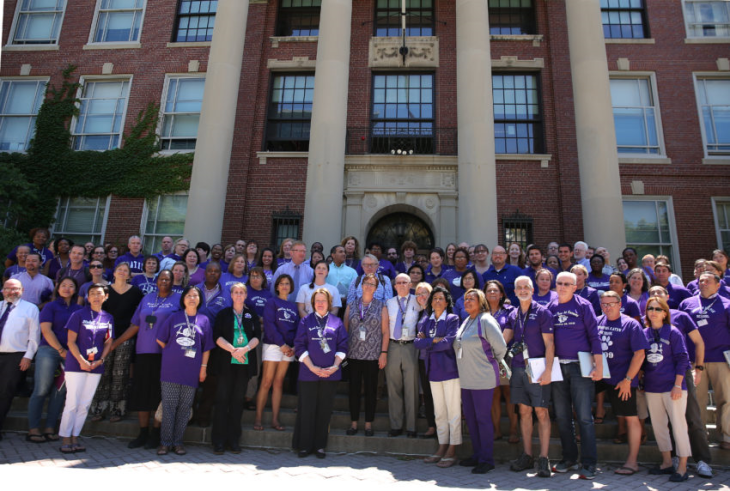
The Mayor has himself a big problem now. “Kicking that hornet’s nest,” as my friend Mary calls his conflict with Boston Latin School and its powerful community, accurately depicts what he has on his hands. Faculty, students, parents, administrators, alumni — and the City’s taxpayers : the Boston Latin School community is enormous; and is also a large part of the leadership of our City, in everything. For Mayor Walsh and his unhappy Schools Superintendent Tommy Chang to have refused BLS headmaster Lynne Mooney Teta their full confidence — to have refused to accept her resignation, and that of head of discipline Malcolm Flynn — was to slap the City’s leadership in its collective face.

Perhaps Mayor Walsh thinks the BLS community is just another “elite,” at a time when elites are under enormous political attack ? If so, he doesn’t know his City very well. Elites are under attack because they have forgotten that, in exchange for high position, they owe a huge debt to the communities they are elites in. That is NOT true of BLS and its people. BLS students are OUR elite. First, every parent in the city wants her kids to go to “Latin” and, if not lucky enough to get in, at least glad to have had an equal chance at the rigorous entrance exam. Second, you do not have to be an elite child to be admitted; BLS for a very long time has taken kids from all backgrounds and economic circumstances. Third, a major portion of BLS graduates stay in Boston to be the City’s leaders — and the leaders of almost every neighborhood in it.Which is why the outcry from BLS supporters has arisen in every neighborhood. BLS is indeed OUR elite, our precious treasure.

The two students who touched off the entire controversy by complaining of racial incidents may have seen how similar students, complaining of similar incidents, have been able entirely to overturn administrations at big colleges and install their own, students’ rules. If something like that outcome was what the BLS pair wanted, they badly misjudged. Well ? Young people make mistakes. I don’t find the two students’ misjudgment a big deal. I don’t fault them at. all. The Mayor and his Superintendent, however, should know better.

The Mayor, at least, should know that elites, when they acknowledge their debt to the community that has raised them high, and perform their obligation to be its voice, are the essential bulwark a community erects against arbitrary leadership. Time and time again, elites have stood fast against tyranny, blocked the path of demagogues, dispersed mob rule. Elites framed our Constitution, articulated our national purpose, fought and died for civil rights, led the nation politically; they’re the voice of civic reform, of betterment, of moral commitments between diverse peoples and ways. Perhaps the mayor does not grasp what a morally committed elite is. In the world of labor Union conflicts that made him who he is, it’s power versus power, force against force; moral obligation has little to do with it.

He is learning that lesson now. Unfortunately, his first move is a wrong one. Boston.com reports that an “interim” headmaster will be appointed. (Read more at this link : https://www.boston.com/news/education/2016/06/26/interim-boston-latin-school-headmaster-named-week ) Chang made the announcement. It is a mistake. No one in the BLs community is going to accept it.

I am not sure that Superintendent Chang can recover; on this and on the Mayor’s schools consolidation plan, he has looked like an afterthought and sounded like a human talking point. (The City’s REAL education chief is Rahn Dorsey, the Mayor’s personal education executive.) But the mayor CAN recover — if.

If he very quickly settles with Lynne Mooney Teta and Malcolm Flynn; if he commits support to BLS’s rules of operation; if he makes clear to student and parents that he wants BLS to go forward as is, to pursue its rigorous excellence as it sees fit; and if he stands with BLS’s leaders at a press conference at which he declares all of the above with the passion and solidity that i have seen him give to the Boston Building Boom, to Labor, and to Civil Rights.

He can do this. He needs to do it soon. Making an opponent of BLS is a very good way for him to put his upcoming re-election at serious risk.

—- Mike Freedberg / Here and Sphere

A WRONG TURNING

Frederick  Barbarossa

^ the last political person to come close to achieving — peacefully — the political and economic unification of Europe : Frederick Barbarossa (and his wife Beatrice of Burgundy)

—- —- —-

You may be wondering why I have chosen Frederick Barbarossa, German emperor from 1154 to 1189, as my lead photograph for a 2016 story. I will explain it all, but later. First, the shocking news from yesterday :

About 2 AM, we knew the amazing result: a slim majority of United Kingdom voters chose the wrong path for their nation. Leaving the European Union would, were it actually to happen, benefit no one and harm almost everyone. Economic unity is only half the unity needed by advanced nations, but half is better than nothing.

Fortunately, the actual leaving is unlikely to happen. Scotland voted 60-40 against; were an “exit” to take place, Scotland would leave the United Kingdom and remain in the European Union (EU). Northern Ireland, too, voted not to separate from the EU. If an exit takes place, it will likely join the Irish Republic. Most seriously of all, however, is that London, the Kingdom’s capital city and by far its economic dynamo, voted strongly against leaving the EU. Londoners are now talking of separating from the rest of England. Were an exit to happen, without London exiting, the exit would be a fizzle as well as a failure.

We’ve seen this before. Twice, Quebec held referendums on leaving Canada. Each time, the vote failed (albeit narrowly) because Montreal voted almost two to one against and made clear that if Quebec were to “leave,’ Montreal would leave it.

The Quebec separatist vote was ugly tribal. Supporters of separation railed against the racial and nationality melting pot of Montreal, blaming “minorities:” for the failure of the province’s”native French” to secure their own state. Yesterday’s vote was tribal too. “Leave” spokespeople decried immigration, especially immigration into England by Muslims and other dark-skinned peoples. But for such immigration, aggravated by the swarms of refugees escaping the Middle East, there would probably have been no “Exit” referendum at all.

As we in America are seeing, the Western world is awash right now in anti-immigrant ugliness, a gutter fascism of hate, scapegoating, and tribal intoxicants in which all the old, long dissipated totem poles of identity have been resurrected and legitimized by demagogues. Anybody who has read the ravings of the “Leave” interest’s Nigel Farage has had to put up with ugliness scarcely less vulgar than that of Donald Trump, our own nation’s scourge of tribal venom.

It should be quite clear, in the 21st Century, that tribal politics is a false fantasm. There IS no “tribe.” The people who inhabit a nation are constantly a changing mix. This has always been true., As far back as we can record human history, the people of any area other than those in utter, extended isolation have been a mix of DNAs. Today’s “other”: is tomorrow’s family and the day after tomorrow’s ancestor. As for scapegoating the “other,” it is always a con by which con men fool us. Our troubles are not caused by scapegoats but by our own decisions. The Roman Emperor Marcus Aurelius, writing in the 2nd Century, noted that “first we blame others for our troubles; then we blame ourselves; then we do something about them.” We would be weak fools to stay fixed at the first pole.

There is weakness in the EU but not that which the “Leave” demagogues want British people to believe. The EU needs be stronger, not weaker. It has economic power but scant political power. In America, in 1787, our leaders realized that they could not have economic prosperity — nor political strength — without forming a union both political and economic. We forget, today, just how close run a thing Ratification of the Constitution was. Ceding political economic power to a central government was not popular. Yet once in place, the Constitution and its government began to forge its own, unified political and economic interest, a following that grew both economically and politically as did the nation, strong enough, and loyal enough that, 84 years later, it was able to absorb and defeat the shock of secession.

Secession among the EU nations hasn’t the same air of treason because it is not treasonous to leave a union purely economic, not political at all. The EU’s founders shrank from confronting the political question. Often, since, observers have remarked that the EU’s reluctance to embrace political union would damage it, even destroy it. Now, with yesterday’s “leave” vote, one of the EU’s political adherents has put the precise question.

Will the exit actually happen ? One wonders if and how. If Scotland, Northern Ireland, and Greater London (and its satellites, Oxford and Cambridge, which also spurned “Leave” by huge margins) plus Manchester (another city that voted “remain” by better than two to one) leave the leavers, who exactly will be doing the EU leaving ? I think the crisis will pass.

Still, the warning has ben sounded. Unless the EU’s component nations bite the bullet of political union, as we in America did in 1787, their economic sharing will henceforth suffer loss of confidence by businesses and investors; will be less and less able to impose economic rules on its components; will bit by bit fade away as nations decide it’s best to chance the economic tides alone than in company. Unfortunately, we know that story’s outcome only too well : conflict, distrust, nationalism, war. Ever since the break up of the Roman Empire, these were the larger story of Europe; not always, but always next. A major difficulty was the predominance of one European nation over all the others. Mostly, since about the year 925, that has been Germany. If not Germany, it has been France. Whichever nation ruled, however, its dominance always ended in tragedy for everybody.

The EU, like its smaller predecessor the Common market, has tamed the beast — but not snuffed it. Germany rules today, every bit as strongly as it did in 1870, 1910, and — yes — 925 to about 1200. Curiously, the converse argument can be sustained : that Germany even at its strongest was never quite strong enough. Germany under the Salian emperors, from about 925 to 1200, almost dominated Europe’s culture and trade : but not quite. France was outside, as was the Papacy (then a major economic and political power). Germany’s dominance was cracked in the 1070’s — the famous “investiture conflict” — and then broken for good, in the period 1220 to 1275, by a centralizing, well-led France and the newly powerful Papacy. Never since (except briefly during terrible wars) has any European nation come close to the political and economic unification of Europe that was lost then; and all of European history until today has been plagued by that failure.

Will the men and women of the EU, and of its various component nations, now take the only steps that can make the EU lasting and strong, a living political thing ? I do not know. I do think, however, that this is their chance. Maybe their last chance.

—- Mike Freedberg / Here and Sphere

HOW TO GOVERN AN ACHIEVEMENT SCHOOL

BLS

^ Boston Latin School (BLS) : anger and frustration lead to major confrontation

—- —- —-

UPDATE 2.10 PM 06/23/16: This morning we were shocked to rtead that Head of Discipline Matt Flynn has now resigned from Boston Latin School’s management. This makes two major resignations. Peter Kadzis of WGBH also reports a very heated confrontation between BLS leaders and Mayor Walsh. Clearly the operation of Boston’s top achievement school has reached a turning point.

We don’t know the details of the events that seem to have resulted in the resignation of both Flynn and Boston Latin School headmaster Lynne Mooney Teta, which means that we cannot opine about them. If the Boston Globe report is correct (follow this link to read it : https://www.bostonglobe.com/metro/2016/06/21/boston-latin-school-headmaster-resigns-wake-racial-controversy/GuY6mdBIlRuXp2CWWotmoN/story.html ), her resignation was not requested by anyone. But she was evidently facing a civil rights violations investigation by the U.S. Att0rney, and discussions had taken place during the school year in which she felt obligated to allow others than her, as headmaster, to impose rules to govern the school.

There may well be good cause therefor. Much that happens in controversial events goes unreported, or is erroneously credited. All sorts of assertions have come my way via social media friends . The purpose of this article, however, is to set forth how I think an achievement school ought be mastered.

An achievement school like Boston Latin is no student’s right to attend. Students compete to be admitted. An achievement school must be challenging, academically and socially. I myself went to an achievement high school — Phillips Academy Andover — and I can assure you that it was a difficult place. As a kid there, I spent much time afraid : of my teachers, of my housemaster, of bullies. Almost every kid walked in fear of the “jocks” and big guys who ruled the campus Trump-like. They, like him, were crazy — unpredictable, secretive, noisy, arbitrary. One day they’d befriend you, the next day make merciless fun of you. And then ignore you. Or short sheet your bed.

Did our faculty step in to save us ? Never. You were on your own. I recall one time when I could not take the bullying by one particularly gross kid in my dorm and made complaint to my housemaster. His response ? He overturned my bed and laughed at me.

It was hard enough for the Jewish kids in my class; for the very few Black kids, life was never anything but one ambush after another by those who felt it smart to imitate the “jocks.” (Note : the “jocks” were far from the worst social offenders. It was the wanna-be’s who made campus life truly nuts.) As for the school administration : Catholic kids are supposed to not eat meat during Lent, but at my prep school they had to ask for a fish meal — it wasn’t supplied otherwise — and that meant outing themselves to the overwhelmingly Protestant majority.

In class, there was no escape, no mercy. If your attention happened to wander, in Mr. McClement’s math class you could expect a chalky eraser to come crashing against your suit coat shoulder as he screamed at you, “take one demerit !” (Five “demerits’ and you were on probation; seven and you were expelled.) Other teachers resisted the eraser caper but were, if anything, more ready to toss you a “demerit.” (I was an unusually lucky kid. I got only two during my entire three years at that school.)

There was a dress code. It made no sense. You had to wear suit coat, tie, and white shirt, but nothing was said about pants and shoes, so many kids got their licks by wearing dirty khakis and taped up loafers without socks. This was a great way of being “jock like” and helped gain you much cred with the Trump types.

But the rules were the rules. Once, when the junior class went on meals strike because we could no longer stand the cardboard and putty that went by the name of “food,” our Headmaster, one John M. Kemper — a former commandant of West Point — called us to assembly and told us that if we continued, he would expel the entire class. We knew that he meant exactly that.

We suddenly, all of us, decided that it was OK to eat putty and cardboard.

In my opinion, that is how an achievement school must be run. The Trustees set the rules, the Headmaster enforces them, no exceptions. And no talk back from the students. You are not at an achievement school to talk back. You are there to grind it out, to take what is thrown at you, just, or unjust, or egregiously unjust, and keep on keeping on: because life is difficult, and unfair, and unjust, and you had better learn pretty quickly that if you don’t learn how to reshape yourself accordingly you will be forever out of shape, and very quickly.

At an achievement school, you must learn that you can always do better; that, as my American History teacher put it to us, “no one will get an A because no one of you can master the subject well enough.” That course was the most demanding I ever took, in high school or in college. And F was never far from catching up to us.

Which leads me to this insight: perhaps the uneasiness that was evidently complained of by students at Boston Latin School gathered steam because school wasn’t difficult enough ? At Andover there was, for a senior taking American History, so much research and dorm room work to do that no one had time to worry about identity grievances. Plus : we were seniors and brutally aware that college admissio0n loomed immediately ahead and that if we didn’t “grind,’ we wouldn’t be admitted to an A list school, maybe not even a B school.

I do not know what possessed students to hurl identity grievances at Boston Latin School administrators, or what possessed those administrators to honor them; perhaps the problem is that BLS is not a boarding school. At a boarding school, kids have no escape, no safe place to hide in, no retreat to Mommy’s skirts and Daddy’s influence. (Let us keep in  mind that, back when I was at school  Daddy and Mommy not only did not sue schools on my behalf, they made it clear they would punish me worse than the school auth0rities.)

Boston Latin School may not be on the edge because its students go home to parents every night : but I do feel that the devolution of a school reputed to be the best in New England says that its academic demands aren’t nearly difficult enough, nor its college admissions demands scary enough. At an achievement school, you work almost all the time at courses which, if you do not work all the time, will bury you; and you do it because college admissions demands you do it. If Boston Latin School is failing to inundate its students in this level of challenge and scares, it probably does require new leadership.

—- Mike Freedberg / Here and Sphere