BOSTON ELECTION : DIFFERENCES APLENTY AT ROX-VOTE’S DISTRICT 7 COUNCIL FORUM

Image

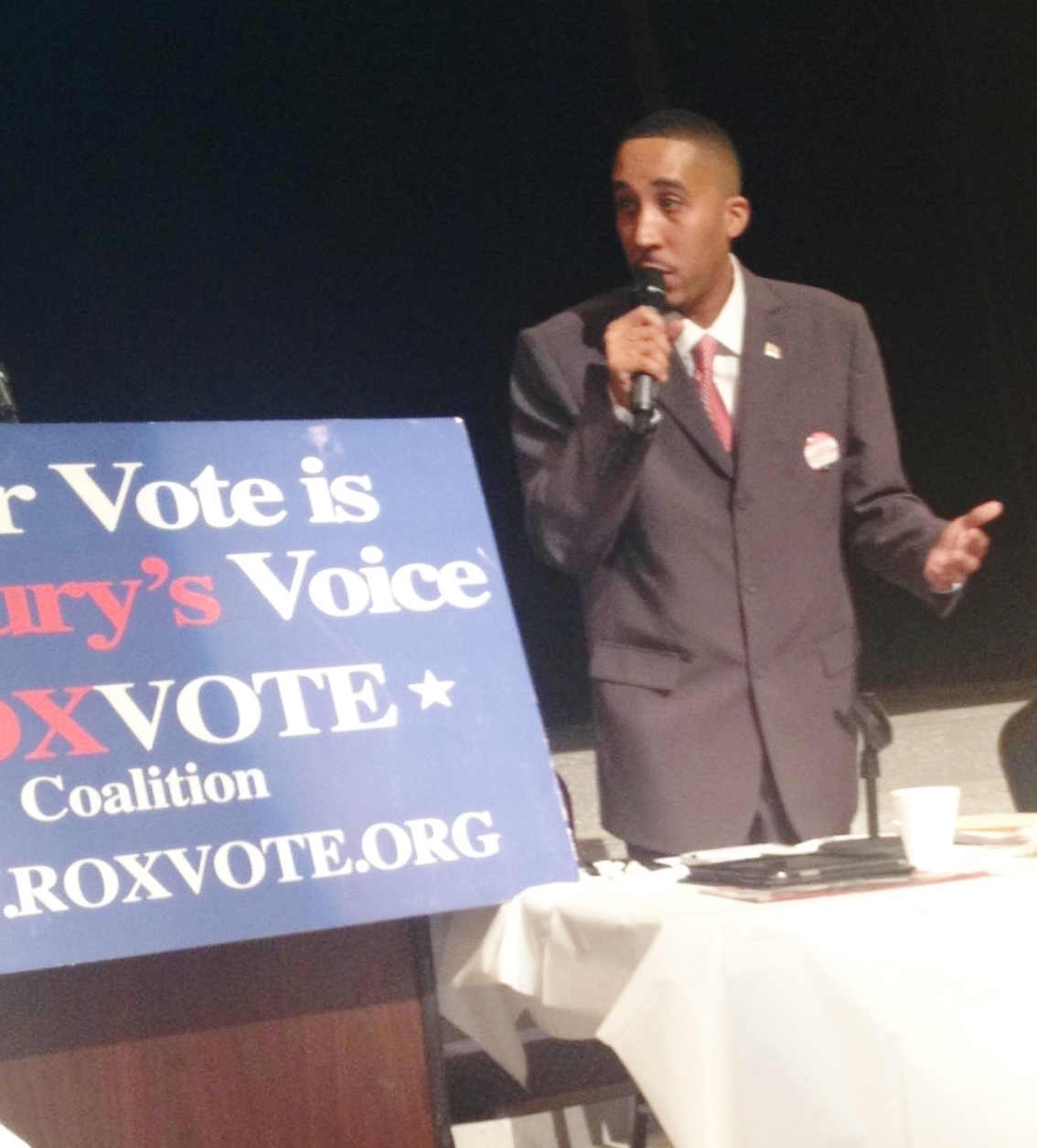
^ insurgent (and endorsed by Doris Bunte) : Jamahrl Crawford acts out at RoxVote Forum

—-    —-    —-


Last night the RoxVote Coalition hosted a Forum for District 7’s three Council candidates, followed by a Forum for the at-Large Council candidates. This report focuses on the District 7 Race, one of three District contests that we are paying close attention to.

The Forum gathered at Hibernian Hall on Dudley Street, and differences aplenty displayed themselves. One saw Tito Jackson, the incumbent, well dressed, well informed, almost professorial as he articulated his council service in detail; Jamahrl Crawford, his main challenger, passionate, a classic insurgent with a long, long history of activism; and Roy Owens, a quiet slender man who has run for office numerous times and whose issue is that City hall should work its Roxbury agenda through faith-based communities.

Time and again Crawford insurged his campaign demands : for housing afforability; that the Roxbury innovation Initiative needs all kinds of enterprises; that city services should revive the RISE movement; that gentrification of the District should mean economic development. Crawford spoke rapidly and intensely, a preacher inspiring. His presentation harked back to an earlier time, when oratory glowed hot onto the faces of listeners; yet it also elicited more applause from the 100 or so voters on hand than either Jackson or Owens. He talked at length about his grandmother, living on the third floor of their Ruthven street house even at her age and being feisty, not one to pander to (as Crawford said politicians do too often when addressing seniors); and this, too, drew applause from many.
Image

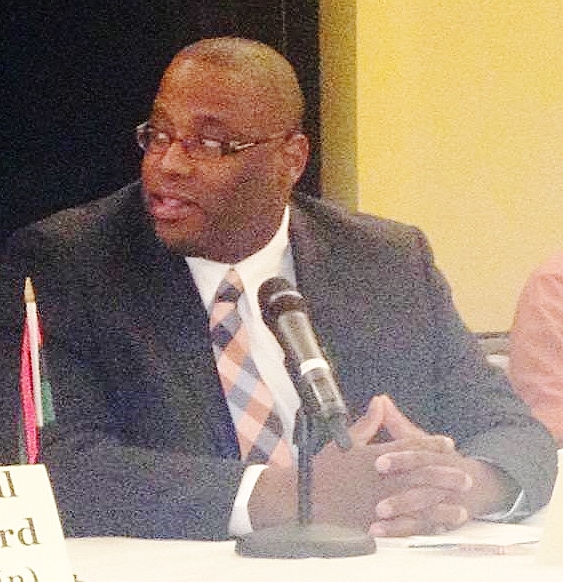
^ detailed answers to all questions but one : Councillor Tito Jackson at RoxVote Forum

Jackson, by contrast, answered every question by narrating the actions he has taken to address the problem or advance the initiative. His housing plan is a three on three : one-third low income housing, one third affordable, and one third market rate. Jackson proposed communication and coffee hours as his constituent outreach proposal. He opined at length about the Boston Police’s Safe Streets task force and the need for the City’s Public Health Commission to rate crime a health problem.

About the Roxbury Innovation Center, Jackson noted that Tim Rowe of Cambridge innovation has committed to run it; but he did not give any answer as to why he was not present when his Council colleague John Connolly, with several prominent Roxbury business leaders at his side, announced his support for said Center. It was at that point that Crawford responded, “we should have had one years ago !”

As for Roy Owens, I mean no disrespect in reporting that his answers were hard to hear, seemed to ramble or disconnect from the question when one could hear them, and often included banter with his two rivals, inaudible except to them. Many in the audience chortled. His was obviously a presence well known to them and long since dismissed. Owens’s one serious point was that all City services should be funneled through “faith based communities.” In a District whose people are so well and diversely led by pastors and church congregations, his call did not seem to me an isolated gasp or readily dismissable. But a generational gulf separated it from Crawford’s protest speeches and Jackson’s managerial steadiness.

—- Michael Freedberg / Here and Sphere

BOSTON MAYOR : CONNOLLY SAYS “I’M THE UNDERDOG”

Image

^ the underdog in South Boston with St rep Nick Collins and, on the left, a man whom you may recognize —  and his son.

—- —- —-

After weeks of leading in the polls for Mayor of Boston, John Connolly today anointed himself the underdog. He even had a poll to prove it. This morning he allowed the Globe to observe as he gave a talk to his finance committee in which he revealed that his campaign’s internal poll shows the race now tied, 43 to 43. This, after a Globe poll last week found Connolly leading 47 to 38 (with leaners assigned). Connolly declared that poll “an outlier’ and said that in fact another poll last week, showing him ahead only 41 to 39, was more accurate.

The release, by Connolly himself, of a poll so bad for him puzzled many. Walsh people gloated that he, the “candidate of working families,” as his spin doctors put it, “had huge momentum.” And doubtless the news of said poll invigorated the already vigorous Walsh door-knockers. So why, then, did Connolly make such a move ?

The answer should be obvious.

By assuming the position of underdog, Connolly gave himself three huge advantages :

1.People who had simply assumed that Connolly would be the next Mayor now had to think again; to contemplate — envision — confront — Walsh as Mayor, with all of its implications, many of them not good for the fisc. This is why Connolly has been gradually stressing — and is now emphasizing — his mastery of the City budget, ahead of his original stance as “the education Mayor.”

2.Given the mountain of big-pol endorsements given to Walsh in the past 16 days, and reports of a tidal wave of Labor Union money from all over, Connolly said something like, “OK, Marty, you ant to be the overdog ? Go right head, be the overdog.  by all means — be my guest !”

3.People like underdogs. They want the small guy to beat the big guy. If not, Sylvester Stallone would not be a multi millionaire today. (As I mention a lot, it is 1959 all over again; John F. Collins with few endorsers against John E. Powers with all of them. Collins won.)

Lastly, with their man now drawing the underdog card, Connolly’s workers can no longer be complacent. Their man is NOT going to coast to a ten-point victory. They will have to work for it — work hard and long and with the foul winds of desperation at their backs. Connolly’s voters too. They know they can’t stay home on election day.

This is the mindset you want your organization to have going into the last week before election day. You want your people committed to aee you win. Connolly as underdog is putting his people to that test. As well he should.

As for Walsh’s people, they need to know this, and I am sure that the smartest of them already knows it : Walsh has bet the farm on his winning.

If he does not do so, likely it is that there will never be another significant Mayor campaign from a base tribally Irish and Union labor. Walsh’s city is receding into history. Indeed, even if Connolly does not win, the society whence Walsh’s core support arises will dwindle and calcify as stony as the statue of Paul Revere in the North End. There already IS a new Boston. entirely new. It is fresh and exciting, open and flush with innovation. It can only grow, and pollenate and bloom, because there is no other way forward. This the Walsh people sense. They’re in  a race against time.  It’s why they have felt such heat, all campaign long, as Connolly seeks to apply to his people, now, with all the marbles anted in.

— Michael Freedberg / Here and Sphere

MEEK AT THE MOVIES : THE COUNSELLOR ( 2.5 stars )

Counsellor

^ mixed up shook up bad gals and bad guys : including Brad Pitt and Cameron Diaz in Ridley Scott’s “The Counsellor”

—-   —-    —-

Not so long ago the Coen Brothers deviated from their usually quirky fare and wove a hard-boiled yarn about lawmen and criminals playing it loose and lethal as they pursued an elusive satchel of money back and forth across the Southwest border.  The basis for that masterpiece came from the laconic and acerbic prose of Cormac McCarthy’s similarly titled novel, “No Country for Old Men.” And in an odd and intriguing, first time move, the scribe, for iconic director Ridley Scott (“Alien” and “Blade Runner”), has delivered his first original screenplay. The result is full of pointed soliloquies, diatribes imbued with philosophy and poetry and even daubs of philosophy regarding poetry; but the mainstays, of course, are protracted dissertations on death and destiny, followed invariably by death.

Just as in “No Country” the plot is driven by an accidental anti-hero ensnared in a macabre web of underworld misdoings. In short, McCathy has cooked up an assured rearrangement of “No Country.” It’s not on par by any means, but it is entertaining. And, if you haven’t gotten enough of him lately, Michael Fassbender tackles the eponymous role (that’s all he’s ever called), as a square-jawed, fashionably stoic defender, who, while very dapper and upper crust, has a litany  of unsavory clients. One, an imprisoned mama kingpin (Rosie Perez put a lot of pizzazz into the brief role), asks him to pay a fine for her son who’s in jail for a traffic violation (going over 200 mph). He reluctantly complies, but doesn’t know that the kid is involved in a scheme to hi-jack a 20 million dollar drug shipment. Which doesn’t matter, because by sheer association he’s now considered one of the brains behind the ever expanding plot.

Zanies and assassins from every corner of the muted desert town start to drift up. And, if the similarities to “No Country” haven’t hit you over the head at this point, Javier Bardem drops in for good measure as the shady club operator who has a few nascent business dealings with the Counsellor. Bardem’s real life wife, Penelope Cruz, shows up too, as the Councilor’s betrothed, but she’s mostly just garnish and a bargaining chip. The real feminine fire power comes from the gams of Cameron Diaz as the high priestess of the Southwest gangland. She’s flip, enjoys Gucci and Prada and doesn’t value life too much, and, if she so desires it, she’ll fuck a Ferrari (no joke).

Brad Pitt’s in the mix too as another shady sort who advises the Counsellor on how to get his neck out of the noose, but his role, like Cruz’s, feels more ornamental than substantive and perhaps somewhere out there, there’s  a studio exec who thought it would be devilish fun to release Pitt and Fassbender in this western noir the same week the pair appeared in the more serious, “12 Years a Slave”–celluloid buddies to save the day at the box office?

The problem with “The Counsellor” isn’t so much the every twisting and inward folding machinations that keep the engine humming. That works quite well, the problem is that none of these people are likable and Fassbender’s Counsellor is such a stiff, you never really give a rat’s ass if he gets offed or not. But the film looks great. Scott has always been a visual stylist and really summons up the dusty milieu with artistic elan.  McCarthy too packs it with some rich treasures and a potpourri of indelible underlings. Heads roll (literally) and the stash of drugs is carted around a septic truck that from time to time gets shot up and re-patched so that the shit don’t stink. That’s the wicked type of fun “Counsellor” has. It’s not much, but it clicks along just enough.

— Tom Meek / Meek at the Movies

BOSTON MAYOR : ADDITION, NOT SUBTRACTION

Image

^ addition versus subtraction ? Politics at its most basic lesson

—-  —-  —-

My friend Dan Winslow, an insurgent, civil rights Republican to whose US Senate campaign I consulted before gearing up Here and Sphere, liked to say to me, “addition, not subtraction.” Every time I groused about our campaign finding favor with this or that constituency whose agenda or outlook I disagreed with, he would say it to me : “Addition, not subtraction.”

Winslow has since left the State Legislature — a huge loss for imaginative politics in Massachusetts and for a constructive GOP — but his observation remains so true. In our democracy of many, many communities, interests, and individuals, the successful campaign draws from many people different. More singly defined campaigns tend otherwise. There are so, so many voters; hardly any single interest can compass more than a small portion. It’s a losing situation in almost all cases. And once the “everybody else” begin to not see themselves within that single interest, the single interest campaign is cooked.

In this election, there is a single interest campaign almost feral in its singularity. Martin Walsh is a fine, fine man, and a hero of civil rights and personal struggle. By no means should any one disparage him. His friends follow him passionately : that says a whole lot. But as a candidate — on the large picture — he has defined single interest politics. He is a labor leader, labor unions are his career, his expertise, his theme, his following. Articulate he is — though not in debate — and, on many issues, extremely well informed. But everywhere he goes it is palpable that his goals are labor union goals. Labor union’s goals are not, however, everybody’s. Union labor comprises about 14 % of Boston voters. That is a mighty small minority. And the City’s wisest labor leaders know it. They know that if union labor is to advance it must join with other constituencies, other interests, and add to a coalition, not stand alone.

Marty Walsh has worked tirelessly in his campaign to attract other interests. He addresses arts issues, school issues, diversity, interfaith, even innovation; has commissioned 40 position papers, 37 of which his campaign reports are now written; has won to his side many politicians from Boston’s communities of color plus some State Legislators and two Boston Congressmen. Clearly he knows that without allies, his labor union following cannot win.

Walsh has bet the farm, that his outreach will not expose labor’s numerical weakness. This is to risk a lot.

He has allowed labor unions to become a major issue in this campaign; and that is bad for labor unions ; because labor unions aren’t exactly popular with most of the public, even in Massachusetts. Strikes send an unpleasant message of intimidation and intransigence. Take the school bus drivers’ walkout, for example. Yes, Walsh condemned it. But the impression made was not an untrue one. Everyone also remembers the Verizon strike, with its images of angry picketers and stories of vandalism. Nor have Boston’s public worker unions exactly made friends and influenced people. Arbitrators’ awards that risk the City’s finances and portend cuts in other City services make City unions look militantly selfish. Same too for the Boston Teachers’ Union (BTU), which so far refuses to accept that school transformation will happen and that it would be better to help forge it rather than doggedly resist it.

Walsh rejects none of it. How can he ?

Thus his campaign has put labor unions under public scrutiny, in all their stubbornness, their resistance to change, their adversary attitude to everybody else. The passion, the heavy-handedness, the rush of politicians to get with Walsh because they don’t want to break with labor — all of it has been a disaster for labor because it has engendered criticism of labor unions from people who would not have gone down that road, and because those criticisms have now become the common perception.

Labor actually emerges weaker from this campaign than had Walsh not become a candidate. As the respected leader of a powerful force in the city, Walsh had enormous influence. As a candidate, he has risked that influence upon a pitiless test : the judgment of the voters.

ALL the voters.

Meanwhile, John Connolly keeps on adding to his following the “everybody else” who are not members of City labor unions or followers of Walsh’s labor-allied office holders.

—- Michael Freedberg / Here and Sphere

OUR 5 YEAR OLD’s GETTING MANDATORY SEX-ED?

Passed in Chicago Mandated Sexual Education for Kindergartners is like a cold case file. It was a heated debate at the start of the school year, only to make NO headlines since. Outraged as a parent vs my abstract — usually unbiased journalism side, I decided to ask around our area — the south coast, for input on the matter. Here is the result of the things combined above……..

Background 150 people were polled at random, 125 men 125 women from all social, financial, sexual, and political — as well as age brackets. With such diversity in our surveyed pool — for sure there would be a fairly decent ratio of No vs Pro Sex-Ed for 5 yr old’s, RIGHT? WRONG, instead we found that actually only 2% agreed with the idea. When it was revealed that this law had already been passed — AND — became effective in Chicago IL. Public School Systems THIS YEAR……Our polled parties were beside themselves, some angry, others terrified — but ALL posing the question –“But HOW could parents ANYWHERE allow schools to take over like that?” THE QUESTION and ANSWERS posed later in this article  seemed to silence all. If only for a few minutes of self-reflection, and deep thought. As the school year approached, and parents began to hustle for last-minute needs and supplies — parents of kindergartners were preparing in a whole different way. For many,this would be your first year with your baby/ babies in the “trusted hands” of the public school system. This year would begin your journey into uncharted territory — full of unknowns, unthinkable’s,proud moments, and those Kodak Captured milestones — as parents you knew were going to come eventually. Yet the moment that matters is the moments you were living. The moments where you as a parent were in complete control of the outcome. Then you find yourself at that pivotal moment in time — where it stands still — and you realize THIS IS WHAT ALL THE FUSS IS ABOUT… Letting go……Handing the reigns, even if only for 6 hours a day –over to someone else. This was the time you loosen your tight grasp, slowly disengaging your entangled hands — and allowing your child to go into the world and BEGIN to learn……Begin to grow into their own….Begin the next chapter of their life’s storybook. BUT DID YOU CONSIDER FOR ONE MOMENT — THAT YOUR BARELY SELF-SUFFICIENT, AUTONOMOUS, FREEWHEELING  5 YR OLD  WOULD BE ((MANDATED)) TO HAVE SEXUAL EDUCATION TAUGHT TO HIM OR HER??  Didn’t think so….. Well parent’s of Chicago IL. kindergartners got just that. A reworked, updated curriculum — with a mandated sex-ed course starting in kindergarten. Chicago Public School or CPS officials say that the “sex ed curriculum will use age-appropriate language to teach children the correct names of body parts” ———-Are they serious? ” Okay yes CPS, that’s just a brilliant idea — I mean screw the part where what “we as a family unit and PARENTS of said children think or feel — HELL, as long as they are not calling their “thingy” a D**k, and she doesn’t really think the name of her “bubbles” are boobs BY ALL MEANS GO AHEAD…….” In the same statement CPS says it’s curriculum will teach the kids about “bullying, and the difference between appropriate and inappropriate touching.” — ????????????????????? (Okay maybe were way off base here but I’m pretty sure any GOOD PARENT, has had the basic what is okay and what’s not conversation as soon as possible with their child/children. The one’s who haven’t either felt no need “yet” or — at the other end of the spectrum should not be parent’s at all, perhaps more focus on that end would be better than telling “OUR” children things that cross lines. Lines put in place to separate what the public see’s and feels is RIGHT or OKAY — versus how ANY other household may view these  subjects. After looking through comments and quotes made to the press, and even general statements and press releases — made by everyone from the CPS to (SIECUS) better known as Sexuality Information and Education Council of the United States — a reoccurring barely noticeable trend was emerging. In EVERY statement about the curriculum — there always seemed to be loosely used terms poignant enough as to redirect the reader’s attention. We will demonstrate as we move on. Right now we will redirect you ourselves back to our polled people. After confronting them with the question — and the rebuttal they gave (see top for refreshing.) The question was then posed…… Who did you vote for in the last 2 elections? obama its the right thing to do Our polled  group  made up of 47%  republican(only 23% of which conservative republicans) — 45% Democrat (30% of which considering themselves liberal democrats) — and the other 8% being an undisclosed or chose not to identify with either party.  When revealed that they had ALL except 11% voted for President Obama — it was actually quite startling. Ages 18-65 — married, single, divorced, separated — poverty-stricken to wealthy — childless to hands full, and /or expecting — ONE COMMON DENOMINATOR — ALL VOTED OBAMA! Now what does Obama have to do with any of this you may wonder? Well our participant’s did too. The answer is not at all black and white, cut and dry, with very little grey area — actually the more we researched the more we discovered how very deeply into “the grey” this subject is.  Yet Obama does factor in and here is how, In 2003 Barack Obama supported even “pushed” for the proposal of mandated sex-ed for kindergartners — he went on to continue defending his stand on this matter, when running for president in 2008’s election cycle. In 2003 Obama who was the then chairperson for the SIECUS committee, voted in favor of a bill (SB99) or Senate Bill 99 — that suggested making changes to the existing Illinois sex-ed law which at the time required instruction for grades 6-12 that included topics like AIDS how it is transmitted, spread, and how to prevent it. Illinois law also said “schools must teach honor and respect for monogamous heterosexual marriage.” SB99 would have eliminated all mention of marriage in the Illinois sex-ed code. It would have REQUIRED that all material used in classrooms be “age and developmentally appropriate, and medically accurate”. AND PAUSE — here is one example of A.) SPIN, and B.) Redirection from the main point. The main point here is that because heterosexual monogamous marriage is not the only kind of relationship it was discarded and no longer worthy of respect and honor. Also the fact that  “age and developmentally appropriate, and medically accurate.”materials be REQUIRED well (sigh of relief) for a second we thought by trying to veer away from the point of teaching our 5 year old’s sex-ed — AND, taking away ALL mention of marriage, and attempting to redirect our focus — whereby putting us at ease with words like age-appropriate, and medically correct — just might have been the goal. (PHEW glad we cleared that up)……. Age-appropriate….Developmentally-appropriate….Medically-Correct — Here is where it gets sticky…. Who decides what age is appropriate? Is it the same age for everyone? (Especially since males supposedly mature slower than females.) What about the special education students? Or how the term medically correct actually means anatomically correct and human body accuracy. Who is the deciding voice? Who has come into OUR homes and asked OUR “opinion” on what our children are taught? Who asked the parents of these little ones what their beliefs — religious, or otherwise are? class of kids ((CRICKETS))??? Thought so. The SB99 bill — even with Obama’s support and push as he called it, DID NOT PASS in 2003. However here are some highlights to keep in mind. Here is a video from a Planned Parenthood convention on July 17th, 2007 at the Ritz Carlton Hotel in D.C. A “peer educator” in the D.C. public school system asked the then U.S. Senator Obama what his intentions where regarding the continued pushing forth with the teaching of “medically accurate, age-appropriate, and responsible sex-ed”? http://www.youtube.com/watch?v=1zQryISazAc Obama proclaims with much conviction that “SEX-ED FOR KINDERGARTNERS IS THE RIGHT THING TO DO!” Obama is seen in this video joking about Alan Keys a running mate using the truth that “Obama had worked with Planned Parenthood to pass a bill on the topic mentioned above about sex-ed for our 5 year old’s — during the time he served in the Illinois state legislature. Again the terms “science-based, fact-based, age-appropriate etc, are tossed around so freely. But as our polls indicate in (Many if not the majority of households here in the south coast and across the U.S. — sex-ed is NOT something that is taken so lightly. Not every household whether by dynamic or religion, or other variable sees this as a topic to be discussed or even touched upon at such a young and possibly detriment causing age. In many households sex-ed is a “FAMILY MATTER”and should not be left in the hands of teachers unfamiliar with each family the curriculum may affect. Key wording would be Family Matter.” Sex-ed at ANY level at this age is usually discussed at an age and time frame a family / parent’s have deemed appropriate” says one Chicago mother of three. Megan Morrow: ” I am pissed the hell off she tells Here and Sphere. I am a mother happily married — my husband of 9 years is in the military, active duty at the moment. Our youngest child is adopted, he is 5. We adopted him when my sister passed away when he was 1 month old. We have not told him ALL of his story yet! ((she sobs)) ……. The new curriculum teaches them all about the different family dynamics and “types of families” including adoption…… “Why some kids look nothing like their “parents”etc. Our son adopted or not has bright red hair — his fathers genes were clearly dominant — the rest of our family are dark-haired, olive complected, dark-eyed….((more sobs)) — he is a very bright child he will know.” she exclaimed…. “I don’t want to play beat the clock to tell him first, unprepared with my husband lands away — ITS JUST NOT FAIR…… There are so many similar stories it is heart breaking. Delving deeper into the curriculum we dug up a “teacher’s memo” showing things no media outlet has even touched on. Such as our 5 year old’s spongy little brains  may be just test subjects in a 7 year implementation of curriculum — developed to assess if it has low-mid-high or no impact on  Chicago’s nationally higher documented STD and underage, unwed pregnancy rate among K-12 graders. The “teacher’s memo” consists of these sentences:

  • Part of the National multi-year Evaluation of Adolescent pregnancy prevention approaches funded by the office of Adolescent Health U.S. Department of Health and Human services.
  • Conducted by Mathematica Policy RESEARCH.

Here is the link you be the judge — http://www.hhs.gov/ash/oah/oah-initiatives/assets/ppa_chicago_implementation_report.pdf When researching for a broader opinion and/ or more facts regarding the curriculum — we also happened upon Thinkprogress.org — they seemed to have a very non-surprising, conservative bashing, liberal take on the matter. A quote from the article found on their site reads: “So what’s at the root of all this concern? What kind of salacious details will Chicago’s youngest student’s be receiving, thanks to the new sex-ed guidelines? What does Obama want to force kindergartners to sit through?” Well for starters now that the bill has passed this year, it reads much like the SIECUS curriculum. Mandating instruction to our Kindergarten classes on things such as same-sex relationships, appropriate touching, correct terminology for anatomy. “Students will take a look at the different types of family structures that exist in today’s society” and  “When discussing same-sex relationships — we will use non-graphic terms” —— AGAIN let me point out the sugar-coating “non-graphic terms” (OH I FEEL SO MUCH BETTER)……Not remotely….. Using these what may be age-appropriate or non-graphic terminology to some — may be a whole other overwhelming, mind-blowing, and startling thing to a 5-year-old who has already had to endure the harsh truth of war, drug overdoses by parents, or family members and the list goes on………BUT WHERE DOES THIS ALL STOP? ENOUGH with the diversion tactics the smoke and mirrors, street magician bullshit –(bring your attention HERE……….and if we are lucky enough you won’t see what we are up to over…………..HERE, HELL we might even get you on board the very train you wanted to derail…..Right? After all is said and done the fact remains that it is only a matter of time before Massachusetts and Rhode Island legislature attempt this in our homes , Cities, Towns, States, are you in the know? Where do you stand we want to hear from you? Comment, share, ask around these ARE OUR CHILDREN AFTER ALL………. sexed Written by: Heather Cornell of Here and Sphere hereandsphereprofileshot

OUR 5 yr OLD’S MANDATED TO HAVE SEX ED?

hereandsphere's avatarThe Local Vocal

Passed in Chicago Mandated Sexual Education for Kindergartners is like a cold case file. It was a heated debate at the start of the school year, only to make NO headlines since. Outraged as a parent vs my abstract — usually unbiased journalism side, I decided to ask around our area — the south coast, for input on the matter. Here is the result of the things combined above……..

Background

150 people were polled at random, 125 men 125 women from all social, financial, sexual, and political — as well as age brackets. With such diversity in our surveyed pool — for sure there would be a fairly decent ratio of No vs Pro Sex-Ed for 5 yr old’s, RIGHT?

WRONG, instead we found that actually only 2% agreed with the idea. When it was revealed that this law had already been passed — AND — became effective in Chicago IL. Public…

View original post 2,013 more words

BOSTON MAYOR : PAY PARITY, PAR, PAY EQUITY ? WHO KNEW

John C Marty W Roxbury

^ The Budget Master versus the Union Master : who will do a better job of untangling City union contracts ? (photo by Chris Lovett of BNN, posted at FB)

—-   —-   —-

Who knew that the labor contract concept of “pay parity” would become a defining issue in this year’s mayor campaign ? I doubt if many voters know even what “pay parity” is. I sure didn’t, and I’ve spent half a lifetime swimming in Boston city politics. Yet we DO know that negotiating contracts with the City’s public employee unions — some 33 of them, I think — is one of the Mayor’s top responsibilities; and the two finalists both come well equipped to master such negotiations. Marty Walsh is himself a labor leader, and John Connolly a master of the city’s budgets and finance. Thus the “can he negotiate a city worker contract ?” question would seem to be easily answered “Yes.” But it isn’t.

The question became hard to answer on the day, about three weeks ago, when the arbitrator deciding the new Boston Police Patrolmens’ Association contract announced a raise of 25.4% over six years. The City heard the news and went into emotional hemmhorage. $ 80,000,000 this award would cost ? And what now when the Fire Fighters Local 718 came to the table next year ? how much would they want ? After all, their last contract negotiation had gone past arbitration to rejection by the City Council and, finally, a raise that just barely missed forcing the City to close its libraries.

Dropping this bomb into the middle of a heavily populated Mayor campaign looked sure to affect the outcome. Suddenly everyone wanted to read Arbitrator Buckalew’s 1-page decision. In it we meet the concept of ‘pay parity.’

The decision does not explain how Buckalew applied the concept, but — I beg you bear with me — it goes like this : ( 1 ) most agree that Boston’s Police and Fire fighters should get something like pay parity ( 2 ) but do we apply parity to their base pay, or do we factor in their second job income ( 3 ) if we factor in the extra income of both groups, the award achieves pay parity : each union’s members earn 107,900 to 109,000 a year in total ( 4 ) but wait : the Fire fighters’ extra income isn’t from public employment, it’s from second jobs; whereas the Police extra income comes from overtime and details, most of it public payroll work ( 5 therefore it’s unfair to include the Fire Fighters’ second job income in calculating pay parity ( 6 ) but if you don’t, then the Police pay is almost 60% higher than what the Fire Fighters earn from public work.

You got that ? Read it again. Then cough.

A link to the Arbitrator’s Decision follows. i know that you cannot WAIT to read it, but just in case you do want to read it, here it is :

Click to access Scanned%20BPPA%20Award.pdf

Unhappily, the only mention of pay parity in the entire 11-page award is found on page one, in which the arbitrator awards a “one time parity adjustment” of $ 2000 payable on January 1, 2014. Other than that, he does not talk of parity, but simple math says that he based his parity award on base pay, not total pay. The 25.4% six-years of pay raises, too, build upon base pay. This seems fair enough — were it not that both the Fire fighters and the Police earn an average annual pay about 40,000.00 higher than base. By what justification do these two work groups merit pay raises much more generous than those granted the City’s other 30 unions (Boston Teachers Union not included) ? Given the outsize award, the certainty that the Fire fighters will next year demand their own base-pay parity adjustment, and the high degree of union activism in this year’s campaign, what avails the City’s voters but to expect a large attack upon City budgets and solvency ?

After all, Tom Menino, even with his 83 % approval rating assuring re-election every four years, could not halt the growth of Police and Fire fighter pay awards. How will a Mayor who depends utterly on union support do so ?

Still, why need it come to this ? There is another scale for determining workers’ pay ; pay equity. We apply it when measuring how workers in approximately equal jobs are to be equally paid. Can we not find a way to apply pay equity to the contract negotiations of Boston’s police and Fire fighters ? (not to mention the City’s other unions.) Fire fighting isn’t police work, and vice versa, but the two careers share much ; on duty, off duty; life-threatening work; calls upon a moment’s notice; working from district stations. Both careers require passing an exam. Both require skill in emergency response. It would be so much easier to settle both unions’ contracts in one negotiation applying pay equity. And more : the pay equity principle would, eventually, once the City’s tax revenue can fund it, bestow a needed raise upon workers in the unions not blessed as are the Police and Fire fighters.

But that would mean change — reform — thinking outside the box : a concept just about as foreign to Boston City governance as scientific evidence is to a Creationist.

This must change. City governance needs to be re-thought, and soon, because as the society it governs is changing rapidly, if city governance does not change, it will be an obstacle rather than an empowerment. Much of Boston governance already is an obstacle. That much has been made clear by at least half of the 12 Mayor hopefuls who competed in the Primary.

Which leads us to the question ; who can better untangle the City’s labor conundrums : the Union Master, Marty Walsh, or the Budget master, John Connolly ? Guess we will soon find out.

—- Michael Freedberg / Here and Sphere

MEEK AT THE MOVIES : Twelve Years a Slave ( 4 stars )

Image
 ^ being sold off like livestock : Solomon Northrup (Chiwetel Ejiofor) in Steve McQueen’s “12 years a Slave’ (Paul Giamatti as the slave trader)
—- —- —-
 
The stain of slavery on American history has seen many vast renderings on celluloid, from the misguided pro-South, silent masterpiece by DW Griffith, “Birth of a Nation” (1915), where Klansmen are embossed in a heroic light, to Quentin Tarantino’s recent revisionist fantasy, “Django Unchained” where the Klan are little more than Keystone cops in hoodies, and an embolden slave, freed of his shackles and armed, rains down his wrath on skin trading vermin. Both are cinematic achievements in their own right, but neither gets at the foul plight of rooting day-to-day under the duress of an overseer’s whip. Stanley Kubrick’s “Spartacus” came close, but that sweeping epic took place centuries ago, long before the pilgrims hit the shores of Massachusetts and our European forefathers began an unwritten policy of treating people of non-white pigmentation, like pests and livestock. The good (or grim as it may be) news is that director Steve McQueen, who is black, British and an auteur of recent reckoning, goes at the matter in “12 Years a Slave” in a fashion that gets under the viewer’s skin in unexpected ways. It’s uncomfortable and telling. What McQueen achieves is a visceral experience that, while not a history lesson in the factual sense, becomes the de facto moral rendering of an era that should only be recalled with remorse and shame.
 
Ironic too, as McQueen’s last movie also bore that same notorious branding. “Shame” plumbed the torment of a sex addict trying to come to terms with himself. In “Slave,” Solomon Northup (Chiwetel Ejiofor), a free black man living in antebellum upstate New York, too is a tormented soul, but his torments are not self-inflicted. Not in the least, they come at the hands of amoral slave traders and sadistic, bourbon-soaked plantation owners bearing jealous outbreak and a cat-o’-nine-tails.
 
How, one might ask did a free man in the Abolitionist North come to be a slave? Northrup’s ordeal really happened, though the film based on his 1851 memoir, plays loose with the circumstance that delivered Northrup into slavery. In quick wisps we understand that he’s an educated man, a talented violin player and has a family and a revered reputation among both black and white in his community. We hardly get all this when he’s hastily introduced to two traveling performers who want to recruit him for a well-paid, short-term gig in DC. After a handshake we then see Northrup with the two men dinning and drinking liberally in a fine establishment. It’s the last time Northup’s face bears a smile. Next, he’s throwing up in an alley, and then waking up in chains in a hellish dungeon right out of a cheap horror flick. It’s a very bad hangover indeed.
 
It’s here too that McQueen makes his most stinging social observation as the camera slowly pans up and out through the grating of the cell and over a brick wall to reveal the Capital in the tantalizing near distance: so much injustice, so close to a bastion of justice.
 
While questions of Northrup’s incarceration persist (Who are these guys, what drives them and how could Northrup be so naive?), the film delves into the denied existence of the slave as Northrup and others are covertly boarded onto a boat and shipped to Louisiana where they are sold off (Paul Giamatti playing the head slave trader). Northrup quickly learns that to appear educated or to protest his incarceration (he is given the name Platt) only means a lashing, so then it becomes a sheer matter of survival. He tells one grieving woman, ostensibly once free herself and separated at auction from her son and daughter, that she needs to get over it and save her own skin for as long as she can. His cruel words are just about the kindest act that occurs on a plantation. Northrup is initially sold to a benevolent owner (Benedict Cumberbatch) who allows Platt to engineer the fording of lumber down the bayou to make the harvesting process more efficient (like the British prisoners in “The Bridge Over the River Kwai”) which enrages the short-fused overseer (Paul Dano, really coming into his own) and leads to his near hanging.
 
Platt’s next passed  on to a drunken cotton plantation owner (Michael Fassbender, who starred in each of McQueen’s previous features) who regularly beats slaves so gruesomely it’s vomit and tear inducing and freely takes pleasure with young slave women; much to the protest of his equally turbulent wife (Sarah Paulson). In short, it’s hell where abuse comes from all angles and there is no right or safe path to stick to. All one can do, is but endure.
 
How the ordeal comes to term, is somewhat redeeming, but not just. If you’ve ever seen “Amistad” and recall the disturbing scene in the ocean where slaves, shackled to each other, some weak, some hale and some dead, are dumped into the ocean, where they all go down in a daisy chain of certain death, that’s the type of grim inhumanity that fills the middle third of “Slave.” And, as a viewer you can’t escape the oppressive torment of the bayou’s humidity and bugs, which McQueen serves up as a sensual feast akin to a gauzy Terrence Malick immersion.  It gnaws as you the way the American tragedy as relayed through one man’s eyes (Ejiofor is more than Oscar worthy) does.
 
The power of “Slave” is not so much its rote plea to ‘not forget,’ but its invitation to understand. 
 
— Tom Meek / Meek at the Movies

BOSTON MAYOR : WHY JOHN CONNOLLY IS THE PROGRESSIVE AND MARTY WALSH ISN’T

Image

^ Old politics, good friendship at Ward 15 Democrats’ dinner rally for Marty Walsh (at John Barros’s restaurant Cesaria on Bowdoin Street, Dorchester)

—-   —-    —-

Much is being made, in this second phase of Boston’s Mayor campaign, of who is the progressive candidate. Marty Walsh’s campaign has claimed the title. John Connolly’s supporters beg to differ. I agree with John Connolly’s supporters. Connolly is the progressive. Here’s why:

To be a progressive, a candidate has to offer progress. A progressive must seek to change things, evolve, develop, innovate. Boston is changing even as I write, and we need to elect a guiding hand for that change rather than allowing it to be a matter of chance. The change begins in the campaign itself. In that regard, Connolly has already delivered. Not since the 1967 election — to which I often refer — have I seen such an uprising of new activists; indeed, activists almost of an entirely new culture. Many are new to Boston. Few have any awareness of, much less connection to, the old tribal, ethnic, neighborhood insularities that defined Boston politics for 100 years at least. The new activists live in the world at large. Their Downtown is a European-ized marketplace of ideas, goods, talk, and music. Their neighborhoods, too. Radically they do not live the past. Radically they are about creating a future device by device, code by code, connection by connection, and creating social circles based on that connectivity, code, and device creation.

Perhaps not since Americans of 1910 to 1930 created the car, the radio, the national highway system, subways, and the movie and music industries has a generation of Americans so utterly rewritten the book as these new Bostonians are re-writing our city’s annals. Connolly is their avatar, their political voice, their trekkers’ guide, their enabler.

The word “Progressive” first came to use in the 1890s and continued into the 1920s. It was a vast movement with five components : reform of government; civil rights; conservation of natural resources; school reform, and financial regulation. Progressivism also had a temperance component that has long since dated — nobody today would take a hatchet to saloons as Carrie Nation did — but it retains a moral fervor, directed now to a celebration of skin color, cultural, and lifestyle diversity.

The moral component of progressivism is present in Marty Walsh’s campaign, but is the cutting edge of Connolly’s. Walsh has himself been a hero of civil rights fights, but Connolly has lived it. So far, so good for both.

But when we look at government reform, schools, and conservation — today, green agendas, bicycles, and parks — the win goes to Connolly. Looking at the two campaigns’ cultures, it’s no contest.

Marty Walsh is far the less radical of the two candidates. His agenda seeks adjustment, not transformation. He is the candidate of an interest group which itself has but a single agenda : jobs and better wages. (Not that jobs and better wages are not important. Of course they are.) He doesn’t grasp what Downtown is all about — and admits it; a likable humility to be sure — and has nothing to say about the kind of Boston he envisions four, eight, 20 years from now. I question whether he thinks ahead at all. It is said that Marty Walsh has helped a lot of people. I believe it. He is all about helping others. His heart is in it. But that is a 1900 ward boss’s definition of politics. You can’t today just help people, because for everyone you help in a huge city there’s 1000 others you can’t get to. And even then, what ? The Mayor has to see the future for everyone and build them a road to it.

Attending the Ward 15 Democrats’ dinner rally for Marty Walsh last night at John Barros’s restaurant Cesaria, I found great food and several dear friends from the old politics. It was like going back to the 1983 Mayor campaign : politicians, laborers, ward heelers. Face to face and hugs. All great people, I have sweated precinct work with many of them (or with their predecessors). Theirs was — still is — a politics of the physical, just as was and is their labor. Boston was built by their ancestors, long-shored by their parents. But it was distressing to me to see just how back in time many of these folks walked. And yes, I walked with them back then. Theirs was for a long time my politics too. But the City has changed, and is changing, and if I do not change with it, that’s my fail.

Image

^ new beats, new dance, new politics ; BREK.ONE SUPREME dropping a set at GEM and introducing John Connolly

At the same time that Ward 15 Democrats were gathering, John Connolly’s new-city supporters were dancing at GEM Night Club, downtown, to the beats, rumble, and strobe light dark plush of DJ’s Akrobatik and BREK.ONE SUPREME.

I do not mean to disparage Marty Walsh’s Ward 15 people. Not at all. The next Mayor of Boston badly needs to bring them into the new City being made even as I write — made, re-made and made again so rapidly that what ripens obsolete today will rot like a mummy before you know it.

It may well be that entrusting the leadership of Boston to a radical transformer like Connolly is too risky for a vote base that seeks immediate security first; that dares not chance tomorrow’s job for next year’s career; that sees admission to a union as the ultimate accomplishment. Understood. But to call the urgency of Walsh voters progressive is a mistake. It is a politics of safety and security, of resistance to change because it sees — has learned to know — economic change as a grave threat.

It is a threat — if one takes it as such. It is hard to chance jumping onto a moving train. But what do you do otherwise ? Those industrial jobs are NOT coming back, and the well-paying union jobs at Verizon and National Grid won’t all survive technology change forever. Even the Boston building boom — the rain that water’s Marty Walsh’s political crops — won’t last forever. What then ? If not the John Connolly, technology future, what then ?

— Michael Freedberg / Here and Sphere

BOSTON MAYOR : APPLE STORE-ING at the BOSTON INNOVATION FORUM

Image

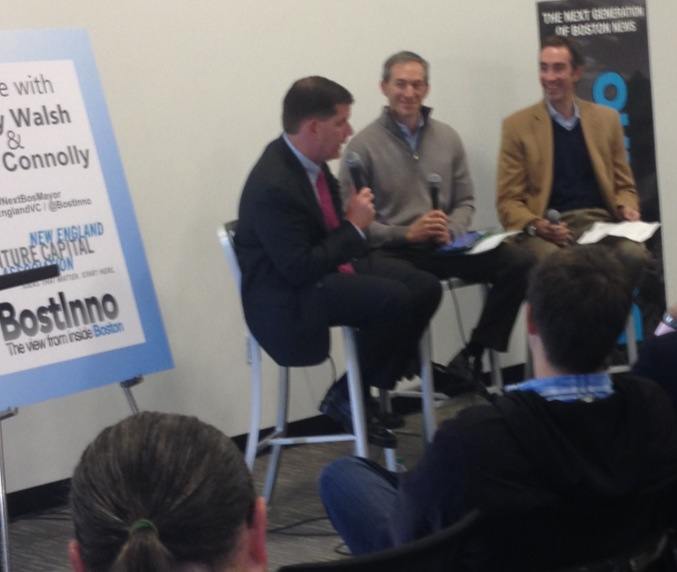
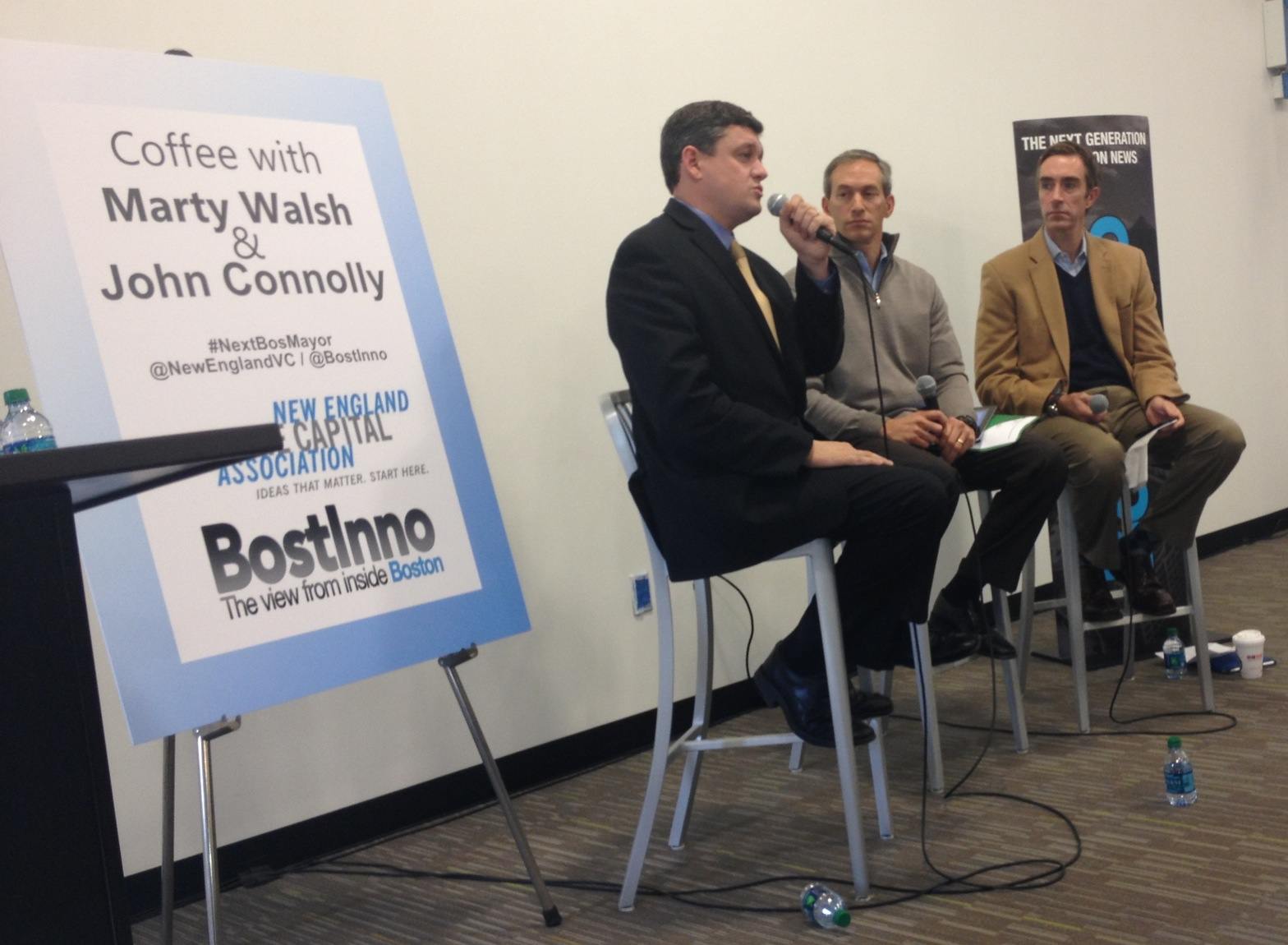
^ Marty Walsh at his humble and practical best : at BostInno Mayor Forum

One candidate speaks the syntax of hi-technology, the other means well. The folks who bring us the media publication BostInno — voice of the “Innovation District,” Inno for short — know the difference. They go first-name with john Connolly, who helped set up the Inno; with Marty Walsh, not so readily. Yet at this morning’s Forum the moderators clearly appreciated Walsh’s humility and readiness to listen to the concerns of people very different from his base. Walsh’s 45 minutes of question and answer showed him at his best : not exactly ready with the answer, and willing to be seen as such. And when an answer was given, it proved practical; and the Forum attendees appreciated Walsh’s practicality and laughed at his self-deprecations. But his answers also proved revealing.

Walsh offered no radical transformations, sees no major shifts. He will bring new kinds of people into his circle of advisors. There will be diverse conversations, diverse decision making. Clearly, Walsh sees access to the Mayor’s ear as his top priority.

Some questions that Connolly would have dined on, Walsh ducked. Asked “how will you win the support of THIS community as you have the unions,” Walsh said “Innovation will be central to my cabinet.” To, ” a question about keeping the city open late at night, he offered “if people want to get a meal late or to install a juke box” — he laughed : “do they still call it that ?” — “it’s a matter of permitting.” Quizzed on what will be his Big Idea — the moderators cited New York mayor Bloomberg creating a technology campus high school — Walsh said “not sure….growing the City is what I’m focused on.”

At other points, however, Walsh outlined regionalized economic initiatives, innovation districts all through the city, arts festivals all weekend; and spoke of them all easily and in detail. Within his comfort zone, Walsh commanded the Forum-goers’ quiet attention, just as he had throughout the marathon of Forums held prior to the Primary. He may not win any debate prizes, but at the BostInno Forum he showed once again that when interviewed, he is an appealing figure.

Image

^ the passionate bold innovator : John Connolly being moderatored

Then it was John Connolly’s turn. He too ducked the toughest question. Asked how he would handle fights with the Teachers Union, he responded “I want to fundamentally alter the culture in city administration, make it like the apple store” — which is his mantra: but sweet ear candy to the folks at this Forum. He also gave boiler plate answers to many questions and talked on too long, in a drone that dissipated the drama. It wasn’t the strongest start I have heard from him, not at all. But then he found his feet and began to assert, as only he can do.

“We aren’t preparing kids to compete in today’s economy…We need highly talented principals… and reforming the teacher contract. We have one of the most antiquated contracts in the country. We have to change it. Seniority cannot be the only way to choose teachers.”

So why, asked the moderators, haven ‘t you changed it ? Connolly replied thus: ” on the Council I don’t get to make any decisions. All we (the Council’s education Committe, which Connolly chaired) could do was be a watchdog…and to redirect some resources. (And) we had hearings on the teachers’ contract. A thing that they hadn’t thought possible. We had parents testify, we even had teachers come in and say that the teachers’ contract was wrong.”

Connolly then mentioned Walsh’s bill to take away from City Councils the power to review labor arbitrators’ awards. He said “The mayor has to represent the whole city…be independent…he can’t just represent one interest. My opponent’s legislation would damage the City’s bond rating and hurt city programs.” He was then asked the same question that was asked of Walsh : “what is your Big Idea — like the Mayor Bloomberg technology campus ?”

Connolly smiled that broad teddy bear smile.”My big idea ? It’s that every child in Boston get a quality education !”

The Forum people loved it. Connolly was among friends, and the rest of his time on stage was devoted to technology advance questions, innovation district questions, late night open hours discussion. It was less a Q and A than an office conversation.

— Michael Freedberg / Here and Sphere