THE LEAVING OF RICK PERRY

Image

The big political story yesterday was that Rick Perry, three term Governor of Texas, will not seek a record fourth term.

Both his supporters and his opponents were thrilled at the news. Tht’s a measure of his political importance. And of the hype.

Rick Perry is not as important as hopes to be, or as he thinks he is. Perry claims that he has left Texas the most competitive economic state of all, the best for business in the 21st century, as he likes to claim. Texas may well be that; but the man who initiated Texas’s modern business prosperity is Lyndon Johnson, not Rick Perry. It was Johnson who, as JFK’s vice-president, successfully lobbied to have NASA headquartered in Houston.(Then Speaker Sam Rayburn, also a Texan, played an important role here too.) You remember NASA; it was the agency that developed a program to put a man on the Moon, and successfully did so. At the time that NASA started in Houston, the city was a growing but still one-industry “oil town.” By 1969 it was the center of America’s most advanced defense/technology enterprise.

From that NASA start, and with the vast development of underwater oil and gas drilling in the Gulf of Mexico, Houston and the Texas Gulf Coast became a major American wealth and jobs hub. Large law firms and international commodities traders located there. Software companies — also drawing upon brains at work at the University of Texas and at Rice University — chose Texas as favored locus. The Texas elite of that period included a governor, John Connally, as well as a future President, George H. W. Bush, and his lawyer friend, James Baker; software pioneer H. Ross Perot; and a Senator, Lloyd Bentsen, who became running mate to a George Bush presidential opponent.

Rick Perry came late onto the scene. He was a very obscure lieutenant governor who became Governor largely by the good will of Texas voters for George W. Bush, who had been elected president two years before.

Perry inherited all of the above — the business strength and the good will. It was easy for him to simply keep on doing what was already working. Whatever drew businesses to Texas, he was for. Whatever might discourage business, he was against. Simple agendas that work are hard to beat. Perry was not beaten.

But then he decided to run for President. Like Romney, he moved to the right — sharply, and much earlier than casual observers of his entry into the 2012 primary race realized — and with effects much more devastating. Romney moved to the right after leaving office. His move affected no one but himself. Perry’s moves, on education funding, executions of prisoners — Texas executes more than the next four death penalty states combined — health care, and “nullification” of Federal laws, including Voting rights laws, made life much harder for Texas’s low income people. 25 % of Texas residents have no health insurance. the same percentage live in poverty. The abortion restriction law that State Senator Wendy Davis filibustered — and became world famous doing so — would impact mostly low income women. Perry also successfully opposed pay equity legislation and rejected hundreds of millions of Federal health insurance dollars.

Perry wants medicare, social security, the income tax, and popular election of senators abolished. These are either anti-social or just loopy views; even though they remain mere noise ,they debase the conversation and lead people away from progressive reform into dead ends of negative rant.

It is hard to see how anyone not a business executive or a negative ranter can want anything to do with Rick Perry ever again. And even business executives might question the advantage of locating ina state that makes life so hard for both the low-wage people whom most businesses count on and for those living in poverty, who lack income to buy what most businesses need to sell. Texas badly needs to change its priorities if it — and its 24,000,000 or so residents — are not to lose ground in the coming decades.

It is said that Perry intends to run again for President. We urge him not to.


WE SHOULD NOT HAVE TO LIVE IN A KAFKA WORLD

Image

^^ Franz Kafka was haunted by the impenetrable bureaucratic, protection state whose surreal impositions he so brilliantly envisioned

——————————————————————————–

You may recall reading the novels and stories of Franz Kafka, a Czech who lived from 1883 to 1924 and who documented the impersonal, labyrinthine, secret world of bureaucratic tyranny in “The Trial” and “The Castle.” We read Kafka, and we had nightmares of his world. It was a maddening world in which the single individual was hemmed in by petty rules about everything, rules issued by no one he could identify or find, and whose minions, when he tried to protest, sent him from one door to the next in a fruitless search for relief or even for an answer to “why ?”

What we did not expect was how peacefully a world like Kafka’s would come into being and how calmly it would sit upon us. But now we know. Because we are living in one. Our Kafka world is called “the surveillance state.” We Americans created it as a result of the jet-plane attacks upon us on September 11, 2001. With legislation ruefully called “The Patriot Act” we have erected around ourselves a bureaucratic shield as impenetrable as possible, a structure of snoop and survey — not to mention the TSA and its body pat downs — intended to make us prophylactically secure against a repeat attack. We named it the “Department of Homeland Security.”

Legislation that placed security above liberty — explicitly said so — proclaims that it’s for our own protection. So said the Kafka “Castle” state as well. So has said almost every Big Brother (thank you, George Orwell in 1984) ever established. Most Castles and 1984’s of course, come into being by violence and are maintained by a terror apparatus. Not so with us. Our surveillance state has come about by legislation and controls us as blithely as the sea is smooth at dawn. Many of us like it that way.

The surveillance state that we put into place here in America always says that it takes every precaution to not violate Constitutional protections; that it respects our privacy, our liberty, our freedoms; that it will “not give up the values we live by.”

This is pure horse manure.

We know now, thanks to the revelations given us by Edward Snowden — and expanded upon by what remains of our free journalism — that the secret FISA court has authorized surveillance of all our communications for many other purposes than hunting terrorists. Our communications — all of them — are now to be commandeered in search of nuclear proliferation, cyber attacks, espionage. And that’s only what we KNOW about. Had Ed Snowden not uncovered the work of this secret court, who knows what authorizations they would have given to the National Security Agency ?

If not for Snowden, we wouldn’t have known that the FISA court even existed, much less been able to read its findings.

Few Americans would deny the CIA, or even the NSA, authority to collect data directly related to the pursuit of terrorists. Since World War II, at least, we are accustomed to having a large intelligence apparatus at work fighting our battles.  But war is war; we are not at war now. Terrorism can hurt us grievously, but it is largely an international police matter. Or you would at least think…

As a secret court, the FISA was not given a brief to fight crime. Yet that is what it has expanded to doing. This brings us to the Fourth Amendment, which sets the ground rules for searches and seizures. The Amendment requires a reasonable basis for the issuance of a search warrant. It has not been repealed — yet.

The ACLU had already sued in Federal Court to block FISA from isuing blanket surveillance authorizations. This week another group has brought suit, directly in the Supreme Court, to obtain a ruling that will limit FISA to surveillances that would pass the Fourth Amemdment test. We support their fight.

One hears the word “security’ a lot lately. “Secure the borders,” say the anti-immigrant people. “Security” is part of the very names of both the National Security Agency and the Department of Homeland Security. we are troubled to hear the word security used so broadly.

We much prefer the word liberty. Unhappily, that word has been all but commandeered by the Tea party and its anarchic, survival of the fittest agenda — a world amoral in the extreme — which, oddly, one finds in Franz Kafka. Amoral liberty, as he well knew, is the only kind that can survive in a surveillance world, secret, impenetrable. It is really no liberty at all. It is a death sentence.

Badly America needs to step back from both its security obsessions and its amoral liberty. We wish all success to those who fight either or both.

—– Michae,l Freedberg / Here and Sphere

BOSTON MAYOR RACE : IF MONEY MAKES A WINNER, THEN THE WINNER IS .

Image

Dan Conley tops the $$$ race (photo courtesy wbur.org)

Money isn’t everything in politics, but it is how everything becomes ….a thing. The thing that money most helps become is a voter base — of committed votes. With twelve (12) candidates on the September 24th Primary ballot, a shockingly small voter base can choose the two Mayoral finalists. As few as 20,000 votes — little more than five percent of all Boston voters — might get a candidate onto the November ballot.  Add the votes going to his or her opponent, and you end up with a mere 45,000 voters choosing the final two. That’s barely 12 percent  of all registered Boston voters.

But it is what it is. Quite a few of the twelve candidates have enough political sock to tally 20,000 votes. So money will make the difference in who actually does it. Money buys campaign literature, campaign advertising, lawn signs, campaign staff. It allows a campaign to make its newspaper, interest group, and union endorsements known — and unless publicized, they don’t count for much. It buys an election-day street-level operation : poll checkers, door knockers, telephone callers, telephone banks, coffee trucks for poll workers, precinct captains, secure phone lines, lists of who needs a ride (with phone numbers and addresses), precinct maps,  ID’d voter lists. Money generates “good morning voter’ doorknob cards that we used to deliver to doors, like newsboys, at 4 AM in the morning. assuming that four or five candidates have a fairly equal ID’d vote, money gives him or her who has it a strong advantage in getting those ID’d voters actually to the polls.

So who has the big bucks ? Now, at the start of July, with less than three months to go ?

Here’s the cash on hand list as of the most recent OCPF report :

Dan Conley — over 1,250,000
John R Connolly — about 675,000
Mike Ross — 500,000
Marty Walsh — about 400,000
Rob Consalvo — about 225,000
Bill Walczak — about 125,000
Felix Arroyo — also about 125,000
John Barros — about 85,000
Charlotte Golar Richie — 50,000
Charles Yancey — about 45,000

The other two candidates, David Wyatt and Charles Clemons, reported no cash on hand.
Image

John R Connolly — strong second in the money campaign (photo : courtesy wbur.org)

The list contains several surprises. We did not expect that Charlotte Golar-Richie, the only woman in the field and boasting of wide support beyond her home Dorchester turf, would figure so low on the list. Nor did we expect Bill Walczak, who has never run for city office, would top two city councillors AND Golar-Richie. And who could have foretold that Dan Conley would have almost double the cash on hand of his nearest competitor, or that he would top the entire list ?

Given that Conley has also put forth the completest policy agenda — and a progressive one at that — and that he will be in office, as Suffolk County District attorney even if he loses, and so should be able to raise money and volunteers aplenty, one has to conclude that he will make the November ballot. In this regard, it was instructive to see Conley’s poll worker operation on US Senate election day, June 25th. In wards 18 and 20, which will likely combine to deliver a full 25 percent of the September vote, he had by far the completest poll worker showing. Conley means business.

So the question remains : who will Conley’s November opponent be ? The money fact gives us scant clues. Though Mike Ross and Bill Walczak have raised much, they lack a definable voter base. As for the others, John Connolly, Rob Consalvo, Marty Walsh, and Felix Arroyo all have defined voter bases and sufficient cash to maximize their base voters’ turnout. Charlotte Golar-Richie should have the same prospect; but her lack of funds, at this late stage, sends a very negative message, both to prospective donors and to voters as yet undecided. With City Councillor Charles Yancey also on the ballot drawing votes from Golar-Richie’s likely base, her prospects look poor.

Image

Marty Walsh : likely to gain (photo courtesy : charlestownbriodge.com)

Two candidates seem poised to benefit most from Golar-Richie’s decline : Marty Walsh, the strongest Dorchester candidate, and Felix Arroyo, who needs to win convincingly among Boston’s voters of color if he is to beat Marty Walsh to the November ballot.

Image

Felix Arroyo : also likely to gain strength

—- Michael Freedberg / Here and Sphere


TWO NATIONS OR ONE ? AN INDEPENDENCE DAY WARNING

Image

^^^ the Convention in Philadelphia reached a decision about the purpose of our Union and the power it should have to do things; but it was a closely divided vote. That division continues even today, as wide apart as ever.

——————————————————————————–

As we celebrate America’s 237th birthday, we look at what has become of us. We do remain committed — almost all of us — to the democratic ideal, as asserted so timelessly in the Declaration of Independence. We remain committed to it even when, a Paul Krugman writes in today’s NY Times, in practice we seek legislation, or pursue behaviors, that negate it.

Still, as we all learn in school, the ideals in the Declaration are only one statement of our nation’s purpose. The other is the Constitution; and that document was not by any means the voice of all. In the conventions held in twelve states — Rhode Island refused to hold one — during 1787 to 1788, the question of whether to ratify or reject the Constitution divided folks bitterly. In key states, ratification was the minority opinion. “Federalists” had to work hard to win — often by just a few votes: in Massachusetts, the majority was nine out of 266 voting; in Virginia, where ratification was opposed by many, including Patrick “give me liberty or give me death” Henry, no less, the vote was 89 to 79; in New York ratification — opposed by Governor Clinton — was secured only three votes. (Rhode Island, stubbornly opposed, had to be forced to consent to the Union.)

Today we worship the Constitution — or at least we say we do — as if it had been an inevitable event. Yet Constitution Nation is, today, as divided about what it means as our founders were then. We are dividing further, in fact; and striking it is how the division gets expressed in the same terms put forth by anti-ratifiers in 1788 : “big” government versus states’ rights; federal power versus liberty; big city commerce versus rural life; national debt versus pay as you go; tyranny versus liberty; and so on.

Modern industrialization made America even more single a nation — and, to those of us seeking it,  more perfect — than the Constitution had envisioned; and the Civil Rights Acts of the 1960s enshrined our common purpose in law. But history did not stop there. Despite the efforts, struggles, and lives of so many generations of Americans to make the Constitution’s promise of “promoting the general welfare” real, our nation seems as divided as it was during the Ratification Conventions.

On the Coasts, and in key states in between, we have big-city commercial life; we enjoy the advantages of a Federal Debt that is the world’s safest and most desired investment. We have social diversity, cultural multiplicity, and full respect for the rights of women, people living alternate lifestyles, and social peace keeping. We welcome immigrants and acknowledge — sometimes proudly — that America is all about immigration. We control weapon ownership closely; we support social safety net legislation and worker unions. We do not allow religion to intrude upon public law but to remain a private matter, as the Constitution and First Amendment require; we live in confidence of the future, and and we have laws that safeguard and promote our commercial diversity.

In much of inland America, however, including most of the South, we are ruled by rural legislators, we dislike Federal debt, we rue social diversity. Culturally we are uniform, and the diversity in prospect frightens us. In these states the rights of women are regulated  by Biblical instructions, as are lifestyle alternatives. Public schools are disliked; the social safety net distrusted,  the taxes that pay for it an imposition. Voting rights are seen as a threat; so are immigrants. Guns rule; and the Constitution is seen not as the enabler of a more perfect union, but as a grudging exception to a general principle that Union is tyranny; that government and all that it seeks is the enemy of free men.

This division into two very different Americas would not be a problem except that Rural Nation controls the Federal House and through that control, prevents Big City Nation from fulfilling our objectives. As Big City nation continues, however, to hold almost all of the money power, most of the media power, and the vast majority of the education and information power, it seems highly unlikely that Rural America can have any lasting effect on Big City America except to alienate us still further from it. There are dangers definitely in aggravating this mutual alienation; just as in 1820 Thomas Jefferson heard, in  the ugly passions unleashed by the slavery question, “a warning bell ringing in the night,” so do we hear several warning bells ringing the intensifying division of America into Two nations.

Let us hope that the warning bells we hear are wrong.

—– Micvhael Freedberg / Here and Sphere

COMEBACK CITY : THE DEEP FALL AND HIGH RISE OF DETROIT

Image
(photo : courtesy : edgoodfellow.com)

If you want to know the future of America, look to Detroit. That’s how the city feels about itself, and the feeling may just have a point. There’s hardly anyone to whom “Detroit” does not mean “automobiles.”

Detroit is well aware of its significance, its status as automobile icon. “The world has a fascination with Detroit, in general,” says Rick Ruiner, of Detroit’s own “The Ruiners,” now celebrating their 16th anniversary as a band. “It’s a bit like watching a boxer bloodied and beaten down in a fight. Some (people/spectators) are rooting for them as they struggle to get back up during the ten count, others are not. People in Detroit are very persistent and proud- – they tend to get back up.”

To understand how Detroit is now getting back up, it’s vital to grasp how huge was its fall. Remember : the American middle class was birthed in Detroit. As the auto industry’s hub, from the 1920’s, the city’s businesses created manufacturing jobs on a large scale, with good pay — for hundreds of thousands who came to Detroit from everywhere to seek them.  — and kept on creating and maintaining them. But then the American auto industry hit a wall, and Detroit jobs all but disappeared. With them almost went the entire city.
Detroit’s decline was that of  the most important industry in the entire US economy.  As the auto business encountered foreign competition, huge capital costs, enormous unfunded pension liabilities, its own grievous design misreads, and, finally, an unsustainable surge of in-house financing defaults, its problems compounded — and mirrored — difficulties that all of American industry was falling into. The decline began well before 2008, but that was the year it hit home to everyone. As President Obama recalled it, in his 2012 State of the Union Address, “Let’s remember how we got here. Long before the recession, jobs and manufacturing began leaving our shores. Technology made businesses more efficient, but also made some jobs obsolete. Folks at the top saw their incomes rise like never before, but most hardworking Americans struggled with costs that were growing, paychecks that weren’t, and personal debt that kept piling up.”

He continued: “In 2008, the house of cards collapsed. We learned that mortgages had been sold to people who couldn’t afford or understand them. Banks had made huge bets and bonuses with other people’s money. Regulators had looked the other way or didn’t have the authority to stop the bad behavior. It was wrong. It was irresponsible. And it plunged our economy into a crisis that put millions out of work, saddled us with more debt, and left innocent, hardworking Americans holding the bag. In the six months before I took office, we lost nearly four million jobs. And we lost another four million before our policies were in full effect.”

Detroit was hit harder than any other major city. As two of its three  auto companies stood on the verge of bankruptcy — and the other, Ford, was hard pressed too — Detroit found fully one-half of all its workers out of work — a 50% unemployment rate. Not even in the Depression did cities fall so far. Making the situation worse still, Detroit became the second most violent city in America — with nearby Flint, MI, according to FBI statistics for 2012, occupying the number one spot. And the 50% unemployment rate pertained only to those who remained; many did not. Detroit from 1950 to 2010 lost fully 50 percent of its population.

The consequences of this abandonment have been huge. One third of the city’s buildings have been burned or abandoned. Seven out of ten murders remain unsolved. Only one quarter of students in the Detroit Public Schools graduate. Statistically, Detroit students have a better chance of going to prison than graduating from high school. (numbers supplied by the documentary “Autopia.” More about Autopia below.)

Image
Yet despite these frightful numbers, Detroit today has moved past them. Turn around is in the air. For many years, mainly local artists drove this a change of gears. In addition to Rick Ruiner and his wife, Nancy Friday, big stars locally born,  like Kid Rock, Eminem, Jack White, Aretha Franklin, Jeff Daniels — and many others — put their craft and positivity to work on many Detroit causes. A major example of the city’s artist-driven innovation is the Detroit Electronic Music Festival. The DEMF (2000-2002), Movement (2003-2004), Fuse-In (2005), and under its current name, Movement Electronic Music Festival – each name reflecting shifts and changes in festival management – is held every Memorial Day weekend in the city’s Hart Plaza. “It is a landmark event that brings visitors from all over the world to celebrate techno music in the city of its birth” (www.movement.us). As the Movement website says, “Detroit’s Movement Electronic Music Festival has evolved into one of the world’s largest electronic music festivals.”

Image

The Movement Festival at night

Significantly, the DEMF has built a Detroit reputation the opposite of crime city. as its website puts it, “the first DEMF occurred in May 2000 and concluded with few hitches and no reported crime. It was applauded by city leaders and tourism officials as an injection of youthful energy into the city” (www.movement.us).

According to Autopia, a wave of young artists and entrepreneurs is moving to Detroit from all over the world. Nina Friday, for example, hails from Russia. Why this move ? Economics, for one thing. Unlike New York and Los Angeles, Detroit is an extremely affordable city and thus very attractive to up and coming artists. “You can buy a loft for around $25,000 and live on $700 a month,” notes Autopia. Houses go for as little a $ 5,000. Prices like these leave a not-yet-rich artist with plenty of cash left over to bask in Detroit’s many amenities: the Detroit Institute of Art, the Detroit Medical Center, Henry Ford Hospital, The Riverwalk, shops, specialty stores, restaurants, bars, festivals, concerts, sports, casinos, shopping, park activities, shows and walk-ability — and all of it, on hand throughout the city.
Little Caesar’s Pizza Founder and CEO, Mike Illitch, has also been a key figure in Detroit’s revitalization. As his Illitch Holdings, Inc. webpage puts it, “An avid sports fan, he and his wife Marian in 1982 purchased the struggling Detroit Red Wings professional hockey franchise and turned the team into a Stanley Cup champion (team). Also in 1982, Illitch purchased Olympia Entertainment which manages several restaurants, sports, and entertainment venues and properties. Hockeytown Café, which opened in 1999 and is managed by Olympia Entertainment, is recognized as one of the top sports bars in the country. Five years later, in 1987, Illitch purchased the neglected Fox Theatre and restored it to its original 1928 splendor. Many thought it was impossible to revive a business in downtown Detroit but since the reopening in 1988, it is consistently rated as one of the top grossing theatres of its size by Pollstar.”

Image

Mike Illitch of Little Caesar’s

The Illitch family continued its commitment to the city with the “purchase and subsequent renovation of the adjacent Fox Office Centre,” making way for a new headquarters for Little Caesar’s in Detroit. “Illitch fulfilled a lifelong dream when he purchased the Detroit Tigers in 1992. Along with the purchase of the Tigers, Illitch needed to address the issue of building a new stadium to replace the outdated ballpark where the team had played since 1912. The new Comerica Park opened in 2000 with the majority of funding supplied by Illitch.” (Illitch Holdings.) The success of the Illitch companies have inspired other investors and brought them to the city.

Most recently, a $650 million plan was proposed to the Downtown Development Authority for a new hockey arena. Leading this project are Olympia Entertainment and Mike Illitch. Plans call for a 650,000-square foot arena along with office and retail development, which by the time of completion will span 45 blocks downtown. Illitch states to the Detroit Free Press, “It’s always been my dream to once again see a vibrant downtown Detroit. From the time we bought the Fox Theatre, I could envision a downtown where the streets are bustling and people were energized. It’s been a slow process at times, but we’re getting there now, and a lot of great people are coming together to make it happen. It’s going to happen and I want to keep us moving toward that vision.”

Moving forward has faced obstacles by the plenty. In addition to financial crisis — as the city’s real estate tax base shrank and all but crumbled — and possible bankruptcy, there have been political scandals and corruption all too well publicized. Detroit has become used to dysfunctional civic government, with one former mayor going to jail and many other officials nicked by scandals and misfeasances. All of it is well known to those who watch cable news; yet Detroit itself seems to have simply shrugged off its dirty laundry moments. The economics of dirt-cheap real estate and a strong base of skilled labor has, for many entrepreneurs, made a Detroit investment too good to pass up. And Detroit firms are beginning aggressively to tout the city’s prospects. For example, five companies headquartered in Detroit are offering incentives to their employees to reside in the greater downtown area. By this initiative, Blue Cross/Blue Shield of Michigan, Compuware, DTE Energy, Quicken Loans and Strategic Staffing Solutions, collectively known as the “Detroit Five Downtown” are currently offering up to $20,000 in forgivable loans towards an employee’s purchase of a Detroit home as a primary residence. As for renters, the firms offer $2,500 towards the cost of an apartment for a first year, and an additional $1,000 to the second year of a lease extended. (Current renters can also receive this $ 1,000 lease extension payment.) By the same program, existing homeowners residing in the city now are eligible for up to $5,000 in matching funds to pay for exterior improvement projects costing $10,000 or more.

It’s not just the “Downtown Five’ who are kicking it up. Other downtown businesses are now offering these incentives. The momentum continues.

Private security businesses are thriving as Detroit Police officers became scarce. The wealthier neighborhoods in the city pay for their protective services, and, as unpaid volunteers, they even patrol the streets in the poorest neighborhoods.

Architectural Salvage Warehouse gathers in and stores up household fixtures, sinks, cabinets, and floors from abandoned and vacant homes and makes them available to home owners. Residents are able to stop by and pick up such materials as they may need for remodeling — even reconstruction — of their Detroit homes. Former prison inmates, who were disadvantaged or early released, are hired and given a second chance at life while they specialize in the art of deconstruction.

THE “DETROIT URBAN GARDEN” MOVEMENT

Image

(photo courtesy : blog.thedetroithub.com)
Other citizens have focused on building a green infrastructure. With plenty of open land now available in the city, thanks to so many structures having been demolished during the down and dirty decades, Detroit is home to over 1500 separate “urban gardens.” This “Greening of Detroit” uses plots of land to plant produce that provides free, healthy food to the community. One of current Detroit Mayor Dave Bing’s most forward visions is to build a city with a healthy ecosystem.

Image

Mayor Dave Bing (photo courtesy bet.com/news)

Still, a word of caution sounds. Although the auto industry is recovering some of its profitability, and despite the 2008, Treasury bailout of GM and Chrysler has saved tens of thousands of jobs, Detroit will never be the same one-industry city that it was 40 or 50 years ago. It will be home to an automobile industry much altered and to diverse enterprises aplenty. it has no choice. As former Michigan governor Jennifer Granholm notes in Autopia, “Where there is crisis, there is opportunity. We don’t want people to say this is the end of Detroit – it is certainly not – but we do want people to learn from our experience, which has not been very pretty. We also want to serve as a wake-up call to the country.”

Detroit now knows what the rest of America has learned at the same time: that change is difficult and it’s a lot of hard work. that you have to keep up with the times, that you have to innovate. that if you don’t,  the world will move forward without you, and you will be left behind – without job or future. Given our global economy, competition strikes from all sides. Detroit now admits that education and diversification key the city’s economic strength going forward. No longer can its economy embed itself safely in one industry.

To predict how the future of America will work out, look to Detroit.

—- by Susan Domitrz-Sapienza / Here and Sphere Correspondent

PAYROLL CARDS : WITH FEES ATTACHED, NOT A GOOD IDEA

Image

Let’s talk about “payroll cards.” If you’re low-income, you already know what they are. They are proof that you’re not in charge of your own life.

To be low-income in today’s America is to do without. It’s your fault if you can’t make ends meet, say the Tea party folks. 

You drove uninsured because you couldn’t afford car insurance and you need your car to get to work ? Too bad; pay the fine, pay to reinstate your driver’s license. Pay, pay, pay. That’s just about all that the low-income person hears in America today. Pay.

Such is the context in which “payroll cards” now enter your life.

What are payroll cards ? They’re a kind of prepaid debit card onto which some employers deposit their workers’ weekly wage. The gimmick is that almost all payroll cards have fees attached. You can’t take money off a payroll card without paying a withdrawal fee. Want to use your payroll card as a savings vehicle instead of withdrawing the money ? Some cards charge an “inactivity fee.”

That’s fine, if workers CHOOSE to use a payroll card. If they make that choice, they agree to the fees attached.

What isn’t fine is that some employers make it mandatory for their workers to receive wages on a payroll card; or, they offer direct deposit or check but either don’t tell their employees or make clear that they frown on an employee making that choice.  The payroll card is a favorite especially of firms that pay its workers minimum wage or just above minimum. For their workers, it’s payroll card or nothing — or a displeased boss.

It is unlawful for an employer to require workers to pay fees to access their wages. It matters economically, too: because to a $ 7.50 an hour worker taking home $ 265 a week, a $ 2.00 withdrawal fee cuts into vital cash. The only way to do it is to withdraw one’s entire pay check at one time and keep the cash at home, just like in the 18th Century before banks existed. Some payroll card employers are doing just that. And if that cash gets stolen — by a family member; it happens often — well, that’s just the way it is when you are low-income in today’s America.

The firms that insist on paying by payroll card, with all the fees that come with them, argue that many of their workers don’t have bank accounts and that the fees attached to payroll cards cost far less than those charged by check cashers. This is true; but the argument is a fake one, because the reason that employers use payroll cards has nothing to do with saving their workers some money. It’s about saving the EMPLOYER money.

It is much cheaper for a large firm to pay its thousands of low-wage employees by payroll card than by electronic deposit or by check.That, and not the convenience of workers, is why the payroll card is this season’s hot employer item. Payroll cards are yet another example of how many of  today’s large employers view their employees not as an asset but as a “cost item.”

Payroll cards do work for social security recipients, because Federal law prohibits card issuers and ATM companies from charging any fees to social security recipients paid by card. If this Federal law cannot be extended to cover cards used by private employers, then payroll cards simply should never be mandatory or pretended to be so. The Attorney General of New York is suing to force companies headquartered in his state to offer payment by direct deposit or check. Good for him.

No-fee payroll cards should be required everywhere in today’s America. It is hard enough to be low-income without having fees unavoidably attached to one’s (mostly) minimum wage paycheck.

—– The Editors / Here and Sphere

MEEK AT THE MOVIES : THE HEAT ( 2 1/2 **)

Image

“The Heat” is funnier than it should be. Part of that’s because director Paul Feig has a way of taking flimsy ideas and strong comedic actors and creating lightning in a bottle. He did it with Melissa McCarthy and Kristen Wiig in “Bridesmaids” and does so again here. If there’s any doubt that it’s more the actors than Feig, I’ll simply point to McCarthy’s recent woeful outing in “Identity Theft.” It’s not so much what he does with the material but the chemistry he educes between his stars and how they build something infectious from thin setups.
The premise behind “The Heat,” which was shot in in our glorious city of Boston — though it doesn’t look so much like the Boston that you and I know — is pretty much the same old comedic cop-buddy story that was popularized by Eddie Murphy and Nick Nolte in “48hrs,” and, later, by Mel Gibson and Danny Glover in the “Lethal Weapon” series. Except that here, the oddball pairing is women, and the focus is more on the funny than the dark and grim — hough people do get shot in the head aplenty, and blood does spurt.

Sandra Bullock puts in a willing and able effort as FBI Special Agent Ashburn, bouncing from nerd to sex pot and even to drunkard. Ashburn’s a by-the-book agent seeking a promotion, but ego, arrogance and lack of people-skills stand in her way. To get ahead she’s got to nab a faceless drug king in Boston and to do so, she must accomplish it with the aid of a portly and potty-mouthed detective (McCarthy) with less people skills than herself. McCarthy’s Mullins takes a longtime to warm up to, because like her hacker role in “Identity Theft,” she’s insensitive, over-bearing and uses the F-word to qualify everything. It almost tanks the movie early on, but the friction with Bullock’s straight lace heats up fast.
Mullins is one mean dog, there are few perps on the street or colleagues in her precinct that are willing or able to tangle with her. It’s her brother (Michael Rappaport), who’s a small fish in the local drug trade that is her Achilles-heel wound of sensitivity.

The silly hi-jinks mostly come when Mullins and Ashburn wind up in some nightspot. One scene has the pair at an upscale club where they are trying to bug an underling of the drug lord. They have to sex-it-up to get close (“You’re the hottest woman over forty,” a slick-haired baddie notes of Bullock), and later the duo bond in an Irish dive bar where Bullock and McCarthy dance poorly to lost 90s classics, down gallons of shots and form a conga line of septuagenarians.

The funniest kicks however come from Mullins’s family. The “Bahston” accent is right on, the house is decorated with velour dunking/homerun/touchdown Jesus paintings, and SNL legend Jane Curtin plays the tough-as-nails matriarch. The whole drug lord angle is just an excuse for Mullins to make jokes about Ashburn’s un-used loins and Ashburn to respond with lines like “that is a gross misrepresentation of my vagina.” What’s not to like about Felix and Oscar toting guns and fueled by estrogen? It ain’t heavy, and it ain’t sharp, but it is funny and Feig does it all on a half a tank of gas.

— Tom Meek / Meek at the Movies

THE TRIAL OF GEORGE ZIMMERMAN : OUR VIEW

Image

In Florida the trial is well under way now of Gerorge Zimmerman, who is charged with second degree murder for shooting dead a 17-year old named Trayvon Martin.

You may recall the case. Martin was visiting family in the town of Sanford. He had gone to he store at night to buy a soft drink and sone Skittles and was on his way back when unexpectedly he found himself being followed by a man who was armed — not clear if Martin knew this — and who at no time identified himself to Martin other than to ask “what are you doing here ?” And that only after Martin had asked, “why are you following me ?” Martin, thinking that this unidentified man meant him harm, defended himself. Zimmerman, thinking that Martin was up to no good, kept pressing. A fight ensued, ended only when Zimmerman, having gotten much the worse of the fight and being afraid for his life — his testimony — he took out his gun and shot Martin dead.

It transpired that Zimmerman was a volunteer for the gated community’s security watch patrol. It also was learned that Zimmerman had noted Martin walking across the gated grounds and called the Sanford police, telling them he intended to follow the Martin. The police advised him not to do so; but he did it anyway.

These are all the relevant facts in the case.

A huge outcry went up when the American public learned that the Sanford police decided not to arrest Zimmerman, who claimed that he shot Martin in self-defense; as a result of that outcry, the police did arrest him, and the state of Florida set in motion the prosecution that has now reached trial.

The outcry and its consequences — lots of public accusation and recrimination — has led to a focus on the fight that took place and not on the events that led up to it. This is a mistake and quickly distracts the mind from a proper consideration of criminal culpability on the part of Zimmerman. As it happens, Zimmerman is unmistakably culpable. Let us see why :

1. He is armed with a loaded gun. A loaded gun is something that the law terms a “dangerous instrumentality.” Our tort law imposes a strict liability upon those who use dangerous instrumentalities, be these explosives, lethal chemicals, waters in a private reservoir, or loaded weapons. And for very good public policy reasons. Our criminal law similarly imposes a like duty upon those who use dangerous instrumentalities; except that criminal liability for their use is not strict; it only arises if the dangerous instrumentality is misused recklessly or, obviously, intentionally). For example, if I drive my car at 60 mph in a 30 mph zone and doing so kill a pedestrian, I am guilty of reckless conduct resulting in a death and am criminally responsible.

2.  He disregards police advice and initiates a train of events that leads to a fight and a killing. Being armed, and following young Martin, in the mistaken belief that Martin is up to no good, persists in following without identifying himself. He allows — induces — Martin reasonably to conclude that he, Zimmerman, means him harm. What actually followed was almost forseeable, just as forseeable as that if I drive 60 in a 30 zone, in disregard of posted speed limit signs, an injury and even death will occur.

3.  His belief that Martin is up to no good is entirely mistaken. The likelihood of mistake — while being armed — is why he owed Martin a legal duty to identify himself. He has no idea who Martin is other than that Martin is walking across the gated community’s grounds.He has no evidence at all to the contrary. If he was going to follow Martin — despite being advised not to — while being armed, he owed Martin a duty to identify himself. Had he done so, none of what ensued would likely have happened.

Zimmerman’s defense is that he shot Martin in self-defense while being beaten pretty badly. However, the self-defense assertion  cannot stand. You cannot initiate a train of criminally reckless train of events and then, when events go against you, claim the rightful man’s defense.

There really is nothing further to this case. The death that took place was the direct result of a train of events set in motion entirely by Zimmerman. His conduct from the beginning was reckless — the mistaken assumption, the disregard of police advice, the failure to identify himself — and, as he was armed, his recklessness was criminal. The only difficulty is in deciding whether Zimmerman is guilty of second degree murder, as the State of Florida charges, or of manslaughter.

As manslaughter is a death caused by criminally reckless conduct, without regard to who is killed, the facts here readily meet that standard.

Second degree murder, however, requires an animus specifically against the person killed. As Zimmerman did not know Martin, the only way to reach the second degree murder standard is to prove that Martin had a generalized animus against people unidentified walking at night across the gated grounds. His original statements to police after the killing make clear that he plenty of such animus. But are these pre-arrest statements admissible evidence ? Probably not. The state is going to have to prove animus from the bare facts of the events of the case. As Zimmerman is unlikely to testify, it will be difficult, we think, to establish the extent of his animus.

Manslaughter it likely is.

—- Michael Freedberg / Here and Sphere

THE AARON HERNANDEZ RIDDLE

Image

We at Here and Sphere aren’t fixated on crime, and we don’t find the doings of sports stars red-letter news. Still, the saga of Aaron Hernandez, until recently one of the New England Patriots‘ major players, commands our attention. Last August he signed a $ 40,000,000 contract with the Patriots — $ 26 million of it guaranteed. Yet now, accused not just of one murder but of three, in two incidents separated by almost a year, Hernandez looks, from the evidence so far released by the police and District attorney in Bristol County, in a huge peck of trouble. If anybody gets that $ 26 million, it’ll be his lawyers.

His eventual prosecution and trial is a matter for the law and courts; and when the trial begins, Here and Sphere will definitely report from it. For now, all we want to do is ask some questions. Questions that arise from the various police narratives already put into the news. These questions do not convict him; they only ask.

These are puzzling questions that defy glib answers :

1. How does a man who plays a violent, utterly demanding sport for a coach who brooks no insubordination of any kind become someone who kills people if they make him “unhappy’ with them ?

2. If he decided to kill Odin Lloyd — his likely future brother in law — because he was “unhappy’ that Lloyd had spoken to people that he, Hernandez, “had troubles with,” what was it that Lloyd and the other men talked about that called for a killing ?

3. They were at a noisy club that we know well : Rumor, in downtown Boston. How did Hernandez hear what Lloyd was supposed to have said ?

4. If Hernandez felt, about Lloyd talking to those men, that now “he couldn’t trust anyone any more,” how come he asked two men to come up to Massachusetts, to accompany him when he went to pick up Lloyd for a talk ? Evidently he DID trust at least SOMEONE still…

5. If, as is now asserted, he is the main suspect in a shooting of two men last July — while they were stopped at a stop light after leaving a bar (Cure, another that we know well) where they had gotten into a fight with a group that included Hernandez — why did the silver SUV with Rhode Island license plates, that was seen pulling alongside the two men who got shot, not get dumped somewhere, instead of being found yesterday, in Hernandez’s home city of Bristol, CT, no less ?

6. Why, with Odin Lloyd in the car with three other men, was Lloyd able to text to his sister that he was “with NFL” and, shortly after, “Just so you know” ? According to the timeline, those texts went out a bare seven minutes before Hernandez was seen, on his home’s surveillance camera, returning with a gun in plain view. No one thought to not let Lloyd use his cell phone during that obviously not a fun drive ?

7. The above suggests that the shooting of Lloyd was an unexpected, impulse act; that the drive was intended only to be a frank talk. But if that was so, why did Hernandez need to have two guys along with him ? Were they to be just talkers ?

8. He rents the drive-car in his own name, gets seen on surveillance cameras everywhere, is accompanied on the drive by two guys who will surely rush to testify against him to save themselves; buys bubble gum and, next morning, upon returning the rental car, hands some of it to the rental agency gal – gum that is also found in the rental car along with a shell casing from a .45; shoots two guys from a car that can be traced and now has been : did he think that being the Great Aaron Hernandez, $ 40 million sports star, that no one would ever suspect him of being a  stone killer easy to anger ? To this question, the answer must be “yes.” It had worked until the killing of Lloyd.

9. Lastly : how could he do all this, putting his fiancee and child at total risk ? Ms Jenkins was photographed at Court totally crying. Her life will never be the same (though at least she is alive). And what of her sister, who was dating Odin Lloyd ? What does she do ? Are women, in that world, just collateral damage ?

—- Michael Freedberg / Here and Sphere


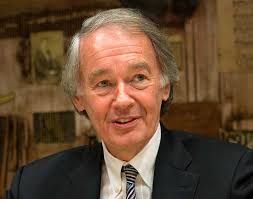
MASSACHUSETTS : ED MARKEY WINS — OUR ANALYSIS

Image
Ed Markey (D), Congressman from the 7th District, was elected our state’s new Senator yesterday, defeating Gabriel Gomez (R). The final totals show the race wasn’t even close. The percentage margin was exactly 10 : 54.8 to 44.8.

642,988 people voted for Markey, 525,080 for Gomez. Add in the small vote won by a third candidate and you find that about 1,200,000 of us voted — more or less 35 % of all our registered voters. This was much less than the nearly 60 % of us that voted in January 2010, when Scott Brown (R) won his now legendary, 5 point victory over Martha Coakley.

The low turnout was no surprise. Both candidates seemed to want it that way. Markey, so that he could tiptoe to victory on Democratic enrollment numbers while keeping Republicans unaroused; Gomez, so that he might lull Democratic “low information” voters (as GOP bloggers call them) asleep while whispering “pssst, I’m a Republican” in GOP voters’ ears.

Gomez’s strategy didn’t work. Markey’s did.

The State’s Democratic party is happy to tout its estimable GOTV operation for the result. It had, so is claims, from 7500 to 15,000 volunteers — depending on who is doing the claiming — working the Markey campaign during the final week. And the state’s GOP is happy to congratulate itself on producing a mere 10 point defeat “in this deep blue state,” as it calls Massachusetts, for the party’s first-time candidate who never ran for office before. (Actually, he did — for selectman in his town of Cohasset, a race that he lost.) Of course the GOP assertion is wrong. Ten points is a big loss in any open-seat race. Major GOP statewide candidates in our state have done quite a bit better these past six years. As for the Democratic party’s claim, it too over-reaches. Volunteers cannot make votes; they can only bring voters to the polls. The voters do the deciding; and in this election, having seen and heard both Markey and Gomez in three debates, they did decide. They chose Markey.

Why did 55 % of us choose Markey ? Two reasons stand out. First, Markey touted his long experience in Washington; Gomez decried it. But Massachusetts voters value long experience in Washington. it’s how we get Federal dollars delivered to our defense and technology industries and to our educational institutions, which employee huge numbers of us. Long experience in Washington is also how the policy priorities of Massachusetts voters get enacted into law. Gomez was never able to make a case why Markey’s long experience was a detriment.

Second, Markey made clear to the voters that he fully supports (1) the rights of women to make their own reproduction decisions and (2) solid gun control legislation, including an assault weapons ban. Gomez offered half a loaf : the abortion decision, but with limitations and qualifications; on gun control, background checks but no assault weapons ban. On these two issues, our voters chose the full deal, not the half-price.

Can there be any doubt, after Scott Brown’s defeat last year, much because of his half-way on women’s issues, that Massachusetts voters will not vote for a half slice of these two issues ? And there was a deeper weakness in his campaign : as a Republican running in Massachusetts for national office, he had to bear the totally toxic blot that the national GOP means to our state’s voters today. Only by running a campaign of full insurgency, AGAINST the national GOP — including against Mitch McConnell as Senate leader — could he have made a case to Massachusetts voters. It might not have worked. Maybe it COULD not have worked. but the attempt needed to be made. It wasn’t.

The vote shows just what Gomez gave up by running a campaign of “pssst…” and issue dilution. Solid Republican towns like Douglas, Sutton, Tolland, Granville, and Charlton heard his “psst…” He carried them by 50 points — just as well as Scott Brown did in 2010. He carried some almost as Republican Merrimack valley border towns — Methuen, Dracut, Tyngsboro — by 30 points; again, very like the margins won by Brown in 2010.

Everywhere else, however — in the swing suburbs between Route 495 and 128 and in the Boston core — Gomez did worse, much worse than Brown. Brown won Peabody by 20 points; Gomez by 2. Brown won Haverhill by 30 points, Gomez by 11. Brown won Marblehead and Quincy; Gomez lost both. Brown lost Boston two to one; Gomez lost it 7 to 2. Brown lost Cambridge 4 to 1; Gomez by 8 to 1. Brown lost western Massachusetts 2 to 1; Gomez, 3 to 1 and in some towns, much worse. Gomez came nowhere near Brown’s percentages in most of our outlying, old mill cities. Brown lost Salem by 8, Gomez by 25; Lynn by 2 tlo 1 instead of 5 to 3. Brown did respectably in Springfield; Gomez lost it by 30 points. Brown almost carried Worcester; Gomez lost it by 18 points. Gomez was trounced in New Bedford and Fall River.

One formerly Democratic old mill city does seem to have moved itself to the GOP. Brown carried Chicopee by 8 points; Gomez won it b y 6. For political campaign planners, is matters. For the rest of us, looking statewide, not much considering the state’s stand on the issues that concern our voters most.

Markey’s victory speech and Gomez’s concession summed up the two campaigns. Markey talked issues; Gomez talked SEAL and veterans. Markey spoke like a Senator, Gomez like a Navy pilot returning from a deployment overseas. His heroism we applaud. But politics it isn’t and wasn’t — and won’t be, if Gomez makes another run for major office in Massachusetts.

—- Michael Freedberg / Here and Sphere