#MAGOV : GROSSMAN BESTS THE FIELD AT LEXINGTON FORUM

Image

two strongest, but opposites in every way : Don Berwick and Steve Grossman at Lexington’s Governor Forum

—- —- —-

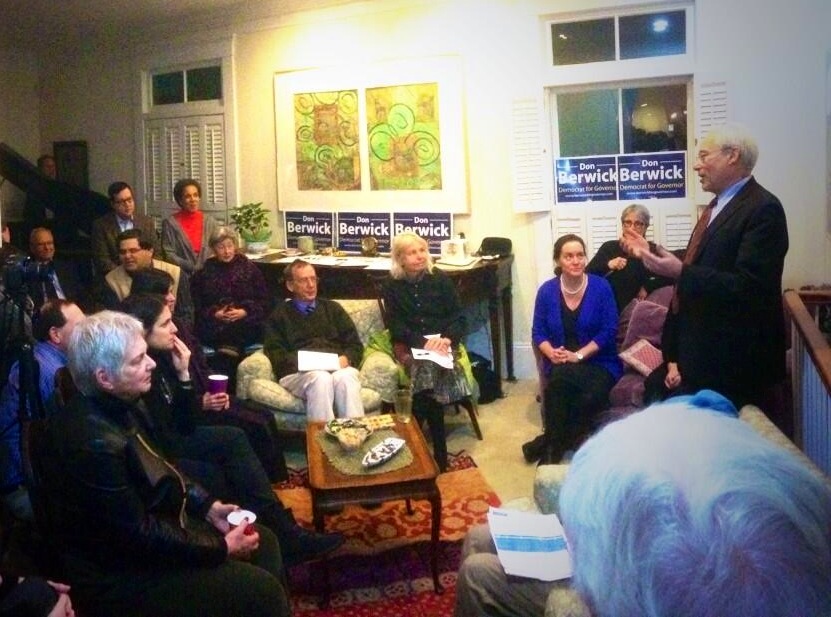
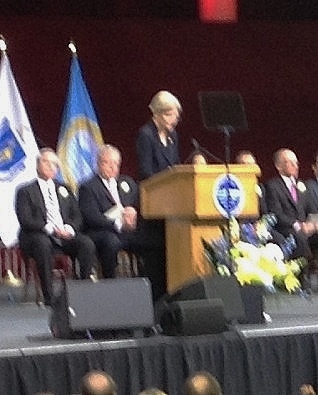
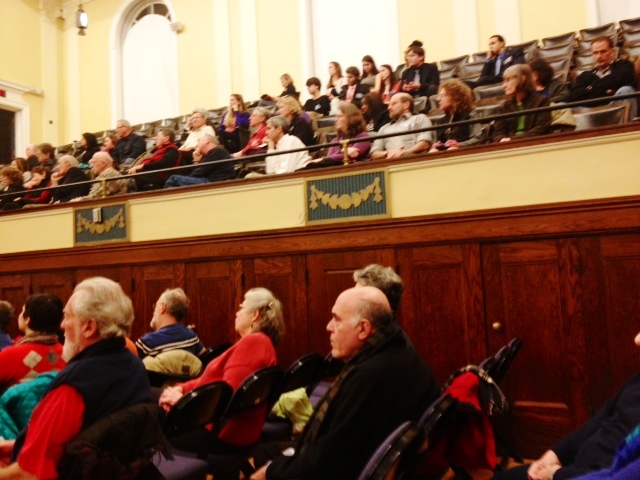
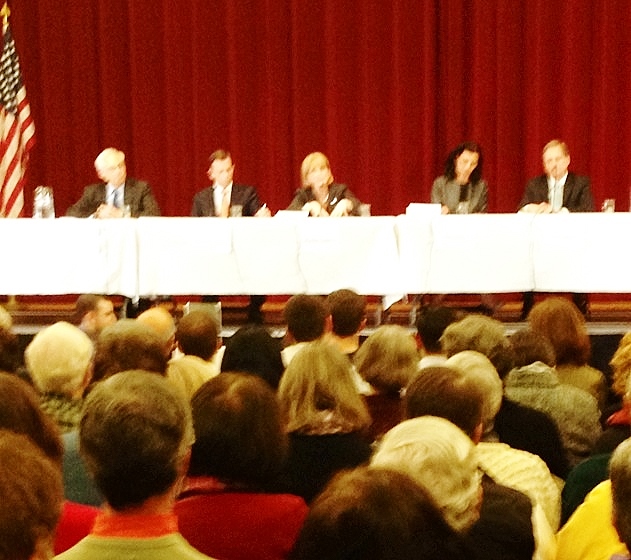
Close to 500 people took seats in Lexington’s Cary Hall to hear the five Democrats running for Governor respond to questions put by the town’s State Representative, Jay Kaufman. The Forum lasted almost two hours, sufficient time for the five to leave clear and very different impressions of what they are about.

Don Berwick, a doctor, sees almost everything as a health care or moral issue ; and as health care and government’s handling of it has roiled the whole nation, the Lexington audience saw it too. Applause galore graced his most fervent flights of pediatric concern. Curiously, he also arrives via the health issue route at favoring repeal of the State’s casino law. All four of his rivals took the opposite position: Grossman pointedly, for both the revenue and the jobs — as he said, ‘how will we replace the casino revenue ?” Coakley opposed Berwick definitively, noting that she has sued to prevent the casino repeal referendum entirely, as an unconstitutional interference with settled contract rights). Even the casual Kayyem said that no, we need casino revenue and jobs.

Many in the Lexington audience applauded Berwick’s anti-casino moralism. To this observer, however, Berwick the anti-casino repealer seemed a Democratic version of Ted Cruz repealing Obamacare. Not exactly the impression he might want to leave.

State Treasurer Steve Grossman addressed many issues on their own two feet, and spoke of immigrant rights, renewable energy, the Governor’s transportation bill, and mental health work, with detail confidently; but he too had his mantras : “I’m the only candidate on this stage who has actually created jobs” and “if we need to raise new revenue, I will do it.” Still, because he often spoke directly after Berwick, Grossman’s intense focus and decisive “this is what I will do as governor’ moments contrasted all to his advantage : Berwick, the moral conscience; Grossman, the man of authority. Berwick drew the loudest applause, and often; but as the Forum continued, Grossman began to draw applause as well — more and more. And if this Forum was about electing a Governor — which hopefully it was — Grossman deserved every kudo accorded him.

That said, was I the only observer who heard a strong likeness to Charlie Baker in Grossman’s “business and job creation” theme ?
Image

^ activists attentive : Cary Hall was full to the loges and balconies

Attorney General Martha Coakley spoke quietly, with a welcoming smile that belied the sarcasm in her many responses, in which she was trying to say, “as Attorney General, I’ve already been working all of these issues, of fairness, budgeting, immigrant concerns, and the big banks.”

Juliette Kayyem, a policy expert and former Obama Administration NSA official, looked gorgeous and spoke casually, almost intimately, as if at a houseparty among friends — a tactic that, to this observer at least, doesn’t work in a setting as structured as the Jay Kaufman Forum. Her informality dissipated her issues statements to the point that I found it hard to grasp what her positions actually are. On the issues that she did address directly her answers seemed tautologous. Berwick and Grossman — even Coakley — stated positions that one might disagree with. Thery took risks. Kayyem appeared to take none and to rely on her charm and personality — pleasant surprise to see in a bureacrat — as a kind of policy statement itself.
Image

^ personality as policy : Juliette Kayyem

Then there was Joe Avellone, a doctor and the CEO of a medical software firm, Parexel. I do not like to speak critically of a man whose candidacy lags so badly, but I have to : on the Lexington stage, Avellone spoke a soft voice that was hard to hear, talked without focus, and, as a doctor on the same stage with the eloquent Doctor Berwick, found himself beaten to the prize almost every time.

Distinctions were thus made, for all to see and appreciate. yet on the night’s most important question — “what will you do if the Speaker won’t sign off on legislation that you propose ?” — all five candidates ducked or evaded. Grossman noted that he has built up solid relationships with members of the legislature. OK, but that wasn’t the question. The question was about just one legislator, the Speaker. Doctor Berwick said, “I’ve met many of our legislators. They seem normal to me.” Laughter — but again, he did not say what he would do about the Speaker, who is not normal but THE Norm. And so it went. Granted that the question was somewhat unfair. In our state the Speaker of the house controls his membership entirely, to the point that no legislation can pass without his OK, and there is nothing that even the Governor can do about it. time and time again, under Speaker after Speaker, we see this happen. What could any of Representative Kaufman’s five guests really say, that would not embarrass them and show them, ultimately, as weak ? The office itself is weak.

Fortunately for the five, this moment of truth came early in the Forum. by the time the Forum ended, the candidates looked important again, their office worthy of activist attention in the party caucuses that begin less than a month hence.

—- Mike Freedberg / Here and Sphere

below : the obligatory Forum photo, complete with white band in the middle annoying every eye.
Image

OMG ! IN DORCHESTER : CARLOS HENRIQUEZ TO JAIL ; GENE GORMAN ON THE TRAIL

Image

^ not a good day for the 5th Suffolk’s Carlos Henriquez

—- —- —-

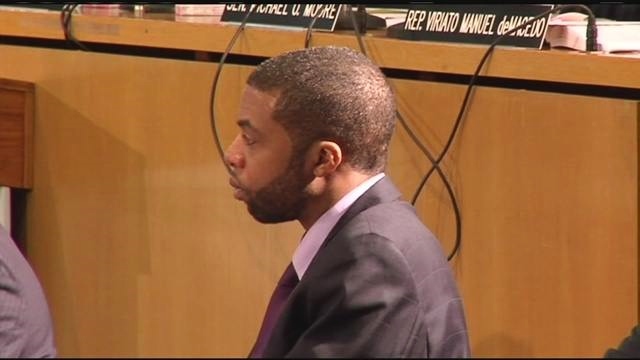
“OMG !” is how the website known as “buzzfeed” might put the big political news coming out of Dorchester yesterday. A jury in Medford found 5th Suffolk District Stater Representaive Carlos Henriquez guilty of two counts of assault and battery. After which the trial judge, Michele Hogan, sentenced Henriquez to two and a half years in the Middlesex House of Correction, six months to be served.

Henriquez was led out of the courtroom in handcuffs, a photo seen by everyone who read today’s Globe or Herald.

I got the word via my twitter feed at about 3:00 PM. Immediately after came a report that Speaker Robert DeLeo requested Henriquez’s resignation; Governor Patrick and Mayor Walsh soon followed. Republican leaders repeated the call — eager to pile on. Would have been wiser had they said nothing.

Will Henriquez resign his office ? It looks simple, but it isn’t. The voters have a right to elect, even re-elect, a person convicted of a misdemeanor. My opinion is that Henriquez should do what his District’s voters want. If they want him to resign, resign. If they are OK with him representing him, no one else has any right to overstep things. I have not sampled opinion in his District, but Henriquez’s troubles have not gone unnoticed among the District’s activists, and he is sure to hear that many of them have had enough.

The many exchanges that I had with Henriquez during the recent Mayor campaign didn’t exactly inspire me. Before the primary, he was nowhere to be heard from; after Arroyo, Barros, and Golar-Richie endorsed Marty Walsh, however, and were joined by some others, Henriquez was suddenly an apostle for Walsh, furious in his intensity, all over twitter chanting Walsh’s praises, arguing at length with Connolly people whom he knew ; and almost all of what the suddenly converted Henriquez said was 100 percent standard Walsh talking point. Not one word from his own experience or observation of a man who, after all, was his state house colleague AND political neighbor. I did not exactly form a high impression of Henriquez’s perspicacity, or loyalty, or his ability to convince anyone of anything.

None of the above is a crime; and, truth be, it seems to me excessive to sentence to jail a man with no criminal record on a misdemeanor conviction. Probation is what we usually do, and rightly. We seek reformation, not retribution. Did Henriquez not receive the mediation that we accord most misdemeanor defendants because he is a legislator ?

That said, resignation seems likely; Speaker DeLeo will seek expulsion if Henriquez doesn’t resign. Of all the State representative openings that have occurred in Boston the past year — five so far, this would be a sixth ! — this one offers truly fascinating possibilities.

One : Charlotte Golar Richie once held this seat. Might she run for it again, regain the political currency that she lacked last year, and, with the backing of communities of color — who very much want a Mayor of color as soon as feasible — run against Walsh in 2017 ?

Two : John Barros also lives in the District and owns Cesaria, a very popular restaurant on Bowdoin Street. Might he run and win and then become a Mayor candidate in 2017 on the same grounds that I posited for Golar-Richie ?

As of 2011, the District included Ward 7 Precinct 10; Ward 8, Precincts 5 and 7; Ward 12, Precinct 6; Precincts 1, 2, 4, 5, and 6 of Ward 13; all of Ward 15 except precinct 6; and Ward 17, Precinct 2. It seems made for Barros.

Of course, momentous possibilities may not come to pass. Both Golar-Richie and Barros campaigned exhaustingly last year. Both have the ear of Mayor Walsh. Who could blame them for not running for yet another office to possibly no great result ? The District does not lack for ambitious new names who will surely run. But whoever does run and win, one fact of the 5th Suffolk district stands out : low voter participation. In its 18 precincts, only 6547 people voted in the Mayor election — about 31 to 33 % of the total registration. Compare that to turnouts of 50 to 80 % in precincts where Walsh or Connolly held a base. Whoever the new 5th Suffolk representative is, he or she should make it a priority to engage the 2/3 of voters who didn’t respond to last year’s intense mayor campaign.

Image

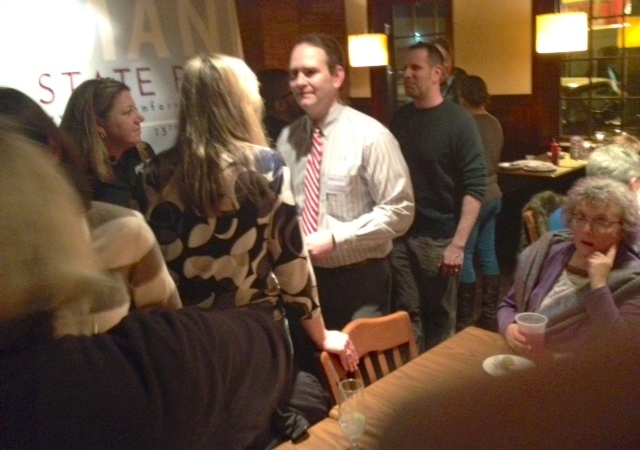
^ better news, right next door, in the 13th Suffolk ; candidate Gene Gorman greets his supporters in Savin Hill

Meanwhile, the Dorchester State Rep seat that Mayor Walsh resigned, next door to the 5th, has a special election on tap; there are — it seems — six candidates in the race, and I attended a reception for one of them, Gene Gorman. The Harp & Bard, scene of many Dorchester political “times,” was plenty full at 7.30 Pm as Gorman, a first time candidate, spoke to the almost 100 people assisting. “Why are we here ?” asked Gorman, “Because we’ve embraced this idea of city life for a lifetime. it’s an important decision. Dorchester by choice.”

Gorman recounted how he, a North Carolina native who now teaches at Emerson College, moved to Savin Hill, because he chose to; and how, a few years ago, he and his wife decided “we wanted a little more room and so we found a house on Melville Park — in Dorchester still.” There, he said proudly, he “served on the governing board of the Robert Frost innovation school. They wanted to close it down. We parents protested , they kept it open, and now it’s a Level One school, one of the strongest performing schools in the whole system !”

Image

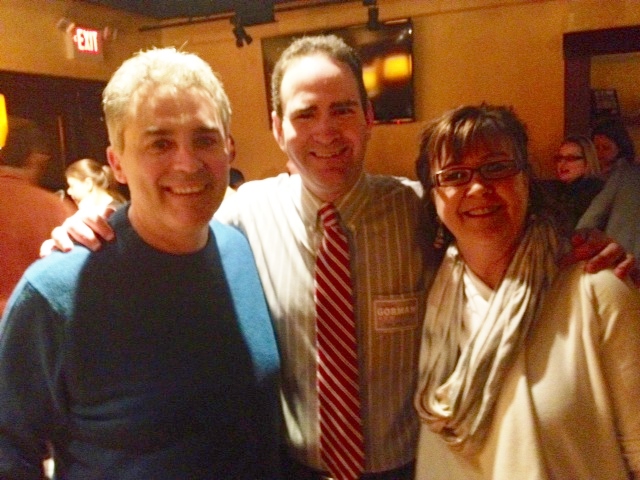
^ solid friends in “Dot” : Gene Gorman embraced by Jim and Millie Rooney — at the Harp & Bard on Savin hill Avenue

Gorman spoke of “progress and transformation” — John Connolly’s theme; and, as Gorman is one of the “new Bostonians” who Connolly’s campaign so appealed to, I almost expected to hear that Gorman had been a supporter. But no; he had volunteered for “Marty,” wrote policy papers for him, and served on Walsh’s Housing task Force during the Transition. Gorman has now resigned that work, to concentrate on the campaign. Judging from last night’s turn out and his own command of the effort, Gorman seems a serious contender even in a field boasting several candidates with major local clout.

—- Mike Freedberg / Here and Sphere

#MAGOV : COAKLEY ATTACKS BAKER; BAKER SAYS “THANK YOU”

Image

Coakley the Chin attacks more thin than win

—- —- —-

In this era of talk show politics, candidates have learned that they can draw attention by attacking opponents early and often. Attention practically erupts when the attacking comes from a surprise direction. It was so, yesterday, when Martha Coakley attcked Charlie Baker for — so she claimed — opposing the minimum wage hike now awaiting enactment by our legislature. Who expected to hear Coakley, the poster child for dull campaigning, signing chin music ?

Coakley’s attack certainly got Baker’s attention. His spokesman Tim Buckley shot back a quick response : that Baker is “open to raising the state’s minimum wage but aslo has other suggestions for putting more money in low-wage workers’ wallets : increasing the earned income tax credit and assuring such workers of longer hours.

To the knee jerk ear Baker’s response sounds like waffling. it isn’t. His earned income tax credot increase is a solid idea, and so is his assurance of longer hours. Too many minimum wage workers aren’t given a 40 hour work week. An employer doesn’t have to provide healh insurance and othetr benefits to workers on the job less than full time; many employers who pay low wages also use the short hours system to avoid incurring benefits. Voters who take the time to think seriously about Baker’s wage and employment ideas will find them quite reform=-minded.

Image

^ a smile on his face : “thank you, Chin, for attacking me !”:

Coakley’s attack, on the other hand, came sucker-punch fashion : slam bang and out. No policy nuance, no ideation, just the one raise the wage do-it. I am all for raising the minimum wage gto # 11.00 an hoiur; we at Here and Sphere have editorialized often in favor of the raise, and we will probably say so again and again. But is “raise up” the only move worth making ? Why should it be ?
Moreover, Coakley added the two talking points being talked by all the standard-issue Democrats : the rause is “good for working families” and “Baker favors the top one percent.” This is dumb stuff. Coakley must know better. I get the impression, actually,l that her attack wasn’t directed at baker at all but a her Democratyic rivals. Coaklehy isn’t runnihg against baker right now;. She is running against Steve grossman, Juliette Kayyem, Don Berwick, and Joe Avellone. Her by-the-book talking points are what Democratic Primary — not November election — voters like to hear.

Coakley must think that by attacking Baker, she’ll be heard first (and she has been) and maybe foremost and that her rivals will have to play catch-up — somehow: because they can’t catch up by attacking Baker : that would look to voters like copy-catting and, well, catching up. We will soon find out how Kayyem, Berwick, Grossman, and Avellone respond to Coakley’s two-bank billiard shot. The winner, one hopes, will be the Coakley rivals who refiuse to play her game at all; who continue to present their own issues and agendas, in their own time and place, gathering support at the upcoming caucuses from activists who want a confident winner, not an attack game tactician. But I could be wrong.

As for Baker, he should send Coakley a thank-you gift. To be attacked so loudly, by such a lamed candidate, this early as the caucvus and convention season ios about to begin, is a blessing. Baker has to be smiling a big smile as I write this column tonight.

—- Mike Freedberg / Here and Sphere

#MAPOLI : CRAP AND FURY IN CENTRAL MASSACHUSETTS

Image

^ PAC’d up talking points : Mike Valanzola of Wales

Image

^ talking the Tea from tax to tightwad ; James Ehrhard says that Stephen Brewer is  Brookline liberal

—- —- —-

As I cover this year’s Governor election, on a statewide basis, I am struck by the number of Republican state legislature candidates from Central Massachusetts who talk the same glib. From Sturbridge to Athol, Clinton to Chicopee, Winchendon to Uxbridge, Ware to Phillipston, you hear what the Cato Institute and its local farm teams, the Mass Fiscal alliance and the Pioneer Institute, have on offer. As if city-based, billionaire-funded policy pushers had anything to say to people living on or close to the edge in towns far beyond the technology quadrant of our state, towns lacking infrastructure, and sometimes health care,effective  schooling or even visibility — the region being vastly under-served by major media.

Ground zero for robo-think Republicanism may well be the State Senate seat now held by Stephen Brewer,a  Democrat who talks the “job creator” poop as glibly as any PAC-d up Republican. Brewer is waiting on the winner of two GOP opponents : Mike Valanzola of Wales and James Ehrhard of Sturbridge. Ehrhard sounds even more Tea-tongued than the rigidly PAC-i-fied Valanzola, and his negative tone doesn’t have much legs : in 2010 he lost a selectman race in Sturbridge by a vote of 1039 to 764. Valanzola in 2012 gave up, after two terms, his selectman seat in tiny Wales; but Valanzola is, so far, running by far the more intense campaign. Central Massachusetts’s Tea-friendly activists badly want the Brewer senate seat, and they have reason to be cheerful : the district’s towns include a bushel of towns that Republicans carry by 30, even 40 points. As Ehrhard points out, Scott Brown in 2010 and Charlie Baker in 2012 carried every one of the district’s 28 communities.

Still, it chills me to see candidates in this hardscrabble district talking Tea fury or  expensively hired bull-bleep. If any area of Massachusetts needs straight talk, and mucho state assistance on many, many fronts, its the Worcester, Hampden, and Hampshire senate district.

Image

^ Democrat on the Tea hot seat staring down PAC flux : 25-year Beacon Hill veteran Stephen Brewer of Spencer

The imposition of PAC-d up quackery isn’t by any means restricted to the Brewer race. Nor the venting of Tea. All Central Massachusetts groans of them. One would think that the Central Massachusetts GOP hopefuls whose facebook pages, twitter feeds, and campaign websites I surf would voice the voices of their towns (few are running in a city); but no : almost all churn out the exact same GreedPAC robo-call, or worse : cut taxes, repeal taxes; don’t raise the minimum wage ; make public assistance almost impossible to get; harass immigrants; go for your guns. Hasn’t anybody got anything original to say ? That suggests a mind at work, not just a lip ?

You confront one of the more aware of these sloganeers, as I have, and you get the answer ‘we need better solutions.” So how about suggesting some ? Maybe.

From the others, all you get is defriended or blocked. Debate not permitted in Central Massachusetts !

PAC-ism is the curse of politics today, especially toxic to regions lacking diversity in people, political party, or media. The Democratic party has PACs too, as we in Boston recently confronted; but these PACs have, it seems, made a decision not to shuttle resources to an area they do not need to win because they already own supermajorities in the legislature; a region lacking in Democratic reliables : Union members, educators, health care interests, and urban planners. Cato-ism thus has free rein — more or less — to rule the unpopulous midsection of our state.

The effect is to drive Republican victory in Massachusetts farther and farther away from  the big cities and from the issues and concerns that big city voters have. It’s a temptation that, right now, our GOP is hard-pressed not to surrender to, a message from the “Quabbin quorum,” so to speak, that will impact city people’s impression of GOP governor hopeful Charlie Baker as much and diligently as he rejects it.

Thus the Democratic party’s light touch in Central Massachusetts be pays big dividends for them.

After all, why not let your opponents voice stuff that doesn’t pass the nutrient test ? You’ve heard the same crap now since 2009. You know it by heart ::

1.”free up the ‘job creators’ to hire people.” Businesses do not hire because taxes are cut. They hire because demand for their product or service increases. Consumer demand amounts to TWO THIRDS OF THE ENTIRE ECONOMY. it can NOT grow if consumers’ income does not grow.

2.”cut taxes, slash public assistance, cut state spending.” How, pray, does it aid the economy to cut taxes ? Our economy cannot grow as it should if our roads, bridges, and transit are constantly in repair, jamming up traffic (no need for a Bridge-gate here, we have a kind of one going on, by itself, every day). Our economy cannot grow if state education spending cuts school needs. Our economy cannot grow if out of work workers can be retrained, can’t get unemployment assistance, can’t get to work because the transit system can’t do maintenance and car updates.

3.Don’t raise the minimum wage, mom and pop businesses will go bust.” That I doubt. If a business is so marginal that it can’t pay its employees enough to not need public assistance, it shouldn’t be in business at all. There may be some such; but there are far, far more working people — and most minimum wage workers are women — who can’t make ends meet, who can’t participate in the growth economy, whose low wages we taxpayers subsidize. This must stop.

4.”force the undocumented immigrants out” : talk about self-defeating ! Every immigrant, documented or not, is a consumer; every consumer maintains the economy.

5.”more guns make us safer.” This one I won’t even dignify. I’m done there.

Why, I ask, why is this haunch gunk being spread across Central Massachusetts, the state’s neediest region, where huge State investment is needed badly, in schools, transit, roads, career centers, and better wages ? A region where many people go unnoticed by any media — except when a tragedy strikes, such as the recent death of a Fitchburg area child in DFC foster care — and basically are left to fend for themselves ?

Expect very little of this to be said out loud in the Stephen Brewer contest with either the angry Ehrhard or the polished Valanzola. Under the table, however, the future of a very dry-rub region of our state will be profoundly affected. Because in theory, at least, Brewer is a Democrat, and he cannot be entirely overlooked, every day, by the big egos in the big city to his east.

—- Mike Freedberg / Here and Sphere

CORRECTION : an earlier version of this story had James Ehrhard being a  Sturbridge selectman, whereas in fact he lost that race in 2010, to Mary B. Dowling by 1039 to 764.

UPDATE 01/21/14 : four days ago, Stephen Brewer announced that he will not seek re-election. His very GOP-leaning seat is now open — maybe — for GOP pick-up.

#MAGOV : AS THE CAUCUSES APPROACH, WHO’S HOT AND WHO’S NOT ?

photo (6)

Today, January 11th, Democratic governor hopeful Don Berwick tours the West. His day begins in Athol, moves to Orange, then over the mountains to Williamstown; the afternoon and evening find him in Springfield, Chicopee, and Palmer. That is a lot of driving, but how else is a statewide candidate to reach out to activists spread across three counties that, combined, comprise about 20 % of Massachusetts’s population ? You can’t helicopter it; trains don ‘t carry people any more; taking the bus seems just a bit wack. So you drive. Berwick has been driving a lot lately. Cape Cod has seen him quite often, the Merrimack valley, even Tea party-laden Worcester County. Tireless he is, this medical man who has a bedside physician’s touch for people he meets.

Peripatetics alone should earn Berwick a high place in the list of hot political properties. Berwick has also attracted solid money this month : $ 62,849 since January 5th. Yet a fourth place man he seems. Attorney General Martha Coakley has twenty times the state-wide clout, as she wields the investigatory poewers of her office. State Treasurer Steve Grossman has the big bucks — don’t be fooled by his raising only $ 13,122.96 this past week; his mid-month report is likely to show a solid dollar haul.. Whoever you talk to, they’ll tell you that Grossman and Coakley own the top two spots in the Democratic part of the governor race. Then there’s Juliette Kayyem. She hasn’t raised as many shekels even as Berwick, much less Coakley or Grossman — though her last week’s $ 39,115.68 merits notice — but on social media she’s the champion of charisma — has more followers than anyone but the seasoned Coakley and, if current tends continue much, will soon pass her too. Kayyem is a physical presence too : eye-catchingly fashionable, and willing to push the style envelope, she could easily be an Oscar actress. She’s the female version of Scott Brown — and a policy wonk besides.

photo (8)

If all else were equal, Kayyem would easily grab the largest number of Democratic delegates at the upcoming caucuses and go on to face Charlie Baker — no slouch in the charisma department himself. But Democratic activists run Masachusetts; they are not amateurs, and no matter how strongly Kayyem may appeal to their idealistic paint, many — probably most — listen not to their paint but to their posts and beams, the basic structure that is the State government which they build and maintain. The carpenter in them knows that Coakley or Grossman already occupy the building and know where its doors and stairways turn up.

Dr. Berwick at least has the health care constituencies to himself. They’ve been his go-to all his adult life and into his government career. They know him, and he knows them. Who does Kayyem have to compare ? I suppose that social media is in itself an interest group these days; and very much a Democratic-leaning one; and them, she has. I run into Kayyem supporters when I’m online far more frequently than supporters of Berwick, Grossman , and Coakley combinbed. But social media people do not overlap very well with caucus goers, many of whom are elderly or professorial and temperamentally at odds with social-speak. Thus both Kayyem and Berwick are toughing it out speaking to 50 people at a gathering or even just 20. It’s like building a sand castle one grain at a time, but there’s no other way for them to climb the castle wall within which lurk Grossman and Coakley.

The caucuses lead to the Democratic convention, at which a candidate must win 15 % at least of the voting delegates. If not, their names won’t be on the Primary ballot. Important to caucus goers are the policy plans, articulated at length, that both Berwick and Kayyem are issuing on their websites. (Grossman too.) A delegate may or may not give kudos to any of these plans; but their issuance at least assures a potential delegate that the candidate offering them is ready — maybe — to govern on Day One. But who to commit to ? We will soon know.

photo (7)

I mentioned Charlie Baker. How is he doing, you ask ? From where I sit typing, he looks doing quite well. He and his running mate Karyn Polito have raised as much money as the Democratic money champ, Steve Grossman. Baker even has a primary cahllenger, a Tea party true believer — “gun rights,’ anti-immigrant, “voter ID,” blame-the-poor : the whole Tea-angry talk show — whose presence in the Republican race frees up Baker to be the moderate problem-solver that Massachusetts voters like.

Baker has given us much more lollipop than the chippy curve he pitched at folks four years ago. He presses the flesh and seems to like it. He mixes with people. He visits cities, even Boston, and talks city issues almost like a Mayor. He has begun to offer policy papers as worthy as, or better, than those of Kayyem, Berwick, and Grossman. He is running almost as if he were competing right now with all four potential democratic winners; and in fact he is competing with them right now. The Tea party, which will, hopefully, split off to one of the several protest candidates on the November ballot, represents about one third of Republican voters. The other two thirds, who form Baker’s core, amount to no more than eight percent of those who will vote for Governor in November. He’ll need to convince plenty of Democrats that he is a better choice than Grossman, Coakley, Kayyem, or Berwick; and the surest way to do that is to do it now, when all four are in the field.

Massachusetts voters often choose Republican governors as a check on our one-party legislature. The four governors prior to Deval Patrick were all GOP. Baker has history on his side. Yet it still might not be enough. Grossman and Kayyem look very strong to me at this time, as strong as Baker; and Berwick stands not far behind them.

—- Mike Freedberg / Here and Sphere

BOSTON MAYOR : TRIUMPH OF THE OLD OLD

Image

^ the old ways first, then the new, maybe : Trin Nuguyen, Alejandra St. Guillen, Joyce Linehan, Joe Rull, Keith Williams, Eugene O’Flaherty

—- —- —-

Mayor Walsh’s first list of appointments has already generated much controversy. I find a lot of the talk otiose. A new Mayor will make new appointments. Who knows if all will last ? Abraham Lincoln, newly at war, made many appointments of generals, but not for two to three years did he identify a team who would and could do the job. It would not surprise if Walsh’s appointments follow a like course.

That said, the current appointments do accord us a look at how Walsh thinks. In the campaign he promised to create a cabinet of adminstratiors that would reflect the cultural diversity of today’s Boston. This he appears to be doing. The appointment of William Gross as deputy Police Commissioner fulfills a commitment in particular to apppoint a person of color to a Police leadership position. His cabinet also now includes Alejandra St. Guillen of Oiste, Felix G. Arroyo (as Chief of Health and human Services), Keith Williams, and Trinh T. Nguyen. St. Guillen will interim direct the Office of New Bostonians; Nguyen, the Office of Jobs and Community Service. Williams, who served Mayor Menino as deputy director of Neighborhood Services, will interim manage the Office of Small Business. These appointments stand; yet all, except Arroyo, are positions of deputy level. The top positions in the new Mayor’s adminstration have gone almost all to people who to Walsh are long-established, close associates and friends. The only exception so far is new police Commissioner William Evans; and even he is a man of tradition.

Image

^ campaign commitment honored : new Deputy Police Commissioner Bill Gross

The two-level division of Walsh appointments mirrors how the Mayor campaign played out. First aboard were Walsh’s core supporters, those who were wth him before the 12-candidate primary. From them has Walsh called upon Joyce Linehan, his new director of policy; Joe Rull, his chief of Operations; Chelsea-Charlestown State Represenative Eugene O’Flaherty, who will be his Corporations Counsel; and — reportedly — former State Representative Brian Golden, of Brighton, as interim director of the BRA. At second remove come those who Walsh added to his support vote after the primary — including Felix G. Arroyo, who alone among second-wavers has earned a first level position in the Walsh administration. One is led to believe that Walsh has said, “First group, I trust. Second group, I will see if I can trust.”

That Walsh seems to value long time relationship so highly isn’t unusual at all in local politics. It’s the norm. It’s how Boston voters vote, and it’s why Boston politics changes hardly at all, especially compared to Boston commerce, Boston residence, Boston fashion and social life. Being a “new” Bostonian is a disadvantage in city governance. It was both the great strength of John Connolly’s campaign — because “new” Boston is so dynamic a presence now, and quite numerous — but it was also that campaign’s big weakness. The old knew its opponent very well, identified it very specifically both geographically and in lifestyle. Walsh has made the very practical decision to emphasize the old and the long-time — shrewdly, if ruthlessly — and to accord the new and the briefly recognized an entry, yes : but not the big prizes. Incremental change it is. We know the drill.

Brian Golden

^ George W. Bush favorited : former St. Rep Brian Golden of Brighton may be directing Mayor Walsh’s BRA

It’s also fascinating to see how many of Walsh’s long-timers now live outside the city and will have to move back into it in order to take positions in his administration. Can I also note that many of these long-timers are politicians of very conservative views ? Brian Golden endorsed George W. Bush in 2004. Eugene O’Flaherty is one of the most socially conservative Democrats in the Legislature. I don’t know Joe Rull’s political opinions, but he is a South Boston native — and Southie is right now by far the most Republican-voting neighborhood in the City. Doubtless all three men will accomodate their views to Walsh’s Left-tinged labor traditionalism — because when you take a job with the boss, you do so knowing what he wants of you. But the appointment to high City office of political people much, much more conservative “at heart” (as most will tell you privately) than the brief they are given has been a fact of Boston city governance as long as I can remember. There hasn’t been a Mayor administered by operatives of reformist mind since Kevin White’s first two terms.

No wonder that Michelle Wu voted for Bill Linehan for Council President. She gets the message coming from the corner office — and from 40 years before it, of governance by very conservative folks. The theme is clear.

—- Mke Freedberg / Here and Sphere

“A KID FROM TAFT STREET IS NOW MAYOR OF BOSTON !”

Image

^ taking the three-part oath as Boston’s 48th Mayor :Martin Joseph Walsh of District 3

—- —- —-

So said Marty Walsh after being sworn in as Boston’s 48th Mayor. Chief Justice Roderick Ireland swore Walsh in. Walsh’s Mom and brother and his gal-pal Lorrie Higgins stood by to watch the “kid from Taft Street” official become His Honor. It was a moving moment no matter which of the 12 Mayoral candidates you wanted. Walsh grew up without a big name, on a three-decker street, surrounded by temptations, some of which befell him. And now here he was, the City’s leader, holder of perhaps the most powerful elected office in Massachusetts.

Other men have traced the same kind of path from bottom to top. One thinks of Diocletian, Roman Emperor, yet born a slave, who rose, who educated himself. Or of Abraham Lincoln. Or Fiorello LaGuardia and Al Smith. It is, in fact, a commonplace of politics, that those on the bottom often believe in the system more truly than many on the top and who, aspiring, steel themselves to rise within it, no matter how long or painful the climb, and to become the steward of it and of all it represents. There have been innumerable Marty Walshes in history. And yet…it is still moving to see an actual Marty Walsh actually become Boston’s Mayor and to see the gathered thousands of Boston’s elite and non-elite actually there, in Conte Forum, to witness his becoming Mayor and to cheer it.

Image

^ Senator Elizabeth Warren delivering her remarks to “my friend Marty”

The powerful did not hang back. Senator Elizabeth Warren spoke eloquently about the passion that she and Walsh, so she said, share for alleviating inequality and the achievement gap. Governor Deval Patrick, choosing a light comic note, told Walsh that he would wake up from “a day of blur” but to savor the moment anyway. Cardinal Sean O’Malley of Boston also sat on stage. Yo Yo Ma performed the “Danny Boy Serenade” with dominant intensity and equally masterful delicacy. The entire City Council, all 13 members, sat on the other side of the podium and took its own oath. The front rows of the Forum found a seated multitude of descendants of former Mayors : Flynns, Whites, Fitzgeralds, Hyneses, Collinses — lending depth to the occasion’s topside.

Image

^ the gathered thousands included a huge segment from Dorchester, all of whom cheered loudly when their Councillor, Frank Baker, was sworn in.

Walsh then delivered an inaugural address sturdy and point by point clear. All the themes of his campaign took a turn : collaboration, diversity in staffing, improving education, ending the achievement gap, attacking violent crime, and assuring full equality to all Bostonians no matter what their sexual orientation, lifestyle or origin. He thanked “,my sisters and brothers in labor” — was roundly cheered — and almost in the next sentence said “let it be known that Boston is open for business.” Here he spoke of “innovation in every neighborhood, not just downtown” and of small business, start-ups, and businesses big.

It was a firm speech, confidently delivered, steady as she goes. Which may well be the defining tenor of Walsh’s administration.

And so you have it. Marty Walsh is your Mayor. Yep.

Image

Image

^ from Chelsea, with what mission ? new corporations counsel Eugene O’Flaherty, currently chairman of the State’s House Judiciary Committee

Hardly two hours had elapsed after that “yep” when an announcement was made at least as portentous as the inauguration itself : State Representative Eugene O’Flaherty, of Chelsea, is giving up his House seat and his House Judiciary Committee chairmanship, moving from Chelsea to Boston, and becoming Walsh’s chief corporations counsel : the city;s top lawyer. I admit that this choice surprised me completely. It was easy enough to believe that Walsh wanted O’Flaherty, who was first elected to the House in the same year as he (1996). The two men share much heritage. The difficult part for me was, why would O’Flaherty take the job ? He isn’t just a State Representative, he is one of the chamber’s key leaders. And also have to move house. There has to be a big story going on, and what it is, I can only speculate. It may involve the Steve Wynn casino project : O’Flaherty represents Charlestown, which Walsh did not come close to winning on election day and which will; be heavily impacted. Is O’Flaherty being asked to use his particular knowledge of the area to win the best mitigation package possible from Wynn, including — a top Walsh priority — construction jobs ? or perhaps to sue the Wynn project, or the Suffolk Downs Revere-only casino project if needed ?

We will soon find out.

We will also find out who Walsh chooses to head the other City departments. Of only one such did he say there would be a “nationwide search” : schools superintendent. Of course so. No Bostonian would want the thankless, frustrating job. (One of his two school committee appointments has already caused comment : replacing charter school principal Mary Tamer with labor lawyer Michael Loconto.) As the school committee appointment shows, not many Bostonians Walsh might name as superintendent would avoid raising an outcry from one interest group or another. Compared to schools superintendent, it’ll be easy to pick a Police Commissioner and one for the Fire Department. No nationwide search needed there.

—- Mike Freedberg / Here and Sphere

BOSTON MAYOR : MANAGEMENT IS THE MESSAGE

Image

^ probably the most-viewed face in Boston today : 29-year old Daniel Koh, who will be Mayor-elect Marty Walsh’s Chief of staff

—- —- —-

“Management” is the message that Mayor-elect Walsh is sending so far. Changes in polkicy may be coming; certainly his core supporters insist on it; but for now, the prioority is to manage better what already is.

We saw the message previewed at the Transition Team Hearings, in which each Task Force found its suggestions divided into “keep,” “implenent,” and “dream” components. Categorization helped task force participants to appraise the impact of their ideas — and to traffic-cop the discussion toward flow, not tie-ups. Still, it wasn’t clear then that traffic-copping would become a policy in itself; but it looks that that is what has happened.

The selction of Huffington Post chief staff manager Daniel Koh to be Walsh’s chief of staff confirms it. Koh is a manager, not a politician. He holds an advanced degree in management; method is his milieu, application his brief. Havard; Phillips Andover (disclosure : my school too). He worked in Mayor Menino’s administration prior to joining Huff post. His selection assures that the policies will be Walsh’s, the implementation, Koh’s. Sometimes chiefs of politicians’ staffs inject policy ideas of their own. It’s all too easy for an office holder’s office manager to control the action. Koh will not — probably can not — do that to Walsh : or maybe I should say, he and Walsh agree completely, that management will be the policy and thus Koh will have free rein to make it happen as he deems best.

(to learn more about Daniel Koh, follow this link to his Huff post bio : http://www.huffingtonpost.com/daniel-koh/ )

The selection has won almost universal applause. Nearly everyone understands that, despite Tom Menino’s remarkable popularity with voters, his City Hall abounds in seat of the pants. “Temperamental” is its key. Who knows what, or who, will be the priority tomorrow, or the next day, of Menino’s impromptu, grudge-freckled mind ? As for the BRA, the less said the better. Developers either got aboard Mayor Menino’s Indiana Jones-like chase horse or they risked getting poofed, or cornered. Communities into which developments were to be deposited found themselves labyrinthed, door-locked, sweet-and-sour talked. One heard it at all the Mayoral Forums during the campaign, in every part of the city. Heard also was an almost universal demand to simplify the City’s permitting process — or should I call it “permitting adventure” ? Permitting should eanble enterprise,l not discourage it, much less laugh at it.

Nobody much mentioned the taxi scandal during the campaign; it wasn’t laid at Menino’s door; but nowhere in City governance was Menino’s managerial unavilability more on view. For how many years had the City’s taxi drivers been allowed to be cheated, gouged, disrespected by taxi medallion owners, with not a whisper of investigation undertaken, much less corrective action ? It happend on Menino’s watch, and he knows it did. So do we.

Walsh appears determined to not let that sort of sinkhole exist on his watch. This is a good thing, and a wise one. Walsh knows that the City is divided on most of the major policy areas he will eventually have to face. School reform, City unions, staffing diversity, traffic and bikes, poverty and achidvement, public safety — all portend division that Walsh, elected by a coalition internally mjuch at odds, cannot afford to take hold. On management of what the City does already do, however, there is almost no disagreement : it needs dramatic improvement. Order out of anarchy, simplicity from confusion.

Improving City management was the message of two Mayoral campaigns that did not win : Rob Consalvo and Dan Conley. Walsh won almost all the Consalvo votes : voters who don’t like Walsh’s charter schools record and don’t readily comport with his trade union style but who chose him nonetheless. These voters must be happy to see Walsh adopt Consalvo’s signature theme. As for Dan Conley voters, Walsh won hardly any. His emphasis on City administration first can only be a pleasant surprise to voters who did not envision Walsh as an administrator of anything.

You all know that we at Here and Sphere favored John Connolly. But I saw in Dan Conley a very capable second choice. Thus I too find Walsh’s “management first” message a wise one. The policy decisions can wait while he — and we — fix the process by which those policy decisions will be implemented.

Meanwhile, Councillor Ayanna Pressley has announced that she will seek the Council Presidency. She is said to have Matt O’Malley’s vote and Tito Jackson’s. The wheels are turning. Oh yes they are.

—- Mike Freedberg / Here and Sphere

UPDATE : Now I am getting reports that Bill Linehan will have no less than 8 votes out of 13.  Even so, Ayanna Pressley has made her move. And a statement.

LABOR ISSUES AND THE ECONOMY : UNITY IN NEW YORK

Image
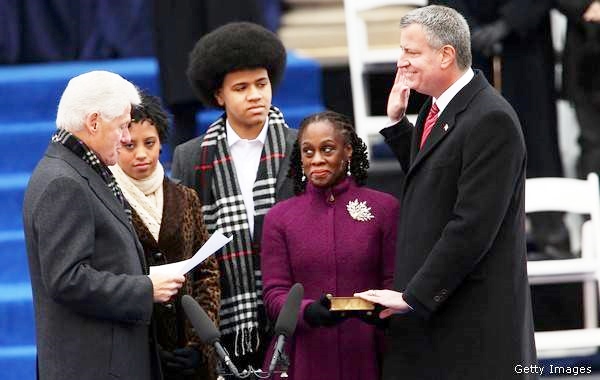
^ center left pact ? unity in New York as Bill Clinton swears in mayor Bill deBlasio

—- —- —-

By asking Bill Clinton to swear him in as New York City’s new Mayor, Bill deBlasio has already made history. On this one move, deBlasio has assured that the Democratic Party will not split between wings “Labor’ and “Centrist.”

This is good news for all Americans who want to see economic progress come to their lives, not just the very favored top earners. Many Americans — myself included — are pushing legislation and referenda to relieve the huge rush of money to the top, money away from everybody else. These moves cannot take the field as an opposition movement within the only political party placed to bring them about. Bill deBlasio and Bill Clinton have signalled that they understand this and will move forward as Democrats together. The initiatives the two men agree on could not be more vital :

1.raise the Federal minimum wage to $ 10.10 n hour and index it to inflation.
2.protect unemployment benefits for long-term unemployed, many of whom have been without work so long that they already require job retraining in order to maintain skills currency
3.commit all the Federal spending needed to repair and improve America’s infrastructure
4.maintain the Federal food stamp program, do not cut funding for it

To which I could add the following :

1.fully staff the National labor relations baord (NLRB) to monitor and protect the organizing and bargaining rights of workers in organizable industries
2.make it an unfair labor practice to (a) reduce workers’ hours to part-time levels so as to avoid paying benefits or providing health insurance (b) make such workers “independent contractors” rather than W-2 employees
3.extend the “earned income” credit to incomes up to 150 % of Federally defined “poverty” level.
4.pass a comprehensive immigration bill that provides all undocumented immigrants other than those with a felony criminal record a pathway to citizenship, and immediately grant social security numbers, access to drivers’ licenses, and access to health care to all such immigrants.

The initiatives that deBlasio and Bill Clinton jointly advocate, and those that I have added to the list, purpose to do the right thing by many millions of our neighbors; they will grow the economy strongly. Did we need Jeb Bush –a Republican — to point out, as he did at last year’s CPAC Conference, that undocumented immigrants are a boon to the economy, in the work that they do and, yes, the taxes that they pay ? That by their young demographic, they help rescue the Social Security fund ? Jeb Bush said that. Why it needed saying, I’ll never understand. It’s common sense ! The economy is ALL of us. If millions cannot participate in it except at the margins, the economy suffers. Time and again I have editorialized that consumer spending = two thirds of our ENTIRE economy. You want jobs created ? Consumer spending creates them. businesses do not hire people because taxes drop. They hire people because demand increases for their products and services.

Why can’t the funders of today’s Republican party get this ? The businesses that have pushed most current Republicans to fight every move that puts more money into more people’s budgets are blind to their own interests. Any business exec with half a brain knows that his or her employees are the strongest asset, that employee turnover is a huge and largely unnecessary expense; that prosperous and loyal employees buy what they make or the services they provide; that they spread the company’s good reputation by word of mouth to everyone they talk to.

May I add, as I’ve said before, that if the Republican-funding business execs don’t like unions, don’t make your workers organize one in order to get paid what they deserve ? Otherwise, expect a union and all the hassle, drama, and — unhappily — oppression and even intimidation that comes with union organizing and job actions.

Granted that almost all of the new job descriptions being formed in the technology world are not union work. They’re as individualistic as innovation in the raw always is. New economy jobs also pay well. There’s no lack of venture funding for innovation work. I also note that many, maybe most, innovation venturists work with the Democratic party now. They’re not the breed of CEO that funds self-defeating money PACs.

In Boston, in our Mayor election, these innovation capitalists and the start-up world that they fund split with union and union-organizing interest groups about which man to support. Nor do we have available a Bill Clinton to swear in Marty Walsh and reunify our state’s Democratic party. But the issue that divided Boston’s Democrats in the mayoral election wasn’t part of the economic progress agenda that Bill Clinton and Mayor deBlasio have shaken hands on. Here the issue was the part that public worker unions should play in the City’s budget and what level of influence they should have on City policy governance. On the economic progress agenda, Walsh and John Connolly fully agreed.

—- Mike Freedberg / Here and Sphere

PS : many of the innovation venturists and execs who supported John Connolly were and are of a mind to support some Republican candidates, at least locally in Massachusetts; possibly even nationally. Why the current Republican consensus cannot connect to these innovation capitalists, I’ll never understand. It would help, of course, if the party could ditch the lifestyle bigotry and lose the opposition to women’s reproductive rights. Fortunately, those obstacles mine no ground in Massachusetts. Charlie Baker, if he hopes to be our Governor, is free to embrace innovation capitalism, discard Scrooge agendas, wave off the anti-immigrant talk, and embrace diversity, economic dispersion, and the future. He might just do that. His excellent plan to end homelessness in Massachusetts is a promising first step.

BOSTON SCHOOLS REFORM : THE ROLE OF PEDAGOGY

Image

^ the teacher overseeing “learning in community”

—- —- —–

In Part I of my look at how Boston should reform its Public Schools mission I focused on curriculum. I asserted that employers and citizenship must be accorded primary status in curriculum, and also must be the decider about competition among teachers and between schools.

Now for Part II, in which I discuss pedagogy — the means and methods by which teaching is done — because pedagogy is the province of teachers and only teachers. It is they who must use them. It is teachers who innovate teaching method. Teachers lead by example. They are the souls in which passion for knowledge lives.

Image

mathematics pedagogy : Building the Habits (Love) of Learning

As in so much of the world of thought and in the practice and theory education, Augustine (354-430 AD) was the first to write comprehensively about pedagogy. I cannot think of any writer then or since who has contributed more — even as much — to our understanding of what a teacher does, how, and why. It is well worth your time to read the following long passage from Wikipedia’s extensive biography of Augustine, who was a teacher all his adult life, a brilliant thinker, and (if anything) an even more brilliant writer :

“Historian Gary N. McCloskey ( says a passage in Augustine’s Wikipedia biography) finds four “encounters of learning” in Augustine’s approach to education:

1.Through Transforming Experiences;
2.as a Journey in Search of Understanding/Meaning/Truth;
3.Learning with Others in Community; and
4.Building the Habits (Love) of Learning.

“His emphasis on the importance of community as a means of learning distinguishes his pedagogy from some others. Augustine believed that dialogue/dialectic/discussion is the best means for learning, and this method should serve as a model for learning encounters between teachers and students. Saint Augustine’s dialogue writings model the need for lively interactive dialogue among learners.

“He introduced the theory of three different categories of students, and instructed teachers to adapt their teaching styles to each student’s individual learning style.

“The three different kinds of students are:
1. the student who has been well-educated by knowledgeable teachers
2.the student who has had no education; and
3.the student who has had a poor education, but believes himself to be well-educated.

“If a student has been well educated in a wide variety of subjects, the teacher must be careful not to repeat what they have already learned, but to challenge the student with material which they do not yet know thoroughly. With the student who has had no education, the teacher must be patient, willing to repeat things until the student understands, and sympathetic. Perhaps the most difficult student, however, is the one with an inferior education who believes he understands something when he does not. Augustine stressed the importance of showing this type of student the difference between “having words and having understanding,” and of helping the student to remain humble with his acquisition of knowledge.

“Augustine introduced the idea of teachers responding positively to the questions they may receive from their students, no matter if the student interrupted his teacher.

“Augustine also founded the restrained style of teaching. This teaching style ensures the students’ full understanding of a concept because the teacher does not bombard the student with too much material; focuses on one topic at a time; helps them discover what they don’t understand, rather than moving on too quickly; anticipates questions; and helps them learn to solve difficulties and find solutions to problems.

“Yet another of Augustine’s major contributions to education is his study on the styles of teaching. He claimed there are two basic styles a teacher uses when speaking to the students. The mixed style includes complex and sometimes showy language to help students see the beautiful artistry of the subject they are studying. The grand style is not quite as elegant as the mixed style, but is exciting and heartfelt, with the purpose of igniting the same passion in the students’ hearts.”

Augustine knew well what teachers today know and apply every day in the classroom : that different students require different means and methods. Augustine’s insight can thus be extended to Special Education as well. There are only two ways to apply Augustine’s individualized teaching. either you can separate the three categories of students and teach them apart, or you can bring them into the same classroom and work each group as they are. As Augustine counted highly the community setting, he would seem to favor the integrated classroom.

Can this work ? Augustine was the first education theorist to suggest a variety of teaching styles, each geared to a category of student. It must have been an exciting classroom, with Augustine teaching one way to one group of students and another way to another group, and all the students observing — even participating — in the diverse program. But Augustine did not confine his teaching to classrooms. He loved company at meals, and it is not unlikely that he had many of his students to dinner, thereat to instruct them, probably by improvisation upon the various pedagogic styles he wrote about (and certainly used).

I make the following additional observations to this examination of the greatest educational theorist’s pedagogy ;

1.None but a teacher could have conceived the pedagogic challenge as creatively as Augustine did, or as insightfully
2.certainly the employer of that time, the Roman imperial bureaucracy, could not have done it. Nor did it care to try. That was why it hired teachers. It was the teachers’ job to figure out how to educate students to the needs of Imperial administration.
3.assumed in all of Augustine’s education manual is that all teaching must met a standard of effectiveness. In his time, that was determined by the employer. The ineffective teacher lost Imperial favor, or students, or both. It was a self-evaluating system.

What we teach today has changed — though not as hugely as we sometimes assume — and schools now answer to a million employers, not only one. But Augustine’s pedagogic rule remains : that it is teachers, and only teachers, who must devise the means and methods by which will be taught the curriculum that the society and employers pay to have taught.

Teachers in Augustine’s day had no choice but to excel. They were not paid by the state. Their pay came from students’ fees. If a teacher had imperial favor, the fact was known, and he drew students; and these students paid. If he lost favor, the students’ parents saw that and sent their children elsewhere. Tenure ? There was no such thing. Every day, a teacher risked all. While it worked, it was the finest education system our civilization knew until modern times. Of course I do not suggest that we abolish tenure. far from it. That’s too much to ask of teachers who practice under the current system and have career time invested in it. But I do want to assert that tenure comes at a cost. A non-tenure system such as Roman education is self-evaluating. Evaluations in our tenure system depend upon who is doing the evaluating and answering for them to whom. Most of the evaluators are middlemen, not the society — and not the employers. But I suppose that, as in so much, inefficiency is the precious price that democratic government pays to a complex society of human fallibility.

Today we educate every child, not just the next generation of imperial administrators. We teach for a hundred different careers; we teach dozens of subjects. Scientific method was unknown. All students, of whatever  origin, learned in Latin. A unified administration was the rule then; diversity is ours now. Then, the stylus and tablet ruled; today, the digital device. Yet for all the differences between Augustine’s late imperial state and our always changing polity, teaching remains what Augustine knew it to be : teacher and student, teacher and students, learning for a purpose, a career, a better life and — perhaps — the love of learning for its own sake.

For Augustine, teachers ruled. So too for most of the educational theorists whose impact has been paramount since. Some theorists emphasize the school administrator — the principal. Some, the grading system and promotion from grade to grades. All these Augustine’s school took into account as well. The teacher yet ruled.

If the members of teachers unions could only accept their mission, embrace it as their unique contribution, risk all, and apply it within the larger context of society, competition, and employer curriculum, we would move a long way toward deploying education’s variety of means, methods, subjects, and standards in a context of challenge, innovation, and struggle as opposed to job security, curriculum debates, and one size fits all. It doesn’t. If Augustine knew that, why not us ?

—- Michael Freedberg / Here and Sphere

NOTE : You should read Augustine’s Retractiones as well as Peter Brown’s almost on-the-scene biography of Western Civilization’s most insightful social and psychological thinker — not to mention brilliant punster, superb speaker, and dramatic lecturer.