NOT MUCH TO LIKE AND A LOT NOT TO LIKE, IN SENATE BILL 2800

Terranova

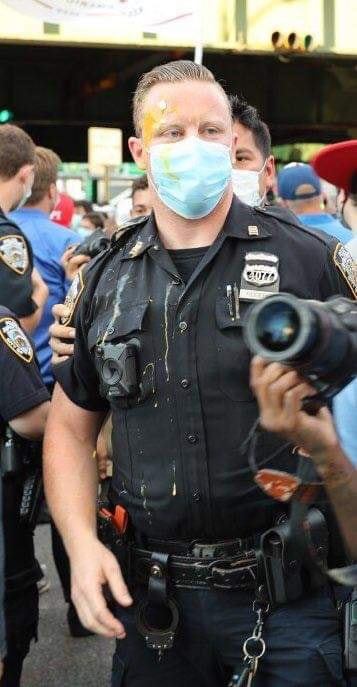
^ a hero for our time. (photo by Tim Terranova, of bay Ridge, Brooklyn)

—- —- —-

Last night, at 4.15 AM, the State Senate voted to enact an “emergency” police bill by a vote of 30 to 10.

One might think that this bill addresses the actual emergency, which we have all seen : assaults upon our police forces by rioters and “peaceful” protesters, harassment of police and their families (even shootings), and defunding actions by various City Councils that undercut the police, who are on the front lines combating the mayhem in the streets of so many American cities right now — not to forget the crime sprees that have gushered up in many cities these past few weeks.

Yet one who assumes this would be wrong.

The Massachusetts Senate bill just voted 30 to 10 addresses nothing of the kind. Instead, it weakens the police and creates an unnecessary, racially constituted commission whose members are to be appointed by persons of said race, for the express purpose of overseeing police operations dramatically compromised by other provisions of this bill.

Begin with the bill’s title : “An act to reform police standards and shift resources to build a more equitable, fair and just commonwealth that values Black lives and communities of color.”

What the blazes is this sentence talking about ? It isn’t the police force’s responsibility to create a “more equitable and fair” commonwealth or to “value Black lives,” etc. The police’s job is to fight crime and to work with neighborhood residents to arrest those responsible. The first request that people ask of police is to keep us safe and to arrest those who interrupt our safety. What else should police do but that ? As for valuing lives, police must first value the lives of those who they are protecting. That is who police work for. ’nuff said.

Sections 3 and 4 of the bill read mostly useful. They outline detailed standards for training prospective police, an initiative which Governor Baker has himself proposed and which makes sense. Section four, however, includes the following language at its end : (iv) the history of slavery, lynching, racist legal institutions and racism in the United States. What this condescending history lesson has to do with the job of keeping residents safe from criminals, I don’t know. Slavery ended 155 years ago — seven generations. Policing takes place entirely in the present, as does almost all of life. I’m also very skeptical, given today’s maoist bullyings and “cancel culture” — all of it assaulting people in the street and online — of the line that would be taken by the “history teachers” who would be providing these lessons.

Sections 6 through 33 of the bill spell out detailed regulations and standards for appointing, overseeing, and promoting or disciplining police, Most can be accepted, although I note that they override union contracts or set aside civil service protections, all of which generations of police and government reformers have fought to enact and maintain.

Sections 34 through 41 of the bill regulate funds received by police forces from other than State budgeting and also enumerate military-grade equipment to be used by police. I have no significant objections to any of these.

Sections 42 through regulate the disciplining of police officers and include the following absolutely objection able provision, which I expect will be stricken from the bill in House deliberations to come : Section 98H. An agency employing a law enforcement officer, as defined section 220 of chapter 6, shall not include or permit the inclusion of a nondisclosure, non-disparagement or other similar clause in a settlement agreement between the agency and a complainant; provided, however, that such settlement may include, but not be limited to, a provision that prevents the agency from disclosing the identity of the complainant and all facts that could lead to the discovery of the complainant’s identity if such provision is requested and approved by the complaint.

Equally offensive is the following school police provision, which cannot stand : School department personnel shall not disclose to a law enforcement officer or agency, or submit to a database or system designed to track gang affiliation or involvement, any information from its databases or other record-keeping systems including, but not be limited to: (i) immigration status; (ii) citizenship; (iii) neighborhood of residence; (iv) religion; (v) national origin; (vi) ethnicity; (vii) native or spoken language; (viii) suspected gang affiliation, unless it is germane to a specific unlawful incident or to a specific prospect of unlawful activity the school is otherwise required to report; (ix) participation in school activities, extracurricular activities outside of school, sports teams or school clubs or organizations; (x) degrees, honors or awards; and (xi) post-high school plans

Section 52 micro-manages street-stop policing to such an extent that front line policing becomes next to impossible. Read the provision here — https://malegislature.gov/Bills/191/S2800 —  to find out just how unrealistic this provision is.

Section 55 regulates actual police uses of force — a fit subject for reform — much too far, crippling a forceful response to rioting, looting, and harassment of officers. The useful admonitions it does offer are already standard policy for most Massachusetts police forces.

Section 58 : I quote in full.

Chapter 276 of the General Laws is hereby amended by inserting after section 2C the following section:-

Section 2D. (a) A warrant that does not require a law enforcement officer to knock and announce their presence and purpose before forcibly entering a residence shall not be issued except by a judge and only if the affidavit supporting the request for the warrant establishes probable cause that if the law enforcement officer announces their presence their life or the lives of others will be endangered.

(b) A police officer executing a search warrant shall knock and announce their presence and purpose before forcibly entering a residence unless authorized by warrant to enter pursuant to subsection (a).

(c) An officer shall not dispense with the requirements of subsections (a) and (b) except to prevent a credible risk of imminent harm as defined in section 1 of chapter 147A.

(d) Evidence seized or obtained during the execution of a warrant shall be inadmissible if a law enforcement officer violates this section.

So much for taking into custody dangerous persons who would surely skee-daddle if notified in advance. This provision arises, of course, from the Breoma Taylor death caused by officers exercising a no-knock warrant at the wrong house for a suspect already in custody. Wrong in so many ways as that police mistake was, it strikes me reckless to place unworkable provisos upon these warrants.

I understand that this column has become a very long read. I will therefore sum up the reaminder of the bill.

It revises guidelines for sealing one’s criminal record. It also eliminates “qualified immunity” from lawsuit for police, firemen, nurses (!!!) and first responders for actions they may perform in the course of doing their jobs. This elimination has generated a ton of controversy. it’s probably the one part of Senate 2800 that you have heard of. It cannot stand.

What policeman, fireman, nurse or first responder is going to risk his or her life, or serious injury, from going into danger, if he or she knows that persons with grievances can ruin their finances, cost them their jobs, and destroy their reputations ? Qualified immunity is the sine qua non of employment in jobs of danger where the readiness to face danger must be supported in every way possible. This bill’s elimination of it alone makes the bill unacceptable.

—- Mikde Freedberg / Here and Sphere


ON MATTERS OF SEX, THERE ARE NO FINAL ANSWERS

J.K.-Rowling

Recently, a famous author, J K Rowling, has published an opinion about transgender with which I in part disagree. That I disagree with it partially makes it all the more important that she publish it and contribute to a discussion — which by definition means more than one opinion. If there is only one opinion, there is no discussion.

You can and probably should read Rowling’s long and detailed report here : https://www.jkrowling.com/opinions/j-k-rowling-writes-about-her-reasons-for-speaking-out-on-sex-and-gender-issues/

Much that Rowling writes troubles me. Transgender is not to be taken as a fad or as a peer group happy trip. This is what Rowling sees happening, and if so, the situation certainly troubles me, as it should bother anyone. Again : transgender is not a plaything, not a gift pony that a kid gets bored with and mistreats. Any sexual or gender feeling ought be confronted by the person felling it and by his or her parents if the transgender is a child. I personally know several parents who are handling such a situation with great care and awareness. There no other good way. I can also assure you that transgender does not become any easier when one reaches adult years. It is never easy.

Upon this riddle, well observed opinions such as Rowling’s must be taken to heart BEFORE any sort of disagreement begins.

Divergent opinions must always be taken seriously, for in human affairs, as well as what human beings can or cannot know, there is no final; truth. Life is a mystery, and perception is subjective; Bishop Berkeley, 250 years ago, made clear that perception is literally in the eye of the beholder. Skepticism is therefore wise in all things.

As for Rowling’s view, she holds that transgender may not be the last word. As I believe myself to be transgender., I can attest that i find my situation an inexplicable mystery. That I feel transgender strongly does not mean that I comprehend my feelings. It is wise to respect those feelings, but not to be intimidated by them.

\Rowling has run into some opposition, not so much to what she opines as to her being able to publish it at all. This I reject. We who find ourselves on a sexual or gender path that doe snot fit the neatly binary categories traditional to society should do what is always wise for human beings to do about everything epistemological : never assume that any judgment is final or true. And if this approach makes one’s life difficult, or tentative ? well, life is difficult, and it is tentative.

That one’s gender or sexual situation is tentative does not, of course, permit anyone else to disparage anyone. Everyone’s life is for that person to figure out and is almost always none of anyone else’s business. So many of us arrogate a permission to decry other people for being who they believe they are. No such arrogance should ever be embraced. We are all journeying through a glass, darkly: and again, here, as everywhere., the rule stated by Rabbi Hillel the Elder apples : whatever is hateful to you, do not do to your fellow. this is the whole Torah, the rest is explanation. You do not want to be judged by others, so do not judge them. Questions about sex and gender, as a general proposition, however, must always be on the table : for no man knows who he is or what is, or likely ever will.

I thank J K Rowling for offering her well-considered views on a topic that no one will likely ever understand.

Note : there may be people ho will feel moved to “cancel” me for writing this editorial. To which I say : “by all means — be my guest.”

—- Mike Freedberg / Here and Sphere

OF A VISIT TO WASHINGTON, DC

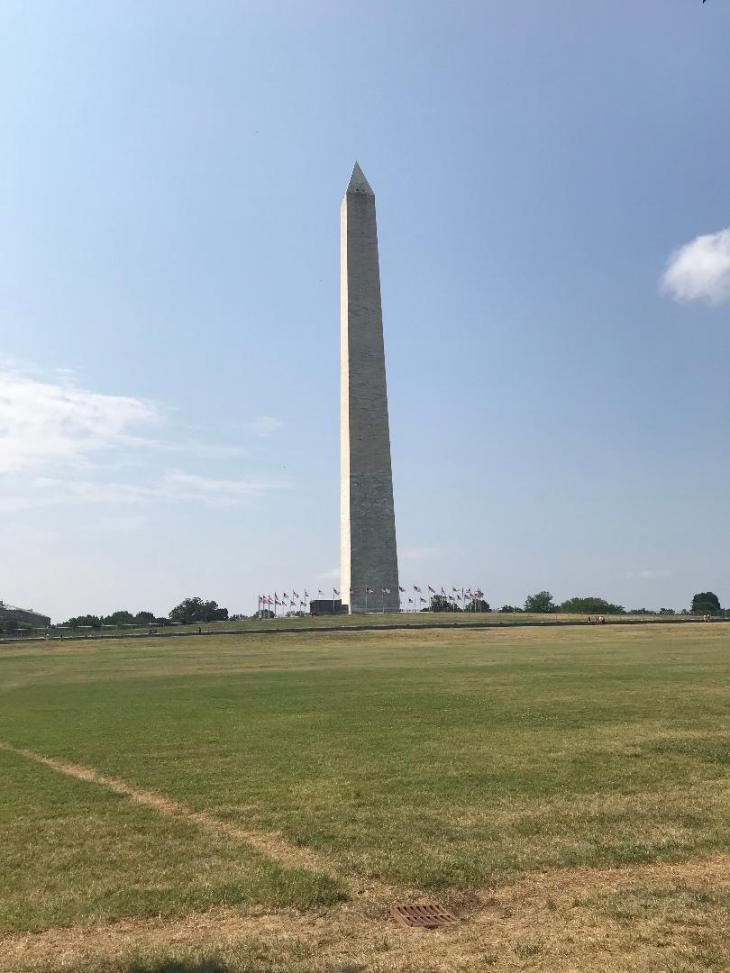
washington

Last night my wife and I returned home from a four-day visit to her brother’s house just outside Washington. Most of the trip was just that, a family affair. But for me, at least, the visit to Washington itself proved to be inspirational. This was the weekend of our Independence Day ! Thus celebration was a pre-condition.

We visited sites that, until the recent attacks on America;s national consensus, I had taken  for granted. Never did I imagine that I would need to pay respects to the Lincoln Memorial, the Washington Monument, the White House, and the National mall. These locii of our national loyalty I had assumed were a given, salutes to ideals and a history that all of us shared and loved. But the destructive events of the past month have shown me that I was wrong; that things which I, and almost all of you, took for granted, had somehow become objects of violent hatred.

I leave aside any attempt to analyze the origins of this hatred, or its manifestations. Plenty of keyboard warriors are out there fulminating and condescending, accusing and sarcastic, bullying the ordinaries, arousing the all-knowing.

One warning for those who wish to visit as I did : it is very, very, VERY HOT in Washington on a July weekend.

I paid my respects to Abraham Lincoln, to George Washington, To Martin Luther King (who delivered his “I have a Dream,” address on the steps of the Lincoln Memorial), to President Lincoln and Archer Alexander, to the White House’s occupants, to Thomas Jefferson,. to Vietnam’s war dead, to the beauty of the Mall. I saluted the huge US Treasury building, bristling in its Napoleon III spread and bulk. I grinned at the glass-windowed, lobbyists’ offices of K Street. I hummed the elegance of Northwest’s beautiful townhouses.  I crossed the Potomac (though not as George Washington did.) It’s all there, the magnificence of an imperially vast presumption, in our case, the assurance that we are the servants of a manifest destiny, to bring democracy and opportunity, freedom and the melting pot, to every human being everywhere. he finest manifest ever devised by flawed men and women.

I share that assurance. I hope that you share it, too.

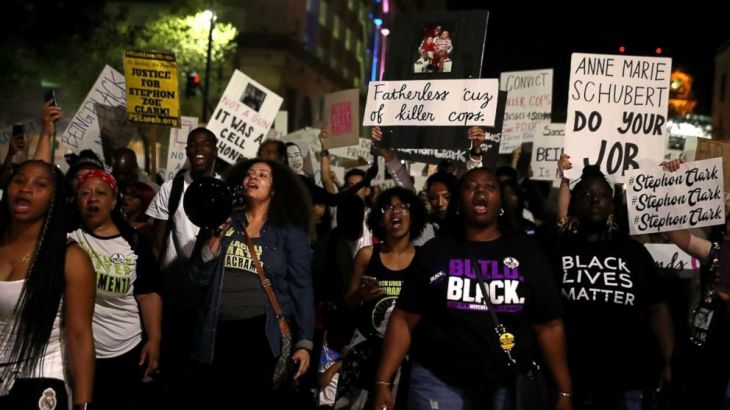
There was, of course, more to see. The phrase “black lives matter” has become the song of 2020, and it was sung almost everywhere in Washington that I visited. It was drumming in the fences and barriers erected along every street between Constitution Avenue and the Potomac (and more), protecting national monuments from attack by vandals. It piped in the conversations between my wife, myself, and other visitors who we met. It hip hopped a bassline in the boarded up windows on almost every building — hotels, stores, restaurants, bars — along sections of H street where “peaceful protesters” have disrupted and broken stuff almost every night. And it chuckled a Bo Diddley guitar riff on “Black Lives Matter Plaza,” formerly two blocks of 15th Street facing the White House, are lined with souvenir kiosks hawking T shirts, masks, paraphernalia in the usual tourist manner.

The phrase certainly fits a mood of Washington today. Downtown, it cannot be put out of mind. What it means, is up to you. I accept it because how can one not affirm that a life matters, whosoever’s it might be ? I don’t mind that the phrase singles out, for special attention, certain lives, even if the singling out is done on a skin color basis. Easy as it is for the phrase to lead to logical and factual dead ends, it’s just as easy to not give in to those temptations and use the phrase “black lives matter” to apply to cavalier killings of black persons — but be careful of the definition ! — by agents of our justice system. If we limit the application to just that narrow event pathway we can maybe achieve important reforms that will allow “black lives matter” to become as honorable to remember as the honorables who I visited this past few days.

— Mike Freedberg / Here and Sphere
ALL LIVES MATTER MEANS THE SAME THING AS BLACK LIVES MATTER

all lives matter

^ the two principles are the same, not opposed

— — — —

We’re on the road, my wife and I.

Says she, “I see Black lives matter signs. Where are the all lives matter signs ? Doesn’t everybody matter, Mike ? Every life matters.,”

Why add anything further ? To me, as to her, the question is a simple one. Yet the circumstances afoot in our nation require me to expound upon the obvious.

All lives matter means exactly the same thing as Black lives matter. Black lives might not matter if all lives did not matter, and if Black lives did not matter, there could not be all lives mattering. Thus the limited principle is subsumed in the general.

Yet here we have the sentence “Black lives matter” presented as if separate from its wider principle.

From day one,  the cry “black lives matter” demands separation — even elevation : that Black lives are somehow special, problems of which are to be attended to more than the difficulties in other lives — whence has flowed all manner of trouble.

America’s equality principle, sanctioned in several Constitutional Amendments and in almost all of our Laws, recognizes no degrees of mattering: everyone is equally crucial to the working of our republic. We detour from this equality at our peril.

There do exist, as we all painfully know, several paths on which citizens with darker skin are denied the equality our laws mete to all of us. True, sadly, even after the winning of a horrible Civil war and the passage of the 14th Amendment, above all, and of several strong Civil Rights Acts, in 1867-75 and 1964-65.

I have written about them — the various interlockings of prejudice in housing, social interaction, incomes, wealth accumulation, and justice. You may read what I have written in my “Systemic Racism : Does It Exist” piece,  here : https://hereandsphere.com/2020/06/08/systemic-racism-does-it-exist-and-if-so-what-is-it/

I am not going to restate any of that in this column. I am going rather to focus on the all lives matter principle in two settings : the Constitution and the street.

The Constitutional principle, I have already discussed. Whatever purpose “Black lives matter” may serve as a political campaign, its parent principle, “all lives matter,” cannot be hurt.

Now to the street.

Every pavement action done pursuant to  “Black lives matter” derives from the separation inherent in the phrase. There is no escape from the consequences of that separation, and in fact most “Black lives matter’ activists have pursued separation as an end in itself. Those who do not fall into line are “canceled,” or branded an enemy, or assaulted; and why not ? If “Black lives matter” is special, then those who reject separation are as abased as the special-ists are rasied up..

The police are an easy target. Much of the unfairness, as we see it, is done by police forces — witness the murder of George Floyd, of Philando Castile, of Tamir Rice, of Walter Scott and more. To protest which, the “black lives matter” flag assaults police, harasses them, calls to defund them, and worse. That police forces defend communities, protect lives and property, and are trusted by more people than almost any other institution, is irrelevant here. Because “black lives matter’ is special, if police stand in the way of special, then go get ’em. Police lives ? Evidently they don’t matter, or as much, in a dynamic in which “all lives matter” is the adversary.

Eventually, as we see, all white people become the enemy, particularly to white people doing “Black lives matter.”

The video clips tell a disgusting story — yelling, lecturing, condescending, and worse, much of it by white people in the faces of black police and elders — of what befalls when separation drives the action. Nor need I more than merely note that much of this street anarchy is done by kids radicalized at college, or on the internet, many of them, veterans of two Bernie Sanders campaigns, or even of antifa (and in some cases, provocateurs of the fringe right), pursuing an explicitly socialist, anti-democratic, Maoist motor.

This is all so needless, because the vast majority of indignities (and worse) sustained by Black Americans are not police shootings but economic denials, social exclusions, housing segregation, avoidance. Thus the phrase “Black lives matter”: might better be worded “Black people matter.”

Is there anyone who disagrees ?

That is the problem. The protesters do not march for an ideal that no one disagrees with, they do so for matters that involve controversy.

This is why the “Black lives matter’ argument, when separated from all lives matter, is inconsistent with itself. Do the lives of Black police matter ? Black business owners ? I wonder if they do. As the vast majority of the street vandals are white, I have my doubts that they care about ANY Black lives rather than their own intoxication with violence and abuse, each of which can become very, very ecstatic as if an ayml nitrate high. High on controversy.

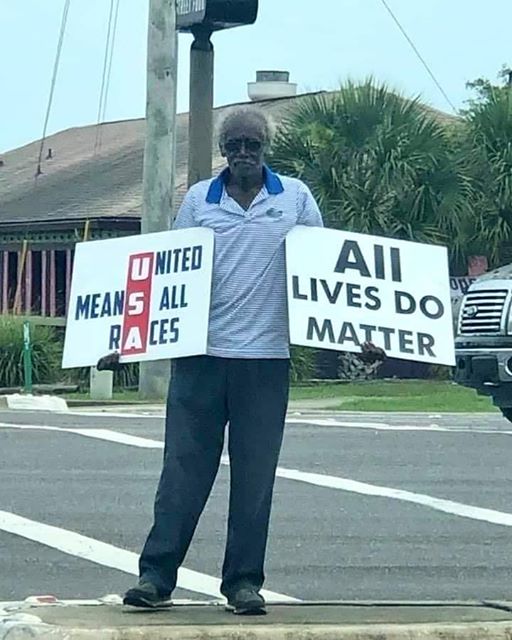
The man protesting in the above photo seeks to unite us, not divide us. What good is it to divide us ? What is achieved by it ?

Will the actual inequalities and distortions in the social fabric that absolutely impact many Black people (as I discuss in my “Systemic Racism” piece) be ameliorated in this phase ? I doubt it . Untangling the distortions will be the work of decades if not longer, and defacing monuments does nothing except give overtime pay to clean-up crews.  We live in a universal suffrage system. Every person has a vote. If you cannot persuade a working majority to vote for this reform or that one, well, you either accept the result or become a revolutionary and lose everything.

—- —-

What of the organization named Black Lives Matter ? Apart from  the phrase, about which no one disagrees ? It has many objectives which have nothing to do with the ideal. You may like socialism; I don’t. You may dislike Israel; I like Israel. What these issues have to do with equality and justice for Black people, I do not know. They’re distractions at best, although they appear to have marshaled much of the Bernie Sanders following — the Democratic Socialists and Justice Democrats — as we can tell, because the Black Lives Matter riots and “peaceful” protests do not look ad hoc, they appear the co-ordinated result of years of planning, campaigning, and communication. Nor do the mattering of black lives appear to be the actual goal of these well-regulated militias. The actual goal appears to be the end of capitalism, police forces, the First Amendment, equality itself, not to mention struggle sessions, re-education camps, and apology tours — very explicitly Maoist — in which they, the militias, dominate and intimidate everyone in the usual totalitarian manner.

No thank you.

THIS is why the movement hates “all lives matter” above all, no matter that their ostensible agenda requires it.

— Mike Freedberg / Here and Sphere


THE BOSTON POLICE BUDGET IS NOT THE RIGHT ACCOUNT TO REALLOCATE

marty

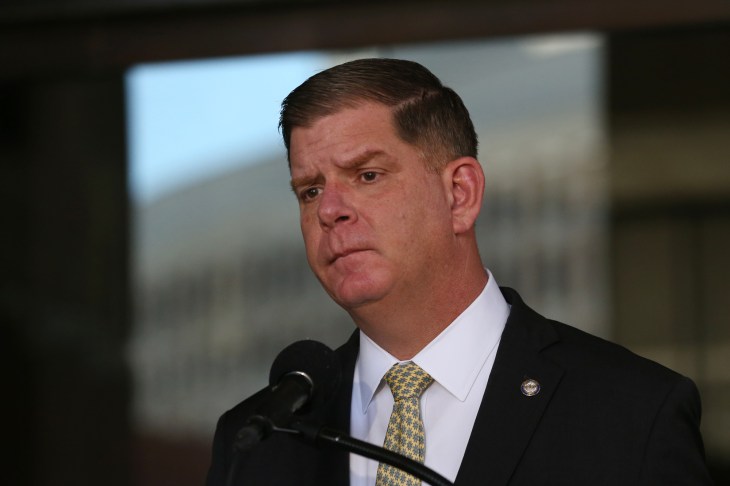
You’ve surely heard the noise coming from some mouths lately, that Boston should cut its Police Department budget in order to fund increased social services.  In response, Mayor Walsh has presented a $ 12,000,000 slash in the City’s Police overtime account in order to fund these:

  • $3 million for the BPHC to begin implementing the eight strategies that Walsh outlined in his declaration
  • $1 million to support trauma teams and counseling services at the BPHC
  • $2 million in new funding for community-based programs, such as violence intervention grants, youth programming, language and food access, Immigrant Advancement, the Age Strong Commission and the Human Rights Commission
  • $2 million for additional public mental health services through a partnership between the Boston Police Department and Boston Medical Center Emergency Services Program or BEST
  • $2 million to support economic development initiatives to support minority and women owned businesses
  • $2 million to provide additional housing supports and youth homelessness programs

We have no objection to these initiatives. A City ought, from time to time, to fund new initiatives, or increase current ones, as needs arise, as in dynamic cities they usually do. We don’t even mind a proposal made by (according to boston.com) “Activists (who) are pushing for a 10% cut to the police budget to be put toward housing, food access, COVID-19 relief and other programs to aid communities of color…Several advocates at Monday’s hearing also called for councilors to pass the current budget to secure funding for immigration, housing, food and park programs.”


The COVID-19 crisis has seriously impacted the City’s more vulnerable residents, disproportionately people of color as well as nearly everyone who earns low income.  City government would be derelict not to address these emergency conditions that have occurred through nobody’s fault.

Where we object is that the Boston Police Budget is not the correct account to cut. Walsh has recommended adoption of a Boston Public Schools budget of $1.26 billion, representing an $80 million or 7% increase over last year’s budget, marking the largest proposed BPS budget in the city’s history.

I’ve written about the City’s vastly bloated schools account many times. It represents FORTY PERCENT of the entire City Budget, and its sub-accounts are stuffed with unnecessary appropriations — starting with the $ 106,000,000 to be spent busing kids all over the City obedient to a Federal Court order now 46 years old and which bears zero relevance to the City as it is today. Imagine how many social services Boston could pay for if that $ 106 million were not wasted on an  historical re-enactment.

Add to this another $ 16,000,000 or so of maintenance costs to keep the City’s aged, environmentally archaeological school buildings, which should have been upgraded 25 years ago; or the several million the Schools Department had to pay to the IRS in fines for mishandling its tax reports (to say nothing of misappropriations); or the money wasted by former Superintendent Tommy Chang on an internal reforms study, by consultants, that never went anywhere.

Boston’s Schools Department continues to maintain 92,000 seats even though only about 55,000 students attend. The utilities costs resulting from such unused capacity contribute another $ 5,000,000 or so in funds that could be used to fund The Council’s social services desires.

To recap : Public education spending remains over 40% of the City budget. Education spending is up over $440 million on an annual basis since FY14 and per-pupil spending at BPS will approach $22,000, more than a 30% increase over the past six years.

Is it not time to rein in BPS’s financial gluttony rather than cut Police funding simply because the cry of the moment on cable news, and among activists with an agenda you wouldn’t like if you knew what it actually is, is that the Police are all potential Derek Chauvins ?

Give me a break.

Boston’s Police are, if anything, under-funded, the Department understaffed. We need at least an additional; 500 line officers. The Department’s inadequacy was made painfully clear by its being outmanned (and outgunned) during the night of looting we endured two weeks ago. But this is an issue for another, saner, more realistic day. Right now, we would do well to boost the presence of social services on the streets of Boston. just don’t do it by cutting the wrong City account.,

—- Mike Freedberg / Here and Sphere
ON SOME THEMES OF NATHANIEL HAWTHORNE

hawthorne 2


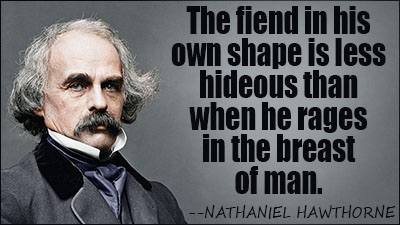
Growing up in Salem, Massachusetts, as I did, long ago, and being of a literary cast of mind from an early age, my interest turned inevitably to Hawthorne, my fellow Salemite, author of The Scarlet Letter and several short stories not to be passed over. Today, surrounded as I am by mobs full of passionate intensity, I am drawn back to the author whose message influenced my ethics as profoundly as any I have ever encountered. If you have read “Endicott and the Red Cross,” or “Young Goodman Brown,” and of course The Scarlet Letter, you can well discern what that message is that has so taken hold of my conscience. Let me set the question aside for a bit and move to another time and place, to the mind of yet another thinker who has affected my ethics beyond measure…

…on many an evening during the late 1570s, and into the 1580s, a vintner of Portuguese ancestry sat in the library of his Perigord estate, in the South of France, and, with his vast library (over 1100 books) at hand, wrote what he called “essays” (“attempt” in French) in which he attempted to understand all about himself. He was particularly drawn to matters of judgment : of passing verdict upon the acts and thoughts of his fellows, and of himself. Michel de Montaigne — that was his name — came to believe that all human judgments were vain, that truth is the possession of no one, that that which is on top today will be on bottom tomorrow, that the only difference between a truth and an irrelevance is the support, or lack of, given by people. In “Of Coaches,” “On Some Verses of Virgil,” “Of Vanity” and “Of the Resemblance of Sons to Their Fathers” Montaigne concluded that the wars of religion going on all around him — the Huguenots versus the League of Guise, with the King shrinking off to one side, trying not to get plowed — could only be ended by an individual act of personal conscience, to opt out, to create in his own home a place of peace, of non-judgment, of no weapons and no death, no persecutions, no armies of truth.

Such was his success that even today we read Montaigne’s essays, and often we find them a guide for our own ethical deciding. And make no mistake : no society can be roiled by armies of truth without having to come to terms with what is the good, what is the righteous, for one’s own piece of this life. It is a shame, perhaps, that our lives must be barred, like a highway being worked, by armies of absolute truth, but shame or not, when those armies block one’s path, one has to take their measure. There are no detours. When one is assaulted, sworn at, plundered and disturbed, one might want to ask, why is this happening here and now ? That, my readers, is a complex question with some not very edifying answers. I have no intention in this brief column of analyzing the causes — although vast deconstructions in the world of education play an outsized role — but the results, we know, just as Michel de Montaigne saw, heard, and felt the guns and battle cries of armies campaigning practically outside his castle doors. And as I have pointed out, his greatest “essays” sought answers to that same question that we face today : what moves the minds of men to battle and kill one another over doctrines unprovable and in any case un-useful ? Where the presumption ? To what end the certainty ?

Nathaniel Hawthorne’s great works ask the same question : where does any man get the right to judge other people ? To brand them ? To rip their flags ? Are we not all equally to be judged by God — if a god exists — the only authority so granted ? Hawthorne hated intolerance with a personal animus. His own ancestor, John Hathorne, had sat as a Judged in the Witchcraft trials of 1692 that ever since — and certainly still in Hawthorne’s day — have tainted the consciences of Salemites and others with a shame appropriate to the sin of truth assumption. Thus Hester Prynne goes forth with Pastor Dimmesdale and their child, to a new life and righteous. Thus Endicott, after defacing the Red Cross flag of Salem, despite the calm advice of Roger Williams, shocks the attending populace against his cause. And thus Young Goodman Brown, called to the forest on a moonless night, sees all of his neighbors, so morally superior and tsk-tsk-ing by day in all their depravity under shroud of dark.

— Mike Freedberg / Here and Sphere

BOSTON’s EMANCIPATION SCULPTURE, FREDERICK DOUGLASS, AND LINCOLN

Emancipation_Memorial

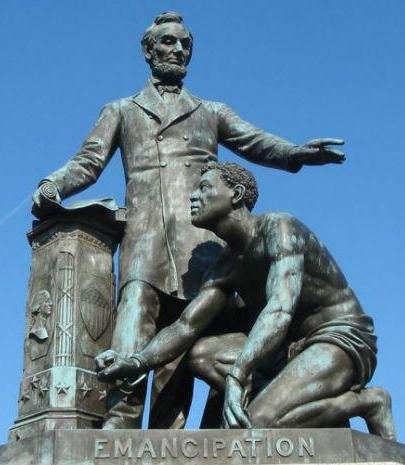
^ Lincoln, on April 1, 1865, to the freed slaves of Richmond, Virginia, who knelt to praise him : “do not kneel to me. Kneel only to God.”


A post on facebook says that 7,000 people have signed a petition to remove the sculpture by which Boston has, since 1876, memorialized the visit by President Lincoln to the city of Richmond, Virginia, after its capture in the Civil War, and specifically the moment when he was greeted by the City’s freed slaves, who, so the telling has it, knelt at his feet to praise him. He turned to them and said, “do not kneel to me. Kneel only to God.”

Ten days after that visit, Lincoln was assassinated by a Confederate sympathizer.

It is sad that, at this time when black lives matter supporters are asking that the Civil Rights successes of my generation be supplemented by full social respect and dignity for Black Americans, that 7,000 people can be found to wish the Richmond visit of Lincoln, and his message of uplift, be removed. Against this expression of reluctance to pursue full respect and equality, and against President Lincoln’s great labors” (as the plaque on the sculpture puts it), I would now quote from the speech that Frederick Douglass himself gave at the sculpture’s first unveiling, in Washington DC, before its move to Boston, where Abolition bore its first fruits :

“…The sentiment that brings us here to-day (spoke Douglass) is one of the noblest that can stir and thrill the human heart. It has crowned and made glorious the high places of all civilized nations with the grandest and most enduring works of art, designed to illustrate the characters and perpetuate the memories of great public men. It is the sentiment which from year to year adorns with fragrant and beautiful flowers the graves of our loyal, brave, and patriotic soldiers who fell in defence of the Union and liberty. It is the sentiment of gratitude and appreciation, which often, in presence of many who hear me, has filled yonder heights of Arlington with the eloquence of eulogy and the sublime enthusiasm of poetry and song; a sentiment which can never die while the Republic lives.

“For the first time in the history of our people, and in the history of the whole American people, we join in this high worship, and march conspicuously in the line of this time-honored custom. First things are always interesting, and this is one of our first things. It is the first time that, in this form and manner, we have sought to do honor to an American great man, however deserving and illustrious. I commend the fact to notice; let it be told in every part of the Republic; let men of all parties and opinions hear it;

“let those who despise us, not less than those who respect us, know that now and here, in the spirit of liberty, loyalty, and gratitude, let it be known everywhere, and by everybody who takes an interest in human progress and in the amelioration of the condition of mankind, that, in the presence and with the approval of the members of the American House of Representatives, reflecting the general sentiment of the country; that in the presence of that august body, the American Senate, representing the highest intelligence and the calmest judgment of the country; in presence of the Supreme Court and Chief-Justice of the United States, to whose decisions we all patriotically bow;

“in the presence and under the steady eye of the honored and trusted President of the United States, with the members of his wise and patriotic Cabinet, we, the colored people, newly emancipated and rejoicing in our blood-bought freedom, near the close of the first century in the life of this Republic, have now and here unveiled, set apart, and dedicated a monument of enduring granite and bronze, in every line, feature, and figure of which the men of this generation may read, and those of after-coming generations may read, something of the exalted character and great works of Abraham Lincoln, the first martyr President of the United States…”

When Douglass spoke these words and many more — orations were often long, long, long in those days — the Civil War was barely eleven years gone; and the assassination of Lincoln was still fresh in everybody’s minds. In some respect the War itself was not yet over : for Federal troops still occupied South Carolina and Louisiana (and would not be removed until the end of the following year). Thus the Emancipation sculpture was not erected and dedicated as a memorial of bygones ; it was an act of protest (“agitation,” Douglass called it) against the continuation of secession hostility and was also — maybe even more importantly — a gauntlet thrown down to those who might oppose the great Civil Rights Acts of 1867 and 1875, the print still not dry upon the latter.

I would appeal now to the hearts of those who oppose this sculpture and all of its spirit of freedom and dignity for black Americans, to loosen their consciences and see that there is no longer any case for setting aside, or delaying, the deepest aspirations of Black Americans for full respect socially and as neighbors, friends, family and citizens.

A friend has suggested that we might erect a plaque on the sculpture’s base, explaining its significance — which was clear to the men of 1876 but maybe not clear 144 years later — and maybe quoting from Douglass’s speech. I second my friend’s suggestion. Let us march forward together in  the spirit of ultimate emancipation, so that President Lincoln can truly, finally, rest from his labors and so that the confidence expressed by Frederick Douglass on the original unveiling day be our guide.

— Mike Freedberg / Here and Sphere


POLICE REFORM : OUR POSITION

Gross

UPDATE 06/14/20 : we have added two sections, on police issues that we neglected to discuss in our original post.

Here and Sphere’s opinion about police reform has been  asked by many of you. Clearly there has been much conversation of this subject. It is timely, therefore, that we offer our stance on what to do or what not to do. As follows :

( 1 ) “defund the police” has been much talked of. By “defund” is usually meant reallocating portions of police budgets to hiring and training social workers who would be called upon, rather than actual police, to handle low-priority criminal situations. We are opposed. If social workers are to be hired, let them be hired within police departments and operated under police direction. We cannot have two agencies, police and social workers, rivaling each other when dealing with a criminal matter., Such competition would quickly lead to jurisdictional disputes and second-guessing on actions taken. Better to have one agency, the police department, oversee all degrees of response. Thus we support increasing police department budgets , if feasible within taxpayers’ approval. to provide the hiring of social workers.

( 2 ) methods of enforcement have been criticized as excessive force. Reformers make a strong case here. Just as we regulate the rules of engagement of soldiers in combat — Geneva Convention and prohibitions of torture — I think we have full authority to regulate patrol police conduct. Choke-holds, knees to the neck, carotid artery constriction — all are solid examples of patrol conduct that should be banned in the ordinary course. In the case of resisting arrest, more flexibility may be permitted, but regulations should err on the side of restraint.

As for shooting, Boston’s police have a rule : “just because you CAN shoot doesn’t mean that you SHOULD.” De-escalation of situations is the Boston police view. We endorse that view.

( 3 ) administrative review of alleged police misconduct : We do not favor civilian review boards and such like. Police are employees of an employing organization. in every employed organization, there is an employees’ handbook, and where discipline is called for, it is reviewed and decided by that organization’s supervisors. Employees must be able to trust the discipline process. How can police employees trust a review board made up of people answerable to persons calling for extreme measures and unwilling to hear exculpatory evidence that might undercut the “get him !” narrative ? Police employees have just as much right to not be tried by the media or by politicians as any other organization’s employees. Of course I speak of the ordinary course. Where review of a misconduct matter shows an actually criminal event, it becomes a District Attorney matter out of the hands of the Department.

( 4 ) body cameras and duty to intervene : some reformers are asking that where a police patrol is of two or more patrolers, each has a duty to intervene if he or she sees a patrol; ember violate the rules of engagement or enforcement. Given the fast-moving pace of most police patrol encounters, it is unrealistic to require any such action. We would, however, favor a police rule recommending — but not requiring — such intervention where feasible. As for body cameras, it is wholly understandable why police might object. The very notion is a statement that “we don’t trust you.” No employee of any organization should ever be signaled that his or her supervisors — much less the public — don’t trust them. If we don’t trust a police person, he or she should not be hired in the first place. We therefore do not like the idea of body cameras and would support them only if the police force itself votes to have them.

( 5 ) standards for police certification : Governor Baker is said to be submitting legislation that would require state certification of persons applying to be police. We like this proposal. If you seek to be a Doctor or a Lawyer, you have to pass a difficult exam and be found of good moral character. I see no good argument why applicants for police employment should not also be examined for character. The public must feel that it can trust the wisdom and training of police persons, who have authority to interrupt our lives and even arrest and charge us.

( 6 ) “diversity” : we do not agree that a police force should “look like the community.”  Policing is not a matter of how one looks but of how one ACTS. That said, police departments should make every effort to hire from every neighborhood in the jurisdiction, and elected officials should require it : because every neighborhood is to be policed, and neighbors must feel that those who are policing them respect the neighborhood and all who reside in it.

( 7 ) police as union members : some reformers want police unions tossed out of unionist organizations. Others also want police unions de-certified or removed from disciplinary procedure. We strongly oppose these proposals. Why should police employees not have as much right to unionize as any other employees ? You’re either a unionist, or you aren’t. In many discipline situations — such as are now being bayed for all over the nation — the only defenders that accused police have is their union leadership. That is exactly what union leadership is there for : to bargain on behalf of members and to defend them when accused of an infraction. This is how due process works; fairness. We support police unions.

( 8 ) police details and flag duty : reformers have for decades been calling for an end to police detailing at road work sites . We support this reform. Many states do without road work police details. The police argument is that their presence is a safety measure; yet flagmen seem to do a pretty good job of keeping road work crews safe.

( 9 ) equipment and armaments : some reformers have called for police forces to not have military-grade arsenals. We feel that that decision should be up to the individual police department. Our principle here is that police should have all the tools that they feel they need, that they should always be able to out-gun criminals, if needed, and that potential criminals should know that they are out-gunned.

Given the level of rioting that we have seen, if police don’t have sufficient tools, cities will have no choice but to call the National guard and even the US military. No one wants that.

( 10 ) qualified immunity : first of all, what is it ? Cornell Law School says “a type of legal immunity. …(which) protects a government official from lawsuits alleging that the official violated a plaintiff’s rights, only allowing suits where officials violated a “clearly established” statutory or constitutional right.”

Police officers know, having this immunity, that they will not be answerable personally for violations of frights, only for violations of specifically established legal or Constitutional acts done in their official capacity and answerable under Title 38 of the Federal code (violation of civil rights laws). Our view is that, one, most of the cases that might require a qualified immunity defense can be avoided by proper training of police applicants and of those already on force and ( 2 ) no police person should feel him or herself restrained, by lack of legal support, from taking such actions she or she deems necessary on the spot to protect him or herself or the public. Anyone who has watched as many riot videos as I have must marvel at the restraint shown by police in terrifying situations, under attack by mobs. It’s a wonder they don’t fight back more forcefully than they do.

Where police respond excessively, as appears to have happened to Martin Gugino in Buffalo, department discipline is available and should be carried out. There can never be any excuse for a police department to smother an investigation of excess.

Granted that people do make bad decisions. Police can make bad decisions. These are not, however, justification for stripping patrol police naked in the face, potentially, of great danger.

Thus we oppose ending the doctrine of qualified immunity.

— — —

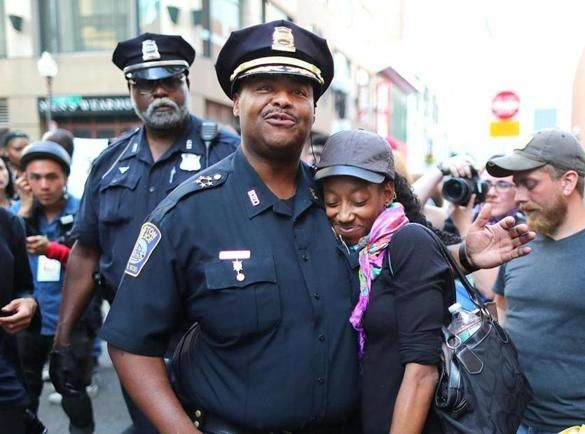
Police on patrol risk their lives at every encounter; as they will tell you, police have been shot and killed even at routine traffic stops. Those who undertake to be police persons should — must — know that until the day they retire they will be placed under pressure, maybe into combat, and always second guessed and needing to embrace relationships of friend with the entire community. To that end, we fully endorse police-community organizations, ombudsmen, and police attendance at neighborhood meetings. We are glad to see police departments as well led and represented a Boston’s by Commissioner William G. Gross ( and by Bill Evans before him). This is a difficult moment for police, on account of a shocking event that displays the worst of un-self-disciplined action by a poorly certified policeman (and his crew). Our response to that act, however, must never be to bloody the reputations and courage of all wearers of the blue. Just the opposite. Let this be a moment for spotlighting the dutiful work performed every day by police persons throughout the nation.

—- Mike Freedberg / Here and Sphere

ON PUBLIC SHAMING

struggle session

^^ the public shaming of Minneapolis Mayor Frey : a sad moment in our nation’s political history

—- —- —- —-

Of all the moves made by moralists throughout human history, I can’t think of one more destructive, more lethal even, than the public shaming of one person by another or others.

Did not Jesus of Nazareth say, in a book we almost all read, “let him who is without sin cast the first stone. judge not lest ye be judged” ?

How do we get from Jesus’s teaching to the scene in Minneapolis recently where that City’s Mayor was made to walk, with his head down, through a crowd berating him ? One commentator on twitter called it “Frey’s struggle session,” referring to the sort of public shaming – apology ritual that Maoist China went through during the 1960s “cultural revolution.”

Perhaps the most frightening aspect of the past week’s “peaceful protests” (if crowds hurling obscenities, chanting slogans one is not allowed to dispute, and throwing spit, water, bottles and bricks at police can be termed “peaceful”) has been the moral bullying. Who appointed them judges of people ? Did you appoint them ? Did you ? Or you ? Certainly I didn’t.

Soviet Russia under Josef Stalin made public shaming its go-to method of opinion control. During the “:Purges,” 1934-39, thousands were hounded from their jobs and homes, arrested, forced to confess to being what they were not, were shamed, tried, and exiled, sent to labor camps, or killed. People hurried to accuse one another of all manner of “anti-Soviet activity, ‘ whatever that was. There was a frenzy of it. Granted that Stalin’s purges were an extreme example, but it’s by the extremes that we diagnose the disease : people whop know they are morally better than other people and arrogate a right to impose their better upon the less good. For make no mistake : what happened in Stalin’s purges was not politics, it was morals, morality weaponized for political purposes.

It could not have happened in a nation of skeptics.

America’s blessing is that its political system is grounded in skepticism. We are suspicious of panaceas and of demagogues who tout them., Our Constitution erects all manner of shields to impose our skepticism upon the true believer.

Equally, universal adult suffrage is an enormous safeguard : for the morally bullied has just as much a vote as his bullyer. One vote each.

If you publicly shame someone who has any sort of self-esteem, you create an enemy for life. And he will vote. He will crawl over glass to vote against you. Is that what you want ?

In America, reform is built upon consensus. You will impose your will upon those who disagree, by force or by sham,in g or whatever device works, but as the saying goes, “a man convinced against his will is of the same opinion still.” And in our universal suffrage democracy, he will vote — will crawl over glass to vote, and, through any representatives he can elect, work to undo the imposed reform. We see it often in our nation’;s history.

Consensus reform, however, works because everyone buys into it. There is no anti constituency left by the wayside to renew a fight.

It amazes me that moralist politicals do not see this point.

—-Mike Freedberg / Here and Sphere
SYSTEMIC RACISM : DOES IT EXIST ? AND IF SO, WHAT IS IT ?

systemic

^ justice for Black Americans remains to be fully assured. But how to assure it ?

——– ——– —- —-

We’ve heard the phrase “:systemic racism” a lot in the past eight days. Sometimes it comes in the form of a Philippic, such as this one sent to me by a friend :

“Systematic racism is the deep rooted intersectionality of a system of laws, culture, institutions and ways of thinking that have created a degraded, otherness for Black people in the USA. The country was built on the blood of indigenous people, Black slaves, and free women’s labor. It is a system of privilege, maintained by violence, hate and fear. It is about extracting labor, maintaining power, and using capital to divide and conquer, while keeping a knee on the back of Black people. It has created a wealth divide and resulted in numerous systematic disparities. “

My friend certainly expresses the condemnation we all feel about seeing fellow Americans being downgraded for a vicarious reason. Yet I think analysis works better here than Philippic. In the phrase “systemic racism” are two words : “racism’ and “systemic.” Since most of us prefer system, to anarchy, the critique must focus upon the other word : racism. What is it ?

I would define racism as the notion that the skin color of a person is a measure of his character, his rights, his place in the society. Yet the definition fall short of the word’s custom. In America, racism is a judgment that is made of African-Americans specifically. People of Nigerian origin are also dark-skinned, darker than African-Americans. same is true of Caribbean-origin people, Indians and Pakistanis, etc. Yet in my experience, the minute that people hear the accents of such persons speaking, the reaction is different than what racism might suggest. These dark-skinned people are often reacted to as immigrants — foreigners — and so a thing different from African-Americans.  Of course I have generalized, many accent-English people with dark skin have experienced racism, and still do; but hear me out; we are far from finished with highlighting the peculiarities of racism in practice.

Why has the custom of degrading African-Americans by skin color persisted, 150 years after our nation granted them full citizenship as enshrined in our Constitution, and after 500,000 of us died to secure those rights to all African-Americans ? Why has social custom, and until 1964-65 legal authority, not been changed by the Constitution we all swear oaths to ? The answer to this question brings us to the systemic part of that phrase, systemic racism.

System was needed by those who would not accept the settlements of 1865-75, and in a democracy with universal suffrage, being defeated, even crushed, by war is no bar to the continuation of opinion; indeed, defeat may aggravate the opinions of the defeated, who, like all human beings, dislike being forced at gunpoint to change their ways; and, in elections pursuant to the great Constitutional settlements, those whose minds were of the same opinion still were able to vote, and thus able to vote against those settlements. It is very hard, I think, to accept seeing most of one’s neighbors elevated to equality with you only at gunpoint or by dint of Federal Courts’ enforceable orders. One wants to accept one’s neighbors, by one’s own, unforced act of the heart, not have them shoved down the throat. So much for the fate of civil rights in the post-Civil War South. I will return to the South later.

What of the North ? Why did racism custom persist in the States whose sons died in large numbers to secure full civil rights to Black Americans ? I think we have to accept that, despite the mythology, the vast majority of Northerners fought to defend the Union against rebellion, not to enfranchise Blacks. And Northerners who did fight to end slavery did so because they viewed slavery as a human wrong, which it is, and not therefore to enact Negro Equality. None of the great 1865-75 Constitutional enactments changed much in the North. They were primarily punishment for the South. In the North, it is true that the Amendments enfranchised Blacks legally. Black men could now vote, sit on juries, run for public office, and the like : yet in many Northern States they could do that already, before the War and without it. Thus the sting factor in the great enactments scarcely pinged any Northern community. The social disqualifications, prevalent almost everywhere, thus continued, there being no pressure at all to abate them. Just the opposite : when, in the decades from 1880 through 1920 a flood of European immigrants came to the North, they were met almost universally with disqualifications similar to, or even harsher than, those imposed on Blacks living in this region. Again, we see here the application of “system.”

In much of the North, the degradations put upon newly enfranchised Blacks might have faded away with time, there being so few Blacks resident in the region. (We see this today in Maine and Vermont, where Blacks amount to less than two percent of the population and social degradation is almost non existent.) Starting in the 1900s, however, the Great Migration brought millions of Southern blacks into the North; these brought with them social and linguistic customs jarringly different from those prevalent in Northern cities, and they aalso found themselves sort of lumped in with the immigrants from southern  and eastern Europe, at a time of maximum dislike thereof, and so degraded by native Northerners even as immigrants, too, feared the Black newcomers as job competitors. that cleavage has persisted even to today.

The above paragraph describes the reactions of millions of individual people. In a democracy, with universal suffrage, the customs of millions of individual people become system.

We are now ready to discuss the term “systemic racism” without accusation, pearl clutching, and the like.

Given the views of many, there has been, these past 100 years or so, continuous under investment in schools serving Black-majority neighborhoods; equally large under investment in health care for persons living in such neighborhoods; much relegation of Black persons to low-paying jobs, which has kept many living in under-served and under-valued neighborhoods. There has also been a perception that Blacks are to be feared, a perception not unlikely given the conditions — well publicized by the news at its most sensationalistic — in which so many Black Americans live. All of these conditions reinforce one another, a kind of vicious circle of exclusion and deprivation of public expenditure. This is the system part of “systemic racism.”

Into this already complex social map comes the housing question. Where people choose to live — assuming they have a choice — is a very individual decision. It is not made collectively. In this, everyone’s residence is twin to universal suffrage. Unfortunately, Americans in most places have chosen to live racially apart from each other. as I see it, this separation is almost entirely perceptual, at least outside the South. If all you know about people racially different from you is what you see in a sensational television newscast — because a crime incident sticks in the mind far more readily than good news, and far too often the news about Black people is of a crime event — then it’s just common sense to live away. Is there any doubt that this junction of perception and publicity underlies our nation’s segregated housing patterns ? What other reasons could there be for it, I have no idea.

Residential segregation leads to social segregation, and social segregation reinforces residential apartness. If people of different races, or skin colors, do not get to know one another, in large numbers, how is this apartness ever to change ? I am at a loss….

What, then, of the South ? There, Black people and white people have lived close, with lives inextricably intertwined, since slavery days. Southerners know each other. I might even say that Southerners of both races interact on all levels, these days, more intimately and constantly than anywhere in the North that I know of. I have seen it in action. Yet the distrust between them runs very very deep. Everywhere in America, Blacks vote differently from white voters, but in the South, the two races vote almost entirely in opposition to each other. (This may be changing. More white Southerners are voting Democratic now than at any time since the Civil Rights Acts were enforced. Look at recent statewide votes in Alabama and Georgia.) Even so, every Southern legislature contains a higher percentage of Black members than any legislature in the North.

I do not live in the South. I am in no position to offer solutions to the racial inequalities that prevail in Southern states. My impression,. in any case, is that such injustices are far worse in today’s North than in the South, at least in part because we of the North refuse to admit them, much less try to alleviate them. Take the housing situation again : right now, and since 2018, Governor baker has laid a zoning reform bill upon the legislative table. It is a very small tweak, that would allow zoning boards to modify zoning restrictions by a majority vote rather than a two-thirds vote. The purpose of his bill is to allow the construction of transit-oriented and workforce housing in communities around Boston and thereby loosen the tight housing market here that has seen prices double and triple in the past decade. His bill has gone nowhere. Why ? Almost every affected town or city has objected, passionately. It is hard not to ascribe this intense objection to race fears.

I do not know how this zoning freeze can be unfrozen. If a reader of this article has a workable suggestion, in would love to hear it.

To sum up :

If we are ever to alleviate the system part of our nation’s racism, we must find ways to relieve the individual opinion part. In a democracy, with universal suffrage, everyone’s individual opinion equals everyone’s individual vote. Our Constitution also protects rights of the minority — it isn’t majoritarian  rule. The reason why we do this is crucial : it is because we believe that no policy is completely correct, no opinion always right; we know only too well from history that the minority view is sometimes the correct one, and by our settlements we ensure that it will always have power to affect. Our polity arises from skepticism as much as from idealism, and wisely so.

Thus the focus is on the individual, as it must be. “Changing society, one mind at a time’ isn’t merely a slogan; it is the ONLY way that worthwhile change can be made permanent, beyond the upheavals arising from minds not persuaded. There is no system, in our democracy, without individuals amassed to make it. “Systemic racism” is the wrong way to phrase what we see as an obstacle. Better to call it “policy by minds not persuaded.”

We can, of course, enact some reforms thanks to the resolve and idealism of so many (and I am on board as well), and we probably will enact such reforms. But they won’t stick unless the majority deciders they are wise, and they won’t change minds unless minds observe the reforms working well to everyone’s benefit. We shall see.

—- Mike Freedberg / Here and Sphere