SEDITION : THE DESTRUCTIVE FORCE OF UNACCOUNTABLE MONEY

Image

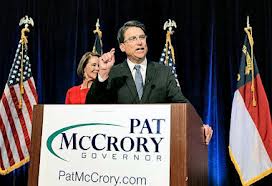
^ destructive : Governor Pat McCrory of North Carolina

—- —- —

There has always been money in campiagns and in governance. This we understand; governments chiefly are formed and operate to move money from here to there. Campaigns cost money too. Community conversations about how to move money require money, for media and for communication services.

All of the above we know, we accept, we can agree to. But as my Dad used to say, “too much of anything is a poison.” Too much money kills off the civic events. We saw this in the recent Mayor election, where a majority of the money spent by the two finalists came from “outside” PACs, some of them secret. We see it in Washington, where big-pocket book PACs threaten Congressmen, put challengers in the field to run against them, and inundate elections with all manner of misleading — deceptive — palpably false — advertising to promote the PAC’s specific interest and, so doing. have brought the Federal government almost to a standstill : a condition that many of these PACs openly seek. the best-funded and greediest of them want to roll back 80 to 130 years of social progress . They want government out of thed way and unfunded so that their donotrs can do want they want with America’s money.

This we have seen and tasted and found most foul. It is most foul. Our society is everybody who lives in it — nothing less. A raid upon the inclusion of everyone is sedition.

Somebody in my twitter feed recently said, “the rich employ FOX to set the middle class against the poor.” True. And after they come for the poor, they will come for the middle class. You don’t like it ? Too bad about you.

It need not be. There’s another saying that seems germane right now : “you can fool all of the people some of the tome and some of the people all of the time, but you can’t fool all of the people all of the time.” Abraham Lincoln said that. He knew the truth of it so well, because no president in our hiostory was the object of so much vitriol amd so many self=seeking lies as was he. Eventually the voters will wake up to the fraud that the greedy are perpetrating upon them, and all the PAC money in the world will then just prove the point.

But in the meantime what damage is abroad in our land ! Our economy is hugely tilted toward the top earners. 95% of us have seen oure arnings stay still, por dtrop, in trelation to procers. Millions of us have been out of work for years; skills have vitiated; how will they now start over ? As for the lost years, the years of penury or bare survival, they can’t be made good. An entire genmeration of workers — maybe 20,000,000 of us — has been hammered by student debt that can’t bne discharged in bankruptcy, weakened by under-employment, injured by stress that hurts one’s health, left almost helpless by having no helath insurance. Barbara Ehrenreich says that these millions of us have been “nickeled and dimed.” She nails it.

Worse still, in the current tone of our politics, these 20,000,000 — and many millions more whose home in come amounts to just a little more, enough to get by but not to save or move up — don’t get heard. Who speaks for those of us who most need a speaker ? A few do. Senators Elizabeth Warren and Bernie Sanders speak for America’s vulnerable. I’m not sure they have much effect, however. The huge monery greed-PACs can’t trouble warren in Massachusetts or dsanders in Vermont, and they can’t trouble Barbara Boxer in California or Chris Murphy in Connecticut. The Northeast of our country — its richest part, ironically — still has a social conscience and honors the social compact that america used to take for granted. But outside the Northeast (and even in some areas of the Northeast), the greed money pressures, intimidates, forces legislators to kick most constituents to the curb.

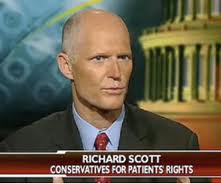
Among the worst offenders is the Governor whose picture heads this column : Pat McCrory of North Carolina. His entire legislative program has been pushed by — much of it drafted by — seditious big money organizations. Two more favorites of greed money are Sam Brownback of Kansas and Rick Scott of Florida. Brownback wants all state taxes gone; Rick Scott cuts social services to the poor. Are these guys nuts ? What sane politician would purposely alienate a huge number of voters ? Well, politicians do that if the money demnds it of them. It’s hardly likely that Governors would dare to propose eliminating state income taxes, file vote suppression legislation, cut teacher staffs, wipe out union benefits, make abortion all but unobtainable, harass immigrants, cut off unemployment pay, engage private prisons, loosen gun control, or cut funding for infrastructure — were it not that the vast money pools insist upon it, demand it, swamp their state with demagogic advertising that demonizes those who need state services, health care, voting rights. This is the reality in those parts of america where sedition has a paymaster with unlimited funds to pay. Candidates compete to see who can express the basest contempt for the most people. Why ? Because that’s where the campaign donations are.
Image

^ sedition : Rick Scott of Florida

America is losing its might to these paymasters. Companies can’t get new hires who have the technology skills to handle evn entry-level jobs. Kids don’t learn anything about American history or citizenship. Parents are too busy working two and three jobs to give their kids the reading time — the intellectual and citizenship challenges — that kids need. Immigrants, our nation’s very essence and its source of innovation, new ways, striving, and heroic endurance, were once valued and welcomed. Now they are disliked and pushed out. Self-serving religionists push their voices into the news, gain attention for their bigotry and outrage, thus reaping huge donor dollars for theur “ministries.” We are mounte-banking our society, collapsing its organs. We are killing our future chunk by chunk.

The Supreme Court has ruled that corporations have free speech rights; that money for political advertising is protected as free speech’s enabler. It’s hard to find a workable way to didagree that does not impede legitimate expenditures for speech. I have yet to see a Constitutional amendment for this purpose that won’t throw the baby out with the bath. The most effective way is to fight the sedition on its chosen field of huge money demagoguery. Where are the social compact hedge funders ? The income fairness billionaires, the civil rights tycoons, the urban reform grandees ? There are some. There are more than just some. It’s time for them to commit huge money against a sedition that is destroying millions of families, society’s decency — the economy itself — day by day, election by election.

Occasionally the people can defeat the armies of reaction. Rick Scott ;looks likely to lose in 2014. Tom Corbett, the vote-suppression avatar, seems in big trouble in Pennsylvania. that’s good; but it is not enough. It’s time for the Cavalry of progress to rescue us.

—- Michael Freedberg / Here and Sphere

#MAGOV : A GOOD TWO WEEKS FOR CHARLIE BAKER — AND JULIETTE KAYYEM

Image

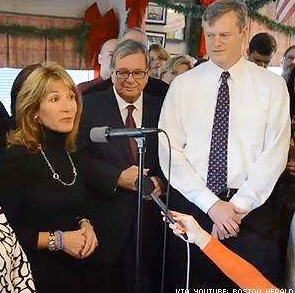
^ spark and height : Karyn Polito joins Team Charlie Baker and announces her support for marriage equality

—- —- —-

From December’s start to now, Republican favorite Charlie Baker has put his campaign into solid definition on many fronts. First, he chose a running mate, former State Representative Karyn Polito, who ran a strong State-wide race for Treasurer in 2010 and has as much charisma as any Republican in the state. A high point of their alliance, to all Massachusetts voters of good will, was Polito discarding her anti-gay rights past and joining Baker’s long-standing support for marriage equality. Second, he released a Homelessness Alleviation Plan that actually addresses the issue, in a beneficial manner completely unlike the contempt that we’ve become so used to hearing from Republicans these past six years, a plan that none of Baker’s Democratic rivals will surpass — they’ll be hard-pressed to equal it. Third, Baker almost raised more money, in this period, than his five Democratic rivals combined.

Baker and Polito announced their ticket allliance on December 3rd. Last night they held a campaign Kick-Off fund-raiser at Coral Seafood on Shrewsbury Street in Worcester. (After which they campaigned along the street’s “restaurant row.”) Polito has added plenty of spark to the Baker brand. It made last night’s event worth the time. Before she and her entourage of young, almost trendy supporters entered the room, the average age of the Baker donors was easily 60. It was — to this Boston-based observer — an almost defiantly unhip group of flattops, toupees, and 1970s sideburns. Nor was there much excitement; the mood of the 150 donors was cardboard flavorless. Then Polito stepped into the room, radiant face, televisably sleek, a “great to see you” outreach, and — yes — excitement. She changed the mood from cardboard to glossy brochure.

The Boston Globe notes that Baker’s fund-raising falls way short of the donations amde to him in 2009, as he was preparing a 2010 run for Governor. But that’s not the right comparison. He was then running against incumbent Deval Patrick. This time the office of Governor is open. In 2009, Baker’s name wasn’t well-known; today it is. The measure of Baker’s success now is his five Democratic rivals. Against them, he is showing strong. Let’s look at the December 1st through 19th receipt numbers reported to the state’s Office of campaign finance, as of 9.30 this morning, December 20 :

Charlie Baker : 203,290.69
Steve Grossman : 106,554.00
Martha Coakley : 88,298.73
Donald Berwick : 72,428.35
Juliette Kayyem : 5,522.04 (receipts 12/15-19 not reported yet)
Joe Avellone : 9,329.11

Several of the Democrats have already filed full bank reports for the December 1st through 15th period. Here are the numbers :

Candidate            Begin Balance Receipts Expenses End balance

Martha Coakley 285,272.65 83,073.73 59,635.73 306,711.13
Donald Berwick 155,521.08 52,973.35 59,266.40 149,237.93
Juliette Kayyem 222,717.32 5,522.04 77,627.56 150,611.80

The Juliette Kayyem receipt number surely misleads. During this same time she has pressed a social media and meet and greet campaign second to none; it has boosted her social media presence enormously — far larger a boost than for all her rivals combined. Her twitter following has gained + 2,553 since November 10th when I first checked. No rival comes close. She’s doing more voter outreach than them all — campaigning almost like somebody running for Boston Mayor. Yes, that thorough and up-close. I am impressed.

Image

^ Juliette Kayyem at La Semana Television

It would surprise not to see Kayyem post a noteworthy fund-raising number in her December 31 or January 15th report. Like Baker, she has released action plans — more of them than Baker so far. We seem to have entered the campaign’s Policy Plan season; every one of the six chief contenders — except Martha Coakley, who is still working her Attorney General agenda as a kind of Governor rehearsal — is releasing Policy plans on everything from Green Environment to Health care costs to criminal justice reform, immigrants’ rights, and women’s health.

The feeling in Berwick’s plans parallels that in Charlie Baker’s Homelessness alleviation paper — maybe because both men come from the health care field. It would greatly uplift the political morale of Massachusetts to see the two of them become the campaign’s finalists. But Berwick has had less success with voters than Kayyem, and he has also fallen into the no-casino hole. Kayyem has avoided cul-de-sac issues and focused herself on the main chance. a final between her and Baker would be a classic policy battle : who has broader capability and a stronger resume predicting success ? Kayyem versus Baker might even rise above the polarized mess that partisan Washington has put upon us. Both candidates are solid reformers who believe that government should benefit people.

What, then, of Steve Grossman and Martha Coakley, presumed to be the two strongest Democrats ? They are that — for now. Grossman has run a laid-back campaign, an almost State of Maine nonchalance. Yet he has by far the most money on hand — I await his December 15th Bank report — and, as state Treasurer, has state-wide connect and name recognition. One woners if his campaign’s low heat is an intentional stance ; that he feels that after so much over-passioned politics, voters of Massachusetts would welcome a candidate who doesn’t stoke fires, who approaches governance with patience, not hurry. On the other hand, as reported, most of Grossman’s fundraising has come from interests doing business with the state. That’s a lazy way to fundraise, and it invites questions about Grossman’s independence. Would Grossman, as baker’s opponent, fall back upon Democrat versus Republican rather than address the State’s actual issues ? It could be.

And now for Martha Coakley. The polls say that she is the clear Democratic favorite. I doubt that will be true after February caucus month. Her fund-raising falls short. She’s running on Attorney General issues. She continues to be the wan campaigner who lost that now legendary 2009 US Senator campaign to then barely known Scott Brown. No activist has forgotten that campaign. It’s one thing to be laid back like Grossman; it’s another to be flat and cliche, words that define Coakley as a campaigner.

In any case, December so far belongs to Charlie Baker and Juliette Kayyem. With the Holiday period now beginning, the rest of December is likely to stay that way.

—- Michael Freedberg / Here and Sphere
LEFT-TEA-ING THE DEMOCRATIC PARTY IS A REALLY BAD IDEA

Image

^ apostasy to party ? to most of us, it’s the way things should be. To the activists, just the opposite

—- —- —-

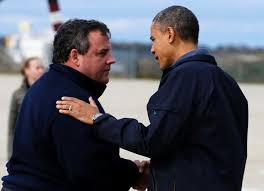
The Democratic party looks on the verge of cleaving, Left versus Left-center, even though the Left’s avatar, Senator Elizabeth Warren, will not be a candidate for President. I seriously hope this does not happen. The Democratic party’s unity is the major factor holding America steady on forward. Splitting the party can only impede. Sometimes it seems as though those who would move the Democratic party to the Left want America to NOT proceed. This is a huge policy mistake.

One sees the signs. Senator Warren has done a lot of talking, challenging the money interests at every turn, and though much of what she talks about needs saying, at a time when the Congress is finally of a mind to take small, fragile steps forward, Warren’s insurgency seems as ill-timed as Ted Cruz’s in October. Warren acolytes abhor the comparison, but I am hardly the first or only one to make it.

Both Cruz and Warren are fanning flames that want to be flamed and which would likely find other bellows if Cruz and Warren were not stoking. At a lower level, here in Massachusetts, in Boston, the decision by newly elected Councillor Michelle Wu to support the “conservative” — but Democratic — Bill Linehan for Council President has generated a huge flare of Left flame, even though the selection of a Council President has almost no policy consequences.

This Left split is not new. I wrote of it three months ago, during the Mayor of Boston campaign, noting attacks, by Left-minded Democrats, upon John Connolly for his school transformation call — a policy advocated by Democrats for Education Reform as part of what Arne Duncan, President Obama’s Secretary of Education, was seeking. Connolly was also attacked as the candidate of moneyed interests generally : yet the bulk of moneyed interests supporting his candidacy was Democratic. All of this sounded strange in a local, one-City campaign. But there it was.

The polarization of national party politics have no business deciding a purely local election. Yet for the Left, polarizing party politics were a key to victory for their candidate, who, after a primary in which the Left made various personal choices with few partisan consequences, became Marty Walsh. He was well advised to take advantage of the opportunity. By no means do I criticize him or seeking out that support : it’s what he had to do. But at the time, I noted that the potential Democratic party split was a rehearsal for a wider split in 2014 and 2016 and a direct consequence of the Tea Party capsizing the GOP. As I wrote, “you can’t radicalize an electorate in one direction only.”

The timing could not be worse for those who, like myself, desire a workable forward national agenda. Even as the Democratic party split aggravates, the split in the GOP is resolving, in favor of the pragmatists. The Tea Right is under serious attack from all quarters — business, incumbents, centrist money PACs, even from evangelicals — and is losing as GOP House (and Senate) incumbents free themselves from the fear of a serious primary challenge. Many states are considering legislation similar to California’s, in which all candidates run in the same primary and then a final between the top two. This process has already made California’s parties move to the center and away from domination by “base” activists.It would hardly be good for Democrats if the nation and the GOP are moving toward unity while the Democratic party is splitting. But activists do not care about consequences. For them, it’s their way or the highway.

I prefer the highway.

You may argue against me, that in the Budget Deal that passed the Senate today, the Democrats stood united, the GOP quite split. True enough; yet the Budget Deal was criticized often and loudly for its omission of unemployment insurance extension. Democrats voted “yes’ as a bloc because to reject the deal might have made any deal impossible, given the fragility of the House GOP’s new pragmatism. My thinking is that the more the House GOP commits to pragmatism, the more that Left Democrats will feel that they can split the Democratic party without endangering the nation.

The warning signs are there. People continue to Cruz-ify Elizabeth Warren.

All of this you would expect to go away were the President to exert his power of office effectively, as he sometimes knows how : in foreign policy always, during the “shut down” too. His weak management of the Federal bureaucracy — ah, the Annals of Health.gov — has opened an effectiveness  gap, however, into which people are stepping who really don’t like the President’s agenda all that much anyway. It’s a cliche now that President Obama’s most activist supporters wanted a messiah but got a mishugas. In other words, a President ; but they don’t want a president, they still want a messiah. When that happens in American politics, we usually get an anti-messiah instead. With Obama, an Abraham Lincoln saved us. Unless things change, I doubt we’ll be as lucky in 2106.

—- Michael Freedberg / Here and Sphere

BOSTON : ON THE DEATH OF HERB GLEASON

Herb Gleason

^ aristocrat in Boston City hall : corporation counsel Herb Gleason, 1928-2013

—- —- —-

Herb Gleason of Beacon Hill died on December 9th. He was 85 years old and was, as Barney Frank recalls, “a man from the Boston aristocracy who deeply immersed himself in Boston politics in a wholly constructive way.” You should read the obituary that Bryan Marquard wrote for today’s Boston Globe and which features Frank’s quote. It tells Gleason ‘s life story and why — as Mayor Kevin White’s Corporations Counsel, most of all — he was important to the civic minded people of my generation.

My intention in this column is not to repeat that obit but to ruminate on Frank’s words and also on something that Gleason’s son David is quoted as saying of him : “He was very progressive in the real meaning of the word, the sense that government should benefit citizens.”

Today that “old Boston aristocracy” has almost disappeared. Those not yet born in its last glory days — the 1970s — probably have no idea what I’m talking about. No one uses the term “aristocracy” any more. “Child of privilege” — the term pinned on Jonn Connolly by Marty Walsh’s notorious AFL-CIO fliers — comes closest; yet A “child of privilege” can have parents who were themselves born into no privilege at all. The “Boston aristocracy” propagated its values (and its privilege) for many, many generations, one after another committed to the idea that wealth and privilege can never be their own justification; that being an aristocrat requires a man or woman to dedicate to the common good. The best-known Boston example of that aristocratic commitment is Robert Gould Shaw, son of Beacon Hill Brahmins, who coloneled the 54th Massachusetts Regiment of African-Americans and gave his life leading them into battle. Shaw’s life and death, thanks to the movie “Glory,’ now belong to the ages; but he was hardly the only exemplar, even in his own family : Barney Frank himself won his first elective office, State Representative from aristocratic Ward 5, with sponsorship by such as Shaw’s collateral descendant (by marriage) Susan Shaw Lyman.

There was much to criticize in the ways of the Boston aristocracy as it became defiantly snobby during the 1870s-90s. It was often anti-Semitic and hostile to Boston’s Irish. It was cruel to its own. Boys who could not shape up became “black sheep,” rarely forgiven. Its women had to suffer the unfaithfulness of husbands; many turned to hard liquor and spent days in a drunk. There was much ceremony — tuxedos and ball gowns to be worn — for the invited few, balls to be staged. Just as staged was the aristocracy’s speech. You knew immediately a Boston aristocrat by his or her pronunciations — consciously imitative of titled Britons. There was a list, too, of the accepted. Boston aristocrats proudly kept a copy of the “blue book” — the Social Register — on their desks or coffee tables; in it were the names, addresses, and current life status of those who “belonged.” And there was boarding school for every child — the most aristocratic of these quite consciously toff — a tumble into discipline for discipline’s sake which propagated itself all the way to the 1960, by which date  men like Herb Gleason (and women too) had reached adulthood.

For the majority of us, who were not Social Register, “that government should benefit citizens” was okay enough. It moved men and women to fight for child labor laws, women’s rights, slum clearance, hospital care open to all (there would be precious few Boston hospitals had not its aristocracy donated millions to their founding and expansion), pro bono legal work, libraries and books, the ACLU, racial integration, a city-girding parks system, bequests to the City for public purposes (think the George Robert White Fund), and service on all manner of City Boards. Taking a paid job in Kevin White’s administration, Herb Gleason went further. But so did John Sears — an aristocrat of aristocrats who also ran for mayor in the year that Kevin White won — when he accepted the job of MDC Commissioner. Yet the jobs taken by Gleason and Sears were a kind of civic-minded donation; each could have earned far more money in private law practice than they did as civic administrators.

All of this civic dedication by people born to great wealth or position seems so foreign to how we view the world today. We see people of great wealth now mostly as greedy self-seekers, or as celebrities fronting selfies. We cannot imagine today’s wealthy or famous sitting on library trustee boards, for example, or cleaning up Boston Harbor, or gathering signatures to raise the minimum wage, or protesting vote suppression — as so many did in the 1960s, even. And when we do encounter a “child of privilege” such as John Connolly was dubbed actually taking an interest in reform — in his case, school transformation — we’re not sure what to think.

Today when we hear of “children of privilege” in politics or civic affairs we’re as likley as not to think them out to serve themselves; to “skew the system” in their favor; to disenable, not enable, those in need. Perhaps that is one reason why John Connolly fell short of victory on November 5th. As said the AFL-CIo flier that i have already mentioned : “He’s trying to fool us.” There were plenty of successful people like that back in the day : but in those days they fooled no one — and didn’t try to. Yet always, from the decades of America’s founding right through the 1970s, critical numbers of civic-minded reformers of wealth and standing confronted the self-seekers at all levels. Today, when such a person appears on the urban horizon, he or she should be welcomed.

Civic-minded, progressive reform was never easy even in its aristocratic salad days. Machine politicians and those who kept them going — saloon keepers, contractors, industrialists, stock manipulators, work padrones, even criminal gangs — always pushed back. Only occasionally was urban reform successful. It was spectacularly successful, often, in New York, Chicago, and Los Angeles, and it was, finally, successful, after many failed attempts, in Kevin White’s Boston. Herb Gleason was a large part of that triumph, as were so many people from aristocratic Ward 5 — think Micho Spring,. Kathy Kane, Susan Lyman, Barney Frank, Stella Trafford, John Sears, David Morse, Joseph Lee, Parkman Shaw, Chris Lydon, Oliver Ames, and many many more. Is that spirit having a revival, with John Connolly as its vanguard ? I am hopeful that it will, and that Boston will advance once more, by the commitment to the City’s civic life of many more men and women like Herb Gleason. RIP, Sir.

—- Michael Freedberg / Here and Sphere

BOSTON MAYOR : YEAR OF 1000 LEMONS

Image

^ A 1000 lemons are zooming toward the man who will have to tend the Boston lemon grove….

—- —- —-

Those of us who preferred John Connolly as Mayor may wonder whether our preference was a blessing or a curse. Because the mayor we did get, Marty Walsh, faces an avalanche of problems verging on intractable. Well might John Connolly be grateful to have dodged the 1000 lemons descending upon Walsh’s first year in office, any one of which could derail his agenda and all of which might leave him muttering “why me ?”

Consider : ( 1 ) Boston Public Schools face change in every aspect, from teacher evaluation to curriculum development; from facilities upgrades to a new union contract; from competition for school funds to a revised school assignment plan that, hopefully, prioritizes close-to-home; and the bugaboo of charter schools, loved by supporters (and Walsh has been one), demonized by the Ravitch-ians ( 2 ) a Police Department that miserably failed to administer the City’s taxis, which entirely lacks diversity at the captain level, that has in many cases lost the trust of neighbors in the most violent zip codes, that just won a budget-busting pay raise heavy with money from public works details ( 3 ) a Fire department ready to rumble its own forthcoming contract negotiation; which now lacks both top administrators; is utterly resistant to firehouse and work rule reform even from a Mayor independent — which Walsh is totally not ( 4 ) city finances standing $ 50 million in the red even before the Police pay raise award and which can only redden more deeply as the funding needs of school reform, future union contracts, and public works present their bills — not to mention tax breaks that project developers will demand, and likely be granted, as the price of moving Boston’s Building boom forward (and thus providing continued work to Walsh’s core support, the building trades workers).

Consider also these : ( 1 ) major school reform that will be demanded — not requested — by employers who will either get job applicants who can meet entry-level requirements, at least, or will move to cities whose graduates do meet those requirements ( 2 ) expanding the City’s hubway bike system without aggravating car traffic flow ( 3 ) figuring a plan for Sullivan Square / Charlestown Neck that makes useful space of it, rather than a traffic-clogged jumble of trash, old brick, and rusty rails; and that takes into account the likelihood of a Steve Wynn casino in Everett, directly across the Mystic River ( 4 ) making the city’s parks safer to use, grounds-keeping them, and opening them — Franklin Park in particular — to tournament sport ( 5 ) devising a platform that makes middle-class housing profitable to build and affordable to buy — and deciding where to base it, in the face of neighborhood NIMBY-ism ( 6 ) configuring the BRA to increase neighborhood input (as most voters want) without enabling NIMBY-ism ( 7 ) choosing new hires without succumbing entirely to favoritism (although at a lower level, favors have value to the collaborator that Walsh has built his following by being; and, lastly ( 8 ) hiring a substantial presence of people from Boston’s Communities of Color (“COC”), and seeing many into the building trades : because without strong COC support Walsh wouldn’t have come close to winning and without which he won’t be re-elected.

Then comes the City Council Presidency flap now roiling some commentators and overly mind-busy “progressives.” The last thing that Marty Walsh needs, given the lemon grove of problems zooming at his head, is a Council President who can credibly run against him in 2017. Walsh will almost certainly face a strong opponent anyway. How can it help city governance to box Walsh further than he is already boxed ?

I wrote two days ago that Walsh may have made a big mistake by holding so many public hearings on the eleven issues that his transition team prioritized; that he might have been better served to put a lid on it all until a few months into his actual term of office. But perhaps his public hearings have more value than not. They give issues constituencies opportunity to speak, insist, petition; to feel that this new Mayor sincerely wants to listen. I think he does.

Listening — which he does well — is true to who Walsh has been, as union leader and legislator : a collaborator who works by bringing various interests together for a common purpose. The weakness in his method is that it depends on the willingness of those interests to collaborate with the collaborator. We will find out soon enough if that happens, and with how many lemons.

One asset that Walsh does possess is a wide circle of “wise old heads’ who trust and respect him and whose reputations in the City;s various communities Walsh now commands. He will not lack for good advice or for spokesmen and spokeswomen to argue bis case to the various interests arguing their cases to him. Other than these folks, however, his team looks young and quite all of a kind. He need to diversify his core staff, and soon.

Most of all, he badly need to hire top people now working for the various entrenched interests that now confront him AWAY from those jobs and INTO his administration.

The success of his lemon grove lemonade depends on it.

—- Michael Freedberg / Here and Sphere
LISA MOELLMAN, GUEST CONTRIBUTOR : RESPONSE TO “PUBLIC SCHOOLS BEAT PRIVATE SCHOOLS” ARTICLE IN BOSTON SUNDAY GLOBE

Lisa Moellman

^ Guest Contributor Lisa Moellman

Editor’s note :

We received this via inbox at our personal facebook page. It was sent, said Ms. Moellman, in response to an article that appeared in Sunday’s Boston Globe, by Christopher and Sarah Lubenski, to the effect that by some measures Public Schools perform better than private ones. As her response addressed the article in question most persuasively and, as well, highlighted a major urban public school set-up as rebuttal, we have decided to publish it as a guest contribution, after which we have posted an essay of our own.

This is Lisa Moellman’s letter :

“I sent an email to Prof. Lubenski sharing my response to the Globe piece highlighting his and his wife’s conclusions about why they found public schools outperforming private ones on a math measure nationally. Here it is:

“I just read the key conclusions of your study highlighted in the Boston Globe piece today (site based autonomy and school competition bode poorly for math achievement). http://www.bostonglobe.com/ideas/2013/12/15/public-schools-beat-private-schools/hWLzdKv1x7wwupcjk5zonI/story.html

“I taught in one of the best PUBLIC school districts in North America (approx. 100,000 students)–Edmonton Public Schools–which in fact maintains a portfolio of schools in which EVERY school has site based autonomies, student weighted funding and the ENTIRE district is an open district of choice for families. It is a public district of autonomy and competition–extremely high performing. This flies in the face of your rationale about auntonomies and competition at the core of the differences you found between public and private…take a look at this summary about Edmonton Pubic and take a deeper dive into understanding the developmental histroy of this district–it’s a beacon for districts across Canada and the U.S., as well as some in the EU.

http://www.hawaiibusiness.com/Hawaii-Business/May-2010/Best-School-System-in-North-America/

“Further, a 2010 McKinsey report notes that public districts moving from poor to good need to centralize professional development, curricula, etc. but that once districts are at a good level, if they want to become great districts, they must decentralize and provide leadership and teachers with site based autonomies.

http://www.mckinsey.com/client_service/social_sector/latest_thinking/worlds_most_improved_schools

“In my experience and reading, your conclusions are not justified by your research findings. It’s troubling because this article was just tweeted by a key advisor to Mayor Elect Walsh in Boston on #Bosmayor. Scaling back our movement toward pilot and in district charter autonomies as Boston Public Schools attempts to move from ‘good to GREAT’ would be a misstep and deeply troubling as we strive to close the Achievement Gap.”

—- Lisa Moellman / Guest Contributor

—- —- —-

Editor’s Note : first, the Lubenskis’ article talks of private schools in general. No distinction or classification is made. This stacks the deck. Because private schools operate almost entirely in competition with one another, the fact of competition becomes the standard, for many such schools, rather than the rigor of the curriculum.  It is unfair to pit ALL private schools, of whatever sort and however set up, against public schools, which must adhere to a common, legislative standard. The argument is not whether public schools do better than ALL private schools but whether they do better than the schools most parents would be comparing to public schools. Most parents would not pay money to send their kids to a poorly performing private school.

Second, by choosing mathematics, the Lubenskis have already made a structural choice as well as a curriculum decision. They do not seem to realize that we school our children to two very distinct obligations : citizenship and the workplace. Mathematics do not get taught at home as often as reading, history, and civics because these are citizenship disciplines, while mathematics is almost entirely a workplace knowledge, at least in our society (to the Greeks, mathematics was as idea-based as te other liberal arts and formed the basis of much of their awareness of the real world).

Much of the otiose discussion going on these days about education arises from the failure to distinguish the prerequisites of citizenship and workplace. For citizenship, we teach reading, writing, argument, the arts, and music; and ethical, societal, moral, and legal knowledege (including history) that does not change — or, at best, slowly evolves — because human nature does not change; whereas for the workplace, everything changes constantly. This has implications for formal education that almost no one talks about. One is that teachers of citizenship knowledge should have long experience of the world — tribal societies used councils of elders to instill such knowledge in their young and to test their mastery of it. Whereas, with workplace knowledge, long experience often impedes instruction. In our rapidly innovating world, the best teacher of workplace knowledge is, likely as not,  to be very young — the younger the better. A career in workplace teaching contradicts the experience of the innovation economy, in which collaborative competition renders career knowledge relentlessly obsolete.

When thinking workplace knowledge, we must never forget that we are educating children for tomorrow. Not for today, not for yesterday.

Much workplace knowledge is most effectively imparted on the job, by apprenticeship. This is what our society used to do, but because apprenticeship was often a form of child labor and indentured servitude, it was given up as immoral or illegal. today it should be brought back, in a new form, as internships.

Unfortunately the huge institutional power of academe has all but monopolized our society’s teaching functions, so that subjects that should be learned by doing (as John Dewey knew 110 years ago), in apprenticeships or internships, are now “taught” in  formal schools by “teachers.” Why should future lawyers go to a law school ? The law, for example, is quintessentially a practiced art. It is best learned by “reading law’ or “clerking’ for a lawyer.

We also ask our schools — public especially — to do too much that isn’t education at all. Teachers are not set up to be day care providers, baby sitters, psychologists, nursers. Parents can NOT simply dump their children at the school door and say, “here, take them, I need a day of quiet.” As long as we allow our schools to be thus imposed upon, schools will be hard pressed to do what schools do. the only way that this “here, take my kids, I need quiet’ system works is with boarding schools. (It’s not such a radical idea. Our first Massachusetts antecedents, back in the 1600s,  often sent their kids at age 12 away to live with a family not their own. It was thought — correctly — that the child would be less likely to fight discipline at someone else’s house than in his or her own. Having been sent to boarding school myself, at age 13, I can attest the truth of this custom.)

At the primary, middle, and high school levels, however, it is fair to ascribe almost all citizenship and work skills education to formal schooling. This we do. But just because we do this, we cannot lose sight of the gulf that separates the two curriculum paths. Citizenship requires learning of one kind, the workplace of a completely different kind.

Of course we could always decide to teach mathematics as a conceptual art, as did the Greeks. The relationship between number and computation as concept, and number and computation in empirical experience, was the first pathway by which Greek civilization developed its sense of what is as opposed to things imagined merely. And it is from Greek speculative research that our civilization’s axioms have developed.

But that is a discussion for another day.

For now, suffice me to assert this education proposition : 1. first is the child — all children, at first.. 2. second is the curriculum : what we agree to teach him or her. 3. third is a teacher we hire to teach it to him or her. 4. fourth is the evaluation of how well the instruction is being done, both by teacher and student. 5. fifth is the site ; where will we teach the student ? (In Athens it was the Lyceum, a building and grounds set aside for that purpose.)

These are important. Everything else in the education discussion is gossip, self-seeking, or house cleaning.

—- Michael Freedberg / Here and Sphere

BOSTON MAYOR : A CURIOUS DAY AT TRANSITION SEMINAR

photo (29)

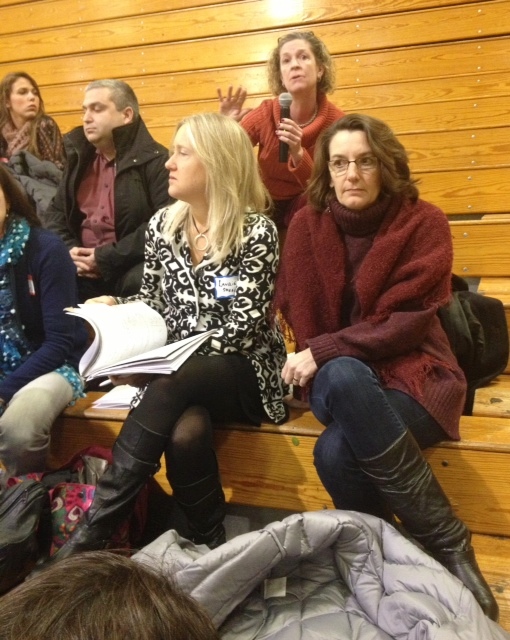
^ Seminar Day : much attention and then discussion at the Morning’s Education “Break-Out session”

—- —- —-

It has been a strange week in Boston City Politics. The Mayor-elect, Marty Walsh, has hosted an entire series of gatherings to discuss the eleven issue categories that his Transition Team has endorsed. Singly, night by night, these issues gatherings have taken place and will continue to do so well into January. On Saturday, all eleven issues gatherings held meetings again, all day long, in what Walsh’s Transition Website dubs “Mayor-elect Martin J. Walsh Town Hall Meeting.” The title misleads. The actual gatherings felt, to this participant, more like college seminars. Perhaps that’s because they were for the most part led by college educators.

That’s the strange part. The eleven issue categories — Arts and Culture, Basic City Services, Economic Development, Education, Energy-Environment & open Space, Housing, Human Services, Public Health, Public Safety, Transportation and Infrastructure, and Youth — all develop in a political context (some of the issues more than others. Arts & Culture seems appropriately collegiate, Basic City Services hardly at all); and political space is certainly where Walsh will have to decide how to structure them and choose priorities. So why the college-y format ? Yes, Boston’s a city plenteous with colleges. It’s nonetheless peculiar to think of Marty as Headmaster Walsh.

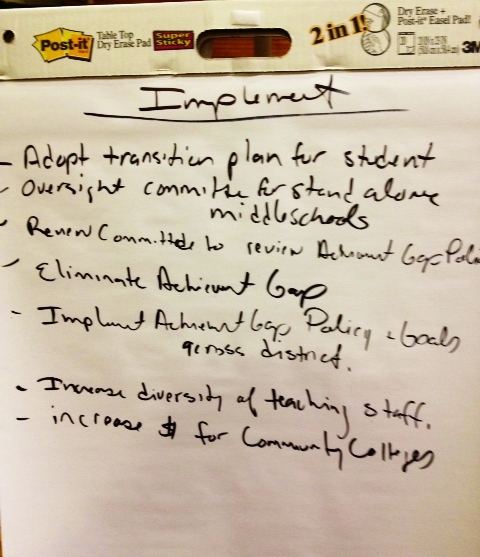
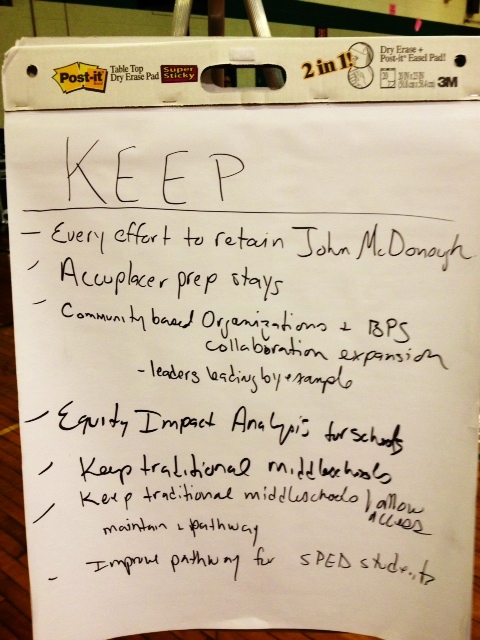
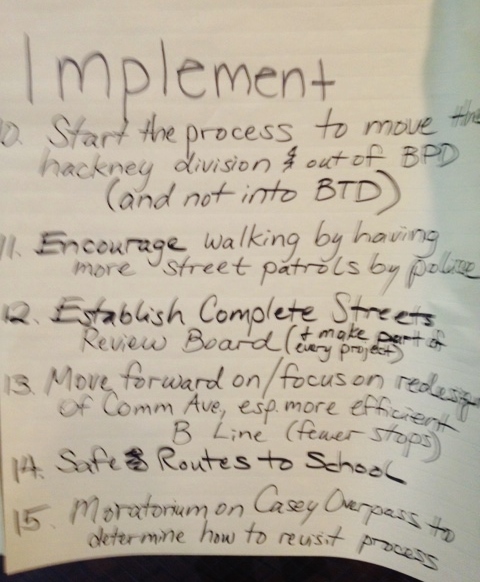
I attended the Morning Education seminar, then the afternoon Transportation/Infrastructure conference. At each, participants offered suggestions on what to keep — stuff that the City is already doing right; on what to implement — stuff that the Mayor can initiate without state legislation or huge budget outlays; and on what to dream about — a wish list for the future. Lists of each were made on large sheets of yellow art paper, and these were read from at the “general session” after all the seminars had ended. From the two sessions that I attended, I photographed both “keep” and “implement” lists. To see just how comprehensive these became, I invite you to peruse the “List” photographs below :photo (27)photo (28)^ the Education Session developed these ^ Lists of “Keep’ and “Implement”

Below —  the Transportation/Infrastructure attendees came up with this “Implement” List :

photo (36)

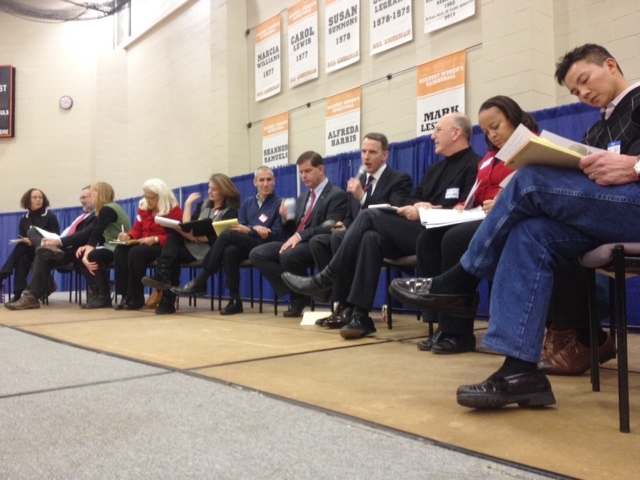
After the seminars had concluded, each seminar moderator delivered a report — and the lists. It was a lot to digest. Walsh sat on stage, in their midst and made an heroic effort to pay attention.

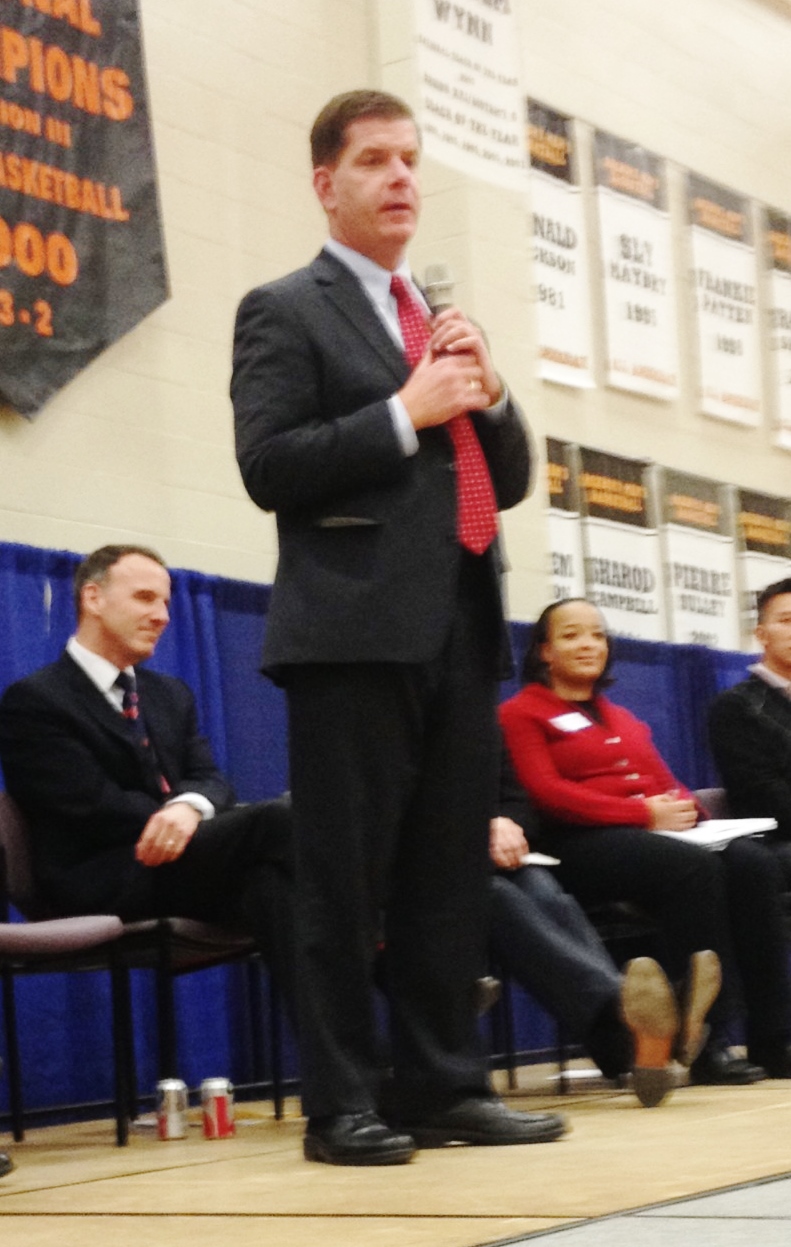
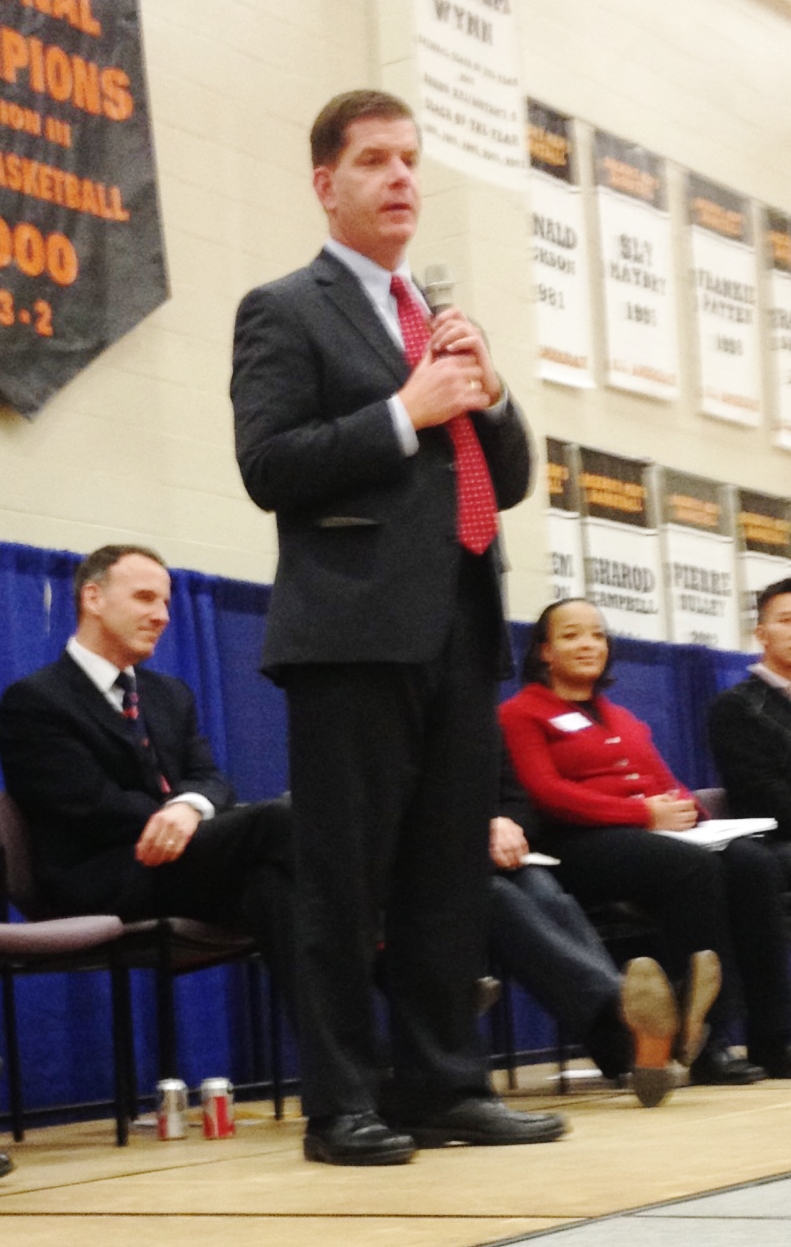
Walsh delivered opening remarks and spoke after the session as well; he then did question-and-answer with the hundreds of citizens who more or less populated the Reggie Lewis Auditorium at Roxbury Community College, ground zero for the day’s discussing.

photo (39)

photo (42)

^ school headmaster ? Marty Walsh addressed the gathered seminar goers after the day’s teaching

His opening remarks told of  a trip to the Nation’s capitol, from which, he said, he had returned only the night before: “The problems we face, the challenges,” said Walsh, “We’ll take them to Washington. Unemployment insurance must be restored…State and federal aid has been cut. we need to change the discussion.” The gathered citizens applauded. After the session ended, Walsh said in summation, “I was told by somebody that they had never seen a mayor and citizens have the kind of conversation we’re having today,” he said. “We need to continue this conversation after today too.”

Clearly Walsh has made a decision that stirring the pot of citizen petitioning the City is good politics. It continues the brilliant move that he made in his campaign, to engage hundreds of educators and public interest advocates in drafting 40 policy papers for future Boston governance. Those papers — 37 were actually completed — made Walsh look Mayoral, not just the Union guy he had been (quite correctly) seen as. No wonder that he is bringing such a thumbs-up campaign device into his transition work. Seminar and conference have much value convincing citizens that City hall is listening diligently. It can. Walsh has brought to his side an impressive group of Bostonians, many of them long known by me, with experience of the City as extensive as my own. And yet…

And yet I’m not sure that Walsh realizes that by keeping the issues pot boiling he is ( 1 ) raising participants’ expectations of his administration very high ( 2 ) will almost certainly disappoint some — maybe many ( 3 ) and thereby is setting the stage for a strong opposition candidate — surely a person of color — in 2017, a campaign that is likely to begin almost immediately after the 2015 Council elections.

Already the early moves are being made, as we see in the serious implications underlying the silly — and distractive — flap about “progressive” Councillor Michelle Wu supporting “conservative’; Bill Linehan for Council President. Already we see the formation of “monitoring’ groups which intend to hold Walsh to a variety of campaign promises — in particular, bringing people of color significantly into his administration at all levels — many of which he will be hard-pressed to keep, especially given the City’s $ 50 million budget deficit (which number is mounting even as I write). Eleven issues seminar groups can only whet the appetite of those with agendas to press.

Politically, it night have been wiser for Walsh to put a lid on politics during his transition — and beyond. This is what John Connolly has done, and most of his supporters. Few Connolly people have participated in the Walsh seminars; fewer still have been much heard from since election day, and John Connolly himself not at all, except to invite supporters to a December 27th “thank you” party. But perhaps I am wrong. Perhaps it’s a pleasant vacation from politics to hear a speech such as Professor (and Boston Globe columnist) Ed Glaeser, emcee of the Seminar, delivered, almost without notes, at session’s end; an eloquent, even stirring, history of The City, in America and elsewhere: what cities are about; why we need them; how they advance the human condition and shape our thoughts; in particular, the history of Boston, with its immigrants, universities, its “human capital,” which, as Glaeser noted, is more valuable than the coal, oil, and minerals that Boston does not have.

photo (25)

^ History 307 — The City — Professor Glaeser tells it sweepingly

Glaeser’s narrative reminded me of the awe-inspiring History lecturers at whose podiums I studied at college. It was a thrilling experience to feel my mind carried back so many decades to when we students felt ourselves graced and awed by such narratives as Glaeser’s. hearing his speech, I almost forgot that this was a seminar about things to be done.

Talking is not doing. Silence often is.

—- Michael Freedberg / Here and Sphere
UPDATE : Marty Walsh badly needs to expand his reach beyond the team that has gotten him to victory. At the “Town hall” he was surrounded by all the familiar faces — hard working all, idealistic many — and accompanied by legislative and Council endorsers who strengthened his campaign. Of the rest of the City’s power players, however, I saw very very few. Some conspicuously had other plans. Clearly there is skepticism about Walsh’s readiness to the entire City. There’s also still a strong tide of continuance, of no giving up, by the “new Boston’ constituency that almost won on election day. It’s a constituency that doesn’t need City Hall to give it vision or goals to achieve and wants the Mayor to rethink the City, not merely improve it ; and will do so without him, if that’s how it is to be.  — MF

photo (40)^ drawing upon practical experience of the wise heads too :Marty Walsh conferred in a time-out moment with my old friend Pat Moscaritolo, of East Boston, who has managed much economic development work in Boston since the 1970s.

#MAGOV : AN OPEN LETTER TO MARK FISHER

On Thursday I received a letter from the “Committee to Elect Fisher for Governor.” Since I am Here and Sphere’s politics reporter, I had heard of Mr. Fisher — had surfed his facebook page, in fact, and not favorably. I wondered why he would be writing to me. I read his letter. Half way through it, I was moved to answer him. As I read to its end, I found in it truly serious questions about what our politics is all about and thus decided to answer him by what political people call an “open letter.”

“Dear Candidate Fisher :

“You write me because of my ‘service to the Republican Party,” for which I thank you. I am, as you note, a registered Republican, as were four generations of my forbears. The Republican party meant something to my Dad, Grand Dad, and Great Grand-Dad, and it has meant something to me since I first became active just out of college. I thus looked in your letter for some commitment on your part to what it has meant to us. I found none. What I did find, I reject.

“You say that you were moved to run for Governor because Governor Patrick “re-opened the tolls on the western part of the Mass Pike.” You then say that “tolls are great for only…Patronage,’ and you decry the men and women who work as toll collectors.

“A candidacy that starts by denigrating people who work is a strange candidacy. Toll collectors work hard under sometimes horrible weather conditions and at all hours. If they earn an average of $ 76,000 a year, as you write, that is hardly a king’s ransom ; but it is enough for them to participate in the consumer economy that keeps our economy — and their family’s lives — moving forward.

“You also miss the larger needs that the resumed tolls address. Our state’s roads and bridges badly need repair, and our public transit facilities break down all the time for lack of money to maintain them, much less upgrade them.

“You talk about ‘conservative values.’ I’m not sure what ‘conservative’ means any more, but on your facebook page you cite several agendas which defame whatever defensible adjective you want to ascribe to them.

“You would deny to women control over thrir own bodies and health care, something that neither you nor I have any right to do and a contravention of the policy of every Republican Governor this State has had in my lifetime.

“You want gay and transgemder people to not have the full civil rights that all citizens are entitled to and which the Republican party was created to fight for. Your position is an affront to all people of good will and incompatible with a Republican nomination for any office.

“You talk about ‘gun rights.’ Such talk was offensive long before Columbine, Aurora, and Newtown, not to mention George Zimmerman. To talk of ‘gun rights’ now is to pit yourself against the entire society which your candidacy seeks to govern. Mr. Fisher, guns HAVE no rights. people have rights. And our society has the right to be free of individuals with loaded guns putting everyone in fear and worse — for what ?

“You dehumanize the people you call “illegal immigrants.” you say they cost the state almost two billion dollars. Mr. Fisher, that’s just wrong. As Jeb Bush — a Republkican — said at this year’s CPAC conference, ‘undocumnted immigrants are a boon to the economy. and because of their young demographic, they’re also how we rescue Social security.’

“Mr. Fisher, undocumented workers pay more in taxes in one year, every year, than Mitt Romney has paid in his entire lifetime. Do you have any idea what the life of most undocumented peope is like ? I have seen them standing outside in summer or the cold, at dawn every day, across from Home Depot in my city, hoping to be hired for a day’s pay. Undocumented people — and immigrants similar — take the subway to work at 5 AM, working at the toilet-cleaning and janitor jobs, in office buildings hospitals hotels and universities, for pay that until recently was minimum wage. Yet you decry these people ? Mr. Fisher, they are heroes.

“Reading what you think of the least among us, do you have the slightest idea what is entailed in governing the 6,000,000-plus people who live in Massachusetts ? The Governor  has to administer our roads, bridges, transit system; to maintain our clean water and environmental quality; to assure a strong public school curriculum; to operate the State’s parks, beaches, courts, district attorneys, prisons, half-way houses, career retraining centers, welfare offices, retirement, veterans affairs, and a variety of administrative agencies, licensing divisions, tax collection, and more. All of these exist because in our extremely complex, diverse, and changing society that we call Massachusetts, capable administration keeps our intricately adjustable State moving forward with as little friction or confusion as human capabilities reasonably manage.

“I read nothing, in all your campaign talk, of any plans to improve, reform, or add to any of these Governor’s responsibilities; indeed, nothing of any of the public policy issues that activists everywhere are discussing and proposing. All the other Governor candidates who I am following have plenty of policy suggestions : where are yours ?

“I can only conclude that your candidacy isn’t about us, the 6,000,000 and more. It’s about you. It is ALL about you. As you say near the end of your letter, “in the past I would vote and then complain.” But “my circumstances have now changed.”

I, I, my, me, and mine ! Mr. Fisher, I hate to tell you, but being Governor is NOT about you. It”s about everyone, diversely, equally respected and all of us together.

Sinerely, Michael Freedberg / Here and Sphere

#MAGOV : A SURGE OF ROMEOS FOR JULIETTE

Image

^ much love for Juliette : Kayyem speaks to Democratic activists in Barnstable last Sunday

—- —- —-

In the parlance of now, there is much love afoot for Juliette Kayyem, one of five Democrats exerting to be that party’s nominee for Governor of Massachusetts. At 10.24 AM on this December 13, 2013 morning, Kayyem has gained 1,089 twitter followers since I first checked the numbers on November 10th. No rival compares. Don Berwick has added 374; Steve Grossman, 194; Martha Coakley, about 600; Joe Avellone, 67. (On the Republican side, Charlie Baker has added 307 followers, while Tea Party Mark Fisher’s newly posted twitter account has 36 followers.)

Kayyem’s total twitter following stands at 5,321 ; about 1600 behind Grossman’s and way behind Coakley’s 12,400 ; but she already tops Baker’s 4,311 and Berwick’s 2,203. As for her presence on facebook, Kayyem trails the “big’ names, yes ; Charlie baker has 32,317 “Likes”; Martha Coakley, 19,193. But Kayyem’s 3,469 isn’t far from Steve Grossman’s 5,520 and leads both Don Berwick’s 2,011 and Mark Fisher’s 1,367. Adding these numbers up, Kayyem has risen to the top of the “second tier” already. So what is going on, that has produced slo many Romeos for this Juliette on our State’s 2014 political scene ?

Charisma first. You need only look at her pictures to see that she connects to people. She leans forward to them, not back away or ramrod straight. She’s casual, even slangy, gets the humor on the net and gives it back. She casts better as the candidate of “now” than any of her rivals — only Charlie Baker has a similar degree of “now”-ness.

Second, her issues and how she addresses them. Of course no one should expect a candidate to accomplish, if elected, what he or she proposes in a campaign ; government isn’t that simple (witness Mayor-elect Marty Walsh’s back-walking his “overhaul the BRA” proposals). But you can tell a lot about how a candidate will approach the office he or she seeks by the temper and content of his or her campaign proposals. Here’s what Kayyem’s website says about “reforming the Criminal justice system” — as pressing a need as there is in State governance right now :

Massachusetts cannot continue to imprison more and more of our citizens at an ever increasing cost. This trend is not fiscally sustainable, it often doesn’t make sense from a law enforcement perspective, and it does not reflect the kind of Massachusetts we want to be. Juliette will make sure that our criminal justice system becomes more evidence based and less wasteful; more rehabilitative and less purely punitive; and, perhaps most importantly, more focused on integrating those who have served their time back into society as productive citizens rather than ignoring their problems once they leave a correctional facility. In order for the Commonwealth to seize the opportunities of the future and build inclusive and productive communities, we must do better when it comes to our criminal justice system.”

Then there’s health care, a huge issue nationally and thus one that we in Massachusetts also talk about, even though for us universal health care has been a given for almost a decade. Kayyem says this :

Massachusetts is a national leader in ensuring that all residents have access to quality, affordable healthcare. As governor, Juliette will work to: Continue to bring technological advancements to Massachusetts’ health care system that will bring the cost of health care down while improving service; and Reduce health disparities in the Bay State’s underprivileged communities.”

Note that last sentence. How many candidates these days for high office ever talk about the difficulties faced by people living in poverty ?

Don Berwick, who is a doctor, confronts the health needs of poor people at least as directly as Kayyem; on other issues of fairness and civil rights he stands, ahead of what Kayyem has published so far. But from the huge love now being accorded Kayyem online — and the immense schedule of meet and greet events with activists that she is pursuing, all of them drawing large crowds — one has to conclude that in person, Kayyem persuades that she — the person she is — will be most able, as Governor, to do what she talks of. One need only ask the large crowds who have recently met her up close in Melrose, Brewster, Franklin, Barnstable, Worcester, and, especially, at the “JPProgressives’ candidates’ night at Doyle’s Cafe in Jamaica plain.

Or perhaps it’s the “Elizabeth Warren” effect ? Until recently, Massachusetts voters had hardly ever elected a woman to high office. Then came Senator Warren, and now Congresswoman Katherine Clark — the State’s third female Congress member. Massachusetts Democrats, at least, are acting like converts do : once seeing the light, they become more than merely enlightened; they become apostles. It helps that, in Kayyem, they have a candidate with a resume and education approaching Warren’s. Especially is Kayyem the object of a ton of Romeos in contrast to the dry and reticent Martha Coakley, the memory of whose befuddled 2009 US Senate campaign has hardly dimmed at all and whose current campaign for Governor hasn’t generated much better.

If you haven’t yet paid much attention to Juliette Kayyem — or to the race for Governor in general — it’s time now to do so. The Democratic party caucuses begin in less than two months. The Republican meetings follow soon after.

NEXT FOR #MAGOV : the mid-December OCPF fund-raising and expenses report

—- Michael Freedberg / Here and Sphere
#BOSPOLI : A SILLY KERFUFFLE

Image

^ a Councillor, not a Don Quixote ; Michelle Wu (with Philip Frattaroli and Marty Keogh at the Frattaroli family’s post-Columbus Day Parade reception

—- —- —-

There’s much flap going around now,as silly a brouhaha as I’ve observed in this entire Boston campaign cycle, including an op-ed by my old Boston Phoenix colleague Yvonne Abraham, to the effect that Councillor-elect Michelle Wu shouldn’t vote for Bill Linehan as the new Council President.. Supposedly she should vote for a Councillor who “shares her agenda.” Today’s Globe quotes several persons, described as “progressives,’ who promise not to support Wu for re-election if she votes for Linehan. This is zealotry of the Tea Party kind, to which the Left, as we’ve seen in the past, is hardly immune. One quoted voice even says that “Unless (Wu) changes her mind…she’s a one-term city councillor.”

This is rubbish. It’s also as silly as a political kerfuffle can be. Boston’;s City Council has no power that the mayor doesn’t want it to have. It can propose, it can debate, it can re-arrange the musical chairs by which Council Committee chairmen are chosen; but it can’t do a damned thing of significant importance without the Mayor thumbing up.

Sure, individual Councillors can have an independent impact, if they’re willing to get frozen out by the Mayor. John Connolly pursued an independent course. Others have done so. But when the chips are on the table, and the Mayor’s agenda is at stake, you will no more find a majority of the 13 Councillors opposing than you’ll find a sting ray in your briefcase on Christmas eve.

So what’s the big deal here ? Let’s try a little political reality, for a change, and lose the ideological version of cgi-created film monsters.

The rule governing voting for Council President has long been : “vote for the weakest.”

In this case ( 1 ) Bill Linehan is no threat to run for Mayor against Marty Walsh ( 2 ) ramping up either Tito Jackson or Matt O’Malley to Council President — both of whom want the honorific — would be a threat and ( 3 ) ramping either man up to Council President would impede the 2017 (or 2021) mayor race plans of the REAL potential candidate of significance. (It’s Jackson’s and O’Malley’s very strength as Councillors that make them musts-to-avoid as Council President. Get my meaning ?)

Image
^ Matt O’Malley of Council District 6 : his record-breaking vote makes him unelectable as a Council President

Most important, Linehan has no base at all independent of Mayor-elect Walsh’s core support and thus has no power to oppose him on any item of import.

THAT is how Council Presidents are chosen. Stupid indeed is the newly elected Councillor who bucks that reality; and Michelle Wu is far from stupid. I applaud her acumen in this matter.

As for being re-elected, Wu’s husband notes that even if you subtract her entire vote from wards 4, 5, 11, and 19 she still won by 14,000 votes. This is an apt subtraction, because 2015 will be a Council-only election, and in these, the voters of Wards 4, 5, and 11 turn out far fewer voters than they do in a Mayoral election. Wu’s re-election will be decided in Wards 20, 18, 2, 16, and 17, and of course also in Chinatown’s Ward 3 Precinct 7. All of these feature constituencies very different from the wards identified with Tea Party Leftism or comfortable urban reform. And you know what else ? Wards 4, 5, 11, and 19 contain plenty of voters who aren’t Tea-Left. Of the 15,000 or so voters who will likely turn out in 2015 in those four wards, Wu will comfortably win at least one-third — probably more. She may slip from second to third or even fourth (though I doubt that); but re-elected she surely will be, assuming that she does the job of city-wide Councillor in painstaking daily detail. Which I have no doubt at all she will do.

— Michael Freedberg / Here and Sphere