LISA MOELLMAN, GUEST CONTRIBUTOR : RESPONSE TO “PUBLIC SCHOOLS BEAT PRIVATE SCHOOLS” ARTICLE IN BOSTON SUNDAY GLOBE

Lisa Moellman

^ Guest Contributor Lisa Moellman

Editor’s note :

We received this via inbox at our personal facebook page. It was sent, said Ms. Moellman, in response to an article that appeared in Sunday’s Boston Globe, by Christopher and Sarah Lubenski, to the effect that by some measures Public Schools perform better than private ones. As her response addressed the article in question most persuasively and, as well, highlighted a major urban public school set-up as rebuttal, we have decided to publish it as a guest contribution, after which we have posted an essay of our own.

This is Lisa Moellman’s letter :

“I sent an email to Prof. Lubenski sharing my response to the Globe piece highlighting his and his wife’s conclusions about why they found public schools outperforming private ones on a math measure nationally. Here it is:

“I just read the key conclusions of your study highlighted in the Boston Globe piece today (site based autonomy and school competition bode poorly for math achievement). http://www.bostonglobe.com/ideas/2013/12/15/public-schools-beat-private-schools/hWLzdKv1x7wwupcjk5zonI/story.html

“I taught in one of the best PUBLIC school districts in North America (approx. 100,000 students)–Edmonton Public Schools–which in fact maintains a portfolio of schools in which EVERY school has site based autonomies, student weighted funding and the ENTIRE district is an open district of choice for families. It is a public district of autonomy and competition–extremely high performing. This flies in the face of your rationale about auntonomies and competition at the core of the differences you found between public and private…take a look at this summary about Edmonton Pubic and take a deeper dive into understanding the developmental histroy of this district–it’s a beacon for districts across Canada and the U.S., as well as some in the EU.

http://www.hawaiibusiness.com/Hawaii-Business/May-2010/Best-School-System-in-North-America/

“Further, a 2010 McKinsey report notes that public districts moving from poor to good need to centralize professional development, curricula, etc. but that once districts are at a good level, if they want to become great districts, they must decentralize and provide leadership and teachers with site based autonomies.

http://www.mckinsey.com/client_service/social_sector/latest_thinking/worlds_most_improved_schools

“In my experience and reading, your conclusions are not justified by your research findings. It’s troubling because this article was just tweeted by a key advisor to Mayor Elect Walsh in Boston on #Bosmayor. Scaling back our movement toward pilot and in district charter autonomies as Boston Public Schools attempts to move from ‘good to GREAT’ would be a misstep and deeply troubling as we strive to close the Achievement Gap.”

—- Lisa Moellman / Guest Contributor

—- —- —-

Editor’s Note : first, the Lubenskis’ article talks of private schools in general. No distinction or classification is made. This stacks the deck. Because private schools operate almost entirely in competition with one another, the fact of competition becomes the standard, for many such schools, rather than the rigor of the curriculum.  It is unfair to pit ALL private schools, of whatever sort and however set up, against public schools, which must adhere to a common, legislative standard. The argument is not whether public schools do better than ALL private schools but whether they do better than the schools most parents would be comparing to public schools. Most parents would not pay money to send their kids to a poorly performing private school.

Second, by choosing mathematics, the Lubenskis have already made a structural choice as well as a curriculum decision. They do not seem to realize that we school our children to two very distinct obligations : citizenship and the workplace. Mathematics do not get taught at home as often as reading, history, and civics because these are citizenship disciplines, while mathematics is almost entirely a workplace knowledge, at least in our society (to the Greeks, mathematics was as idea-based as te other liberal arts and formed the basis of much of their awareness of the real world).

Much of the otiose discussion going on these days about education arises from the failure to distinguish the prerequisites of citizenship and workplace. For citizenship, we teach reading, writing, argument, the arts, and music; and ethical, societal, moral, and legal knowledege (including history) that does not change — or, at best, slowly evolves — because human nature does not change; whereas for the workplace, everything changes constantly. This has implications for formal education that almost no one talks about. One is that teachers of citizenship knowledge should have long experience of the world — tribal societies used councils of elders to instill such knowledge in their young and to test their mastery of it. Whereas, with workplace knowledge, long experience often impedes instruction. In our rapidly innovating world, the best teacher of workplace knowledge is, likely as not,  to be very young — the younger the better. A career in workplace teaching contradicts the experience of the innovation economy, in which collaborative competition renders career knowledge relentlessly obsolete.

When thinking workplace knowledge, we must never forget that we are educating children for tomorrow. Not for today, not for yesterday.

Much workplace knowledge is most effectively imparted on the job, by apprenticeship. This is what our society used to do, but because apprenticeship was often a form of child labor and indentured servitude, it was given up as immoral or illegal. today it should be brought back, in a new form, as internships.

Unfortunately the huge institutional power of academe has all but monopolized our society’s teaching functions, so that subjects that should be learned by doing (as John Dewey knew 110 years ago), in apprenticeships or internships, are now “taught” in  formal schools by “teachers.” Why should future lawyers go to a law school ? The law, for example, is quintessentially a practiced art. It is best learned by “reading law’ or “clerking’ for a lawyer.

We also ask our schools — public especially — to do too much that isn’t education at all. Teachers are not set up to be day care providers, baby sitters, psychologists, nursers. Parents can NOT simply dump their children at the school door and say, “here, take them, I need a day of quiet.” As long as we allow our schools to be thus imposed upon, schools will be hard pressed to do what schools do. the only way that this “here, take my kids, I need quiet’ system works is with boarding schools. (It’s not such a radical idea. Our first Massachusetts antecedents, back in the 1600s,  often sent their kids at age 12 away to live with a family not their own. It was thought — correctly — that the child would be less likely to fight discipline at someone else’s house than in his or her own. Having been sent to boarding school myself, at age 13, I can attest the truth of this custom.)

At the primary, middle, and high school levels, however, it is fair to ascribe almost all citizenship and work skills education to formal schooling. This we do. But just because we do this, we cannot lose sight of the gulf that separates the two curriculum paths. Citizenship requires learning of one kind, the workplace of a completely different kind.

Of course we could always decide to teach mathematics as a conceptual art, as did the Greeks. The relationship between number and computation as concept, and number and computation in empirical experience, was the first pathway by which Greek civilization developed its sense of what is as opposed to things imagined merely. And it is from Greek speculative research that our civilization’s axioms have developed.

But that is a discussion for another day.

For now, suffice me to assert this education proposition : 1. first is the child — all children, at first.. 2. second is the curriculum : what we agree to teach him or her. 3. third is a teacher we hire to teach it to him or her. 4. fourth is the evaluation of how well the instruction is being done, both by teacher and student. 5. fifth is the site ; where will we teach the student ? (In Athens it was the Lyceum, a building and grounds set aside for that purpose.)

These are important. Everything else in the education discussion is gossip, self-seeking, or house cleaning.

—- Michael Freedberg / Here and Sphere

#MAGOV : AN OPEN LETTER TO MARK FISHER

On Thursday I received a letter from the “Committee to Elect Fisher for Governor.” Since I am Here and Sphere’s politics reporter, I had heard of Mr. Fisher — had surfed his facebook page, in fact, and not favorably. I wondered why he would be writing to me. I read his letter. Half way through it, I was moved to answer him. As I read to its end, I found in it truly serious questions about what our politics is all about and thus decided to answer him by what political people call an “open letter.”

“Dear Candidate Fisher :

“You write me because of my ‘service to the Republican Party,” for which I thank you. I am, as you note, a registered Republican, as were four generations of my forbears. The Republican party meant something to my Dad, Grand Dad, and Great Grand-Dad, and it has meant something to me since I first became active just out of college. I thus looked in your letter for some commitment on your part to what it has meant to us. I found none. What I did find, I reject.

“You say that you were moved to run for Governor because Governor Patrick “re-opened the tolls on the western part of the Mass Pike.” You then say that “tolls are great for only…Patronage,’ and you decry the men and women who work as toll collectors.

“A candidacy that starts by denigrating people who work is a strange candidacy. Toll collectors work hard under sometimes horrible weather conditions and at all hours. If they earn an average of $ 76,000 a year, as you write, that is hardly a king’s ransom ; but it is enough for them to participate in the consumer economy that keeps our economy — and their family’s lives — moving forward.

“You also miss the larger needs that the resumed tolls address. Our state’s roads and bridges badly need repair, and our public transit facilities break down all the time for lack of money to maintain them, much less upgrade them.

“You talk about ‘conservative values.’ I’m not sure what ‘conservative’ means any more, but on your facebook page you cite several agendas which defame whatever defensible adjective you want to ascribe to them.

“You would deny to women control over thrir own bodies and health care, something that neither you nor I have any right to do and a contravention of the policy of every Republican Governor this State has had in my lifetime.

“You want gay and transgemder people to not have the full civil rights that all citizens are entitled to and which the Republican party was created to fight for. Your position is an affront to all people of good will and incompatible with a Republican nomination for any office.

“You talk about ‘gun rights.’ Such talk was offensive long before Columbine, Aurora, and Newtown, not to mention George Zimmerman. To talk of ‘gun rights’ now is to pit yourself against the entire society which your candidacy seeks to govern. Mr. Fisher, guns HAVE no rights. people have rights. And our society has the right to be free of individuals with loaded guns putting everyone in fear and worse — for what ?

“You dehumanize the people you call “illegal immigrants.” you say they cost the state almost two billion dollars. Mr. Fisher, that’s just wrong. As Jeb Bush — a Republkican — said at this year’s CPAC conference, ‘undocumnted immigrants are a boon to the economy. and because of their young demographic, they’re also how we rescue Social security.’

“Mr. Fisher, undocumented workers pay more in taxes in one year, every year, than Mitt Romney has paid in his entire lifetime. Do you have any idea what the life of most undocumented peope is like ? I have seen them standing outside in summer or the cold, at dawn every day, across from Home Depot in my city, hoping to be hired for a day’s pay. Undocumented people — and immigrants similar — take the subway to work at 5 AM, working at the toilet-cleaning and janitor jobs, in office buildings hospitals hotels and universities, for pay that until recently was minimum wage. Yet you decry these people ? Mr. Fisher, they are heroes.

“Reading what you think of the least among us, do you have the slightest idea what is entailed in governing the 6,000,000-plus people who live in Massachusetts ? The Governor  has to administer our roads, bridges, transit system; to maintain our clean water and environmental quality; to assure a strong public school curriculum; to operate the State’s parks, beaches, courts, district attorneys, prisons, half-way houses, career retraining centers, welfare offices, retirement, veterans affairs, and a variety of administrative agencies, licensing divisions, tax collection, and more. All of these exist because in our extremely complex, diverse, and changing society that we call Massachusetts, capable administration keeps our intricately adjustable State moving forward with as little friction or confusion as human capabilities reasonably manage.

“I read nothing, in all your campaign talk, of any plans to improve, reform, or add to any of these Governor’s responsibilities; indeed, nothing of any of the public policy issues that activists everywhere are discussing and proposing. All the other Governor candidates who I am following have plenty of policy suggestions : where are yours ?

“I can only conclude that your candidacy isn’t about us, the 6,000,000 and more. It’s about you. It is ALL about you. As you say near the end of your letter, “in the past I would vote and then complain.” But “my circumstances have now changed.”

I, I, my, me, and mine ! Mr. Fisher, I hate to tell you, but being Governor is NOT about you. It”s about everyone, diversely, equally respected and all of us together.

Sinerely, Michael Freedberg / Here and Sphere

#MAGOV : A SURGE OF ROMEOS FOR JULIETTE

Image

^ much love for Juliette : Kayyem speaks to Democratic activists in Barnstable last Sunday

—- —- —-

In the parlance of now, there is much love afoot for Juliette Kayyem, one of five Democrats exerting to be that party’s nominee for Governor of Massachusetts. At 10.24 AM on this December 13, 2013 morning, Kayyem has gained 1,089 twitter followers since I first checked the numbers on November 10th. No rival compares. Don Berwick has added 374; Steve Grossman, 194; Martha Coakley, about 600; Joe Avellone, 67. (On the Republican side, Charlie Baker has added 307 followers, while Tea Party Mark Fisher’s newly posted twitter account has 36 followers.)

Kayyem’s total twitter following stands at 5,321 ; about 1600 behind Grossman’s and way behind Coakley’s 12,400 ; but she already tops Baker’s 4,311 and Berwick’s 2,203. As for her presence on facebook, Kayyem trails the “big’ names, yes ; Charlie baker has 32,317 “Likes”; Martha Coakley, 19,193. But Kayyem’s 3,469 isn’t far from Steve Grossman’s 5,520 and leads both Don Berwick’s 2,011 and Mark Fisher’s 1,367. Adding these numbers up, Kayyem has risen to the top of the “second tier” already. So what is going on, that has produced slo many Romeos for this Juliette on our State’s 2014 political scene ?

Charisma first. You need only look at her pictures to see that she connects to people. She leans forward to them, not back away or ramrod straight. She’s casual, even slangy, gets the humor on the net and gives it back. She casts better as the candidate of “now” than any of her rivals — only Charlie Baker has a similar degree of “now”-ness.

Second, her issues and how she addresses them. Of course no one should expect a candidate to accomplish, if elected, what he or she proposes in a campaign ; government isn’t that simple (witness Mayor-elect Marty Walsh’s back-walking his “overhaul the BRA” proposals). But you can tell a lot about how a candidate will approach the office he or she seeks by the temper and content of his or her campaign proposals. Here’s what Kayyem’s website says about “reforming the Criminal justice system” — as pressing a need as there is in State governance right now :

Massachusetts cannot continue to imprison more and more of our citizens at an ever increasing cost. This trend is not fiscally sustainable, it often doesn’t make sense from a law enforcement perspective, and it does not reflect the kind of Massachusetts we want to be. Juliette will make sure that our criminal justice system becomes more evidence based and less wasteful; more rehabilitative and less purely punitive; and, perhaps most importantly, more focused on integrating those who have served their time back into society as productive citizens rather than ignoring their problems once they leave a correctional facility. In order for the Commonwealth to seize the opportunities of the future and build inclusive and productive communities, we must do better when it comes to our criminal justice system.”

Then there’s health care, a huge issue nationally and thus one that we in Massachusetts also talk about, even though for us universal health care has been a given for almost a decade. Kayyem says this :

Massachusetts is a national leader in ensuring that all residents have access to quality, affordable healthcare. As governor, Juliette will work to: Continue to bring technological advancements to Massachusetts’ health care system that will bring the cost of health care down while improving service; and Reduce health disparities in the Bay State’s underprivileged communities.”

Note that last sentence. How many candidates these days for high office ever talk about the difficulties faced by people living in poverty ?

Don Berwick, who is a doctor, confronts the health needs of poor people at least as directly as Kayyem; on other issues of fairness and civil rights he stands, ahead of what Kayyem has published so far. But from the huge love now being accorded Kayyem online — and the immense schedule of meet and greet events with activists that she is pursuing, all of them drawing large crowds — one has to conclude that in person, Kayyem persuades that she — the person she is — will be most able, as Governor, to do what she talks of. One need only ask the large crowds who have recently met her up close in Melrose, Brewster, Franklin, Barnstable, Worcester, and, especially, at the “JPProgressives’ candidates’ night at Doyle’s Cafe in Jamaica plain.

Or perhaps it’s the “Elizabeth Warren” effect ? Until recently, Massachusetts voters had hardly ever elected a woman to high office. Then came Senator Warren, and now Congresswoman Katherine Clark — the State’s third female Congress member. Massachusetts Democrats, at least, are acting like converts do : once seeing the light, they become more than merely enlightened; they become apostles. It helps that, in Kayyem, they have a candidate with a resume and education approaching Warren’s. Especially is Kayyem the object of a ton of Romeos in contrast to the dry and reticent Martha Coakley, the memory of whose befuddled 2009 US Senate campaign has hardly dimmed at all and whose current campaign for Governor hasn’t generated much better.

If you haven’t yet paid much attention to Juliette Kayyem — or to the race for Governor in general — it’s time now to do so. The Democratic party caucuses begin in less than two months. The Republican meetings follow soon after.

NEXT FOR #MAGOV : the mid-December OCPF fund-raising and expenses report

—- Michael Freedberg / Here and Sphere

BOSTON SCHOOLS : THE SOUND OF ONE HAND CLAPPING

photo (19)

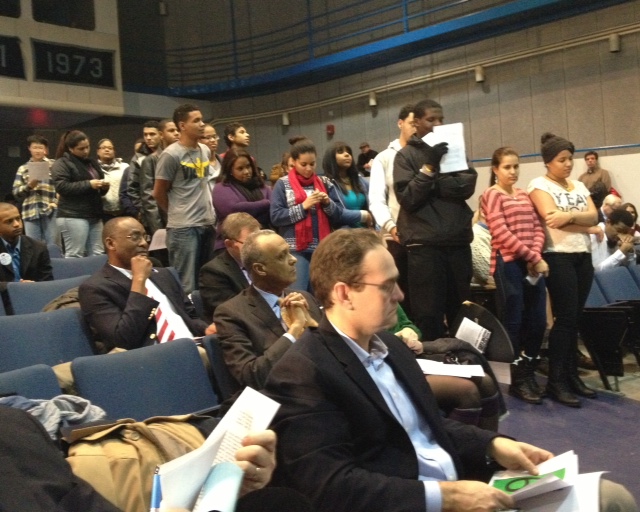
^ Boston public school students lined up to testify and support the issues on order at Mayor-elect Walsh’s education Hearing

—- —- —-

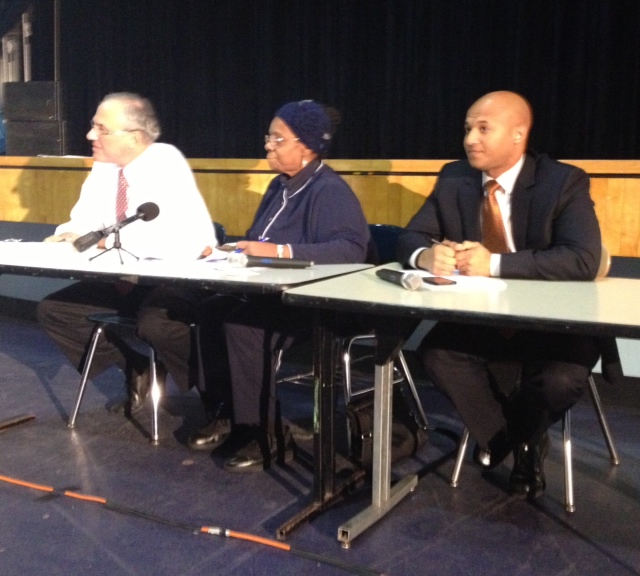
Last night Mayor-elect Walsh’s Transition team held its Education Public Hearing, at English High school in Jamaica Plain. For two hours, from 5.30 Pm to 7.30, three of Walsh’s Transition Team menbers, including his Education Team chairman, John Barros, heard testimony from at least fifty witnesses. Students, school parents, teachers, advocates all spoke.

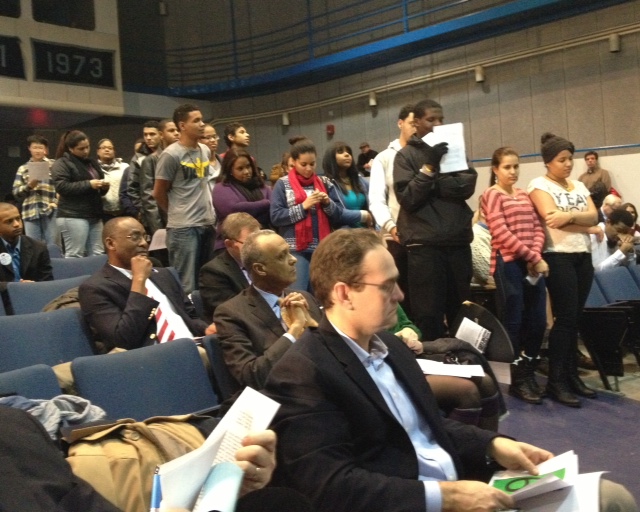
Less people attended than came to the previous night’s education rally held by Boston Truth. There were at least a hundred vacant seats at English high’s auditorium. listening to the testimony, it was easy to tell why. With hardly any exceptions — more on these later — every witness said basically the same thing : more funding for public schools, downplay charter schools. It was the sound of one hand clapping.

photo (19)

^ plenty of vacant seats : the elephant wasn’t in the room

There isn’t much to learn from a soundless sound and hardly much more from hearing the same message repeated again and again, with only the age, gender, or skin color of the speakers differing (and these aren’t policy matters, although identity issues were raised by some of the witnesses).

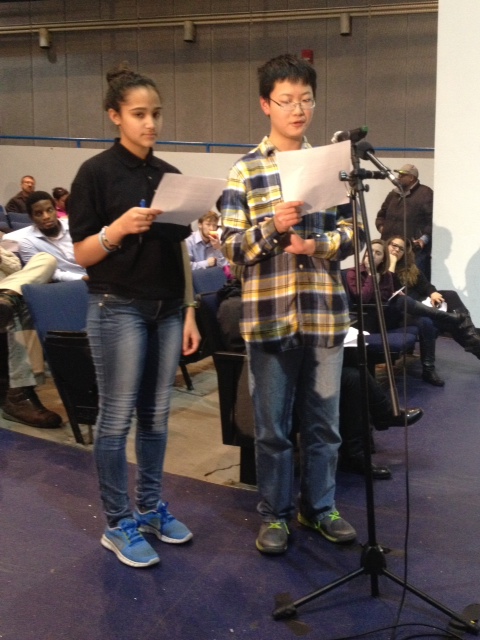
photo (17)^ Boston Latin student (and Student Advisory Council President) testifying against charter schools and thus, basically, that there shouldn’t be any additional Boston Latin schools. “Making history,” wrote one activist about my post of this photo 🙂

It was especially odd — unsettling, too — to hear the students who testified. How does a 17-year old Boston Latin student — smart, yes; Chairman of the Studernt advisory Group; but — acquire an interest in curbing the number or funding of charter schools ? Did he learn his view in debate at school ? Was he coached to his position ? Quite possibly, because he read his testimony from a prepared statement. I found his testimony manipulative. Contradictory, too ; after all, Boston Latin, the City’s totally competitive exam-entry school, is the ultimate “charter” school. Was he really telling us, not that charter schools are bad, but that Boston Latin doesn’t like having its exceptionalism duplicated ?

photo (21)

^ respectful : Education Transition team members George Perry, Jen Robinson, and John Barros (Team Chairman)

The Transition Team members, George Perry, Jen Robinson, and John Barros, listened respectfully to all. Barros, at least, knows all these issues masterfully. At numerous Mayoral Forums during his candidacy for the office he heard, and responded to, all manner of school reform agendas. Last night surely tried his patience. At times I saw a bored look in his eyes. Did he really need to hear the applause given the various witnesses — the louder, the more in agreement — by the Hearing’s audience, heavy with Boston Teachers Union members (including its President, Richard Stutman, and its organizer, Jessica Tang, who testified) and Boston Truth activists, in order to get the evening’s message ?

photo (16)

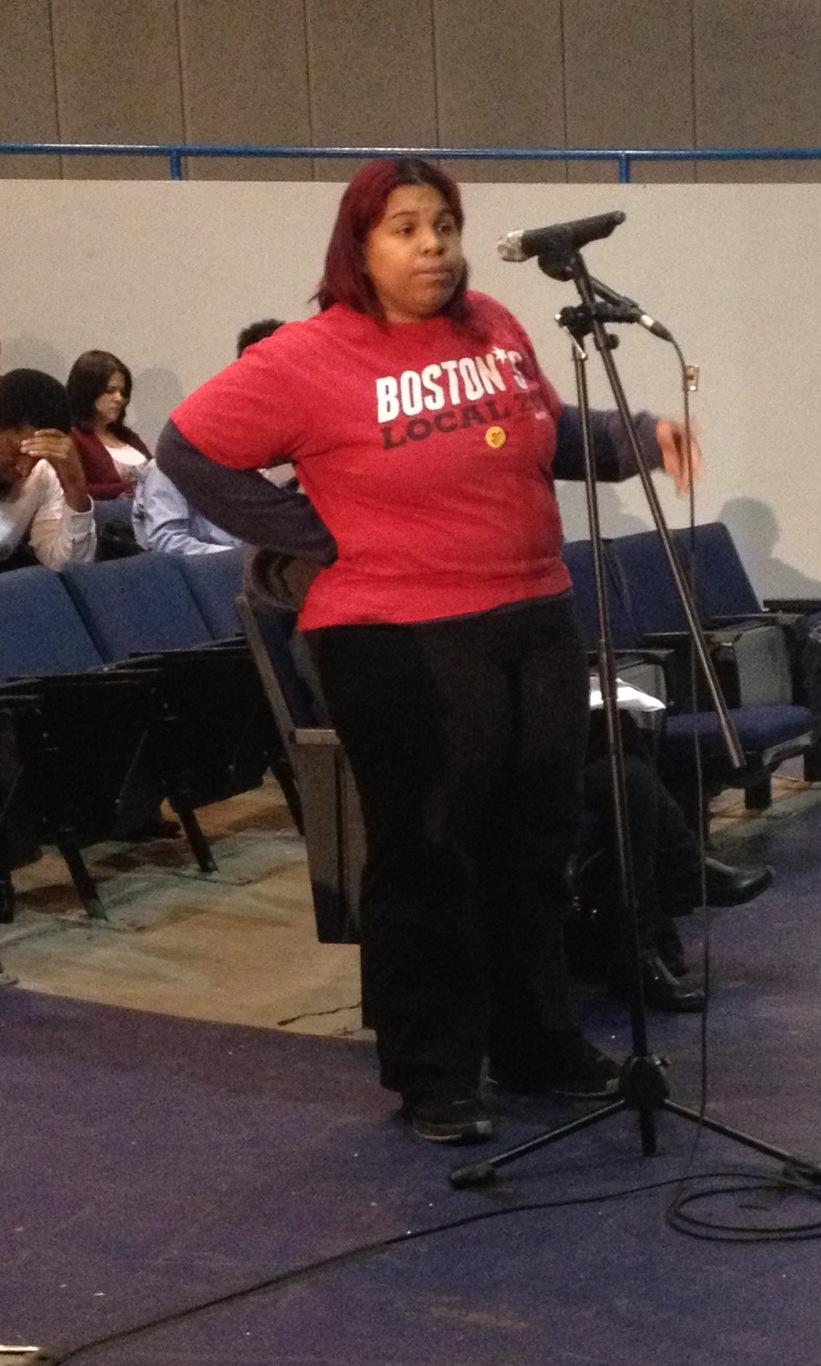
^ “I’m a Boston public school parent,” she said, and told of her difficulties getting her child properly assigned to a school convenient to her home. I wondered : Hadn’t she asked Councillor Connolly to help with that — as did so many Boston school parents ? Then I noticed her LOCAL 26 T shirt…

Fortunately for those who might have expected the incoming Mayor’s Education Team to hear a diversity of views rather than a one-hand clap, a few witnesses did offer opinions credibly their own. Jason Williams, an executive with of Stand for Children, hoped that Mayor-elect Walsh would continue his commitment to charter schools, noting that as a legislator, Walsh worked to increase their number. Applause ? None. Another witness, who said that he was a Boston Harbor captain, suggested that BPS should offer 6th grade students a course with sailing experience. Applause ? A few. Karen Kast, organizer of Boston Truth, challenged Mayor-elect Walsh to keep his campaign promises. Aplause ? plenty.

Most interestingly, Mary Pierce, who heads a special eduaction advocacy group, voiced her personal experience of frustrations dealing with Boston School Department administration. This was risky territory : reform of Boston Schools administration was a centerpiece of John Connolly’s education agenda. A door was opened — a bit; but the moment passed.

Sometimes the elephant is in the room; sometimes he is not in the room. John Connolly was the elephant not in the room. Other than Jason Williams, there likely wasn’t a single person testifying (or applauding) who on November 5th stood with Connolly’s 48.5 % of the vote.

Education became a key issue in the campaign entirely because John Connolly made it so. Most of the other candidates would gladly have left it aside — Walsh too — to be dealt with at the State House. Connolly made sure that Boston schools would be front and center — the decider — on election day. The major effort now being assembled by the Boston Teachers union and its allies, to push the schools reform agenda in its direction, would likely not be taking place had John Connolly not forced school reform sharply, radically forward.

This history makes many people wonder why the Mayor-elect even bothered to have an Education Hearing last night. As I was preparing to write this column, I found on my facebook page the following comment (excerpts follow) by friend Lisa Moellman :

“At 5:30 on a school night, just before Christmas — thry are stacked so that BTU representation/agenda dominates. picking up and feeding kids, holiday commitments prevent so many parents from participati9ng. Why would Walsh hold these important forums…at a difficult hour….? Why not the first weeks of January when actual diversity of participation could happen ?”

Why, indeed ? Myself, I think it’s public relations — Walsh’s showing the voters (and the media) that “he will listen to the people.” Nothing more, nothing less. Education is an issue that Walsh wants to put aside as much as possible ; to hand over to whichever poor sucker accepts becoming his new School superintendent, so that Marty can get on with his first priority : keeping the Boston Building boom alive and expanding, so that his building trades workers — including the many new hires that he will insist upon — can keep on earning hefty pay checks.

As for public schools and charter schools, compared to the issue debate that took place the prior evening at Boston Truth’s gathering, and much more so at every Mayoral Forum during the campaign, last night was a complete waste of auditorium heating oil.

—- Michael Freedberg / Here and Sphere
UPDATE at 3.11 PM 12/11/13 : am informed that during the 20 minutes prior to my arrival at the Hearing at 5.50 PM, other opinions, including from representatives of charter schools, were given. These sure didn’t last long. Still, it’s good to know that the Hearing wasn’t completely one thing. — MF

#MAGOV : THE FIGHT FOR CONTROL OF THE BAKER CAMPAIGN

Image
^ Charlie Baker 2013 : taking it to real people in the real world

—- —- —-

GOP Governor hopeful Charlie Baker tweeted at 9:55 AM this morning :

“Visiting the team at the Dimock Center to discuss health and social service issues with one of Boston’s top provider groups.”

With that tweet — the first, since the campaign began, that i have seen in which he addresses health issues, and in Boston, no less — Baker pretty much said to the GOP right-wing “Game On !”

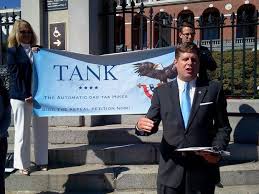
Baker does face a fight from the Right. He faced one, as Governor nominee, in 2010 too : but then, the GOP had a Senator, Scott Brown, who wielded his power to tamp down that year’s  Tea candidate, with complete success. This time there is no Senator Scott Brown in office, and the GOP right-wing looks far stronger. Its candidate in the Special Senate election, Michael Sullivan, won 33 % of the vote in the GOP Primary. Today’s Right uses all the social media linkages. A new pressure group,” Mass Fiscal Alliance,” is importing the Cato Institute’s anti-social safety net propaganda — devious stuff — into the boil.  The Right has also spurred a ballot referendum called “Tank the Tax,” collecting well more than the 68,000-odd voter signatures needed to be printed on the 2014 state ballot. This effort expanded the right wing’s reach beyond the Michael Sullivan voters into the 15 % vote that libertarian-ish Dan Winslow won at that Senate primary and even into the 51 % garnered by non-ideological Gabriel Gomez.

Baker’s challenge has steepened in the past week thanks to two developments : ( a ) one Max Fisher, a Tea Party member from Worcester County — ground zero for right-wing doom-saying in Massachusetts — announced his candidacy for Governor and ( b ) Karyn Polito, also of Worcester County, and a former State Representative, announced her candidacy for Lieutenant Governor.  Fisher’s candidacy doesn’t scare a whole lot, but Polito’s does. She was a Sullivan supporter and — so reports today’s Boston Globe — spoke at a right-wing event honoring one Allen West, whom some may remember as an outspokenly hateful one-term Florida Congressman. West is a hero to the folks who sling the word “patriot” around as if mouthing a phrase with seven bleepable letters. That Polito would even be in the same county as such a man, much less speak in  his honor, casts a pall upon the GOP’s Governor prospects, already damaged in Massachusetts by the contemptuous 2012 Presidential campaign and all but poisoned by the recent government shut down.

Yet now, on the very morning of the Boston Globe article entitled “Running Mate Issue Gets Thornier for Baker,” Baker tweets about health care and social service ! It caught my attention, and it should catch yours. Either he sees Polito as his shield against the angry right, freeing him to discuss issues that matter to the vast majority of voters, or he is sending the right — and Polito — a message that he will not be intimidated, will in fact move aggressively away from right-ism and make IT his bogey man, as it already is for most Massachusetts voters.

We will soon find out which of the two courses Baker has chosen. Meanwhile, the fight is on, as anyone following Worcester County Tea-publican’s facebook threads and anti-Obama tempests should know.  The right has its guns locked and loaded, and how ! It is itching to win one… As accomodative Republicans mix on the same floor as power-groupies and the Right wing contempt machine, the Massaachusetts GOP convention of March 22nd should be a barn-burner.

It may come down to the supporters of state Representative Geoff Diehl, of Plymouth County. Though Diehl has got aboard the “Tank the Tax” referendum drive, to great effect, I sense that his instincts favor the reasonable side. He proclaims himself a “Charles Sumner Republican” in a context strongly advocat-ive of civil rights for all, including voting rights — the original GOP message. My guess is that at the Convention, Diehl’s supporters find an alternative Lieutenant Governor nominee to Polito; and by all means they go with Baker, not Max Fisher. The Republicans of Plymouth and Norfolk Counties are not Worcester Tea guns. My sense is that they congratulate Charlie Baker speaking to Boston area voters. I also sense that Baker sees these South Shore Republicans the same way that I do. Baker has tweeted his outreach to all voters, in social settings, as well as to business groups and innovators, who he addresses no differently from how Democrats Steve Grossman and Don Berwick speak.

We might even see more of Baker out and about in Boston. Meets and greets, perhaps. Wouldn’t that be something ? Baker of course wants to steer clear of the ballot referenda. He wants not to become the grinch of welfare “reform.” He does not want to be talking “2nd Amendment.” Would you ?

No, Baker wants to talk innovation, health care, empowerment for immigrants, school reform, the huge numbers of homeless that the State now houses;  transportation improvements — all the issues that matter to most Massachusetts voters. He wants to move Massachusetts forward, not backward. The question is, will be allow himself to do that ?

We will soon find out what Baker is thinking — I may well have it wrong. In any case, don’t count out Geoff Diehl. His is a name you’ll be hearing a lot more of.

—- Michael Freedberg / Here and Sphere

A BAD REFERENDUM — AND WE OPPOSE IT

Image

^ Geoff Diehl (R-Abington) : a good guy makes his pact with an unserious rant

—- —- —-

Massachusetts voters going to the polls next November face at least two referendum questions. One, we support : raising the minimum wage to $ 11.00 an hour. we have already editorialized our reasons for casting a “yes’ on this referendum. The  proposal, we strongly dislike. This one seeks to cancel the three percent gas tax hike enacted earlier this year, by which our state will fund all sorts of needed road and public transit repair and upgrades.

That “Transpo Bill,” as it has come to be known, has already taken one hit : repeal of the software tax included in the original enactment. We agreed that taxing technology was a wrong idea. Technology should be encouraged and aided, not nicked. It is different with the gas tax. Driving wears and tears our roads and bridges; their upkeep is a public charge –and we make it so because driving keeps the economy moving, pun intended — and thus the gas tax.

The same people who initiated the software tax repeal now initiate the gas tax repeal. This time, their motives are suspect. From what they say at facebook and on twitter, they appear to oppose all public spending, or to view it suspiciously, as if public spending were a kind of con man come to scam us. Many of these opponents are Tea sorts, who view public spending as extortion money paid to “moochers” and “illeagl aliens.” We’ve already seen their impact upon the EBT program, a food-buying fund by which those living on the margins try to survive.

A referendum that begins with this mindset is tainted ab initio. By two arguments, its sponsors seek to justify it. We reject both :

1. they tell us that gas tax revenue is often spent by the state on programs other than road and bridge repair and transit upgrades. True enough, but so what ? This happens because the anti-public spending crowd denies the state funds that it needs for those other programs, many of them immediate, such as policing, courts, and administration, to pay for which the State’s Commissioner of Administration and Finance simply decides to defer road and transit work. Denying the State new gas tax revenue is going to worsen this situation, not improve it.

2. they say that pegging gas tax increases to the cost of living index is “taxation without representation.” Representaive Geoff Diehl (R-Abington), one of the repeal referendum’s leaders, and usually one of the really good guys, actually tweeted last night that every single “COLA” hike, every year, should be voted on by the legislature !

Keep in mind that the gas tax hike itself is three percent. On a 20-gallon fill-up at current gas prices — about $ 3.35 a gallon — that’s a tax of $ 2.01 per fill up. the usual “COLA” hike these days runs about two percent. two percent of $ 2.01 = $ 0.04 ! For four cents a fill up we’re to call the legislature into session to vote ?

The entire argument crashes and burns. We already peg our sales tax to prices; and prices go up, automatically, without the legislature voting. That the gas tax hike takes effect without a legislative vote is simply to tie it to the price of gas. Otherwise the gas tax hike would be assessed upon gas only at the price of gas on the day the tax hike took effect.

The referendum proponents already know this. They know the whole flap is a nullity. Its  REAL purpose is to raise the hue and cry against “moochers” and “illegal aliens,” anti-spenders’ favorite scapegoats, and thus to help elect no-spending legislators in Districts outside the Boston media zone, within which the unseriousness of this device would be fully and quickly debunked.

Someday, if and when the no-spending crowd actually adduces a serious reason — and attacks upon its scapegoats’ desperate lives is both flip and despicable — for why they oppose taxes to fund State spending, we will listen respectfully to their arguments and maybe even agree. I’m not holding my breath.

—- Michael Freedberg / Here and Sphere
BOSTON PUBLIC SCHOOLS : WHAT NEXT FOR REFORM ?

Image

^ Boston school reformer Mary Tamer : Marty Walsh needs to reappoint her

—- —- —

Lawrence Harmon’s column in today’s Globe tweaked me to write once more about the prospects for school upgrade in Boston. My last column on this topic appeared well before the Mayor election. Much has happened since, and not just the selection of a new Mayor. School reform occupies center stage nationwide, as parents, students, and the job market push for — insist upon — huge changes in how we educate children, how rigorously, and to what purpose.

Harmon focuses on the City’s teacher evaluations, which he finds very suspiciously upbeat. 93 percent of teachers, he writes, land “in the exemplary and proficient categories on a new teacher-evaluation system.” He also notes that almost every BPS principal rated high. “Yet,” he goes on, “about two thirds of the city’s schools rank in the bottom 20 percent statewide based on student test data.”

He asks, “what is going on here ?” A few sentences later comes an answer : “It suggests that good teachers are unable to compensate for poverty, social ills, non-native English status, and other difficulties associated with urban schools.”

The suggestion rings true. Harmon says that it should not matter, that just as the Boston Police do not settle for the high rate of crime in certain neighborhoods but attack it head-on, so should the schools. No doubt that Harmon is right. But teachers aren’t a police force. Boston’s police patrol 24/7 ; teachers teach only seven hours a day, five days a week. Boston school children live by far the most of their day with someone other than their teachers.

I agree that the new teacher evaluations disservice everyone, the teachers included. No one working on any job does it perfectly. All of us can improve; all should try to do so. To have value, an evaluation system should do what my Phillips Andover American History teacher did ; “no one in this course will get an A,” he said, “because none of you can master the subject that well.” The best that anyone could do, he told us, was a B. My American history teacher was pressing the point that what he would be teaching us really, really mattered. Being the best teacher that one can be matters even more.

Harmon also quotes school committee member Mary Tamer at length, on the evaluation issue — especially of Boston Public school administrators. Her rigor and critique should be cherished by a system dedicated to improving itself.

That said, as I see it the big problem in urban public schools is not the competence of teachers or principals. The problem lies elsewhere, most often at home. If children are sent to school without a healthy breakfast; if they come from homes in dysfunction or commotion; if they cannot negotiate the English language; if they are prey to peer pressures, from bad decisions to worse; if at home no one ever reads to them, challenges them intellectually, engages their curiosity — if any or all of these home situations devils every part of a child’s life outside school, what is his life IN school likely to be ? Peer pressure becomes even more intense at school.

The home lives that I listed in the previous sentence come to school on the backs of all too many kids. Your kid may have the solidest home life in the neighborhood ,and it is not going to be enough, confronted as it will be in school itself by kids from problemed homes. A very few, remarkable kids can work through such peer pressure. A few can triumph even over their own home badness. But how many ? And there isn’t much that a teacher can do about it. Most Boston public school teachers I have known can rescue many kids from the badness; what about the others ? It cannot be all on the teachers.

School reform begins at home. If the parents or guardians aren’t fully committed to see that their kids triumph intellectually, morally, physically, and emotionally, and if they cannot rely on their neighbors to do the same with their own kids, urban public schools are going to continue to under-perform even with miracle men as teachers.

It is this time that we evaluate the parents and guardians. And time too that we expect no better of Boston public school kids than public school parents put into it.

Frankly if I were a Boston public school parent, I would grow grim about the certainty that my kid(s) will find it almost impossible to get that cutting-edge technology job — or even an entry level tech-competent position — because I am failing, my neighbor is failing, and thus the public schools are failing, too, because my neighbors and I aren’t demanding that school concentrate on testing, teaching, cajoling, piquing every child in class to work to the next level, to experiment, to imagine, and to really, really THINK. None of which my school can succeed at because too much class time is spent getting hepped-up kids to calm down, into some sort of order, into concentration.

No wonder that diligent parents choose charter schools if they can make the cut. But that too is not the answer. The only answer is the community-wide, full-metal jacket — much more than the competence of teachers and principals evaluated without compromise — that I have outlined. Anything less well work only partly, leaving some parents unsatisfied and some children unready for tomorrow’s mercilessly experimental jobs.

One final question : do you have any evidence that the new Mayor will spur a school reform as vast as the effort i have outlined ? I sure don’t. The voters of Boston already passed judgment on how much school reform they wanted. Mary Tamer supported John Connolly, as did I, for much the same reason: school reform cannot be piecemeal. Yet piecemeal it looks now to be. There will be some changes. More teachers and principals will be people of color. The school day will lengthen. Trade and technology curricula will expand, in partnership with universities, labor unions, and businesses. Some children will definitely benefit, somewhat. I doubt it will be anything like enough; yet I am willing to be proved wrong.

Harmon suggests in his column that Mayor Walsh should reappoint Tamer, whose term is at end. “Walsh…needs to hear strong, independent voices,” writes Harmon, “as he tackles the job of improving schools.” I agree.

—- Michael Freedberg / Here and Sphere
SALLY CRAGIN : NEWS FROM TRI-TOWN … DECEMBER ( VOLUME 3 )

Image

We’ve had a dusting or too of ESSENNOOUCH, but the big guns (e.g., the storms that are advertised as 4 inches for you, that turn into 18 inches for us) are yet to be seen. Not a problem — I can’t remember whether the big-tread tires are on the front wheels as they should be. Should ask my husband. These decisions matter out here in the land of no-reliable-public-transportation but beautiful scenery and sincere folks.

A lot has gone on since my last entry, and if you’re interested in theatre, come see a charming production of Christmas Carol every weekend in December leading up to Xmas at Stratton Players (currently housed in the UU church at the top of the Common, Main Street, Fitchburg). Strattonplayers.com for more. Also, a group of artists is having a discussion on la vie boheme on Tuesday, December 10, 6:30 pm at The Kiln, 353 Main Street, Fitchburg. This is a glass shop this is also (shhh) a head shop! I was so delighted when owner Michael Flanagan talked about their wares. He brought an amazing box of glass-made items by local glass artists — the kind of work you’d see under the glass cases at Harvard’s MCZ (anatomically correct milkweed caterpillar, surrealist beads, etc). This is free, and more on Facebook if you go to my site.

The bigger story is that a group of people are trying to launch a charter school here in Fitchburg. This would be a K-4 and is utterly unnecessary and redundant, particularly since 3 of our 7 schools moved up a level in the state testing, and one K-4; Crocker Elementary was voted #5 of the top 15 elementary schools by Boston.com. We had a public hearing and a lot of people spoke on behalf of FPS — eloquent testimony by parents and students, teachers and administrators, that really brought the point home to the DOE Board who was in attendance that FPS are very much on the right track. Since then, I have been doing research on charter schools and truly impressed by how their lobbyists have effectively commod-ified a public service. The last motherlode of public money was protected — until Ed. Reform! And so, we get egregious examples like the so called “STEAM STUDIO” charter project trying to launch in Andover (a top-tier public school system — but the folks who want their charter school want to limit further the number of kids who can take advantage of public money), and various frequent-flyers in the application process.

Our Representative, Stephen DiNatale, our Senator, Jen Flanagan, our Mayor Lisa Wong, our School Committee, our City Council have all voted against this proposed charter school, and we have lively meetings every week of “Fitchburg Public Schools First” (FPS 1) to discuss our ongoing support of public schools.

DOE makes this decision in February, so we have some weeks to go and if I’m not out and about doing cool things, I’m hunkered down protecting the public schools and the education of 5100 kids that I swore to protect six years ago when elected School Committee. Happy Hanukkah/holidays to all.

more at fitchburgfun.blogspot.com

— Sally Cragin / News from Tri-town

#MAGOV : FRAMING THE ISSUES FOR CAUCUS DAY

photo (2)

^ Don Berwick : the “governor” as issues referendum

—- —- —-

The race for Governor of Massachusetts continues to feel less than grave. We all know that the REAL Governor is Robert DeLeo, Speaker of the General Court (as our legislature is called). Yet the office which we call “Governor” is filled by a vote of all the people, as that of Speaker is not; and so even if all the people’s Governor isn’t in fact a governor, he or she still embodies what we the people want leadership on. Thus choosing a “governor” is a kind of referendum, not much different from the several referenda that look likely to be put on our state’s 2014 ballot, except that the “governor referendum” is not one-issue specific but an entire menu of issues.

So, what are the issues menus on offer from each of the six servitors ?

1. Martha Coakley has yet to tell us what she will do as “governor” that she isn’t now doing as our — admittedly very effective — Attorney General. Perhaps her issues menu is “consumer protection” ?

2. Steve Grossman is just beginning to talk issues. His menu appears — so far — to be “business recruitment, lots of fund raising, and a higher minimum wage.” All good, but much more is likely coming.

photo (3)

^ charisma to spare : Juliette Kayyem

3. Juliette Kayyem has drawn enthusiastic crowds of Democratic activists and certainly is the charisma champion of the field. It’s a little less clear what her issues menu is. Everybody knows that she was an NSA bureaucrat and wrote expertly — albeit in prose as dry as a month old egg sandwich — about national security issues for the Boston Globe. Who would have guessed that such a sere pen would, in person, exude such fire and warmth ? Perhaps that’s her menu : passion and charm.

4. Donald M. Berwick (see photo above) has, so far, put forth the most inspiring menu : health care as a human right, complete with a cost-control and care delivery plan; business recruitment and a higher minimum wage; and bold leadership on all civil rights issues. He seems to grasp, better than any of his rivals, that the office of “governor” is the issues referendum that I see in it. The activists seem to be responding; of late, Berwick’s twitter follower numbers have surged.

5. Joe Avellone says all the right things. his issues menu parallels Berwick’s although with less talk about health care (which is strange : Berwick is an MD, but so is Avellone). Still, Avellone draws smaller crowds and is — and seen as — a huge underdog. Running state-wide for “governor” is a difficult course for anyone as little known as Avellone, whose gentlemanly demeanor only adds to his difficulties arousing serious attention.

photo (4)

^ meeting & greeting : the new, charimatic Charlie baker ; still the man to beat

6. Charlie Baker : his menu we already know from 2010 — or do we ? Unlike then, Baker is taking himself out to the people, doing meet and greets, just as Scott Brown did (and so doing, changed everything about Massachusetts GOP campaigns, which had tended to be press release and stand-out affairs merely, a soft touch of couch potato and hardly serious). Out and about — in Worcester County often — Baker stresses business recruitment (who isn’t ? But how about some innovation district initiatives as well ?), business confidence, and just a hint of education reform (surely we’ll see more of this from him). He’s also being Mr. Good Buddy, unlike the pissed-off persona he shopped in 2010. The change in demeanor is most welcome and seems to be catching fire. His twitter follower gains trail only Berwick’s and Kayyem’s.

The Democratic candidates are amassing issues rapidly; caucus day approaches. Hard to believe that caucuses will convene scarcely 120 days from now ! (According to the State’s Democratic party, they cannot take place later than March 2, 2014. For the Party Rule governing caucuses, follow this link : http://www.massdems.org/wp-content/uploads/2013/08/METHOD-2014_Proposed1.pdf ) Soon the issues roll-outs will give way to caucus commitments as candidates fight each other to secure the 15% of delegates needed in order to earn a spot on the printed Primary Day ballot at which the actual Democratic nominee will be chosen.

I will be covering this fight as it intensifies.

As with all Republican candidates, so outnumbered in Massachusetts by a host of Democratic hopefuls, Baker is running as if he and all of his Democratic rivals were part of the same selection slot. And they are. If the Republican candidate cannot outpoll all the Democratic hopefuls mano a mano, he won’t likely do so at the November election. Thus I am rating Baker on the same stage that I evaluate the five Democrats.

One big difference in quality between Baker and the rest : he has run for “governor’ already; they haven’t. He has tested the waters, against an incumbent no less. All the others have yet to prove anything. Most definitely do I include Martha Coakley in that assertion.

The way I see it right now, Baker is the favorite to take the people’s “issues referendum” into the State House and get the REAL Governor, Robert DeLeo, to listen to — us. I am not at all convinced that any of the five Democrats can capture DeLeo’s attention, interest, or concern.

—- Michael Freedberg / Here and Sphere
ANNALS OF THE ECONOMY : MY FRIEND WALTER MICHALIK ASKED ME A QUESTION …

Image

^ Walt Michalik of Roslindale : a question that went right to the heart of economic matters

—- —- —

Last night, at Hyde Park Main Streets’s tribute to City Councillor Rob Consalvo — retiring after 12 years service — I ran into an old friend, Walt Michalik, who lives in Roslindale and supported me the one time that I put aside political work for others to become a candidate myself. That was 1986. I had known Walt, and, very early on, as I visited “people of influence” in my “Rozzie” neighborhood seeking support, before I actually made a decision to run, I knocked on his door. (He was, in fact, my first such visit.) Walt was a Democratic activist. He knew that I was a Republican. So he asked me : “what is your opinion of the prevailing wage law ?”

For those who don’t know, the Prevailing Wage law, also known as the Pacheco Law, requires that on all State-funded contracts, the contractor pay his workers, whether they are union members or not, the same hourly amount that prevails in union-labor contracts. It wasn’t a law that I had thought much about and wasn’t something that I had planned to base my candidacy upon. So I didn’t answer Walter right away. But I knew a lot of ironworkers well, and I knew that they spent their big paychecks and thus brought a lot of prosperity to a lot of businesses. So an answer came to me :

“You know what, Walter ? I don’t see how taking money out of the pockets of workers helps the economy.”

Walter shook my hand, a handshake of solidarity.

Well, that was then. A generation has passed; and the answer that I came up with that afternoon opened the door for me to understanding how a democratic economy works — and should work ; it begins with the customer.

1.The less customers a business has, the less it prospers.

2.The less that a person earns (or receives by way of public assistance if that he needs), the less of a customer he can be.

3.An economic policy that impedes worthwhile money from accruing to most people defeats itself.  This axiom is one big reason why I support the welcoming immigration policy that until the past 90 years or so was America’s boon. Every immigrant is a potential customer and this grows the economy. This same axiom is why I support Massachusetts’s impending minimum wage hike. The more that workers earn, the more they can spend.

Quite frankly, the above is my ENTIRE economic policy. All else is commentary and implementation.

One hears the political Right talk about businesses being “job creators.” But businesses CANNOT create ANY jobs unless there are customers for its products or services. The more customers, the more jobs. Angel investors for start-up businesses want to know, first of all, who and how large will be the “market” — i.e., the customers — for that start-up’s offerings. No “angel investor” I have ever presented to requires the business plan to pay workers so little that they need public assistance to make ends met. Just the opposite ; angel investors want the start-up’s workers paid enough that they will stay, not leave, and thus (1) see the venture through to success and (2) avoid the huge costs, in money and time, of hiring and training replacements. I also know no “angel” investor who doesn’t want a start-up’s workers to not have paid sick time. Angel investors know that life is hard enough; a start-up shouldn’t make things harder for its workers than they already are.

Just who, then, does the political right speak for as it pursues “job creator” corporate tax breaks and opposes both workers’ wage hikes and the social safety net ? It doesn’t speak for workers, obviously, and it doesn’t speak for venture capitalists or the management of smart businesses. So who then ?

Speculators figure prominently among those who push this destructive agenda. Stock market funds often push publicly owned companies to cut back everything and anything in search of maximum immediate buy and sell gains. For the sake of purely paper windfalls these money poolers would trouble every other interest in our society. Unhappily, these money pools have drawn to them more and more money that, instead of investing in economic innovation, which bears vast risk and takes long time to accrue, seek sharp-fingered quickie hits; arbitrage — the most economically useless item in the entire money picture.

Even the money-lender has his place in an economy. Yes, he seeks interest on his money and does no work to earn it other than to have it to lend. But the money lender knows that if the borrower doesn’t prosper, he won’t get paid back. Yes, the lender may, if not paid back, claim the borrower’s assets as security; but no money lender wants those assets; he wants his interest and he wants his principal repaid.

For the stock trader, however — the arbitrageur — it;s just the opposoite,. He DOEs wnat that asset. He buys it at current value and dumps it at whatever higher value he can squeeze out of it by whatever means and as soon as possible, even if it means destroying the business and laying off its workers. This is what Bain Capital did, famously, during Mitt Romney’s partnership there and was a major reason why his candidacy for senator in 1994 earned the enmity of a majority of voters.

Not all stock buyers and hedge funders pursue a strategy of profit by desruction. Many investors buy in or the long term — and the huge success of a long term investment, wisely chosen, says all that needs be said : look at Warren Buffett, who has become a multi- billionaire by buying and holding, forever it seems, well chosen businesses whose management he supports and whose growth — in the classic economic manner I have outlined — he encourages. But for every dollar invested with the Warren Buffett sort of investor, 1000 dollars are invested these days with swift destroyers.

It is difficult to conceive legislation that will curb the economics of profit through destruction, that will not also limit the free movement of capital to positive purposes. But we are not helpless as a society to limit the impact of arbitrage money. We can impose a strong societal disapproval upon those who would profit by hurting all who stand in profit’s way. We can continue to angel-fund innovation businesses and support their entrepreneurs — and approve them socially too, social approval being one of a society’s strongest ways of policing good works and bads. At the same time, we can make it quite clear that he who would take money out of the pockets of workers lies beyond the pale of approval.

You don’t have to be a Wal-mart. You can be a Costco. It is an outrage that we allow low-wage employers to leave their staff no choice but to need taxpayer dollars in order to make ends meet. It’s also a no-growth policy, maybe even a recession policy. It is stupid. And immoral.

So how do we fight this stupidity ? Simple. It really does start with the question that Walt Michalik asked of me on a February afternoon 27 years ago.

—- Michael Freedberg / Here and Sphere