LISA MOELLMAN, GUEST CONTRIBUTOR : RESPONSE TO “PUBLIC SCHOOLS BEAT PRIVATE SCHOOLS” ARTICLE IN BOSTON SUNDAY GLOBE

Lisa Moellman

^ Guest Contributor Lisa Moellman

Editor’s note :

We received this via inbox at our personal facebook page. It was sent, said Ms. Moellman, in response to an article that appeared in Sunday’s Boston Globe, by Christopher and Sarah Lubenski, to the effect that by some measures Public Schools perform better than private ones. As her response addressed the article in question most persuasively and, as well, highlighted a major urban public school set-up as rebuttal, we have decided to publish it as a guest contribution, after which we have posted an essay of our own.

This is Lisa Moellman’s letter :

“I sent an email to Prof. Lubenski sharing my response to the Globe piece highlighting his and his wife’s conclusions about why they found public schools outperforming private ones on a math measure nationally. Here it is:

“I just read the key conclusions of your study highlighted in the Boston Globe piece today (site based autonomy and school competition bode poorly for math achievement). http://www.bostonglobe.com/ideas/2013/12/15/public-schools-beat-private-schools/hWLzdKv1x7wwupcjk5zonI/story.html

“I taught in one of the best PUBLIC school districts in North America (approx. 100,000 students)–Edmonton Public Schools–which in fact maintains a portfolio of schools in which EVERY school has site based autonomies, student weighted funding and the ENTIRE district is an open district of choice for families. It is a public district of autonomy and competition–extremely high performing. This flies in the face of your rationale about auntonomies and competition at the core of the differences you found between public and private…take a look at this summary about Edmonton Pubic and take a deeper dive into understanding the developmental histroy of this district–it’s a beacon for districts across Canada and the U.S., as well as some in the EU.

http://www.hawaiibusiness.com/Hawaii-Business/May-2010/Best-School-System-in-North-America/

“Further, a 2010 McKinsey report notes that public districts moving from poor to good need to centralize professional development, curricula, etc. but that once districts are at a good level, if they want to become great districts, they must decentralize and provide leadership and teachers with site based autonomies.

http://www.mckinsey.com/client_service/social_sector/latest_thinking/worlds_most_improved_schools

“In my experience and reading, your conclusions are not justified by your research findings. It’s troubling because this article was just tweeted by a key advisor to Mayor Elect Walsh in Boston on #Bosmayor. Scaling back our movement toward pilot and in district charter autonomies as Boston Public Schools attempts to move from ‘good to GREAT’ would be a misstep and deeply troubling as we strive to close the Achievement Gap.”

—- Lisa Moellman / Guest Contributor

—- —- —-

Editor’s Note : first, the Lubenskis’ article talks of private schools in general. No distinction or classification is made. This stacks the deck. Because private schools operate almost entirely in competition with one another, the fact of competition becomes the standard, for many such schools, rather than the rigor of the curriculum.  It is unfair to pit ALL private schools, of whatever sort and however set up, against public schools, which must adhere to a common, legislative standard. The argument is not whether public schools do better than ALL private schools but whether they do better than the schools most parents would be comparing to public schools. Most parents would not pay money to send their kids to a poorly performing private school.

Second, by choosing mathematics, the Lubenskis have already made a structural choice as well as a curriculum decision. They do not seem to realize that we school our children to two very distinct obligations : citizenship and the workplace. Mathematics do not get taught at home as often as reading, history, and civics because these are citizenship disciplines, while mathematics is almost entirely a workplace knowledge, at least in our society (to the Greeks, mathematics was as idea-based as te other liberal arts and formed the basis of much of their awareness of the real world).

Much of the otiose discussion going on these days about education arises from the failure to distinguish the prerequisites of citizenship and workplace. For citizenship, we teach reading, writing, argument, the arts, and music; and ethical, societal, moral, and legal knowledege (including history) that does not change — or, at best, slowly evolves — because human nature does not change; whereas for the workplace, everything changes constantly. This has implications for formal education that almost no one talks about. One is that teachers of citizenship knowledge should have long experience of the world — tribal societies used councils of elders to instill such knowledge in their young and to test their mastery of it. Whereas, with workplace knowledge, long experience often impedes instruction. In our rapidly innovating world, the best teacher of workplace knowledge is, likely as not,  to be very young — the younger the better. A career in workplace teaching contradicts the experience of the innovation economy, in which collaborative competition renders career knowledge relentlessly obsolete.

When thinking workplace knowledge, we must never forget that we are educating children for tomorrow. Not for today, not for yesterday.

Much workplace knowledge is most effectively imparted on the job, by apprenticeship. This is what our society used to do, but because apprenticeship was often a form of child labor and indentured servitude, it was given up as immoral or illegal. today it should be brought back, in a new form, as internships.

Unfortunately the huge institutional power of academe has all but monopolized our society’s teaching functions, so that subjects that should be learned by doing (as John Dewey knew 110 years ago), in apprenticeships or internships, are now “taught” in  formal schools by “teachers.” Why should future lawyers go to a law school ? The law, for example, is quintessentially a practiced art. It is best learned by “reading law’ or “clerking’ for a lawyer.

We also ask our schools — public especially — to do too much that isn’t education at all. Teachers are not set up to be day care providers, baby sitters, psychologists, nursers. Parents can NOT simply dump their children at the school door and say, “here, take them, I need a day of quiet.” As long as we allow our schools to be thus imposed upon, schools will be hard pressed to do what schools do. the only way that this “here, take my kids, I need quiet’ system works is with boarding schools. (It’s not such a radical idea. Our first Massachusetts antecedents, back in the 1600s,  often sent their kids at age 12 away to live with a family not their own. It was thought — correctly — that the child would be less likely to fight discipline at someone else’s house than in his or her own. Having been sent to boarding school myself, at age 13, I can attest the truth of this custom.)

At the primary, middle, and high school levels, however, it is fair to ascribe almost all citizenship and work skills education to formal schooling. This we do. But just because we do this, we cannot lose sight of the gulf that separates the two curriculum paths. Citizenship requires learning of one kind, the workplace of a completely different kind.

Of course we could always decide to teach mathematics as a conceptual art, as did the Greeks. The relationship between number and computation as concept, and number and computation in empirical experience, was the first pathway by which Greek civilization developed its sense of what is as opposed to things imagined merely. And it is from Greek speculative research that our civilization’s axioms have developed.

But that is a discussion for another day.

For now, suffice me to assert this education proposition : 1. first is the child — all children, at first.. 2. second is the curriculum : what we agree to teach him or her. 3. third is a teacher we hire to teach it to him or her. 4. fourth is the evaluation of how well the instruction is being done, both by teacher and student. 5. fifth is the site ; where will we teach the student ? (In Athens it was the Lyceum, a building and grounds set aside for that purpose.)

These are important. Everything else in the education discussion is gossip, self-seeking, or house cleaning.

—- Michael Freedberg / Here and Sphere

BOSTON MAYOR : A CURIOUS DAY AT TRANSITION SEMINAR

photo (29)

^ Seminar Day : much attention and then discussion at the Morning’s Education “Break-Out session”

—- —- —-

It has been a strange week in Boston City Politics. The Mayor-elect, Marty Walsh, has hosted an entire series of gatherings to discuss the eleven issue categories that his Transition Team has endorsed. Singly, night by night, these issues gatherings have taken place and will continue to do so well into January. On Saturday, all eleven issues gatherings held meetings again, all day long, in what Walsh’s Transition Website dubs “Mayor-elect Martin J. Walsh Town Hall Meeting.” The title misleads. The actual gatherings felt, to this participant, more like college seminars. Perhaps that’s because they were for the most part led by college educators.

That’s the strange part. The eleven issue categories — Arts and Culture, Basic City Services, Economic Development, Education, Energy-Environment & open Space, Housing, Human Services, Public Health, Public Safety, Transportation and Infrastructure, and Youth — all develop in a political context (some of the issues more than others. Arts & Culture seems appropriately collegiate, Basic City Services hardly at all); and political space is certainly where Walsh will have to decide how to structure them and choose priorities. So why the college-y format ? Yes, Boston’s a city plenteous with colleges. It’s nonetheless peculiar to think of Marty as Headmaster Walsh.

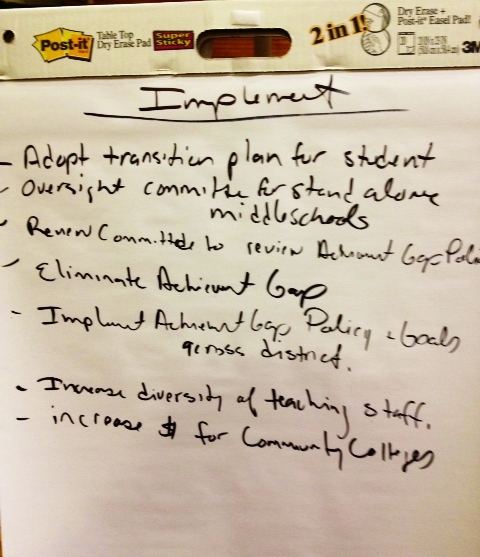
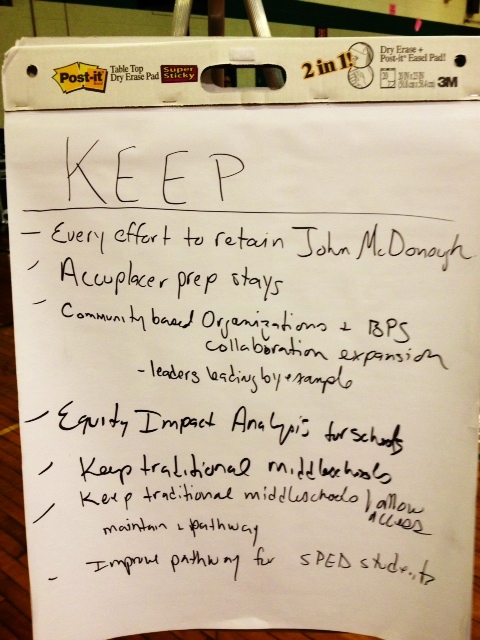
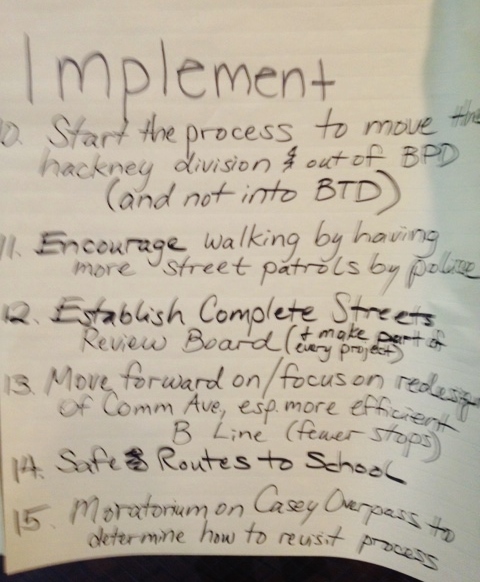
I attended the Morning Education seminar, then the afternoon Transportation/Infrastructure conference. At each, participants offered suggestions on what to keep — stuff that the City is already doing right; on what to implement — stuff that the Mayor can initiate without state legislation or huge budget outlays; and on what to dream about — a wish list for the future. Lists of each were made on large sheets of yellow art paper, and these were read from at the “general session” after all the seminars had ended. From the two sessions that I attended, I photographed both “keep” and “implement” lists. To see just how comprehensive these became, I invite you to peruse the “List” photographs below :photo (27)photo (28)^ the Education Session developed these ^ Lists of “Keep’ and “Implement”

Below —  the Transportation/Infrastructure attendees came up with this “Implement” List :

photo (36)

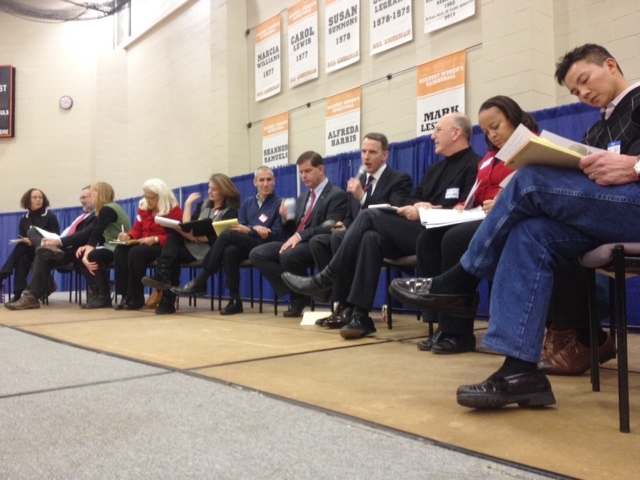
After the seminars had concluded, each seminar moderator delivered a report — and the lists. It was a lot to digest. Walsh sat on stage, in their midst and made an heroic effort to pay attention.

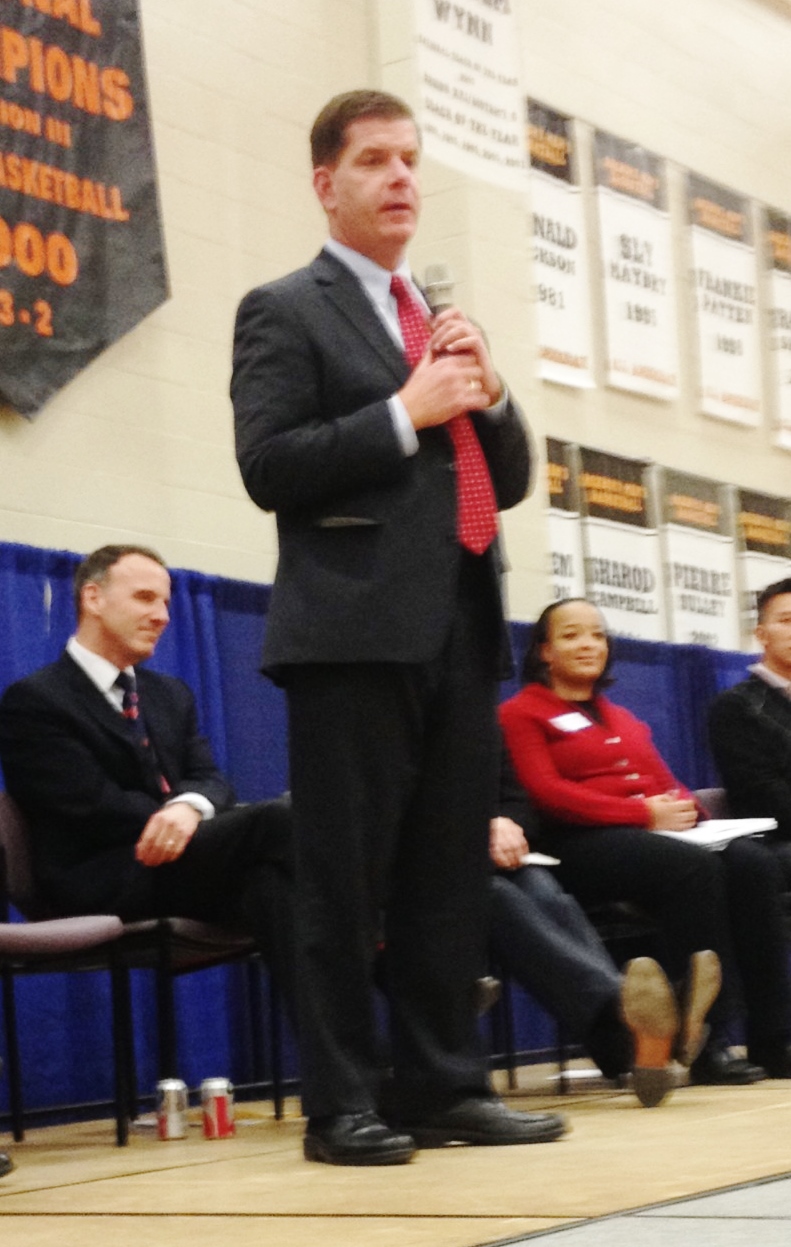
Walsh delivered opening remarks and spoke after the session as well; he then did question-and-answer with the hundreds of citizens who more or less populated the Reggie Lewis Auditorium at Roxbury Community College, ground zero for the day’s discussing.

photo (39)

photo (42)

^ school headmaster ? Marty Walsh addressed the gathered seminar goers after the day’s teaching

His opening remarks told of  a trip to the Nation’s capitol, from which, he said, he had returned only the night before: “The problems we face, the challenges,” said Walsh, “We’ll take them to Washington. Unemployment insurance must be restored…State and federal aid has been cut. we need to change the discussion.” The gathered citizens applauded. After the session ended, Walsh said in summation, “I was told by somebody that they had never seen a mayor and citizens have the kind of conversation we’re having today,” he said. “We need to continue this conversation after today too.”

Clearly Walsh has made a decision that stirring the pot of citizen petitioning the City is good politics. It continues the brilliant move that he made in his campaign, to engage hundreds of educators and public interest advocates in drafting 40 policy papers for future Boston governance. Those papers — 37 were actually completed — made Walsh look Mayoral, not just the Union guy he had been (quite correctly) seen as. No wonder that he is bringing such a thumbs-up campaign device into his transition work. Seminar and conference have much value convincing citizens that City hall is listening diligently. It can. Walsh has brought to his side an impressive group of Bostonians, many of them long known by me, with experience of the City as extensive as my own. And yet…

And yet I’m not sure that Walsh realizes that by keeping the issues pot boiling he is ( 1 ) raising participants’ expectations of his administration very high ( 2 ) will almost certainly disappoint some — maybe many ( 3 ) and thereby is setting the stage for a strong opposition candidate — surely a person of color — in 2017, a campaign that is likely to begin almost immediately after the 2015 Council elections.

Already the early moves are being made, as we see in the serious implications underlying the silly — and distractive — flap about “progressive” Councillor Michelle Wu supporting “conservative’; Bill Linehan for Council President. Already we see the formation of “monitoring’ groups which intend to hold Walsh to a variety of campaign promises — in particular, bringing people of color significantly into his administration at all levels — many of which he will be hard-pressed to keep, especially given the City’s $ 50 million budget deficit (which number is mounting even as I write). Eleven issues seminar groups can only whet the appetite of those with agendas to press.

Politically, it night have been wiser for Walsh to put a lid on politics during his transition — and beyond. This is what John Connolly has done, and most of his supporters. Few Connolly people have participated in the Walsh seminars; fewer still have been much heard from since election day, and John Connolly himself not at all, except to invite supporters to a December 27th “thank you” party. But perhaps I am wrong. Perhaps it’s a pleasant vacation from politics to hear a speech such as Professor (and Boston Globe columnist) Ed Glaeser, emcee of the Seminar, delivered, almost without notes, at session’s end; an eloquent, even stirring, history of The City, in America and elsewhere: what cities are about; why we need them; how they advance the human condition and shape our thoughts; in particular, the history of Boston, with its immigrants, universities, its “human capital,” which, as Glaeser noted, is more valuable than the coal, oil, and minerals that Boston does not have.

photo (25)

^ History 307 — The City — Professor Glaeser tells it sweepingly

Glaeser’s narrative reminded me of the awe-inspiring History lecturers at whose podiums I studied at college. It was a thrilling experience to feel my mind carried back so many decades to when we students felt ourselves graced and awed by such narratives as Glaeser’s. hearing his speech, I almost forgot that this was a seminar about things to be done.

Talking is not doing. Silence often is.

—- Michael Freedberg / Here and Sphere
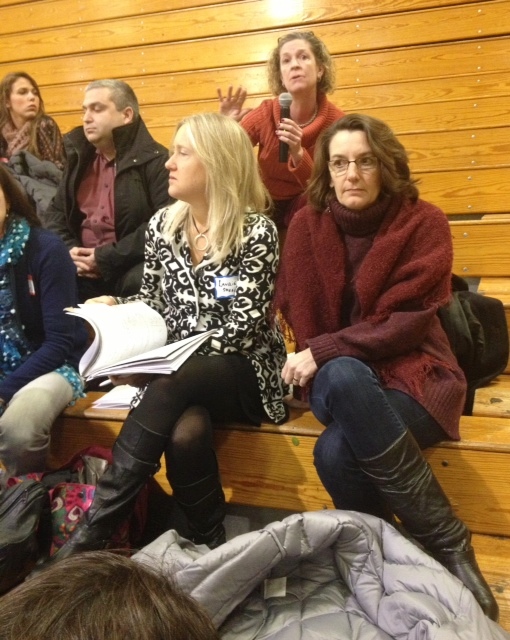
UPDATE : Marty Walsh badly needs to expand his reach beyond the team that has gotten him to victory. At the “Town hall” he was surrounded by all the familiar faces — hard working all, idealistic many — and accompanied by legislative and Council endorsers who strengthened his campaign. Of the rest of the City’s power players, however, I saw very very few. Some conspicuously had other plans. Clearly there is skepticism about Walsh’s readiness to the entire City. There’s also still a strong tide of continuance, of no giving up, by the “new Boston’ constituency that almost won on election day. It’s a constituency that doesn’t need City Hall to give it vision or goals to achieve and wants the Mayor to rethink the City, not merely improve it ; and will do so without him, if that’s how it is to be.  — MF

photo (40)^ drawing upon practical experience of the wise heads too :Marty Walsh conferred in a time-out moment with my old friend Pat Moscaritolo, of East Boston, who has managed much economic development work in Boston since the 1970s.

#BOSPOLI : A SILLY KERFUFFLE

Image

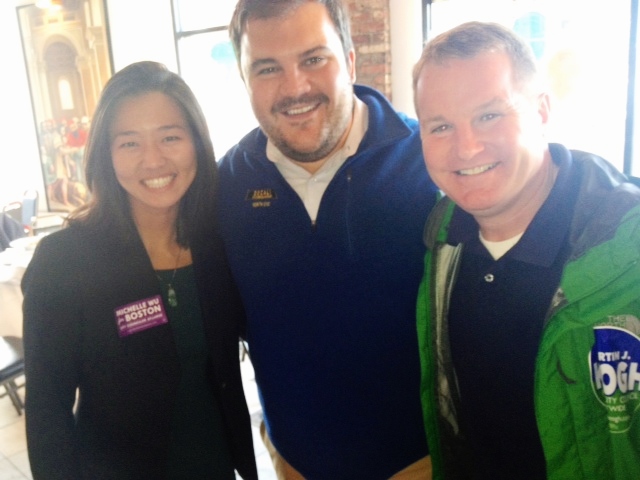
^ a Councillor, not a Don Quixote ; Michelle Wu (with Philip Frattaroli and Marty Keogh at the Frattaroli family’s post-Columbus Day Parade reception

—- —- —-

There’s much flap going around now,as silly a brouhaha as I’ve observed in this entire Boston campaign cycle, including an op-ed by my old Boston Phoenix colleague Yvonne Abraham, to the effect that Councillor-elect Michelle Wu shouldn’t vote for Bill Linehan as the new Council President.. Supposedly she should vote for a Councillor who “shares her agenda.” Today’s Globe quotes several persons, described as “progressives,’ who promise not to support Wu for re-election if she votes for Linehan. This is zealotry of the Tea Party kind, to which the Left, as we’ve seen in the past, is hardly immune. One quoted voice even says that “Unless (Wu) changes her mind…she’s a one-term city councillor.”

This is rubbish. It’s also as silly as a political kerfuffle can be. Boston’;s City Council has no power that the mayor doesn’t want it to have. It can propose, it can debate, it can re-arrange the musical chairs by which Council Committee chairmen are chosen; but it can’t do a damned thing of significant importance without the Mayor thumbing up.

Sure, individual Councillors can have an independent impact, if they’re willing to get frozen out by the Mayor. John Connolly pursued an independent course. Others have done so. But when the chips are on the table, and the Mayor’s agenda is at stake, you will no more find a majority of the 13 Councillors opposing than you’ll find a sting ray in your briefcase on Christmas eve.

So what’s the big deal here ? Let’s try a little political reality, for a change, and lose the ideological version of cgi-created film monsters.

The rule governing voting for Council President has long been : “vote for the weakest.”

In this case ( 1 ) Bill Linehan is no threat to run for Mayor against Marty Walsh ( 2 ) ramping up either Tito Jackson or Matt O’Malley to Council President — both of whom want the honorific — would be a threat and ( 3 ) ramping either man up to Council President would impede the 2017 (or 2021) mayor race plans of the REAL potential candidate of significance. (It’s Jackson’s and O’Malley’s very strength as Councillors that make them musts-to-avoid as Council President. Get my meaning ?)

Image
^ Matt O’Malley of Council District 6 : his record-breaking vote makes him unelectable as a Council President

Most important, Linehan has no base at all independent of Mayor-elect Walsh’s core support and thus has no power to oppose him on any item of import.

THAT is how Council Presidents are chosen. Stupid indeed is the newly elected Councillor who bucks that reality; and Michelle Wu is far from stupid. I applaud her acumen in this matter.

As for being re-elected, Wu’s husband notes that even if you subtract her entire vote from wards 4, 5, 11, and 19 she still won by 14,000 votes. This is an apt subtraction, because 2015 will be a Council-only election, and in these, the voters of Wards 4, 5, and 11 turn out far fewer voters than they do in a Mayoral election. Wu’s re-election will be decided in Wards 20, 18, 2, 16, and 17, and of course also in Chinatown’s Ward 3 Precinct 7. All of these feature constituencies very different from the wards identified with Tea Party Leftism or comfortable urban reform. And you know what else ? Wards 4, 5, 11, and 19 contain plenty of voters who aren’t Tea-Left. Of the 15,000 or so voters who will likely turn out in 2015 in those four wards, Wu will comfortably win at least one-third — probably more. She may slip from second to third or even fourth (though I doubt that); but re-elected she surely will be, assuming that she does the job of city-wide Councillor in painstaking daily detail. Which I have no doubt at all she will do.

— Michael Freedberg / Here and Sphere

BOSTON SCHOOLS : THE SOUND OF ONE HAND CLAPPING

photo (19)

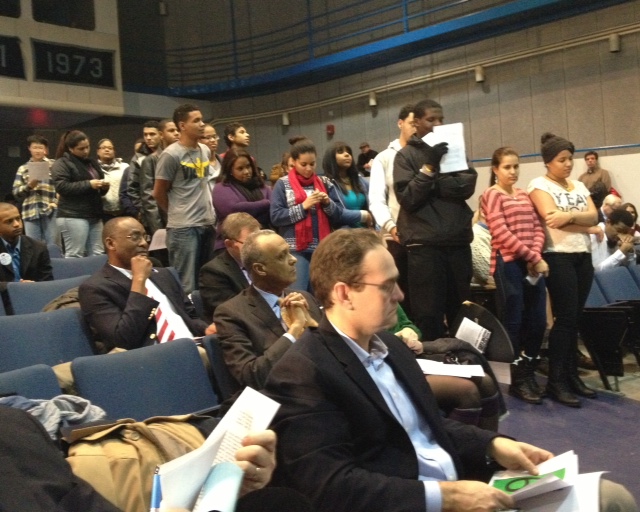
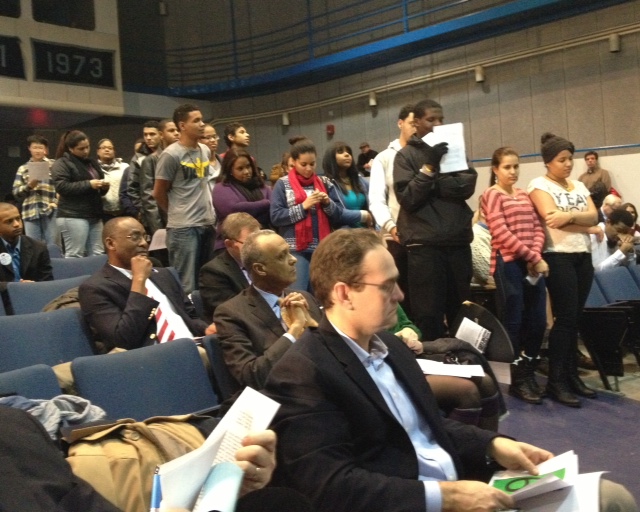
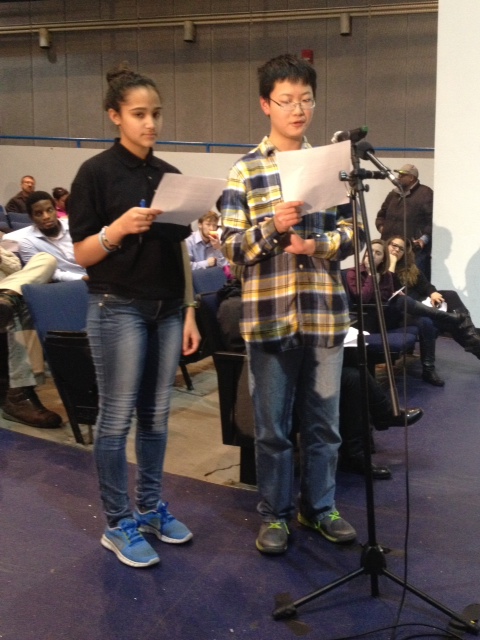
^ Boston public school students lined up to testify and support the issues on order at Mayor-elect Walsh’s education Hearing

—- —- —-

Last night Mayor-elect Walsh’s Transition team held its Education Public Hearing, at English High school in Jamaica Plain. For two hours, from 5.30 Pm to 7.30, three of Walsh’s Transition Team menbers, including his Education Team chairman, John Barros, heard testimony from at least fifty witnesses. Students, school parents, teachers, advocates all spoke.

Less people attended than came to the previous night’s education rally held by Boston Truth. There were at least a hundred vacant seats at English high’s auditorium. listening to the testimony, it was easy to tell why. With hardly any exceptions — more on these later — every witness said basically the same thing : more funding for public schools, downplay charter schools. It was the sound of one hand clapping.

photo (19)

^ plenty of vacant seats : the elephant wasn’t in the room

There isn’t much to learn from a soundless sound and hardly much more from hearing the same message repeated again and again, with only the age, gender, or skin color of the speakers differing (and these aren’t policy matters, although identity issues were raised by some of the witnesses).

photo (17)^ Boston Latin student (and Student Advisory Council President) testifying against charter schools and thus, basically, that there shouldn’t be any additional Boston Latin schools. “Making history,” wrote one activist about my post of this photo 🙂

It was especially odd — unsettling, too — to hear the students who testified. How does a 17-year old Boston Latin student — smart, yes; Chairman of the Studernt advisory Group; but — acquire an interest in curbing the number or funding of charter schools ? Did he learn his view in debate at school ? Was he coached to his position ? Quite possibly, because he read his testimony from a prepared statement. I found his testimony manipulative. Contradictory, too ; after all, Boston Latin, the City’s totally competitive exam-entry school, is the ultimate “charter” school. Was he really telling us, not that charter schools are bad, but that Boston Latin doesn’t like having its exceptionalism duplicated ?

photo (21)

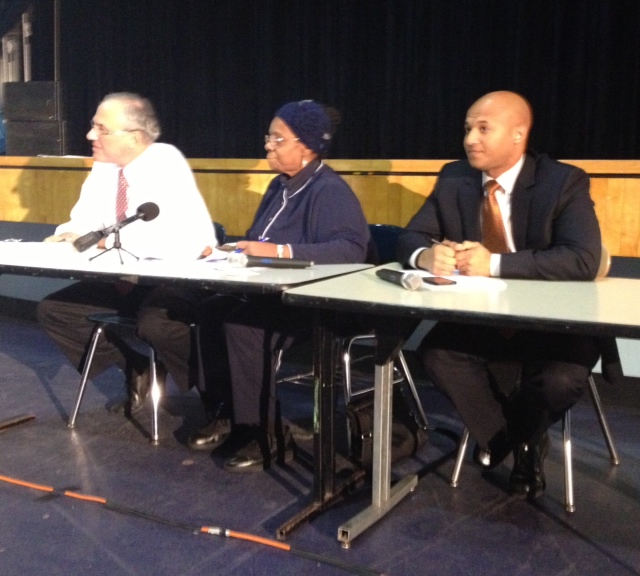
^ respectful : Education Transition team members George Perry, Jen Robinson, and John Barros (Team Chairman)

The Transition Team members, George Perry, Jen Robinson, and John Barros, listened respectfully to all. Barros, at least, knows all these issues masterfully. At numerous Mayoral Forums during his candidacy for the office he heard, and responded to, all manner of school reform agendas. Last night surely tried his patience. At times I saw a bored look in his eyes. Did he really need to hear the applause given the various witnesses — the louder, the more in agreement — by the Hearing’s audience, heavy with Boston Teachers Union members (including its President, Richard Stutman, and its organizer, Jessica Tang, who testified) and Boston Truth activists, in order to get the evening’s message ?

photo (16)

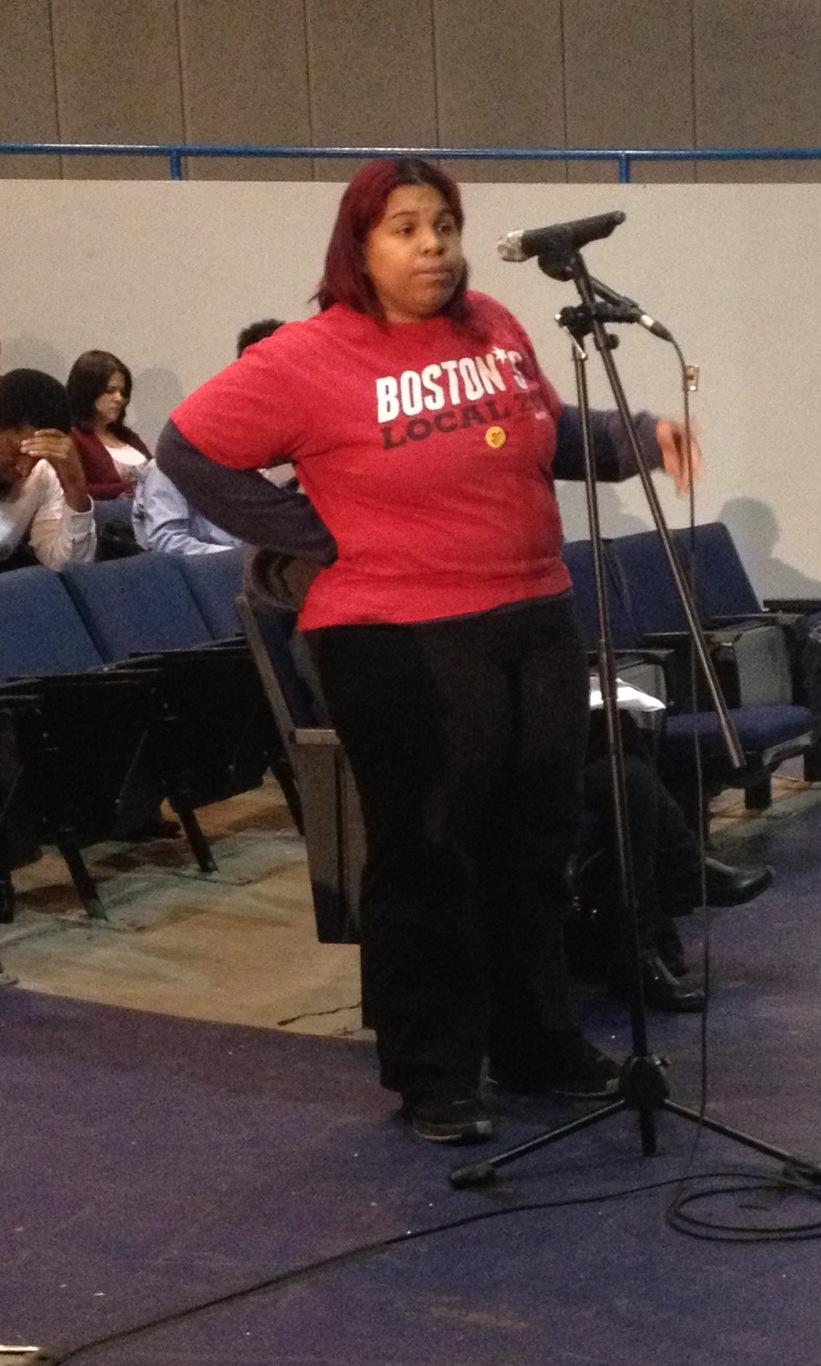
^ “I’m a Boston public school parent,” she said, and told of her difficulties getting her child properly assigned to a school convenient to her home. I wondered : Hadn’t she asked Councillor Connolly to help with that — as did so many Boston school parents ? Then I noticed her LOCAL 26 T shirt…

Fortunately for those who might have expected the incoming Mayor’s Education Team to hear a diversity of views rather than a one-hand clap, a few witnesses did offer opinions credibly their own. Jason Williams, an executive with of Stand for Children, hoped that Mayor-elect Walsh would continue his commitment to charter schools, noting that as a legislator, Walsh worked to increase their number. Applause ? None. Another witness, who said that he was a Boston Harbor captain, suggested that BPS should offer 6th grade students a course with sailing experience. Applause ? A few. Karen Kast, organizer of Boston Truth, challenged Mayor-elect Walsh to keep his campaign promises. Aplause ? plenty.

Most interestingly, Mary Pierce, who heads a special eduaction advocacy group, voiced her personal experience of frustrations dealing with Boston School Department administration. This was risky territory : reform of Boston Schools administration was a centerpiece of John Connolly’s education agenda. A door was opened — a bit; but the moment passed.

Sometimes the elephant is in the room; sometimes he is not in the room. John Connolly was the elephant not in the room. Other than Jason Williams, there likely wasn’t a single person testifying (or applauding) who on November 5th stood with Connolly’s 48.5 % of the vote.

Education became a key issue in the campaign entirely because John Connolly made it so. Most of the other candidates would gladly have left it aside — Walsh too — to be dealt with at the State House. Connolly made sure that Boston schools would be front and center — the decider — on election day. The major effort now being assembled by the Boston Teachers union and its allies, to push the schools reform agenda in its direction, would likely not be taking place had John Connolly not forced school reform sharply, radically forward.

This history makes many people wonder why the Mayor-elect even bothered to have an Education Hearing last night. As I was preparing to write this column, I found on my facebook page the following comment (excerpts follow) by friend Lisa Moellman :

“At 5:30 on a school night, just before Christmas — thry are stacked so that BTU representation/agenda dominates. picking up and feeding kids, holiday commitments prevent so many parents from participati9ng. Why would Walsh hold these important forums…at a difficult hour….? Why not the first weeks of January when actual diversity of participation could happen ?”

Why, indeed ? Myself, I think it’s public relations — Walsh’s showing the voters (and the media) that “he will listen to the people.” Nothing more, nothing less. Education is an issue that Walsh wants to put aside as much as possible ; to hand over to whichever poor sucker accepts becoming his new School superintendent, so that Marty can get on with his first priority : keeping the Boston Building boom alive and expanding, so that his building trades workers — including the many new hires that he will insist upon — can keep on earning hefty pay checks.

As for public schools and charter schools, compared to the issue debate that took place the prior evening at Boston Truth’s gathering, and much more so at every Mayoral Forum during the campaign, last night was a complete waste of auditorium heating oil.

—- Michael Freedberg / Here and Sphere
UPDATE at 3.11 PM 12/11/13 : am informed that during the 20 minutes prior to my arrival at the Hearing at 5.50 PM, other opinions, including from representatives of charter schools, were given. These sure didn’t last long. Still, it’s good to know that the Hearing wasn’t completely one thing. — MF

BOSTON POLICE PAY RAISE : THE CITY COUNCIL SETS A TRAP

Image

^ trapped — and not by a thing called love : Mayor-elect Marty Walsh

—- —- —-

At my first hearing of it, the Boston City Council’s unanimous 12-0 vote to grant a 25.4% pay raise to the Boston Police Patrolmen depressed me enormously. (The 13th vote, John Connolly, woiuld have been a No, but he is on vacation; he told the Boston Globe that he would have come back and cast his No vote if it was going to make a difference.) Why even HAVE a Council if it’s going to take a hike when the City’s funds are on the line ? 25.4% is DOUBLE the pay raise granted to almost every other of the City’s many employee unions.

Reasons for the vote were trotted out by Councillors trying not to look wind-twisted ; none makes any sense, including the Quinn Bill of 1998, by which the Patrolmen gave up certain pay raises in exchange for education-furthering bonuses. 1998 ? Really ? Come on, guys. Comic indeed was Councillor Pressley’s statement that she voted yes because she “didn’t want to begin a race to the bottom.” I don’t think it’s racing to the bottom to reject an award double that granted to other city unions. Pressley also praised “the huge sacrifices” that Patrolmen make to ensure citizen safety. Does she mean the “sacrifice” of doing public works details for which the Patrolmen get paid most generously, details that no other state requires be handled by uniformed police officers ? If you include those plum puddings, the average Boston patrolmen — as pointed out in Farah Stockman’s damning op-ed in the Boston Globe two days ago — grabs yearly pay of about $ 109,000 ! Many earn north of $ 175,000. Some scoop over $ 200,000.

These are scandalous numbers.

I am the last journalist to want public employees to earn skimp money — far from it — but Boston Police pay exceeds any argument of fairness or necessity. There has to be balance between city employees and city taxpayers — and as columnist Stockman also pointed out, most Patrolmen move out of the City as soon as their ten-year in-city obligation terminates, which means that most of them aren’t even city taxpayers — and a raise double that of other city employees is a ramp that will repercuss like crazy when the other city Unions come calling at contract renewal time.

My thinking had reached this point, when suddenly I realized that the Council had done something more portentous. They had laid a trap for the incoming Mayor, Marty Walsh. He cannot be pleased.

It is Walsh who will now have to decide how to adjust the Patrolmen’s huge pay raise to the City’s budget deficit. Walsh has said there may be layoffs. For a Union guy, that cannot be a happy message to send to his core supporters, many of whom are looking to be hired, not sent home

Next year the FireFighters of Local 718 will be coming to the table with their pay raise demand. Local 718 was the first city union to back Marty Walsh in his Mayor campaign. It was at Local 718’s request that he filed his now infamous House 2467 bill to strip City Councils of the power to review arbitrator awards — a bill that almost cost him the election. Walsh deferred whenever in the campaign he was asked about closing under-worked City fire-houses. His ducking this issue was noted by editorialists.

Walsh was already going to have a hard time negotiating Local 718’s next contract demand. By voting 12 to 0 to give a 25.5% pay raise to the patrolmen, the Council has boxed Walsh into a Local 718 corner he almost certainly cannot get free of. How can he not let Local 718 do its damnedest and thereby earn the dislike to City taxpayers ? How will he not paint himself forever as exactly “the Union guy” that people other than his core supporters saw him as ? Local 718 can, if it wants, save his ass. It will cost them pay to do it. Is that likely ?

I may of course be wrong. Walsh may find a way to wiggle free of Local 718. Even so, he cannot be happy wth the ugly leg trap that yesterday’s Council vote has placed in his path.

A foundation for the 2017 Mayor election is being laid now. Yesterday’s vote placed the cornerstone.

—- Michael Freedberg / Here and Sphere
#MAPOLI : BAKER TAKES A RIGHT TURN…AND OTHER VEERINGS

Image

the would be Governor stoops for a spot of Tea : Karyn Polito to be Charlie Baker;s running mate

—- —- —

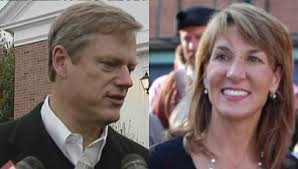
A number of high-visibility Massachusetts pols did the attention-getting unexpected today. Perhaps the biggest such event of the day, however, was not a happy move and had the feeling of a surrender  : Charlie Baker, who almost certainly will be the Republican nominee for Governor next year, anointed one Karyn Polito as his Lieutenant Governor sidekick.

Who IS Karyn Polito ? A former State Representative from Shrewsbury and the 2010 Republican candidate for Treasurer. And why her ? It is speculated that Baker chose her because ( 1 ) Baker lost women voters in the 2010 Governor election by 24 points and ( 2 ) she is popular with the Worcester County Tea folks. As I wrote three days ago, Polito recently spoke at an event on the South Shore at which the featured guest was one Allen West, a stridently contemptuous, Tea party favorite and one-term (defeated) Florida Congressman. Polito is said to have praised West in her own speech at that event. That would be reason enough to wonder why Baker would link his candidacy to Polito, who served as campaign chair for Michael Sullivan’s right-wing US Senator campaign earlier this year. Sullivan’s opposition to marriage equality (and of course to transgender civil rights) mirrored Polito’s own recent legislative record. (Baker’s campaign says tat Polito has since come around and now shares his views on social issues.)

All of this represents a huge shift for Baker, who in 2010 chose as his running mate Richard Tisei, an openly gay State Senator who vigorously supports lifestyle civil rights — indeed, he was the original legaislative sponsor of the transgender rights bill that was enacted as law last year. As it happens, Polito, too, has made her own huge shift. During the Romney years she was — like almost all Massachusetts Republicans — strongly pro-choice and supportive of marriage equality. Of course we all know what Mitt Romney did in the years since he left he Massachusetts governorship. Polito has simply followed his example, bowing her reformist record to the voices who want to repeal all reform.

Such is the politician whom Baker has chosen as his symbol this campaign cycle : a gravatar of reaction, a face of opposition to nearly everything the GOP has stood for in Massachusetts since it was founded. Well might I call the Baker-Polito ticket “anti-Republican.”

Baker had other options. He could have chosen State Representative Geoff Diehl, a social progressive who spearheads the “Tank the Gas Tax” movement. He might have gone really bold and picked Pamela Julian, leader of the League of Women Voters and a force in Boston. Elizabeth Childs of Brookline was a possibility. I would have preferred any of these.

Will this ticket likely succeed with Massachusetts voters ? As hardly anybody votes for a Lieutenant Governor, in the end it probably won’t matter to anyone who isn’t a political junkie. But it should. A successful candidacy gives the angry anti’s of the Tea party a credibility that right now they thankfully lack.

Connolly w Chin

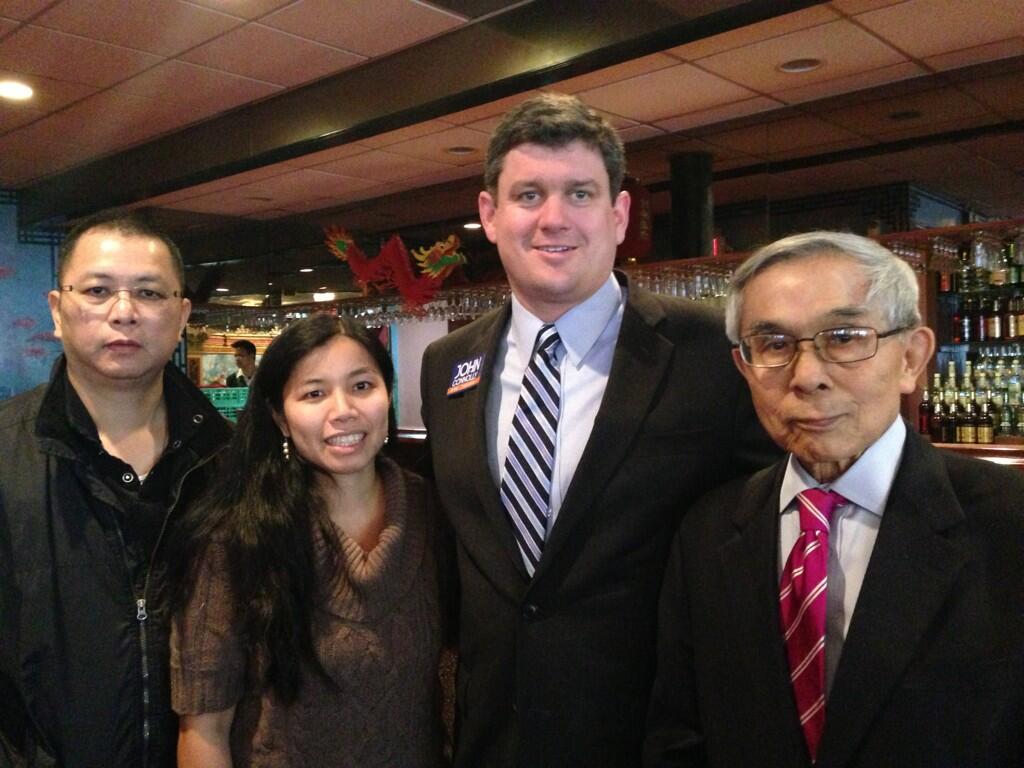
^ John Connolly as WHAT ? Mayor Walsh’s new school superintendent ? Not damn likely

No sooner had I digested this swig of political castor oil than news came that, in an interview by radio host Jim Braude, Mayor-elect Marty Walsh said that he “absolutely do(es) not rule out asking John Connolly to be his new superintendent of schools.”

WTF ? Immediately came the waves of outcry from the teachers union activists, the Diane Ravitch groupies, and the opponents of charter schools and US Secretary of Education Arne Duncan. That was to be expected. But I too, a supporter of Connolly and his “school transformation” vision, found the suggestion a red herring — or maybe a sly nick. Connolly is screwed by this knee-chop remark no matter how he responds — IF he does respond. His best response being to not respond at all. Clearly John Connolly has a ton of career options better than the tainted biscuit that Walsh so suavely served up.

Whoever agrees to be Mayor Walsh’s superintendant of schools is bound to disappoint almost everyone : school parents wanting big reform, the Teachers Union opposing every reform except its own politically unlikely agenda, the administrators, principals, kids — you name it. Boston’s public schools need significant reconfiguration; almost any new superintendent won’t be able to get it done. Why should John Connolly descend into that vortex ?

photo (5)

^ Guess who is heading to Israel as a guest of the ADL ? Yup, Council Felix G. Arroyo.

No sooner had I digested the Connolly suggestion than Councillor Felix G. Arroyo announced that he is visiting Israel next week as a guest of the Anti-Defamation League. This surprised me. Most politicians allied with the Labor Left — and Arroyo is definitely there — are supporters of the Palestinians, not the ADL. So what is up ? Politicians make trips to Israel when they have high officer in mind. Might Felix G. Arroyo be thinking of running for Lieutenant Governor ? It would make sense. He would enhance the Democratic ticket no matter which of the four likely hopefuls becomes the nominee. He’d be an inspired choice. Is Arroyo on it ?

—- Michael Freedberg / Here and Sphere
NOTE : this is article was updated December 5, 2013 at 8:00 am.

THE MAYORALTY OF MARTY WALSH : THE WEAKNESS COMES HOME TO ROOST

Michael Curry NAACP

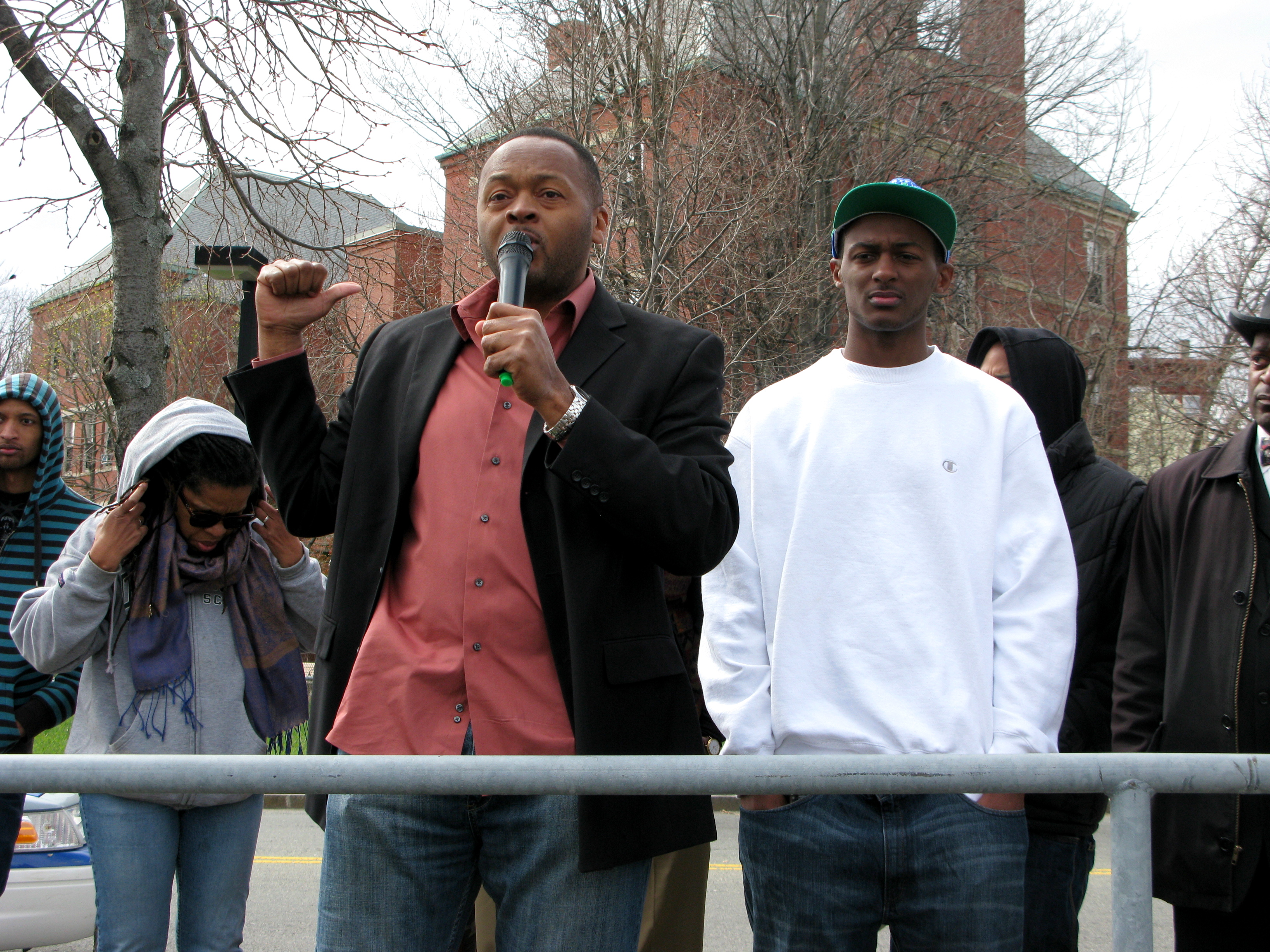
^ “access, opportunity and results” : Michael Curry of the Boston NAACP and son at a rally recently

—- —- —-

In Friday’s Boston Globe appeared an article by Akilah Johnson in which was made clear that incoming mayor Marty Walsh will be monitored on his response to diversity issues and held accountable for his actions. Wrote Johnson in the article :

The group, calling itself The Inclusive Boston Alliance, is developing a score card to scrutinize the creation and implementation of education, public safety, employment, and economic development policies. The group plans to conduct status checks after the first 100 days of Walsh’s administration and again at the six-month, one-year, two-year, and four-year marks.

Access, opportunity, and results have to be the building blocks of the Walsh administration,” said Michael Curry, president of the Boston Branch NAACP, one of the organizations involved in the alliance. “That’s what communities of color voted for.”

The alliance, which plans to formally announce its intentions Friday, includes the Urban League of Eastern Massachusetts, the Commonwealth Compact at the University of Massachusetts Boston, and MassVOTE. These and several other community and civil rights groups came together during the campaign and held two debates focused on issues affecting communities of color.

In no way can any of this be a surprise to Walsh. He actively sought votes from Boston’s communities of color. The vote that they provided him tallied more than his own Primary vote. As I wrote immediately after the Primary and before it : one of the odd features of this election was that whoever won, a big majority of his vote would come from people who didn’t want him. It proved so. Now we see what the consequences are. The new Mayor either adopts as a priority the demands of those who voted for him as skeptics rather than supporters, or he is in trouble right away.

It would have been no different had John Connolly won. Except for one thing : Connolly was a much stronger candidate, politically, than Walsh. As Paul McMorrow has astutely pointed out, Connolly defeated Walsh in 95 of Boston’s 137 Caucasian-majority precincts. Connolly didn’t need to win any of the 118 COC-majority precincts; he only needed to break even, or to lose them slightly. Walsh needed to win these 118 precincts by 15 points. (He won all but 11, most of them by 20 to 25 points).

The numbers prove it. In the Final, Walsh carried 49 selected precincts (in Wards 8, 9, 11, 12, 13, 14, m15, 17, and 18) by 5687 votes : almost 800 more votes than his city-wide win margin. In the Primary, Walsh won those same 49 precincts by a mere 110 votes. Between September 24 and November 5, Walsh’s Black community endorsers alone (I leave out precincts where Felix G. Arroyo was strong; his situation is different; see my Note below) brought Walsh an additional 5577 votes : again, about 700 more than his Final election win margin. Walsh has been called a “bridge Mayor” — bridge between the Menino years and a Mayor of color. The numbers and the politics of Connolly voters make a strong case for that assessment.

Connolly would have had much more liberty to negotiate the monitoring groups agenda than has Walsh. It is not clear to me that this calculation played a role in the endorsements that John Barros, Charlotte Golar-Richie, Gloria Fox, Russell Holmes, and most other politicians of color accorded Marty Walsh. But it would surprise me if (1) the political advantage offered them by Walsh’s vote weakness didn’t occur pretty soon after the endorsements were given and (2) the advantage didn’t occur right away to many of these endorsers’ advisors.

And another thing : make no mistake. Boston’s communities of color want a Mayor who “looks like them,’ as the campaign’s mantra often put it,  as soon as they can elect one. A Mayor Connolly would have been very hard to beat: because it is not at all clear that Marty Walsh’s Caucasian vote base would vote by 15 to 20 points for a candidate of color as readily as the precincts of color voted for Walsh. Whereas John Connolly’s voters are much more open to such a candidate and have always been. Can anyone doubt that had Walsh faced Charlotte Golar-Richie, she would have beaten Marty in almost every Ward carried by Connolly ?

Mayor Walsh will be much easier to defeat, than would have Connolly, if not in 2017 then definitely in 2021. I think that both parts of his coalition know this very well indeed. I think he knows it, too. He is moving all the chess pieces right now to make himself trusted as well as accepted, and nobody in Boston politics is better able to get there. But can he ? It will be interesting to see how Walsh’s political vulnerability plays out at the tables of power where Boston’s — and his — political future is decided.

—- Michael Freedberg / Here and Sphere
NOTE : I have left out Felix G. Arroyo frrom my analysis for three reasons : ( 1 ) he is Hispanic, not Black, and has a significantly smaller vote base than Charlotte Golar-Richie had ( 2 ) his endorsement was, I feel, given entirely sincerely on the issues and not in any way out of real-politik calculation and ( 3 ) if he is to win a fight to be Mayor he will have to break free of the coalition that he whole-heartedly embraced this time around. It won’t be easy, but Arroyo has tgime on his side. He’s only 34 years old !

ANNALS OF THE ECONOMY : MY FRIEND WALTER MICHALIK ASKED ME A QUESTION …

Image

^ Walt Michalik of Roslindale : a question that went right to the heart of economic matters

—- —- —

Last night, at Hyde Park Main Streets’s tribute to City Councillor Rob Consalvo — retiring after 12 years service — I ran into an old friend, Walt Michalik, who lives in Roslindale and supported me the one time that I put aside political work for others to become a candidate myself. That was 1986. I had known Walt, and, very early on, as I visited “people of influence” in my “Rozzie” neighborhood seeking support, before I actually made a decision to run, I knocked on his door. (He was, in fact, my first such visit.) Walt was a Democratic activist. He knew that I was a Republican. So he asked me : “what is your opinion of the prevailing wage law ?”

For those who don’t know, the Prevailing Wage law, also known as the Pacheco Law, requires that on all State-funded contracts, the contractor pay his workers, whether they are union members or not, the same hourly amount that prevails in union-labor contracts. It wasn’t a law that I had thought much about and wasn’t something that I had planned to base my candidacy upon. So I didn’t answer Walter right away. But I knew a lot of ironworkers well, and I knew that they spent their big paychecks and thus brought a lot of prosperity to a lot of businesses. So an answer came to me :

“You know what, Walter ? I don’t see how taking money out of the pockets of workers helps the economy.”

Walter shook my hand, a handshake of solidarity.

Well, that was then. A generation has passed; and the answer that I came up with that afternoon opened the door for me to understanding how a democratic economy works — and should work ; it begins with the customer.

1.The less customers a business has, the less it prospers.

2.The less that a person earns (or receives by way of public assistance if that he needs), the less of a customer he can be.

3.An economic policy that impedes worthwhile money from accruing to most people defeats itself.  This axiom is one big reason why I support the welcoming immigration policy that until the past 90 years or so was America’s boon. Every immigrant is a potential customer and this grows the economy. This same axiom is why I support Massachusetts’s impending minimum wage hike. The more that workers earn, the more they can spend.

Quite frankly, the above is my ENTIRE economic policy. All else is commentary and implementation.

One hears the political Right talk about businesses being “job creators.” But businesses CANNOT create ANY jobs unless there are customers for its products or services. The more customers, the more jobs. Angel investors for start-up businesses want to know, first of all, who and how large will be the “market” — i.e., the customers — for that start-up’s offerings. No “angel investor” I have ever presented to requires the business plan to pay workers so little that they need public assistance to make ends met. Just the opposite ; angel investors want the start-up’s workers paid enough that they will stay, not leave, and thus (1) see the venture through to success and (2) avoid the huge costs, in money and time, of hiring and training replacements. I also know no “angel” investor who doesn’t want a start-up’s workers to not have paid sick time. Angel investors know that life is hard enough; a start-up shouldn’t make things harder for its workers than they already are.

Just who, then, does the political right speak for as it pursues “job creator” corporate tax breaks and opposes both workers’ wage hikes and the social safety net ? It doesn’t speak for workers, obviously, and it doesn’t speak for venture capitalists or the management of smart businesses. So who then ?

Speculators figure prominently among those who push this destructive agenda. Stock market funds often push publicly owned companies to cut back everything and anything in search of maximum immediate buy and sell gains. For the sake of purely paper windfalls these money poolers would trouble every other interest in our society. Unhappily, these money pools have drawn to them more and more money that, instead of investing in economic innovation, which bears vast risk and takes long time to accrue, seek sharp-fingered quickie hits; arbitrage — the most economically useless item in the entire money picture.

Even the money-lender has his place in an economy. Yes, he seeks interest on his money and does no work to earn it other than to have it to lend. But the money lender knows that if the borrower doesn’t prosper, he won’t get paid back. Yes, the lender may, if not paid back, claim the borrower’s assets as security; but no money lender wants those assets; he wants his interest and he wants his principal repaid.

For the stock trader, however — the arbitrageur — it;s just the opposoite,. He DOEs wnat that asset. He buys it at current value and dumps it at whatever higher value he can squeeze out of it by whatever means and as soon as possible, even if it means destroying the business and laying off its workers. This is what Bain Capital did, famously, during Mitt Romney’s partnership there and was a major reason why his candidacy for senator in 1994 earned the enmity of a majority of voters.

Not all stock buyers and hedge funders pursue a strategy of profit by desruction. Many investors buy in or the long term — and the huge success of a long term investment, wisely chosen, says all that needs be said : look at Warren Buffett, who has become a multi- billionaire by buying and holding, forever it seems, well chosen businesses whose management he supports and whose growth — in the classic economic manner I have outlined — he encourages. But for every dollar invested with the Warren Buffett sort of investor, 1000 dollars are invested these days with swift destroyers.

It is difficult to conceive legislation that will curb the economics of profit through destruction, that will not also limit the free movement of capital to positive purposes. But we are not helpless as a society to limit the impact of arbitrage money. We can impose a strong societal disapproval upon those who would profit by hurting all who stand in profit’s way. We can continue to angel-fund innovation businesses and support their entrepreneurs — and approve them socially too, social approval being one of a society’s strongest ways of policing good works and bads. At the same time, we can make it quite clear that he who would take money out of the pockets of workers lies beyond the pale of approval.

You don’t have to be a Wal-mart. You can be a Costco. It is an outrage that we allow low-wage employers to leave their staff no choice but to need taxpayer dollars in order to make ends meet. It’s also a no-growth policy, maybe even a recession policy. It is stupid. And immoral.

So how do we fight this stupidity ? Simple. It really does start with the question that Walt Michalik asked of me on a February afternoon 27 years ago.

—- Michael Freedberg / Here and Sphere
 

THE MAYORALTY OF MARTY WALSH : A LETTER FROM MEL KING

photo (7)

^ Mel King : says that his endorsement was prompted by the “young adults” of Right to the City,” whom he “encouraged to do this analysis” of “its questionnaire to both candidates.”

—- —- —-

A letter from Mel King in today’s Boston Globe prompts me to write a column about Marty Walsh’s impending Mayoralty that I was already thinking about. In his letter, King — the Grand Old man of street-theater activism, decades before Occupy — says :

“A group called Right To the City, composed of various organizations working on access to affordable housing, good jobs, quality education, and sustainable community development, seeks to enable a cross section of racial, ethic, and income groups to remain and participate in all aspects of Boston.’

The letter continues : “The group’s members, a new rainbow coalition, are in the forefront of such issues as foreclosure blockades to protect people’s homes, stopping no-fault tenant evictions, and fighting alongside unions for construction jobs.”

This letter fascinates me. It raises all sorts of questions :

1.The second quote sums up the organization City Life/Vida Urbana, of which Steve Meacham, a man very close to both Felix Arroyo’s, is the justly respected spokesperson. Vida Urbana does all but one (that, see below) of the things cited in that quote. Yet in the Primary, when it most mattered, King did not back Felix G. Arroyo. He was closest to Charles Clemons, a man of almost Republican economic views, and to Clemons’s major supporters — all of whom ended up supporting John Connolly.

2.The first quote mentions affordable housing initiatives as one of Right To the City’s priorities. Did King not know — does he not YET know ? — that one of John Connolly’s primary endorsers, State Representative Jay Livingstone, filed and shepherded a $ 1.4 billion affordable housing bond bill that Governor Patrick signed into law just last week ? Later in his letter King says that “the group felt that Walsh was more responsive to its concerns.” Not true of the affordable housing issue.

3.King then says, “Having encouraged these young adults to do this analysis, I joined with them.” King then talks about watching Walsh, at several rallies : “I saw evidence of ways Walsh’s campaign included people.” True enough; but did King not manage to see a few of John Connolly’s rallies ? If not, why not ? It would be fascinating to know what inclusion King did NOT see at the Connolly rallies.

These questions merit answering. Can I start with the one thing, in King’s quote, that City Life does NOT do :  “…fighting alongside unions for construction jobs” ?

These seven words express the reason why King finally joined a group comprised chiefly of Felix G. Arroyo people, to endorse a man about whom this most original of Boston citizens had nothing original to say…

Construction jobs and unions were Walsh’s cliche. The Construction Chief’s campaign piled forty stories of Mayor-initiative atop that cliche, space well built and beautifully appointed by 600 architects of policy hired for the job. The cliche is what King clings to.

Time is coming soon now when that policy building will have to be built. Will it be ? CAN it be ?

Walsh is hemmed in by his union support even more than he is empowered by it. If he favors his unions supporters too obviously, he will hand a perfect “See ? we told you so” issue to a 2017 opponent. If he cracks at the next City union contract crunch time… or, if he pushes back against the City unions, as he did against the school bus drivers… If he proceeds with the infamous House Bill 2467…or if that bill is never heard from again : whichever way Walsh chooses, either the opposition will gain or his supporters will complain. Which is it to be ?

Implementing even a fraction of the 40 policy initiatives that his campaign crafted and published will require intricate management. Compromise and collaboration won’t suffice. Every one of Walsh’s policy proposals shifts the job descriptions of those who will have to carry them out. City employees, like union workers, resist work rule changes. gho will assure that the city employees tasked to carry out Walsh’s initiatives will comply ? Will feel enthusiastic about it ?

Enter, perhaps, some of those business, university, and Union partnerships that Walsh talked of during the campaign.

And then comes the Boston Public Schools, which, according to State evaluation, appear able to educate properly barely half their students.

Easier for Walsh will be what he is already masterful at, with long partnerships in place : continuing the Boston building boom. And ramping it up. The Building trades people and the developers who accord them a living can expect to work the BRA a lot more invitingly than they did under Mayor Menino. City hall plaza — a good idea, if rather impracticable — and hotels galore, new school buildings, Downtown Crossing, Dudley Square, Jackson Square — and more. The next few years will surely be a field day for Boston construction. Probably, also, for workers from the City’s communities of color, whose entry into the Building trades Walsh has long sought, with less success than he would like.

This is one deal that Walsh can definitely close.

It seems, however, that Walsh and his team want to say and do everything they can to distract the voters’ attention from this deal. The Walsh Mayoralty, in their talk and print, puts on an ear-ful of masquerade. Is there a reason why the Walsh team so gilds their developer-deal lily ? Certainly it’s not that building trades jobs are a bad thing. They’re very much a good thing. Then what IS it that they are cos-playing about ? Do I sense a price tag dressed in domino in the background ? (Yes, I am thinking Venice here — an echo only, since we won’t be getting a Venetian casino, sigh.) Perhaps when we find out who the “One Boston PAC” is — the half-million bucks that Joce Hutt is harlequin-ing for — we’ll find out who is carnivalling in Walsh’s political pasquinade.

—- Michael Freedberg / Here and Sphere
A NIGHT OF DEFEAT : THE CHARLOTTE GOLAR RICHIE TALK

Image

^ Charlotte Golar-Richie gives a talk : ‘all the isms are alive and well…racism, sexism…”

—- —- —-

The Mayor of Boston campaign of 2013 may be over, but evidently it’s not over. Last night Charlotte Golar-Richie, who finished third in the September Primary, was the key speaker at a conference hosted by University of Massachusetts’s Center for Women in Politics and Public Policy.

NOTE : If there were any doubt about the institutional colossi that encumber Boston politics, the very length of that host name — “University of Massachusetts Center for Women in Politics and Public Policy” — should set our heads nodding, But I digresss…

The topic for discussion was “Opening Doors : Women’s Political Leadership in Boston.” It seems a timely topic, given the prominence of several women in elected office within the City. One thinks of State Senators Sonia Chang-Diaz and Linda Dorcena-Forry (and of former State Senator Marian Walsh), of Councillors Ayanna Pressley and (newly) Michelle Wu, of State Representatives Gloria Fox and Liz Malia. One might also think of Abby Browne and Marian Ego, school committee members back in the day, and even of Elvira “Pixie” Palladino and Louise Day Hicks longer ago — but Palladino and Hicks were severely incorrect politically and thus not “women’ despite being women; and one could even mention the late, fishwife-mouthed Katherine Craven, a City Councillor, and State Representative Katherine Kane (who died about two weeks ago), both women in politics long before there needed be an educational institution hosting said discussion.

One could have mentioned all of the above; and mentioned the significant involvement of women in Boston politics well before that, from Abolitionist champions to Progressive era women of conscience to civil rights and civic leaders like Susan Story Lyman, Melnea Cass, Stella Trafford, Alice Hennessey, and my own mother. Mentioning all of these, one wonders what sort of “doors” still need to be “opened.’ Are they not already wide wide beckoning ? But no. Evidently the failure of one woman candidate to become Mayor of Boston trumps all of the successes that women in politics have had, are having, and, likely, will have in Boston.

In any case, the night being given over to defeat, it was quite appropriate for Charlotte Golar-Richie to trumpet the notes of defeat’s song :

“The isms are still alive and well in Boston…racism, sexism…along with that misogyny thing.’
“For women the stakes are high. Women of color, the stakes are higher.”

To which lament many Forum pundits added their oboe and bassoon :

Priti Rao : “I think there’s a lot of voter fatigue in this state.’
Joyce Ferriabough Bolling : “Charlotte lost because her base did not come out.”
Paul Watanabe ; “Globe’s editorial op-ed was devastating.”
The entire discussion panel : “EMILY’s list failed her.”

Golar-Richie then summed up this Sonata of Defeat by saying that she “opened the doors, someone else will have to walk through.”

As you have doubtless surmised, I shrug both my shoulders at Golar-Richie’s speech. Not once did she allow that perhaps she was not exactly an authoritative candidate. Not once did she acknowledge that in a field of twelve, whence eleven candidates ended up losing, she was hardly alone in being among the eleven. Why was Golar-Richie entitled — I use the verb on purpose — to a better result than the other ten losers ? Were John Barros, Dan Conley, Mike Ross, and Felix G. Arroyo not equally worthy candidates  ? Not to mention John Connolly.

Fact is that, in the 17,000-odd Forums that i attended at which Golar-Richie spoke, I found her performance wildly uneven ; strong one day, out of focus the next; vague sometimes, insightful at others. There was no such vaguery about Mike Ross, john Connolly, John Barros, Dan Conley, Marty Walsh, and even Charles Yancey and Rob Consalvo.

But in assessing Golar-Richie as a candidate there is no need to measure her performance at Forums. When her crunch time truly came, after the primary, and she had to decide, quickly, whether to endorse John Connolly or Marty Walsh, she flubbed the role. She delayed her decision, hemmed and hawed; when after some days she finally endorsed Marty Walsh, all of her support group went the other way, to John Connolly. Compare her handling to the focus and unity that Arroyo and Barros brought to their Walsh endorsements..

So, to respond to Charlotte : no, I do NOT think that “all the isms are in place.” Nor do I think that the bar is doubly high for women of color. Tell me how Michelle Wu’s finishing second out of eight, for City Council, on her first run ever for public office, demonstrates either of Golar-Richie’s assertions. Golar-Richie is simply WRONG. She did not fail to become Boston’s Mayor because she is a woman. She failed because she wasn’t a strong enough candidate.

And finally, Golar-Richie’s assertion that she lost because “all the isms are alive and well in Boston” disrespects Marty Walsh. Did he beat Golar-Richie because he is male, or because he simply had a stronger base of votes, as a sitting state representative and respected union leader ? Golar-Richie’s suggestion tells me what she really thinks of Walsh. It’s not pretty.

—- Michael Freedberg / Here and Sphere