CRIME : THE MURDER OF AMY LORD

Image

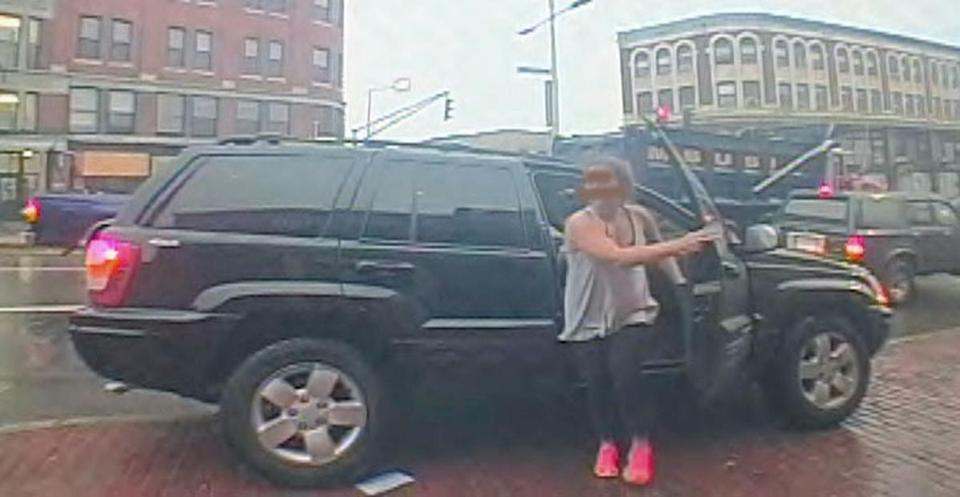
^ surveillance photo at Upham’s Corner, Dorchester, showing Amy Lord, in gym clothes, getting out of passenger side of her Jeep to withdraw money at ATM per her kidnapper’s orders.

Just when we in Boston have had about all that we can stand of murder most foul, of murder trials, of murder testimony and murder graphics, our city has awoken to the happening of yet another murder — one more than foul; a murder beyond explication. Amy E. Lord, a 24-year old gal living in South Boston — reputedly one of our safest neighborhoods — was, it appears, kidnapped by two men (the police think it was two — but see update at the end of this report), forced to withdraw her money at ATM’s, then stabbed to death and her corpse dumped in scruffy woods several miles away, in Boston’s Hyde Park section.

Lord grew up in Wilbraham, a flat-land suburb bordering Springfield, a once-booming, former mill city 100 miles west. She had moved to the “big city” — for Boston is that, to kids living in our state’s back areas — to make her way in the world; and was, it seems, doing so, as a web designer; not spectacularly but in an ordinary, tech-savvy, 21st century way. “If you had a daughter, you would want her to be like Amy,” her grandfather Donald Lord is quoted as saying. A great many daughters are, indeed, like Amy must have been. That is what most unsettles us. Murder beyond foul is not supposed to happen to daughters like Amy Lord.

Her killer or killers did not stand outside a seedy dive in Boston’s Theater district looking for streetwalkers to hijack — some killers do do that. The killer(s) did not break into a millionairess’s loft in the tony Back Bay, looking for jewels and riches — some killers do that, too. Nor were they, it seems, sexual predators on a rape spree — that, too, more than once happens, depressingly. These killers weren’t terrorists, or athletes night-shifting as gang-bangers, or big name mobsters — all of which are on trial, or soon to be on trial, right now in our city, living through our time as America’s Grand Central station of high-profile murder. Amy Lord was none of this. Nor were her killers. They, appear to have been as ordinary as she. This is what unsettles us most.

They (or he) wanted money, ordinary money; probably for drugs — an ordinary craving. They found an ordinary girl, forgetting, or not giving a damn, that ordinary people, too, have families and friends who care about them. People in crisis, like streetwalkers, have advocates. Millionairesses have big money lawyers and influential relatives. Attack a streetwalker or a millionairess, and you will face heavy, institutional retribution. This is known. But attack an ordinary person ? Who is there to defend her but her ordinary family ?

So might think the killing mind, if it thinks at all when kidnapping, robbery and murder pushes it to act.

They kidnapped her at an ordinary time — 56AM — when many tech-ies are already awake and up, getting ready for work, which in many tech companies begins at 7 AM. They robbed her by ATM machines — as routine as money gets.

The robbing of ATM kiosks was over at 6,47, the BPMDtells us. 47 minutes. Not much longer than savoring a latte at Starbucks.

Everything about the murder of Amy Lord ws ordinary, as ordinary as life is good, which it ordinarily is, for most of us, even though it has its stressful stretches — and these stressful times are ordinary too. But that murder should be an ordinary part of an ordinary life, that is the shocking thing, the inexplicable, the frightful. It is not merely hyperbole to say that Amy Lord is us. She WAS us. Her murder murders a part of us too.

Let us grieve….

—- Michael Freedberg / Here and Sphere

UPDATE at 12.45 PM : Police have now concluded that it was only ONE man who kidnapped, robbed, and killed Amy Lord, and that he beat her seriously inside her apartment building before ordering her into her Jeep — which he hijacked — to withdraw money.


UPDATE # 2 :  Boston Police still are not ready to make an arrest, even though they have a suspect in custody in another South Boston mugging that occurred the same morning. It is thought that said suspect is involved in the Amy Lord murder.  This morning the suspect, one Edwin Alemany, age 28, was found mentally incapable of attending an arraignment. He is now at Bridgewater State Hospital for the Criminally Insane, undergoing the standard 21-day psychiatric evaluation.   (This update at 8.40 P,M. 07/25/13)

BLUES TALK : JOHN TEJADA @ ARC NIGHT CLUB 07.12.13

Image

When this writer arrived at Arc, a new room for Boston house music, at about 12.15 AM, John Tejada was already hard at it. Working his own mix board, rich with shape-shifting knobs and beat-breaking buttons, Tejada put the bluest house music this writer has heard recently into talk and walk shape. Blues is a music of talk and walk — of move and monologue — and in house music there are plenty of move and monologue tracks. Tejada dropped a couple of those — glitch vocal tool ins — but his talk works sounded most prickly and seductive when he made instrumentals do the talking.

Born in Vienna, Austria, to an Austrian, orcherstra-conducting Dad and a Mexican Mom, Tejada, who will be forty years old next year, has been workling his uniquely bluesy sound for almost fifteen years — but rareky in boton. His last vist that we know of happened four yrears ago. The rarity of his performing in Boston assured a full dance floor at Arc, and full it was, and entirely committed to Tejada’s mix work. Guys danced to the front; cameras flashed on all sides; and on and on Tejada moved his music, never coasting, not taking a bathroom break (something no DJ should ever have to do in a two hour set), no acceding to a fan greeting. (Why fans feel they have the OK to interrupt DJs, this writer will never understand. People at a rock or jazz concert wouldn’t think to come up on stage like that.) With Tejada, fans evidently felt they owed him the space not to play “hey good-buddy ! hi-ya !” with. He was able thus to concentrate all attention upon forty or so mix board edit buttons of which he made constant use.

He describes his sound as techno — but of the Detroit, not the German version. Detroit, at Arc, it was ; a sound almost entirely blues based from which ticklish, twisty, wire-thin strands of upper register noise arose, seductive to the body as to one’s ear. His sound had family resemblance to that of Carl Craig : choppy but soulful, airy as well as blues. Tejada, however, dropped a sound much more walk and talk than Craig’s glide and sublime.

Playing his best-liked “Elsewhere,’ “Somewhere,’ and “Here” — the titles felt appropriate to the sonic displacements Tejada made — as well as “Wanna,” “Seven X Seven” and several others similar, Tejada played stomp and tickle, rumble and fumble; and his fans loved every move.

There was, however, less dancing than appreciating. Most of the approximately 225 fans stood to watch Tejada do his mixes and to snap photos of it. This was not a mistake. Tejada played the mix board as if it were a piano. Almost every knob and button made its mark, as Tejada jumped from track to track and shattered, repeated, stuttered, undertoned, fade-knobbed, flatted and sharped his sound. He kept his head down, his hands on the music, making it a throat, lips, and belly of burp, squeak, and irresistibly lush blues walk-offs.

Curiously, Tejada’s set ended not at Arc’s closing time but at 1.25 A.M. he was followed by Matt Mcneil, a local DJ who dropped a plush, loud, embracing sound. Mcneil has the deep house chops needed to take over from a headline master, and he did not lose Tejada’s ground. This writer will be very disappointed if Mcneil does not get invited, and soon, to open at Bijou, Boston’s most important house music venue, and, quickly thereafter, to headline.

— Deedee Freedberg / Feeling the Music

BOSTON MAYOR RACE : IF MONEY MAKES A WINNER, THEN THE WINNER IS .

Image

Dan Conley tops the $$$ race (photo courtesy wbur.org)

Money isn’t everything in politics, but it is how everything becomes ….a thing. The thing that money most helps become is a voter base — of committed votes. With twelve (12) candidates on the September 24th Primary ballot, a shockingly small voter base can choose the two Mayoral finalists. As few as 20,000 votes — little more than five percent of all Boston voters — might get a candidate onto the November ballot.  Add the votes going to his or her opponent, and you end up with a mere 45,000 voters choosing the final two. That’s barely 12 percent  of all registered Boston voters.

But it is what it is. Quite a few of the twelve candidates have enough political sock to tally 20,000 votes. So money will make the difference in who actually does it. Money buys campaign literature, campaign advertising, lawn signs, campaign staff. It allows a campaign to make its newspaper, interest group, and union endorsements known — and unless publicized, they don’t count for much. It buys an election-day street-level operation : poll checkers, door knockers, telephone callers, telephone banks, coffee trucks for poll workers, precinct captains, secure phone lines, lists of who needs a ride (with phone numbers and addresses), precinct maps,  ID’d voter lists. Money generates “good morning voter’ doorknob cards that we used to deliver to doors, like newsboys, at 4 AM in the morning. assuming that four or five candidates have a fairly equal ID’d vote, money gives him or her who has it a strong advantage in getting those ID’d voters actually to the polls.

So who has the big bucks ? Now, at the start of July, with less than three months to go ?

Here’s the cash on hand list as of the most recent OCPF report :

Dan Conley — over 1,250,000
John R Connolly — about 675,000
Mike Ross — 500,000
Marty Walsh — about 400,000
Rob Consalvo — about 225,000
Bill Walczak — about 125,000
Felix Arroyo — also about 125,000
John Barros — about 85,000
Charlotte Golar Richie — 50,000
Charles Yancey — about 45,000

The other two candidates, David Wyatt and Charles Clemons, reported no cash on hand.
Image

John R Connolly — strong second in the money campaign (photo : courtesy wbur.org)

The list contains several surprises. We did not expect that Charlotte Golar-Richie, the only woman in the field and boasting of wide support beyond her home Dorchester turf, would figure so low on the list. Nor did we expect Bill Walczak, who has never run for city office, would top two city councillors AND Golar-Richie. And who could have foretold that Dan Conley would have almost double the cash on hand of his nearest competitor, or that he would top the entire list ?

Given that Conley has also put forth the completest policy agenda — and a progressive one at that — and that he will be in office, as Suffolk County District attorney even if he loses, and so should be able to raise money and volunteers aplenty, one has to conclude that he will make the November ballot. In this regard, it was instructive to see Conley’s poll worker operation on US Senate election day, June 25th. In wards 18 and 20, which will likely combine to deliver a full 25 percent of the September vote, he had by far the completest poll worker showing. Conley means business.

So the question remains : who will Conley’s November opponent be ? The money fact gives us scant clues. Though Mike Ross and Bill Walczak have raised much, they lack a definable voter base. As for the others, John Connolly, Rob Consalvo, Marty Walsh, and Felix Arroyo all have defined voter bases and sufficient cash to maximize their base voters’ turnout. Charlotte Golar-Richie should have the same prospect; but her lack of funds, at this late stage, sends a very negative message, both to prospective donors and to voters as yet undecided. With City Councillor Charles Yancey also on the ballot drawing votes from Golar-Richie’s likely base, her prospects look poor.

Image

Marty Walsh : likely to gain (photo courtesy : charlestownbriodge.com)

Two candidates seem poised to benefit most from Golar-Richie’s decline : Marty Walsh, the strongest Dorchester candidate, and Felix Arroyo, who needs to win convincingly among Boston’s voters of color if he is to beat Marty Walsh to the November ballot.

Image

Felix Arroyo : also likely to gain strength

—- Michael Freedberg / Here and Sphere


BOSTON MAYOR RACE : THE 2ND MONTH STARTS

Boston Mayor 2013 – candidates of color

Whether 15 candidates qualify for the Primary ballot or some number less, it looks as though there’ll be far too many aspirants presenting themselves to Boston voters for anyone but political junkies to even know all the names, much less what they’re about.

Meanwhile, the primary vote, which will eliminate all but two candidates, takes place less than four months from now. This puts a premium on long connection; and long connection favors the most stable city communites. Hello, East Boston, much of Charlestown, Southie, South Dorchester; upper Roxbury, Readville, Fairmount Hill,Moss Hill,  White City, West Roxbury, Roslindale, Brighton; see ya, Allston, Fenway, Back bay, downtown, the South End, Mission Hill, north Dorchester (Blue Hill Avenue), Mattapan, and much of Jamaica Plain.

To put it on political junkie terms, Hello wards 1, half of Ward 2, 6,7, 12, 16, 18, 19, 22, and 20; see ya, most of Wards 3 and 5 and almost all of Wards 4, 8, 9, 10, 13, 14, 15, and 21.

Given the huge field, those candidates who can add any significant bloc to his or her long connected base has a huge leg up in this situation. It can be a geographic bloc, an interest group — labor union, especially — or an “issues constituency.” So far, Dan Conley — presently Suffolk County District attorney — leads the issues campaign with two strong agenda points: gun control ordinances and a citywide casino vote. Meanwhile State Rep Martin J. Walsh and Councillors John R Connolly, Rob Consalvo, and Felix G Arroyo seem to be harvesting voters blocs outside their respective “base.” Arroyo has strong union support; Martin Walsh, the backing of progressive Jamaica Plain state Rep. Liz Malia; John Connolly, dots of strength all over the city. Rob Consalvo, an opening to East Boston, partly resulting from Dan Conley’s rejection of an East Boston-only casino vote.

As for Charlotte Golar Richie, currently an official in Governor Patrick’s administration, she has garnered significant bloc support outside her own base and also demonstrated an effective street-level campaign by collecting some 8,100 nomination signatures.

None of the above successes by these contenders should surprise. Conley, Consalvo, Connolly, Arroyo, Walsh, and Richie are the obvious leaders of the pack. Campaigns often reveal the “obvious leaders” to not be as leading as the common wisdom expected; in this election, the common wisdom so far has it right.

What of the other names that will surely be on the ballot ? Who is going to be voting for Bill Walczak, John F. Barros, John G. Laing, David G. Portnoy, Charles L. Clemons — and City Councillor Charles Yancey, if he runs ? And how about City Councillor Mike Ross, who by all measures looks less vote-getting than the six “majors” ? It’s hard to say what they will do, but one factor we know : all come from the 70% of the ciy that is “new Boston.” None of these other candidates, except possibly Bill Walczak, who is well known in the stretch of Dorchester between the Polish-American Club on Boston street and Codman Square — is likely to draw even a soupcon number of votes from the “traditional” candidates Walsh, Connolly, Conley, and Consalvo. To the extent that these “extra six” (or seven) candidates hurt anyone, it will be Arroyo and Richie.

Turnout will be a factor. With so many mayor hopefuls joined by a large crowd of candidates or city council, it would surprise few if 40% to 50% of Boston voters — say 125,000 to 160,000 — show up at the polls in September.

Supporters — including this writer — of “new Boston” finally having its turn to elect a mayor may not like this prospect. Not to worry: in recent years, turnout among people of color has risen sharply, in some cases surpassing the turnout percentage of “traditional” voters. There seems scant reason for a “new Boston’ candidate to feel bearish about who will vote in September. The major hurdle will be to convince “new Boston” voters that a “new Boston’ candidate can actually win . Candidates perceived as winnable generate much larger voter participation than candidates sen as losing.

So, can a “new Boston” hopeful win ? Yes, most definitely so.  Clearly Arroyo or Golar Richie have all that it takes to win the entire prize.

The only way that neither Arroyo and Richie get into the “final,’ as this writer sees it, is if they divide the “new’ vote fairly evenly while one or more of the “traditionals” generate a large voter turn out from their bases.

This outcome could happen. For example, there’s no candidate from South Boston. No region of the city turns out voters as numerously as Wards 6 and 7. Trust me: 8,000 votes in the “primary” from South Boston would surprise no one. If a “traditional” can dominate these 8,000 votes — nobody expects a “new Boston” candidate to do that — added to his base, he will surely win the “primary” and gather strong further support for the “final.”

It is THAT prospect that Walsh, Connolly, and Conley, especially, as Irish-name candidates, are now fighting for. It is why on April 30th, when Southie participated in electing a new State Senator for the First Suffolk District, Dan Conley spent the day greeting voters at Southie polling places. South Boston will get plenty of candidate attention during this next month.

But so will Mission Hill, the South End, Back Bay, and the new Downtown, Navy yard, and Seaport.  A gold mine number of voters — at least 40,000 total, in wards 2, 3, 4, 5, 6, and 9 — resides here, many of them high income, highly educated — exactly the sort of motivated and progressive voters that any “new Boston’ candidate shares political DNA with. All that’;s needed is for “hew Boston” candidates and “new Boston” voters to find each other.

That is what the month of June will surely be about in the heart of our City.

After that, the campaign changes. It spreads out, putting a premium on large organizational effort. Many Boston people go to Cape Cod for the summer or on every summer weekend. Candidates will almost certainly be seen meeting and greeting at Falmouth happy hours, Hyannis lawn parties, and Dennis clam shacks. Sign holders will line the Sagamore and Bourne bridges and the sides of routes 28 and 6. Meanwhile, other volunteers will be canvassing stay-at-homes in the more voter- accessible neighborhoods, shaking hands at senior citizen centers, greeting revelers at outdoor festivals, and phone-banking the less accessible. Campaigns’ social media overseers will be working overtime. Here too, chance favors the “major” candidates. “Their” voters are used to seeing mayors and mayor hopefuls all the time and know who is who and who isn’t.

Enormously so. But that’s for July and August. Meanwhile there’s June, a month of campaigning everywhere inside the Boston city limits during which a last pre-primary effort will be made to reach out and touch voters not yet committed to, or even focused on, any candidate. Expect agenda announcements galore and the beginning of what will eventually be an avalanche of “key’ endorsements.

———- Michael Freedberg, “Here and Sphere”

BOSTON MAYOR RACE : THE FIRST MONTH

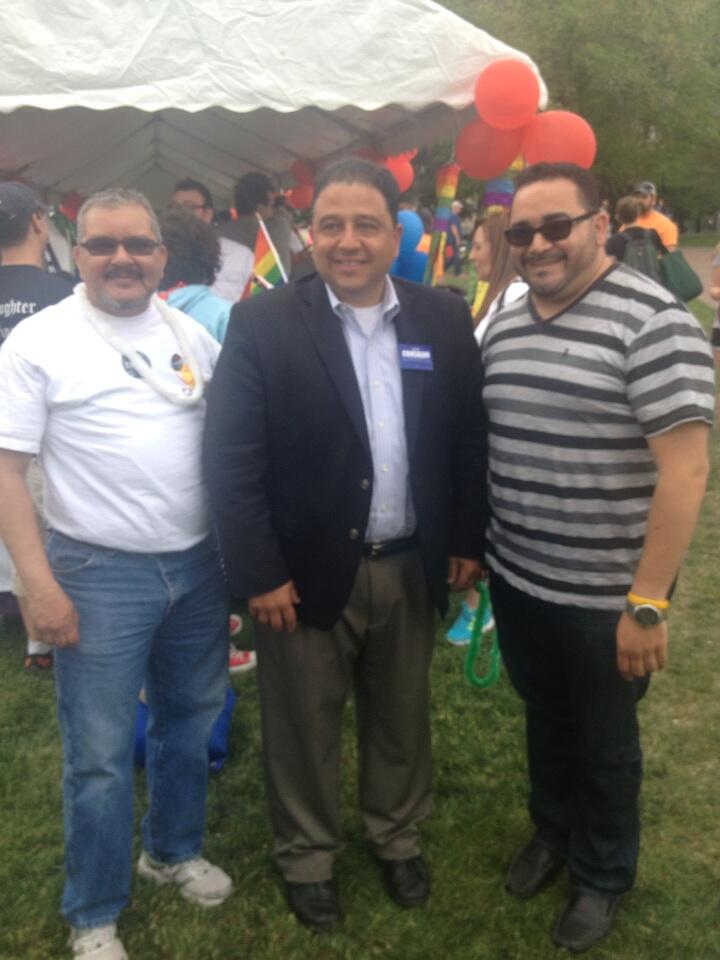
Mayor connections : Hyde Park’s Rob Consalvo at BAGLY (Boston Area Gay & Lesbian Youth) event

Mayor Tom Menino’s more or less last minute announcement that he would not be running for re-election set of what has turned out to be a mad scramble, by a hurrying multitude, to get to the “final” in which only two will face off. To date there are twenty-four (24 !) candidates signed up, making 1967’s eight look sparse. Could 24 people actually all have a chance to get past the September primary ? The answer is yes, for most: because in a four and a half month campaign, anyone can shape up. Usually a run for an office as powerful as Boston Mayor begins well in advance — at least a year before, maybe two. Indeed, as any veteran campaigner in Boston knows, your whole life — maybe also those of your parents and grandparents — goes into making you strong on vote day. Still, all that life history of connections and re-connections needs to be organized and called upon. That this year a candidate will get only 20-odd weeks, no matter who he or she is, grievously levels the odds.

Some things remain the same, however. Candidates holding current office already have made their connections and reconnectiions. They are combat ready. The first battle is to collect 3,000 certifiable nomination signatures. Large organization in place makes it easier to collect at least 3,000 signatures — and to submit them first, because if a voter signs more than one Mayoral nomination paper — and many do — only the first submitted counts. Consider also this : for 24 candidates to qualify for the ballot, at least 72,000 signatures will need to count. that is fully 20% plus of ALL Boston voters. The City has probably never seen such a huge street-level effort.

Probably half the 24 will actually make it onto the ballot. So what comes next ? Already the major eight or so candidates are running all over the city; marching parades, meeting and greeting at eateries, shaking hands at festivals and crowd gatherings, congratulating park League sports teams; holding coffee parties in neighborhoods; advancing an agenda. But does any of this even matter on vote day ? Not many voters give their vote, in a multi-candidate field, to a candidate they happen to meet once, or even twice. Likely they have already known at least one of the “major 8” already and have interacted with him or her. It is difficult for another candidate to overtop a voter’s long experience of another candidate. Truly, in local politics, it’s an axiom that the longer that one has known a candidate, the more likely he or she is to vote for that candidate.

The force of this axiom is likely why the “major 8′ are spending so much time right now acmpaigning to communitiues of voters — LGBT and allies, Haitians, Cape Verdeans, Asians, “new Boston — who for the most part do NOT have long connection with Boston politics. If the long-connected voters — the “traditional” voters of Wards 6, 7, 16, 19, 20, and half of 18; and the “new Boston” voters of Wards 4, 5, 8, 9, 10, 11, and 21 — are pretty much already “in the bag” for one or another of the “majors,” then it makes sense for them to seek out whatever they can bag up from the less connected communities.

Less connected voters also means “issues” voters. Voters who may not be able to say to a “major”, “geez, I knew your Daddy back in the West End — great guy,” for example, can judge that candidate’s stand on the issues. Thus the rolling out of agendas, that we have already seen from the canniest candidates: Dan Conley (gun control; citywide casino referendum), Felix Arroyo (labor rights), and Marty Walsh (education).

Canny candidates have also sought, smartly, to demonstrate that however they may be “based” in a long-connected community, they have the respect and support of leaders of the less connected. thus Charlotte Golar Richie, African-American of Dorchester, parades endorsements by State Reps. Michael Moran of Ward 22 and Aaron Michlewitz of Wards 3 and 8, and the Callahan Brothers of Ward 2. Likewise Marty Walsh, Irish-American from Ward 16, has the support of openly gay State Rep. Liz Malia of Jamaica Plain. City Councillor John R Connolly, too, strongly based in ward 20, has a house-sign campaign going on all over the city. Almost certainly the other “majors” will, if they can, announce similar cross-community support.

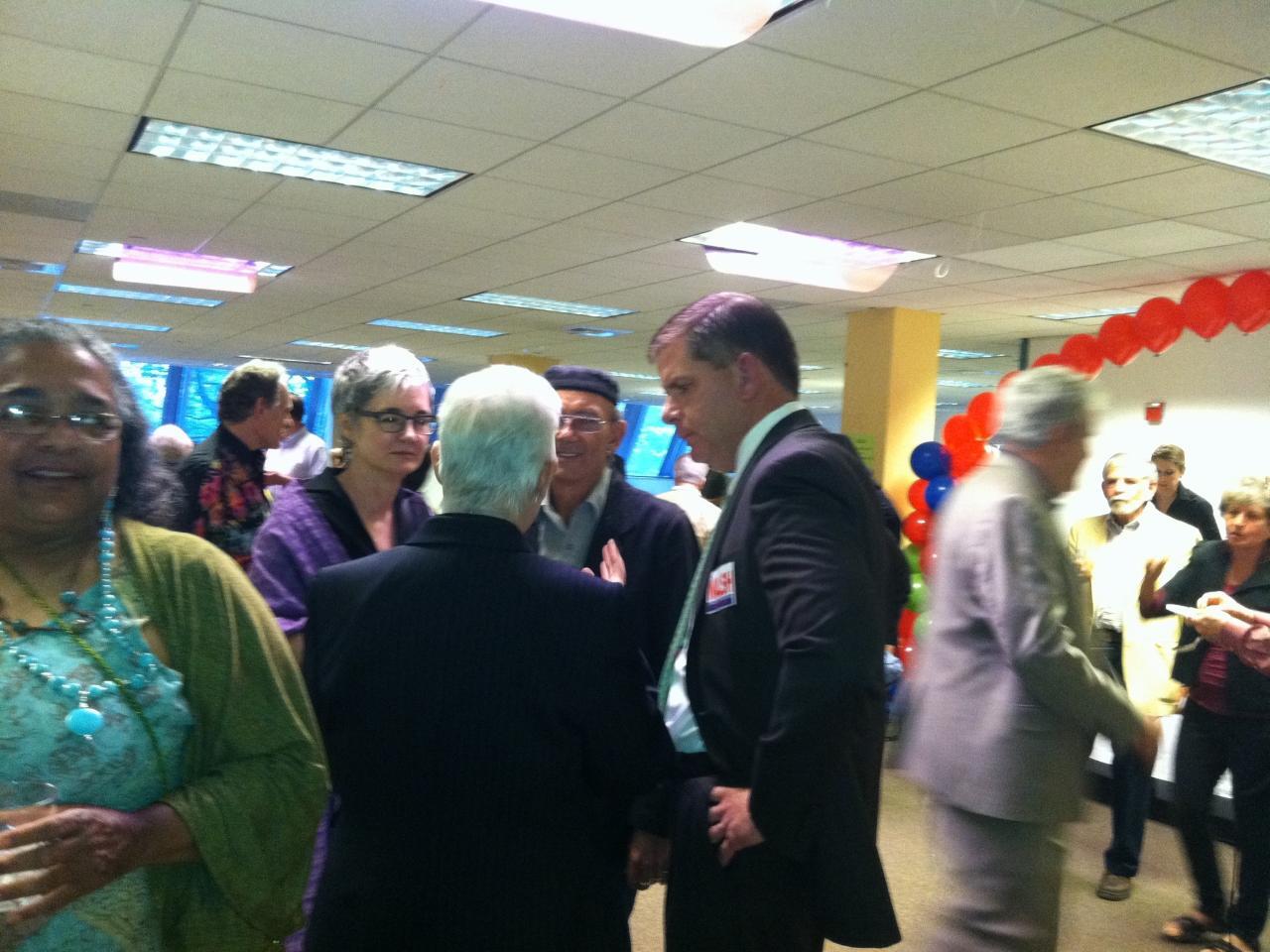
Ward 16’s Marty Walsh greeting City Life / Viuda Urbana supporters at the SEIU Hall.

This, then, is the exciting phase of the Boston mayor campaign. watching the city’s long-connected candidates dig deeply into its less-connected communities enhances the city’s togetherness and makes everyone feel that he or she counts in the halls of power. It is “retail politics” at its truest. It’s also a campaign phase that didn’t exist until Ray Flynn made it happen in 1983, as a South Boston guy campaigning among Jamaica Plain lefties. Before Flynn, Boston mayor races were combats of the powerful versus the powerful — the less so didn’t matter much and were, in fact, often pushed out of the city entirely by “urban renewal.” And Flynn himself had already worked with Jamaica Plain activists on Logan Airport issues, specifically approach run overflights of residential areas. This year, the “majors’ are seeking out the less connected voters no matter what, for their own sakes. This year, the less connected are being welcomed into the halls of city power.

—- Michael Freedberg / Here and Sphere