MAGOV14 : POLITO, KERRIGAN DEBATE IS ALL ABOUT WORCESTER

photo (17)

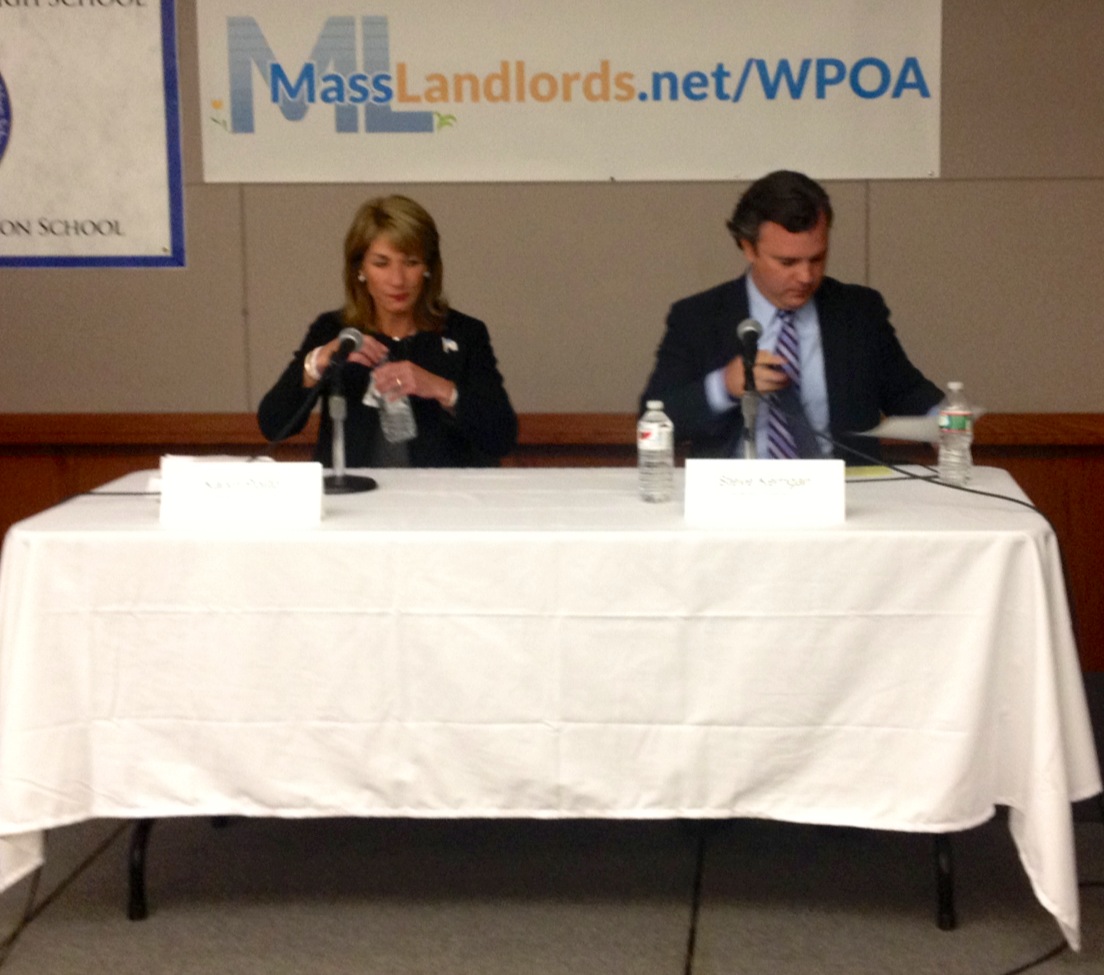
^ Karyn Polito and Steve Kerrigan give all their Worcester-ness to their home region at their Worcester debate

—- —- —-

Last night, at Worcester Technical High School overlooking Lake Quinsigamond, the two candidates for Lieutenant Governor — Karyn Polito and Steve Kerrigan — debated for an hour.

The two may be running state-wide, but almost all of last night’s debate was about Worcester. Both Polito and Kerrigan hail from Worcester County — Polito was a five-term State representative from next-door Shrewsbury; Steve Kerrigan has been a selectman for many years in nearby Lancaster . The debate was moderated by a past mayor of the city, Ray Mariano; and many of the questions Mariano asked were Worcester-specific.

Often I felt like I was watching a debate between two candidates for a Worcester seat in the state senate.

That said, Polito commanded almost from beginning to end.

The first debate job of a Lieutenant governor candidate is to argue for his or her running mate’s plans. Polito did her work of discussing Charlie Baker’s plans — including economic development plans for Worcester — much more thoroughly than Kerrigan on behalf of Martha Coakley. Often, in his answers, Kerrigan didn’t mention Coakley at all. Polito failed to talk of Baker only once.

Polito had apter answers than Kerrigan to moderator Mariano’s specific questions, many of which were Worcester-specific or upside down. Asked by Mariano, “”what policy advanced by the other candidate would you adopt ?” Polito lauded Coakley’s plans to address violence agianst women. Kerrigan lauded nothing of Baker’s. It seemed an ungenerous moment.

On the other hand, Kerrigan agreed with many of Polito’s economic development responses and, generally, made an affable presence and gentlemanly, even if most of his answers came across conversational rather than authoritative.

Kerrigan’s strongest moment — certainly his most specific — was an attack on Baker’s record of fiscal management when he oversaw the “Big Dig”: twenty years ago for the Weld administration. Polito deftly countered by saying ‘we’re not running for twenty years ago, this campaign is about tomorrow.

Polito’s weakest moment was her answer to a question about welfare eform. She discussed welfare fraud but seemed not to grasp that almost all of it results not from recipients’ scheming but from incompetent management of the agency that oversees ‘transitional assistance.” But the baker plan for welfare reform really let her no choice. Welfare is the issue addressed leat convincingly by Baker.

Polito’s strongest answer was given to Mariano’s question, ‘why do we need a lieutenant governor ?” Kerrigan fumbled to respond — to a question he jokingly said he gets asked all the time. Polito pointed out that she and Baker are a team and have been one for almost a year, whereas the Democratic pair came together only by the result of that party’s primary. that Baker and Polito are a team has always been a major advantage to the Baker campaign; often there have been Democratic governors and lieutenant governors who, thrown together by primary voters, didn’t see eye to eye, and, in a few cases, hated each other. Kerrigan and coakley seem to be workling well enough together, but it’s as yet unproven. Whereas Polito made clear that the state might even benefit from having a lieutenant governor trusted enough by the goverbor to be a partner in the work of reform.

But all of the above took a back seat to praise for Worcester and even for its poiticians. it sounded odd to my Boston-based ears to hear both candidates laud former Mayor Tim Murray, who to say the least crashed and burned on the big stage and decided to resign his office. In Worcester, however, he’s a hometown hero.

The Commonwealth’s second city defends its own as it seeks to be noticed, even attended to, by the bigwigs in Boston.

—- Mike Freedberg / Here and Sphere

MAGOV14 : DID LAST NIGHT’S WBZ DEBATE MATTER AT ALL ?

1 Baker and Coakley 1

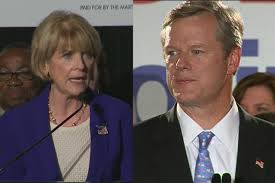
Last night’s big governor debate, sponsored by WBZ-TV, occupied an odd space in this intensifying campaign. The momentous events of the campaign are taking place elsewhere ; the movement of most unions to Coakley, the now infamous Children’s Defense Fund PAC ad, the attention being paid by Baker to Springfield, the gender gap, on both sides, between the two candidates. These are the actions now driving voters’ decisions – and believe me, they are deciding. Tons of twitters followers for Baker — fewer for Coakley — have risen seemingly from nowhere : ordinary voters, not political insiders. Nor is twitter, of course, the only arena of decision or even the biggest.

So ; did anything at all happen in the WBZ debate to match any of the above ? Perhaps. Baker’s twitter following grew significantly; Coakley’s too. The debate moved some voters from undecided to decided, or from decided to committed.

Personally,l found the debate quite boring. Baker often delved into administrative details, as if he were presenting to a policy seminar. Coakley said very little that was specific — she never does — but said it in a conversational voice, a fireside chat manner less formal than the wonk-y Baker, who lacked his trademark smile and showed almost none of what opponents call “Charming Charlie.” If only Steve Grossman had been on that stage, to deliver his articulate, masterful policy points in a voice passionate and fun ! He is very much missed.

Baker had the better night. It was classy o him — and smart — to say to Coakley that ‘no one is challenging your record as a child advocate across a long and distinguished career in public service.” I can’t recall ever seeing a candidate give such a kudo to an opponent on a debate stage : and if after the very mistaken Children’s Defense Fund ad a kudo was needed, it was not a given that Baker would say it. But he did.

Baker also laid out his basic theme — transforming the often inefficient, even incompetent management of state administration — with full authority. (As he always does.) He discussed the particulars of the Springfield economy, including siting of its casino, with Grossman-like thoroughness. The Springfield theme has come to the fore in Baker’s campaign for two reasons ; on the small scale, it’s usually a 20-point loss for a Republican candidate : Baker hopes to get close, maybe win the city. Just as significantly “Springfield” is the symbol of how Baker addresses one of this year’s major governor issues : raising up the economies of the estate’s cities outside the Boston economy boom.

Coakley offered no equivalent. I’m not sure she grasps the significance of Baker’s Springfield theme.

Coakley offered few specific points but doesn’t really need any. She is a Democrat and a woman.

She spent much time addressing herself not to Baker buy to Evan Falchuk, an “independent” who stood immediately to her left (the candidates being lined up alphabetically). Granted that Evan Falchuk had much to say that was critical of both the major candidates — and of state government. I think dhe did this in order to deflect attention from Baker and give it to Falchuk, the independent. If so, it was a smart move : “independents” comprise 52% of Massachusetts voters and will be the overwhelming majority of Baker’s vote if he wins.

But Baker made the strongest, directest, and, as I see it, most convincing statement about independence : that much of the failure on Beacon Hill is attributable to having only one party, the Democrats, in charge of every branch. There has been much to criticize about state administration during Deval Patrick’s second term, and much to correct as it has taken place; yet neither the criticism nor much correction have happened because it’s in no Democrat’s interest to go that route (although Steve Grossman went that route at many pre-Primary Forums).

Baker is on solid ground here. Massachusetts voters usually prefer to elect non-Democrats as governor in order to keep a watchdog eye on one-party rule. The state has worked well thereby, not so well under the popular but sometimes ineffectual Patrick.

On that point alone, Baker won the debate. That’s what happens when you make a key governance point that everyone agrees is true. Coakley made no such point, but she too had her victory, because she is, yes, a woman in a state that has yet to elect a woman governor.

And both candidates won by not being Scott Lively. His bigotry, stupidity, and just plain gutter venom made everyone else on stage look ten times nobler. hHw the other candidates could stand on that stage and not vomit in Lively’s face, I do not know. I applaud their self-control. I could not have managed it.

—- Mike Freedberg / Here and Sphere

MAGOV14 : COAKLEY SEEKS LINEUP, BAKER HITS HOME RUNS

photo (11)

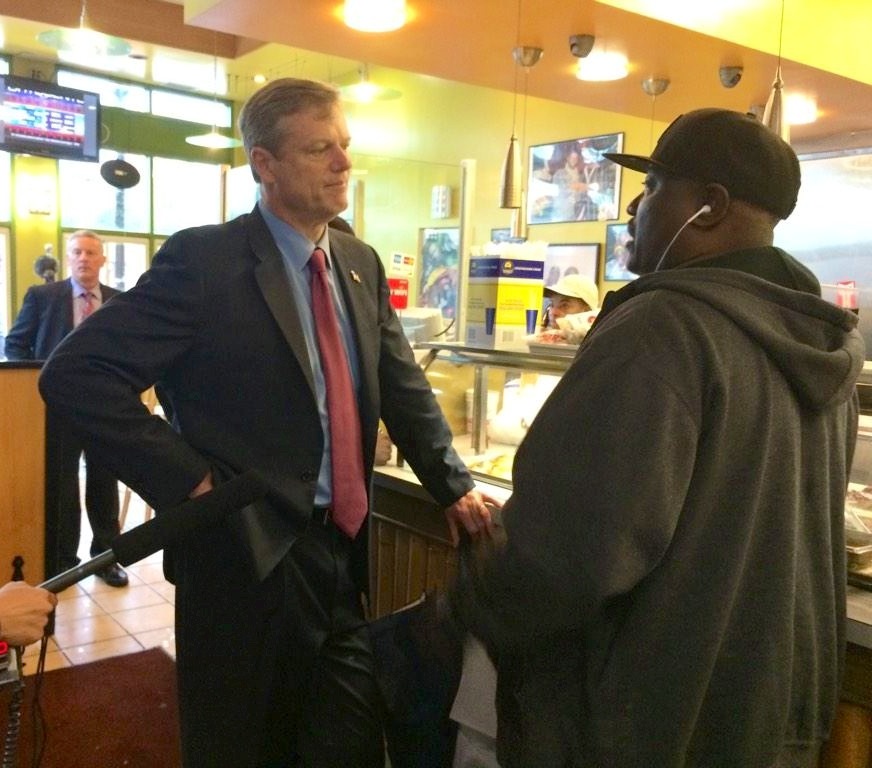
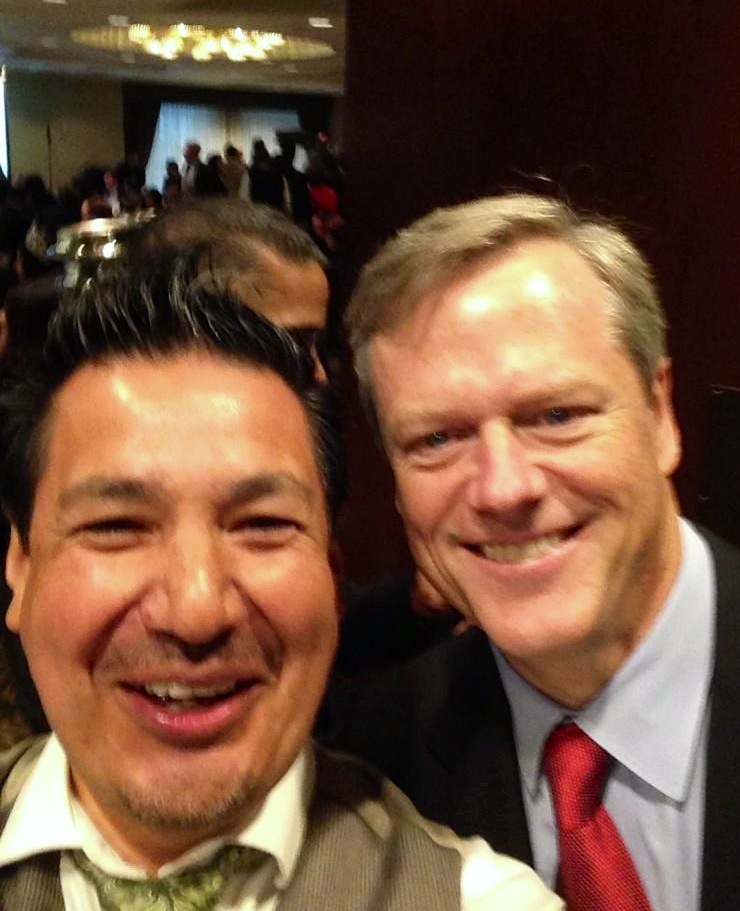
^ Charlie Baker with Emcee Baltazar at El Mundo’s 5th Annual hispanic Heritage Breakfast in boton last week

—- —- —-

It isn’t over yet, not by a long shot. Polls have Charlie Baker up by one to three points. My snse is that he’s ahead by more. But I also sense that his amrgin is peaking. Martha Coakley, buoyed by Michelle Obama’s visit, Baker’s Paid Sick Leave misfire, and by the overreaching PAC ad about her fighting the Children’s Defense Fund, has a campaign now, and it’s beginning to show.

Helping her as well is that the campaign has fully dived into mudpie mode. Demagogic, misreading, even palpably false ads are being dumped into the campaign by outside interest groups — do these folks have nothing better to offer than slime and scurrility ? — and one thing you can count that such ads will do ; make the opposition angry, driving up turnout and arousing passion among supporters of the person attacked.

Beyond their stink, the mudpie ads hurt Baker more than they damage Coakley. Until they appeared, Coakley had no campaign, almost no issues; nobody but her (very few) supporters wanted any part of her side. that has changed. The charges against her have given people a reason to come aboard and help. Even a blah candidate becomes sympathetic when unfairly ambushed.

That said, it’s very late in the election for Coakley to rev things up sufficiently to catch Baker, whose campaign has moved right along doing what it has been doing, targeting city voters and communities of color with a message optimistic, reformist, inclusive and — most o the time — all in on the social basics almost all of us subscribe to. It’s a plus to be so aggressively positove. Voters want to know (1) what you stand for and (20 how passionately committed you are to it. they also want to know that your commitkehts are, for the most patm theirs as well.

Charlue baker has done all that and continues to do it. his campaign is moving fast. In Boston, he continues to knock and expand the knocking. He’s busy on the North Shore, in the Framingham to Waltham corridor and — the real surprise, perhaps — in Springfield. That’s a lot to cover — and his running mate Karyn Polito is working just as hard in Worcester and in the Italian-voting regions north of boston Harbor — but, because Baker began the effort long ago, as of now he is revisiting places already visited. that’s what you want to be able to do once the election reaches its last month. it’s way too late to depend upon first-visit outreach.

On a first visit, a candidate is usually received politely; the voters are in meeting-you mode. For most, it’s the repeat visit that wins a vote. baker and Polito are making many re-visits in places where it counts. They will keep on doing it.

Meanwhile, Martha Coakley finds herself still in the foundation stage. All summer long she had to fight off a superior, but much less well known, Steve Grossman, and she did so not by taking the bold initiative but by playing the caution card. at orums she said as little as possible. She won her primary — narrowly, only because more articulate and bold Grossman lacked her universal name recognition — without rising to any occasion but itself.

Now she has to live with the consequneces pf her caution decisilon : at a time when she needs to be sewing up votes, she is having to do the introduction visits that Baker did months ago.

Coakley also lacks a coherent message. there is no drama in her campaign except what was given to it by the twisted Children’s Fund ad and bhy Michelle Obama’s visit. Baker’s campaign has a very coherent message — unleashing the power of small business and ramping up school performance to grow the economy — and the drama in his campaign arises from him alone. it is not imported.

Baker won’t win in a landslide; there are many issues on which his position is less cogent than Coakley’s — think labor matters especially, but also immigration receptivity. But if Baker continues moving at the relentless steady speed he now commands, Coakley will find herself a week or two behind him. This is not a recipe for victory.

and what is her campaign message ? It used to be “defending women’s health care rights” and was very clear nad understood by the voters,. But Baker has made it just as clear that he is all-in on women’s health care issues too. Baker has had some success with women voters thios past month, and quite a bit of “yes” from LGBT voters as well, as it has become clear that LGBT issues are personally important to him and not just a policy matter. Right now I do not see how Coakley beats Baker to the ten or so percent of voters who remain undecided.

She had better find lightning in a debate bottle. Either that, or mistakes by Baker — and he has made a few. All yrear long I have seen no lightning from Coakley. Legalese, yes. Light, not so much. The voters know the difference. It’s Baker’s election to lose.

—- Mike Freedberg / here and Sphere

MAGOV14 : COAKLEY Vs. THE CHILDREN’S DEFENSE FUND

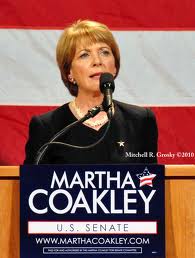
1 Martha Coakley at rally

^ handed a campaign thanks in part to pressure group misreads : Martha Coakley

—- —- —-

An issue that is no issue — except in a way that wasn’t mentioned — has now become an issue thanks to a misconceived and quite erroneous ad dropped into the governor race by an outside interest group.

The ad claims that Martha Coakley, as our state’s attorney general, somehow “failed to protect children” by oppoing the Children’s Defense Fund, which sued the state to bring about major upgrades in how DCF (Department of Families and Children) operates. This claim is nonsense. As the state’s lawyer, Coakley had a duty to oppose the suit. She did so.

The ad seems to suggest that the failures at DCF — grievous ones though they be — are somehow to be attributed to Coakley because, by winning that lawsuit, she assured that no changes would be made. This too is nonsense. The Governor’s office oversees state agencies. Failures at DCF go on the record of Governor Patrick. If Patrick decided that Coakley’;s winning the Children’s Defense Fund lawsuit gve him a pass, he — not Coakley — was quite wrong. Judge Young, who heard the case, made it clear that DCF needed to change its ways; that though the changes sought by the Children’s Defense Fund did not rise to the level at which the Court could by law intervene, reconstruction was definitely in order.

But all that was for Governor Patrick to act upon.

Meanwhile, the outsiue group’s ad has given Coakley’s campaign a big boost.

Coakley has had a strong last three days. First came Charlie Baker’s Paid Sick Leave (PSL) plan, which falls short of the plan that will be on November’s ballot and which will pass overwhelmingly. By his PSL plan Baker gave Coakley an opening to many labor unions. Now, the outside ad, coming the night before Michelle Obama’s electrifying speech yesterday on Coakley’s behalf, has energized many Democratic activists who had hardly, if at all, lifted a finger.

In Boston, at least, the battle is joined, Baker’s city thrust blunted somewhat.

Baker needs now to find a strong crunch-time stride; to get back into positive mode with large vision, authoritative plans, and all the inclusion he can muster wherever her goes — continue to campaign in the cities, all of them — and to make sure the race is decided on competence, reform, and, yes, the future, not the past or present, of our cities. If Baker can do most of this, and keep the outside pressure groups far, far away from him, he will win and should win.

If not, then probably not.

—- Mike Freedberg / Here and Sphere
MAGOV14 : PLAYING CATCH-UP IN CRUNCH TIME : THE COAKLEY CAMPAIGN

1 Martha Coakley at rally

^ help for a candidate who needs to help herself : Martha Coakley in catch-up mode

—- —- —-

The Governor race has entered crunch time. Debates, ads, press conferences; charges and counter charges; who did not do what, when, and to whom. it’s all there, the political air is full of missiles, bullets, and even a couple of stink bombs. And that’s OK.

As crunch time begins, the race looks close if you follow the polls : yet every instinct and observation tells me that Charlie Baker is ahead, probablysignificantly. He has three times the cash in his campaign coffers that Martha Coakley holds, and the dollars keep on dialing in. Baker is winning important endorsements; wowing attendees at Forums; manoeuvering his message one step ahead of the Coakley train, broadenming his ,message ever wider than Coakley’s briefcase sights.

Baker used the summer weeks brilliantly to plant his campaign squarely in the big cities (especially in communities of color) and on the North Shore, and he has doubled down on both regions since. The move appears to have caught the Coakley campaign by surprise — or which she is not to be faulted, as until now no GOP candidate in Massachusetts had, in decades,risked a major big city effort. Baker has done it, and it has succeeded : polls show him tied with Coakley in Boston and its immediate suburbs, a region where in recenmt elections a GOP candidate loses by 20 to 30 points.

photo (39)

Charlie baker in Grove Hall, boston, with Larry Ellison of the Minority Officers association endorsing him and accompanying him

Recently, Baker has begun a major push in the winnable western suburbs of Boston (Framingham, Natick, Wellsley, Wayland, Weston, Needham and such) — a region that since the 1990s has trended inexorably to the Democrats. Now comes Baker, with a message of all-in on women’s health and gay rights that has begun to win him friends in this progressive values region (where cDemocratic hopeful Don Berwick won many votes on Primary Day) : as has his emphasis on aligning education with technology, reform of state administration and — Baker’s powerfully authoritative presentation both in ads and face to face. And in debate.

In comparison, the diffident Coakley, anxious at events and given to avoidance or imprecision at Forums, has seemed not the leadership figure voters expect our governor t9o be. This side of caokley has been apparent all year long, at orums and events. The news is that she also seems to lack basic campaign knack. Many candidates who get pushed into the behind position find a way to rise out up and win despite. So far, Coakley has shown no such resilience :

1.She has aksed the Democratic party to help her . Dooes she not see that a governor ought to help the party, not the party the governor ? Help in politics comes to those who show the ability to profit by it.

2.She appears at rallies with a phalanx of top Democratic office holders, when far hetter would be fpr her to stand entirely alone, at press conferences and at rallies, and focus the voyers’ eyes on her and only her. A Governor should not need a crowd around him or her in order to appear important.

3.She evidently refuses to embrace the underdog position, despite its power to move people. Granted that few Democratic politicians in Massachusetts ever find themselves the underdog and so don’t really know how to make underdog status an advantage. Coakley not only appears not to know how, but even to deny that she’s in it.

Coakley has gone on the attack, but her attack opens up her own record — a long record as prosecutor and overseer of charitable institutions, and an uneven, even at times shameful record it often is, on issues of all kinds, narrow and broad.

Team Coakley seems to have expected the baker campaign to be a typical 2008-2012 Republican one : right wing on everything (or almost), rural, base-oriented. Instead, Coakley got a Baker campaign progressive on much, fully committed to LGBT issues and women’s reproductive choice, very much a big city campaign in tone and presence, and a campaign always welcoming, always positive.

Donors are not fools. They can sniff a winner. They give nore to a winner than tio a likely loser. Even “PAC” money isn’t bottom;ess. The Democratic party can call on many well-funded PACs, but donors even to PACs spare scant money for lost causes. The Democratic party’s first priority right now is to win enough US Senate races to retain control. (there are at least twelve senate seats in play.) I doubt that the Party has much time or funds on hand for a weak candidate fior governor, an office with no national party implications or consequences. Meanwhiole,. Baker and his running mate Karyn Polito raised a cool million bucks in September — to Team Coakley’s 330,000 — and Baker’s fundraising is still gaining speed. He will get his message. Can coaklry deliver hers ?

Only if she embraces the unerdog position fully, utterly, passionately ; which means main-theming an issue, one issue on;ly, an issue powerful enough, and her advocacy of it convincing enough, to make voters take a second look and rethink their choice.

Doing that is one of politics’s most difficult tasks. Passion, conviction, credibility, risk, and an issue that all the voters can iunderstand and agree with : all must be there I have yet to see any indication that Coakley has it in her, or sees the need to find it and use it. She has scant time left

—- Mike Freedberg / Here and Sphere

MAGOV14 : BAKER GIVES COAKLEY AN OPENING

1 Martha Coakley at rally

^ Paid Sick Leave : Martha Coakley now has an issue she can run on, thanks to Charlie Baker

—- —- —-

On November 4th, one of the referenda that voters will approve or not concerns Paid Sick Leave. Charlie Baker stated that he will vote “no.” He approves the concept, he has said, but not the specifics.

That was bad enough,. It allowed voters to conclude that he isn’t committed to a policy they very much want. Paid Sick Leave looks like it will get a “yes” vote by more than two to one — 56 to 25 in a recent UMass poll — putting Baker very much on the wrong side of a paycheck issue. Not good.

Baker has now offered his own Paid Sick Leave (PSL) plan, and it compounds his mistake.

The Baker PSL plan offers it to employees of companies with 50 or more workers; the ballot question applies to companies with as few as 11 employees. Who the blazes advised Baker to cut out the thousands of workers who toil for companies employing 11 to 49 people ?

Baker’s plan gives workers even in companies employing 50 people or more a weaker PSL. It doesn’t begin to accrue for three months, where the ballot referendum begins it immediately; and that they can gain PSL only one hour for every 40 hours worked — the ballot question pegs it at one hour to 30. How petty can he get ?

Politically, Baker’s plan undercuts his own campaign. To what purpose has he campaigned intensely in the big cities, every day, to communities of color (COCs) — where workers have the lowest rates of PSL — if he now offers them a PSL plan that gives them less than they are going to vote in favor of at the same election as Baker’s ?

And COC voters WILL know the difference. Because the Coakley campiagn will make them know it. Her people are already on it.

Until the PSL issue burst forth, Baker had Coakley smothered. She had no opening, nothing to attack; on every major issue, Baker either seemed to have a better answer than Coakley, to be more authoritative,as progressive socially;  or, on initiatives, to offer an alternative at least as beneficial as any of Coakley’s if not more so. Baker’s vision was broader, his articulation of it clearer, than anything Coakley tried to say — and most often, she didn’t even try.And on most matters, all of that is still true ; Baker has by ar the stronger agenda for reforming Massachusetts government.

Now, however, inan election too close to call, Coakley has her opening, on a bread and butter issue that even she can articulate, and is articulating.

Baker’s timing could not have been worse. These three weeks are the time in which almost all voters are solidifying their choice. Michelle Obama comes to Boston on Friday to boost Coakley’s standing. Unions are much more potent, politically, than they were when Baker last ran in 2010. Into all of this momentum and organization, Baker has now wrong-footed himself.

He has no excuse. The very intensity of his face to face campaign in the cities assures that he knows very well what is happening and what city voters are thinking. For all his bartending at guy bars, seeking the sports dude vote, where few policy matters are discussed and politicians in general are talked down — most of it bull-bleep — Baker has also talked aplenty to voters who have paycheck concerns. He cannot say that he doesn’t know the score.

He has given half a loaf to voters who want all-in. On an issue where every voter can count the difference.

Baker also knows well that very few union endorsements have come to Coakley. He has tried to romance some of the key unions still uncommitted. How does he win their endorsement now ? The membership of wht union will tolerate theior leaders endorsing a candiate who offers half a PSL loaf instead of all-in ?

Baker has also worked hard to assure Boston Mayor Walsh that he will be an ally and even a partner. So far, Walsh has not lifted a finger for Martha Coakley. But unions are Mayor Walsh’s core constituency. how can he now stay on the sidelines as so far he has pointedly done ?

Every poll shows that Baker has, at most, a two-oint lead over Coakley. My own feeling is that, until twlo days ago, he had quite a bigger lead, maybe six to seven points. easily his PSL plan will cost him three points, maybe four or even five points — the Coakley camapign, now alive again after looking quite dead, will see that it does. Even a three point switch defeats
Baker.

Baker has now put himself on the defensive in a state where a non-democrat has scant margin to do so even for a day. What opponent’s mole seduced him to do this ? Who in his campaign didn’t veto it ?

—- Mike freedeberg / Here and Sphere