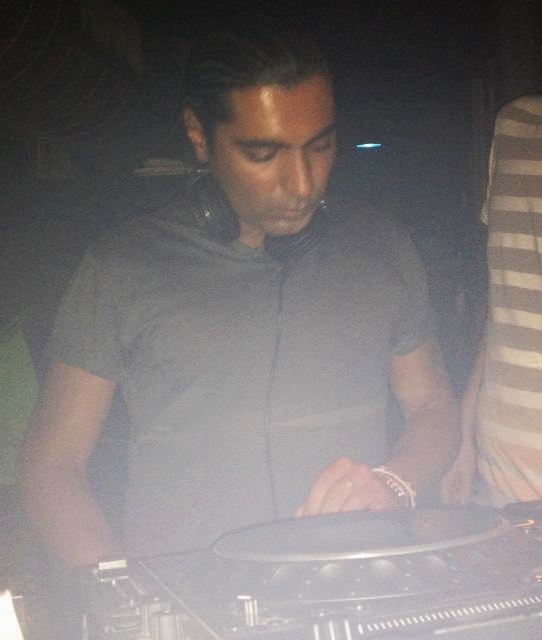
CREATING STREAK-IES : OMID NOURIZADEH @ RISE CLUB 08.17.13

Image

It has been a commonplace, since the late 1990s at least, for house music and techno DJs to create, as a bridge between rhythm runs, jet streak effects. There were jet streak effects even in late 1970s Eurodisco and beyond; their appearance as a kind of intermission in techno, especially, simply honored dance music tradition and moved it upward. At RISE Club last night, however, Omid Nourizadeh, also known as “Omid 16 B” — Tehran born, but for a long time living in England, didn’t just employ streak effects; his set centered on them. His streakies soloed; they acted like soprano diva vocals, lifting the music, screaming it, a throat of ecstasy.

Placing the spotlight on streak effect breaks has portended in techno for quite some time. All that Norizadeh did wass to give in to the movement and make it his mark. this he achieved. Again and again his streak effects displayed complexities all his own : notes soprano and higher than soprano, metallic clinks and twinkles, breezes, wind rush, pants and gasps, twists and rope knots of scream, screech, and cheering. Usually, a DJ’s streak effect breaks stop the dancing; not so for Nourizadeh. RISE’s crowd dacned across his streak breaks.

Using only Rise’s mix board and two CD players, programming many of his own tracks — including the luscious “Slide To Unlock,” a graceful and echo-laden “Double You,” the chanted “Yeah Yeah,” and “Blue Jeans,’ his and Lana Del Ray’s much updated equivalent of the reverb, undulating rumble and girl in heat duet that Giorgio Moroder and Donna Summer, in “I Feel Love,” rode to dance music glory so long ago — Nourizadeh made forty years of disco, house, and techno very much his own.

That music is not something that he has learned after the fact Nourizadeh has been active in DJ-ing for 20 years. his first album, Sounds From Another Room, appeared in 1998. though less known in the Us than fellow Iranians Dubfire, Sharam, and Behrouz, he is their contemporary. And, as he made fair to prove at RISE, of a dance music imagination as dominant as theirs.

Though his reverb bass lines, Brazilian rhythms, and girly chant drop-ins all recalled the shape and frills of disco, Nourizadeh used none of that era’s instrumental cliches. This was not a set of recaptured memory but of recreation, in entirely different sonic context of disco’s feeling and character. Daft Punk, eat your heart out.

Almost all of his set felt trippy, spacey, gently psychedelic. Deep beats rolled and rumbled, then strolled coolly, then morphed to samba, as soundscapes of innumerable siren provenance glittered in the upper frequencies. Much of Nourizadceh’s high note evocations sounded like Iranian or Kurdish pop — a soulful wail, falsetto notes, a mountain top flute yodel. In which mode he reminded this writer of Dubfire’s sound; but he did not linger in Persian mode. Into his soup of seduction he dropped street talk, reggae toasts, John Ciafone’s classic “Club Therapy,” cries of “you can’t stop,” and even a chant that went “you’re crazy, Limbaugh !” No one on the RISE dance floor cared to disagree with that !

Having dropped his Limbaugh message, however, he rapidly quick-cut the music to puckering glam-rock — think Erasure and Depeche Mode — whence he jumped to heavy, boot stomp techno leading back to Brazilian beat and a concerto’s worth of streak effects long and tortuous, delightful and pained, embroidered and spangled, a luxury of tactile sounds — especially the strong swirls and twisted spurts and hushes that climaxed his live take on “Blue Jeans.” With an economy of mix moves he made his effect breaks act out the stroke and desire of his rhythms. Dance music has rarely exulted so blatantly, yet melodic, in its orgasmic core as in Nourizadeh’s long strong bursts of liquid sound.

—- Deedee Freedberg / Feelin’ the Music

DJ MUSIC AND THE “SELFIE” SOCIETY

Image

^ selfie music

—- —- —-

We have watched house music and techno develop, as pop music genres must, over the past 27 years or so since these genres first grew a name. Of everything that house and techno first came to me, however, nothing remains except for one aspect : it’s solo stuff. Yes, there are DJ duets, a few of them superb. They are exceptions. To probably everyone who imagines a DJ, the image is of one person, earphones on, commanding equipment that sends out good vibrations, good rhythms.

It was not that way in rock and roll, nor, for the most part, in jazz. Rock and roll was played by bands — mostly three or four musicians, sometimes five or more. If a rock band featured a soloist — and many did — he or she was always, always of that band, never by him or herself. In jazz, the small combo and the big band were the rules. Solo performance arose from ensemble performance and took place within it.

As ensemble genres, rock and roll and jazz signified community, demonstrated common interests, rose above the glitter of self, its smell, its gimme’s. Yet of course the urge to spotlight rumbled within the music and often burst through it. Stars arose aplenty and took over, nailed the fans, made their names immortal — backing band or no backing band. Yet even then, even with Elvis or James Brown, as elephantine as any egos that have ever walloped an audience, the music needed several players to build its arc, give context, outline the star’s temper and contours.

With DJ music there’s none of that. the audience is the context the setting the temper. There is one music maker and one only; he or she does it all. No previous pop music, except maybe the blues, has ever presented so singly. Yet the blues is best played within four walls, or on a front porch. It is also music of pain — maybe joy and pain (in the immortal phrase of a great song by Maze) — and of one person and nobody else. Blues is as personal as a toothbrush. DJ music, on the other hand, though almost always solo, is hardly ever singular, and though much house music cries pain as often as not, the pain it cries is the fans’ pain. (It may also be the the DJ’s pain, but only as he or she is of the audience as much as at the mix-board.

The art forms closest to what DJ music does are painting and photography. Here the presentation is exclusively the artist’s — hermetically so. If it speaks to those who look, it speaks to them all, equally; or to none. Paintings and photographs do not — cannot — send a message only to one fan, or a few. For how can the photographer or painter know who will look ? The most popular DJ music does the same. It sends the DJ’s message — and his or hers only — to everyone everywhere. There is no locality in big-arena DJ music, no observable bounds, no contour or temper. It contains no private messages, no communal come-ye’s.

If the most popular DJ music has no definitions, why does anyone like it ? Yet a lot do. All over the world millions love big, beachy, smiley DJ music. Why ? There is, of course,. never a simple answer to why anyone likes a work of art, expression, entertainment. Some like them because their friends do. Some are snagged by the rhythm, the squiggles, the giddy glee. This writer is tempted, however, to conclude that people who like big-name DJ music do so because the music is its own mirror, its own photograph; a “selfie” sound track.

Image

^ selfie at work

The “selfie” — a smartphone snapshot, usually, of the person taking the snapshot, usually holding the smartphone up to her or his face — is as much the watermark of DJ society as the hot rod was of rock and roll, the two dancer twirl and leaps of jazz, the packed-tight dance floor of disco. At the disco, no one thought of being just a self; one melded into a crowd, sweat to sweat, thigh on thigh. People went to jazz dances in pairs, foursomes, whole busloads. Rock and roll was rebel music, but a soften as not, the rebel of it was an entire generation of young people. At huge DJ gigs, however, the fans exult the music by taking “selfie” of themselves — all of them the same “selfie,” but who’s counting ? The only number that matters in DJ music is ONE. Sound familiar ? it’s the politics we live in, the music we live by.

Image

^ the selfie icon ?

This is not to say that there are no DJs who play to contours and communities. What today is called the “underground” features plenty of masterful DJs who play joy and pain, message and aspiration, struggle and stride, and a vast dome of images frightful, mechanistic, bellowed and screeched. It’s solo music, but solo is not the message. Friends, competitors, alliances, imagination — these are the messages often carved by “underground’ DJs. Still, the “underground” gathers a fan base maybe one-fiftieth as big as the solos who populate big DJ gigs by the tens of thousands. Is it surprising that one encounters hardly any “selfie” snap-shooters at “underground” DJ sets ? When you are one of 20,000, it is you and only you swimming in a sea of bodies. You’re very, VERY much alone, and you know it; and the “selfie” is an icon of aloneness as lonesome as any such this writer has ever seen.

Image

^ a selfie = alone = lonely

On the other hand, when you’re on a dance floor with less than 200, every shoulder next to you and leg on the other side of you become real people who matter. There the self has allies warmer than a selfie pic.

—– Michael Freedberg / Here and Sphere