MAGOV14 : CHARLIE BAKER’S CHANCES LOOK LESS GOOD RIGHT NOW

Image

^ 29 point lead in latest poll : Martha Coakley (D)

—- —- —

For the past several months of covering this year’s Governor election I’ve been of the opinion that Charlie Baker was the favorite; that he had the most compelling case to make; and that the tax revolt under way in the outer suburbs would surge him to victory. But now, after looking at Western Mass University’s new poll, i am changing my mind.

Prior polls showed Baker losing to Martha Coakley by some big numbers : but in them, neither candidate topped 45 percent, much less a majority. In the new Western Mass poll, Coakley wins 54 percent to Baker’s 25. As Coakley’s numbers have risen, Baker’s have fallen.

All of this is bad enough; and there is more. The poll has Baker not known by a full 30 percent of voters. how can a man who ran for Governor in 2010, in a hotly contested and well-journalized election, be not known by that many people ? The only explanation is that baker’s name dropped out of the news ; and that now he is playing the most basic of catch-ups, very late in the game.

The solidest votes that candidate has are the early votes. the earlier, the better. Later on, the doors start to close ever more quickly. The doors haven’t yet begun to close — 21 % of voters remain undecided in a Baker Coakley election — but they will soon begin to. Meanwhile, the poll numbers detail the bad news :

Independents go Coakley, 49 to 27.
Women choose Coakley 62 to 16
Even 10 % of Republicans prefer Coakley to Baker; only 3 % of Democrats prefer Baker to Coakley
Baker loses every region of the state; his home region (North Shore and South shore suburbs he loses by 12. in Boston he is wiped out : Coakley 60, Baker 20.

Baker’s apologists point to Scott Brown’s come from way behind victory over Martha Coakley in the January 2009 special senate election. Sorry, but that election is an exception, not a model. Brown was a fresh face; baker isn’t. Coakley ran an ignore-him campaign. She won’t do that again, isn’t doing it now. the Democratic party GOTV operation took a pass in 2009; it is fully geared up now.

Baker’s apologists reply that Coakley continues to be a poor candidate. She is that. But she has become smoothly glib with a gentle smile — enough, probably, to not lose a 29 point lead.

Will the race tighten ? Of course it will. Baker’s favorable-unfavorable number is 31 to 13; Coakley’s is 51 to 27. Baker looks well positioned to gain a majority the 21 % still undecided, perhaps too win a few votes away from Coakley as well. By all means, give Baker a 2 to 1 break of the 21 percent undecided. But that only makes the race 61 to 39. It is axiomatic that a candidate can take 10 % of his opponent;s vote away — probably not more — if he campaigns well. So let’s do that. Now the result is Coakley 55, Baker 45.

That was the result in last year’s Gabriel Gomez – Ed Markey US Senate race.

If everything breaks for Baker — if he runs a near perfect campaign — if Coakley continues to be the dicey, underexposed photograph that she has been, then a 55 to 45 loss is doable for Baker. Such an outcome means Baker will win all the places that the current GOP always wins : central MA, most of the South Shore, much of the North Shore. He might carry a city or three ; Chicopee, Melrose, Methuen. Elsewhere, he will be beaten where he cannot afford to be beaten (Peabody, Quincy, Brockton, Framingham, Norwood) and wiped out where current GOP candidates are always wiped out (Cambridge-Boston-Brookine-Newton, the West, the Outer cape, Worcester and Springfield). There the margin will be 30 points, maybe more.
Image

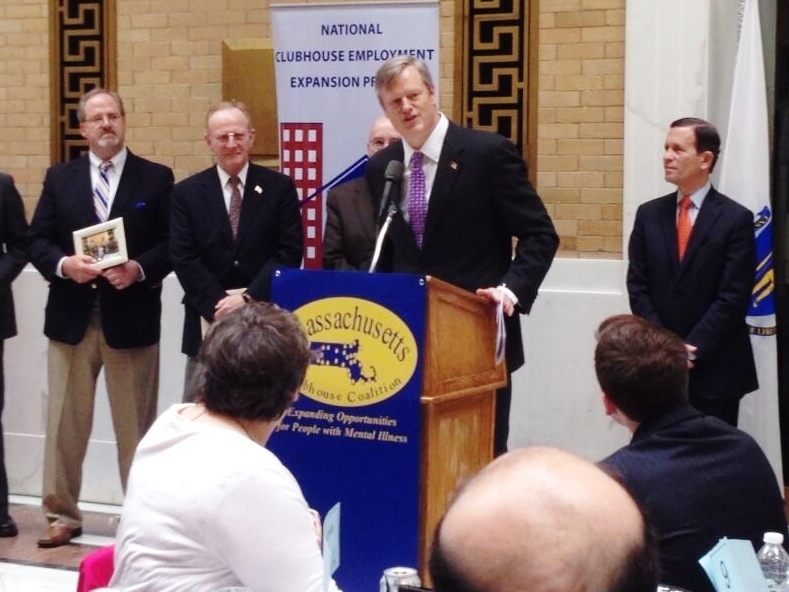
^ looking gubernatorial, and against Steve Grossman, he might be : Charlie Baker

Baker does much better against State Treasurer Steve Grossman. The Western MA Poll has it Grossman 38, Baker 29. Partly that is because Grossman’s favorable-unfavorable is only 21 to 14 : people who know him (44 % don’t) don’t like him nearly as well as they like Coakley and Baker. So Baker’s actual vote goes up from 25 to 29, and the undecideds go up from 21 to 33.

Facing Grossman, Baker actually wins two regions of the state ; Central MA by 18 points (45 to 27, 28 % undecided) and his home region by 3 (34 to 31, 35 % undecided). But he loses the West by 17 (39 % undecided) and is smashed in the Boston core (47 to 23, 30 % undecided).

Clearly a Baker win against Steve Grossman is doable; but it’s not quite probable. losing by 9 — and winning only 8 % of Democrats while losing 9 % of Republicans (!) — Baker has to win the 33 % of voters who remain undecided by 2 to 1. Can he do that ? Maybe : but there are more undecided voters in Democratic areas of the State than in GOP sections. My own guess is that he will probably — if he runs that excellent campaign I mention above — and continues to raise the big money he has gained thus far — win the undecideds by somewhat less : 19 to 14. That would make the November result Grossman 52, Baker 48.

Baker has one more card to play in a race this close, but it’s a highly sophisticated one : so bear with me as I explain what many highly moral readers do not want to hear :

Historically, strong GOP governor candidates have been able to bring aboard many Democratic legislators, in the cities especially, and with their active support either carry that city or come close. Many Democratic legislators (and I will specify no further) would love to see Baker elected, both for policy reasons, public works, and issues of House governance. But none of these will come actively into a Baker campaign unless they feel pretty sure they can make the difference. (The reasons for this should be obvious.) 52 to 48 is exactly the kind of race of which 20 or 30 Democratic legislators could turn the result around. BUT : of all the Democrats running, Steve Grossman is the candidate closest to exactly that kind of Democratic legislator. Would 20 or 30 of them turn on him ? Nobody is better positioned to make that happen than Baker, with his connection to the Big Dig and its huge dollars paid out to Building trades workers. But it definitely WON’T happen unless ( 1 ) the Democratic nominee is Grossman ( 2 ) the race is as close as I estimate and ( 3 ) Grossman can’t counter it.

Baker’s fate is in the hands of key Democrats. Since John Volpe’s 50.3 to 49.7 win in 1960, it has always been like that for GOP governor candidates. Believe me, he knows it.

—- Mike Freedberg / Here and Sphere

BOSTON SCHOOLS : REFORM MOVES FORWARD THROUGH THE BERMS

Image

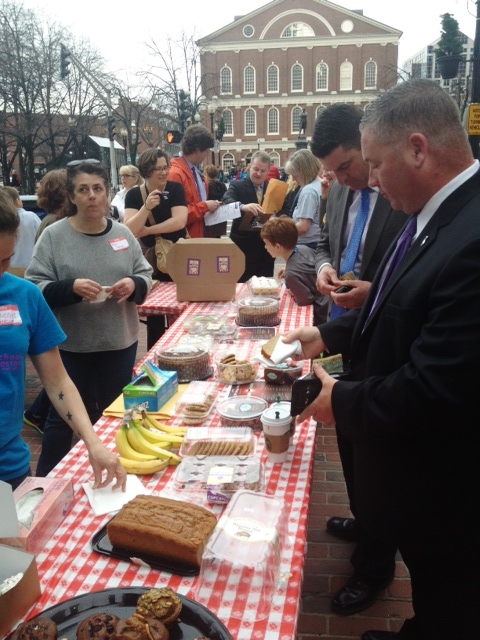
^ street theater at City Hall & Faneuil  : the “$ 61 million” BPS parents’ bake sale yesterday

—- —- —-

As just about everyone knows who is involved in it, moving the Boston Public School system forward is almost a combat challenge. Berms galore face the advancing warriors ; severely decreased Federal funding; unfunded State mandates; administrative change, including to staffing and work rules; figuring out a workable relationship between charter schools and “standard schools”; layoffs; teacher salaries. Doubtless I have left out many more.

That said, the army of school reform Is moving forward. Some even of the opponents of reform are actually assisting it by highlighting the difficulties. One such highlight took place yesterday, at the back of Boston City Hall, across the street from Faneuil Hall : a school parents’ “$ 61 million” bake sale.

The $ 61,000,000 they refer to is, as they see it, the dollar amount by which the Boston School department’s FY 2015 budget falls short of what is needed. Superintendent John McDonough agrees that the new school budget has “at the end of the day…only so much revenue,” as he put it at the March 26th Budget hearing. Whether McDonough concurs that the shortfall amounts to $ 61 million, I do not know; there is no disagreement, however, that the budget foes come up short. as McDonough put it, “trade offs” were needed. The trade-offs included eliminating abort 200 position : 100 of them from central school department administration, another 100 or so from the staffs of individual schools.

Hard hit was the Mary Curley K to 8 school in Jamaica Plain ; a school that has, since the late 1970s, occupied a central place in Jamaica Plain’s re-invention as a gentrified neighborhood. Parents of Curley School children cite losing a coach, support personnel, and a school nurse. Other parents, with children at other schools on Boston’s western edge, report the same.

it may well be that McDonough chose to layoff staff in these schools rather than in poorer neighborhoods because he knew that Curley parents would organize and protest loudly, and that those responsible for cutting Federal and state school funding would hear ; and that their protests would matter more to these officials than if he himself were making them. McDonough is as shrewd as they come, and I find nothing that he does to be without well placed purpose. In this case, if his intent is as I suggest, he has planned well indeed.

Image

^ shrewdest guy in Boston : School Superintendent John McDonough at the “$ 61 million” bake sale

The bake sale drew at least four City Councillors, several Boston teachers, and much media attention. Less attention has been paid to what McDonough has done to school administration. He has made major moves, chiefest of which is to give every Boston school principal full authority to choose every teacher and staff at the school of which he is principal; and to do so by early hiring, when the best teachers are still on offer, and to count diversity as a criterion. The effect on future teacher union work rules can only be revolutionary.

Mayor Walsh, too, has made school improvement moves. his new appointees to the School Committee both voted for McDonough’s propos;las (which were adopted unanimously); and today, at the City Councils’ FY 2015 Budget Hearing, orders presented by the Mayor were adopted unanimously, as follows:

Order # 0637, to borrow $ 72,848,295 for constructing the Dearborn 6-12 STEM/Early college Academy, on Dearborn Street in the Cape Verdean part of Boston : the City’s first new school building in many, many years.

Orders # 0588 through 0593, statements of interest to the Massachusetts School Building Authority, for six more new projects, in West Roxbury, South boston, Jamaica Plain , East Boston, Hyde Park, and the South End.

It would he hard to make a case that thee projects are moving forward without an accompanying commitment by the mayor and City to set these new schools up in any way but under the McDonough reforms.

Now all that is needed is for the State and Federal governments to do their part in funding the goal that McDonough states best : “this isn’t about charter schools or standard schools. It;s about making all schools better. we must cloze the achievement gap.”

—- Mike Freedberg / Here and Sphere

UPDATE 11.30 PM 04/09/14  : Mary Tamer, who was a Boston School Committeewoman until her term ended on January 5th, questions the viability of the Dearborn STEM project — citing what she calls the “poor results” at the current Dearborn as a turnaround school — and also some other school moves being made around the City. Tamer asks how the City justifies the Dearborn project. It’s a good question deserving an answer that was not given at today’s Council hearing.

IMMIGRATION BAD : THE PRESIDENT COURTS AND DEPORTS


Image
In 2012 when President Obama announced that by, executive order, he was stopping the deportation of young undocumented immigarnts who qualified, it was easy to think that he would finally do whatever was needed to bring 11,000,000 future Americans fully aboard.

It didn’t happen.

As a front page article in today’s New York Times reports, President Obama’s Justice Department continues to deport more immigrants than all previous Presidents combined; that his focus is on those convicted of minor offences rather than on serious offenders. He has pledged just the opposite. Obviously, for immigrants, his pledges mean nothing.

This is a serious matter not just for the immigrants sent away. America is immigration; it’s who we are and how we grow the economy. As Jeb Bush said just this week, immigrabts come here breaking a law, but “it’s not a felony, it’s an act of love, for someone to come here seeking a better life for his family.”

An “act of love” !!! Yes it is.

Jeb Bush also said last year, that undocumented immigrants are, because of their young demographic, a boon to the economy AND help rescue Social security. Truth to power…

Image

^ truth to power : Jeb Bush gets it

All of that should be as obvious as the sun shining in your face. Everry immigrant is a consumer, consumer spending is two-thords of the entire economy; immirants are the most basic economic growth fact. Immigranys also bring cultutal diversity, new idea, new ways of doing things. Far more successful businesses are started by immigrants than their percentage of the entire population.

President Obama says he wnats to grow the economy but that repiublocan obstriction prevebts it. Republican obstruction there is, plenty, including on immigration reform legislation. But nobody is obstructing the President from directing the Justice department.

It ain’t a pretty operation. Immigrants are taken into custody, jailed, often without even basic rights that all people have, not just citizens. They are held in custody for long periods of time as cases drag on and on. Evidently the 5th Amendment’/s guarantee of speedy trail doesn’t apply. That’s only for citizens.

Image

Here in Massachusetts, three immigrant initiatives are on the table : (1) giving undocumented immigrants drivers’ licenses; (2) providing their children with in-state tuition; and (3) passing the Trust Act, by which the state would opt out of the Justice Department’s deportation actions. the first is a public safety measure. The second, simple fairness. the third is more controversial — nullification of Federal law is something one expects from gun people, not snsible policy makers — but it sends a message of what kind of America we are and want to be.

And make no mistake. If Jeb Bush riuns for President in 21016 and sticks to his powerful and, to my mind, irrefutable advocacy for 11,000,000 future Americans as he runs, he will be a candidate well worth voting for. His words shame President Obama’s on immigration. How can the President not understand ?

—- Mike Freedberg / Here and Sphere

MAGOV14 : WHY CHARLIE BAKER AS GOVERNOR CAN DO WHAT MAYBE NONE OF THE DEMOCRATS CAN DO

Image

One of the big reasons why I find a Charlie Baker governorship a positive prospect is that he, as a Republican, can get a lot of things done that probably none of the five Democrats can do. Example : the minimum wage rise bill, which the House voted Yea on just this week.

that bill was going nowhere, because Speaker DeLeo insisted on an unemployment insurance give-back that Speaker DeLeo insisted on but which few of the Democratic party’s core groups wanted to give. then, about two months ago, Baker announced that he supported the DeLeo bill and, what was more, would expand the earned income tax credit.

Two weeks ago Baker won the GOP nomination for Governor. Next thing I knew, DeLeo’s minimum wage bill, with its give back, was on the House agenda and was voted Yea 123 to 24. All but one democrat voted Yea.

Can there be any doubt that the House took up the deleo bill when it did, and voted it yea, because the Democrats did not want to cede the Minimum wage rise issue to Baker ? And so the bill now goes to conference, with the DeLeo bill certain to be the final law, because DeLeo has that power and because Baker is waiting.

As for the Democrats, not one, in anhy Forum, would commit to supporting the DeLeo bill — and as DeLeo said, if the legislation didn’t contain his give back, it “wasn’t going very far.’ (his words) Steve Grossman even said that he would veto a bill that included the DeLeo give-back.

Were Baker not in the fight, and taking the minimum wage issue up, can there be any doubt that we would see years of battle between this Democrat and that one ? After all, that’; how it has been for eight years of Governor Patrick’s administration — sometimes effective, often not effective at all, occasionally a disaster.

All that baker has to do is raise one of the state’s many major issues — education reform, driver’s licenses for immigrabts, crinminal justiuce reform, transportatioon funding, reconfiguring the DCF, redoing state government’s technology — in a progressive way, but in line with what Speaker DeLeo will support, and it gets done. Why ? Simple : the Democratic party cannot allow the Massachusetts Republican party to steal its key issues and, with them, key constituencies.

As long as the State’s major challnges remain a striggle within the Democratic party, with a small GOP entirely on the sidelines, little gets done. Enter Baker as Governor, however, working with the Speaker, and suddenly almost all gets done, very quickly.

This is how Massachusetts has been best governed since 1990 at least. It remains true today. The one Democratic governor candidate whom I haven’t yet discarded, Juliette Kayyem — shrewd and brilliant charisma champion that she is — needs to tell me how she can get done stuff that Baker WILL get done.

—- Mike Freedberg / Here and Sphere

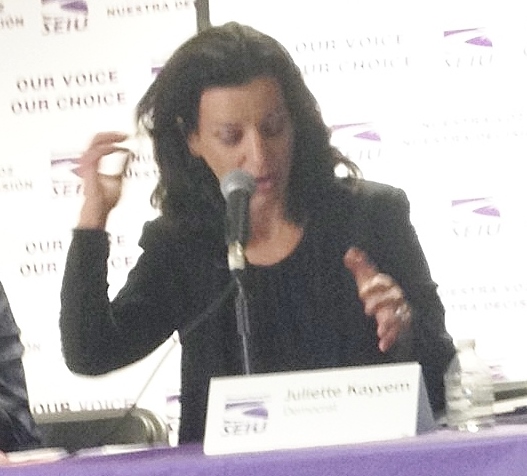
below : the one Democratic governor hopeful left standing : Juliette Kayyem

Image

WITH THE MINIMUM WAGE NOW RAISED, HERE’S WHAT’S NEXT FOR MASSACHUSETTS

Image

^ the Democrat with fewest weaknesses : Juliette Kayyem

Image

^ the best potential governor, on an across-the-board basis : Charlie Baker (with Nightline’s Dan Rea)

—- —- —-

Two days ago, the Massachusetts House passed a big rise in the minimum wage, to $ 10.50 in 2015 and $ 11.00 in 2016. The House legislation included, however, a provision that the Senate bill does not : a give back of five percent, on the unemployment compensation portion that employees pay. That portion will rise from 15 % to 20 %.

Because the two bills do not mesh, a conference wil be held at which the two bills will be reconciled. Almost certainly the reconciliation will adopt the House version: because Senate President Murray is leaving, whole Speaker DeLeo is very much staying.

Such is the way of things in the Massachusetts legislature. The big result, however, is that the base wage for every Massachusetts worker now earning minimum wage will rise by over $ 3.00 an hour. Minimum wage earners will no longer need as much public, taxpayer-paid assistance as before; taxpayers will get some relief; and workers will have some money to spend into the discretionary economy. In Boston, $ 10.50 to 4 11.00 an hour is still nowhere near enough; not with  rentals costing $ 1,600 and up; but in outlying cities such as Worcester, New Bedford, Holyoke, and Fitchburg, the new minimum wage will provide a real boost to many, many families and thus to the economy of those cities.

There were 24 votes against the Raise. Their message was the same : the higher wage would mean fewer jobs.

Businesses that have been able to short-change employees and pass them off to taxpayers will now not have that taxpayer subsidy. Will these businesses close ? To ask the question is to answer it. What then will they do ? Easy. They will change their business model.

These businesses will be operating in a very different economy, one that will grow quite quickly at first as the boost in wage checks gets spent into the economy. And this is good all around. But it is far from being enough. Massachusetts needs much more reform in how it operates ; some of it economic reform, a lot of it structural.

Here’s what we would like to see happen ;

1.economic : expand the earned income credit to childless families who qualify on an income basis.

2.economic : give Boston granting authority over its liquor licenses. A home rule petition, by Councillor Ayanna Pressley now sits in the legislature awaiting action.

3.economic : enable innovation districts in neighborhoods of Boston, and in outlying cities, on the model of those currently operating in Cambridge and Seaport Boston. Local aid funding can help here.

4.structural : reconfigure the website interface and interactivity of every State department, from health connector to DCF to Secretary of State and permitting. Publish the State Budget online. Embed a mobile phone app into the State’s most-used Department websites, such as the DCF, RMV, DOR, and Transitional assistance.

5.encourage and establish the full range of public school reforms now being put in place in Boston by Superintendent John McDonough

6.human rights : eliminate mandatory sentencing; establish a prisoners’ bill of rights that would provide for legal remedies — including assigning public defenders to each state or county lock-up — to prisoners who are abused by incarceration personnel; pay minimum wage to prisoners doing work they are required to do by the institution; assure re-entry procedures that are fair and helpful to the released prisoner; restore voting rights to convicts who have finished their sentences;.

7.civil rights: extend the state’s transgender rights law to include places of public accommodation. grant driver’s licenses to undocumented immigrants and pass the Trust Act

8.gun control: require owners of guns (other than antique) to purchase liability insurance, as we now require owners of vehicles; require smart gun technology

9.transportation : review all transit and road budgets and cost-cut administration where feasible; repair and replace MBTA cars and buses, lines,a nd equipment; expand Green Line to West Medford; complete new stations on Fairmount Line; finish the South Coast rail Connector

10.DCF : hire sufficient case workers so that the state-mandated maximum case load is never breached; pay social workers a professional salary; require the DCF chief to circuit-ride from DCF office to office and to use mobile phone and ipad communication as a regular feature.

All of what we’d like to see is more than enough to challenge two governor terms, much less one. Some of this year’s Governor candidates want still more. That’s OK, for a wish list but not for the campaign, which we hope will be about now and the next four years, not times still over the horizon. After all, our list doesn’t even talk about climate change, alternative fuels, conservation, affordable housing, in-state tuition for undocumented immigrant kids, and local aid — any one of which could occupy an entire editorial.

— Mike Freedberg / Here and Sphere

THE FIRST AMENDMENT PROTECTS SPEECH, NOT PURCHASE

Image

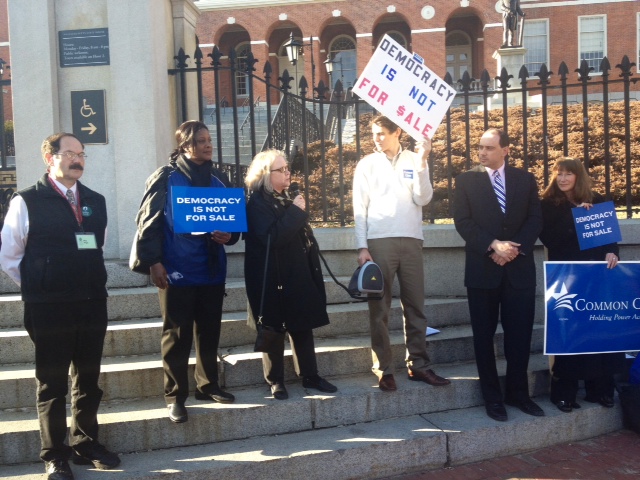
^ protesting the purchase of our democracy : St Senator Jamie Eldridge and Common Cause chairperson Pam Wilmot (both on right) at the state House yesterday

—- —- —-

Yesterday the Supreme Court, by its usual 5 to 4 vote, decided that “participation in the political process” means allowing the very rich to buy the process. We vigorously disagree,

Money is NOT speech. It only BUYS speech. There is no word in the First Amendment about buying speech. The First Amendment protects such speech as is spoken (with a few exceptions that do not apply here) and that is all.

Anybody is free to speak out, on political matters above all. Anyone is free to publish. Anyone is free to advertise. That is all.
In political campiagns, speech gets printed or it gets broadcast. Printing and broascast, however, are businesses; and businesses have to charge those who buy space or time, because revenue from advertising is how media pay their costs. Obviously if a political campaign cannot pay for print or broadcast, its speech isn’t going to heard by many.

Thus there is room to accord campaigns legal authority to raise enough money to get their speech printed or broadcast. And to grant the same authority to interest groups advocating an issue. The question is, what kind of authority can we grant ?
It seems obvious to us that the authority to raise money cannot be open-ended, because if it is, then those who have lots of money to donate can hugely overtalk those who don’t have a lot of money. And there can never be any reason whatsoever, in a democracy, to permit anyone legal authority to overtalk anyone else. All voices must be accorded equal access to print and broadcast.

To allow otherwise is to sanction oligarchy. this we can never do.

Five justices of the Supreme Court seem not to understand the difference between speech and purchase.

Overturning the McCutcheon decision — and Citizens United as well — by constitutional amendment won’t happen. If it could have been done — and so far it couldn’t — it is impossible now, for the plutocrats now have open season to buy a majority of Congress.

Pushing for an amendment is worthy, as a protest; more doable is to elect a democratic president in 2016, ensure eventually a different Supreme Court majority, and overrule two decisions which, if allowed to stand, will end American democracy as we know it.

Do I alarm you ? i intend to. we have already seen what a plutocratic, purchased Republican party is capable of doing to the economy and society as a minority party. Imagine what the country will be like if the purchased party takes the presidency. There will be oligarchy, or a revolution. Do you want to see either of these happen ? We don’t.

—- Mike Freedberg / Here and Sphere
5TH SUFFOLK DISTRICT : “A VICTORY FOR THE COMMUNITY”

Image

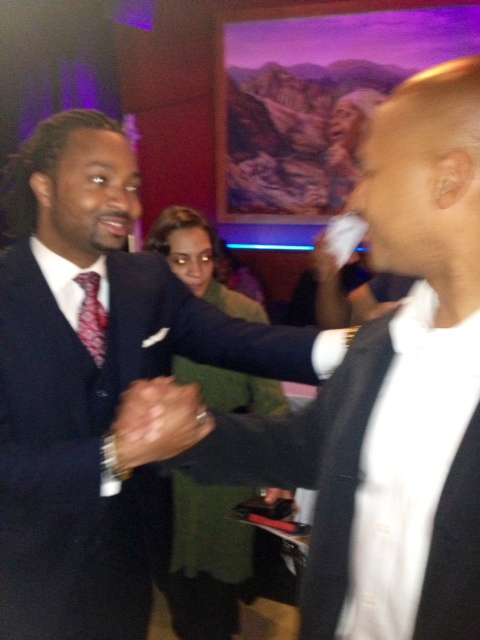
^ a victory for the community : Evandro Carvalho with John Barros

—- —- —-

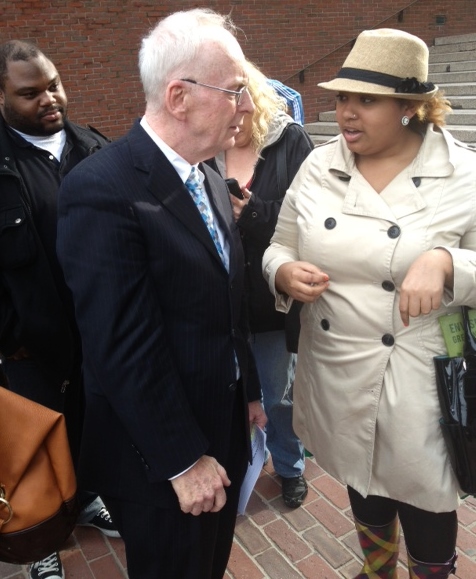
Last night the Special Election to choose a new State Representative for a District badly needing a strong one was won by Evandro C. Carvalho. He defeated three other candidates, drawing almost 50 % of the total vote. it was impressive win for the young, former assistant District attorney in his first ever run for elected office.

The numbers (courtesy of local activist Jed Hresko) were: Evandro Carvalho, 960 votes; Karen Charles-Peterson, 521 votes; Barry O. Lawton, 190 votes; Jennifer Johnson, 151 votes; Roy Owens, 89 votes; 46 write-ins and one blank. total ballots cast : 1,957.

The turnout wasn’t as small as my informants had surmised, nor quite as large as my guesstimate. It was barely one-quarter a large as the District’s vote total in last year’s mayor campaign. That said, Carvalho’s numbers, in this context, look even stronger than the raw total. They tell the story of this race : it was, as John Barros said at the victory celebration, “a victory for the community.”

By which he meant, first of all, Boston’s Cape Verdean community. It was he, John Barros, who in last year’s Mayor election, energized and focused Boston’s Cape Verdeans into a serious voting bloc. A community, however, already existed and has grown ever stronger in time — much of that strength drawn from the response by area mothers to the tragic feud that has seen several shooting deaths, among them three members of Isaura Mendes’s family.

Image

^ “we won !” : Isaura Mendes with Carvalho’s grand-dad, who voted yesterday for the first time as a citizen

On Tuesday, Isaura Mendes, who heads the Bobby Mendes Peace Legacy — named for her son — was a precinct leader, door-knocking in Ward 7 Precinct 10, which Carvalho won by 109, to 25 for Charles-Peterson and 11 for Jen Johnson. It was beautiful to see her face, trouble-lined, smiling fiercely as she announced her precinct “We won ! We won !”

Mendes wasn’t the only person happy at Carvalho headquarters. Hugs abounded, cheers, smiles, tears. It had the feel of a sports victory, a win for Team Carvalho. And beyond that.

Carvalho won the Cape Verdean precincts overwhelmingly. I took the count at the strongest of them, Ward 8 Precinct 5 — Dudley Street from St Patrick’s Chiurch toward Harrison Avenue. There, a steady stream of voters showed up and gave Carvalho 156 votes to Charles-Peterson’s 19 and Jen Johnson’s 2.

The defeated candidates conceded; two of them came to the celebration and embraced the winner. Register of Probate candidates Felix Arroyo and Marty Keogh both chipped in. District Councillor Frank Baker was there. So was State representative Dan Cullinane. And John Barros, at whose Cesaria restaurant the victory was toasted to.

For me, the Carvalho victory was a win for John Barros too — without the 2,071 votes that he gathered, from the District’ 19 precincts in last year’s Mayor campaign, and the effort needed to win them, last night’s result would surely have been different. I told him so. But Barros was having none of it. “it was a victory for the community,” he told me — and said it again in his speech.

Image

^ The Community at Cesaria

He was right.

For the first time, Boston’s Cape Verdean community has an elected voice — much needed.

And what of the people of the 5th District who are not Cape Verdean ? I saw few of these at Carvalho’s gathering or in his headquarters. Before this campaign began, his name was surely almost unknown to people not of Cape Verdean ancestry. That’s no longer true at all — victory cures all obscure-ness — but there is much talk that Carlo Henriquez, whose expulsion from the House occasioned this election, will seek his old seat back, and soon.

Can he win it ? If the answer lay primarily with the District’s non-Cape Verdean voters, it would be very doable. But my own feeling is that Carvalho’s win is the worst case scenario for a Henriquez comeback. Carvalho’s vote really was a community one. The community is his now, and it will not be denied or broken — and the vote turnout will only increase now that Cape Verdeans know they have something to hold on to. The future of the 5th District is his to lose.

—- Mike Freedberg / Here and Sphere
SCHOOLS REFORM : WE SUPPORT THE COMMON CORE INITIATIVE

Image

^ the apostle of Common Core standards : US Secretary if education Arne Duncan

—- —- —

We support the Common Core curriculum initiative, both for its content and its suggested teaching methods. We also support it for the nationwide equality inherent in it.

A society educates its children for two lives : citizenship and employment. Education for citizenship is primarily a moral undertaking and does not change, because human nature doesn’t change. Education for employment is primarily economic, and as the structure of a modern economy changes all the time, so must education change as well.

These are axioms of education. There is nothing new about the Common Core initiative. Throughout the history of Western civilization, education has prepared students for employment. Nor is there anything new or shocking about Common Core being nation-wide. Throughout most of Western history, the curriculum was civilization-wide, not just national.

Children should not grow up compartmentalized by national political agendas, much less by states. Children should be educated so as to move, work, live, and communicate everywhere in the world. That’s how it was in Roman Empire times, in the merchant city-state era of Greece, and again in the “Renaissance of the 12th Century,” a time and place of huge intellectual advance in both Europe and Islamic society, and — because the two go together — of big economic advance as well.

The resistance to a Common Core curriculum and practice comes from two advocacy sides that have nothing else in common. That’s often how it is with important progress movements. No one should be intimidated by seeing these strange political bedfellows raise the hue and cry side by side.

On the one hand is the ultra conservative think tank interest, which fears a “national take over” of education, which it holds to be a matter of local control. This despite the Common Core initiative having been put together by governors of states, at the state level, and major employers. Common Core is not a “national takeover.’ it is a coming together of every state and many interests who want to see America’s school graduates ready and able to claim the best jobs of tomorrow. On the other hand are certain teachers unions, and many educators committed to current pedagogy : these interests decry the rigid rigor of Common Core and its emphasis on testing and more testing.

The objections from the Right can be dismissed quickly. Why does it matter whether a curriculum initiative is nationwide rather than local ? If the initiative is beneficial, that’s enough. There is a Constitution, it applies, via its Supremacy clause and the 14th Amendment, to the states, live with it.

More serious are the objections to Common Core being raised by teachers and educators. It is understandable that those who have long personal investment in the current pedagogy should feel that their work is good, and that a radical change of direction will unsettle the process and cast teachers adrift while they adapt to the new standards and method. This will happen, and it will have an effect on teaching during the transition period. That’ always the case when systems embrace large change. The bigger objection is that Common Core practices don’t educate students as well as current pedagogy; that testing, in particular, dominates teaching to the exclusion of course work. One very vocal opponent of the tougher standards say that they were put together “in violation of how education standards are supposed to be decided” — whatever that means. My own thought is that if the new standards work, and employers accept them, that’s game, set, and match/.

The entire anti argument misses the point. Which is that both teaching methods work equally well. How could they not ? Students learn what they are told to learn; and they learn it how they are told to learn it. This applies to EVERY teaching method, rote memorizing included. Every student goes to school in recipient mode; the teacher gives, the student receives. Recipient mode is marvelously adapted to taking in what is received. Students even in my stone age time knew well to listen to teacher and give back what he or she wanted. It was a school survival skill. Somehow we managed to learn what teacher — and the college we were headed to — wanted us to learn. We didn’t sit in class and say, “that’s a bad method.”

The crafters of Common Core know this. Their standards seem designed for students first — should they not be ? We hire teachers to teach not what the teacher wants to teach, or how, but for what the society wants taught. As for “how,” that’s still up to the teacher, but within the guidelines implied by the “what.”

Which for Common Core means lots of testing. Too much testing ? This to me is — with one exception — as red a herring as it gets. The exception : CC testing seems to  begin at too young an age. Kids younger than 3rd grade probably don ‘t have much to test for, other than cognition and other physical issues. But that said, all of life is a test, constantly, in everything. All employment is a testing. Every task that an employee takes up is a test of his or her mastery of what is tasked. When an employee does whatever is in his or her job description, he or she is not in recipient mode : he or he is in performance mode. That, dear reader, is what testing is. It is education’s performance mode.

Bring it on.

—- Mike Freedberg / Here and Sphere

UPDATED March 31, 2014 at 9.50 AM

UPDATED again on April 20, 2014 and re-posted.

INDEXING THE MINIMUM WAGE — BUT NOT THE GAS TAX ? WHAT’S GOING ON, AND WHY

Image

^ Massachusetts’s minimum wage is higher than most, but far behind our cost of living.It must be raised — and should be indexed to inflation

—- —- —-

A proposal has been offered, in my twitter feed, to index Massachusetts’s soon to be enacted Minimum wage hike to inflation. I support the proposal.

Inflation right now isn’t a worry. We haven’t had more than two percent inflation in almost a decade. A slow-growth economy with much unemployment and a lot of under-employment isn’t an inflation situation. Someday, however, inflation may well increase, to three percent annually or even four percent. Ten years of four percent inflation reduces any minimum wage figure we enact by 40 percent. that’s one of the reasons why we’re revisiting a minimum wage enacted many years ago,when price inflation stood a large chunk lower.

Indexing the proposed $ 11.00 an hour minimum wage to inflation will keep us from having to revisit the number. Revisiting doesn’t happen when it should; it waits until the number has been significantly degraded. That’s why we’re revisiting our state’s $ 7.80 minimum now. When originally enacted, it paid workers enough money to make ends meet without public assistance, Today, $ 7.80 doesn’t do that at all.

Full time workers should never have to need taxpayer assistance to pay their family’s vital bills. With an indexed minimum, full time workers in jobs paying minimum can at least keep pace. And while we’re at it, for goodness sake raise the minimum wage for tipped workers and airport employees.

Raising the minimum and indexing it help the economy. Need I say it again ? That if people can’t earn enough to participate in the growth economy, it grows less than it could ? And that that hurts all of us, including businesses ? Either we want a strong growth economy or we don’t. If we want it, we should enact laws that help bring it about.

To do otherwise is to force taxpayers to subsidize the low-wage policies of low-wage employers. There is no good policy reason at all why we should allow this. it is wrong economically and wrong morally. It is also a stupid business decision, because low-wage workers don’t stay on the job and don’t want to. They move on. Turnover is huge and wastefully expensive. Plus, a loyal work force is a motivated work force. Any business with any brains wants this.

Low-wage business interests will tell you that they don’t hire because of regulatory uncertainty or because the minimum wage will go up. Don’t belive it for a minute. Businesses hire because demand for their products or services increases. Consumer demand drives the economy. IT is the “job creator.”

So much for the argument about indexing a minimum wage. Yet indexing is also on the table with respect to the gas tax hike enacted by the Legislature and Governor last year as part of the large transportation Upgrade bill. I understand why the Transport bill included tax indexing; I agree with the added revenue’s purpose. But I also understand the constitutional argument adduced by the supporters of a referendum to eliminate the gas tax’s indexing feature. it is a shame that the Transport bill included a provision of specious constitutionality, because this has handed the anti-tax, anti-government crowd a persuasive case it doesn’t deserve.

The “Tank the Tax” crowd says that it’s opposed to indexing on classic taxation legislation principles. I don’t believe them for a minute. They’re opposed to taxes, period; opposed to State services; opposed to the people who need those services — public transportation included. It’s a shame that these folks are now able to cloak, inside a principle everyone holds dear, what they are really after : forcing Massachusetts residents who need public services to fend for themselves.

Let there be no mistake here. The people who wield now their high principle are the same ones talking about EBT fraud as if it were rampant, whereas it amounts to about 0.7 % of the entire EBT budget. They’re the same people who tout the Cato institute’s ridiculous claims that public assistance families average $ 40,000 in benefits, when in fact that the bulk of that figure includes retirees receiving social security, veterans and disabled veterans receiving benefits, and public workers drawing down their retirement payments. And they’re the same people who want to deny in-state tuition to children of undocumented workers — indeed, the same people who demonize undocumented workers as a group, even though undocumenteds work the hardest, for the least pay, at jobs few others will do at any price.

That the indexing feature of last year’s Transport Bill has offered these disconnected people a legitimate argument galls me. it should gall you. We need somehow to amend the Transport Bill so that indexing of its taxes is not needed. The “Tank the Tax” referendum will likely pass otherwise, with huge consequences for people struggling to make do, people who need public transit, people who do hard work beyond the imagining of those whose agenda is not the State’s friend.

—- Mike Freedberg / Here and Sphere

MAGOV14 : HOW ONE DEMOCRAT IS DEMAGOGUING, DEGRADING THIS ELECTION

Image

^ tantrums, attacks, and back look : Steve Grossman loses his grooming

—- — —-

The Democratic party of Massachusetts seems determined to degrade this election — thus to discredit itself : because a party whose first response is to demonize its opponents is unfit to govern, unprepared for citizenship.

I had thought, until recently, that Steve Grossman was the class of the Democratic #magov14 field. My opinion began to shift when i saw him attack Martha Coakley at candidate Forums; attack and disrespect her. On his own his always fully groomed answer to every question had begun to annoy me : was he human or just a policy bot with bryl creem ? Then came the tantrums, the childishness.

And then came the attack on Charlie Baker, the GOP nominee, an attack outrageous in its overkill : Grossman attacked Baker for throwing transgender rights under the bus during the 2010 campaign,

Huh ?

Dear Mr. Grossman :

This is 2014. Four years ago, Baker handled transgender rights very wrongly, indeed handled much of his campaign wrongly. And he lost thereby. But that was then. Baker has run an entirely different campaign this time, one full of optimism, outreach, and progress; a campaign focused on technology reform of government — much needed, as the failure of our health connector makes painfully clear.

Baker’s running a campaign, quite frankly, a heckuva lot more innovative than yours.

If you want to challenge Baker, challenge his policy plans, not his past errors. But so far you haven’t done that. Is it because he might be right and you cannot accept that ? Frankly, I liked you better as a bryl-creemed policy bot.

Meanwhile, Mr. Grossman, two of your opponents, Juliette Kayyem and Don Berwick, are out there making forward policy proposals, running on optimism and grace and not on demagoguing opponents.

Image

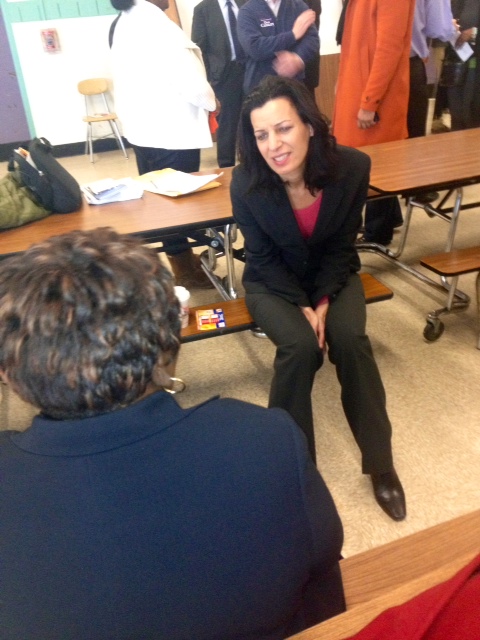
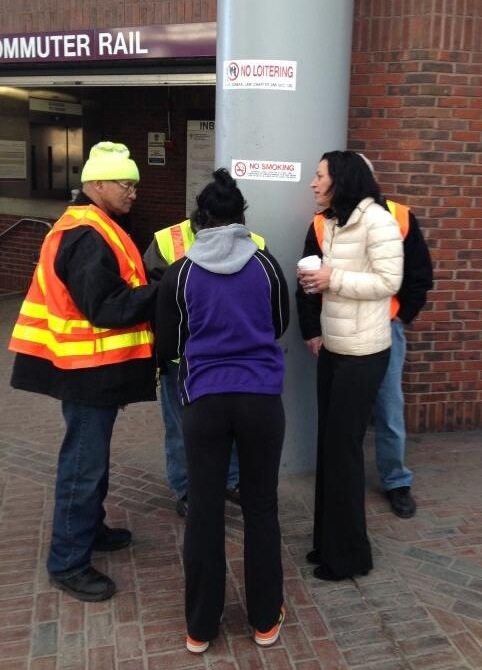
^ meeting the voters where they work : Juliette Kayyem at an East Boston T stop

photo (16)

^ serious, if, for the time being, somewhat unrealistic, policy proposals : Don Berwick explains.

photo (15)

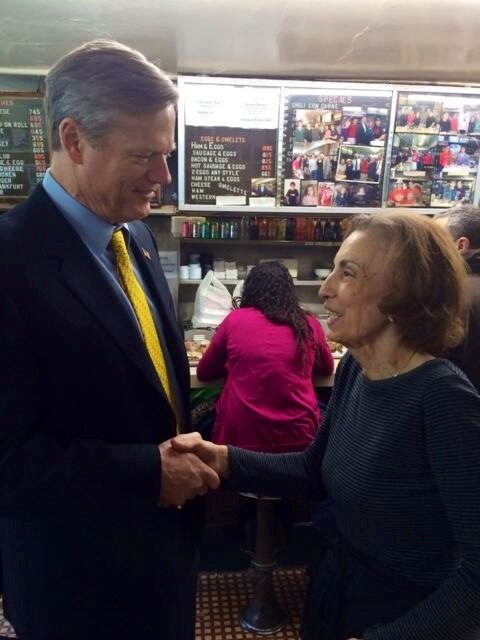
^ street and meet, greet and tweet : Charlie Baker in Braintree two days ago

There are enough failures of administration in State government right now to make serious reform crucial. Don Berwick has been unafraid to address these failures in detail. Where has Steve Grossman been ? So far I haven’t heard much. attacking baker for events of four years ago is a distraction, not a solution.

Hopefully Massachusetts voters will reject the current Grossman approach — one mirrored by other Democratic campaigns going on in Massachusetts right now — in favor of the Berwick and Kayyem approach. Let this be a campaign of ideas and competence, not one of who can throw the stinkiest mudpie. And if running a campaign that enhances the public’s respect for our election process brings us a Republican governor, so be it. Because this campaign should NOT be about Steve Grossman or Don Berwick — or about Charlie Baker. It should be about Massachusetts gaining the best potential Governor, not the last card left undiscarded.

—- Mike freedberg / Here and Sphere