
LIFE AFTER HORSE RACING : THE FUTURE OF SUFFOLK DOWNS

1 East boston people

1 East boston today

The new East boston looks to the new Boston but also loves the old : EastBoston2020’s vision enclompasses both

—- —- —- —-

Suffolk Downs’s owners warned us. If the site was ot granted the coveted boston-area casino liocebnse, horse racing at Suffolk would end. The license was not granhted, and horse racing will end.

So what becomes of the dite now ? A group called “Eastie 2020” has a plan. They have smartly framed it, avoiding specific development suggestions, focusing on principles to guide development of Boston’s most singular section.

Singular because only East Boston is divided from the rest of the vity by a bridge, or tunnels, with a toll attached. Singular because East Boston — like Charlestown — has no land connection to any other part of the city.

Singular, lastly, because East Boston’s separation from the rest of the city — from Charlestown too; it’s extremely difficult to get from East Boston to Charlestown by land — cleaves it to the North Shore, of which it’s really a part, more readily than to the city itself. Yet East Boston, like it or not, is politically a Boston neighborhood and is governed from City Hall, for whose occupant its voters have often made the difference on election day.

East Boston is no stranger to plans. It’s perhaps the most planned nd re-planned part of Boston. In 1830 it was a pleasant getaway for Bostonians seeking a summer weekend; on the part of East boston known aas “the Fitrst section” — facing the City barely a mile across the harbor — resiort hotels wited day-trippers. Then came Donald mckay nd his clipper sips : wharves were built, and for the n ext 90 years or so east boston waa Boston’s shipyard and its import haven. Soon enough whole areas of East Boston back from the “First Section” were built over with “three deckers’ along streets named after Revolutionary war battles, then, farther away, for poets; and finally, along the steep glacial moraine known (in classic developer style) as “Orient Heights.”

McLellan Highway, paved during the 1930s, cut East boston’s Mystic River frontage off from everyone as it beckoned North Sbore commuters into the city, by-passing “Eastie”and all that it had to offer. Soon enough the Harbor Ferry stopped running, and so did the trolleys that used to make Chelsea Street shake bebeath them.

Lastly, within my own lifetime, Logan Airport claimed at least half of East Boston’s capacious waterfront and leaned its jet engine noise on the entire neighborhood.

That was fity years ago. Since then, no plan has disturbed the peace of East Boston. The neighborhood still looks almost exactly as it did in 1960, even, in many parts, like 1900. When my Aunt Liz Mugglebee came back to East Boston for my Mother’s funeral — our family were East Boston folk; the second floor of 184 Bennington Street was our manse — in 1969, having left in 1925, she recognised almost every building, even the pharmacy at the corner of Brooks and Trenton Streets, not to mention Doctor Morrison’s house — he who as the neighborhood obstetrician had delivered all the Mugglebee babbes — on Princeton Street a block away.

Eastie2020 will change nothing in that central part of East Boston that isn’t changing already : its ethinicity and what rssults therefrom. Today, as Eastie2020’s Jim Aloisi points out, one savors restaurants of all nations in downtown Eastie, and not just these. Many cultures (even i predominantly Latino) flourish where not so long ago only Italian could be visited. One even finds young, gentrifying professionals in the area, with their signature boites : artists’ lofts and art shows, DJ music, zaza clothing shops, and pricey bistros serving very small meals.

It’s these folk, Aloisi tells me, whose presence in the neighborhood — a growing presence that he likes very much — requires a “new direction,” as he calls it.

This new direction gains impetus from Suffolk Downs’s closing but is hardly limited thereto. Aloisi envisons several zones of development — and much natuaral preservation, too. He lauds the beauties of Belle Isle Marsh, sited directly across upper Bennington Street from the downs, and the river that feeds it. Multi-cultural culinary offerings and natural beauty, in East Boston ? Aloisi has a point.

But mostly, to Aloisi, the 161 acres o Suffolk Downs offer future development o East Boston a model : close to public transportation, so that vehicle traffic won;t impede East Boston more than it already does.

Transit and natural poreservation are Eastie2020’s first two principles. Aloisi lists iuve. the others are : community engagement — development going forward must do what residents want it to odo; economic feasibility — yes, says Aloisi, “we recognize that developers have to make a profit. we don’t want unprofitable plans to leave scars on the neighborhood” ; and, lastly, job creation and training (as Aloisi points out, “Boston has been good at attracting 21st century upwardly mobile jobs : technology, innovation, research, academic. Why not here in East Boston too ?”

It’s all right there at EastBoston2020’s website :

http://www.eastboston2020.com/the-principles.html

and also images of what east boston used to be, at many stages, in its long history of game-changing development :

http://www.eastboston2020.com/images.html

Aloisi’s hopes represent something quite new in Boston devlopment. the rebuilding that we have watched arise in the City has almost always been initiated by the developer, not the community, and approved behind doors more or less closed to anyone but the Mayor and his plan approval team. Now comes EastBoston2020 with an opposite process : a community plan which it invites — maybe requires — developers to buy into before seeking mayoral approval.

Is it good for East Boston ? Almost certainly. The site is large, and so are the other plats the committee wants to build on. Projects so large cannot help bt sound a major new tone for “the Island.”

But will East Boston2020 be allowed its community-first process ? That’s more iffy. The group was part of the committee that opposed an East Boston casino and defeated the 2013 referendum on the matter. Mayor Walsh is singularly unhappy that that casino project was beaten that day and again, after Suffolk Downs’s owners rebuilt the plan, on Revere land only and with a new partner, by the Gaming commission, which warded the casino to Steve Wynn and the City of Everett,

Mayor Walsh had negotiated a significant mitigvation package from the Revere casino devloper, lonly to see its money and jobs denied. He was not happy.

How willing is Mayor Walsh going to be about adopting a plan advocated by people who defeated him ? Who cost the City big money and many jobs ? Stay tuned.

—- Mike Freedbeerg / Here and Sphere

ANNALS OF ONE PARTY GOVERNMENT : THE ELECTRICITY RATE HIKE

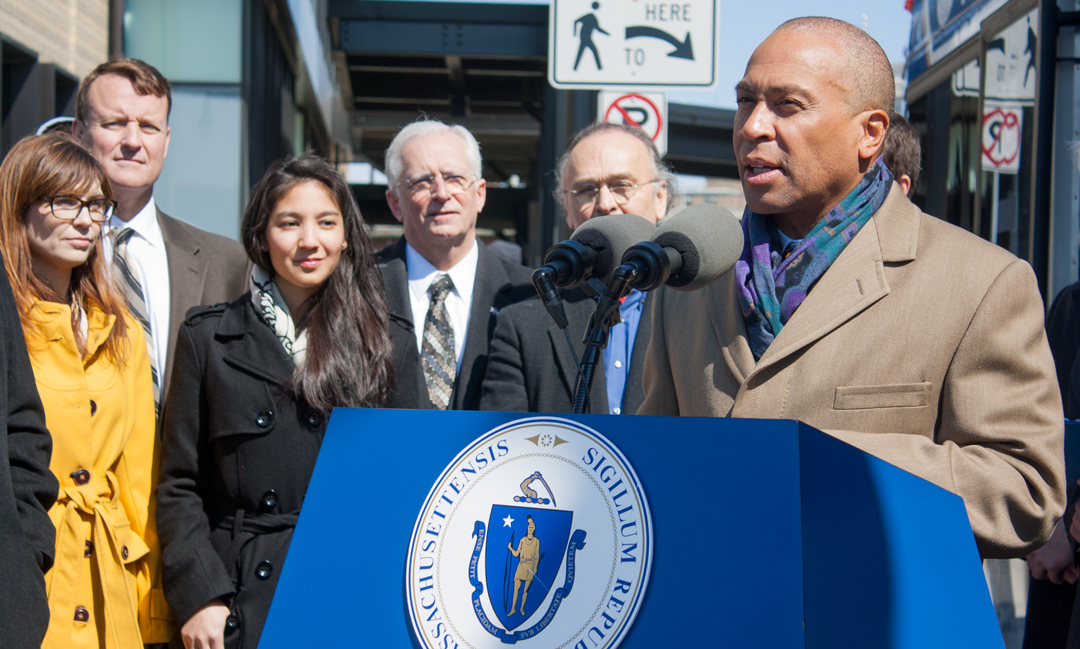
1 Gov Ptrick announces new electric rates

^ Governor Patrick to the people : “Pay for elctricity or twist in the wind !”

—- —- —

Electricity rates are going up by a whopping 37 percent. For almost all Massachusetts after the residents. The new rates were announced on October 1st and go into effect in November — after the election.

Of course.

It need not have been thus. Governor Patrick had plenty of warning of the problem : a shortage of natural gas. Because Massachusetts’ s economy is doing well — booming in Boston, at least — much more natural gas has been needed to power electric plants. The gas is there. Gas suppliers very much want to bring it into Massachusetts and are ready to do so ; except that none of the proposed nnew pipelines needed have won Governor Patrick’s OK.

Instead, Patrick has pushed the development of alternative energy : solar and wind. I have no problem with alternative energy, none at all. By all means let’s develop it. But making solar power cost-effective for the vast majority of people, especially in the cities, is a task encompassing an entire generation. Meanwhile, only natural gas can bring us electricity affordably and now.

So could coal power, but environmental activists have successfully made the case that coal power burdens the atmosphere. All of our state’s coal-powered electric plants are converting to gas. And doing so even though there isn’t enough gas for even current needs, much less conversion’s demands.

Two months ago I opined that Kinder Morgan, a major gas supplier, could expand its existing gas pipeline that parallels, more or less, Route 20 along our state’s southern tier. Doing so would set aside the company’s proposed pipeline along the state’s northern border. a route which aroused opposition in all 27 towns through which it would pass. Why wasn’t this southern addition approved ? Why did Governor Patrick do nothing ?

Because Massachusetts is the crux of all New England’s utility lines, Patrick’s inaction affects the entire region’s electricity rates. What was he thinking ?

Patrick’s inaction could not have happened if Massachusetts had a strong opposition political party to hold him accountable. He was able to get away with passing the huge political cost of this rate hike to his successor only because no such opposition exists on Beacon Hill. There are far too few Republicans in the legislature to force anything, annd none in the administration.

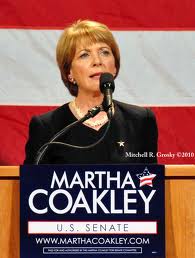
Some have asked, ‘where was Martha Caokley when this inaction was bruited ?” The answer : she was nowhere.

Coakely won only 23 percent of votes at her party’s nominating convention. Less than a quarter of the dominant political party’s activists wanted her. That the electricity hike occasioned by Patrick’s inaction might negatively impact Martha Coakley’s campaign was in no one’s thinking. Most of the people who matter on Beacon Hill were with Steve Grossman. That Coakley might end up the nominee was either not likely to the administration’s deciders or not a problem, because, so their thinking probably went, Massachusetts is now so democratic that she’d win anyway.

And so here we are, we the people, facing a huge increase in our electric bill that could not have — would not have — happened had we a strong two-party government in which the deciders had to take major objections into account, or else.

For me, the rate hike means $ 800 a year that I now cannot spend into the consumer economy : and i badly need a new iPhone, but don’t have the $ 300, much less $ 800. And you ? I suspect you’re in much the same boat.

What are we to think of the signal being sent ? That Martha Coakley’s political prospects were so lightly regarded by the Beacon Hill deciders that they saddled her with this stink bomb tells us just what she will be like as governor : disregarded by almost everyone, in office only to keep the Republicans out, and for no other, bigger purpose.

We deserve beter. We deserve two-party government. The deciders must be confronted before the decisions are made — or avoided — not afterwards, when it’s too late for anybody to do anything about it.

Meanwhile, get ready for November’s electric bill.

—- ike Freedberg / Here and Sphere

MAGOV14 : “I SEE PEOPLE, NOT NUMBERS”

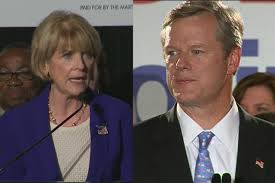
1 Baker and Coakley 1

^ Coakley : “I see people, not numbers.” It’s a line powerfully reminiscent of Scott Brown’s “it’;s the people’s seat,’ a line which clearly taught Coakley a ;lesson

—- —- —– —-

With this line, given to her by Governor Patrick, whose persona it is, Martha Coakley has taken her campaign to the high ground, the vision ground, upon which the governor election will be decided.

Meanwhile, Charlie Baker, whose campaign all summer long and for a month after, occupied, even defined, the vision ground, has lost his message and finds his campaign hogtied by charges and counter charges about stuff that has nothing at all to do with his message — or should i say, what his message ought to be.

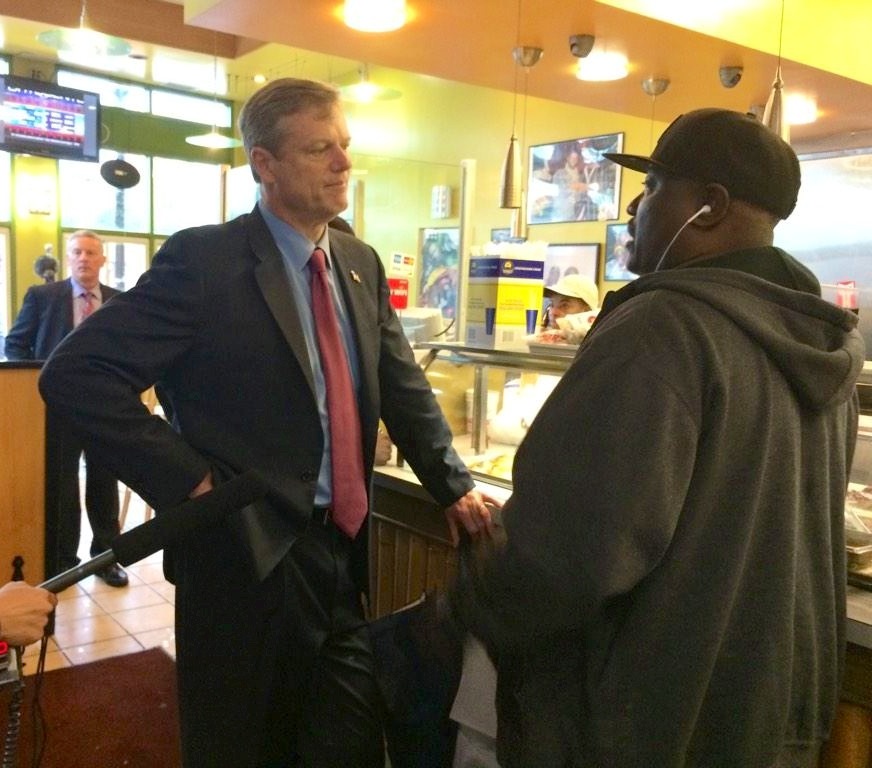
I’m not sure, the more I see of Baker’s actual campaign on the ground — who he talks to most readily, who he draws to his events, how he sees the state, his bartender stints, the Cellucci-like ethnic appeal of running mate Karyn Polito, that Baker doesn’t live, politically, in the early 1990s; doesn’t understand that Massachusetts has changed enormously since. Baker’s message of low taxes, small business tax breaks, and welfare reform carried the day.

For the past eight years at least, the GOP brand has lost whatever force it had for most Massachusetts voters and is today a non-starter. the only way for a Republican nominee to run is to cast the party’s distrust of people entirely aside and go for broke on high-minded reform : “I see people, not numbers.”

It’s also a strong connection to the female voters who are Coakley’s base. just saying…

Baker — or his advisers — do not seem to understand that today, Massachusetts is a values voter state above all, and that our values have developed a passionate core formed in opposition ton the values enunciated by the national GOP.

I read in today’s Globe that baker has amassed a superb, state of the art data bank to arouse Republican-minded voters on election day; a data bank which, he resolves, will get him the votes that didn’t come to the polls ifor his 2010 run. that’s all well and good; a candidate needs have aground game.” B8t if baker’s bottom line is to ra8ise his vote total rather than expand his message to encompass forward-looking reformers, he disappoints the hopes of those who see him as a man of the future, not a return to the past.

Yet Baker’s  potentially winning message — of bold transformation of state administration — can carry Massachusetts values very well indeed as long as he makes all-in clear his dedication to people, people, people. He says that he doesn’t have a “compassion deficit,” and often during this campaign he has proved his caring about people. But there’s plenty in his campaign plan, and in his talk about taxes going down, to let voters think that he is indeed the “numbers guy” that coakley says he is.

Only if voters feel confident that Baker won’t cut state agency budgets to the bone — as Bill Weld did in the years that formed Baker’s political life; won’t blame public assistance recipients for monies handed out by agency incompetence; won’t give workers seeking better wage packages half a loaf when they want, and — as I see it — deserve the whole loaf — only then will Baker win the political room to talk about budget numbers.

Perhaps I’m leaning too hard on Baker. his campaign has always had huge obstacles to overcome — barriers far bigger than the ones facing Coakley. She has only to convince people that she isn’t the vague, even passive place-seeker that she appears to be, and that she can be as charming as charlie. baker, on the other hand, has had to — felt the need to — appease a Republican electorate half of which haters everything that Massachusetts is and to convince “independent” voters — our state’s majority — that he will stand up the entire apparatus of Massachusetts party politics, even as he works to win the votes of many who prosper by party politics. And he has to do it while carrying a party label that most Massachusetts voters viscerally dislike. Maybe only a miracle man can accomplish the mission that Baker has accepted.

He can still win it. Martha Coakley remains greatly distrusted by many activists, disliked by even more. the state’s Democratic party is, as we all know, far too satisfied with itself, deaf, on Beacon Hill, to opinions other than its own. Inefficiency and incompetence go unaddressed by one-party rule of everything; and because of it, the people of Massachusetts lose out. yes, the people, even more than the numbers.

Baker should make that point. If the campaign is going to talk about people, people let it be : not only what people ant state government to do but also what state government does not do that hurts people. On that ground, Baker can win, and should. Whether he will take this message up or not, we shall soon see.

—- Mike Freedberg / Here and Sphere

MAGOV14 : CAMPAIGN WILL LIKELY BE DECIDED THIS WEEK

1 Baker and Coakley 1

^ Coakley or Baker / Most voters will decide during the next week

—- —- —-

By the end of next week — October 18th — almost all voters will have made up their mionds whether they’ll pick Charlie Baker or Martha Coakley. After that, whoever finds him or herself behind will have very few voters to win a strong majority of.

Charlie Baker looks in second place as we go into this crucial week. His campaign, so strong all summer long and after, so full of reformist optimism and powerful command, has lost its duende. Not all of that is his doing. the Children’s Defense Fund, anti-caokley ad knocked baker off message and, somehow, sucked him intlo iyts current. He should have known better. The ad completely misjudges how Massachusetts government operates,and it draws the opposite conclusion to the truth about what Martha Coakley is not. (Her problem is narrow zealotry, not reticence.) But Baker, instead of spurning the ad altogether — decrying, even, its ignorance — tried to have it both ways : “I don’t like the ad, but it has a point.’ Something like that is what he said.

Baker’s biggest mistake in this whole campaign has been his attempt to stand on both sides of controversial issues. That’s OK — maybe — if you’re already elected. it’s disastrous when you’re still a candidate. as a candidate you must — MUST — take a stand all-in on one side of a major issue ; that’s how you demonstrate to the voters that you are committed to policies that most of them (hopefully most of them) want.

Baker wants to be a centrist candidate ? Good; but the “center” does not lie in Straddle Country.

It took Baker all the way to the end of September to go all-in on values issues that the overwhelming majority of Massachusetts voters want : women’s health care rights and equality for LGBTQ people. That was good, and true : Baker has always been committed to these positions, but until he SAID it, his campaign rhetoric sent an opposite signal.

Baker now has only a few days in which to go all-in on committing his administration to the needs of people living in crisis, or receiving public assistance, and to the most effective, job-improving school policy.

So far, his campaign plan’s welfare policy reads like blaming welfare recipients for being recipients. He seems to blame recipients for the “fraud” found in welfare administration ; whereas the actual “fraud” — which doesn’t amount to much in dollar terms — arises almost all from poor administration.

Baker’s early education plan, which calls for different school projects for different needs — a sensible policy — sounds as if he doesn’t see the need for it except in a few cases. Meanwhile Martha Coakley is all-in on universal pre-kindergarten. Her position may be too sweeping : but voters embrace the commitment. Baker’s “I don’t like one size its all’ reads like straddle.

Baker’s straddle campaign almost certainly arises from his desire to keep the rejectionist half of tour state’s Republican voters from bolting. The stench of the crypt has hung around Baker’s campaign almost from its start. it’s why he chose Karyn Polito, rather than a more progressive figure, such as Gabe Gomez, as a running mate. (That Polito turned out to be the campaigning surprise, a powerful and caring presence — a Paul Cellucci twin — could not have been foreseen at the time.) The rejectionist threat is why Baker worked so hard to keep the toxic Mark Fisher out of his hair; it’s why Baker missed the bus on Paid Sick Leave. it’s why he imposes a job search requirement on welfare recipients.

The rejectionist Republicans count maybe six percent of Massachusetts voters. Their presence, as a crucial component of a Baker victory now threatens to make that victory unlikely. Baker made a pact with the devil when he gave these voters space in his campaign message. He should have cut them loose long ago and gone all-in on compassionate reform.

Martha Coakley, meanwhile, has become masterful at saying nothing — generalities ‘r’ us — in a very pleasing, conversational, fireside chat way. She does it at debates and looks — and sounds — like the most reasonble person in the room. She speaks in a voice that listens. That’s a marvelous gift.

During the Primary campaign, Coakley was able to finesse the passionate Steve Grossman; all of his comprehensive knowledge of every important state governance issue, and all of his often brilliant policy initiatives, didn’t triumph over Coakley’s easy-going conversation.

Coakley right now is a formidable opponent who has been handed several issues by Baker’s wrong-footing and straddle. Because Democrats outnumber all Republicans in Massachusets by three to one, she will win this election — that Baker leads among independents, the majority of voters, can’t counter this math — unless Baker very quickly finds a way to steer his message back to what he seemed to represent all summer long : positive reform that works for everybody, and an all-in commitment to the needs and aspirations of every part of diverse Massachusetts, from communities of color to immigrants to working families being left behind, and to single moms overtaxed by family crises every day.

—- Mike Freedberg / Here and Sphere

MAGOV14 : POLITO, KERRIGAN DEBATE IS ALL ABOUT WORCESTER

photo (17)

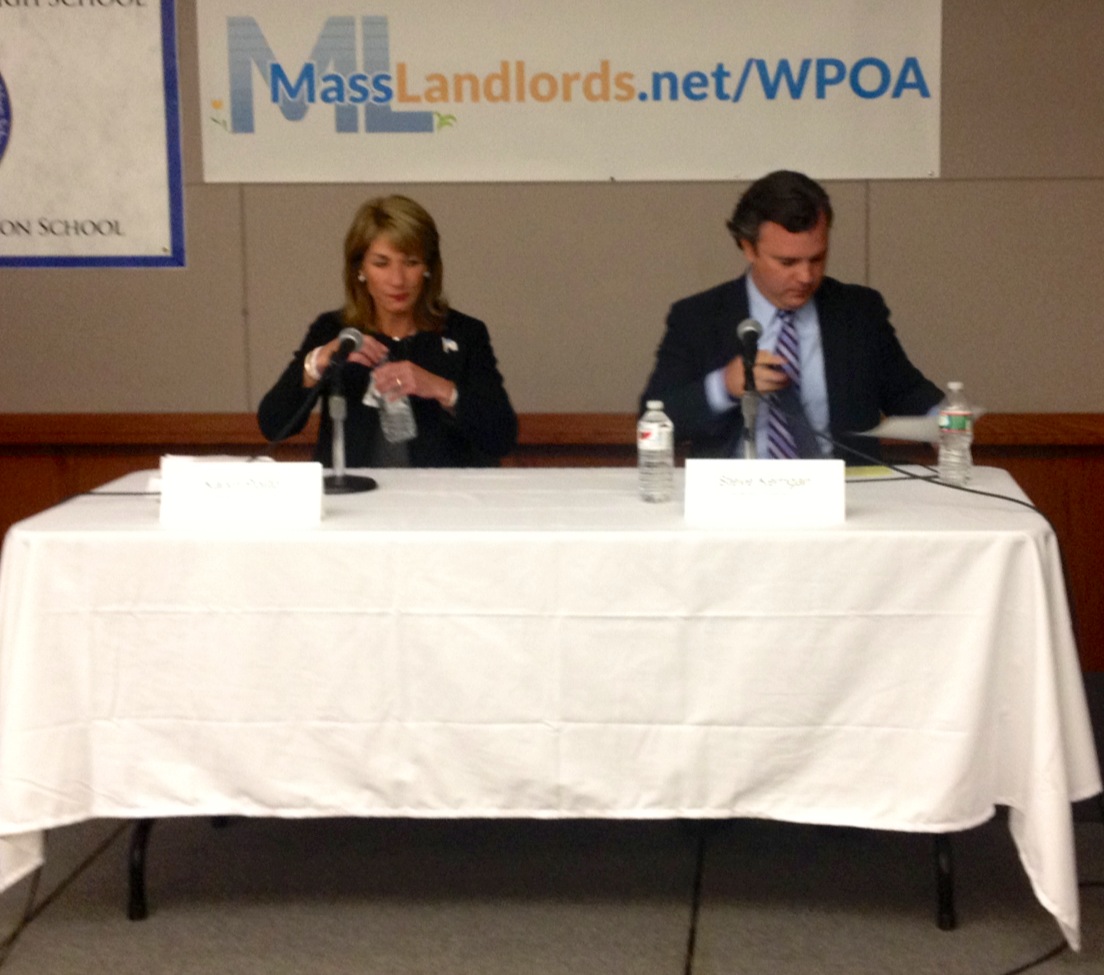
^ Karyn Polito and Steve Kerrigan give all their Worcester-ness to their home region at their Worcester debate

—- —- —-

Last night, at Worcester Technical High School overlooking Lake Quinsigamond, the two candidates for Lieutenant Governor — Karyn Polito and Steve Kerrigan — debated for an hour.

The two may be running state-wide, but almost all of last night’s debate was about Worcester. Both Polito and Kerrigan hail from Worcester County — Polito was a five-term State representative from next-door Shrewsbury; Steve Kerrigan has been a selectman for many years in nearby Lancaster . The debate was moderated by a past mayor of the city, Ray Mariano; and many of the questions Mariano asked were Worcester-specific.

Often I felt like I was watching a debate between two candidates for a Worcester seat in the state senate.

That said, Polito commanded almost from beginning to end.

The first debate job of a Lieutenant governor candidate is to argue for his or her running mate’s plans. Polito did her work of discussing Charlie Baker’s plans — including economic development plans for Worcester — much more thoroughly than Kerrigan on behalf of Martha Coakley. Often, in his answers, Kerrigan didn’t mention Coakley at all. Polito failed to talk of Baker only once.

Polito had apter answers than Kerrigan to moderator Mariano’s specific questions, many of which were Worcester-specific or upside down. Asked by Mariano, “”what policy advanced by the other candidate would you adopt ?” Polito lauded Coakley’s plans to address violence agianst women. Kerrigan lauded nothing of Baker’s. It seemed an ungenerous moment.

On the other hand, Kerrigan agreed with many of Polito’s economic development responses and, generally, made an affable presence and gentlemanly, even if most of his answers came across conversational rather than authoritative.

Kerrigan’s strongest moment — certainly his most specific — was an attack on Baker’s record of fiscal management when he oversaw the “Big Dig”: twenty years ago for the Weld administration. Polito deftly countered by saying ‘we’re not running for twenty years ago, this campaign is about tomorrow.

Polito’s weakest moment was her answer to a question about welfare eform. She discussed welfare fraud but seemed not to grasp that almost all of it results not from recipients’ scheming but from incompetent management of the agency that oversees ‘transitional assistance.” But the baker plan for welfare reform really let her no choice. Welfare is the issue addressed leat convincingly by Baker.

Polito’s strongest answer was given to Mariano’s question, ‘why do we need a lieutenant governor ?” Kerrigan fumbled to respond — to a question he jokingly said he gets asked all the time. Polito pointed out that she and Baker are a team and have been one for almost a year, whereas the Democratic pair came together only by the result of that party’s primary. that Baker and Polito are a team has always been a major advantage to the Baker campaign; often there have been Democratic governors and lieutenant governors who, thrown together by primary voters, didn’t see eye to eye, and, in a few cases, hated each other. Kerrigan and coakley seem to be workling well enough together, but it’s as yet unproven. Whereas Polito made clear that the state might even benefit from having a lieutenant governor trusted enough by the goverbor to be a partner in the work of reform.

But all of the above took a back seat to praise for Worcester and even for its poiticians. it sounded odd to my Boston-based ears to hear both candidates laud former Mayor Tim Murray, who to say the least crashed and burned on the big stage and decided to resign his office. In Worcester, however, he’s a hometown hero.

The Commonwealth’s second city defends its own as it seeks to be noticed, even attended to, by the bigwigs in Boston.

—- Mike Freedberg / Here and Sphere

MAGOV14 : DID LAST NIGHT’S WBZ DEBATE MATTER AT ALL ?

1 Baker and Coakley 1

Last night’s big governor debate, sponsored by WBZ-TV, occupied an odd space in this intensifying campaign. The momentous events of the campaign are taking place elsewhere ; the movement of most unions to Coakley, the now infamous Children’s Defense Fund PAC ad, the attention being paid by Baker to Springfield, the gender gap, on both sides, between the two candidates. These are the actions now driving voters’ decisions – and believe me, they are deciding. Tons of twitters followers for Baker — fewer for Coakley — have risen seemingly from nowhere : ordinary voters, not political insiders. Nor is twitter, of course, the only arena of decision or even the biggest.

So ; did anything at all happen in the WBZ debate to match any of the above ? Perhaps. Baker’s twitter following grew significantly; Coakley’s too. The debate moved some voters from undecided to decided, or from decided to committed.

Personally,l found the debate quite boring. Baker often delved into administrative details, as if he were presenting to a policy seminar. Coakley said very little that was specific — she never does — but said it in a conversational voice, a fireside chat manner less formal than the wonk-y Baker, who lacked his trademark smile and showed almost none of what opponents call “Charming Charlie.” If only Steve Grossman had been on that stage, to deliver his articulate, masterful policy points in a voice passionate and fun ! He is very much missed.

Baker had the better night. It was classy o him — and smart — to say to Coakley that ‘no one is challenging your record as a child advocate across a long and distinguished career in public service.” I can’t recall ever seeing a candidate give such a kudo to an opponent on a debate stage : and if after the very mistaken Children’s Defense Fund ad a kudo was needed, it was not a given that Baker would say it. But he did.

Baker also laid out his basic theme — transforming the often inefficient, even incompetent management of state administration — with full authority. (As he always does.) He discussed the particulars of the Springfield economy, including siting of its casino, with Grossman-like thoroughness. The Springfield theme has come to the fore in Baker’s campaign for two reasons ; on the small scale, it’s usually a 20-point loss for a Republican candidate : Baker hopes to get close, maybe win the city. Just as significantly “Springfield” is the symbol of how Baker addresses one of this year’s major governor issues : raising up the economies of the estate’s cities outside the Boston economy boom.

Coakley offered no equivalent. I’m not sure she grasps the significance of Baker’s Springfield theme.

Coakley offered few specific points but doesn’t really need any. She is a Democrat and a woman.

She spent much time addressing herself not to Baker buy to Evan Falchuk, an “independent” who stood immediately to her left (the candidates being lined up alphabetically). Granted that Evan Falchuk had much to say that was critical of both the major candidates — and of state government. I think dhe did this in order to deflect attention from Baker and give it to Falchuk, the independent. If so, it was a smart move : “independents” comprise 52% of Massachusetts voters and will be the overwhelming majority of Baker’s vote if he wins.

But Baker made the strongest, directest, and, as I see it, most convincing statement about independence : that much of the failure on Beacon Hill is attributable to having only one party, the Democrats, in charge of every branch. There has been much to criticize about state administration during Deval Patrick’s second term, and much to correct as it has taken place; yet neither the criticism nor much correction have happened because it’s in no Democrat’s interest to go that route (although Steve Grossman went that route at many pre-Primary Forums).

Baker is on solid ground here. Massachusetts voters usually prefer to elect non-Democrats as governor in order to keep a watchdog eye on one-party rule. The state has worked well thereby, not so well under the popular but sometimes ineffectual Patrick.

On that point alone, Baker won the debate. That’s what happens when you make a key governance point that everyone agrees is true. Coakley made no such point, but she too had her victory, because she is, yes, a woman in a state that has yet to elect a woman governor.

And both candidates won by not being Scott Lively. His bigotry, stupidity, and just plain gutter venom made everyone else on stage look ten times nobler. hHw the other candidates could stand on that stage and not vomit in Lively’s face, I do not know. I applaud their self-control. I could not have managed it.

—- Mike Freedberg / Here and Sphere

MAGOV14 : COAKLEY SEEKS LINEUP, BAKER HITS HOME RUNS

photo (11)

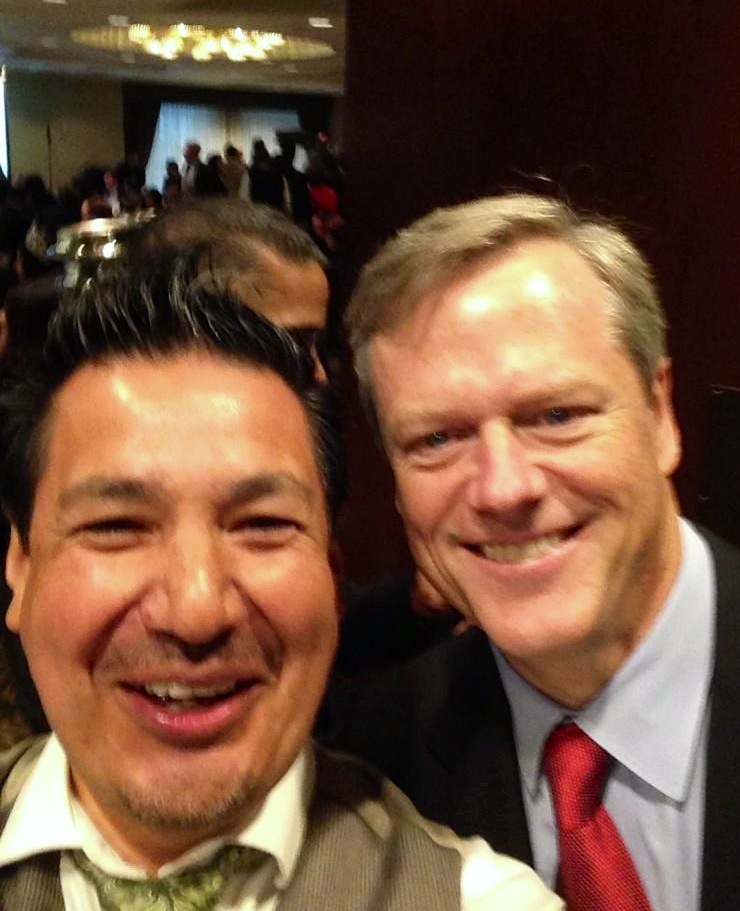
^ Charlie Baker with Emcee Baltazar at El Mundo’s 5th Annual hispanic Heritage Breakfast in boton last week

—- —- —-

It isn’t over yet, not by a long shot. Polls have Charlie Baker up by one to three points. My snse is that he’s ahead by more. But I also sense that his amrgin is peaking. Martha Coakley, buoyed by Michelle Obama’s visit, Baker’s Paid Sick Leave misfire, and by the overreaching PAC ad about her fighting the Children’s Defense Fund, has a campaign now, and it’s beginning to show.

Helping her as well is that the campaign has fully dived into mudpie mode. Demagogic, misreading, even palpably false ads are being dumped into the campaign by outside interest groups — do these folks have nothing better to offer than slime and scurrility ? — and one thing you can count that such ads will do ; make the opposition angry, driving up turnout and arousing passion among supporters of the person attacked.

Beyond their stink, the mudpie ads hurt Baker more than they damage Coakley. Until they appeared, Coakley had no campaign, almost no issues; nobody but her (very few) supporters wanted any part of her side. that has changed. The charges against her have given people a reason to come aboard and help. Even a blah candidate becomes sympathetic when unfairly ambushed.

That said, it’s very late in the election for Coakley to rev things up sufficiently to catch Baker, whose campaign has moved right along doing what it has been doing, targeting city voters and communities of color with a message optimistic, reformist, inclusive and — most o the time — all in on the social basics almost all of us subscribe to. It’s a plus to be so aggressively positove. Voters want to know (1) what you stand for and (20 how passionately committed you are to it. they also want to know that your commitkehts are, for the most patm theirs as well.

Charlue baker has done all that and continues to do it. his campaign is moving fast. In Boston, he continues to knock and expand the knocking. He’s busy on the North Shore, in the Framingham to Waltham corridor and — the real surprise, perhaps — in Springfield. That’s a lot to cover — and his running mate Karyn Polito is working just as hard in Worcester and in the Italian-voting regions north of boston Harbor — but, because Baker began the effort long ago, as of now he is revisiting places already visited. that’s what you want to be able to do once the election reaches its last month. it’s way too late to depend upon first-visit outreach.

On a first visit, a candidate is usually received politely; the voters are in meeting-you mode. For most, it’s the repeat visit that wins a vote. baker and Polito are making many re-visits in places where it counts. They will keep on doing it.

Meanwhile, Martha Coakley finds herself still in the foundation stage. All summer long she had to fight off a superior, but much less well known, Steve Grossman, and she did so not by taking the bold initiative but by playing the caution card. at orums she said as little as possible. She won her primary — narrowly, only because more articulate and bold Grossman lacked her universal name recognition — without rising to any occasion but itself.

Now she has to live with the consequneces pf her caution decisilon : at a time when she needs to be sewing up votes, she is having to do the introduction visits that Baker did months ago.

Coakley also lacks a coherent message. there is no drama in her campaign except what was given to it by the twisted Children’s Fund ad and bhy Michelle Obama’s visit. Baker’s campaign has a very coherent message — unleashing the power of small business and ramping up school performance to grow the economy — and the drama in his campaign arises from him alone. it is not imported.

Baker won’t win in a landslide; there are many issues on which his position is less cogent than Coakley’s — think labor matters especially, but also immigration receptivity. But if Baker continues moving at the relentless steady speed he now commands, Coakley will find herself a week or two behind him. This is not a recipe for victory.

and what is her campaign message ? It used to be “defending women’s health care rights” and was very clear nad understood by the voters,. But Baker has made it just as clear that he is all-in on women’s health care issues too. Baker has had some success with women voters thios past month, and quite a bit of “yes” from LGBT voters as well, as it has become clear that LGBT issues are personally important to him and not just a policy matter. Right now I do not see how Coakley beats Baker to the ten or so percent of voters who remain undecided.

She had better find lightning in a debate bottle. Either that, or mistakes by Baker — and he has made a few. All yrear long I have seen no lightning from Coakley. Legalese, yes. Light, not so much. The voters know the difference. It’s Baker’s election to lose.

—- Mike Freedberg / here and Sphere

MAGOV14 : COAKLEY Vs. THE CHILDREN’S DEFENSE FUND

1 Martha Coakley at rally

^ handed a campaign thanks in part to pressure group misreads : Martha Coakley

—- —- —-

An issue that is no issue — except in a way that wasn’t mentioned — has now become an issue thanks to a misconceived and quite erroneous ad dropped into the governor race by an outside interest group.

The ad claims that Martha Coakley, as our state’s attorney general, somehow “failed to protect children” by oppoing the Children’s Defense Fund, which sued the state to bring about major upgrades in how DCF (Department of Families and Children) operates. This claim is nonsense. As the state’s lawyer, Coakley had a duty to oppose the suit. She did so.

The ad seems to suggest that the failures at DCF — grievous ones though they be — are somehow to be attributed to Coakley because, by winning that lawsuit, she assured that no changes would be made. This too is nonsense. The Governor’s office oversees state agencies. Failures at DCF go on the record of Governor Patrick. If Patrick decided that Coakley’;s winning the Children’s Defense Fund lawsuit gve him a pass, he — not Coakley — was quite wrong. Judge Young, who heard the case, made it clear that DCF needed to change its ways; that though the changes sought by the Children’s Defense Fund did not rise to the level at which the Court could by law intervene, reconstruction was definitely in order.

But all that was for Governor Patrick to act upon.

Meanwhile, the outsiue group’s ad has given Coakley’s campaign a big boost.

Coakley has had a strong last three days. First came Charlie Baker’s Paid Sick Leave (PSL) plan, which falls short of the plan that will be on November’s ballot and which will pass overwhelmingly. By his PSL plan Baker gave Coakley an opening to many labor unions. Now, the outside ad, coming the night before Michelle Obama’s electrifying speech yesterday on Coakley’s behalf, has energized many Democratic activists who had hardly, if at all, lifted a finger.

In Boston, at least, the battle is joined, Baker’s city thrust blunted somewhat.

Baker needs now to find a strong crunch-time stride; to get back into positive mode with large vision, authoritative plans, and all the inclusion he can muster wherever her goes — continue to campaign in the cities, all of them — and to make sure the race is decided on competence, reform, and, yes, the future, not the past or present, of our cities. If Baker can do most of this, and keep the outside pressure groups far, far away from him, he will win and should win.

If not, then probably not.

—- Mike Freedberg / Here and Sphere

MAGOV14 : PLAYING CATCH-UP IN CRUNCH TIME : THE COAKLEY CAMPAIGN

1 Martha Coakley at rally

^ help for a candidate who needs to help herself : Martha Coakley in catch-up mode

—- —- —-

The Governor race has entered crunch time. Debates, ads, press conferences; charges and counter charges; who did not do what, when, and to whom. it’s all there, the political air is full of missiles, bullets, and even a couple of stink bombs. And that’s OK.

As crunch time begins, the race looks close if you follow the polls : yet every instinct and observation tells me that Charlie Baker is ahead, probablysignificantly. He has three times the cash in his campaign coffers that Martha Coakley holds, and the dollars keep on dialing in. Baker is winning important endorsements; wowing attendees at Forums; manoeuvering his message one step ahead of the Coakley train, broadenming his ,message ever wider than Coakley’s briefcase sights.

Baker used the summer weeks brilliantly to plant his campaign squarely in the big cities (especially in communities of color) and on the North Shore, and he has doubled down on both regions since. The move appears to have caught the Coakley campaign by surprise — or which she is not to be faulted, as until now no GOP candidate in Massachusetts had, in decades,risked a major big city effort. Baker has done it, and it has succeeded : polls show him tied with Coakley in Boston and its immediate suburbs, a region where in recenmt elections a GOP candidate loses by 20 to 30 points.

photo (39)

Charlie baker in Grove Hall, boston, with Larry Ellison of the Minority Officers association endorsing him and accompanying him

Recently, Baker has begun a major push in the winnable western suburbs of Boston (Framingham, Natick, Wellsley, Wayland, Weston, Needham and such) — a region that since the 1990s has trended inexorably to the Democrats. Now comes Baker, with a message of all-in on women’s health and gay rights that has begun to win him friends in this progressive values region (where cDemocratic hopeful Don Berwick won many votes on Primary Day) : as has his emphasis on aligning education with technology, reform of state administration and — Baker’s powerfully authoritative presentation both in ads and face to face. And in debate.

In comparison, the diffident Coakley, anxious at events and given to avoidance or imprecision at Forums, has seemed not the leadership figure voters expect our governor t9o be. This side of caokley has been apparent all year long, at orums and events. The news is that she also seems to lack basic campaign knack. Many candidates who get pushed into the behind position find a way to rise out up and win despite. So far, Coakley has shown no such resilience :

1.She has aksed the Democratic party to help her . Dooes she not see that a governor ought to help the party, not the party the governor ? Help in politics comes to those who show the ability to profit by it.

2.She appears at rallies with a phalanx of top Democratic office holders, when far hetter would be fpr her to stand entirely alone, at press conferences and at rallies, and focus the voyers’ eyes on her and only her. A Governor should not need a crowd around him or her in order to appear important.

3.She evidently refuses to embrace the underdog position, despite its power to move people. Granted that few Democratic politicians in Massachusetts ever find themselves the underdog and so don’t really know how to make underdog status an advantage. Coakley not only appears not to know how, but even to deny that she’s in it.

Coakley has gone on the attack, but her attack opens up her own record — a long record as prosecutor and overseer of charitable institutions, and an uneven, even at times shameful record it often is, on issues of all kinds, narrow and broad.

Team Coakley seems to have expected the baker campaign to be a typical 2008-2012 Republican one : right wing on everything (or almost), rural, base-oriented. Instead, Coakley got a Baker campaign progressive on much, fully committed to LGBT issues and women’s reproductive choice, very much a big city campaign in tone and presence, and a campaign always welcoming, always positive.

Donors are not fools. They can sniff a winner. They give nore to a winner than tio a likely loser. Even “PAC” money isn’t bottom;ess. The Democratic party can call on many well-funded PACs, but donors even to PACs spare scant money for lost causes. The Democratic party’s first priority right now is to win enough US Senate races to retain control. (there are at least twelve senate seats in play.) I doubt that the Party has much time or funds on hand for a weak candidate fior governor, an office with no national party implications or consequences. Meanwhiole,. Baker and his running mate Karyn Polito raised a cool million bucks in September — to Team Coakley’s 330,000 — and Baker’s fundraising is still gaining speed. He will get his message. Can coaklry deliver hers ?

Only if she embraces the unerdog position fully, utterly, passionately ; which means main-theming an issue, one issue on;ly, an issue powerful enough, and her advocacy of it convincing enough, to make voters take a second look and rethink their choice.

Doing that is one of politics’s most difficult tasks. Passion, conviction, credibility, risk, and an issue that all the voters can iunderstand and agree with : all must be there I have yet to see any indication that Coakley has it in her, or sees the need to find it and use it. She has scant time left

—- Mike Freedberg / Here and Sphere

MAGOV14 : BAKER GIVES COAKLEY AN OPENING

1 Martha Coakley at rally

^ Paid Sick Leave : Martha Coakley now has an issue she can run on, thanks to Charlie Baker

—- —- —-

On November 4th, one of the referenda that voters will approve or not concerns Paid Sick Leave. Charlie Baker stated that he will vote “no.” He approves the concept, he has said, but not the specifics.

That was bad enough,. It allowed voters to conclude that he isn’t committed to a policy they very much want. Paid Sick Leave looks like it will get a “yes” vote by more than two to one — 56 to 25 in a recent UMass poll — putting Baker very much on the wrong side of a paycheck issue. Not good.

Baker has now offered his own Paid Sick Leave (PSL) plan, and it compounds his mistake.

The Baker PSL plan offers it to employees of companies with 50 or more workers; the ballot question applies to companies with as few as 11 employees. Who the blazes advised Baker to cut out the thousands of workers who toil for companies employing 11 to 49 people ?

Baker’s plan gives workers even in companies employing 50 people or more a weaker PSL. It doesn’t begin to accrue for three months, where the ballot referendum begins it immediately; and that they can gain PSL only one hour for every 40 hours worked — the ballot question pegs it at one hour to 30. How petty can he get ?

Politically, Baker’s plan undercuts his own campaign. To what purpose has he campaigned intensely in the big cities, every day, to communities of color (COCs) — where workers have the lowest rates of PSL — if he now offers them a PSL plan that gives them less than they are going to vote in favor of at the same election as Baker’s ?

And COC voters WILL know the difference. Because the Coakley campiagn will make them know it. Her people are already on it.

Until the PSL issue burst forth, Baker had Coakley smothered. She had no opening, nothing to attack; on every major issue, Baker either seemed to have a better answer than Coakley, to be more authoritative,as progressive socially;  or, on initiatives, to offer an alternative at least as beneficial as any of Coakley’s if not more so. Baker’s vision was broader, his articulation of it clearer, than anything Coakley tried to say — and most often, she didn’t even try.And on most matters, all of that is still true ; Baker has by ar the stronger agenda for reforming Massachusetts government.

Now, however, inan election too close to call, Coakley has her opening, on a bread and butter issue that even she can articulate, and is articulating.

Baker’s timing could not have been worse. These three weeks are the time in which almost all voters are solidifying their choice. Michelle Obama comes to Boston on Friday to boost Coakley’s standing. Unions are much more potent, politically, than they were when Baker last ran in 2010. Into all of this momentum and organization, Baker has now wrong-footed himself.

He has no excuse. The very intensity of his face to face campaign in the cities assures that he knows very well what is happening and what city voters are thinking. For all his bartending at guy bars, seeking the sports dude vote, where few policy matters are discussed and politicians in general are talked down — most of it bull-bleep — Baker has also talked aplenty to voters who have paycheck concerns. He cannot say that he doesn’t know the score.

He has given half a loaf to voters who want all-in. On an issue where every voter can count the difference.

Baker also knows well that very few union endorsements have come to Coakley. He has tried to romance some of the key unions still uncommitted. How does he win their endorsement now ? The membership of wht union will tolerate theior leaders endorsing a candiate who offers half a PSL loaf instead of all-in ?

Baker has also worked hard to assure Boston Mayor Walsh that he will be an ally and even a partner. So far, Walsh has not lifted a finger for Martha Coakley. But unions are Mayor Walsh’s core constituency. how can he now stay on the sidelines as so far he has pointedly done ?

Every poll shows that Baker has, at most, a two-oint lead over Coakley. My own feeling is that, until twlo days ago, he had quite a bigger lead, maybe six to seven points. easily his PSL plan will cost him three points, maybe four or even five points — the Coakley camapign, now alive again after looking quite dead, will see that it does. Even a three point switch defeats
Baker.

Baker has now put himself on the defensive in a state where a non-democrat has scant margin to do so even for a day. What opponent’s mole seduced him to do this ? Who in his campaign didn’t veto it ?

—- Mike freedeberg / Here and Sphere