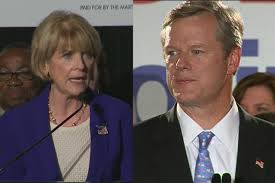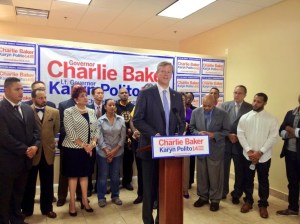
Whom will the Globe endorse for governor?

MAGOV14 : Former Boston phoenix colleague dan kennedy weighs in on whom the Globe will endorse for governor.

Dan Kennedy's avatarMedia Nation

Screen Shot 2014-10-25 at 10.03.43 AMSometime this evening, I imagine, we’ll learn whom The Boston Globe has endorsed for governor. So today we can play a parlor game and try to figure out the choice.

I thought Martha Coakley’s chances improved when challenger Seth Moulton beat incumbent John Tierney in the Democratic primary for the Sixth Congressional District. Why? Because the Globe surely would have endorsed moderate Republican Richard Tisei over the ethically tarnished Tierney, as it did two years ago, thus making it easier to endorse a Democrat for governor. But the Globe seems certain to choose Moulton, a liberal war hero whom it has already endorsed once this year, over Tisei. (That may come tonight as well.)

Today, though, came the Globe’s endorsement of Patricia Saint Aubin, a Republican who’s challenging incumbent state auditor Suzanne Bump, a Democrat. The folks who run the Globe’s liberal editorial pages generally like to endorse one…

View original post 177 more words

PABLUM AND PUKE : THE 6TH MASSACHUSETTS CONGRESS DEBATE

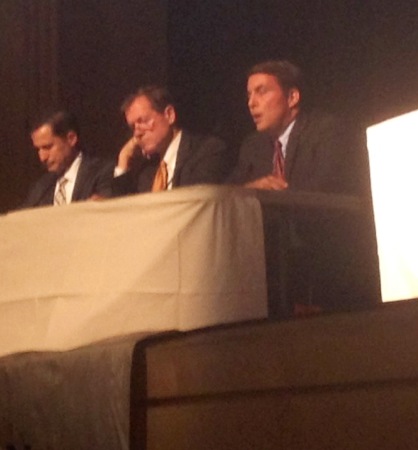
photo (15)

(from left : Seth Moulton, Chris Stockwell, Rich Tisei)

—- —- —-

Danvers High school’s capacious auditorium was full on Thursday night, for the last in-person debate between the three candidates who seek to be next Congressman from a District that takes in most of northeastern Massachusetts. The Lowell Sun newspaper moderated the session; three of its diligent journalists asked the questions.

If only the two major party candidates had responded to their questions with equal diligence.

One hopes — one has a right to expect — that candidates gor the Federal Congress will address major issues — budget priorities, fueling and regulating the economy, enacting immigration legislationl dealing with energy issues, and, yes, bringing Federal funds into the District — would speak informedly about them; would propose what he intends to seek, and why; would seek solutions to difficulties, not aggravate them with rants and bulk them with pablum.

I was so hoping, and I was much disappointed, when I was not being insulted, by the verbiage rolled out by Republican Rich Tisei and Democrat Seth Moulton.

Disappointing was the first half of the debate, in which Tisei delivered an unfocused opening speech and Moulton a pontification; in which both men fumbled for specifics, or packaged them in high-blown blather.

Not until that half way point did Mr. Tisei hit upon an argument actually meaningful : that today Massachusetts has no Congress person who belongs to the majority party, a situationm that limits the effectiveness of our delegation in all things as it hurts our state’s power to secure Federal funding.

It would have been nice if Tisei had followed up his argument by telling the debate audience just what he would do with his majority party clout. Would he secure Federal funding, and or what ? Would he advocate for reformist education bills ? Promote alternate energy ? Pass immigration reform ? Fight to raise the Federal Minimum wage ?

But no; Tisei spoke of small business — this year’s buzz phrase — tax burdens, and he loudly insisted on “securing the border” : offering undocumented immigrants a path to citizenship, said he, insults those “legally” here who have waited so long. To which he added that “illegal” immigrants shouldn’t have drivers’ licenses, nor should they be able to get into piblic housing, hiveh the long waiting list. (Moulton said, quietly, that he would grant a path to citizenship.)

Granted, that Tisei had to spend much time responding to an outside PAC ad dropped on behalf of Moulton, in which Tisei is accused of voting against veterans. Tisei called the ad ‘a lie,’ and Moulton, who had the chance a few days ago to call for the ad’s withdrawal, instead doubled down on its assertions — which led the debate into byways and pathways of bills and budgets debated, or enacted, in the Massachusetts legislature years ago when Tisei was a state senator.

It was a mistake for Tisei to digress the debate, as it was for Moulton to abet the digression. But the digression, and the charges and counter-charges, drew my attention — as for some in the adudience — to the third candidate, Chris Stockwell.

Stockwell, who like Moulton lives in Marblehead, addressed every question directly; spoke of his entrepreneurial experience; adduced progressive solutions to the various immigration issues demagogued by Tisei (issues that, admittedly, Moulton also responded to progressively); and, in general, spoke with humor as he framed his answers in the moment.

It would have been nice if Tisei and Moulton had edified the debate, and dignified the high office they seek, had they too franmed answers thoughtfullyu in the monet rather than speaking so obviously under pressure from the various outside PACs — the two men wasted debate time accusing the other of taising big money on Wall Street, as they both have done — that today ruthlessly pimp those who seek high office.

Stockwell, of course, has no PAC money and so is free to discourse like an actual candidate.

It woiuld have been nice, indeed, had Tisei and Moulton acted like potential Congressmen rather than expensive whores. But that’s what it’s come down to, today, in the era of Citizens United and one-issue PACs sucking up greed and spitting it back out as puke and pablum.

—- Mike Freedberg / Here and Sphere

WE ENDORSE : CHARLIE BAKER FOR GOVERNOR

photo (23)

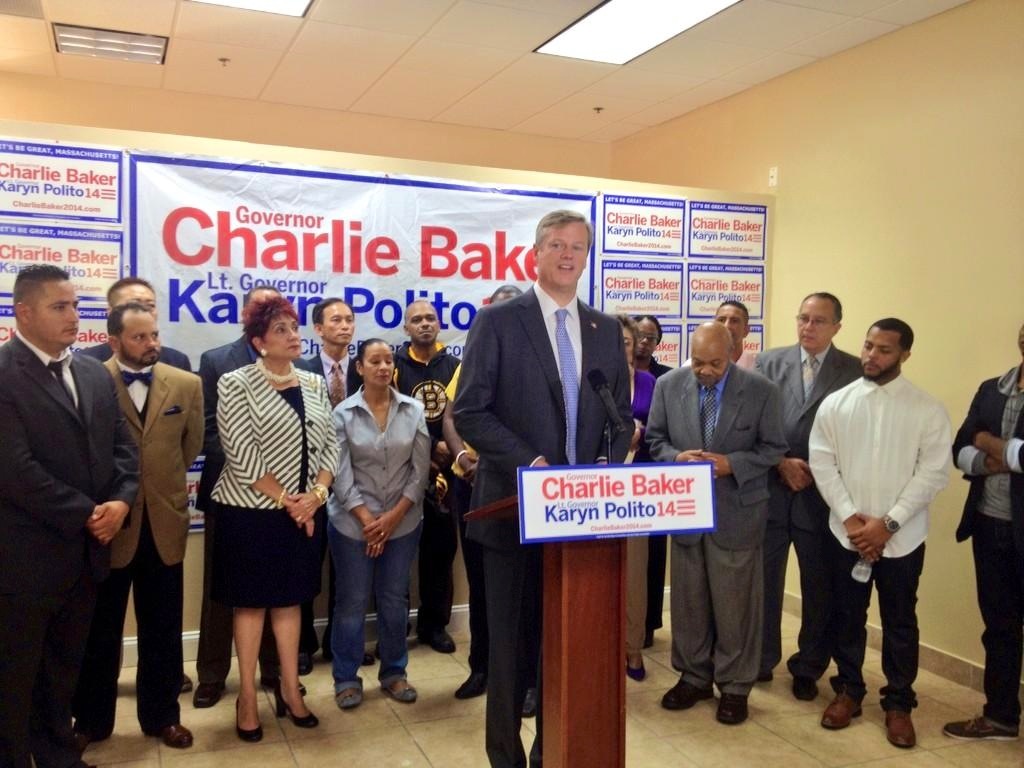
The editors of this paper often disagree on political matters; but about who should be Massachusetts’s next Governor, we are in full accord : Charlie Baker is our choice.

Massachusetts state government badly needs new energy and a new way of doing its business. During the past four years, and especially the last two, we have watched numerous breakdowns in state administration : DCF losing track of children in its care; scandal at the state’s crime lab, that has put hundreds of criminal convictions in doubt; mistreatment of inmates — in one case, resulting in death — at Bridgewater State Hospital; at least 200 million taxpayer dollars wasted on a failed Health Connector website — and loss of health insurance for thousands of us; lastly, a confused and often contentious Transportation funding bill that left us with too little money to do the necessary repairs and upgrades and much of that money coming from a taxing method opposed by at least half our state’s citizens.

Charlie Baker is exactly the right person to tackle this systemic breakdown. He oversaw the successful turnaround of Harvard-Pilgrim Health Care, from bankruptcy to rated as the top health care management enterprise in the state, serving one million Massachusetts people. Before that, as a top administrator working for Governors Weld and Cellucci, he learned how to make failed systems work better, often in crisis mode day after day. There were, as we have learned during this campaign, failures along the way, many of them caused by the state’s lack of monitoring systems. From those failures, Baker learned, as skilled managers must, and his work at Harvard-Pilgrim shows it.

Remaking state government’s delivery of services will not be easy or quick. The state’s outmoded technology must be upgraded radically. Interface between agencies and the public must become user-friendly and quick. Budgeting must be made transparent — as it isn’t now. Before the primary, Democratic hopeful Juliette Kayyem called this transformation “better data management.” That it is, and Charlie Baker has sworn to do it.

It’s his bottom line, a task that he believes in passionately, as he has demonstrated at Forums and debates.

Baker knows that state administration failure doesn’t only waste money (though it does that too); it also disrespects all of us. Baker’s opponent has charged that he sees “numbers, not people” ; but is not a faiulure of “numbers” equally a broken promise to our people ? Baker gets this equation.

Baker is willing to admit past mistakes — in politics, a very uncommon thing. If a reformer is to win the confidence of those he hopes to serve, it begins with trust in the person; and by admitting his past mistakes, as he has, Baker uncommonly earns our trust.

Meanwhile, his opponent, Martha Coakley, in debates now and all year long before the primary, has refused to admit to anything and declined to commit to major policy questions. She has offered a plan having worthy objectives — but no suggestion at all how she will accomplish them. On several issues, the scourge of drug addiction most blatantly, she doesn’t seem conversant with what is actually happening. As for state administrative failures, Coakley says nothing, offers no correctives.

Coakley has won some worthy battles as Massachusetts’s Attorney General. She has successfully fought foreclosure abuses by major banks, winning multi-billions of dollars in settlements. Her office’s Civil Rights chief — Maura Healey, soon likely to be our next Attorney General — argued and won the landmark 2004 case that made Massachusetts the first state to sanction marriage equality. But just as often, Coakley has gone down a wrong road. One instance especially needless was her prosecution of former state Treasutrer Tim Cahill for ethics violations civil in nature — charges of which he was acquitted.

A reformist Governor must, az we said, have the confidence of the people, and of State employees at all levels, if he or she is to accomplish these reforms. Yet Coakley was the choice, at her party’s nominating convention, of only 23 percent of the delegates. She barely avoided finishing third. Those who know her best gave her the opposite of a vote of confidence.

Mean while, Charlie Baker has amassed a following prodigious in its size and breadth. Those who know him best, the people of his home town, Swampscott, and on the North Shore nearby, have given him more than 6,000 of his 30,000 individual campaign donations. Baker has campaigned intensely in the state’s biggest cities — over 150 campaign events in Boston alone, in every part of the city. Not many of last year’s Boston Mayor candidates waged a campaign more inclusive or intense than Baker for Governor this year.

Baker has done much the same in Springfield, Worcester, New Bedford, Fall River, Lowell, Lynn, Brockiton, Revere, and Quincy. These “gateway” cities, and others less populous, are home to the state’s people most in need of effective delivery of state services. they’re also the engines of economic growth. Baker makes no mistake in according them his campaign’s top priority. Baker shares city voter values as well. he’s solidly a champion of civil rights, of marriage equality, and of lifestyle diversity — innovation in the personal sphere — even as he touts a commitment to innovation in the economy.

Baker will be a “city governor,” as Deval patrick has sought to be. Which brings us to yet another reason for choosing Baker : as the candidate of the 63 percent of Massachusetts voters who are not Democrats (and supported by some Democrats as well), he has the clout to deal with the Speaker of the House.

In Massachusetts, the Speaker appoints every member of every House committee. If he doesn’t want a piece of legislation to pass, it doesn’t. A Democratic governor falls inside the same party boundary that the Speaker dominates. Time and again, the Speaker has embarrassed Governor Patrick, even stopped him cold. That is less likely to happen when the Governor draws his core support from outside the Democratic party. Governors Weld and Cellucci, even Romney, were able to get things done that the reform-mined Patrick has not..

For all of these reasons, we enthusiastically endorse Charlie Baker for massachusetts Governor.

—- the Editors / Here and Sphere

THE FOUR BALLOT QUESTIONS : WE SAY “NO, YES; NO, YES”

All of our state’s voters will find four referenda on their November 4th ballots. We now make our recommendations for a vote on each.

Question One : Should the Indexing of the state’s gas tax be repealed ?

Our vote : NO.

When the legislature last year enacted the first gas tax hike in 18 years — three cents a gallon, less than one percent of the gallon price — it included an inflation adjustment feature, so that as the cost of living goes up, and the price of repairing roads and bridges with it, the gas tax woiuld not fall behind, forcing the state to borrow the difference. Those who seek to repeal the automatic indexing — who want a vote on every hike in the tax — say they that it represents a tax increase without a vote, something not allowed by our state constitution.

This is a false argument. All that indexing does is to keep the taxed dollars in line with their relationship to the costs for which the tax is being assessed.

Drivers do not drive less because the cost of living goes up. Why should the state be forced to borrow money — upon which taxpayers pay the interest, so that the out of pocket result is the same as indexing — to repair the roads and bridges that dtrivers use ?

Question 2 : Expand the bottle bill

Our Vote ; Yes

This ballot question will extend the five cent refund, now attached to liquor and some tonics, to all bottled drinks. The “no” argument is that it will increase the cost of these drinks. The “yes” argument is the better. It will add these containers to the bottles that scavengers now hunt vigorously, for a hard-won income, providing the taxpayer with a no-cost recycling machine, as opposed to the costly recycling that many cities and towns pay contractors to do.

Question 3 : should the state’s casino law be repealed ?

Our Vote : No

Casino repeal is the last stand for those who have a moral objection to your spending your money on gambling at casinos. They adduce other arguments — crime, traffic, gambling addiction — but those already exist, if they do, at keno parlors and lottery stores, which abound, fully legal without much objection. Meanwhile, the three casinos planned for Massachusetts will add thousands of jobs to the low-income cities in which they will be sited and offer hard-working residents of our state fun and entertainment. Lastly, right now almost $ 7 billion in Massachusetts money goes to Foxwoods and Mohegan Sun casinos in Connecticut. Our new casinos will keep much of that money right here in-state.

Question 4 ; Paid Sick Leave

Our vote : Yes

By this question, employees of businesses with eleven employees or mote will earn paid sick leave, accruing to them after 30 hours of work. There is a question whether it will apply to part-time employees; but for the one million employees to whom this referendum clearly applies, paid sick leave grants a benefit that almost every first world nation accords to full time workers.

And why not ? Why should a worker be penalized because he or she gets sick ? Or, why should a worker feel that he or she has to go to work sick because he or she can’t afford to lose a day’s pay ?

—- Mike Freedberg / Here and Sphere

WE ENDORSE : MAURA HEALEY FOR ATTORNEY GENERAL

photo (26)

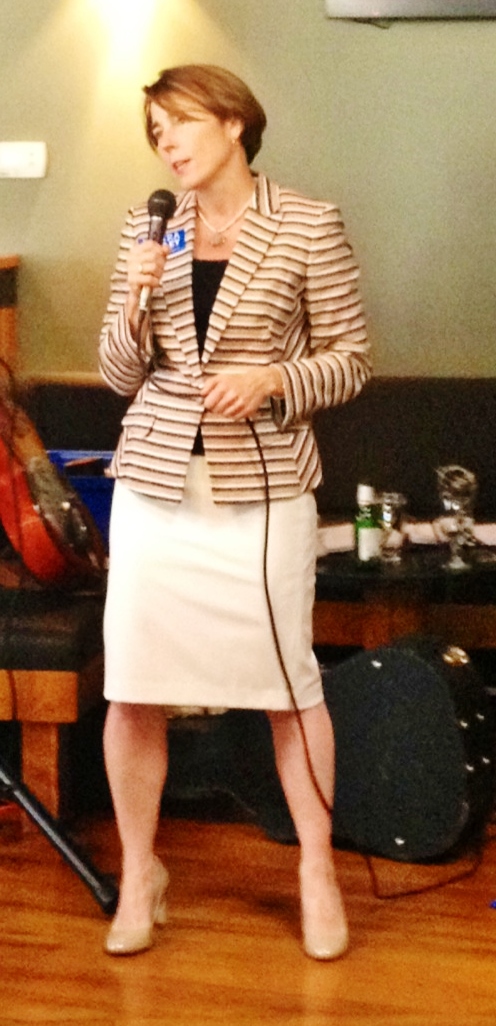
^ activist with spark and verve : Maura Healey addressing voters at a meet and greet in Jamaica Plain three months ago

—- —- —-

The 2014 election campaign has reached the point where endorsements are in order. We’ve seen all the candidates, measured their positions and their level of support among the voters, and what we have done, so have almost all the voters.

Our first endorsement is for Attorney General. There are two candidates, Republican John Miller and Democrat Maura Healey. Both have distinguished resumes, Miller as attorney in private practice, Healey as chief of the Civil Rights division in the current Attorney General’s office. But the Attorney General isn’t only a lawyer. He or she is a significant maker of public policy — overseeing non-profit organizations and trusts, protecting consumers, choosing which civil rights battles to prioritize, weighing in on criminal justice matters, reading and opining on major state contracts.

Attorney General is also a political office. The voters elect him or her. Maura Healey is spot on when she calls the ofice “the people’s lawyer.” She walks the walk, too. Few candidates for any office connect to people — all sorts of people — with anything like Healey’s verce and spark. .

Healey promises to establish in the AG’s office a division specifically charged with child protection ; and as we all know, DCF failures, and the enormity of family dysfunction among those who live in crisis, requires no less than a pro-active Attorney General on this front.

Healey vows to be a lawyer for those whose civil rights are compromised, including transgender people, immigrants, and people of color generally. It was Healey who was the lead attorney arguing, and winning, the landmark 2004 case by which Massachusetts became the first state to sanction what we now call “marriage equality.” Healey’s commitment in this area of the law is strong and certain.

Healey speaks eloquently about criminal justice reform; about remedying drug addiction by treatment first of all; and about enforcing the state’s labor and wage laws. As she says, “combatting wage theft and overtime pay violations is a core responsibility” of the office.

In contrast, John Miller takes a reticent view of the office. His campaign has focused on the health care connector disaster, epecially the incompetent manner in which the software contract was negotiated. “40 hours of lawyering could have saved us 200 million,” he has said. That is true; and the next Attorney General needs to be a lot smarter about technology contracts entered into by the Governor. But the role — “lawyering” a contract — that Miller outlines is one for a Chief of Division. The AG herself must embrace a larger role, a values role, because so much of her core responsibilities are values issues : economic fairness, civil rights, child protection, consumer protection.

Miller talks also about “keeping politics out of the (Attorney General’s) office.” I’m not sure what that means, considering that, as a statewide elected office, our Attorney General is perforce and fundamentally a political office. If on the other hand Miller means that as “AG” he will not take the politics of a matter into consideration, he badly misses the point of what the people want their “AG” to do — and is quite unrealistic about the AG’s influence plays out in actual events of state governance, where “politics” is how you get things done.

Supporters of Miller say that they don’t want an ‘activist AG.” Will, they wonder, an “activist” AG be merely a tool of public sentiment, which always changes ? Can an “activist” AG take unpopular stands if a vital principle is at stake ? The Maura Healey whom I have seen has the backbone to do that, and enjoys enough good will from Massachusetts voters that she’ll have plenty of room to take an unpopular stand without risking defeat.

But that is a caution for another day. Right now, a positivist, active “AG” is what the state needs, as its people find themselves confronted by entrenched institutional powers at large — many of them money powers — and by sentiments among some people that put other people, especially people of color or ethnicity, at risk. Maura Healey is ideally suited to be the Attorney General now needed. We are proud to endorse her.

—- Mike Freedberg / Here and Sphere

MAGOV14 : U-MASS DEBATE — BAKER FORCEULLY PRECISE, COAKLEY PLEASANTLY VAGUE

photo (24)

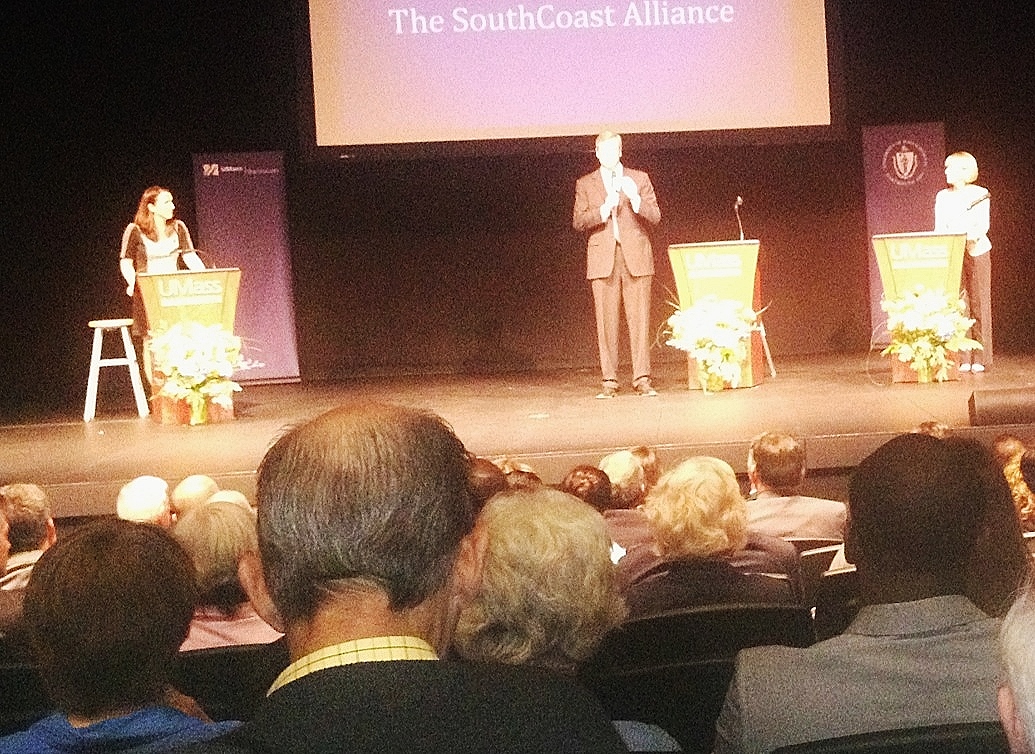
^ precise vs. pleasant : Charlie Baker answers, Martha Coakley listens at U-Mass South Coast campus debate

—- —- —-

Because Charlie Baker remains a bit less well known by the voters than Martha Coakley, he won the debate simply by showing up and expressing his views precisely and clearly.

That’s a given. The lesser known candidate always wins the first big debate.

But now to the debate itself, which took place at University of Massachusetts’s Dartmouth campus, on the South Coast. Whom you think won depends on what you want from the next governor. If you think that state administration is doing OK and has the right priorities, you probably liked Martha Coakley’s mostly content-free, conversational ramble. If you think that state government is not doing OK, or has its priorities wrong, you certainly liked charlie Baker’s passionate, clear statements of what is wrong on Beacon Hill, and throughout Massachusetts as a result, and what he will do about it.

Which of these two vastly opposite presentations was liked by more debate watchers, I cannot tell. i can only speak for myself, as one who has journo’d state administration matters constantly all year long and attended more than two dozen governor candidate Forums, starting last January. For me, the debate was a knockout by Baker.

On clarity of presentation, it was all Baker.

On knowledge of the issues, and on what has gone wrong, or right, regarding them, it was all Baker.

On political tune, it was mostly Baker. Who advised Coakley to call Baker “my Republican opponent,” as a bad thing, on stage in a part of Massachusetts that is rapidly trending toward a Republican voting majority ? Martha, listen to me : New Bedford and Bristol County are NOT Watertown and Cambridge…

On debate points, Baker simply blew Coakley away. She attacked his administration of the Big Dig, saying that its cost overruns were the reason that the long-delayed South Coast Rail project can’t get funded. Baker’s response ? “Those overruns resulted from a large shortfall of Federal funding during the Clinton administration, for which we had to make up the difference.”

Pow….

Coakley also didn’t seem to realize — if so, she never said it — that much of the delay holding back the South Coast rail line comes from stalled environmental impact examination of the project, by both Beacon Hill and the Federal government, as a result of which the permits to build it can’t be granted. Baker did know, and cited them.

Pow…

Having been knocked out twice, Coakley wisely gave up attacking Baker, shifting instead to the conversational ramble in which she feels most comfortable, seeming to answer the moderator’s specific question by not answering; instead, chatting generalities about “focusing on people.”

It worked for Coakley in the primary, where she defeated — barely — Steve Grossman, a candidate even more knowledgeable than Baker, and with plenty of excellent policy proposals. But Grossman was unknown, three weeks before primary, by a full 25 percent of voters. Baker is unknown only by ten percent, and by election day he will be unknown by very few. Grossman, quite less known as he was, came within six points of beating Coakley on primary day.

Like Coakley, Baker smartly shifted his debate ground. Coakley began with her strongest suit : citing the local, South Coast’s economy in keeping with her “16 economic regions” policy. The debate audience liked what they heard. Before long Baker also began to answer the moderator’s questions with a South Coast, regional focus, and his command of them proved stronger than Coakley’s. She must have noticed, because during the hour-long debate’s second half, regional examples disappeared from her answers.

At least 500 people filled the U-Mass auditorium. Not long ago, the governor campaign engaged only activists. Today, it engages almost everyone. We’ll know the result of it soon enough.

—- Mike Freedberg / Here and Sphere

photo (25)

MAGOV14 : A DEAD HEAT, BUT ADVANTAGE BAKER

photo (23)

^ polls show an absolute dead heat, but the advantage going forward is very much Baker’s

—- —- —-

Three new polls of the Governor campaign say the race is a dead heat. In one poll, Baker leads 48 to 46; in another, he’s behind, 41 to 39; and in today’s Boston Globe poll, he and Martha Coakley are tied at 41.

If you add the numbers in all three polls and then divide, you get Baker 43, Coakley 43, with about 6 percent choosing one of the minor candidates. That leaves eight percent — about 160,000 voters — still undecided.

Today, these voters appear to lean to Martha Coakley by about three to two : but that’s because Coakley even now has slightly better name recognition than Baker. He remains unknown by ten percent, Coakley only by three percent. By election day, that recognition gap will surely close, leaving Coakley probably no advantage at all among these 160,000 voters.

But that’s how things look right now. In fact, things won’t look like that by election day. Baker, say these polls, has recovered smartly from his bad last week and now enjoys, again, all of the favorable voter rating that he lost because of the outside, DCF-critical ad dumped on him by Children’s Defense Fund. When a candidate can recover all that he has lost, and do it so quickly — something rare in campaigns — he is in very good shape to increase his numbers a lot more.

Baker has on his side one huge positive and one equally big negative.

The negative is the multiple failures in state administration these past two years — and which the voters are very much aware of, as the new Boston Globe poll indicates. They attribute them to Deval Patrick — well meaning though he is, but, in many voters’ opinion, ineffectual.

The positive for Baker is his strong reputation for effective management — the precise reverse of how voters see the Patrick governorship. Together, these factors constitute Baker’s key argument : he can do the job and has already proven, in his business management record, that he can do it.

My feeling is that this argument will win the day unless Baker stumbles, or an outside pressure group muddies the race, as the Children’s Defense fund did, or both. Barring these disruptions, I think Baker’s “the job hasn’t been done, and I can do it” argument beats Martha Coakley’s remarkably content-free campaign.

So far, Martha Coakley’s campaign appears to rely on one task only : bringing back to her side the many Democrats who currently aren’t there. If she could do that, she would definitely win : Democrats total 36 percent of the state’s voters, much larger than the mere eleven percent that Baker can count on as a Republican. But right now, a full 25 percent of Democrats choose Baker. That too arises from a positive and a negative. the negative is that less than a quarter of activist Democrats wanted Coakley as their nominee. The positive is that Baker, like all recently successful Republican candidates for governor, isn’t really a party spokesman. Because the Massachusetts GOP is so small — because a full 82 percent of a Baker majority woUld come from voters who are not Republican, those Democrats who don’t like Coakley are quite free to vote Baker — like Bill Weld and Paul Cellucci before him (and even Mitt Romney, then), he’s a sort of non-party “Mr. Fix It” — because of what he is good at, without compromising their position as Democrats.

I’m sticking to my October 1st prediction : Baker wins by 2.5 to 3 points.

—- Mike Freedberg / Here and Sphere

WEST ROXBURY : HUNDREDS AT MEETING EXPRESS THEIR DISTRUST OF THE QUARRY OWNERS

photo (19)photo (20)photo (22)

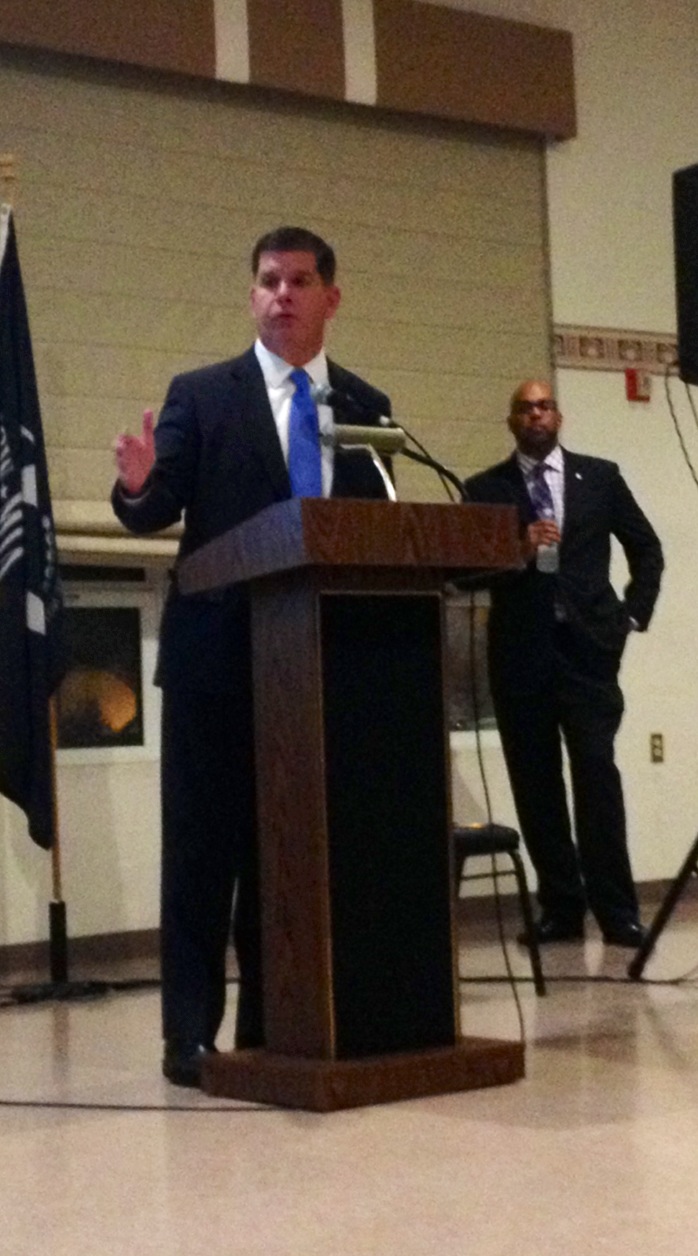
^ (left) Mike McCann, suffering a debilitating respiratory illness, addressing the meeting; (center) Mayor Walsh spoke (right) Senator Mike rush set forth the legislation governing quarry reclamation

—- —- —-

Even if the owners of the huge quarry that the LoRusso family operates in the midst of West Roxbury had the neighbors’ trust, their present proposal — to fill the quarry hole with construction-site soils — would generate opposition. And West Roxbury people don’t trust the qauarry owners at all.

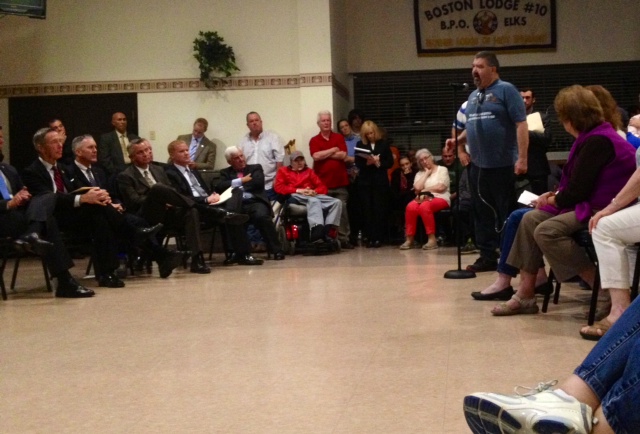
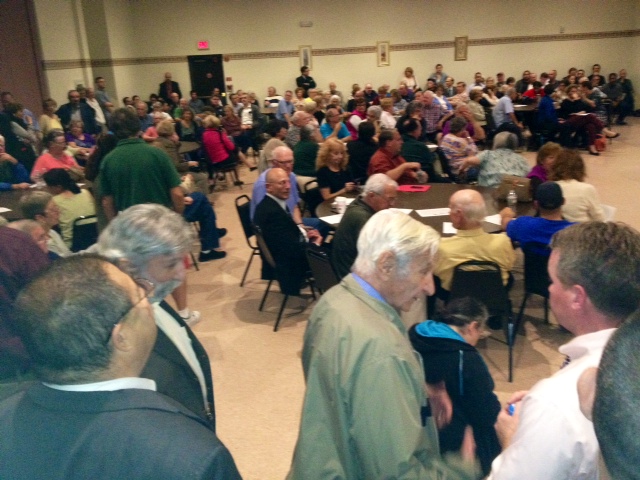
That was the message at last night’s meeting at Elks Hall. At least 400 people showed up, standing room only, to express their intense opposition to the quarry owners’ landfiull proposal.

The meting was called by Mayor Marty Walsh, who was present at it, as was Congressman Stephen Lynch. One doesn’t nornally see Congressman Lynch at a local meeting on a local issue, and he said so. Mayor Walsh said the saem thing. But, said both men, this was different. The landfill proposal is a major community issue and one that they will take an active role in resolving in West Roxbury residents’ favor.

The facts of the quarry proposal were explained clearly in detail by State Senator mike rush, who in the process of fighting the quarry — the proposal was fitst bruited last year — has become perhaps the legislature’s top expert on quarry reclamation matters. Rush outlined legsialtion that has been enacted with respect to quarry landfills, truck transport, and contamination matters. Rush also made clear to the large gathering that the state’s top environmental regulator is aware of the quarry issue and will not sign off on any landfill proposal that the community does not support.

Also on hand were State Representatives Ed Coppinher and Angelo Scaccia and City Councillor Matt O’Malley, who announced that his proposed otdinance regarding zoning oversight of the quarry wa adopred unanimously and signed by Mayor Walsh — and that it now awaits BRA approval. It was not said whether that approval would be given.

photo (21)

^ at least 400 people crowded into the Elks Hall

The quarry, which occupies 55 acres of prime real estate in the southeast quarter of West Roxbury, has been digging and blasting rock into gravel since 1893 — so said Mayor walsh. it has long been a given; and the people who have bought homes situated near it have known that the quarry was their neighbor. But they probably did not know, when they voluntarily accepted the quarrty as a presence, that blasting dust might lead yo respiratory diseases — one such man (Mike McCann, I think) spoke to the gathered crowd and was an eloquent presence, carrying his breathing apparatus and his tearful declaration that he wanted to work — badly wanted, always had worked — but now could not.

Nor did the people who have bought homes near the quarry thereby accepted that it would seek to do a landfill that includes very contaminated soil. Just how contaminated that soil might be, and with what, was set forth in a slide show that also made clear that the quarry owners’ statement did not accord with waht they claimed it said on the contamination issue.
Thus the distrust, and the justice of it.

Nor was there any support for the qaurry owners’ proposl to truck the landfill in at a rate of maybe 600 trucks — huge dump trucks — a day. The number seems almost unbelievable. No residential community can accept that kind of disruption.

—- Mike Freedberg / Here and Sphere

MAGOV14 : FUNDRAISING AS A ROUTE TO UNITY — THE BAKER APPROACH

1 Jack Connors1 Mitt Romney 2013

^ Jack Connors raised big money in 2012 to defeat mitt Romney. Now they’re united for Team Baker

—- —- —-

Tonight, Jack Connors, the legendary powerful finance guy who bundled huge sums for President Obama in 2012, will co-host a Big dollar Affair on behalf of Charlie baker, the Republican candidate for Governor. his co-host ? Mitt Romney, the man who in 2012 Connors worked to defeat.

You read correctly. Jack Connors and Mitt Romney are co-hosting tonight’s big Charlie Baker fundraiser.

I have attended several Baker fundraisers — at least two dozen, beginning late in May. At all of them, Baker has been hosted by men and women of both parties. The talk that baker gives at these affairs is always about his plans for state government; his vision, his method, his readiness to do what works regardless of which party –or no party — originates it. Baker’s fundraiuders are almost part of bhis message. They symbolize it, exemplify it in human presence.

This is far from the usual. Most campaign fundraiders I have been to — tons of them, by hundreds lof candidates — in my longish career in local politics draw only upon the candidate’s close personal supporters. They draw lines between the candidate and opponents. They have an edge, an opposition in mind. Not so baker’s fundraisers. For him, the opponent is an idea, a mindset : resistance to change.

Most people who care about how Massachusetts state government is run want change, big change. They see the need. But in the usual course, the competing impetus of party politics — and almost all the activists belong to a party — draw them in opposite directions, to serving party interests rather than the interests of all of us. that is not how Baker’s fundraising events work. Party interests just don’t get talked about. Ther public interest is what Baker speaks to, and the people who hear him — at least when I’ve witnessed — respond to that, want it, applaud it.

Baker can take this route as a practical matter because the Republican party in Massachusetts, whose nomination he runs on, is so small that it has very little pulling power. If baker wins 52 percent of the major candidate vote on November 4th — that’;s my prediction — at least 82 percent of it will come from voters who are not Republican. Think aboiut that. Less than one out of five Baker voters will be Republicans. The overwhelmingly majority of his voters will be “everybody else.” That’s a lot of pull.

Unity is thus not only the thene of baker’s campaiyn but also its structure, its math, its reality. Because most of us want unity in state administration, rather than gridlock or disunity, the Baker message — the Baker fact — has enormous power to persuade.

Even many of those who, as Massachusetts Democrats representing a bit more than one-third of us — but more than three quarters of those who currently govern us — want the unity that Baker brings. But they are pulled in the opposite direction, toward the generic Democratic campaign passively offered by martha coakley because Democratic party dynamics cannot, in their mind or interest, be set aside : not with the 2016 Presidential campaign so near at hand. In 2016 there will be no incumbent President seeking re-election, not to mention a Democratic President inevitably re-nominated. Thus every democratic party component is jockdeying for influence : public employee unions, environmental activists, advocatesof banking reform, social service workers, the AFL-CIO, Mayors. this jockeying enormously shaped last year’s mayor races in boston and New York : union-backed candidates won both. The same factor works in the goverbor race, even more strongly, to keep many supporters of unified state administration from joining the unity team.

To these Democrats it doesn’t really matter if Martha Coakley wins. Most of them didn’t want her as their nominee in the first place. But her campaign requires their participation as each seeks to win the pole position as the Presidential nominating process begins a scant three months from now.

If Charlie Baker does become governor, these interests will work with the fact, as they always have, both from the outside and through the legislature, in which the Democrats will have veto-proof majorities. With the legislature and their control of Boston politics to safeguard their interests, they’ll devote their major energy to the Presidential nomination without much regret at all of a Baker win. After all, though few can say it, Baker will be very ready to work with the Boston building trades unions, the Hotel and Hospitality Workers who staff the building boom, the IBEW who staff the industrial recovery that Baker seeks. Evenh the service workers of SEIU might find Baker a friend, not the enemy that their ads now picture him.

It happened often during the Weld and Cellucci adminstrations. It can happen again and probably will.

—- Mike Freedberg / Here and Sphere

MAGOV14 : CAN BOLD PLANS BEAT THE STATUS QUO ?

1 Baker and Coakley 1

status quo versus bold reform : that’s what it comes down to between these two

—- —- —- —-

In a campaign, as in war, it’s easier to play defense than offense. thus we find Charlie Baker marching boldly into the cities and offering forward-looking plans for empowering urban communities; while Martha Coakley represents those whose vested interests are, or think themselves, threatened by Baker’s bold.

“Keep things exactly as they are” is the Coakley theme. Malfunctions in state administration ? Whatever ARE you talking about ? Coakley notes no missteps in policy, smells nothing wrong with which interest groups get the prizes and which get the silent treatment. For the politically Panglossian Coakley, all is just ducky in the best of all possible worlds.

Such a passive, and palpably false, narrative works because it’s a political truth that (1) not everyone who stands to benefit from bold plans will vote for them and (2) everyone who is, or feels, threatened by them will vote against them.

I have yet to hear Coakley, after a year of candidate Forums, commit to anything not apple=-pie. She converses easily now, but her words of smile and affable there are, when you listen past the soft touch, feature no nouns, few verbs, less adjectives than a $ 100 trendy meal has food. In Coakley-speak there’s only a cilantro-dip crumble.

Meanwhile, Charlie Baker offers plans as pointed as pine needles, as hefty as a barroom steak. You know what he’s for, you can weigh what he will do, the where he wants to take the state slaps you five.

Much the same dynamic dominated last year’s Mayor race in Boston. Connolly did the bold; Marty walsh, the “everything is just fine. I oversimplify a bit. Walsh offered what Globe columnist Yvonne Abraham called “incremental change.” (And did so with multi-tentacled outreach and all the good guy persona that he has, and he has a lot). But Walsh’s incremental looked like all-is-just-fine compared to Connolly’s Teddy Rooseveltian charge up the hills of entrenched Boston interest groups.

Walsh edged Connolly by three points on election day. Can Coakley edge Baker ? Right now the polls say it’s 50-50. But they also claim that 12 to 15 percent of voters remain undecided. Baker needs only a slight break among these voters to take the corner office. To do so, he will have to convince the “undecideds” — and maybe persuade a few currently Coakley votes — that his bold plans will actually get implemented and, if implemented, will actually make things better. Because so many voters in today’s America distrust government altogether, that’s going to be a difficult sell.

Still, i have heard Baker speak, eloquently almost always, to groups that he chooses to campaign to. (Other groups, he avoids. i suppose that shunning is no worse, really, than Coakley’s way of attending lots of Forums but saying nothing at them. Baker avoids Forums whose attendees won’t likely approve of what he has to say to them. It’s probably best, thus, that he simply bot step on a stage and say them.) If presence and articulation can symbolize accomplishment, Baker’s an easy winner. But…

But Coakley’s campaign is doing everything it can to derogate Baker’s stellar resume — the Harvard Pilgrim turnaround, and the huge money that , under his administration, the Big Dig paid into the wallets of 1000s of Building trades unionists — and turn him into “the bad guy.” It’s a smart campaign plan on Coakley’s part. as the candidate of the status quo, all she has to do is tune into the voters skepticism about reform, their distrust that any reforms will work, much less bold ones.

If you don’t believe me, just look at what happened to high-minded, passionately good will Deval Patrick. If Patrick is anything, he’s a bold reformer. How’d that work out for him ? DCF, the health connector boondoggle, the Transpo bill confusion, the huge electric rate hike…

In a healthy political climate, the failures of the Patrick administration would call for baker’s bold reforms — across the board — to state administration. But we don’;t rigyt now enjpoy a healthy political climate. we suffer one in which special interests defend their interests willy-nilly, where insiders talk onloy to each other and defecate on taxpayer money, where lobbyists and advocates talk loudly to bulk up thrit donor lists. we inhbait a forest of selfish trees, through which pioneer baker is trying to cut a trail of betterment. I hope it works. It might.

—- Mike Freedberg / Here and Sphere