JED HRESKO : OVFERREACH IN YESTERDAY’S MASSACHUSETTS ELECTION

By guest columnist Jed Hresko —

There’s a concept of “overreach” in politics, usually when ideologues or loyalists decide to double down… and ultimately alienate the center and lose the big contest:

– Question 2: expanded bottle bill. Everyone is used to the nickel on soda. I bet if the question had solely been to expand the nickel deposit to other drinks, it could’ve passed. But no, the environmentalists also had the indexing provision. The bogeyman of paying a 25 cent deposit freaked voters out.

– Coakley: I get why certain unions wanted to reward Coakley for taking legal action on behalf of their members, but really, here we are again where Coakley was pushed through the Primary over candidates who would’ve done better in the general election. Enough already.

– Charter schools: my non-political 12-year-old who attends a charter school told me that he was voting in the school’s straw poll for Baker because, “Baker supports charter schools.” This, at a Boston charter where I’m sure most of the parents and staff are progressives or Dems. Lesson: Senator Chang-Diaz and some anti-ed-reform lefties in JP doubled-down last year and ground charters to a halt, with some inexplicable help from Deval Patrick’s Dept. of Ed. Did this provoke a major backlash? Of course not in terms of statewide numbers. But did it matter in a close election? Sure.

– public employee unions: the general policy of deny-deny-deny the need for reforms doesn’t hold water with regular voters. Baker was able to make the argument that he’ll be a better manager and that he’ll be a check/balance against the status quo of a Dem legislature, Dem governor and public sector unions that are overwhelmingly Dem supporters.

FOR GOVERNOR, IT’S CHARLIE BY 2 POINTS

Bakermap

At last the year-long campaign to choose Massachusetts’s next Governor is over. Charlie Baker has won by two percent, a lead of 40,000 votes out of 2,040,000 cast (with 99% of precincts reporting.

It was closer than many expected, a bit closer than even I had anticipated. Though the loser, Martha Coakley, had seemed, as recently as a month ago, to have almost no campaign at all, during the time since, a campaign was put together for her, and she, somehow, found her voice, one that voters could actually connect to.

There was enthusiasm in her campaign, and several constituencies, and a tactic that made sense: concentrate on the 37 percent of Massachusetts voters who are Democrats.

If a Massachusetts statewide candidate can win the votes of at least 90 percent of our Democrats, he or she is almost sure to win, because only 12 percent of our voters are Republican. To beat a candidate winning 90 percent of Democrats, an opponent would have to win almost all the Republicans and at least 70 percent of Independents. That hardly ever happens.

Nor was it enough for Coakley to concentrate on Democrats. She had to give them a completely, almost only, Democratic agenda and she had to get them to actually come to the polls and vote. Thus the campaign’s embrace of the Democratic party’s most loyal interests – unions, left-wing advocacy groups, immigrants, and communities of color.

That concentrating her campaign on these very polarizing interests might isolate her from the state’s moderate, unorganized majority was a risk she had to take, and did take. After all, without them fully committed, she had no campaign at all, because she was – and remained – very unpopulkar with her own party. At the Democratic convention to choose a nominee, she won only 23 percent of delegate votes. She barely finished ahead of the third place candidate.

Coakley’s passionate army of ideologues, unions, and communities of color then targeted several cities in which many similar types of Democrats live : Boston, Cambridge, Somerville, Framingham Worcester, Springfied, Brockton, Lowell, New Bedford, Chelsea, Lawrence. She carried them all, and except in Boston, won them by a larger margin than she was accorded in her legendary US Senate loss to Scott Brown in 2010.

Yet if Coakley succeeded in assembling a real campaign and in meeting her targets, so did Baker. Between the two, there was no comparison : Baker was by far the stronger, more convincing candidate on almost all levels. And if Coakley’s campaign was about the Democratic Party, Baker’s was about the entire state and its needs.

Baker concentrated on winning independent voters, disaffected Democrats, and as many city voters as he could talk to. It worked. That Baker was able tol defeat the well-organized, ideological Coakley campaign was almost entirely his personal achievement. Yes, Baker had a strong boiler-room operation and more canvassers than any Massachusetts Republican campaign has deployed in at least 40 years; but “Team Baker” was no match for Coakley’s team, in numbers or intensity. Yet he did win.

Baker targeted several regions and surpassed Scott Brown’s 2010 margins in all. In Boston he won 31 percent; Brown took 27. In the Western suburbs of Boston south of Route 2, Baker topped Brown’s 2010 results by four to eight points. Baker campaigned all year long as the “North Shore candidate,” and he won the area by 15 points, five points better than Brown in 2010. He won big victories in Worcester County and all along the South Shore.

Baker appears to have won independents by 32 to 17 and captured the votes of 18 percent of Democrats. Those are numbers a Massachusetts Republican cannot fall short of and expect to win.

It was just barely big and wide enough to top Coakley’s own improvements. Just as the state’s long tradition of electing Governors independent of the Legislature’s dominant Democrats tops, but barely, our voters’ preference for the Democratic party over the Republican. It was a close-run thing but a decisive one. The Deval Patrick era on Beacon Hill is over.

Patrick is an idealist and an inspiring man; but he has had less success managing state services. There is often confusion on Beacon Hill between Governor and the legislature. That will now change. Baker is the most precise of men and as committed to reform as Patrick has been to inspiration. The moment now belongs to “Charlie.”

—- Mike Freedberg / Here and Sphere

WHAT IF THE REPUBLICANS TAKE CONTROL OF THE SENATE ?

1 Cory Gardner CO1 Dan Sullivan AK

Two GOP likely winners to watch : Colorado’s Cory Gardner and Alaska’s Dan Sullivan

—- —- —-

Much alarm is being sounded by those who don’t like the prospect of seeing Republicans achieve a majority in the US Senate — as seems quite lilely to happen tomorrow. We’re not so sure it’s a bad thing.

As a majority, the Republicans will be held to account. It’s so much easier to be the minority. All you have to do is oppose and criticise. Not so when you’re the majority. Then you have you propose and to face up to criticism.

Some will say, “but the Republican already are the majority, in the House, and they’re nothing if not opposers and criticizers.” That is true; but with the Senate firmly in Democratic hands these past six years, the House GOP majority can act like a minority, knowing that their opposition to everything will be blocked in the Senate and thus remain just talk.

It will now be different if, as polls predict, the GOP adds six to eight to its current 45 Senators. South Dakota, Montana, West Virginia, Arkansas, Colorado, Iowa, and even Louisiana and Alaska seem poised to elect Republicans, and New Hampshire looks on the verge; only Kansas, of current GOP senate seats, lookms ripe to go the other way. That adds up to a Senate with 53 Republicans and 47 Democrats.

Some Republican radicals plan to use their majority to scrap Obamacare or greatly change it; to limit Federal spending; to oppose any efforts at immigration reform or pay equity. That is certainly what the Republicans of 2010-2012 would have done. Today, the GOP walks a differnt route. Though skeptical of Federal deficits and spending, critical of aspects of Obamacare, and uneasy with path to citizenship for undocumented immigrants, the GOP of now has tempered its rhetoric : compromise seems in the offing, maybe even innovation. The young generation of GOP operatives insists on it. For them — urbanites mostly — the GOP must change its ways, its culture, its priorities and move from the rural countryside to the downtowns : where the next generation of elections will be won.

A few Republican Senators get this already. I’m betting that if the GOP does take control of the sebate, more Senators still will find their way to new agendas and new campaign fields.

—- Mike Freedberg / Here and Sphere

WE RECOMMEND : STATE REPRESENTATIVE CANDIDATES

1 Josh Cutler1 Susannah Whipps Lee

two good ones : St Rep Josh Cutler (D) of the 6th Plymouth District and 2nd Franklin District challenger Susannah Whipps Lee (R)

—- —- —-

We have looked closely at some 30 contested State Representative races and have a recommendation to make in 26 of them. You will notice that our recommdation is for the person, not the party. Neither party has a monopoly of informed discourse. Thus our list features 15 Republicans and 11 Democrats.

What we’re looking for is a candidate who either campaigns to “100 prcent of the vote,” as Charlie Baker has put it, or who eloquently represents a partisan viewpoint. Ability to raise substantial campaign money, and thus to mount a credible campaign, is also a plus for us.

And now to our list :

1st Barnstable : no incumbent. We favor Tim Whalen (R)
2nd Barnstasble : Democratic incumbent. We favor Adam G. Chaprales (R)
2nd Bristol : Democratic incumbent : We favor Bert J. Buckley (R), the challenger, over the controversial incumbent in this Attleboro district.
3rd Bristol : Republican incumbent. We like populist Shaunna O’Connell, seeking her third term representing Taunton and Easton, especially for her “yes” vote on raising the state’s minimum wage.
1st Essex : open seat. We like Amesbury selectman James Kelcourse (R)
16th Essex : Democratic incumbent. We support the re-election of Marcos Devers over his discredited opponent, who was ignominiously  ousted Mayor of Lawrence.
2nd Franklin : Democratic incumbent. We like incumbent Denise Andrews, but we like the challenger, Susannah Whipps Lee (R) even better. She just may be our favorite State legislative candidate of this entire cycle.
2nd Middlesex : Democratic incumbent. James Arciero was the target of one of this campaign’s most unfair PAC attacks. His re-election is the answer to such stuff.
5th Middlesex : Democratic incumbent. David Linsky was the leading sponsor of our state’s new gun control legislation. Reason enough to re-elect him enthusiastically.
18th Middlesex : open seat. We recommend Rady Mom (D),l who will be the state’s first Cambodian-American legislator if elected.
31st Middlesex : open seat. We recommend Michael S. Day (D)
33rd Middlesex : open seat. We endorsed Steve Ultrino (D) in the Primary and continue to like him, although independent candidate James Matheson, who like Ultrino is a Malden city councillor, also merits your consideration.
36th Middlesex : Democratic incumbent. We recommend long-time state representative Colleen M. Garry be re-elected by this Dracut/Lowell district.
15th Norfolk : Democratic incumbent. We prefer bright, articulate, smart newcomer Curt Myers (R) to this north Brookline district’s current, conventionally-minded state legislator.
1st Plymouth : open seat . Current state representative Vinny deMacedo (R) is seeking a state senate. We favor Matthew Muratore (R), who will continue the deMacedo approach to state issues.
4th Plymouth : Democratic incumbent. We recommend that James M. Cantwell be re-elected.
6th Plymouth : Democratic incumbent. Josh Cutler is one of the state’s most diligent and open-minded representatives. We prefer him to his rather histrionic challenger.
lst Suffolk ; Democratic incumbent. We strongly prefer Carlo Basile to his anti-casino challenger.
5th Suffolk : Democratic incumbent. Evandro C. Carvalho is fast becoming one of Boston’s most eloquent voices on Beacon Hill. Easily we prefer him to his social conservative challenger.
5th Worcester : open seat. Anne Gobi, the current (D) representative, is seeking a state senate seat. We like Donald Berthiaume (R) as her successor.
7th Worcester : Republican incumbent. Paul K. Frost was one of six Republican legislators to vote “yes” on raising the state’s minimum wage. For that vote alone he merits enthusiastic re-election.
8th Worcester : Republican incumbent. We like Kevin Kuros for another term.
9th Worcester : open seat. The retirement of George Peterson is a loss for reasonable discourse in the legislature. David K. Muradian, the (R) candidate, will contnue the Peterson point of view.
18th Worcester : open seat. Ryan Fattman, the current (R) legislator, is seeking a state senate seat. Joseph McKenna (R) of Webster will be, if anything, an even smarter voice for this district of all too overlooked southern Worcester counthy towns.

—- Mike Freedberg / Here and Sphere

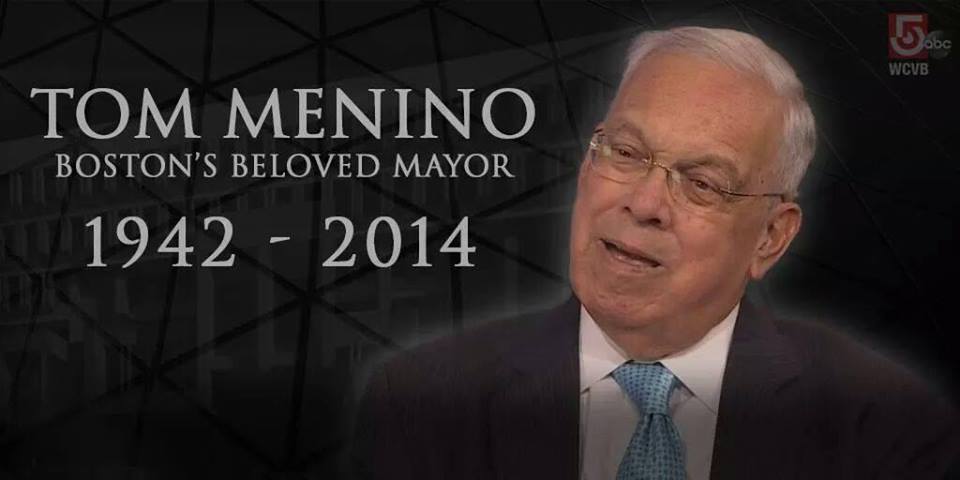
40 YEARS OF TOM MENINO

1 Tom Menino

It was early in 1973 when I first met Tom Menino. Joe Timilty, at that time one of the bring young, Kennedyesque men of Boston politics, had decided to seek the State senate seat let vacant in Mattapan and Hyde park by the retirement of Sam Harmon. My roommate and I were precinct leaders in that campaign, in the Mattapan neighborhood that he lived in, and one evening we had gone to headquarters to pick up literature. Several campaign volunteers were there, talking stuff, as campaign people will do, and among them was a new guy : a stocky, grumbly fellow about as unpolitical as anyone i had ever met.

He was from “the Island,” they said, a hardscrabble part of Hyde Park filled with workers’ houses the size of thimbles, living in a three-decker within easy smell distance of Henry Kara’s tire store. He looked quite uninviting to talk to, and I didn’t.

Later on I learned the fellow’s name. It was Tom Menino.

He became quite a presence in that campaign, and when Timilty won the election, Menino, like all of us, became somebody the political community wanted to know. On several city and state campaigns thereafter, the Menino place on Hyde Park Avenue was a place to be for people you wanted — needed — to know.

Still, Menino’s gruff personality alienated many, and made enemies of some, even as he acquired several very significant friends, especially then young state Representative Angelo Scaccia, who lived with his mother in a modest home near the huge Westinghouse factory in the Readville part of Hyde Park. For several years Menino, with Timilty as his mentor, moved from one political job to another, but it was his friendship with Scaccia that proved crucial when, in 1983, Menino decided to seek the newly created City Council District Number 5.

Another friendship was almost as significant : I lived in that newly created District. As map advisor to City Councillor Terry McDermott, who was charged with holding the Council hearings that led to the map which set up the nine Council Districts devised by the City’;s new charter, I created a Roslindale and Hyde Park district very much with Tom Menino in mind. There was one other likely local candidate, but in my mind (and McDermott’s) he was far too conservative for our tastes. Thus it was Menino whom we hoped would run, and we mapped him a district as closely aligned with the Timilty state senate District as we could fairly shape.

Menino did run, and he did win. He quickly made the District his own. The fierce Hyde Park political rivalries that almost sidelined Scaccia a few times never endangered the dogged, grouchy, but somehow likeable Menino. You could trust Tom. What you saw was what you got. He never thanked me for what I (and McDermott) had done for him, but that was OK; he did the job. What more could I ask for ? He was my area’s councillor, and when we needed him to be there for us in Roslindale, was there, gruff and grouchy and more reliable than a wall clock.

So it was that when, in 1993, Mayor Flynn resigned to be our nation’s ambassador to the Vatican, I backed Tom Menino rather than State Representative Jim Brett his chief opponent, whom I also knew well and respected highly. Menino was our neighborhood’s man, ours had never had a Mayor from our area, and that was that, in an election that wasn’t about high policy, as they are today, but about the neighborhoods.

Because that year’s mayor election was about neighborhoods, it was no drawback to Menino that he talked like a neighborhood guy and walked the neighborhood walk. And it was he, not the much more eloquent and worldly Brett, who assembled a coalition of neighborhoods — the left out and the not so powerful mostly — big enough to defeat Brett by a huge margin.

Tom was now our Mayor. Our no frills, speech-challenged, lumpy Mayor. He was one of a kind. Most people liked that. Yes, there were those who didn’t, and more who didn’t like Tom one day but liked him the ent, and over the years he became irreplaceable because when you started thinking about potential rivals, they all lacked Tom’s dogged singularity. they were “pols.” Tom was never that.

The rest o the story, you all know. By the end of his second term, Tom was so well known, and so widely accepted, that there’s no secrets I can reveal, no special insight that many of you cannot duplicated. we all got to know the Tom that I had known in the neighborhood — well, not quite; because it was amazing, even to the end, to see Tom become a powerful voice for civil rights, to watch him go eyeball to eyeball with powers that be, to marvel at his readiness to go anywhere in his city, to anybody;s house, and to become a brother or an uncle : that close would he get when people needed him.

The Scaccia-Menino friendship lasted to the end; it was never, ever broken. But the same could be said of many Menino relationships, with all sorts of people in Boston powerful, middling, and powerless. It’s a cliche now to say that Tom “loved Boston”; what that really means is that Tom loved Boston’s people. There was no doubt of it. It mattered. Even as Tom oversaw the city’s reinvention,m its economic boom and its rebirth as a mecca of fashion, social life, and innovation, his gruff candor and all-in connection to everybody lifted our spirits and made us — who had been at each other’s throats during the racially troubled 1970s — feel all One City. That’s what we are today. It was Tom’s doing. Ours, too; but Tom’s achievement first.

Good-bye, old buddy ! May you grouch and gruff and love us from wherever you are now, till we meet again…

—- Mike Freedberg for Here and Sphere

WE RECOMMEND : MASSACHUSETTS STATE SENATE

2 MIKE ValanzolaAnne Gobi

two good ones for a large rural state senate district : Mike Valanzola (R) and Anne Gobi (D)

—- —- —- —-

The death this morning of Boston Mayor Tom Menino is sad; and we will publish our memoriam of him tomorrow.

Nonetheless, our responsibilities as a journal do not stop; there is an election on hand five days from now. thus today we make our recommendations for State Senator, in selected districts where a significant contest exists that has drawn our attention.

1st Hampden & Hampshire : In a district embracing the soithern parts of Springfield and several surrounding towns — some poor, a few not poor at all — there’s a contest between two candidates whose money issues have aroused some controversy. Despite that, we prefer Debra Boronski (R) over eric Lesser, the Democrat, significantly because the district’s communities are very conservative and merit a like-minded voice in the Senate.

1st Plymouth & Bristol : the district that includes Taunton and Attleboro is fairly conservative-minded itself; biut the 20-year incumbent, Marc R. Pacheco (D), is our choice because of the strong respect that he commands among his Senate colleagues, all of it a bonus for his not so wealthy constituents.

1st Worcester : no one in the State Senate works harder than long-time incumbent Harriette Chandler (D), a tireless voice for Worcester, a city much in need of her influence, as well as for the small suburbs included in her mostly urban bailiwick. We recommend her highly.

2nd Essex & Middlesex : for a district that includes well-off Andover but also the depressed city of Lawrence a well as two very Republican-minded towns, Dracut and Tewksbury, two Andover selectmen are running : Democrat Barbara L’Italien, a former state representative, and Alex Vispoli (R), who has campaigned as intensely in Lawrence as any Republican legislative candidate, in any city, that we are aware of. We choose Vispoli.

5th Middlesex : Winchester, Melrose, Malden, Wakefield, Reading, and Stoneham elected Jason Lewis (D) in a special election last Spring. Monica Medeiros, a Melrose selectwoman, the Republican whom he defeated then, is running again. Lewis is a prodigious campaigner, unflinchingly progressive, and just as unflinchingly supported. We like Lewis’s advocacy. He should be elected to a full new term.

Plymouth & Barnstable : There aren’t many, if any, policy decisions or constituent services that Plymouth state Represehtative Vinny deMacedo (R) gets wrong. The retirement of senate President Therese Murray gives him his chance to advance to the Senate. We’re on his side.

Worcester & Norfolk : Not many Republican state representatives dare to challenge a sitting state Senator, but two-term Rep Ryan Fattman has done so. Incumbent Richard T. Moore (D) knows that he is of the wrong party in one of the state’s most Republican-minded areas, and he is. Fattman is very conservative, and we disagree with most of his positions on the issues; but for his southern Worcester county communities he is well-positioned, and his tireless campaign wins major respect. We support his election.

Worcester, Hampden, Hampshire & Middlesex : Anne Gobi (D) and Mike Valanzola (R) : the retirement of Senate Ways and Means chairman Stephen Brewer opens up a mostly rural district that reaches from the New Hampshire border to that of Connecticut, 27 towns as forgotten by Beacon Hill as any in the state. Valanzola, an EMC Corp. executive, would ordinarily be the easy favorite in his very Republican-minded region; but his opponent, Anne Gobi of Spencer, a five-term state representative, has criss-crossed the 27 towns even more vigorously than Valanzola and, though not as conservative in policy as he, is fully conversant with the area’s rural culture, organizations, and interests. She also has the full support of Brewer. We like both Gobi and Valanzola.

—- Mike Freedberg for Here and Sphere

AS EXTREMISTS BULLY THE DEMOCRATIC PARTY, A NEW GOP EMERGES

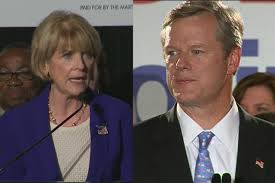
1 Baker and Coakley 1

^ a new GOP, of opportunity ? as Labor all-ins the Democratic party

—- —-

As the two major political parties get ready for 2016, the party in trouble is the Democrats. It is they who are being bullied to the extreme left by labor unions whose approach to poitics is “my way or the highway,’ who threaten Democratic office holders who don’t go along, who have all but taken over the Democratyic party’s boots on the ground.

We have seen, sadly, the same omnivorous extremism, in Tea Party form, almost devour the Republican party these past eight years. Tea Party intransigence cost the GOP many Congress and senate victories that should have been theirs. it help cost the GOP wins in both the 2008 and 2012 elections, by driving Republican presidential candidates over the right-wing cliff. Voters rejected the Tea Party — and also, in most states, religion-based extremism, preferring more or less centrist Democrats.

But this year the GOP’s realists managed to defeat right wing extremists in almost every major intra-party contest. Today, Tea Party extremism seems as quaint as a non-smart cell phone. Meanwhile, realistic Republicans, in charge again, look poised to win five to eight US Senate seats and to increase the party’s amjority in the House.

Now it’s the Democrats’ turn to be bent out of shape, by organized labor especially, as labor union PACs not only commandeer Democratic primaries and general election campaigns but also provide the bulk of the money. Here in Massachusetts, Treasurer candidate Deb Goldberg — whom we have endorsed, by the way — almost would not have a campaign were it not for labor union activists; and Martha Coakley, the Democratic nominee for Governor, would find herself almost as soldier-less as Goldberg but for organized labor’s near monopoly of her “ground game’ and voice.

Coakley at a debate sounds like the nicest cocktail party conversant in the room; but in fact she is almost entirely the captiove of a labor movement that brooks no digression from, or moderation in, its mission to acquire absolute control of state policy, just as, in last year’s Boston Mayor campaign, it sought — and won — complete control of City Hall. that that move almost split the local Democratic party was no bar to organized labor’s purposes. Just loike the Tea Party in the GOP, organized labor was willing — and ready, and able — to squash Democrats who sought to answer to the public interest.

Anyone who doubts the ideological rigidity of the labor movement today — or its willingness to spit on the pib lioc interest as it crushes Democrats who don’t automatically do its bidding — should listen to hiow labor leaders talk. And they’re not shy about it. they tell uou : our way or the highway.

Sound familiar ?

That organized labor has reached this level of destructive influence is no accident. wages have stagnated, even fallen, as the money in our society accrues almost all to the top one percent. The minimum age, even raised, still fall s short, even far sgortm of according to thiose who earn it any participation in the economy other than necessities. Labor union members, just like the rest of us, want a better life, and they are willing to elect union leaders who will break whatever they have to break because, unless there’s much breakage, there’ll be no improvement in their pay checks.

For laborers it’s a state almost of desperation and definitely of frustration, that things for them are not improving and in many cases worsening.

The Tea Party folks feel the same way. True,l that unlike the Tea Party, labor union people are not usually bigots and are ready to embrace social progressivism. But that’s not much different from — if the revese of — the Tea Party’s allaince with religionists.

For “Clinton Democrats” — centrists on the issues, as President Obama has usually been — the future looks bleak as the Democratic party heads to its 2016 Presidential nominating process. Shamelessly greedy plutocrats and petty chambers of commerce have kidnapped far too much of America’s money and almost all of Federal fiscal policy, killing the economy and leaving tens lof millions of Americans living in crisis or close to it. In such a situation, what can we expect but extremist politics ? Since the Tea Party began its political terrorism in 2006, the solidity of the Democratic party kept America united. today, the unity is on the other side, as a newly opportunistic GOP works its way to the value system of inclusion and tolerance (albeit way too slowly) and a new economic agenda of innovation, chance taking, even optimism.

Nobody whom I have heard has expressed it better than Worcester civic activist Juan Gomez : “I don’t want more programs, i want more opportunity !”

Call it “Clintonian” : because it is. Boston Globe columnist Yvonne Abraham made no mistake when she wrote that Charlie Baker is “running, basically, as a Clinton Democrat.”

I’m betting that the majority of voters will sign on to that. Because very few of us are happy in our souls being afraid and extreme.

—- Mike Freedberg / Here and Sphere

WE ENDORSE : BILL KEATING FOR CONGRESS IN THE 9TH DISTRICT

1 Bill Keating

Massachusetts’s 9th Congress District takes in all of the state’s Southeast, including the Cape and Islands, all of the South Shore, and two major cities : Fall River and New Bedord. it’s also our home area. We’re based in New Bedford.

Voters in our home area have two spirited campaigns to choose from: Bill Keating, the Democratic incumbent, and John Chapman, his Republican challenger. Both are well informed and speak authoritatively about actual issues — a rarity amid Congress campaigns befouled by super-PAC-dominated, talking points nonsense.

Bill Keating highlights the drug addiction crisis and has taken active steps to co-ordinate a response. John Chapman has made the South Coast’s endangered fishing industry a major focus. And these are, indeed, the South Coast’s major concerns, along with expansion of New Bedford’s port and the completion of the long-delayed South Coast rail line. Chapman also makes the point — a correct one — that as a member of Congress’s majority party, he will give South Coast a more influential voice than Keating, who caucuses with the minority Democrats.

It would be a great boon to the South Coast if both men could represent us in Congress; but a choice must be made, and we choose Bill Keating.

The District’s incumbent Congressman has plenty of clout himself. Single-handedly he called out the FBI for its sloppy failures in the Boston Marathon bombing matter. By himself, Keating has brought substantial Federal money into a District whose two major cities need all the Federal assistance they can get.

Federal money and Federal administration are no small matters to a District almost all of which fronts the ocean, much of which is under constant flood watch, and a lot of which is patrolled by the Coast Guard. Chapman’s GOP has starved the Federal government for funds and, particularly deplorable, forced a government shut down last year. Chapman has called for a balanced budget amendment to the Constitution. Such an amendment constantly comes up in GOP campaigns. it’s a mistake. When times are bad, the government has to move to deficit spending to alleviate hardship. it’s hard to see how Chapman can bring aid to New Bedford’s fishing industry if his inclination is to cut Federal spending, not lift it.

Meanwhile, we like Bill Keating’s focus on the epidemic of drig addiction. New Bedford and Fall River are especially hard hit. We personally have had to see friends die; not to mention the many, many more who live with addiction. And though the fishing industry is vital, one can’t fish at all if one is dead of a drug overdose.

So, first things first. Keating is right to make the fight against drug addiction — by intervention and treatment, not incarceration — his starting point. We endorse Bill Keating for re-election.

— The Editors / Here and Sphere

WE ENDORSE : DEB GOLDBERG FOR TREASURER

DebGoldberg

Massachusetts, unlike many states, elects its Treasurer. The office merits decision by the voters. The Treasurer oversees the billion-dollar state lottery; invests the state’s money; guides state workers’ pension funds and retirement accounts; and collects unclaimed property accounts, monies that can amount to hundreds of millions of dollars.

For the past four years, Steve Grossman has held the office. He has made it an activist, innovative position : one of his most significant moves was to invest the state’s money accounts in Massachusetts banks only and require them to extend lending to businesses (and start ups) owned by veterans, immigrants, women, and people of color.

To succeed him, the ballot offers two choices, Democrat Deb Goldberg and Republican Mike Heffernan. Both are well qualified to manage money and investments as complex as the state’s. Heffernan, who lives in Wellesley, has been a securities analyst for at least 25 years and makes the state’s pension liability a top priority. Goldberg, a Brookline resident, is a member of the family that founded and, until recently, owned the Stop & Shop supermarket chain, for which she oversaw cash management and accounts. She also served as a Brookline selectwoman for six years and there acquired expertise in managing that wealthy town’s substantial fund accounts.

Goldberg’s selectwoman service accords her a slight edge over the well-spoken Heffernan, new to high level politics; but we are endorsing her for an entirely different reason.

Because we endorsed Charlie Baker for Governor, and because the Governor and Treasurer both are given the task of directing the state’s income — the Governor formulating the budget and prioritizing spending, the Treasurer managing the income — we think it wiser to have the two offices held by citizens of different political parties.

In the discussions that must take place between Governor and Treasurer on fiscal matters, it is vital that all the citizens be represented, not just those of one or the other party.

Of course having Governor and Treasurer of different parties assumes that each cares for the interests of citizens more than for party interests. Baker and Goldberg both meet this test.

One other factor influences our choice : Goldberg’s campaign has been assembled chiefly by labor unions; and labor unions have a major interest in seeing the state’s pensions and retirement accounts fully funded. Public worker unions have had to make concessions, in recent legislative sessions, on contributions to health insurance. It wasn’t easy; more concessions may be asked if our state’s economy doesn’t grow more capaciously. It’s important that the Treasurer have their full confidence.

Goldberg has their confidence. She has the business clout to discuss investment and money management on a par with former Harvard Pilhgrim CEO Charlie Baker. She’s our choice for state Treasurer.

—- The Editors / Here and Sphere

LABOR UNIONS : FOR THEM, 2016 HAS ALREADY BEGUN

GBLC Breakfast

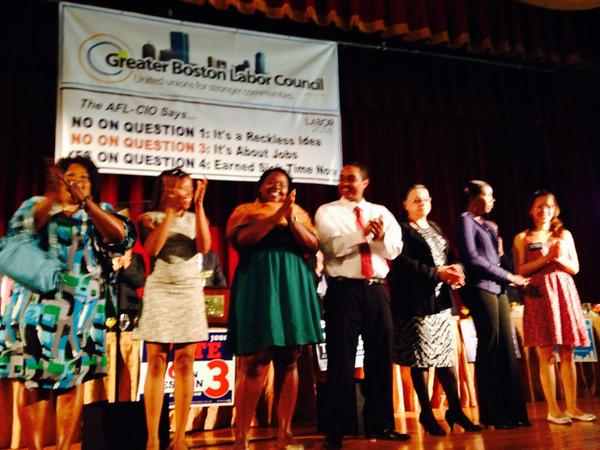
The leadership and activists of most Boston-based labor unions have moved strongly into the Governor campaign during this, the last ten days of it. A few, SEIU especially, were already there, all-in as eaarly as before the Primary. Now most of the other unions have joined them.

The question is, “why ?” Why now ?

It’s too late, most likely, and too little, to change the outcome. One union activist likes to tell me that in last year’s Boston Mayor election Marty Walsh’s labor supporters knocked on 30,000 doors. But they started their effort much earlier, and faced an electorate 150,000 strong. In the Governor election, 2,000,000 people will vote. A proportionate labor effort would require them to knock on 400,000 doors.

They know the math as well as do the Governor candidates. So why are they doing it ? Why all the physical effort to influence, at best, about 20,000 votes ?

The answer : 2016. The Presidential campiagn has already begun. In it, labor unions are determined to have a major say in — even to choose — which Democrat is nominated. In last year’s Mayor election, the determination of union labor (not all, but most) to choose a labor man as Mayor, and to attack his equally Democratic, but decidedly Clintonian, opponent in the event, almost split the Massachusetts Democratic party. That, and the split between Democrats for Education Reform and teachers’ unions, set a stage — as I forecasted then in several Here and Sphere columns — now moves to the next step.

That step beagn on Friday, as Hillary Clointon took the speaker’s podium at park plaza hotel. She came here ostensibly on behalf of the local Democratic ticket, but, more likely, on behalf of herself. And if she runs, she now looks unstoppable. Polls accord her from 58 to 67 percent of Democratic Primary voters, Vice President Joe Biden about 14 percent. And then there’s Senator Elizabeth Warren — whom few Massachusetts voters want to see run for President. As if sentiment could caution ambition.

Which of these becomes the nominee matters hugely bto labor unions. As we see, the wages of most workers have stagnated or fallen since ten to fifteen years ago, while the salaries of top managers and CEOs has boomed exponentially. Most wage earners can’t do much more these days than pay the necessities. Many live one pay check from broke. The Boston building boom, like the Big Dig before it, has put big wages into the budgets of building trades unionists; but for service workers and most industrial unions, wages are losing ground to living costs; unfair labor practices abound too; and the nation’s labor laws have lost much of their sting through weak, even non-existent enforcement.

No labor union leader wants these conditions to worsen, nor to continue. They want a better deal; justice says they should have it; but economic justice wull be hard to win. thus the battle for it has to begin now, and it has.

The Governor race has seen the effect of labor’s urgency. Many unions might well have endorsed Charlie Baker, who as overseer of the Big Dig, was a good friend to construction workers. The Hotel Workers endorsed Bill Weld in 1990. They might have done so this time too : Baker has, since May, put a proposal out to sell state owned land, in Boston especially, to developers at a small price in order to generate the building of affordable housing. He says of his plan, “Mayor Walsh is making permitting easier; labor will always be expensive, but there’s no reason why land acquisition should be.” Note the words about labor. To my ears, that is an offer : under Baker’s plan, everything will be made easy so that construction workers can “always” earn “expensive” wages.

I think that what has happened since, between labor unions and the Governor campaign, is this ; because labor unions are trying to dominate the Democratic party for 2016, they can’t very well bolt it by endorsing Baker. But they can, and have, withheld commitment to the Democratic ticket until very late; so late that their campaign will advance their influence within the party while not changing the Beacon Hill outcome. If I’m right, it’s a very smart move, one that suggests some — not all — labor leaders have learned how to naviagate political waters bigger than their footprint but liquid enough to be redirected to the right economic beach.

—- Mike Freedberg / Here and Sphere