POLITICS CONTNUES TO BE ABOUT PEOPLE — AND THE GOOD

Going about Suffolk County, mainly, according to my own commitment as a citizen, i am reminded every day that politics thrives because people use it and accept its gifts. Equally I find confirmation that politics still seeks the good.
1 Thucydides

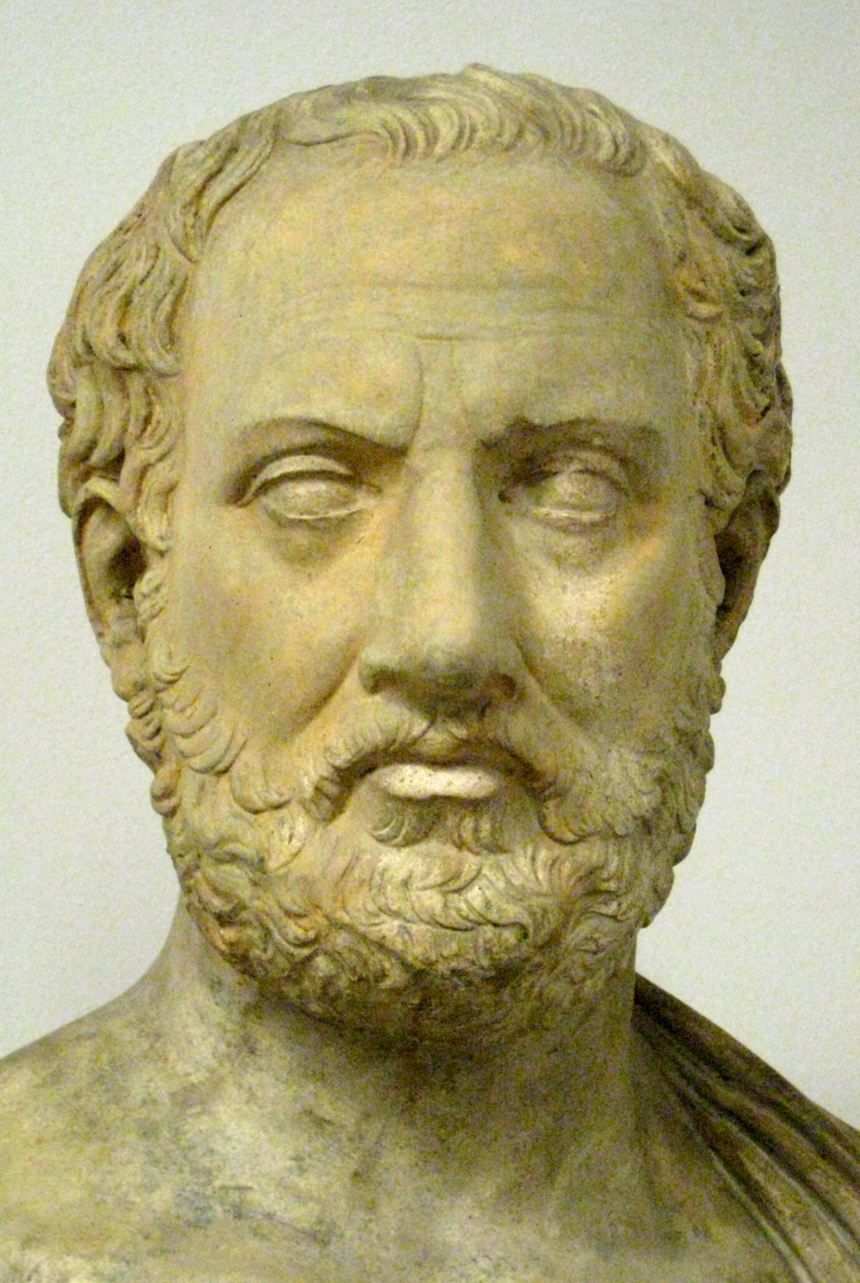
^ Thucydides : whose observations of politics still govern good citizenship

—- —- —- —-

To do politics, you ought remember what Rabbi Gamaliel taught, in Judea, some 2050 years ago : ‘whatever is hurtful to you, do not do to your fellow man.” (Jesus of Nazareth, so the gospels tell us, took up Gamaliel’s saying in the form “do unto others as you would do to yourselves.”) This is the moral ground of politics in our nation; its ethics..

The second fundamental of politics comes to us from 4th century BC Greece, Aristotle inventing the word “politics” (from the Greek word “polis” meaning “city”). Aristotle’s politics was the art and system by which cities ruled themsleves. Citizens — the “demos,” from the word “deme” meaning tribe or extended clan, met “democratically” in public assembly to choose a city’s leader and to decide public questionas. The process by which all this took place was “politics,” which I can readily translate as “city-ism.”

Aristotle did not limit his analysis of politics to city-ism. His treatise describes several other systems of governing, weighs their worth, critiques their failings — he critiqued city-ism too. Even today, city-ism requires a constant vigilance and much criticizing.

We who engage in politics seek the good; but we know when to settle. Plutarch tells this story of the pre-Aristotelian city manager Solon (yes, that’s what the Greek word “tyrannos” meant. not despot or sultan but “city manager.”) who, in exile far from Athens after being ousted, was asked by the king, “did you give the Athenians the best laws ?” replied “No, I gave them the best laws they would accept.” The late Ted kennedy said much the same : “the perfect is the enemy of the good.”

Let’s opine about that saying of Kennedy’s. “The perfect is the enemy of the good.” In it we read everything that Augustine had in mind when he saw that men do evil because they want to — because they substitute their will to that of God (who for Augustine was the good). We who engage in politics can adviocate ideal solutions, annd we proably should; but we must always be ready to see that an ideal solution may leave out a lot of people live other means or modes. And doesn’t become any more just because we advocate it.

The city-ism that Aristotle described was full of argument and discussion, difference of opinion and, sometimes, the wron g outcome. There was no guarantee at all in Aristotle’s city-ism that the process would make life better. And as we read Thucydides, who preceded Aristotle by a century, we measure the misjudgments made by Athenian politics, the selfishness, the petty piques, and the manipulations, just as we see the bbrilliant oratory and debate. Still, no one who wrote about Athenian politics had any doubt that it was the best way to do good.

Nobody who reads Thucydides’s narrative should have any doubt that the offended temper tantrums of Alcibiades are not beneficial to the state; nor that the cynical scandal-mongering and backstage maneuvers of Cleon helped the Athenians to focus on the war they had decided to engage in. Thucydides — who personally participated in the history he wrote about — wrote after the fact; still, he wrote, so he tells us in his magnificent prologue, in order that future politcians might avoid the mistakes and conflicts that voided the Athenians’ policies. Today, we who engage in politics have no excuse. We have Thucydides’s book and his admonitions looking over shoulder, telling us to do better, and about what; to be circumspect even as we fight for reform; to not think ourselves possessed of ultimate wisdom about people, nor to seek our own power at all costs, or tasked to make the world wholly right all at once.

This year we see an ocean of tantrums flooding our politics. we see the usual maneuvering by cynical power-seekers. We see it and we usually recognie them as such and as evil — because there is no guarantee, in politics, that the decisions will go as you want them to. Oten they do not; because no one is always right or able to persuade a majority of his cause. When that happens, the citizen (a Latin word meaning “inhabitant of a civis, a city) doesn’t become a bomb tosser. He or she accepts the decision and works patently to alter or change it.

Thus politics meets the moral precept of Gamaliel.

i am conident that most Amrricans desire the good and trust that citizenship politics is the best way to bring the good about. i am confidht that the tantrum tossers and cynical subverters will be seen for what they are about and will be rejected. We in America do have moral leaders and just. I ve confidence that in the end, the vast majority of us will recognize them and vote them to office.

But I do have one last illustrative story. it comes from Plutarch, who wrote about Aristides, an Athenian politician of the generation preceding that of Thucydides. A move was started to vote Atistides into banishment (which was often how Athenians voted leaders out of office). One day an illiterate man came up to Aristides in the street (not recognizing him) and said, “I want Aristides bansished. Will you please write his name on this tablet ?” To which Aristides answered, “Has he wronged you ?” The man said, “No, and I do not even know him, but it irritates me to hear him everywhere called the just.”

At which point Aristides wrote his name on the man’s tablet.

—- Mike Freedberg / Here and Sphere

EDUCATING BOSTON’S KIDS : WHICH PRIORITIES DO PEOPLE ACTUALLY WANT ?

FullSizeRender

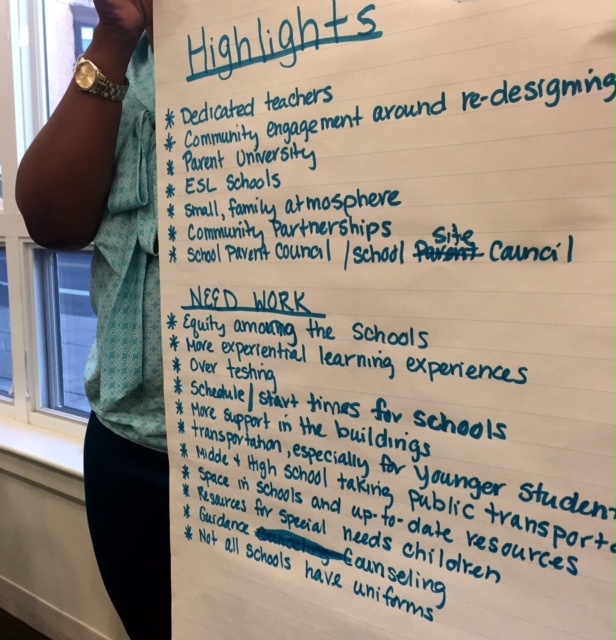
^ some of the many recommendations advanced at last night’s Dudley Square Neighborhood Initiative meeting

—- —- —- —-

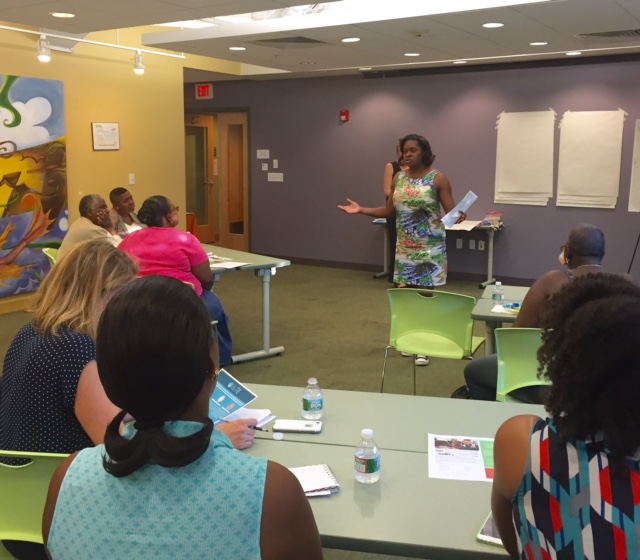
If last night’s meeting at the Dudley Square Neighborhood Initiative’s Headquarters indicates, residents want an education prospect very different from the situation that exists now.

Each table of people at the meeting was asked to discuss what aspects of current education they think are working and those they think need more work. The group included school principals, teachers, parents, and one member of the Boston School Committee, Jeri Robinson. Their responses were written up on large sheets of paper (see my photographs) and produced remarkably authoritative assessments:

  1. Contrary to those who wanted the old Dearborn School preserved and a different location, or different model, sett\led upon for the new Dearborn, last night’s people universally like the new Dearborn STEM Academy.
  2. Everybody agreed that there needs be a broader range of school choice : charters and, yes, schools operated in partnership with employers.
  3. Everybody wants to see greater parental involvement and a higher number of people-of-color teaching staff.
  4. Everybody agreed that students need to be confronted with far moire real, world, everyday experience
  5. Almost everybody had praise for the Public School headquarters being located now in Dudley Square, no longer downtown.

Attendees also want to see a curriculum better attuned to “21st century skills”; younger teachers; more up to date technology in classrooms; a longer school day; and stricter monitoring of bullying at school and on school buses. Strong, too, was support for more effective special needs teaching. Many want better “ESL” (English as second language) pedagogy. Few had a good word for the present BPS use of public transportation for seventh and eighth graders.

Little, if any, discussion was had of school budgets. Much of what the meeting did not like, or wanted reformed, lacks budget money to accomplish. That said, what you’ve read amounts to an education menu monumentally different from current parameters. Expanding school choice means, first, getting the cap on charter school creation lifted. Expanding partnership pedagogy is fiercely opposed by the Diane Ravitch, teacher-control constituency. Younger teachers threatens Boston Public Schools’ teacher tenure system. The other DSNI recommendations challenge fewer entrenchments, but those that challenge had the broadest support.

FullSizeRender (1)

Clearly the Dudley area’s residents and education professionals get what almost everyone else wants, who cares about education in Massachusetts. The Dudley list also parallels, quite closely, the education platform advocated by John Connolly in the epic 2013 Mayor contest. I highly recommend that city and state elected office holders, at all levels, think seriously about the full range of last night’s agenda and work to get as much of it implemented as feasible — beginning with, but not at all limited to, charter school cap lift on next year’s November ballot.

—- Mike Freedberg / Here and Sphere
THE CHARLIE BAKER MISSION : A MORAL ONE DEEPLY GROUNDED IN CIVIL RIGHTS GOSPEL

FullSizeRender

^ Governor Baker greets Boston Public Schools Superintendent Tommy Chang and 30 graduates of College Bound’s matriculation program at last night’s ceremony in the Bruce Bolling Building in Roxbury

—- —- —- —-

If you want to grasp Governor Baker’s fundamental message, a good place to start is Curtis Mayfield’s 1960s-era anthem “Keep On Pushing” :

Keep on pushin’
Keep on pushin’

I’ve got to keep on pushing
I can’t stop now
Move up a little higher
Someway or somehow

‘Cause I’ve got my strength
And it don’t make sense
Not to keep on pushin’

Hey, Hallelujah, Hallelujah
Keep on pushin’

Now, maybe some day
I’ll reach that higher goal
I know I can make it
With just a little bit of soul

‘Cause I’ve got my strength
And it don’t make sense
Not to keep on pushin’

Now look a look, look a look
A look a yonder
A what’s that I see
A great big stone wall
Stands there ahead of me

But I’ve got my pride
And I’ll move the wall aside
And keep on pushin’

Hey, Hallelujah, Hallelujah
Keep on pushin’
Keep on pushin’

What I say, yeah
Keep on pushin’
Well, that’s alright

Or one might watch James Brown do “I Don’t Want, Nobody To Give Me Nothin’, Open up the Door, I’ll get It Myself” :

These anthems from the Black struggle for Civil Rights 50 years ago inspired us all; the determination, courage, and idealism that made it happen remain iconic for the best in us. They’re the fire that moves Baker’s basic message to people : that life is tough no matter what and that yhou have top keep on keeping on, at all times, if you want to have any fair chance tro succeed.

Last night, at the College Bound matriculation ceremony, Baker talked of “grit,” speaking directly to the 30 or so graduates in front of him : “I cannot imagine the grit necessary to face life;’s problems, feed a family, work, and still have the desire to go to college… you have grit.”

He talked of setbacks in life — of his own setback, the defeat of 2100,and what it took for him to decide to try again, knowing that if he lost, he would be, and forever known as, a “two time loser.”

Politicians rarely talk about their defeats. They certainly do not talk about how defeat got to them, challenged their self worth.But baker here was talking to people who have had their self worth challenged many, many times by defeats in life.

You simply have to keep on pushing. Yes, you may have to ask someone to open the door for you — as College Bound’s graduates all have had to do — but once that door is open, you simply have to be ready to grasp the opportunities yourself. Now and forever after, as long as you live.

This is the message that baker brings, over and over again, to Boston’s communities of color, at sports events and to self-help groups — of which there are many in Communities of Color, largely because self-help is often the only help available to people whom society often shuts out. Baker bonds with self help groups all the time, and politically it’s as wise as ,morally, because Baker is, at day’s end,a Republican, and self help groups accord well with the morally, politically best GOP mission.

Self-help also has deep, broad roots in American history well beyond particular applications to people of color. And Baker is right : underlying self-help is grit : keep on pushing, I’ve got to keep on pushing, I can’t stop now, Move up a little higher, 
Someway or somehow.

Baker’s view is that government can — and should — give those who need a hand all the door-openings it can; but that it really is up to those for whom doors are opened to keep on pushing, getting it themselves. Baker talks all the time about getting people out of poverty. For him it’s a partnership been door openers and people’s motivation : their grit.

I think he’s right. Motivation is crucial. Life is never easy, not for anyone at all who isn’t born rich (and even for them quite often) and there is nothing government can do to make it easier except to not be an actual barrier to people’s advancement.

Baker sees every agency of state government as a door opening. He’ll do the best he can to open those doors effectively and at not too dear a cost, in hopes that people will take equally effective advantage of said services.

This is the pact that Baker is building with the state’s residents. There remains work for him to do, especially with the state’s Hispanic communities, which have different cultural referents than Black Americans and somewhat different legal barriers facing them. But my guess is that Baker will bring his message and power position to Hispanic communities, too. It’s what motivates him.

Obviously Baker has his sights on re-election. Will his mission prove a vote-winning one ? In the 2014 election he won barely 9 percent of Black voters,maybe 12 percent of Cape Verdeans,  about 18 percent of Hispanic voters. Voters of color are the Democratic party’s core constituency. Baker is almost certainly winning the favor of many. I see it every day. Yet come 2018, the Democrats will almost certainly nominate a Baker opponent who voters o color will like as well. How will Baker stack up against that nominee ? Better than 9 to 18 percent of the vote, almost certainly. But by how much ?

—- Mike Freedberg / Here and Sphere

NO END TO GOVERNOR BAKER’S TRANSPORTATION BATTLES

north south rail link

^ the Boston University Bridge, seen here under repair in 2012, is the only current rail link between North of Boston and South of Boston. Will we build an actual connector ?

—- —- —- —-

If Governor Baker thought that securing his MBTA reform bill was the end of his transportation wars, he now knows differently. About a week ago a revived fight to build a North Station to South Station connector rail hit prime time, and yesterday came news that the Green Line expansion to Somerville and Medford might cost at least $ 1 billion more than anticipated — a stunning number.

So what does Baker do now ? He cannot set either one aside, as he was able to do with the Boston Olympics bid. The Olympics Bid was a trial balloon; Boston’s economy and social life may hurt without the Games, but only temporarily. Not so with Green Line expansion or the North-South rail connector. Dismissing either will impact our region’s transportation for many decades. That’s not to say that the decision to go ahead with either project is easy. Still, the two are not equal. The North to South rail connector remains conceptual, while Green Line expansion has reached the build-out point.

So, again, what decisions is Baker likely to make ? He hasn’t asked me, but I’d offer the following :

1, Green Line expansion should continue, even if the contract price can’t be brought into line with the engineer’s projections. The Feds have committed $ 1 billion to the project; it would be foolish to lose that.The City of Somerville needs the Green Line. So does Medford. Communities farther up Route 38 can use it. So can people who now pack I-93 to overflow at rush hour. If we’re serious about decreasing vehicle traffic — and carbon emissions — Green Line expansion must be finished, as soon as feasible. So I repeat: it should be done even if there’s a substantial cost overrun.

Two problems portend. First, a Green Line cost overrun means making hard decisions about repairing existing MBTA tracks, equipment, signals, and trains. These can NOT be put off, which means applying state monies currently slated to other state agencies. (DO I hear DCF reform ?) Second, anyone who has attended public meetings concerning Green Line expansion has seen the nitpicking and design unrealities that always get pushed into the mix. Green Line expansion cannot be finished anywhere close to budget if it takes on every bell and whistle desired by those who show up at public meetings.

That said, extension of the Green Line has already consequenced development in Somerville and the city’s entire economy. It can’t be set aside.

2. The North Station to South Station connection looks daunting. Certainly Baker should require thorough cost and engineering analysis of the project before deciding anything.

Digging a tunnel between the two stations means going very deep under immense structures. If you thought the Big Dig was an engineering nightmare 25 years ago, imagine what will be needed to tunnel under buildings vastly taller than those of 1990; under sewer lines, subway tunnels, and the depressed Central; Artery itself. It also might require relocating South Station and its current ten rail portals, because, imagining potential connector routes, I can’t see how it gets from North Station to South Station otherwise. The easiest route would be to underride Atlantic Avenue. Sixty years ago that roadway included train tracks of a connector railroad. I recall those trains : they were surface vehicles. Today’s connector would have to tunnel under the already very deep Blue Line tunnel — and under the Red Line tunnel, which, quite inconveniently, runs directly alongside South Station. How would the connector tunnel rise up steeply enough to go from under the Red Line to a surface connection with South Station’s ten rail portals ?

Perhaps a connector line could run alongside the Orange Line from North Station to Downtown Crossing, thence alongside the\ Red Line to South Station ? This too would be an engineering nightmare and a budget buster, and you’d still have the rise to surface problem, at both ends of the connection.

Lastly, what happens to the $ 1.6 billion expansion of South Station, planning for which is nigh complete, awaiting only agreement to move the Boston Post office ? Do we roll this project into the connector proposal and thereby delay it, even kill it ?

Advocates for building the connector speak passionately and hurl a blizzard of answers at you, to questions you ask — and to those you haven’t asked yet. Which only ratchets my skepticism up. Not skepticism for the idea. I support the concept. Why our city lacks a rail pass through, I’ll never understand. Lacking a connector forces cars onto the Central Artery which that groaning roadway can barely manage — and at rush hours, cannot. Someday the rail connector ought be built. I’m just not sure that now is the right time, given the huge dollar demands faced immediately by the MBTA, commuter rail, bridges and roadbeds.

On September 9th, Baker meets with the connector rails’ two most potent advocates : former Governors Dukakis and Weld. That should be quite the dust-up. Let’s see what comes of it.

NOTE : this story has been UPDATED as of 08.26.15 at 10.05 AM in light of what we now know about the economicsof Green Line extension.

—- Mike Freedberg / Here and Sphere
BASIC RIGHTS ARE BIRTHRIGHTS FOR IMMIGRANTS — AND ALL OF US

immigrants

^ immigrants from Central America, mostly, waiting for a border crossing

—- —- —- —-

Never in my long history of political involvement did I anticipate that the citizenship of people born in America would become an issue, much less be taken up by one of our two major political parties. What has happened, to make a substantial number of voters want to deny citizenship to people born here ? Extending citizenship into all who are born on American soil was one of the great victories of the Civil war. 5r00,000 of us died so that civil rights could be own and secured, firmly in the Constitution. The 14th Amendment was that war’s ultimate victory. Let us quote the Section One of the Amendment in full, so that you can grasp its no=nonsense power :

“Section 1. All persons born or naturalized in the United States, and subject to the jurisdiction thereof, are citizens of the United States and of the State wherein they reside. No State shall make or enforce any law which shall abridge the privileges or immunities of citizens of the United States; nor shall any State deprive any person of life, liberty, or property, without due process of law; nor deny to any person within its jurisdiction the equal protection of the laws.”

These are words of equality first of all. They make clear that everybody is included in all the basic rights accorded by the Constitution — no exceptions — and by “the laws” of all jurisdictions — again, no exceptions.

A war had only recently been concluded as these words were crafted and adopted. They were a life and death affair. The makers of the Amendment weren’t fooling around.

Nobody of any political significance missed that message for over 125 years. Only in 2012 did I begin to hear some people on the far right say that birthright citizenship ought to be repealed. They said it during a time when right wing extremists were one-upping each other saying things so outrageous that you wondered when they would find themselves cast out, utterly, by voters who had to be offended — at the very least — by hearing people talk about taking away basic Constitutional protections. But these extremists were not cast out. They found support, more and more support.

I did not see this coming. I’ll admit that I could not imagine it even when it had in fact come. Reluctantly I find it necessary now to write this editorial defending stuff that I assumed was long since settled. Obviously I was wrong. A substantial number of voters think the 14th Amendment should be repealed ! Candidates for President say so. Thus t.he need to rebut them.

Every person born in America is a citizen of America AND — the Amendment says so — OF THE STATE in which he or she resides. All does indeed mean all. No matter what ski9n color, or national origin, or native language., you are a citizen by virtue of being born on American soil. And more : being born here, you are guaranteed equal protection of the laws, state and Federal. No state, nor the Federal government, can take away birthright citizenship for some people or some class of people.

Those who want to change this — which they cannot; the 14th Amendment will never be abolished or amended — want it because they don’t like immigrants. Don’;t like immigrants’ looks, or origin, or language, or don’t like that some immigrants came here on their own and not by way of immigration laws, quotas, time frames. We have been here before. Hatred of immigrants has diseased America since at least the 1820s, when people rioted against incoming Irish immigrants to New England. Such hatred makes no sense at all. All of us are immigrants or the descendants of immigrants. It;’s who America is  Hating immigrants, we hate America and hate ourselves. Not that that ever gave a hater pause.

Common human decency says that we welcome the newcomer. Welcome him and maker him (or her) feel at home. America has enshrined those words on the Statue of Liberty’s pedestal, no less :

Give me your tired, your poor,

Your huddled masses yearning to breathe free,

The wretched refuse of your teeming shore.

Send these, the homeless, tempest-tost to me,

I lift my lamp beside the golden door!”

That was how America some 130 years ago engraved its welcome on its most iconic statue. Do these words hold any less powerful feelings today ? Has the human heart altered its state since our great great grandfathers heard these lines ? I think not. Through the port waters upon which the Liberty Statue rises passed all those immigrants whom haters hated most : the Italians, the Jews, the Poles, the Greeks. Welcomed first and foremost, long before they reached the havens of hate.

Even then, other immigrants, from Asia, arrived 3300 miles West and faced discrimination which was thrown utterly down by the Supreme Court in an 1898 case involving the right of Chinese immigrants to have their children born here recognized as citizens pursuant to the Amendment now under hater attack.

It is all so immoral, and so futile. Immigration boosts the American economy. Every immigrant is a customer for American business. Even undocumented immigrants — 11,300,000 of them, pay billions of dollars in taxes for services which the laws of many states deny to them. If you cannot welcome immigrants morally, do so economically. Their coming here is bullish — economics 101.

Immigrants almost always worship this nation. How else come here by way of such trails and tribulations., leaving one’s home to chance it anew ? Who of us would endure what immigrants do to get here ? Few, I think.

And if for many the endurance and the danger of getting to America is undertaken in order to give their future children citizenship, why is that not a terrifically good thing ? If American citizenship is that valuable, what voter would debunk it ? What activist devalue it ? What presidential candidate disparage it ?

—- Mike Freedberg / Here and Sphere

ECONOMIC REFORM WITHOUT RAISING TAXES

IMG_9969

^ signing the EITC expansion : will there be consensus on the NEXT economic reforms ?

—- —- —-

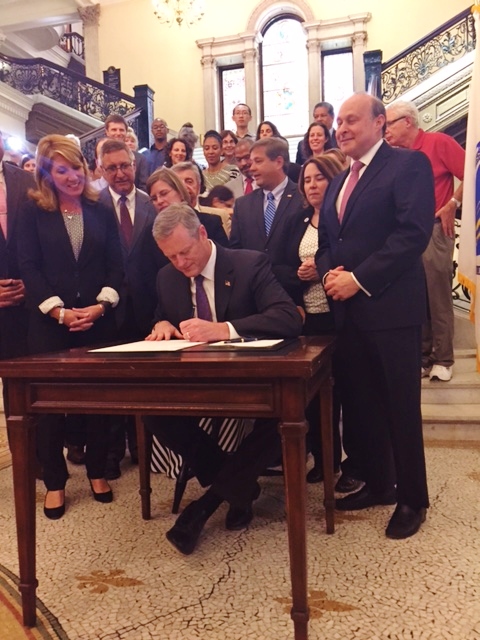
Economic reform of Massachusetts began about three weeks ago, as the Governor signed a new law expanding the Earned Income Tax Credit (EITC) by 50 percent. State Senators, state Representatives, and progressive activists joined the Governor and Lieitenant Governor at the signing — the very icon of consensus.

No one cared to mention that a significant number of Senators had wanted to pay for EITC expansion by not lowering the state income tax to 5 percent from 5.15 percent, as by law it will change. The Senate did move away from that proposal; instead, EITC expansion is being paid or by not implementing a scheduled corporate tax break.

The House, led by a more conservative financial voice, had already enacted that EITC plan. And so the State had its progressive consensus moment.

Less than month later, however, there are at least two plans afoot in the senate to increase taxes. Both should be rejected.

First is a proposal to create a two tier tax assessemnt. Those with incomes over one million dollars annually will pay 9 percent tax. Everybody else will pay the new 5 percent rate. The second proposal — just released this week — will create a $ 250 college savings account fotr every baby born in Massachusetts, half to be apid fpor by taxpayers. The cost : $ 18 million annually.

Progressive State Senators adduce these proposals because the state probably does need additional evenue if it’s to pay for massive transportation upgrades and service expansion, pre-kindergarten education, and the new Opioid addiction crisis terams. Taxing to obtain that money, however, doesn’t seem a wise choice.

In our view, instead of penalizing those who earn a lot — and who spend most of it into the economy, boosting businesses and thereby creating jobs — it’s far better to raise the state’s minimum wage, or to approve home rule petitiions raising the minimum wage in our big cities. Bernie Sanders likes to point out that if the 1968 Federal minimum wage had kept pace with inflation, it would now be $ 26 an hour. Imagine the economic boost if every full time worker had that kind of income to spend on stuff and services !

We don’t advocate raising the minimum wage that high — yet — but we do think it smart to boost the state’s minimum to $ 15 an hour and index it to inflation. Workers earning $ 600 a week — or more — and thus $ 31,200 a year would rise above the level of EITC credits; they’d actually pay taxes instead of receiving credit payments rom the state. They’d also have funds to spend into the discretionary economy. A two-worker family earning the current minimum wage and, let us say, ten percent above it, $ 9.90 an hour, can barely afford necessities. At $ 792 a week, that family, if living in Boston, pays at least 50 percent of its total income rent. Even in New Bedford or Worcester, they’d pay one quarter of their income for rent only, never mind utiiities, cell phone, cable TV, clothes, food, and insurance.

Raise that two worker family’s income to $ 1200 a week, now, and they’re paying one-third of their earnings for rent even in Boston and can afford to eat out occasionally, buy furniture, send the kids to summer camp, take in an entertainment event, maybe even save some money to buy at least a condominium. And pay taxes.

To us, that makes sense.

We likewise do not see the purpose in asking taxpayers to pay half of the proposed college savings accounts. State Treasurer Deb Goldberg proposes that such collgege savings accounts be funded entirely from private sources. Why not do this ? And if we can raise the state’;s minimum wage to $ 15 an hour, why not give families the option to designate a portion of their state tax payment to such fund ?

Economic growth for all seems to us far more progressive than tax penalties for a few.

One last note. At the EITC signing, Governor Baker said, “this is just the first part. i can’t wait to come back for the second part !” I wonder what he has in mind.

—- Mike Freedberg / Here and Sphere

BOSTON2024 : THE BRATTLE REPORT AND A REBUITTAL

Boston 2024

^ great vision, bold plan : but the Brattle Report strongly suggests there wasn’t enough time between now and 2024 to get it done

—- —- —- —-

NOTE : I have updated this story in light of Boston 2024’s response to the Brattle Report. See below for updating.

We now can read the much-awaited Brattle Group’s report on the risks involved in Boston 2024’s Olympic Games bid. At 10.30 AM this morning the e-mail arrived from the Governor’s press office. There it, was : the Executive Summary, which I have now read, and the full report, which I’ll read eventually. There’s enough in  the Executive Summary to tell us much about the “2.0” Bid.

To read it, click on the link : http://www.mass.gov/governor/docs/news/final-summary-brattle-report-8-17-2015.pdf

The Brattle Report evaluates four separate areas of revenue and cost : ( 1 ) revenue ( 2 ) construction costs ( 3 ) security costs and ( 4 ) infrastructure costs. As we might have expected, the greatest area of risk was construction costs. It is disturbing to read that, according to Brattle, the 2.0 Bid underestimated construction costs for everything, as much as 90 percent too low in the case of the Media Center. It is equally disturbing to read Brattle’s finding that the major construction — at Widett Circle and the Olympic Village — had no developer committed to doing it, and to read that the costs of construction, in relation to likely financial return (i.e., developer profit) might very well not compute. To read this section of the report is to conclude that the Bid Committee had nothing more solid in its hands than high hopes.

That part is unsettling enough. Just as unhappy it is to read the report’s assessment of Bid 2.0’s Infrastructure Plans. The Plans themselves get high marks, but not the available time. The report makes clear that it would have been next to impossible to complete all of the planning, financing, approving, and building of the various transportation segments in anything like the eight years available.

Those of us who supported the games Bid felt that the transportation infrastructure requirements, which would also benefit the entire City’s transportation improvement, would not get done in our lifetime but for the time pressure put on them by the Games Bid. The Brattle Report concludes that our strategy was infeasible. For those of us who supported the Games Bid, that is OK; our thought was a shrewd one. For the Bid Committee itself, however, it was regrettable to learn that they allowed supporters to advocate a tactic the Committee knew would not fly.

UPDATE 08/19/2015 10.30 AM

I leave that sentiment as is; however, last night the Boston Bid Committee sharply criticized the Brattle Report, and their rebuttal has legs. Specifically, the Bid Committee notes that the Brattle report erred completely in estimating the Media Center. As the Bid Committee noted,. it wasn’t building a Media Center from scratch but instead retrofitting already existing buildings. thus the Bid Committee;s estimated $ 50 million allocation was NOT 90 percent too low, as charged by the Brattle Report.

The Bid Committee also correctly notes that the Brattle Report never mentioned the financials from the last three American games., This omission I noted when first I read the report. The only recent games mentioned by the Brattle Report were the 2012 London games. What happened to Atlanta ? To Salt lake City ?

I’m left with the impression that, as to costs, the Brattle Group wanted to describe a kind of worst-case outcome.

So let us instead surmise that the Bid Committee would have found developers ready to commit to the Widett and Olympic village developments at available cost prices for available profit. Those are numbers, and numbers can adjust. Not so time. Time is what it is. The Brattle Report’s one undeniable critique asserts quite convincingly that the Bid not have enough time available to complete its preliminaries; and that, therefore, the games could not have happened at all, except, if possible, by an heroic undertaking by everybody in City and State with a damn the costs, damn the approvals, to hell with the procedures attitude.

It would have taken the City and State an all hands on deck, crisis level of commitment to thus beat the clock. Could we have don it ? Yes, but not given the division, the confusion, the overlap and disagreements that abounded during the Bid months.

Scant wonder that the Mayor refused to commit the City’s finances to a money guarantee of a Bid so likely to not get to the starting line on time.

—- Mike Freedberg / Here and Sphere

GOVERNOR BAKER CONFRONTS THE DCF CHALLENGE

Baker at presser

^ the press wants to know : what will Governor Baker do about the DCF ?

—- —- —-

Yesterday at the State House, Governor Baker faced an inquisitorial press contingent riled by the latest death of a child in care by the Department of families and Children (DCF). A two-year old child living in a foster home in Auburn, a town suburban to Worcester, had died — this coming barely a week after a seven-year old was removed from a dysfunctional home under DCF observation, in Hardwick — also a town in Worcester County.

baker was accompanied by Lieutenant Governor Polito, a Worcester County resident; Dan Bennett, Director of the Department of Public Safety; and Marylou Sudders, who heads the Department of Health and Human Services, of which DCF is a crucial part.

Bennett’s task, Baker said, is to conduct a full investigation into the two year old child’s death. But it was Sudders who — along with Baker — faced the most pointed questions. It transpired that the foster home in which the two year old had been placed by DCF had been the subject of “dozens” of 911 calls. How does a home that disrupted become qualified as a foster home under DCF’s foster parent gui8delines ? Evidently DCF’s foster parent background check doesn’t include 911 calls.

Sudders assured the press that 911 calls will now be added to those background checks.

She then outlined the big DCF conundrum : 100 million $ had been cut from the agency’s budget during the years after 2009, yet now, in 2015, the agency’s caseload has increased by 30 percent and totals the highest number ever.

Baker assured the press that “we and the legislature are agreed on adding additional funding to DCF.” As the state now has a surplus, thanks to rigorous financial discipline applied to the FY 2016 state budget, that funding exists — and will surely be provided in the forthcoming FY 2017 state budget.

Baker vowed that fixing DCF is now his highest priority.

Having spent six difficult months achieving complete reform of the MBTA, Baker now faces at least six difficult months getting DCF right. His DCF Commissioner, Linda Spears, told the Boston Globe, “it’s easier to write a report than to get it done.” How true. Especially with DCF.

Fact is, that the DCF most likely can never prevent every tragic outcome for children under its watch. The dysfunctional people that DCF is called to deal with have all kinds of life issues. Many are in addiction. Some are in jail, or newly out of jail, facing going back to jail. Some have craziness issues. Foster homes can be supervised to the moon, but unless DCF social workers come to live 24-07 in a foster home, what goes on in said home most of the time happens without supervision.

Much is written about unlicensed social workers, or high caseloads, or foster home certification. All of it merits rigor. But you can hire 10,000 new social workers, and rigor away foster home applicants till there’s almost none, and it will not eliminate tragedy. No social worker can live 24-7 with the 18 families the DCF social worker contract agrees is a caseload limit. No social worker can live 24-7 with even one such family. So what becomes of DCF children during the time that no social worker is watching ? Yes, school personnel and police — as well as others — are mandated by law to report child abuse or neglect; but it takes time to read those reports and to check them out; and who knows if the social worker gets it right ? Often they don’t.

Even then, most of such childrens’ lives do not have on the spot supervision.

Doubtless Baker, the manager’s manager, will fix what can be fixed of DCF;’s procedures, staffing, and response times. But it will not free DCF from tragedy. Note that many of the recent DCF failures have occurred in Worcester County, a region largely of isolated small towns where people live far away from nearest neighbors. In big cities, people live next door and notice stuff. In much of Worcester County, a dysfunctional home’s social worker visit may be the only occasion that anyone notices anything. And even then, nothing may be noticed. Nothing that Baker can do is going to change this fact.

—- Mike Freedberg ./ Here and Sphere

BALANCE THE FEDERAL BUDGET ? YES…AND NO

speculation

^ Traders seeking speculative winnings : they will have less to do if we apply some sensible balanced-budget investment rules

—- —- —- —-

For quite a while I’ve held a deficit Federal Budget to be a good thing. A deficit Federal budget means increasing the supply of Treasury bonds and bills, the world’s safest investment, upon which almost every financial institution relies as foundation of asset stability. $ 16 trillion of Treasury bonds and bills also act as clearing house for much of the world’s economy; their stability keeps the world economy on track. I’ve also favored increasing the supply of “Treasuries” because in economic crisis times, the only way to sustain vulnerable Americans is to borrow the money they need for survival.

All of these purposes remain in the mix. Yet today I am rethinking my preference. I’m not sure that $ 16 trillion of investors’ money should be parked in safe investments. Couldn’t at least a big part of that $ 16 trillion better serve our economic future by committing to innovation enterprise, research, and experiment ? Risk investors do play their part already, yes; more than a trillion dollars of venture capital money juice start-ups and second-round newcomers. Still, it’s not enough. For every start-up or newcomer that secures investor money, ten to 100 don’t receive it. Research gets put on hold, or fails altogether, because the funds simply aren’t there. Unleashing a fair portion of the $ 16 trillion would benefit many.

For that reason, I am thinking that a balanced Federal budget has found its moment. Maybe Federal budget drafters should even seek a surplus and use that surplus to pay down part of the $ 16 trillion., It happened during the Clinton years; why not again ? I opposed the Clinton surplus at the time because interest rates were much higher then, and many investors relied on Treasury bond interest for an ongoing income. Today, however, interest rates have fallen almost to zero; and even the upcoming Federal Reserve interest rate hike won’t do much to make Treasury bonds income-productive. meanwhile, that money sits parked.

SO : is it time, finally,to go all in for this major monetary policy change ? You would think so; but there’s a pretty strong counter argument : much investment today goes to arbitrage — algorhythmic speculation that benefits no industry, and no workers, only speculators who spin their huge pools of money through one rinse after another. Speculator money never touches the ground., It provides neither innovation commitment nor stability. It must be curbed.

To that end, I propose the following Federal Reserve rules and Tax law changes:

  1. the tax rate on trading profits should be three-tier (today it is two tier) : profit on investments held longer than five years gets the 15 percent rate now in effect
  2. the tax rate on investments held for one year up to five gets the 28 percent tax rate now in effect
  3. the tax rate on investments held less than one year get a 50 percent tax rate.
  4. stock investments cannot exercise shareholder voting rights unless held for more than five years. Stock held “in street name” can only be voted, even then, pro rata by individual investors in hedge funds,etc. according to their share of the entire fund
  5. Margin requirements for purchasers of derivative instruments should be the same as currently for stocks. The Federal Reserve should have power to set those margin requirements and be able to do so up to 100 percent if it deems the need
  6. require all-purpose banks to apply savings depositor funds only to investments requiring a five year holding per,iod.

These changes would make it far less attractive for speculators and “activist investors” to bogard publicly traded companies and difficult for them to pursue a strategy of speculation — a use of money that benefits no one but the speculator.

Come to think of it, my suggested reforms ought to be enacted regardless. Our nation needs to commit to innovation, research, and experiment, including the huge task it will be to transition, even in part, from fossil fuel energy to alternatives. Balancing the Federal budget and changing our financial policy seems the right step to get us to this next phase.

A final note : you may be thinking “this writer favors Bernie Sanders and his anti-big banks agenda.” You would be wrong to think so. I have no problem wit.h bigness in banking. The world’s banks are consolidating rapidly; ours need to do so as well in order to maintain our nation’s position is the world’s financial clearing house and to keep our dollar the world’s reserve currency. Breaking up the big banks would damage us internationally. The reforms that I have suggested will work everything worthy in Sanders’s agenda without bringing on the mistakes he seems unaware of.

—- Mike Freedberg / Here and Sphere

NEW BOSTON IS COMING, FASTER AND MORE WIDELY THAN EVER

widett

^ Widett Circle reconceived : focal point for the “10 people on twitter” (actually more like 70-80) ?
—- —- —- —-

Whatever negatives the anti-Olympics constituency may have hurled into New Boston’s machine, its inexorable progress has not suffered even one nick. In the past few days the BRA has approved several major new projects, all over the City; including affordable living quarters near North Station, the Harmon Apartments in Dorchester, a new AC Hotel in the South , a big mixed-use development at 1650 Commonwealth Avenue, and the re-purposing of Dorchester Avenue from Andrew Square to the Post Office. This last was a feature of Boston 2024’s Olympic Plan. It will now go forward. So will a major expansion of South Station, as soon as the US Post Office administration approves this vast and complicated rearranging.

Today we add reports aplenty that the rebuilding of Widett Circle has moved from talk to plan. (Widett Circle is the huge, mostly open area between Massachusetts Avenue and Southampton Street, between South Bay Mall and the I-93 exit at Albany Street.) Widett now hosts the City’s meat packing, food distribution industry — no minor matter at all.

Do the meat packers object to being re- purposes ? Do they insist on staying put ? To read what the anti-Olympics crowd tweeted, you’d think these meat guys were A tribe of Native Americans, facing eviction from sacred tribal grounds. After all, didn’t the anti-2024 bards tweet dozens of haikus to the beauty of meat packing ? ens of poems to the hard-working meat me ?140-character epics to the Widett tribe’s holy soil ?

One might almost have thought, watching the USOC give our City the finger, that the 2024 Committee’s Widett plan would get nixed by the City’s “tone police.” Yet here we are. Sara Myerson, who now heads Mayor Walsh’s Imagine2030 initiative, discussed Widett plans with The Boston Globe two weeks ago. Those plans include the possibility of building a deck over the major railroad tracks that pass through Widett, the possibly prohibitive cost thereof., and alternatives. I quote the following from that article :

“The Widett redevelopment will probably be one of the most high-profile changes put in place by Walsh’s Imagine Boston 2030 plan, which is expected to be done in 2017.

“On Thursday night, the Boston Redevelopment Authority took the next step in the process when it selected New York-based HR&A Advisors to work with Boston’s Utile in running the master-planning effort. Myerson said it’s not clear when Boston would seek a developer for Widett. City officials, she said, need to have a better idea of what they want built.

“The wholesalers probably won’t want to wait much longer for some answers, though. Boston 2024 had been negotiating to find a new home for them in Marine Industrial Park, on land in South Boston controlled by the Massachusetts Port Authority. Massport’s chief executive, Thomas Glynn, said officials at the authority plan to meet with a broker representing the wholesalers this month to discuss what they would require.”

Disturbing, it might sound, that the City plans public meetings in connection with Widett futures. Do we really want to go there, after seeing what became of “public:” meetings for the 2024 Bid ? Yet the outcome of the passionately opposed 3200- Washington Street development in Egleston Square suggests that opening a major project to protesters need not squelch it. Approval thereof was granted by the BRA last night, despite a full room including dozens of loud opponents. (I have seen the opposition personally, having attended a 3j200 Washington Street meeting about a month ago.)

Why did 3200 Washington Street succeed, when the loudly opposed 2024 Bid failed ? As I see it, there’s two major factors : one, the 3200 Project also had strong support right there in the neighborhood, and those supporters showed up at public meetings to say so; and two, 3200 Washington threatened only one geographic segment of the anti-development constituency, whereas Boston 2024 threatened all of it at one time.

My guess is that Widett will face more powerful and better-prepared opposition than 3200 Washington did. For the anti Olympics folks, Widett Circle became a big deal, a flash point. I expect to see and hear lots of vilification, personal attacks upon City Hall people including the Mayor, slogans and buzzwords, and those famous “10 people on twitter” (actually more like 70 to 80) boiling up cray cray all over the place. Indeed, they’ve already begun. If you search the hashtag #Widett on twitter you’ll see the tweets as red and sharp as a lobster clawing at your face.

Menawhile, as #Widett draws all the lobsters, the rest of the city goes on fishing, hauling traps; BRA on the move roaring like a cigarette boat making way to a harbor entirely different than Boston has settled into. That’s not imagination at all. It is real. 2030.

Lastly, let’s remember the big catch : a huge boost in real estate taxes. You want all those new high schools, gyms, libraries ? You want “affordable” housing ? Well, you can’t get them without money. Real estate taxes boosted big time by the utterly reconstructed City will get them for you.

Be clear about what you wish fir, oh lobsters of Boston.

—- Mike Freedberg / Here and Sphere