MAYOR WALSH RUNS FOR RE-ELECTION

Walsh

^ Mayor Walsh will run for re-election. Game on.

—- —- —- —-

Two days ago Mayor Walsh told a news reporter that he will run for re-election. Are you surprised ? Are you glad, or pissed ? Doubtless you have a thought or two about Walsh’s plans. So do we.

Walsh has moved much more forcefully to change Boston than I thought he would. Moved with passion; aroused deep enmity in some quarters; much respect in others. That Walsh would juice the City’s building boom, we knew : his core support comes from the Building Trades unions and the developers who hire them. The BRA has opened the floodgates to projects of all sorts, in almost every neighborhood. Walsh seems ready even to grant major real estate tax breaks to developers who insist they need this.

Many of us think that developer tax breaks are an outrage. In fact they’re commonplace in most cities. Less commonplace is the extent to which Walsh seems willing to rewrite the City’s footprint. One of the reasons he backed the Boston 2024 Games Bid at the outset was its transformation of many areas of the City where, so the argument had it, land use was not optimal. These transformations — of the entire Widett Circle area, of the South Station – Dorchester Avenue district, and the greening of Columbia Road — continue on. As does some of the new school construction that Walsh promised in his 2013 campaign.

Less visible is an even more sweeping transformation : the imagine Boston 2030 project, by which, with direct citizen input via online, the City is planning (and in some cases, building) as many as 53,000 units of moderate income housing as well as amenities appurtenant thereto. Imagine Boston also has a transportation component : and here is the nexus of a connection that few might have predicted of Walsh ; a partnership with Governor Baker that has developed into a friendship.

Transportation makes their friendship vital to both, because the vast reformations of the area’s public transit system (and attendant alleviation of motor vehicle traffic on roads) underpin the success or failure of both men’s administrations. It is to the State (and Federal dollar assistance) that Walsh must look for transportation legislation and administration,. and it is to Walsh that Baker must turn to get the users and neighbors of most public transit projects to approve. Housing, too, brings Baker and Walsh together, because the State owns much unused Boston land upon which Walsh’s Imagine 2030 housing might be built.

The same  seems truer of education. Walsh clearly supports the charter school movement and likely will support, or stay neutral about, next year’s ballot initiative to raise the cap limits on charter school permissions — an initiative Baker fully committed himself to. Like Baker, Walsh also encourages school and business partnerships (a Baker favorite), as well he might : they’re well analogous to the apprenticeships that train the next generation of Building Trades workers.

All of which is easy to say : but the same could narrate many, many other infrastructure necessities involving State, City, and Federal government which aren’t proceeding , because there is no partnership at all between the necessary parties. We should cherish the friendship that Walsh and Baker have put in place. Not every state or city is so lucky.

These are the plus side of Walsh’s re-election campaign. There’s a down side as well.

Walsh has thrust his Labor supporters into several political fights that have not worked out. He is culturally far removed from the mindset of Boston 2024’s opposition — and showed it. His building boom explosion has exacerbated neighborhood change — opponents call it “displacement” — even as neighborhoods as yet untouched get attention from City Hall only when their Councillor demands it. Walsh has yet to find any workable answer for the City’s street violence. Trash ticketing and parking space conflicts aggravate many streets. The City’s gas pipeline leaks continue : what is the Mayor’s answer ? What is to happen to Long Island, now marooned without a land bridge ? I am not aware of effective solutions being advanced for these annoyances and failures.

Lastly, the big question of the 2013 Mayor election continues : can Boston’s communities of color elect a Mayor, finally ? Identity  politics shouldn’t take precedence, but other issues boost them. Communities of color continue to fall short of the City’s income median, its street safety, its restaurants and shopping, its school quality. With some justification, activists of color assert that having a Boston Mayor who is of color will change much of this fall-short. If Walsh’s main opponent in 2017 is a credible, well financed person of color, all of these open issues will be on the table for an electorate whose Caucasian voters by no means all support Walsh.

Thus the Mayor faces a challenging election. But he knows it. He also knows that a Mayor of Boston has vast powers to marshal against even a well financed opponent. Right now I say he has much the advantage.

—- Mike Freedberg / Here and Sphere

TOWARDS AN INNOVATION CONCEPT OF SCHOOLS AND SCHOOLING

FullSizeRender (35)

^ Governor Baker and Mayor Walsh presiding at ribbon cutting, opening of Codman Academy’s K through 8 expansion

—- —- —- —-

Next year voters in November will have the opportunity to decide, by initiative petition, whether or not to increase the number of charter schools permitted in Massachusetts. At present the allowance falls far short of demand. Parents in communities of color especially want the much more disciplined, challenging, individualized education that most charter schools offer.

We support these parents. we support expanding the allowed number of charter schools, which are able to hire and fire whom they please, devise their own versions of the State’s curriculum requirements, establish codes of conduct, and offer a much longer school day to the students lucky enough to be selected for a spot in a charter school.

We also support that some charter school students do not make the cut. Only in a system where students understand that they can in fact not make it is there unavoidable pressure to not fail. That realization is integral to charter school’s lesson : you will not be able, simply by showing up, to get promoted to the next grade. Performance is required.

Advocates for the traditional, one size fits all, take-everybody public school decry charter schools’ codes of conduct and expulsion. I find their argument unconvincing. Taxpayers pay for public education; they have a right to expect schools to do more than provide a kind of pedagogic day care. Taxpayers have every right to insist on better. One might even say that taxpayers, as citizens, have a moral duty to the community to demand better.

Granted, that traditional public schools are asked to perform many task that aren’t pedagogic and to provide education to kids all along the scale of commitment from motivated to indifferent to sullen. Traditional public school teachers face impossible expectations and often meet them.

Yet the traditional public school, without systemic consequences for kids who do not make it, no longer assures what education must do : prepare students for the actual workplace. Every sort of employment today requires its own specific technologic skills and has its own workplace culture. What works in a research firm doesn’t work in a utility. The skill set needed for public relations differs hugely from what workers in health care or education must master.

Under John McDonough’s leadership, the Boston School District moved toward performance teaching and away from the lold time-served work rules. I applaud McDonough for seeing the goal and for moving our 57,000 Boston district students toward it.

Still, there’s huge imbalance in every year’s Boston district budget. Teacher salaries — not overly generous, mind you — take up a huge percentage of available money, leaving scant resources for school meals, school facilities, books, laptops, and extra curriculars. Budget imbalances worsen every year, as costs of everything increases : facilities repair, custodial work, books and laptops, technology, and teacher pay. As a friend observes, the State’s Chapter 70 reimbursement can’t keep up with current costs, much less future increases.

All this will change, and quickly. Soon enough, it will all be gone. The “summer vacation” will be gone, and the school day ending at 2:30 to 3:15 pm. School will last all year, for a child aged four to such age — seventeen at least — as a student needs be ready to handle the challenge of job or gig. A prime example of future schooling is the Mattapan Technology Center, created entirely by the Haitian community with support from Comcast and other smart businesses. It prepares students for specific technology jobs and successfully places graduates, thanks again to its partnering with businesses.

FullSizeRender

^ at Mattapan Technology school : Lt Gov Karyn Polito with (from Left) Councillors Mike Flaherty and Tim McCarthy and Sheriff Steve Tompkins

The schooling of tomorrow will involve so much specialization that, in effect, every student in it will be a special needs kid. The lessons we have learned, in the 36-odd years that state education law has enacted special needs services, provide a surprise new model.

Teachers, too, will have to be specially skilled. in many disciplines they’ll need to be younger. Tenure, gained after years of service, will be irrelevant to schools in which the younger a teacher is, the better equipped to teach the curriculum.

Schools of the future will demand experiment, imagination, intellectual rebellion : because those are the capabilities that the workplace will insist upon — is already wanting. In future schools, teachers will not have actual careers. They’ll be skill workers in technology and cutting-edge systems, teaching for a year because it’s a terrific way for them to stay ahead of the curve — challenged by students who aren’t afraid to be bold on a whim.

They’ll teach for a year and then move on to an other gig : both to apply what their students have taught them and to master what the new gig demands of them.

Schools of the future may resemble universities, in which all kinds of individualized colleges co exist in community, and where such coexistent community provides lessons in citizenship. It may happen that such university-like school communities will also include workplaces — certainly in the future university this will be the case — because in the future school there won’t be a years of pedagogy followed by years of employment. Pedagogy and employment will alternate, co-operating, challenging each other.

On the highway to this new education purpose, charter schools are only the first step. We can and should expect to see more education operated, or co-managed, by businesses, universities, non profit associations : because these are what education today must prepare students to take on. We can, and should, expect to see far greater variety in the missions of charter schools. There will be vocational education, maybe apprenticeship learning, maybe seminar and field-trip education. (these last worked for Aristotle’s students, why not for ours ?) e should expect, we should insist, on these transformations, because the entire economy is changing, society with it. Our children will be living it. Encourage them to make the most of the new, as we once made the best of the old.

—- Mike Freedberg / Here and Sphere

OUR MESSAGE FOR LABOR DAY

1 Labor day

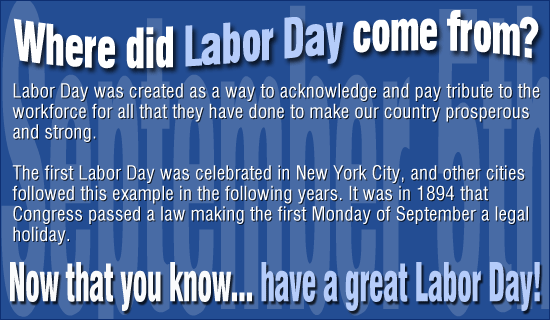
We celebrate Labor Day to honor labor unions : their struggles, their achievements, their ongoing importance to those who labor.

Tomorrow Governor Baker will greet President Obama at Logan Airport as the President comes here to address the annual AFL-CIO Labor Day breakfast. It is particularly timely that we say our say in favor of what unions at their best do for workers.

Less workers belong to unions now than formerly, mostly because mass-employment enterprises have given way, in large part, to much smaller businesses. Yet today unions are enjoying some resurgence as once unorganized service businesses have grown to mass size.
Meanwhile, public employment unions remain strong, thanks to the huge growth of public budgets during the years 1942 to 2009, but are now seeing their power challenged.

We honor them all. There is a tendency today to identify unions as a Democratic party thing. Not so. President Teddy Roosevelt said over 100 years ago : “As capital has organized, so Labor must organize.” Barely 25 years later, two Republican members of Congress, Senator George Norris of Nebraska and Congressman Fiorello LaGuardia of New York, sponsored successful passage of the Norris-LaGuadia Anti Injunction Act, Labor’s biggest victory prior to the New Deal 1930s and still a vital cannon of labor rights. It outlawed the use of injunctions, on grounds of disturbing the peace, riot, or restraint of trade, to block worker strikes. There was more to be done, yes; and the presidency of a second, Democratic Roosevelt saw the ceation of the National Labor Relations Board (NLRB), by which labor union organizing could be monitored and opponents sanctioned, as it exercised power to issue and enforce rulings.

The NLRB still matters a lot. Barely ten days ago it issued its most important ruling in years, holding that employees of a business’s franchisees could be deemed employees of the parent business for purposes of organizing drives and contract bargaining.

We honor unions because more than any other activism, they enable workers to earn higher pay and secure better benefits than they’d likely gain singly.

Some employers understand that workers are their greatest asset and pay accordingly as well as give benefits commensurate. Why businesses do not see workers as an asset I cannot understand. How can you execute if you don’t have workers ? Yet many businesses, especially those whose stock is publicly traded and thereby at the mercy of speculators choose to maximize instant arbitrage profits by whittling worker costs down to the bone. Against such short sighted hurry, labor unions build mighty fortresses.

Today union organizers take the lead in securing living wages for fast food workers, home health aides, airport janitors and many other employees whose wages have not kept up with the cost of normal living. We applaud union struggles on behalf of these hard working people.

Are unions perfect ? Not at all. When industries become obsoleted by technological change, unions often block such changes. Unions in declining businesses choose security over change even though it means losing public support and, just as likely, hastening that industry’s demise. Public employee unions sometimes make the same mistake. The structure of public education is undergoing radical transformation, and teacher unions, for example, are being left behind, as if on an island, as they post one block after another against such change, heedless o its inevitability. Unions aren’t very good at systemic reform.

That said, we honor Labor day and what it means. More often than not, unions put more money in workers’ wallets and thereby boost the general prosperity of our economy — not to overlook the social peace that well paid workers are part of. Let us applaud and be glad that unions have fought the good fight and still do so.

—- Mike Freedberg / Here and Sphere

TOO MANY COOKS

1 C Baker DCF

^ Governor Baker has every right to be upset at child care confusion in Massachusetts. Now comes the hard part

—- —- —- —-

You do remember that old saw, right ? About how “too many cooks spoil the broth” ? I’m thinking about just how appropriate the saying is to the Rube Goldberg machine known as Department of Families and Children (DCF) and its failure to protect little Jack Loiselle of Hardwick in Worcester County, who now lies in a hospital bed in a coma.

Or perhaps the too many cooks thing doesn’t apply merely to DC. Perhaps in the matter of protecting children it lies with the entire palette of child protection laws in force in Massachusetts. Because DCF does NOT have the cause of child safeguards all to itself. Probate Courts share in it. Custody of a child is covered by c. 208 of our General Laws. Probate Courts make custody decisions, and the rule is that a child’s parents (natural or by adoption) have a presumption over other possible custodians. Probate Courts also appoint a lawyer — a guardian ad litem — for any child whose care is before it.

If custody of a child up for ruling by a Probate Judge has a DCF involvement, the DCF is asked for its opinion. But i DCF is not involved, the Probate Judge makes his or her decision based on the presumption I mentioned. Which is how jack Loiselle came to have his very dysfunctional father as his custodial parent once his mother lost custody.

Thereby DCF, later called to investigate reports of abuse, found itself nicked at the outset of its involvement. or it, too, is greatly influenced by the custody presumption in favor of parents. DCF tries hard not to take custody of a child away from its parent(s). Child advocates make much noise about it. Has anyone forgotten the Justine Pelletier lap last year, in which mostly right-wing activists made huge noise that she should not be in hospital care but returned to her parents ?

In custody matters the DCF is damned no matter how it decides.

Care of children is an issue where passion has become an obstacle to right decision making. How else to explain the 20 to 30 people, therapists and DCf workers, school people and Courts,. monitoring Jack Loiselle in the first place ? It was almost inevitable that 20 or 30 monitors would have very different opinions of his situation; and so they did. But after the loss, last year, of Jeremiah Oliver, under DCF care in a city not very far from Hardwick, DCF was taking no chances — because what DCF leader ants to go through what Commissioner Olga Roche went through ? – and thus the overkill that led to irresolvable confusion.

Governor Baker said yesterday, at a press conference regarding the Loiselle case report, that there was systemic failure on DCF’;s part. There was. he will now move to reconfigure DCF procedures; as he should. Yet no DCF rewrite can, by itself, cut to the quick of child care confusion in Massachusetts, because a DCF rewrite won’ change how Probate Courts rule in custody conflicts.

In addition, state law has yet a third procedure for dealing with children in need of extra care : the so-called “CHINS,” a child in need of services petition, that almost anyone involved in a particular child’s life can file at a District Court. Judges of District Courts lack the family service help that Probate Judges have at hand; and if, in “CHINS” cases a guardian ad litem is always appointed, the money or him or her to do a worthwhile investigation may not be at hand. The result is a guesswork decision that often feels like sledgehammer justice.

If we want to put paid to DCF outcomes like that which has befallen Jack Loiselle, we need to reform our child care laws much more comprehensively than Baker ha snow ordered. we need to integrate DCF decisions — and its administrative procedures — into Probate Court family service guidelines, and we need to merge “CHINS” cases entirely into DCF procedures.

Doing all this will require the legislature to add significant money to the DCF budget — probably much more than the $ 100,000,000 that was cut during Deval Patrick’s second term and which Baker has committed to restore.

—- Mike Freedberg / Here and Sphere

CRUNCH TIME FOR GOVERNOR BAKER’S MANAGER TEAM

Kristen Lepore

^ Baker has every reason to look worried as he and his Budget chief Kristen Lepore face FY 2017’s many crucial choices

—- —- —-

To what the Governor actually does every day, I am not privy. Much of his time is spent on the roads of our State, going from the Cape to Springfield and everywhere in between, sometimes delayed by traffic, speaking at this factory or touring that educational institution, talking to officials, addressing fund raisers — more than most, he also visits kids’ sports programs and self-help organizations where he encourages young people to challenge life’s difficulties.

Good thing that he has a cell phone. I’ve seen him take calls and make them when out and about. Mostly, though, when he’s at an event, he’s talking to people, addressing the difficult issues and selling his solutions. Of course he also meets with his management team in the office most every day. And there, i assume, he reviews the details of their tasks.

Meanwhile, as the Governor is out selling, his chiefs of agencies have the actual grunt work of putting Baker’s agenda into practice. For most of these managers, the challenges become more difficult, not less, every day.

For Transportation Secretary Stephanie Pollock, every week uncovers a new difficulty. Can we complete Green Line expansion within budget ? How much will it ACTUALLY cost to bring the current MBTA up to performance condition ? (Last week we found that the repair backlog price has increased from $ 6.7 billion to $ 7.3 billion.) In what budget year can we install new-technology trains on the commuter rail’s Fairmount Line ? There’s also the Carmen’s Union pension trust, which is undergoing redesignation — we will soon see the result.

Baker has made T reform his top priority. Which means that Pollock has no place to hide, no occasion to not be scrutinized.

The task is no easier for Health and Human Services Secretary Marylou Sudders. The Department of Families and Children (DCF) is in the news constantly, answering for neglect by the Department’s foster parents, deaths of abuse of children living with utterly dysfunctional parents, often in rural settings far away from, notice by neighbor, school officials, or police. Then there’s the Governor’s Opioid Addiction Task Force, which he has established and which pretty soon must move from surveying the problem to actually dong something about it ? Can they ? So far, the actual addiction community has been left out of the task — given so far entirely to institutional advice — even though addicts are the people who have to deal with it and do, often ingeniously.

Department of Public safety’s Dan Bennett has just as busy a schedule and plenty of challenges. Public Safety emergencies arise without warning. Protestors may block highways : Bennett has to get State Police to the spot and quickly. Bennett’s biggest challenge, however, lies in criminal justice, where reform is every policy activist’s hot topic. Much of this reform will be done by the legislature; but the five hours and more of inquisition given to Parole Board nominee Paul Treseler, at his confirmation hearing before the Council, makes painfully clear that every part of criminal justice reform will be contentious. In particular, the Councillors grilled Treseler at such length because parole decisions in Massachusetts have led, recently, to newsworthy misjudgments, followed — during Governor Patrick’s last years in office — by removal of an entire Parole Board membership. Treseler is a career prosecutor; and Councillors Duff, Iannella, and Albano made it quite clear that they think a prosecutor ill suited to reform; to expansion of parole eligibility.

And what of Kristen Lepore, Baker’s Secretary of Administration and Finance ? Her task seems hardest of all. Every piece of Bennett’s, Sudders’s, and Pollack’s missions entails money. The Parole Board, as we learned at Treseler’s hearing, has seen its budget cut by $ 2,000,000. No less than $ 100,000,000 was pared from DCF’s budget during Governor Patrick’s last years in office; so far they have not been restored, though at a recent press conference Baker committed to bringing back quickly the lost $ 100 million. Lepore probably still does not have a good figure for what the Opioid Addiction crisis initiative will cost. And then comes Transportation, for which the bill never seems to stop adding up.

Lepore is probably already working out the next year’s fiscal budget — FY 2017 — because it needs be presented to the Legisdal;ture early next year. that’s only a few months away now. In a way, Lepore had it easy working the FY 2016 budget. The State faced a large budget deficit. Lepore had no choice buy to cut, and she did. As it turned out, she overestimated the deficit; and the State now has a surplus, much of which Baker is allocating to this and that urgency, Transportation especially. The FY 2017 budget will be more difficult. Every Department will bark loudly for more money. Most of that will be fully justified — the MBTA’s anguish cannot be set aside.

The FY 2016 budget also continued a hiring freeze ordered by Baker the week that he took office. Now the freeze will end. But how many new hires will be allotted to which agency ? That’s not merely a money decision.

Lastly, there’s a huge, political dimension to the FY 2017 Budget. Many policy activists are calling for new revenue, especially for the MBTA. There may be a ballot initiati8ve to establish a two-tier state income tax. The Governor has promised to seek a second part to the EITC expansion he spearheaded in his campaign and which the Legislature adopted. Advocates are mentioning a new Gas tax hike, and it is receiving support from some people who opposed the previous gas Tax hike. All such proposals will have to pass muster with the :Legislature. So far, House Speaker DeLeo has resisted tax hikes and user fee increases, well in line with Baker’s position. The Senate has taken the opposite position. Its leader, Stan Rosenberg joined by about eight “progressive” senators, want more revenue. Will Speaker DeLeo continue to say no ? Will Baker ?

For Baker, it’s a gamble no matter which way he goes. His Republican activist base mostly wants less taxes, not more. But 78 percent of Baker’s winning 2014 vote came from voters who are not Republicans. Many of them — to say nothing of voters who didn’t support Baker in his narrow, two-point victory and who he surely hopes to win this time –want state services to be full funded (for education especially, a Department I have not even mentioned). I expect that Baker and Lepore  have many days and evenings ahead of them hammering one difficult money nail after another into the political mileposts.

—- Mike Freedberg / Here and Sphere

HOW TO FIGHT THE OPIOID CRISIS ? BAKER CHOOSES HEAVY ARTILLERY

FullSizeRender (34)

^ Governor Baker accompanied by major medical leaders : heavy artillery rather than small scale platoons of infantry

—- —- —- —-

When last year Charlie Baker made fighting the opioid crisis a top campiagn priority, the only question was How, not If. Baker spent several years guiding Harvard Pilgrim Health Care through hard times into good, till it became maybe Massachusetts’s numnber one helath organization. Health care was and still is his roots. The opioid addiction epidemic was a natural for him to take on. And that he has done.

Today, at a major press conference, Baker was joined by the Deans of the Boston area’s top four medical schools — Harvard, Tufts, Boston University, and UMass — and by Dr. Dennis Dimitri, President of the Massachusetts Medical Society as well as by his own Department of Health Commissioner, Dr. Monica Bharel. said baker, “the number of opioid deaths is going up steeply” — he made a steep-slope gesture with his arm — ‘and we can’t move fast enough to deal with it.” By which he meant, “we can’t possibly move too fast because the death incidence is rising that steeply.”

Baker is right. The statistics show it. Last year there were some 2500 opioid deaths In Massachusetts. This year’s number will surpass that. So Baker is correct : no matter how fast the State moves to head the opioid epidemic off, it might not be fast enough.

The assembled Deans and organizational Doctors all agreed that there are too many opioid prescriptions written; too many opioid pills abounding in the community. Yet, as Dr. Dimitri eloquently noted, there so far isn’t an easy alternative for dealing with patients in severe pain; and to not deal with grave pain is not an option.

What, then, will the Doctors, Deans, and Baker do ? Baker explained that he’s expecting these high-level medical advisors to give him a kind of best practices user manual.

But why them ? Why not entrust the opioid crisis fight to actual opioid addicts, who have been there, done that and who communicate remedy option among themselves ? Why adopt such an institutional approach to a crisis that mostly plays out on the streets in settings improvisational, difficult to rank on a best practices scale ?

I ask this question because there is a large communhity of opioid addicts who do meet and do discuss and who forge large networks of their own, addict to addict, exchanging information, emergencies, and solutions.

As I see it, the reason that Baker has chosen to fight opioid addiction with instititional weapons, instead of street level search and destroy, is that street level addict experience may involve too much gamble : which anecdotes to support, which not ? Truthfully, who really can tell ? There may be genius in some direct addict response, but just as likely there is a dead end. Do, fat safer, as I see Baker thinking, to entrust battle to institutiions that can process thousands of addiction narratives and compute the best fair odds of doing some good.

It’s a “take as few chances as feasible”” approach rather than a bold ambush; but Baker has said, about voters, that “at the end of the day, what people want is effcetive delivery of ssvices.” This is a motto of caution; and caution has been Baker’s basic gait since day one of taking office. “Do more of what works and less of what doesn’t.” he has said at meet and greets.

That’s certainly a wise tactic, usually, and in the “Fix the T” struggle it makes precise sense.

But perhaps when fighting opioid deaths, csutiin hasn’t the same clout ? Activists in the addict commnity passionately believe they, not the institutions, know the iopioid devil best and how to fight it.

But what if they don’t ? Baker will be up for re-election, not the addict community. He will be judged, not they. Thus the decision to entrust the Baker administration’s opioid fight to the biggest, most experienced, highest prestige organizations he can bring to bear.

How quickly can such heavy artillery be deployed in the fight ? the addict community is already in it, fighting it at platoon level in the jungles where opioid drugs lurk and seduce. It may take the institutional people a year to get its opioid combat boots on. Does that support Baker’s assertion that “we cannot move fast enough to fight the (death curve) momentum” ? I guess it will have to.

—– Mike Freedberg / Here and Sphere

IMMIGRANTS ARE A BOON, NOT A CURSE

immigrants

^ people trying desperately to get to America are not evil. They are —  JUST LIKE US !

—- —- —- —-

This political season has dumped some of the vilest troll talk into the national conversation that I have heard in decades. Toxic especially : attacks upon immigrants who the trollers call “illegal.”

I now post this response to the trolling of “illegal” immigrants :

  1. there is no such thing as an illegal person. Candidate Don Berwick said that in last year’s Governor campaign, and he was right and is right.
  2. Immigrants, as Jeb Bush noted last year before trump intimidated him, come to America at great risk, out of love for their families, to seek a a better life.
  3. Immigrants undocumented or documented are customers, every one of them, for businesses of all sorts. Do we want businesses to grow and prosper ? I think we do.

Much of the bile tossed at “illegal” immigrants has no basis in fact, none : (1) undocumented immigrants cannot receive “welfare” because you need a valid Id to qualify (2) most work super hard at crummy jobs, often exploited, at all hours of the day; jobs that few of us would do if we had to (3) undocumented immigrants sometimes manage to acquire social security numbers and thereby pay taxes — billions of dollars of taxes, in fact.

As was recently pointed out by a national columnist, the so-called “birth tourism” “anchor babies” that this year’s number one demagogue rails about aren’t “welfare” cases at all; they are mostly Asian and quite well off : it costs an average of $ 35,000 to come here and deliver a child. This same columnist wrote that a grand total of 9,075 such babies were born to “birth tourists” — not the 60,000 or so that Mr. Demagogue yells about.

It’s a non-issue.

In Massachusetts we face one immigrant request that isn’t simple : should the state accord drivers’ licenses to immigrants undocumented ? All sense says “of course.” Who wants unlicensed drivers — uninsured — on the road ? It has recently been argued, contra, that awarding licenses to undocumented people invites identity fraud, because if the applicant has no documents, how do we know who he or she actually is ? I agree that that’s a problem; but solutions hardly lie beyond the Kuiper Belt. The applicant can send to his or her country of origin for a birth certificate; or he or she may possess a verifiable identity card from said country.

Let’s give it a try.

As Frank Zappa once sang, “think — it ain’t illegal yet.”

Immigrants work hard, start more businesses than the rest of us, and — as Jeb Bush noted in that last year’s talk I referred to above — have a younger demographic that relueves the current age imbalance threatening the financial health of Social Security and Medicaid.

Immigrants also include refugees and asylum seekers, and should : our nation was founded by such, and we have always been the safe harbor for the world’s oppressed. It’s our national purpose, almost our national mission.

Immigrants also enrich our national culture, in which multitude prevails over uniformity. Immigrants bring many languages, varied cultural customs, different faiths. Their multiplicity reinforces that there is no one correct faith, no language better than any other, no national custom superior to any other. Immigrants live the equality our national Independence Day myth seems merely memorized.

Why do some of us not see this ? Do we prefer to believe the lies told by demagogues about immigrants because our brains are wired for thinking ill of people ? Does the national impetus to conformity arise as a caution against multiplicity becoming divisive rather than unifying ? For me, conformity is just as cautionary as multiplicity. as in all things societal, the practical  answer lies somewhere in between.

Candidates for President should embrace immigration, not spurn it. Basic economics cries out; as does commin decency, not to mention the profound morality of welcoming all of good will who seek to join  our nation’s mission.

—- Mike Freedberg / Here and Sphere

WHY POLITICAL ELITES MATTER

HillaryJeb Bush

^ that these two candidates are “elite:” is NOT a reason to not vote for them.

—- —- —- —-

There’s much talk, among commentators and on social media, about “elites.” For most of the talkers the word emits pejoration. Why so ? What is wrong with political elites ?

By “elites” we seem to mean “people who have been around a long time,” or “people who have lots of money,” or some combination of the two. I don’t see how these attributes detract. Those who have lots of money usually take a lot of care to preserve or extend it; which necessarily involves them in understanding markets, industries, and politics. Those whose names have “ben around a long time” owe their longevity at least in part to mattering for a long time, either because they are always asked for an opinion, or because they take part in newsworthy decision making. (Not always, but often enough.)

Elites thus have experience of affairs. I don’t see how that’s bad. Experience of affairs cautions one to take many points of view into account, many factors, disciplines, chance. Experience breeds healthy skepticism even as it — should — arouse experiment.

For example : Hillary Clinton was exactly right when she said this (according to a report) at a fundraiser this weekend : “‘…I don’t believe that elections that are going to result in leadership decisions should be about personalities, should be about insults, should be about rhetoric, should be about a lot of what we see going on in this campaign.’ 

Democracy premises that anyone can be Governor, Senator, President. True enough., But it cannot — or should not — happen with a mere snap of the fingers. The Byzantine Empire, for much of its history, chose its Emperor with what amounted to a snap of fingers. An inspired churchman would have a vision that so and so was called; or an itinerant hermit would suddenly announce that this or that ordinary man — a shepherd, come to town, perhaps : it happened — was It, and so it was. Who could tell whethe4r the Emperor thus chosen ruled brilliantly, or carelessly,m or downright drunk (yes, there were utter sots who ruled the Byzantine world.) The only reason that the empire didn’t collapse, ruled by a  drunk, was that the imperial bureaucracy kept on keeping on, no matter what. The Emperor might murder his rivals, torture his nobles, exile his bishops, and tax rich men into poverty, but the bureaucracy kept on — kept on and on. We in 2015 America have, I hope, a better way. We don’t go helter-skelter. We enable people of vast experience and, yes, much money, running for office; and we usually want it that way, and should this year too.

I do not mean that you must vote for either of the two major “elite” candidates running for President. There are other well worthy men running who have just as strong resumes and almost the same fame. But to support someone on the grounds of “not being of the elite” is really quite inconsistent with the reality.

As far as I’m concerned, only two questions need be asked of a candidate seen as “elite” :

  1. Do you intend to govern in the national interest and not merely in your own financial interest ?
  2. Do you commit to governing for the sake of everyone, not just the elites ?

After that, the contest becomes a question of which candidate’s platform you prefer. That is all.

Let’s be quite honest ; everyone wants to rise into “the elite,” or to see his or her children do so.  Elites have a wide circle of connections as well as money and famed name. Elites simply can touch more lives first-hand than those who are not of the “elite.” What we do ask, and justly, is that the elite be open to all who aspire to it. This has been the way with the wisest prior elites : think the Catholic Church during the years from about 400 AD to today. A poor boy’s son had — has — just as much chance of becoming an archbishop, even a Pope, as a rich man’s. Education was his opportunity. And we who devote the bigger part of our taxpayer dollars — or tuition fees — to education know very well that school is the escalator to elite condition., Would we spend generous dollars if we did not believe profoundly in the desirability of becoming of the elite ?

Why, then, do we, in political time, scorn the elites ? They are elite because of us; and in most cases, we are3 not wrong to have caused them.

—- Mike Freedberg / Here and Sphere
AN ACT OF REAL LEADERSHIP

FullSizeRender (33)

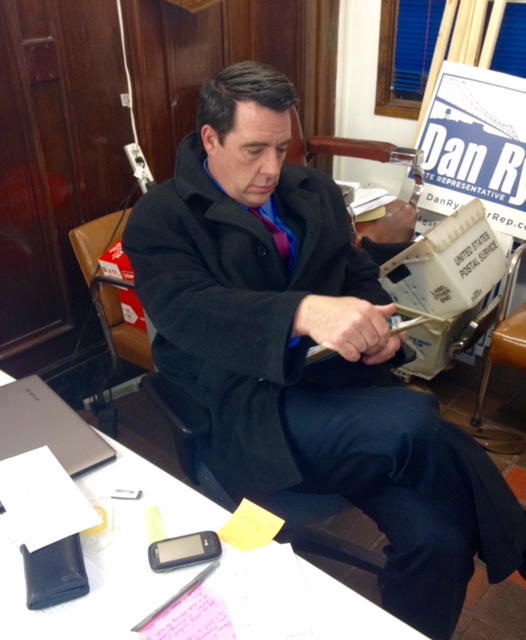
^ leadership with conclusive authority : Charlestown’s State Rep Dan Ryan

—- —- —- —-

Not very often does it fall to a State Representative, as opposed to the Governor or the Mayor, to take a stand — against, perhaps, majority opinion in his own District — that resolves an almost insoluble dispute and thus moves things forward. Yet that is what Charlestown’s Representative, Dan Ryan, did last week. He announced, in a letter, that he favored the Steve Wynn casino — which will now be built in Everett, across the Mystic River from Charlestown, thanks to Ryan’s stand and what ensued : the granting of a go-ahead permit by the Baker administration.

Ryan was elected only last year. But he’s no rookie, that you know the minute you read his letter. He spoke to me by phone yesterday telling me the reasons why he decided as he did. Chiefest of them : “the casino opponents talk about traffic it’ll cause. But there’s been a traffic problem on Rutherford (Avenue) and in Sullivan Square for a long time, and no one did anything about it before. Now that the casino is the issue, they’re doing something about it. Isn’t that what we want ?”

Hard to disagree with that. Ryan cited another reason : “look, the traffic situation in Boston has to be handled regionally. Because the whole region creates the traffic and you can’t fix it one square mile at a time.”

Ryan sent his letter to Matt Beaton, Secretary of Environmental Affairs, referencing also Transportation Secretary Stephanie Pollack. Those who want to read it can find it, in a tif file that I cannot post here, at the Mass.gov website.

I have never read a more authoritative, comprehensive, boldly accurate argument by any political person, much less a simple State representative. Ryan not only addresses Charlestown’s longstanding traffic situation, he also calls out forty years of neglect thereof. He appraises the Wynn casino from several viewpoints : revenue, sales tax, jobs, mitigation, development criteria, social impact, gambling. As he notes with truthful finality, those who oppose the gaming law ought to be consistent and oppose the Lottery.

He is not shy to be sarcastic. As he writes, “if you have another business to place near us that generates $ 200 million revenue a year and provides lots of jobs, please send it to me.”

Is it a coincidence that Secretary Beaton issued the Wynn casino a go-ahead license only a few days after receiving Ryan’s letter ? I think not. His timing was as authoritative as his argument reads conclusively.

Before Ryan took his stand, the Wynn casino was on hold, mired in litigation, and going nowhere fast.

The stand that Ryan took occasioned much guts. Opposition to the Wynn casino has galvanized much of charlestown. That opposition has found encouragement in Mayor Walsh’s all-in legal battle to force Wynn to agree to a large annual mitigation payment. Mayor walsh cannot be happy to see his mission embarrassed and defeated by Ryan’s stand. As for Charlestown voters, they’re likely the reason why Ryan’s letter extends to six pages discussing every aspect of his stand, every consequence, every reason why the go-ahead is a plus for the neighborhood.

Will Ryan’s stand cost him when he comes up for re-election next year ? It could. Many Town residents have attended many meetings bitterly opposing the Wynn plan. Given the comprehensive discussion in his letter, however, I think he can persuade most. But we shall see.

Political leadership has scant value if it merely hands public opinion a microphone. Nor is a political leader a mere messenger. He or she must persuade, must change minds, must cut through all the reasons inertia adduces for why change should not happen, reform not be adopted. Ryan has done a leader’s work, and his neighborhood — and the entire region — will surely benefit enormously from it.

—- Mike Freedberg / Here and Sphere