OUR BROKEN NATION

planned-parenthood

The latest target of a multi-bullseye-ing broken Washington : Cecile Richards of Planned Parenthood

—- —- —- —-

Thank goodness we live in Massachusetts, where office holders of both parties work together to deliver services and enact some justice. If only the same could be said of Washington.

Here in Massachusetts government works because almost everybody agrees on the ends and the means : effective state services, the kinds of services delivered, energy policy, and civil rights for all as well as some measure of economic fairness. We’re not all agreed on how large these measures should be, but there’s no disagreement about the direction.

In Washington, the opposite prevails. There’s no agreement at all on what services to deliver, on energy policy, on economic fairness or civil rights, none on immigration or gun regulation, no agreement on foreign or monetary policy either; and the disagreers are willing to shut the entire apparatus down if they can’t have their marbles exactly where and how they want them.

Our Federal government is broken because many voters want it broken. So do some interest groups. Those who in ordinary times would have grumbled in their beer and kept their rants private now spew them publicly and find their spew validated by talk shows whose shtick is to say loudly what used to go unsaid and to say it over and over again because that attracts ad dollars.

The internet did not just reveal to isolated transgenders that they were not alone; that they could, in fact, form a community via online connection., The same online revelation showed those who want the Federal government broken that they, too, are not alone; that indeed they are legion.

Prior to online connections, the haters and breakers had talk shows to cling to, but no one who clung could know if he might be the only or one of a few. Same was true for the talk show hosts of that time. They said outrageous things, but there were lines they did not cross because they, too, had no way of proving their popularity. Now they can do that. As a result, talk show hosts have lost all restraint, competing with one another to see who can say the worst. And the more vulgar or destructive, or bigoted or boorish the talk show rant, the more validated are the listeners who think likewise.

If the breaking of our nation were but speech, it might not matter. Talk doesn’t incommode anybody. But Washington’s breakdown crumples immigration reform; infrastructure repairs; a Federal jobs bill; oil and gas infrastructure;. minimum wage reform; financial regulations regarding Wall Street activity. Even foreign policy has fallen victim to Washington anarchy.

The latest victim of Washington talk show-ism is Planned parenthood, the premier  organization serving the healthy needs millions of women of modest means. Fraudsters ambush Planned parenthood with doctored, falsifying videos, and all hell breaks loose as the shutdown ranters and their talk show validators hurl volcanoes of bile onto the conversation.

no responsible bation makes women’s health needs the plaything of selfie venom.

Because the Federal legislature is broken, the only means by which the nation’s business has been able to get done is by Presidential; order. This is not a unique occurrence in human affairs. When the Roman republic, in the decades before Caesar,  broke into factional squabbles that soon evolved to outright armed conflict, Rome’s business was eventually entrusted to a princeps — Octavian Augustuswho ruled by edict even while according the Senate first dignity. We are now almost at that stage., President Obama is not yet a princeps, but his executive orders are the acts of a decider, at a crossroads where his is the only direction marker.

The Constitution accords the President executive power to “faithfully execute the laws” ; but if almost all of the nation’s pressing immediacies go without laws to legitimize them, what recourse does executive have if not to issue edicts ? Were the President to do nothing, injustice would rule in his stead, and economic chaos too.

Our Federal system grants to Washington exclusive monetary power., Only the Federal government can issue money. Only it can decide how much money to issue, what interest rate to establish, and how to  administer the nation’s supply of money, credit, and savings. The nation’s monetary monopoly cannot break down, or anarchy will descend to worse. Some want it that way.

The Federal, government also issues the largest single supply of debt instruments in the world. Treasury bonds and bills hold the world economy together; they’re the world’s reserve currency and thus the guarantor of our economic primacy even when the economy of China tallies larger measured as GDP. The primacy of Federal debt cannot be broken without breaking the world.

Those who seem ready to break the entire nation sound to me like the people whose lives are so in wreck that they decide to kill themselves and take as many people with them as they can — as if other people are the cause of their perceived troubles. For people in this black state of mind, scapegoats abound : people of color, low income people,. women seeking reproductive care, immigrants, whatever. Scapegoats rain down upon such minds in torrents.

Storms of scapegoats and rages of bile would be OK, I suppose, if they could be exiled to a million private Idahos. But in the internet connection age these storms become public typhoons with institutionalized force that is breaking — has broken — our nation. I do not see it ending well.

—- Miked Freedberg / Here and Sphere

DIVERSIFYING THE STATE’S SCHOOL OPTIONS

FullSizeRender

^ Governor Baker rallying charter school activist students at Brooke Charter School, on American Legion Highway, in the Franklin Hill section of Dorchester

—- —-

Three charter school initiatives now come before the residents of our state. The newest, and probably most powerful, has just been put by Governor Baker, who yesterday filed legislation that would permit an ANNUAL increase in the number of charter schools in school districts found to be among the 25 percent worst-performing.

The Governor issued the following statement itemizing the points in his legislation:

“Every child in the Commonwealth deserves the opportunity to access high-quality education regardless of their zip code or background, and this bill would help make that a reality,” said Governor Baker. “This legislation puts mechanisms in place to make sure that charter schools are able to – and do – serve more of the students they aim to educate, including low-income students, English Language Learners, and students with learning disabilities.”

“We have some of the best charter schools in the nation, and this legislation would allow more families access to them, while opening up new opportunities for district-charter partnerships on behalf of communities with the greatest educational challenges,” said Secretary of Education James Peyser. “We look forward to working with the legislature to find a path forward and help the students, families, and communities who need it most.”

The Governor’s legislation, “An Act to Improve and Expand Educational Opportunity,” addresses some key components around charter school approvals and renewals, enrollment, facilities, and funding. Some of those components include:

· ** Expand access to charter schools in the state’s lowest-performing districts: Allows the Board of Elementary and Secondary Education to approve up to 12 new Commonwealth charter schools and/or amendments to increase enrollment annually in districts in the bottom 25% of state-wide performance; these charter schools would not count toward existing caps in current law.

· ** Improve access to charter schools, particularly for high-need students: Allow charter schools to use a weighted lottery system that provides additional weight to high-need and low-income students, as well as students within a particular geographic zone.

· ** Enable charters to become part of choice-based district enrollment systems: Allow charter schools to enter voluntary agreements with districts to participate in district student enrollment systems that take into account parental preference, similar to the “common enrollment system” that has been proposed in Boston.

· ** Create new opportunities for charters to partner with districts in turning around their lowest-performing schools: More effectively leverage the expertise and demonstrated success of charter school operators to close the achievement gap and turn around failing schools by expanding strategic partnerships between those high-performing operators and under-performing district schools.

You can also read the actual legislation at this link : http://www.mass.gov/governor/legislationexecorder/legislation/an-act-to-improve-and-expand-educational-opportunity.html

Meanwhile, a ballot initiative is underway. It would, according to reports — I have yet to see the precise language of it —  arrive at the same result as Baker’s legislation by empowering the state Board of Elementary and Secondary Education to approve up to 12 new charter schools or charter school expansions a year not be subject to the cap.

A group called Great Schools Massachusetts has formed to shepherd this initiative onto the ballot and all the way to voter approval next November.  Associated with them is an active facebook page entitled “Lift the Cap on Massachusetts Charter Schools.” You can link to it here : https://www.facebook.com/Liftchartercapma This page is the social media voice of http://www.masscharterschools.org/ headquartered in Hudson, MA.

The above two efforts coincide. A third move brings front-line advocacy to the drive : five Boston students have sued, with the assistance of three top law firms, for relief from the portion of our charter school law that limits (and in their case, forbade) their right to seek the school of their choice. This suit is grounded, according to the following legal analysis, in the Massachusetts constitution’s right to “an adequate education.” You can read the legal review here : http://www.lexology.com/library/detail.aspx?g=399d0d3c-62f0-4ea2-b48f-ee4076fd41ca

I cannot tell whether the  lawsuit will succeed, or when it will be heard by the court. I suspect that Governor Baker’s bill will be voted upon long prior and that even next year’s ballot initiative will  be decided before any court issues a finding on the students’ lawsuit.

We have opined often in favor of removing legal limitations on the state’s public school options. I repeat that opinion now. In our mind, the “adequate education” which the state owes students must enable students to be employable by actual employers in the economy of today and tomorrow ; and as said economy required substantial technology skills and knowledge, of many different tracks according the job being sought, so must our schools diversify and specialize, becoming technology skills set schools of as many varying curricula as there are major technology grooves to be entered. This means that classes will be smaller, the school day much longer, the vacation periods shorter, and the optional courses in social life (because social media are crucial to technology networking) far more comprehensive than anything we find today.

Neither Baker’s legislation nor Great Schools’s ballot initiative can by themselves bring about the new education paradigm; but each can help to close “the achievement gap” whereby students of color and from families where English is not the first language now often fall behind. More is needed, for such students, many of them from homes where parents aren’t fully engaged in their children’s education, to master the knowledge and accomplish the skills that students from higher income, usually Caucasian, families reach more readily. Some assert that children from low income or non-English speaking homes simply lack the intelligence or educability of their Caucasian or higher income peers., I vigorously disagree. Such students perform very well indeed in smartly administered schools with a rigorous curriculum.

Implementation of Baker’s legislation will demonstrate whether this assertion is true or not.

Opposition to these diversification moves rests almost entirely with teachers’ unions and their school parent allies. The basis of such opposition ultimately amounts to money. Give us more money, say the advocates of traditional public schools. They point, with truth, to the scarcity, in district school budgets, of money for school lunches,water fountains, bathroom stall, doors, and basic equipment, even pens and pencils, much less laptops and iPads, which in many cases are not at hand either. In Boston the scarcity is such that the district has had to resort to the T to get 7th and 8th grade kids to school.

These truths, however, do not exist because there are charter schools. Chapter 760 of our state’s laws requires that for every student who leaves the district to attend a charter school, the first year cost of his or her tuition be reminbursed to the district and a portion of every tuition year thereafter. How can this be anything but an outright boon ? The district has, let us say, 10 percent fewer students but receives more money than if the students had not left it at all.

That’s 10 percent fewer books, 10 percent less equipment, ten percent less utilities used in classrooms. Where, then, does that extra money go, that does not need to be spent on books, etc ?

Now let us factor in the likely consequences of either Baker’s bill or the Great Schools ballot initiative being enacted. In this situation even more students will no longer be assigned to the district and, thereby, even less district money being spent on books and more. Yet in exchange for less students being assigned to the district, the district receives even more money. Where will it go ?

It’;s not as though municipal budgets shortchange school districts. In Boston in each of the past two years, the school budget was the only city department to receive an increase in funding, and a generous one at that. Where did the money go ?

Teachers’ unions want charter schools not only not expanded but gone altogether. Very few unions are good at reform, much less the sort of transformation now under way in public education. It is no surprise, therefore, that teachers’ unions feel not challenged but threatened — in salary, benefits, and work rules, by schools which operate ad hoc, encourage administrative innovation, pay less to teachers. These unions should have taken the lead in reforming school systems rather than resisting every move; but decisions get made. Unfortunately, by resisting all change except their own, said unions risk disservicing the students they profess to cherish and misapplying the taxpayer money paid over by their students’ parents.

Last night at Sheriff Tompkins’s “State of Education in Massachusetts” forum, two things happened that made clear where things stand. Fi9rst, the audience was packed with teacher union activ9ists who applauded everything said by union president Richard Stutman and scoffed at Secretary of Education Jim Peyser. Second, City Councillor Tito Jackson, who endorsed most of Stutman’s assertions, called for an override, by Boston voters, of Proposition 2 1/2 to “give us more resources…it’s a a question of resources,” notwithstanding the City financial facts that I outlined above.

So there you have it.

—- Mike Freedberg / Here and Sphere

WE SAY : ENACT HOUSE BILL 1577 NOW

1007_healey-trans-hearing

^ Attorney General Maura Healey, with Suffolk District Attorney Dan Conley and Boston Police Commissioner Bill Evans : “a matter of basic human dignity and respect.”

—- —- —- —-

Four years ago Massachusetts enacted some measure of protection for transgender people. Unfortunately, public accommodations protection was left out of that law. As a result, transgender people may be denied entry to restaurants, shops, bus stations, hotels — any venue that offers accommodation to the general public. As a result, a Massachusetts restaurant cannot reject an employee for being transgender, but it can deny that same person entry as a customer.

That makers no sense at all.

So it is that proponents of transgender civil rights protections have filed House Bill 1577, which would establish these public accommodation civil rights. You may read the language of House Bill 1577 here : https://malegislature.gov/Bills/189/House/H1577

Section 2 of House Bill 1577 contains language worth quoting :  “Any public accommodation including without limitation any entity that offers the provision of goods, services, or access to the public that lawfully segregates or separates access to such public accommodation or other entity based on a person’s sex shall grant all persons admission to and the full enjoyment of such public accommodation or other entity consistent with the person’s gender identity.”

These words make clear that transgender people are entitled to the same protections as anybody else, which is as it should be. So, why is this even an issue ?

Perhaps Attorney Maura Healey said it best, at yesterday’s Judiciary Committee hearing, when she noted that “there is discomfort out there.” It is indeed uncomfortable to find that one’s assumptions about identity aren’t as settled as we think. After all, if identity isn’t settled for a transgender person, might it also not be settled for the rest of us ? The existence of transgender people challenges who we are.

It certainly unsettles those who openly oppose House Bill 1577. In a New Boston Post op-ed, opponent Jim Lyons, a State Representative from Essex County, uses the phrase “men who claim to be women.” Lyons either does not get, or refuses to admit, that transgender women are NOT men claiming to be women. They ARE women. By self realization deeply, profoundly felt.

Some transgender people submit to surgery to bring their bodies into line with their identity, but why should surgery be the basis of identity ? If one is a woman, then one’s body is a woman’s body, regardless of genitalia. Not all chromosomic women are born with full estrogenic genitalia. Does that make them any less women ?

One can go on endlessly about these distinctions to no end. The issue of House Bill 1577 isn’t to settle biological or medical ethics but to establish legally that a person’s gender identity need not accord with his or her body characteristics; that you have a right to be who you affirm to be. For many, that assertion surprises. But life is a mystery. It surprises. It catches unawares even those who find themselves made whole by that which they were once unaware of.

And that is where House Bill 1577 steps in to say, the law supports and protects you.

Representative Lyons, at yesterday’s hearing, asserted that transgender people already have a remedy from discrimination : they can file a complaint with the MCAD. But why should a transgender person have to suffer harassment or worse, then have to hire a lawyer, file a complaint within the brief time allowed by the MCAD, then miss days of work or school to attend a hearing that may or may not rule favorably ? Transgender people risk bullying, shaming, ridicule, and violence. They do this because they have the strength to be who they are despite all. Why should our law add legal burdens to those that transgender people already face ?

The ultimate battlefield, as all concerned know, is bathrooms. The toilet and the shower bath are where the rubber of nakedness hits the road of identity. The eye of the beholder sees the nakedness; only the soul can grasp the identity within.

By the way : kids get this. Kids mostly are quite OK with transgender people. But kids don’t enact laws. Parents do.

All the signs say that Speaker DeLeo supports House 1577; which means that it will pass. The Senate is fully aboard its own version, Senate Bill 735. A final bill will thus surely reach the Governor’s desk, What will Governor Baker do ?

Months ago he stated opposition. More recently he has softened that position, saying that he “prefers” the current law. Mike Deehan of WGBH writes that Baker will “examine the details of the legislation.” That sounds almost promising.I also note that while he has not lifted a finger to support the bill, neither has he done anything to prevent it. He was conspicuously absent from yesterday’s hearing, as were his guardians.

I cannot tell what he will do, and no one is saying; I think that is exactly how he wants it.

My sense is that he “prefers” that the legislature deliver him a veto-proof majority vote. Can it ? we will soon find out.

—- Mike Freedberg / Here and Sphere

THE BUSINESS PROGRESSIVISM OF AYANNA PRESSLEY

FullSizeRender

^ business progressivism, in the language of Black church and Black professionals : Ayanna Pressley

—- —- —- —-

This year’s Boston City Council at large contest hasn’t exactly gone viral. Quiet reigns. (disclosure : i am advising and supporting a challenger candidate, Annissa Essaibi George.) Yet at least one at large campaign consciously represents one of the major movements in American politics : business progressivism. The candidate I am talking about is Ayanna Pressley.

I’ve written about business progressivism before in these pages. Business progressivism, several months ago, turned back Indiana’s anti-gay discrimination law. It did the same in Arkansas and Arizona. Business progressives dominate Pride marches. They have played the major institutional role in winning full civil rights for LGBT people. Business progressives have also taken part in raising the minimum waged in several cities and some states.

Social justice is, however, not all there is to business progressivism. Ayanna Pressley’s campaign displays an entirely separate side thereof : encouraging and enabling entrepreneurship among women. people of color, and immigrants. At meet and greets around the city — I have attended two and will attend one at Haley House in Roxbury tonight — Pressley speaks a language I first heard 35 years ago in Memphis, at a luncheon gievn by that city’s JAGs, a professional association of women of color. It’s a language partly Mary Kay Cosmetics cheerleader, part Black church rise-up, and part political protest,

Whatever its parts, Pressley’s message is that one must self-start, and that self-start must be supported by City Hall.

Her language is different from what Governor Baker uses when addressing audiences of color, but Pressley and Baker have pretty much the same goal : get people to rise up. To think it, attempt it, and see government encourage and enable it. For Baker, that means creating, funding, and purposing pathways for kids to get from school to skills sets to employment and to innovation. For Pressley, it means fostering small businesses. She has already done this. The 2014 home rule petition\ whereby Boston now controls its liquor licenses was hers..

She’s well into phase two of the liquor license movement now, advocating at meet and greets and elsewhere to see those licenses granted to restaurants in the city;s outlying neighborhoods.

Again she and Baker coincide. Getting small businesses up and running, permitted and enabled, is the prime mission of Baker’s Business Development Secretary, Jay Ash. Pressley, as a Councillor only, hasn’t an equivalent agency in her arsenal, but she has the bully pulpit and the following, women and people of color who get her meaning and support pretty much all of it. Of all the at large Councillors, she is the only one whose identity is business progressive. (challenger Essaibi George also speaks the small business message, but she has additional priorities and seems more neighborhood-social than the business-focused Pressley.)

To those who touch only surface, Governor Baker and Councillor Pressley may feel very different in texture, perhaps even opposite. I disagree. Business progressivism has more than one fabric in its fall collection, as befits a significant political movement — the most promising political development in our nation today.

Business progressivism is changing the conversation radically. Baker’s managerial perfectionism and education for innovation have entirely transformed perceptions of the Governor'[s mission. Pressley is carving out the same kind of transformation in Boston, as fervent as Baker is dogged.. Mayor Walsh would do well to borrow from her agenda, as he is generously taking from Baker’s.

There really is no choice about this. Business employs millions of people and engages many, many more in its entrepreneurship. Here is the engine of inclusion, of diversity — our future prosperity, of our optimism. If we reject the politics of exclusivity and failure, here is our rescue. The smartest politicians among us are taking rescue to heart.

—- Mike Freedberg / Here and Sphere

GUNS AND AMMO : WHAT COULD BE DONE — BUT WON’T

JPO Stevens

^ former Justice John Paul Stevens : the man whose reasoning saves the Second Amendment from obsolescence and error

—- —- —- —-

Last week I wrote an editorial theme-ing that “nothing will be done” about guns and ammunition in America. I still feel that way. Nothing will be done. Yet plenty COULD be done. A few states have enacted fairly strict controls on gun and ammunition traffic — Massachusetts among them. No state, however, as far as I know, has put in place all of the controls that we could enact if the political will existed.

Opponents of gun and ammunition regulation cite the Constitution’s Second Amendment as their basis. I strongly disagree, and later on in this editorial I will address the constitutional question. But first, some suggestions for controlling guns and ammunition :

1.require that every gun owner insure, for bodily injury, each and every gun he or she takes ownership of. Compulsory vehicle insurance provides a model. As with vehicles, a gun found to be uninsured is impounded until proof of insurance is provided.

2.remove the immunity from lawsuits that gun and ammunition makers now enjoy .

3.require background checks for all gun or ammunition purchases, said checks to include mental illness, criminal records, violations of restraining orders. Alternatively, the State can require people seeking to buy guns or ammunition to obtain a state-issued license, and said background check can be done then. Said license shall, as with driver’s licenses, be subject to periodic review and renewal.

4.”smart” chips can be fitted into all guns and every piece of ammunition, so that public safety officers can know at all times where said gun or ammunition is.

5.all weapons not clearly for sport, hunting, or limited personal protection — military-scale weapons — should be disallowed to private persons, and the unauthorized sale of same should be a felony..

6.All sales of guns and ammunition shall be conducted by state-licensed dealers, just as we require of liquor stores 9and now marijuana dealers). Private sale between family members may be an exception, but each such sale shall be in writing and a copy thereof delivered to the state registry of weapons.

7.A gun safety course, as prescribed by the state, shall be required of all persons seeking to purchase a gun or ammunition. This requirement includes police officers as well.

Other controls, though not priorities, could be added. For example : only unloaded weapons, with few exceptions, shall be allowed in private homes. Ammunition for sporting or hunting weapons shall be kept at sport clubs or at hunting lodges, under lock and key supervised by the club’s manager. Exception : with individual, special permission given only by a municipality’s police chief, a person can keep up to two loaded weapons in his or her home.

Said controls will not prevent every gun death. There will still be accidental shootings, and there will be killings by people who obtain guns and ammunition criminally. With 310,000,000 guns circulating in America, and every sort of ammunition readily obtainable, it will be quite some time before we can blow out the hurricane of weapons afoot. But the gun absolutists’ cry that “gun laws won’t keep criminals from obtaining guns’ is nothing but cynical. After all, if we shouldn’t have gun laws because criminals won’t obey them, why have laws at all ?

And now to the Second Amendment, which means nothing that the gun apologists say it does.

Let us quote it in full : A well regulated Militia, being necessary to the security of a free State, the right of the people to keep and bear Arms, shall not be infringed.

The words make clear that this is an Amendment about militia. Not only a militia, but a WELL REGULATED one. The Amendment goes on to talk about “the people.” Not individuals, but a collective. The phrase “the people” occurs also in the Constitution’s Preamble, which begins with the term “We the people.” The phrase is collective. It does NOT mean each and every individual. The language of the Second Amendment derives from a similar clause in the English Bill of Rights, of 1689, that DOES include an individual right to keep and bear arms. That language does NOT occur in the Second Amendment.

What, then, did the drafters of the Second Amendment intend ? In my view, they meant to bar a Federal standing army of hired mercenaries, or of long-term professionals, such as the British had wreaked upon us during the Revolution and before. Such armies, in those days, were forcibly billeted in people’s homes. Mercenary armies, usually of foreigners, were the rule in the 18th Century world, and their appearance was often as rapacious to communities as battle itself.

Mercenary hired armies disappeared from the developed world by the 1870s. The entire system of soldier mobilization was revolutionized, as railways and industry changed all.

The armies of our Civil War had been citizen militia; those of the 1870-71 Franco Prussian war were conscript armies of civilians of the nation they fought for. By that time, too, American militia were incorporated into every State’s national Guard (as happened in France as well); and today, though we have a professional, standing armed force, it is housed in barracks on the grounds of Forts and camps, not in private homes.

Thus we see that the conditions that made the Second Amendment necessary no longer exist, from which we can conclude that the Amendment as written no longer has a mission.

Here I apply these words of Justice John Paul Stevens, from his essay “The Five Extra Words That can save the Secvond Amendment” : For more than 200 years following the adoption of that amendment, federal judges uniformly understood that the right protected by that text was limited in two ways: First, it applied only to keeping and bearing arms for military purposes, and second, while it limited the power of the federal government, it did not impose any limit whatsoever on the power of states or local governments to regulate the ownership or use of firearms. Thus, in United States v. Miller, decided in 1939, the court unanimously held that Congress could prohibit the possession of a sawed-off shotgun because that sort of weapon had no reasonable relation to the preservation or efficiency of a “well regulated Militia.”

“...that holding was generally understood as limiting the scope of the Second Amendment to uses of arms that were related to military activities. During the years when Warren Burger was chief justice, from 1969 to 1986, no judge or justice expressed any doubt about the limited coverage of the amendment, and I cannot recall any judge suggesting that the amendment might place any limit on state authority to do anything. 

Justice Stevens then goes on to suggest his revision to the Amendment. Words that give it meaning today : “A well regulated Militia, being necessary to the security of a free State, the right of the people to keep and bear Arms when serving in the Militia shall not be infringed.”

You should now read Justice Stevens’s entire essay. Here is the link : https://www.washingtonpost.com/opinions/the-five-extra-words-that-can-fix-the-second-amendment/2014/04/11/f8a19578-b8fa-11e3-96ae-f2c36d2b1245_story.html

To me, Stevens’s narrative and argument are unassailable except by those with a deeply anti-social agenda in their hearts. We as a nation should not any longer be bullied by their misguided imposition.

—- Mike Freedberg / Here and Sphere

6.

NOTHING WILL BE DONE

oregon

^ routine it is : first responders rush victims of Oregon shooting to hospital.

—- —- —- —-

Yet another mass shooting, at a school, and yet more outrage : words are as easy as it is to shoot and kill anyone a shooter pleases. This time it is Oregon, where only last year legislators who sought to stiffen the state’s gun laws found themselves picketed at their homes and intimidated by threats.

Where will the next mass shooting occur ? And the thousand such shootings after that ? It makes no difference. We know by now that although at least 90 percent of Americans want significant restrictions on the availability of guns, nothing will be done. After the sandy Hook shooting, the President and some Senators tried. Their effort was snuffed out quicker than a cough. The organization that represents the gun makers saw to that.

After every shooting, gun sales boom. Is it any wonder that the organization that does the gun makers’ bidding loves to see such shootings take place ?

They love “open carry’ and want it everywhere — schools, malls, stores, even churches and bars !

I have no words. None. It cannot be real.

After every such shooting, this small but rabid force of gun-toting anarchists gets aboard social media intimidating, grossing out, trolling, vulgarizing anyone andc everyone who wants to abort their fetish. That’s all it takes.

The troillers, vulgarizers, intimidators, and grossers talk in lies a mile long. They misapply the Second Amendment, which means nothing at all that they pretend it means; they talk about fighting our national government — thereby proclaiming themselves enemies of it. They say “patriot” as often as a sick person sneezes –debasing a term they have no idea the reference of. They post pictures of the nation’s flag and of 1775’s Minute Men, as if they were heroes of the Revolution 240 odd years ago : yet they are deserters from the evolution that our nation undergoes every minute in search of social justice.

Selfish and hateful, bullies and fearful, the trolls of gun fever live in destructive contradiction bringing our nation to anarchy Yet nothing will be done. Because the 90 percent of us do not dare.

Every other developed nation has serious restrictions on the availability of guns. Every other developed nation has far, far, FAR fewer gun shootings they the U.S.A. What do we lack that they know ?

Nothing will be done. Not now, not ever. There will be more mass shootings, thousands of shootings. Teachers and kids will be armed. There’ll be armed vigilantes everywhere. Public places will become as sealed off as prisons — of course. But it will not matter. Guns everywhere will pervade everything. People in cocoons will die just the same in shoot-outs.

One by one, twenty by twenty, and the more of us who are shot, the surer it is that gun restriction legislation will fail — will not even be submitted. Eventually all will be anarchy, and the gun makers will celebrate booming sales to an epidemic of suckers in the line of fire.

All sorts of dodges will rise up. It’s a mental health problem ? Hoo hah. It’s kids being kids ? Ya hoo. It’s the illegals and the Muslims ? Wee wee. Look at the shootings in Chicago ? Eww eww.

But as for those who say that less guns equals less killings ? Hey — that’s un-Amurrican, dude.

We’re all hepped up about women who decide to abort a pregnancy. That cannot be allowed, heavens me no ! But mass shootings by folks with guns ? Yo ! Dat’s patriotic.

Nothing will be done.

—- Mike Freedberg / Here and Sphere

HISTORIC FIRST : SUFFOLK COUNTY JAIL HOSTS CITY COUNCIL HEARING

FullSizeRender

^ City Council members hold historic hearing inside Suffolk Jail : Stephen Murphy, Mark Ciommo, Chairman Tito Jackson, Matt O’Malley, Josh Zakim, frank Baker

—- —- —- —-

Last night the Suffolk County Jail and its leader Sheriff Steve Tompkins hosted an historic first : a City Council hearing right there, in the jail’s auditorium. It was, said Tompkins, the first time anywhere in the entire nation that a formal City Council hearing had taken place inside a correctional lock-up.

Six Councillors attended : Mark Ciommo; Stephen Murphy; Frank baker; Matt O’Malley; Josh Zakim; and Tito Jackson, chairman of the Council’s Special Committee on the Status of Black and Latino Men and Boys.

The audience included State Representatives Gloria Fox and Russell Holmes; council candidates Andrea Campbell and Jean Claude Sanon; and many City of Boston staffers.

This Special Committee — which, as Jackson said, also cares about Black and Latina Women and  Girls — heard from, and questioned, several panels of witnesses. Including : Suffolk Jail staff; women incarcerated there; City Health Care Officials; the State’s Commissioner of Transitional Assistance; and men incarcerated; police officials; and one Darryl Wright, who announced himself a long term addict now successfully transitioned to the position of licensed addiction treatment counselor.

Jail staff testified to the many, many services and educational programs offered; health care people talked about recovery services. The incarcerated witnesses talked about what got them imprisoned and of their plans for a better life — though some seemed daunted — understandably — by the obstacles to making a better life once you have an imprisonment record.

These are legion : CORI checks; the absurd cost of reinstating a driver’s license; no family, no money, no home; few skills; not much of a support system; and children to feed who cannot wait for things to fall into place. It is true. In our state, if you become imprisoned you’re almost always in addiction or have mental health issues, or both; and are three to four times more likely to be Black or Latino; and probably lack job skills; and are in the company of, or next to, other people in as bad straits as yourself.

All of this the Council committee heard, over and over again. Sheriff Tompkins emphasized the night’s main theme in his won speech : that it’s “outrageous” to have mandatory minimum sentences for drug offenses, that most of the people who “live downstairs” should be “at home with their families.,”

FullSizeRender (1)

^ Sheriff Tompkins : “the first 72 hours after a person leaves jail are the most crucial if we’re to see them not come back.”

Tompkins and his witnesses also made the point, over and over again, that it’s almost impossible for his “guests” to successfully re-enter society. “95 percent of those who live downstairs are coming out,” he said. “And 55 percent of them are coming back.” Why so ? Because against their lack of skills, family support, and money, and their low self confidence, is a system most reluctant to hire people with a tainted CORI (criminal offender records information), few skills, and no ready way of getting to their job.

Tompkins did not need to remind anyone that it’s hard enough to get ahead or even to keep on keeping on, for most of us, much less for those re-entering society after a year or two in Suffolk Jail. The challenges hung in the air : are we going to change how we re-receive inmates into society or aren’t we ? Are we going to reform sentencing laws or not ? Are we going to change the laws that take driver’s licenses away from people for offenses not connected with driving ?

Tompkins’s coup de theatre succeeded. The City took notice of this Council hearing. Hopefully so will the legislature. We cannot continue to keep so many people in prison, nor incarcerate so many people of color.

—- Mike Freedberg / Here and Sphere

GOVERNOR BAKER : MAKE MASSACHUSETTS NATION’S CLEAN ENERGY LEADER

FullSizeRender (1)

^ Governor Baker (with Energy Secretary matt Beaton) testifying at yesterday’s clean energy Legislative hearing

—- —- —- —-

Yesterday Governor Baker testified for a full hour to the legislature’s Public Utilities Committee. In that testimony he committed himself fully to meeting the state’s published goals of reducing greenhouse emissions by 80 percent by the year 2050. There were a good 600 people there in Gardner Auditorium, and they heartily applauded Baker’s words, laughed with his jokes, and seemed ex cited to have him as a spokesperson for green energy. Baker too. “I want to make Massachusetts the nation’s leader in clean energy solutions,” he said.

You can listen to the Governor’s testimony here : https://drive.google.com/file/d/0B4omc5faDIECSmQ1dDISTFdQaFE/view

Some in the hall seemed to have assumed that Baker would not be a supporter of these goals. (why they thought that, I can’;t guess. Baker is a veteran of Governor Weld’s administration, and Weld was as conservation-mined a chief executive as Massachusetts has elected in my lifetime.) Whatever the assumptions of some, Baker corrected them all. In principle he’s fully aboard the clean energy train.

But principle is not practice. The bill that Baker advocated, Senate 1965, has critics. Before I discuss the criticisms, I invite you to read the legislation itself at this link : https://malegislature.gov/Bills/189/Senate/S1965

The bill seeks to add large chunks of Canadian hydro-power into our state’s green energy mix. Everybody agrees that hydro power should be part of the “diversified portfolio of green energy solutions,” as advocates put it. The difficulty, according to critics, is that Canadian imported hydro power would be expensive; would actually raise electricity rates for Massachusetts consumers. Baker responds that the legislation does not require4 such contracts be entered into, only that the state allow them to be negotiated for. The legislation does say exactly that.

Critics also assert that long-term hydro importation contracts, such as advocated by Baker, would undermine the arrangements currently in place between suppliers and deliverers. Senate 1965 says nothing about that, but it does note that any hydro contract entered into pursuant would require approval by the state;’s Public Utilities Commission.

Critics also aver that Massachusetts is already well on track to meet its Federal Clean Energy Act goals and therefore does not need a bill like Senate 1965. That may be true, but electric rates in Massachusetts have risen substantially during the past two years — some 37 percent at least —  which makes the addition of substantial green energy urgent. As Baker said it : “we need to get large users off the grid.”

It is hard to see how the addition of large hydro power supplies can raise electric rates at all. To accept the critics’ argument one would have to assume that imported hydro power would merely substitute for current power rather than add to it.

One power source that everybody remains committed to is gas supply. This has risks, because West Roxbury people are up in arms — justifiably — about a pipeline plan to route along a major street that borders a blasting quarry. That the pipeline firm planning this route is willing to accept huge public disfavor suggests that there’s an urgent need for much, much mire gas supply. There is; and if pipelines cannot be built because they will pass through communities that face being degraded, hydro importation now has its moment.

Baker also said that he would be open to adding substantial wind power — passionately advocated by one Senator — as well; and that he would study the requirements of the “clean energy standard”: that legislators suggested at the hearing. These details and plans will surely enter the policy conversation, now that Baker wants them discussed. Meanwhile, the state moves forward : to lower electric rates, to increase its alternative energy sources, and to diversify its energy preferences so that all can help. Only one electric power source was not mentioned at all at the hearing : nuclear.

—- Mike Freedberg / Here and Sphere

GOVERNOR BAKER RESTRUCTURES THE DCF : IS IT ENOUGH ?

CB today

^ at a presser this morning, Governor Baker and DCF Commissioner Linda Spears announce a major agency restructure.

—- —- —- —-

Below I have reprinted the actual items of Department of Children and Families (DCF) reforms that Governor Bake4r announced this morning. These reforms have been occasioned by tragic events that DCF either failed to prevent or misjudged via the standards that baker has now replaced. Most moving of these tragic ends was that of “Baby Doe” Bella Bond, who, it is alleged, was killed by her mother’s live-in boyfriend, a man deep in the clutches of long-term addiction, as was the mother herself.

I have an opinion about these reforms to DCF, but before I give it, I urge you to read the itemized reform list :

New DCF Intake Policy  

The Department’s intake policy covering the period of time from when an allegation of abuse or neglect is filed (51a) through the investigation, substantiation of a claim and opening of a case, has not been updated in 12 years. Through negotiations with SEIU Local 509 leadership already underway, the policy will be updated by November 17, 2015. Reforms will include:

·       Standardized risk assessment tools for social workers

·       CORI checks in all DCF cases (Currently used in approximately 70% of cases)

·       Review of the entire family or household’s prior or current involvement with DCF

·       Review of frequency and type of emergency (9-1-1 calls) responses to the home

·       Parental capacity assessment

New Supervisor Policy

The new supervisor policy to be implemented by November 17, 2015 consistently across all DCF offices, will include detailed, mandated steps for case review and management support necessary to working with all families and especially those with complex conditions, ensuring all information about the family is understood and special consultation is provided for thorough understanding of a case and decisions to protect the children involved.

Examine All Complex Cases Within the Department

Regional Directors began examining more complex in-home cases where there are multiple abuse reports.  DCF directors will use a nationally developed child welfare continuous quality improvement (CQI) tool to assess several facets of cases including: safety, stability, placement needs, permanency, wellbeing, engagement of service providers, understanding of case situation and context.

Retention and Recruitment of Social Workers; Reinstating Technicians

The stress of high caseloads at an average of 20.66:1 in July is cited as a primary reason for the loss of social workers and the Department continues to target an 18:1 average caseload. DCF management and union leadership will make a concerted effort to develop strategies for retention and recruitment of social workers by Fall of 2015, as the Department continues to hire new social workers with the $35.5 million increase provided in the Fiscal Year 2016 budget. DCF will also work towards reinstating social work technicians, first eliminated due to budget reductions in 2009 and critical to providing non-clinical support for caseworkers and families.  

Reestablishing the Central Massachusetts Regional Office

Budget reductions in 2009 also forced the closing of DCF’s Central MA Regional Office, resulting in the Western Office taking on more than 50% of the state’s geography and caseload. The Department will reinstate the Central Regional Office in Worcester by January 1, 2016, with managerial, administrative, legal, nursing and other staff to increase frontline workers’ access to supervision and other support resources.  

Reduce Backlog for Foster Home Applicants

The Department will initiate further efforts by this fall to meet the immediate needs for placing children in safe, caring foster homes, working with social service providers to review applicants and reduce the applicant backlog.

Other Reforms and Policy Updates

The Department and union leadership by March of 2016, will also develop and implement a new Practice Model as well as policies around Ongoing Casework, Family Assessment and Service Planning, Case Closing and Coordination with service partners, Data Integration, and Foster Homes – all reforms recommended by the CWLA Blueprint.

New Specialist Positions include: medical social workers statewide, Central Regional Director, Ombudsperson, Assistant Commissioner for Adoption and Foster Care, and Director of Strategic Initiatives.

—- —-

These reforms were worked out by DCF management, its leader Linda Spears, and SEIU Local 509 representing DCF’s social workers. There are some who feel that structural reforms shouldn’t need SEIU participation; with that, I disagree. It’s the social workers who have to do the front line work and who are held accountable if they do it wrong. How can it not be vital to them that DCF get it right, when, starting in year 2009, the agency’s budget was slashed, important support positions were eliminated, and caseloads fore ach social worker increased way beyond the agreed number ? These imbalances have now been made good. SEIU Local 509’s participation was crucial to getting there.

Governor Baker’s forte is institutional reform. It’s how, at Harvard Pilgrim, he won respect from the state’s institutional public. Thus I expected no less than the major accomplishment he has now achieved. And as Baker says often — I am paraphrasing — “at the end of the day, the voters want to know that the State services they pay for get delivered to them effectively, efficiently.” To the extent that systematic reform can accomplish this, Baker will without a doubt achieve.

In the case of DCF, however, I don’t think that systematic transformation is enough. DCF is not a health clinic; yet most of the people it becomes involved with live deep in addiction — just like Bella Bond’s Mom and Mom’s boyfriend. DCF can’t possibly hire enough people to oversee every family in addiction, not even close. Commissioner Spears concedes that the DCF caseload has increased by 30 percent : but addiction impacts far more homes than that. Unless the State puts in place an apparatus for treating the addiuction epidemic, DCF will fall short even if it restructures once a month.

I know that Governor Baker knows this. He has an Opioid addiction working group, and it is moving diligently to get a treatment structure in place f or opioid addicts. Baker’s people passionately defend the Opioid Addiction Working Group; they are right to do so. Yet the group is taking an institutional approach to solving a crisis that in my opinion needs an ad hoc component. The addiction and recovery communities are directly affected, and it is they who, as I have had reason to see, are working out solutions of their own to the addiction menace. The recovery community provides support for each addict and a networking method to keep every addict bonded to every other. To me, no remedy seems more crucial. Addiction causes isolation, and isolation aggravates addiction. Networking addicts to one another, and people in recovery to all, can bust the isolation gene instantly.

In my opinion, baker should import this ad hoc component and make it a vital part of his Opioid Addiction response. The sooner he can bring the addiction and recovery community itself into the solutions discussion, the sooner, in my opinion, he can lighten the burdens that addiction places on DCF.

—- Mike Freedberg / Here and Sphere
ROXBURY HERE : UPLIFTS AND NOT SO UP AT THE COUNCIL DISTRICTS 4 AND 7 FORUM

FullSizeRender (36)

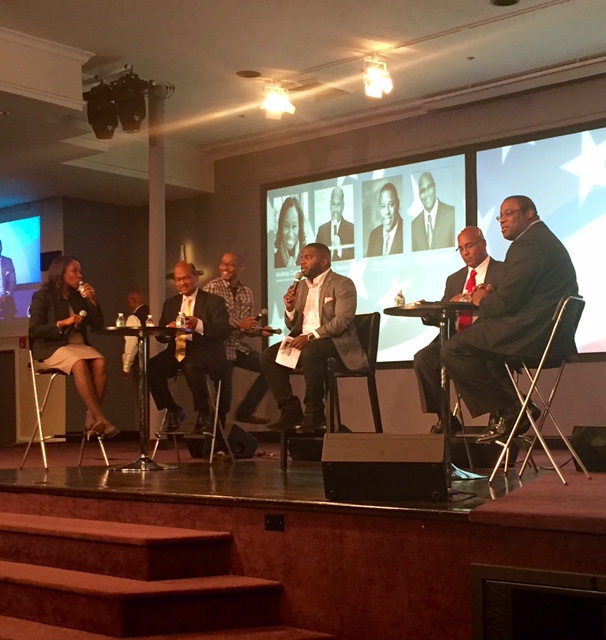
^ the Forum — candidates from L to R : Andrea Campbell; Charles yancey; Moderator; Charles Clemons; Tito Jackson

—- —- —- —-

Last night at least 250 voters showed up at Jubilee Church to hear the four candidates running in Boston’s only Council District contests. District 4 denizens heard from incumbent Charles Yancey and challenger Andrea Campbell. Council District 7 voters listened to challenger Charles Clemons and present Councillor Tito Jackson.

District 4 runs the length of Washington Street from Four Corners down to the Milton line and also takes in Harvard Street and a small, American Legion Highway bite of Roslindale. District 7 encompasses the entire 02119 portion of Roxbury, Blue Hill Avenue, and the Franklin Park-bordered neighborhood old timers call Elm Hill or “Sugar Hill.”

As i am writing for a Roxbury journal, I would like to report that Clemons and Jackson edified the campaign. The opposite was the case. all night long Clemons voiced positions –loudly — that are Jackson’s, constantly : better jobs and more of them for District 7 residents, a quota system so that at least 51 percent of jobs filled in local construction live in District; and “action, not talk.”

Jackson, for his part, has been the activist as well as the talker; but at the Forum, he talked, and not to advantage. To questions from the Forum moderator he gave responses inflammatory and as distorted of the facts as anything you’d hear at a GOP Presidential debate. It was difficult to hear him say that “charter schools steal money” from the City school budget and then, in the net breath say “I’m not against charter schools per se.”

Nor was it easy to listen as Jackson talked about how the Boston 2024 games bid — which he did much to wound — would have cost the city 13 billion dollars, a figure about three times higher than what even the anti-Games people cited during the 2024 debate.

For all his and Clemons’s railings at the evils of charter schools, they spoke not one word about the many non-profit education organizations — based in these two Districts, too — that every year get thousands of kids from Districts 4 and 7 from high school to employment. Nor did Clemons or Jackson seem to care that charter school cap lift is a pressing issue for school parents in District 4 especially. Do they never attend a Dudley Square Neighborhood Initiative education conversation ? Were they unaware of the hundreds of parents of color who rallied at the state House a few days again support of charter school cap lift ? Jackson, at least, knows better. he attended College Bound’s graduation ceremony at the Bolling Building about three weeks ago.

Little wonder that audience member Ken Williams asked the candidates, “exactly what will you do to close the achievement gap ?”

From what was said, not much.

District 4’s two candidates performed much better. Campbell (whom i am supporting) and yancey gave well reasoned, authoritatively detailed answers to questions. Each made clear a very diufferebt vision of what the role of District Ciouncillor shoulod be. campbell sees her work as being constantyly on the move, talking to voters in her Distriuct all the time, bbringting them information aboytr what is going in around them “a week in advance, not just on the day before, as happens now.” Yancey listed his accomplishments : among them, building the Mildred Avenue Community Center and the Mattapan Branch Library (which, as he was glad to announce, is named after his formidable mother, Alice Yancey). “I will fight for you,” said Yancey.

Yancey also admitted a defeat : he has never been able to persuade a mayor to build a Mattapan High school. and, in answer to a charter school question, he cited that a larger percentage of public school graduates go to college than charter graduates : a talking point direct from the Citywide Parents Council that ignores the competitive nature of charter schools, from which many children drop out. This despite Yanc ey’s having been happy to attend the ribbon cutting for an expanded Codman academy scarcely two weeks ago.

Campbell, meanwhile, hinted at recognition or schools other than standard public. She certainly knows, having attended a Bottom Line fundraiser at Antico Forno in the North End a few months back. “poverty and race play a role in school underperfiormance in this District,” she said, “and we need to address that.” As an example, she cited the excellence of Worcester’s technology academy — a role model for what Governor Baker wants to bring to many big city school districts.

Campbell won the District 4 primary overwhelmingly; Yancey is playing a steep game of catch-up. Yet the two candidates aren’t making voters’ November choioce easy: both speak well and know their role.

The same, actually, can be said of the District 7 race ; two candidates who speak loudly and loosely with the facts, each given to showmanship — Clemons as “Brother Charles’ of 108 FM “Touch Radio,’ Tito Jackson as master of the “Tito dance,’ whose presence on youtube he mentioned and demonstrated. Perhaps it will go viral yet.

—- Mike reedberg / Roxbury Here